Carlos Pestana Barros & Nicolas Peypoch
A Comparative Analysis of Productivity Change in Italian and
Portuguese Airports
WP 006/2007/DE
_________________________________________________________
José Pedro Pontes & Joana Pais
Coordination and Development
WP29/2013/DE/UECE
_________________________________________________________
Department of Economics
W
ORKINGP
APERSISSN Nº 0874-4548
School of Economics & Management
By
Joana Pais1 and José Pedro Pontes2
Abstract: This paper addresses the issue of industrial development using a coordination game. Complementarities between transport infrastructure provision by the Government and consumer goods manufacturing firms, and among consumer goods firms themselves dictate the outcome: either the transport infrastructure (i.e., a highway) is not built and firms keep doing “home” production, thus supplying mainly nearby consumers and dispensing with a highway; or they switch to “factory” production, a more spatially centralized regime, where output must be sold over long distances, thus implying the construction of a highway.
In relation to the existent literature, this paper presents two main innovations. Firstly, the two sources of linkage, namely cost linkage, through the provision of an indivisible input (the highway), and demand linkage, through the wage rise brought about by industrialization, are not treated separately, but they are integrated in the same model. Consequently, the game has now two levels of equilibrium selection. Secondly, the paper does not limit itself to checking that there can arise multiple Nash equilibria under certain circumstances, but it discusses methods for the selection of a unique outcome. Consequently, in addition to the classical Nash equilibria mentioned above, there is a third possible solution where the
Government builds the highway but the consumer goods firms refrain from using it and stick to “home” production. Hence, the transport infrastructure becomes a “white elephant”.
Keywords: Big Push, Coordination Games, Economic Development, Equilibrium selection, Industrialization.
JEL Classification: C72,O12,O14.
1
Address: Lisboa School of Business and Economics, University of Lisbon and UECE, Rua Miguel Lupi, 20, 1249-078 Lisboa, Portugal. Te. +351 21 3925902. Email <[email protected]>
2 Address: Lisboa School of Business and Economics, University of Lisbon and UECE, Rua Miguel Lupi, 20,
1.
Introduction
The existence of multiple Nash equilibria has been regarded by game theorists in a twofold way. On the one hand, it is deemed as a problem, since it prevents the players from adhering to a unique solution for the game. With multiple equilibria, each player becomes uncertain about the strategy that will be chosen by the opponent, so that his move can lead him to an out of equilibrium situation. Hence, game theory has the task of supplying the players a
process of selecting the “good” equilibrium and this process amounts to specify for each player a way to form robust expectations about the intentions of the other individuals.
There are two fundamentally different ways of specifying for each player expectations of the intended actions of the opponents. Either the prescribed beliefs are endogenous to the mathematical structure of the game, i.e. they can be calculated by manipulating the numbers in a payoff matrix (this is the “risk dominance” approach by HARSANYI and SELTEN, 1988), or they are exogenous to it. In the latter case, expectations stem from the information implicit in the “labels” or “names” assigned to the players and strategies (this is the approach of the “focal points”, by SCHELLING, 1960).
On the other hand, since a long time ago, multiplicity of equilibria has been considered as a positive feature:
For a given society, a set of moves and patterns of behavior gradually build up and then remain stationary for long periods of time; yet, another society, with approximately similar initial conditions will evolve to a quite distinct pattern of cultural norms. Loosely speaking, we may regard these as two possible equilibrium “solutions to this game”. (LUCE and RAIFFA, 1957).
The process of industrialization is a natural field of application of “coordination games”, i.e. games that have at least two strict Nash equilibria. Industrialization concerns the transition by firms between two stages. In the first stage, production is carried out at a small scale, mainly close to household’s residence. Since productive activity is very evenly dispersed in space, most of the output is sold in the neighborhood of the firm, so that it does not require long distance transport. Furthermore, production occurs under constant returns to scale, unit production costs are fairly constant and one unit of labor is transformed in one unit of output.
By contrast, in the second stage, production is made in large scale, usually in a factory located in an urban area. Production is much more concentrated in space, so that most of the output must be sent over long distances in order to be sold. Moreover, production works under increasing returns to scale, this meaning that unit production costs decrease with the amount of output produced (there are economies of scale).
Although the word “industrial revolution” is usually associated with specific social
place in China and other East-Asian countries. Furthermore, areas that were formerly industrialized and somehow lost their manufacturing basis, such as regions within the European Union, face the need to re-industrialize. Consequently, industrialization processes remain a very important context of economic development.
The merit to have the intuition that the switch from traditional “home” technologies to modern “factory” is connected with some kind of coordination of investment decisions across industrial sectors belongs to P. N. ROSENSTEIN-RODAN (1943). The basic idea is that there are complementarities in the production of different manufactured goods. Hence, producing more of a given industrial good raises the profitability of expanding the output of other goods. This complementarity arises either from increasing consumers’ demand and or decreasing
production costs.
The first model concerns complementarities in demand. The population in this area is
exclusively composed by farmers who produce and consume raw food and materials (such as cotton) in the context of a “home production”. A share of the population is underemployed in the sense that it can be withdrawn from agriculture without this shift causing a decrease of the agricultural output.
Consider now the introduction of manufacturing in this area. For simplicity, assume that there are two kinds of transformed goods: processed food, produced through the transformation of raw food (through freezing, packaging, canning and so on); and other consumer goods, for instance clothing, through the transformation of cotton. Let us suppose furthermore that factories are located in a town, so that a worker must consume processed food that is transported from the countryside. Hence, factory workers spend their income into equal shares of “processed food” and “clothing”. The value added created by the factory is composed by 90% of wages and 10% of profits.
Let us assume that a clothing firm invests in a factory employing one thousand workers. The owners of capital live abroad and receive the profits in the form of exports of 10% of the “clothing” produced by the factory. These exports compensate the purchase or leasing of capital goods (machines) from abroad made by the factory.
If the factory workers spent the whole of their wages in “clothing”, the firm’s output could be completely sold. As the expenditure shares in the two manufactured goods are 50-50, 45% of the production finds no buyer. However, if a second factory for processing food is created in the region employing also a thousand workers, according to the above line of reasoning, each firm will find enough demand to sell its output. That is to say, an isolated move by a firm in a sector will be unprofitable, whereas two coordinated investments will be profitable. The complementarities work as pecuniary externalities: they will not be felt by the firms, if they decide in isolation, but they will appear as profits in the balance sheets in the case that coordinate their undertakings.
outputs and information, and increasing trade integration at the regional and the multilateral levels.
Although it is apparently well founded this criticism does not invalidate the adequacy of ROSENSTEIN-RODAN’s (1943) perspective of the industrialization process, on account of three factors. Firstly, balanced growth does not preclude foreign trade because a share of the output of consumer goods must be exported in order to pay for imported capital goods, such as machines. Secondly, although net exports are an important component of aggregate demand, a country or region only attracts increasing returns production if it has a large home market. Otherwise the geographical concentration of production following from strong scale
economies will take place abroad and the domestic market will be supplied by means of imports. This is KRUGMAN’s (1980) well known Home Market effect. Finally “balanced growth” does not require very high explicit subsidies to domestic production, through tariffs or other kinds of protection, because it leads to a high degree of physical proximity between producers and consumers of each manufactured good. This strong closeness gives domestic production a competitive edge over imports that must be carried over long distances and generates
“implicit subsidies” that substitute for explicit protectionist barriers.
This observation is particularly important because the need for coordination among investments for the production of different consumer goods may stem from cost linkages rather than from reciprocal demand creation as it was described above. ROSENSTEIN-RODAN (1943) cited the example of a underground line to be built in the Greater London Area. If a standard cost-benefit analysis is performed, it can be concluded that the preexistent traffic is not sufficient to make the line profitable enough. However, if the growth of residences and shops and the rise of land values are taken into account, then building the underground line becomes a profitable undertaking. It is also efficient provided that the movement of
population towards the neighborhood of the new transport line does reduce aggregate income in the areas where the migrants come from. This condition is likely to be satisfied if the
population density is high and there is a considerable set of currently underemployed workers.
The importance of coordination of investments in complementary goods appears more clearly if we refer to economy with two consumptions goods, ” processed food” and “clothing”, each one accounting for one half of both consumer expenditure and labor force. Suppose that the infrastructure is a highway. The producers of either good are users of the highway only if they select the modern, mass production technology, where production is concentrated in a single plant and a single location and the output must carried to the customers over long distances. By contrast, if is made by a large number set of small home units evenly dispersed in space, the highway is needless since the customers of each plant locate very close to it.
This latter instance of development through coordination of investment bears two major differences in relation to the former one. Firstly, complementarity between the two sectors does not follow from reciprocal demand creation, but rather from decreasing costs: the decision to use a modern technology by a firm makes infrastructure construction feasible and thus decreases the costs of switching to the modern technology for the other firm. Secondly, this kind of complementarity through decreasing costs dispenses with any kind of assumption of closure of the domestic economy to foreign trade.
The paper by MURPHY et al. (1989) formalizes the two situations described in ROSENTEIN-RODAN (1943), in terms of coordination games: games that have more than one strict Nash equilibrium. They consider a large number of productive sectors, each sector being able to choose between a “home” traditional technology and a modern “factory” technology. The coordination situation arises when it is profitable for all sectors to switch technologies simultaneously, but each firm loses money if it attempts to modernize itself in isolation.
MURPHY et al. (1989) were also careful do distinguish that a coordination game does not arise for every values of the game parameters. In the demand linkage model, there should be a positive wage premium in order to induce the worker to shift from “home” to the “factory” as a workplace. It is implicit that this shift causes a disutility for the worker. A share of this disutility corresponds to increased transport costs. Implicitly, the technology change is related with a move by the workers from the countryside to a town. Hence, workers are no longer able to raise a share of their food as they did before and become constrained to buy the whole of it. They have also to bear a transport cost on the food they consume from the countryside to the town. Urbanization also leads to housing expenditures that did not exist when workers lived in cottages scattered in the countryside.
MURPHY et al. (1989) stressed that a coordination game arises for high enough values of the wage premium. Clearly, the reciprocal demand creation by two coordinated plants is directly proportional to the wage rise related with transition from home to factory technology. This mutual demand increase is correlated with size of the region where a game with two Nash equilibria emerges.
Something analogous can be said about the conditions for a coordination game to hold for the cost linkage situation. Here the crucial parameter is the degree of use of the infrastructure associated with the density of population in area crossed by the highway. If the set of
consumers that potentially use the highway are low, even a simultaneous technological move by all firms, may not allow the infrastructure to break even. If potentially users are plentiful, the infrastructure will always be built in equilibrium. A coordination game will emerge if the density of potential users is intermediate.
In particular, we remark that the two main procedures of selecting a unique equilibrium, namely the specification of “endogenous expectations” for the players through the
manipulation of the payoff matrix (HARSANYI and SELTEN, 1988) and the setting of “exogenous expectations”, founded in the information implicit in the “labels” of players and strategies (SCHELLING, 1960) lead to opposed outcomes of the game. Furthermore, if “exogenous expectations” are used, very different solutions emerge if the player’s beliefs follow from a tacit “convention” or from pre-play communication.
Basically, the infrastructure game in MURPHY et al. (1989) had two equilibria. Either all sectors switch simultaneously to the mass production technology and the transport infrastructure is built, or all firms stay in cottage production and the infrastructure is not built. Our model, by introducing different procedures of selecting a unique equilibrium, has a third feasible outcome, where the infrastructure is built but the industrial firms remain stuck in a backward technology.
This last equilibrium is a very relevant tool for understanding the spatial evolution of the Portuguese economy
In Portugal, since its adhesion to the European Economic Community, there has been a strong investment in highways. It is estimated that the average transport costs by road have fallen about by 45% between the provincial capitals (capitais de distrito) during the period 1985-1998. The decline of transport costs should have been 42% approximately for the period 1998-2010 (TEIXEIRA, 2006).
2.
The game
We assume an economy that is described by a non- cooperative game whose rules are defined below.
2.1.
Description of the economy
We assume an economy that is wide enough to allow for significant internal transportation and has enough population for firms to exploit economies of scale if they choose to do so. However, aggregate income is relatively low since the economy is underdeveloped.
The population of consumers/workers is accounted for by a representative consumer that supplies a fixed amount of labor Lto firms. The economy is made up by the production of two consumer goods: “food” and “other consumer goods” (that will be labeled henceforth as “clothing”). We name “food” as “good 1” and “clothing” as “good 2”. The utility function of the representative consumer is Cobb-Douglas with equal shares expenditure shares for each good:
(
)
0.5 0.51
,
2 1 2U C C
=
C C
(1)Hence, the demand function addressed to each good has unit price elasticity:
0.5
, 1, 2
i i
y
C i
p
= = (2)
Here ystands for consumer income.
We account for the underdevelopment of the area by saying that each consumer good is produced by a fringe of competitive firms, that use a “home” or “traditional” technology of constant returns to scale, where one unit of labor is transformed into one unit of output (either “food” or “clothing”). It is assumed that, in this case, the wage is the numéraire of the economy, so that the competitive price of both goods is 1. This economy has no roads or other transport infrastructures: goods are carried at a high cost either by land on horseback, or through water by boat. Hence, unit transport costs are high. As production does not entail scale economies, production is evenly distributed across space, in order to achieve proximity among the seller and its buyers.
We can alternatively regard this traditional economy as being made up by a set of farms, where each farm self-produces and self-consumes both “food” and “clothing”, with no need to engage in market transactions or in transportation of goods.
In each productive sector, in addition to the competitive fringe of small firms, there is a firm that as the option to switch to a “modern” technology and become a monopolist in it sector. The main feature of this “modern” is the rise of labor productivity. Instead of transforming an input into output according to a “one-to-one” ratio, the firm now processes one unit of labor into
α
>
1
units of output.The “modern” technology is more productive because it manufactures higher quality goods, with a high value per unit of weight. Consequently, these new products are somehow “lighter” and easier to ship, thus leading to an expansion of the market for the consumer good. But, for the market expansion to take place, it is necessary that a transport infrastructure has been previously set up and connects buyers and sellers over long distances. We assume that, if an industrial sector switches to the “modern” technology, it is willing to pay a toll just above
one-half of the construction cost, 2
R
ε
+ , where
ε
is positive and arbitrarily small.If a firm switches to the “modern” technology, its price remains unchanged at the unit level. As a matter of fact, the firm cannot raise its price above 1, since it would lose all its customers to the competitive fringe. Moreover it does not pay off to decrease the price below 1, since it faces a demand curve with unit price elasticity.
The transition from a “traditional” technology to a “modern” one, implies that the wage is raised from 1 to wwhere
1 , 0
w= +v v> (3)
This raise has to do with the fact that the worker shifts from a rural location to an urban one. With this shift, his living cost rises because:
1. He has to buy food, which was formerly self-produced in the farm where he lived.
2. As the worker now lives in a town, food must be transported between the places of production and consumption.
3. The displacement creates the need to find a new home, which must be paid for.
The main idea is that the wage increase due to industrialization, expressed in equation (3), does not increase the utility obtained by the representative consumer, whose utility function becomes
(
)
0.5 0.51
,
2 1 2U C C
=
C C
−
v
(4)2.2.
The rules of the game.
We now try to give a formal account of the working of this economy through a non-cooperative game.
This game has three players, each one being endowed with a choice set of two actions:
• Government, labeled as “G”, that can either “Build” or “Not Build” a transport infrastructure.
• Firm 1, producing “food”, that can either select a “traditional” technology (producing “raw food”); or a “modern” technology (producing “processed” food).
• Firm 2, producing “clothing”, that can either choose a “traditional” technology (spinning and weaving at home); or a ”modern” technology (producing cloth in a factory).
Mod. Firm 2
Mod. Trad. Trad.
Modern Traditional
Firm 2
Firm 1
Do nothing Build Highway
Government
The payoffs will be written as the triplet (Government, Firm 1, Firm 2). If the Government
chooses to “do nothing”), payoffs are
(
0, 0, 0
)
, since the firms will be constrained to usetraditional technologies under perfect competition, thus leading to a zero profit.
Instead, if the Government decides to build the highway, a proper subgame is started with the decision by Firm 1.
Since this subgame is static, it can represented in the normal form. In the following matrix, the payoffs have the following meaning:
• gijis the government’s payoff, when Firm 1 chooses action i and Firm 2 selects action
j
.•
a
ijis the payoff of Firm 1, when it selects action i and Firm 2 selects actionj
.•
b
ij is the payoff of Firm 2, when Firm 1 selects move i and Firm 2 chooses actionj
.•
0
is the payoff of a firm that chooses to employ a “traditional” technology.The payoff matrix is
11 11 11 12 12
21 21 22
Firm 2
Modern
Traditional
Firm 1
Modern
,
,
,
, 0
Traditional
, 0,
, 0, 0
g
a
b
g
a
g
b
g
(5)
In order to set the Government’s payoffs, we must take into account that it supplies a transport infrastructure (a highway, for instance) with a fixed construction cost
Rw
, that for simplicity is identical to the total cost – variable costs are supposed to be zero. Rstands for a fixed amount of labor, while wis the wage rate under the “modern” technology. TheGovernment charges to each using firm a toll 2
Rw
ε
+ , where
ε
is positive and arbitrarilysmall.
The “modern” technology leads the firm to concentrate the productive activity in few sites and to use the transport infrastructure to distribute the product. By contrast, the “traditional” technology entails the dispersion of productive activity in space and its closeness to customers, thus making the transport technology almost needless.
11
2
2
0
2
Rw
g
= +ε
−Rw
=ε
≈ε
>21 12
0
2
2
2
Rw
Rw
Rw
g
=g
= +ε
−Rw
= − +ε
≈ − < (6)22
0
g
= −
Rw
<
If we set the Government’s payoffs fixed, we can write the subgame in normal form with the payoffs related with the players that indeed belong to the subgame. This becomes:
11 11 12
21
Firm 2
Modern
Traditional
Firm 1
Modern
,
, 0
Traditional
0,
0, 0
a
b
a
b
(7)
It is also clear that his is a 2 2× symmetric game, where:
11 11
a
=
b
12 21
a
=
b
Hence, the payoff matrix of a single player (player Firm 1, w.l.g.) contains all the relevant information about this subgame:
11 12
Firm 2
Modern Traditional
Firm 1 Modern
Traditional 0 0
a a (8)
Now we will determine the values of payoffs in Table (8).
2.2.1. Consumer good firm profit when both firms adopt modern technologies
The income of the representative consumer is
(
)
2
1
y
=
π
+
L
+
v
(9)Where
π
is each firm’s profit.π
is given by:(
1
)
1
1
2
2
R
v
v
y
π
ε
α
+
+
1
v
α
+
is the unit variable cost of a “modern” firm with labor productivity
α
>
1
that pays awage
w
= +
1
v
.If we solve (9) in relation to
π
, we obtain:(
1
)
2
y
L
v
π
=
−
+
(11)By substituting (11) in (10), we get
(
1
)
1
(
1
)
1
2
2
2
y
L
v
v y
R
v
α
−
+
+
+
≈
−
−
(12)By solving (12) in relation to y, we have:
(
)
y=
α
L−R (13)By substituting (13) in (11), we obtain each firm’s profit, equivalent to payoff
a
11 in Table (8)(
)
(
1
)
2
L
R
L
v
α
π
=
−
−
+
(14)2.2.2. A “modern” firm’s profit when the other firm sticks to “traditional” technology.
We now try to find the exact value of payoff
a
12 in Table (8). We use the symbolw
= +
1
v
, where wstands for the wage in the modern sector. Then, the representative consumer works 50-50 in the “modern” plant, where he is paid wage w, and in the “traditional” sector where he receives a unit wage. It should also be remarked that only a firm makes positive profits, which are distributed as dividends to the representative consumer. Hence, his income becomes now(
1
)
2
L
y
=
π
+
+
w
(15)Firm 1’s profit now becomes
1
2 2
w y Rw
π
α
≈ − − (16)
According to (15), firm 1’s profit is
(
1
)
2
L
y
w
Substituting (17) in (16), we obtain
(
1)
12 2 2
L w y Rw
y w
α
− + ≈ − −
By solving this equality in relation to the income y, the result is
(
)
1
L w L R
y w
α
+
−
≈
+
(18)If we substitute (18) in (17), we get firm 1’s profit, as expressed by
a
12 in Table (7):(
)
(
1
)
2
L
w L
R
L
w
w
α
α
π
α
+
−
=
−
+
+
(19)The payoff matrix of Firm 1 in the symmetric 2 2× subgame can be written as:
(
)
(
)
(
)
11 12
Firm 2
Modern
Traditional
Firm 1
Modern
1
2
2
Traditional
0
0
L
R
Lw
L
w L
R
L
a
a
w
w
α
α
α
α
−
−
+
−
≈
≈
−
+
+
(20)
2.3.
Set of Nash equilibria in the subgame
If
−
a
12 is added to second column of matrix (20), the set of Nash equilibria of the subgame remains unchanged. With this transformation, matrix (20) becomes:(
)
(
)
(
)
1 2 Firm 2 Modern TraditionalFirm 1 Modern 0
2
Traditional 0 1
2
L R Lw
a
L w L R
L a w w
α
α
α
α
− − ≈ + − ≈ + − + (21)Then we check the signs of
a
1and
a
2, in order to determine the set of Nash equilibria in theThe condition
(
)
1
0
2
L
R
Lw
a
≈
α
−
−
>
Is roughly equivalent to
( )
(
1
)
R
L
L v
v
α
α
>
=
−
−
(22)Function L v
( )
in (22) has the following properties:1.
( )
0
1
R
L
α
α
=
−
2. L v
( )
>0⇔v<α
−1. This condition is met by assumption.3. L v
( )
→ +∞ when v→( )−α
−14.L v
( )
is increasing and convex: L v′( )
>0,L′′( )
v >0We check now the condition
(
)
(
)
2
1
0
2
L
w L
R
L
a
w
w
α
α
α
+
−
≈
+
−
>
+
Which is equivalent to
( )
(
)
(
)
(
)
2
1
1
2
v R
L
L v
v
v
α
α
+
<
=
−
−
+
(23)The function L v
( )
has the following properties:1.
( )
0
1
R
L
α
α
=
−
2.
L v
( )
→ +∞
when
v
→
( )−α
−
1
4.
L v
( )
is increasing:
L v
′
( )
>
0
.It is easy to show that the difference ∆ ≡L L v
( )
−L v( )
is positive and monotonicallyincreasing with
v
, ifv
∈
(
0,
α
−
1
)
:( )
( )
(
1)
(
2)
L
Rv
L v L v
v v
α
α
∆ ≡ − =
− − + (24)
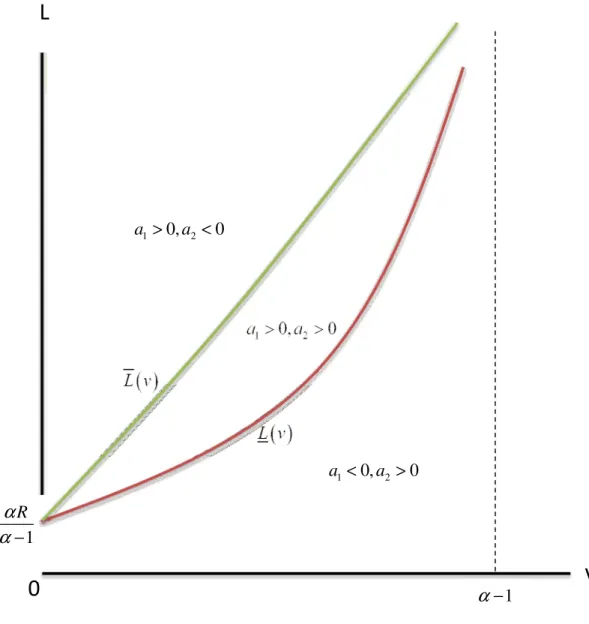
The curves L v
( )
and L v( )
are plotted in the space(
v L
,
)
in the following Figure:Figure 1: Regions of Nash equilibrium in
(
v L
,
)
space( )
L v
( )
L v
1 0, 2 0 a > a >
1
R
α
α
−0
v
L
1 0, 2 0 a > a <
1 0, 2 0 a < a >
1
The region where there are two Nash equilibria is comprised between curves L v
( )
and L v( )
.In this region, the two consumer good firms may either agree on using traditional technologies and selling to nearby consumers or, through a Big Push, switch to modern technologies and distribute their outputs to customers over long distances using a highway.
In the intermediate region, the subgame is a unanimity game whose strict equilibria are
(
) (
)
{
Modern,Modern , Traditional,Traditional
}
It is easy to assess that the former equilibrium dominates the latter in payoffs. Clearly,
a
1>
a
2is equivalent to
(
)
(
1
)
(
)
2
2
L
R
Lw
L w
L
w L
R
w
α
α
α
α
−
−
+
+
−
>
−
+
(25)By solving inequality (25) in relation to L, we get the result
( )
(
)
(
)
(
)
*
3
1
2
3
R
v
L
L v
v
v
α
α
α
α
+ +
>
=
−
−
+
+
(26)Comparing (26) and (22), we conclude that for
v
∈
(
0,
α
−
1
)
, the following inequality holds:( )
( )
*
L v
<
L v
(27)Consequently, in the two equilibrium region, the “modern” equilibrium Pareto dominates the “traditional” outcome.
2.4.
Equilibrium selection and the solution of the game.
HARSANYI and SELTEN (1988) defend that, in a game with multiple Nash equilibria, finding the solution may proceed by decomposing the game into parts (typically, subgames or
Hence, we should begin to select a Nash equilibrium in the simultaneous subgame, i.e., to specify for each player a belief or expectation about the strategies that the opponents may select. There are two contrasting methods for making this kind of belief specification: either the players use endogenous or make exogenous expectations.
2.4.1. Endogenous expectations: selecting equilibrium through “risk dominance”.
HARSANYI and SELTEN (1988) proposed a method for selecting an equilibrium that uses only the rationality and common knowledge of the payoff matrix by each player. Hence, only the mathematical structure of the game is used to compute the unique Nash equilibrium. Their solution, widely known as “risk dominant”, implies that each player uses the pure strategy that is supported by the widest set of beliefs he may have about the strategies the other players will select.
In a symmetric unanimity game, such as the subgame in this paper, the “risk dominant” equilibrium is coincident with the Pareto or payoff dominant equilibrium, that is, the Nash
equilibrium
(
Modern, Modern
)
.If we make this kind of selection for the subgame, it is clear that the Government chooses to supply the highway, with a payoff
ε
>0, whereas he gets 0if he does nothing. Hence, the unique Nash equilibrium is(
Supply highway, Modern, Modern
)
(28)The payoffs associated with this equilibrium are:
(
ε
,
a
11,
a
11)
.2.4.2. Exogenous expectations: selecting equilibrium according either a “convention” or pre-play communication.
According to SCHELLING (1960), in a coordination game, expectations of each player about the decisions of the opponents should be specified using the information that is implicit in
“names” or “labels” that are assigned either to players or strategies.
If there is no pre-play communication, the players’ beliefs coordinate around a “focal point” or “tacit convention”, which may be different from the Pareto dominant equilibrium. In this game, the economy is underdeveloped in the first place, so that the firms start using the “traditional” technology. It can happen that his status quo ante makes a “tacit convention” for producing in the economy, even if it is not socially efficient.
precisely the ability to plan and undertake joint several related investment projects. Hence, he defended that the investment game should not be regarded as simultaneous with multiple equilibria, but rather as pure sequential game where each player is endowed with perfect situation. This view would lead to the same solution as in (28). However, it is well known that this is not the only possible outcome of the overall game.
FARRELL and SHAPIRO (1996) argue that the HIRSCHMAN (1958)’s objection is founded if firms are concerned with communication forms such as “signaling”, where the transmission of information is directly related with a cost to be supported by the signal sender. By contrast, there are forms of communication, usually known as “cheap talk”, that do neither affect directly the sender’s payoff, nor constrain his behavior afterwards.
“Cheap talk” is not always an efficient mean for selecting a Nash and Pareto-efficient equilibrium in a coordination. But in the case of this subgame, since the preferences of the firms are perfectly aligned, it is indeed efficient. As FARRELL and SHAPIRO (1996) argue, here each sent message, has two essential properties:
1. It is “self-signaling”: If a player says “I will use a modern technology”, he is actually intending to use this kind of technology and he wants the other firm to believe him. 2. It is “self-commiting”: If the other firm believes the message, it will also use the
“modern” technology. Then, as (
Modern, Modern
)
is a Nash equilibrium, the sender has indeed an interest to stick to initial proclaimed intention.The efficiency of “cheap talk” may not be generalizable to coordination games with a higher number of players. HUYCK et al. (1990), also mentioned in COOPER (1999), show that, in a repeated coordination game with several Pareto-ranked equilibria, the payoff dominant equilibrium is the result if there are only two players. However, if the number of players is increased, the solution switches to the “worst but safe” equilibrium. Something similar should happen in pure coordination games with pre-play communication.
2.5.
Selection of a unique Nash equilibrium: discussion
Hence, it is not easy to select an equilibrium for the subgame, with a consequence that, in addition to equilibrium (28), we have the equilibrium:
(
Do nothing, traditional, traditional
)
(29)with payoffs
(
0, 0, 0
)
.Furthermore, there is an equilibrium following from the fact that the Government forecasts that the firms will invest in “modern” technologies, whereas the firms by “tacit convention” remain stuck in traditional ones. Formally, the equilibrium is
(
Supply highway, traditional, traditional
)
(30)The three possible Nash equilibria are Pareto ranked in the following way: equilibrium (28) dominates equilibrium (29), which in turn dominates equilibrium (30).
The evolution of Southern European countries, such as Portugal, seems to conform itself with the “worst” equilibrium. A dense network of highways was built in Portugal with the help of European Funds, not limiting itself to the areas with denser productive activity but covering the whole territory. However, most of the high speed roads are nowadays “white elephants”, with a low rate of use by both cars and lorries.
The economic consequences of this outcome are harmful to the Portuguese economy. Most of the inputs necessary to build the highways (both intermediate goods and consumer goods to keep the workers employed in their construction) were imported. Moreover, the consumer good firms failed to industrialize, that is, to switch to more spatially concentrated technologies that could increase productivity and enable them to sell over long distances and achieve exports. Hence, the highway program contributed heavily to the trade deficit problem, which is being redressed only now.
Why did this unfortunate outcome take place? Several explanations are in order:
1. The highway program was too ambitious and too expensive, so that the demand for transport services did not match the increase of their supply. Eventually, as the costs soared, tolls had to be raised to a high level thus discouraging consumers to use them. 2. Paradoxically, the arise of European Internal Market decreased the size of the market
addressed to manufacturing goods producers in the Southern European periphery, because it came along with the sudden and unexpected admission of the competing countries of Central and Eastern Europe. This was aggravated by trade liberalization in the context of the World Trade Organization, thus giving access to the internal market to countries endowed with huge domestic markets, such as China.
3. The mechanism of industrial planning during the period of Estado Novo (the so-called
3.
Concluding remarks
Using a coordination game to model the possible industrialization of a backward economy allows us to consider two opposite outcomes: either transport infrastructures are built by the Government and the production of consumer goods becomes industrialized, that is, the firms adopt “mass production” technologies that enable them to sell over long distances; or the Government does nothing and firms are constrained to do “home production” and sell to consumers located in its neighborhood.
The working of this coordination game is founded on two kinds of complementarities across consumer good firms. Firstly, we have demand complementarities. If a firm invests in a factory, the wages of the workers are raised in relation to the level they had under the “home”
production. This expands the demand for the products delivered by the other industrial firms. Then, we have cost complementarities. If the firms use a fixed input (an infrastructure), the investment by a firm helps the infrastructure to break even and facilitates the investment by other using firms. Usually, these two kinds of linkages (demand or cost) are modeled
separately.
The novelty of this paper lies in the integration of demand and cost linkages in the same model. Hence, we have two different sources of multiplicity of Nash equilibria, instead of just one. Moreover, we do not limit ourselves to check the existence of multiple equilibria, but we try instead to discuss the methods for selecting the “good” Nash equilibrium.
In addition to the well-known outcomes of stagnation (no infrastructure, the firms use “traditional” technologies) and industrialization (infrastructure is built and firms switch to “modern” technologies), we have a third possible result, where the Government provides the infrastructure but the firms refrain from investing and using the highway, which consequently becomes a “white elephant”.
This latter situation seems to characterize a share of the highways that were built in Portugal recently aided by European Funds. The factors for this sad outcome concern both the
European Union (that has given free access to the Internal European Market to tough
competitors from outside) and the country (that has over-invested in highways and dismantled the former mechanisms of economic coordination without replacing them by other
REFERENCES
COOPER,RUSSELL W.(1999),COORDINATION GAMES –COMPLEMENTARITIES AND
MACROECONOMICS,CAMBRIDGE,CAMBRIDGE UNIVERSITY PRESS.
FARRELL,JOSEPH AND MATHEW RABIN (1996),“CHEAP TALK”,JOURNAL OF ECONOMIC PERSPECTIVES, 10(3), PP.103-118.
HARSANYI,JOHN C. AND REINHARDT SELTEN (1988),AGENERAL THEORY OF EQUILIBRIUM SELECTION IN GAMES,LONDON/ENGLAND AND CAMBRIDGE/MASS.,MITPRESS.
HIRSCHMAN,ALBERT O.(1958),THE STRATEGY OF ECONOMIC DEVELOPMENT,NEW HAVEN (USA), YALE UNIVERSITY PRESS.
KRUGMAN,PAUL (1980),“SCALE ECONOMIES, PRODUCT DIFFERENTIATION AND TRHE PATTERN OF
TRADE”,AMERICAN ECONOMIC REVIEW,70(5),DECEMBER, PP.950-999.
KRUGMAN,PAUL (1995),DEVELOPMENT,GEOGRAPHY AND ECONOMIC THEORY,CAMBRIDGE/MASS. AND LONDON/ENGLAND,MITPRESS.
LUCE,R. AND H.RAIFFA (1957),GAMES AND DECISIONS,NEW YORK,JOHN WILEY &SONS.
MURPHY,KEVIN M.,ANDREI SHLEIFER AND ROBER W.VISHNY (1989),“INDUSTRIALIZATION AND THE BIG PUSH”,JOURNAL OF POLITICAL ECONOMY,97(5),OCTOBER, PP.1003-1026.
ROSENSTEIN-RODAN,P.N.(1943),“PROBLEMS OF INDUSTRIALISATION OF EASTERN AND SOUTH -EASTERN EUROPE”,ECONOMIC JOURNAL,53(210/211), SEPTEMBER, PP.202-211.
SCHELLING,THOMAS C.,THE STRATEGY OF CONFLICT,CAMBRIDGE/MASS.,HARVARD UNIVERSITY, 1960.
TEIXEIRA,A.C.FERNANDES (2006),“TRANSPORT POLICIES IN THE LIGHT OF THE NEW ECONOMIC
GEOGRAPHY – THE PORTUGUESE EXPERIENCE”,REGIONAL SCIENCE AND URBAN ECONOMICS,36, PP. 450-446.
VAN HUYCK,JOHN B.,RAYMOND C.BATTALIO AND RICHARD O.BEIL (1990),“TACIT COORDINATION