ABSTRACT The study aimed to describe how the participation of Community Health Workers (CHW) took place in the National Program for Access and Quality Improvement in Primary Care (PAQI-PC), and to evaluate their perspective regarding improvements in both the access and the quality of Primary Care (PC). This is a descriptive, cross-sectional study with quan-titative approach, carried out with 133 CHWs linked to family health teams that joined the program. Results pointed out the need of greater efforts by municipalities to encourage the in-volvement of CHWs in evaluation processes and to improve their training, aiming at adjusting their level of apprehension and awareness of both the access and the quality in primary care.
KEYWORDS Community Health Workers. Primary Health Care. Health policy. Family health. Health evaluation.
RESUMO A pesquisa objetivou descrever como ocorreu a participação dos Agentes Comunitários de Saúde (ACS) no Programa Nacional de Melhoria do Acesso e da Qualidade da Atenção Básica (PMAQ-AB) e avaliar sua perspectiva em relação às melhorias no acesso e na qualidade da Atenção Básica (AB). Trata-se de estudo descritivo, transversal com abordagem quantitativa, realizado com 133 ACS vinculados às equipes de saúde da família que aderiram ao programa. Observou-se a necessidade de maiores esforços dos municípios para incentivar a inclusão dos ACS nos processos avaliativos e melhorar a sua capacitação, visando adequar seu nível de apre-ensão e conhecimento sobre o acesso e qualidade do cuidado na AB.
PALAVRAS-CHAVE Agentes Comunitários de Saúde. Atenção Primária à Saúde. Política de saúde. Saúde da família. Avaliação em saúde.
Improvement in Primary Care access and
quality: the perspective of Community
Health Workers
Melhoria do acesso e da qualidade da Atenção Básica: perspectiva dos
Agentes Comunitários de Saúde
Ana Claudia Pinheiro Garcia1, Maria Angélica Carvalho Andrade2, Eliane de Fátima Almeida Lima3, Érika Maria Sampaio Rocha4, Rita de Cássia Duarte Lima5
DOI: 10.1590/0103-1104201811805
1 Universidade Federal
do Espírito Santo (Ufes) –Vitória (ES), Brasil. Orcid:https://orcid. org/0000-0001-5559-7463
2 Universidade Federal
do Espírito Santo (Ufes) –Vitória (ES), Brasil. Orcid:https://orcid. org/0000-0002-3690-6416
3 Universidade Federal
do Espírito Santo (Ufes) –Vitória (ES), Brasil. Orcid:https://orcid. org/0000-0001-5128-3715
4 Universidade Federal
do Espírito Santo (Ufes) –Vitória (ES), Brasil. Orcid: https://orcid. org/0000-0003-4347-0531
emsampaiorocha@gmail. com
5 Universidade Federal
do Espírito Santo (Ufes) –Vitória (ES), Brasil. Orcid:https://orcid. org/0000-0002-5931-398X
Introduction
The structure of the Community Health Workers Program (CHWP) is based on the principles of territorial responsibility and pop-ulation involvement, focused on families rather than on individuals, with an enlarged concept of health and appraisal for prevention and pro-motion. It laid the foundations for building-up the Family Health Strategy (FHS), with posi-tive impacts on some of the main health indica-tors and improvements in the quality of life for formerly unassisted populations1-3.
The relevance of this program is expressed in increased number of Community Health Workers, reaching 265,685 in 2016, which made it possible to attain health coverage for 63.13% of Brazilian population. In the state of Espírito Santo, they are now 5,119, covering 62.75% of the state’s population, close to 2016 national average4. Many studies5-7 evidence the importance and the extension of the capillarity of this network of social actors. Those profes-sionals play a decisive role in the reorientation and expansion of Primary Care (PC) in Brazil, considered to be a ‘nucleus’ or a ‘link’ between the health system and the community.
The process of institutionalization of the work those professional perform does not imply, however, that one may consider overcome the tensions resulting from the presence of a
[...] worker whose professional profile is am-biguous and not yet clearly defined, whose or-igins are in popular classes, as part of a team mainly composed by medical doctors, nurses and odontologists8(232).
Considering the origins and the historical process of those workers’ skills, as well as their bonds with common people, it can be assumed that their professionalization is prone to be understood as a contradictory and conflicting process from the point of view of institutional policies. In this sense, it is relevant to analyze the Community Health Worker
[...] on the premise that he/she is, in the health area, a strategic target for the study of new working morphologies at service and the mediations of this category regarding social conflicts9(0260).
The theme of Primary Care evaluation is reinforced with the Program for Access and Quality Improvement in Primary Care (PMAQ-AB), aimed at launching a com-prehensive process of cultural changes in the model of health care, at all levels, com-prising both assistance and management in all governmental spheres. The program, to be developed in cycles (Quality Cycles), was launched in 2012 (first cycle), with a second cycle in 2013. Each cycle involves four phases: 1) Adherence to the program; 2) Development, with four strategies aimed at changing results obtained by the health teams: self-evaluation; monitoring; continu-ous education and institutional support; 3) External evaluation and certification, clas-sifying the teams’ performance as a refer-ence for the value of financial incentives to be received, by means of transferences between funds; and 4) Re-contracting new commitments10.
It is worth pointing out that, in the health sector, PC evaluation turns to be a problem when it requires the collective mobilization of PC professionals.
Recognizing and including all PC profes-sionals in PC evaluation are key elements for identifying the quality of the evaluation process and an important criterion for the results to be used as grounds for decision making11. Among professionals in family health teams, CHWs should be included and emphasized, since they are in charge of stra-tegic and complex functions.
of the program have been performed. It is intended, therefore, to highlight PC limits and potentialities, so as to contribute with empirical data to the qualification of the PC evaluation process.
Methods
A descriptive, transversal study with a quanti-tative approach was carried out. Information was obtained from 133 CHWs connected to t family health teams that adhered to PMAQ-AB in three municipalities in the state of Espírito Santo. These are large municipalities, located in the Metropolitan Region of the so-called Expanded Vitória, where 33.4% of the state’s population is concentrated12.
The study integrates a more comprehen-sive project about the CHW work process in Primary Health Care. Data were collect-ed using a questionnaire fillcollect-ed out by agents who work in Basic Health Units (BHUs), on previously booked date and time. The questionnaire included 49 questions, 17 of which focused the CHW’s profile; the 22 following questions investigated the work process, and the 10 remaining questions in-vestigated their perceptions about PMAQ-AB. As variables to be discussed, the paper highlights the awareness of PMAQ-AB, its purposes and the team’s adherence, their participation in both the self-evaluation and the external evaluation phases, and their perceptions about improvements in PC access and quality.
A pilot study was performed with CHW of a municipality that was not planned to be part of the sample, and the data collection tool proved adequate, requiring no refor-mulations. Data collection took place from November 2015 to June 2016.
The criterion established for participat-ing in the study was the professional en-gagement in the teams that had adhered to PMAQ-AB in at least one of the program’s cycles. CHW who were temporarily out
of job, either in leave or in vacation during the data collection period were excluded, as well as those who had not been acting in the teams in any PMAQ phase.
A descriptive analysis was performed with raw and relative frequencies of study variables using the Stata program, version 13.0.
The project of the study was approved by the Ethic Research Committee of Veiga de Almeida University, and made public in the Expert Report Nr. 876-415. Participants were informed of what was the purpose of the study and about data confidentiality, and a Free and Informed Term of Consent was submitted and signed. There were no inter-est conflicts between the researchers and the object of the research.
Results and discussion
Participation of CHWs in the
self-evaluation of the team
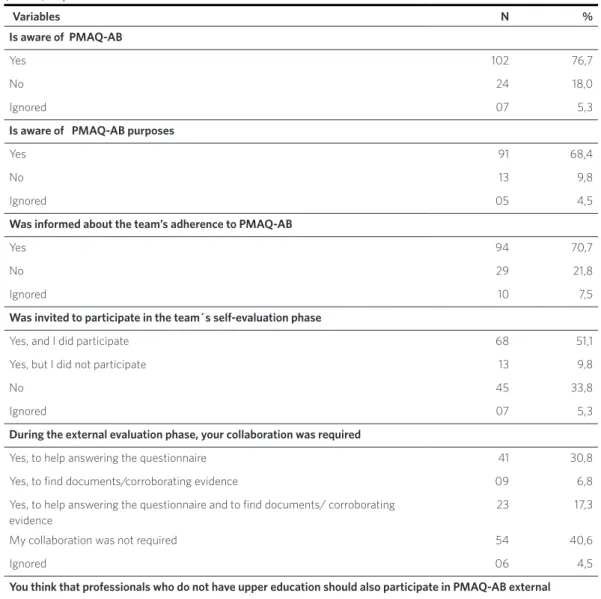
The evaluation process proposed by PMAQ-AB starts with self-evaluation by the health team. In the present study, it was ob-served that around one third (33.8%) of the CHWs were not invited and, among those who were invited, almost 10% did not par-ticipate (table 1).
One may thus identify a gap between the recommendation by the Health Ministry and the teams’ reality. In this sense, some authors13 put in question the up-down nature of the PMAQ-AB implementation of PMAQ-AB and point out the need for en-gagement and for a reflexive glance of the professionals, as a group, on their practices viewed as a primary requisite for changes aimed at in the qualification of the work process and the care to be offered.
cycle, self-evaluation was performed by more than 80% of the teams all over the country, except for the Central-West region, where this percentage was 69.5%14.
It can be noticed that in the interviews about the teams’ work process carried out with professionals in the external evalua-tion phase, quesevalua-tions refer to informaevalua-tion such as self-evaluation performed in the two preceding months, availability of documents to confirm the occurrence of self-evaluation, tools used and management support. There is, though, no reference to the participation of members of the team, which makes it im-possible to infer which professionals were actually involved in the process.
Considered as the starting point of PMAQ-AB development phase, self-evalua-tion is a tool that allows for identifying and recognizing either positive or problematic dimensions of the work carried out by man-agement and health care teams, so as to put in motion initiatives aimed at changing and improving the services. Taking into account its reflexive and problem rendering peda-gogical potential, the Health Ministry rec-ommends that
[...] the tool to be used takes into account the different points of view of actors involved in health oriented actions – users, professionals and managers –, yet recognizing that they are all co-responsible for the qualification of the Unified Health System (UHS)10(13).
The collective participation of all the actors involved with PC in their different areas is important for the self-evaluation to actually come to be critical-reflexive action, allowing for the identification of situations in need of revision and/or change15.
The present study makes clear that, despite the awareness of PMAQ-AB, its purposes and the teams’ adherence stated by most CHWs, the mobilization of local teams towards an ef-fective participation of these professionals cannot yet be noticed. This fact reinforces the
existence of a realm of interests and disputes within family health teams, which varies ac-cording to the correlation of forces and both institutional and political arrangements, at re-gional and local levels8.
This health workers’ perspective is con-sonant with the statement that the evalu-ation is a negotievalu-ation that incites interests and disputes among the many actors in-volved16. The author adds that “only those who do have power would ask for an evalu-ation”16(3), which includes the power to recognize the importance of a given actor in the process, that could be highlighted by the participation of CHWs in the team’s self-evaluation process.
It stands out that, according to Costa and Ferreira17(465), community health professionals
[...] ensure a strong identification with the community where they belong, constitut-ing themselves as unique health workers; however, they end up by forming a separate group as a consequence of being differ-ent from other members of the team as to both social and economical conditions and schooling level.
CHWs and the external evaluation of
the PMAQ-AB
It was also found that 55% of the CHWs did collaborate during the external evaluation phase, helping to fill out the questionnaire and/or finding documents/corroborating evidence. However, 40% of these profession-als were not invited to help.
It is worth pointing out that the external evaluation – the third phase of PMAQ-AB – was supported by Teaching and Research Institutions (IES), responsible for submit-ting evaluative tools to the PC teams that had adhered to the Program, organized in three modules18:
Module II – Interview with the profession-al about the work process of the PC team and checking documents at the BHU; and
Module III – Interview at the BHU about satisfaction and access conditions, and use of health services.
In module II, in order to answer the ex-ternal evaluation tool, it was determined that the team should choose the professional with college degree more deeply aware of team’s work process and from the community, who could rely on the collaboration of the remain-ing professionals of the team. Furthermore, as shown by the results of the present study, the participation of CHW was extremely impor-tant, mainly to help filling out the question-naire and finding documents.
It must be remarked that, due to its me-diating character, the work to be carried out by the CHW is a privileged evaluation field. However, it has been unveiled that PMAQ-AB is not able to realize this poten-tiality and the work performed by CHWs – which shows that this policy is not yet con-solidated as a promoter of the changes these actors do observe19.
The core function of the CHW is the re-lationship established with both the com-munity and the team. Their mediating role is considered to be critical to make FHS proposals come true, and is continuously enlarging17. Besides, practices have been noticed that deviate this worker away from his/her function, particularly in the sense of placing him/her in charge of bureaucratic tasks thus reproducing the disease-centered biomedical model, to the detriment of health promotion actions, which calls for a reflec-tion on the devaluareflec-tion and depreciareflec-tion of both the essence and the purpose of the CHW’s performance.
Function deviations betray the com-prehension of the CHW’s work as non-specific and of low complexity, liable to be re-directed according to service needs, to
activities that supposedly demand not much qualification20. This professional is not con-sidered as a legitimate member of the team, his work being submitted to prescription. As to PMAQ-AB, Mota shows that the program approached the CHW as a goal to be ac-complished, with participation restricted to bureaucratic issues, such as organizing information.
AHW’s awareness of
PMAQ-AB, its purposes and
team adherence
Table 1 shows that most CHWs have stated being aware of PMAQ-AB (76.7%) and that, among those, 68.4% affirmed being fa-miliar with the purposes of that program. Furthermore, 70.7% were informed that their team did join the program. In the evaluation process, these results corroborate the statement that the production of care in a social context as complex as the commu-nity requires recruiting workers who are fa-miliar with knowledge and practices which differ from those produced by the education institutions that prepare workers for the health sector. The development of strategies derived from the popular praxis and concep-tions is, thus, vital9.
Feitosa and collaborators highlight the professionals’ awareness of PMAQ-AB’s proposal as an articulating element of the collective construction of strategies, accord-ing to health demands of the population21. According to the authors,
[...] the opportunity is created for institution-alizing, within the working processes of each professional, the culture of improving and monitoring the quality of health practices in PC21(825).
questions, a significant number of them had no basic information on the program or on the participation of the team they were linked to for at least one PMAQ-AB cycle. One must keep in mind that the territory where the agent lives and renders services affects the production of his work concern-ing the incorporation of counter-hegemonic practices9. Thus, the tensions resulting from
the CHW’s practices and knowledge must be carefully thought over, considering that, according to Luz (1981), quoted by Queirós e Lima9(260),
[they] have political implications and involve a conflicts between groups and social classes that shape those institutions and are inserted in a historical block.
Table 1. Characterization of the sample according to the perception about Primary Care Access and Quality Improvement (N=133). Espírito Santo.2016
Variables N %
Is aware of PMAQ-AB
Yes 102 76,7
No 24 18,0
Ignored 07 5,3
Is aware of PMAQ-AB purposes
Yes 91 68,4
No 13 9,8
Ignored 05 4,5
Was informed about the team’s adherence to PMAQ-AB
Yes 94 70,7
No 29 21,8
Ignored 10 7,5
Was invited to participate in the team´s self-evaluation phase
Yes, and I did participate 68 51,1
Yes, but I did not participate 13 9,8
No 45 33,8
Ignored 07 5,3
During the external evaluation phase, your collaboration was required
Yes, to help answering the questionnaire 41 30,8
Yes, to find documents/corroborating evidence 09 6,8
Yes, to help answering the questionnaire and to find documents/ corroborating evidence
23 17,3
My collaboration was not required 54 40,6
Ignored 06 4,5
You think that professionals who do not have upper education should also participate in PMAQ-AB external evaluation phase
Yes 115 86,5
No 11 8,3
Access and quality improvements in PC
When questioned about improvements after the PMAQ-AB concerning the access to PC, 36.8% of the agents noticed little progress, and 48.1% did not notice any progress. As to the PC quality, 38.3% also reported little progress, and 45.9% reported no progress at all. The high percentage of agents who did not notice any progress after two PMAQ-AB cycles is outstanding. This result is even more significant considering the large penetration of this professional in the community.
It is remarkable that, among the 64 agents who did not identify improvements in the access to PC after PMAQ-AB event, 28.1% were not aware of the program; 39% were not aware of its purposes; 39.1% had not been informed about the team’s adherence; 53.1% did not take part in the self-evaluation; and 60.9% had not been asked to collaborate during the external evaluation.
On the other hand, considering the 61 professionals who answered positively when asked about improvements to PC, the per-centage was lower among those who were not aware of the program (6.7%), of its pur-poses (10%) and of the adherence of their team (5%); and, although 36.7% affirmed
they did not take part in the self-evaluation, and 23.3% were not asked to collaborate during the external evaluation, this group reported more involvement in the process as compared to the previous group.
Similarly, among the 61 agents who found no improvements in PC quality after PMAQ-AB, a larger percentage (45%) of unaware-ness of the program can be noticed, as well as of the team’s adherence to the program (37.7%), when compared to the group that observed improvements – 6.2% and 7.9%, respectively. The group that observed prog-ress presented a larger percentage of par-ticipation in both the self-evaluation and the external evaluation when compared to the group that did not observe any progress. In the first group, 35.9% did not participate in self-evaluation, and 26.6% were not asked to collaborate during the external evalua-tion; on the other CHW group, 52.4% did not participate in the self-evaluation and 57.4% were not asked to collaborate during the ex-ternal evaluation.
An important aspect to be considered based on these results is related to the daily practice of the community health profes-sional, since his/her functions surpass the health sector, enlarging attention to include
Table 1. (cont.)
Source: Research Report ‘Caracterização e análise do trabalho dos Agentes Comunitários de Saúde e sua percepção sobre a implantação do Programa de Melhoria do Acesso e da Qualidade da Atenção Básica no Espírito Santo’, 2017.
Did you observe improvements in access to Primary Care from PMAQ onin the unit you work at
Yes, many improvements 11 8,3
Yes, some improvements 49 36,8
No, no improvements 64 48,1
Ignored 09 6,8
Did you observe improvements in the quality of Primary Care from PMAQ onin the unit you at
Yes, many improvements 13 9,8
Yes, some improvementes 51 38,3
No, no improvements 61 45,9
multiple aspects of the population’s life conditions. Two main dimensions can be identified in the CHW’s activities: a techni-cal dimension, related to the care offered to individuals and families, to damages preven-tion and to the monitoring of groups with specific problems; and a political dimension, directed to the organization of the communi-ty, in order to change their life conditions22.
Therefore, the population’s needs are not dealt with the same way by all members of the team. This is particularly clear when it comes to Community Health Workers, whose professional practice sets them apart from other health workers, mainly concern-ing the mediation of social and political conflicts9. This enlarged understanding may be influencing their apprehension of the meaning of PC access and quality.
On the other hand, an enlarged awareness of PMAQ-AB, more information about the team’s adherence and the external evalua-tion allowed for better identificaevalua-tion of im-provements by CHWs. The insertion of those professionals in the health care process makes it possible to organize the work from a multi-professional perspective, involving, at one time, complementarity and specific-ity, in order to improve attention to the pop-ulation’s needs17, bringing forward the effort to shape the workers’ perception and profes-sional practice, which has been advancing in the conquest of the professional regulation and the enlargement of its scope9.
Furthermore, attention must be paid to CHWs’ professional qualification, carried out by means of in-service training, with contents that vary according to local problems, where the evaluation is based on in-service activi-ties, and the education material is structured according to the activities to be performed20. In this context, despite the enlargement of CHW’s role, requiring new competencies in both the social and the political areas, par-ticularly linked to the health promotion, the qualification process of these professionals is still centered in the technological control of
the disease, which leads them to reproduce the fragmented and reductionist view of the biomedical model practice22.
These data demonstrate that self-eval-uation is not yet consolidated as a tool that enables for thinking over and improving the work process of the teams involved. They also evidence the difficulties for inserting the Community Health Worker into the health team, and the limited valorization of this professional as a PC evaluator. These results match other studies performed in different places19.
What has improved from PMAQ on?
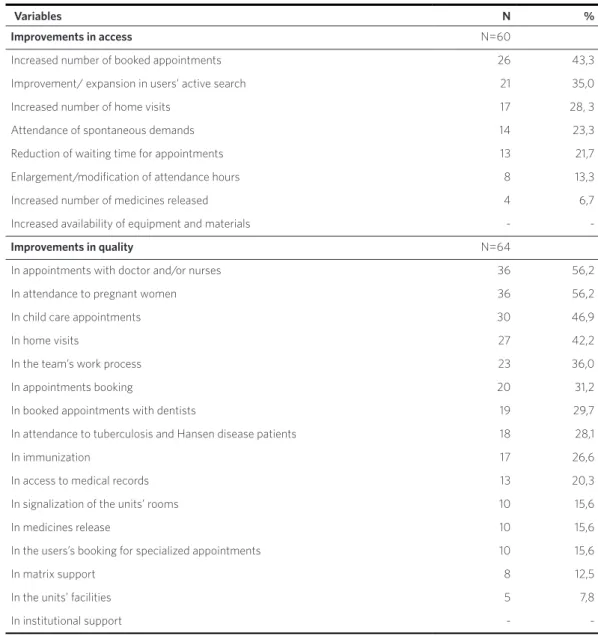
Alternatives for where improvements had been detected were presented to all 61 Community Health Workers who reported having observed progress in access to PC and to the 64 who reported the same about PC quality (table 2).
As to access to PC, improvements pointed out were mainly concerned to the number of appointments (43.3%) and to the users’ active search (35%). Increases in equipment and ma-terials availability were not mentioned.
As to quality, improvements were ob-served as to appointments with doctors/ nurses (56.2%), attention to pregnant women (56.2%) and childcare appointments (46.9%). Improvements in institutional support were not mentioned.
A research21 carried out with middle and upper education health profession-als involved as responsible assistants for PMAQ-AB municipal coordination revealed changes following the program implemen-tation, mainly related to work organization, FHS material resources and infrastructure, and records organization.
with findings by Feitosa and collaborators21, showing that records organization affected both attendance and reduction of waiting time. According to the authors, the use of family medical records, one of the requisites of PMAQ-AB, not only ensured the informa-tion registrainforma-tion, but also allowed for prompt access to the family health team’s actions, thus contributing to health actions planning.
It is also worth remarking that, although the service daily routine, marked by the ratio-nality of the biomedical model, may affect the production of CHW professional practice9(260), understanding CHW as a nuclear element for the re-orientation of health assistance in the country will necessarily include a conception of health as a social process that results from the population’s life conditions20.
Table 2. Improvements observed by CHWs as to Primary Care access and quality. Espírito Santo. 2016
Variables N %
Improvements in access N=60
Increased number of booked appointments 26 43,3
Improvement/ expansion in users’ active search 21 35,0
Increased number of home visits 17 28, 3
Attendance of spontaneous demands 14 23,3
Reduction of waiting time for appointments 13 21,7
Enlargement/modification of attendance hours 8 13,3
Increased number of medicines released 4 6,7
Increased availability of equipment and materials -
-Improvements in quality N=64
In appointments with doctor and/or nurses 36 56,2
In attendance to pregnant women 36 56,2
In child care appointments 30 46,9
In home visits 27 42,2
In the team’s work process 23 36,0
In appointments booking 20 31,2
In booked appointments with dentists 19 29,7
In attendance to tuberculosis and Hansen disease patients 18 28,1
In immunization 17 26,6
In access to medical records 13 20,3
In signalization of the units’ rooms 10 15,6
In medicines release 10 15,6
In the users’s booking for specialized appointments 10 15,6
In matrix support 8 12,5
In the units’ facilities 5 7,8
In institutional support -
Final remarks
The importance of evaluation from a per-spective of changes in the health care logics is evident, and the critical and active partici-pation of all professionals in the accomplish-ment of these changes is decisive. Contrary to this logics, the participation of CHWs in the evaluation process, as proposed by PMAQ-AB, remained restricted to helping upper education professionals to answer the questionnaire and finding documents (shortly above 50%) during the external evaluation phase; and around one third of them have not even participated in the self-evaluation of the team.
It must be stressed the unique character of Community Health Workers – exclusive professionals at the UHS service –, as well as their importance and transformational capability in the process of changing the health care pattern. However, the poor valorization of these professionals in PC evaluation processes expresses the difficul-ties for their effective insertion into health teams. This fact might have hindered the results of this evaluation, since it ignored the life experience of the professional who is the nearest to the community – the main
reason for better health care. Furthermore, the exclusion of a number of CHWs from the PC evaluation process may contribute to perpetuate this exclusion, thus hindering the support, the implementation and the development of basic actions targeted at the population that must be expanded and strengthened.
These results point to the need for stron-ger efforts in municipalities aimed at devel-oping strategies to encourage the inclusion of Community Health Workers in the evalu-ation process and, consequently, to improve their training in order to adequate their ap-prehension, awareness of the process and the quality in PC, so that they may perform according to the system’s guidelines and to allow them to effectively contribute to con-solidate that system.
Collaborators
References
1. Macinko J, Guanai FC, Fátima M, et al. Evaluation
of the impact of the Family Health Program on in-fant mortality in Brazil, 1990-2002. J Epid. Commu-nity Health.2006 jan; 60(1):13-19.
2. DouradoL, Oliveira VB, Aquino R, et al. Trends in primary health care – sensitive conditions in Brazil: the role of the Family Health Program (Project IC-SAP-Brazil). Med Care. 2011 jun; 49(6):577-584.
3. Aquino R, Medina MG, Nunes CA, et al. Estratégia de saúde da família e reordenamento do sistema de serviços de saúde. In: Paim JS, Almeida Filho N,
or-ganizadores. Saúde Coletiva: teoria e prática. Rio de Janeiro: Medbook; 2014. p. 353-371.
4. Brasil. Ministério da Saúde. Sala de Apoio a Gestão
Estratégica [internet]. Brasília, DF: [sem data defi-nida] [acesso em 2017 jun 4]. Disponível em: http:// sage.saude.gov.br/#.
5. Kluthcovsky ACG, Takayanagui AMM. O trabalho do agente comunitário de saúde. Rev. Bras. Med. Fam. Com. 2006 abr-jun; 2(5):23-29.
6. Filgueiras AS, Silva ALA. Agente Comunitário de Saúde: um novo ator no cenário da saúde do Brasil. Physis. 2011; 21(3):899-9161.
7. Costa SM, Araújo FF, Martins LV. Agente Comuni-tário de Saúde: elemento nuclear das ações em saú-de. Ciênc Saúde Colet. 2013 jul; 18(7):2147-2156.
8. Mota RA, David HMSL. A crescente escolarização do agente comunitário de saúde: uma indução do processo de trabalho? Trab. Educ. Saúde. 2010 out; (2):229-248.
9. Queirós AAL, Lima LP.A Institucionalização do Trabalho do Agente Comunitário de Saúde. Trab. Educ. Saúde. 2012 jul-out; 10(2):257-281.
10. Brasil. Ministério da Saúde. Secretaria de Atenção à Saúde. Departamento de Atenção Básica. Autoa-valiação para a Melhoria do Acesso e da Qualidade
da Atenção Básica: AMAQ [internet]. Brasília, DF:
Ministério da Saúde, 2012 [acesso em 2017 maio 13]. Disponível em: http://189.28.128.100/dab/docs/ge-ral/amaq.pdf.
11. Serapioni M. Avaliação da qualidade em saúde: de-lineamento para um modelo multidimensional e correlacional. In: Mercado FJ, Bosi MLM, organi-zadores. Avaliação qualitativa de programas de
saú-de: enfoques emergentes. Petrópolis: Vozes; 2013. p. 207-228.
12. Instituto de Geografia e Estatística. Conheça
cida-des e estados do Brasil [internet]. Rio de Janeiro: IBGE; c2017 [acesso em 2018 maio 26]. Disponível em: https://cidades.ibge.gov.br/.
13. Medrado JRS, Casanova AO, Oliveira CCM. Estudo avaliativo do processo de trabalho das Equipes de Atenção Básica a partir do PMAQ-AB. Saúde deba-te. 2015 out-dez; 39(107):1033-1043.
14. Cruz MM, Souza RBC, Torres RMC, et al. Usos do planejamento e autoavaliação nos processos de tra-balho das equipes de Saúde da Família na Atenção
Básica. Saúde Debate. 2014 out; 38(esp):124-139.
15. Brasil. Ministério da Saúde. Secretaria de Atenção à Saúde. Departamento de Atenção Básica.
Progra-ma Nacional de Melhoria do Acesso e da Qualidade da Atenção Básica (PMAQ-AB): manual instrutivo. Brasília, DF: Ministério da Saúde, 2012.
16. Tanaka O, Ribeiro EL, Almeida CAL. Avaliação em Saúde: contribuições para a incorporação no coti-diano. Rio de Janeiro: Atheneu; 2017.
17. Costa EM, Ferreira DLA. Percepções e motivações de agentes comunitários de saúde sobre o processo de trabalho em Teresina, Piauí. Trab. Educ. Saúde 2011 nov; 9(3):461-478.
Básica Participantes do Programa de Melhoria do Acesso e da Qualidade na Atenção Básica. Brasília, DF: Ministério da Saúde, 2013 [acesso em 2017 maio
13]. Disponível em: http://189.28.128.100/dab/docs/ portaldab/documentos/nota_metodologica_pmaq. pdf.
19. Mota RRA. A avaliação da Atenção Básica e o tra-balho dos agentes comunitários de saúde: implanta-ção do PMAQ-AB-AB no Médio Paraíba Fluminen-se [teFluminen-se]. Rio de Janeiro: Universidade do Estado do
Rio de Janeiro; 2015. 184 p.
20. Morosini MV, Corbo AA, Guimarães CC. O agente comunitário de saúde no âmbito das políticas
volta-das para a atenção básica: concepções do trabalho e da formação profissional. Trab. Educ. Saúde. 2007 jul; 5(2):287-310.
21. Feitosa RMM, Paulino AA, Lima Júnior JOS, et al. Mudanças ofertadas pelo Programa Nacional de Melhoria do Acesso e da Qualidade da Atenção
Bá-sica. Saúde Soc. 2016; 25(3):821-829.
22. Gomes KO, Cotta RM, Cherchiglia ML, et al. A prá-xis do agente comunitário de saúde no contexto do
programa saúde da família: reflexões estratégicas. Saúde Soc. 2009; 18(4):744-755.
Received on 08/18/2017 Approved on 07/04/2018 Conflict of interest: non-existent