GIVE TO RECEIVE: PRIVATE FUNDING OF SCIENCE AND
CORPORATE SOCIAL RESPONSIBILITY
Sara Isabel Silva Borges Catita
Project Report
Master in Management
Internal Adviser:
Professor Doctor Reinaldo Proença
External Adviser: Doctor Maria João Leão
Abstract
The thesis offers a general review about corporate social responsibility (CSR) and some related subjects like CSR strategies, relation with stakeholders, cause related marketing, social marketing, sponsorship and patronage. We then discuss funding for science and how the process to obtain it is structured, as well as a practical perspective of the funding process of a private science institution.
From the general public perspective, this thesis provides a preliminary study of the opinion that Portuguese people have about Science, scientists and science related events. We focus primarily on the Researcher’s Night 08 event, on how the funding was obtained for it and the partnerships that were created in this context. We also explore ways to fund scientific research in Portugal in partnership with companies. We extend the research in detail to the Portuguese reality and analyze the results of the event from the perspective of the general public and partner companies involved. We also detail the CSR strategy of a Portuguese telecommunication company that participated in the event.
Finally, this research suggests about how to promote Science in companies as a good CSR strategy. We also study the role of information and openness inside these partnerships as a key for a successful strategy.
Keywords: CSR; Funding Strategies for Science; Sponsorship and Patronage; Science communication events
Resumo
Esta tese tem por objectivo fazer uma revisão de conceitos relacionados com a responsabilidade social da empresa e explorar alguns temas ligados com o mesmo. Temos assim como conceitos próximos as estratégias de responsabilidade social, os stakeholders, o marketing social, patrocínio e mecenato. Também é estudado em detalhe, o processo e o modo de obter financiamento para a ciência, assim como um exemplo prático de uma instituição científica portuguesa, sobre este assunto.
Quanto à perspectiva do público em geral sobre este tema foi feito um estudo preliminar sobre a opinião dos mesmos quanto à ciência, cientistas e eventos relacionados com ciência. O presente estudo é baseado no evento “Noite dos Investigadores 2008” e demos importância ao modo como todo o financiamento para o mesmo foi obtido, e as parcerias com as empresas que foram estabelecidas para o sucesso do mesmo. O estudo deste caso foi alargado em detalhe com uma análise de resultados tanto ao público em geral presente no evento, como às empresas que estiveram envolvidas neste evento.
Finalmente, o estudo sugere como melhorar a presença da ciência nas estratégias de responsabilidade social das empresas. O papel da comunicação e de uma maior abertura entre ciência e empresas são vistos como estratégias de sucesso para futuras relações.
Palavras – chave : RSE; Estratégias de Financiamento para a Ciência; Patrocínio e Mecenato; comunicação de eventos científicos
Acknowledgements
I want to thank all the people who helped me in this thesis work.
To start, I would like to thank my parents that supported me and helped during the writing of my thesis, and also the effort that they did to support all my studies, because they always wanted to gave me the best education possible. For them, I don’t have more words than a huge thank you for everything that I have achieved in my life.
I would like to thank Professor Doctor Reinaldo Proença for the kind support and his insight in helping me to structure this thesis. I would also to thank, Doctor Maria João Leão for her support and guidance throughout this project and her helpful comments.
I wish to acknowledge the collaboration and the support provided by Dr. Maria Manuela Guimarães and Engineer Clara Cidade, of PT Group and PT Foundation respectively.
Last but definitely not the least, I would like to thank Afonso, for his support and patience over the duration of this thesis and for giving me happiness even when I was depressed. I realized how important he was in encouraging me to write this thesis in English.
List of Abbreviations
CSR Corporate Social Responsibility SME Small and Medium Enterprises
APCL Associação Portuguesa contra as Leucemias CRM Cause Related Marketing
SM Social Marketing
R&D Research and Development GDP Gross Domestic Product
IGC Instituto Gulbenkian de Ciência NGO’s Non – governmental organization
EMBO European Molecular Biology Organization
FCT Portuguese Foundation for Science and Tecnology FP Framework Programme
FCG Calouste Gulbenkian Foundation PT Portugal Telecom
EC European Commission RN Researchers’ Night
List of Tables
TABLE 1: SYNTHESIS THE THREE CSR COMMUNICATION STRATEGIES THAT WERE DEFENDED BY METTE MORSING BASED ON DIFFERENT APPROACHES FOR EXTERNAL
STAKEHOLDERS ... 7
TABLE 2 – DIFFERENCES BETWEEN COMMERCIAL AND SOCIAL MARKETING ... 13
TABLE 3 – SIMILARITIES BETWEEN COMMERCIAL AND SOCIAL MARKETING... 13
TABLE 4 – THE DIFFERENCES BETWEEN SPONSORSHIP AND PATRONAGE – ADAPTED FROM ANA REIS, 2003 ... 18
TABLE 5 – PORTUGUESE R&D PERCENTAGES ACCORDING THE ENTERPRISE SECTOR (PRIVATE) AND INSTITUTIONS SECTORS (PUBLIC) ... 19
TABLE 6 - BRIEF SCHEME OF PRIVATE FUNDING IN 2008, EXCLUDING GRANTS OR FELLOWSHIPS ... 22
TABLE 7 – SOME PROJECTS OF IGC ... 23
TABLE 8 – FUNDRAISING EVENTS OF IGC ... 24
TABLE 9 – ENTITIES ORGANIZING THE EVENT ... 25
TABLE 10 – BUDGET FROM THE EUROPEAN COMMISSION FOR THE DIFFERENT PARTNERS... 26
TABLE 11 - SHOWS THE DISTRIBUTION OF THE BUDGET FROM THE EUROPEAN COMMISSION TO THE IGC, ONE OF THE PARTNERS ... 27
TABLE 12 - COMPANIES INVOLVED AND TYPE OF SUPPORT... 28
TABLE 13 – PROJECT ACTIVITIES TIMETABLE ... 30
TABLE 14 - PARTICIPANTS PROFESSIONAL SITUATION... 34
TABLE 15 – PARTICIPANTS EDUCATION LEVEL... 35
TABLE 16 – PARTICIPANTS AGE GROUP... 35
TABLE 17 - DO YOU PLAN TO PARTICIPATE IN A FUTURE EVENT? ... 36
TABLE 18 – DID THE ACTIVITIES CONTRIBUTE TO AN INCREASED PROXIMITY BETWEEN SCIENTISTS AND GENERAL PUBLIC? ... 36
TABLE 19 - DID THE ACTIVITIES CONTRIBUTE TO INCREASE THE RECOGNITION OF SCIENTIST’S ROLE IN SOCIETY?... 36
TABLE 20 – HOW SHOULD BE THE FUNDING OF SCIENCE IN PORTUGAL? ... 40
TABLE 21 – DOES PRIVATE FUNDING OF SCIENCE HAS ANY PERCEIVABLE CONSEQUENCES IN SOCIETY?... 41
List of Figures
FIGURE 1 – THE BUSINESS IN SOCIETY: WHAT IS CSR?... 5
FIGURE 2 – TYPICAL DIVISION OF STAKEHOLDERS ... 8
FIGURE 3 – DIFFERENT WAYS OF INDIVIDUAL GIVING SUPPORT... 15
FIGURE 4 – A RANKING OF FUNDRAISING MEANS ACCORDING TO EFFECTIVE IMPACT ... 16
FIGURE 5 – FUNDING SCHEME OF IGC ... 21
FIGURE 6 – PROCESS TO CONTACT POTENTIAL DONORS FOR RN ... 29
FIGURE 7 – RESPONDENTS’ SATISFACTION ABOUT THE EVENT... 37
FIGURE 8 - COMPARISON BETWEEN THE EDUCATION LEVEL AND THE RANK OF SATISFACTION WITH THE EVENT ... 38
FIGURE 9 – GLOBAL EVALUATION AVERAGE OF THE EVENT’S ACTIVITIES IN THE DIMENSIONS QUALITY, INTEREST, ENTERTAINMENT, INNOVATION AND KNOWLEDGE ACQUIRED... 39
FIGURE 10 – PARTIAL EVALUATION AVERAGE OF THE EVENT’S ACTIVITIES IN THE DIMENSIONS QUALITY, INTEREST, ENTERTAINMENT, INNOVATION AND KNOWLEDGE ACQUIRED RELATED WITH EDUCATION LEVEL... 39
FIGURE 11 - COMPANIES’ SATISFACTION WITH THE EVENT, MEASURED BY THE NUMBER OF COMPANIES ... 42
FIGURE 12 - COMPANIES SPONSORSHIP PROFILE, MEASURED BY THE NUMBER OF COMPANIES ... 43
FIGURE 13 - COMPANIES PARTICIPATION BENEFITS IN SCIENCE RELATED EVENTS, MEASURED BY NUMBER OF THE COMPANIES ... 44
Table of Contents
Abstract ... 2 Resumo ... 3 Acknowledgements ... 4 List of Abbreviations... 5 List of Tables... 6 List of Figures ... 7 Chapter 1 – Introduction... 1 1.1 CSR Problem Statement... 11.2 Science and Business ... 2
1.3 Aim of the study... 2
Chapter 2 - Literature Review ... 4
2.1 Corporate Social Responsibility... 4
2.1.1 Concept/ Definition ... 4
2.1.2 Stakeholders and corporate public image... 5
2.1.3 CSR communication strategies ... 7
2.1.4 The importance of CSR... 9
2.1.5 Social Aspects of CSR in the society ... 9
2.1.6 Corporate Social Responsibility and Marketing – Cause Related Marketing (CRM) and Social Marketing (SM)... 12
2.2 Funding Science ... 14
2.2.1 Public and Private Funding of Science... 14
2.2.2 The two different methods of communication in private support of science – Sponsorship and Patronage ... 17
2.2.3 Funding science in Portugal ... 18
2.2.4. Science Funding at Instituto Gulbenkian de Ciência ... 20
2.3. Private funding of Science and CSR ... 24
Chapter 3 - Research Methodology... 25
3.1 Practical Case Introduction ... 25
3.2. Methodologies used during this study... 29
3.2.1 Establishment of partnerships with the private sector ... 29
3.2.2. Instruments and Procedures... 29
3.2.4. Elaboration of the interview to be made to a company (PT) that was substantially
involved in the event ... 32
Chapter 4 - Results ... 34
4.1 Evaluation of Surveys ... 34
4.1.1. Statistical analysis of the general public surveys ... 34
4.1.2. Statistical analysis of the results from the companies present in the event ... 42
4.2 Company Interview ... 45
4.2.1 Case presentation – objective and methodology ... 45
4.2.2 Company presentation... 46
4.2.3 Group Strategy ... 47
4.2.4 Strategies to promote a high private contribution to science... 50
Chapter 5 – Discussion... 51
Chapter 6 – Conclusion ... 54
Bibliography ... 56
Appendix ... 58
Appendix 1: RN Survey ... 58
Appendix 2: Companies survey ... 61
Appendix 3: Interview IGC... 64
Appendix 4: Portugal Telecom direct interview ... 65
Chapter 1 – Introduction
1.1 CSR Problem Statement
Corporate social responsibility (CSR), also known as corporate responsibility, corporate accountability, corporate ethics, corporate citizenship or stewardship, responsible entrepreneurship and “triple bottom line”. (Honen & Potts 2007). The triple bottom line is the development of business practices and processes in three areas: economic, environmental and social.
A definition appears by Lord Holme and Richard Watts stating that “CSR is the continuing commitment by business to behave ethically and contribute to economic development while improving the quality of life of the workforce and their families as well as of the local community and society at large”( Baker, 2008)
During the past years, CSR has been developed and implemented in most companies having a vital role not only in big but also in small and medium enterprises (SME). The majority of the companies are now developing ways to explore this new marketing scheme.
Nowadays CSR is becoming a marketing strategy more widespread as a factor of differentiation and awareness for consumers, mainly due to the lack of product differentiation and the tendency of people to choose the company that provides a better relationship with the customers and other stakeholders. The companies that embrace CSR can obtain competitive advantage over the other competitors, such as good public image, good image among employees, good profits and return of the investment, which is important for supporting events not directly related with core business.
In a time when governments are reducing their spending, the private sector has been playing an important role by supporting sectors as culture, arts, science, sport, health, among others through a wide range of funding types as donations, sponsorships, patronage and cause related marketing (SMART Company, 2005).
Nevertheless CSR practice has also been a subject to debate and criticism considering that there is a strong business interest in this practice.
1.2 Science and Business
The use of private funds to support scientific research is not something new in the history of Science. Wealthy patronshave always been supporting scientific progress around the world by patronage. The United States and some European countries have already a strong component of
private funding for scientific research mainly due to their culture of philanthropy and fundraising in society.
In countries such as Portugal, scientific research is still highly dependent on governmental funding and private funding is still very low. Nevertheless, with the recognition of the impact of science in the development of new technologies and in everyday life of all, efforts have been made to obtain additional private funding from business and other sectors of society. Science and scientific research is therefore also becoming part of CSR strategy of companies, contributing to both company image and quality of scientific research.
1.3 Aim of the study
This works aims to study and understanding, relationships between a Portuguese scientific institute, the business sector, and the public in general and to further discuss how to improve these relationships.
The Institute Gulbenkian de Ciência (IGC) is an important biomedical research institute in Portugal that has recently begun to develop a fundraising strategy involving the scientific community, the private sector and the general public.
The practical part of this thesis is based on the analysis of one of the outreach initiatives that IGC developed during 2008, the European Researchers` Night in Portugal. This event is promoted by the European Commission since 2005 with the aim of increase the boundaries between Science and Society.
Due to the nature of the event, this was a good opportunity to analyze in parallel topics such as science communication, public awareness of scientists, fundraising and even CSR.
designed to raise the researchers’ public recognition and increasing the knowledge of the general public about science. This interaction helps to bridge the world of science to the world of non-scientists or even scientists in the making.
The funding for each location where the event took place didn’t come solely from the Marie Curie Fellowship given by the European Commission; several partnerships were established with companies of different sizes and relevance on the Portuguese market. Because the support was not only monetary, these partnerships contributed to the success of the activities in many ways (e.g. by providing free food and beverages for the visitors or promoting the event in local media).
During the event a fund was raised with individual donations of participants in the event and with the fundraising initiative “the walk for science” This fund was donated at the end of the event to the Portuguese association against leukemia (“Associação Portuguesa Contra as Leucemias” or APCL for short). The degree of success of the partnerships between companies and the organizers of the Lisbon branch of this science promoting event will be thoroughly analyzed during this thesis and suggestions for improvements will also be later discussed.
This event is a proof that the partnership between business leaders and scientific institutes can provide the world with a degree of social wellbeing that was impossible to achieve otherwise.
Chapter 2 - Literature Review
This chapter is divided in two main sections. The first section discusses the concept of Corporate Social Responsibility and related subjects. In the second section, we focus on the Science funding perspective as a way to provide a comprehensive background to its potential relation with the private sector. We complemented this section with a detailed practical example of the funding process behind the IGC, a renowned Portuguese research institute.
2.1 Corporate Social Responsibility
2.1.1 Concept/ DefinitionA different definition from the one present in the introduction is described in the book, Corporate Social Responsibility (Kotler & Lee 2004: 3) that says that corporate social responsibility is "a commitment to improve community well-being through discretionary business practices and contributions of corporate resources."
The benefits that a company could earn by using this strategy are mainly: improve brand image and client trust, motivate and attract employees, attract investors and differentiate over competitors.
When companies apply CSR, they can take on three strategies (May et al., 2007):
• Proactive – they are stimulated to have CSR projects because of the company culture and principles;
• Accommodative – the company “tends to follow existing guidelines and regulations to fulfill minimum CSR criteria. They also may consider feedback from important stakeholders and attempt to meet the CSR expectations of these groups”;
• Reactive - the company “tends to react to events and conduct CSR activities on an ad hoc basis. We also found that, although evaluation is critical to all organizational activities, it is conducted minimally as far as CSR is concerned”.
Figure 1 – The Business in Society: What is CSR?
As we can see in figure 1, companies should take into account two aspects of their operations: the quality of management (people and processes) and the impact on society in the different areas (marketplace, workplace, community, and environment). Beyond this, we still have the outside stakeholders (represented in green color in the figure) that are interested in observing what the company does (Baker, 2008).
A business has a normal function with “a multitude of relationships with customers, employees, suppliers, communities, investors and others – in other words, stakeholders”
(Honen & Potts 2007).
2.1.2 Stakeholders and corporate public image
In earlier times the traditional view of the companies was to achieve profits for their owners, but actually the companies begin to see that is also important to show and address their needs to all the stakeholders that are involved with the companies. Therefore, there was a need to change this traditional view, leaving to the appearance of the stakeholder theory. The stakeholder theory is a theory of organizational management and business ethics that addresses morals and values in managing an organization (Phillips, 2003).
This theory has it’s focus on two main questions – what is the purpose of the firm and what responsibility does management have to stakeholders – these questions offer a response of how managers should articulate “the shared sense of the value they create, and what brings its core stakeholders together” and also a response to “what kinds of relationships they want and need to create with their stakeholders to deliver on their purpose”, as defined by some authors(Freeman et al., 2004).
Stakeholder theory was first developed in 1984 in Strategic Management where the author stated that –“the stakeholder approach is about groups and individuals who can affect the organization, and is about managerial behavior taken in response to those groups and individuals”.(Freeman 1984)
In this way, we can say that stakeholders are a vast group of people that affect all the company’s actions but can also be affected by the practices that the company follows in day-to-day operations.
This theory is becoming more popular, as it becomes clear that decisions taken by the companies can interfere positive or negatively in the society that surrounds them.
Others authors have a different view about the stakeholders theory (Thomas Donaldson & Lee E.Preston, 1995). To them, this theory is related in three central hypotheses:
• Descriptive-means that “the theory is used to describe and sometimes to explain, specific corporate characteristics and behaviours" (p. 70);
• Instrumental-means that “the theory is used to identify connections, or lack of connections, between stakeholder management and the achievement of traditional corporate objectives"(p.71);
• Normative-means that “the theory is used to interpret the function of the corporation, including the identification of moral or philosophical guidelines for the operation and management of corporations”(p. 71).
Freeman illustrated the importance of stakeholders in corporate strategic planning, because a better and constructive relationship with the stakeholders could give positive financial implications for the company.
2.1.3 CSR communication strategies
Communication is an important tool for the companies in the process of engaging internal and external community to support CSR strategies.
Some researchers recommended the need to increasing the long term relation more than only obtain direct profit (Morsing & Schultz 2006).These authors presented three types of strategies to CSR communication, changing the conventional monologue to an interactive stakeholder relationship. These strategies are: the stakeholder information strategy, the stakeholder response strategy and the stakeholder involvement strategy. On the table below is a synthesis about the three strategies that were defended by Mette Morsing based on different approaches for external stakeholders.
Table 1: Synthesis the three CSR communication strategies that were defended by Mette Morsing based on different approaches for external stakeholders
Information strategy Response strategy Involvement strategy Communication Ideal
(previous study by Grunig and Hunt,1984)
Public information, one way communication
Two way asymmetric communication
Two way symmetric communication
Communication Ideal Sense making and sense
giving Sense giving Sense making Sense giving Sense making Sense giving Stakeholders
Request more information on corporate CSR efforts
Must be reassured that the company is ethical and
socially responsible
Co-construct corporate CSR efforts
Stakeholder role Support or oppose Respond to corporate actions
Involved, participate and suggest corporate actions.
Top management
Top management agreed with feedbacks, dialogue, networks and partnerships.
Discussed in interaction Decision of CSR focus
Strategic communication
to stakeholders Inform about corporate CSR actions and
decisions.
Show how the company integrates their concerns.
Invite and establish frequent dialogue
Corporate communication department’s task
Design appealing concept message
Identify important
stakeholders Build relationships
Third-party endorsement of CSR
initiatives
Unnecessary
Integrated element of surveys, rankings and
opinion polls
Stakeholders are themselves involved in corporate CSR messages
It is extremely important for a success CSR strategy that managers can give value for the stakeholders because a better stakeholder involvement provides an excellent image of what are the main expectations and what they want particularly. An important solution for a superior involvement with stakeholders is to always keep in contact with them, even if just to share information.
An approach to stakeholder relationships proposed by Sillanpaa & Wheeler (1997) claims that stakeholders are divided in primary and secondary. Primary group or core stakeholder group has a direct participation and contributes for company’s success (owners, employees, customers and suppliers), while secondary group has influence over company but it is more a representational involvement as in getting credibility for the company and supporting its daily actions( NGOs activities, communities, governments and competitors). Figure 2 illustrates this division of stakeholders groups.
From the figure 2, it can be seen that there is a distinction between the primary stakeholders that control the business results and the secondary ones that only have indirect involvement and whose main role is to make suggestions for improvements
2.1.4 The importance of CSR
According to a previous study,there are four main justifications for the use of CSR (Porter & Kramer 2006):
• Moral obligation, describes the companies duty to have an active role in society;
• Sustainability, suggests that company management should be concerned, not only with short-term goals, but also to provide an image of social and environmental responsibility in the long run;
• The “license to operate” approach is especially prevalent in companies that require an external authorization to operate. In this situation it is viewed as a positive thing to reattribute by supporting causes that matters to their stakeholders;
• Reputation, to emphasize that using CSR initiates contribute to the company’s image, brand, morale and add value.
The same authors also refer that, sometimes, some problems arise due to lack of connection between the philanthropic activities and the company’s strategy:
• Internally, there isn’t connection between CSR strategies and “operating units”;
• Externally, “the company’s social impact becomes diffused among numerous unrelated efforts, each responding to a different stakeholder group or corporate pressure point”.
2.1.5 Social Aspects of CSR in the society
Research by Porter & Kramer (2006) identifies the importance of interrelationship between society and a company and how is more and more essential the link between them. In this way it is extremely important that the options are going to benefit both and for this reason it is necessary to take special care with the next points.
1. Recognize the points of intersection – the following aspects can be opportunities for CSR initiatives:
• Company’s value chain: all the activities that the company realizes can socially interfere positively or negatively;
• Competitive context: this point can be separated in four parts such as - Quantity and quality of available business inputs; Rules and incentives that govern competition; Size and sophistication of local demand; Local availability of supporting industries.
2. Choosing which social issues to address – the company should choose between the three main categories of social issues according to its business, so that it can create shared value.
• Generic social issues: “important to society but not affected by the company’s operations nor influence company’s long term competitiveness”;
• Value chain operations: “affected by the company’s activities”;
• Social dimensions of competitive context: “external environment that affect the drivers of competitiveness where company operates”.
3. Creating a corporate social agenda – the more closely a social issue is to the company’s business, the greater the opportunity to leverage the firm’s resources and capabilities, and benefit society.
• Responsive CSR: “acting as a good corporate citizen” where through company plans it can produce goodwill for them and develop relations with local institutions and also to predict and minimize the negative impact resulting from the company’s activity;
• Strategic CSR: the company should choose an exclusive position regarding the competitors. It involves both inside – out and outside – in dimensions working together.
4. Integrating inside–out and outside-in practices - nowadays it is important to put together the company and society, for this the company must classify the positive
and negative social impacts of the value chain and considerate the social dimension of the competitive context.
5. Creating a social dimension to the value proposition – it is important for a company to construct the value proposition, adding a social impact to it strategy.
Integrating business and social needs require adjustments in organization, reporting relationships and incentives.
In corporate social responsibility it is important to choose which social issues to focus. Organizations that make the right choices and build focused, proactive and integrated social initiatives with their core strategies can more effectively stand out against competition and contribute to a better society. Some companies have a section in their annual reports, informing about their CSR activities or they develop separate CSR reports. Some companies support their sustainable development, using four themes such as: (Idowu & Filho, 2008)
•
Community Investment: the company affirms that has a responsibility to make good things for its community and describes in its report some of the actions that made for the community;•
Marketplace: the company have a “policy to invest ethically (green investments) and in other market – related actions”;• Workplace: the company guarantees a construction of a working environment where personal and employment rights are maintained and also that it is protected equal opportunities for employers;
• Environment: the company guarantees that makes all the activities with interest for the environment via recycled products, saving energy and also don’t pollute the Earth.
Corporate Social Responsibility initiatives can be targeted to one of these four main themes or have more widespread targets, aiming at several social issues at once.
2.1.6 Corporate Social Responsibility and Marketing – Cause Related Marketing (CRM) and Social Marketing (SM)
Nowadays, the companies are more interested in increasing their status and trust of all the people that are involved with them. In this way, CSR has assumed an important role and is considered as a technique to demonstrate credibility and transparency into every business activities. One way of the companies has to support CSR activities is through CRM activities because with this strategy they can demonstrate their concern with social issues.
(Baghi et al., 2009)
CRM is a company marketing strategy possibility. Main objective is to connect marketing (product, service, brand or company) and sales goals with a social cause for promotion and mutual benefit. Marketing objectives of CRM programmes are aimed to build corporate, brand and product awareness, increase sales, income and image, develop trial and repeat purchases, promote a new product and differentiation, and add value (Benjamin & Stoler, p.12). This practice involves associating a business with a cause.
As Sue Adkins, international expert on CRM said “CRM adds another dimension. It provides the emotional as well as the rational engagement of the consumer with the brand. It provides a tangible demonstration of the company’s corporate social responsibility, its values and its ethics”
More and more the presence of CRM in the companies is growing. CRM works as a social expression, conjugating the enterprise goals and social problems.
A Portuguese example was the campaign “Swatch Mundo Perfeito”. It’s objective was to build a center for children and young people. For this, Swatch launched a watch where part of the price was donated for the construction of the center.
The notion of CRM appeared in 1983 in the famous American Express campaign that aimed to raise money for the restoration of the Statue of Liberty, the ex-libris of NYC. This enterprise gave a one-cent contribution to the Statue of Liberty fund, each time someone utilized one of their cards. With this idea, they obtained a growing number of new card holders and also increased card usage.
In SM, the main difference to CRM is that not associated with a company and the principal objective is to help society in a specific social problem, excluding promotion of a business. The authors (Kotler et al. 2002) define social marketing as “the use of marketing principles and techniques to influence a target audience to voluntarily accept, reject, modify, or abandon a behaviour for the benefit of individuals, groups, or society as a whole”.
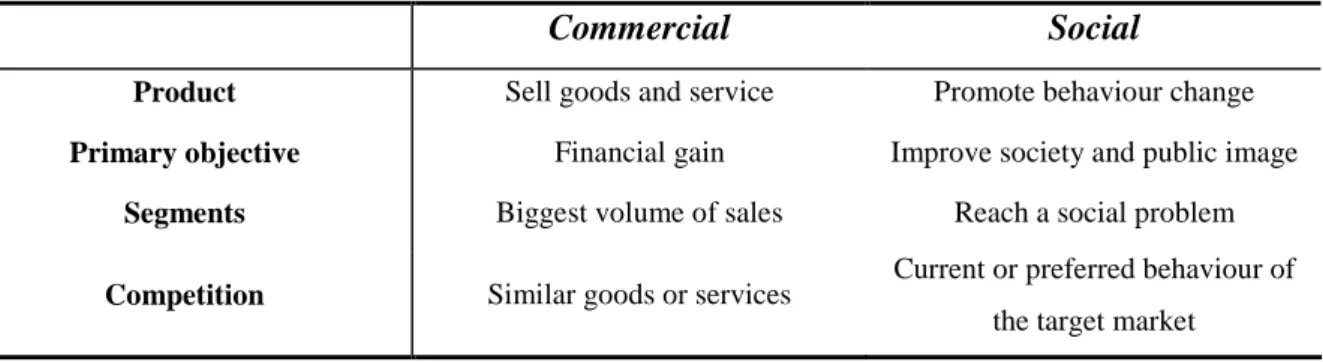
The same authors described some differences and similarities between social marketing and commercial marketing (Kotler et al. 2002). Although they are both marketing techniques, the goals and the way to reach the public are entirely different.
Table 2 – Differences between commercial and social marketing
We can also look at the similarities between the two approaches.
Table 3 – Similarities between commercial and social marketing
Over the marketing approach there are also another four approaches to persuade the public behaviour, such as technology (automatic seat belts), economic force and incentives (taxes
Commercial Social
Product Sell goods and service Promote behaviour change
Primary objective Financial gain Improve society and public image
Segments Biggest volume of sales Reach a social problem
Competition Similar goods or services Current or preferred behaviour of the target market
Both Customer orientation Offer has to appeal
Exchange theory Benefits vs. Costs
Marketing research Know the needs, desires to build strategies
Segmentation Strategies in accordance with market segments
4P’s ( Price, Place, Promotion and Product) Integrate the 4P’s for a good strategy
on cigarette), “law making” (seats for children in cars) and education (information about the spread of certain types of disease with the principal aim of promotion).
2.2 Funding Science
In modern society, Science represents evolution, change, hope for humanity including cure for diseases yet to come. All this progress comes at a cost. Research institutes often struggle to find enough funding to ensure the success of projects within, that will eventually provide the basis for further progress. We found that, although companies generally try to contribute to the public well being to boost their image, they often disregard Science as a good candidate for their initiatives.
Therefore, this collaboration has still a lot of unexplored potential in Portugal. In this section, we will focus on the different ways to fund Science.
2.2.1 Public and Private Funding of Science
Science funding can be obtained through two major sources: the private and public sectors. Regarding the public sector, governments provide funds for science and scientific projects through fellowships and other types of funding programmes. For example, at European level, the European Commission has been developing a funding scheme for science known as FP. The Portuguese Government support science at national and international level through the Portuguese foundation, “Fundação para Ciência e Tecnologia”(FCT).
It is essential to make a distinction between funding and fundraising. Funding is essentially to provide the means (cash or non cash funding) to realize some activities and projects in institutions, while fundraising is the way how the institutions or other non monetary ask for contributions for their projects.
Private funding has a strong impact for scientific development in countries such as the United States and the United Kingdom. Different strategies can be developed to raise private funds for scientific research. A definition of Fundraising is given by Norton( 2007, p.10): “selling people the idea that something can be done, and then creating a partnership /
relationship in which they [the donor] provide the means and you [the activist] do all the work to make things happen”.
The main objective of science events is to arrange funds for science and to bring science closer to the general public, in a way to promote science and improve public recognition of the scientist’s role in society and motivate young people to take scientific careers.
Private money for science can be obtained through trusts, companies or individuals by using different funding schemes (Norton, 2007):
• One-off donation where people give by direct contact or just because they desire to help;
• Regular donation where people or enterprises give cash every month or year;
• Membership that works as an annual contribution or fee for one certain organization;
• Major gift that means a huge sponsorship normally given by enterprises;
• Legacies and memorials.
There is an inverse correlation between the value of the donation and the frequency of the donations of that type. This relation is schematized on figure 3.
Others forms of giving for both organizations and individuals consist in non-monetary support such as volunteer work, making a give in kind, donating objects or helping raising money.
Fundraising events and merchandising are other strategies that can be used by scientific organisations. Fundraising events such as sport, music and art events are excellent opportunities to both raise money for a cause and at the same time to increase the visibility and notoriety of the cause that is being sponsored at the event.
A strong dialogue between scientific community and the public in general is essential for the effectiveness of a fundraising programme.
The fundraising effectiveness could be divided as the figure below show. (Burcham, 2008)
Preparing a fundraising program requires a sequential process that involves:
• Strategic plan and strategic needs analysis - essential need (determines the plan and fundraising aims) and compelling a case for support (define competencies and strengths, develop a marketing statement for the institution);
• Feasibility study – inspired and influential leadership and prospects to meet the goal, this is, give a marketing perspective program in which donors could be interested;
• Major gifts campaign – complete plan of action in which it is described the schedule to take out strategies and with specific fundraising goals and also, it’s important the work of the senior development officer in giving motivation and coordination of volunteers.
The donors generally like to have impact, social recognition, involvement in the project, have access to a financial report and to be thanked for their contribution. The institutions have to be cautious, as it is important not promote unrealistic expectations. On the other hand the institution expects from the donors things such as: financial support, time, networking opportunities, longtime engagement and involvement on boards.
2.2.2 The two different methods of communication in private support of science – Sponsorship and Patronage
The companies have today a bigger involvement in social issues through sponsorship and patronage.(http://www.eurexport.com/anglais/apptheo/marketing/comm/comrelapubliquea.htm).
Sponsorship is a way that a companies use to communicate, for that purpose, there is a contract which gives different types of support that can range from help for an event, to help other organizations, a persons with promotion as the main objective. The company expects to improve the image for its brands, products or services, with this kind of plan.
Patronage is other method that a company has to give financial support to an institution that wants to do better for the society. Patronage differs from the sponsorship not only in the objectives, but also in the expected outcome of its actions as the company doesn’t expect a direct return.
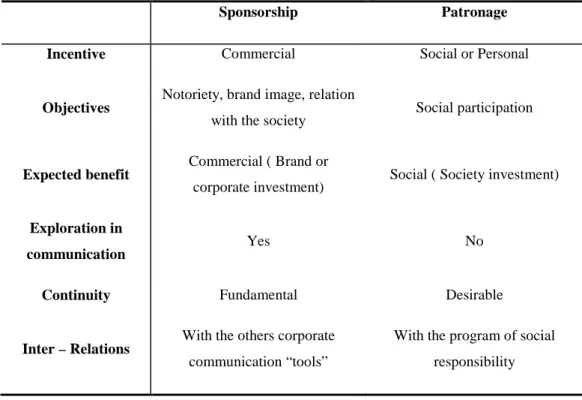
On the table below, table 4, we will summarize the major differences between sponsorship and patronage (Reis, 2003). Nowadays, it isn’t easy to make a division between these two concepts; the main difference is in tax.
Table 4 – The differences between sponsorship and patronage – Adapted from Ana Reis, 2003
Sponsorship Patronage
Incentive Commercial Social or Personal
Objectives
Notoriety, brand image, relation
with the society Social participation
Expected benefit
Commercial ( Brand or
corporate investment) Social ( Society investment)
Exploration in
communication Yes No
Continuity Fundamental Desirable
Inter – Relations
With the others corporate communication “tools”
With the program of social responsibility
2.2.3 Funding science in Portugal
In Portugal, despite of the weak but steady improvement in science funding, Research and Development (R&D) intensity has substantially grown in the last few years and therefore Portugal is becoming a more attractive country to do research.
In a statistic document for the year 2007( Table 5) carried out by Technology and Higher Education department from the Ministry of Science, the following conclusions were presented:
• The total expense in Research and Development (R&D) had an increase, representing about 1,2% of the country’s Gross Domestic Product (GDP), the highest value ever reached, while in 2005 was only 0,81%. This variation expresses the progress made on research in Portugal;
the importance that have been given by the private sector to scientific progress in Portugal and also due to the tax benefits and other incentives for businesses that financially support scientific research;
• The number of enterprises supporting R&D had an increase from 930 to 1500 between 2005 and 2007;
• In the same period, the number of researchers increased from 3,8‰ to 5‰.
Table 5 – Portuguese R&D percentages according the Enterprise Sector (Private) and Institutions Sectors (Public) 1982 1984 1986 1988 1990 1992 1995 1997 1999 2001 2003 2005 2007p Enterprise Sector 0.09 0.09 0.09 0.09 0.13 0.13 0.11 0.13 0.16 0.26 0.24 0.31 0.61 Institutions Sectors 0.19 0.23 0.26 0.29 0.36 0.45 0.43 0.46 0.55 0.55 0.49 0.50 0.57 Total 0.28 0.32 0.36 0.39 0.48 0.58 0.54 0.59 0.71 0.80 0.74 0.81 1.18
Nevertheless, besides these promising results, science funding in Portugal, is still very immature when compared with other countries and is still highly dependent on public investments.
According with Sofia Rodrigues and colleagues, some examples of philanthropy in Portugal are: (Rodrigues et al. 2007)
• The Calouste Gulbenkian Foundation, created through a legacy left by the known Armenian businessman Calouste Sarkis Gulbenkian;
• The Sommer-Champalimaud Foundation was also created through a €400 million legacy left by António Champalimaud with the aim of develop Neurosciences and Cancer biomedical research;
• The Bial Foundation, created by the homonymous Portuguese pharmaceutical company, encourages the scientific research in health area through research fellowships, attribution of scientific prices;
• Associação Portuguesa Contra a Leucemia, non-profit organization that was created to support leukaemia patients. They develop a series of fundraising initiatives like
fundraising concerts, sport events. It also has a fellowship program to support biomedical research;
• Associação Viver a Ciência is another non-profit Portuguese association whose central objectives are to promote Portuguese scientific investigation and raise private funds for science.
2.2.3.1 Portuguese law of scientific sponsorship(“Lei do Mecenato Científico”)
The law of scientific sponsorship was created in Portugal with the Law No.258/86, 28 August 1986, ten years later than in the Europe and the statute of “Scientific Patronage” was approved by the Law No. 26/2004, of 8th July.
This law provides tax benefits for science-related donation by both private organizations and individuals.
This idea emerged from the Lisbon Strategy where the main objective is to increase productivity and the economy and also because in this meeting was defined that until 2010 its necessary to increase the support for scientific activities to 3% of the GDP, being 1% provided by public funds and 2% to be provided by the private sector.
It was also highlighted the importance of science in society and recognized that private investment in scientific research needs to increase.
2.2.4. Science Funding at Instituto Gulbenkian de Ciência
The Portuguese Instituto Gulbenkian de Ciência (IGC) was founded in 1961 by Fundação Calouste Gulbenkian (FCG) and it is nowadays an important internationally recognized biomedical research institute.
In this section we will elaborate on how this institute gets funding needed for its activities. In the scientific community, the tenure of researchers in an organization is dependent on the aptitude to successfully raise research funds. Group leaders in the IGC dedicate huge amount of time looking for financial support for their research activities including their own salary and those of their staff.
IGC has several means to receive money and these depend on where these funds will be applied. The source can be public money, private money or the Calouste Gulbenkian Foundation itself. IGC funding is schematically summarized in figure 5.
Figure 5 – Funding scheme of IGC
There are three states to get “direct” funding from public or private grants this is, money for specific scientific projects. The first phase is looking for funding opportunities, the second phase is applying for a funding and the final phase is getting through the selection process.
Considering the phases to obtain public or private grants, we have:
1. Looking for a grant (search) – where the grant administration place on the internet website, information about grants in competition. After this, IGC hold internal meetings to further spread grant information. The Institute also gives advice and helps the staff trying to find a science funding;
2. Applying for a grant (ask) – prepare grant proposals in subjects as administrative forms, scientific proposal and budget and have attention with the deadline;
3. Getting the funding (spend) – negotiate/talk with granting agencies, manage the contract and obtain signatures. After this, the procedure is the implementation of scientific project, the reporting and finally the closing of the project.
The annual budget for the IGC is around 10 million euros. As shown in Figure 5, IGC financial funds come from different sources. Since the beginning of IGC, the Calouste Gulbenkian Foundation have been supporting IGC by providing funds for infrastructures,
most of the IGC non-scientific staff (administrative and maintenance staff) and few researchers from IGC. Funds for salaries for the vast majority of the IGC scientific staff come from the FCT and from other International public organizations. Nevertheless, IGC has already few examples of fellowships for IGC scientific staff supported by private organizations (eg. OptimusAlive-IGC fellowships for young scientists sponsored by “Everything is new, Lda”).
The Instituto Gulbenkian de Ciencia has recently begun to develop fundraising initiatives that involve the scientific community, the private sector and the general public. This project aims to establish alternative means of financial resources for research in Portugal and to contribute to a closer interaction between research centres and the Portuguese society. Fundraising events (e.g. Presence of IGC at the music and art event OptimusAlive!Oeiras08 and organization of the European Researchers Night in Portugal), in partnerships with companies and merchandising are part of the strategy that have been developed at IGC to increase private funding of science.
Table 6 - Brief scheme of Private Funding in 2008, excluding grants or fellowships
Company (Partners and Sponsors) Type of donation
Champalimaud Foundation, Siemens, PT Foundation and FLAD for PhD’s Programs.
Payment of neuroscience PhD program, payment of part PhD program, payment of the institute’s
Internet connection during 7 years. Adidas, Bar Majong, Bio-Rad, Clarke-Modet,
Cooking Lab, Diário de Notícias, Delta Cafés, Everything is New, Portugal Telecom, Público, Roche, Sapo, Sportis, Unicer, Frida and Biosphere.
Financial or in kind support to scientific research, education and science communication and outreach
activities at IGC.
For IGC is vital to inform the public in a way understandable to them, the importance and potential of Science in the society and also its limitations.
The main objective is to bring science closer to the general public. For this, science communicators have to direct their efforts to target the population or a particular sub-group that they want to reach. It’s necessary, for more efficiency, not only to inform people but also to use other strategic marketing tactics, such as special event, open lab days for schools and general public. In 2008, IGC did some projects as a way to increase the interactions
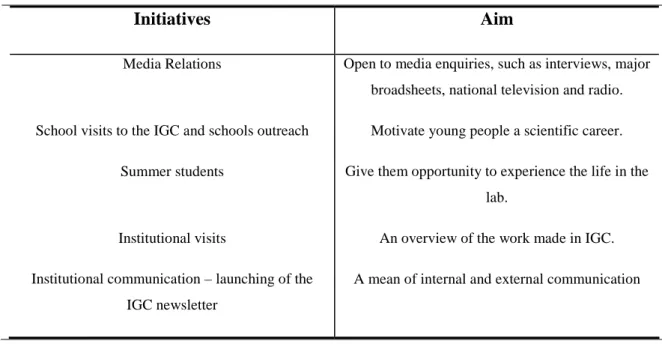
between science and media, students, companies, general public and policy makers. The table 7 summarizes the diverse 2008 initiatives of IGC.
Table 7 – Some projects of IGC
Initiatives Aim
Media Relations Open to media enquiries, such as interviews, major broadsheets, national television and radio.
School visits to the IGC and schools outreach Motivate young people a scientific career.
Summer students Give them opportunity to experience the life in the lab.
Institutional visits An overview of the work made in IGC.
Institutional communication – launching of the IGC newsletter
A mean of internal and external communication
Other initiatives have been taken for give knowledge of science and to get fund grants but through “indirect” processes, such as science fundraising events and some science merchandising are now appearing in the institute as a science calendar for 2009 year, five different mugs with scientific images and Pins.
As a way to have alternative means of financial resources and to a closer communication involving Research Centres and Portuguese Society, the IGC has recently started to develop fundraising initiatives that involve all the community. In table 8 is presented some initiatives that were taken by IGC.
Table 8 – Fundraising Events of IGC
Fundraising Events 2008 Profit
Lisbon Mini and Half marathons
Personalized t-shirts for IGC by a sport company “Adidas”.
IGC Calendar for 2009
A partnership between IGC and a portuguese newspaper “Público”, to advertise and distribute
the calendar with the newspaper.
Optimus Alive
A pavilion in the event and two research fellowships each one with a value of 15.000€ to
research biodiversity.
Walk for science at Researchers’ Night
One research fellowship with a value of 4000 € was given to APCL.
Science Winter Party at Majong Bar in
Lisbon To raise funds for a PhD meeting.
Private companies or the public sector give money to invest in ideas that contribute to the general public interest, that will result usually in the creation of research fellowships.
2.3. Private funding of Science and CSR
Companies support science because they directly need scientific knowledge or alternatively because they choose Science as a target for their CSR program. Efforts have been done to increase interaction between the business sector and the scientific community. Scientific progress is essential for economy growth and therefore is becoming a topic of discussion in the business sector as well. Mainly in the United Stated and United Kingdom, Science is already part of most CSR programs from both scientific-related and non-scientific companies. In Portugal, although private funds for scientific research are still below, there are already some examples of companies that have include science in their CSR strategies (e.g. L’Oreal, PT, Bial, Everything is new).
Chapter 3 - Research Methodology
3.1 Practical Case Introduction
The main objectives of this study were to develop strategies to increase private funding of science by both individuals and the business sector, to better evaluate Portuguese society’s opinion about science and scientists, to analyze different alternatives that companies have been using to support science in Portugal and finally to evaluate the reasons why companies have started to include science at their CSR strategies.
As described in chapter 1.3 the practical part of this work was focused on the Researcher’s Night 2008, a 7 month project, proposed by the European Commission inside the FP7 European Framework.
Researcher’s Night 2008 was an initiative of the European Commission Framework
Programme 7, under the People program (FP7-People -
http://ec.europa.eu/research/researchersineurope/ ). Its aim was to bring scientists and the public together, and took place simultaneously in several European countries, on the 26th of September 2008. In Portugal it was organised and carried out by a consortium of three institutions: the Instituto Gulbenkian de Ciência (www.igc.gulbenkian.pt), the University of Oporto (www.up.pt) and Inova+ (www.inovamais.pt). Their respective roles are summarized on table 9.
Table 9 – Entities organizing the event
Name of partner Acronym Role
Inovamais – SME Inova+ Coordinator
Oporto University UPIN
Partner - Responsible for
the activities carried out in
Oporto
Calouste Gulbenkian Foundation – Gulbenkian Institute for
Science FCG – IGC Partner - Responsible for the activities carried out in Lisbon
In Lisbon, all events and activities took place in the Cultural Centre of Belém, and included:
• A fundraising activity “Walk for Science”;
• “Speed-dating” with scientists;
• Science-art exhibits;
• Hands-on experiments;
• A ‘Scientist’s Bands stage;
• Interactive science in the Champimóvel.
In Oporto, the activities took place at the promenade of Matosinhos and at the Centro de Astrofisica of Porto University for:
• Exhibitions and workshops;
• Starlab – the portable planetarium;
• Speed-dating with scientists;
• Exhibitions;
• Hands-on experiments.
The complete project had a seven month duration with different working parts:
• Preparation of the event- From 1st of April 2008 until the 25th of September 2008;
• The day of the event-26th of September 2008;
• Impact of the project – 27th of September until 31st of October.
The European Commission funded the Portuguese edition of Researchers Night 2008 with a total budget of 120 thousand euros distributed by the 3 partners as explained in table 10.
Table 10 – Budget from the European Commission for the different partners
Partner Budget from the European
Commission (Total-120,000 Euros) Function
INOVA+ 40, 000 Euros Coordination
IGC 30, 000 Euros Lisbon activities
It is clear that these three entities had to search for opportunities to establish partnerships with the private sector to amplify the reach and impact of activities.
For that purpose and catching only the IGG example, we can easily prove that the value of the private sector in this event was important to ensure support, promotion and also to obtain funds for the scientific research fellowship that was created in this event.
Although the event has been only one day it had big costs involved. In the table 11 is shown the costs of the IGC.
Table 11 - Shows the distribution of the budget from the European Commission to the IGC, one of the partners
COST CATEGORY COSTS EU Contribution
Personnel costs(personnel specially hired for RN purposes) 1.500,00
Travel costs 350,00
Consumables (Consumables linked to the RN activities) 1.500,00
Subcontracted costs
Setting up and maintenance of the blog 'real time science diaries 2.000,00 Fees of external communication/advertising/sponsorship agency (subcontracting) 500
Organization of the “Walk for Science” event ( to the Sportis company) 15.000,00
Technicians (sound and light) 680
Total 18.180,00
Other Costs linked to the venue
Renting of premises/meeting rooms without services 6.400,00
Equipment linked to the venue (e.g. light, sound, video) and hired without services linked 1.300,00
Total 7.700,00
Indirect costs (7% Personal Costs + Travel Costs + Consumables + Other Costs) 773,50
Cost by Partner
29.230,00 (30.003,5 with indirect costs )
30.000
It is important to specify that the funding provided by the European Commission (EC. wasn’t meant to cover all the costs of the event, as they promoted the interaction with private sector during the project. Therefore search for sponsorships and other forms of private support was an important step for the success of this initiative, to obtain funds for science research and was part of the practical part of this thesis.
We made a brief description of the support of RN by the private sector.
Several companies supported the event by either monetary support, support in kind or support of the activities during the event, as shown in table 12.
Table 12 - Companies involved and type of support
Other kind of support was given by the general public that participated in the “Walk for Science”, a fundraising activity organized at this event, donated 10 Euros for the walk T-shirt. This activity raised 4500 Euros that were given to the APCL, to create a fellowship for scientific research in the area of the leukaemias.
The general public could also contribute by leaving donations by buying merchandising present in the event.
The evaluation of the impact of this initiative was also an objective of the Researchers Night project and is also presented at this thesis.
Companies Type of support
Sapo Merchandising for the event Delta Cafés, Frida,
Unicer and Biosphere Food and Beverages Clarke Modet & Cº
and PT Comunicações
Monetary support
Diário de Notícias Media Communication
Sportis Organization of the “walk for science”
3.2. Methodologies used during this study
A mixed methodology with quantitative and also qualitative data was also used in our study. This makes our pioneering research as detailed and expanded as possible.
3.2.1 Establishment of partnerships with the private sector
The process shown in Figure 6 was followed in the establishment of partnerships with the private sector that could support the event.
Figure 6 – Process to contact potential donors for RN
1. List of potential donors: companies already in contact with the partners and new companies that could be interested in sponsoring this event;
2. Contacts and presentation of the project to companies were made by email, fax, phone;
3. After the partners show interest in the project, a meeting was scheduled to discuss the details of the contribution of each involved part;
4. At the day of the event contact with the donor was established;
5. After the event a report about the event and acknowledgements were sent individually to each partner company.
3.2.2. Instruments and Procedures
Our project activities had three different phases: public survey, companies’ survey and last but not the least the PT direct interviews. These phases were separately analysed.
Table 13 synthesizes the research activities performed during this project. These will be detailed in sections 3.2.3 and 3.2.4.
Table 13 – Project activities timetable
Activities Duration
Public Survey Preparation July 2008 – August 2008
Collection 26th September 2008
Analysis October 2008 – November 2008 Companies survey Preparation September 2008 – October 2008 Collection October 2008 – December 2008
Analysis January 2009
PT interview Preparation January 2009
Collection February 2009 – March 2009
Analysis March 2009
3.2.3 Elaboration and evaluation of surveys to participants and companies
Surveys for people present at the event were made to ascertain the participant’s opinions about Science, scientific events and science funding, and they were conducted face-to-face at the day of the event. Another survey was made to companies by email after the event, to evaluate their opinions about private funding of science and to get feedback from their participation at this scientific initiative. We intend to focus only in the companies present at the event, because they were the ones that shown more interest in this project and, as we are pioneering work, we found it to be more appropriate to focus on this smaller group. A transcription in the English language of the surveys presented to both participants and companies are included in appendix 1 and 2 respectively. The program SPSS (Statistical Package for the Social Sciences), version 16.0 was used for the statistical analysis of the survey results.
The main incentive for these surveys is to understand the motivations and the importance of science funding for the general public and for companies. This theme is yet unexplored and for this reason, this study is not fully conclusive about this topic. Nevertheless, this project provides important preliminary information about CSR and funding of science. For this reason, it offers some insights that can contribute to the development of future studies about this important topic.
In order to achieve the objective of this project, as described, we have done two surveys that allow us to answer some questions about the relation between science and both companies and the general public. After these two surveys, an interview was developed to one of the main partners of the event, as described in section 3.2.4.
3.2.3.1 Surveys Procedures
In order to validate the data we collected, a discussion with Dr.Joana Soares from the Inova+ company was realized and some questions were reviewed, reformulated and ordered. These were then further discussed with other colleagues with different backgrounds, from the IGC.
For the survey to the companies, we carried out a brainstorming during a group meeting at the IGC. Nine members of the group participated in the analysis and improvement of the questions.
3.2.3.2 Surveys questions explanation
We will present a brief explanation about questions, as a way to make clearer what our aims were in the first place.
The RN participant’s survey is divided in five sections. In order to be coherent with the thesis objectives, we only focused on the first (socio demographic data), third (evaluation of satisfaction), fourth (potential impact) and fifth (financing and science) parts of the survey. This procedure was employed because the survey was made in a partnership with the company Inova+ that had different goals for this analysis, therefore a consensus was reached and questions that fit both parties’ objectives were combined into a single survey. In the first section we asked participants to provide socio-demographic details to establish the profile of the participants in the event. The third section, we sought to understand the level of satisfaction with the event, and also how general public evaluate the program of the activities. We believe this is an important section to be done, because Science needs to acquire and have access to the general public opinion, as a way to make improvements in future events and also because this target is considered important for the funding of science. In the fourth part we analysed the impact of the event’s activities in the participant’s views of Science and scientists. This is an important section because one of the aims of the event was to promote the approach of the general public to the scientific community.
The last section was designed to provide some data about the opinion of the participants regarding science funding in Portugal.
Regarding partner companies, their survey contained questions regarding their general satisfaction with the event, some details to establish the company profile regarding to previous contacts with the IGC or other scientific institutions. They were also asked about their knowledge of the tax benefits they could obtain from sponsoring Science related events and how they evaluated their relation with the IGC and feedback provided after the event.
3.2.4. Elaboration of the interview to be made to a company (PT) that was substantially involved in the event
An interview was made to Portugal Telecom, an important Portuguese company that participated in this event. The elaboration of this interview was made with the intention of better understanding the reasons why private companies think that is important to support science and scientific initiatives in Portugal, and also to understand how CSR is structured in the company. Our goal was to focus in this important company, because we believe that this is a good example of a company that invests some resources in CSR, and also because they were open and available to participate and to collaborate with this study.
3.2.4.1 Interview procedures
We had as an objective to enrich the results and to provide a practical case-study and a more concrete example of CSR and Science funding. We have discussed the structure and the formulation of the interview with the two advisers of this thesis. Before the interview itself, the questions to be asked were sent to the two selected interviewees for them to document themselves and be informed of the purpose of the study. Both interviews were recorded with permission.
3.2.4.2 Interview explanation
related with general CSR of the PT, and this Foundation is the department responsible for external matters. The second section, from questions 11 to 16 was concerning with PT department for internal CSR, that was directly involved in the RN project. The questions are related with their participation in the project and, with Science related social responsibility.