2212, Page 1
Experimental Analysis of Aerothermodynamics Performance of the Air Curtain Subject to
the Systematic Crossing of a Solid Body
Samuel M. NASCIMENTO
1, Gustavo G. HEIDINGER
1, Pedro D. GASPAR
2,*, Pedro D. SILVA
2 1Eletrofrio Refrigeração Ltda, r João Chede, 1599, Cidade Industrial,
Curitiba - PR, 81170-220, Brazil,
+55 (41) 2105-6097, [email protected]; [email protected]
2
University of Beira Interior, Engineering Faculty, Dept. of Electromechanical Engineering,
Rua Marquês d’Ávila e Bolama, 6201-001, Covilhã, Portugal,
+351 275 329 759, * [email protected]; [email protected]
* Corresponding Author
ABSTRACT
Vertical open refrigerated multideck display cabinets (VORDC) are widely used to display perishable products in supermarkets and convenience stores. During the daily operation of food stores, consumers and repository personnel pass in front of VORDC and frequently remove or place food products on shelves. This movement is part of the trade, however it has consequences on the thermal performance of the VORDC. Each interference drags or breaks the air curtain of the equipment resulting in the modification of air flow and promoting the ambient air thermal entrainment that consequently changes the equipment's operative conditions. This paper reports the results of experimental tests performed according to ISO 23953 in a VORDC to assess the thermal performance of the air curtain when subjected to the systematic crossing by a solid body simulating people arms. This solid body consists on a moving electromechanical device composed by a set of pneumatic cylinders that allows several patterns of air curtain interference.
The experimental laboratory tests were conducted for climate class n.° 3 (25°C and 60%). The analysis of results shows an increase of the electrical energy consumption of the VORDC due to the air curtain breaking by an automated solid body’s structure simulating people arms extracting food products from the VORDC. Experimental tests were developed for periods of 150 sec and 100 sec of the solid bodies crossing the air curtain. The comparison of results of the two case studies allows concluding that the air curtain interference occurred every 100 sec increases the energy consumption by approximately 2.5%, even though it does not influence significantly the food products temperature. The analysis of these experimental results provides valuable information to set the operative parameters of the VORDC taking into account usual in-store conditions, both environmental and consumers’ traffic.
1. INTRODUCTION
Open refrigerated display cabinets (ORDC) used to expose perishable food for sale in convenience stores and supermarkets are subject to human interference. Consumers and repositories pass in front of the ORDC and frequently remove or place food products on the shelves depending on sales volume. This movement is part of the trade, however it has consequences on the thermal performance of the ORDC. Each interference drags or breaks the air curtain resulting in the modification of air flow and promoting the ambient air thermal entrainment that consequently changes the equipment's working conditions.
ASHRAE (2010) indicates that the percentage of the energy consumed in a typical supermarket due to the refrigeration systems reaches 50%. This energy is consumed by compressors, refrigerated display cases, walk-ins and condensers. The vertical and open refrigerated display cases (VORDC) are the cabinet type that consumes more energy. According to Faramarzi (1999), ASHRAE (2010) and Gaspar et al. (2011), the thermal load due to ambient air infiltration in a VORDC corresponds 67% to 81% of the total thermal load. This condition results from the low efficacy of the air
2212, Page 2
curtain in separating (thermal and mass) two contiguous spaces with different thermal environments, whose access must be kept open for operational and/or commercial reasons. The application of air curtains results from the need of a non-physical sealing between the food products stored in cold and the consumer, so that he can see and handle without constrains the food product to purchase, and thus increasing the sales potential.The effectiveness of this aerothermodynamics sealing is highly dependent on ambient air conditions, i.e. its temperature (Tamb), relative humidity (øamb) and velocity - module (vamb) and direction (amb). The thermal entrainment
is associated with the variation of these parameters, which impact on the overall performance of the equipment is significant and differentiated as shown by Gaspar et al. (2010a, 2010b). The global demand for commercial refrigeration equipment is forecast to rise 4.7% per year through 2018 to $36.5 billion (Freedonia, 2014). Thus, the combined analysis of these data confirms the need to evaluate the influence of ambient air conditions on the stability of the air curtain of VORDC in order to develop methodologies and procedures that promote the reduction of energy consumption, improve the thermal performance and consequently ensure the food safety. There is a world trend to retrofit the VORDC into vertical closed refrigerated display cabinets (VCRDC) by installing glass doors in order to reduce the thermal entrainment of ambient air and consequently to reduce the energy consumption. However, in countries of Latin America most equipment is open-type. In Brazil are manufactured about 30,000 refrigerated equipment, of these 30% is of closed type, 65% is open type and 5% are combined (Nascimento et al., 2015; Heidinger et al., 2014a).
This paper reports the results of experimental tests performed according to ISO 23953 in a VORDC to assess the thermal performance of the air curtain when subjected to the systematic crossing by a solid body simulating people arms. This solid body consists on a moving electromechanical device composed by a set of pneumatic cylinders that allows several patterns of air curtain interference.
The experimental laboratory tests were conducted for climate class n.° 3 (25°C and 60%). The analysis of results shows an increase of the electrical energy consumption of the VORDC due to the air curtain breaking by an automated solid body’s structure simulating people arms extracting food products from the VORDC. Experimental tests were developed for periods of 150 sec and 100 sec of the solid bodies crossing the air curtain. The comparison of results of the two case studies allows to conclude that the air curtain interference occurred every 100 sec increases the energy consumption by approximately 2.5%, even though it does not influence significantly the food products temperature. The analysis of these experimental results provides valuable information to set the operative parameters of the VORDC taking into account usual in-store conditions, both environmental and consumers’ traffic.
2. STATE OF THE ART
The work developed by various researchers for the improvement of the thermal performance and energy efficiency of this type of equipment has focused in qualifying and quantifying the perceptible thermo-physical properties of the jet that provides a cold air curtain. Hayes & Stoecker (1969) developed a correlation that describes the ability of the air curtain to provide a proper separation between environments. The correlation is given by a dimensionless parameter named as deflection modulus, Dm, which is the ratio between the air curtain momentum and the modulus of the
transverse forces caused by temperature difference between the contiguous environments. Faramarzi (1999) determined the relative weight of the cooling load components for VORDC, composed by thermal loads from infiltration, radiation, conduction, product pull-down cooling, devices (lights and fans), defrost and anti-sweat heaters, and product respiration. According to EN-ISO 23953 (2005), the total cooling load can be determined by eq. (1).
= ∙ ∆ (1)
Chen et al. (2005, 2009, 2011) developed studies using Computational Fluid Dynamics (CFD) codes to evaluate the thermo-physical parameters of the air curtain in VORDC. The performance of the air curtain was evaluated by the variation of Reynolds number, Grashof number, Richardson number and dimensionless temperature. The results provided the following conclusions: There is a range of values of Reynolds number, dependent of the height/width ratio of the air jet, that provide an optimal thermal insulation of the cold air curtain jet; The Grashof number provides the fluctuation proportion of the buoyancy force that acts on a viscous fluid in situations involving heat transfer by natural convection while the Richardson number is related to the influence of natural convection in relation to forced
2212, Page 3
evaluation indicates that the Reynolds number has direct effect on the ambient air entrainment due to its role in the turbulence development. According to Navaz et al. (2005), the best range of values for Reynolds number in the discharge air grille (DAG) is about 3200-3400. In that study, the authors defined the Thermal Entrainment Factor, TEF, to quantify the thermal entrainment of the air curtain with the ambient air, varying 0 < TEF < 1. The analysis of the correlation shows that a TEF close to 0 provides a low thermal entrainment with the ambient air. The correlation described by Navaz et al. (2005) does not take into account the air flow through the perforated back panel (PBP). Yu et al. (2009) developed the TEF equation considering this air flow. The results obtained by Yu et al. (2009) show a good approximation for TEF and temperature value at the return air grille (RAG) with deviations of 0.9% and 0.1 °C respectively. These deviations indicate that the correlation has a good approximation at the engineering level and can be applied in the design of VORDC. Gaspar et al. (2009, 2010a, 2011) evaluated the stability of the air curtain for climatic classes according to EN-ISO 23953 (2005) and other classes beyond the standard. The evaluation was made by experimental testing and numerically using CFD models. The results showed that the VORDC performance strongly depends on the ambient air conditions such as temperature, humidity, velocity and direction of ambient air flow in relation to the VORDC's frontal opening. These authors showed that (1) the cooling load increases with the air temperature and relative humidity of the external environment, (2) the increase of the ambient air velocity increases more significantly the power consumption of the VORDC than the airflow direction change from parallel to perpendicular in relation the frontal opening of the VORDC, (3) the magnitude of deflection modulus Dm related withminimum momentum required to maintain a stable curtain of air is between 0.12 and 0.25; (4) the cooling load due to air infiltration is 78% - 81%, which is range closer to the value obtained by Faramarzi (1999) and (5) TEF is not constant along the length of the equipment for parallel air flow. Furthermore, the TEF value increases when the ambient air flow goes from parallel to perpendicular, being the worst case for θamb = 45°. In the case study,
TEF = 0.25, 0.32, 0.3 for θamb = 0°, 45°, 90° respectively. However, the majority of studies abovementioned were
based in VORDC with a single jet in DAG. This paper presents the initial calibration for experimental studies in a VORDC with double jet in DAG. This kind of equipment is used when is needed a "stiffer" aerothermodynamics sealing to separate the contiguous spaces. Nascimento et al. (2013th, 2013c) developed experimental fieldwork to assess the energy consumption of VORDC in stores during open and close periods. The results showed that the VORDC consume on average during the open period 18% more energy than in close period. This increase of the energy consumption is due, in part, to the consumers’ movement inside the store that affects the performance of the air curtain. In that study was not possible to quantify the thermal load increase due to movement inside the store, because the equipment was also subject to variations of the environment air temperature and humidity. Based on this constrain, it was recommended the development of experimental and numerical studies in which thermal effect due to the external environment can be considered constant, to thereby quantify only the effect of consumers’ movement in front of the VORDC. Nascimento et al. (2014a) developed experimental work with a VORDC in a climatic room which internal environment was adjusted according to EN ISO 23953-2 (2005) and to ASHRAE Standard 72-2014. The experimental results obtained in each test condition were compared. Additionally, the results were also compared with the tests developed by some manufacturers. The analysis of results showed that the indications provided by the EN ISO standard are stricter than the indication of ASHRAE standard. Thus, tests following the former standard have more energy consumption. The tests produced by manufacturers simulate the internal environment of a store with several equipment connected at the same time in a large room with a traditional air conditioning system with air vents in the ceiling and air return nozzles in the room sides. The results showed that the VORDC consumes on average 17% less energy in non-standardized tests. These results are used by manufacturers as project data and usually do not show operating problems due to the undersizing the mechanical refrigeration system. Nascimento et al. (2014a) indicate that further studies are needed to clearly describe the performance differences obtained in standardized laboratory and in field tests. To pursuit this objective, several experimental and numerical studies were developed by Nascimento et al. (2015), Heidinger et al. (2014a, 2014b, 2015a, 2015b) and Carneiro et al. (2015) to evaluate the influence of the test procedure for setting the external air movement on the thermal performance of the VORDC and its evaporator, as well as the influence of door opening. Experimental tests and simulation models were developed to analyse the thermal performance by varying the width of the discharge air grille and the perforation density of the back panel, since they have a significant effect on the thermal entrainment factor and the energy consumption of the equipment. The results described on this review of studies covering this topic along with the results shown in this paper provide valuable information based on in-store environmental conditions and airflow efficiency for the air curtain and heat exchanger design as well as the control, regulation and command system of the refrigeration system.
2212, Page 4
3. MATERIALS AND METHODS
3.1 Experimental apparatus
The VORDC provided by Eletrofrio Refrigeration LTDA - Brazil has 2.5x1.1x2.1 m3. It comprises (1) an insulating
body (IB) surrounding all the equipment; (2) tube and fins heat exchanger (HX); (3) discharge air grille (DAG); (4) return air grille (RAG); (5) perforated back panel (PBP) and shelves (SH) as shown in Figure 1. The temperature of the refrigerated compartment is provided by the cold air mass flow that exits DAG and PBP and returns to RAG to be cooled again in the HX. The air flow exiting DAG forms an air curtain which protects the inner refrigerated compartment. Note that this equipment has a primary air curtain (PAC) and a secondary air curtain (SAC) in order to promote a more effective aerothermodynamics sealing. The air for SAC is collected from the bottom front of the VORDC.
An electronic expansion valve in mounted in the HX to control the refrigerant superheat, maintaining it at the temperature of 7 °C.
The device has four fans with 53 W each to supply a flow rate of 0.4 m3.s-1 to DAG and PBP. The air, before reaching
the DAG, passes through an evaporator with dimensions 2.20x0.13x0.35 m3 constituted by 222 fins and three rows of
tubes in the air flow direction and 8 rows of tubes perpendicular to it. The DAG has a total width, b, of 140 mm, which is equally distributed to form the PAC (bPAC = 70 mm) and SAC (bSAC = 70 mm). This equipment is used to display
products with temperature class M1 (-1 °C to +5 °C). It was installed a remote mechanical system with a compressor Octagon 2DC-3.2 and water condenser. The measuring instruments were selected in order to obtain reliable measurements of the relevant physical properties variation collected every minute during the experimental test. The experimental tests (ET) followed EN ISO 23953 (2005) and were performed in a climatic chamber designed in accordance to the standard. Figure 1 shows the location of the test probes inside the VORDC. Air temperature and humidity sensors Super MT 530 were placed in DAG, RAG and ambient. Temperature sensors type PT1000 were placed in the test M-packages (product simulators). A Coriolis flow meter MASSFLO 2100 DI 6 was installed at the liquid refrigerant line.
2212, Page 5
Table 1 shows the experimental techniques and probes/experimental measuring devices used to collect the relevant physical properties.Table 1: Experimental techniques and probes/experimental measuring devices.
Experimental technique Model Measuring range Accuracy
Thermometry MT 530 Super PT 1000 -40°C to +80°C -10°C to 70°C ± 0.3 °C ± 1.5 °C
Hygrometry MT 530 Super 20% to 85% ± 5%
Anemometry HD2903TC3.2 0.05 m.s-1 to 1 m.s-1 ± 2%
Flowmetry MASSFLO 2100 0 to 1000 kg.h-1 ± 0.1%
Barometry AKS 32 0 to 200 psig ± 0.3%
3.2 Automated Solid Body System
The automated solid body system aims to simulate people arms extracting food products from the shelves of the VORDC. The location (height and length) where the air curtain is breached will influence differently the thermal performance of the VORDC due to differentiated thermal entrainment triggered by the movement. This system was designed to determine the effect of the air curtain breaking location on the thermal performance and consequently on the products temperature.
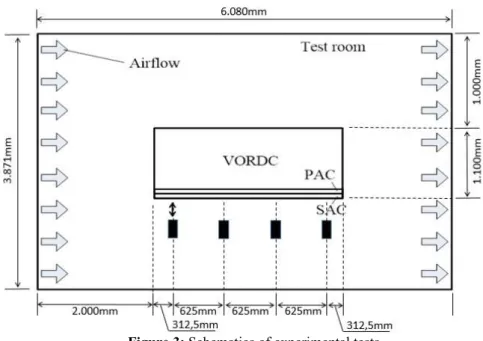
The solid body was positioned in front of the VORDC at a distance of 500 mm from the shelves. At this distance, the solid object is able to cross the PAC. The solid object is a cylinder with diameter D = 100 mm and a length L = 200mm, connected to a pneumatic cylinder as shown in Figure 2.
Figure 2: Solid Body (solid bodies location).
This solid body was replicated four times along the VORDC length. Thus, four aligned solid bodies were placed in each shelf level as shown in Figure 3. This design aims to evaluate the influence of the location along length of the air curtain breaking on the thermal performance. The locomotion of the automated solid body system was programmed in a Programmable Logic Controller (PLC).
2212, Page 6
Figure 3: Schematics of experimental tests.
3.3 Experimental testing procedure
This work starts from the results obtained by Nascimento et al. (2013, 2014a, 2014b) through the development of experimental studies aimed to optimize the thermal performance with adjustment of the air flow between the DAG and PBP. The best configuration lead to tests carried out with a Mannequin for Automatic Replication of the Interference in the Air curtain (MARIA) moving in the front of the VORDC in order to determine the thermal performance when subjected to the transfer of an object (MARIA) in the frontal opening.
The results showed that: (1) adjusting the proportion of air flow between the DAG and PBP improved the VORDC performance by 10%. (2) the movement of MARIA in front of the VORDC at a velocity of 0.6 m.s-1 increased energy
consumption by 4.6%. These results are part of a more detailed study of the interference on the air curtain triggered by consumers. These results are to be used in the development of new products on an industrial scale. This experimental study is part of that study since it was designed to evaluate the influence of the systematic passage of consumers in front of the VORDC on the perturbation of the air curtain and consequently on its performance. This experimental study aims to quantify the thermal load increase in the VORDC when the air curtain is breached by a solid body, which simulates the movement of products been taken out or refilled in a real condition.
The reference values for the opening frequency and breaking velocity of the air curtain by the solid bodies were based on the test parameters defined on the ISO 23953-2/2005 (2005) testing standard of vertical closed refrigerated display cabinets (VCRDC). This standard suggests that testing of VCRDC should be carried opening each door six times per hour. The commercial model of VCRDC with a 2.5 m length have in general 4 doors. Therefore, for this case it means that doors will open consecutively each 150 sec during the experimental test.
The initial tests of the interference of the air curtain by solid bodies were conducted with a time period of 150 sec. The experimental tests (ET) were performed for the height corresponding to each shelf (for decreasing height from the Shelf 4 – SH4; Shelf 3 – SH3; Shelf 2 – SH2; Shelf 1 – SH1; to the Well Tray – WT) and along the its length (for increasing length along each shelf: 312,5mm; 937,5 mm; 1562,5 mm; 2187,5 mm). However, the results obtained had not significant variation due to the fast stabilization of the air curtain and consequently of the thermal performance of the VORDC. Thus, it was necessary to reduce the time intervals for 100 sec. The ET are named as follows: ET.0 for the initial condition without the interference of the air curtain by the solid body; ET.1 for interference at the height of the SH4 and so forth until the height of WT (ET.5). The ET were performed three times for each configuration. Each 24 hour ET was performed after a 24-hour stabilization period.
2212, Page 7
consumption of the VORDC is 4.82 kW. From the analysis of Figure 4, the highest energy consumption of the VORDC is obtained when the air curtain is breached at the height of the Shelf 2 (ET.3). At this position, the energy consumption of the VORDC increases 70 W in relation to the base case. This location is at mid-height of the frontal opening. At this height, the air curtain has less momentum so that the breach caused by the solid body passage promotes a large thermal entrainment. The air curtain is unable to rapidly stabilize after the solid body came out, whereas the vortex and turbulence generated by the solid body passage promotes mixing between the two air masses, ambient air and refrigerated air inside de VORDC.Comparing the energy consumption results shown in Figure 04, each time that an object with such dimensions goes through the air curtain (like a consumer arm) at the height of SH4, near the DAG, increases the energy consumption by 170 mW. For decreasing heights of SH3, SH2, SH1, the energy consumption increase is 540 mW, 810 mW and 230 mW.
In contrast, the energy consumption of the VORDC when the air curtain is breached at the height of the WT, ET.5, shows no difference to ET.0. This is due to the fact that the WT is too close to the RAG. The air curtain is a mix of refrigerated air and ambient air at this height. Considering that each solid object went through the air curtain every 400 sec and that the time between defrosts was 144 min (8540 sec), there were 86 breaks of the air curtain in each ET.
Figure 4: Relative increase of the energy consumption by ET.
Table 2 shows the average, maximum, minimum and standard deviation of the temperature values of the product simulators placed inside the VORDC. In relation to the simulators temperatures, Nascimento et al. (2013b, 2013c) demonstrated that there are differences of products temperature between the shelves. However, in what concerns the experimental tests devoted to simulate the air curtain crossing by people arms, the variation of the products temperature is not perceptible.
Table 2: Temperature values of product simulators placed in each shelf height. Shelf Temperature [ºC] SH4 SH3 SH2 SH1 WT Average 2.5 3.7 3.4 3.8 4.4 Maximum 2.7 4.0 3.6 4.1 4.6 Minimum 2.0 3.3 2.9 3.4 3.9 Standard deviation 0.2 0.2 0.2 0.2 0.2
2212, Page 8
In practice, the joint analysis of the values of energy consumption and products temperature allows to suggest that products exposed at the height of SH2 in a VORDC at a convenience store, have a low aggregated financial result for sale of the product. In this case, the products with higher turnover should be placed in height levels of SH4, SH1 and WT. In that way, the air curtain breaking was a smaller effect on the energy consumption increase.5. CONCLUSIONS
This experimental test quantified the increase of the energy consumption when a solid body systematically crosses the cold air curtain. The results showed that for each air curtain interference there is an increase in the energy consumption of the VORDC. The highest energy consumption of the VORDC is obtained when the air curtain is breached at the mid-height of the frontal opening, i.e. at the height of Shelf 2 (ET.3). At this position, the energy consumption of the VORDC increases 70 W in relation to the base case. At this position, the energy consumption of the VORDC increases 70 W in relation to the base case.
The air curtain broken at height levels of SH4 (near discharge air grille), SH1, and WT (near return air grille) recovers faster its flow structure, providing again an aerothermodynamics barrier to thermal interaction with ambient air. When the air curtain is crossed at the height levels of SH2 and SH3, due to the lower momentum of the air curtain, it takes longer to recover its sealing structure and consequently the thermal entrainment is higher and thus the energy consumption.
In this sense, it was concluded that, in a real condition is the most suitable to expose high turnover products at height levels of SH4, SH1 and WT shelves.
Another relevant factor is that for air curtain break occurring each 100 sec, the products temperature is not significantly changed; however, it is worth to note that in a real condition the interferences are totally random and different frequencies throughout the day. A higher frequency of the air curtain interference will also affect the products temperature.
NOMENCLATURE
CFD Computational Fluid Dynamics
DAG Discharge Air Grille
DPIV Digital Particle Image Velocimetry
HX Heat exchanger
MARIA Mannequin for Automatic Replication of the Interference in the Air curtain ORDC Open Refrigerated Display Cabinets
PAC Primary Air Curtain
PBP Perforated Back Panel
PLC Programmable Logic Controller
RAG Return Air Grille
SAC Secondary Air Curtain
SH Shelf
TEF Thermal Entrainment Factor
VCRDC Vertical Closed Refrigerated Display Cases VORDC Vertical Open Refrigerated Display Cases
WT Well Tray
b width (m)
D diameter (m)
Dm deflection modulus (-)
L length (m)
ø air relative humidity (%)
T air temperature (ºC)
v air velocity (m.s-1)
direction (º)
total cooling load (W) refrigerant mass flow (kg/s)
2212, Page 9
Subscriptamb ambient air
DAG Discharge Air Grille
PAC Primary Air Curtain
RAG Return Air Grille
SAC Secondary Air Curtain
REFERENCES
ASHRAE. (2010). ASHRAE Handbook: Refrigeration. Atlanta, Ga: American Society of Heating, Refrigerating and Air Conditioning Engineers (ASHRAE).
ASHRAE 72-2014 (2014). Method of Testing Open and Closed Commercial Refrigerators and Freezers. Atlanta, Ga: American Society of Heating, Refrigerating and Air Conditioning Engineers (ASHRAE).
Carneiro, R., Gaspar, P.D., & Silva, P.D. (2015). 3D transient CFD modeling of sliding door operation and its influence on the thermal performance of cold rooms. Proceedings of the 24th IIR International Congress of Refrigeration (ICR2015), International Institute of Refrigeration (IIR), Yokohama, Japan.
Chen, Y. (2009). Parametric evaluation of refrigerated air curtains for thermal insulation. International Journal of Thermal Sciences 48(10), 1988-1996.
Chen, Y., & Xia, D.H. (2011). The flow characteristics analyses of refrigerated air curtains in multi-deck display cabinets. Proceedings of the International Congress of Refrigeration, 23rd ed., Prague, Czech Republic: IIF/IIR. Chen, Y., & Yuan, X.-L. (2005). Simulation of a cavity insulated by a vertical single band cold air curtain. Energy Conversion and Management 46(11-12), 1745-1756.
Faramarzi, R. (1999). Efficient display case refrigeration. ASHRAE Journal 41(11), 46–52.
Foster, A.M., Madge, M., & Evans, J.A. (2005). The use of CFD to improve the performance of a chilled multi-deck retail display cabinet. International Journal of Refrigeration, 28(5), 698–705.
Freedonia (2014). World Commercial Refrigeration Equipment - Industry Study with Forecasts for 2018 & 2023. Freedonia.
Gaspar, P.D., Gonçalves, L.C.C., & Ge, X. (2010). CFD parametric study of ambient air velocity magnitude influence in thermal behaviour of open refrigerated display cabinets. Proceedings of the 5th European Conference on Computational Fluid Dynamics (ECCOMAS CFD 2010), Lisbon, Portugal.
Gaspar, P.D., Gonçalves, L.C.C., & Ge, X. (2010). Influence of ambient air velocity orientation in thermal behaviour of open refrigerated display cabinets. Proceedings of the ASME 2010 10th Biennial Conference on Engineering Systems Design and Analysis ESDA 2010 (ASME ESDA 2010), Istanbul, Turkey, July: ASME.
Gaspar, P.D., Gonçalves, L.C.C., & Pitarma, R.A. (2011). Análise Experimental da estabilidade de cortinas de ar de equipamentos de refrigeração para diferentes condições do ar ambiente, Proceedings of the International Conference on Engineering (UBI 2011), Covilhã, Portugal.
Gaspar, P.D., Gonçalves, L.C.C., & Pitarma, R.A. (2011). Experimental analysis of the thermal entrainment factor of air curtains in vertical open display cabinets for different ambient air conditions. Applied Thermal Engineering 31(5), 961–969.
Gaspar, P.D., Gonçalves, L.C.C., & Vogeli, A. (2009). Dependency of air curtain performance on discharge air velocity (grille and back panel) in open refrigerated display cabinets. Proceedings of the ASME International Mechanical Engineering Congress and Exposition, Lake Buena Vista, Florida, U.S.A: ASME.
Hayes, F.C., & Stoecker, W.F. (1969). Design data for air curtains. ASHRAE Transactions 75(2), 68-180.
Heidinger, G.G., Nascimento, S.M., Gaspar, P.D., & Silva P.D. (2013). Impact des conditions ambientes sur les performances de meubles frigorifiques verticaux ouverts. Revue Générale du Froid & du conditionnement d’air, Octobre – Novembre, 2014.
Heidinger, G.G., Nascimento, S.M., Gaspar, P.D., & Silva, P.D. (2014a). Influence of the test procedure for setting the external air movement on the thermal performance of open multideck display case. Recent Advances in Mechanical Engineering 11, 96-104.
Heidinger, G.G., Nascimento, S.M., Gaspar, P.D., & Silva, P.D. (2014b). Impact of external air currents on the performance of open multideck display case evaporators in laboratory conditions. Proceedings of the 5th International Conference on Fluid Mechanics and Heat & Mass Transfer (FLUIDSHEAT'14), Lisbon, Portugal, 96-104.
Heidinger, G.G., Nascimento, S.M., Gaspar, P.D., & Silva, P.D. (2015a). Variation of the thermal performance of open multideck display case due to the procedure of setting the external air velocity. International Journal of Energy and Environment 9, 73-82.
2212, Page 10
Heidinger, G.G., Nascimento, S.M., Gaspar, P.D., & Silva, P.D. (2015b). Experimental study of the influence of consumers’ movement parallel to the frontal opening of a multideck display case on the evaporator's thermal performance. Proceedings of the 24th IIR International Congress of Refrigeration (ICR2015), International Institute of Refrigeration (IIR), Yokohama, Japan.Huzayyin, A.S., Nada, S.A., & Elattar, H.F. (2007). Air-side performance of a wavy-finned-tube direct expansion cooling and dehumidifying air coil. International Journal of Refrigeration 30, 230-244.
ISO 23953-2 (2005). Refrigerated display cabinets - Part 2: Classification, requirements and test conditions. Geneva, Switzerland: International Organization for Standardization (ISO).
Nascimento, S.M., Heidinger, G.G., Gaspar, P.D., & Silva P.D., (2013). Thermal insulation by air curtains in open refrigerated display cabinets - Comparison of the thermal performance of tests performed in laboratory, open and closed food shop conditions. Proceedings of the International Conference on Engineering (ICEUBI 2013), Covilhã, Portugal.
Nascimento, S.M., Heidinger, G.G., Gaspar, P.D., & Silva P.D. (2014a). Performance variation of vertical refrigerated display case in situ operation and testing according to ISO and ASHRAE STANDARDS. Proceedings of the 3rd IIR International Conference on Sustainability and the Cold Chain (ICCC 2014), London, United Kingdom: IIF/IIR. Nascimento, S.M., Heidinger, G.G., Gaspar, P.D., & Silva P.D. (2014b). Experimental study of the interference in air curtains due to the parallel transfer in front of refrigerated display cases. Proceedings of the ASME 2014 12th Biennial Conference on Engineering Systems Design and Analysis ESDA2014, Copenhagen, Denmark: ASME.
Nascimento, S.M., Heidinger, G.G., Gaspar, P.D., & Silva, P.D. (2015). Experimental analysis to optimize the performance of air curtains and heat exchangers: Application to open refrigerated display cases, Ch. 16, pp. 590-640, in Gaspar, P.D., & Silva, P.D. (Eds.), Handbook of Research on Advances and Applications in Refrigeration Systems and Technologies, IGI Global.
Navaz, H.K., Henderson, B.S., Faramarzi, R., Pourmovahed, A., & Taugwalder F. (2005). Jet entrainment rate in air curtain of open refrigerated display cases. International Journal of Refrigeration 28(2), 267–275.
Reindl, D.T., & Jekel, T.B. (2009). Frost on air-cooling evaporators. ASHRAE Journal 51(2), 27-33. Rigot, G. (1991). Meubles et Vitrines Frigorifiques. PYC DITION, París, France, 340p.
Yu, K., Ding, G., & Chen, T. (2009). A correlation model of thermal entrainment factor for air curtain in a vertical open display cabinet. Applied Thermal Engineering 29(14-15), 2904–2913.