Repositório ISCTE-IUL
Deposited in Repositório ISCTE-IUL: 2019-03-20
Deposited version: Post-print
Peer-review status of attached file: Peer-reviewed
Citation for published item:
Lebres, I., Rita, P., Moro, S. & Ramos, P. (2018). Factors determining player drop-out in Massive Multiplayer Online Games. Entertainment Computing. 26, 153-162
Further information on publisher's website: 10.1016/j.entcom.2018.02.010
Publisher's copyright statement:
This is the peer reviewed version of the following article: Lebres, I., Rita, P., Moro, S. & Ramos, P. (2018). Factors determining player drop-out in Massive Multiplayer Online Games. Entertainment Computing. 26, 153-162, which has been published in final form at
https://dx.doi.org/10.1016/j.entcom.2018.02.010. This article may be used for non-commercial purposes in accordance with the Publisher's Terms and Conditions for self-archiving.
Use policy
Creative Commons CC BY 4.0
The full-text may be used and/or reproduced, and given to third parties in any format or medium, without prior permission or charge, for personal research or study, educational, or not-for-profit purposes provided that:
• a full bibliographic reference is made to the original source • a link is made to the metadata record in the Repository • the full-text is not changed in any way
The full-text must not be sold in any format or medium without the formal permission of the copyright holders. Serviços de Informação e Documentação, Instituto Universitário de Lisboa (ISCTE-IUL)
Factors determining player drop-out in Massive Multiplayer Online Games
Abstract
A large number of people worldwide play free-to-play Massive Multiplayer Online Games (MMOGs) on a regular basis. Considering the significant amount of investment required in the early phases of game development, product managers aiming to quickly attract players deploy several in-game premium features which can be purchased by players willing to leverage their gaming experience. When the gap of advantage between premium and non-premium players is quite noticeable, it may lead to the lack of game fairness, resulting in players dropping out. This study aims at understanding the relevance of the drop-out factors that can be controlled by product managers, with an emphasis on game fairness when compared to other factors. A survey was sent to English-speaking communities of a MMOG. Results show that 53.9% of the variation in dropping-out is explained by the significant predictors analyzed: latency/performance issues, in-game features, community, service/support team and game fairness. Latency/performance issues and game fairness are the most relevant drop-out factors. By focusing on drop-out factors that can be controlled by product managers, this research contributes for decision making in the development of free-to-play MMOGs.
Keywords
1. Introduction
Massive Multiplayer Online Games (MMOGs) are videogames played online over the Internet where a large quantity of individuals can interact simultaneously in persistent worlds (which exist regardless of whether players are logged in the game or not) through their self-created characters/avatars, with other players’ avatars as well as with the gaming software [1, 2].
In the free-to-play (F2P) MMOG industry, product managers are required to offer players premium paid features as a primary source to finance all the resources used to develop such category of games. However, pushing it too hard – that is, having lots of premium features in important game mechanisms or creating premium features that grant huge advantages for those who decide to invest on the game (premium players) – leads to a lack of game fairness in the perspective of non-premium players. Those players may eventually stop playing the game and thus this sense of game unfairness may increase the drop-out rates. Moreover, there seems to be no tendency to find an equilibrium and so interests of shareholders towards profitability may conflict with users’ interests [3, 4, 5].
Notwithstanding, no studies were found concerning the relation between the lack of game fairness and (other) drop-out factors on MMOGs. The present research is an attempt to fill such gap by furthering research on this issue in the perspective of the players’ motivations to play MMOGs, thus helping to unveil unnoticed aspects on the development of MMOGs related to drop-out factors. By understanding what impels players to leave MMOGs, product managers will be able to manage their efforts on players’ retention more effectively. From a managerial perspective, game developers and publisher companies with balanced shareholders and players’ interests may forecast a decrease in the drop-out rates, which means that more players will be investing on them and the results of the companies will be improved [6, 7]. In consequence,
players will be much more engaged in the online communities when feeling that their feedback really counts towards the development of the game, translating it into an increase of user satisfaction. Those types of games can be, in that moment, creative and mindful hobbies and the communities will be certainly places for pro-active discussions, inevitably leading to positive electronic word-of-mouth [8].
This research aims to establish a relation between product managers’ decisions and the motives behind players quitting F2P MMOG and how the advantage gap between premium and non-premium players affects the drop-out rates. Thus, the research questions are as follows:
• What are the main drop-out factors related to MMOG which may be controlled by product managers?
• Are the drop-out factors common to premium and non-premium players?
• What is the level of importance of game fairness (gap between premium and non-premium players) when compared to (other) drop-out factors?
2. Background
2.1. MMOGs overview
Within MMOGs, there are several game categories. From these, MMORPG, MMORTS and MMOFPS are the most known initials [9]. MMORPG stands for Massive Multiplayer Online Role-Playing Games (e.g. World of Warcraft, Ultima Online), which represent the most common type of MMOGs, with focus on character development, player versus player (PvP) and player versus environment (PvE) combat, existence of communities within the game (e.g., tribes, guilds, clans) and item collection; MMORTS means Massive Multiplayer Online Real Time Strategy
(e.g., Tribal Wars, Clash of Clans), with focus on strategy and tactics, so that the progress of a single player is very dependable on the game styles and relationship with others; MMOFPS are the initials for Massive Multiplayer Online First Person Shooter (e.g. Counterstrike, Project Blackout), where the main goal is to shoot other players within 3D maps [2]. One other genre that has been gaining more fans over the years is MOBA (Multiplayer Online Battle Arena), which may explain why League of Legends deposed World of Warcraft in terms of revenues in 2014.
Previous studies have been conducted to understand the evolution of business/revenue models in the MMOG industry, concluding that we are experiencing a shift [3, 10]. In the beginning, subscription-based (or pay-to-play - P2P) MMOGs were the most popular ones and game developers would collect their earnings by charging players on monthly fees. Although World of Warcraft observed an increase on the number of subscribers, the games that thrive through a subscription revenue model are declining and its tendency is to being pushed by F2P MMOGs - this free way of making money lies basically on the inclusion of premium in-game features, which players can use by purchasing virtual game currency, and advertising [11]. SUPERDATA RESEARCH INC. [12] estimates that F2P MMOG will generate $17.1 billion, while the pay-to-play continues its fall to $2.7 billion.
2.2. Game fairness
Notwithstanding being a billion dollar industry, a successful MMOG requires a huge initial investment and continuous expenditures to maintain the game running. These facts obviously influence the decisions of those responsible for the product, the product managers. Thus, to assure sustainability, one of the primary concerns of managers is the game longevity, given that
business must generate revenues to finance the initial investment and support running costs, thus maximizing revenues while minimizing costs [3, 13, 14].
The aforementioned running costs include the distribution of content and game servers (usually to maintain a MMOG the game developers make updates regularly, which include feature rebalancing, creation of new features and bug fixes), service infrastructures and supporters to provide in-game support and keep game communities alive (customer service platforms and those who manage them are expensive), and marketing costs in order to attract new customers and retain players. That’s why Alves and Roque [15] state that “every MMOG requires a steady and continuous flow of income to keep it running, since the cost structure also involves a continuous flow of, usually proportional, maintenance costs. That income comes from players that are actually playing and paying, and therefore, a MMOG needs a constant and large population or number of players to grant its survival.”. Hamari [3] also support this argument.
Thus, pressured by shareholders, who aim at short-term results, product managers’ primary solution to finance all the resources spent on free-to-play MMOG is the addition of so-called premium features. However, pushing the need to finance the game to the limit by adding increasingly more premium features in core game mechanisms or creating premium features that grant huge advantages for those who decide to invest on the game (paying players) may break the players’ vision of a fair game [3, 4, 5].
Although the majority of players seem to agree upon a free-to-play MMOG need to earn money to survive, the game must still possess certain elements of fun and fairness, otherwise players will switch in mass to other games they consider having these characteristics. In fact, some players argue publicly in community forums that those who want to participate in the whole
experience of a F2P MMOG will have to spend more money on in-game currency than they would on P2P games and thus gain plenty advantage against non-premium players. Lin and Sun [5] go on to consider that in P2P games players are all equal, whereas in F2P games players are divided on premium and non-premium players. The latter case evidences the unfair phenomenon of “one game, two experiences”. Some studies mention that free game play is heavily influenced by those who spend money, creating inequality. As an example, Lin and Sun [5] state that, although the “balance” idea is vague and dependent on the context, the players’ sense of fairness is imposing a balance in the games - meaning that “all player types should have equal opportunity to survive in and enjoy all game worlds”. This implies that product managers must find equilibrium between the shareholders and players interests.
2.3. Players as customers
In competitive markets, such as the online gaming industry, successful companies are the ones that best meet the needs of customers and find balance between long and short-term goals, aligning the interests of several stakeholders [16]. As stated by Kinnunen et al. [6], “(...) successful product development usually requires the interaction with several stakeholders, both internal and external. (...) To achieve product success, it is essential to understand both the objectives of stakeholders and the means through which their interest can affect the design and development.”.
However, each organization has always a wide range of stakeholders, which means that some stakeholders have more salience than others in product development. Since product managers have limited time and resources, they must determine stakeholders’ salience and manage stakeholders based on it [17]. Furthermore, Hillman and Keim [18] found that stakeholder
management is positively associated and leads to improved shareholder value creation – in this study shareholder value is represented as Market-Value Added (MVA = market value – capital).
Many authors agree that the most salient stakeholder should be the customer [6, 19], since the market is composed by this entity. Actually, according to Jobber and Ellis-Chadwick [20], meeting the objectives of stakeholders is achieved by satisfying customers, hence emphasizing the concept of customer orientation. Customer-oriented organizations set as a top priority customer needs and satisfaction, thus believing that the organization must have a dynamic interaction with the customer [21].
In order to have that dynamic interaction with customers and collecting benefits from it, companies must apply a specific business strategy supported by technologies and systems. Customer Relationship Management (CRM) is a business strategy which tends to grant the maintenance of profitable long-term business relationships with customers [22]. This customer-oriented management philosophy brings higher profitability, customer loyalty and brand identification [7, 23].
An important element of the online gaming industry included on CRM is customer care. As Piskorski [24] pointed out, a successful community strategy is the one which is able to help establish not only the relationship between customer and company but also the relationship between customers and products or services. Customer care in the MMOG industry is done generally through specific platforms (e.g., external forums, support systems), that players are able to use to provide feedback, report technical problems, report inappropriate behaviors occurring in-game, ask questions and submit complaints – Uusitalo et al. [25] argue that “customer complaints can be a valuable and inexpensive source of information for identifying
systematic errors and enabling customer-focused process improvement”, since this feedback “provides a more reliable picture of the customer’s true opinion”. All those issues are handled by support/moderation teams. A good service at this level is imperative as it is an important and large part of the communication that a company performs with its customers. It becomes even more vital and necessary when talking about virtual/online communities. With such a perspective in mind, product managers must be aware of players’ behaviors and feedback, making an effort to address their needs and trying to prevent the existence of high drop-out rates.
According to Chambers et al. [15], to keep players satisfied, which is an essential aspect to develop a successful game, product managers must understand players’ behavior and how to address their needs. The aforementioned authors unveiled the following characteristics:
• Players are impatient – There is a noteworthy degree of impatience to busy game servers – high latency – as it influences the game performance and consequently the playing experience and the user satisfaction [26];
• Player churn is considerable and increases over time – The ability to retain and attract new players decreases over time, mainly because players lose interest in the game due to power imbalance;
• Updates slightly impact player growth and gameplay – Games are often updated to provide new content to the players and keep them interested. Although in an ideal world these updates would impact player retention, those are not the conclusions taken by Chambers et al. [14];
• Players reveal when they lose interest – Players play less than their average when they are about to leave the game (they log in less regularly and each playing session is shorter than usual).
Achterbosch et al. [2] state that the in-game graphics and effects, a large world to explore, socialization and PvP combat are the features that players like the most. In the other side of the balance, exploiting/cheating, running out of game content, in-game griefing and high latency are considered as the worst plagues in MMOG. Anderson [27] observes that the four major problems seem to be lack of clearly defined goals, the amount of time the game demands for the player to be affective in the game server, interference with the gamers’ personal life and too complex and/or oversized game server.
2.4. Motivation to play MMOGs
To better understand why players access to their game accounts regularly, we must look at their motivation factors and which elements are responsible for their engagement in a MMOG. Thus, according to Yee [28], those elements are divided in the following three components:
• Achievement component – This component includes the desire to have a quick progress and accumulate in-game items that give the player as much power as possible; the interest in understanding the system and features that compose the game in order to get a character performance optimized; and the desire to compete with other players.
• Social component – This component includes the interest in helping and chatting with others; the desire to create relationships and bonds with other players; and the satisfaction deriving from teamwork.
• Immersion component – This component includes the satisfaction of discover game aspects that other players don’t know about; the interaction with other players having created a character with a background story (role-play); the customization of the character; and the possibility to use the virtual environment to disconnect from the real life problems during some moments.
Using the components mentioned above and two more components (relaxing and escaping), Dauriat et al. [29] researched on the importance of fourteen items. Table 1 displays these items.
Table 1 - Motivation items (adapted from Dauriat et al. [29]). What importance do you give to the following factors?
1 Entertainment Immersion component
2 Escaping from real world Escaping component
3 Passing time Escaping component
4 Meeting new people Social component
5 Relaxing Relaxing component
6 Source of adrenalin Relaxing component
7 Being a member of a top guild/clan Achievement component 8 Fame and recognition Achievement component
9 Competitiveness Achievement component
10 Communication tools outside the game Social component 11 Chat with other players Social component 12 Exploring and discovering the world Immersion component 13 Avatar style and aspect Immersion component 14 Having responsibilities within the guild/clan Achievement component
These several components may predict game addiction as suggested in studies conducted by
Nacke et al. [30] and Dauriat et al. [29]. Kuss et al. [31] state that “there is a thin line between high engagement (...) and addiction”, but these concepts have distinct indicators. An engaged player pursues game enjoyment while an addicted player is compelled by withdrawal symptoms to keep playing in order to alleviate those symptoms [32].
Lee et al. [33], Beranuy et al. [34] and Griffiths [35] argue that there are core components a player needs to experience to get addicted to a video game. Those are salience – occurs when playing dominates a person’s thinking, feelings and behavior and becomes the most important activity in his or her life –, mood modification – when the players’ game experience is a way of
dealing or escaping from other areas on their life –, tolerance – if a player increase the amount of time in the game due to mood modification effects, it leads to tolerance –, withdrawal symptoms – feeling states or physical effects that players experience when they are not able to play –, conflict – occurs when playing too much time starts to interfere with players’ lives – and relapse – happens if, when trying to change behavior and reduce playing time, the previous behavior is quickly restored.
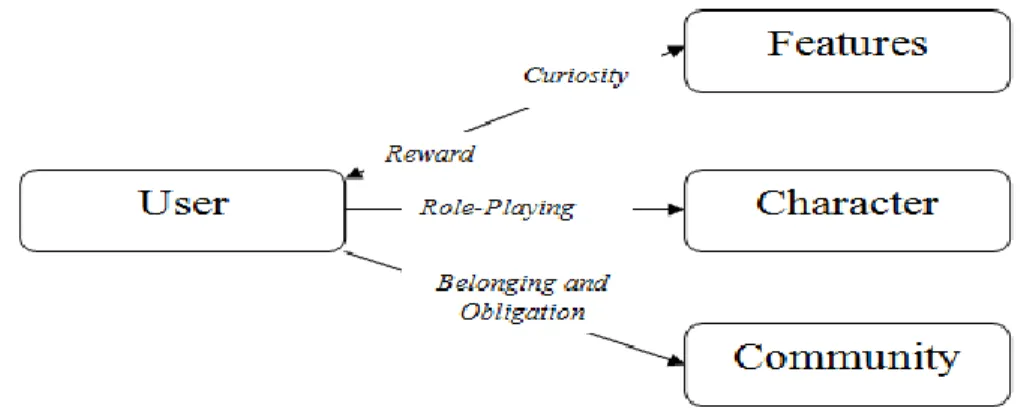
According to Hull et al. [36], Griffiths et al. [37], and King et al. [38], some features that MMOGs possess rise the probability of experiencing the above mentioned addiction indicators. Amongst them, the social features (in-game voice and text chat, existence of guilds/clans, score lists, forums and strategy guides) have the most significant impact. Also, Beranuy et al. [34] and Smahel et al. [39] pointed out that players’ identification with their in-game character may stimulate an addictive use of video games. Moreover, Hsu et al. [40] found out five factors that have high probability of causing addiction – curiosity of interacting with the game environment and making new discoveries on game features; reward related activities (King et al. [38] state the same); belonging to a community; obligation towards a guild/clan/community; and role-play. Figure 1 summarizes it.
Lee et al. [41] state that “Multiple factors influence gamers to quit playing MMORPG, and those factors tend to reflect the reasons why gamers became addicted to those MMORPG.”. According to the same authors, the drop-out factors can be divided in three categories:
• Immersion in a virtual environment – those factors are tied to the effort required to reach goals without recurring to premium currency, changes in in-game features players do not like, or a lack of excitement or pleasure from repetitive playing due to games not being updated often;
• Social networks – one of the common features of MMOGs is the existence of guilds/alliances. “After accumulating many good memories with other gamers, tight bonds within a social network give some gamers a sense of belonging and responsibility that they don’t feel in their offline lives. But there can be another side to this sense of belonging as it becomes a social burden.” When there are problems with guild members, the guild often gets fractionated and many players may leave the game as they lose that bond;
• Gameplay is situated in real-life social contexts – gamers that get addicted and play for many hours may get pressured to stop playing by their family and peers who disapproved it.
This research intends to go beyond current state of the art and study elements that can be associated to the game itself and lead to players quitting games, while at the same time analyzing if these are the same for premium and non-premium players.
3. Research hypotheses
Several authors have studied and identified drop-out factors, as described in the previous section. In the present study, a drop-out factor is defined as the reason why players quit F2P MMOGs. The present research is only interested in the factors that product managers are able to control, at
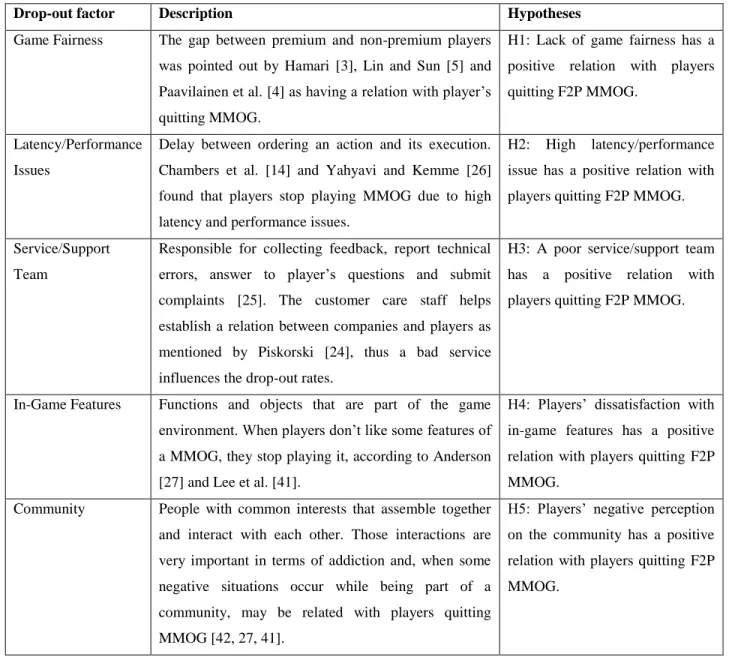
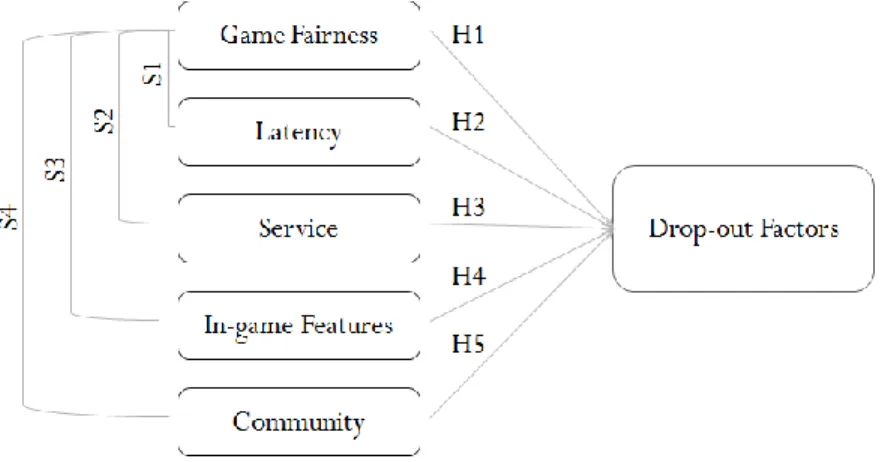
least to a certain degree. Table 2 highlights the five drop-out factors identified in the literature next to the derived hypotheses that this research intends to test. Figure 2 illustrates the proposed research hypotheses.
Table 2 - Drop-out factors and research hypotheses.
Drop-out factor Description Hypotheses
Game Fairness The gap between premium and non-premium players was pointed out by Hamari [3], Lin and Sun [5] and Paavilainen et al. [4] as having a relation with player’s quitting MMOG.
H1: Lack of game fairness has a positive relation with players quitting F2P MMOG.
Latency/Performance Issues
Delay between ordering an action and its execution. Chambers et al. [14] and Yahyavi and Kemme [26] found that players stop playing MMOG due to high latency and performance issues.
H2: High latency/performance issue has a positive relation with players quitting F2P MMOG.
Service/Support Team
Responsible for collecting feedback, report technical errors, answer to player’s questions and submit complaints [25]. The customer care staff helps establish a relation between companies and players as mentioned by Piskorski [24], thus a bad service influences the drop-out rates.
H3: A poor service/support team has a positive relation with players quitting F2P MMOG.
In-Game Features Functions and objects that are part of the game environment. When players don’t like some features of a MMOG, they stop playing it, according to Anderson [27] and Lee et al. [41].
H4: Players’ dissatisfaction with in-game features has a positive relation with players quitting F2P MMOG.
Community People with common interests that assemble together and interact with each other. Those interactions are very important in terms of addiction and, when some negative situations occur while being part of a community, may be related with players quitting MMOG [42, 27, 41].
H5: Players’ negative perception on the community has a positive relation with players quitting F2P MMOG.
Figure 2 – Research hypotheses.
In this research, the particular relevance of game fairness when compared with the other drop-out factors was also scrutinized. Therefore, four additional hypotheses are included in Figure 2:
• S1: Game fairness and latency are equally important when deciding to leave free-to-play MMOGs;
• S2: Having a great support team is more important than the game's fairness;
• S3: There's no sense on deploying new features that will make free-to-play MMOGs significantly unfair;
• S4: Players would continue to play unfair free-to-play MMOG, as long as it has an engaged community.
4. Research methodology 4.1. Survey
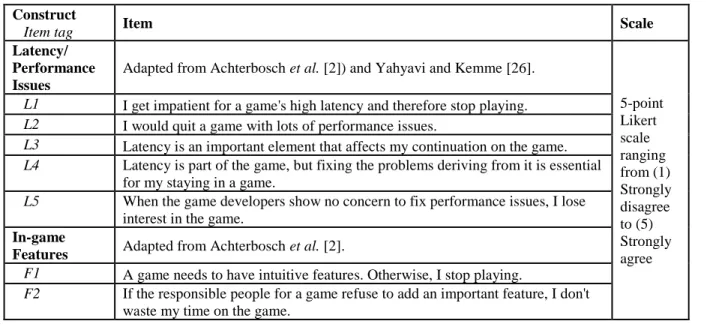
In order to achieve the study objectives, a survey was designed. Online surveys are an efficient way to reach the maximum users in a short period of time and the sense of anonymity tends to impel honest answers. Taking the data collected, the conceptual model constructs were the target of a validity and reliability analysis. The survey includes demographic questions – age, gender and country of origin –, general questions regarding F2P MMOGs – which game(s) the respondents play/played, money spent on average per month and reasons why they quit the games – and several questions related with the conceptual model constructs – latency/performance issues, in-game features, community, service/support team and game fairness – in order to test the research hypotheses. The questions were drawn from the literature detailed in Section 2 (Table 3). The first version of the survey was revised and answered by a test group composed by 20 people from company XPTO (fictitious name, since the company required anonymity). After some suggestions and discussion, the final version was implemented. The survey recipients are F2P MMOG players which speak English, thus it was spread on the English-based communities of a specific MMORTS from company XPTO.
Table 3 - Items for each construct and measurement scale.
Construct
Item tag Item Scale
Latency/ Performance Issues
Adapted from Achterbosch et al. [2]) and Yahyavi and Kemme [26].
5-point Likert scale ranging from (1) Strongly disagree to (5) Strongly agree L1 I get impatient for a game's high latency and therefore stop playing.
L2 I would quit a game with lots of performance issues.
L3 Latency is an important element that affects my continuation on the game.
L4 Latency is part of the game, but fixing the problems deriving from it is essential for my staying in a game.
L5 When the game developers show no concern to fix performance issues, I lose interest in the game.
In-game
Features Adapted from Achterbosch et al. [2].
F1 A game needs to have intuitive features. Otherwise, I stop playing.
F2 If the responsible people for a game refuse to add an important feature, I don't waste my time on the game.
F3 If an essential feature takes lots of time to be implemented, I'll not be there when it happens.
F4 When a feature is promised, I expect to get it on time or I would stop playing.
F5 Too complex features would make me leave the game. Community Adapted from Dauriat et al. [29] and Chang et al. [43].
C1 When my in-game friends leave the game, I stop playing it.
C2 When I feel that I don't belong to the community, I rather stop playing.
C3 A secure and fun environment on the community is essential for my continuation on the game.
C4 My relationship with my guild members affect my willingness to continue to play the game.
C5 Community is an important element that affects my continuation in the game. Service/Suppo
rt Team Adapted from Chou [42].
ST1 Having a team that shows lack of knowledge on the game, makes me leave the game.
ST2 If the support team is not pleasant, I just leave the game.
ST3 When there're proves of bad procedures on the support team, I stop playing the game.
ST4 Lack of professionalism by the support team, makes me stop playing the game.
ST5 The service provided by the support team is an important element that affects my continuation in the game.
Game
Fairness Adapted from Lin and Sun [5] and Paavilainen et al. [4].
GF1 When features provide huge advantages for those who spend money, I would stop playing.
GF2 If I feel that the game is providing unfair advantages, I would leave it.
GF3 If the game is unfair and people in charge show no concern in solving it, I would leave the game.
GF4 If the game doesn't provide a fair competition, I would leave it.
GF5 When I cannot compete with premium players without spending money, I lose interest on the game.
GF6 Game fairness is an important element that affects my continuation in the game.
The survey was active for one week and got a total of 96 valid responses. The respondents are from several countries, including United Kingdom, United States (over 30% from the UK and US), Germany, Portugal, Australia, the Netherlands. Almost 40% of players is between 18 and 29 years old, and 87.5% of the sample is male. Several additional sample characterization findings should be stated. First, 60% of the respondents under 18 years old are from the USA and the UK. Also, only 20% of the respondents between 30 and 39 years old are from English-speaking countries. To the question “How much money do you spend per month, on average, in
F2P MMOG?”, under 18, 18-29 and 50-59 are the age ranges that spend less money. Players over 60 years old spend more money on average. Additionally, 59.5% of the male do not spend money on F2P MMOG, while 32.1% spend between 0 and 20 USD and only 8.3% spend more than 20 USD.
4.2. Validity and Reliability Analysis
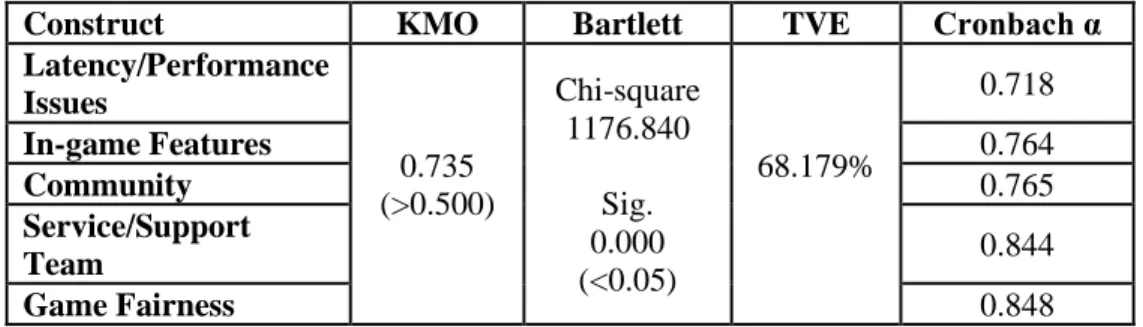
The several items (shown in Table 3) from the five constructs of this study – latency/performance issues, in-game features, community, service/support team and game fairness – were subjected to various tests in order to assess their validity and reliability.
The validity was tested by performing a principal component analysis (PCA) with varimax rotation. The Kaiser-Meyer-Olkin measure of sampling adequacy (KMO) value obtained was 0.735 and the Bartlett’s test was significant (p=0.000). According to Tabachnick and Fidell [44], a KMO value higher than 0.5 is considered suitable and Bartlett’s test must be significant (p<0.05). Moreover, the components extracted in the PCA explain 68.2% of the total variance. The construct reliability was assessed by getting the Cronbach α (the values ranged from 0.718 to 0.848), which threshold suggested by Hair et al. [45] and Sharma [46] is 0.7. The details from every test mentioned in this section are given in Table 4.
Table 4 - Results of validity tests - Kaiser-Meyer-Olkin measure of sampling adequacy (KMO),
Bartlett’s test and total variance explained (TVE) – and reliability test – Cronbach α.
Construct KMO Bartlett TVE Cronbach α Latency/Performance Issues 0.735 (>0.500) Chi-square 1176.840 Sig. 0.000 (<0.05) 68.179% 0.718 In-game Features 0.764 Community 0.765 Service/Support Team 0.844 Game Fairness 0.848
5. Results
Nearly 70% of the players stated having already quit a F2P MMOG. Several reasons were mentioned, from which personal issues and game fairness (gap between premium and non-premium players) were predominant. When asked directly if they have quit a F2P MMOG due to each specific drop-out factors present in the research hypotheses, 45.8% of the responders mentioned lack of game fairness as the reason, 33.3% of them due to community, while 32.2% have already quit due to latency/performance issues. Moreover, 31.1% have quit due to in-game features and 22.9% due to service/support team.
More than half (56.3%) of the players in the sample spend no money in F2P MMOGs. 43.7% of the players spend money on F2P MMOGs and 83.3% of those premium players spend on average per month something in the range ]0-20] USD (Table 5). Only 35.8% of the players that did not spend money in games have eventually quit.
Table 5 - Money that players spend on average per month in F2P MMOGs. Money/Month # % Non-Premium Premium
0 USD 54 56.3 56.3%
]0-20] USD 35 36.5
43.7%
]20-50] USD 3 3.1
]50-200] USD 3 3.1
More than 200 USD 1 1.0
Total 96 100
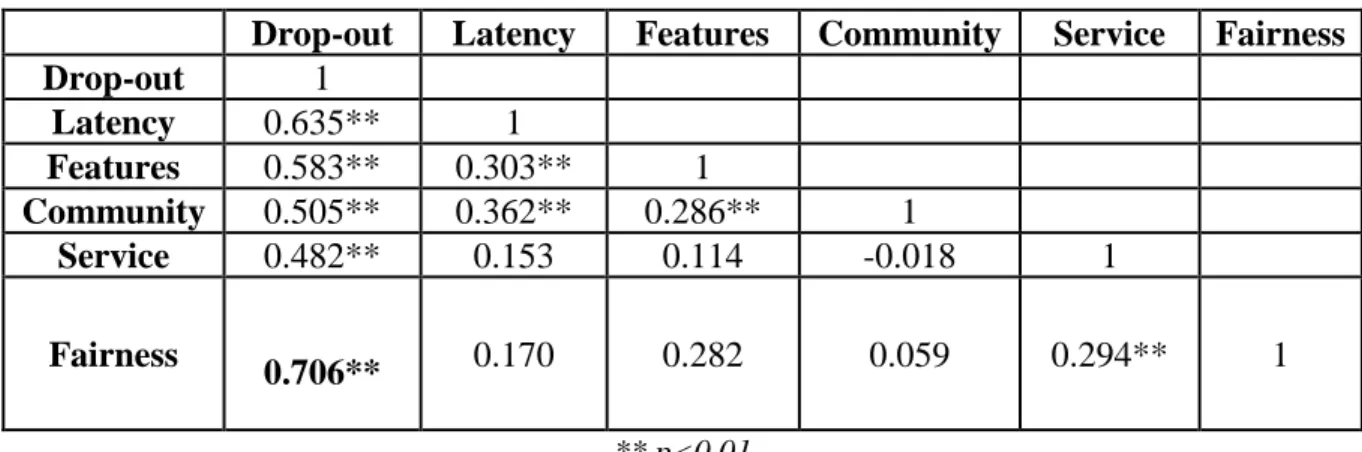
In order to test the five hypotheses in this study, Spearman correlation coefficients were computed for each construct, as the items of every construct in the survey were designed with a 5-point Likert scale (Table 6). A coefficient between 0.500 and 0.700 implies a moderated
correlation and higher than 0.700 a strong correlation. The correlation of dropping out and every construct was significant (p=0.000) and positive, thus sustaining H1, H2, H3, H4 and H5.
Moreover, the relation between drop-out and game fairness is the strongest. Besides that, the relation between out and latency/performance issues, out and in-game features, drop-out and community is moderated (0.635, 0.583 and 0.505, respectively). The only correlation coefficient which is weak (<0.500) is the one between drop-out and service/support team.
Table 6 - Correlation matrix.
Drop-out Latency Features Community Service Fairness
Drop-out 1 Latency 0.635** 1 Features 0.583** 0.303** 1 Community 0.505** 0.362** 0.286** 1 Service 0.482** 0.153 0.114 -0.018 1 Fairness 0.706** 0.170 0.282 0.059 0.294** 1 ** p<0.01
Complementing such analysis, a multiple regression was performed, where the dependent variable is “Drop-out” and the model predictors are the factors under study (Table 7). The R2
obtained is 0.539, thus 53.9% of the variation in drop-out is explained by the significant (p<0.05) predictors (latency/performance issues, in-game features, community, service/support team and game fairness). Latency/performance issues has a standardized beta of 0.346 (p=0.000), in-game features 0.256 (p=0.000), community 0.286 (p=0.000), service/support team 0.300 (p=0.000) and game fairness 0.444 (p=0.000).
Table 7 - Multiple regression results. Predictors Standardized β Latency 0.346 Features 0.256 Community 0.286 Service 0.300 Fairness 0.444 R2=0.539
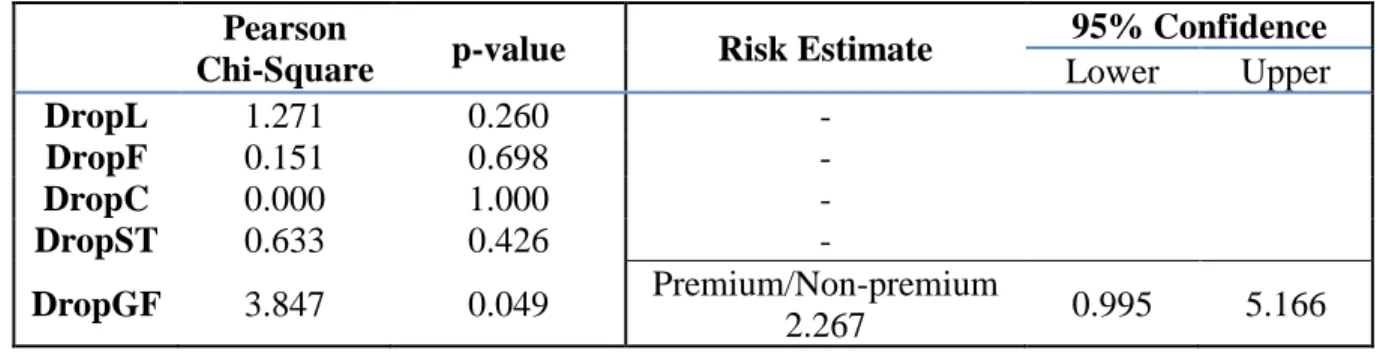
The chi-square test of independence (Table 8) allowed for checking whether or not dropping-out of a F2P MMOG due to each of the factors under study is dependent on being a premium/non-premium player. Dropping-out due to game fairness is the only element which has a slightly p-value (0.049) lower than 0.05 of significance level. Therefore, the null hypothesis is rejected, since there’s no statistical evidence to consider the independence between dropping-out due to game fairness and being a premium/non-premium player. The next step is then looking into the risk estimate, which gives the information that a premium player is 2.3 times more likely to quit a F2P MMOG due to game fairness than a non-premium player. Also, in the worst case scenario, the odds ratio between premium and non-premium players would be 5.2, whereas the other edge would have a ratio of 1.0.
Table 8 - Chi-Square test of independence (left) and risk estimate (right). Pearson
Chi-Square p-value Risk Estimate
95% Confidence Lower Upper DropL 1.271 0.260 - DropF 0.151 0.698 - DropC 0.000 1.000 - DropST 0.633 0.426 - DropGF 3.847 0.049 Premium/Non-premium 2.267 0.995 5.166
DropL – drop-out due to latency/performance issues; DropF – drop-out due to in-game features; DropC – drop-out due to community; DropST – drop-out due to service/support team; DropGF – drop-out due to game fairness.
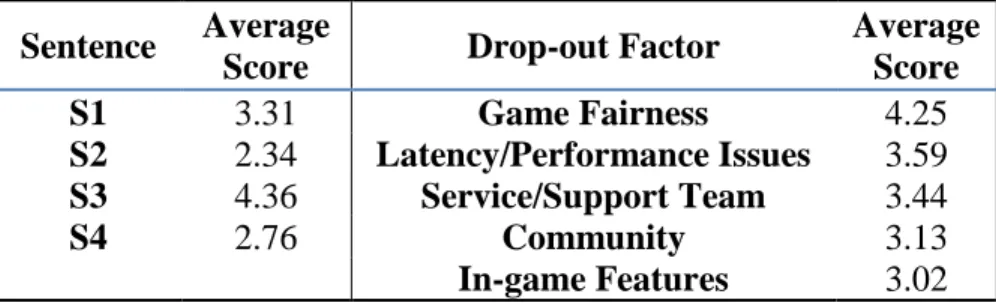
Players were asked to give their opinion on S1, S2, S3 and S4 (see “Research hipotheses Model” section) based on a 5-point Likert scale – (1) Strongly disagree, (2) Somewhat disagree, (3) Neither agree nor disagree, (4) Somewhat agree and (5) Strongly agree – and to rate the importance they give to the five drop-out factors when deciding to leave a F2P MMOG, using also a 5-point Likert scale - (1) Far below average, (2) Somewhat below average, (3) Average, (4) Somewhat above average and (5) Far above average.
Regarding the four sentences, S2 and S3 got the average scores (2.3 and 4.4, respectively) which are more distant from the neutral option on the scale (neither agree nor disagree). Thus, players believe that having a great support team is not more important than the game fairness and there is no sense on deploying new features that will make F2P MMOG unfair. When looking at the average scores rating the importance of each drop-out factor when deciding to quit a F2P MMOG, it is remarkable that game fairness wins the game with a score of 4.3, followed by latency/performance issues with 3.6 and service/support team with 3.4. In the bottom of the ranking, community has a score of 3.1 and in-game features 3.0 (Table 9).
Table 9 - Average score of players’ opinions on the four sentences surveyed and average score
of importance players give to each drop-out factor when deciding to stop playing a F2P MMOG.
Sentence Average
Score Drop-out Factor
Average Score S1 3.31 Game Fairness 4.25 S2 2.34 Latency/Performance Issues 3.59 S3 4.36 Service/Support Team 3.44 S4 2.76 Community 3.13 In-game Features 3.02
Table 10 shows the reasons identified by surveyed users for quitting F2P MMOGs. The largest percentage of users stresses out game fairness issue as the most relevant reason for quitting. Such
result clarifies a direct confirmation of hypothesis H1 (Figure 2). Following closely in terms of percentage appears personal issues for justifying to quit MMOGs. This is an uncontrolled factor by product managers that is also accountable for a large number of quits. From the four remaining factors controlled by managers, in-game features accounted as the reason for 9% of the responders. Interestingly, although latency issues and service support were considered the second and third most relevant drop-out factors by users (Table 9), the reality shows a different picture when it comes to really deciding to quit games.
Table 10 - Overall reasons for quitting F2P MMOGs.
Question Total Percentage
Gap between premium and non-premium players 30 31.25%
Personal issues 26 27.08%
In-game features 9 9.38%
Service provided by support team 6 6.25%
Environment on the community 4 4.17%
Latency/performance issues 4 4.17%
Other 17 17.71%
Total 96 100.00%
Next lines devote further attention to detailing results regarding the perceived reasons for quitting F2P MMOGs under three dimensions: age, gender and money spent per month.
When considering all the reasons why players quit F2P MMOGs, it is possible to observe in Table 11 that personal issues and the gap between premium and non-premium players play a major role in every age range.
Table 11 - Reasons for quitting F2P MMOG split by age.
Question Under
18 18 - 29 30 - 39 40 - 49 50 - 59
60 or
older Total
Gap between premium and non-premium players 6.67% 43.33% 13.33% 20.00% 10.00% 6.67% 30 Personal issues 3.85% 46.15% 19.23% 15.38% 11.54% 3.85% 26 In-game features 0.00% 77.78% 0.00% 11.11% 11.11% 0.00% 9 Service provided by support team 0.00% 33.33% 16.67% 16.67% 16.67% 16.67% 6 Environment on the community 0.00% 50.00% 0.00% 25.00% 0.00% 25.00% 4 Latency/performance issues 0.00% 75.00% 0.00% 25.00% 0.00% 0.00% 4 Other 0.00% 68.75% 6.25% 12.50% 6.25% 6.25% 17
Additionally, no respondent under 18 that have purchased premium currency in F2P MMOG eventually quit. 22.2% of the respondents in the range 30-39, 32.2% in the range 18-29, 45.6% in the range 40-49 and 50% in the range 50-59 have not spent money in games in which they quit. All respondents in the range 60 or older did stop playing at least some games in which they did spend money.
Regarding the five drop-out factors analyzed, the following information per age group was obtained:
• Under 18: 20% of the respondents have quit F2P MMOG due to latency/performance issues, 40% due to in-game features, 40% due to community factors, 40% due to bad service provided by the support team, 60% due to lack of game fairness;
• 18-29: 28.9% of the respondents have quit F2P MMOG due to latency/performance issues, 31.6% due to in-game features, 36.8% due to community factors, 15.8% due to bad service provided by the support team, 52.6% due to lack of game fairness;
• 30-39: 40% of the respondents have quit F2P MMOG due to latency/performance issues, 40% due to in-game features, 33.3% due to community factors, 20% due to bad service provided by the support team, 40% due to lack of game fairness;
• 40-49: 27.8% of the respondents have quit F2P MMOG due to latency/performance issues, 27.8% due to in-game features, 11.1% due to community factors, 33.3% due to bad service provided by the support team, 33.3% due to lack of game fairness;
• 50-59: 40% of the respondents have quit F2P MMOG due to latency/performance issues, 40% due to in-game features, 50% due to community factors, 30% due to bad service provided by the support team, 50% due to lack of game fairness;
• 60 or older: 40% of the respondents have quit F2P MMOG due to latency/performance issues, 10% due to in-game features, 40% due to community factors, 20% due to bad service provided by the support team, 40% due to lack of game fairness.
When considering all the reasons why players quit F2P MMOG, it is possible to observe in Table 12 that personal issues and the gap between premium and non-premium players are the most relevant factors on both genders.
Table 12 - Reasons for quitting F2P MMOG split by gender.
Question Male Female Total
# % # % # %
Gap between premium and non-premium players 28 93.33% 2 6.67% 30 31.25%
Personal issues 23 88.46% 3 11.54% 26 27.08%
In-game features 9 100.00% 0 0.00% 9 9.38%
Service provided by support team 6 100.00% 0 0.00% 6 6.25%
Environment on the community 4 100.00% 0 0.00% 4 4.17%
Latency/performance issues 3 75.00% 1 25.00% 4 4.17%
Other 14 82.35% 3 17.65% 17 17.71%
96 100%
Moreover, 62.7% of the male have purchased premium currency at least in some F2P MMOG they did eventually quit against 75% of the female.
Regarding the five drop-out factors analyzed, the following information was obtained:
• Male: 31% of the respondents have quit F2P MMOG due to latency/performance issues, 32.1% due to in-game features, 34.5% due to community factors, 22.6% due to bad service provided by the support team, 46.4% due to lack of game fairness;
• Female: 41.7% of the respondents have quit F2P MMOG due to latency/performance issues, 25% due to in-game features, 25% due to community factors, 25% due to bad service provided by the support team, 41.7% due to lack of game fairness.
When considering all the reasons why players quit F2P MMOG, the gap between premium and non-premium players and personal issues play a major role for respondents who do not spend money at all (50.0%) and who spend up to 20 USD (43.3%) per month in F2P MMOG. For respondents who spend between 20 and 50 USD latency/performance issues was the only reason pointed out. Respondents who spend between 50 and 200 USD quit F2P MMOG due to the gap
between premium and non-premium (33.3%), the service provided by the support team (33.3%), latency/performance issues (16.7%) and personal issues (16.7%). Environment on the community was pointed out by 50% of the respondents who spend more than 200 USD.
Table 13 - Reasons for quitting F2P MMOG split by money spent per month.
Question 0 USD ]0-20[ USD [20-50[ USD [50-200] USD More than 200 USD Total # % # % # % # % # % # % Gap between premium and non-premium players 15 50.00% 13 43.33% 0 0.00% 2 6.67% 0 0.00% 30 31.25% Personal issues 16 61.54% 9 34.62% 0 0.00% 1 3.85% 0 0.00% 26 27.08% In-game features 4 44.44% 5 55.56% 0 0.00% 0 0.00% 0 0.00% 9 9.38% Service provided by support team 2 33.33% 2 33.33% 0 0.00% 2 33.33% 0 0.00% 6 6.25% Environment on the community 1 25.00% 2 50.00% 0 0.00% 0 0.00% 1 25.00% 4 4.17% Latency/performance issues 2 50.00% 0 0.00% 1 25.00% 1 25.00% 0 0.00% 4 4.17% Other 9 52.94% 7 41.18% 0 0.00% 0 0.00% 1 5.88% 17 17.71% 96 100%
Moreover, only a small percentage of respondents state they did not spend money on games they did eventually quit.
Regarding the five drop-out factors identified in proposed hypotheses (Table 2), the following information was obtained:
• 0 USD: 37% of the respondents have quit F2P MMOG due to latency/performance issues, 29.6% due to in-game features, 33.3% due to community factors, 25.9% due to bad service provided by the support team, 37% due to lack of game fairness;
• ]0-20[ USD: 22.9% of the respondents have quit F2P MMOG due to latency/performance issues, 37.1% due to in-game features, 37.1% due to community factors, 17.1% due to bad service provided by the support team, 62.9% due to lack of game fairness;
• [20-50[ USD: 33.3% of the respondents have quit F2P MMOG due to latency/performance issues, 0% due to in-game features, 0% due to community factors, 33.3% due to bad service provided by the support team, 0% due to lack of game fairness;
• [50-200] USD: 33.3% of the respondents have quit F2P MMOG due to latency/performance issues, 33.3% due to in-game features, 0% due to community factors, 33.3% due to bad service provided by the support team, 66.7% due to lack of game fairness;
• More than 200 USD: 100% of the respondents have quit F2P MMOG due to latency/performance issues, 0% due to in-game features, 100% due to community factors, 0% due to bad service provided by the support team, 0% due to lack of game fairness.
6. Discussion
This study aims at understanding what are the most relevant drop-out factors among the players of F2P MMOG and compare game fairness (gap between premium and non-premium players) with the remaining factors.
The first thing to point out is related with the sample size. 96 valid responses is a reduced number, clearly under the initial expectations of the authors. Unfortunately, due to confidentiality reasons, the timeframe negotiated with company XPTO to run the survey could not be extended. It was also not possible to find other highly related studies based on surveys for having a baseline for comparison. Notwithstanding these two facts, it was possible to achieve interesting findings, which are summarized in the next section.
A significant percentage of players have already left F2P MMOG due to factors that can be controlled by product managers. There are plenty different games in the market with the same basic features. Thus, when players are not satisfied with some aspects in a game they have many alternatives to choose from, making dropping-out of a game an easy option if those aspects are not addressed by product managers.
Game fairness, as proposed by Hamari [3], Paavilainen et al. [4], and Lin and Sun [5], and latency/performance issues, spotted on by Yahyavi and Kemme [26], Chambers et al. [14] and Achterbosch et al. [2], community [41], service/support team and in-game features [27, 41] are significant drop-out factors that can be controlled by product managers. From these, game fairness and latency seem to be the most important factors when deciding to quit a F2P MMOG, since both factors got higher scores in every test than the other three factors. It is also obvious that players believe having a great support team is not more important than game fairness and there is no sense on deploying new features that will make F2P MMOG unfair.
The research question “Are the drop-out factors common to premium and non-premium players?” brought to light a very curious conclusion: although all factors tend to be common to both types of players (premium and non-premium), regarding game fairness the results point out that a premium player will more likely quit a F2P MMOG due to game fairness than a non-premium player. Although this sounds odd, it may be explained by the nature of competition existent in F2P MMOG. Dauriat et al. [29] and Yee [28] found out that the achievement component of player’s motivation to play MMOG included the competitiveness of the game. By having huge advantages for investing in the game, premium players may be bored due to lack of competition and so they leave it.
Moreover, only a small percentage of the respondents state they did not spend money on games they did eventually quit. The majority of that small percentage are players that currently do not spend money at all in F2P MMOG. When considering only the five drop-out factors in focus on this research, players who do not spend money in F2P MMOG have quit games mostly due to latency/performance issues and game fairness (37% each). Players who spend ]0-20[ USD per month have quit mainly due to game fairness (62.9%). Players that spend something in the range [20-50[ USD have already quit F2P MMOG only due to latency/performance issues and service provided by support team (33.3% each). In the range [50-200] USD, players have quit mainly due to game fairness (66.7%). Players who spend more than 200 USD have quit F2P MMOG only due to latency/performance issues and community (100% each).
The age ranges that spend less money on average per month in F2P MMOG are under 18, 18-29 and 50-59, while players over 60 years old tend to spend more money on average. No respondent under 18 have purchased premium currency in F2P MMOG they did eventually quit. 45.6% in the range 40-49 and 50% in the range 50-59 have not quit games in which they did spend money. All respondents in the range 60 or older did stop playing at least some games where they did spend money.
Personal issues and the gap between premium and non-premium players play a major role in every age range – gap between premium and non-premium players becomes more visible in respondents under 18 years old and personal issues on the range 30-39. When considering only the five drop-out factors in focus on this research, under 18 years old is the age range that have quit mainly due to game fairness (60%). However, service provided by support team, community and in-game features play also an important role in this range with the same percentage (40%) each. In the range 18-29 years, more than half of the respondents have quit due to game fairness
and these players quit less due to the service provided by the support team. In the range 30-39, players give less importance (20%) to the service provided by the support team and latency/performance issues, in-game features and game fairness have the same percentage of drop-out (40%). In the range 40-49, game fairness and service provided by the support team are more relevant and community less relevant. More than half of the players between 50 and 59 years old have quit F2P MMOG due to game fairness and community. Actually, this is the age range that quit more due to community. Players with 60 years old or more give less importance to in-game features and service provided by the support team.
The gender analysis brought to light that more than a half of the male respondents do not spend money at all in F2P MMOG against one third of the female respondents. Most part of female spends small amounts of money and some male spend high amounts. When considering all the reasons why players quit F2P MMOG, personal issues and the gap between premium and non-premium players are the most relevant factors on both genders. Moreover, 62.7% of the male have purchased premium currency at least in some F2P MMOG they did eventually quit against 75% of the female. When considering only the five drop-out factors in focus on this research, the most relevant for male is game fairness and the least relevant is the service provided by the support team. The female gender seems to give more importance to game fairness and latency/performance issues. While latency/performance issues are more relevant for the female gender than for the male gender, the opposite occurs for in-game features and community, while the service provided by the support team and game fairness are equally important for both genders.
7. Conclusions
This study’s goal is to understand why players stop playing F2P MMOG, focusing on the factors that product managers can control, and test out the importance of the gap between premium and non-premium players when deciding to leave this type of games.
The conclusions of this study provide several hints that Product Managers of F2P MMOG may
turn into tips and key points when deciding how to develop their games, as the factors studied
came up to be very important to players when deciding to leave F2P MMOG.
It is proven that the gap between premium and non-premium players plays a major role as a
drop-out factor, but there’s more. This research also allows concluding players that spend money
in-game are more likely to stop playing it, probably due to the competitiveness of the game and
the “boringness factor”. Also the age range that currently spends the highest amounts (over 60 years old) did stop playing already at least some of the games in which they invested money.
Thus, product managers must not only pay attention to game balance in terms of features that
create the gap of advantage between premium and non-premium players, but also make sure to
retain both categories, in order to avoid damaging the competitiveness of the game, thus reducing
the risk of the game to become boring. This means that the so-called premium features must be
optimized so that the advantage to those who invest on them do not refrain non-premium players
to compete with premium players. Moreover, new features, in-game events and an engaged
community will help to avoid boringness and to retain players.
Latency/performance issues represent another important drop-out factor. Thus, product managers
must assure that the game runs fine in a wide range of devices, operative systems and browser,
since they have no control which of those players will pick to play.
The present research intends to help product managers understanding several aspects regarding drop-out factors in the demanding and fast paced industry of F2P MMOG.
First of all, this research delivers a complete analysis on drop-out factors that can be controlled, allowing product managers to have a clear notion of these when designing and developing F2P MMOG. Besides that, product managers have also in this study useful data that may ease their overviews on what is essential for players. Of course that listening the player communities and give significance to their concerns and suggestions is a key component to bring success to F2P MMOG.
Moreover, realizing that the gap between premium and non premium players may be harmful to F2P MMOG is an extremely important asset, as it was proven to be a very significant drop-out factor. Also, the level of importance of game fairness when compared with other drop-out factors that can be controlled may help product managers prioritizing the issues to address.
Finally, this study helps to shed some light on a relatively neglected domain in the scientific community related to drop-out factors that can be controlled by managers, helping to leverage MMOG organizations toward profitability.
There are some limitations in this research which could not be overcome, due to time, limited resources and confidentiality reasons.
The first limitation to point out is related with the sample size. 96 valid responses is a reduced number, clearly under the initial expectations of the authors. Unfortunately, due to confidentiality reasons, the timeframe negotiated with company XPTO to run the survey could not be extended. It was also not possible to find other highly related studies based on surveys for having a baseline for comparison. Even though 32.3% of the respondents stated having played several games from other companies besides XPTO, surveying players through a single company channels may not give accurate conclusions for the whole market of F2P MMOG. Thus, a larger sample would help to sustain the conclusions drawn.
One factor not addressed in this study is the player’s experience and its influence on the different reasons in abandoning a MMOG. This raises an interesting trend to explore in the future, as segmenting players according to their experience may highlight different motivations in the drop-out factors.
Also, F2P MMOG are divided in several categories. As the research was not split in those several categories, some specific drop-out factors may be more or less relevant for each category. As a final note, although the correspondent explanations/definitions were included in the survey and a specific mandatory question intended to avoid it, the survey recipients may have not understood well enough what free-to-play MMOG are. The lack of knowledge or biased concepts may cause error on the analysis of the results.
Finally, based on the limitations identified previously, it would add value to this research domain
to focus future researches on each of the categories of F2P MMOG and compare them, realizing
if there is a big difference in the conclusions or not. Also, future researches could deeply study
the impact of drop-out factors in several player investment ranges in order to better realize what
References
[1] L. Suárez, C. Thio, S. Singh, Why people play massively multiplayer online games?. Int. J. e-Educ., e-Bus., e-Manag. and e-Learn. 3 (2013) 7-12. Doi: 10.7763/IJEEEE.2013.V3.184
[2] L. Achterbosch, R. Pierce, G. Simmons, Massively multiplayer online role-playing games: The past, present, and future. ACM Comput. Entertain. 5:4 (2008) Article 9, 33 pages. Doi: 10.1145/1324198.1324207
[3] J. Hamari, Why do people buy virtual goods? Attitude toward virtual good purchases versus game enjoyment. Int. J. Inf. Manag. 35 (2015) 299-308. Doi: 10.1016/j.ijinfomgt.2015.01.007
[4] J. Paavilainen, J. Hamari, J. Stenros, J. Kinnunen, Social network games: Players’ perspectives. Simul. Gaming 44:6 (2013) 794-820. Doi: 10.1177/1046878113514808
[5] H. Lin, C. Sun, Cash trade in free-to-play online games. Games Cult. 6:3 (2011) 270-287. Doi: 10.1177/1555412010364981
[6] T. Kinnunen, A. Aapaoja, H. Haapasalo, Analyzing internal stakeholders’ salience in product development. Technol. Invest. 5 (2014) 106-115. Doi: 10.4236/ti.2014.52011
[7] F. Kristian, H. Panjaitan, Analysis of customer loyalty through total quality service, customer relationship management and customer satisfaction. Int. J. Eval. Res. Educ. 3 (2014) 142-151. Doi: 10.11591/ijere.v3i3.6191
[8] S. Rezaei, S.S. Ghodsi, Does value matters in playing online game? An empirical study among massively multiplayer online role-playing games (MMORPGs). Comput. Hum. Behav. 35 (2014) 252-266. Doi: 10.1016/j.chb.2014.03.002
[9] D. Ghuman, M.D. Griffiths, A cross-genre study of online gaming: Player demographics, motivation for play, and social interactions among players. Int. J. Cyber Behav. Psychol. Learn. 2 (2012) 13-29. Doi: 10.4018/ijcbpl.2012010102
[10] J. Hamari, V. Lehdonvirta, Game design as marketing: How game mechanics create demand for virtual goods. Int. J. Bus. Sci. Appl. Manag. 5 (2010) 15-29.
[11] T. Söderlund, M. Svahn, S. Ghellal, Deliverable D4.2: Business and revenue models – Version 1.2. Integrated Project on Pervasive Gaming FP6 – 004457, 2005.
[12] SUPERDATA RESEARCH INC. 2016. MMO market report 201. Retrieved in 1st December 2016 from: https://www.superdataresearch.com/market-data/mmo-market/
[13] A. Drachen, J. Riley, S. Baskin, D. Klabjan, Going out of business: auction house behavior in the massively multi-player online game glitch. Entertain. Comput. 5:4 (2014) 219-232.
[14] C. Chambers, W. Feng, S. Sahu, Characterizing Online Games. IEEE/ACM Trans. Netw. 18 (2010) 899-910. Doi: 10.1109/TNET.2009.2034371
[15] T.R. Alves, L. Roque, Because players pay: the business model influence in MMOG design. Proceedings of Digital Games Research Association 2007 conference, 658-663.
[16] R. Freeman, A. Wicks, B. Parmar, Stakeholder theory and the corporate objective revisited. Organ. Sci. 15 (2004) 364-369. Doi: 10.1287/orsc.1040.0066
[17] J. Olsen, H. Harmsen, A. Friis, Linking quality goals and product development competences. Food Qual. Prefer. 19 (2008) 33-42. Doi: 10.1016/j.foodqual.2007.06.002
[18] A.J. Hillman, G.D. Keim, Shareholder value, stakeholder management and social issues: What’s the bottom line? Strateg. Manag. J. 22 (2001) 125-139.
[19] J. Majava, J. Nuottila, H. Haapasalo, K. Law, Customer needs in market-driven product development: Product management and R&D standpoints. Technol. Invest. 5 (2014) 16-25. Doi: 10.4236/ti.2014.51003
[20] D. Jobber, F. Ellis-Chadwick, Principles and practice of marketing. London: McGraw-Hill Education, 2012.
[21] P.F. Drucker, The practice of management. New York: Routledge, 2011.
[22] J. Wongsansukcharoen, J. Trimetsoontorn, W. Fongsuwan, Social customer relationship management and differentiation strategy affecting banking performance effectiveness. Res. J. Bus. Manag. 7:1 (2013) 15-27. Doi: 10.3923/rjbm.2013.15.27
[23] L.G. Schiffman, L.L. Kanuk, Consumer behavior. New Jersey: Prentice Hall, 2007.
[24] M.J. Piskorski, Social strategies that work. Harv. Bus. Rev. 89:11 (2011) 117-122.
[25] K. Uusitalo, H. Hakala, T. Kautonen, Customer complaints as a source of customer-focused process improvement: A constructive case study. Int. J. Bus. Sci. Appl. Manag. 3:1 (2008) 1-13.
[26] A. Yahyavi, B. Kemme, Peer-to-peer architectures for massively multiplayer online games: A survey. ACM Comput. Surv. 46:1 (2013) Article 9, 51 pages. Doi: 10.1145/2522968.2522977
[27] D. Anderson, The dark side of MMOGs: Why people quit playing. Proceedings of cgames’ 2009 USA, 76-80.
[28] N. Yee, Motivations for play in online games. CyberPsychology Behav. 9:6 (2006) 772-775. Doi: 10.1089/cpb.2006.9.772
[29] F.Z. Dauriat, A. Zermatten, J. Billieux, G. Thorens, G. Bondolfi, D. Zullino, Y. Khazaal, Motivations to play specifically predict excessive involvement in Massively Multiplayer Online Role-Playing Games: Evidence from an online survey. Eur. Addict. Res. 17 (2011) 185–189. Doi: 10.1159/000326070
[30] L.E. Nacke, C. Bateman, R.L. Mandryk, BrainHex: A neurobiological gamer typology survey. Entertain. Comput. 5:1 (2014) 55-62.
[31] D. Kuss, J. Louws, R. Wiers, Online gaming addiction? Motives predict addictive play behavior in massively multiplayer online role-playing games. CyberPsychology, Behav. Soc. Netw. 15:9 (2012) 480-485. Doi: 10.1089/cyber.2012.0034
[32] J. Charlton, I. Danforth, Distinguishing addiction and high engagement in the context of online game playing. Comput. Hum. Behav. 23 (2007) 1531–1548. Doi: 10.1016/j.chb.2005.07.002
[33] Z. Lee, C. Cheung, T. Chan, Massively multiplayer online game addiction: Instrument development and validation. Inf. Manag. 52 (2015) 413–430. Doi: 10.1016/j.im.2015.01.006
[34] M. Beranuy, X. Carbonell, M. Griffiths, A Qualitative analysis of online gaming addicts in treatment. Int. J. Ment. Health Addict. 11 (2013) 149-161. Doi: 10.1007/s11469-012-9405-2
[35] M. D. Griffiths, Diagnosis and management of video game addiction. New Dir. Addict. Treat. Prev. 12 (2008) 27–41.
[36] D. Hull, G. Williams, M. Griffiths, Video game characteristics, happiness and flow as predictors of addiction among video game players: A pilot study. J. Behav. Addict. 2:3 (2013) 145–152. Doi: 10.1556/JBA.2.2013.005
[37] M.D. Griffiths, D.J. Kuss, D.L. King, Video game addiction: Past, present and future. Curr. Psychiatry Rev. 8 (2012) 308–318. Doi: 10.2174/157340012803520414
[38] D.L. King, P.H. Delfabbro, M. D. Griffiths, Video game structural characteristics: A new psychological taxonomy. Int. J. Ment. Health Addict. 8:1 (2010) 90–106. Doi: 10.1007/s11469-009-9206-4
[39] D. Smahel, L. Blinka, O. Ledabyl, Playing MMORPGs: connections between addiction and identifying with a character. CyberPsychology Behav. 11 (2008) 715–718. Doi: 10.1089/cpb.2007.0210
[40] S. Hsu, M. Wen, M. Wu, Exploring user experiences as predictors of MMORPG addiction. Comput. Educ. 53 (2009) 990–999. Doi: 10.1016/j.compedu.2009.05.016
[41] I. Lee, C. Yu, H. Lin, Leaving a never-ending game: Quitting MMORPGs and online gaming addiction. Proceedings of Digital Games Research Association 2007 conference, 211-217.
[42] C. Chou, Factors affecting brand identification and loyalty in online community. Am. J. Ind. Bus. Manag. 3 (2013) 674-680. Doi: 10.4236/ajibm.2013.38076
[43] K.T. Chang, A.T. Koh, B.Y. Low, D.J. Onghanseng, K. Tanoto, T.S. Thuong, Why I love this online game: The MMORPG stickiness factor. ICIS 2008 Proceedings, paper 88.
[44] B. Tabachnick, L. Fidell, Using Multivariate Statistics. Boston: Pearson Education Inc, 2007.
[45] J. Hair, R. Anderson, R. Tatham, W. Black, Multivariate Data Analysis. New Jersey: International Edition, Prentice Hall, 2004.
![Table 1 - Motivation items (adapted from Dauriat et al. [29]).](https://thumb-eu.123doks.com/thumbv2/123dok_br/18659319.913014/11.918.171.741.227.630/table-motivation-items-adapted-dauriat-et-al.webp)