Programa Interdisciplinar de Pós-Graduação em
Computação Aplicada
Mestrado Acadêmico
Leonardo Dalmina
GAMIPROM: A GAMIFICATION MODEL BASED ON
PROFILE MANAGEMENT
UNIDADE ACADÊMICA DE PESQUISA E PÓS-GRADUAÇÃO PROGRAMA DE PÓS-GRADUAÇÃO EM COMPUTAÇÃO APLICADA
NÍVEL MESTRADO
LEONARDO DALMINA
GAMIPROM: A GAMIFICATION MODEL BASED ON PROFILE MANAGEMENT
GAMIPROM: A GAMIFICATION MODEL BASED ON PROFILE MANAGEMENT
Dissertação apresentada como requisito parcial para a obtenção do título de Mestre pelo Programa de Pós-Graduação em Computação Aplicada da Universidade do Vale do Rio dos Sinos — UNISINOS
Advisor:
Prof. Dr. Jorge Luis Victória Barbosa
Dados Internacionais de Catalogação na Publicação (CIP) (Bibliotecária: Bruna Sant’Anna – CRB 10/2360) D148g Dalmina, Leonardo.
GamiProM: a Gamification Model based on Profile Management / Leonardo Dalmina. – 2018.
101 f. : il. color. ; 30 cm.
Dissertação (mestrado) – Universidade do Vale do Rio dos Sinos, Programa de Pós-Graduação em Computação Aplicada, São Leopoldo, 2018.
“Advisor: Prof. Dr. Jorge Luis Victória Barbosa.”
1. Ontologia. 2. Gamificação. 3. Usuários de computador. 4. Jogos por computador. 5.Software – Desenvolvimento. I. Título.
Leonardo Dalmina
GAMIPROM: A GAMIFICATION MODEL BASED ON PROFILE MANAGEMENT
Dissertação apresentada à Universidade do Vale do Rio dos Sinos – Unisinos, como requisito parcial para obtenção do título de Mestre em Computação Aplicada.
Aprovado em 26 de março de 2018
BANCA EXAMINADORA
Prof. Dr. Jorge Luis Victória Barbosa - UNISINOS
Nome do Componente da Banca Examinadora – Instituição a que pertence Prof. Dr. José Palazzo Moreira de Oliveira - UFRGS
Nome do Componente da Banca Examinadora – Instituição a que pertence Prof. Dr. Sandro José Rigo - UNISINOS
Nome do Componente da Banca Examinadora – Instituição a que pertence
Prof. Dr. Jorge Luis Victória Barbosa (Orientador)
Visto e permitida a impressão
São Leopoldo,
Prof. Dr. Rodrigo da Rosa Righi
O uso de elementos de design de jogos em contextos não relacionados a jogos, definido
como gamificação, está sendo cada vez mais usado para aumentar a motivação e o engajamento dos usuários quando eles precisam executar uma tarefa em um ambiente não relacionado a jogo, como o local de trabalho, a escola ou uma aplicação de software. No entanto, quando a gami-ficação precisa ser implementada, um desafio enfrentado pelos desenvolvedores é identificar quais elementos do jogos engajarão efetivamente os usuários de um software com base em seus perfis de usuário e características motivacionais. Frequentemente, muitas pesquisas tendem a não incluir ou apenas apoiar os tipos de usuário e fatores motivacionais mais comuns. Em resposta a este desafio, esta dissertação propõe um modelo de gamificação genérico intitulado GamiProM que permite um desenvolvedor de software criar uma solução gamificada adapta-tiva para qualquer área fazendo uso de ontologias e regras, visando fornecer representação do conhecimento bem como adicionar um valor semântico à informação gerada pela gamificação e gerenciamento de perfil. O modelo é avaliado com um teste de correlação que identifica a existência de qualquer associação entre as necessidades psicológicas básicas dos usuários e suas motivações coletadas com a aplicação gamificada, desenvolvida para implementar o mo-delo proposto. Os resultados mostraram que as motivações coletadas dos perfis gamificados dos usuários têm uma correlação acima de 80% com as necessidades psicológicas básicas analisa-das.
The use of game design elements in non-game contexts, defined as gamification, is being increasingly used to raise the motivation and engagement of users when they have to execute a task in a non-game environment, such as the workplace, the school or a software application. However, when gamification needs to be implemented, a challenge faced by developers is to identify what game elements will effectively engage the users of a software based on their user profiles and motivational characteristics. Often, many researches tend to not include or only support the most common user types and motivational factors. In response to this challenge, this thesis proposes a generic gamification model entitled GamiProM that allows a software developer to build an adaptive gamified solution for any area by making use of ontologies and rules, aiming to provide knowledge representation as well as add a semantic value to the in-formation generated by gamification and profile management. The model is evaluated with a correlation test that identifies the existence of any association between the basic psychological needs of the users and their motivations collected with the gamified application, developed to implement the proposed model. The results showed that the motivations collected from the gamified profiles of the users have a correlation above 80% with the basic psychological needs analyzed.
Figure 1: Gamification design Hexad . . . 26
Figure 2: An example ontology as semantic network . . . 30
Figure 3: Studies filtering . . . 38
Figure 4: Distribution of primary studies by applied area . . . 40
Figure 5: Distribution of primary studies by motivational factor . . . 41
Figure 6: Distribution of primary studies by user type . . . 42
Figure 7: Distribution of primary studies by gamification mechanic / element . . . 44
Figure 8: Distribution of primary studies by design followed . . . 45
Figure 9: Distribution of primary studies by validation method . . . 46
Figure 10: Distribution of primary studies by focused question . . . 47
Figure 11: Distribution of primary studies by year . . . 49
Figure 12: Distribution of primary studies by type of forum . . . 49
Figure 13: Summary of classification (Applied Area by Focused Question) . . . 51
Figure 14: Summary of classification (Applied Area by Gamification Mechanic / Element) 53 Figure 15: Model Architecture . . . 58
Figure 16: Ontology Development Process . . . 60
Figure 17: Ontology Composition . . . 61
Figure 18: Ontology Class Diagram . . . 61
Figure 19: Relationships of Mastery (EngagementFactor subclass) . . . 62
Figure 20: Equivalence Axiom of GamifiedActivity . . . 63
Figure 21: Inference rule def-motivates . . . 64
Figure 22: SPARQL query example . . . 65
Figure 23: UseCase Diagram (Client) . . . 66
Figure 24: UseCase Diagram (Server) . . . 67
Figure 25: Sequence Diagram . . . 68
Figure 26: GamiProM Application . . . 69
Figure 27: GamiProM Application with Validation Errors . . . 74
Figure 28: GamiProM Application with Validation Succeeded . . . 75
Figure 29: OWL Model Generation Notification . . . 76
Figure 30: OWL Model Exportation . . . 76
Figure 31: Exported Model Individuals . . . 77
Figure 32: RDF/XML Syntax Example of an individual . . . 77
Figure 33: Tables created for theQrCaféApplication . . . 78
Figure 34: Data stored in Table "gm_tipos_usuarios" . . . 79
Figure 35: Data Stored in Table "gm_tipos_elementos" . . . 79
Figure 36: Data Stored in Table "gm_elementos" . . . 80
Figure 37: QrCaféUI Change Comparison . . . 81
Figure 38: Ranking Screen of theQrCaféApplication . . . 82
Figure 39: Dataset containing the Evaluation Data . . . 85
Table 1: Research questions of the study . . . 35
Table 2: Search string . . . 35
Table 3: Summary of the search strategy . . . 36
Table 4: Summary of the selection strategy . . . 36
Table 5: Distribution of primary studies by applied area . . . 40
Table 6: Distribution of primary studies by motivational factor . . . 41
Table 7: Distribution of primary studies by user type . . . 43
Table 8: Distribution of primary studies by design followed . . . 45
Table 9: Distribution of primary studies by validation method . . . 46
Table 10: Distribution of primary studies by focused question . . . 47
Table 11: Distribution of primary studies by type of forum . . . 50
Table 12: Related works characteristics comparison . . . 55
Table 13: Single Values of the Gamified Activities . . . 75
ACM Association for Computing Machinery API Application Programming Interface CSS Cascading Style Sheets
IDE Integrated Development Environment
IEEE Institute of Electrical and Electronics Engineers FQ Focused Question
FR Functional Requirement GUI Graphical User Interface GQ General Question
HTML HyperText Markup Language MEI Mechanic or Element or Idea OWL Web Ontology Language PHP PHP Hypertext Preprocessor RDF Resource Description Framework
SPARQL SPARQL Protocol And RDF Query Language SQ Statistical Question
1 INTRODUCTION . . . 21
1.1 Motivation . . . 21 1.2 Problems and questions . . . 22 1.3 Objectives . . . 23 1.4 Methodology . . . 23
1.5 Outline . . . 24 2 BACKGROUND AND BASIC CONCEPTS . . . 25
2.1 Gamification . . . 25 2.2 Personalization and Adaptability . . . 27
2.3 Profile Management . . . 28
2.4 Ontologies . . . 29 2.5 Considerations about the chapter . . . 31 3 RELATED WORKS . . . 33
3.1 Systematic mapping study . . . 33
3.2 Related systematic mappings . . . 33
3.3 Planning of the systematic mapping . . . 34
3.3.1 Research methods and questions . . . 34 3.3.2 Data sources and search strategy . . . 35 3.3.3 Classification . . . 36
3.4 Results of the systematic mapping . . . 38 3.4.1 Results of the search . . . 38 3.4.2 Research questions . . . 39
3.5 Discussion . . . 50 3.6 Conclusions of the systematic mapping and future work . . . 52 3.7 Considerations about the chapter . . . 54
4 THE GAMIPROM MODEL . . . 57
4.1 Overview . . . 57 4.2 Architecture . . . 57 4.3 GamiProM Ontology . . . 59
4.3.1 Composition . . . 60 4.3.2 Structure . . . 61 4.3.3 Inferences . . . 64 4.3.4 Queries . . . 64
4.4 GamiProM Application. . . 64
4.4.1 Functional Requirements . . . 65 4.4.2 UseCase Diagrams . . . 66 4.4.3 Sequence Diagram . . . 67 4.4.4 GUI . . . 67 4.4.5 Modules . . . 67 4.4.6 OWL API . . . 70
5.1 Ontological model . . . 73 5.2 Database preparation . . . 76 5.3 UI Development . . . 79
5.4 Considerations about the chapter . . . 80 6 EVALUATION . . . 83
6.1 Basic Psychological Need Satisfaction Scale. . . 83 6.2 Data Collection Methodology . . . 84 6.2.1 Outliers . . . 84
6.3 Correlation Test . . . 85 6.4 Results . . . 86
6.5 Considerations about the chapter . . . 87 7 FINAL CONSIDERATIONS AND FUTURE WORKS . . . 89
REFERENCES . . . 91
APPENDIX A COMPLETE LIST OF ALL PRIMARY STUDIES INCLUDED IN THE SYSTEMATIC MAPPING STUDY . . . 95
APPENDIX B COMPETENCE QUESTIONS TO THE GAMIPROM ONTOLOGY 97
APPENDIX C LIST OF RELEVANT TERMS TO GAMIPROM ONTOLOGY . . 99
1 INTRODUCTION
The word gamification has been defined by DETERDING et al. (2011) as “the use of game design elements in non-game contexts”. By making use of game mechanics and elements, gamification aims to increase the motivation and engagement of users when they have to execute a task in a non-game environment, such as the workplace, the school or a software application. The gamification field has grown significantly and its popularity increased over the years, thus being applied in several areas (DETERDING et al., 2011; ZICHERMANN; CUNNING-HAM, 2011; WERBACH; HUNTER, 2012; MACMILLAN, 2011; HAMARI; KOIVISTO; SARSA, 2014). Nowadays, there is a considerable amount of gamification works providing a variety of motivational solutions for users. These works often describe what gamification mechanics / elements are included, the supported area, and sometimes what type of user the work supports. Once the main key of gamification is increase the engagement of users, a va-riety of motivational factors are connected to different user types, leading to another field of gamification: adaptability / personalization.
Personalization means the individual adaptation of products, services and information. Per-sonalization technology usually involves programs that learn a user’s patterns, habits, and pref-erences. The main purpose of modern personalization systems is offer to users what they want without requiring them to explicitly state this (MULVENNA; ANAND; BÜCHNER, 2000). A way to obtain the users’ preferences is by storing their actions on profiles. Profiles with useful stored information are the key to identify the behavior of the users, their interests and, combined with a profile manager, also make suggestions regarding future actions (WAGNER; BARBOSA; BARBOSA, 2014).
When gamification needs to be implemented, a challenge faced by developers is to identify what game elements (supported by an application) will actually engage the users of the soft-ware based on their respective user profiles. In response to this challenge, this thesis proposes a gamification model entitled GamiProM (Gamification based on Profile Management) that al-lows software developers to integrate gamification on different applications, building gamified solutions (gamification models) for any area based on the motivational characteristics of the users, being capable to identify their user types (gamified profiles) thus supporting adaptability.
1.1 Motivation
application with users’ usage data, helping developers to wisely choose the next features that will be implemented. Applications with the ability to identify and manage the users’ gamified behavior based on their gamified actions are capable to provide richer usage data, thus being able to use this data to personalize the gamification at runtime.
The ideal solution to gamify a software is to follow a design that organizes every gamifica-tion element mapping it to an engagement factor and user type. Once following a design, the gamification structure can be expanded to generate useful information about the users and their gamified activities, such as gamified usage data provided by the interaction between users and gamification elements. Additionally, the analysis of such information could be used to adapt and personalize the gamification elements available for users based on their behaviors and user profiles (FERRO; WALZ; GREUTER, 2013).
The integration of all the aforementioned concepts can be organized and maintained in the form of ontologies. According to GRUBER (1995), an ontology is an explicit specification of a conceptualization. The term is borrowed from philosophy, where an Ontology is a systematic account of Existence. In AI systems, what “exists” is that which can be represented. When the knowledge of a domain is represented in a declarative formalism, the set of objects that can be represented is called the universe of discourse. This set of objects, and the describable relation-ships among them, are reflected in the representational vocabulary with which a knowledge-based program represents knowledge. The knowledge, in the proposed model, refers to the concepts and ideas involving gamification, user profiles and their engagement factors gathered to support adaptability.
1.2 Problems and questions
A gamification solution usually tends to work with specific domains and user types. This happens because users have different engagement factors, thus being motivated by different gamification elements. A study presented in the chapter 3 presents the results of a systematic mapping about gamification models, indicating that there is a considerable amount of gamified applications that implement only the most common gamification elements, such as leaderboards and achievements that may not reach the engagement expected. The motivation in this case is completely subjected to match the random user profiles that are using an application. Therefore, a few questions can be generated from the aforementioned problems, such as:
• Is it possible to generate different gamification models oriented to motivational factors supporting different areas of application?
• How to turn non-gamified activities into gamified activities?
• How to identify the motivation of users while using a gamified application?
These difficulties justify the development of a gamification model with generic purposes able to provide all the resources necessary to answer these questions, being implemented as a gamification solution that embeds not only the gamification knowledge but also the motivational characteristics involved. In this way, the model not only enhance its usability but provides a semantic value, also offering means to be evaluated.
1.3 Objectives
This research work has as main objective to provide a gamification model with generic pur-poses oriented to motivational factors, supporting different users types and offering knowledge representation about the concepts of the model. To achieve this main objective, the following specific objectives are defined:
• Analyze the background of the gamification area;
• Characterize the state of art of related works;
• Specify the gamification model and architecture;
• Implement a prototype of gamified application that is built based on the gamified solution generated by the model;
• Validate the model based on the data collected from the prototype.
1.4 Methodology
To elaborate this research work, initially a preliminary research was carried out to identify the technologies, techniques and concepts that offer a theoretical background needed to con-ceptualize a gamification model that attends to the proposed objectives. This research resulted in some gamification designs that help to solve the identified problems. The theoretical back-ground present in the researches that implement these designs was important to embed useful knowledge in the development of the ontological model.
Once the ontological model was designed, an initial specification about the application con-tained in the full model was created, providing a detailed view about its functional requirements. It was also developed the architecture of the model that covers the application, the ontologi-cal model and implementation aspects, in order to address the aforementioned problems, thus reaching the desired objectives and identified requirements.
After the conclusion of all these steps, the specification of the model was completed. At that stage, the application that works along with the ontology was developed and its features were tested.
A prototype of a gamified application was developed following the specifications contained in the gamified solution generated by the gamification model, also including a set of motivations that were included in the prototype.
The evaluation of the model was performed correlating the motivation of the users that used the prototype with their basic psychological needs identified by a separated form.
1.5 Outline
2 BACKGROUND AND BASIC CONCEPTS
This chapter presents the background and basic concepts related to the terminologies utilized in this research. The text is organized in five sections, described as follows. The first section presents an overview of Gamification from its first definition to recent gamification designs and some negative results present in the literature. Section two explains information about personalization and adaptability, also highlighting how they can be connected to this research. The third section describes concepts about Profile Management, complementing the information introduced in the previous section and commenting relevant works making use of this technique. Section four provides basic information about ontologies, they origin, usability reasons and an usage example of the main components required for a better understanding of the semantic concept. At last, the fifth section presents the considerations about the chapter highlighting the most relevant aspect approached in each section.
2.1 Gamification
The term gamification was first used by PELLING (2011) in 2002, when he wanted to make non-game related interfaces more like games, with a preliminary definition of “Applying game-like accelerated user interface design to make electronic transactions both enjoyable and fast”. However, this term only started to gain attention in 2010 (DETERDING et al., 2011), being popularized by industry applications and conferences on the topic, which emerged in new definitions about the concept. DETERDING et al. (2011) expressed the first official definition of gamification as “The use of game design elements in non-game contexts”. Another definition was made by WERBACH (2014), stating that gamification is “The process of making activities more game-like”.
With the wide usage and popularization of gamification, many game elements and mechan-ics were included in this concept. Nevertheless, gamification still do not have a consolidated list or classification of these game elements in literature. As an example, some researches present in the literature identifies terms like challenges and rewards as distinct game elements or me-chanics. However, DUBOIS; TAMBURRELLI (2013) mixed both terms stating that the most elementary gamification element, also known as challenge, consists of a reward mechanism that awards people in response to the accomplishment of certain activities that need to be encour-aged.
game-design elements. In his work, MARCZEWSKI (2015) tried to group every gamification element, mechanic or idea under a motivational factor, also highlighting different user types that are motivated by these motivational factors, as can be seen in Figure 1.
Figure 1:Gamification design Hexad
Source: MARCZEWSKI (2015)
In software development organizations, the increase of motivation provided by gamifica-tion can help to create a better environment that can impact directly on productivity and soft-ware quality, since softsoft-ware design and development is intrinsically a human-centric and brain-intensive activity in which the experience, motivation, and discipline of developers represent crucial ingredients (DUBOIS; TAMBURRELLI, 2013). Following this concept, SINGER; SCHNEIDER (2012) utilized gamification to propose an experiment that consists in encourage computer science students to make more frequent commits to version control by using a social software application. The experiment resulted in a majority of positive statements provided by the students.
Recently, XU; BUHALIS; WEBER (2017) examined gaming in general terms and the ap-plication of it in specific tourism fields, identifying game design elements that can contribute to a meaningful gamification. The work presented a few cases of best practices to show how this concept can benefit tourism marketing, also discussing potential implications and future research recommendations.
gamification is not planned, thus not providing a real fun, pleasure, or challenges to players.
2.2 Personalization and Adaptability
Another field of gamification present in the literature is personalization, sometimes accom-panied by the term "calm technology". According to WEISER; BROWN (1996), calm tech-nology is a kind of techtech-nology that engages both the center and the periphery of our attention, moving back and forth between the two, being "periphery" the name used to define what we are attuned to without attending to explicitly. Directing this to the gamification scenario, it could be a gamified application that indirectly collects useful information of the users only requiring the periphery attention of them.
A pervasive computing system that strives to be minimally intrusive has to be context-aware, thus being able to recognize its user’s state and surroundings, modifying its behavior based on this information (SATYANARAYANAN, 2001). A user’s context can be quite rich, consisting of attributes such as physical location, physiological state (i.e. body temperature and heart rate), emotional state (i.e. angry, distraught, or calm), personal history, daily behavioral patterns, and so on. These richness of context examples can be expanded to gamification, where the interactions of the user with gamification mechanics, preferred elements, identified motivations and historical data usage can also be identified as gamified context information. According to SATYANARAYANAN (2001), if a human assistant were given such context, he or she would make decisions in a proactive fashion, anticipating user needs. This could be used, for example, to provide an adaptation of gamified elements displayed for users based on their actions and choices using an application.
According to MULVENNA; ANAND; BÜCHNER (2000), the goal of personalization sys-tems is to provide users with what they want or need without requiring them to ask for it explic-itly. In this way, personalization is the provision to the individual of tailored products, services, information or information relating to products or service. The coverage is extensive, including recommender systems, customization, and adaptive applications.
In short, personalization technology involves software that learns patterns, habits, and pref-erences (MULVENNA; ANAND; BÜCHNER, 2000). This learning process is used to provide personalized information for users based on their specific needs and also adapt the application to the user when necessary.
For this research provide support for the adaptive characteristics and personalization tech-nology aforementioned, a set of concepts were defined to meet these requirements. These defi-nitions are described in details in section 4.3.2.
as-pects of ubiquitous computing, such as, context formal representation and privacy. As part of the research it was built a functional prototype that allowed the conduction of two experiments. The first experiment successfully tested the main functionalities provided by ORACON to sup-port context prediction and privacy aspects. The test used context histories generated with a location database that contains 22 millions check-ins across 220,000 users in the location shar-ing services Foursquare and Twitter. The second experiment assessed the adaptive feature of ORACON. The test simulated the behavior of 30 users for a period of 30 days, using context histories generated by a particular simulator. The simulator generated data for the evaluation and the comparison of machine learning methods in mobile context-aware settings. ROSA; BARBOSA; RIBEIRO (2016) concluded that ORACON chose the most accurate prediction al-gorithm in the simulated scenario, proving that the model reached the main contribution sought by the research.
Another work focusing on adaptability is the research of ABECH et al. (2016), proposing an architectural model entitled EduAdapt for the adaptation of learning objects considering device characteristics, learning style and other student’s context information. The adaptation was provided by the use of inferences and rules in a proposed ontology, named OntoAdapt. The purpose of the ontology is to help recommending learning objects to students or adapt these objects according to the context (context-aware computing). The model received a two steps evaluation, by firstly use scenarios and metrics to assess the ontology and secondly being developed a prototype of the model further submitted to a class of 20 students with the intention of evaluating the usability and adherence to adapted objects, resulting in a 78% of acceptance. ABECH et al. (2016) concluded that the evaluation indicates that the proposed model would be useful in the learning process.
2.3 Profile Management
Following this line, KIM; LEE (2008) proposed a profile management method to provide personalized services to the user. The profile was configured with various user related infor-mation that use Web Services to exchange profiles among client device, profile repository, and services server, also applying meta-data and dynamic configuration techniques for efficient pro-file management. The authors concluded, after the result of a performance evaluation, that the proposed techniques in the profile management framework were efficient to manage the profiles. Focusing on multimedia services that must perform automatic actions / operations to adapt the delivered content to the user expectations and his environment capabilities, also ensuring the best quality of experience, CHELLOUCHE; ARNAUD; NÉGRU (2010) conducted a research to facilitate the adaptation process by introducing a flexible context-sensitive user profile model that gathers static and dynamic data characterizing the user and his operational context. The authors also proposed an efficient framework for managing and delivering the user profile, cre-ating a context-dependent user profile instance for each application according to its adaptation process needs.
Recently, WAGNER; BARBOSA; BARBOSA (2014) proposed a model that allows appli-cations to register entities’ actions in trails and infer profile information from these trails, using semantic interoperability and allowing different applications to share information and infer a unified profile. From this research, an application was also developed and integrated with two different softwares in a scenario of ubiquitous learning, where the student profiles were dynam-ically updated, allowing them to better adapt to the environment.
As aforementioned, Profiles gather useful information of users in order to offer knowledge about their personal characteristics. Nowadays, a way to represent this knowledge is by the use of ontologies.
2.4 Ontologies
While phenomenally successful in terms of amount of accessible content and number of users, today’s Web is a relatively simple artifact. Web content consists mainly of distributed hypertext and hypermedia, accessible via keyword-based search and link navigation. Simplic-ity is one of the Web’s great strengths and an important factor in its popularSimplic-ity and growth, where even naive users quickly learn to use it and even create their own content (HORROCKS, 2008). However, this large amount of content also highlights serious issues in the hypertext paradigm. The required content becomes increasingly difficult to locate via search and browse, like finding information about people with common names. This problem only exists because the semantic data about these names can not be considered in regular search engines. To identify two identical names as different persons, the semantic data about these individuals also needs to be considered. This semantic data, also known as knowledge, can be provided by the use of ontologies.
the philosophical investigation of existence. It is concerned with the fundamental question of "what kinds of things are there?" and leads to studying general categories for all things that exist dating back to the times of Aristotle (CRAIG, 1998).
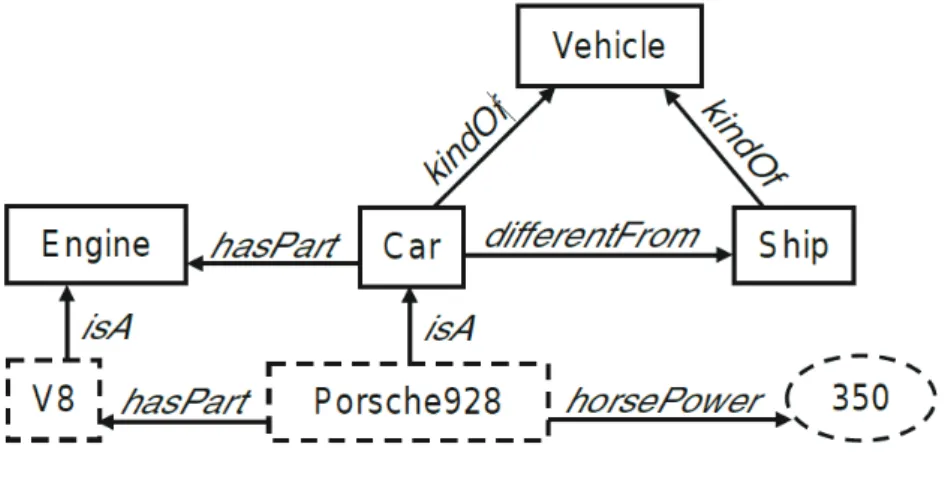
Transferred to knowledge representation and Computer Science, information systems can benefit from the idea of ontological categorization. When applied to a limited domain of interest in the scope of a concrete application scenario, ontology can be restricted to cover a special subset of the world. Some examples of ontological categories in the technical vehicular domain areVehicle,CarorEngine. In this sense, ontology provides a semantic vocabulary to define the
meaning of things (GRIMM et al., 2011).
In short, ontologies are composed by the following items:
• Classes:they represent domain concepts, also being identified asThing. In Figure 2,Car,
Engine,ShipandVehicleare examples of Classes;
• Axioms: they are restrictions applied on specific ontology elements, usually defined to delimit the knowledge domain;
• Instances:also known asIndividuals, they represent the object orThingof a class in the real world. In Figure 2,Porsche928andV8are examples of Instances;
• Object properties: they are the relationships between Classes. In Figure 2, hasPart,
differentFrom,kindOf andisAare examples of Object properties;
• Data properties: they consist in relationships between a Class and a data type (i. e. number, string, URI). In Figure 2,horsePoweris an example of Data property.
Figure 2:An example ontology as semantic network
Source: GRIMM et al. (2011)
agents, enable reuse of domain knowledge, make domain assumptions explicit, separate domain knowledge from the operational knowledge, analyze domain knowledge, and so on.
Exemplifying, the research of MIRANDA et al. (2017) proposes an ontology-based model for the representation of competences able to support a wide range of scenarios where it is fun-damental to model, organize and represent professional competences, enable interoperability and co-operation among different and heterogeneous tools and, lastly, execute queries and in-ference operations over these competences. In his model, he started from the outcomes of the specialized literature and the related R & D projects and produced a novel integrated model that represents both job offers and demands to support recruiting initiatives and to develop employ-ability strategies aiming at a best matching as well as a careful skill gap analysis.
2.5 Considerations about the chapter
3 RELATED WORKS
In this chapter is presented the whole process of a research technique used to map in the gamification field works related to this research. A total of 17 studies resulted from this tech-nique. Each study was carefully classified under different aspects and categories. In this way, this chapter is organized in 7 sections. Sections 1 to 6 present information strictly related to the research technique performed, with further details about these sections explained in the first section. Section 7 presents the considerations about the chapter comparing the characteristics of the related works with the GamiProM model, further describing the most related work iden-tified throughout the mapping process and highlighting important differences in relation to this research.
3.1 Systematic mapping study
With the objective of analyze in the existing literature gamification models with character-istics related to the ideas mentioned in the first chapter of this work, a systematic mapping was carried out. The aim is to provide a more structured view of the state of the art in the field and to identify possible trends, existing gaps and weaknesses (BUDGEN et al., 2008; COOPER, 2016; PETERSEN; VAKKALANKA; KUZNIARZ, 2015). Systematic mapping is a method-ology that involves searching the literature to verify the nature, extent and number of studies published in the area of interest (PETERSEN et al., 2008). The next sections are structured as follows: section 2 presents the related systematic mappings. Section 3 describes how sys-tematic mapping was planned. In Section 4 is presented the results obtained during the study, providing answers for the research questions. Section 5 discusses the results obtained in the study and section 6 presents the conclusions of the mapping with challenges that may lead to future works.
3.2 Related systematic mappings
To the best of my knowledge, in the relevant literature there are no systematic mapping studies about gamification models oriented to motivational characteristics. However, it is pos-sible to find works providing the state of art in specific fields of gamification. In this line, PEDREIRA et al. (2015) conducted a systematic mapping study on gamification in the area of Software Engineering with the aim of characterizing the state of art in this field, identifying gaps and opportunities for future research. The author concluded that to analyze the impact of gamification in the area of Software Engineering, more research works in this field will need to be performed.
map-ping about the individual characteristics in the gamification of virtual learning environments, in order to verify if students with different characteristics react differently to the gamification elements. At the end of the study, the authors identified that characteristics such as age, gender, motivation, and many others can influence in the gamification of a virtual learning environment. The study of SOUSA BORGES et al. (2014) carries out a systematic mapping whose objective is to synthesize an overview about the area of gamification applied to Education. The authors concluded that the overview obtained through the mapping process suggests that most studies focused on investigating how gamification can be used to motivate students, improve their skills, and maximize learning.
3.3 Planning of the systematic mapping
The purpose of this study is to determine and characterize the state of art of gamification models with motivational characteristics, analyzing the existing proposals and research work and thus identifying potential gaps and opportunities for future research. Therefore, the main research question of this study is:
What is the state of art of Gamification Models oriented to motivational characteristics?
To carry out this systematic mapping, the recommendations of PETERSEN et al. (2008) were followed. In this section is presented the planning of each step of the study: research questions, data sources and search strategy, along with the classification criteria.
3.3.1 Research methods and questions
Table 1: Research questions of the study
Ref. Research question
General Questions
GQ1 In what areas are the gamification models applied?
GQ2 What motivational factors are included in the gamification models? GQ3 What user types the gamification models support?
GQ4 What are the gamification mechanics and elements present in the current models?
GQ5 What gamification designs the models follow? GQ6 What methods are used to validate the models?
Focused Questions
FQ1 What are the existing generic gamification models? FQ2 What models are presented in the form of ontologies? FQ3 What models have adaptive or personalized characteristic?
FQ4 What models support profiles?
Statistical Questions
SQ1 How many gamification models have appeared in recent years? SQ2 Where the gamification models have been published?
Source: Elaborated by the author.
3.3.2 Data sources and search strategy
To build the search string it was chosen the major search terms “Gamification” and “Model”. However, since the search process and filtering options available differ among the different search engines, the studies that include these two terms are not always returned, due to the way in which such terms are distributed throughout the studies. In this way, from these two terms, different “alternative terms” have been derived, thus providing the build of a broader search string, which was used similarly in all search engines, only being inserted in different ways according to the tools offered by each search engine. The search string, as well as the relationship of the main terms and their respective alternative terms can be seen in Table 2.
Table 2:Search string
Major terms Alternative terms
Gamification (("gamification" OR "gamified") AND
Model ("model" OR "ontology" OR "profile" OR "profile management" OR "profiles" OR "personalized" OR "customized" OR "adaptive"))
Source: Elaborated by the author.
Table 3 demonstrates the search strategy used in this study. The scope of the search con-siders academic publications (journals, conferences and workshops) over six different search engines (ACM Digital Library,IEEE Explore,Science Direct,Scopus,Springer LinkandWiley Online Library), applying the terms of the search string to abstracts, keywords and titles.
Table 3:Summary of the search strategy
Search strategy
Academic databases searched •ACM Digital Library •IEEE Explore
•Science Direct •Scopus
•Springer Link
•Wiley Online Library
Target items •Conference papers
•Journal papers •Workshop papers Search applied to •Abstract
•Keywords •Title
Language •Papers written in English
Publication period •Until September 2016 Source: Elaborated by the author.
represented as model, make use of the Software Engineering area, include motivational factors or user types, were published until September 2016. It was excluded every paper that met some of the following criteria: work consists in a literature review or systematic mapping study, not written in English, not accessible in full-text, book or gray literature, duplicated work. The selection strategy is presented in Table 4.
Table 4:Summary of the selection strategy
Selection strategy
Inclusion criteria
IC1 Gamification works represented as models IC2 Works in the area of Software Engineering
IC3 Works that include motivational factors or user types / personalities IC4 Works published until September 2016
Exclusion criteria
EC1 Works consisting in literature reviews or systematic mapping studies
EC2 Works not written in English
EC3 Works not accessible in full-text
EC4 Books and gray literature
EC5 Duplicate works returned by different search engines Source: Elaborated by the author.
3.3.3 Classification
data:
1. Applied Area: The area where the model was applied, independently of its specificity.
This field is related to GQ1.
2. Motivational Factor: The motivational or engagement factors included in the model.
Since there is no commonly-accepted taxonomy, the terms were standardized based on the most recent gamification design (MARCZEWSKI, 2015). This field is related to GQ2.
3. User Type Supported: The user types (or gamified user types) supported by the model,
generally establishing a relation with a motivational factor. The taxonomy changes ac-cording to the gamification design, so the terms were also standardized based on the same design of GQ2 (MARCZEWSKI, 2015). Although user personalities are no user types, their relations are very similar to the motivational factors, so models supporting user per-sonalities were also considered in the study. This field is related to GQ3.
4. Gamification Mechanics / Elements: This term has the most extensive variation among
all of the classified data, since every model name is based on different sources of study (Points, Experience Points, XP). For such, the terms as usual were standardized based on the same design of GQ2 (MARCZEWSKI, 2015). This field is related to GQ4.
5. Design Followed: The gamification design followed by the model. Although there are
many motivational designs that can be used to develop gamification models, only those that were developed with focus on gamification or gamified user types were considered. This field is related to GQ5.
6. Validation Method: Any official method used to validate or evaluate the model. This field
is related to GQ6.
7. Generic Model: The specificity of the model, if it is generic or not, independently of its
applied area. This field is related to FQ1.
8. Ontology Representation: If the model is represented in the form of ontologies. This field
is related to FQ2.
9. Adaptive / Personalized Model: It determines if the model has any adaptive or
personal-ized characteristic or purpose. This field is related to FQ3.
10. Profiles Support: It identifies if the model contains profiles on its concept or stores user
related information on profiles. This field is related to FQ4.
11. Year of publication: The year that the study was published or presented. This field is
related to SQ1.
12. Type of publication: The type of forum where the study was published. It can be academic
3.4 Results of the systematic mapping
In this section are presented the results of the systematic mapping. At first, the results of the search are explained, describing how the studies were filtered. Lastly, the data extracted from the studies are presented to answer each research question of the systematic mapping.
3.4.1 Results of the search
Figure 3 shows the different steps present in the studies filtering process. The searches were performed following the search string shown in Table 2 and in the Initial Search step a total of 1366 articles were returned over six different search engines. The searches were conducted at the end of September 2016, and no search filter was applied in this first return, such as a publication date limit period.
Figure 3:Studies filtering
Source: Elaborated by the author.
In the second filtering step, it was performed an Impurity Removal, this time applying the inclusion criteria (IC2) and the exclusion criteria (EC2) and (EC4), resulting in a reduction of the total number of results in 33.8%, totaling 905 works at the end of this step.
Subsequently, the studies were filtered by title, where the exclusion criteria (EC1) and (EC3) were applied. This step was the most thorough since it required a careful reading of each title in order to try to identify the main purpose of each work. As a result, it was possible to reduce the number of works to be mapped by 85.8%, which resulted in a total of 129 works.
reduction of 31.8% in the total number of results was observed, totaling 88 papers.
In the subsequent step, it was applied the exclusion criteria (EC5) to remove the duplicate studies, eliminating 22.7% (20) of the works resulting from the previous step.
In the next step (Addition by Heuristics), 2 papers compatible with the inclusion and exclu-sion criteria of the systematic mapping that were not returned in any of the search engines were added, increasing the number of results by 2.9% .
From the 70 papers resulting from the previous step, 71.4% of them were removed by apply-ing the inclusion criteria (IC1) and (IC3) throughout the text (Filter by Full Text step), resultapply-ing in a total of 20 selected papers.
Analyzing the 20 works selected in the filtering step, it was observed that some studies from the same author or research group were technically similar, being updates of previously published studies. Thus, only the most representative study was selected and the remainder removed. Consequently, 3 studies were excluded (15%), totaling 17 selected representative works, which are listed in Appendix A.
3.4.2 Research questions
In this section, it was performed an analysis of the primary studies obtained from the results of the studies filtering process. Each information related to the gamification model present in the studies was classified and organized according to the research questions that have been outlined previously. The answers to the research questions, which include general questions (GQ), focused questions (FQ) and statistical questions (SQ) are described as follows:
3.4.2.1 GQ1. In what areas are the gamification models applied?
Figure 4 shows the distribution of the primary studies according to the area that the gam-ification models were applied. The results of this classgam-ification show that 88% of the models were developed for and/or applied on a specific area, with the Education area being the target of more than half of the primary studies, where most of them present a gamification model to increase the motivation of learning processes.
Another area identified in this classification is the Information Technology (IT). This term (IT) was used to encompass related fields such as Information Systems, Computer Science, and so on. Five models were developed for this area, thus representing 29% of the representative studies.
Figure 4:Distribution of primary studies by applied area
Source: Elaborated by the author.
Table 5: Distribution of primary studies by applied area
Applied Area Studies
Any [A1], [A2]
Education [A3], [A4], [A5], [A6], [A7], [A8], [A9], [A10], [A11], [A12] IT [A13], [A14], [A15], [A16], [A17]
Source: Elaborated by the author.
3.4.2.2 GQ2. What motivational factors are included in the gamification models?
The motivational factors mapped in this work followed the definitions present in the gami-fication design Hexad (MARCZEWSKI, 2015). In short, they can be defined as:
• Autonomy: The need to feel independence or freedom;
• Change: The desire to perform positive or negative changes;
• Mastery: The desire to learn new skills and develop expertise in them;
• Purpose and Meaning: The feeling of greater meaning or a desire to be altruistic;
• Relatedness: The desire to be connected to others;
• Rewards: The desire to collect rewards.
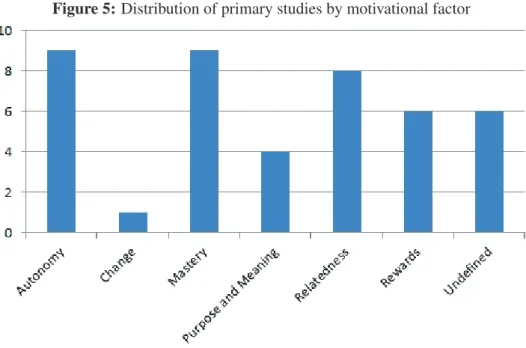
Figure 5:Distribution of primary studies by motivational factor
Source: Elaborated by the author.
The less used motivations by the models are Change and “Purpose and Meaning”, with only 2.3% and 9.3%, respectively. However, 35.3% of the studies did not mention motivational factors in their models, thus representing 14% of the total occurrences and being classified as “Undefined”. The classification of each primary study is described in Table 6.
Table 6:Distribution of primary studies by motivational factor
Motivational Factor Studies
Autonomy [A1], [A3], [A4], [A6], [A8], [A9], [A11], [A14], [A16]
Change [A11]
Mastery [A1], [A3], [A4], [A6], [A7], [A8], [A9], [A12], [A14] Purpose and Meaning [A3], [A6], [A8], [A12]
Relatedness [A1], [A3], [A4], [A7], [A9], [A11], [A14], [A16] Rewards [A3], [A4], [A8], [A11], [A12], [A16]
Undefined [A2], [A5], [A10], [A13], [A15], [A17] Source: Elaborated by the author.
3.4.2.3 GQ3. What user types the gamification models support?
To adopt the same organization utilized in GQ2, the user types mapped followed the defini-tions present in the gamification design Hexad (MARCZEWSKI, 2015). In brief, they can be defined as:
• Disruptor: It wants to disrupt a system, either directly or through other users to force positive or negative change;
• FreeSpirit: It wants to create and explore;
• Philanthropist: It is altruistic, wanting to give to other people and enrich the lives of others in some way (with no expectation of reward);
• Player: It will do what is needed to collect rewards from a system and not much more. It is in it for itself;
• Socialiser: It wants to interact with others and create social connections.
Figure 6 shows the distribution of the primary studies according to the gamification user types identified throughout the models. Among the 17 studies selected, a total of 47 user type occurrences was identified (after the terms’ standardization). Achiever, FreeSpirit and Socialiser are the main user types used by the models, with 21.3% and equally 19.1% of the occurrences, respectively.
Figure 6:Distribution of primary studies by user type
Source: Elaborated by the author.
The less used user types by the models are Disruptor and Philanthropist, with only 8.5% and 2.1%, respectively.
occurrences and being classified as “Undefined”. The classification of each primary study is described in Table 7.
Table 7:Distribution of primary studies by user type
User Type Studies
Achiever [A2], [A3], [A4], [A5], [A6], [A7], [A10], [A13], [A15], [A17] Disruptor [A2], [A5], [A6], [A11]
FreeSpirit [A2], [A3], [A4], [A5], [A6], [A10], [A11], [A15], [A17] Philanthropist [A3]
Player [A2], [A4], [A5], [A6], [A10], [A11], [A13], [A17] Socialiser [A2], [A3], [A4], [A5], [A6], [A7], [A10], [A11], [A17] Undefined [A1], [A8], [A9], [A12], [A14], [A16]
Source: Elaborated by the author.
3.4.2.4 GQ4. What are the gamification mechanics and elements present in the cur-rent models?
Figure 7 presents the distribution of the primary studies according to the gamification me-chanic or element identified throughout the models. After the terms’ standardization, a to-tal of 137 occurrences was identified among the 17 studies selected. Badges/Achievements, Points/ExperiencePoints(XP) and Leaderboards/Ladders are the main gamification elements
and mechanics used by the models, with equally 9.5% and 8.8% of the occurrences, respec-tively.
The less used gamification elements and mechanics by the models are Collect&Trade, Learning/NewSkills,Meaning/Purpose,ThemeandTimePressure, with 0.7% of the occurrences
each.
Even with a considerable variety of gamification mechanics and elements (totalling 32) identified in the models, 15 terms present in the design of MARCZEWSKI (2015) were not used, thus concluding that the resulting models of this study cover 68.1% of the complete set of gamification mechanics and elements available.
3.4.2.5 GQ5. What gamification designs the models follow?
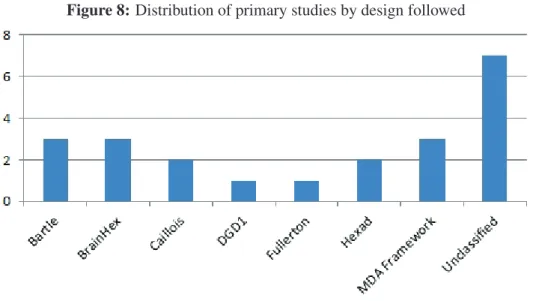
Figure 8 shows the distribution of the primary studies according to the gamification design followed by the models. The results of this classification show that 41.2% of the studies do not follow any externals gamification design, thus representing 31.8% of the total occurrences and being presented as “Unclassified”, since they can be following their own design.
Figure 7:Distribution of primary studies by gamification mechanic / element
Figure 8:Distribution of primary studies by design followed
Source: Elaborated by the author.
was used.
It is also important to highlight that some designs provided by the results of this study were built or inspired on other (and previous) designs, by making use of some ideas and concepts, so future research in the next years could help to identify the most followed gamification design over the time. The classification of each primary study is described in Table 8.
Table 8: Distribution of primary studies by design followed
Design Followed Studies
Bartle [A2], [A10], [A15]
BrainHex [A2], [A5], [A6]
Caillois [A2], [A11]
DGD1 [A2]
Fullerton [A2]
Hexad [A3], [A4]
MDA Framework [A8], [A10], [A12]
Unclassified [A1], [A7], [A9], [A13], [A14], [A16], [A17] Source: Elaborated by the author.
3.4.2.6 GQ6. What methods are used to validate the models?
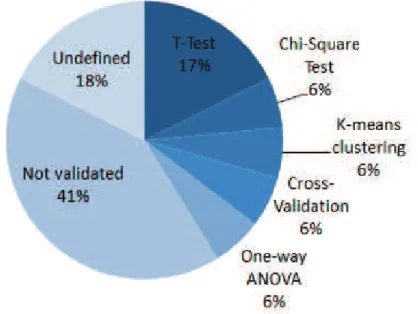
Figure 9:Distribution of primary studies by validation method
Source: Elaborated by the author.
Five different validation methods were identified among the remaining models (41%). The validations were used not only to verify if the model accomplishes its purpose but also to evalu-ate among the different uses provided by the model where it succeeds or fails. The classification of each primary study is described in Table 9.
Table 9:Distribution of primary studies by validation method
Validation Method Studies
T-Test [A5], [A13], [A16]
Chi-Square Test [A10] K-means clustering [A4] Cross-Validation [A6] One-way ANOVA [A17]
Not validated [A1], [A2], [A7], [A9], [A11], [A12], [A15] Undefined [A3], [A8], [A14]
Source: Elaborated by the author.
3.4.2.7 FQ1. What are the existing generic gamification models?
Figure 10 presents the distribution of the primary studies organized by the focused question identified in the models. For a better viewing, all of the questions were presented in the same figure, including an extra data representing the studies that did not answer positively to any of the focused questions, thus being grouped as "Not Applicable". The classification of each primary study is described in Table 10.
Figure 10:Distribution of primary studies by focused question
Source: Elaborated by the author.
Table 10: Distribution of primary studies by focused question
Focused Question Studies
What are the existing generic gamification models? [A1], [A2], [A3], [A5] What models are presented in the form of ontologies? [A7]
What models have adaptive or personalized characteristic? [A5], [A6], [A7], [A9], [A15]
What models support profiles? [A4], [A5], [A6], [A9], [A14],
[A15], [A17]
Not Applicable [A8], [A10], [A11], [A12],
[A13], [A16] Source: Elaborated by the author.
The classification decision used to answer this question is provided by the studies that ex-plicitly informed that their models had an generic purpose or use, despite of the area they were (if applicable) designed to.
3.4.2.8 FQ2. What models are presented in the form of ontologies?
The results of this classification show that only 1 study developed a gamification model represented by an ontology, resulting in only 5.9% of the total studies.
3.4.2.9 FQ3. What models have adaptive or personalized characteristic?
The results of this classification show that 5 studies developed an adaptive or personalized gamification model, thus representing 29.4% of the total studies.
The classification decision used to answer this question is provided by the studies which the main purpose is to provide adaptive or personalized gamification or that explicitly informed that their models contain such characteristic. Most of these studies also make use of profiles as a mean to provide adaptability or personalization.
3.4.2.10 FQ4. What models support profiles?
The results of this classification show that 7 studies developed a gamification model that supports profiles, being the highest percentage of positive results among the studies (41.2% of the total studies).
The classification decision used to answer this question is provided by the studies which explicitly stated that their models support user profiles or can keep user related information on profiles, even for those that in first instance do not make use of that information.
A total of 6 “Not Applicable” studies also resulted from the classification process, represent-ing 35.3% of the models that do not answer positively to any of the focused questions selected for this study.
3.4.2.11 SQ1. How many gamification models have appeared in recent years?
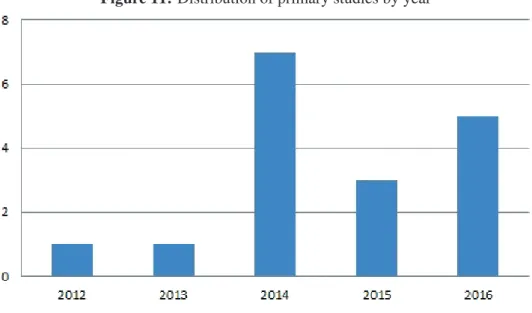
Figure 11 presents the distribution of the studies classified by the year they were published. The first primary study presenting a gamification model that follows the criteria of this System-atic Mapping Study appeared in 2012. The same result appeared in the subsequent year. The number of studies published in 2014 is seven times bigger than in 2013, and the number was less than a half in 2015 compared to the previous year. However, the number of primary studies published in the first three quarters of 2016 already exceeds the number of papers published in 2015. This result seems to follow the same growth trend of gamification in general (Google Trends, 2017), that is not specifically focused on models. According to WERBACH; HUNTER (2012), the first use of gamification as it is nowadays understood happened in the year 2003. On the other hand, and according to DETERDING et al. (2011), the first documented use of the term “gamification” happened in 2008.
3.4.2.12 SQ2. Where the gamification models have been published?
Figure 11:Distribution of primary studies by year
Source: Elaborated by the author.
or workshop papers, being 71% in conferences and only 6% in workshops.
Figure 12:Distribution of primary studies by type of forum
Source: Elaborated by the author.
Almost one-quarter of the papers were published in journals, representing 23% of the total results and indicating that the majority of the research under these aspects is still somehow preliminary. Table 11 presents the primary studies for each type of forum.
Another interesting information to analyze are the conference’s occurrences. Whilst many of them present only 1 representative study, 3 studies ([A9], [A11] and [A15]) were presented in the same conference, entitled as Proceedings of the Second International Conference on Tech-nological Ecosystems for Enhancing Multiculturality. This certainly indicates that gamification
Table 11: Distribution of primary studies by type of forum
Type of Forum Studies
Conference [A1], [A2], [A3], [A4], [A5], [A9], [A11], [A12], [A13], [A15], [A16], [A17]
Journal [A6], [A8], [A10], [A14]
Workshop [A7]
Source: Elaborated by the author.
3.5 Discussion
In this section is discussed the results obtained from the classification and analysis of the studies, along with an identification of gaps and opportunities for future research.
As a result of this analysis, the first point to highlight in this work is the lack of material in the literature concerning gamification models oriented to motivational characteristics, which is the main research question of this study. After many filtering steps, from the 1366 results obtained in the Initial Search, only 17 studies were approved throughout the filtering process, representing only 1.25%. It is true, however, that many models available do not consider in-cluding motivational characteristics, since if this restriction were removed, the representative work selection would have been a way bigger (more than 2 times the current amount).
As mentioned before, it was also observed that only a small part of the studies selected have been published as journal articles, which indicates that the status of the research is somehow preliminary, reinforced by the fact that almost 60% of the studies do not validate or evaluate their models.
Another important result collected from this study is the focus of the works on the Education area. It is very conclusive that the literature is interested in different attempts to increase the motivation of learning processes, as can be seen in Figure 13. It is the only area with studies covering all the focused questions of this study, although they are provided by different studies, once it was not found a unique study answering positively to all of the focused questions.
A possible gap found in this analysis is the use of ontologies to represent the knowledge of the models. Only 1 study (5.9% over all studies) developed a gamification model using ontologies. With an extensive amount of gamification mechanics and elements, motivational factors and user types available in the gamification field, ontologies and its applicability can be a powerful tool to engage future researches and provide new possibilities for gamification models.
exclu-Figure 13:Summary of classification (Applied Area by Focused Question)
Source: Elaborated by the author.
sive use of motivational factor or user type, the results confirmed the aforementioned relation. The most used motivational factors by the models are Autonomy, Mastery and Relatedness, which means that the most motivated user types by the models are FreeSpirit, Achiever and Socialiser.
Gamification is indeed very effective and can provide an increase of motivation, but will it be effective when implemented randomly or following a poor gamification model? In previous years, Gartner (PETTEY; MEULEN, 2012) predicted that “80% of current gamified applica-tions will fail to meet business objectives primarily due to poor design”. As stated previously, more than 40% of the models resulted from this study do not follow any known gamification design, also indicating that even models might follow the same success rate path of gamified applications.
A second analysis studying the applied area of gamification models was made, now fo-cusing on the gamification mechanics and elements selected, as can be seen in Figure 14. Following the same pattern observed in Figure 13, the area which provides most coverage is Education. But a dubious question remains: are the selected mechanics and elements the best choice for their models? There is a strong tendency to choose the mechanics and elements identified as Badges/Achievements, Points/ExperiencePoints(XP), Leaderboards/Ladders and Levels/Progression as the main option to be applied in these models, but will they reach their
be the safest way to build a successful model? Moreover, which of these elements have their effectiveness proven on their application area? Among an enormous variation of mechanics and elements available, developers must be very careful with their choices, considering psy-chological needs of the users, their types and personalities, factors that motivate them and most important: “do not follow any path just because everybody’s doing it” (DAVIS, 1993).
3.6 Conclusions of the systematic mapping and future work
In this section is presented the conclusion about the systematic mapping study conducted to characterize the state of art of gamification models with motivational characteristics. After carrying out the search for primary studies, they were classified according to eight categories, namely the areas that the gamification models have been applied, what motivational factors were included, what type of users they supported, which gamification mechanics and elements have been used, what designs the models followed, what methods have been used to validate them, how many models have appeared in recent years and in which type of research forums they were published. It was also created an additional classification according to four categories (in response to the focused questions of the study), namely the models that are generic, what are presented in the form of ontologies, what have adaptive or personalized characteristic and what models support profiles.
The results obtained during the analysis of the primary studies show that the existing re-search of gamification models is somehow preliminary and immature, since most studies have been published in workshops or conferences, and few of them were validated or evaluated due to be in a conceptual stage of development. Further research providing empirical results about the application of these models would provide richer information about the effectiveness of their gamification proposals.
Most of the analyzed studies focus on Education, commonly referred as “Gamification of Learning”. This leads to an important gap in the field, since gamification by itself offers me-chanics and elements to be applied on diversified areas, and Education is not the only area which suffers with lack of motivation by the users.
Another aspect that deserves further research effort is the gamification design to be followed when a model is being created. As an opinion, it was concluded that gamification designs offer an opened way to build a model, not referring to the implementation itself but to the gamification knowledge that needs to be carefully analyzed. More than 40% of the models did not follow a gamification design, resulting in similar choices of gamification mechanics and elements between them, so different options should have been considered and explored a little more.
53
and Philanthropist certainly have a space in some areas, although they were completely ignored by many models.
A research opportunity found is the development of gamification models that comply with all of the focused questions proposed in this study. Many combinations were identified, but with most of them only answering positively in up to half of the questions. It is believable that a model with generic purposes, making use of the benefits of ontologies, organizing all of the gamification user types and their motivations in profiles to provide adaptability and personal-ization, surely covers the existing research gaps highlighted in this work and deserves a full evaluation to validate the aforementioned concepts, thus proving its applicability.
From the results of the systematic mapping, it is possible to conclude that the development of gamification models is still growing, and more areas and uncovered gamification mechan-ics and elements should appear in future researches, as well as the number of studies and the completeness of their ideas.
3.7 Considerations about the chapter
This chapter presented a variety of results obtained from a systematic mapping study per-formed in the gamification field. In order to provide a simplified view of the characteristics analyzed in the representative studies in comparison with this research, a comparison table was created to highlight the main differences among the studies and in relation to the GamiProM model. These characteristics, described in Table 12, are used to identify if the gamification model presented in the representative study follows a gamification design, is validated, has a generic purpose, is represented in the form of ontologies, provides personalization / adaptabil-ity and makes use of user profiles. The model proposed in this research is mainly focused on support gamified profiles by managing and identifying the different motivations of the users, but it also answer positively to the others characteristics, once it follows a gamification de-sign (Hexad), has generic purposes, is represented in the form of ontologies, has support for adaptability and most importantly, is validated.
Table 12:Related works characteristics comparison Research Work Follows Design Validated Model Generic Model Ontology Representation Personalized / Adaptive Model Profiles Support
[A1] No No YES No No No
[A2] YES No YES No No No
[A3] YES No YES No No No
[A4] YES YES No No No YES
[A5] YES YES YES No YES YES
[A6] YES YES No No YES YES
[A7] No No No YES YES No
[A8] YES No No No No No
[A9] No No No No YES YES
[A10] YES YES No No No No
[A11] YES No No No No No
[A12] YES No No No No No
[A13] No YES No No No No
[A14] No No No No No YES
[A15] YES No No No YES YES
[A16] No YES No No No No
[A17] No YES No No No YES
GamiProM YES YES YES YES YES YES