ACTIVOBANK: A NEW MARKET
OPPORTUNITY
MARIA MATOS
Student Number: 152113109
Thesis written under the supervision of Professor João Simão Pires
Dissertation submitted in partial fulfilment of the requirements for the degree of Master of Science in Business Administration, Major in Strategy and Entrepreneurship
ABSTRACT
ActivoBank: A new market opportunity Maria Matos
ActivoBank (AB) has identified a new business opportunity to diversify the bank’s offer within the business client segment. The project’s goal is to develop a portfolio of products and services targeting start-ups, micro and small enterprises (MSE).
This case study presents the early steps of the business plan for the strategic diversification. Given the identified new business opportunity, market and customer analysis were made. Forecasts of the size and profitability of the target segment were prepared in order to assess its potential.
The research confirmed the existence of an under-served segment in the banking industry. However at the same time, is not straightforward that the bank will succeed in targeting it. In line with this conception, a deeper, customer-centric and process-driven methodology is recommended. This process aims to ensure a better alignment between customer processes and financial services.
This case study, however, does not reach any conclusion regarding whether or not the bank should invest on targeting this new segment.
Keywords: Business Strategy, Segmenting, Targeting, Entrepreneurship, Online Banking
RESUMO
ActivoBank: A nova oportunidade de mercado Maria Matos
O ActivoBank (AB) identificou uma nova oportunidade de negócios para diversificar a sua carteira de negócios para o segmento empresarial. O objetivo do projeto foi desenvolver um portfólio de produtos e serviços dirigidos a start-ups, micro e pequenas empresas.
O caso de estudo apresenta os primeiros passos do plano de negócios tendo em vista a estratégia de diversificação. Dada a oportunidade de negócio, tanto o mercado como o cliente alvo, foram analisados. Foram calculadas previsões da dimensão e rentabilidade do segmento alvo, de forma a avaliar o seu potencial.
A pesquisa efectuada, confirmou a existência de um segmento que não está a ser servido, adequadamente, pelo sector bancário. No entanto, não foram encontradas provas incontestáveis do sucesso do banco em servi-lo. Foi recomendado ao banco, que fizesse uma análise mais profunda do potencial cliente. A abordagem centrada no cliente e a metodologia orientada para os seus processos visa assegurar o alinhamento entre os processos do cliente com os serviços financeiros propostos pelo banco.
O caso de estudo não foi conclusivo sobre se o banco deve investir na implementação do novo segmento ou retirar o projeto.
Palavras-chave: Estratégia empresarial, Segmentação, Targeting, Empreendedorismo e Online Banking
ACKNOWLEDGEMENTS
I would first like to thank ActivoBank for the opportunity to profit from an internship in a bank with so many differentiated and valuable characteristics. It was a rewarding experience. The bank was able to come up with a truly interesting topic to be developed in the scope of my dissertation and this boosted my motivation towards the progress of the challenged in hands.
I am grateful to Luis Magro, ActivoBank’s Marketing Director, and Teresa Siopa, Product Manager, for their assistance and unwearyingly commitment to the project.
I appreciate the recommendations and insights given by my advisor João Simão Pires and by my friends and colleagues Mariana Vaz da Silva and Margarida Ramalho Ortigão. To them, I address my sincere gratitude for all the honest and valuable feedback.
I acknowledge also João Maria Rodrigues, who was an invaluable support through the most difficult times.
Finally I would like to thank my family, especially to my sister Cláudia Marques Matos and my mother Hortense Matos that despite not mastering the topic at hand were always available and helpful in what they could.
TABLE OF CONTENTS ABSTRACT 1 RESUMO 2 ACKNOWLEDGEMENTS 3 LIST OF FIGURES 4 LIST OF TABLES 6 LIST OF EXHIBITS 7
GLOSSARY & ACRONYMS 8
A. CASE STUDY 1
Introduction 1
The company: ActivoBank 2
The group: Millennium bcp overview 2
ActivoBank’s history 3
Strategy formulation 4
Online banking 7
The scope of analysis 7
Trends 7
The competitive environment 11
An under-served segment: start-ups 12
Entrepreneurship in Portugal 12
The profile of the Portuguese entrepreneur 17
Available offer 21
A new market opportunity for ActivoBank 23
Start-ups, micro and small companies 23
The target segment 28
AB’ approach to target and segment enterprises 31
Future value for the bank 32
Conclusion and recommendations 34
Exhibits 37
B. TEACHING NOTE 1
Introduction 1
Synopsis 1
Suggested assignment questions 2
Teaching objectives 3
Use of the case 3
Relevant theory 3
Specific theory 8
Analysis and discussion 10
LIST OF FIGURES
Figure 3.2.1.: The Evolution of Digital Strategy for Banks
Figure 3.2.2.: Banking’s transaction (as a percent of pre-1980 teller branch activity) Figure 3.2.3.: Banking services (process requests)
Figure 3.2.4.: Banking sales (account acquisition)
Figure 4.1.1: Entrepreneurship in Portugal vs. the European Union’s Average Figure 4.1.2.: Impact of Entrepreneurship education, 2012
Figure 4.2.1.: Distribution by entrepreneurs and workers’ age
Figure 4.2.2.: Motivation for the entrepreneurial activity, 2010 – 2014 Figure 5.1.1.: Company’s size and business longevity
Figure 5.1.2.: Distribution of the business by age ranges
Figure 5.1.3.: Contribution of each age group for economic activity
Figure 5.1.4.: Percentage of young, adult and mature companies by sector of activity Figure 5.2.1.: Evolution of Portuguese entrepreneurship owners (2010-2014)
LIST OF TABLES
Table 3.3.1.: Summary of relevant data on online banks in Portugal
Table 5.2.2.: Number of AB’s individual clients with potential to be business clients Table 6.2.1.: Forecast of business clients
LIST OF EXHIBITS
Exhibit 1: ActivoBank’s Offer
Exhibit 2: Matrix of AB’ Segmentation and Number of Clients 1994 – 2015 Exhibit 3: ActivoBank Core Values
Exhibit 4: Branches Evolution
Exhibit 5: Examples of AB’s Advertisements Exhibit 6: Standard Offer
Exhibit 7: Online banking penetration in European markets in 2014 Exhibit 8: Online Baking - international perspective
Exhibit 9: Number of smartphones sold to end users worldwide from 2007 to 2014 Exhibit 10: Worldwide PC and tablet shipment forecast
Exhibit 11: List of Banks in Portugal, as for 2015/03/09
Exhibit 12: Top 5 Financial Institutions in Portugal: Main Financial Indicators Exhibit 13: Competitors’ profile
Exhibit 14: Offer comparison between the Portuguese online banks Exhibit 15: Five years’ overview of AB’s financial performance
Exhibit 16: Responsive Administration in Portugal vs. European Union average Exhibit 17: Market Research - Interviews
Exhibit 18: Data on Portuguese Enterprises 2014 Exhibit 19: Data on Entrepreneurship
Exhibit 20: Individual clients’ segmentation
Exhibit 21: Relevant data, estimations and forecast Exhibit 22: Forecast of AB’s business clients profitability
GLOSSARY & ACRONYMS
AB – ActivoBank
ATM - Automated Teller Machine B2B – Business-to-business B2C – Business-to-consumer
Best Bank – Banco Electrónico de Serviço Total, S.A BiG – Banco de Investimento Global, S.A.
DSA – Direct selling agents EU – European Union
GEM – Global Entrepreneurship Monitor GDP – Growth rate of gross domestic product ICT – Information and communications technologies
IES - Informação Empresarial Simplificada (Simplified Enterprise Information) MB Net – Multibanco online (online ATM)
MSE – Micro and small enterprises POS – Point of Sale
OECD – Organization for Economic Co-operation and Development SME – Small and medium size enterprises
SOHO – Small office and home office
STP – Segmenting, targeting and positioning Tech – Technology
A. CASE STUDY
INTRODUCTION
“Change is the law of life. And those who look only to the past or present are certain to miss the future.”
John F. Kennedy
Recent changes in culture, behaviour and technology have been shaping today’s society. This new paradigm impacts customer demand in all industries in every market and has therefore been changing the set of products/goods/services suppliers need to make available.
Having this in mind, a marketing team in a small online bank has been struggling to understand what is the product portfolio that will generate more profit and therefore allow the bank’s survival in such a harsh economy.
The team pointed out two possible market segments, which could be targeted in the near future once they are seen as an opportunity for growth and also as a threat if not addressed. However, when companies start to diversify their portfolio and to expand its business into other segments, complexity arises as differentiated value propositions are delivered. Moreover, the bank in question is still very small, owning less than one percent of the market share in the individual segment which is currently the only segment targeted by the bank.
The issues narrated by this case study relate to the uncertainty of whether or not it is premature to diversify a portfolio, considering the risk of raising complexity with no pay off in terms of the number of new clients and of its respective added value. The team is perfectly aware of the urgency of this strategic move in order not only to capture more clients but also to keep its small clients’ base. Nevertheless, a cost-benefit analysis addressing the segment in question and the value of these potential clients to the bank is indispensible in order to measure the consequences of this change to the success of the Portuguese online bank ActivoBank.
THE COMPANY: ACTIVOBANK
THE GROUP: MILLENNIUM BCP OVERVIEW
Millennium bcp is a Portuguese bank founded in 1985, as Banco Comercial Português. It became a leading institution of reference in Portugal, with a consolidated market share of 18,9% (1) in clients’ deposits, serving 2,3 million clients in Portugal. Nowadays, it is the biggest private bank in Portugal and the second biggest regarding both private and public
banks, since Caixa Geral de Depósitos has a market share of 30,5%a (2). Millennium owns
more than 1.600 branches and employs 20.000 people in six countries where it operates, addressing the needs of 5,5 million customers (3).
The bank’s activity in Portugal is divided as follows:
It provides a wide offer of banking and financial products and services: current accounts, savings and investment products, private banking, asset management and investment banking, among others. Its offer is distributed across 774 branches and remote channels (telephone and internet). Millennium bcp has the largest retail branch network, 16% of the total number in Portugal (4).
Millennium BCP
• Universal bank ActivoBank
• Online bank
Banco de Investimento Imobiliário
• Real state credit Millennium BCP Ageas
• Insurance
Interfundos
ACTIVOBANK’S HISTORY
Back in 1994, Millennium bcp created Banco7, the first telephone-only bank in Portugal. It was considered to be an innovative bank, exploring a new distribution channel and adding its value to the group with full autonomy in the midst of the large institution that was Millennium bcp. At that point in time, the target was middle-high class customers, offering simple transactions enabled by phone calls. The cornerstone of accessibility was already a hallmark, as one can infer by its extended business days: seven days a week. It was an atypical bank since all the usual concepts of the banking industry, as branches and accounts managers, were not present in Banco7’s value proposition.
In 2001, in pace with technology and with the rapid spread of the internet, the bank was reshaped and rebranded. It was no longer the old Banco7 accessible only by phone, but the new ActivoBank7 available by phone and online.
The bank had also repositioned itself, offering investment solutions to affluent middle to high-class customers, and medium-sized companies. The bank was led into opening branches, one in Lisbon and a second one in Oporto, not only for legal purposes but also due to the higher complexity of the products it was marketing, which required a closer relationship with the clients.
Until 2009, the bank was not focused in growing, given its value to the Group. The main concern was for it to be the innovative and experimental bank of Millennium bcp. It was nevertheless necessary to be profitable and this requisite was put into question due to the economic downturn. By that time, ActivoBank7 had its first negative results and the future was uncertain. The bank had only 16.000 clients and had not been growing since 2007. To exacerbate the situation, the bank’s offering was strongly linked to investment opportunities in the retail segment, which was massively affected by the withdrawal of money markets and the drop in stock markets. People were not willing to invest anymore and a change was due in order to survive. ActivoBank7 was until then focused on becoming the people’s second bank, however the financial crisis cut the bank’s revenues from financial instruments. Without having other products within its portfolio, the bank was not able to
provide sustained profit. The future was to rebrand the bank once again and shape it in a
way that would meet the overcoming challenges.
In March 2010, the brand name dropped the seven and became ActivoBank (AB). The bank changed more than its name, the core business also suffered considerable alterations. The bank was no longer only focused on retail investment but also on day-to-day products, loans, deposits and insurances. All products within the portfolio had the same importance to the bank and all of them shared a single philosophy: Simplicity. The philosophy became the keystone of the bank, originating the five values that currently rule the daily lives of the people who work at AB, and which will be introduced in the next section (Exhibit 1 and 2).
STRATEGY FORMULATION
MISSION, VISION AND VALUES
AB launched a new concept in the Portuguese banking industry, translated into a new approach, new image, new offer and new channels of distribution that increased customers’ convenience – website and mobile. The goal was to respond to clients’ and potential clients’ needs and expectations, through an offer adapted to fit their current lifestyle. On the other hand, the idea was to make use of AB’s expertise in the investment area.
AB’s mission is: “ActivoBank designed in detail to simplify people’s life”. The bank also
focuses on giving to the client exactly what he/she needs with a simple and relatively short portfolio of products and services. Value for money is something which is taken seriously by the bank, promising to the client to pay only what he/she needs without commissions and complexity.
AB is ruled by five values: Simplicity, Transparency, Accessibility, Trust and Innovation
(Exhibit 3). Moreover, the concept is based on seven key elements:
2. Distinctive use of physical presence: Branches located in prime locations with easy
access with enlarged schedule (from Monday through Saturday, from 10am to 8pm).
It aims to be used as less as possible, almost exclusively for opening accounts (Exhibit
4).
3. Independent sales representative: Innovative sales force, including associated promoters doing peer-to-peer recommendations.
4. Online Presence: Simple and direct platforms (web and mobile) with high standards
of reliability. Its presence in social and virtual networks (Facebook and Twitter)
improves the quality of service and helps to increase consumers’ confidence.
5. Worksites: Sales force that have as their mission to introduce AB’s offer in companies, with the goal of offering special conditions to employees.
6. Operational: Leverage operations thanks to the mother company – Millennium bcp – without affecting the strategic independence of AB.
7. Brand & Image: Independent brand, taking advantage of Millennium bcp endorsement (“by Millennium”) to reinforce trust and legitimacy.
TARGET SEGMENT
The target market potentially comprises approximately 770.000 individuals in Portugal and it is characterized as follows:
Self-directed, preferring to acquire and fulfill its needs, autonomously and valuing simplicity;
Urban, with a young attitude praising their time and money; Highly cost-conscious requiring a committed low-cost approach;
Instant-messaging individuals, aiming for a highly technological connection;
Demanding of peer-approval, requiring informed and independent advice when making their decisions.
PRODUCTS
AB provides a standard and differentiated offer to reel consumers in. Some of the products offered by the bank are Millennium’s ownership while others were fully developed by AB (currently 39).
The standard offer consists of five categories: day-to-day, savings, credit, insurance and trading services for financial investments (Exhibit 5). Among its different features, the following stand out:
No maintenance fees;
No annual fees;
Tangible offer: products are given in physical boxes when a new client opens an
account;
Simple and easy to understand contracts;
Complementary offer in investment services.
AB’s marketing hooks consist in a Welcome Campaign and the savings products Start (for new clients) and Extra (for existing ones). These products aim to attract new clients to the bank and to deepen the relationship with the existing ones.
The products were developed in line with the new values of the bank and in order to respond to a complex and highly regulated industry. AB simplified the number of products and features, communication and other processes, reducing time consumption. AB is also clear and very direct in terms of communication with no need for an instructions manual. The language of all contracts is easy to understand and hidden clauses do not exist in its advertisements (Exhibit 6).
ONLINE BANKING
THE SCOPE OF ANALYSIS
AB is operating specifically in the online banking industry; however, the traditional banking industry is also under analysis since the difference between the two is merely the distribution channel and the degree of direct contact with the client. Moreover, despite a few differentiating features in client segmentation, clients are mostly the same and most of the core products remain unchanged. On top of that, AB positions itself first as a bank, which means that it has a global offer with all of the most common products of a retail bank. AB’s main product to capture new clients is the salary account which is a reflection of its positioning.
It is important to highlight the fact that in this industry, revenues are generated by the return from products and services through the charging of interests, transaction fees and financial advice. Banks profit from the spread concerning the cost of funds, the interest rate it pays for deposits and the interest rate it charges for loans. Both rates suffer the impact with different conjectural factors, which makes these streams volatile. Financial advice and fees are much more stable revenues accounting for its crucial importance for the banks.
TRENDS
The cultural setting was clearly impacted by the digital era and the banking industry is not an exception. The technology trends combined with the expected evolution in customer behavior will change significantly the banks’ strategy in the near future. Trends such as the increasing number of smartphones and tablets but also the proliferation of cloud services and the spread of digital culture across generations, industries and locations will boost the digital transformation. A change in the activity of physical branches is expected: given its decreased share in client interaction, they will probably tend to be fewer in quantity but bigger in size, to provide an exclusive customer experience (5).
The retail banking has been developing its digitization as internet access has become more and more present in people’s lives.
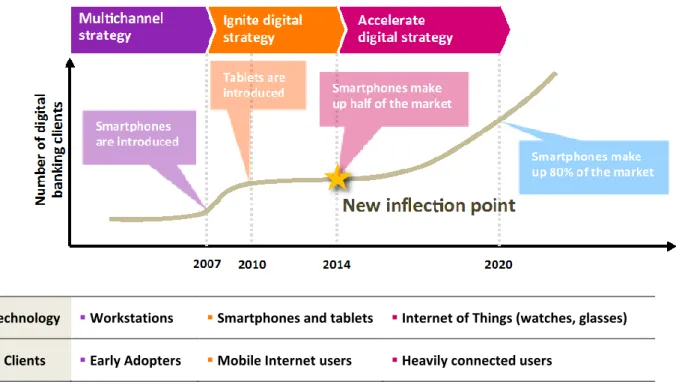
The mobile channel has been gaining ground and is expected to be the epicenter of digital banking. Mobile phones have become the costumers’ first touch point for several products and services, converting this channel into the cornerstone of the digital strategy of major banks (5).
Figure 3.2.1: The Evolution of Digital Strategy for Banks
Source: A.T. Kearney analysis
The internet is growing at a fast pace, and online banking has quickly caught up with the trend. From the 95 million households that have internet hardware worldwide, 72,5 million benefit from online banking (6). In 2014, the online banking penetration in Europe was 44%. As for Portugal, 25% of the population accesses online banking sites (7), (Exhibit 7 and 8).
The growth of the online banking industry is also closely related to smartphone data traffic since much of the online transactions have been shifting from computers to mobile
Technology Workstations Smartphones and tablets Internet of Things (watches, glasses) Clients Early Adopters Mobile Internet users Heavily connected users
devices. Between 2007 and 2014, global sales of smartphones to end users increased by 10 times (exhibit 9). In 2014, 303 million desktop and laptop PC were shipped worldwide although this figure is expected to decrease by 7,3% per year until 2018 (8). As for tablets, it is forecasted the shipment of 406,8 million devices in 2017, an increase of 74% in relation to 2014 (9), (Exhibit 10).
In line with this trend, it is not surprising that 75% of mobile traffic in 2019 is expected to be done through smartphones (10). Taking the example of mobile phone payments, they increased from 161 million in 2011 to 212 million in 2012. Projections for 2016 indicate €551 billiona worth of transactions (10).
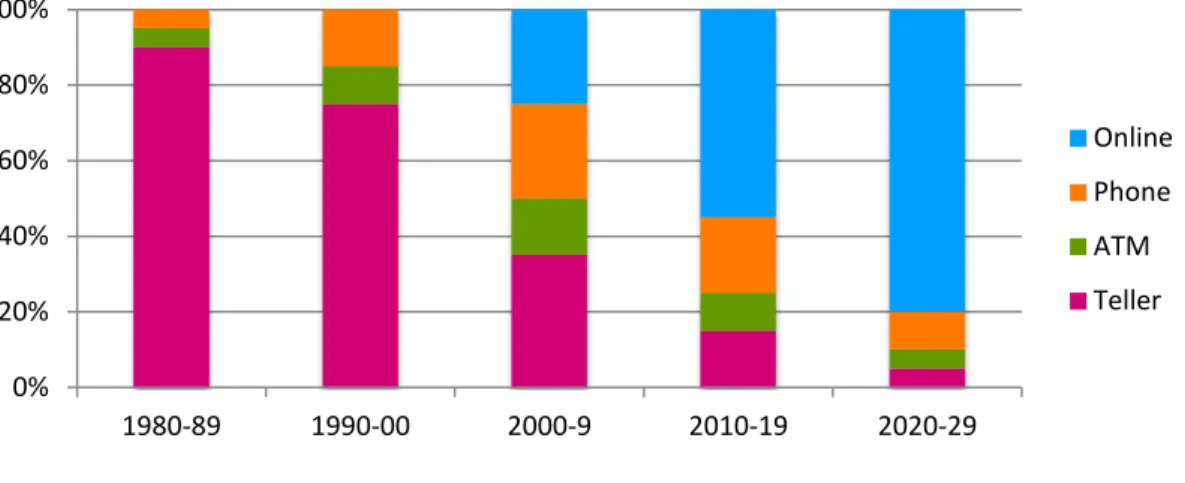
Figure 3.2.2.: Banking transactions (as a % of pre-1980 teller branch activity) Source: Smart Bank 2015
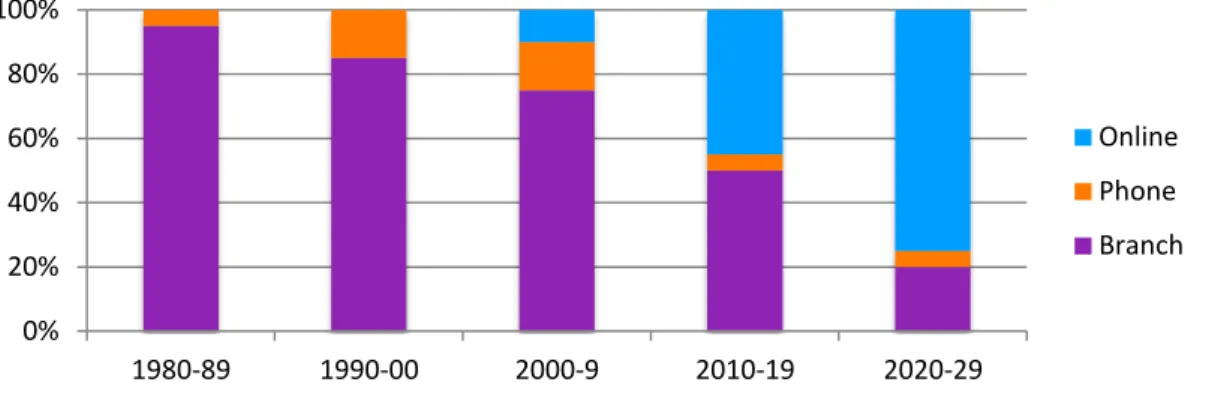
Figure 3.2.3.: Banking services (process requests) Source: Smart Bank 2015
0% 20% 40% 60% 80% 100% 1980-89 1990-00 2000-9 2010-19 2020-29 Online Phone ATM Teller 0% 20% 40% 60% 80% 100% 1980-89 1990-00 2000-9 2010-19 2020-29 Online Phone Teller
Figure 3.2.4.: Banking sales (account acquisition) Source: Smart Bank 2015
While the value and the growth of this industry are clear, there are some risks associated with migrating to the online channel. On one hand, digital transactions bring cost-savings and higher interaction, but on the other hand it also brings revenue risks due to customers distance from the branch, potentially leading to a decline in engagement, loyalty, sales and cross-selling (11).
THE COMPETITIVE ENVIRONMENT
In Portugal there are 35 financial institutions (4) (Exhibit 11), a number that has been decreasing due to mergers and acquisitions occurred in recent years. The market is considered to be highly concentrated, since 5 institutions control 78,9% of the total clients’ resources and 81,6% of loan initiatives (Exhibit 12).
Despite being competing with major banks, AB differs largely from these institutions with respect to customer behavior. Firstly, AB is much smaller in scale, secondly AB’s distribution channels is different and provides a less exhaustive portfolio of products and services. Therefore, AB also belongs to a strategic group where it competes with banks with a similar market share and distribution channel: Banco Electrónico de Serviço Total, S.A (Best Bank) and Banco de Investimento Global, S.A. (BiG). Both banks are online banks and have few physical points of sale. They are mainly focused on investment products as ActivoBank7
0% 20% 40% 60% 80% 100% 1980-89 1990-00 2000-9 2010-19 2020-29 Online Phone Branch
was before 2010 (Exhibit 13). Despite the AB’s restructuration that made it compete with all the other banks in daily products and services, Best and BiG are still part of AB’s competitors list as they also chose online and mobile phone routes to reach its customers (Exhibit 14).
Table 3.3.1.: Summary of relevant data on online banks in Portugal Source: Banks’ annual reports and internal data
Net Income Number of Accounts
Assets Under
Management Deposits Loans
ActivoBank -3 64.145* 441 414 44
Banco BiG 58 - 2.159 684 197
Best Bank 10 ~82.000* 360 277 159
* Number as for the end of 2014 FY As for the end of 2013 FY
In million Euros except the values for the number of accounts
Exhibit 15 contains further information on this matter.
AN UNDER-SERVED SEGMENT: START-UPS
ENTREPRENEURSHIP IN PORTUGAL
From 2008 to 2012, Portugal experienced a deep recession, hitting the construction and real estate industries the hardest (12). Still, all the other industries were impacted and in general small and medium-size enterprises (SME) became more fragile, leading to the bankruptcy of many in the following years. In 2013, a total of 8.131 companies were declared insolvent (13), and as a result, the unemployment rates increased substantially having reached 16,2% of the active population (14). The numbers of companies, the volume of business and the number of people employed by SME have been decreasing. However, the reforms implemented by Portugal in the last years have been changing the negative trends and creating room for economic recovery.
Nevertheless, the employment conditions have forced the population to find new professional alternatives and a notorious consequence was the increasing number of new businesses’ constitution. In 2013, there were more than 890.000 small business owners in Portugal, representing an annual growth rate of 16% from 2011 to 2013 (13).
Entrepreneurship brings economic growth and creates jobs, and it is therefore fundamental for a country like Portugal to nurture the entrepreneurial spirit in the population.
“Creating good conditions for new firms to enter the market and for young firms to grow can therefore play a key role in fostering job creation.” OECDa (15)
A good sign of Portuguese government’s attempts to encourage entrepreneurship was the victory of the European Entrepreneurial Region Award in June 2014 that acknowledged Lisbon for its “efforts to boost entrepreneurship and implement key EU policies, such as the Small Business Act b and the Europe 2020 Strategy for Growth and Jobs” (16).
“By far the best performing SBA area was entrepreneurship, as the Portuguese economy is characterized by intense and high-quality entrepreneurial activity that is underpinned by a remarkably positive entrepreneurial culture.” (17)
Moreover, the Ministry of Economy is creating several initiatives to boost the creation of new companies, like Portugal 2020 and the Strategic Programme for Entrepreneurship and Innovation (+e+i). Besides creating programs, the government simplified the insolvency framework by creating a new law that accelerates the liquidation
a
Established in 1961 in France, the OECD is an organization with 34 member countries that promotes policies aiming the improvement of the economic and social well-being of people worldwide.
procedure and out-of-court settlements are allowed. Costs are reduced and the stigma for failure is mitigated, giving confidence for honest entrepreneurs to pursue new business attempts. Plus, start-ups began to be reimbursed with a percentage of the single social tax. Another factor that boosts entrepreneurship is the ease of starting a business, and on the rank of countries where it is easier to start a new business, Portugal is ranked number 10 (18). It is possible to do so in one business day at a cost of 290€ with no capital requirements. However, the administrative procedures and the legislative frameworks are still perceived as complex as they lack stability (Exhibit 16).
The improvements occurred in recent years are in fact recognized. The OECD’s report, Skills will drive inclusive economic growth in Portugal (19), highlighted the reduction on the necessary bureaucracy to create new businesses in Portugal.
“In the past two years, Portugal had the merit of creating an ecosystem. Nowadays, any entrepreneur has immense facility to launch anything. There are support structures such as incubators and accelerators, and in three months an APP can be launched.” (20) Alexandre Barbosa, Co-Founder and Managing Director of Faber Venturesa
It is undeniable that entrepreneurship is a growing segment, supported by a diversified ecosystem composed by government agencies, entrepreneurs’ hubs, universities, capital sources and support services that impel entrepreneurial activities.
Media companies are also showing signs of supporting this segment and are starting to explore entertainment opportunities associated with entrepreneurship. The American awarded TV show Shark Tank, was brought to the country by SIC and is on air since March 2015. It is not only a TV show that aims to entertain the Portuguese population, but it will also inject capital on the Portuguese economy, given the 2,5M Euros each shark has to invest; and help to shape the mindset of the population. Five years ago, this and other TV contests of the same nature were already broadcasted abroad but in Portugal it was only
possible to watch online or in niche channels. Today, one of the major channels fighting for the front lead in audiences is transmitting an entrepreneurship related show at prime time. On the two first episodes, the average audience was close to one million viewers (21).
The mindset of the Portuguese people has been shaped towards an entrepreneurial attitude. Moreover, there is not only an increasing need for Portuguese citizens to create their own job opportunities, but there also seems to be a preference for self-employment, which represents 20% of the employed population (14). Comparing to other European countries, in Portugal there are more adults employed and preferring to be self-employed (16).
Figure 4.1.1.: Entrepreneurship in Portugal vs. the European Union’s Average Source: European Commission
It is also the result of an entrepreneurial culture that reflects the attitude that the Portuguese population have towards entrepreneurship and the probability to choose this path as a career. In society, this culture is driven by skills and by the education system, which have been developed in this sense for a while.
Studies show that in terms of higher education level, Portugal is in line with other countries in EU. However, at lower levels of education students are not trained at the same level to the development of new businesses (22). Therefore, there is room to improve the existing training and enlarge its scope. In spite of this, the 2012 Eurobarometer survey showed that 70% of the Portuguese participants agreed that “school education provided them with the necessary skills to run a business”.
Figure 4.1.2.: Impact of Entrepreneurship education, 2012
(Proportion of adults aged 15 to 64 who agree that their school education provided the skills and know-how to run a business)
Source: European Commission (2013), “Entrepreneurship in the EU and beyond”, Flash Eurobarometer 354.
The lack of managerial skills undermines the potential of good ideas and its viability to build new businesses. Enterprises’ failures can be reduced with better training; however the importance of other factors should not be overlooked.
There are still some obstacles for those who have vision and work hard to create its own business and in Alexandre Barbosa’s opinion, one is the lack of a clear strategy to 0% 20% 40% 60% 80% Po rtu gal Tu rk ey Sp ain Fi n lan d N o rw ay Ice lan d U n ited Sta tes Sw ed en G re ece Au stria Lu xe m b o u rg Slov ak r ep u b lic Sw itz erlan d Be lgi u m Cze ch r ep u b lic H u n gary De n m ar k Po lan d N eth erlan d s Korea Slov en ia Irel an d Fran ce G erm an y It aly Es to n ia Is ra el U n ited kin gd o m Jap an
sustainably attract the funds needed by venture capital firms to invest in entrepreneurial activities (20).
According to Teresa Fernandes, board member at Portugal Venturea it is fundamental for start-ups to be appealing to international investors in order to mobilize the needed volumes of resources to grow (23). Moreover, due to the constraints of financial resources, MSE are particularly vulnerable when credit is limited. If these companies are more involved in international trade, they can dodge European market’s contractions and benefit from more successful markets abroad.
The OECD points out the high cost of credit in Portugal comparing with other countries. Interest rate spreads on new loans are almost twice as high as the EU average and the interest rates on new loans up to 1 million Euros is on average 3,4% higher than in other countries in the euro zone.
THE PROFILE OF THE PORTUGUESE ENTREPRENEUR
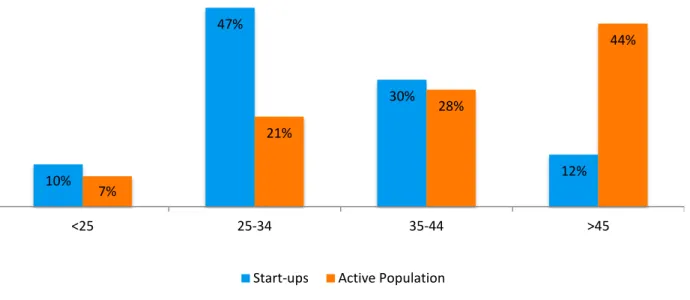
Almost half of the people incurring in entrepreneurial activities are between 25 and 34 years old, which is a much higher percentage than that found in other types of companies in Portugal and reflects the attractiveness that younger and possibly more prone to risk individuals have for start-ups. The second largest group is made up of people up to 45 years. As for gender, two thirds of entrepreneurs are male.
Figure 4.2.1.: Distribution by entrepreneurs and workers’ age
Source: Data as for 2014 from INE, PORDATA. Data for start-ups from "O Ecossistema
empreendedor de Lisboa" by Lispolis, Macrometria e Camara Municipal de Lisboa, 16 de abril de 2014
The education level of these individuals is higher than that of the average Portuguese workforce. In the incubation network, more than 80% of entrepreneurs had completed higher education. The group of people in Portugal that have this level of qualifications amounts to 20%, which means that entrepreneurial activity attracts highly skilled people.
80% of entrepreneurs found in incubators are Portuguese. However, a greater percentage of international people is found in incubators specialized in technology and in start-ups with scalability potential, developing goods and services orientated to external markets.
When describing the profile of the Portuguese entrepreneur, it is important to mention that 34% of these people had already attempted to start a business before. This percentage is in line with the numbers observed in other European capital cities like Berlin, Paris or London, however below the ones verified in Silicon Valley or New York. The difference could mean that European entrepreneurs are more risk averse and only commit to projects with high chances of survival. Other explanation could be the less favorable
10% 47% 30% 12% 7% 21% 28% 44% <25 25-34 35-44 >45
environment in Europe to start a new project when the former has failed, the difficulty of access to new funding and the stigma associated with default.
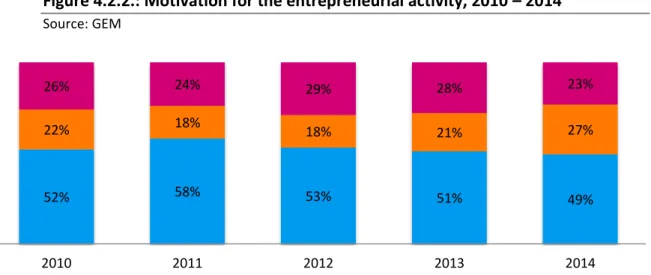
The profile of entrepreneurs can also be distinguished by individuals’ motivation. People can be either motivated to start their own business by necessity or motivated by opportunities to improve their life.
Figure 4.2.2.: Motivation for the entrepreneurial activity, 2010 – 2014 Source: GEM
1. Opportunity-Driven: people driven by opportunity as opposed to finding other option for work.
2. Necessity-Driven: people involved in entrepreneurship because entrepreneurship presents the best option available for employment, however it is not the preferred option.
The volume of necessity and opportunity is a reflection of the nature and structure of entrepreneurial activities. In fact, these drivers are important due to the positive impact on economic development created by opportunity entrepreneurship whereas the necessity-driven type does not have any effect (24).
One of the biggest differences between the two profiles of entrepreneurs is related
52% 58% 53% 51% 49%
22% 18% 18% 21% 27%
26% 24% 29% 28% 23%
2010 2011 2012 2013 2014
Improvement-Driven Opportunity Entrepreneurial Activity: Relative Prevalence Necessity-Driven Entrepreneurial Activity: Relative Prevalence
opportunity-driven expects its business to grow more and to create new jobs, oppositely to the necessity-driven. (24)
Even though the majority of entrepreneurs in Portugal are involved in entrepreneurial activity due to their own choice, the percentage of people who has started a business driven by necessity has been increasing in the last few years.
The individual initiatives have been increasing and the constitution as sole proprietorship has been the most common choice (94%). 77% of entrepreneurs are running their venture as managers. (25)
NEEDS AND CONSTRAINTS
The marketing research provided relevant insights regarding the difficulties that entrepreneurs face in the different stages of developing and managing their ventures. Investment and financial issues are the root of most of entrepreneurs’ problems and have a great impact on the success and ease of operating their businesses.
The marketing team in AB developed 7 interviews to people within the entrepreneurial environment in Portugal (Exhibit 17). Most of the people interviewed addressed the difficulty in setting up a business. Part of this problem regards political and bureaucratic concerns, but also the high cost of capital charged by banks due to the high risk associated with start-ups. Moreover, entrepreneurs are not willing to pay for such expensive bank loans. As previously mentioned, there are few venture capital, investment funds and angel investors providing opportunities to start-ups in Portugal.
A great portion of entrepreneurs does not have a management or any other related degree. They start a business empowered with what seems a good business idea and the expertise on the field addressed by their business. However, they lack management skills. Developing a business plan is a struggle for them and later, accounting and financial management is a challenge. When it comes to managing the business, the problem arises later on, and when internationalization comes into play, complexity amplifies creating the
the entrepreneurs interviewed claimed that, because they had already failed in the first entrepreneurial attempt, the second time they have asked for mentors and recurred to consultancy in order to maximize their chances for success. So, financial consulting services may be a good opportunity to be undertaken by the bank.
It was found that entrepreneurs value celerity and easiness in banking services. They value simplicity and transparency, since they are not experts in banking. Despite valuing advice, they need things to be simple in order to do it quickly and by themselves. Therefore, there is a good opportunity to simplify the bank’s communication and hold the values that currently drive AB.
As for the people interviewed, the discontent with the current financial offer is clear. They claimed that not a single bank in Portugal is thinking about their needs and presenting a truly valuable offer. They need:
Lower minimum values to open an account; No annuities and maintenance fees;
Free transfers, both nationally and internationally.
Since many new enterprises are operating in digital marketplaces by developing apps, online shops, social networks and software, entrepreneurs need online billing with different paying options (PayPal, Visa, MB neta, etc.) and credit cards or pre-paid webcards to shop online. Due to the nature of their business, entrepreneurs need cloud services for which they pay a considerable amount. This presents an opportunity for AB to develop packages or partnerships with companies providing these services, in order to get a more attractive pricing to this segment and earn a margin on the deal.
Complex financial products, such as mutual warranty, micro credit, factoring and confirming were mentioned. Pricing is the main concern in these products, looking for more attractive interest rates. Confirming and factoring are especially important for start-ups since they lack liquidity to fund their operations. These products are very complex and, therefore, might be set aside at least on a primary stage.
AVAILABLE OFFER
There is only one bank in Portugal explicitly targeting start-ups: Montepio. The remaining banks provide financial products that mainly focus on solutions for SMEs’, offering standard products with a great emphasis on credit and on loans. Banks usually offer:
SME accounts SME Loans Credit Lines Insurance Payment solutions POS
Debit and credit cards International Trading Guarantees
Investment Solutions Leasing/Renting
MONTEPIO GERAL
Montepio has developed a valuable offer to start-ups composed by innovative financial and non-financial services packaged to appeal to the entrepreneurial segment.
Montepio is partner of Startup Lisboa, an integrated network of business incubators that support entrepreneurs on takeoff of their projects. In Startup Lisboa, entrepreneurs receive mentoring, have access to investment, strategic partners and to specialized services, to participate in networking activities and can benefit from work spaces. Montepio provides physical and material resources.
Moreover, the bank delivers products to assist in managing and administrative issues. It developed a package for early-stage start-ups (until 2 years in the market). To subscribe, entrepreneurs have to pay a monthly fee of 8 € (+ stamp duty at the legally required rate).
Apart from the package, Montepio also developed insurance for self-employed people, and created Montepio Active Management Account, a solution that, while available to all companies, is communicated to start-ups. It aims to manage the day-to-day treasury operations in a simple and automatic way.
Montepio created a virtual POS, Montepio Gateway which accepts credit cards, home banking and MB Net, Net24 in online stores and it is compatible with the vast majority of existing e-commerce platforms. It is a payment system with zero risk of transaction. Montepio offers the membership fee and monthly maintenance, charging one single commission on purchases.
In terms of financing, Montepio offers FINICIA Axis II which is a specialized financing solution to support entrepreneurship and the creation of new business. It is directed to short and medium term financing with preferential interest rates.
In Montepio, entrepreneurs also can resort to Support Entrepreneurship and Self-Employment Creation, which has the objective of facilitating the creation of their own company/job for unemployed citizens, young people looking for their first job and independent workers with low incomes, through bank loans with bonuses.
Through Lisboa Empreende, the bank gives regular workshops for those who aspire to open their own business. Other product offered is a physical space, Atmosfera m, which was created to stimulate the exchange of ideas between entrepreneurs. Radar is an online gateway where companies can find useful information and where they can disclose their businesses.
A NEW MARKET OPPORTUNITY FOR ACTIVOBANK
START-UPS, MICRO AND SMALL COMPANIES
Businesses can be analyzed by longevity, volume of business, number of employees, sector of activity, etc. The companies under analysis are the ones that could be targeted by AB. Therefore, all the companies that involve major complexities in terms of necessities whether caused by its size, by operating internationally or due to the industry or sector of activity, will not be considered.
To narrow the target and focus only on companies to which AB can provide a superior value, two variables were considered: size and longevity.
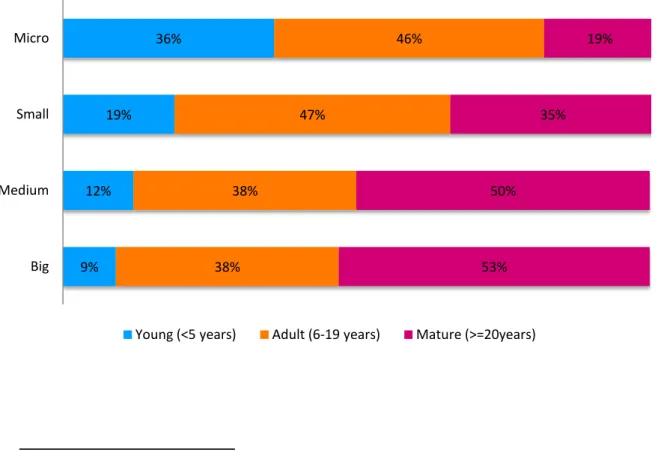
Figure 5.1.1.: Companies’ sizea and business longevity (Percentage of young, adult and mature companies in each size level)
Source: Informa D&B analysis; Data source: IES and corporate acts publications from Ministry of Justice 9% 12% 19% 36% 38% 38% 47% 46% 53% 50% 35% 19% Big Medium Small Micro
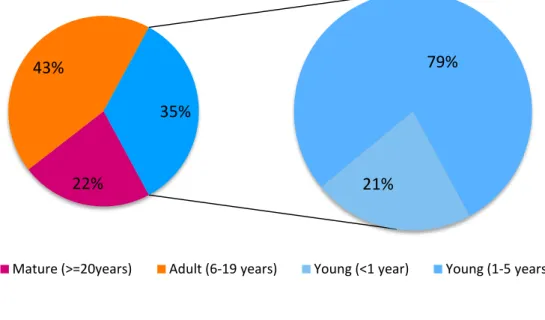
There is a direct correlation between companies’ size and longevity. The larger the company is the higher the probability of it to become a mature company. The majority of big and medium-sized companies have at least twenty years of existence. Since large companies have more specific and complex needs, it can be assumed that most of the mature companies will not be part of AB's segment. Micro and small enterprises (MSE) will be a better fit for AB, however these companies (with less than 2M Euros of business volume per year) account for 94,8% of the total companies in Portugal. Therefore, it is also important to focus on the young companies and probably on the adult ones to limit the target. Following this reasoning, the market is reduced to 35%, which are companies operating for less than 5 years.
Figure 5.1.2.: Distribution of businesses by age ranges (As for December 2014)
Source: Informa D&B analysis; Data source: IES and corporate acts publications from Ministry of Justice
On average, companies operating for less than 5 years employ 4 people and have a volume of business of 435,000 Euros. As for adult companies, they employ 8 people and on average generate 983,000 Euros of business volumea.
22% 43%
35%
Mature (>=20years) Adult (6-19 years) Young (<1 year) Young (1-5 years) 79%
Figure 5.1.3.: Contribution of each age group for economic activity
Source: Informa D&B analysis; Economic data as for 2014: IES and corporate acts publications from Ministry of Justice
Young companies represent 16% of the Portuguese workforce and 10% of the business volume. From the 35.000 companies created in 2014, almost the totality (93%) was commercial entities. As stated before, necessity entrepreneurship has been increasing, being this reflected on the individuals’ initiatives for business constitutions. The most common legal nature of these new constitutions was sole proprietorship, accounting now for 25% of the total existing companies. The share capital of new constitutions had been decreasing, reaching an average of 1.045€ in 2014 (25).
Services and retail sectors are the ones that still comprise a higher concentration of companies, however the most common sectors in which entrepreneurs are opening more new businesses are agriculture, livestock, hunting and fishing (+16%), telecommunications (+10%) and accommodation and restaurants (+4%).
However, telecommunications, financial institutions and gas, electricity and water are still the “youngest” sectors; however, these are not suitable targets for AB. Financial activities for obvious reasons and the other two sectors are young as the result of the great development of these industries in the past several years.
The services sector is one of the “youngest” sectors with the greatest concentration of companies (27%) and workforce (23%). However, it only represents 9% of the volume of business. Retail is the second sector with more companies (17%) and represents 16% of the
22% 54% 45% 43% 36% 39% 34% 10% 16%
Number of companies Volume of business Number of employees
volume of business (25). This sector is important due to new retailers that have embraced technologies and are distributing its products exclusively through online channels, which fits perfectly with AB’s profile (Exhibit 18).
As for entrepreneurs found in incubators, most of them develop businesses in the fields of ICT (30%). Consultancy and health (biotechnology included) are the second most popular, representing 15% each. Commerce (retail and wholesale) and creative industries come in third, representing 12% each.
From a wide perspective, 54% of entrepreneurs target the final consumer, being B2Ca, 26,5% are in the field of transformation (transportation, communication, utilities, wholesale, construction and manufacturing) and 15,5% are B2Bb companies.
Figure 5.1.4.: Young, adult and mature companies by sector of activity
Source: Informa D&B analysis; Economic data as for 2014: IES and corporate acts publications from Ministry of Justice a B2C – business to consumer 57% 53% 42% 42% 35% 33% 32% 31% 31% 31% 25% 19% 15% 37% 37% 51% 45% 45% 51% 46% 39% 42% 52% 44% 58% 41% 6% 10% 7% 13% 20% 16% 22% 30% 27% 17% 31% 23% 44% Telecommunications Financial activities Gas, electricity and water Services Agriculture, livestock, hunting and fishing Real estate activities Wholesale Accommodation and restaurants Retail Construction Transforming industries Transports Extractive industries
As for locations, the North of the country is the region where the average annual growth of business constitutions is more accentuated (+1,9%) and comprises 34% of the business activity in Portugal (25). Lisbon is the most entrepreneurial city in Portugal and was the birthplace of 10.317 new businesses in 2014, accounting for 30% of the total. The capital city distinguishes itself positively by the proximity to clients and to goods and services’ suppliers and by the highly qualified workforce; however it has the drawback of having high fixed costs (26). Porto and Braga are the second and third most attractive Portuguese cities with 18,7% and 8,5% of new business constitutions (13).
Crossing borders is an increasing propensity. In 2013, 10% of start-ups were exporting in the first year, when in 2007 such activity took place in 8% of the cases. In their fifth year, the number of companies that went trough internationalization doubles. It is important to highlight that more than half of the volume of business in such start-ups stems from international clients, having reached 62,4% in 2013 (26).
THE TARGET SEGMENT
The active population in Portugal is constituted by 5,2 million people, of which 19% are self employed (865.000). The number does not say everything about the target market, because while these people are not employed by somebody else, this does not necessarily mean that they have a company constituted. Hence, in order to measure the addressable market, data provided by the Global Entrepreneurship Monitor (GEM)a was used.
“GEM measures individuals’ perceptions to entrepreneurship, their involvement in entrepreneurial activity and their aspirations in doing so.” (27)
According to GEM, in the active Portuguese population, there are 4,4% new business ownersa, estimating the existence of 230.000 people owning and managing a running business, as of 2014. The same study also refers to nascent entrepreneurs and established businesses. The difference between the three types of entrepreneurs is the longevity of the business operations:
1. Nascent entrepreneursb: do not own a company yet but are actively involved in setting up a business.
2. New business entrepreneurs: have a business set up and are operating for more than 3 months and less than 3,5 years.
3. Established businessesc: have been in operations for at least 3,5 years.
Figure 5.2.1.: Evolution of Portuguese entrepreneurship owners (2010-2014) Source: GEM
a
New Business owners are 18-64 individuals who are currently a owner-manager of a new business, i.e., owning and managing a running business that has paid salaries, wages, or any other payments to the owners for more than three months, but not more than 42 months
b
Percentage of 18-64 population who are currently a nascent entrepreneur, i.e., actively involved in setting up a business they will own or co-own
c Percentage of 18-64 population who are currently owner-manager of an established business, i.e., owning and managing a running business that has paid salaries, wages, or any other payments to the owners for more
The target segment comprises new businesses and part of the established businesses since the premise of being operating for more than 3,5 years implies that these companies could be young, adult or mature. Estimating the longevity of these companies is needed to get a closer number of the actual market. It was estimated that from the 398.000 established businesses, 310.000 are either start-ups, young or adult companies. As for nascent entrepreneurs, they provide insights of what promises to be new businesses in the future, therefore they should be targeted only on the basis of helping them succeed in their business constitution. Nevertheless, they are not accounted for in the target market, since they do not have a fully constituted business yet.
The target of AB does not include all types of legal constitutions. The targeted companies must have the decisive power for banking purposes centralized on one individual due to the AB’s website constraints. The current website only asks for the signature of an individual to move the bank account. In a first stage was decided to only target companies that could operate under this constraint due to the high development costs to change the current technology. These companies include sole proprietorships, SOHOa, independent professionals, freelancers, limited companies that only require the manager’s signature or public limited companies requiring only the president's signature. This does not constitute a problem when targeting start-ups, since 94% of start-ups are sole proprietorships (25).
Therefore, the addressable market segment for ActivoBank is approximately 540 thousand people, a number that has been growing by 10% since 2010.
Part of these individuals is already AB’s client. In this sense, it is important to know how many they are, since these individuals are most likely to open a business account with the bank, due to the pre-existing relationship and personal background.
Assuming that the clients’ base is representative of the Portuguese population, the total percentage of new business owners was divided by the seven segments that AB currently offers its individual clients, according to the age ranges from each one (Exhibit 20).
Table 5.2.2.: AB’s individual clients with potential to be business clients
Source: Bank’s internal data as for the end of 2014; Population data source: INE, PORDATA, 2014; Companies’ data source: IES, Ministry of Justice, SICAE.
New business Established
Age Active pop. (%) # of accounts % of the segment # of accounts % of the segment # of accounts Kids 0-17 0,0% 56 0,0% 0 0,0% 0 Students 18-24 7,2% 5839 0,0% 0 0,0% 0
Living the life 25-35 21,3% 18385 0,9% 172 1,6% 298 New life/peek-a-boo 30-55 52,5% 26052 2,3% 602 4,0% 1040 Empty nest 56-65 14,2% 5136 0,6% 32 1,1% 55 Golden years 65+ 4,8% 4073 0,0% 0 0,0% 0 No segment N.A. 12,4% 8427 0,5% 46 0,9% 79 TOTAL Total 100,0% 67968 4,4% 3002 7,6% 5186
Companies (%) Entrepreneurs as a percentage
Start-ups 7,5% 104 Young 26,7% 372 Adult 43,4% 605 Mature 22,4% 312 Sub-total 100% 1393 Total 77,6% 1081
Given the assumptions made, there are 4.083 individual clients that could be part of AB’s new target, representing 6% of existing customer base, most of them coming from new life and peek-a-boo segments.
AB’ APPROACH TO TARGET AND SEGMENT ENTREPRISES
Given the bank’s constraints in what is able to offer to its clients, 3 variables were crossed in order to come up with a company’s profile. The size of the company must be micro or small and operating for a short or medium period of time, at the most for 19 years.
The reason for these two restrictions is linked to the complexity of operations and its needs for financial products that often increase with volume of activity. AB aims to align financial services to customer processes having not only a customer-centric but also a process-driven approach.
The sectors of activity are restrained to services and online retail, since these are the two that are more in line with the main characteristics of an AB company. In terms of legal constitution, companies must have the decisive power for banking purposes centralized on one individual, due to the AB’s website constraints.
Given the constraints the bank has on its branches, like the non existence of treasury service, the businesses must be cash-less in the sense of not needing to regularly deposit/withdrawal of money, since this service is only offered on Millennium’s branches.
Figure 6.1.: Considered variables to segment the business client
FUTURE VALUE FOR THE BANK
A forecast was made in order to assess how many clients the bank can expect to have in the following years. It was assumed that the marketing efforts to promote the new
Size Longevity Sectors of Activity Legal constitution
Micro (<2M€) Start-up (<1 year) Services Sole proprietorship
Small (2-10M€) Young (1-5 years) Online retailers Limited company with
the manager’s signature
Adult (6-19 years)
Public limited company with the president's
signature
Others
Cash-less companies: without greater needs for cash requirements (e.g. deposit or withdrawal of coins)
Self-directed: that value and use remote channels as a way to acquire financial products No necessity for complex financial products
Therefore, the verified client acquisition rates between 2010 and 2014 were used assuming a similar evolution of business clients’ acquisition (Exhibit 21).
Table 6.2.1.: Forecast of business clients
The business plan is not finished, as neither the costs nor revenues were estimated. The return appraisal was based on the annual average profitability of Millennium’s sole proprietorship businesses. The profitability of Millennium’s clients was not used directly, since AB is expected to maintain most of the structure of the current business model, like the non-charge of fees which differs from Millennium’s revenue model. Calculations were made based on the annual average profitability of individual clients in AB and in Millennium, giving a more proportional and accurate value for the profitability of these businesses in AB
(Exhibit 22). It was found that the business client values approximately 2,5 times more than the individual client. Therefore the following table was reached:
Table 6.2.2.: Forecast of business clients’ profitability
CONCLUSION AND RECOMMENDATIONS
The project’s objective in ActivoBank was to develop a portfolio of products and services targeting start-ups and MSE.
The insights about the potential target segment came from several sources. Interviews to start-ups and incubators’ founders, bankers in Millennium’s microcredit and
This research allowed narrowing the target and achieving a final decision regarding who AB aims to and is able to reach.
The individuals confirmed that the current offer from AB’s competitors is unsatisfying and not addressing their needs. The inadequate offer from other banks enhances a further tailored offer and, therefore, originates a market opportunity to be tackled by AB. Moreover, it was discovered that their needs are also related with the challenge of managing a new business, which could be in several cases potentially addressed by a bank, making room for the development of non-financial services and products.
The only competitor in this market is Montepio that already detains a significant position, boosted by the partnership with Startup Lisboa, and representing a substantial challenge for new entrants.
In other industries, companies had tried to target this segment and failed. An example of that is Fidelidade, the market leader in the insurance industry, which developed a packaged of insurances, Fidelidade to Start-ups. This and other offers failed to reach the target segment, as the value offered was not in line with start-ups’ needs.
In fact, the market opportunity exists. However, it will not be covered until at least one player is able to deliver what MSE are looking for.
There are strong intuitions of having a portfolio with valuable offers however there are no empirical evidences to prove it. In such a diverse market as the one under analysis, with thousands of different companies, interviews to less than ten people do not provide accurate enough grounds to proceed with project’s implementation. For AB, relevant investments are at stake, as well as, and most importantly, the brand’s image. Pursuing a market unprepared and fail to truly create a solid business can undermine and diminish the successful path traveled so far.
In that sense, I would recommend AB to run a deeper customer analysis, going through questionnaires to a relevant sample of customers and doing more interviews to people that can deliver meaningful qualitative data. These actions will most likely provide useful and more concrete feedback about the already developed portfolio and also insights and clues about other products that could be interesting to the segment. This approach will empower the bank with sufficient tools to build helpful solutions to its customers, instead of
delivering products that might not be aligned with their needs. It is important to create a customer-centric and process-driven methodology to ensure the alignment between customer processes and financial services. The bank must identify sub-processes in specific business activities of its potential clients. Each sub-segment should then be analyzed so the bank can develop services that will be problem-solvers for clients. Finally, the bank must determine whether it has the resources to support the portfolio offer in-house or outsource the development of some products. Having established the partnerships needed, the time arrives to test the products in the market, resorting to landing pages or trial versions, among other methods.
Accomplished the recommendations given, the bank will have more knowledge to make the decision of whether or not to implement the project. Until this point is reached, and given the arguments presented, the answer to the question raised remains unanswered. It is too soon to know if AB should target this opportunity. Diversifying a portfolio too early could be risky for the bank, and therefore all the steps should be taken to avoid making strategic mistakes.
EXHIBITS
Exhibit 1: ActivoBank’s Offer ActivoBank7
Blue Ocean Project
Investment
ActivoBank, as for 2012
ActivoBank, as for 2014
Investment
Exhibit 3: ActivoBank Core Values
Exhibit 4: Branches Evolution
4 branches in 2010 14 branches in 2014 OEIRAS (1) Lagoas Park OEIRAS (1) Lagoas Park MATOSINHOS (1) Norte Shopping CASCAIS (1) Cascais Shopping COIMBRA (1) Dolce Vita LEIRIA (1) Pç. Rodrigues Lobo BRAGA (1) Pç. Conde Agrolongo
Exhibit 5: Standard Offer
Daily
o Simple Account o ActivoKid Account
o Build Your Future Account o Mobile Channel
o Web
o Pre-paid Cards: Kid, Home, Junior, Web, Boost o Credit Card o ATM o CAT o Branches o Call Centre Credit o Home o Multi Purpose Savings
o Chose the Term Saving o Monthly Rent Deposit o Goal Saving
Investment
o Pairs of investment managers o 5 Model Portfolio
o Investment Platforms: Web site and App o Newsletter
o 3 Credits Insurance o Personal o Home o Health o Automobile o Work o Life
Exhibit 7: Online banking penetration in European markets in 2014 Source: Statista 2015
Exhibit 8: Online Baking - international perspective
There is no clear pattern of growth in online banking, across the world. The high use of online banking is present mainly in developed economies, having relatively low growth rates though. As for middle and low income countries, growth rates are quite high. The countries more advanced in the European Union, like Denmark, Netherlands and Sweden have over 80% of the adult population regularly using the online channel to access banks’ services. Germany, France and the United Kingdom, the largest developed economies in Europe, have approximately 50% of adults regularly using the service.
Nonetheless, Portugal (25%), Italy (26%) and Spain (36%) have still very low and not growing penetration rates despite national leading banks’ efforts to be innovative and to develop online services. Romania and Bulgaria, the developing EU countries have 4% and 5% respectively penetration rates, making this countries the bottom list in Europe. (Check graph 4 for further details).
From a wide perspective, in Chile the online banking penetration is 40%, have been growing 23% per year since 2009 to 2013. In the same period, the penetration in Malaysia grew 18% per year, reaching 71% of the adult population in 2013. As for Mexico, the growth rate has been 20% per year and the penetration is 26% of the adult population. Thailand registered the fastest growth (26%), however the penetration is still quite low, around 15%.a