SOME REFLECTIONS ON THE PROBLEMS AND THEIR ROLE IN THE DEVELOPMENT OF MATHEMATICS
ALGUMAS REFLEXÕES SOBRE OS PROBLEMAS E SEU PAPEL NO DESENVOLVIMENTO DA MATEMÁTICA
Juan Eduardo Nápoles Valdes1
“Would you tell me, please, which way I ought to go from here?” “That depends a good deal on where you want to get to,” said the Cat. “I don’t much care where” - said Alice. “Then it doesn’t matter which way you go”, said the Cat. “so long as I get somewhere,” Alice added as an explanation. “Oh, you’re sure to do that”, said the Cat, “if you only walk long enough”. Chapter 6, Pig and Pepper ALICE IN WONDERLAND
Abstract: In this work we show the historical significance of mathematical problems and their meaning, not only for Mathematics itself, but for the Philosophy of Mathematics and other related sciences, in which the current conceptual and methodological apparatus has been developed, as a result of the development of investigations related to the resolution of certain problems. From these results, we build the Mathematical Development Matrix. Keywords: Problems; History of Mathematics; Mathematics.
Resumo: Neste trabalho, mostramos a importância histórica dos problemas matemáticos e seu significado, não apenas para a própria matemática, mas para a filosofia da matemática e outras ciências relacionadas, nas quais o aparato conceitual e metodológico atual foi desenvolvido, como resultado do desenvolvimento de investigações relacionadas à resolução de certos problemas. A partir desses resultados, construímos a Matriz de Desenvolvimento Matemático.
Palavras-chave: Problemas; História da Matemática; Matemática.
1 Preliminary
As the Cat says, you will get somewhere if you walk long enough, and in the particular case that concerns us, we will see how the mathematical problems “have walked” enough to become a central point in the development of current Mathematics. As the History of Mathematics shows, there have been certain problems that refused to “to give in” to the will of the researchers, either because busy mathematics was not fully formalized and had to settle for
1 Facultad de Ciencias Exactas y Naturales y Agrimensura, Corrientes, y Facultad Regional Resistencia, Universidad tecnológica Nacional, Resistencia, Argentina. E-mail: [email protected]; [email protected]
approximate solutions, or because the myriad of issues involved made it impossible to know the solution to the problem. This suggested that possibly our knowledge and prediction of phenomena could be banned in certain situations that they could not correspond to simplifications of reality, which is the case with most of the models studied.
Is there a special one so that the problems stand out over other mathematical items (theorems for example)?
If, of course, mathematical problems are probably the only way to refute certain philosophical positions around this science. First, Eurocentrism, a trend established in the History and Philosophy of Science, which consists of underestimating, dismissing and even ignoring the contributions of non-European cultures, reducing them to mere observations in a few lines. Secondly, the discussion about the study focus: Historicism and Presentism, as we will see later, what we do is use both visions, I think that absolutizing one or the other is not beneficial for Science itself and much less for a discussion fruitful. And third, and not least, the discussions on the questions: What is Mathematics? And, Is Mathematics invented or discovered? In this case, the vision we give of Mathematical Problems allows us to accept a fallibilist vision of Science, consistent with the vision that comes from problem solving.
The above can be reinforced with the following example
In Differential and Integral Calculus there are two fundamental problems: constructing the tangent line to a curve at a given point (of the curve) and calculating the area under the curve, the first is solved with the notion of a derivative and the second with that of definite integral, both on totally different operators, with no possible comparison between them. Let's go to the first one. The definition of derivative, is presented as the limit of an incremental quotient, and is defined (traditionally) for integer values, that is, it talks about the first derivative, the second, ... however, mathematical development today has overcome that obstacle, raised in a question from L'Hopital to Leibniz on September 30, 1695: what would happen if the order were not whole, for example 1/2. Obviously Leibniz did not have the answer, but he did predict something that is true today: someday we can draw useful consequences.
The curious thing is that, in the development of this concept, two paths were taken: the global one (the classic one) and the local one (much more recent) and the really striking thing is that the classical fractional derivatives are not derivatives and the local fractional derivatives, they are not fractional! This illustrates how in solving a problem, situations can occur and paths can be taken that do not seem correct and logical beforehand. Today fractional derivatives
(global) and generalized derivatives (local) have become a widely used tool and used in multiple applications2.
Before presenting our basic assumptions, I would like to point out that the different methods of mathematical thought, used in solving mathematical problems of various kinds (from geometrical to quite recent areas such as Fractional and Generalized Calculus3) have appeared in historical circumstances and contexts, many times different, and in the minds of very unique men, which is why making comparisons and highlighting differences is very committed.
To begin, our answer to the questions we asked earlier, which we have been working on for some years now.
First, we would like to answer the question, what is mathematics?
I beliefs that “mathematics is the science which deals with magnitudes (variables and constants, qualitative and quantitative), forms (abstract and concretes), patrons and rules, that it uses general methods and own techniques for study, understand and modify social, naturals and human systems and phenomena. The mathematics is a collective activity of the mathematic community, consolidated gradually in the time”4.
This conceptualization makes it clear that Mathematics, as we conceive it, is a product of the "community" work of many centuries and that the problems solved have been very varied and different, some coming from Mathematics itself and others from the interrelationships between it. and applications5.
This leads us to our conception of the History of Mathematics, conceived as follows6. “The history of mathematics is the scientific discipline that aims to study the historical development of mathematics, the genesis, evolution and consolidation of methods, theories,
2 An attractive characteristic of this field is that there are numerous fractional operators, and this permits researchers to choose the most appropriate operator for the sake of modeling the problem under investigation, in Baleanu and Frenández (2019) a fairly complete classification of these fractional operators is presented, with abundant information, on the other hand, in Baleanu (2020) some reasons are presented why new operators linked to applications and developments theorists appear every day. In addition, Chapter 1 of Atangana (2016) presents a history of differential operators, both local and global, from Newton to Caputo and presents a definition of local derivative with new parameter, providing a large number of applications, with a difference qualitative between both types of operators, local and global. Most importantly, Section 1.4 LIMITATIONS AND STRENGTH OF LOCAL AND FRACTIONAL DERIVATIVES concludes “We can therefore conclude that both the
Riemann-Liouville and Caputo operators are not derivatives, and then they are not fractional derivatives, but fractional operators. We agree with Umarov and Steinberg (2009), the local fractional operator is not a fractional derivative" (p.24). As we said before, they are new tools that have proved their usefulness and potential in the
modeling of different processes and phenomena.
3 One of the central questions in this one is the notion of derivative, in addition to the previous note, in Nápoles and Quevedo (2019), we make a historical-methodological discussion about it.
4 Nápoles (2012).
5 In this regard, and in the particular case of ordinary differential equations, you can consult Nápoles (2019). 6 See Dolores et al., (2016).
problems, notations, etc. in a social and cultural context (under influence of political, religious, economic, ideological and mathematical factors) taking a point of view: historicism, presentism, considering European contributions and also the non-European contributions”.
Of course it should now be clear what we mean by Problem and, of course, by a Mathematical Problem. Definitions and conceptualizations in this regard are varied and it would take us a long time and space to present and discuss them, so we chose characterize them in this way.
By Problem we understand that situation that satisfies:
• There is "a person" interested in solving it, in obtaining its solution.
• Two instances can be distinguished: the initial one (the problem has not been solved) and the final one (when we solve the problem).
• The path to go from that initial instance to the final one is unknown. A Problem will be a Mathematical Problem, if:
• It is defined in mathematical categories and/or its solution implies this science.
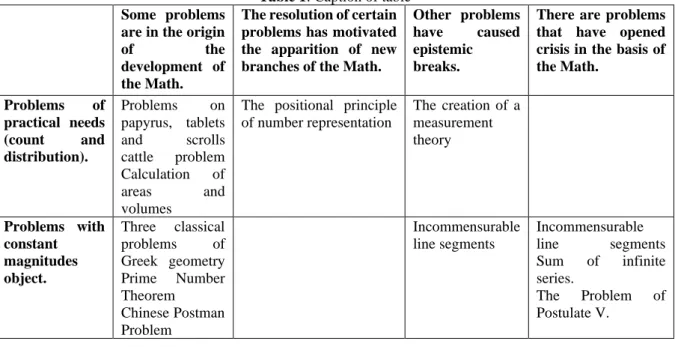
Now that our conceptual conception is clear, we want to say that in our work we are interested in showing the historical significance of mathematical problems and their transcendence not only for Mathematics itself, but for other related sciences. All of the above leads us to the construction of a matrix of mathematical development, which allows us to analyze a given mathematical problem and organize more easily its impact on the development of the Mathematics themselves.
We want to point out that we will not make didactic reflections on the issues raised, more than the necessary ones, because they go beyond the framework of this work.
2 The problems at the center of history
First of all, we must point out that problems are our driving axis, in the periodization that we use in our studies. Thus, we try to distinguish the following stages7:
• Problems of practical needs (count and distribution). • Problems with constant magnitudes object.
• Problems with variable magnitudes object. • Problems with abstract objects.
The Mathematics has always been linked to the resolution of certain problems. It can be done this affirmation since four points of view8:
1. Some problems are in the origin of the development of the Mathematics. At the same time, these they can be divided into two classes: A) Problems linked to the social-economic life. B) Problems that appeared in initial phases of some branches of the Mathematics, for example, the Three Classical Problems of the Greek Geometry.
2. The resolution of certain problems has motivated the apparition of new branches of the Mathematics. Some of these problems they are: A) The 7 Bridges of Königsberg. B) The problem of estimation of the volume of the barrels (problem of the capacity). C) The construction of tangents and the areas. D) The games of chance. E) The 23 Problems of Hilbert in 1900. F) The Last Theorem of Fermat. G) The problem of the infinitesimal (The non Standard Analysis). H) The study of the behavior of functions (The Theory of the Catastrophes). I) The Geometry Fractal.
3. Other problems have caused epistemic breaks. Among these they are found: A) The apparition of the Immeasurable (irrational after Peano's work in the early 20th century). B) to Express in formulae closed, the solution for the general equation of 5º degree (and of upper order). C) The inversion (1827). D) The Problem of the V Postulate (The Non-euclidean Geometries). E) The Problem of the Infinite.
4. There are problems that have opened crisis9 in the bases of the Math. Some of
which they are: A) Immeasurable. B) The sum of infinite series. C) The Problem of the V Postulate. D) The infinitesimals in the CALCULUS. E) The Set Theory. F) The Theorem of the 4 Colors.
With the two aforementioned aspects, we want to highlight that the "quality" (related directly linked to the four directions noted above) of the problems solved are, on the one hand, a tool to analyze the development of Mathematics and, on the other hand, to serve as a measure of how far we have advanced and why causes.
In order to complete our ideas, we need to establish some frameworks of mathematical rigor and the characteristics of each stage. First let us remember that the periodization used is not "temporary", therefore, we do not group in centuries, but in mathematical development. I. Problems of practical needs (count and distribution)
8 Dolores et al., (2016).
9 Crisis in the sense of controversies and discussions around basic notions in Mathematics, symptoms of anomaly in a Normal Preciencia, according to Khun.
This type of problem, inherent in the early stages of human development, suggests that the first mathematical notions originated in this stage. Quantities (associated with weight, volume, areas or people), correspondence (established as property of one or another person) and forms (obtained from observation). If we add to this the first advances in the registers of regularities, we have a fairly complete overview of the type of problem and its impact on the future development of mathematics.
II. Problems with constant magnitudes object
Let us remember some basic and repeated aspects in civilizations such as Mesopotamia10, Egypt, China, India and pre-Columbian America. The word Mathematics or mathematician did not exist (both of Greek origin), therefore, the "mathematical" requirements demanded by the problems of this stage are directly linked to what today we would call accounting, keeping record books, amounts used, earnings, etc ... It is true that there were own rules and methods, even quite developed (as examples enough, the calculation of the square root, the falsi regulation method, the Mayan calendar, among others). A second part of this stage begins with the emergence of Greek Mathematics, characterized by these central questions: deductive organization, geometric orientation, the ideal of disinterested science (hence we have the division between Pure and Applied Mathematics), the relationship with Philosophy (more than mathematical schools are schools of natural philosophy) and with two contributions that have made Mathematics as we know it today: the notion of angle and the idea of the classical proof.
The Greek invention of the idea of proof does not consist in the occasional use of effectively convincing evidence. In this sense, Greek mathematics would not have been very unique: other previous or contemporary mathematics - such as that of the Egyptian scribes, the Babylonian priests or the Hindu ritualists - also had calculation procedures and rules for checking results. The Greek invention has three characteristic developments11:
1.The express distinction between a strictly conclusive demonstration and any other type of argument or more or less effective and convincing evidence.
2. Meta-discursive reflection on the assumptions and conditions that distinguish such a proof, as well as the analysis of its logical, epistemological and methodological aspects.
10 We prefer to speak of the region and not of the various civilizations that lived there, Assyrians, Akkadians, and Sumerians, for example.
3. The projection of its systematic virtues with a view to organizing a set of proved results, either in the heat of a philosophy of "demonstrative science" or in the effective course of construction of certain deductive bodies, "axiomatiform", of mathematical knowledge.
All this contributed to the creation of a mathematical body with a "life of its own", on which its independent development was based, proof of that independence are the well-known classic problems of this mathematics. Of course, from this moment the problems will no longer be the same, because the Mathematics itself changed. The three classic problems of Greek mathematics, squaring the circle, doubling the cube, and trisecting the angle, are proper to this level of development and fully illustrate it. Arab mathematics, the natural heir to Greek development, followed this direction, and together with the algebraic contribution it shaped and made possible the European Renaissance.
III. Problems with variable magnitudes object
Although it is affirmed, by virtue of the discoveries that the Palimpsest has produced, that Archimedes was the only mathematician of antiquity capable of handling the actual infinity, we must understand that only after the appearance of Descartes's Analytical Geometry, can one speak of solving problems with variable magnitudes in Mathematics. Everything that made possible the emergence of the Calculus some time later and the appearance of new and varied areas of Mathematics (Celestial Mechanics, Topology, Graph Theory, among others). The emergence of new practical requirements (linked to the development of geographic and maritime expeditions, the industrial revolution, military expeditions, the reform of the calendar, etc.) necessitated the development of new tools and the establishment of new theories. If we add to this, in the 17th century, the rise of the Academies (that is, of "professional" researchers), of periodical publications, of new universities (the Ecole Polytechnique, for example) and the Age of Enlightenment (with Encyclopedism) configures what can be called contemporary mathematics, in which we can highlight the following as distinctive characteristics of the problems:
1. In these centuries, XVII-XVIII, the problems were still addressed with a visión geometric-euclidean. Both, Leibniz and Newton, elaborate their mathematical conceptualizations in terms of geometric, entities in which properties and concepts are represented. This was a consequence of how restricted the concept of function was in the 17th century. The notion of function still remained linked to the idea of a geometric curve. In this sense, obviously the concept of tangent was Euclidean. In Leibniz there is a different but
ambiguous element of conceiving the tangent line as that which joins two infinitely close points. Anyway, the notion that was handled of tangent line was clearly intuitive.
2. Both Newton's and Leibniz's calculations dealt with variable quantities. In Leibniz a sequence of infinitely close values; in Newton quantities that varied with time. The first conceives the geometric continuum formed by infinitesimal segments. The second has an intuitive idea of continuous movement close to the concept of limit. Newton preferred to refer to the indefinitely small in terms of ultimate reasons.
In the development of mathematics there are several successive disappointments, the outcome of which can be summed up in the "loss of certainty" as the title of Kline's book reads. Since solving problems with variable magnitudes, Mathematics has gone through the following trances12:
• The loss of ingrained evidence and certainties in physico-mathematics, especially from the development of non-Euclidean geometries.
• The bankruptcy of the aspirations to cement the logical and/or theoretical solidity of the deductive building of classical mathematics.
A curious question is that if at the beginning of this stage the resolution of the problems involved the differentiation of mathematical fields, in the last part of this stage (which continues to this day) we have a certain inverse process, the resolution of Various problems have involved the integration of different mathematical disciplines and mathematical areas with other sciences, a feature that is distinctive of modern science, if we need an example of this we can take the chaos and research around the chaotic systems.
IV. Problems with abstract objects
This stage, like no other, shows the philosophical-methodological discussions around the solved problems. Let's start with a fairly simple case, the manipulation of infinite sets (and the appearance of transfinite cardinals) broke with an ingrained axiom "The whole is greater than the parts", if we add to this that the mathematical conceptions around the actual infinity were consolidated, it is clear then that the well-known Prime Number Theorem, which Euclid states as "For every prime number there is a greater prime number", is now stated (following Hilbert) as "There are infinite prime numbers".
Like all thinking styles, the set theory approach has its merits and its shortcomings. Among the first we have:
1. Consider the most complex objects and systems in the simplest terms.
2. A single point of view that allows to find the relationships between the different theories and makes it possible to build a universal methodology.
Of the deficiencies we can point out:
1. Theoretical-conjunctivist reductionism makes the specific and unrepeatable of mathematical objects disappear.
2. The historical character of the formation of the most important concepts is hidden. 3. The development of knowledge is denied, neglecting the role of practice and other external factors.
4. It is not effective from a didactic and heuristic point of view. The setbacks produced by the so-called Modern Mathematics, we have not been able to overcome, at least in Latin America.
The emergence of the crisis in the theoretical-conjunctural foundations of mathematics reflected in the discovery of paradoxes, led to the conviction that set theory in its original form, which is often called naive theory, cannot serve as a foundation to the mathematical sciences. Faced with this crisis, different positions were taken:
1. Ignore the paradoxes, consider them as artificial constructions and continue elaborating the Cantorian set theory in its non-paradoxical aspects.
2. Restrict the existence of "paradoxical" sets through more consistent axiom systems. 3. Within the Cantorian limits of the consideration of the current infinity, improve its foundation through reasoning with finite elements.
4. Criticizing the conceptions of the abstraction of the actual infinity and the laws of classical logic, formulate a new foundation program with the corresponding new logic.
The first position remains so naive that it does not deserve its philosophical consideration - although in practice it may be effective.
The second position was maintained by many specialists in the foundations of mathematics, who, like Zermelo and Gödel, as they refined the system of axioms, found new contradictions. Within this position we can include the trend called logicist.
The third position of those highlighted at the beginning, formalism, like Hilbert, by emphasizing the formal nature of Mathematics, which constitutes an essential note of this science, was therefore the most traditional and conservative trend, and also the most related to mathematicians by profession.
Logicism and formalism were conservative tendencies in the sense that they tried to keep intact the mathematical body already built. Referring specially to set theory, Hilbert would
say in 1930: "From the paradise that Cantor created for us, nothing can expel us"13. The same is not the case with intuitionism which, even though born within mathematics itself, opposes classical mathematics in a frankly revolutionary, radical attitude.
Although not in this attitude, but in some concepts, intuitionism counts among its predecessors Leopold Kronecker, as we already know Cantor's decisive adversary, and for whom all mathematics had to be based on the natural number, the only type number whose existence is safe and true. His phrase is well known: "The good God created the natural number, the rest is human work". With the subsequent development, intuitionist logic is no longer bivalent like classical logic, but trivalent, thus increasing the number of polyvalent logics, whose study constitutes one of the contributions of these discussions.
To illustrate the new type of problems at this stage, let's take the next one. Find the non-null solutions of the equation 𝑥 + 𝑥 = 𝑥. A simple equation that in the numerical domains studied in the basic training only admits the null solution, then? Actually, to find non-null solutions, we must use transfinite cardinals, for example, for countable sets, this solution admits aleph subzero solution. Obviously, if instead of a sum of two terms, we consider n addends, it still has the same solution and if, what a thing, we consider an infinite numberable sum of addends, it still has the same solution! Honestly, there are other solutions but his presentation would make this paper too tedious.
7 The Mathematical Development Matrix
"Problems are the driving force of Mathematics"14 says Ian Stewart. Of course, good problems, in addition to allowing us to clarify and order mathematical knowledge, open up new directions for us.
We are going to stop at a particular problem, the appearance of the immeasurable, which caused the First Crisis in the Foundations of Mathematics.
We take the case of the irrational numbers of the form 𝑛√𝑎, a and n naturals. The demonstration of the immeasurability of the diagonal with the side of the square according to all the glints dates from the second half of the V century B.C. Is one of the oldest demonstrations math, perhaps the first one, and of whose really demonstrative quality we have constancy. As reports Aristotle, he rests in the reduction of the hypothesis of the commensurability of the diagonal to the absurd one that a same number result odd and even. A more elaborate and
13 Translation from German. See Hilbert (1930, p. 274). 14 Stewart (1998, p. 16).
subsequent version than was added in the end of the book X of the “Elements” of Euclid as Proposal 117 is apocryphal without doubt15 and today no longer found in the editions of the treaty. The test establishes the impossibility of a common, exact, numerical measure among the respected magnitudes, negative conclusion of maximum reach that the Greeks only could establish by means of the logical resource of the indirect deduction or reduction to the absurd one inside the theoretical framework of speech given, such is thus, that the direct proof of a parallel result in the modern theory of the numbers (that the square root of an entire one or is entire or is irrational) must have waited for Löwenheim16. The test of Löwenheim, more interesting and informative that the traditional indirect test of the irrationality of √2, does not it pass to be a technical curiosity practically ignored.
What problem we have here? Speaking correctly, we have more than one theoretical problem:
1°. The consideration of a new class of numbers, logically situated after N, Q+, Z and
Q, while, since the historic point of view, had N and Q+.
2°. The linking of this subject matter to the modern Theory of the Argument. Thus, the traditional indirect test that has always represented a model of mathematical severity, does not prove that √2, be irrational neither something about our irrational numbers. Rather, we should emphasize various points:
(1) the object of the test is geometric,
(2) our “irrational” does not equal in extension to the álogon (without reason given) of Euclid,
(3) in the measure that the Greek mathematics lacks our concept of real number, the idea of álogon of Euclid also remains far from coinciding intentional or conceptually with what today is understood for “irrational”17, still in the 19th century the irrational did not possess an
own identity as numbers and when was utilized them, resorted to the infinite approximation taking like base the rational numbers18, is little probable “that the Greek mathematician thought about terms of an infinite progression of numbers”19.
On the other hand, the relations between the logic and the argument come being a matter very discussed, no matter how more at times it placed in question be the same existence of some relation among them, thus, in the proofs, since the Greeks, the logic has always had that to be
15 See Müeller (1981), Vega (1995), and Vega (1997). 16 Cf. Löwenhein (1946).
17 Vega (1995)-Ob. Cit. 18 Recalde (1994). 19 Rotman (1988).
seen the faces with the argument. In these moments the affirmation of Scholz of 1939 “what is to proof or learn in mathematic or do not learn anywhere”, is not so final.
The certain thing is that never as now has begun speak of the possible death of the mathematical proofs (in its classical sense). The rumor propagates that the new philosophical and historic perspectives of the development of the Math, along with the new types of test that have appeared in the horizon of research, for example the proofs that require the aid of computers increasingly more powerful, in this topic suffices to title of presentation the test of the four colors that threaten to strike him the blow of grace20.
Nevertheless, we renounce the classical proofs? Or analyzing the situation since a positive angle: How can we assimilate the tests by computers? Leaving from the fact that, for the majority, are not math proofs.
We should add here, that the concept of a proof not only as a formal verification of a result, but like a convincing argument, has acquired greater importance ultimately among the ones that they worry about the Mathematical Education. Hanna (1990) suggests that provided that being possible, we give our students proofs that explain instead of proofs that only prove21. So much the proof that prove, as the proof that explain are test valid (although the second be not considered a “classical proofs”). A proof that explains, besides, “should provide a justification based on the ideas math involved, the properties math that do that the theorem affirmed be certain” as well says Hanna in the work before cited, inside these they excel in the last times the calls proof without words, that is to say, with aid of graphics, symbols, etc., also called proofs by look that have been revealed, particularly useful, in the proof of certain numerical formulae. After Ken Appel and Wolfgang Haken in the proof of the Four Colors Theorem, with the help of a computer, demonstrate that their 1,482 configurations are reducible (50 days of calculation) and that N. Robertson, D.P. Sanders, P. Seymour and R. Thomas improve proof with the help of computer (only 633 configurations), in 1996, a central epistemic issue arose: verification. What is the problem? Simple: How to know if the proof of the computer is correct, if it can only be checked by another computer?! That divided mathematicians into two large groups: those who accept computer generated proofs and those who do not accept them.
3°. The tendency to the formalization of the Mathematics, contrasting with the empirist inclination of the previous Mathematics. They are several the reasons that traditionally they
20 Appel and Haken (1986); Detlefsen and Luker (1980); Lolli (1991); Swart (1980) and Tymoczko (1979). 21 Hanna (1990).
are put forward to explain this; such causes can be grouped in the following way22: • Sociological causes,
• Intercultural causes, • Intramath causes.
Now well, the problem to find a fraction whose square be equal to 2, resolved negatively by the Greeks, goes back with meaning to the Pythagoreans toward the 550 B.C. It was a very important question, since the Greeks geometers knew that the diagonal of a sideways square 1 has a length whose square is 2, therefore, geometric quantities should exist in the Nature that represent it and that cannot be written as fractions (quotient of whole numbers). This finding had a decisive influence on the Greek math of the following 600 years, inclining the scale in favor of the geometry, in detriment of the arithmetic one and the algebra, imbalance that lasted to the apparition of the Analytic Geometry and the Calculus Infinitesimal. All an illustration of the influence of the external factors in conjunction of the internal; in this case, the internal causes were subordinated to the external philosophical ideas, like motor of the mathematical development.
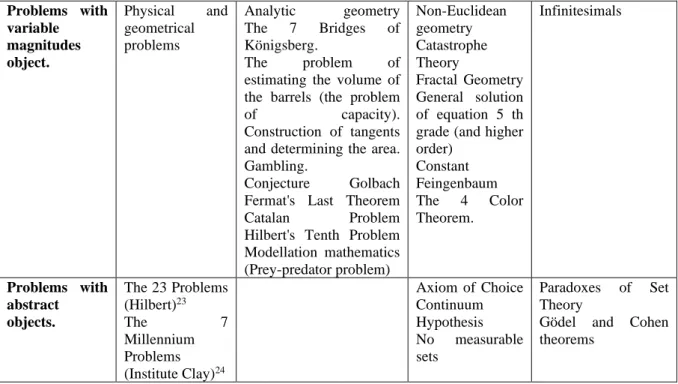
We treat now to express the results before presented. It is of course to analyze the historic development of the Mathematics, keeping in mind the resolved problems are not an easy task, for it, we want to present a first version of how can be done this (blanks are intentionally left blank):
Table 1: Caption of table Some problems
are in the origin
of the
development of the Math.
The resolution of certain problems has motivated the apparition of new branches of the Math.
Other problems have caused epistemic breaks.
There are problems that have opened crisis in the basis of the Math. Problems of practical needs (count and distribution). Problems on papyrus, tablets and scrolls cattle problem Calculation of areas and volumes
The positional principle of number representation The creation of a measurement theory Problems with constant magnitudes object. Three classical problems of Greek geometry Prime Number Theorem Chinese Postman Problem Incommensurable line segments Incommensurable line segments Sum of infinite series. The Problem of Postulate V. 22 Filloy (1995).
Problems with variable magnitudes object. Physical and geometrical problems Analytic geometry The 7 Bridges of Königsberg. The problem of estimating the volume of the barrels (the problem
of capacity).
Construction of tangents and determining the area. Gambling.
Conjecture Golbach Fermat's Last Theorem Catalan Problem Hilbert's Tenth Problem Modellation mathematics (Prey-predator problem) Non-Euclidean geometry Catastrophe Theory Fractal Geometry General solution of equation 5 th grade (and higher order) Constant Feingenbaum The 4 Color Theorem. Infinitesimals Problems with abstract objects. The 23 Problems (Hilbert)23 The 7 Millennium Problems (Institute Clay)24 Axiom of Choice Continuum Hypothesis No measurable sets Paradoxes of Set Theory
Gödel and Cohen theorems
Table Source: From the Author
Thus, analyzing the significance of a mathematical problem involves first analyzing the historical moment in which it arises, and secondly, what resulted in Mathematics resolution.
As final point, I consider that the attitude to take when faced with a history of mathematics. I dare to ask them to worry about out first, what is the epistemological foundation assumed by its author, which is explicit or implicit conception of mathematics, second, he traced the manuscript's Eurocentric bias in order to assume a clear philosophical position on it, and to transmit it to research and development, not just Mathematics.
We want to point out some a general remark on the above: Almost all Mathematics has been built on a succession of preceding ideas and, as one can return in this chain, the motivation for a problem is clear.
9 Epilogue
There are, of course, many different addresses than those listed here. We have presented those that might seem more relevant to our discourse, and we hope to have shown that the solution of mathematical problems and their relationship with the development of Mathematics, throughout History, has worked as mutual steps and that the solution of Problems is, right now, one of the main lines of development of Mathematics, deeply interwoven with multiple currents
23 These have been further divided into four areas: Foundations, Theory of Numbers, Algebra and analisys. See also Arnold et al., (2000). A similar purpose can be found in Smale (1998).
and with a not inconsiderable paradigmatic base: applications, an inexhaustible source of problems and, therefore, of development.
That the Mathematics one should be considered as a class of mental activity, a social construction that contains conjectures, proofs and refutations whose results are subjected to revolutionary changes and whose validity, therefore, it can be judged with relationship to an it pierces social and cultural, contrary to the absolutist vision (platonic) of the mathematical knowledge.
Finally, we would like to emphasize that the problems are not the only source of development of mathematics, we must incorporate the examples and theorems, since they are all also reflected the forces of mathematical development, although we believe that the problems are best illustrated by the stages development of this science
References
APPEL, K.; HAKEN, W. The four color proof suffices. The Mathematical Intelligencer, Springer Nature Switzerland AG, v.8, n.1, p. 10-20, 1986.
ARNOLD, V. I. et al. Mathematics: Frontiers and Perspectives. IMU and AMS, 2000.
ATANGANA, A. Derivative with a New Parameter Theory, Methods and Applications. Academic Press, 2016.
BALEANU, D.; FERNANDEZ, A. On fractional operators and their classifications. Mathematics, MDPI Basel (Switzerland), v. 7, i. 830, p. 1-10, 2019.
BALEANU, D. Comments on: “The failure of certain fractional calculus operators in two physical models” by M. Ortigueira, V. Martynyuk, M. Fedula and J.A.T. Machado. Fractional Calculus and
Applied Analysis, Sofía (Bulgarian Academy of Sciences), v. 23, i. 1, feb. 2020. DOI: https://doi.org/10.1515/fca-2020-0012.
DETLEFSEN, M.; LUKER. M. The four-color theorem and mathematical proof. The Journal of
Philosophy, [S.I.], v. 77, n. 12, p. 803-820, dec. 1980.
DOLORES, C. F. et al. An approach to the History of Mathematics. Far East. Journal of
Mathematical Education, [S.I.], v. 16, i. 3, p. 331 – 346, aug. 2016.
FILLOY, E. Didactic and history of euclidean geometry, Memorias Dpto de Matemática Educativa, CINVESTAV-IPN, México, 1995.
HANNA, G. Some pedagogical aspects of poof. Interchange, [S.I.], v. 21, p. 6–13, 1990. https://doi.org/10.1007/BF01809605
HILBERT, D. Grundlagen der Geometry. 7. ed. Teubner: Leipzig-Berlin, 1930.
LOLLI, G. The machine and proofs. Mathematics, logic and computer. Madrid: Alianza Editorial, 1991.
LÖWENHEIN, L. On making indirect proofs direct. Scripta Mathematica, New York, v. 12, n. 2, p. 125–147, 1946.
MÜELLER, I. Philosophy of Mathematics and Deductive Structure in Euclid's Elements. Cambridge, Mass: The MIT Press, 1981.
NÁPOLES, J. E. V. Some reflections on mathematics and mathematicians. Simple questions, complex answers. The Mathematics Enthusiast, Montana University, v. 9, i.1&2, p. 221-232, 2012.
NÁPOLES, J. E. V. The Differential Equations between Theoretical Sublimation and Practical Universalization. Acta Scientiae, Canoas, v. 21, i. 1, p. 55-63, 2019.
NÁPOLES, J. E. V.; QUEVEDO, M. N. The derivative notion revised: The fractional case. The
Mathematics Enthusiast, Montana University, v. 16, i. 1-2&3, p. 369-376, 2019.
RECALDE, L. C. The role of infinity in the emergence of sets topology. 1994. Master’s Thesis in Mathematics, UniValle, Cali, 1994.
ROTMAN, B. Towards a semiotics of mathematics, Semiotica, De Gruyter Mouton, 72, vol 1/2, p. 1-35,1988.
SMALE, S. Mathematical Problems for the next Century. The Mathematical Intelligencer, Springer Nature Switzerland AG, v. 20, p. 7–15, 1998. https://doi.org/10.1007/BF03025291
STEWART, I. From Here to Infinity: A Guide to Today's Mathematics. First Edition, USA: Oxford University Press, 1996.
SWART, E. R. The philosophical implications of the four-color problem. The American Mathematical
Monthly, Volume 87, 1980-Issue 9. https://doi.org/10.1080/00029890.1980.11995128
TYMOCZKO, T. The four-color problem and its philosophical significance. The Journal of
Phylosophy, [S.I.], v. 76, n. 2, p. 57-83, feb., 1979.
UMAROV, S.; STEINBERG, S. Variable order differential equations with piecewise constant order-function and difusion with changing modes. Z. Anal. Anwend, [S.I.], v. 28, n. 4, p. 431-450, 2009. doi: 10.4171/ZAA/1392
VEGA, L. The elements of geometry and the development of the idea of the proof. Mathesis, UNAM México, v. 8, p. 403-423, 1992.
VEGA, L. Around the traditional idea of proof: (self) critical issues and considerations. Laguna, ULL (Tenerife), v. 3, p. 9-32, 1995.
VEGA, L. Is the classical idea of mathematical proof in crisis? Conference COMPUMAT'96. Holguín, Universidad de Holguín, 1996.
VEGA, L. Mathematics and proof: the current vicissitudes of an ancient liaison”. In: ZALAMEA, F. (ed.). The veil and the braid. First Edition. Bogotá: Editorial Universidad Nacional, 1997. p. 49-79.
Received in: July 10, 2020. Accepted on: August 03, 2020.