Analysis of Microbial Contamination of Gutta-Percha Points commonly used in Clinical Practice: a Practical Approach
Universidade Fernando Pessoa Faculdade Ciências da Saúde
iii
FRANCESCA BRACCIALE
Analysis of Microbial Contamination of Gutta-Percha Points commonly used in Clinical Practice: a Practical Approach
Universidade Fernando Pessoa Faculdade Ciências da Saúde
iv
FRANCESCA BRACCIALE
Analysis of Microbial Contamination of Gutta-Percha Points commonly used in Clinical Practice: a Practical Approach
Trabalho apresentado à Universidade Fernando Pessoa como parte dos requisitos para a obtenção do grau de Mestre em Medicina Dentária
Atestando a originalidade do trabalho,
_________________________________ (Francesca Bracciale)
v RESUMO
Objectivos
Avaliar a contaminação bacteriana dos cones de Gutta-Percha utilizados rotineiramente na prática clínica e a eficácia de um Protocolo de Desinfecção “Chairside”.
Métodos
Cones de Gutta-Percha (n240) nos tamanhos A,B,C,D,K15,K20,K25,K30,K35,K40,F1,F2,F3 (Dentsply®, Proclinic®, ProTaper® e R&S®) foram recolhidos, aleatoriamente, de embalagens comerciais abertas em uso e, de imediato, adicionados ao Meio Fluído de Tioglicolato e incubados, a 37ºC, durante 21dias para avaliação da presença ou ausência de turvação. Para testar a eficácia de um Protocolo de Desinfecção, os cones de Gutta-Percha detectados como contaminados foram imersos durante 1minuto em 10mL de Hipoclorito de Sódio a 5,25%, seguidos de 5 minutos em 10mL de solução detergente (3% Tween 80 e 5% de Tiossulfato de Sódio) e a lavagem final foi feita com 10mL de Água Destilada Estéril, tendo sido novamente incubados nas condições descritas anteriormente.. Os dados foram analisados pelo teste do Qui-Quadrado com nível de significância de 5%.
Resultados
Observou-se crescimento bacteriano em 22,9% das amostras (Dentsply® e R&S® apresentaram o maior número de contaminados 47,3% cada). O calibre mais contaminado foi o K30 (16,4%), mas todos os cones de calibre D mostraram contaminação microbiana. O Protocolo de Desinfecção “Chairside” mostrou-se eficaz em 76,4% dos casos.
Conclusões
Um pequeno número de cones de Gutta-Percha em uso clínico mostrou contaminação microbiana, inclusive após o Protocolo de Desinfecção “Chairside”, que, contudo, provou ser consideravelmente eficaz. Não se observou nenhuma diferença estatisticamente significativa entre as marcas comerciais em teste. É necessário dar particular atenção ao controlo da contaminação nosocomial durante todas as fases do Tratamento Endodontico Não-Cirúrgico de forma a melhor garantir o seu sucesso.
Palavras-Chave
“Endodontic treatment”, “root canal filling”, “guta-percha points”, “contamination”, “disinfection protocol”, “secondary Endodontic infection”
vi ABSTRACT
Aim
To evaluate the bacterial contamination of Gutta-Percha points routinely used in clinical practice and the efficacy of a “Chairside” Disinfection Protocol.
Methodology
Gutta-Percha points (n240), in sizes A,B,C,D,K15,K20,K25,K30,K35,K40,F1,F2,F3 (Dentsply®, Proclinic®, ProTaper® and R&S®), were randomly sampled from open commercial packages in use. These were added directly to Fluid Thioglycolate Medium and incubated, at 37ºC, for 21days. During this period, the presence/absence of turbidity was evaluated. To evaluate the efficacy of a “Chairside” Disinfection Protocol, all detected contaminated Gutta-Percha points were immersed for 1minute in 10mL of 5,25% sodium hypochlorite, followed by 5minutes in 10mL of detergent solution (3% Tween 80 and 5% Sodium Thiosulfate) and a final rinse with 10mL of Sterile Distilled Water and incubated, again, as described before. Data were analysed by the chi-square test at 5% significance level.
Results
Bacterial growth was observed in the 22,9% of samples (Dentsply® and R&S® showed the highest number of contaminated 47,3% each). The most contaminated gauge was K30 (16.4%), but, all D gauge were found to be contaminated. The “Chairside” Disinfection Protocol resulted effective in 76,4% of cases.
Conclusions
A small number of Gutta-Percha points in clinical use harboured microorganisms, including after the “Chairside” Disinfection Protocol that, anyway, proved to be remarkably effective. No significant difference was observed between the commercials brands in test. Awareness in nosocomial contamination control should always be performed during all stages of Non-Surgical Root Canal Treatment to better ensure its success.
Key Words
“Endodontic treatment”, “root canal filling”, “guta-percha points”, “contamination”, “disinfection protocol”, “ secondary Endodontic infection”
vii DEDICATION
Aos meus pais, e ao meu irmão Alessandro. Nunca irei conseguir agradecer-lhes por tudo que fizeram e continuam a fazer por mim, pelo amor, o suporte e por todos os sacrifícios que eles próprios enfrentaram para que isto
hoje fosse possível. Para eles que acreditaram em mim, para eles que são a minha fonte de inspiração, meu exemplo de vida, a minha felicidade.
viii ACKNOWLEDGMENTS
Em primeiro lugar queria agradecer à minha orientadora Professora Doutora Ana Moura Teles, pelos preciosos conselhos e disponibilidade. Obrigada pelos ensinamentos e entusiamo transmitido, e por me orientar em todas as fases da realização deste trabalho.
À minha co-orientadora Professora Cristina Pina, pela sua disponibilidade e pelos ensinamentos microbiológicos conduzidos e prestados que foram fundamentais para a realização da componente laboratorial.
À Professora Conceição Manso pela sua ajuda e grande paciência no desenvolvimento estatístico deste trabalho.
A todos os Professores, pelos ensinamentos, as preciosas criticas construtiva e, sobretudo, por me terem transmitido a sua paixão e amor por esta profissão.
Ao Ricardo pela sua disponibilidade e grande ajuda nas execuções técnicas laboratoriais. Ao meu namorado, meu melhor amigo e agora também colega Luca. Não seriam suficiente milhões de palavras para conseguir agradecer-lhe. Obrigada pelo teu amor, que tornou tudo mais fácil, mais emocionante. Esta minha meta, também é a tua.
A toda a minha família fantástica, aos meus tios, aos meus primos e as minhas amadas avós, Rita e Clara por terem sempre cuidado de mim, orando muito e oferecendo doces palavras de coragem que ficarão sempre nas minhas memorias mais preciosas.
À Irene, Alfredo e Virna, a minha segunda família, que estiveram sempre prontos para me apoiar nos momentos de dificuldade, ajudando-me a fazer as escolhas mais acertadas e pelo amor com quem, desde sempre me preenchem.
Aos meus amigos de sempre, que quando precisei estiveram sempre ao meu lado e a todos os meus colegas por terem convivido comigo alegria, sacrifícios e sucessos. Particularmente as minhas amigas Anariely e Nicole, com quem foi partilhar a maioria dos momentos felizes desta aventura. O afecto e o apoio que todos vocês me mostraram tornam esta meta ainda mais única.
À minha fiel amiga Zora, que com um simples olhar consegue-me fazer sentir importante. Por tudo isso, e muito mais, Obrigada.
ix INDEX LIST OF FIGURES………...x LIST OF TABLES………...xi INDEX OF ABREVIATURES………...xii I. INTRODUCTION………...1
II. MATERIALS AND METHODS………....3
1. PROTOCOLS………..4
1.i Gutta-Percha points collection and contamination evaluation……...…….4
1.ii “Chairside” Disinfection Protocol………..5
2. STATISTICAL ANALYSIS………...6 III. RESULTS………....7 IV. DISCUSSION……….…9 V. CONCLUSION……….15 VI. REFERENCES………..16 VII. ANNEX……….18
x LIST OF FIGURES
Figure 1– Different brands of Gutta-Percha points……….3 Figure 2 – Fluid Thioglycolate Medium.………4 Figure 3 – Gutta-Percha points incubated at 37 °C……….4 Figure 4 – Representation of a contaminated Gutta-Percha point (left Eppendorf tube) against an uncontaminated one (right Eppendorf tube) ……….4 Figure 5 – Representation of the “Chairside” Disinfection Protocol on a contaminated Gutta-Percha point (left Eppendorf tube) after 1 minute of immersion in 5,25% Sodium Hypochlorite (middle Eppendorf tube), result subsequently decontaminated (right Eppendorf tube) ………...5
xi LIST OF TABLES
Table 1 – Sampling of Gutta-Percha points divided by brands and gauge………...5
Table 2 – Total contamination of collected Gutta-Percha points ………...7
Table 3 – Contamination of Gutta-Percha points related to the brand………7
Table 4 – Contamination of Gutta-Percha points related to the gauge………...8
xii INDEX OF ABBREVIATIONS
NSRCT - Non-Surgical Root Canal Treatment MO - Microorganism
RCS - Root Canal System GP - Gutta-Percha
NaOCl - Sodium Hypochlorite min - Minute
1 I. INTRODUCTION
The success rate of Non-Surgical Root Canal Treatment (NSRCT) is around 86-98% and a major cause of failure is a persistent infection (Tabassum & Khan, 2016).
The role of bacteria in periradicular infection has been well established in Literature and NSRCT will be aflicted with a higher chance of failure if microorganisms (MO) persist in the root canal system (RCS) at the time of filling (Tabassum & Khan, 2016). Therefore, in this last phase of the NSRCT, it is essential to maintain the aseptic chain obtained during the previous ones, implementing effective measures to eliminate and prevent infection (Siqueira et al., 2011).
So, the canal filling has two main objectives: on the one hand, to avoid reinfection of the RCS and, on the other hand, to minimize the eventual MO growth in case they have remained inside the pulpal space, after the chemical-mechanical preparation. As such, ideally, the filling material should seal, in 3 dimensions, the RCS and maintain a stable volume as well as not irritate the periapical tissues. Endodontic filling with Gutta-Percha (GP) and cement still persist as the most universally accepted and used option (Yildirim et al., 2016).
The GP was first used by Bowman in 1867 (Castellucci, 2005) and for over 150 years remains the most widely used material. It is composed of zinc oxide (conferring antibacterial activity) (33-62,5%), GP (19 to 45%), barium sulphate (radiopacifier) (from 1,5 to 31,2%), waxes and plastics materials (from 1% to 4,1%) and various dyes (from 1,5 to 3,4%) (Yildirim et al., 2016).
Because it is thermolabile, GP is not amenable to sterilization by wet or dry heat (Türker et al., 2015), a matter of concern, since sterilization of Endodontic instruments and materials is essential to maintain the aseptic chain and, also, in preventing the introduction of pathogenic MOs into the RCS (Niazi et al., 2016; Malmberg et al., 2016).
Furthermore, although GP points are produced under aseptic conditions, several studies have shown the presence of MO in newly opened boxes and this contamination can occur as a result of bad storage, exposure to aerosols or improper handling, among others (Vidotto et al., 2006; Kayaoglu et al. 2009; Sayão et al. 2010; Da Silva et al. 2010; Pereira & Siqueira, 2010; Demiryürek et al., 2012; Mcam et al. 2017; Saeed et al., 2017; Angami et al., 2019). Hence, the need to adopt a rapid “Chairside” Disinfection Protocol of GP points with chemical
2
agents.
The protocol foresees the immersion of the GP points in the Sodium Hypochlorite (NaOCl) at 5,25% for 1 minute (min), because it is a sufficient time for them to be disinfected without the point suffering topographical alterations (Valois et al., 2005; Gomes et al., 2010; Zand et al., 2012; Giovarruscio et al., 2019).
Various studies (Valois et al., 2005; Prado et al., 2011; De Assis et al., 2012), have shown that longer periods deteriorate the point surface. This deterioration includes a greater depth of the irregularities that would lead to the creation of spaces between the point and the root canal surface, increasing the risk of leaks and, furthermore, to an improvement in the elasticity of its surface that could increase the proper insertion, during the filling procedure, especially in case of curved canals.
In view of the above, there is a need for further studies on the contamination of GP points in clinical practice, as well as ways of disinfecting them, prior to their use as a sealing material. This “in vitro” study aims to analyze the possible contamination of GP points during clinical use and to test the efficiency of a “Chairside” Disinfection Protocol.
The following null hypothesis were formulated:
1) For the presence of contamination detected in the GP points:
• H0: There are no significant differences in contamination in the different trademarks and gauge of GP points tested;
2) For the “Chairside” Disinfection Protocol:
3 II. MATERIALS AND METHODS
The approval for the study protocol was obtained by submitting the project to the Ethics Committee of the Health Sciences Faculty of Fernando Pessoa University and of the Clinical Direction of Pedagogical Clinic of Dentistry of the Institution mentioned. (Annex 1)
For the accomplishment of this study, we analyzed 240 points of GP of different trademarks (Dentsply® Sirona, Ballaigues, Switzerland; Proclinic®, Zaragoza, Spain; ProTaper Universal®, Denstply, Switzerland; R & S, Tremblay-en-France, France) and of different ISO gauges (A, B, C, D, K15, K20, K25, K30, K35, K40, F1, F2, F3). (Figure 1)
Figure 1 – Different brands of Gutta-Percha points
The GP points were collected from commercial packages already opened and in use, during the filling phase at the Pedagogical Clinic of Dentistry - Fernando Pessoa University (CPMD-UFP). The students, who were performing NSRCT in patients, were not aware of the “intentions” of the study, in order to avoid influencing their attitude in collecting points before inserting them in the RCS.
All laboratory procedures were performed by one operator recreating an aseptic environment using sterile material (tweezers, gloves and masks) and a lamp.
4 1. PROTOCOLS
1.i. Gutta-Percha points collection and contamination evaluation
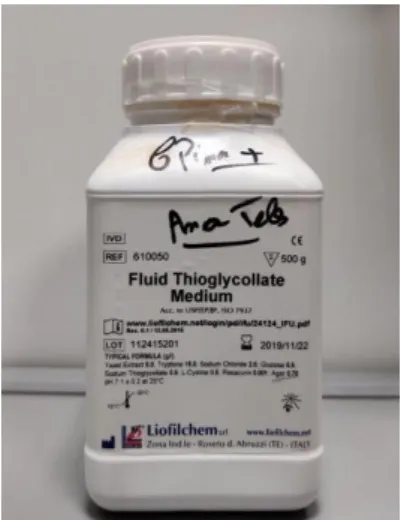
240 GP points were sampled, according to the adopted methodology, which preview the collection of 2 GP points from each gauge in each commercial box (2+2). As in the study conducted by Pereira & Siqueira (2010), each point was taken and placed directly in a sterile test tube, duly identified and incubated, containing sterile Fluid Thioglycolate Medium (Merck, Darmstadt, Germany) (Figure 2) and, then, incubated at 37 °C and evaluated, individually, every 72 hours to verify the eventual occurrence of turbidity, which was indicative of growth, until a maximum period of 21 days. (Figure 3 & 4)
Figure 2 – Fluid Thioglycolate Medium Figure 3 – Gutta-Percha points incubated at 37 °C
Figure 4 – Representation of a contaminated Gutta-Percha point (left Eppendorf tube) against an uncontaminated one (right Eppendorf tube)
5
In total, 240 points were collected, distributed by trademarks and gauges. (Table 1)
BRAND AND GAUGES NUMBER OF GP POINTS
DENTSPLY® A B C D 104 34 44 20 6 PROCLINIC® K25 K30 8 4 4 PROTAPER® F1 F2 F3 26 8 10 6 R&S® K15 K20 K25 K30 K35 K40 104 6 10 34 32 18 4 TOTAL 240
Table 1 – Sampling of Gutta-Percha points divided by brands and gauge 1.ii. “Chairside” Disinfection Protocol
In the case of contamination, a “Chairside” Disinfection Protocol for each GP point was tested in a solution of 10 mL of 5,25% Sodium Hypochlorite placed for 1 min in an Eppendorf tube where each point was completely submerged, followed by 5 min in 10 mL of detergent solution (3% Tween 80 and 5% Sodium Thiosulfate) and a final rinse with 10 mL of Sterile Distilled Water (Zand et al., 2012). Subsequently, it was dried with a sterile gauze and placed in a new sterile tube containing Fluid Thioglycollate Medium and processed under conditions similar to those described above. (Figure 5)
Figure 5 – Representation of the “Chairside” Disinfection Protocol on a contaminated Gutta-Percha point (left Eppendorf tube) after 1 minute of immersion in 5,25% Sodium Hypochlorite (middle Eppendorf tube), result subsequently decontaminated (right Eppendorf tube)
6 2. STATISTICAL ANALYSIS
The analysis was conducted using IBM® SPSS® Statistics vs 25.0 (Armonk, NY, IBM Corp., USA).
Qualitative variables were described using absolute and relative counts (n and %). Differences with relation to negative and positive points’ groups) were perfomed with the chi-square test. Diferences among characteristics of dicotomic variable were perfermormed using the binomial test. The significance level was set at p<0.05.
7 III. RESULTS
The total rate of contamination was 22,9% (55/240). (Table 2)
CONTAMINATION POINTS GP n % p* NEGATIVE 185 77,1% <0,001 POSITIVE 55 22,9% TOTAL 240 100%
Table 2 – Total contamination of collected Gutta-Percha points *binomial test
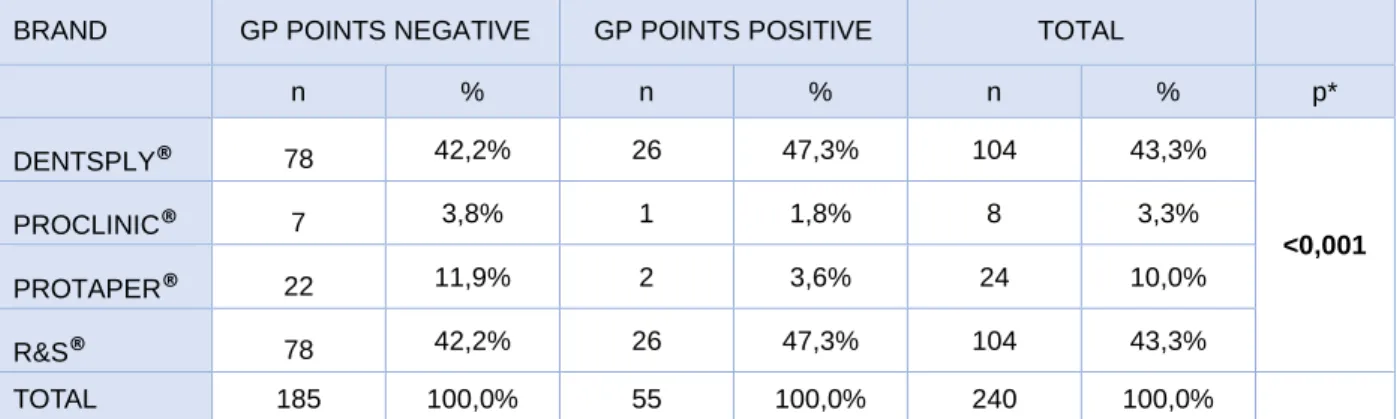
The brand that showed the highest number of contaminated GP points were Dentsply® and R&S® with 47,3% (26/55) each. (Table 3)
BRAND GP POINTS NEGATIVE GP POINTS POSITIVE TOTAL
n % n % n % p* DENTSPLY® 78 42,2% 26 47,3% 104 43,3% <0,001 PROCLINIC® 7 3,8% 1 1,8% 8 3,3% PROTAPER® 22 11,9% 2 3,6% 24 10,0% R&S® 78 42,2% 26 47,3% 104 43,3% TOTAL 185 100,0% 55 100,0% 240 100,0%
Table 3 – Contamination of Gutta-Percha points related to the brand *binomial test
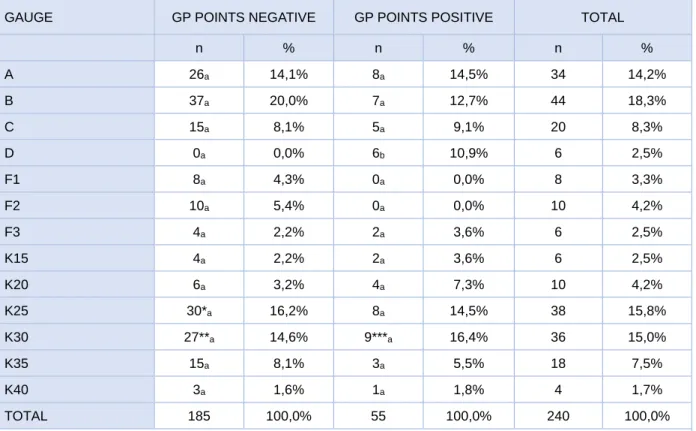
The most contaminated gauge was K30 with 16,4% (9/55) of contamination found. In detail, 8/9 GP points were of the R&S® brand and 1/9 of the Proclinic® brand.
Furthermore, all Dentsply® brand points wich was D gauge, were found to be contaminated, namely 10,9% (6/55) of the total number of GP points collected. (Table 4)
8
Table 4 – Contamination of Gutta-Percha points related to the gauge
In the contaminated GP points the “Chairside” Disinfection Protocol was effective in 76,4% (42/55) of the cases. (Table 5) (Figure 5)
“CHAIRSIDE” DISINFECTION PROTOCOL GP POINTS n % p* EFFECTIVE 42 76,4% <0,001 NOT EFFECTIVE 13 23,6% TOTAL 55 100,0%
Table 5 – Effectiveness of the “Chairside” Disinfection Protocol *binomial teste
GAUGE GP POINTS NEGATIVE GP POINTS POSITIVE TOTAL
n % n % n % A 26a 14,1% 8a 14,5% 34 14,2% B 37a 20,0% 7a 12,7% 44 18,3% C 15a 8,1% 5a 9,1% 20 8,3% D 0a 0,0% 6b 10,9% 6 2,5% F1 8a 4,3% 0a 0,0% 8 3,3% F2 10a 5,4% 0a 0,0% 10 4,2% F3 4a 2,2% 2a 3,6% 6 2,5% K15 4a 2,2% 2a 3,6% 6 2,5% K20 6a 3,2% 4a 7,3% 10 4,2% K25 30*a 16,2% 8a 14,5% 38 15,8% K30 27**a 14,6% 9***a 16,4% 36 15,0% K35 15a 8,1% 3a 5,5% 18 7,5% K40 3a 1,6% 1a 1,8% 4 1,7% TOTAL 185 100,0% 55 100,0% 240 100,0%
Each subscript letter denotes a subset of contamination categories whose column proportions do not differ significantly from each other at the .05 level.
* 4/30 are Proclinic® GP points. ** 3/27 are Proclinic® GP points. *** 1/9 is Proclinic® GP points.
9 IV. DISCUSSION
The outcome of NSRCT is significantly influenced by the presence of MO in the RCS at the time of filling (Siqueira et al., 2008). Tabassum & Khan (2016), among the various causes attributed to Endodontic failure such as inadequate canal filling, overextension, improper coronal seal, untreated canals, iatrogenic procedural errors such as poor access cavity design and complications of instrumentation as ledges, perforations, or separated instruments, in fact indicates the persistent microbiological infection one of the foremost causes.
Mentioned that, it can be deduced that the persistent MO can survive in the pulpal space after the chemical-mechanical and filling procedures, being able to induce or sustain the inflammation of the periradicular tissue. (Hargreaves & Cohen, 2011)
Siqueira et al. (2008) explains the reasons why some bacterial species can withstand the aforementioned procedures, promoting the onset of infections: "(1) they have the ability to withstand periods of nutrient scarcity, scavenging for low traces of nutrients and/or assuming a dormant state or a state of low metabolic activity, to prosper again when the nutrient source is reestablished; (2) they resist to treatment-induced disturbances in the ecology of bacterial community, including disruption of quorum-sensing systems, food webs/chains and genetic exchanges, and disorganization of protective biofilm structures; (3) they reach a climax population density (load) necessary to inflict damage to the host; (4) they have unrestrained access to the periradicular tissues through apical/lateral foramens or perforations; and (5) they possess virulence attributes that are expressed in the modified environment and reach enough concentrations to directly or indirectly induce damage to the periradicular tissues".
It is important to underline the fact that not all periradicular lesions have the same microbiological nature. Conceptually, the primary lesions are those infections caused by MOs that invade the necrotic pulp tissue, prior to the onset of NSRCT. Differently, in secondary infections, the colonization takes place by MOs of different species from the primaries ones and occurs during the clinical intervention (Hargreaves & Cohen, 2011).
It is intuitive to deduce that if it is very important that all the chemical and mechanical procedures of NSRCT are carried out accurately to minimize the occurrence of secondary infections.
10
all NSRCT stages and considering that Endodontic procedures are carried out in an environment with a high risk of contamination, it's the duty of the dentist to be on alert using well defined strategies in order to avoid MO introduction within the RCS.
The lateral condensation technique, conceived by Callahans in 1914, is the most widely used and known filling technique in Endodontics mainly due to its simplicity and good clinical results (Chemim et al., 2013). This technique involves placing more points in the RCS and each point is taken individually from the box. This causes the clamp to make contact several times with the contents of the packets, and it is sufficient for the contamination to occur in one of these steps to risk, pottentially contaminating the remaining GP points in the package. Keeping in mind that a package is used for multiple Endodontic sessions, the risk of cross-contamination must be considered as a real fact.
The realization of this study was motivated by the lack found in the Literature of studies that analyze the contamination of GP points in Clinical Practice, given the influence of contamination on treatment success rates (Siqueira et al., 2008; Saeed et al., 2017).
In this study we analyzed 240 GP points, master and auxiliary, of different brands and different sizes, coming from packages already open and in use. As the polymicrobial nature of Endodontic infections, Fluid Thioglycolate Medium was chosen for its ability to provide growth of a wide variety of demanding MO with a wide range of growth requirements and that may be present in low numbers in a specimen (Chandler, 2013).
The total amount of contamination was 22,9%, with 55 points contaminated on 240 total, results that are in agreement with others previous studies published which found low contamination of GP points during clinical use. An interesting detail was that although more points were taken from the same compartment of the same box, not all of them were contaminated. An explanation could be that microbial contamination didn't affect the entire package and, therefore, clinical use only contaminated some GP points in the package.
The contamination rate was related to point brand, where Dentsply® and R&S® showed the highest number of contaminated GP points with 47,3% (26/55) each of the total.
Moreover the contamination was related to point gauge where the most contaminated was K30 with 16,4% (9/55) of contamination found. In detail, 8/9 GP points were of the R&S® brand and 1/9 of the Proclinic® brand.
11
namely 10,9% (6/55) of the total number of GP points collected. An explanation could be the fact that the D GP points are the least used in clinical practice, and therefore remain for longer in open and in use boxes. This considerably increases the time of exposure to possible contaminants resulting from the continuous manipulation of these boxes even if for the use of different gauges.
Several studies (Vidotto et al., 2006; Kayaoglu et al. 2009; Sayão et al. 2010; Da Silva et al. 2010; Pereira and Siqueira, 2010; Demiryürek et al., 2012; Mcam et al. 2017; Saeed et al., 2017; Angami et al., 2019) in the Literature have examined GP points from sealed and not yet used boxes, and from open and in-use boxes.
Vidotto et al. (2006), collected and examined 39 GP points stored in different ways: sealed boxes, dry container and wet container (glycerine) - none of these came from packages already in use. The results did not observed bacterial growth in any of the three groups tested. Kayaoglu et al. (2009), analyzed GP points taken from packages still sealed, finding that they contained a rather low number of cultivable MO. Furthermore, the clinical use of the packages has increased the number of GP points found as contaminated.
Sayão et al. (2010), in their study, analyzed 34 auxiliary GP points from sealed and handled packages of different commercial brands. The results showed contamination in 6,67% of the points from sealed boxes and in 6,67% of the points of open ones.
Da Silva et al. (2010) examined a total of 40 GP points without specifying the number coming from packages already opened and in use and from sealed ones. A number of points from packages already opened and in use were evaluated only after being disinfected in a 2% NaOCl solution for 1 min. The totality of the points was found to be free of contamination. Pereira & Siqueira (2010), analyzed several brands of GP points from sealed packages without showing any contamination.
Demiryürek et al. (2012), analyzed 28 packages of newly opened GP points and subjected them to clinical use. The MO were initially found only on 3 packages of points; the clinical use of them led to an increase in microbial contamination in 11 of the 28 packages.
Mcam et al. (2017), observed a 30% (14/30) contamination in the boxes of evaluated GP points that had already been used in the clinic. 13,3% (4/15) of these correspond to samples taken from dentists and 16,6% (9/15) from Endodontist samples. They concluded that
12
bacterial contamination of GP points of packages already in clinical use is frequent and was not statistical different between General practice clinicians and Endodontic specialists.
Saeed et al. (2017), in their study, deduced that the GPs taken from newly opened sealed packages are contaminated, with a contamination level of 11,1%. Normal clinical use may increase the level of contamination, finding 16,7% contamination on day 14.
Angami et al. (2019) analyzed 10 GP points from two different sealed packages, 5 each (Dentsply® and Coltene®) of 25 size using two different culture media namely, Blood Agar and MacConky and concluded that all points in test didn’t contained MOs.
The general low detection of contamination found, as described before, could be due to the structural and antimicrobial properties of GP likem, for instance, the large amount of zinc oxide, compound that promotes excellent antibacterial properties (Yildirim et al., 2016). Unlike the analogous studies analyzed, the present work examined a higher quantity of GP points. Sampling took place during 6 months and each GP point was taken only during the filling phase from packages that were being used by the operator at that time. Furthermore, the students were not aware of the objectives of the study, in order to avoid influencing their attitude in collecting points before inserting them in the RCS. All this, in order to have a more realistic idea of what happens in a university clinical setting.
Regardless of the contamination rate, in all the studies examined, the awareness of the Professional is recommended in using GP disinfection techniques in order to prevent the occurrence of infections associated with the use of contaminated GP points.
In the present study, a “Chairside” Disinfection Protocol applied to the 55 GP points contaminated was assessed for its efficiency.
The choice of 5,25% NaOCl is mainly due to its antimicrobial and dissolution characteristics of organic tissues, in addition to the fact that it is an economic solution, easily available and demonstrates a good shelf life, so as to be the most used irrigation solution in Endodontics. The NaOCl obtained wide acceptance as a disinfectant by the end of the 19th century. Based on the laboratory studies conducted by Koch and Pasteur, it was first indicated as an antiseptic solution by Dakin, in 1919, to clean and disinfect the wounds of the soldiers of the First World War. Alongside its broad range, non-specific and cationic on all microbes, NaOCl preparations are sporicidal, virucidal and show much sharper tissue dissolution effects on vital
13
and necrotic tissues due to its saponification reactions, neutralization of aminoacids and chloramination (Agrawal et al., 2014).
Our protocol involved immersing the GP points in 5,25% NaOCl solution for 1 min as suested by Moreno, 2014.
Of the 55 points tested, the protocol proved to be effective on 42 points (76,4%), being them completely disinfected. However, there is no agreement in the Literature on the real need to decontaminate points before their use and on what could be the ideal protocol (Moorer and Genet, 1982; Namazikhah et al., 2000; Carvalho et al., 2015).
Gomes et al. (2005) used concentrations of 0,5%, 1%, 2,5% and 5,25% NaOCl and testing times (45 seconds, and 1, 3, 5, 10, 15, 20, and 30 min) to disinfect the GP points. They concluded that in all the concentrations evaluated, there was no bacterial growth in the GP points and, the most suitable concentration, due to its practicality, was NaOCl 5,25% for 1 min, not recommending low concentrations because of the longer time it would take to kill microbial cells. They also concluded that the disinfection time is inversely proportional to that of the solution concentration, in fact, 5,25% of NaOCl provided for 15 seconds to 1 min to kill all the MO (1 min was efficient for Enterococcus faecalis and Bacillus subtilis), while 0,5% of NaOCl took 30 min.
Regarding what was said above Marion et al. (2014), in their study, evaluated GP points from 30 clinics, and 3 of them reported that they did not perform any Disinfection Protocol of GP points, prior to obturation. The chemical solution used was exclusively NaOCl, but not all of them used the same concentration: 0,5% (5/27), 1% (12/27), 2.5% (9/27) and 5,25% (1/27). Also in relation to disinfection time, this varied between 1 to 5 min (2/27), 5 to 10 min (21/27) and 15 to 20 min (4/27). The authors have simulated the same disinfection of the Clinics in the collected points, finding an absence of contamination in all cases.
Undoubtedly, the prolonged immersion of the GP points guarantees the microbial elimination on the surface of the points as the NaOCl is more effective by increasing the application time (Agrawal et al., 2014), but it is necessary to take into account its corrosive properties (Slaughter et al., 2018).
Regarding this, Valois et al. (2005) analyzed the topographical effects on GP points with atomic force microscopy, after disinfection with 5,25% NaOCl for 1, 5, 10, 20 and 30 min. The results were that after 10 min there was a great deterioration in the topography of GP
14
points compared to untreated samples. Although the nature of these phenomena is not clear, it seems that the changes in the topography are due to the loss of the components of the GP point, with consequent modification of its surface. This deterioration includes a greater depth of the irregularities that would lead to the creation of spaces between the point and the root canal surface, increasing the risk of leaks. Furthermore, after a minute the elasticity of the GP point is increased, which can be caused by alterations in the polymer chain. This fact could be clinically relevant because it can influence the proper insertion of the filling material, especially in curved canals (De Assis et al., 2012).For these reasons, in our protocol, we decided not to exceed 1 min of submersion.
The subsequent rinse with 3% Tween 80, 5% Sodium Thiosulfate and a final rinse with 10mL of Sterile Distilled Water was carried out to remove the crystallized NaOCl on the GP’ surface, a practice confirmed by Prado et al. (2011), which, in their study, showed that the formation of chloride crystals occurs in points immersed in NaOCl at 5,25 %, and how a rinse with Distilled Water is enough to remove them. The importance of removal is due to the fact that it would damage the seal capacity of the filling material (Short et al., 2003).
The efficiency of the “Chairside” Disinfection Protocol found in the present study joins the numerous studies that have proven the validity of the NaOCl in the disinfection of GP points. In favor of what has been said, some studies have evaluated the efficiency of this solution against several MO and bringing to the attention the efficiency of disinfection against Enterococcus faecalis, considered as a specific opportunistic pathogen of periapical persistent pathology (Del Fabbro, 2009). The study by Gomes et al. (2010), showed that just 1 min of immersion in 5,25% NaOCl is sufficient to completely disinfect it and Nabeshima et al. (2011) recommended 10 min in NaOCl 1%.
15 V. CONCLUSIONS
In accordance with the results obtained, the continuous use of the packages of GP points is related to the their contamination. To confirm this, even the less used GP points were found to be contaminated, as the continuous handling of the boxes in which they are present, even if for different gauges, considerably increases the time of exposure to possible contaminants. No significant difference was observed between the commercials brands and gauges of points. Although the contamination rate detected, in this study, was not excessive, it is imperative that the clinician acts in full compliance with the rules of asepsis and implements valid prevention strategies, since the failure of NSRCT is strongly correlated to the introduction of MO in the RCS in the moment of filling; from this comes the possibility of a secondary infection.
The disinfection protocol tested, proved to be remarkably effective in the disinfection of GP points before its use, and taking into account the Literature examined, it is recommended, as good clinical practice, the immersion of GP points in 5,25% NaOCl for 1 min; this is considered an efficient concentration/time combination in relation to the benefits concerning both the disinfection and the structural maintenance of the GP points.
Future studies should either target on identification of contaminants species, as well as increasing the study sample in order to develop evidence-based strategies to better insure success of NSRCT.
16 VI. REFERENCES
Angami, N. et al. (2019). Assessment of Microbial Contamination of Gutta-Percha Cones after opening a Sealed Package. IOSR Journal of Dental and Medical Sciences, 18(2), pp. 58–61.
Carvalho, A. et al. (2015). EDS analysis of Gutta-Percha cones disinfected by 1% and 2.5% Sodium Hypochlorite solutions. Brazilian Dental Science, 18(4), pp. 84–88.
Castellucci, A. (2005). Endodontics, Volume 1. Florence, Il Tridente.
Chandler, L. (2013). Challenges in Clinical Microbiology Testing. In: Desgupta, A. & Sepulveda, J. L. Accurate
Results in the Clinical Laboratory: A Guide to Error Detection and Correction. First Edit. Chennai, Elsevier
Inc., pp. 315–326.
Chemim, H. et al. (2013). Obturation techniques Endodontic. Revista Faipe, 3(2), pp. 30–58.
Da Silva, E., Sponchiado, E. & Marques, A. (2010). Microbiological assessment of contamination of gutta-percha cones used by post-graduation students. Journal of the Health Sciences Institute, 28(3), pp. 235–236. Gomes, B. et al. (2005). Disinfection of gutta-percha cones with chlorhexidine and sodium hypochlorite. Oral
Surgery, Oral Medicine, Oral Pathology, Oral Radiology and Endodontology, 100(4), pp. 512–517.
De Assis, D., Do Prado, M. & Simão, R. (2012). Effect of disinfection solutions on the adhesion force of root canal filling materials. Journal of Endodontics, 38(6), pp. 853–855.
Del Fabbro, M. & Taschieri, S. (2009). Le Infezioni Endodontiche. Giornale Italiano Di Endodonzia, 23(01), pp. 34–47.
Demiryürek, E. (2012). Evaluation of microbial contamination of resilon and gutta-percha cones and their antimicrobial activities. African Journal of Microbiology Research, 6(33), pp. 6275–6280.
Giovarruscio, M. et al. (2019). Strategies to reduce the risk of reinfection and cross-contamination in Endodontics. Clinical Dentistry Reviewed, 3(8).
Gomes, C. et al. (2010). Evaluation of Sodium Hypochlorite and Chlorhexidine in Disinfection Gutta-Percha Cones. Revista de Odontologia da Universidade Cidade de São Paulo, 22(2), pp. 94–103.
Hargreaves, K. & Cohen, S. (2011). Cohen Caminhos da Polpa, 10ª edição. Rio de Janeiro, Mosby Elsevier. Kayaoglu, G. et al. (2009). Examination of Gutta-Percha Cones for Microbial Contamination During Chemical Use. Journal of Applied Oral Science, 17(3), pp. 244–247.
Malmberg, L., Björkner, A. & Bergenholtz, G. (2016). Establishment and maintenance of asepsis in Endodontics – a review of the literature. Acta Odontologica Scandinavica, 74(6), pp. 431–435.
Marion, J. et al. (2014). Disinfection efficiency of gutta-percha cones in Endodontics. Revista da Associacao
Paulista de Cirurgioes Dentistas, 68(3), pp. 214–218.
Mcam, N. et al. (2017). Contamination Of Gutta-Percha Cones In Clinical Use By Endodontic Specialists And General Practitioners. Revista Facultad de Odontología Universidad de Antioquia, 28(2), pp. 327–340.
Moorer, W. & Genet, J. (1982). Evidence for antibacterial activity of Endodontic gutta-percha cones. Oral
Surgery, Oral Medicine, Oral Pathology, 53(5), pp. 503–507.
Moreno, A. (2014). Protocolo experimental para desinfeção imediata “Chairside” de cones de Guta-percha. Dissertation thesis, University Fernando Pessoa, Porto.
Nabeshima, C. et al. (2011). Effectiveness of different chemical agents for disinfection of gutta-percha cones.
17
Namazikhah, M., Sullivan, D. & Trnavsky, G. (2000). Gutta-percha: a look at the need for sterilization. Journal
of the California Dental Association, 28(6), pp. 427–432.
Niazi, S., Vincer, L. & Mannocci, F. (2016). Glove Contamination during Endodontic Treatment Is One of the Sources of Nosocomial Endodontic Propionibacterium acnes Infections. Journal of Endodontics, 42(8), pp. 1202–1211.
Pereira, O. & Siqueira, J. (2010). Contamination of gutta-percha and Resilon cones taken directly from the manufacturer. Clinical Oral Investigations, 14(3), pp. 327–330.
Prado, M. et al. (2011). The importance of final rinse after disinfection of gutta-percha and Resilon cones. Oral
Surgery, Oral Medicine, Oral Pathology, Oral Radiology and Endodontology. Elsevier Inc., 111(6), pp. e21–
e24.
Saeed, M. et al. (2017). Bacterial Contamination of Endodontic Materials before and after Clinical Storage.
Journal of Endodontics. Elsevier Inc., 43(11), pp. 1852–1856.
Sayão, D. et al. (2010). Microbiological Analysis of Gutta-Percha Cones Available in the Brazilian Market.
Pesquisa Brasileira em Odontopediatria e Clinica Integrada, 10(2), pp. 265–269.
Short, R., Dorn, S. & Kuttler, S. (2003). The Crystallization of Sodium Hypochlorite on Gutta-percha Cones After the Rapid-Sterilization Technique: An SEM Study. Journal of Endodontics, 29(10), pp. 670–673.
Siqueira, J. & Rôças, I. (2008). Clinical Implications and Microbiology of Bacterial Persistence after Treatment Procedures. Journal of Endodontics, 34(11), pp. 1291–1301.
Siqueira, J. et al. (2011). Biological principles of Endodontic treatment of teeth with vital pulp. Revista
Brasileira de Odontologia, 68(02), pp. 161–165.
Slaughter, R. et al. (2019). The clinical toxicology of sodium hypochlorite. Clinical Toxicology. Taylor & Francis, 57(5), pp. 303–311.
Tabassum, S. & Khan, F. (2016). Failure of Endodontic treatment: The usual suspects. European Journal of
Dentistry, 10(1), pp. 144–147.
Türker, S. et al. (2015). Antimicrobial and Structural Effects of Different Irrigation Solutions on Gutta-Percha Cones. The Journal of Istanbul University Faculty of Dentistry, 49(1), pp. 27–32.
Valois, C., Silva, L. & Azevedo, R. (2005). Effects of 2% chlorhexidine and 5.25% sodium hypochlorite on gutta-percha cones studied by atomic force microscopy. International Endodontic Journal, 38(7), pp. 425–9. Vidotto, A. et al. (2006). Bacterial Contamination of the Gutta-Percha Cones Used in the Dentistry Clinics of the Pontifícia Universidade Católica de Campinas School of Dentistry. Revista de Ciências Médicas, 15(1), pp. 41– 46.
Vineet, A. et al. (2014). A Contemporary Overview of Endodontic Irrigants – A Review. Journal of Dental
Applications, 1(1), pp. 105–115.
Yildirim, A., Lübbers, H. & Yildirim, V. (2016). Obturation du canal radiculaire à la gutta-percha – exigences, composition et propriétés. Swiss Dental Journal SSO, 126, pp. 150–151.
Zand, V. et al. (2017). Efficacy of different concentrations of sodium hypochlorite and chlorhexidine in disinfection of contaminated Resilon cones. Medicina Oral, Patologia Oral y Cirugia Bucal, 17(2), pp. 352– 355.
18 ANNEX
Annex 1 – Approval for the study protocol by submitting the project to the Ethics Committee of the Health Sciences Faculty of Fernando Pessoa University and of the Clinical Direction of Pedagogical Clinic of Dentistry of the Institution mentioned