1. Master Program in Health Promotion and Physical Therapy course e Centro de Pesquisa Clinica do Instituto de Medicina Física e Reabilitação, Adventist University of São Paulo e University of São Paulo
2. Master Program in Health Promotion, Adventist University of São Paulo
3. Departamento de Medicina Legal, Ética Médica, Medicina Social e do Trabalho da Faculdade de Medicina da Universidade de São Paulo e Centro de Pesquisa Clinica do Instituto de Medicina Física e Reabilitação, University of São Paulo
cant reduction in pain assessed by WOMAC. Thera-peutic exer cise programs led to pain relief, but no im-provements were observed in joint stiffness and fun-cionality.
Conclusions: Both programs were effective in
reduc-ing pain intensity and increasreduc-ing PPT, however, ELG also exhibited reduction in pain evaluated by WOMAC.
Keywords: Pain; Osteoarthritis; Pain measurement;
Exercise therapy; Lifestyle.
IntroductIon
The increase in lifespan worldwide places osteoarthri-tis (OA) as a topic of great interest in public health, as it is a common chronic disease that leads the causes of pain and disability among adults and elderly people 1. The knee is one of the joints most affected by OA, which causes disability in 10% of the individuals over 55 years old2.
Besides pain, patients with OA may experience mus-cle weakness, joint stiffness and crackling, deformities and disability3,4. Several therapeutic interventions have been tested targeting symptoms relief or function im-provement in these patients5.
A rehabilitation strategy usually employed as an adjunct therapy for patients with OA is physical or thera -peutic exercise. Because of its ability to promote an in-crease in muscle strength, flexibility, proprioception and, as a consequence, reduce pain, exercises are no-torious for alleviating the symptoms of this disease6,7. Therefore, exercise interventions have been recom-mended as an efficient non-pharmacologic approach for the treatment of knee OA8,9.
Amongst the various therapeutic exercises, resis-tance exercises add an overload to the muscles10,11, and kinesiotherapy, which involves different types of
exer-Efficacy of an exercise program
combined with lifestyle education in
patients with knee osteoarthritis
Alfieri FM1, Lima AR2, Salgueiro MM2, Andrade EA2, Battistella LR3, Silva NC2 ACTA REUMATOL PORT. 2020;45:201-208
AbstrAct
Objectives: To compare the impact of an exercise
pro-gram vs. exercise propro-gram plus LS education in indi-viduals with knee OA.
Therapeutic exercise and lifestyle changes (LS) are usua lly recommended for the treatment of knee os-teoarthritis (OA).
Materials and Methods: Single-blind randomized
clinical trial with individuals of both sexes with clini-cal and radiologiclini-cal diagnosis of knee OA. Participants received the treatment 2 times/week for 8 weeks. The -rapeutic exercise involved warm-up, flexibility, muscle strengthening, balance and proprioception. The exer-cise plus lifestyle education group (ELG) also partici-pated in 8 sessions of lectures and discussion on disease self-management and healthy LS. Participants were as-sessed for pain intensity (visual analog scale), lifestyle, symptoms and physical disability (WOMAC) and pres-sure pain tolerance threshold (PPT).
Results: Sample consisted of 39 participants, divided
into exercise group (EG, n=17) and ELG (n=22). Groups were homogeneous regarding regarding age, weight, height, initial pain perception (VAS) and gender predominance. After the interventions, reduc-tion in pain percepreduc-tion and increase in PPT was ob-served in both groups. Despite the improvement in LS of both groups, only the ELG group showed a
signifi-cises (as aerobic, stretching and isotonic, isometric and isokinetic strengthening) must be highlighted11. In a recent study of our group12, both resistance exercise and kinesiotherapy were efficient in improving pain, joint stiffness, functional mobility and muscle strength in patients with knee OA.
Other adjunct therapies include patient education, lifestyle (LS) changes and the use of orthopedic appa-ratus13. A cross-sectional study has demonstrated that, in addition to a higher body mass index (BMI) and lower pressure pain tolerance threshold (PPT), patients with OA had a worse lifestyle when compared to healthy individuals14.
Chronic pain seems to be related to lifestyle, neverthe less, research about this issue is still scarce15. Patients with this condition may experience psycho social effects, anxiety, stress, addiction, may ne-glect usual activities and present poor health percep-tion16. Thereby, therapeutic strategies with this group require a contextualized and multidisciplinary approach aiming at reinforcing self-image, reflecting on personal living conditions and self-care mecha-nisms. Intervention programs must focus on LS com-ponents, modifiable factors, overlooking pain reduc-tion and improvement in funcreduc-tional capacity in patients with OA17. Clinical practice should also spot-light this18, as comprehensive interventions19such as cognitive behavioral therapy, lifestyle education, self-care and self-management of the disease may be ben-eficial for treating knee OA. Thus, the aim of this study was to compare the impact of an exercise program vs. exercise program combined with LS education in in-dividuals with knee OA.
MAterIAls And Methods
This was a single-blind randomized clinical trial in which 83 individuals (men and women) with knee OA were invited to participate. The present study was ap-proved by local research ethics committee (protocol number 1.815.849).
Data collection took place at a University clinic of a private University in the city of São Paulo (Brazil). Pa-tients referred to exercise treatment or physical thera-py by the public primary health attention were invit-ed to participate in the research by the clinic’s health professionals.
• Inclusion criteria: study participants were older than 50 years of age, presented clinical and
radio-graphic diagnosis of unilateral or bilateral knee OA (evaluated by and x-ray images), Kellgren-Lawrence grading scale 1 to 4, and pain perception equal to or above 4cm in visual analogue scale (VAS)20. • Exclusion criteria: patients with any other chronic
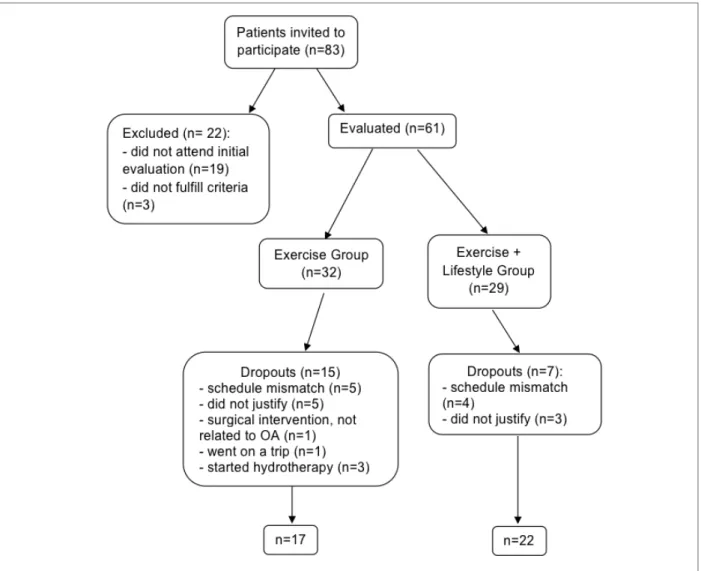
diseases such as fibromyalgia, rheumatoid arthritis, neurologic or cardiac diseases and uncontrolled hy-pertension were excluded from the study, as well as the ones with total or partial prosthesis in one or both knees or hips. The final analysis excluded pa-tients who missed 4 or more consecutive treatment sessions and the ones who started in any other type of physical exercise during the course of the study. Of the 83 patients initially enrolled, 39 were eligi-ble to participate in the research (Figure 1). A priori sample size estimate for an α=0,05 and statistical power of 95% revealed that 36 participants were necessary.
Volunteers underwent an evaluation including de-mographic data (age, gender, weight and height), PPT and response to some research instruments before and after the interventions, by an evaluator who was un-aware of which intervention group each volunteer be-longed to.
Lifestyle was assessed by the FANTASTICO ques-tionnaire21, in its validated Portuguese version (Brazil). The instrument contains 25 questions with answers in a Likert scale, and the sum of the points adds up to a score (0-100) that points out to a better LS the higher it is.
The evaluation of pain intensity was conducted with a VAS, a straight line of 10cm in which the individual marks a dash indicating the intensity of his or her pain. The closer to the beginning of the line, the smaller the pain, and the closer to its end, the more unbearable the pain was20.
Western Ontario and MacMaster Universities Index (WOMAC), in its Portuguese version22was also com-pleted by participants. This specific instrument for OA patients assesses pain perception, joint stiffness and function based on the 48 hours prior to its applica-tion. Each of the 24 questions is scored 0-4, and the higher the score, the worse the pain22,23.
Pressure pain tolerance thresholds were assessed by pressure algometry with J Tech digital algometer (J Tech Medical, Salt Lake City, UT, USA). The device contains a rubber end of 1cm2 in diameter. Pressure was applied at a constant rate of 1kg/s until pain or discomfort was reported by the volunteer. Participants were instructed to say "stop" as soon as the feeling of
ily, friends and other social support providers, co-existence with pain and pain management, disease and pain coping and improvement of living condi-tions and social relacondi-tions.
• Health education (two 1-hour meetings with a physi cal therapist and physical educator): guidance on the disease and its symptoms, performing daily activities without unnecessary physical efforts, lifestyle guidance (the importance of rest, of being physically active, healthy eating, sun exposure, breathing fresh air, drinking plenty of water, having good relationships, cultivating spirituality and avoiding harmful products such as tobacco and al-cohol).
This intervention program was developed based on literature’s considerations that lifestyle interventions may be beneficial for patients with knee OA18,25,26. Treatment sessions were conducted 2 times/week dur-ing 8 weeks.
Statistical analysis was performed with SPSS version 24 for Windows. Data were treated according to the in-tention-to-treat concept and are expressed as means ± standard deviations. Normality of data was tested by the Kolmogorov-Smirnov method. Comparisons between groups regarding demographic data were obtai -ned by Student’s t test or Mann-Whitney U test. Inter-action effect was determined by 2-way ANOVA for repeated measures. In all cases, descriptive level was set at 5%.
results
The study sample was composed by 39 participants, divided into exercise group (EG, n=17) and exercise plus lifestyle group (ELG, n=22). Groups were homo-geneous regarding age, weight, height, BMI, pain per-ception (VAS) and gender predominance prior to the intervention (Table I).
Despite the lack of differences in pain perception between groups before the interventions, after them a reduction in pain perception (VAS) and increase in PPT were observed in both groups at most sites evalu-ated. Despite the improvement in lifestyle of both groups, only ELG exhibited a significant reduction in pain assessed by WOMAC (total score and pain) (Table II).
The therapeutic exercises employed in the present study, besides being a low-cost conservative strategy, produced no side effects on any of the participants. pressure changed from unpleasant to painful. The test
was interrupted as soon as the volunteer indicated the onset of pain, and the final amount of force applied was recorded. For the evaluation, each participant remained in dorsal and lateral decubitus positions. Regions eval-uated were: longus adductor, vastus lateralis, vastus medialis and tibialis anterior muscles, patellar tendon and center of the patella. These sites have been des -cribed and evaluated by previous studies24,25.
Participants signed an informed written consent to participate in the study, and were randomized (simple draw) into one of two intervention groups:
exercIse Group (eG)
EG participants were enrolled in a therapeutic exercise program including warm-up, flexibility, active muscle strengthening exercises, balance and proprioception exercises.
In warm-up, participants were oriented to perform brisk walking and play ball games with feet and hands. Stretching exercises targeted the following muscle groups: hip flexors, extensors and adductors, knee flex-ors and extensflex-ors and plantar flexflex-ors. Strengthening exercises were performed using the volunteer’s own body resistance against gravity. Exercises for feet plan-tar flexors, dorsiflexors, knee and hip extensors and flexors, and abdominal muscles were performed.
Exercises combining sensory stimulation of feet plantar surface and dynamic and static balance were also proposed. Volunteers were instructed to walk for-ward, backward and sideways on different surfaces, with and without visual information. This intervention program was based on the considerations reported by a previous study12.
exercIse plus lIfestyle Group (elG)
Volunteers of this group participated in the same above described exercise program, and additionally joined 8 sessions of lectures and group discussions on the following topics:
• Nutritional counseling (three 1-hour meetings with a nutritionist): discussion and follow-up on the im-portance of maintaining a healthy weight, and healthy eating based on the consumption of fresh and minimally processed foods instead of processed nutrition.
• Self-management of the disease (three 1-hour meet-ings with a psychologist): educational interventions aiming at developing self-care strategies, discussions about the beneficial effects of relationships with
fam-dIscussIon
This study aimed to compare the influence of an exer-cise program vs. exerexer-cise program combined with lifestyle education in patients with knee OA. Results showed that both interventions were effective in re-ducing pain, increasing PPT and improving LS in pa-tients with knee OA.
Chronic pain affects many individuals, especially the elderly, and knee OA is a disease that may contribute to this condition1,3,4. For this reason, the investigation of pain in this study was thoroughly conducted: by VAS, a subjective measure, but widely employed in re-search and clinical practice, and by algometry, which evaluates the PPT, and therefore, is an objective mea-sure. Both groups presented significant reduction in pain intensity (VAS) after the intervention, indicating that the therapeutic exercises were beneficial to the pa-tients.
A recent study has shown that the effects of exercise depend on its type and outcome, and muscle strength-ening and flexibility exercises can be used for different purposes27. In the present study, therapeutic exercises were general and intended to provide joint stability, flexibility and increase the muscle tone of the affected region, aiming at reducing pain. The exercise program had a positive influence not only on pain intensity as-sessed by VAS, but also on PPT.
The increase in pain tolerance was observed in all muscles and structures evaluated (without statistical significance only at the right vastus lateralis). This in-crease in PPT in regions not even close to the knee, such as the adductor and tibialis anterior muscles,
re-veals that although there is pain sensitization in indi-viduals with OA19,28, when submitted to therapeutic exer cise, sensitization to a painful stimulus may de-crease.
A recent meta-analysis showing that the evident sen-sitization of individuals with OA is evidenced by PPT reports that other treatments such as mobilization, pharmacological and surgical interventions, in addi-tion to therapeutic exercises, are effective forms of treat-ment for this condition28. Accordingly, exercise is a use-ful and effective strategy to increase pain tolerance in individuals with OA in a short period of time28.
Several studies reported PPT assessment in indivi -duals with OA in order to evaluate central sensitiza-tion19,24,29. A study about the use of TENS (transcuta-neous electrical nerve stimulation) in OA verified that a single session produced increase in PPT30. Other au-thors observed reduction in pressure pain sensitivity in patients (compared to the controls) after 12 weeks (3 weekly sessions) of supervised exercise31.
In the present study, both groups participated in su-pervised exercise sessions for 8 weeks and with 2 week-ly sessions. Our results, obtained by a blind evaluator and with a digital algometer (gold standard to assess PPT32), not only confirm the benefits of exercise as a therapy, but also highlight the beneficial effects for pa-tients, who experienced symptomatic relief.
Pain was also assessed by the WOMAC question-naire, which revealed significant pain reduction in ELG only. Pain perception assessed by this instrument was more pronounced in the group that received the addi-tional lifestyle education, attesting the importance of this comprehensive approach in patients with OA.
However, an interesting fact was not observed in this study. Changes in physical functionality and joint stiff-ness assessed by WOMAC were not significant. There are reports that aerobic exercise (not included in the therapeutic exercise program) may be useful to im-prove pain and function27. In the present study an ex-ercise program that combined strength, flexibility and postural control was studied, and it was efficient to re-duce pain, but did not improve functionality. Perhaps the lack of an aerobic exercise would justify this find-ing, or even the short intervention period. Neverthe-less, data herein confirm that therapeutic exercises do contribute to the success of treatment of this complex and multifactorial disease, and they also may minimize the negative consequences of OA33, a condition that di-rectly affects patients’ quality of life.
The inclusion of regular exercise in the routine of tAble I. deMoGrAphIc And AnthropoMetrIc
dAtA EG ELG (n=17) (n=22) p Age (years) 64.4±6.7 63.7±8.6 0.49* Weight (kg) 78.4±13.5 75.8±12.0 0.53** Height (cm) 159.4±11.2 154.4±8.6 0.12** BMI (Kg/m2) 31.8±5.4 31.0±3.3 0.55** VAS (cm) 6.7±1.9 6.8±1.8 0.82** Gender (%F) 70.6 86.4 0.22#
EG: exercise group, LEG: exercise plus lifestyle education group, BMI: body mass index, kg: kilograms, cm: centimeters, VAS: visual analogue scale, F: female.
Data are expressed as means ± standard deviations or percentages. *Mann-Whitney U test, **Student’s T test, #Chi-square test.
patients with OA may have contributed to the positive changes observed in their lifestyle. Yet, the adoption of other healthy habits that may contribute to alleviate the symptoms of the disease (weight management, for example) may take longer than a few months34. In ad-dition, ELG participants attended three sessions with a nutritionist, who paid special attention to this topic. Prior to the intervention, individuals from both groups presented a high BMI (>30), so they were strongly en-couraged to manage their own weight, as obesity itself is a major public health issue, besides being related to knee joint pain35.
A balanced diet is a key aspect for cartilage metabolism and thus may be related to the course of OA. A diet rich in antioxidant food sources may con-tribute to attenuate the cellular oxidation process and produce a protective effect against agerelated disea -ses36. Hence, educational actions to promote healthy eating, a diet rich in fresh foods over processed ones, can positively impact patients with OA.
In one of the first sessions ELG, researchers were surprised by the fact that some individuals were un-aware of elementary healthy habits and basic features of OA itself. The ability to self-manage the disease is essential to the success of any treatment, and the knowledge about the mechanisms of pain and related phenomena (catastrophizing, for example) can help guide positive health behaviors and self-management of OA37,38. In addition, other healthy LS habits encour-aged by ELG are known to be beneficial to overall health, including that of patients with OA5,39,40-43. Al-though LS improved in both groups, we believed that 8 weeks were not enough time to produce consistent and lasting changes in patients’ habits. The instrument may not have been sensitive enough to capture con-scious and intentional changes in the lifestyle of ELG, but in the long run they may impact treatment success. This study has limitations. As changes in LS need a long period to be internalized and incorporated into patients’ routine, a follow-up would bring interesting tAble II. pAIn IntensIty pressure pAIn thresholds, lIfestyle And physIcAl functIonAlIty
EG before EG after ELG before ELG after
(n=17) (n=17) (n-22) (n-22) p* BMI 30.7±3.0 30.7±3.2 31.8±4.9 31.6±4.9 0.77 VAS 6.7±1.6 5.5±2.3 6.8±1.9 4.7±3.4 0.01# PPT R longus adductor 1.65±0.6 3.4±2.5 1.7±0.9 2.6±1.5 <0.001# PPT R vastus lateralis 3.0±0.8 4.1±2.9 3.0±1.4 3.6±2.2 0.43 PPT R vastus medialis 2.8±1.0 3.7±2.2 2.7±0.9 3.5±1.8 0.03# PPT R patellar tendon 4.1±1.9 5.9±3.4 4.5±2.4 5.4±2.5 0.01§ PPT R center of patella 3.4±1.2 5.4±3.6 3.3±1.6 4.5±2.7 0.008# PPT R tibialis anterior 3.6±1.5 5.1±2.5 3.6±1.6 4.8±2.1 0.001# PPT L longus adductor 1.6±0.9 3.2±2.3 1.7±0.8 2.3±1.6 0.02§ PPT L vastus lateralis 2.6±0.7 4.5±2.7 2.7±1.1 3.8±1.9 <0.001# PPT L vastus medialis 1.9±1.0 4.3±2.9 1.9±1.1 3.4±2.0 <0.001# PPT L patellar tendon 3.6±1.5 6.3±3.4 3.4±2.4 5.8±3.4 <0.001# PPT L center of patella 3.4±0.9 4.8±3.1 2.6±1.2 4.3±2.6 0.003# PPT L tibialis anterior 3.4±1.2 5.1±2.8 2.8±1.1 4.4±2.3 0.001# Lifestyle 66.3±7.8 74.2±9.7 72.6±11.3 77.3±11.4 0.01# WOMAC 42.2±16.9 47.0±17.4 48.4±24.5 41.3±26.7 0.03&
WOMAC - Pain 48.1±18.6 43.5±21.1 55.2±26.1 41.8±28.0 0.03& WOMAC - Joint stiffness 37.7±21.9 47.0±19.1 45.4±28.5 43.7±29.3 0.19 WOMAC - Functionality 38.7±19.2 35.2±18.6 42.1±28.0 38.4±30.9 0.99 EG: exercise group, LEG: exercise plus lifestyle education group, PPT: pressure pain tolerance threshold (kgf), R: right side, L: left side. Data are expressed as means ± standard deviations.
*2-way ANOVA for repeated measures.
#Difference between before and after in both groups, § Difference between before and after in EG only, &Difference between before and after in ELG only.
ments in joint stiffness and physical functionality were observed. The group that received additional lifestyle education also exhibited pain reduction assessed by the disease-specific questionnaire.
correspondence to
Fábio Marcon Alfieri
Rua Candal 01 apto 5; 05890030 E-mail: [email protected]
references
1. Allen KD, Golightly YM. State of the evidence. Curr Opin Rheumatol 2015; 27(3): 276-283.
2. Peat G, McCarney R, Croft P. Knee pain and osteoarthritis in older adults: a review of community burden and current use of primary health care. Ann Rheum Dis 2001; 60(2): 91-97. 3. Alkan BM, Fidan F, Tosun A, Ardıço lu O. Quality of life and
self-reported disability in patients with knee osteoarthritis. Mod data. Poor adherence to treatment for reasons beyond
the researchers’ domain, as shown in the study flowchart (Figure 1), reduced the study sample size.
Pain assessment using the gold standard instrument, group randomization and a blind evaluator are posi-tive features of this study. Nevertheless, future follow--up studies that evaluate adherence to lifestyle change, or how long it takes for this change to produce quan-tifiable results, are desirable.
conclusIon
Individuals with knee OA submitted to therapeutic exer cise programs may benefit from pain relief and in-crease in pain tolerance. Nonetheless, no
Rheumatol 2014; 24(1): 166-171.
4. Aghdam ARM, Kolahi S, Hasankhani H, Behshid M, Varmaziar A. The relationship between pain and physical function in adults with knee osteoarthritis. Intl Res J Appl Bas Sci 2013; 4(5): 1102-1106.
5. Sofat N, Kuttapitiya A. Future directions for the management of pain in osteoarthritis. Int J Clin Rheumtol 2014 ;9(2): 197-276. 6. Duarte VS, Santos MLS, Rodrigues KA, Ramire JB, Arêas GPT, Borges GF. Exercícios físicos e osteoartrose: uma revisão sis-temática. Fisioter Mov 2013; 26(1): 193-202.
7. Fransen M, McConnell S, Harmer AR, Van der Esch M, Simic M, Bennell KL. Exercise for osteoarthritis of the knee: a Cochrane systematic review. Br J Sports Med 2015; 49(24): 1554-1557.
8. McAlindon TE, Bannuru RR, Sullivan MC, Arden NK, Beren-baum F, Bierma-Zeinstra SM, et al. OARSI guidelines for the non-surgical management of knee osteoarthritis. Osteoarthr Cartil 2014; 22: 363-388.
9. Li Y, Su Y, Chen S, Zhang Y, Zhang Z, Liu C, et al. The effects of resistance exercise in patients with knee osteoarthritis: a sys-tematic review and meta-analysis. Clin Rehabil 2016; 30(10): 947-959.
10. Jorge RT, Souza MC, Chiari A, Jones A, Fernandes Ada R, Lom-bardi Júnior I, et al. Progressive resistance exercise in women with osteoarthritis of the knee: a randomized controlled trial. Clin Rehabil 2015; 29(3): 234-243
11. Bunning RD, Materson RS. A rational program of exercise for pa-tients with osteoarthritis. Semin Arthritis Rheum 1991; 21(3 Suppl 2): 33-43.
12. Oliveira NC, Vatri, S, Alfieri FM. Comparison of the effects of resistance exercise versus kinesiotherapy in knee osteoarthritis. Acta Fisiatr 2016; 23(1): 7-11.
13. Hussain SM, Neilly DW, Baliga S, Patil S, Meek R. Knee os-teoarthritis: a review of management options. Scott Med J 2016; 61(1): 7-16.
14. Oliveira, NC, Alfieri FM, Lima ARS, Portes LA. Lifestyle and pain in women with knee osteoarthritis. Am J Lifestyle Med 2017; 13(6): 606-610.
15. Naylor R, Hayes C, Egger G. The relationship between lifestyle, metaflammation, and chronic pain: a systematic review. Am J Lifestyle Med 2013; 7: 130-137.
16. Brasil. Ministério da Saúde, Secretaria de Atenção à Saude, De-partamento de Atenção Básica. Estratégias para o cuidado da pessoa com doença crônica (Cadernos de Atenção Básica, n.35). Brasília: Ministério da Saúde, 2014, 162 p. Available at: http://bvsms.saude.gov.br/bvs/publicacoes/estrategias_cuida-do_pessoa_doenca_cronica_cab35.pdf Access: August 15th 2019.
17. Alfieri FM, Vatri S, Oliveira NC. Osteoartrite de joelho e estilo de vida: revisão da literatura. EF Deportes 2015; 20(206): 1. 18. Fransen M, Simic M, Harmer AR. Determinants of MSK health
and disability: lifestyle determinants of symptomatic os-teoarthritis. Best Pract Res Clin Rheumatol 2014; 28: 435-460. 19. Lluch GE, Nijs J, Torres Cueco R. e López, C. C. Pain treatment for patients with osteoarthritis and central sensitization. Phys Ther 2013; 93(6): 842-851.
20. Chapman RS, Syrjala KL. Measurement of pain. In: Bonica JJ, editor. The Management of Pain. 2nd ed. London: Lea & Febiger; 1990: 580-594.
21. Anez CRR, Reis RS, Petroski EL. Versão brasileira do ques-tionário "Estilo de Vida Fantástico": traducao e validacao para
adultos jovens. Arq Bras Cardiol 2008; 91(2): 102-109. 22. Fernandes MI. Tradução e validação do questionário de QV
es-pecífico para osteoartrose Womac (Western Ontario and Mc-Master Universities Osteoarthritis Index) para a língua por-tuguesa [dissertation]. São Paulo: Escola Paulista de Medicina, Universidade Federal de São Paulo; 2002.
23. Bellamy N, Buchanan WW, Goldsmith CH, Campbell J, Stitt LW. Validation study of Womac: a health status instrument for measuring clinically important patient relevant outcomes to an-tirheumatic drug therapy in patients with osteoarthritis of the hip or knee. J Rheumatol 1988; 15: 1833-1840.
24. Imamura M, Imamura ST, Kaziyama HH, Targino RA, Hsing WT, de Souza LP, et al. Impact of nervous system hyperalgesia on pain, disability, and quality of life in patients with knee os-teoarthritis: a controlled analysis. Arthritis Rheum 2008; 59(10): 1424-1431.
25. Skou ST, Roos EM, Laursen MB, Rathleff MS, Arendt-Nielsen L, Simonsen O, et al. A randomized, controlled trial of total knee replacement. N Engl J Med 2015; 373(17): 1597-1606. 26. Ambrose KR, Golightly YM. Physical exercise as
non-pharma-cological treatment of chronic pain: Why and when. Best Pract Res Clin Rheumatol 2015; 29(1): 120-130.
27. Gohn SL, Persson MSM, Stocks J, Hou Y, Welton NJ, Lin J, et al. Relative efficacy of different exercises for pain, function, per-formance and quality of life in knee and hip osteoarthritis: sys-tematic review and network meta-analysis. Sports Med 2019; 49(5): 743-761.
28. De Oliveira Silva D, Rathleff MS, Petersen K, Azevedo FM, Bar-ton CJ. Manifestations of pain sensitization across different painful knee disorders: a systematic review including meta-anal-ysis and metaregression. Pain Med 2019; 20(2): 335-358. 29. Fingleton C, Smart K, Moloney N, Fullen BM, Doody C. Pain
sensitization in people with knee osteoarthritis: a systematic re-view and meta-analysis. Osteoarthritis Cartilage 2015 ;23(7): 1043-1056.
30. Vance CG, Rakel BA, Blodgett NP, De Santana JM, Amendola A, Zimmerman MB, et al. Effects of transcutaneous electrical nerve stimulation on pain, pain sensitivity, and function in people with knee osteoarthritis: a randomized controlled trial. Phys Ther 2012; 92(7): 898-910.
31. Henriksen M, Klokker L, Graven-Nielsen T, Bartholdy C, Schjødt Jørgensen T, Bandak E, et al. Association of exercise therapy and reduction of pain sensitivity in patients with knee osteoarthritis: a randomized controlled trial. Arthritis Care Res (Hoboken) 2014; 66(12): 1836-1843.
32. Egloff N, Klingler N, Känel RV, Camara RJA, Curatolo M, Weg-mann B, et al. Algometry with a clothes peg compared to an electronic pressure algometer: a randomized cross-sectional study in pain patients. BMC Musculoskelet Disord 2011; 25(12): 174.
33. Wellsandt E, Golightly Y. Exercise in the management of knee and hip osteoarthritis. Curr Opin Rheumatol 2018; 30(2): 151--159.
34. Ryan S. Managing lifestyle factors in adults with osteoarthritis. Nurs Stand. 2015; 29(46): 43-50.
35. Zdziarski LA, Wasser JG, Vincent HK. Chronic pain manage-ment in the obese patient: a focused review of key challenges and potential exercise solutions. J Pain Res 2015; 8: 63-77. 36. Messina OD, Wilman MV, Neira LFV. Nutrition, osteoarthritis
and cartilage metabolism. Aging Clin Exp Res 2019; 31(6): 807--813.
37. Sánchez-Herán Á, Agudo-Carmona D, Ferrer-Peña R, López-de-Uralde-Villanueva I, Gil-Martínez A, Paris-Alemany A, et al. Postural stability in osteoarthritis of the knee and hip: analysis of association with pain catastrophizing and fear-avoidance be-liefs. PM R 2016; 8(7): 618-628.
38. Darlow B, Brown M, Thompson B, Hudson B, Grainger R, McKinlay E, et al. Living with osteoarthritis is a balancing act: an exploration of patients' beliefs about knee pain. BMC Rheumatol 2018; 2: 15.
39. Glover TL, Goodin BR, Horgas AL, Kindler LL, King CD, Sibille KT, et al. Vitamin D, race, and experimental pain sensitivity in older adults with knee osteoarthritis. Arthritis Rheum 2012; 64(12): 3926-3935.
40. Amin S, Niu J, Guermazi A, Grigoryan M, Hunter DJ, Clancy M, et al. Cigarette smoking and the risk for cartilage loss and knee pain in men with knee osteoarthritis. Ann Rheum Dis 2007; 66(1): 18-22.
41. Muthuri SG, Zhang W, Maciewicz RA, Muir K, Doherty M. Beer and wine consumption and risk of knee or hip osteoarthritis: a case control study. Arthritis Res Ther 2015; 17: 23.
42. Somers TJ, Blumenthal JA, Guilak F, Kraus VB, Schmitt DO, Babyak MA, et al. Pain coping skills training and lifestyle be-havioral weight management in patients with knee osteoarthri-tis: a randomized controlled study. Pain 2012; 153(6): 1199--1209.
43. Wetzels R, van Weel C, Grol R, Wensing M. Family practice nurses supporting self-management in older patients with mild osteoarthritis: a randomized trial. BMC Fam Pract 2008; 9: 7.