http://iraj.in
ASSESSMENT OF PERCEIVED QUALITY: COMPARISON OF
SPORTS APPAREL RETAIL CHAINS
1
JOAO FILIPE GOMES, 2ANA LUCIA MARTINS, 3JOAO C. FERREIRA
1
Instituto Universitário de Lisboa (ISCTE-IUL), 2Business Research Unit (BRU-IUL), 3ISTAR-IUL E-mail: [email protected], [email protected], [email protected]
Abstract - Sports apparel retail is a very competitive industry in Portugal and is dominated by two main players that
continuously seek to capture more customers. The quality of the service provided is a key issue for a company to succeed in the market. Although service quality has been explored in literature, its link to the value proposition of the retail stores is still missing. This research aims at analyzing the adequacy of the service provided by each of these main players to customers’ desires in a comparative way. Customers’ perceived quality is assessed as well as suitability of companies’ desired benefits for the customers. Data was collected using interviews and a customer questionnaire. A sample of 423 responses is used. Conclusions showed that Decathlon has a better fit to customers’ desires as well as better perceived quality than Sports Zone. Specific managerial recommendations for the improvement of the service quality are provided for both companies.
Keywords - Benefits, Case study comparison, Perceived quality, RSQS, Sports apparel retail. I. INTRODUCTION
Service quality is a relevant issue for every company aiming at succeeding in the market. In fact, service quality has proved to be a means to achieve sustainable competitive advantage [1], which is a strong element in competitive environments. Matching customers’ expectations is a long discussed topic (see, for instance, [2] and [3]) and it goes beyond the comparison of expectation and perceptions to the assessment of value creation, mainly the value proposal of the entities towards the actors they relate with [4]. In parallel there is the need to go beyond pure perception of service provision and understand if the service process and its outcome fulfil the benefits desired by customers. As so, the challenge for the organizations is not only to provide good perceived quality but also to fulfil customers’ desired benefits.
Assessment of perceived service quality is widely used but usually limited to the assessment of the quality dimensions proposed by [2] or of dimensions proposed by other authors who aimed at adjusting the seminal ones to specific service industries. The dual assessment of perceived quality and adjustment of focal benefits has been missing from service research.
After a period of economic crisis that severely reduced Portuguese citizens’ income, unemployment rate is decreasing and well as available income. This new situation emerged with a new tendency for practicing sports. More and more customers are buying sports materials, which leads companies to having to improve their value proposals and adjust their services and assortment to customer’s requests. Assessing the quality of these services is still in its infancy and challenges faced by the sports apparel retail chains are increasing, requiring research.
The purpose of this research is to overcome this gap in literature by finding which factors influence customers’ perceived quality in sports retail and assess the adequacy of the benefits companies aim to offer, and to produce managerial recommendations to improve service quality. This research has therefore a dual objective: 1) to identify which factors influence customers’ perceived quality, from the customers perspective, and to identify the benefits companies aim for in their value propositions and compare them with the customers’ desired value; 2) to develop managerial recommendations based on the comparison of the interpretation of value from both actors: retailers and customers.
In order to address the first part of the purpose of this research, the assessment of perceived service quality and the factors that influence it, several tools are available in literature but all of them face some type of criticisms. As the retail industry has specific characteristics [5][6] specific tools [5] need to be used to assess perceived service quality in the retail industry. As a consequence, the Retail Service Quality Scale (RSQS) from [5] will be used as a starting point. From this point factors that derive from literature are assessed in order to identify their influence on customers’ perceived quality in sports apparel retail. The assessment of the benefits intended by sports apparel retailers and the ones aimed for by the customers is achieved through the use of service-dominant logic [7][8]. In this context, the research starts with a literature review on service quality assessment as a basis to develop the research model, the hypotheses and the propositions; secondly, the methodological guidelines will be disclosed; thirdly, the results will be presented and discussed; finally, conclusions concerning the hypotheses and the propositions will be summarized and recommendations will be produced to improve
http://iraj.in sports apparel retailers value propositions. Limitations on the findings will be highlighted. II. LITERATURE REVIEW
Service quality assessment is not new to literature. Many proposals can be found (for instance [9], [10] or [11]). Although the most popular one if from [2] its authors are the ones who state that adjustments are required to make it fil specific industries.
[5] proposed a specific tool to assess perceived service quality in the retail industry, the Retail Service Quality Scale (RSQS). The RSQS model assumes that every customer aims at receiving the perfect service, therefore only the perceptions are considered in this tool [5] instead of a comparison between perceptions and expectations as proposed by [9]. Based on [12] argument that in retail stores there are two categories of experiences that are very relevant to customers (experience in store and experience with the goods), [5] built on [2] and proposed five dimensions for their instrument: physical appearance, reliability, personal interaction, problem solving, and store’s policy.
The several measurement tools available in literature, although able to assess quality or perceived quality, are limited in their own scope and lack the ability to evaluate the adequacy of the value proposition of the retailers/service providers.
The dichotomy between products and services is no longer as clear as before. New approaches emerge, and economy can also be perceived as a system in which actors trade service between them [7][8]. Organizations make value propositions available to customers in the shape of goods and services, but what they offer is not the trade but the use of the service, which is to say that the focus in no longer place on value in exchange but instead on value in use [13]. Therefore, the benefits organizations aim to provide should be aligned with what customers value and desire the most.
As there are not yet researches that consider both perspectives at the same time, the assessment of service quality during the service process and the benefits experienced by the customers, it is possible to state that there is a gap in literature that needs to be fulfilled.
III. METHODOLOGY AND METHODS A. Case study comparison
In order to be able to compare distinctive offerings, two retail chains are analyzed: 1) one retail chain with international coverage, Decathlon, that is in 27 different countries and has 33 physical stores in Portugal as well as an online store; 2) a Portuguese sports retail chain with national coverage (94 physical stores in Portugal, 32 in Spain and an online store). Both cases offer products and services under their own brands as well as other international
brands. As a case study comparison results cannot be generalized [14].
B. Hypotheses and Proposition
According to [5], five quality dimensions should be considered. As this research is based on two retail chains, and under the scope of this research, it is relevant to perceive if there are differences in the perception of the quality of service provided by each if the retail chains in each of the considered dimensions and also overall. As so, the following hypothesis is defined:
H1: The retail chain influences the perception of quality in each of the dimensions of retail service and overall.
[15], while assessing the quality of service provided by retailers found out that customers’ personal characteristics (gender, age, and occupation) influence the perception of service quality. Under this scope, these characteristics are included in this research as possible factors influencing perceived service quality and the following hypothesis is formulated:
H2: The characteristics of the customer influence the perception of quality in each of the dimensions of retail service and overall.
[16] identified waiting time in the service process as a factor influencing perceived quality. As a consequence, this factor is included in the present research and the following hypothesis is produced: H3: The waiting time at the store and at the counter influences the perception of quality in each of the dimensions of retail service and overall.
[17] argue that the more customers use a service the most influence it will have on perceive service quality. Therefore this factor is included in the scope of the present research and the following hypothesis emerges:
H4: The frequency of visit to the store influences the perception of quality in each of the dimensions of retail service and overall.
[18] analyzed the role of store’s location on customer’s choice of retail store. Putting these arguments in line with [17], the following hypothesis is formulated:
H5: The time required to get to the store influences the perception of quality in each of the dimensions of retail service and overall.
Although the retail chains under analysis are dedicated to sports apparel, the customer does not have to be an athlete. As a consequence, and due to the fact that both retail chains offer both specialty apparel and more casual lines, the following hypothesis is formulated:
H6: The type of sports practice and it frequency influence the perception of quality in each of the dimensions of retail service and overall.
Research is lacking the analysis of the adequacy of the value propositions to the requests of the customers from the perspective of the service
http://iraj.in process. As both customers and service suppliers are simultaneously engaged not only in the service process but also after that process is completed, in the experience of the product or service bought, the value proposition should be adjusted to customers’ requests. Under this assumption, the following proposition is rehearsed:
P1: The benefits involved in the value proposition of the retail chains are adjusted to the benefits required by their customers.
C. Research instruments and data collection Two separate instruments were used to collect data: 1) interviews; 2) questionnaire.
The interviews were used to perceive apparel retail chains value propositions as well as the benefits they intend to offer their customers. Two interviews took place, one in each retail chain under analysis, to managers of large retail units. These interviews aimed at identifying the value proposition of each retail chain as well as the benefits each aims at providing to their customers. Interviews followed an open set of guidelines and interviewees were occasionally guided to the topics. No recording of the interviews was allowed therefore notes were taken and confirmed at the end of each interview to assure validity of interpretation. The questionnaire used to collect data has four parts. The first aimed at identifying the benefits customers recognize from sports apparel retailers and to rank then. The second part was based on the RSQS instrument from [5], adjusted to apparel retail. The five original dimensions form RSRQ and its 28 items, plus a final questions concerning overall quality. At the beginning of this part respondents had to identify which of the two retail chains they would answer the questionnaire about.
As suggested by [2] a Likert-like scale was used ranging from “1 – Totally disagree” to “7 – Totally agree”. Concerning the overall quality the scale used ranged from “1 – Very low” to “7 – Very high”. The third part aimed at assessing if respondents agree with the benefits identified by the stores. A Likert-like scale of 7 points was used ranging from “1 – Totally disagree” to “7 – Totally agree”. The last part of the questionnaire included the factors that are believed to influence customers’ perceived quality (distance, frequency of visit, waiting time, frequency of sports practice) and demographics (gender, age, scholar background, and occupation). A pre-test was conducted with 8 persons who use the services of these retail chains and adjustments in terms of wording and sequence of questions were introduced. D. Sample and Data Collection
Population was considered as all the customers of the two retail chains considered for this research. Data from the questionnaire was collected using Qualtrics.
A snowball approach was used for individuals and the link to the questionnaire was made available at specialty blogs and Facebook group accounts. 451 full answers were collected but only 423 were considered valid as the remaining ones showed the same number in the scale for every item.
E. Analyses
Analysis was conducted following a four step process. Firstly the sample is characterized using descriptive statistics, secondly Cronbach’s alpha coefficient are used to assess the true reliability of the instrument in each of the dimensions from RSQS; thirdly, hypotheses testing was conducted based on the true distribution shape; lastly, recognition of benefits considered by the retail chains in their value propositions by customers was analyzed using descriptive statistics and ranked. Analysis used IBM 24.0 SPSS software.
IV. RESULTS A. Demographics
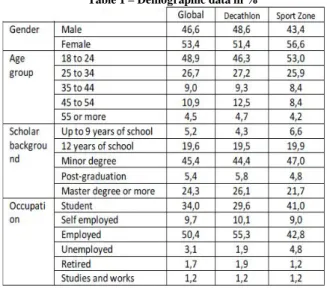
The final demographics are shown in Table 1. The sample is fairly balanced in terms of gender, with females showing only a small relative percent higher than males. In terms of age groups, these are mainly of younger age, which is consistent with the overall profile of customers of this type of retail stores.
Table 1 – Demographic data in %
The sample shows a deviation of respondents towards high scholarly background (24,3%), nonetheless this tendency is similar in both case studies (26,1% and 21,7%, respectively). In terms of occupation, respondents are mainly (50,4%). The overall profile of respondents in each of the considered variables is similar between the two case studies.
B. Assessment of perceived quality
In order to evaluate the reliability of the five service dimensions considered by [5], Cronbach’s alpha coefficient was computed and results are shown in
http://iraj.in Table 2. The lowest alpha is of 0,814, which allows stating that the instrument is sufficiently reliable in all its dimensions.
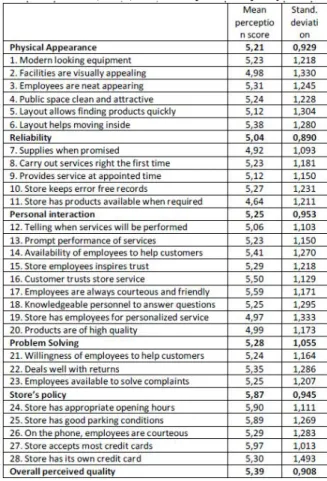
Findings show an high overall perceived quality of the service provided with a mean of 5,39 (SD=0,908). In terms of the quality dimensions, customers ranged their scores from 5,04 on Reliability (SD=0,890) to 5,87 on Store Policy (SD=0,945). In terms of the items, scores ranged from 5,97 on item 27 (Store accepts most credit cards) (SD=0,1,013) to 4,64 on item 11 (Store has products available when required) (SD=1,211). Overall, all dimensions and items score above the middle point of the scale which allows stating that perceive quality is positive. Table 3 shows the means scores and standard deviations of all dimensions and items considered, and of the overall perceived quality.
Table 2 – Cronbach’s alphas
Table 3 – Means and standard deviation for service quality dimensions, items, and overall perceived quality
C. Hypotheses testing
In order to test the hypotheses Kolmogorov-Smirnov was conducted and showed that almost none of the distributions associated to the independent variables
follow a normal distribution, either for the overall quality, the dimensions, or the items considered. Therefore non-parametric tests were used to test H1 to H6 except for H3 in the specific case of waiting to be served at the store for the physical appearance
dimension (Levene test also showed
homoscedasticity in this case). A summary of the results for the hypotheses testing are shown in Table 4.
In terms of the two retail chains, Kruskal-Wallis test results evidenced that there are statistically significant differences in terms of customers’ perceived quality in all dimensions but reliability, and also in terms of the overall quality. H1 is not rejected except for the reliability dimension. When comparing means between the two retail chains for the different dimensions and overall quality, Decathlon showed consistently higher perceived quality.
Table 4 – p-value from the hypotheses tests, per quality dimension and for overall quality
Legend: * -using Anova test; PA – Physical appearance; R – Reliability; PI – Personal interaction; PS – Problem solving; SP – Store’s Policy; OQ – Overall Quality
Mann-Whitney test was used to assess the gender independent variable and Kruskall-Wallis tests were conducted to test H2 for age, scholar background and occupation. It is possible to conclude that there are no differences in terms of perceived quality emerging from any of these variables, therefore H2 is rejected. Kruskall-Wallis tests were conducted to test H3 for time waiting to be served at the store and at the counter and in the particular case of Physical Appearance for waiting time to be served at the store Anova test was used. It is possible to conclude that there are differences in most of the dimensions, which leads to say that the waiting time to be served at the store and at the store’s counter influence the perception of quality of the customers. This way H3 is rejected but only partially.
http://iraj.in Multiple comparison tests (Bonferroni) showed that the longer the customer waits in the queue to be served inside the store by an employee the lower the perceived quality they have in the previously highlighted dimensions. In terms of waiting time at the counter before paying, multiple comparison testes (Bonferroni) only confirmed differenced for Personal Interaction and Overall Quality.
In order to test H4 Kruskall-Wallis tests were used for all the dimensions and overall quality. They show that the frequency of visit only influences perceived quality in the Personal Interaction dimension. Bonferroni test showed that customers who visit the stores more often express a better perceived quality. This might be a consequence of an eventual proximity developed with the employees. This way H4 is rejected but only partially.
As for H5, Kruskall-Wallis tests were conducted to assess the influence of the time to get to the store on the perceived quality. It is possible to conclude that there are significant differences only in the Store’s Policy dimension. Bonferroni tests shows that customers spending average to short amount of time show a perceived service quality that is slightly smaller in this dimensions that the ones spending 20 to 40 minutes to get to the store. Although H5 is rejected, it is so but only partially.
Testing H6 also involved Kruskall-Wallis tests. It is possible to conclude that the type of sports practice and its frequency do not influence the perception of the service provided at the retail chains considered. As a consequence, H6 is rejected.
D. Benefits as identified by customers
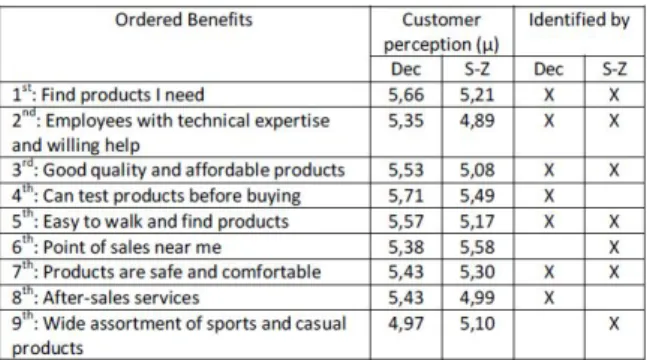
Both stores identified similar benefits, with only two identified by each of the store managers individually. Some customers (twelve) identified additional benefits nonetheless these were single identifications and therefore removed from analysis. Table 5 shows the rank of the benefits, the means scores per store and which retail chain identified is as being part of its value proposition.
Comparing the overall ordering of the benefits with the mean score from customers for each of the retail chains it is possible to conclude that the most relevant benefits for customers are not the ones they recognize the most from the stores, allowing space for improvement from both retail chains. Finding also show that the second most relevant benefit is the one with the lowest perceived quality by customers from Sport Zone and the second lowest one in terms of perceived quality by customers buying from Decathlon. This shows that both retail chains should consider this benefit as a way to improve their value proposition and gain advantage over the other chain. Only in benefits 6 and 9 customers show a better perception of the benefit at Sport Zone than on Decathlon, which suggests that overall Decathlon leads customers to a better perceptions of the benefits
from their store than Sport Zone. To find out if these differences were statistically relevant Chi-Square test were conducted. Findings showed significant differences in the distributions of benefits 1, 3, 6 and 7. From these findings it is therefore possible to state that Sport Zone’s network of retail store is perceived by customers as significantly leading to improved benefits for customers than Decathlon’s. Sport Zone policy of having store in all major malls is more adjusted to customers’ needs than Decathlon’s policy of building mega stores in few locations, therefore not having this benefit in its value proposition. At the same time, Decathlon’s is significantly perceived has having more product availability, products with better quality and more affordable, and safer products than Sport Zone.
Overall, it is possible to conclude that P1, that assumed that the benefits aimed for by the retail stores in their value propositions were aligned with customers’ desired, is not entirely true as some lack of alignment was found.
Table 5 – Benefits from service
Legend: Dec= Decathlon; S-Z: Sports Zone DISCUSSION
Although perceived quality is positive, above the middle point of the scale, the level of perceived quality per dimensions and overall is not very high, allowing room for improvement in terms of the service provided by the retail stores. Decathlon is perceived as having a better service is most retail service dimensions. Although the store’s policy of location only in a few places instead of having more store closer to the customers, although a relevant issue for customers, does not seem to affect the perception of the quality of the service process used by the retail chain.
Waiting time is a customer concern and it affects the perception of quality in almost all service dimensions. The development of a closer relationship between service suppliers and the customers leads customers to have an improved perception of service. This leads to recommend sores to reduce employee rotation and train them to be more friendly and available to customers, and to find alternative ways to supply the service so that waiting time both at the
http://iraj.in payment are at the store to ask for support is reduced. One possible way to implement this is by using self-check-out counters that allows freeing more employees to be closer to the customers.
Although value is generated not only during the service process but also every time the customer experiences the value proposition offered by the retail chain, both retail chains only considered as value the service they is provided inside the physical stores and the quality of the products. Customers also did not identify as a benefit the intangible outcomes from the service process, only the process experience and the goods that are purchased. This leads to conclude that the retail chain that first starts to invest in leading their customers to recognize value in use, i.e. the value experienced during future used of the goods that are bought might gain customers preference as well as more brand notoriety.
The analysis of the benefits reinforced what has already been highlighted by the hypothesis testing – that having employees with technical expertise is very relevant for customers. As it is one of the issues in which the retail chains are performing not as good, this is an opportunity for improvement and gain competitive background. The one that invests in training their employees to provide technical support to customers is likely to gain market share as it is such a relevant issue for customers.
CONCLUSIONS
Findings showed RSQS has a reliable instrument reliability to monitor perceived quality in Portuguese sports apparel retail stores.
H1 was not rejected. It was possible to conclude that the two retail chains use service processes that lead to significantly different perceptions of quality by customer.
H3, H4, and H5 were partially rejected but showed that the waiting time at the store influences the perception of quality, which is in line with [16]. It was also shown that the intensity of interaction at the store influenced the perception of the quality of the process experienced. This supports findings from [17]. It was also shown that the time required to reach the store influences the perception of quality of the service process. This reinforces [18] findings. H2 and H6 were rejected. It was found that the personal characteristics of the customer do not influence the perception of service. These findings contradict the ones from [15], but the contexts in which both researches were conducted are different and cultural issues might be the reason for these differences. It was also found that the type of sports the customer practices and the frequency of sports practice do not influence the perception of quality. These findings were not expected but might emerge from the fact that both retail chains sell not only
sports apparel but also apparel that can be used in situations not involving sports practice.
It was also possible to conclude that P1 is not completely true, i.e. although some adjustment exists between the customers’ perception of the benefits, the level of accomplishment of the retail stores in performing them is not very high.
From the findings it was possible to produce managerial recommendations for the analyzed retail chains.
Findings show limitations that are relevant mentioning. These emerge from the analysis of two retail chains and were produced using a convenience sample, therefore they should only be considered in the context of this research and, according to [14], cannot be generalized to other retail chains. Nonetheless, some tendencies were identified and therefore other retail chains with similar characteristics might be able to receive practical contribution from these findings.
REFERENCES
[1] Clow, K. and Vorhies, D. (1993), Building a competitive advantage for service firms, Journal of Services Marketing, 7, 1, 22-32.
[2] Parasuraman, A., Zeithaml, V.A. and Berry, L.L. (1988), Servqual: a multiple-item scale for measuring consumer perceptions of service quality, Journal of Retailing, 64, 1, 12-40.
[3] Cronin, J.J. and Taylor, S.A. (1992), Measuring service quality: a re-examination and extension, Journal of Marketing, 56, 3, 55-68.
[4] Vargo, S.L., Maglio, P.P. and Akaka, M.A. (2008), “On value and value co-creation: A service systems and service logic perspective”, European Management Journal, Vol. 26, pp. 145-152.
[5] Dabholkar, A., Thorpe, D. and Rentz, J. 1996. A Measure of Service Quality for Retail Stores: Scale Development and Validation. Journal of the Academy of Marketing Science, 24 (1): 3– 16.
[6] Yarimoglu, E. 2014. A Review on Dimensions of Service Quality Models. Journal of Marketing Management, 2(2): 79-93
[7] Vargo, S.L. and Lusch, R.F. (2004), “Evolving to a new dominant logic for marketing”, Journal of Marketing, Vol. 68, pp. 1-17.
[8] Vargo, S. and Lusch, R. (2016), “Institutions and axioms: an extension and update of service-dominant logic”, Journal of the Academy of Marketing Science, Vol. 44, pp. 5-23.
[9] Grönroos, C. (1984), A service quality model and its marketing implications, European Journal of Marketing, 18, 4, 36-44. [10] Parasuraman, A., V.A. Zeithaml e L.L. Berry (1985), A
Conceptual Model of Service Quality and Its Implications for Future Research, Journal of Marketing 49(4), 41-50.
[11] Cronin, J.J., Jr. e S. A. Taylor (1992), Measuring Service Quality: A Reexamination and Extension, Journal of Marketing, 56 (3), 55-68.
[12] Westbrook, R. 1981. Sources of Consumer Satisfaction with Retail Outlets. Journal of Retailing, 57: 8-85
[13] Lusch, R.F., Vargo, S.L., O’Brien, M. (2007), Competing through service: insights from service dominant logic, Journal of Retailing, 8, 2, 148-160.
[14] Yin, R. 2014. Case Study Research: Design and Methods (Applied Social Research Methods Series) (6th Edition). Thousand Oaks, CA: SAGE Publications.
[15] Yuen, E. and Chan, S. 2010. The effect of retail service quality and product quality on customer loyalty. Database Marketing & Customer Strategy Management, 17 (3): 222-240
http://iraj.in [16] Brady, M.K. and J.J. Cronin Jr. 2001. Some New Thoughts on
Conceptualizing Perceived Service Quality: A Hierarchical Approach. The Journal of Marketing, 65(3), 34-49
[17] Olio, L., Ibeas, A. and Cecín, P. 2010. Modelling user perception of bus transit quality. Transport Policy, 17: 388– 397.
[18] Jaravaza, C. and Chitando, P. 2013. The Role of Store Location in Influencing Customers’ Store Choice. Journal of Emerging Trends in Economics and Management Sciences, 4(3), 302– 307.