UNIVERSIDADE DA BEIRA INTERIOR
Ciências Sociais e Humanas
A Validation of the Brief Ageing Perceptions
Questionnaire (B-APQ) Among Elderly Portuguese
Adults
Sara Cristiana Barros Fernandes
Dissertação para obtenção do Grau de Mestre em
Psicologia Clínica e da Saúde
(2º ciclo de estudos)
Orientador: Prof. Doutor Henrique Pereira
Acknowledgments
These last 5 years have been a roller coaster of feelings. Despite all the difficulties, I managed to overcome them, but I could not do it alone. I was lucky to have amazing people right by my side. I thank you all from the bottom of my heart.
A huge thank you to professor Henrique Pereira for the supervision, the guidance, the counseling, the availability and for everything you taught me in these recent months. You increased my interest about scientific research. Thank you so much.
To my parents and sister, the reason I was able to continue working even after all the obstacles and tiredness. You are my example. Always had in my mind what you permanently said to me throughout the last 5 years: all work and effort pays off. I love you.
To my family, that even far away, they always support me and believe in me. Hope to make you all proud.
To my friends, my second family, a huge thank you for making me smile, for all the silly things, for all the teas, for being amazing people. I have the best friends I could ask for. A huge thank you to Ana, Mariana, Delcio, Rita, Tânia, Dalila and Jéssica. You know how special you are to me.
Lastly, to all the people I met at the Beira Interior University, thank you for all the help and support. I'll never forget you.
Resumo Alargado
No âmbito do 2º ciclo em Psicologia Clínica e da Saúde, a presente dissertação está organizada em formato de artigo, tal como previsto no regulamento do grau de mestre em Psicologia da Universidade da Beira Interior. Assim, a dissertação teve como objetivo o aprofundamento de conhecimentos e competências de intervenção e de investigação em Psicologia, bem como o desenvolvimento de procedimentos metodológicos que permitiram a validação de um instrumento de avaliação sobre auto-perceções face ao envelhecimento e compreender as diferenças entre perceções, género e orientação sexual.
O estudo é de natureza quantitativa e a sua pertinência deve-se ao aumento mundial da população idosa, principalmente em Portugal, que é atualmente considerado um dos países da União Europeia com uma maior taxa de envelhecimento. Apesar do aumento de investigação nesta temática, é necessário investir mais no conhecimento relativo a esta faixa etária junto da população portuguesa, visto que irá fornecer informação importante que facilitará a planificação de programas de prevenção e intervenção. Conhecer as particularidades do processo de envelhecimento nas minorias sexuais é também uma necessidade, visto que é um assunto pouco estudado em Portugal.
Assim, os objetivos da investigação foram: (1) validar psicometricamente um instrumento de avaliação das auto-perceções face ao envelhecimento; e (2) comparar diferenças nas perceções entre géneros e orientações sexuais. A amostra (N) é de 722 participantes, em que 404 (55.9%) são homens e 318 (44.1%) são mulheres entre os 50 e 95 anos (M=60.55; DP=9.23). Dos 722 participantes, 76.5% identificaram-se como heterossexuais, 16.6% identificaram-se como homossexuais e 6.9% identificaram-se como bissexuais.
Os resultados do estudo 1 demonstraram que: (1) os índices de ajustamento do modelo foram adequados para todos os 5 fatores da versão portuguesa do modelo do B-APQ; (2) todos os fatores do B-APQ foram associados com o CES-D, o que demonstra uma relação entre auto-perceções e depressão; (3) os fatores 2 e 4 foram associados negativamente com o CES-D; (4) a análise da sensibilidade indicou que todos os itens apresentaram valores adequados; e (5) o alfa de Cronbach foi aceitável para todos os fatores da versão portuguesa do B-APQ, o que indicou que preservou a consistência interna da escala. Assim, devido aos resultados descritos, é possível afirmar que a versão portuguesa do B-APQ é válida e fidedigna, e pode ser aplicada na avaliação de perceções face ao envelhecimento em adultos mais velhos portugueses.
Do estudo 2, os resultados apresentam que: (1) diferenças estatisticamente significativas foram obtidas quando os géneros foram comparados, indicando que as mulheres apresentam maior sintomatologia depressiva; (2) para todos os fatores do B-APQ, não foram encontradas diferenças estatisticamente significativas quando comparados homens e mulheres; (3) foram encontradas diferenças estatisticamente significativas em níveis de depressão relativas à orientação sexual, em que os participantes que se identificam como heterossexuais apresentam maior sintomatologia depressiva; e (4) existem diferenças estatisticamente significativas para os fatores 2 e 4 do B-APQ, em que os participantes que se identificam como homossexuais tiveram uma pontuação mais baixa quando comparados com os indivíduos que se identificam como heterossexuais e bissexuais, o que indicou que estes apresentam perceções face ao envelhecimento mais negativas.
Neste sentido, e de acordo com os resultados obtidos, é necessário que as entidades institucionais percebam a importância de fornecer aos idosos, independentemente do seu género ou orientação sexual, as condições para atingirem um envelhecimento mais positivo e bem-sucedido. A presente dissertação contribui para o aumento de pesquisa na área do processo de envelhecimento, constituindo uma investigação que possibilita uma melhoria de boas práticas por parte dos psicólogos que intervêm com este tipo de população.
A secção final da dissertação inclui o material utilizado durante a investigação (anexo 3), a teoria que fundamentou este estudo (anexo 1) e o comprovativo de submissão do artigo elaborado na revista “European Journal of Psychological Assessment” (anexo 2).
Palavras-chave
B-APQ, validação, auto-perceções face ao envelhecimento, adultos mais velhos, género, orientação sexual.
Abstract
For the 2nd cycle in Clinical and Health Psychology, this dissertation is organized in an article format, as foreseen in the regulation of the master's degree in Psychology of the Beira Interior University. The purpose of this dissertation was to deepen the knowledge and skills of intervention and research in psychology, as well as the development of methodological procedures that allowed the validation of an evaluation measurement on self-perceptions regarding aging and to understand the differences between perceptions, sex and sexual orientation.
The study is of a quantitative nature and its relevance is due to the worldwide increase of the elderly population, mainly in Portugal, which is currently considered one of the European Union countries with a higher rate of aging. Despite the increase in research on this subject, it is necessary to invest more in the knowledge related to this age group with the Portuguese population, since it will provide important information that will facilitate the planning of prevention and intervention programs. Knowing the particularities of the aging process in sexual minorities is also a necessity, since it is a subject understudied in Portugal.
Therefore, the objectives of the research were: (1) to validate psychometrically an instrument to evaluate self-perceptions regarding aging; and (2) compare differences in perceptions between sex and sexual orientations. The sample (N) consisted of 722 participants, encompassing 404 (55.9%) males and 318 (44.1%) females between the ages of 50 and 95 years old (mean=60.55; SD=9.23). Of the 722 participants, 76.5% identified themselves as heterosexual, while 16.6% self-identified as homosexual and 6.9% identified themselves as bisexual.
The results of study 1 demonstrated that: (1) the model’s goodness-of-fit indices were adequate for all 5 factors of the Portuguese version of the B-APQ model; (2) all factors of the B-APQ were associated with the CES-D, showing the link between aging self-perceptions and depression; (3) factors 2 and 4 were negatively associated with the CES-D; (4) the sensitivity analysis indicated that all items presented adequate scores; and (5) the Cronbach’s alphas was acceptable for all factors in the Portuguese version of the B-APQ, indicating that it preserved the scale’s internal consistency. Therefore, due to the described results, it is possible to affirm that the Portuguese version of the B-APQ is valid and reliable, and it can be applied when assessing aging perceptions among older Portuguese adults.
From study 2, the results show that: (1) statistically significant differences were obtained when comparing sex, indicating that women present greater depressive symptomatology; (2) for all B-APQ factors, no statistically significant differences were found
between men and women; (3) statistically significant differences in levels of depression based upon sexual orientation where found, with self-identified homosexual participants presenting more depressive symptoms; and (4) there are statistically significant differences for factors 2 and 4 of the B-APQ, as self-identified homosexual participants scored lower than their heterosexual and bisexual counterparts, indicating that they possess more negative aging perceptions.
In this sense, and according to the results obtained, it is necessary that institutional entities perceive the importance of providing the elderly, regardless of their sex or sexual orientation, the conditions to reach a more positive and successful aging. The present dissertation contributes to the increase of research in the area of the aging process, representing an investigation that allows an improvement of good practices by the psychologists who intervene with this type of population.
The final section of the dissertation includes the material used during the investigation (Annex 3), the theory behind this research (Annex 1) and the evidence of the article submission in the journal "European Journal of Psychological Assessment" (Annex 2).
Keywords
List of Contents
Chapter 1: Introduction. . . 1
Chapter 2: A Validation of the Brief Ageing Perceptions Questionnaire (B-APQ) Among Elderly Portuguese Adults . . . .. . . . 3 Abstract. . . .3 Introduction. . . . .4 Methodology. . . .6 Participants. . . 6 Measurement Instruments. . . . . .7 Procedures. . . . . . . .. . .. . . . .8 Results. . . . . . . . .. . . .. . . ..10 Study 1. . . . . . . . . . . . . . .10 Study 2. . . . . . . . . . . . . . .13 Discussion. . . .15
Limitations and Future Implications. . . .17
Conclusion. . . . . . . . .. . . 17
Disclosure Statement. . . . . . . .. . . 17
References. . . . . . .18
Chapter 3: Overall Discussion. . . .23
Annexs. . . . . . 25
Annex 1: Literature Review. . . 27
Annex 2: Article Submission. . . . . . 65
List of Figures
Figure 1 – Final model of B-APQList of Tables
Table 1 - Sociodemographic Characteristics of the Participants Table 2 - Items and Factors translation to Portuguese
Table 3 - Results for CFA of the model tested of B-APQ Table 4 - Correlations between CES-D and B-APQ Table 5 - Distributional characteristics
Table 6 - Internal consistency of the B-APQ’s original and Portuguese versions Table 7 - Differences in depressive symptoms and aging perception factor by genders Table 8 - Differences in depressive symptoms and aging perception factor by sexual orientations
List of Acronyms
AAQ - Attitudes to Ageing Questionnaire AMOS - Analysis of Moment Structures ATOA - Attitudes Towards Own Aging APQ - Ageing Perceptions Questionnaire
B-APQ - Brief Ageing Perceptions Questionnaire
CES-D - Center for Epidemiologic Studies Depression Scale CFA - Confirmatory Factor Analysis
CFI - Comparative Fit Index
ERA – Expectations Regarding Ageing IP - Internet Protocol
RMSEA - Root Mean Square Error of Approximation SPSS - Statistical Package for Social Sciences
Chapter 1: Introduction
A rise in life expectancy and a decline in birth rate have led to gradual growth of the proportion of the elderly among the world’s total population (Mohammadpour, Sadeghmoghadam, Shareinia, Jahani, & Amiri, 2018). With an aged population, a better understanding of the aging process is needed in order to improve the quality of life of the elderly (Moser, Spagnoli, & Santos-Eggimann, 2011), which made it a widely studied topic nowadays. The increase of aging supposes a demographic change and a challenge for both academics and institutions (Shankar, Rafnsson, & Steptoe, 2015).
In the Portuguese society, improvement of the living conditions leaded to an increased life expectancy, greater longevity and a progressive aging of the portuguese population (Nunes, 2017b). According to INE (2018), Portugal has become one of the oldest countries in the European Union, where 21.1% of its population is over 65 years old. The progressive aging of the population presents a challenge for the contemporary society, since it has several consequences and whose implications and constant search for solutions constitute one of the major social problems (Mateus, & Alves, 2018).
Aging is an automatic category by which humans naturally define each other (Robertson, Savva, King-Kallimanis, & Kenny, 2015). The society provides beliefs, opinions, attitudes, behavioural patterns and perceptions about age, which allows the incorporation of roles, ideas and patterns of judgments and shared opinions towards a certain age group (Toledo, 2011). In a youth-oriented society, the stigmatization of old age applied to the aging process itself (Shaw & Langman, 2017). Ageism is defined by the development of negative and stereotyped attitutes or behaviors towards a person based only on their age (Schwanen, Hardill, & Lucas, 2012).
When age stereotypes are directed at oneself in old age, they can be classified as self-perceptions of aging (Levy, 2009). In recent years, self-perceptions of aging have gained importance in research, because positive self-perceptions of aging have been shown to predict better health outcomes and lower mortality, whereas negative self-perceptions were found to be associated with ill-health (Levy, Slade, Kunkel, & Kasl, 2002; Wurm, Tesch-Römer, & Tomasik, 2007; Sargent-Cox, Anstey, & Luszcz, 2012a; Wolff, Schüz, Ziegelmann, Warner, & Wurm, 2017). Investigations have found that older individuals’ self-perceptions are affected by cultural stereotypes about age (Fernández-Ballesteros et al., 2013).
Successful aging involves the relationship of development, health and adaptative pychosocial mechanisms acting to mitigate against the adversities and the challenges of aging
(Fredriksen-Goldsen, et al., 2014; Greene, Britton, & Shepherd, 2016). The concept of successful aging should be a research and policy priority, since identifying its determinants is crucial to better understand how to intervene in order to achieve it (Whitley, Benzeval, & Popham, 2018).
LGBT older adults share a unique historic place as witnesses to dramatic, rapid and ongoing social changes in the construction of minority sexual and gender identity (Van Wagenen, Driskell, & Bradford, 2013). They have very specific characteristics, particularly as regards the stigmatizing socio-historical context where they were developed which, in turn, shaped and still shapes the way they live, leading them to experience the effects of the double stigma that has an impact on different areas of their lives (Gonçalves, Costa, & Leal, 2018).
In an aging society, it is important to have access to validated measures that assess the particularities of the aging process and give us insight into how to solve related problems. Due to the scarcity of validated instruments for the Portuguese population that assess self-perceptions regarding aging, the current investigation pretends to translate and validate the instrument “Brief Ageing Perceptions Questionnaire” (B-APQ) to elderly Portuguese adults and, as a complementary study, to assess and compare differences in aging perceptions related to sex and sexual orientation, aiming to provide instrumental value at both prevention and intervention levels.
In the next section, chapter 2, a review of the literature was undertaken, directing to explore the definitions and themes necessary for the elaboration of the studies and for the understanding of their results, followed by a description of the methodology approach used. Then, the results of the two studies are debated in depth. Finally, an overall discussion is presented, followed by its limitations, future implications and conclusion.
On chapter 3 is presented an overall discussion of the dissertation, where the results are debated and its suggested the implications of this research in Psychology.
The last section contains the annexes, in which annex 1 includes the literature review annex where all the themes and variables of the investigation are explored and discussed in depth for a better understanding about the research topic. Then, the annex 2 is the article submission evidence, followed by the created website with the measurement instruments used to collect the sample (annex 3).
Chapter 2: A Validation of the Brief
Ageing Perceptions Questionnaire
(B-APQ) Among Elderly Portuguese
Adults
This chapter is based on the article:
Fernandes, S. C. & Pereira, H. (submitted). A Validation of the Brief Ageing Perceptions Questionnaire (B-APQ) Among Elderly Portuguese Adults. European Journal of
Psychological Assessment (see Annex 2).
Abstract
Portugal is one of the oldest countries in the European Union, and, as a result, it is important to possess measurement instruments that can assess the aging self-perceptions of older Portuguese adults. The primary aim of this study was to translate and validate the B-APQ for use among the elderly Portuguese population. Complementarily, the second part of this study sought to assess differences in aging perceptions among participants based upon sex and sexual orientation. Using a website, older adults between the ages of 50 and 95 (N=722) completed a Portuguese version of the B-APQ, alongside a scale used to measure depression (the CES-D). This study employed Confirmatory Factor Analysis (CFA) to verify the multidimensionality of the B-APQ. We analysed the correlation between the B-APQ and the CES-D to assess convergent and discriminant validity. Cronbach’s alpha coefficients were used to measure internal consistency, and a sensitivity analysis of the items was employed through measures of asymmetry and flatness. This study also assessed differences in aging perceptions in relation to sex and sexual orientation. The CFA indicated that the 5 factors of the Portuguese version of the B-APQ model were adequate. The results also showed that all factors of the B-APQ were associated with the CES-D, supporting the existence of convergent and discriminant validity. The Cronbach’s alphas were acceptable for all factors, indicating that internal consistency was preserved and that sensitivity presented adequate scores for all items. Regarding sex, statistically significant differences were obtained for depression levels (women present greater depressive symptomatology than men), but no differences were found for all factors of the B-APQ. The results obtained also showed significant differences for
levels of depression based upon sexual orientation (self-identified homosexuals present more depressive symptoms) and for factors 2 and 4 of the B-APQ (self-identified homosexuals scored lower, indicating more negative aging perceptions). In conclusion, the B-APQ is a valid and reliable measurement, which can be used to assess aging self-perceptions among older Portuguese adults. Furthermore, our results confirm that while aging perceptions are independent of influences related to one’s sex, sexual orientation was found to have an influence on aging perceptions.
Keywords:
B-APQ; validation; aging self-perceptions; older adults; sex; sexual orientation.Introduction
Currently, the aging process is a widely studied topic. Changes in modern society and enhancements in quality of life have led to a worldwide increase in life expectancy, which has contributed to the population aging process (Mota-Pinto et al., 2011; Nunes 2017a; Nunes 2017b; Mohammadpour et al., 2018). In Portugal, due to lower fertility and increased life expectancy, the population is progressively aging (Ferreira, 2015; Rodrigues et al., 2014). As a consequence, Portugal has become one of the oldest countries in the European Union, where 21.1% of its population is over 65 years old (INE, 2018). By 2050, it is expected that the elderly population will comprise more than one third of the total Portuguese population (Gonçalves, Costa, & Leal, 2019).
Among older populations it is important to investigate self-perceptions of aging, as defined by Moser, Spagnoli, & Santos-Eggimann (2011), as these perceptions can be seen as a personal evaluation of one’s own aging process, and they can provide insights to help understand how aging affects older adults’ lives and how to better meet their needs. Perceptions of old age have often been reported as negative, pessimistic and being related to declining health and functioning (Toledo, 2011; Warmoth, Tarrant, Abraham, & Lang, 2016; Shaw & Langman, 2017; Mateus & Alves, 2018). Negative aging self-perceptions have been found to have an impact on sleep quality (Lin, 2016), depression (Djernes, 2006; Sindi et al., 2012; Freeman et al., 2016), predictions of anxiety related to death (Mohammadpour et al., 2018), mortality predictions (Sargent-Cox, Anstey, & Luszcz, 2013), cognitive decline (Robertson, King-Kallimanis, & Kenny, 2016), declines in walking speed (Robertson, Savva, King-Kallimanis, & Kenny, 2015), the association between frailty and cognitive functioning (Robertson & Kenny, 2016) and delayed health care access (Sun & Smith, 2017). On the other hand, positive aging self-perceptions have been proven to lead to better outcomes, such as better functional health, a positive impact on health changes, being able to enjoy leisure
activities and having an active lifestyle (Levy, Slade, & Kasl, 2002; Wurm, Tesch-Römer, & Tomasik, 2007; Lagacé, Charmarkeh, & Grandena, 2012; Liechty & Genoe, 2013).
Therefore, the importance of assessing aging perceptions is paramount. To assess self-perceptions of aging, Barker, O'Hanlon, McGee, Hickey, & Conroy (2007) developed the Aging Perceptions Questionnaire (APQ), an instrument based on Leventhal’s Self-Regulation Model (Leventhal, Nerenz, & Steele, 1984). Despite the fact that the APQ has good psychometric properties, the increasing need for multiple instruments that can be used to assess aging perceptions requires more concise tools that preserve good psychometric characteristics, even if they are subject to item reduction (Goetz, Coste, Lemetayer, Rat, Montel, Recchia, & Guillemin, 2013). With this in mind, Sexton, King-Kallimanis, Morgan, & McGee (2014) created an abbreviated version of the APQ, the Brief Ageing Perceptions Questionnaire (B-APQ). The B-APQ still examines multiple dimensions of aging perceptions, such as timeline chronic, consequences positive, consequences and control negative, control positive and emotional representations, in addition to capturing the complexity of these experiences (Sexton, King-Kallimanis, Morgan, & McGee, 2014).
Regarding aging self-perceptions, differences based on sex have been observed. In some studies, women presented less positive aging self-perceptions when compared to men (Kotter-Grühn, Kleinspehn-Ammerlahn, Gerstorf, & Smith, 2009; Lin, 2016; Parra-Rizo, 2017). Despite a scarcity of studies concerning the relationship between aging self-perceptions and sexual orientation, there is some evidence that self-identified homosexuals/bisexuals have positive perceptions of aging due to the adaptive capacity that they were obliged to develop resulting from the social stigma concerning homosexuality/bisexuality (de Vries & Croghan, 2014; Pereira et al., 2017). Therefore, it is possible that sex and sexual orientation may have a mediating effect on aging perceptions.
The purpose of this study was to translate and validate the B-APQ for use among the elderly Portuguese population and, complementarily, to assess and compare differences in aging perceptions related to sex and sexual orientation, with the overarching goal of providing instrumental value for future applications at both the prevention and intervention levels.
Methodology
Participants
The sample (N) consisted of 722 participants, encompassing 404 (55.9%) males and 318 (44.1%) females between the ages of 50 and 95 years old (mean=60.55; SD=9.23). Just over three-quarters (76.5%) identified themselves as heterosexual, while 16.6% self-identified as homosexual and 6.9% identified themselves as bisexual. Participants’ sociodemographic information is displayed in Table 1.
Table 1. Sociodemographic Characteristics of the Participants
N % Mean SD Age 60.55 9.23 Gender Male Female 404 318 55.9 44.1 Marital Status Single Married Divorced/Separated Widow Live together Relationship/Affective Commitment Other 102 399 82 72 38 27 2 14.1 55.3 11.4 9.9 5.3 3.7 .3 Place of Residence Big City Small City Big Urban Place Small Urban Place
234 287 78 123 32.4 39.8 10.8 17 Education Level Up to 9 years of school Up to 12 years of school University Degree (Bachelor) University Degree (Master/Doctor)
266 166 222 68 36.8 23 30.8 9.4 Professional Status Retired Employee Self-Employed Unemployed 220 341 107 35 30.5 47.2 14.8 4.9
Student Other 3 16 .4 2.2 Socio-Economic Status Low Medium-Low Medium Medium-High High 68 172 395 79 8 9.4 23.8 54.7 11 1.1 Children Yes No 551 171 76.3 23.7 Number of children 2.21 1.33
Sufficient monthly income Yes No 476 246 65.9 34.1 Type of residence Owned house/apartment Rented house/apartment Institution Other 539 153 21 9 74.7 21.2 2.9 1.2 Sexual Orientation Heterosexual Bisexual
Homosexual (Gay or Lesbian)
552 50 120 76.5 6.9 16.6
Measurement Instruments
A Sociodemographic Questionnaire was used to collect personal data, such as age, sex, marital status, place of residence, educational level, professional status, socioeconomic status, filiation, monthly income, type of residence and sexual orientation.
The Brief Ageing Perceptions Questionnaire (B-APQ), developed by Sexton et al. (2014), is a short version of the Aging Perceptions Questionnaire (APQ). It is psychometrically valid for the Irish population over 50 years of age, and possesses a Cronbach’s alpha of 0.75. The APQ, created by Barker et al. (2007), is a multidimensional measure with 32 items that assess self-perceptions regarding aging. It contributes to the understanding of the subjective experience of aging and can help with the identification of individuals at risk due to maladaptive perceptions regarding the aging process (Barker et al., 2007). The B-APQ has 17
items and utilizes a 5-point Likert scale, with 1 corresponding to “Strongly Disagree”, 2 to “Disagree”, 3 to “Neither Agree nor Disagree”, 4 to “Agree” and 5 to “Strongly Agree”. The brevity of the questionnaire makes this instrument particularly suitable for use with large scale surveys and to administer to elderly populations and/or populations with low levels of educational attainment.
The Center for Epidemiologic Studies Depression Scale (CES-D) is a scale developed by Leonor S. Radloff (1997) that evaluates depressive symptomatology among the general population. It is a self-administered questionnaire with 20 questions in which respondents answer according to the frequency of each symptom in the week prior to the application of the instrument. Scores range from 0 to 3, with 0 corresponding to a frequency of “Never or Regularly”, 1 to “Occasionally (1-2 days)”, 2 to “Frequently (3-4 days)” and 3 to “Often or Always (5-7 days)”. The sum of the results ranges from 0 to 60, with higher scores indicating more severe depressive symptoms. A score of 16 is used as a cutoff point intended to differentiate nondepressive participants from those with moderate depression, while a score equal to 23 or higher indicates significant depression (Loureiro, 2009). Loureiro’s study (2009) validated the CES-D scale for the Portuguese population.
Procedures
The study began by translating the items of the original version of the B-APQ to Portuguese (see Table 2). For the purposes of data collection, this study created a website that included information introducing the study, the study objectives and an explanation that study participation was voluntary and that all responses were automatically stored in a database in which the anonymity of respondents’ IP (Internet Protocol) addresses was guaranteed. The website also contained the Sociodemographic Questionnaire and the Portuguese versions of the B-APQ and the CES-D, respectively. The study website was disseminated through social networks, mailing lists and Internet forums. The target audience was senior citizens, age 50 or older.
This study used SPSS (Statistical Package for Social Sciences), version 25, and AMOS (Analysis of Moment Structures), version 25, to conduct statistical analyses. In the first part of this study, a confirmatory factor analysis was utilized to meet the objective focused on evaluating construct validity (if the instrument adequately evaluates the desired construct). In order to assess convergent and discriminant validity, this study assessed the correlation between the B-APQ and the CES-D. It also analysed the skewness and kurtosis of each item of the B-APQ, in order to understand the sensitivity level of the instrument. Finally, in order to verify the internal consistency of the questionnaire, this study observed the reliability and, more specifically, the Cronbach’s alphas for each individual factor, as well as for the
instrument as a whole. In the second part of the study, which sought to compare differences in aging self-perceptions in relation to sex and sexual orientation, a t-student test and an ANOVA parametric test were used to accomplish this objective.
Table 2. Items and Factors translation to Portuguese
Original Version B-APQ Portuguese Version B-APQ
Factor 1 Timeline chronic Linha do tempo Crónica1
Item 1 I always classify myself as old Classifico-me sempre como velho/a
Item 2 I am always aware of the fact that I am getting older
Estou sempre ciente do fato de que estou a ficar mais velho/a Item 3 I feel my age in everything that I do Sinto a minha idade em tudo o
que faço
Factor 2 Consequences-positive Consequências positivas
Item 4 As I get older I get wiser À medida de envelheço fico mais sábio/a Item 5 As I get older I continue to grow as a
person
À medida de envelheço continuo a crescer como pessoa Item 6 As I get older I appreciate things more À medida de envelheço aprecio
mais as coisas
Factor 3 Consequences and control negative Consequências e controlo negativo
Item 10 Getting older makes me less independent Envelhecer torna-me menos independente Item 11 As I get older I can take part on fewer
activities
À medida que envelheço posso participar em menos atividades Item 12 As I get older I do not cope as well with
problems that arise
À medida que envelheço não lido bem com os problemas que
surgem Item 13 Slowing down with age is not something I
can control
Abrandar com a idade não é algo que possa controlar Item 14 I have no control over the effects which
getting older has on my social life
Não tenho nenhum controlo sobre os efeitos que envelhecer
tem sobre a minha vida social
Factor 4 Control Positive Controlo positivo
Item 7 The quality of my social life in later years depends on me
A qualidade da minha vida social mais tarde na vida
Item 8 The quality of my relationships with others in later life depends on me
A qualidade dos meus relacionamentos com os outros mais tarde na vida depende de
mim Item 9 Whether I continue living life to the full
depends on me
Continuar a viver a vida ao máximo depende de mim
Factor 5 Emotional representations Representações emocionais
Item 15 I get depressed when I think about how ageing might affect the things that I can
do
Fico deprimido/a quando penso em como o envelhecimento pode afetar as coisas que eu
posso fazer Item 16 I worry about the effects that getting
older might have on my relationships with others
Preocupo-me com os efeitos que o envelhecimento pode ter sobre os meus relacionamentos
com os outros Item 17 I feel angry when I think about getting
older
Sinto-me zangado/a quando penso que estou a envelhecer 1. It was used the term “linha do tempo crónica” for the translation of “timeline chronic” because there is no word that best describes the intended meaning.
Results
Study 1
Validity
Construct Validity. A confirmatory factor analysis (CFA) was conducted using the
5-factor structure to evaluate the construct validity of the instrument, using AMOS software. CFA is a multivariate statistical procedure that tests how well a set of items represent a number of dimensions or factors (Byrne, 2010). CFA specifies the number of dimensions or factors as latent variables to which the corresponding items are subsequently related to (Byrne, 2010).
To assess the quality of the model fit adjustment to the sample data, goodness-of-fit indices such as the Root Mean Square Error of Approximation (RMSEA), the Comparative Fit Index (CFI) and the Chi-Square test (χ²/df) were used. Table 3 shows the results of the CFA, indicating that the model is suitable for items grouped in theoretically significant factors, which supports the construct validity of the B-APQ (Marôco, 2010), organized according to Figure 1.
Table 3. Results for CFA of the model tested of B-APQ
Goodness-of-Fit Indices Results
χ² 398.179*** df 109 χ²/df 3.76 RMSEA .061 CFI .915 Figure 1.
Convergent and Discriminant Validity. The correlations between the CES-D and the
B-APQ are all statistically significant, exhibiting moderate correlation levels (see Table 4) (Cohen, 1988). As expected, factors 2 and 4 were negatively associated with the CES-D because they are positive factors (consequences positive and control positive, respectively), while the CES-D accurately assesses negative (depressive) symptomatology. Moreover, the correlations between factors 2 and 4 and the CES-D are negative, as expected, as the CES-D is an instrument that measures a different construct (see Table 4).
Table 4. Correlations between CES-D and B-APQ
CES-D Factor 1 Factor 2 Factor 3 Factor 4 CES-D Factor 1 .340** Factor 2 -.083* -.123** Factor 3 .321** 0.460** -.105** Factor 4 -.117** -.134** .507** -0.080* Factor 5 .393** .380** -.078* 0.504** -.071
** Correlation is significant at the 0.01 level (2-talled) *Correlation is significant at the 0.05 level (2-talled)
Sensitivity
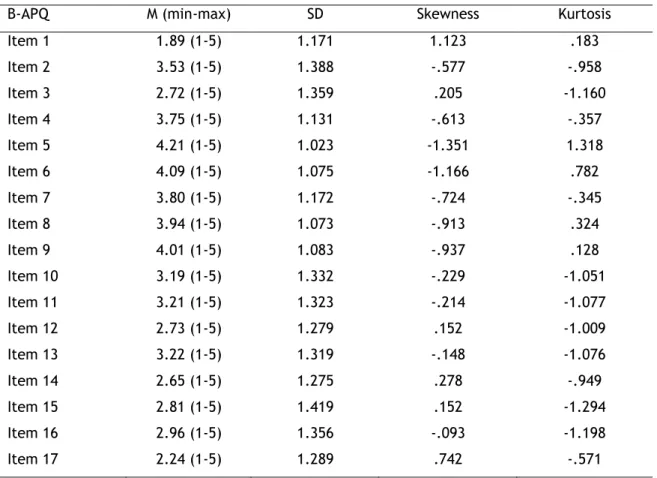
A sensitivity analysis of the items was conducted, which allowed for the evaluation of possible errors in the assessment of each item through measures of asymmetry (skewness) and flatness (kurtosis), according to the respective critical ratios (Kline, 1998). All items presented adequate scores, as shown in Table 5.
Table 5. Distributional characteristics
B-APQ M (min-max) SD Skewness Kurtosis
Item 1 1.89 (1-5) 1.171 1.123 .183 Item 2 3.53 (1-5) 1.388 -.577 -.958 Item 3 2.72 (1-5) 1.359 .205 -1.160 Item 4 3.75 (1-5) 1.131 -.613 -.357 Item 5 4.21 (1-5) 1.023 -1.351 1.318 Item 6 4.09 (1-5) 1.075 -1.166 .782 Item 7 3.80 (1-5) 1.172 -.724 -.345 Item 8 3.94 (1-5) 1.073 -.913 .324 Item 9 4.01 (1-5) 1.083 -.937 .128 Item 10 3.19 (1-5) 1.332 -.229 -1.051 Item 11 3.21 (1-5) 1.323 -.214 -1.077 Item 12 2.73 (1-5) 1.279 .152 -1.009 Item 13 3.22 (1-5) 1.319 -.148 -1.076 Item 14 2.65 (1-5) 1.275 .278 -.949 Item 15 2.81 (1-5) 1.419 .152 -1.294 Item 16 2.96 (1-5) 1.356 -.093 -1.198 Item 17 2.24 (1-5) 1.289 .742 -.571
Reliability
In this study we considered internal consistency as an index of reliability. Table 6 displays the Cronbach’s alpha coefficients for the factors of both the original version and the Portuguese version of the B-APQ. In comparison with the original version of the B-APQ, the Portuguese version shows decreased internal consistency for almost every factor, except for factor 2. However, the Cronbach’s alphas continued to be acceptable for all factors in the Portuguese version of the B-APQ (DeVellis, 2011), indicating that it preserved the scale’s internal consistency.
Table 6. Internal consistency of the B-APQ’s original and Portuguese versions Original Version B-APQ
α
Portuguese Version B-APQ α Factor 1 .76 .66 Factor 2 .78 .78 Factor 3 .81 .70 Factor 4 .84 .75 Factor 5 .75 .74 All factors .75 .73
Study 2
Results for aging perceptions by sex
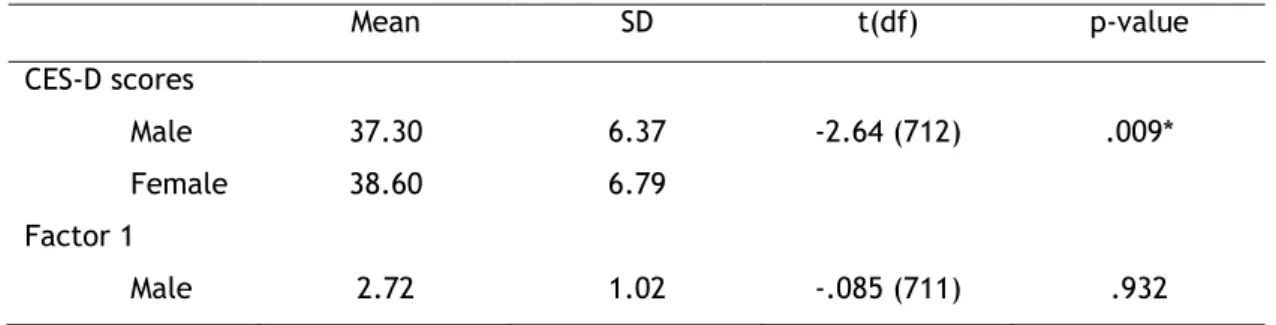
Statistically significant differences were obtained when comparing men and women [t(712)=-2.64; p=.009], indicating that women present greater levels of depressive symptomatology. For all B-APQ factors, no statistically significant differences were found between men and women (see Table 7).
Table 7. Differences in depressive symptoms and aging perception factor by genders
Mean SD t(df) p-value CES-D scores Male Female 37.30 38.60 6.37 6.79 -2.64 (712) .009* Factor 1 Male 2.72 1.02 -.085 (711) .932
Female 2.72 1.00 Factor 2 Male Female 3.97 4.06 .88 .93 -1.40 (709) .164 Factor 3 Male Female 3.01 2.99 .85 .82 .33 (712) .740 Factor 4 Male Female 3.87 3.98 .92 .89 -1.57 (711) .117 Factor 5 Male Female 2.62 2.75 1.09 1.11 -1.62 (711) .105 *<.05; **<.001
Results for aging perceptions by sexual orientation
Our results found statistically significant differences in levels of depression based upon sexual orientation, with self-identified homosexual participants presenting more depressive symptoms [F(122.95;43.14)=2.850; p=.049]. There are statistically significant differences for factors 2 and 4 of the B-APQ, as self-identified homosexual participants scored lower than their heterosexual and bisexual counterparts, indicating that they possess more negative aging perceptions (see Table 8).
Table 8. Differences in depressive symptoms and aging perception factor by sexual orientations Mean SD F(df) p-value CES-D scores Heterosexual Bisexual Homosexual 37.93 35.74 38.39 6.54 5.40 7.10 2.850 (122.95;43.14) .049* Factor 1 Heterosexual Bisexual Homosexual 2.73 2.50 2.70 1.04 .90 .93 1.107 (1.13;1.02) .331 Factor 2 Heterosexual 4.05 .89 4.919 .008*
Bisexual Homosexual 4.07 3.77 .84 .94 (3.970;.80) Factor 3 Heterosexual Bisexual Homosexual 3.01 2.86 2.97 .90 .85 .79 .675 (.52;.77) .510 Factor 4 Heterosexual Bisexual Homosexual 3.95 3.95 3.70 .89 1.09 .90 3.761 (3.07;.82) .024* Factor 5 Heterosexual Bisexual Homosexual 2.69 2.52 2.61 1.11 1.06 1.06 .669 (.81;1.21) .512 *<.05; **<.001
Discussion
In an aging society, it is important to have access to validated measures that assess the particularities of the aging process and give us insight into how to solve related problems. Due to the scarcity of validated instruments for the Portuguese population that assess self-perceptions regarding aging, the main aim of this study was to translate and validate the B-APQ for older adults. The questionnaire was translated to Portuguese and its psychometric properties and factor structure were evaluated. An assessment of the Portuguese version of the B-APQ’s construct validity, convergent validity, discriminant validity, sensitivity and internal consistency, confirms that it is a reliable and valid instrument for evaluating aging self-perceptions among older adults in Portugal. The B-APQ has already been translated and validated for use in other countries, where it has also been shown to possess appropriate psychometric properties (Slotman, Cramm, & Nieboer, 2015; Moghadam et al., 2016; Jaafar, Villiers-Tuthill, Sim, Lim, & Morgan, 2018), indicating that it is a robust measurement instrument applicable to different cultural settings.
The model’s goodness-of-fit indices were adequate for all 5 factors of the Portuguese version of the B-APQ model. The results also showed that all factors of the B-APQ were associated with the CES-D, highlighting the link between aging self-perceptions and depression. This finding is supported by previous studies, which suggest that negative aging self-perceptions are predictors of depression symptoms (Djernes, 2006; Sindi et al., 2012; Freeman et al., 2016). An association between self-perception and depression was also found
when the B-APQ was validated in the Malaysian context (Jaafar et al., 2018). In the present study, the Cronbach’s alpha for factor 1 was lower than those found for the other factors (α=.66). This is probably due to the fact that, among older Portuguese adults, exposure to the perception of timeline chronic circumstances may be influenced by age-related prejudice, which, in turn, creates less consistency in the interpretation of this factor’s items (Coelho, 2013). The Cronbach's alpha value for the entire questionnaire was .73, which is similar to the value found for the Persian version of the B-APQ (Moghadam et al., 2016).
Regarding study 2, statistically significant differences were obtained when comparing sex, indicating that women present greater depressive symptomatology. This is supported by several previous studies that aimed to assess differences in depressive symptoms related to sex (Leach, Christensen, Mackinnon, Windsor, & Butterworth, 2008; Essau, Lewinsohn, Seeley, & Sasagawa, 2010; Van de Velde, Bracke, & Levecque, 2010). Women presented more negative levels of depression due to the fact that they were perceived as more fragile, emotional and vulnerable, revealing that gender roles are mediated by social norms. This dual sex pattern is characterized by different expectations for men and women regarding how to manifest their roles in society, which consequently influences how they express depressive symptoms, and seems to be better internalized by women, thus leading them to respond accordingly. Maji (2018) emphasizes the importance of thinking beyond the possible biological factors behind sex differences in regard to depression, stressing the importance of social and cultural problems that place women in a socially disadvantaged position. The influence of sex on aging perceptions was not corroborated for any B-APQ factors, as no factors presented statistically significant differences between men and women. This indicates that aging self-perceptions seem to be independent from sex-related factors, encapsulating a more neutral/universal experience that is not subject to societal influences.
Our research found statistically significant differences for depression levels in relation to sexual orientation, with self-identified homosexuals presenting more depressive symptoms. These findings are in agreement with a previous Portuguese study (Pereira et al., in press). However, it is important to note that only 6.9% of participants in this study identified themselves as bisexual. There are also statistically significant differences for factors 2 and 4 of the B-APQ, as self-identified homosexuals possessed lower scores for these factors, indicating more negative aging perceptions. A Portuguese study of aging perceptions among older gay and bisexual men has shown how homosexuals/bisexuals are intensely subject to social stereotypes and discrimination (Pereira et al., 2018). In another study, Pereira et al. (2019) reported that almost half of participants had experienced discrimination due to their sexual orientation when seeking health or social services. These experiences can lead to high levels of anxiety, depression and suicidal thoughts related to sexual or gender identity (Gonçalves, Costa, & Leal, 2018). Minority stress (Meyer, 1995) and the stigma surrounding homosexuality have serious repercussions on both physical and mental health (Gonçalves,
Costa, & Leal, 2018), which may explain the results regarding the evidence of higher depressive symptomatology in self-identified homosexuals.
Limitations and Future Implications
One of the limitations of this study is the type of data collection that was used. As data were collected online, this study possesses restrictions resulting from the voluntary nature of each individual’s participation, as well as due to older adults’ low levels of Internet access and technological skills. Another limitation arises from the effect of social desirability bias on questionnaire responses, since people tend to respond according to what is "socially accepted."
Regarding this study’s future implications, the authors hope that it will help to improve adaptive care programs that challenge the negative effects of aging perceptions present in prevention and intervention programs targeted at older people, while raising further awareness concerning the differences in depressive symptomatology related to sex and sexual orientation. The results obtained show that the Portuguese version of the B-APQ is valid and reliable, and it can be applied when assessing aging perceptions among older Portuguese adults. Therefore, the use of this measure by health professionals and researchers provides information that can help to improve care for older adults.
Conclusion
As a result of the population aging process in Portugal, it is paramount to possess a validated measurement instrument that is capable of evaluating aging self-perceptions. The B-APQ has been proven to be a valid and reliable measure to assess aging perceptions among older Portuguese adults. This study also showed that aging perceptions are independent of influences deriving from sex, but that sexual orientation had an influence on factors 2 and 4 of the B-APQ, with self-identified homosexuals possessing more negative aging perceptions.
Disclosure Statement
References
Barker, M., O'Hanlon, A., McGee, H. M., Hickey, A., & Conroy, R. M. (2007). Cross-sectional validation of the Aging Perceptions Questionnaire: a multidimensional instrument for assessing self-perceptions of aging. BMC geriatrics, 7(9), 1-13.
Byrne, B. (2010). Structural equation modeling with AMOS: Basic concepts, applications, and
programming (2nd ed.). New York: Routledge.
Coelho, C., (2013). Idades apartadas: pensar o idadismo e a intergeracionalidade. In Pereira, J. et al. (Eds.) Animação Sociocultural, Gerontologia e Geriatria, A Intervenção Social,
Cultural e Educativa na Terceira Idade (pp. 63-72). Chaves.
Cohen, J. (1988). Statistical power analysis for the behavioral sciences (2nd ed.). Hillsdale, NJ: Erlbaum.
DeVellis, R. F. (2011). Scale development: Theory and applications (3rd ed.). Thousand Oaks, CA: Sage.
de Vries, B., & Croghan, C. (2014). LGBT aging; Results and lessons from community-based research. Journal of Homosexuality, 61, 1–20.
Djernes, J. K. (2006). Prevalence and predictors of depression in populations of elderly: a review. Acta Psychiatrica Scandinavica, 113(5), 372-387.
Essau, C. A., Lewinsohn, P. M., Seeley, J. R., & Sasagawa, S. (2010). Gender differences in the developmental course of depression. Journal of affective disorders, 127(1-3), 185-190. Ferreira, P. M. (2015). O Envelhecimento ativo em Portugal: tendências recentes e (alguns)
problemas. Revista Kairós: Gerontologia, 18(19), 07-29.
Freeman, A. T., Santini, Z. I., Tyrovolas, S., Rummel-Kluge, C., Haro, J. M., & Koyanagi, A. (2016). Negative perceptions of ageing predict the onset and persistence of depression and anxiety: Findings from a prospective analysis of the Irish Longitudinal Study on Ageing (TILDA). Journal of Affective Disorders, 199, 132-138.
Goetz, C., Coste, J., Lemetayer, F., Rat, A. C., Montel, S., Recchia, S., & Guillemin, F. (2013). Item reduction based on rigorous methodological guidelines is necessary to
maintain validity when shortening composite measurement scales. Journal of Clinical
Epidemiology, 66(7), 710-718.
Gonçalves, J. A. R., Costa, P. A., & Leal, I. (2018). Silver rainbow: estigma em homens gays idosos, uma perspetiva de stress minoritário. Psicologia, Saúde & Doenças, 19(1), 80-86. Gonçalves, J. A. R., Costa, P. A., & Leal, I. (2019). Minority Stress in Older Portuguese Gay
and Bisexual Men and Its Impact on Sexual and Relationship Satisfaction. Sexuality
Research and Social Policy, 1-10.
INE (2018). Península Ibérica em Números. Lisboa, Portugal: Instituto Nacional de Estatística. Jaafar, M. H., Villiers-Tuthill, A., Sim, S. H., Lim, M. A., & Morgan, K. (2018). Validation of
the Brief Ageing Perceptions Questionnaire (B-APQ) in Malaysia. Aging & mental health, 1-7.
John, O. P., & Benet-Martinez, V. (2000). Measurement: Reliability, construct validation, and scale construction. In H. Reis & C. Judd (Eds.). Handbook of research methods in social
and personality psychology (pp. 339-369). Cambridge: Cambridge University Press.
Kotter-Grühn, D., Kleinspehn-Ammerlahn, A., Gerstorf, D., & Smith, J. (2009). Self-perceptions of aging predict mortality and change with approaching death: 16-year longitudinal results from the Berlin Aging Study. Psychology and aging, 24(3), 654-667. Kline, R. B. (1998). Principles and Practices of Structural Equation Modelling. The Guilford
Press. NewYork.
Lagacé, M., Charmarkeh, H., & Grandena, F. (2012). Cultural perceptions of aging: the perspective of Somali Canadians in Ottawa. Journal of cross-cultural gerontology, 27(4), 409-424.
Leach, L. S., Christensen, H., Mackinnon, A. J., Windsor, T. D., & Butterworth, P. (2008). Gender differences in depression and anxiety across the adult lifespan: the role of psychosocial mediators. Social psychiatry and psychiatric epidemiology, 43(12), 983-998. Leventhal, H., Nerenz, D.R., & Steele D.J. (1984). Illness representations and coping with
health threats. In A. Baum, S. E. Taylor & J. Singer (Ed.). Handbook of Psychology and
Levy, B. R., Slade, M. D., & Kasl, S. V. (2002). Longitudinal benefit of positive self-perceptions of aging on functional health. The Journals of Gerontology Series B:
Psychological Sciences and Social Sciences, 57(5), 409-417.
Liechty, T., & Genoe, M. R. (2013). Older men's perceptions of leisure and aging. Leisure
Sciences, 35(5), 438-454.
Lin, J. N. (2016). Gender differences in self-perceptions about aging and sleep among elderly Chinese residents in Taiwan. Journal of Nursing Research, 24(4), 347-356.
Loureiro, M. G. D. P. D. (2009). Validação da escala do center for epidemiologic studies of
depression-CES-D numa população clínica de idosos (Dissertação de Mestrado, Universidade
de Coimbra).
Maji, S. (2018). Society and ‘good woman’: A critical review of gender difference in depression. International Journal of Social Psychiatry, 64(4), 396-405.
Marôco, J. (2010). Análise de equações estruturais: Fundamentos teóricos, software &
aplicações. Pêro Pinheiro: ReportNumber.
Mateus, M. D. N. E., & Alves, T. E. R. (2018). Perceção dos idosos autónomos face ao seu próprio envelhecimento. Eduser-Revista de educação, 10, 69-88.
Meyer, I. H. (1995). Minority stress and mental health in gay men. Journal of Health and
Social Behavior, 36, 38–56.
Moghadam, L. S., Foroughan, M., Shahboulaghi, F. M., Ahmadi, F., Sajjadi, M., & Farhadi, A. (2016). Validity and reliability of the Persian version of the Brief Aging Perceptions Questionnaire in Iranian older adults. Clinical interventions in aging, 11, 507-511. Mohammadpour, A., Sadeghmoghadam, L., Shareinia, H., Jahani, S., & Amiri, F. (2018).
Investigating the role of perception of aging and associated factors in death anxiety among the elderly. Clinical interventions in aging, 13, 405-409.
Moser, C., Spagnoli, J., & Santos-Eggimann, B. (2011). Self-perception of aging and vulnerability to adverse outcomes at the age of 65–70 years. Journals of Gerontology
Mota-Pinto, A., Rodrigues, V., Botelho, A., Veríssimo, M. T., Morais, A., Alves, C., & Oliveira, C. R. (2011). A socio-demographic study of aging in the Portuguese population: The EPEPP study. Archives of Gerontology and Geriatrics, 52(3), 304-308.
Nunes, A. M. (2017a). Demografia, envelhecimento e saúde: uma análise ao interior de Portugal. Revista Kairós: Gerontologia, 20(1), 133-154.
Nunes, A. M. (2017b). Envelhecimento ativo em Portugal: desafios e oportunidades na saúde. Revista Kairós: Gerontologia, 20(4), 49-71.
Parra-Rizo, M. A. (2017). Diferencias de género en la percepción de salud en personas
mayores de 60 años físicamente activas. Revista Espanola de Comunicacion en Salud, 8(2), 219-227.
Pereira, H., Serrano, J. P., de Vries, B., Esgalhado, G., Afonso, R. M., & Monteiro, S. (2018). Aging perceptions in older gay and bisexual men in Portugal: A qualitative study. The
International Journal of Aging and Human Development, 87(1), 5-32.
Pereira, H., de Vries, B., Serzedelo, A., Serrano, J. P., Afonso, R. M., Esgalhado, G., & Monteiro, S. (2019). Growing Older Out of the Closet: A Descriptive Study of Older LGB Persons Living in Lisbon, Portugal. The International Journal of Aging and Human
Development, 0(0), 1-18.
Pereira, H., de Vries, B., Serrano, J. P., Afonso., R. M., Esgalhado, G. & Monteiro, S. (in press). Depression and Quality of Life in Older Gay and Bisexual Men in Spain and Portugal. International Journal of Aging and Human Development.
Radloff, L. S. (1977). The CES-D scale: A self-report depression scale for research in the general population. Applied psychological measurement, 1(3), 385-401.
Robertson, D. A., Savva, G. M., King-Kallimanis, B. L., & Kenny, R. A. (2015). Negative perceptions of aging and decline in walking speed: A self-fulfilling prophecy. PloS
one, 10(4), 1-17.
Robertson, D. A., & Kenny, R. A. (2016). Negative perceptions of aging modify the association between frailty and cognitive function in older adults. Personality and Individual
Differences, 100, 120-125.
Robertson, D. A., King-Kallimanis, B. L., & Kenny, R. A. (2016). Negative perceptions of aging predict longitudinal decline in cognitive function. Psychology and Aging, 31(1), 71-81.
Rodrigues, V., Mota-Pinto, A., de Sousa, B., Botelho, A., Alves, C., & de Oliveira, C. R. (2014). The aging profile of the Portuguese population: a principal component analysis. Journal of community health, 39(4), 747-752.
Sargent-Cox, K. A., Anstey, K. J., & Luszcz, M. A. (2013). Longitudinal change of self-perceptions of aging and mortality. Journals of Gerontology Series B: Psychological
Sciences and Social Sciences, 69(2), 168-173.
Sexton, E., King-Kallimanis, B. L., Morgan, K., & McGee, H. (2014). Development of the Brief Ageing Perceptions Questionnaire (B-APQ): a confirmatory factor analysis approach to item reduction. BMC geriatrics, 14(44), 1-11.
Shaw, R., & Langman, M. (2017). Perceptions of being old and the ageing process. Ageing
International, 42(1), 115-135.
Sindi, S., Juster, R. P., Wan, N., Nair, N. P. V., Ying Kin, N., & Lupien, S. J. (2012). Depressive symptoms, cortisol, and cognition during human aging: The role of negative aging perceptions. Stress, 15(2), 130-137.
Slotman, A., Cramm, J. M., & Nieboer, A. P. (2015). Validation of the Dutch aging perceptions questionnaire and development of a short version. Health and quality of life
outcomes, 13(54), 1-13.
Sun, J. K., & Smith, J. (2017). Self-perceptions of aging and perceived barriers to care: Reasons for health care delay. The Gerontologist, 57(2), 216-226.
Toledo, A. M. (2011). Viejismo (ageism). Percepciones de la población acerca de la tercera edad: estereotipos, actitudes e implicaciones sociales. Poiésis, 10(19).
Van de Velde, S., Bracke, P., & Levecque, K. (2010). Gender differences in depression in 23 European countries. Cross-national variation in the gender gap in depression. Social
science & medicine, 71(2), 305-313.
Warmoth, K., Tarrant, M., Abraham, C., & Lang, I. A. (2016). Older adults’ perceptions of ageing and their health and functioning: a systematic review of observational
studies. Psychology, health & medicine, 21(5), 531-550.
Wurm, S., Tesch-Römer, C., & Tomasik, M. J. (2007). Longitudinal findings on aging-related cognitions, control beliefs, and health in later life. The Journals of Gerontology Series B:
Chapter 3: Overall Discussion
The dissertation intends to communicate the acquired competences on psychological investigation. It involves the presentation of an empirical study that proves to be relevant to clinical and health psychology, taking into account the literature review in a thematic area, the delimitation of the object of study, the selection of methodologies for its approach, data collection and respective treatment, and relevant bibliography.
This study was carried out considering the objectives of the dissertation curricular unit. The dissertation began with the definition of the objectives of the study, which was the portuguese validation of a measure for the evaluation of self-perceptions regarding aging among older adults and the comparison of differences about aging perceptions between sex and sexual orientations. Several steps were required, such as literature review of the variables, translating the items of the original version of the B-APQ to Portuguese, creation of a website that included the required instruments, dissemination of the website through social networks, mailing lists and internet forums to collect the sample, conducting statistical analyses and comparison and discussion of the results.
Regarding the results of the main study of “A Validation of the Brief Ageing Perceptions Questionnaire (B-APQ) Among Elderly Portuguese Adults” article, it was demonstrated that: (1) the model’s goodness-of-fit indices were adequate for all 5 factors of the Portuguese version of the B-APQ model; (2) all factors of the B-APQ were associated with the CES-D, showing the link between aging self-perceptions and depression; (3) factors 2 and 4 were negatively associated with the CES-D; (4) the sensitivity analysis indicated that all items presented adequate scores; and (5) the Cronbach’s alphas was acceptable for all factors in the Portuguese version of the B-APQ, indicating that it preserved the scale’s internal consistency. Therefore, due to the described results, it is possible to affirm that the Portuguese version of the B-APQ is valid and reliable, and it can be applied when assessing aging perceptions among older Portuguese adults.
As for the complementary study, it was possible to conclude that: (1) statistically significant differences were obtained when comparing sex, indicating that women present greater depressive symptomatology; (2) for all B-APQ factors, no statistically significant differences were found between men and women; (3) statistically significant differences in levels of depression based upon sexual orientation where found, with self-identified homosexual participants presenting more depressive symptoms; and (4) there are statistically significant differences for factors 2 and 4 of the B-APQ, as self-identified homosexual
participants scored lower than their heterosexual and bisexual counterparts, indicating that they possess more negative aging perceptions.
The purpose of this research was mainly to reinforce the importance of perceiving the individual functioning of the aging process through the very self-perceptions of the elderly. Because of the progressive aging of the Portuguese population, this investigation provided a validation of an instrument that evaluates perceptions regarding aging among the elderly (B-APQ). The study is intended to improve adaptive care programs regarding prevention and intervention targeted at older people. Therefore, the use of this measure by health professionals and researchers provides information that can help to improve care for older adults. The role of sex in aging is also emphasized, since the aging process and its implications vary from men to women. These sex differences were also shown in depressive symptomatology, which is consistent with results of previous research, demonstrating the importance of raising further awareness concerning these aspects.
Despite the growing literature in the area of sexual orientation and aging, in Portugal the investigation about this topic is scarce, which leads to the lack of understanding of this population. This investigation had also the intention of support the need to investigate the relationship between aging and sexual minorities, as their particularities provide certain needs and age-related differences. Taking into account these differences will provide more specialized intervention, which will lead to a more positive and successful aging for the elderly. Identifying the perceptions of aging in sexual minorities will also help in the planning of prevention and intervention programs.
The psychology knowing and perceiving the specific mechanisms underlying aging, as well as the inherent implications of this process for people's daily lives, may play a preponderant role in understanding the development of a more positive and healthy aging. Future research should focus on providing new ways of working with older people, respecting their limitations and individuality. Must also provide solutions to the barriers that Portuguese institutions face daily regarding sex and sexual orientation differences, and intervention programs that maximize a successful aging process.
To conclude, it it important to perceive how the aging process is so diverse and felt differently among the elderly. The main objective of institutions should be to provide the elderly with the conditions that lead them to have a successful aging. The present dissertation assumes as a contribution to the increase of the research in this area, constituting an investigation that makes possible the improvement of the good practices of the psychologists that work with this population.
1. Aging process
Human aging is a universal and inevitable phenomenom (Parra, Valencia, & Villamil, 2012). Changes in modern society and enhancements in quality of life have led to a worldwide increase in life expectancy, which has contributed to the population aging process (Mota-Pinto et al., 2011; Parra, Valencia, & Villamil, 2012; Nunes 2017a; Nunes 2017b; Mohammadpour et al., 2018). These changes include improved living conditions, the development of technology and scientific knowledge, as well as healthier life styles and the practice of physical activity (Nunes, 2017a; Nunes, 2017c).
As the population ages, a better understanding of the aging process is needed in order to improve the quality of life of the elderly (Moser, Spagnoli, & Santos-Eggimann, 2011; Waites, & Onolemhemhen, 2014), which made it a widely studied topic nowadays. In academic studies on old age, efforts have been made in order to analyze, problematize and propose new ways of understanding aging through diverse disciplines, such as medicine, psychology, sociology, anthropology and gerontology (Silva, 2008).
Aging has been defined as a multifactorial process (biological, psychological and social), that causes characteristic changes throughout the life cycle, producing limitations to the adaptability of the person to the environment (Parra, Valencia, & Villamil, 2012; Paúl, 2017). Also, aging is decribed as a multidimensional process, where each person lives this phase of life in a different way, taking into account their personal history and all the underlying structural aspects such as culture, education, health and economic conditions (Mateus, & Alves, 2018). In addition, the authors emphasize the idea that, although aging is a common process to all individuals, it manifests in a differentiated way through the characteristics of each one, according to the biological constitution, the psychological structure and the surrounding environment.
The biological aging refers to the physical transformations that reduce the efficiency of the functional systems of the organism, resulting from the increasing vulnerability of the elderly and the greater probability of dying (Moreira, 2012; Mateus, & Alves, 2018), which includes structural and functional changes. Structural changes arise essentially at the metabolic and cellular level, resulting in transformations in body image, like cells and tissues, body composition and weight, muscles, bones and skin (Schneider, & Irigaray, 2008; Mateus, & Alves, 2018). Functional changes occur at the level of cardiovascular, respiratory, renal and urinary, gastrointestinal, nervous and sensory, endocrine and metabolic, reproductive and immune systems (Schneider, & Irigaray, 2008; Mateus, & Alves, 2018).