The influence of service climate, identity strength,
and contextual ambidexterity upon the performance
of public organizations
Francisco Guilherme NUNES
1, Luis Manuel MARTINS
2,
Juan MOZZICAFREDDO
3Abstract: Improving the performance of public organizations has become a major concern among researchers and managers, rendering the search for the factors that distinguish the best performers a fundamental endeavor. Despite the abundant empirical research conducted about this topic, there are still inconsistencies in how management and other organizational elements determine organizational performance, calling for more theory-oriented research. In this paper, we join this line of reasoning and suggest that service climate, organizational identity strength and contextual ambidexterity, variables coming from very different theoretical traditions, predict the performance of public organizations, as perceived by their members. In order to test this proposition, we surveyed a sample of 618 civil servants working for two different organizations. In this survey, we included measures of the three predictors (service climate, organizational identity strength and contextual ambidexterity) and the variable of interest (organizational performance). Using hierarchical regression analysis, we found evidence supporting a positive relationship between organizational performance and service climate, identity strength, and especially, contextual ambidexterity, with some differences between the two organizations regarding the intensity of these relationships. Besides contributing to broadening the discussion about the antecedents of public organizations’ performance, this study also supports the validity of the three theoretical perspectives. Considering the management of public organizations, our study challenges managers to play a fundamental role in orchestrating routines and work practices that allow configuration of the most relevant organizational capacities leading to better performance.
Keywords: organizational performance; public organizations; service climate; organizational identity strength; contextual ambidexterity.
JEL: D22; H83; M14
DOI: 10.24818/amp/2018.31-01
1 Professor PhD, Instituto Universitario de Lisboa, Business Research Unit, Lisbon,
Portugal; [email protected]
2 Professor PhD, Instituto Universitario de Lisboa, Business Research Unit, Lisbon,
Portugal; [email protected]
3 Professor PhD, Instituto Universitario de Lisboa, Business Research Unit,Lisbon,
Portugal; [email protected]
public organizations. Administratie si Management Public, (31), pp. 6-20, DOI:10.24818/amp/2018.31-01
Introduction
Searching for paths to improve the performance of public organizations is a major concern among researchers and managers (Amirkhanyan, Kim, and Lambright, 2013; Brewer and Selden, 2000; Rhodes et al., 2012). Organizational performance is also a core feature of reforms occurring in the public sector, whether or not these changes are inspired in New Public Management, (Pollitt and Dan, 2013; Androniceanu, 2017). Thus, identifying the factors that influence organizational performance becomes a fundamental endeavor, for the sake of theory development and for effective public management. Given this relevance, the study of organizational and management factors explaining the performance of public organizations has led to abundant empirical scientific production, and comprehensive reviews of these studies have already been conducted (Walker and Andrews, 2013; Andrews, Boyne, and Walker, 2011; De Waal, 2010).
However, probably due to the enormous diversity of public organizations and their respective contexts, those reviews highlight a number of inconsistencies regarding how management and other organizational elements determine organizational performance. As noted by O’Toole and Meier (2014), explaining the conflicting and ambiguous results about what determines public organizations’ performance would benefit from a more general theory about the context and influencing mechanisms. Such a theory should provide an articulation of variables pertaining to the political, external and internal organizational context.
According to O’Toole and Meier (2014), the political context describes the degree of concentration of power (unitary versus shared), the degree of federalism (one level of government versus multiple levels), the process (corporatist versus adversarial), and how performance is assessed (formalized system versus no formal system). The external context can be described according to the degree of complexity, turbulence, munificence and social capital available. Critical dimensions of the internal context are the existence of clear and consistent goals versus multiple and conflicting ones, the degree of centralization in decision making, and the degree of professionalization of civil servants.
In this paper, we join the discussion about what explains public organizations’ performance by studying specific organizational capacities, or dimensions of the internal context according to O’Toole and Meier’s (2014) terminology. We selected three variables that can be shaped by managers in order to improve performance on the basis of specific assumptions about public organizations. In the first place, we assume that most public organizations provide services to society. Thus, we can presume those organizations that developed management systems and practices more oriented to delivering a high quality service to citizens, a capacity here named service climate, will have better performance.
Secondly, we assume that public organizations are missionary, in the sense that they are created to fulfill a purpose in a society, thus contributing to higher values of equality, cohesion and justice. Because the context in which organizations operate is composed of groups with different interests, public organizations become
internally divided, due to the requirement to answer to different or contradictory expectations. In this context, organizations that developed a stronger sense of shared purpose, a capacity here named identity strength, will deal better with internal fragmentation and have higher performance (Fonseca et. al, 2017).
The basis of our third assumption is the observation that public organizations are often confronted with the double requirement of following a predefined set of aligned procedures and regulations and, at the same time, showing the ability to adapt to a changing context. Thus, we suggest that organizations exhibiting this dual capacity of alignment and adaptability, here named contextual ambidexterity, will show better performance.
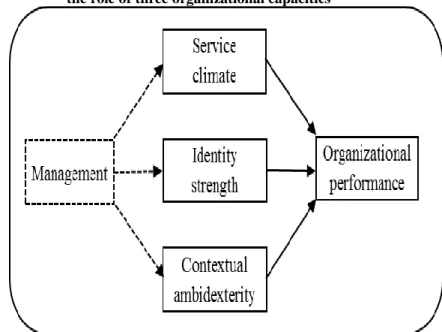
We propose that management influences organizational performance by nurturing the organizational capacities of service climate, identity strength and contextual ambidexterity. Besides their appropriateness to describe the fundamental dynamics of public organizations, as mentioned above, we selected these capacities on the grounds of the theory explaining how they predict organizational performance, as will be described in the next sections. Figure 1 represents the above framework.
Figure 1. How management influences organizational performance: the role of three organizational capacities
(Source: own elaboration. Solid lines: studied concepts and relationships; dashed lines: implicit concepts and relationships)
In this paper, we seek to answer the following question: what factors explain the performance of public organizations? More precisely, we investigate to what extent the three capacities of service climate, identity strength and contextual ambidexterity influence the perception of organizational performance. Using a
sample of 618 civil servants belonging to two distinct organizations, this study shows that the three capacities, especially contextual ambidexterity, significantly influence perceived organizational performance.
1. Literature review
1.1 How service climate influences organizational performance
Organizational climate is usually defined as the shared meaning attached by organizational members to practices, policies, procedures and actions expected, supported and rewarded in their work environment (Schneider et al., 2017; Bowen and Schneider, 2014). Service climate refers to a subset of these shared meanings, namely those that regulate how employees should behave in order to provide a good service to customers or citizens. Because public organizations are usually service providers, the service climate becomes a potential predictor of organizational performance, especially if we consider, following Needham (2006), that taking care of citizens is a part of the public service ethos. Better customer service is viewed by Slater and Narver (1994) as a core organizational capability.
Service climate is an organizational level attribute responsible for shaping service providers’ attitudes and behaviors that will influence citizens’ service experience. This connection between service provider and service receiver is the essential element of an explanatory chain for organizational performance (Yagil, 2014): service-oriented management and leadership practices create a service climate that shapes employee attitudes and behaviors towards good service, which in turn impacts on customers’ service experience, leading to satisfaction and loyalty, commonly used performance indicators (Van Ryzinand Immerwahr, 2007). Meta-analytical work reveals generalized support for this link between service climate and organizational performance (Hong et al., 2013). In the public sector, Vashdi, Vigoda-Gadot, and Shlomi (2013), using a sample of Israeli schools, found a positive relationship between service climate and teachers’ satisfaction and citizenship behaviors. Based on these arguments, we offer the following hypothesis:
H1. Service climate is positively related to perceived organizational performance.
1.2 How identity strength influences organizational performance
Organizational identity is defined as organizational members’ answer to the question “who are we as an organization”?(Albert and Whetten, 1985). All characteristics considered central, distinguishing and enduring in defining an organization are part of its identity. In essence, organizational identity is the result of the collective process of self-definition (Pratt et al., 2016). Organizational identity strength describes the shared perception held by members about the existence of a
common purpose and mission, a clear vision, and a sense of unity within an organization (Kreinerand, Ashforth, 2004).
A strong organizational identity will influence organizational performance because it allows reconciling the multiple and often conflicting objectives within an organization, a very common feature of public organizations. According to Boyne (2002), due to their inherently political nature, public organizations tend to pursue multiple and ambiguous objectives. Under the influence of different interest groups, with non-coincident preferences and goals, in other words, contradictory logics (Thornton, Ocasio, and Lounsbury, 2012; Greenwood et al., 2011) that have different internal supporters (Pache and Santos, 2010), many public organizations struggle to cope with recurrent tensions coming from conflicts about the appropriate goals to reach, what priorities to follow or how to allocate scarce resources. These tensions can drain key internal actors’ motivation or lead to decision-making paralysis, thus compromising organizational performance.
In organizations that have to pursue multiple, ambiguous or conflicting goals, a strong identity can play the role of a self-regulatory device, allowing the clarification of priorities, reconciliation of internal disagreements, or establishing a super ordinate purpose, thus influencing organizational performance (Haslam, Postmes, and Ellemers, 2003). Although scarce, empirical research supports this possibility. For instance, studying non-profit theaters in the USA, Voss, Cable, and Voss (2006)found that the existence of agreement about “who we are” among top management teams positively influences theaters’ performance. Additionally, using a sample of Portuguese pharmacists, Nunes et al. (2017) found that organizational identity strength is positively related to the perceived performance of community pharmacies. Accordingly, we posit the following hypothesis:
H2. Identity strength is positively related to perceived organizational performance.
1.3. How contextual ambidexterity influences organizational performance
The concept of contextual ambidexterity is well established in the literature as an explanation for both short and long-term organizational performance (Simsek, 2009; O’Reilly and Tushman, 2013;Junni et al., 2013). At its core, ambidexterity is a metaphor used to describe a number of paths organizations can follow to solve a fundamental tension inherent to their existence, namely the opposition between the exploitation of current assets and capabilities and the exploration of novel markets, technologies or capabilities (March, 1991). Because exploitation involves control, reducing uncertainty, and seeking efficiency, and exploration entails search, discovery and innovation, the conciliation of this contradiction requires the development of specific capacities. Ambidexterity is this organizational capacity (O’Reilly and Tushman, 2008; Subiyanto and Djastuti, 2018).
Three types of ambidexterity have been studied. The first, named sequential ambidexterity (Duncan, 1976),suggests that organizations use different structures in
periods that require exploration or exploitation, changing their organizing arrangements along with their history, according to requirements.
The second type, structural ambidexterity, suggests the creation of an organizational architecture in an organization composed of a unit created to deal with exploitation and another unit to cope with exploration (O’Reilly and Tushman, 2013). A common vision and a shared reward system help to integrate these two very different business units.
The third type of ambidexterity, the contextual one used in this research, is based on the idea that a specific organizational unit can exhibit, simultaneously, alignment and adaptability (Gibson and Birkinshaw, 2004). Alignment refers to the degree to which all management systems in one unit are coherent and work together to reach a predetermined goal. Adaptability is the ability to reconfigure activities and work processes in order to deal with changes observed in the task environment. Alignment and adaptability are the two components of a meta-capability, contextual ambidexterity, which reveals itself in members’ daily behavior, as individuals must decide when they are supposed to engage in aligned or adaptable activities (Birkinshaw and Gibson, 2004).
We contend that, to some extent, all public organizations are required to be both aligned and flexible, and often civil servants are required to follow established, well-known rules and procedures, and at the same time, respond to changes in their work context by adopting new practices that challenge the status quo to a greater or lesser extent. Thus, we offer the following hypothesis:
H3. Contextual ambidexterity, i. e., the combination of alignment and adaptability, is positively related to perceived organizational performance
2. Method
2.1. Data gathering and sample
Data were gathered in two public organizations: an agency responsible for facilitating the internationalization of the Portuguese economy and attracting foreign investment (hereafter the Alfa organization) and the general secretariat belonging to the Brazilian Ministry of Health, responsible for administering resources channeled to a specific municipality (the Beta organization). We chose two different public organizations in order to reach greater external validity (Scandura and Williams, 2000). After obtaining consent from the top management of both organizations, in each one, a person was made responsible for collecting the data. The questionnaires were made available by this person to all members of both organizations, guaranteeing the confidentiality of answers.
This procedure yielded 618 usable questionnaires, of which 42.9% came from the Alfa organization and the remaining 57.1% from the Beta organization. Comparing the populations, the samples represent 45.5% in Alpha and 41.0% in Beta, values falling within acceptable limits for response rates of general
organizational populations in academic studies(Baruch, 1999; Baruch and Holtom, 2008). In Alfa, 61% of respondents were female, the mean age was 44.88 years (SD = 10.43), the mean tenure was 17.24 years (SD = 9.60) and the mean time in the current function was 6.11 years (SD = 7.07). In Beta, female respondents also prevailed (68.8%), the mean age being 36.69 years (SD = 9.31), mean tenure was 6.60 years (SD = 6, 21) and work experience in the current function was 5.26 years on average (SD = 5.78).
2.2. Measures
All variables were measured using previously published scales already tested in Portuguese public organizations. Unless otherwise noted, all survey items were responded to on five-point rating scales from 1 (strongly disagree) to 5 (strongly agree).
We measured organizational performance using the Gibson and Birkinshaw (2004) four-item scale. A sample item is: “This organization is achieving its full potential”. Using perceptive measures to assess organizational performance has a long tradition in organizational studies (Delaney and Huselid, 1996; Raymond et al., 2013; Kim, 2010), and is considered a valid psychometric standpoint(Wall et al., 2004)and appropriate for public organizations (Andrews, Boyne and Walker, 2006). Principal component analysis demonstrated that all items loaded on a single factor with an eigenvalue of 2.70 and accounted for 67.60% of the variance. Internal reliability is adequate(α=0.84).
We measured service climate with the Schneider, White and Paul (1998) seven-item scale. A sample item included “How would you rate the overall quality of service provided by your organization?” This was rated from very poor (1) to excellent (5). Principal component analysis confirmed that all items loaded on a single factor (eigenvalue=3.85) and accounted for 54.93% of the variance. Internal reliability of this scale is acceptable (α=0.86).
Identity strength was measured using the Kreiner and Asforth (2004) four-item scale. A sample four-item included “There is a common sense of purpose in this organization”. All items loaded on a single factor, as revealed by principal component analysis. With an eigenvalue of 2.98, this factor accounts for 74.50% of the variance. This scale has acceptable internal validity (α=0.89).
We measured contextual ambidexterity with the Gibson and Bikinshaw (2004) six-item scale. Three items measure alignment (example: “The management systems in this organization work coherently to support the overall objectives of this organization”) and three assess adaptability (example: “The management systems in this organization are flexible enough to allow us to respond quickly to changes in our context”). Principal component analysis revealed that both sets of items load on a single factor (eigenvalue=2.19 and 2.17 respectively for alignment and adaptability; variance explained=72.85% and 72.40, respectively for alignment and adaptability). Internal reliability is acceptable for both scales (α=0.81 and 0.80, for alignment and adaptability, respectively). Because alignment and adaptability are
interdependent, we computed the multiplicative interaction between these two variables, following the procedure used by Gibson and Bikinshaw (2004).
2.3. Analysis strategy
Given that this study tests to what extent three distinct explanations – service climate, identity strength and contextual ambidexterity – predict organizational performance, the data analysis strategy follows a correlation approach. Perceived organizational performance is the variable to be explained and the other three are the explanatory variables (Gay and Dihel, 1992). Hierarchical multiple regression was used to test the hypotheses. Because individual characteristics and work experience can influence the perception of organizational performance, respondents’ age, tenure and time in the current job were included as controls.
3.Research results and discussions
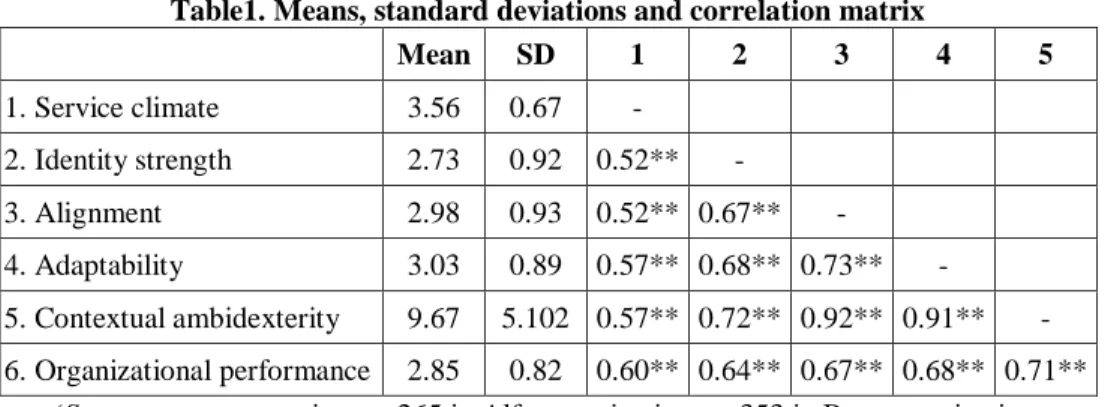
Table one displays the means, standard deviation, and inter-correlations among the study variables. As can be seen, overall, means are low, considering that scales range from 1 to 5. Significant correlations between organizational performance and other study variables provide preliminary evidence supporting our hypothesis. Additionally, there are other high correlations. Alignment and adaptability are correlated (r=0.73, p<0.01), meaning that, even if they are distinct constructs, respondents notice that they can co-exist within the same organization. Further, alignment, adaptability and, especially, their interaction (ambidexterity) are correlated with performance, signaling the relevance of this dual capacity. Identity strength is also significantly correlated with ambidexterity, meaning that the presence of this dual capacity in respondents’ context is related with a clearer vision, a sense of purpose and feelings of unity within the organization.
Table1. Means, standard deviations and correlation matrix
Mean SD 1 2 3 4 5 1. Service climate 3.56 0.67 - 2. Identity strength 2.73 0.92 0.52** - 3. Alignment 2.98 0.93 0.52** 0.67** - 4. Adaptability 3.03 0.89 0.57** 0.68** 0.73** - 5. Contextual ambidexterity 9.67 5.102 0.57** 0.72** 0.92** 0.91** - 6. Organizational performance 2.85 0.82 0.60** 0.64** 0.67** 0.68** 0.71**
(Source: own processing; n=265 in Alfa organization; n=353 in Beta organization; *p<0.05; **p<0.01.)
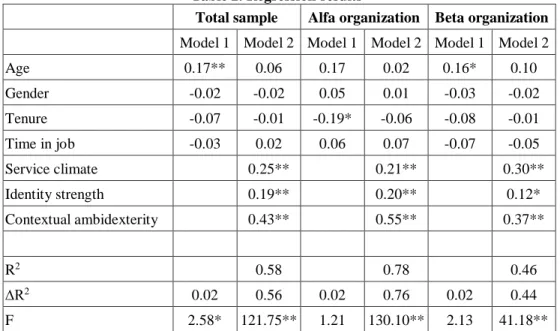
Table 2 presents the results of hierarchical regression. Considering the total sample, the one we used for hypothesis testing, the results yield evidence supporting all hypotheses. According to hypothesis one, service climate would be positively
related to organizational performance, and as shown in model 2, the result supports this prediction (β=0.25; p<0.01). Results also give support to hypothesis two, according to which identity strength would be positively related to organizational performance (β=0.19; p<0.01). Hypothesis three posits a positive relationship between contextual ambidexterity and organizational performance and the results also support this statement (β=0.43; p<0.01).
Table two also shows the results for each organization. As shown by model 2, our three hypotheses are supported in both Alfa and Beta organizations. However, the three variables under examination explain Alfa’s organizational performance
(R2=0.78)much better than Beta’s (R2=0.46).Notably, in both Alfa and Beta,
contextual ambidexterity is the most important predictor of organizational performance (β=0.55; p<0.01 andβ=0.37; p<0.01 in Alfa and Beta, respectively). In Beta, service climate has more influence on organizational performance (β=0.30; p<0.01) than in Alfa (β=0.21; p<0.01), but the effect of identity strength is lower in Beta (β=0.12; p<0.05) than in Alfa (β=0.20; p0.01).
Table 2. Regression results
Total sample Alfa organization Beta organization Model 1 Model 2 Model 1 Model 2 Model 1 Model 2
Age 0.17** 0.06 0.17 0.02 0.16* 0.10 Gender -0.02 -0.02 0.05 0.01 -0.03 -0.02 Tenure -0.07 -0.01 -0.19* -0.06 -0.08 -0.01 Time in job -0.03 0.02 0.06 0.07 -0.07 -0.05 Service climate 0.25** 0.21** 0.30** Identity strength 0.19** 0.20** 0.12* Contextual ambidexterity 0.43** 0.55** 0.37** R2 0.58 0.78 0.46 ∆R2 0.02 0.56 0.02 0.76 0.02 0.44 F 2.58* 121.75** 1.21 130.10** 2.13 41.18**
(Source: own processing. Standardized coefficients are presented; n=265 in Alfa; n=353 in Beta; *p<0.05; **p<0.01.)
4. Conclusions
This research aimed to investigate to what extent service climate, identity strength and contextual ambidexterity, seen as distinct capacities coming from very different but well established theoretical traditions, influence the perceived performance of public organizations. Overall, data analysis provides empirical evidence supporting these relationships, especially for the effect of contextual ambidexterity, even though the pattern of results is different in both organizations under study.
This study contributes to broadening the discussion about the antecedents of public organizations’ performance. O’Toole and Meier (2014) call for deep theorizing about the performance of public organizations, by studying, among other aspects, factors pertaining to their internal context. In this study, we included three organizational capacities with strong theoretical roots and relevant empirical evidence regarding their relationship with organizational performance. According to our assumptions, higher levels of public performance are achieved by organizations that show the capacity to provide high service quality, to deal with multiple and sometimes competitive goals, and to reconcile the dual requirement of following pre-specified procedures and responding to changing contexts. Those capacities were conceptualized as service climate, identity strength and contextual ambidexterity, respectively.
More generally, the results provide additional empirical support for the three theoretical approaches under study, namely the rich evidence about the effects of service climate on organizational performance(Hong, 2013), the empirical evidence reviewed by Junni et al. (2013) concerning the effects of ambidexterity on organizational performance, and to a lesser extent, studies that found a positive relationship between organizational identity and performance (Voss, Cable, and Voss, 2006; Nunes et al., 2017). In this way, the study also contributes to testing the value of these well-established frameworks in the context of public organizations, thus widening the validity of these approaches.
The three predictors of organizational performance we studied are generally statistically significant, but with unequal weights in Alfa and Beta organizations. This is relevant insofar as it invokes contextual factors that moderate the relationships between service climate, identity strength and contextual ambidexterity and organizational performance. In this respect, we can speculate that since the Alpha organization is more exposed to international contexts and is required to follow companies with very different businesses, it is natural that contextual ambidexterity becomes more relevant in influencing performance than in the Beta organization, but this supposition would require additional research.
Considering the management of public organizations, this study raises some additional reflections. If we identify that contextual ambidexterity, service climate and identity strength influence organizational performance, and if we admit that public managers are responsible for improving the performance of the organizations they lead, then knowledge of this pattern of results can be a fundamental way to
increase performance. Overall, managers are required to play a fundamental role in designing a set of routines and recurrent patterns of action to establish a configuration of organizational capacities leading to improved performance in specific organizations.
When it comes to contextual ambidexterity, Birkinshaw and Gibson (2004) challenge managers to create a high-performance context by combining performance management and social support practices. Along with careful selection practices targeting ambidextrous individuals, performance management and social support practices will lead to higher levels of contextual ambidexterity, a capacity that, in turn, will improve organizational performance.
Regarding service climate, if we look at the beginning of the chain explaining how this capacity affects organizational results (Hong et al., 2013; Yagil, 2014), we find a combination of factors including leadership, resources, structures, processes and routines that are important for better service. Managers are responsible for orchestrating this configuration of factors for the sake of performance improvement.
Concerning organizational identity strength, a capacity that enables organizations to deal with complexity arising from strong external pressures and the corresponding internal fragmentation (Battilana and Dorado, 2010), managers will have a central role in reconciling these tensions, taking advantage of the multiplicity of perspectives, but compensating for conflicting preferences by emphasizing a shared super ordinate purpose and a sense of unity, thus playing the role of identity custodians (Schinoff, Rogers, and Corley, 2016).
Although this study makes contributions to the extant literature, there are limitations that can impact on some aspects of its validity. First, focusing on just two organizations limits the ability to generalize the pattern of outcomes to contexts other than those that were used to produce it. In addition, although well-established, validated and currently used in research (Brewer, 2006, Kim, 2010), exclusive reliance on perceptive measures of performance may limit the validity of the results, even if the evidence shows that the choice of archive or perceptual performance indicators may be irrelevant (Andrews, Boyne, and Walker, 2011). In line with what is theorized by O'Toole and Meier (2014), contextual factors such as the national culture, the dynamism of the external context, the abundance of resources or the degree of institutional complexity may also influence organizational performance, and their effects were not controlled in this study.
In addition to dealing with these limitations, future research could be conducted at the supra-individual level, and measure performance from the point of view of other relevant groups besides civil servants, such as citizens or managers. Moreover, testing models incorporating moderating variables could contribute to capturing the effects of the enormous diversity of public organizations and their respective contexts. Finally, we studied three variables coming from relevant theoretical traditions. However, these are not the only ones that can be invoked to explain the performance of public organizations (Ciobanu, Androniceanu, 2018). The explanatory power of other capacities, such as the safety climate (Zohar and
Hofman, 2012) or market orientation (Vieira, 2010), or relevant configurations of these capacities (Fiss, Marx, and Cambré, 2013) can be tested, according to the specificities of the organizations to be studied and their context.
References
Albert, S., Whetten, D. A. (1985).Organizational identity. Research in
Organizational Behavior, 7, 263-295.
Andrews, R., Boyne, G., Walker, R. M. (2006). Subjective and objective measures of organizational performance: An empirical exploration. In: G. Boyne, K. J. Meier,L. J. O’Toole, & R. M. Walker (Eds.), Public service performance:
Perspectives on measurement and management. New York: Cambridge
University Press.
Andrews, R., Boyne, G., Walker, R. M. (2011).The impact of management on administrative and survey measures of organizational performance. Public
Management Review, 13(2), 227-255.
Androniceanu, A. (2017). Improving citizens’ satisfaction concerning the social welfare services at urban level. Theoretical and Empirical Researches in
Urban Management,12(4), 67-82.
Armirkhanyan, A. A., Kim, H. J., Lambright, K. T. (2013).The performance puzzle: Understanding the factors influencing alternative dimensions and views of performance. Journal of Public Administration Research and Theory, 24(1),1-34. DOI: https://doi.org/10.1093/jopart/mut021.
Baruch, Y. (1999). Response rate in academic studies: A comparative analysis.
Human Relations, 54(2), 421-438.
Baruch, Y., & Holtom, B. S. (2008).Survey response levels and trends in organizational research. Human Relations, 61(8), 1139-1160.
Battilana. J., Dorado, S. (2010). Building sustainable hybrid organizations: The case of commercial microfinance organizations. Academy of Management Journal,
53(6), 1419-1440.
Birkinshaw, J. Gibson, C. (2004).Building ambidexterity into an organization. Sloan
Management Review, Summer, 47-55.
Bowen, D. E., Schneider, B. (2014). Service climate synthesis and future research agenda. Journal of Service Research,17(1), 5-22.
Boyne, G. (2002). Public and private management: What´s the difference ? Journal
of Management Studies, 39(1), 97-122.
Brewer, G. A. (2006). All measures of performance are subjective: More evidence on U.S. federal agencies. In: G. Boyne, K. J. Meier, L. J. O’Toole and R. M. Walker (Eds.), Public service performance: Perspectives on measurement and
management. New York: Cambridge University Press.
Brewer, G. A., Selden, S. C. (2000).Why elephants gallop: Assessing and predicting organizational performance in federal agencies. Journal of Public
Ciobanu A., Androniceanu A. (2018). Integrated human resources activities - the solution for performance improvement in Romanian public sector institutions,
Management Research and Practice, 10(3), September, 60-79.
De Waal, A. A. (2010). Achieving high performance in the public sector: What needs to be done ? Public Performance & Management Review, 34(1), 81-103.
Delaney, J. T., Huselid, M. A. (1996).The impact of human resource management practices on perceptions of organizational performance. Academy of
Management Journal, 39(4), 949-969.
Duncan, R. B. (1976). The ambidextrous organization: Designing dual structures for innovation. In: R. H. Kilmann, L. R. Pondy, D. Slevin (Eds.), The management
of organization design: Strategies and implementation. New York: North
Holland.
Fiss, P. C., Marx, A., Cambré, B. (2013). Configurational theory and methods in organizational research: Introduction, Research in the Sociology of
Organizations, 32, 1-22.
Fonseca, L. M., Domingues, J. P., Guimarães SÁ, J., (2017). Leading quality in the 21st century: profiles of quality and organizational excellence managers,
Quality - Access to Success, 18(161), December, 34-38.
Gay, L. R., Diehl, L. (1992).Research methods for business and management. Toronto: Maxwell Macmillan International.
Gibson, C., Birkinshaw, J. (2004). The antecedents, consequences. and mediating role of organizational ambidexterity. Academy of Management Journal, 47(2), 209-226.
Greenwood, R., Raynard, M., Kodeih, F., Micelotta, E. R., Lounsbury, M. (2011).Institutional complexity and organizational responses. Academy of
Management Annals, 5(1), 317-71.
Haslam, S. A., Postmes, T., Ellemers, N. (2003).More than a metaphor: Organizational identity makes organizational life possible. British Journal of
Management, 14(4), 357-369.
Hong, Y., Liao, H., Hu, J., Jiang, K. (2013). Missing link in the service profit chain: A meta-analytic review of the antecedents, consequents, and moderators of
service climate. Journal of Applied Psychology, 98(2),
237-267.
Junni, P., Sarala, R. M., Taras, V.,Tarba, S. Y. (2013). Organizational ambidexterity and performance: A meta-analysis. The Academy of Management
Perspectives, 27(4), 299-312.
Kim, J. (2010). Strategic human resource practices: Introducing alternatives for organizational performance improvement in the public sector. Public
Administration Review, 70(1), 38-49.
Kreiner, G. E., Ashforth, B. E. (2004).Evidence toward an expanded model of organizational identification. Journal of Organizational Behavior, 25(1), 1-27. DOI: https://doi.org/10.1002/job.234.
March, J. G. (1991).Exploration and exploitation in organizational learning.
Organization Science, 2(1), 71-87.
Needham, C. E. (2006). Customer care and the public service ethos. Public
Administration, 84(4), 845-860.
Nunes, F. G., Anderson, J. E., Martins, L., Wiig, S. (2017). The hybrid identity of micro enterprises: Contrasting the perspectives of community pharmacies’ owners-managers and employees. Journal of Small Business and Enterprise
Development, 24(1), 34-53.
O´Reilly, C. A. Tushman, M. L. (2008).Ambidexterity as a dynamic capability: Resolving the innovator’s dilemma. Research in Organizational Behavior, 28, 185-206. DOI: https://doi.org/10.1016/j.riob.2008.06.002.
O´Reilly, C. A. Tushman, M. L. (2013). Organizational ambidexterity: Past, present
and future. The Academy of Management Perspectives, 27(4),
324-338. DOI: https://doi.org/10.5465/amp.2013.0025.
O’Toole, L. J., Meier, K. J. (2014). Public management, context, and performance: In quest of a more general theory. Journal of Public Administration Research
and Theory, 25(1), 237-256.
Pache, A-C., Santos, F. (2010).When worlds collide: The internal dynamics of organizational responses to conflicting institutional demands. Academy of
Management Review, 35(3), 455-476.
Pollitt, C., Sandru, D. (2013). Searching for impacts in performance-oriented management reform: A review of the European literature. Public Performance
& Management Review, 37(1), 7-32.
Pratt, M. G.,Ashforth, B. A., Schultz, M., Ravasi, D. (2016).Introduction: Mapping where we have been, where we are, and where we might go. In: M. G. Pratt, M. Schultz, B. E. Ashforth, D. Ravasi (Eds), The Oxford handbook of
organizational identity. New York: Oxford University Press.
Raymond, L., Marchand, M., St-Pierre, J., Cadieux, L., Labelle, F. (2013). Dimensions of small business performance from the owner-manager’s
perspective: A re-conceptualization and empirical validation.
Entrepreneurship & Regional Development, 25(5-6), 468-499.
Rhodes, M. L., Biondi, L., Gomes, R., Melo, A. I., Ohemeng, F., Perez-Lopez, G., Rossi, A., Sutiyono, W. (2012).Current state of public sector performance management in seven selected countries. International Journal of Productivity
and Performance Management, 61(3), 235-271.
Scandura, T. A., Williams, E. A. (2000). Research methodology in management: Current practices, trends, and implications for future research. Academy of
Management Journal, 43(6), 1248-1264.
Schinoff, B. S., Rogers, K. M., Corley, K. G. (2016).How do we communicate who we are? Examining how organizational identity is conveyed to members. In: M. G. Pratt,M. Schultz, B. E. Ashforth, D. Ravasi (Eds),The Oxford handbook
of organizational identity. New York: Oxford University Press.
Schneider, B., González-Romá, V., Ostroff, C., West, M. A. (2017). Organizational climate and culture: Reflections on the history of the constructs in the Journal
of Applied Psychology. Journal of Applied Psychology, 102(3), 468-482. DOI: http://dx.doi.org/10.1037/apl0000090.
Slater, S. F., Narver, J. C. (1994). Market orientation, customer value, and superior performance. Business Horizons, March-April, 22-28.
Schneider, B., White, S. Paul, M. C. (1998). Linking service climate and customer perceptions of service quality: Test of a causal model. Journal of Applied
Psychology, 83(2), 150-163.
Simsek, Z. (2009). Organizational ambidexterity: Towards a multilevel understanding. Journal of Management Studies, 46(8), 597-624.
Subiyanto, D., Djastuti, I. (2018). Transformational leadership, organizational support, and dynamic ambidexterity capabilities in troubleshooting: strategic efforts to improve lecturer performance, Quality - Access to Success, 19 (162), February, 96-101.
Thornton, P. H., Ocasio, W., Lounsbury, M. (2012).The institutional logics
perspective: A new approach to culture, structure, and process. Oxford:
Oxford University Press.
Van Ryzin, G. G., Immerwahr, S. (2007). Importance-performance analysis of citizen satisfaction surveys. Public Administration, 85(1), 215-226.
Vashdi, D. R., Vigoda-Gadot, E., Shlomi, D. (2013).Assessing performance: The impact of organizational climates and politics on public schools’ performance.
Public Administration, 91(1), 135-158.
Vieira, V. A. (2010). Antecedents and consequences of market orientation: A Brazilian meta-analysis and an international mega-analysis. Brazilian
Administration Review, 7(1), 45-58.
Voss, Z. G., Cable, D. M., Voss, G. B. (2006).Organizational identity and firm performance: What happens when leaders disagree about who we are?
Organization Science, 17(6), 741-755.
Walker, R. M., Andrews, R. (2013).Local government management and performance: A review of evidence. Journal of Public Administration
Research and Theory, 25(1),101-133.
Wall, T. D., Michie, J., Patterson, M., Wood, S. J., Sheehan, M., Clegg, C. W., West, M. (2004). On the validity of subjective measures of company performance.
Personnel Psychology, 57(1), 95-118.
Yagil, D. (2014). Service quality. In: B. Schneider, K. M. Barbera (Eds.), The Oxford
Handbook of Organizational Climate and Culture. New York: Oxford
University Press.
Zohar, D., Hofman, D. H. (2012). Organizational culture and climate. In S. J. Kozlowski (Ed.), The Oxford handbook of organizational psychology. Oxford: Oxford University Press.