of a coaStal population at riSk (faro Beach,
portugal): a qualitative content analySiS
Rita B. Domingues1Susana Costas2
Saul Neves de Jesus3
Óscar Ferreira4
ABSTRACT
Faro Beach, a heavily urbanized settlement in Ria Formosa, southern Portugal, is highly vulnerable to coastal hazards, namely beach erosion and overwashes caused by storms, that have resulted in house and road damage on several occasions. Despite the risks, local residents accept to live there. Four semi-structured interviews were conducted to understand residents’ beliefs, risk perceptions and preparedness regarding coastal risks. We used a qualitative content analysis to derive manifest contents from the interviews.
Three main themes were identified in the interviews: how residents feel about Faro Beach; how they perceive coastal hazards and risks; and how they deal with those risks. Positive feelings regarding Faro Beach were identified in all residents, reflecting a strong sense of place that includes high levels of place attachment, rooting, sense of community and place identity. Residents’ personal experiences with hazards probably undersized their perceptions regarding the risks that they are exposed to. Their willingness to participate in disaster risk reduction measures seemed associated with behavioral barriers driven by mistrust in authorities and externalization of responsibility. Residents also revealed low levels of preparedness towards coastal hazards, probably due to their low risk perceptions and their perception of threats as distant in time.
Keywords: Place Attachment, Risk Perception, Coastal Management, Content Analysis. JEL Classification: Q54
1. INTRODUCTION
Coastal areas are widely recognized as one of the most important ecosystems in the world; they provide a myriad of services and resources (Kennish & Paerl, 2010), whilst suffering from increasing anthropogenic pressures due to human population growth and economic development (Lloret, Marín & Marín-Guirao, 2008). Although attractive from natural and socioeconomic perspectives, coastal areas are dangerous places to live in. These regions, particularly low elevation coastal zones (<10 m altitude: McGranahan, 2007) are extremely vulnerable to natural hazards, such as erosion, overwash, cliff collapse, floods, harmful algal blooms, among others. In the last decades, human-induced climate change has been added to the myriad of threats that coastal populations are exposed to. At the same time,
1 Centre for Marine and Environmental Research (CIMA), Research Centre for Spatial and Organizational Dynamics (CIEO), University of
Algarve, Faro, Portugal ([email protected])
2 Centre for Marine and Environmental Research (CIMA), University of Algarve, Faro, Portugal ([email protected]) 3 Research Centre for Spatial and Organizational Dynamics (CIEO), University of Algarve, Faro, Portugal ([email protected]) 4 Centre for Marine and Environmental Research (CIMA), University of Algarve, Faro, Portugal ([email protected])
population growth in coastal regions and urbanization of coastlines have been increasing worldwide (Neumann, Vafeidis, Zimmermann & Nicholls, 2015). Thus, it is important to consider coastal areas as linked ecological-socioeconomic systems that co-evolve spatially and temporally (Crooks & Turner, 1999) and to balance the needs of development and the protection of ecosystem resources, by taking into consideration the public’s concern about the environmental, socio-economic and cultural state of the coastline (EEA, 2006).
One of the most vulnerable areas in Portugal is the Ria Formosa coastal system, at the southernmost end of the Portuguese coast, which includes a coastal lagoon protected from the direct impact of ocean waves by a chain of sandy barrier islands and peninsulas split by several inlets. Due to its ecological and economic importance, the Ria Formosa and its hinterland were established as a Natural Park and, currently, a multitude of governmental organizations are responsible for its management, including national and regional organizations as well as municipalities (Guimarães, 2010; Costas, Ferreira & Martinez, 2015).
The sandy islands and peninsulas, particularly the Ancão Peninsula at the westernmost part of the Ria Formosa, have a history of human occupation that extends over the last five decades, although a significant increase in the number of buildings and population was only observed from the 1980’s onwards. Faro Beach, located at Ancão Peninsula (Figure 1), is one of the most threaten locations of the Ria Formosa system (Figure 2) and it is also a major source of tension and disagreement among stakeholders. Land occupation at Faro Beach developed chaotically, in a disorganized manner, without consideration for aesthetical and urbanism principles (Dias, 1993). Nowadays it includes a traditional fishermen community and second residences occupied mainly during summer by Faro inhabitants and tourists. A total of 623 buildings and 245 all-year residents (and over 4000 residents during summer: Viegas, 2003) have been identified at Faro Beach (Costas et al., 2015).
Coastal management plans such as POOC (Coastal Zone Spatial Plan) and POLIS Litoral (programme on integrated operations towards the renewal and enhancement of the coastal zone) contain several measures to prevent coastal risks and promote nature conservation and biodiversity in the Ria Formosa, through the protection and requalification of the coastal zone. Such measures include inlet relocation, beach nourishment, dredging of navigation channels, waterfront requalification, and the removal of houses. The latter has not been well accepted by local residents and homeowners, mainly because it does not consider all residents/owners equally, and has generated several public debates and confrontations with managers and policy-makers.
Despite the high risks, residents of Faro Beach have accepted to live there in exchange for benefits that they perceive as largely exceeding potential personal damages (Costas et
al., 2015). Although residents are aware of the hazards impacting the area, they do not seem worried or prepared to deal with the associated risks, hence showing low levels of risk perception (Costas et al., 2015). Risk perception is a complex emotion-based construct, rather than a rational one, and it is influenced by many other psychological variables and, in turn, affects preparedness and coping behaviors (Gifford, 2014); therefore, a thorough knowledge on the psychological drivers of risk perception and the role of risk perception on people’s preparedness is critical for the proper development and implementation of coastal management tools and disaster risk reduction strategies. A previous work identified the cultural, socio-economic and ecological framework of Faro Beach and the factors shaping risk perceptions, through in-depth interviews with selected stakeholders (Costas et al., 2015). The present paper adds a psychological perspective to Costas et al. (2015), by re-analyzing the interviews through the use of a qualitative content analysis to derive manifest content from the interviewees’ discourses. The main goal of this work is, thus, to understand the relationships between risk perceptions, preparedness and other psychological constructs in Faro Beach residents.
Figure 1. Location of Faro Beach at the Ria Formosa barrier island system
Source: Dr. Ana Matias, CIMA-UAlg
2. METHODS
2.1 Participants and data collection
The material reported in this paper was collected within EU FP7 Collaborative project RISC-KIT (Resilience-Increasing Strategies for Coasts – toolKIT) that aimed, among other goals, to integrate stakeholders’ risk perceptions into management tools, to reduce risk and increase resilience to hydro-meteorological events in problematic coastal zones (Costas et al., 2015). Faro Beach was one of the case studies included in RISK-KIT project, due to its high vulnerability to coastal hazards.
Individual, semi-structured interviews were conducted in early 2014 with each of four selected stakeholders. Interviewed stakeholders were 1 local resident and fisherman (and leader of a fishermen association), 1 local resident and business owner, 1 business owner (non resident) and 1 second residence owner5. These individuals were selected due to their
representativeness within the community and/or extensive knowledge of the area. Contrary to local managers, authorities, academics and other stakeholder groups, local residents may provide direct insights on the needs, perceptions and values of the local population, as well as on the occurrence and impacts of past hazardous events (Risc-Kit, 2016).
Four main topics were addressed in the interviews (Costas et al., 2015): (1) socio-cultural and environmental values and traditions in the community; (2) risk perception; (3) coastal disaster risk reduction knowledge; (4) participation and constraints to the application of coastal disaster risk reduction strategies. A guide with open-ended questions was used flexibly by the interviewer; participants were allowed to elaborate on their answers and they were not asked exactly the same questions with the same wording. The interviews took about an hour and all the content was recorded and transcribed.
5 For the sake of simplicity, hereafter we refer to this group of stakeholders as “residents”, even though two of the interviewees do not reside at
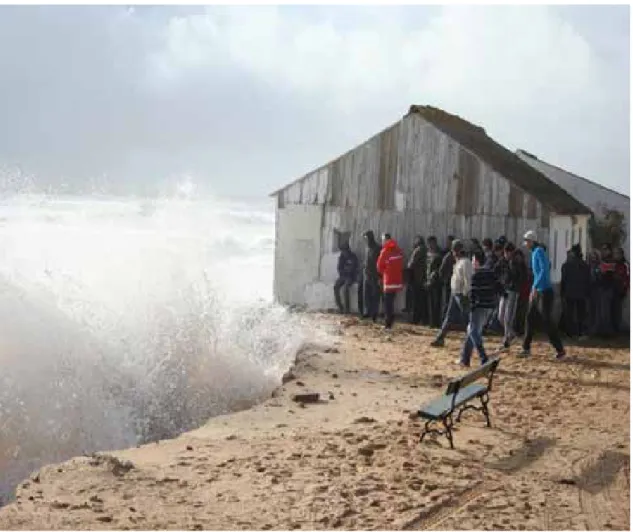
Figure 2. Storm at Faro Beach that led to loss of houses in 2010 (the house shown here is the same as in Figure 3)
Source: http://adefesadefaro.blogspot.pt/2011/02/ilha-de-faro-sob-risco-iminente.html (used with permission)
2.2 Data analysis
A qualitative content analysis based on an inductive approach was conducted to compile and analyse the interview data, following guidelines suggested by Gondim and Bendassolli (2014) and Mayring (2000). An inductive content analysis was used because the interviews were not structured around any previous psychological theory or model; therefore, an abstraction process that includes open coding and creating categories derived from the data is more suitable (Elo & Kyngäs, 2008). For that reason, the coding was primarily done by the first author and afterwards the co-authors checked the coding to ensure reliability.
The units of analysis considered were the interviews as a whole. The transcripts were read several times and meaningful units were gradually identified and open-coded. The codes were then formulated into sub-categories, and overarching categories were created out of the subcategories. Finally, main themes were identified.
3. RESULTS AND DISCUSSION
The content analysis allowed the identification of three main themes: (a) how individuals feel about Faro Beach; (b) how individuals perceive coastal risks; and (c) how individuals deal with coastal risks. Each theme will be presented and discussed with quotations from the interviews to illustrate the different categories identified.
3.1 How individuals feel about Faro Beach
When asked about how long they have been living/working at Faro Beach, why they have decided to move/stay there, how would they describe Faro Beach to outsiders and what they think is truly special about the beach, interviewees demonstrated strong and multifaceted emotional bonds to the place that were categorized as “sense of place”. Despite the different terminologies that exist for such constructs (e.g., place attachment, place identity, place dependence, sense of community, etc.), we opted to consider “sense of place” as a broad construct that includes cognitive, affective and conative dimensions (Jorgensen & Stedman, 2001), and that were sub-categorized in our analysis as place attachment, rooting, sense of community and place identity (Michel-Guillou & Meur-Ferec, 2017).
Place attachment, generally defined as an affective bond or link between people and specific places (Hidalgo & Hernández, 2001), was clear in all individuals. They said “We
built a link to this place, I like the island6 very much and I like living here”, or “I always felt a strong
link to this area, I feel like I was born here”. This bond is reflected on a desire to maintain closeness to the object of attachment, which is, ultimately, the main characteristic of the concept of attachment (Ainsworth & Bell, 1970): “I don’t want to leave the island”, “That
island… if they take this away from me, they take everything from me...”. This strong emotional attachment to Faro Beach seems to be associated to the concept of rooting, a type of spatial anchoring often reinforced by temporality, memories, intergenerational transmission and heritage (Michel-Guillou & Meur-Ferec, 2017). Interviewees have been living or working at Faro Beach for many decades (“I’ve been living at Faro Beach for 38 years”, “I’ve been living here
for 40 years, since I was 8”, “The restaurant was owned by my father, since almost 40 years ago”, “I
have a house at Faro Beach since I was born”) and they demonstrated the effect of heritage and intergenerational transmission, not only the whole-year residents but the second resident as well: “Part of the family died, and we stayed here, this is our land and homeland”; “My mom was born
here, so was her family and we built our small house (..) I have four children that are also living here”; “I spent all my childhood there and all summers I come here, come rain or come shine”; “We come every
summer, especially because of the kids – here, they are like I was, in a state of total freedom”.
Interviewees also showed a strong sense of community, related to their connections to local social networks and the interactions between them (Raymond, Brown & Weber, 2010). These social ties are especially relevant within the fishermen community and were evident in residents’ discourses: “The fishermen are a very strong community, they help each other”, “We help each other when something happens”, “We are a fishermen community, this is our heritage”, “This is a very small population, and we’ve known each other for many years, and sometimes you get
the seafood from one and the fish from others”.
Place identity is another construct that can be integrated in the overarching category of sense of place, and refers to a person’s sense of continuity, self-esteem, self-efficacy and sense of distinctiveness (Twigger-Ross & Uzell, 1996). The distinctive character of Faro Beach, i.e., the characteristics of the place the individual uses to differentiate it from others, was obvious in the discourses: “I think that the Ria Formosa and Faro Beach are among the most
beautiful things we have here in Portugal”, “This is the paradise, for us this is the paradise”, “The
freedom you get by living here, you’d never have living in a city”, “I would say that it is the best beach
in the world (…) and it is the best place for working”, “I’ve had the opportunity to visit several places
in the world and I’ve never found anything as good as this”.
We can argue that residents’ place attachment has had positive effects on their place perception, leading to a perceptual bias. Like Gifford (2014) puts it, “being attached to a place
is like wearing rose-colored glasses, and its flaws and dangers become less apparent”. The inflation of
6 Although not an island, but a peninsula (Península do Ancão), residents and outsiders usually refer to it as an island, because the attachment
to the mainland is approx. 4 kilometers away from the end of Faro Beach and the only road connection between the mainland and the beach is a bridge.
the place’s qualities can be explained by the social identity theory (Tajfel & Turner, 1986) as an unconscious process that people use to maintain their self-esteem, given that one’s self-identity is strongly linked to the places that are important for the individual (Gifford, 2014). Consequently, place attachment, place identity and related constructs will influence risk perceptions; strongly attached people will most likely (but not always, see review by Bonaiuto et al., 2016) minimize the risks associated to their place of attachment (e.g., Brown, Perkins & Brown, 2003; Billig, 2006).
Considering the person-process-place framework of place attachment (Scannell & Gifford, 2010), place attachment of Faro Beach residents seemed to be both at the individual level, mainly due to length of residence and familial heritage, and at the community level, due to the strong sense of community that has developed there, particularly among fishermen. The affective component is obvious from interviewees’ answers and it comprises positive feelings about the place and the desire to maintain closeness to that place; indeed, in terms of behavioral outcomes, residents show no intention of leaving the beach, not even in the future to mitigate potential problems caused by coastal hazards (Costas et al., 2015).
This resistance to relocation in Faro Beach residents has been viewed by coastal managers as a consequence of a misunderstanding of risks and, consequently, low risk perceptions (Costas et al., 2015). The same have been observed in other coastal populations; for instance, in the Aveiro region in NW Portugal, the majority of residents considered that it would be difficult for the population to move and adapt to areas farther away from the sea, due to their affective connections and economic dependence (Martins, Betâmio de Almeida & Pinho, 2009).
Research has shown that high levels of place attachment lead to feelings of safety and security in individuals (Billig, 2006); people are usually well aware of the risks associated with their environment and they accept those risks (Michel-Guillou & Meur-Ferec, 2017), usually in exchange for the benefits they obtain by living there (Costas et al., 2015). Individuals highly attached to a place also tend to view place change as negative (Anton & Lawrence, 2016), given that it may affect their place identity (Twigger-Ross & Uzell, 1996). This negative relationship between place attachment and risk perception has been observed not only for natural hazards and associated risks, such as seismic risks (Armaş, 2006) and volcano risks (Donovan, Suryanto & Utami, 2012) but also for war-related risks (Billig, 2006). However, positive relationships between place attachment and risk perception have also been found for volcano risks (Bird, Gísladóttir & Dominey-Howes, 2011), drought risks (Stain, Kelly, Carr, Lewin, Fitzgerald & Fragar, 2011) and other environmental risks.
Either way, place attachment and related constructs play significant roles as predictors, mediators or intervening factors in risk perceptions; therefore, people’s attachment to their places should be addressed in natural hazard risk management (Bonaiuto, Alves, De Dominicis & Petruccelli, 2016).
3.2 How individuals perceive coastal risks
Participants were asked several questions that aimed to understand their perceived levels of threat in relation to coastal hazards at Faro Beach, such as which are the major risks they face at the beach, if they feel people should be concerned and if they feel at risk. All residents revealed awareness about risks and some concern, but their risk perceptions are low (Costas
et al., 2015). When asked if people in the region should be concerned about storms and coastal erosion, they answered “We have to be concerned about the storms”, “The wind can remove
part of our roofs”, “I am more concerned about waves suddenly coming in than about a large storm; (…)
a storm is well predicted today and there are alerts”, “The people living and working here are concerned
Being aware of risks, i.e., having information and knowing about hazards and associated risks, does not necessarily lead to concern or increased risk perception. Concern about risks and risk perceptions are sometimes used interchangeably, but we consider concern a more rational, information-based process and risk perception an emotion-based construct or a subjective judgment that individuals make regarding the characteristics and severity of a risk (Gifford, 2014; Van der Linden, 2015). That is why the concern about risks that residents demonstrated was not reflected in high risk perceptions; despite being aware of risks, people feel safe at the beach: “We feel safe here at the beach”, “I was never afraid of the storms”, “There
is no risk for living here. We are not at risk; the houses are not at risk. Our houses do not fall, only if people don’t take care of them”, “I was not afraid, because I did not felt my life at risk”, “I never felt at
risk myself, because I felt everything was under control.”
Risk perception is influenced by many individual and contextual variables, such as age, gender, personality, social influences, information, education, etc. Another important variable that influences beliefs and perceptions is individuals’ past experience with hazards (Qasim, Nawaz Khan, Prasad Shrestha & Qasim, 2015; Guo & Li, 2016; Takahashi, Burnham, Terracina-Hartman, Sopchak & Selfa, 2016). When asked how often they have experienced hazards and disasters in the region, all interviewees answered that they have witnessed storms at the beach and they described past episodes: “I saw how the water passed over a car
parked here at the back”, “When we moved here and built our house, the sea came into the house… and
we had to collect parts of the house (that were transported along the shore)”, “It was very usual
for strong winds to damage the roofs of the houses”, “Two or three years ago, two very large waves came
suddenly and the entire bar was inundated”, “I remember huge storms, some years better, other years
worse”.
Although residents of Faro Beach have witnessed coastal hazards, most of them were not personally impacted by those hazards. The consequences of these events at Faro Beach have only been the destruction of houses (Figure 3) and roads that are usually rebuilt afterwards (Costas et al., 2015). The absence of serious consequences, like fatalities, may have contributed to an optimistic bias, making residents believe that they are personally less likely to experience negative outcomes than other people (Breakwell, 2014). The availability heuristics (a simple information-processing rule that relies on immediate examples that individuals easily remember: Tversky & Kahneman, 1974) may have also contributed to an underestimation of more frequent, less serious events (such as storms and erosion at Faro Beach) in relation to rare and catastrophic events (such as earthquakes and tsunamis) that are more easily remembered and overestimated. Therefore, past experience with hazards at Faro Beach in combination with cognitive biases may have played a significant role in decreasing risk perceptions of Faro Beach residents, explaining why they still feel safe living there.
3.3 How individuals deal with coastal risks
This theme was divided in two overarching categories: public participation in disaster risk reduction measures and preparedness towards coastal hazards. Disaster risk reduction (DRR) measures such as beach nourishment, dune rebuilding, coastal armoring, relocation, among others, have been suggested by stakeholders for the Ria Formosa system and, particularly, for Faro Beach (Costas et al., 2015). When asked about their willingness to participate in the implementation of such measures, interviewees demonstrated some openness and interest: “We would like very much to help, I would like very much to help improve the island”, “If they ask people
to volunteer, they will help, and it will be very cheap”, “The people living here have much to tell and
they should be listened to”, “The fishermen should be listened to, because they are pearls of wisdom.” However, residents are only willing to participate in the implementation of measures that
allow their permanence at the Beach, such as “planting plants and taking care of them” (to preserve the dune).
However, behavioral barriers to participation were also evident from residents’ discourses, mainly the threat perceived as distant in time, mistrust in authorities and the externalization of the responsibility/blame regarding coastal hazards and environmental problems. Regarding the latter, interviewees believe that “All the risks from sea rise could be
partially avoided if, for instance, the authorities plan or preserve the dune”, “The future of the beach
will be black with what the authorities are planning to do”, “They should definitely take measures
to avoid the risk”, “The administration only thinks about cleaning the beach, but not on keeping
or maintaining the beach”. Residents have shown disappointment for being invited only for informative sessions about measures to be implemented, but never to actual discussions about those measures: “They should invite us to accompany the process of discussion, but no, they
have only invited us once everything was decided; they never asked us anything”, “If we ask for a
meeting, we have to wait forever”, “They have never communicated or asked us anything”. The same scenario is observed in other coastal populations in Portugal, where people feel that their opinions are not considered by authorities, public meetings are not properly publicized and they consist more of public presentations of projects than discussions about them (Schmidt, Gomes, Guerreiro & O’Riordan, 2014). Indeed, public participation is usually very low in participatory strategies, because the majority of local people underestimates their potential influence (Schmidt et al., 2014); this may lead to a low perceived self-efficacy regarding coastal management decisions, acting as behavioral barrier to participation in discussions and DRR plans. Consequently, the mistrust that residents feel towards authorities is obvious: “The problems come from the relationship with the public institutions”, “I could say that we were
abandoned by the institutions (in charge of the Ria Formosa)”, “(The politicians) promise but then they
do nothing when they get to the power”, “The authorities have never met with us”, “They do not consider
us anymore”, “There are too many conflicts of interests here that we are missing”.
Figure 3. House threatened by storm-induced erosion at Faro Beach in the winter 2003 (the house seen in the photo is the same as in Figure 2)
Source: Author’s photo
Besides the externalization of responsibility and lack of trust in authorities, interviewees also perceive coastal risks as distant in time. Perceiving a threat as distant in time or space
is a common psychological barrier that leads to a lack of concern and preparedness to act (Spence, Poortinga & Pidgeon, 2012). This psychological distancing has been most commonly observed for global scale risks such as climate change (Lorenzoni, Nicholson-Cole & Whitmarsh, 2007; Pidgeon, 2012), but is was also evident in Faro Beach residents regarding local coastal hazards: “In the future, I think Faro Beach will stay like this, and if there are
any changes they will take a long time, not during my generation or my children’s”, “We all think that
someday the sea will come and it will make minor and major damages. Someday, the sea will take all the houses”. Psychological distance is an important factor in shaping people’s concern and risk perception, and it should be considered in risk communication strategies and environmental politics (Spence et al., 2012; Sacchi, Riva & Aceto, 2016). The large psychological distance that residents of Faro Beach demonstrate towards coastal hazards may have also contributed to their low risk perceptions.
Finally, considering that residents’ risk perceptions regarding coastal hazards are low, the externalization of responsibility and the psychological distancing, it is no surprise that their preparedness in case of disaster is also extremely low or even non-existent. When asked if they have measures or plans in case a storm or other event affects their houses or businesses, they said “I don’t’ have a plan B”, “I don’t have another hypothesis, I’ll just wait and see what
happens”, “We never had any problems, so we have no alternative plans”, “No, I don’t have any sort
of preparation in case something happens; I cannot do anything against nature”.
Given that a major goal of coastal management is to increase people’s preparedness and resilience to coastal risks, it is crucial to understand how and why individuals engage in preparation strategies (Lindell & Perry, 2000). Research has shown that preparedness is positively associated with risk perception (Miceli, Sotgiu & Settanni, 2008); given that risk perception is an emotional construct and it is affected by other variables that are mostly emotion-based, such as place attachment, it is clear that emotional factors are more important than cognitive ones in convincing people threatened by hazards to engage in preparation strategies. This is why giving people more information and education about hazards may not increase their risk perception, as intended. In fact, informed people, particularly those who expose themselves voluntarily to risks (Twigger-Ross & Breakwell, 1999), develop illusions that allow them to psychologically cope with the threats, and thus maintain their mental health and psychological well-being (Luís, Pinho, Lima & Roseta-Palma, 2016). This process, known as risk normalization, often results in a decrease in risk perception (Lima, 2004; Lima, Barnett & Vala, 2005; Luís et al., 2016).
4. CONCLUSION
Faro Beach is an intricate case in terms of coastal management and implementation of disaster risk reduction (DRR) strategies. It is located in a highly ecologically and economically valuable ecosystem, subject to multiple anthropogenic stressors and highly vulnerable to extreme storm events that often result in house and road destruction. Local residents seem to be aware of the risks to which they voluntarily expose themselves to and all interviewees have witnessed coastal hazards, but given that there were never fatalities or serious consequences, they have low risk perceptions. Residents feel safe living at the beach and show no intentions of ever leaving, mostly due to their strong emotional attachment to the place, based on decades of residency, familial heritage and social ties.
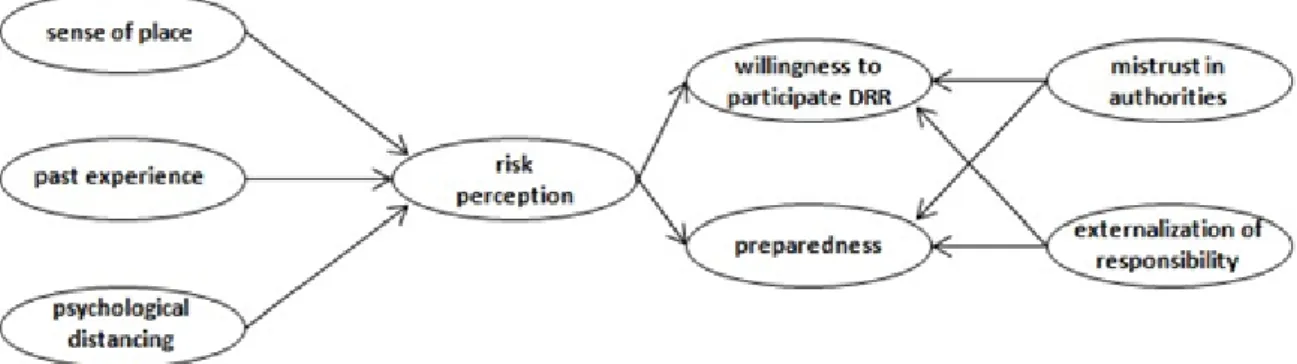
Based on the qualitative content analysis, a conceptual model of risk perception, preparedness and related variables in Faro Beach residents was developed (Figure 4). Residents’ risk perceptions seem to be negatively influenced by their sense of place (includes place attachment, rooting, sense of community and place identity), their past experience
with hazards and their perception of threats as distant in time. Risk perception, in turn, influences residents’ willingness to participate in disaster risk reduction strategies and their preparedness towards hazards. The mistrust that residents feel towards authorities and their (seemingly contradictory) externalization of responsibility also impact negatively their preparedness and participation in DRR measures. A psychometric approach should follow to quantitatively evaluate the proposed relationships.
Figure 4. Conceptual model of risk perceptions, preparedness and related psychological and behavioral variables, based on interviews conducted with Faro Beach residents
Source: Own Elaboration
In terms of socio-political implications, knowledge on the psychological dimensions of coastal hazards is critical for an informed and sustainable management. Education and information are not a panacea to solve environmental problems and may even have the opposite effect, by decreasing risk perceptions through the process of risk normalization (Luís et al., 2016). Indeed, “people are not logical, they are psychological” (anonymous) – in order to increase awareness, risk perception, preparedness and resilience of coastal populations, i.e., to change beliefs, attitudes and behaviors, a thorough understanding of the emotional, cognitive and conative processes that drive individuals is a critical component. Therefore, a holistic approach that integrates not only sociological, economic and ecological perspectives, but also a psychological one is critical to increase the effectiveness and feasibility of management plans and the implementation of DRR measures in vulnerable coastal regions.
ACKNOWLEDGEMENTS
The Portuguese Foundation for Science and Technology (FCT) provided funding for R.B.D. through a postdoctoral fellowship (SFRH/BPD/108444/2015). Ó.F. and S.C. participation was under the scope of the EU FP7 research project RISC-KIT (ref. RISC-KIT-GA-2013-603458).
REFERENCES
Ainsworth, M. D. S. and Bell, S. M. (1970). Attachment, exploration, and separation: illustrated by the behavior of one-year-olds in a strange situation. Child Development. 41: 49–67.
Anton, C. E. and Lawrence, C. (2016). The relationship between place attachment, the theory of planned behaviour and residents’ response to place change. Journal of Environmental
Armaş, I. (2006). Earthquake risk perception in Bucharest, Romania. Risk Analysis. 26(5): 1223–1234. http://doi.org/10.1111/j.1539-6924.2006.00810.x
Billig, M. (2006). Is my home my castle? Place attachment, risk perception, and religious faith.
Environment and Behaviour. 38(2): 248–265. http://doi.org/10.1177/0013916505277608 Bird, D. K., Gísladóttir, G. and Dominey-Howes, D. (2011). Different communities, different
perspectives: issues affecting residents’ response to a volcanic eruption in southern Iceland. Bulletin of Volcanology. 73: 1209–1227.
Bonaiuto, M., Alves, S., De Dominicis, S. and Petruccelli, I. (2016). Place attachment and natural environmental risk: research review and agenda. Journal of Environmental Psychology. 48: 33–53. http://doi.org/10.1016/j.jenvp.2016.07.007
Breakwell, G. M. (2014). The Psychology of Risk. Cambridge University Press.
Brown, B., Perkins, D. D. and Brown, G. (2003). Place attachment in a revitalizing neighborhood: Individual and block levels of analysis. Journal of Environmental Psychology. 23(3): 259–271. http://doi.org/10.1016/S0272-4944(02)00117-2
Costas, S., Ferreira, O. and Martinez, G. (2015). Why do we decide to live with risk at the coast? Ocean and Coastal Management. 118: 1–11. http://doi.org/10.1016/j. ocecoaman.2015.05.015
Crooks, S. and Turner, R. K. (1999). Integrated coastal management: sustaining estuarine natural resources. Advances in Ecological Research. 29: 241–289. http://doi.org/10.1016/ S0065-2504(08)60195-6
Dias, J. (1993). Estudo de Avaliação da Situação Ambiental e Proposta de Medidas de Salvaguarda
para a Faixa Costeira Portuguesa (Geologia Costeira). Liga para a proteção da Natureza. Donovan, K., Suryanto, A. and Utami, P. (2012). Mapping cultural vulnerability in volcanic
regions: The practical application of social volcanology at Mt Merapi, Indonesia.
Environmental Hazards-Human and Policy Dimensions. 11(4): 303–323. http://doi.org/10.1 080/17477891.2012.689252
EEA (2006). The changing faces of Europe’s coastal areas. Publications of the European Communities (Vol. 6). Accessed in January 2017 on the website: http://www.eea.europa.eu/publications/ eea_report_2006_6
Elo, S. and Kyngäs, H. (2008). The qualitative content analysis process. Journal of Advanced
Nursing. 62(1): 107–115. http://doi.org/10.1111/j.1365-2648.2007.04569.x Gifford, R. (2014). Environmental Psychology. Optimal Books.
Gondim, S. M. G. and Bendassolli, P. F. (2014). The use of the qualitative content analysis in psychology: A critical review. Psicologia em Estudo. 19(2): 191–199. http://doi. org/10.1590/1413-737220530002
Guimarães, M. (2010). The use of q-methodology to obtain stakeholder discourses on the future development of Ria Formosa coastal zone, south of Portugal. Revista Portuguesa de
Estudos Regionais. 23: 5–19.
Guo, Y. and Li, Y. (2016). Getting ready for mega disasters: the role of past experience in changing disaster consciousness. Disaster Prevention and Management: An International
Journal. 25(4): 492–505.
Hidalgo, M. C. and Hernández, B. (2001). Place attachment: conceptual and empirical questions. Journal of Environmental Psychology. 21(3): 273–281. http://doi.org/10.1006/ jevp.2001.0221
Jorgensen, B. S. and Stedman, R. C. (2001). Sense of place as an attitude: lakeshore owners attitudes toward their properties. Journal of Environmental Psychology. 21(3): 233–248. http://doi.org/10.1006/jevp.2001.0226
Kennish, M. and Paerl, H. (2010). Coastal lagoons: critical habitats of environmental change. In: M. Kennish and H. Paerl (eds.), Coastal Lagoons: Critical Habitats of Environmental
Change. CRC Press.
Lima, M. L. (2004). On the influence of risk perception on mental health: living near an incinerator. Journal of Environmental Psychology. 24(1): 71–84. http://doi.org/10.1016/ S0272-4944(03)00026-4
Lima, M. L., Barnett, J. and Vala, J. (2005). Risk perception and technological development at a societal level. Risk Analysis. 25(5): 1229–1239. http://doi.org/10.1111/j.1539-6924.2005.00664.x
Lindell, M. K. and Perry, R. W. (2000). Household adjustment to earthquake hazard: a review of research. Environment & Behaviour. 32(4): 461–501.
Lloret, J., Marín, A. and Marín-Guirao, L. (2008). Is coastal lagoon eutrophication likely to be aggravated by global climate change? Estuarine, Coastal and Shelf Science. 78(2): 403–412. http://doi.org/10.1016/j.ecss.2008.01.003
Lorenzoni, I., Nicholson-Cole, S. and Whitmarsh, L. (2007). Barriers perceived to engaging with climate change among the UK public and their policy implications. Global Environmental
Change. 17(3–4): 445–459. http://doi.org/10.1016/j.gloenvcha.2007.01.004
Luís, S., Pinho, L., Lima, M. L. and Roseta-Palma, C. (2016). Is it all about awareness ? The normalization of coastal risk. Journal of Risk Research. 19(6): 810–826. http://doi.org/10.1 080/13669877.2015.1042507
Martins, F., Betâmio de Almeida, A. and Pinho, L. (2009). Have you ever listened coastal inhabitants? Know what they think… Journal of Coastal Research. 56: 1242–1246.
Mayring, P. (2000). Qualitative Content Analysis. Forum: Qualitative Social Research. 1(2), Art. 20.
McGranahan, G., Balk, D. and Anderson, B. (2007). The rising tide: assessing the risks of climate change and human settlements in low elevation coastal zones. Environment &
Urbanization. 19(1): 17–37. http://doi.org/10.1177/0956247807076960
Miceli, R., Sotgiu, I. and Settanni, M. (2008). Disaster preparedness and perception of flood risk: a study in an alpine valley in Italy. Journal of Environmental Psychology. 28(2): 164–173. http://doi.org/10.1016/j.jenvp.2007.10.006
Michel-Guillou, E. and Meur-Ferec, C. (2017). Living in an “At Risk” environment: the example of “coastal risks.” In: G. Fleury-Bahi, E. Pol and O. Navarro (eds.), Handbook of
Environmental Psychology and Quality of Life Research. Springer.
Neumann, B., Vafeidis, A. T., Zimmermann, J. and Nicholls, R. J. (2015). Future coastal population growth and exposure to sea-level rise and coastal flooding - a global assessment.
PLoS ONE. 10(3). http://doi.org/10.1371/journal.pone.0118571
Pidgeon, N. (2012). Public understanding of, and attitudes to, climate change: UK and international perspectives and policy. Climate Policy. 12(SUPPL. 1): S85–S106. http:// doi.org/10.1080/14693062.2012.702982
Qasim, S., Nawaz Khan, A., Prasad Shrestha, R. and Qasim, M. (2015). Risk perception of the people in the flood prone Khyber Pukhthunkhwa province of Pakistan. International
Raymond, C. M., Brown, G. and Weber, D. (2010). The measurement of place attachment: personal, community, and environmental connections. Journal of Environmental Psychology. 30(4): 422–434. http://doi.org/10.1016/j.jenvp.2010.08.002
Risc-Kit. (2016). Multi-Criteria Analysis Guide. Accessed in January 2017 on the website: http://www.risckit.eu
Sacchi, S., Riva, P. and Aceto, A. (2016). Myopic about climate change: Cognitive style, psychological distance, and environmentalism. Journal of Experimental Social Psychology. 65: 68–73. http://doi.org/10.1016/j.jesp.2016.03.006
Scannell, L. and Gifford, R. (2010). Defining place attachment: a tripartite organizing framework. Journal of Environmental Psychology. 30(1): 1–10. http://doi.org/10.1016/j. jenvp.2009.09.006
Schmidt, L., Gomes, C., Guerreiro, S. and O’Riordan, T. (2014). Are we all on the same boat? The challenge of adaptation facing Portuguese coastal communities: risk perception, trust-building and genuine participation. Land Use Policy. 38: 355–365. http://doi. org/10.1016/j.landusepol.2013.11.008
Spence, A., Poortinga, W. and Pidgeon, N. (2012). The psychological distance of climate change. Risk Analysis. 32(6): 957–972. http://doi.org/10.1111/j.1539-6924.2011.01695.x Stain, H. J., Kelly, B., Carr, V. J., Lewin, T. J., Fitzgerald, M. and Fragar, L. (2011). The
psychological impact of chronic environmental adversity: responding to prolonged drought. Social Science & Medicine. 73: 1593–1599.
Tajfel, H. and Turner, J. C. (1986). The social identity theory of intergroup behavior. In: W.G. Austin and S. Worchel (eds.), Psychology of Intergroup Relations. Nelson-Hall Publishers. http://doi.org/10.1111/j.1751-9004.2007.00066.x
Takahashi, B., Burnham, M., Terracina-Hartman, C., Sopchak, A. R. and Selfa, T. (2016). Climate change perceptions of NY state farmers: the role of risk perceptions and adaptive capacity. Environmental Management. 58(6): 946–957. http://doi.org/10.1007/s00267-016-0742-y
Tversky, A. and Kahneman, D. (1974). Judgment under uncertainty: heuristics and biases.
Science. 185: 1124–1131.
Twigger-Ross, C. L. and Breakwell, G. M. (1999). Relating risk experience, venturesomeness and risk perception. Journal of Risk Research. 2(1): 73–83. http://doi. org/10.1080/136698799376998
Twigger-Ross, C. L. and Uzell, D. L. (1996). Place and identity processes. Journal of
Environmental Psychology. 16(16): 205–220. http://doi.org/10.1006/jevp.1996.0017
Van der Linden, S. (2015). The social-psychological determinants of climate change risk perceptions: Towards a comprehensive model. Journal of Environmental Psychology. 41: 112– 124. http://doi.org/10.1016/j.jenvp.2014.11.012
Viegas, G. (2003). Contribuição para o estudo da “capacidade de carga” da Praia de Faro. Relatório de Estágio de Licenciatura em Biologia Marinha e Pescas. Universidade do Algarve.