SUMMARY
The DNA from eighty goats belonging to the indigenous portuguese caprine breed Charne-queira, ecotype from Beira Baixa (Beiroa), was analysed. Single-strand conformation polymor-phisms were identified at exon 9 and at exons 10-11 of the as1-casein gene and at exon 4 of the k-casein. The b-casein gene was found monomorphic at exon 7 in this population sam-ple. The establishment of an association of some of these SSCP polymorphisms with milk produc-tion and protein and fat content was attempted.
RESUMEN
Se analiz— el DNA de ochenta cabras aut—c-tonas portuguesas de la raza Charnequeira, eco-tipo de la Beira Baixa (Beiroa). Se identificaron polimorfismos conformacionales de cadena mo-nocatenaria en el ex—n 9 y en los exones 10-11
del gen de la as1-case’na y en el ex—n 4 de la k-case’na. El gen de la b-case’na se identific— co-mo co-monom—rfico en el ex—n 7 en el muestreo de esta poblaci—n. Se intent— el establecimiento de relaciones entre algunos de estos polimorfismos de SSCP y la producci—n de leche, contenido proteico y de grasa.
INTRODUCTION
Single-strand conformation poly-morphism (SSCP) is a powerful me-thod for identifying sequence variation in amplified DNA. SSCP analysis of DNA have been used for detection of genetic mutations in humans (Orita et
al., 1989), rats (Pravenec et al., 1992),
cattle (Kirkpatrick, 1992) and in va-rious bacteriological (Morohoshi et al., PALABRAS CLAVE ADICIONALES
Cabras. SSCP. PCR. Polimorfismos genŽticos. as1-case’na. b-case’na. k-case’na.
ADDITIONAL KEYWORDS
Goat. SSCP. PCR. Genetic polymorphisms. as1 -casein. b-casein. k-casein.
CHARNEQUEIRA PORTUGUESE INDIGENOUS GOAT BREED
ANçLISIS POR POLIMORFISMO CONFORMACIONAL DE CADENA MONOCATENARIA (SSCP) DE LOS GENES aS1-CASEêNA, b-CASEêNA Y k-CASEêNA EN LA CABRA
PORTUGUESA AUTîCTONA CHARNEQUEIRA Bonif‡cio, C.1, I.C. Santos1, C. Belo2and A. Cravador1
1Unidade de Ci•ncias e Tecnologias Agr‡rias. Universidade do Algarve. 8000-810 Faro. Portugal. E-mail: [email protected]
2Esta•‹o ZootŽcnica Nacional. Departamento de Ovinicultura e Caprinicultura. Fonte Boa. 2000-763 Vale de SantarŽm. Portugal. E-mail: [email protected]
1991) and viral (Fujita et al., 1992) systems.
The search for SSCP polymor-phisms could lead to the finding of ge-netic markers useful for improved se-lection of agricultural populations, namely when applied to candidate ge-nes associated with quantitative genetic variation in traits of economic impor-tance.
Most significant studies using the SSCP approach were accomplished on bovines in linkage analysis (Neibergs et
al., 1993) and to define intragenic
ha-plotypes at the growth hormone (Lag-ziel et al., 1996).
The present study is part of a gene-tic improvement programme of the in-digenous portuguese caprine breed Charnequeira. Charnequeira goats are reared mainly in the northern part of Alentejo, southern part of Beira Baixa (Castelo Branco, Idanha-a-Nova, Pena-macor, Vila Velha do R—d‹o) and also in southern Alentejo (Sines, Santiago de CacŽm, Odemira) where they are very well adapted to their natural envi-ronment. They are used for meat and for cheese. This work describes some SSCP polymorphisms at the as1-casein, b-casein and k-casein genes from 80 goats belonging to the indigenous por-tuguese caprine breed Charnequeira, ecotype from Beira Baixa (Beiroa).
MATERIAL AND METHODS
DNA
SAMPLESDNA was obtained from peripheral blood leukocytes of 80 animals of Charnequeira goat breed ecotype Bei-roa using a DNA isolation kit from Pu-regene.
PCR
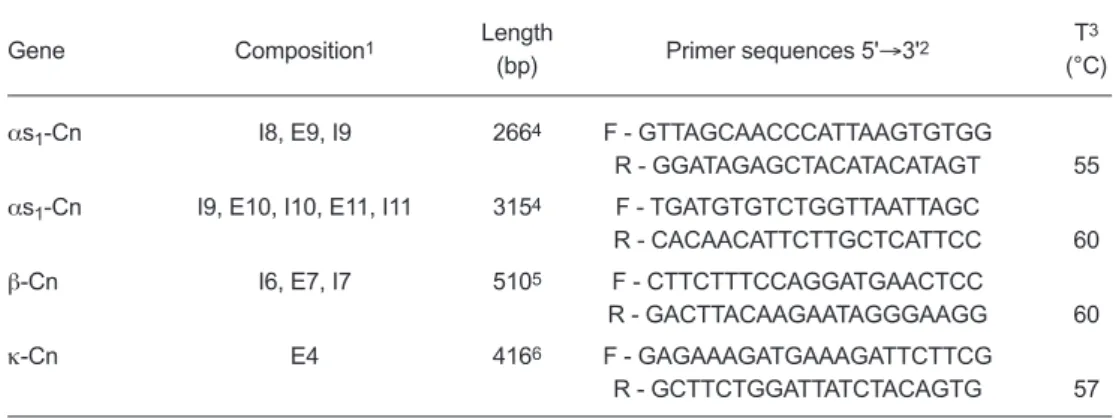
AMPLIFICATIONThe lactoprotein genes were ampli-fied by PCR using the four primer pairs shown in table I. Four amplification fragments were generated ranging in si-ze from 257 to 500 bp. PCR amplifica-tion was carried out for each primer pair using Ready-To-Go PCR Beads (Amersham Pharmacia Biotech) accor-ding to the following conditions. Each lyophilized Bead contains 1.5 units of
Taq DNA polymerase, 10 mM Tris-HCl
(pH 9), 50 mM KCl, 1.5 mM MgCl2 and 200 mM of each dNTP. The reac-tion mixture was completed with 16 pmol of each primer (32 pmol for am-plification of exon 4 of k-casein) and 50 ng of genomic DNA. For amplifica-tion of exon 7 of b-casein a final con-centration of 2.5 mM of MgCl2 was used. The amplification began with de-naturation at 95¼C for 5 min followed by 30 cycles of denaturation at 95¼C for 30 s, annealing at 55¼C, 57¼C or 60¼C during 30s and extension for 30 s at 72¼C and was concluded with a final extension at 72¼C for 5 min.
SSCP
ANALYSIS OF THEa
S1-
CASEIN,
b-
CASEIN ANDk-
CASEIN GENES For SSCP analysis, 5 (l of each am-plification product were added to 15 ml of stop solution (95 p.100 formamide, 10 mM NaOH, 0.05 p.100 xylene cya-nol and 0.05 p.100 bromophecya-nol blue). The samples were heat-denatured at 95¼C for 5 min and chilled on ice, and loaded onto a 9 p.100 (exon 9 of as1 -casein), 12 p.100 (exons 10-11 of as1 -casein), 7 p.100 (exon 4 of k-casein) or 8 p.100 (exon 7 of b-casein) polyacry-lamide/TBE 0,5x gel containing, only for exon 4 of k-casein and exon 7 ofb-casein, 5 p.100 of glycerol. Gels were run at 25W (as1-casein) or 30 W (k-ca-sein and b-ca(k-ca-sein) for 2 h 50 min (exon 9 of as1-casein), 3 h 30 min (exons 10-11 of as1-casein), 4 h 30 min (exon 4 of k-casein) or 5 h 30 min (exon 7 of b-casein) at 15¼C while cooling using a DCodeª Universal Mutation Detec-tion System (BIO-RAD). After the run the gel was removed from the appara-tus and the DNA bands were visualised through silver staining.
RESULTS
SSCP
POLYMORPHISMSWe have chosen the exon 7 of the b-casein gene, the exon 4 of the k-b-casein gene and the exons 9 and 10-11 of the as1-casein gene for the SSCP analysis.
The analysis of the amplified frag-ments by the PCR method using the pri-mers described in table I is shown in
fi-gure 1. Their lengths correspond to
tho-se expected according to the position of the primers deduced from the described nucleotide sequence of the correspon-ding genes from Capra hircus (Vilotte
et al., 1991; Leroux et al., 1992;
Ro-berts et al., 1992). Considering the eighty Charnequeira goats the following SSCP polymorphisms were found insi-de each of those fragments (figures 2,
3, 4 and table II). Five conformational
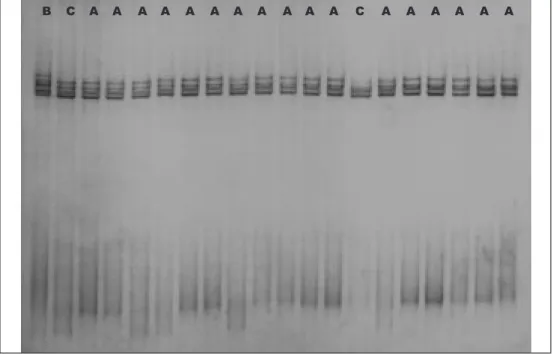
patterns were found in exon 9 of the as1-casein gene and three conformatio-nal patterns in exons 10-11 of the same gene. Two conformational patterns were identified in exon 4 of the k-casein ge-ne. The exon 7 of the b-casein gene was found monomorphic (not shown).
Table I. SSCP fragments at the casein genes and PCR analysis parameters for the Charne-queira goat breed.. (Fragmentos de SSCP de genes de las caseinas y par‡metros de an‡lisis PCR pa-ra la cabpa-ra de la pa-raza Charnequeipa-ra).
Gene Composition1 Length Primer sequences 5'®3'2 T3
(bp) (¡C)
as1-Cn I8, E9, I9 2664 F - GTTAGCAACCCATTAAGTGTGG
R - GGATAGAGCTACATACATAGT 55 as1-Cn I9, E10, I10, E11, I11 3154 F - TGATGTGTCTGGTTAATTAGC
R - CACAACATTCTTGCTCATTCC 60
b-Cn I6, E7, I7 5105 F - CTTCTTTCCAGGATGAACTCC
R - GACTTACAAGAATAGGGAAGG 60
k-Cn E4 4166 F - GAGAAAGATGAAAGATTCTTCG
R - GCTTCTGGATTATCTACAGTG 57 1Fragment composition: E1, E2, Éexon 1, exon 2,É; I1, I2, É, intron 1, intron 2,É.
2F: forward primer; R: reverse primer. 3Optimum annealing temperature. 4Leroux et al., 1992.
5Roberts et al., 1992. 6Chikuni et al., 1995.
Figure 1. 2% Agarose gel electrophoresis of the fragments amplified with the primers specific to b-casein exon 7 (c and d), k-casein exon 4 (f and g), as1-casein exon 9 (j) and as1-casein exons 10-11 (m and n); b, e, h, i and l are negative controls; a - molecular marker (HaeIII f x174 (in bp). (Electrophoresis en gel de agarose a 2% de fragmentos amplificados con primers espec’fi-cos para la b-caseina ex—n 7 (c y d), k-caseina ex—n 4 (f y g), as1-caseina ex—n 9 (j) y as1-caseina exones 10-11 (m y n); b, e, h, i y l son controles negativos; a - marcador molecular (HaeIII f x174 (en bp)).
a 1353 (bp) 1078 872 603 310 283 271 b c d e f g h i j l m n
Figure 2. SSCP analysis at exon 9 of the as1-casein gene in Charnequeira goat breed (20 animals). A to D - conformational patterns; X - no amplification. (An‡lisis SSCP del exon 9 del gen de la as1-caseina en la cabra Charnequeira (20 animales). A a D - padrones conformacionales; X - sin amplificaci—n).
Figure 3. SSCP analysis at exons 10-11 of the as1-casein gene in Charnequeira goat breed (20 animals). A to C - conformational patterns. (An‡lisis SSCP de los exones 10-11 del gen de la as1-caseina en la cabra Charnequeira (20 animales). A a C - padrones conformacionales).
B C A A A A A A A A A A A C A A A A A A
Figure 4. SSCP analysis at exon 4 of the k-casein gene in Charnequeira goat breed (20 ani-mals). A and B - conformational patterns. (An‡lisis SSCP del ex—n 4 del gen de la k-caseina en la cabra Charnequeira (20 animales). A y B - padrones conformacionales).
S
E A R C H F O R A N A S S O C I AT I O N O FSSCP
POLYMORPHISMS WITH MILK PRODUCTION AND WITH PROTEIN AND FAT CONTENTWe have made a preliminary at-tempt towards the search for associa-tions between the SSCP polymor-phisms and quantitative variation in the productive traits. However, the results obtained using the SAS programme ap-plied to the analysis of linear contrasts of SSCPs relating to milk production, protein and fat content for each exon analysed did not allow to conclude to the existence of any association betwe-en the observed polymorphisms and productive trait in this sample.
DISCUSSION
Milk composition, namely its pro-tein content, is the main factor influen-cing the yield of cheese production. The polymorphism of milk proteins af-fect the milk composition and cheese quality. Caseins, in particular, have be-en proposed as polymorphic markers for the selection of goats in order to improve the yield and the quality of cheese. The SSCP analysis of milk pro-tein genes could be a valuable alterna-tive approach for establishing allelic variants useful as markers to aid selec-tion. We have applied this technique to exon 7 of the b-casein gene, exon 4 of Table II. Schematic representation of SSCP patterns for the indicated Charnequeira goat ca-sein exons and respective frequencies. (Representaci—n esquem‡tica de los padrones SSCP para los exones de las caseinas de cabra Charnequeira indicados y respectivas frecuencias).
Pattern A Pattern B Pattern C Pattern D as1-Cn Exon 9 87,5% 1,25% 6,25% 3,75% as1-Cn Exon 10-11 93,75% 1,25% 5% k-Cn Exon 4 77,5% 22,5% b-Cn Exon 7 100%
the k-casein gene and exons 9 and 10-11 of the as1-casein gene from the in-digenous portuguese caprine breed Charnequeira ecotype Beiroa. The SSCP polymorphisms we have found in these genes coding for milk proteins hint at the possibility of exploring this approach for the search of genetic mar-kers located in these genes. In spite of the impossibility of concluding through statistical analyses within our sample, to the existence of associations between the polymorphisms observed and milk production and protein and fat content the SSCP polymorphic va-riation makes these genes potential candidates for the establishment of as-sociations with quantitative traits. In-deed, our sample is too small and our analysis limited to a few number of exons containing a small portion of the
genes. At the protein level various ca-sein polymorphisms were determined in goats and correlated with milk com-position and physicochemical proprie-ties (Manfredi et al, 1993; DallÕOlio et
al, 1989). The SSCP approach could be
used in a more extended study for the establishment of a correspondence with the observed protein polymor-phism. The complete analysis of the exons of casein genes should lead to the definition of haplotypes represen-ting all the DNA sequence alleles pre-sent at these casein genes in a larger population of this breed. If it is possi-ble to specifically define haplotypes at these candidate genes that can be asso-ciated with milk production, protein and fat content it would be rendered available a valuable genetic resource for improvement of this caprine breed.
REFERENCES
DallÕOlio, M. and J. Gellin. 1989. Affinity chroma-tography of ovine casein. Anim. Genet., 20: 108.
Fugita, K., J. Silver and K. Peden. 1992. Chan-ges in both gp120 and gp41 can account for increased growth potential and expanded host range of human immunodeficiency virus type 1. J. Virol., 66: 4445-4451.
Kirkpatrick, B.W. 1992. Detection of a three-allele single strand conformation polymorphism (SSCP) in the fourth intron of the bovine growth hormone gene. Anim. Genet., 23: 179-181.
Lagziel, A., E. Lipkin and M. Soller. 1996. Asso-ciation between SSCP haplotypes at the bo-vine growth hormone gene and milk protein percentage. Genetics, 142: 945-951. Leroux, C., N. Mazure and P. Martin. 1992.
Muta-tions away from splice site recognition
se-quences might cis-modulate alternative spli-cing of goat as1-casein transcripts. J. Biol.
Chem., 267: 6147-6157.
Manfredi, E., M.E. Barbieri, J. Bouillon, A. Piac•-re, M.F. MahŽ, F. Grosclaude and G. Ricorde-au. 1993. Effets des variants de la casŽine as1sur les performances laiti•res de ch•-vres. Lait, 73: 567-572.
Morohoshi, F., K. Hayashi and N. Munakata. 1991. Molecular analysis of Bacillus subtilis ada mutants deficient in the adaptative res-ponse to simple alkylating agents. J. Bacte-riol., 173: 7834-7840.
Neibergs, H.L., A.B. Dietz and J.E. Womack. 1993. Single strand conformation polymor-phisms (SSCP) detected in five bovine ge-nes. Anim. Genet., 24: 81-84.
Orita, M., H. Iwahana, K. Hayashi and T. Sekiya. 1989. Detection of polymorphisms of human
DNA by gel electrophoresis as single-strand conformation polymorphisms. Proc. Nat. Acad. Sci. USA, 86: 2766-2670.
Pravenec, M., L. Simonet, V. Kren, E. St. Lezin, G. Levan, J. Szpirer, C. Szpirer and T. Kurtz. 1992. Assignment of rat linkage group V to chromosome 19 by single strand conforma-tion polymorphism analysis of somatic cell hybrids. Genomics, 12: 350-356.
Roberts, B.T., P. Ditullio, J. Vitale, K. Hehir and K. Gordon. 1992. Cloning of the goat b-casein gene and expression in transgenic mice. Ge-ne, 121: 255-262.
Sneyers, M., R. Renaville, M. Falaki, S. Massart, A. Devolder, F. Boonen, E. Marchand, A. Brandi, A. Burny and D. Portetelle. 1994. Taq I restriction fragment length polymorphism for growth hormone in bovine breeds and their association with quantitative traits. Growth Regulation, 4: 108-112.
Vilotte, J.L., S. Soulier, C. Printz and J.C. Mer-cier. 1991. Complete nucleotide sequence of goat alpha-lactalbumin-encoding gene: com-parison with its bovine counterpart and evi-dence of alpha-lactalbumin-related sequen-ces in goat genome. Gene, 98: 271-276.