1
This article was published in Renewable and Sustainable Energy Reviews, 42,
1187-1213, 2015
http://dx.doi.org/10.1016/j.rser.2014.10.084
Challenges and Strategies for Optimization of
Glycerol Steam Reforming Process
Joel M. Silva
1, M. A. Soria
1,*, Luis M. Madeira
1,*1
LEPABE, Department of Chemical Engineering, Faculty of Engineering,
University of Porto, Rua Dr. Roberto Frias s/n, 4200-465 Porto, Portugal
* Corresponding Authors.
[email protected]
(MA Soria) and +351-225081519 /
2
Abstract
The steam reforming of the main biodiesel by-product, glycerol, has been catching up the interest of the scientific community in the last years. The use of glycerol for hydrogen production is an advantageous option not only because glycerol is renewable but also because it’s use would lead to the decrease of the price of biodiesel, thus making it more competitive. Consequently, the use of biodiesel at large scale would significantly reduce CO2 emissions comparatively to fossil fuels. Moreover,
hydrogen itself is seen as a very attractive clean fuel for transportation purposes. Therefore, the industrialization of the glycerol steam reforming (GSR) process would have a tremendous global environmental impact. In the last years, intensive research regarding GSR thermodynamics, catalysts, reaction mechanisms and kinetics, and innovative reactor configurations (sorption enhanced reactors (SERs) and membrane reactors (MRs)) has been done, aiming for improving the process effectiveness. In this review, the main challenges and strategies adopted for optimization of GSR process are addressed, namely the GSR thermodynamic aspects, the last developments on catalysis and kinetics, as well as the last advances on GSR performed in SERs and MRs.
Keywords: glycerol; steam reforming; catalyst; kinetics; sorption enhanced reactor;
Table of Contents
1 Introduction ... 1
2 Thermodynamics of GSR – Influence of different parameters ... 3
2.1 Conventional GSR ... 3
2.2 GSR with CO2 Sorption ... 5
2.3 GSR with H2 Removal... 8
3 GSR catalysts developments ... 10
3.1 Ni-based Catalysts ... 10
3.1.1 Effect of the support on the catalytic performance ... 10
3.1.2 Effect of the addition of a promoter on the catalytic performance ... 12
3.2 Pt-based Catalysts ... 14
3.2.1 Effect of the support on the catalytic performance ... 14
3.2.2 Effect of the addition of a promoter on the catalytic performance ... 16
3.3 Co-based Catalysts ... 17
3.3.1 Effect of the support on the catalytic performance ... 17
3.3.2 Effect of the addition of a promoter on the catalytic performance ... 17
3.4 Ru-based catalysts ... 19
3.4.1 Effect of the support on the catalytic performance ... 19
3.4.2 Effect of the addition of a promoter on the catalytic performance ... 20
3.5 Other noble metal-based Catalysts ... 21
4 Mechanisms and Kinetics ... 24
5 Sorption-Enhanced Reactors ... 30
5.1 CO2 Sorbents ... 30
5.2 Sorption Enhanced Glycerol Steam Reforming ... 32
5.2.1 Effect of Temperature ... 33
5.2.2 Effect of the Water/Glycerol Feed Ratio ... 34
5.2.3 Effect of Pressure ... 36
6 Membrane Reactors ... 37
6.1 Hydrogen perm-selective membranes for membrane reactors ... 37
6.2 Glycerol Steam Reforming in Membrane Reactors ... 39
6.2.1 Effects of Temperature, Pressure and weight hourly space velocity ... 39
7 Conclusions ... 42
Notation and Glossary
𝐸𝑎 Activation energy
𝐸𝑎,𝑃𝑑 Activation energy of a Pd-based membrane
𝑓 Fraction of H2 removal
𝐺 Gibbs free energy
𝐽𝐻2 Flux of H2 through the membrane
𝐾 Equilibrium constant
𝑘 Reaction rate constant
𝐾𝑖 Adsorption constant of component 𝑖
𝑘0 Pre-exponential factor
𝑘𝐶 Coke deposition reaction rate constant
𝑛𝑖 Molar number of component 𝑖
𝑝𝐻2,𝑝𝑒𝑟𝑚𝑒𝑎𝑡𝑒 Partial pressure of H2 in the permeate side 𝑝𝐻2,𝑟𝑒𝑡𝑒𝑛𝑡𝑎𝑡𝑒 Partial pressure of H2 in the retentate side 𝑝𝑖 Partial pressure of component 𝑖
𝑃𝑃𝑑,𝐻2 Permeability of a Pd-based membrane to H2 𝑃𝑃𝑑,𝐻0 2 Pre-exponential factor
𝑅 Ideal gas constant
𝑟
𝑐𝑜𝑘𝑒 𝑑𝑒𝑝𝑜𝑠𝑖𝑡𝑖𝑜𝑛 Reaction rate of coke deposition𝑟𝐺𝑆𝑅 Reaction rate of glycerol steam reforming
𝑇 Absolute temperature
𝑋1, 𝑋2 Basic and acid active sites, respectively
Greek letters
𝛿 Membrane thickness
𝛥𝐻0 Standard enthalpy
∆𝐻𝑟298 𝐾 Reaction enthalpy at 298 K
𝜇𝑖 Chemical potential of component 𝑖
Superscripts
𝑎, 𝑏 Partial reaction orders for glycerol and steam, respectively
𝑥 Pressure exponent
List of acronyms
CTAB Cetyltrimethyl Ammonium Bromide
CVD Chemical Vapor Deposition
EP Electroless Plating
GHSV Gas Hourly Space Velocity
GSR Glycerol Steam Reforming
IUPAC International Union of Pure and Applied Chemistry
MR Membrane Reactor
PEMFC Polymer Electrolyte Membrane Fuel Cell PSA Pressure Swing Adsorption
PSS Porous Stainless Steel
SEGSR Sorption-Enhanced Glycerol Steam Reforming
SER Sorption-Enhanced Reactor
SRM Steam Reforming of Methane
TR Traditional Reactor
WGS Water-Gas Shift
WHSV Weight Hourly Space Velocity YSZ Yttria-Stabilized Zirconia
1
1 Introduction
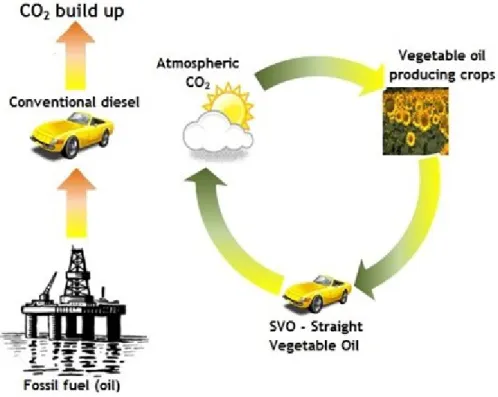
Biodiesel is a promising alternative energy source because it is a renewable fuel and reduces greatly CO2 emissions compared to fossil fuels (Fig.1). The production of
biodiesel is most commonly done through transesterification with methanol of triglycerides extracted from sunflower oils, soybean and rapeseed (Fig. 2). This process produces glycerol as the main by-product (100 kg of glycerol/tone of biodiesel) [1, 2]. Moreover, the annual worldwide production of biodiesel has been in an increasing trend lately, as can be seen in Fig. 3 [3]. However, biodiesel is not competitive in terms of price yet [4]. One way of lowering the production cost of biodiesel would be to use its main by-product, glycerol, to produce H2 (or syngas) via steam reforming, for example,
thus providing an extra value to such a waste.
Hydrogen is a clean energy source with numerous uses and its demand is expected to greatly increase in the future, mainly due to the technological advancements in the fuel cell industry. Nowadays, nearly 48% of the worldwide produced hydrogen is generated through the steam reforming of methane (SRM), while the reforming of naphtha/oil contributes with 30%, the coal gasification with 18% and electrolysis with only 3.9% [5]. The SRM, in particular, consists of CH4 reacting with
H2O to yield syngas at high temperatures (700-1100 ºC) [4]. Stoichiometrically, 3 moles
of H2 can be obtained per mole of methane through SRM, while 7 moles of H2 can be
extracted from 1 mol of glycerol through glycerol steam reforming (GSR), as presented in eq. (1).
C3H8O3 + 3H2O ↔ 7H2 + 3CO2 (𝛥𝐻𝑟298 𝐾 = 128 kJ·mol-1) (1)
Furthermore, while for SRM a fuel (CH4) is consumed to produce another fuel, the same
thing does not happen for GSR. Therefore, the use of glycerol instead of methane would be advantageous [4]. Even though steam reforming is the main target of focus in this review, there are other methods to convert glycerol into H2:
Auto-thermal reforming [6-8]; Partial oxidation gasification [9-11]; Aqueous-phase reforming [12-14]; Supercritical water reforming [15-17].
The reason why GSR was chosen as focus of study instead of any of the other processes is mainly due to the fact that the steam reforming process is widely used in industry and it would not require many changes in the system if the feedstock was changed from natural gas or naphtha to glycerol [4].
2 The GSR process, like any other process, has some challenges that need to be overcome in order to accomplish its effective commercialization. Some of the main challenges are:
The GSR is an endothermic reaction, thus requiring high temperatures and inherently high operating costs. Furthermore, more resistant reactors would be needed and so higher capital costs would be involved;
The GSR process has side reactions, which affect both production and purity of H2. The main side reactions represented by eq. (2, 3 and 4) lead to methane
formation either by reaction of carbon monoxide and hydrogen or reaction of carbon dioxide and hydrogen or through hydrogenolysis of glycerol, respectively.
CO+ 3H2 ↔ CH4 + H2O (𝛥𝐻𝑟298 𝐾 = -206 kJ·mol-1) (2)
CO2 + 4H2 ↔ CH4 + 2H2O (𝛥𝐻𝑟298 𝐾 = -165 kJ·mol-1) (3) C3H8O3 + 2H2 ↔ 2CH4 + CO + 2H2O (𝛥𝐻𝑟298 𝐾 = -160 kJ·mol-1) (4)
Although 7 moles of hydrogen should theoretically be produced per each mole of glycerol that reacts, many authors have observed upper H2 yield limits lower
than 7 [18-23];
The GSR is a thermodynamically-limited reaction (eq. (1)), being inherently the conversion detrimentally affected in certain conditions, particularly at lower temperatures [24];
The formation of coke is also an issue since it deactivates the catalyst, thus affecting H2 yield and purity and long term operation;
Besides producing hydrogen the GSR reaction also produces carbon dioxide, whose release is target of environmental concern and restricted by legislation. With the aim of addressing these problems, new catalysts have been developed and different purification methods have been studied. Moreover, new reactor configurations combining the GSR reaction and hydrogen or carbon dioxide selective removal have also been target of intense research, due to their potential to solve some of the limitations previously mentioned. In this review some of the important developments regarding the GSR reaction (including thermodynamics, developed catalysts and reaction kinetics) and its combination with a hydrogen perm-selective membrane or a CO2 sorbent, in the perspective of process intensification, are
reviewed.Up to the authors’ knowledge, a review that conjugates a literature survey of all these subjects is still missing.
3
2 Thermodynamics of GSR – Influence of different
parameters
2.1 Conventional GSR
The GSR is an equilibrium-limited process, as previously mentioned, that involves the decomposition of glycerol followed by the water-gas shift (WGS) reaction:
C3H8O3 ⇌ 3CO + 4H2 (𝛥𝐻𝑟298 𝐾 = 251 kJ·mol-1) (5) CO + H2O⇌ H2 + CO2 (𝛥𝐻𝑟298 𝐾 = -41 kJ·mol-1) (6)
In order to maximize the production of hydrogen, one must first fully understand how the thermodynamic boundaries are influenced by the different parameters.
There are several studies focused on the thermodynamics of the GSR [24-31]. One of the most important parameters affecting any reaction system is temperature. Once glycerol decomposition is highly endothermic and requires more heat than that produced in the WGS reaction, the overall GSR process is endothermic (eq. (1)), thus meaning that higher temperatures benefit the H2 production (glycerol conversion, H2 yield and
selectivity) (Fig. 4) [24]. Mathematically, the equilibrium of a system at constant pressure and temperature is given as follows:
𝑑𝐺 = ∑𝐾 𝜇𝑖𝑑𝑛𝑖
𝑖=1 = 0 (7)
where 𝐺 is the Gibbs free energy, 𝜇𝑖 is the chemical potential of component 𝑖 and 𝑛𝑖 is the number of moles of component 𝑖 in the system. The goal is to determine the set of 𝑛𝑖 values that minimize de value of 𝐺 (thermodynamic equilibrium). There are two different thermodynamic approaches that can be used to solve this: (i) stoichiometric [30, 32, 33] and (ii) nonstoichiometric [24-28, 31, 34-38]. By using the stoichiometric approach a set of stoichiometrically independent reactions, which are normally chosen arbitrarily from a set of possible reactions, is used to describe the system. Instead, if the nonstoichiometric method is used the equilibrium composition is calculated based on the direct minimization of the Gibbs free energy of a specific set of species [27]. Both methods have their own advantages, however there has been a significant tendency towards the nonstoichiometric one. In fact, the use of the latter does not require a selection of the possible set of
4 reactions. Moreover, during computation there is no divergence and there is no need of an accurate initial estimation of the equilibrium composition [27].
Since the GSR is an endothermic process (∆𝐻0 > 0), if higher temperatures are used more hydrogen is produced, thus confirming the trend in Fig. 4. Furthermore, a variation of the number of moles of all products (H2, CO, CO2 and CH4) with temperature is also
observed in this figure. At lower temperatures, the formation of H2, CO2 and CH4 as main
products is seen. This might be due to the fact that the exothermic WGS and methane formation reactions are mainly favored at low temperatures. In contrast, endothermic reactions like GSR and reverse WGS are more favored at higher temperatures. This could explain the increase of both H2 and CO contents and the small decrease of CO2 observed
at those temperatures. In any case, an optimum high temperature is normally determined. However, higher temperatures are not favorable from the economic point of view and so alternative ways to attain high H2 production yields have to be considered.
The molar water/glycerol feed ratio (WGFR) has also been found to highly influence the production of H2 (mainly the H2 yield and selectivity) in the equilibrium. Considering
the Le Chatelier’s principle, it is expectable that for higher WGFRs the equilibrium shifts towards the consumption of the excess of water, thus producing more hydrogen. Such a behavior has been indeed verified and, as can be seen in Fig. 5, the H2 yield increases as
the WGFR increases from 4 to 15, whatever the temperature. For WGFRs above 9 the H2
yield increases at a slower rate, especially at higher temperatures. However, the amount of water used should not be too high due to the excessive vaporization costs that it would bring at industrial scale. Moreover, it should be chosen taking into consideration the H2O
activation capacity of the catalyst used and the other operating conditions (temperature and pressure).
The influence of both operation temperature and WGFR on the formation of coke has been investigated as well [25, 28, 39]. Adhikari et al. [28] suggest that carbon formation may happen through the following reactions:
2CO(g) ↔ CO2(g) + C(s) (8)
CH4(g) ↔ 2H2(g) + C(s) (9)
5 CO2(g) + 2H2(g) ↔ 2H2O(g) + C(s) (11)
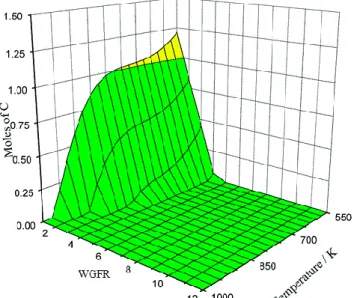
Fig. 6 [25] shows that, in order to avoid carbon formation, which poisons the catalysts, high WGFRs and temperatures should be used. In fact, for WGFRs higher than 5, carbon formation is completely inhibited for all the temperature range considered (550-1000 K). These results are in line with those obtained by Adhikhari et al. [28] and Authayanun et
al. [39].
Pressure is also an important parameter because it has a significant influence on the performance of reaction systems. That influence is even more noticeable for processes during which there is variation of the total number of moles, like the GSR, since it affects the thermodynamic equilibrium (Le Chatelier’s principle). For the case of GSR, higher pressures lead to a lower hydrogen production in the equilibrium. Moreover, enhanced formation of methane has also been verified [25, 28-30]. Therefore, it results to be advantageous to use lower pressures not only because it is economically more attractive (as far as the pressure is not too low) but also because it leads, under equilibrium, to higher H2 production (Fig. 7) [26]. Pressures lower than the atmospheric pressure would
be desired, however, these pressures are more difficult to attain under economically attractive conditions in industrial practice. An alternative way to achieve this would be to use a carrier gas to dilute the reactants, thus decreasing their partial pressures. Chen
et al. [26] came to the conclusion that by increasing the amount of carrier gas, not only
the maximum H2 production increased but also the optimum temperature dropped.
Although it may seem a good solution, at industrial scale it is not so attractive since it would require complex separation processes after the reactor.
In sum, it is clear that high temperatures, high WGFRs and low pressures favor hydrogen production in the equilibrium. Temperatures between 580-702 ºC, WGFRs between 9-12 and atmospheric pressure have been reported in the literature as optimum conditions [25-27, 29].
2.2 GSR with CO2 Adsorption
It is clear that even at favorable conditions, the GSR equilibrium is still quite limiting in terms of H2 yield, for example. For the cases analyzed in the previous section, the
maximum H2 yields observed were close to 6, due to the co-existence of several reaction
6 H2 yield close to 7 can be obtained. Such a yield could be reached by performing GSR
simultaneously with CO2 capture, since the selective removal of CO2 shifts the
thermodynamic equilibrium towards higher H2 yields. The Sorption Enhanced Glycerol
Steam Reforming (SEGSR) process also allows to work at milder operating conditions, thus leading to lower operation costs. Moreover, since the emissions of CO2 are diminished,
the SEGSR can be considered as a good solution as long as there is a way to store/valorize captured CO2 [40]. In this section a review of some thermodynamic studies on SEGSR is
done.
Different approaches have been used to account for CO2 sorption in thermodynamic
simulations. Wang et al. [41] accounted for 17 species in SEGSR among which 13 were gases and 4 were solids. These solids include carbon, CaO, CaCO3 and Ca(OH)2. It is
assumed that, in the presence of a CO2 sorbent like CaO, the following reactions take
place:
CaO(s) + CO2(g) ↔ CaCO3(s) (12)
CaO(s) + H2O(g) ↔ Ca(OH)2(s) (13)
Ca(OH)2(s) + CO2(g) ↔ CaCO3(s) + H2O (14)
In Fig. 8 [41] the effect of temperature and WGFR on the equilibrium concentration of H2
(dry basis) during (a) GSR and (b) SEGSR is presented. For the first case, the observed behavior is very similar to what has already been discussed in the previous section. Regarding the SEGSR, it can be observed that for increasing WGFR values, at constant temperature, the equilibrium hydrogen concentration also increases for the reason stated before. Therefore a balance should be sought, being that a value of 9 is proposed by Chen
et al. [42] and Silva et al. [43] as the most favorable for hydrogen production. In terms of
temperature, a more noticeable effect is observed. While for temperatures between 500-900 K and constant WGFR there is an increase of the equilibrium hydrogen concentration, for temperatures above 900 K this concentration decreases. The authors suggest that the increase of the H2 concentration up to 900 K is associated to the compromise between eq.
(2, 5, 6, 12, and 13). The decrease of the equilibrium hydrogen concentration observed thereafter is due to the fact that the CO2 sorption described by eq. (12) is inhibited due
to its exothermic nature. By comparing Fig. 8 (a) and (b), it is clear that the removal of CO2 during reaction enhances H2 production (Le Chatelier’s principle), especially at lower
7 temperatures where CO2 sorption is more intense. Chen et al. [42] observed that, while
without CO2 capture the maximum H2 yield, at WGFR of 9 and 1 atm, was 6, H2 yields of
approximately 6.5 and 7 were obtained when 80% and 99% of the CO2 was removed,
respectively. Moreover, the increment of H2 production due to CO2 removal is higher for
lower temperatures, which is related with the fact that lower temperatures favor CO2
capture.
Regarding the variation of the concentration of CO2, Wang et al. [41] observed very
similar behavior between GSR and SEGSR at temperatures above 900 K. However, at temperatures below 900 K the CO2 concentration was much lower in the SEGSR due to the
already mentioned enhanced sorption, despite the higher CO2 production (Le Chatelier’s
principle). On the other hand, the production of both methane and carbon monoxide is lower in the SEGSR.
Chen et al. [44] varied the operation pressure between 1-20 atm and analyzed its effect on both GSR and SEGSR in terms of hydrogen yield. The first thing that the authors noticed was that the H2 yield decreased with increasing pressures for both processes.
However, the SEGSR was less sensitive to pressure than GSR. This happens because, even though higher pressures do not favor SEGSR but methanation instead, higher pressures enhance CO2 adsorption. For this reason, the negative effects of pressure are diminished
during SEGSR, being that the increment in the production of H2 due to CO2 removal is more
noticeable at higher pressures.
The sorbent/glycerol ratio is also an important parameter to be taken into consideration. The concentration of H2 increases for increasing CaO/glycerol ratios, while
the concentrations of both CO and CO2 highly decrease [41]. The concentration of methane
presents a maximum. However, for increasing CaO/glycerol molar ratios above 10, there is almost no variation of H2, CO, CO2 and CH4 concentrations. Therefore, 10 may be
considered the optimum CaO/glycerol molar ratio.
Finally, the deposition of carbon has also been target of investigation. As already discussed for GSR, high temperatures and WGFRs inhibit coke formation. Wang and co-authors observed higher carbon deposition in GSR than in SEGSR. Therefore it can be concluded that the capture of CO2 inhibits coke formation. This is supported by the lower
concentrations of CO and CO2, which origin coke formation, during SEGSR (eq. (8, 10, and
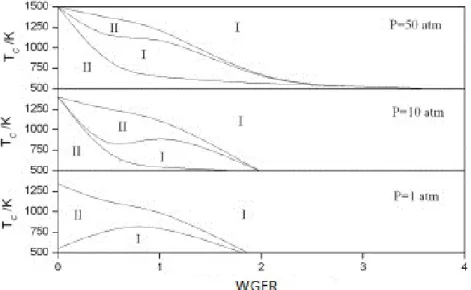
11)). On the other hand, by analyzing Fig. 9 [41] it can be observed, for SEGSR, that at 1 atm coke is completely absent at temperatures above 500 K and WGFRs higher than 1.8.
8 By increasing the pressure from 1 to 50 bar, the formation of a second carbon formed region occurs. This might be because of the enhancement of the reactions in eq. (8, 10, and 11). In this case coke formation is only completely avoided at WGFRs above 3 (again for temperatures above 500 K). In another work, Silva et al. [43] concluded that even using a WGFR as low as 1.5, it would be possible to work at temperatures below 885 K (1 atm) without any carbon formation. Furthermore, in order to eliminate the possibility of carbon formation in all the temperature range (500-1400 K) under atmospheric pressure, WGFRs higher than 2 would have to be used. This value is very similar to the one reported by Wang et al. [41] – Fig. 9.
2.3 GSR with H2 Removal
The removal of hydrogen from the reaction medium instead of CO2 is another
possibility that has been target of some interest. Analogously to the SEGSR, the selective removal of H2 during GSR by means of a membrane reactor (MR) also shifts the
thermodynamic equilibrium towards higher H2 yields. Moreover a highly pure H2 stream,
which is suitable to be used in polymer electrolyte membrane fuel cells (PEMFCs), is generated. There have been several studies that have focused on the experimental assessment of GSR in MRs, however the study of the thermodynamic behavior of the process has seldom been done. A revision of such work is briefly reported in this section. Wang et al. [45] investigated the effect of temperature, WGFR, pressure and fraction of hydrogen removal on a MR. Regarding the operation pressure, it was found that higher pressures benefit the permeation of hydrogen through the membrane due to the increase of the driving force. However, the thermodynamics of GSR is not favored by high pressures as already discussed. The authors observed that superior hydrogen production occurs at 1 atm and, for that reason, all the analysis was performed at this pressure. Fig. 10 [45] depicts the influence of both temperature and WGFR on the production of H2
through GSR in a MR. It is observable that, as expected, the increase of both temperature and WGFR provoke an enhancement in the production of hydrogen. However, H2
production reaches a maximum at a certain temperature and then starts decreasing for higher temperatures (such effect is not verified for H2 removals of 99% and 100%).
Regarding the fraction of H2 removal, removing more hydrogen shifts the thermodynamic
equilibrium towards higher hydrogen production according to the Le Chatelier’s principle. Moreover, higher H2 removal dislocates the maximum hydrogen production to lower
9 temperatures (Fig. 10a). While with no H2 removal the maximum H2 yield is approximately
6 at 925 K, the maximum yield becomes close to 7 at 825 K for 80% of H2 removal, and
with fractional hydrogen removal of 0.99 and 1, the H2 yield is close to 7 for all range of
temperatures considered. The same is verified for all range of WGFRs considered (Fig.10b). Furthermore, the increase in H2 production when the WGFR increases from 9 to
12 is very small. Consequently, the optimum conditions for GSR in the MR were found to be 825-875 K, WGFR of 9 and 1 atm. The formation of both CO and CH4 is decreased by
selectively removing H2.
The formation of carbon was also analyzed by Wang et al. [45]. As can be seen in Fig. 11 [45], a WGFR value of 4.5 is enough to completely inhibit carbon formation for all range of temperatures and fractions of hydrogen removal tested. With exception to the case of fractional H2 removal of 0.99, the minimum WGFR required to avoid carbon
formation decreases slightly with the increase of temperature up to 800 K. From that point on, the decrease with temperature is much faster and from approximately 873 K on, the influence of the H2 removal fraction on the minimum WGFR is practically negligible. For a
fraction of hydrogen removal of 0.99 the minimum WGFR required to inhibit carbon formation decreases very rapidly. By comparing the different levels of hydrogen removal, it can be observed that higher hydrogen removal leads to higher minimum WGFRs necessary to inhibit carbon formation, except for 99% hydrogen removal (where the minimum WGFR necessary to avoid carbon formation becomes lower than that for lower hydrogen removal fractions at temperatures lower than 923 K). In any case, if the optimum WGFR of 9 is used, no problems with carbon formation will exist.
10
3 GSR catalysts developments
In the last decade extensive research has been done regarding the heterogeneous catalysis of the GSR reaction for either synthesis gas or H2 production. The most
investigated materials until now have been Ni, Pt, Co and Ru-based catalysts. Other less researched materials like Rh, Ir and Pd have also shown interesting attributes. Among the above mentioned catalysts, Ni-based catalysts, as non-noble metal-based catalysts, have been extensively studied. At the moment, the main goal is to design highly reducible and with high oxygen mobility redox catalysts for low-temperature GSR [46].
3.1 Ni-based Catalysts
Nickel catalysts for the GSR have been extensively studied over the last years. A big advantage that Ni catalysts present when compared to the noble metal-based ones is their lower price.
3.1.1 Effect of the support on the catalytic performance
It has been found that the use of different supports in Ni-based catalysts results in much different catalytic performances [47-51]. Table 1 summarizes the catalytic performance and operating conditions of different Ni-based catalysts on GSR. Adhikari et
al. [48] compared the performance of Ni catalysts on different supports: MgO, CeO2 and
TiO2. At 600 ºC and WGFR of 9, it was observed the following order of H2 selectivity: CeO2
(70%) > MgO (40%) > TiO2 (15%). Moreover, the ceria supported catalyst was found to
present the lowest carbon deposition. It was suggested that ceria establishes a better interaction with the nickel active phase, which leads to a higher metal dispersion and inherently available surface area. Pant et al. [50] observed that the presence of ceria affects the reduction of Ni2+ species, thus enhancing the catalyst activity. It has also been
suggested that the dual oxidation state (+4/+3) that ceria presents leads to oxygen release which reacts with the carbon that is deposited, thus reducing coke formation [15, 52-55]. Moreover, Ni/CeO2 catalyst is able to enhance both methane reforming and WGS reaction
and presents high hydrogen selectivity through GSR [28, 56-58]. Also, it has been reported that the H2 yield is highly dependent on the nature of the active phase as well as its
11 The acidic character of TiO2 is responsible for the higher coke formation on
Ni/TiO2, which leads to a worse GSR performance [48]. Nichele et al. [51] showed that
Ni/TiO2 has very low activity in C-C bond rupture, even at high temperatures, and that
the contribution of the WGS reaction is even smaller. This is due to the fact that anatase, where nickel ions are incorporated after being oxidized and then reduced under H2 flow,
is stable only at relatively low temperatures and its weak interaction with Ni is not able to avoid re-oxidation of the metallic active phase in the steam reforming conditions [51]. Sánchez et al. [49], Pant et al. [50] and Adhikari et al. [56] analyzed the performance of Ni/Al2O3 catalysts for the GSR. The first group observed catalyst
deactivation after 8h time on stream (at 600 and 650 ºC). Wen et al. [61] verified that Ni-Al2O3 supported catalysts undergo quick deactivation. However, as already stated,
deactivation is highly dependent on, among another things, the support nature. Many authors have verified the formation of carbonaceous deposits over Ni/Al2O3, which led to
relatively fast catalyst deactivation [49, 50, 61, 62]. Normally, the formation of coke deposits is associated to dehydration, cracking and polymerization reactions which take place on the acid sites of alumina [63]. Besides presenting higher carbon deposition, Pant
et al. [50] also concluded that the prepared Ni/Al2O3 catalyst presented higher catalyst
sintering than the Ni-ceria supported one. It has been suggested that the sintering of the Ni active phase is associated to a transition of alumina to crystalline phase during reaction [64].
Nichele et al. [51] also tested a Ni/ZrO2 catalyst, having concluded that it
presented high surface area, high stability at 650 ºC and strong interaction of the support with the metal phase. Also, it was found that for lower temperatures (500 ºC) the zirconia supported catalyst was even more active. However, there was a lower stability. In the same work a Ni/SBA-15 was also used, having presented insufficient hydrothermal resistance, which led to catalyst deactivation. However, sintering was avoided since it provided a good stabilization of the Ni active phase.
Nickel supported on neutral SiC has been reported to present outstanding stability and high yield of syngas [60]. The neutral nature of this material promotes an intrinsic nickel contribution to GSR, especially in terms of dehydrogenation and decarbonylation. Simultaneously, SiC leads to minimal side reactions from the condensation and the dehydration induced by the basic and acid properties, respectively. Because of this, the Ni/SiC catalyst is able to present high stability for GSR and low carbon deposition.
12 It is, therefore, evident that the nature of the support affects mainly the stability of the active phase. In order to reach a highly stable active phase, strong interactions between the metal phase and the support are required. These strong interactions also lead to higher activity and selectivity.
3.1.2 Effect of the addition of a promoter on the catalytic performance
In many studies reported in the literature, promoters have been used in Ni-supported catalysts in order to improve their performance towards the GSR reaction. Table 2 presents, in summary, the effect of the promoter on the catalytic activity.
As previously mentioned, ceria presents good characteristics for GSR, having for that reason been used by many authors as a promoter [53, 67-69]. In general the addition of CeO2 promoter enhances the activity of the non-promoted catalyst. This is mainly
related to the capacity of ceria to stabilize the nickel active phase and to promote the steam reforming of the oxygenated hydrocarbons intermediates, thus leading to a reduction of coke deposition. It has also been suggested that Ce inhibits secondary dehydration reactions, which are normally favored by the presence of support acid sites, which lead to the formation of hydrocarbons that are coke precursors and generate fast catalyst deactivation [68]. It is, nonetheless, important to notice that the ceria loading must not be too high. Iriondo et al. [53] suggest that for a 20 wt.% ceria promoter content on alumina, ceria tends to interact with alumina instead of Ni, thus decreasing the stabilization of the nickel active phase and lowering the available surface for Ni dispersion. In the same way, it is also possible that the bigger size of ceria crystallites could also diminish the interaction between ceria and nickel active phase [70]. On the other hand, Cui et al. [54] showed that the activity of the La0.3Ce0.7NiO3 mixed oxide
catalyst for GSR is enhanced compared to LaNiO3 catalysts and that its performance is
comparable to that of a noble metal like Pt [54].
The use of ZrO2 as a catalyst modifier has also been reported as an alternative
promoter [18, 65, 67, 68], despite the fact that ZrO2 alone is not very active for steam
reforming [71]. Iriondo et al.[67] observed that the addition of zirconia promoter to alumina not only enhanced the performance of the non-promoted catalyst but also presented better GSR performance than the ceria-promoted catalyst. The addition of an intermediate ZrO2 content [65, 72, 73] enhanced the H2 yield and the capacity of the
13 500 ºC, due to the enhancement of H2O activation by ZrO2. It is suggested that this
improvement is associated to the formation of ZrO2-Al2O3 species, which facilitates the
reduction of Ni2+ [65]. Pant and co-workers [18] came to similar conclusions after
performing GSR over a ZrO2-promoted Ni/CeO2 catalyst. Zirconia is able to make the ceria
support more crystalline, consequently improving the metal dispersion. It is also known that, in general, ZrO2 inhibits sintering of metallic active sites in the presence of water at
high temperatures [64].
With the aim of reducing the acidity of alumina supports, thus preventing metal sintering and catalyst deactivation, alumina supports have been modified with basic La2O3
[22, 66, 67, 74, 75]. It has also been reported the performance of a Ni/SiO2 modified with
La2O3 for the GSR [76]. The combination of SiO2, which is known to present large surface
area and weak acidity, and La2O3,favored the formation of H2 and CO2 and reduced carbon
formation. This decrease in the carbon formation with increasing La2O3 content was due
to the formation of a La carbonate that removes C species deposited on the nickel sites. Therefore, the 30 wt.% (highest La2O3 content used) La2O3 catalyst presented itself as
promising system for GSR, since it was stable (Fig. 12) [76], while presenting good glycerol conversion, good H2 yield and low carbon formation.
The addition of basic Mg(II) to Ni/Al2O3 catalysts has been reported to prevent
carbon formation by favoring both the adsorption of H2O, O2, CO2 or –OH fragments and
the spillover of such fragments from the support to the metal particles [20, 77, 78], thus facilitating carbon gasification. Moreover, the use Mg(II) promoter in Ni/Al2O3 materials
enhances the stability of Ni against sintering, since it decreases the degree of interaction of Ni with alumina through intercalation between the nickel active phase and alumina. Consequently, the incorporation of nickel in the alumina phase is inhibited [67]. It has been found that the use of low amounts of Mg(II) promoter leads to higher metal dispersion, thus favoring glycerol conversion into gaseous products, while higher loadings result in lower coke deposition [20]. Other basic promoters such as Mo [66, 79-83] and Ca [66, 69, 79] have also been reported to enhance the GSR performance of non-promoted catalyst, for the same reasons previously mentioned for basic modifiers. Huang et al. [66] observed that the simultaneous presence of Mo-La-Ca inhibits the interaction between nickel and the commercial Ca-containing Linde-type 5A zeolite support, thus resulting in a remarkable stability during GSR (no deactivation during 100 h time-on-stream). Gong and co-workers [84] verified that the synergetic effect caused by the partial substitution
14 of La by Ca in the perovskite structure leads to enhanced metal dispersion and stronger metal-support interaction.
Hakim et al. [85] studied the GSR reaction over hydroxyapatite-supported Ni-Ce-Cu catalysts. It was found that doping with Ni-Ce-Cu influenced the catalytic performance of the catalyst. Also, higher Cu contents led to higher glycerol conversions and hydrogen production. Hakim’s group came to the conclusion that the interaction between CuO and CeO2 on the hydroxyapatite support in the GSR reaction enhanced the active sites (more
active sites) of the catalysts. Moreover, the presence of ceria facilitated the reduction and increased the dispersion of the copper species on the surface of the catalysts. In terms of Ni content, it was found that it does not enhance significantly the production of H2. As
a matter of fact, it is suggested that since for the catalysts with higher Ni loading there is a greater presence of NiO phase on the surface of the catalysts during preparation and calcination, not all the nickel ions substituted the position of Ca2+ in the hydroxyapatite
support and some metallic nickel became agglomerated.
Profeti et al. [86] studied the catalytic activity of Ni/CeO2-Al2O3 catalysts modified
with noble metals (Pt, Ir, Pd and Ru) for the GSR reaction. The addition of noble metals stabilizes the Ni sites in the reduced state, increasing the glycerol conversion and decreasing the coke formation. Moreover, this stabilization of the nickel surface species interacting with the support occurs at lower temperatures in the presence of small amounts of noble metals due to hydrogen spillover effect. A more detailed review on noble metal-based catalysts for GSR is done in further sections.
3.2 Pt-based Catalysts
Noble metal catalysts normally are more active and stable towards the GSR reaction that Ni-based materials [87]. Pt-based catalysts are no exception and because of that, many authors have studied the potential of these catalysts for H2 production through
this process.
3.2.1 Effect of the support on the catalytic performance
Platinum catalysts supported on carbon have been investigated for the GSR either for syngas or hydrogen production [88-90]. A summary of the catalytic performance and
15 operating conditions of some Pt-based catalysts is presented in Table 3. It has been found that Pt/C supported catalysts present higher stability during GSR than other Pt-based materials making use of different supports (Al2O3, ZrO2, MgO/ZrO2, and CeO2/ZrO2); this is
due to the very low formation of C2-hydrocarbons, which is symptomatic of lower carbon
formation on the Pt/C catalyst [88]. Sutar et al. [89] attained catalytic results for GSR over a Pt/C sample that are in general comparable to the ones presented in the previous section for some Ni-based catalysts. However, for nickel catalysts those results were obtained at temperatures around 600-700 ºC, while in this case the temperature used was 400 ºC – Table 3. Simonetti et al. [88] reported an even more noticeable superior activity of Pt-based catalysts for the GSR compared to nickel ones.
Although Pt/C supported catalysts present very interesting results at relatively low temperatures, they are more suitable for syngas production. Oxide supports, on the other hand, promote the WGS reaction, thus being more appropriated for hydrogen production with lower CO content [88, 93-96]. Despite this, acid ZrO2 and Al2O3 supports lead to fast
deactivation of platinum catalysts mainly due to coke deposition, which results from the promotion of lateral reactions of dehydration, hydrogenolysis, dehydrogenation and condensation [88, 97], as seen for Ni-based catalysts. It has been reported that the acidity of supports decreases in the order Al2O3 > ZrO2 > SiO2 [97, 98]. Therefore, a solution for
this deactivation problem includes the use of a support with lower acidity, like SiO2 [91,
97, 99]. According to Pompeo et al. [91, 97], the silica support allows the Pt catalysts to promote mainly dehydrogenation reactions and subsequent cleavage of C-C bonds, thus presenting excellent activity to gaseous products, high H2 selectivity and remarkable
stability over time. It was also observed for Pt/SiO2 supported catalyst that increasing the
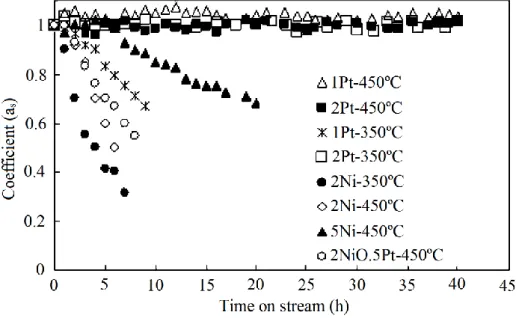
Pt content maintains the same active phase (same metal dispersion and average particle size). Therefore, the 2 wt.% Pt catalyst shown in Table 3 presented better performance than the 1 wt.% Pt one. Moreover, a comparison between Pt and Ni catalysts supported on SiO2 was done at 350 and 450 ºC. At these temperatures the Ni-based catalysts ended up
deactivating after a couple of hours, while the Pt-based catalysts presented higher stability; moreover, at 350 ºC the 2 wt.% Pt catalyst was considerably more stable than the 1 wt.% Pt catalyst (Fig. 13) [91].
A Pt/Y2O3 catalyst was tested for GSR by Cui et al. [54], having presented high
16
3.2.2 Effect of the addition of a promoter on the catalytic performance
Similarly to Ni-based catalysts, the performance of Pt-based catalysts can be enhanced by adding promoters. Table 4 summarizes the effect of different promoters on the GSR catalytic activity of Pt-based catalysts. It has been demonstrated that the heat of CO adsorption on Pt-based catalysts can be decreased by the formation of metal alloys [100, 101]. Simonetti et al. [90] came to the conclusion that bimetallic Pt-Re/C catalysts with atomic Pt/Re ratios ≤ 1 are 5 times more active to syngas production through GSR than monometallic Pt/C and Pt-Re with a higher Pt/Re ratio (10). The authors suggest that the primary promotional effect of Re is to weaken the interaction between CO and the surface, thus leading to faster turnover of catalytic sites. Kunkes et al. [93] added Fe; Cu; Sn; Ir; Co; Ni; Rh; Os; Ru; or Re to Pt supported on C. The addition of Fe; Cu; Sn; Ir; Co; Ni; or Rh had a detrimental or neutral effect on the catalytic activity for all reaction temperatures (275-350 ºC). According to Pompeo et al. [91], the fact that the coexistence of Pt and Ni did not improve the catalytic performance suggests that the formation of a bimetallic Pt-Ni phase affects the platinum electronic properties. On the other hand, the addition of Os; Ru; or Re to Pt enhanced the syngas production comparatively to Pt/C, being that Re was the promoter that allowed the best syngas production improvement.
The addition of ceria promoter has been verified as advantageous, but in this case for platinum-based catalysts [88, 92, 97]. As already mentioned, the addition of ceria to a support like alumina reduces its acidity, thereby improving the catalyst stability and H2
selectivity and reducing the formation of undesirable products and coke deposition. Montini et al. [92] verified that the Pt/CeO2/Al2O3 catalyst, despite presenting improved
performance, still deactivated after 20 h time-on stream (Fig. 14) [92]. This deactivation could be due to coke deposition on the active sites and only marginally due to Pt sintering. Similar behavior, in terms of performance enhancement, has been observed for Pt-based catalysts promoted with basic oxides like La2O3 [92] and MgO [88]. However, the La2O3
promoted catalyst only deactivated after 50 h time-on-stream, as can be seen in Fig. 14. On the other hand, Pompeo et al. [97] reported the attainment, for a Pt/Ce4Zr1𝛼
catalyst, of higher H2 selectivity and glycerol conversion to gaseous products than both
Pt/γ-Al2O3 and Pt/ZrO2 catalyst. The promoted catalyst presented higher average
platinum particle size than the other two catalysts. Claus and co-authors [102] suggested that larger particles present a higher number of face atoms of the metal crystallite. Moreover, the adsorption of oxygenated hydrocarbons for posterior C-C cleavage can be
17 preferably performed at face positions, thus leading to higher hydrogen selectivity. Furthermore, the simultaneous presence of Ce and Zr promotes the WGS reaction, thus enhancing the H2 selectivity [93].
3.3 Co-based Catalysts
Cobalt catalysts have shown good performance in ethanol reforming for hydrogen production and are proposed as appropriate catalytic systems [103-105]. However they have shown significant deactivation through sintering and surface cobalt deactivation. Even so, many authors have investigated in the last years the catalytic behavior of Co-based materials for GSR [23, 106-109].
3.3.1 Effect of the support on the catalytic performance
The use of alumina as support for Co active phase has been reported [107], having been observed the existence of both strong and weak acid sites on the catalyst surface with an acidic/basic ratio of approximately 5.5. Therefore, expected carbon deposition was verified. Moreover, TPO-TPR and TPR-TPO cycles showed different reactivity of the carbon deposited on the surface of the coked catalyst, meaning that there were at least two types of carbon pools on the surface. One of the pools was reactive in the presence of H2 while the other was inert to H2, reacting only in the presence of O2.
Zhang et al. [106] verified that Co/CeO2 catalyst for GSR originated small
concentrations of CH4 and CO at the reactor outlet stream. Furthermore, only slight
changes on their concentrations were observed while increasing the reaction temperature, meaning that the Co/CeO2 catalyst did not catalyze effectively both WGS and steam
reforming of methane. Dehydration of glycerol was not observed over the ceria-supported catalyst, and so no significant deactivation occurred.
A comparison of the catalytic performance of both types of catalysts described along this section for GSR is presented in Table 5.
3.3.2 Effect of the addition of a promoter on the catalytic performance
It has been found that bimetallic Co-Ni/Al2O3 catalyst, used by Adesina et al. [108],
18 synergism between the Ni and Co metals [110]. The reasons of such synergism are not, however, disclosed. The coexistence of both Lewis and Bronsted acid sites was discovered through physicochemical characterization. However, the bimetallic catalyst presents a net surface acidity (acidic/basic ratio of 9). Analogously to what was reported elsewhere [107], it was verified the occurrence of carbon deposition during reaction, which led to a reduction of the surface area and pore volume of the catalyst. Furthermore two types of carbon deposits were observed once again, being that one of them is inert to H2 as well.
The GSR catalytic activity of this promoted catalyst is compared in Table 5 with that for the non-promoted catalysts presented in the previous section.
CeZr mixed oxides have also been target of attention since they allow the insertion of transition metals, like Co and Ni, and/or noble metals, like Ru and Rh, into the oxide structure, thus increasing the active phase-support interaction [111-113]. Araque et al. [23] evaluated the effect of the active phase by using two mixed oxide catalysts: Ce2Zr1.5Co0.5O8-𝛿 and Ce2Zr1.5Co0.47Rh0.07O8-𝛿. Rhodium did not significantly affect the
glycerol total conversion. However, it highly affected the conversion of glycerol into gaseous products at the expense of liquid ones. It was also observed an enhancement of the 24 h average H2 production from 1.6 molH2·molGly.in-1 up to 5.8 molH2·molGly.in-1 when
Rh was added to the mixed oxide catalyst. Also, for the Rh-containing catalyst, an average production of H2 of 6.7 molH2·molGly.in-1 was obtained for over 16 h, while the other catalyst
kept stable only for 1 h. The enhanced behavior of the Rh containing catalyst is related to the capacity of Rh to break the C-C bonds. The loss of activity verified is due to the loss of the C-C bond breaking capacity, since C2H4 formation was observed when deactivation
occurred. In another work, Roger and co-authors [109] studied the effect of the Ce/Zr ratio in fluorite-type mixed oxides of CeZr-CoRh catalysts on the H2 production by GSR.
Catalysts with three different Ce/Zr ratios were prepared: Ce0.53Zr2.97Co0.47Rh0.03O8-𝛿 with
poor ceria content (CZPCoRh), Ce
2Zr1.5Co0.47Rh0.03O8-𝛿 with intermediate ceria content
(CZICoRh), and Ce
2.59Zr0.91Co0.47Rh0.03O8-𝛿 rich in ceria (CZRCoRh). It was observed that the
increase of the Ce content enhances both the stability (Fig. 15) [109] and selectivity towards H2 and CO2. This happens because of the improved cobalt reducibility and
re-oxidation properties, oxygen storage capacity and metal support interaction. Also, the catalytic stability and activity of the catalysts is related to their capacity to activate H2O
under reaction conditions, thus favoring the steam reforming reaction over the decomposition reaction. By increasing the Ce content, the H2O activation is favored for a
19 longer period of time, thus allowing carbon gasification and delaying the catalyst deactivation; even so this effect is not very pronounced (Fig. 15).
3.4 Ru-based catalysts
Ruthenium is currently, along with nickel and platinum, one of the most promising materials to catalyze hydrogen production through GSR. Moreover, Ru is the least expensive among all noble metals [114]. Ru-based catalysts have been reported has having superior catalytic activity for H2 production, not only through GSR but also through
methane steam reforming, for example [1, 115, 116]. By comparing the GSR activity of catalysts loaded with Group 8-10 metals supported on oxides (Y2O3, ZrO2, CeO2, La2O3,
SiO2, MgO, Al2O3), the order Ru ≈ Rh > Ni > Ir > Co > Pt > Pd > Fe was found in La2O3
-supported materials [117]. It has also been reported that the order of the catalytic activity of Group 8-10 metal catalysts over SiO2 is as follows: Ru ≈ Rh > Ni > Ir > Pt ≈ Pd ≫ Co ≈
Fe [117].
3.4.1 Effect of the support on the catalytic performance
Hirai et al. [117] prepared several catalysts loaded with Group 8-10 metals supported on Y2O3, ZrO2, CeO2, La2O3, SiO2, MgO, and Al2O3 via a conventional impregnation
method. Among all the metals used, Ru was the one that showed the best catalytic activity. Therefore, since ruthenium allowed the attainment of the highest H2 yield, the
effects of the previously mentioned supports for ruthenium on GSR were evaluated at 600 ºC. The Ru/MgO supported catalyst showed very low glycerol conversion to gaseous products compared to the other samples. This low activity is due to the fact that ruthenium on MgO is hard to be reduced to metallic ruthenium and so the number of active sites would decrease [118]. The Ru/Al2O3 supported catalyst presented the lowest glycerol
conversion into gaseous products. It also showed low H2 yield because of the higher
selectivity towards methane production and lower selectivity to CO2. On the other hand,
both Ru/Y2O3 and Ru/ZrO2 supported catalysts presented high glycerol conversion into
gaseous products and H2 yield. In fact, the Ru/Y2O3 sample was the one that presented
the best results. This has been attributed to the ability of yttria to promote de WGS reaction [119]. Considering this, an optimization of the loading level of ruthenium was performed at 500 ºC, to compare the catalytic activity at lower conversions [117]. The H2
20 yield kept increasing as the ruthenium loading increased up to 3 wt.%. A further increase in the ruthenium loading to 5 wt.% did not affect the H2 yield and so, the optimal loading
was found to be 3 wt.%. Finally, it was observed that both glycerol conversion into gaseous products and H2 yield did not decrease during a 24 h time-on-stream test, as shown in Fig.
16 [117]. Very small carbon deposition was verified after 24 h reaction, thus meaning that the 3 wt.% Ru/Y2O3 material is apparently resistant for the deactivation caused by carbon
deposition. However, some deactivation caused by sintering of the dispersed catalytic metal clusters was observed. Ultimately the authors concluded that the Ru/Y2O3 catalyst
presents very high performance in GSR. The catalytic performance of some of these Ru-based catalysts for GSR is presented in Table 6.
3.4.2 Effect of the addition of a promoter on the catalytic performance
Kim and Lee [119] studied the GSR on Ru and Ru-Me (Me = Fe, Co, Ni, and Mo) catalysts supported on Y2O3, Ce0.5Zr0.5O2, and commercial 𝛾-Al2O3. It was verified that the
use of different supports affects the performance of the catalysts, being that for the Ru-based catalysts supported on reducible yttria and ceria-zirconia there was a significant enhancement of the H2 production turnover rate and selectivity. This happens because
these supports tend to facilitate the WGS reaction. On the other hand, the acidic 𝛾-alumina supported Ru-based catalysts showed low H2 production turnover rate, high CO
selectivity and formation of C1-C2 hydrocarbons for the reasons already stated.
In opposition to what was verified for the different supports, the metallic promoters did not influence much neither H2 production rate nor selectivity. On the other
hand, the addition of metallic promoters led to lower catalysts deactivation. In terms of coke deposition, both yttria and ceria-zirconia supports showed superior resistance against coke formation on the catalysts. In fact, very small deposited amounts of carbonaceous species were verified for these supports (< 3 wt.%). However, deactivation of the catalysts at levels between 15% and 80% was observed. Since the low amounts of deposited coke could never lead to such deactivation levels, the authors suggest that sintering of the dispersed catalytic metal clusters was the cause of the verified activity drop. As can be seen in Fig. 17 [119], the Ru-Mo/Ce0.5Zr0.5O2 and Ru-Mo/Y2O3 catalysts exhibited superior
stability against deactivation by sintering and lower carbon deposition. The results suggest that the MoOx species effectively diminished sintering of the surface metal clusters.
21 Ru-based catalysts supported on Mg(Al)O mixed oxide were reported by Gallo et
al. [120, 121]. The Mg(Al)O mixed oxide support plays an important role in enhancing the
performance of the catalyst. Ru based catalysts supported on Mg(Al)O mixed oxides have been reported in the literature to present good performance in steam reforming of ethanol [123], acetic acid [124] and hydrocarbons [125-127]. It is known that Mg(Al)O oxides are able to stabilize supported metal nanoparticles, even at high operating temperatures and/or glycerol concentrations, thus avoiding metal nanoparticles sintering [120]. The presence of Mg in the support is, in part, responsible for this good behavior. The effect of Sn doping on the bimetallic Ru-Sn/Mg(Al)O supported catalysts was accessed as well by using catalysts with different Sn loadings [120]. The Ru-based catalyst without tin showed very high glycerol conversion with high selectivity towards H2 and CO2, and CO selectivity
lower than 10% during the entire catalytic run. By increasing the tin loading, a progressive increase in both CO and CH4 selectivity was verified. On the other hand, the CO2 selectivity
decreased gradually. Therefore, the catalysts that showed the most attractive results in terms of specific H2 productivity (mmol H2∙mmol Ruexp-1∙min-1) and specific activity (mmol
glycerol∙mmol Ruexp-1∙min-1) was the catalyst with the lowest tin content (Sn/Ru molar
ratio of 0.33). It was concluded that the addition of tin has different effects depending on the Sn/Ru molar ratios. For low Sn/Ru molar ratios it was verified that both activity and H2 productivity per exposed Ru sites are significantly enhanced, since tin selectively
coated Ru faces, and only co-ordinatively unsaturated Ru sites, which are the most active ones, are exposed. However, by increasing the ratio a large amount of acidic tin oxides is unselectively deposited onto support materials. Therefore, glycerol decomposition is promoted rather than GSR, thus leading to high amounts of CO and finally to coke deposition responsible for the catalyst deactivation [120]. A comparison between the GSR performance of some of the promoted ruthenium catalysts here discussed and the non-promoted catalysts discussed in the previous section is presented in Table 6.
3.5 Other noble metal-based Catalysts
In addition to the materials analyzed in the previous sections, there are others that have not been so frequently reported in the literature for H2 production through GSR, but
22 Zhang et al. [106] studied, has already mentioned, the performance of ceria-supported Ir, Co and Ni catalysts for GSR in the temperature range between 250-600 ºC. Among all the catalysts tested, the Ir/CeO2 sample was the one that presented the best
performance. It was verified that the methane concentration greatly decreased with increasing temperature, thus meaning that the steam reforming of methane has occurred in a significant extent. Consequently, most of the produced methane was converted into H2. Also, the increasing concentrations of CO2 in the outlet gas stream and progressively
lower CO content for increasing temperatures, indicates that the Ir/CeO2 catalyst
successfully catalyzes the WGS reaction. Therefore, Ir/CeO2 seems to be a very promising
catalyst for GSR.
Chiodo and co-workers [128] reported the comparison between a Rh/Al2O3 catalyst
and several Ni supported materials for the GSR. The group came to the conclusion that the rhodium catalyst is more active and stable than the nickel-based ones. However, after approximately 8 h fast deactivation of the catalyst was verified. Rodhium catalysts are more resistant to coke formation than Ni-based due their high activity in hydrogenation reactions which, in case of removal of unsaturated compounds from the catalyst surface, is fundamental to avoid coke formation. Furthermore, Rh materials are active in C=C bond activation. Considering that the main species that reach the catalyst surface are CO and olefins (C2H4, C3H6), it is therefore deducible that the catalytic performance depends on
the tendency towards C=C cleavage and coke formation inhibition through polymerization of CHx species and/or CO dissociation (Boudouard reaction) [129-132]. Despite this, there
are still some improvements that need to be done regarding the relatively fast deactivation of Rh-based catalysts.
Ebshish et al. [133] compared the catalytic performance of 1 wt.% Ce/Al2O3 and 1
wt.% Pd/Al2O3 catalysts, as well as the performance of 1 wt.% Ce/Al2O3 and 10 wt.%
Ce/Al2O3. The authors observed that the 1 wt.% palladium catalyst supported on alumina
presented better glycerol conversion to gaseous products as well as better H2 yield than
both 1 wt.% Ce/Al2O3 and 10 wt.% Ce/Al2O3 catalysts. In terms of H2 selectivity, the 10
wt.% Ce/Al2O3 sample was superior to the other two catalysts, having low amounts of
carbon oxides been formed. This enhancement was suggested to be due to the higher metal loading. However, it also presented higher carbon formation than the other Ce-based catalyst. It has been concluded that in general Pd is more active and more stable than Ce because of its favorable lattice parameters. It is also important to remark the
23 fact that this was the first time that Ce was reported as having been used as a catalyst for GSR. In all the previous works, only its oxide had been used as catalyst support.
A summary of some of the catalysts reviewed in this section and their catalytic performances in GSR is presented in Table 7.
24
4 Mechanisms and Kinetics
Establishment of reaction rate equations for any process, and for GSR in particular, is crucial for reactor design, while the comprehension of the associated mechanism may lead to improvements in catalyst design with the inherent implications at industrial scale. In the last years many authors have studied the kinetics of the GSR over different catalysts and have proposed different reaction mechanisms, being that there has not been full agreement on this matter. In this section a review of the proposed reaction kinetics, as well as the most accepted reaction mechanisms is done. This is, as mentioned above, fundamental for reactor modeling, design, optimization and operation.
Normally the reaction rate data for the GSR have been fitted to a general power-law type equation with the following form:
− 𝑟𝐺𝑆𝑅 = 𝑘𝑝𝐺𝑎𝑝𝑊𝑏 (15)
where 𝑘 is the reaction rate constant (defined by the Arrhenius equation), 𝑝𝐺 and 𝑝𝑊 and 𝑎 and 𝑏 are the partial pressures and the reaction orders of glycerol and steam, respectively.
Normally it is difficult to compare activation energies reported in the literature since the conditions used differ from study to study. Moreover, special attention should be put on whether or not mass (and even heat) transfer resistances are absent, so that cases of kinetics falsification can be identified. In Table 8 are presented some literature values of kinetic parameters obtained for some of the most relevant GSR catalysts in the absence of any resistances. In terms of activation energy, a comparison between all the Ni-based and Co-based catalysts presented in Table 8, which were tested at higher temperatures, can however be done. Among these catalysts, it is possible to notice that while the Ni or Co/Al2O3 supported catalysts present activation energies around 60-70
kJ/mol, both the 24.1 wt.% Ni- 26.1 wt.% Mg- 49.8 wt.% Al sample and the 15 wt.% Ni- 10 wt.% ZrO2/CeO2 material present activation energies of 38 kJ∙mol-1 and 43 kJ∙mol-1,
respectively. This suggests that the reaction mechanism or the rate-determining step for the last two samples may be different from that over the other catalysts. On the other hand, both Ru-based and Pt-based catalysts were tested at lower temperatures, being that the 5% Ru/Al2O3 sample, among all catalysts in Table 8, is the one that presents the
25 to the enhanced catalyst activity even at low reaction temperatures, which is associated to the high loading level of Ru. It should also be noticed the substantial difference between the activation energies of both Ni/CeO2 catalysts (36.5 vs. 103.4 kJ∙mol-1). Since
for both cases, external and internal mass transfer limitations were minimized by selecting suitable flow rates and an appropriate particle size range, respectively, this peculiar difference may be associated to the different temperature ranges used, possibly different metal loadings, and different preparation methods. The last factor is probably the one that contributes the most to the verified significant difference. In comparison to the wet impregnation technique, the deposition-precipitation method improves, among other things, the metallic dispersion and decreases catalyst sintering.
In terms of glycerol partial reaction order, all Ni-based catalysts presented similar values (0.2-0.5) except for the Ni-Mg-Al sample, which presents a value of 1.0. This difference suggests that different reaction mechanisms or different rate-determining steps may exist for these catalysts. Regarding the Co-based materials, both present low values of glycerol partial reaction order, especially the Co/Al2O3 catalyst. As a matter of
fact, this catalyst also presents small values of glycerol partial reaction order for the production of C1 products (CO2, CO and CH4). This might indicate the existence of a
cancellation effect of the molecularly adsorbed glycerol in the rate-controlling step and the presence of a glycerol adsorption term in the denominator of the Langmuir-Hinshelwood rate expression (see eq. (30)) [107]. Therefore, an apparent reduced order for glycerol in the overall reaction rate is obtained. For the Pt- and the Ru-based catalysts, glycerol partial reaction orders of 1 were considered as a valid approach for the low glycerol concentrations used. However, this assumption may not be valid for more concentrated solutions, which can be used during real operation in reformers. In terms of H2O reaction order, for most of the catalysts in Table 8 it is considered to be zero due to
the use of excess of water. For the others, however, values between 0.3-0.4 were obtained despite the excess steam used.
The formation rates of H2, CO2, CO and CH4 have been often fitted to a power-law
expression (eq. (15)) as well [107, 108, 134]. For all cases, the formation rate of CO was inhibited by steam (negative value of 𝑏). This can either be because of the competitive adsorption of steam on the same active sites as the surface precursor for CO production (especially at high steam partial pressures), or because of CO consumption via WGS reaction [134]. For the other gases, positive values of 𝑎 and 𝑏 were obtained, meaning
26 that both glycerol and steam positively contribute to H2, CO2 and CH4 formation. In terms
of activation energy, H2, CO2 and CO formation present similar values (in the range 60-75
kJ·mol-1) [108, 134] while the formation of methane presents a much higher activation
energy (100-120 kJ·mol-1) [107, 108, 134].
In what concerns the reaction mechanism, Adesina and co-workers [108] came to the conclusion that the most adequate one for the GSR reaction over the 5 wt.% Co-10 wt.% Ni/Al2O3 catalyst is the Langmuir-Hinshelwood dual site mechanism with molecular
adsorption of both glycerol and steam. This mechanism involves the following steps: C3H8O3 + X1 ↔ C3H8O3-X1 (16)
H2O + X2 ↔ H2O-X2 (17)
C3H8O3-X1 + H2O-X2 → HCOO-X2 + CH2OHCHOH-X1 + 2H2 (18)
HCOO-X2 → CO2 + H-X2 (19)
CH2OHCHOH-X1 + H-X2 → CH2OH-X1 + CH3O-X2 (20)
CH2OH-X1 + X2 → CH2-X1 + OH-X2 (21) CH2-X1 + H-X2 → CH3-X1 + X2 (22) CH3-X1 + H-X2 → CH4 + X1 + X2 (23) CH3O-X1 + X2 → CH2O-X1 + H-X2 (24) CH2O-X1 + X2 → HCO-X1 + H-X2 (25) HCO-X1 + X2 → CO-X1 + H-X2 (26) CO-X1 ↔ CO + X1 (27) CO-X1 + OH-X2 ↔ CO2 + H-X2 + X1 (28) 2H-X2 ↔ H2 + 2X2 (29)
27 where X1 and X2 represent the basic and the acid active sites, respectively. The authors
suggested that surface reaction was rate-controlling, and so the following kinetic expression was proposed [108]:
𝑟 =
𝑘𝑝𝐺𝑝𝑊(1+ 𝐾𝐺𝑝𝐺)(1+ 𝐾𝑊𝑝𝑊) (30)
where 𝐾𝐺 and 𝐾𝑊 are the adsorption constants of glycerol and steam, respectively. In another work, Cheng et al. [134] concluded that the GSR reaction rate over a Ni/Al2O3
supported catalyst is better described by a Langmuir-Hinshelwood model considering molecular adsorption of glycerol and dissociative chemisorption of steam, on two different sites, with the surface reaction as rate-determining step. The authors proposed the following mechanism represented by eq. (31-44).
C3H8O3 + X1 ↔ C3H8O3-X1 (31)
H2O + 2X2 ↔ OH-X2 + H-X2 (32)
C3H8O3-X1 + H-X2 → CH2OHCHOH-X1 + CHOH-X2 + 2H2 (33)
CHOH-X2 → CO-X2 + H2 (34)
CH2OHCHOH-X1 + H-X2 → CH2OH-X1 + CH3O-X2 (35)
CH2OH-X1 + X2 → CH2-X1 + OH-X2 (36) CH2-X1 + H-X2 →CH3-X1 + X2 (37) CH3-X1 + H-X2 → CH4-X1 + X2 (38) CH3O-X1 + X2 → CH2O-X1 + H-X2 (39) CH2O-X1 + X2 → HCO-X1 + H-X2 (40) HCO-X1 + X2 → CO-X1 + H-X2 (41) CO-X1 ↔ CO + X1 (42) CO-X1 + OH-X2 ↔ CO2 + H-X2 + X1 (43) H-X2 + H-X2 ↔ H2 + 2X2 (44)