Customer Segmentation and Value
Proposition
The case of KG International
Trabalho Final na modalidade de Relatório de Estágio apresentado à Universidade Católica Portuguesa
para obtenção do grau de mestre em Gestão
por
Carlos de Brito
sob orientação de
Professor Doutor Ricardo Morais
Católica Porto Business School, Universidade Católica Portuguesa Maio 2016
Acknowledgments
To professor Ricardo Morais for the orientation.
To Michal Dabrowski and Raquel Dias for the opportunity and knowledge acquired. As well as to Eléonore Soares for the partner experience on KG.
A special thanks to my parents and Catarina Fernandes for all the extra help and support.
Abstract
The purposes of this Master’s Degree Final Assignment are as follows: (1) Assess the relationship between customer segmentation and value propositions; (2) Review previous research on both concepts; (3) Present empirical evidence based on a curricular internship at the firm Konsulting Group International (KG International); (4) Propose a framework based on the comparison of the theory and the case. The goal is to explore the importance that Customer Segmentation has on Value Propositions. It later identifies aspects as the need for rethinking, adapting and redesigning customer segmentation and value propositions, especially in the company’s early years. The case is particularly illustrative of Value Propositions in the context of consulting services.
Keywords: customer segmentation, value proposition, case study, consulting services, KG International
Index
Acknowledgments ... iii Abstract ... v Index ... vii Table Index ... ix Abbreviations ... xi Introduction ... 1 Literature Review ... 3 1. Customer Segmentation ... 3 2. Value Proposition ... 42.1 The origin of Value Proposition concept ... 4
2.2. Theoretical contributions to Value Proposition ... 5
2.3 S-D Logic and Value Propositions ... 6
3. Importance of Segmentation in the elaboration of Value Proposition ... 7
Methodology ... 9
The Case of KG International ... 13
Discussion ... 17
Conclusion ... 21
References ... 25
Appendixes: ... 31
Table Index
Table 1: KG’s Customer Segmentation and Value Proposition ... 15
Table 2: KG’s Customer Segmentation and Value Proposition (Now and Then) ... 15
Table 3: Findings on the Case ... 16
Table 4: Customer Segmentation and Value Propositions ... 21
Abbreviations
CS – Customer Segmentation
G-D Logic – Goods-Dominant Logic KG – Konsulting Group International LTV – Lifetime Value
S-D Logic – Service-Dominant Logic
Introduction
Being a relatively “neglected” topic amongst Academia until the 1990’s (Frow & Payne, 2014), the evolution of research and written documentation associates that a majority of companies are familiar with Value Propositions (hereby VPs), but not even 10% of said companies truly understand and take advantage of them (Frow and Payne, 2008).
The main purpose of a VP is to provide a sense of true value to the intended customers, delivering a “statement of benefits” added with their fair counterparts (Lannings and Michaelis, 1988), which cannot be assertive (and consequently well applied) if those customers have not been carefully segmented and cross-referenced with what a company can offer (Osterwalder et al., 2014)
The importance of customer needs and the growth of the service economy delineated research on VP’s and its surroundings to follow the trends. Thus raising an interest on its construction process and setting in motion some new ways of approaching the subject. This work has a tendency to emphasize the importance of Customer Segmentation (hereby CS) in the VP elaboration process, being given a preference to a CS methodology that follows a behavior analysis.
With the intention to exploit a research gap that dictates a certain lack of research on service based companies’ VP processes pointed by Skålén et al. (2015) and highlighting their indication of the calling for micro-analysis done by Michel et al. (2008), an opportunity arose. While Skålén developed on how
matters as service innovation development and VPs anatomy, this work directs its focus on interpreting the effects of CS has on VPs, by analyzing the specific case of a consulting services company. In addition, it also elaborates on the need to recalculate the company’s position regarding CS (and consequently VPs) over time.
In a Service-Dominant Logic (hereby S-D Logic), theory goes as far as to indicate multiple value perspectives (Grönroos and Voima 2013), the customer and the company being the most common denominators. This last one tests the limitations, benefits and expectations in order to have the most accurate value delivery system (Osterwalder et al., 2014). In this context, the integration of resources and the co-creation of value are noticeable strengths (Skålén et al., 2015) that allied with the evolution of value perceptions may settle capacity for development. The VP is a means that can be given by the company to the customers, but the value itself is created after experiencing said offer (Payne and Frow, 2011).
Companies tend to adapt to changes, to grow in needs and to rethink strategies along time, so a call of attention to this matter is at hand, in order to expresses the pertinence of the needs to invest in CS and VPs. This work is presented with the intention of exploring the theoretical background allied with a case study, which states that from the time a company starts its business, in a period of less than 2 years there’s already a need to put to practice an adaptation strategy that connects any loose ends in the CS and VPs processes.
Literature Review
1. Customer Segmentation
Aside from being a key concept, both to consumer and B2B marketing theory (Hwang and Suh, 2004; Jonker et al., 2004; Osterwalder et al., 2014), CS is a tool that enhances the firm’s capacity to categorize customers and prioritize markets (D’Souza et al., 2008) giving knowledge on where and how concentrate their efforts (Sampaio & He, 2005).
The conceptualization of the term is attributed to Wendell R. Smith in the 50’s (Jung and Zheng, 2005; Bailey et al., 2009) and is interpreted with the role of being a mean to an end (Jonker et al., 2004).
According to Bailey et al. (2009) the relevant majority of the literature about Segmentation on the services marketing area is generated based on the “customer’s propensity to switch suppliers”, also suggesting later on that theory has a great focus on the choosing of the process to apply segmentation
A high number of models and strategies have been published and documented by a large number of authors (Jonker et al., 2004), that can be divided (Chu Chan, 2008) as: (1) Methodology Oriented – with focus on mathematics, statistics and numeric evidence; (2) Application Oriented – used to solve specific situations and with a more customer centric point of view. Some relevant studies rely on Lifetime Value (or LTV) models (Dwyer, 1997; Jain & Singh, 2002; Hoekstra & Huizingh, 1999) to support their theories as
other prefer to adopt a Customer Behavioural Segmentation (Kotler, 1997; Rossiter & Percy, 1997; Mulhern, 1999).
The approach of Osterwalder et al. (2014) builds around a capacity to observe and assort the customers based on their needs, contributions and demands. It aims to understand the outmost important aspects that can be relevant to the business and are of concern to the customer.
After the theoretical background of CS, the next chapter will focus on presenting the development of VP theory.
2. Value Proposition
2.1 The origin of Value Proposition concept
Although the concept of VP is not defined with full detail (Frow & Payne, 2011), the research and written documentation associates the first appearance in 1985 by the work of Bower and Garda (Payne and Frow, 2014). Later on, Lannings and Michaelis (1988) contributed with a first conceptualization of VP as “A clear, simple statement of the benefits, both tangible and intangible, that the company will provide, along with the approximate price it will charge each customer”. Nevertheless, around that time, it was not a commonly academic topic, instead we can find their study written on a McKinsey Staff Paper. This supports that “detailed discussion on VPs was restricted to consulting firm’s internal documents” (Frow and Payne, 2011). The contribution of Lannings and
2.2. Theoretical contributions to Value Proposition
Kambil et al. (1996) defended an approach based on the development of a value map for VPs, settled on the variables of cost and performance and comparing positions with their competitors. The evaluation settles on three strategies to strive for a better position among themselves: (1) Reducing cost and performance; (2) Increasing price and performance; (3) Enhance value without increasing price. This kind of work was later counter-argued with a different methodology more centered on interaction, experimentation and relation between customers and companies, turning to a definition of value that places its origin coming from the experiences exchanged between one and other, evaluating them by comparison to the competition (Lanning, 1998).
The work of Anderson et al., 2006, gave insights on the classification of VPs, enumerating three different typologies: (1) All benefits – Elaborating on all benefits a customer receives from a market offering; (2) Favorable points of difference – Focus on all favorable points of difference a market offering has, keeping in check the competition and best (next best) alternatives; (3) Resonating Focus – Going for the exact points of difference, that when improved, can and will deliver appreciated value to the customer on a near future.
The sharing of knowledge between all involved parts (influencing and influenced) is known to have a positive effect on the process of VP creation (Ballantyne and Vary, 2006), working with the goal of mutual completion and co-creation of value.
Another categorization of VPs was suggested by Rintamaki et al. (2007), accomplishing a wider range of possibilities and combining research done until that point, contributing to a greater focus on customer experience. This time, there were four identifiable categories, as follows: (1) Economic – price is the main driver of customer value; (2) Functional – focusing on convenient
solutions that deliver functional value to customers; (3) Emotional – moved by emotions and experiences; (4) Symbolic – taking advantage of self-expressed aspects of consumption and meanings that the customer has an impulse to attach.
Through the Ballantyne et al. (2011) article interpretation made by Skålén et al. (2015) there are three common factors in understanding VPs: (1) They are offered to the market; (2) their inherent value is delivered to the customer by the firm; (3) customers do not interfere directly in the construction process of the VPs. This does not exclude the fact that customers can be co-creators of value, since the sharing of knowledge is of most importance on the design process of VPs (Ballantyne et al., 2011; Vargo and Lusch, 2004).
On a more recent development around the theory of the VPs, it is noticeable the appearance of the Value Proposition Canvas (Osterwalder A. et al., 2014) which presents a process that advises a company (mainly when they are beginning to plan or put to practice their business ideas) to, first of all, conduct a thorough analyses to the customers, creating a segmentation of the intended targets and elaborate a value map that, in a general way, will define how value can be created to said customers. On a next stage, both are combined both in the most harmonious way possible.
2.3 S-D Logic and Value Propositions
Theories and models were generalized and based on a Good-Dominant Logic (G-D Logic) until Vargo and Lusch‘s research on the S-D Logic caught the
the real needs (Grönroos and Voima 2013) paving the way to a reciprocal relationship that better mirrors both sides of the VP (Ballantyne et al., 2011).
2. Importance of resource integration – Adding knowledge and other competences (Skålén et al., 2015) in order to create value (Grönroos, 2013), having in mind that these integrations are transformed and presented in the form of VPs (Vargo and Lusch, 2008; Grönroos and Voima 2009). VPs address the needs of not only one individual or organization, but various points of view and contributions (Kowalkowski, 2011; Ballantyne et al., 2011), the pressure being on the task of making all of these distinct wills converge (Frow and Payne, 2011). One main fact gathered from the S-D Logic is that a firm is empowered with the capability of delivering VPs and co-create value (Vargo and Lusch, 2004) with customers or other stakeholders co-evolving and building better ones in the future (Ballantyne et al., 2011). In the end, the true value is only created when these propositions are put to practice and experimented by the customers (Frow and Payne, 2011).
Since the coverage of both major concepts on section 1 and 2, the next step will be dedicated to address the importance of CS in the design of VPs.
3. Importance of Segmentation in the elaboration of
Value Proposition
Segmentation is a crucial part of the VP process, in a way that it helps managers to explore opportunities separately and assort what is the best way to explore the market (Lannings and Michaels, 1988). In this early study they pointed out 10 step checklist (among other relevant contributions) on how to elaborate superior VP’s, in order to achieve a successful way to present value to
customers. The list focused on subjects like the specificity and clarity of the benefits, price, viability and superiority when faced with the competitors. All of this intense market research and analysis should obey a logic order of first, “segment by value desired” and second “access the opportunities in each segment”. The authors also referred that different VPs should target different segments within a company’s offer range, as a way to assort and prioritize efforts into the best suited options.
Osterwalder et al., (2014, page 9 – 25) dedicate half of their “Value Proposition Canvas”, pointing out the (1) “pains” – what can go wrong, (2) “gains” – what customers seek, and (3) “jobs” – what customers can and try to do. This agglomerates to a complete study that profiles and segments taking into to account all characteristics, behaviors and possible outcomes. They further add that multiple customer segments should each have associated VPs.
The “area of priority” that is segmentation (Rintamaki et al., 2007) can be made in different ways (Frow and Payne, 2011) and is a tool to better understand who companies want to get to and how to get to them. Later on, companies are able to elaborate multiple VPs and investing on those that have the capacity of responding to what really matters to both company and customer segment, applying those that stand out (Rintamaki et al., 2007).
Having the theoretical background presented above, that disclosed aspects of both CS and VP concepts as well as their relationship, the next chapter will be built upon the methodology applied in this work.
Methodology
The purpose of this work is to access the relationship of CS and VPs while a business is growing, inserted in the context of a consultancy services company specialized on internationalization processes. The adopted method was the Case Study Research. It was developed under the attendance of a curricular internship, conducted by the author of this work, on KG International comprehended between the months of September 2015 and January 2016.
The need of introspective analysis during a company’s lifetime makes them aware to certain aspects that might need to be adapted, refurbished and presented in new ways. While a company’s business grows, the CS that was defined on its early days can turn out to present itself unfitted to the challenges of the days ahead. This creates a domino effect, since one thing leads to another, and reciprocally VPs may become misaligned with customers’ true needs and expectations, generating a shock between what is valued and what is proposed, which is not positive for the development and innovation processes.
Cooper (1984) suggests that the research questions should be based on a consistent literature revision. Yin (2015) refers to literature revision as a useful method aiming to the development of new researches, opportune questions that have still not been fully represented or understood or simply need a push to a more detailed research. With that in mind, the previous chapter was dedicated to expose the fundamental theoretical frame and background in order to build up the scientific and theoretical pillars on which this work is supported.
Examine the extent to which the CS and VP relation stretches and needs to be refurbished, from the beginning of a company’s activity on the market.
The research methodology used to take on this matter was a case study, which is normally associated to practical situations (Yin, 2015) and is referred to a work where the investigator has little or none interfering participation, with the added factor of the case being a mirror of a real life situation.
According to Fidel (1992), the objective of a case study is to understand the studied phenomenon and, at the same time, construct and develop more general theories around it, take for granted that the investigator does not have any particular interference on the event. Supporting this statement, Guba and Lincoln (1994) emphasize that the purpose of a case study is to expose and describe situations or facts, create and deliver knowledge on the phenomenon and obtain proof for debating the study’s effects and relations.
Yin (2015) also argues that the “case” can have different focuses being them from an “individual”, an “organization” or even an “event”, and that these can be explorative, descriptive and/or explanatory, in a way that a case study can describe, explain or explore a specific real life event/happening.
The techniques used for the gathering of all the information presented on this case were essentially put to practice following the suggestions of Yin (2015):
1. Semi structured interview with open questions. Choosing this kind of interview there is a liberty of response for both the interviewing and interviewed party, while placing important questions to the
fact that these information recovery mechanism was not singed to a singular or particular moment, but instead took place during various stages along the internship, a framework of topics and main questions to be explored was created. This served a purpose to facilitate the task of the interviewer with a somewhat “checklist” of topics to be discussed should opportunity arise. On Appendix 1 it can be found which were the main guidelines adopted for this method appliance as well as the profiles of both interviewer and interviewed.
2. Direct observation of the participant. Considering the curricular internship that inspired this work, the author had a privileged position in terms of perspective and analysis capability inside the company KG International. This participation on the day-to-day can lead to a more complete insight on the reality.
3. Document analysis, that provided information on the management and procedures of the company. The main documents from which the information was gathered were (1) The internal documents for the new VPs (scratch and final documents); (2) KG’s Internal Processes (Sales); (3) KG’s website (About KG / Internationalization Process).
After gathering all contributing pieces of data, it was made, at the end of the internship, an analysis based on all matters that were discussed during conversations and all the information read in the documents. The decision process of which data should be used was made using a qualitative point of view, choosing evidences that were meaningful for the development of this work and at the same time maintaining a position as impartial as possible when developing opinions and arriving to conclusions. Hence the choosing of the case study option.
Following the exposition of the method, the case of KG International will be presented on chapter 3.
The Case of KG International
KG International is a consulting company that specializes on providing services to companies that want or feel the need to explore international markets, designing and accompanying internationalization processes (mainly from Portugal to Poland). With a team of polish and portuguese consultants the company started its activity in Portugal in 2013 with a self-developed method of internationalization for portuguese companies. The internationalization process consists of a 3 step logic (Analysis – Creation – Development), focusing on the client/consultant relation in order to create a specific solution that matches all particular requirements.
At first, the kind of customers that KG chose to represent and relied on KG’s services were companies that dwell in the industry and machinery market, hence the logic to acquire a somewhat common strategy. The strategy gave importance to the entry modes specifications, approach and techniques based on the particularities of the work in course, time spent, efforts needed, contacts created and modus operandi. Basically, KG created a singular VP based on their internationalization process, which could stretch in a way to answer multiple customers inside a defined typology. While these clients’ VPs were clear and well directed, others started to show a growing need to be rethought, especially when it concerned to clients that were in the retail business.
At the same time, KG made a partnership with MTP fairs (the biggest expo in Poland, located in Poznan), becoming the official partner in Portugal. This implied new opportunities and new business strategies to be explored.
Faced with the different customer segments to be attended for, there came a time that there was a need to analyze each segment and design VPs that could respond to their needs. Two questions arose from this dilemma:
1. How to address the needs of the retailers?
2. What if customers want only to get a chance to interact with the market
and not start with an internationalization process already?
The answer to question number two seemed quite obvious once the deal with MTP fairs was struck, hence, a new segmentation and VP creation took place. This was also viewed by KG as an opportunity to make to client aware of the advantage of taking on an Internationalization Process and take baby steps on conquering their trust.
On what concerns the first question, after some time of research and strategy creation that went through processes such as a redefinition of the segments to attend to, exploring pros and cons, measure what the company can offer and what possible future returns can be provided, managing the available work force and possible outsourcing, idea debates between partners and decision making, an outcome was presented and is at present date being practiced by KG International. Other helping factor was the available feedback from retail customers and potential customers that were kept in mind during the design process of the upgraded VPs.
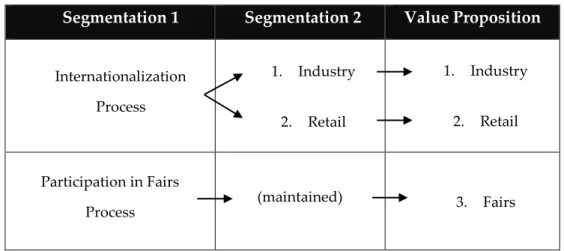
Table 2: KG’s Customer Segmentation and Value Proposition (Now and Then) Table 1: KG’s Customer Segmentation and Value Proposition
On a first stage there is a discrimination applied to either the service is Participation in Fairs Process or Internationalization Process, this last one is later discriminated either being Industry or Retail related, for in the end each one has a tailored VP that meets the expectations and needs required.
The segmentation was conducted based not only on a client’s characteristics such as the propensity to invest on internationalization, the dimension of the company, the market on which they practice their activity and what benefits can the client bring, but also on an introspective view of what KG can offer in order to understand who would be more interested on the services provided.
Table 2 graphically shows and provides a quick summary of the changes.
Segmentation 1 Segmentation 2 Value Proposition
Internationalization Process 1. Industry 2. Retail 1. Industry 2. Retail Participation in Fairs
Process (maintained) 3. Fairs
Then
•1 value proposition (used partially or totally depending on customer) •3 kinds of customersNo
w
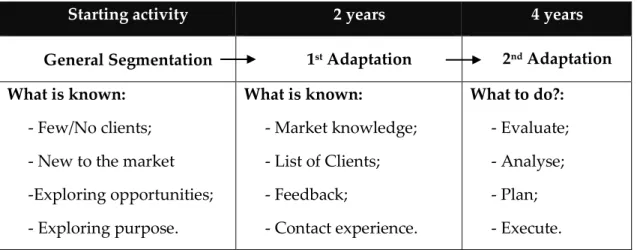
•3 value propositions •3 kinds of customersAll of this redesigning and rethinking process was needed to better understand and provide what the client really expects of the service and it was took into action nearly two years in the history of KG’s activity. It is interesting the fact that probably in less than two more years a new analysis must be made and new segmentation and VP attribution processes should take place, taking into account the company’s growth rhythm in work possibilities and opportunity grasping.
Table 3 represents a somewhat illustration of the main conclusions in a summarized way, as well as a suggestion for a what could come next based on all that has been stated.
Table 3: Findings on the Case
The discussion of the related information gathered until this point, from all of the above sections (theory to case and though method) is the topic of the chapter that follows.
Starting activity 2 years 4 years
General Segmentation 1st Adaptation 2nd Adaptation
What is known:
- Few/No clients; - New to the market -Exploring opportunities; - Exploring purpose. What is known: - Market knowledge; - List of Clients; - Feedback; - Contact experience. What to do?: - Evaluate; - Analyse; - Plan; - Execute.
Discussion
CS provides insight and better understanding of the intended customer targets, therefore being handled as a tool to build better and stronger relations between companies and customers (D’Souza et al., 2008; Sampaio & He, 2005). On this criteria, KG’s policy to hear what clients and potential clients had to say about their VPs, allied with the will to work on solutions to accommodate the various client needs made a difference when came the time to analyze and strategize. The customer centric philosophy practiced by the company is, in a way, a great provider of information and enables a state of awareness of necessity to address current and future situations.
From the multiple available methods and models of CS (Jonker et al., 2004), KG undertook a “self-made” methodology, not using a particular or delineated strategy. It can be framed as an Application Oriented Methodology (Chu Chan, 2008) since it was mainly based on the behavior, feedback and observation of their clients and potential clients, setting the goal to prioritize the true customer needs and understand which kinds they were dealing with and mostly, wanted and could deal with. Summing up, although there is no particular theoretical model supporting the actions, there is theoretical background on which the actions took place.
Turning the attention to the process of VP design, one of the first things that come up is the resemblance with the two aspects of S-D Logic philosophy (Skålén et al., 2015). This is mostly noticeable through the approach taken on the co-creation of value, building towards a mindset that gave a high value to
the customer’s contribution to the creation process, nourishing a healthy reciprocal relationship (Grönroos and Voima 2013; Ballantyne et al., 2011). It can also be detected an integration of important factors (Skålén et al., 2015) as the knowledge, mainly of both portuguese and polish market that was brought by experience and the practice on implementing internationalization strategies. Presenting themselves in a more open and simpler way to customers, urging to adopt a responsible position and committing to the established goals, KG mirrored the Resource Integration virtue of the S-D Logic (Vargo and Lusch, 2008; Grönroos and Voima 2009; Grönroos, 2013).
The relation between CS and VP in this case took a path that did not stood far from what theory experts tend to elaborate, taking the steps needed at each given time and place. The origin of all the processes on the CS and later the combination with the VP Design, in a way, revealed a “close-to-customer” mindset, that should be a positive aspect moving on to the future. The insight on the customer’s needs, demands and the joint optimization with the company’s resources at hand brought KG a step closer to the modern tendencies on the matters at hand.
On the other hand, the VPs created can also be patterned by claiming they present a Resonating Focus, observing that they improve specific aspects in order to deliver a specific and appreciated value (Anderson et al., 2006) as well as they can the recognized as Functional VPs (Rintamaki et al., 2007) since they are solutions that deliver functional value to customers. These observations fix some pillars on the reliability and timely suitable capacity of the presented
(Frow and Payne, 2014), which leads them to at least try to develop one to explore the market on the first years. As time goes by and evolution takes its place, the need to think what is right, what is wrong and what can be done about it starts to arise, especially to service companies since they generally dwell within high competitive markets (Bolton et al., 2014). As stated in the case, on the verge of the second year of activity, that necessity became a reality that could not be ignored. Whether it is a planned program since the foundation of the company, or an action by reaction, the attitude on both situations should commonly be to strategize a bettered approach. The CS process that led to a result of three VPs to three different segments gives the possibility to better combine efforts to deliver what the clients expect to get, and in parallel perspective, it also opens some curtains to cross-selling opportunities (Baley et al., 2009).
Conclusion
The main conclusions associated with this work are as follows:
CS and VPs should be taken into account as complementary concepts. This way, it is possible to power up, on one hand, a better comprehension of the market for the companies, as on the other hand a more complete and straight to the point response to the customer needs. Table 4 expresses the direct implication of CS on VPs.
It is of growing importance the process of including the points of view and feedbacks of customers on the process of VPs design, this way ensuring that a healthy co-creation of value is possible benefiting all participant entities.
Companies face themselves with the necessity to rethink their customer strategy once their business starts to claim new grounds and new dimensions.
It is positive to take advantage of a company’s position on its early years to adapt to the customer strategy and planning new and improved processes, this way granting a more sustainable future. It is also pertinent to indicate that once
Customer Segmentation •Choose segmentation
patterns;
•Apply segmentation.
Value Proposition
•Develop VPs for the chosen segments;
•Reach the intended targets; •Deliver Value "to who will
value it". Table 4: Customer Segmentation and Value Propositions
the changes/upgrades are made, they are not free from future alterations and improvements.
A service provider these days has to be aware of what their customers need or might need at some point, so the attention to what surrounds them should be at high point in order to be able to identify, analyze and create sustainable customer strategies. Table 5 gathers procedures that service companies should consider when developing their VPs.
This work is not without limitations, being so, they are presented next along with some future work suggestions to be taken into account:
Theoretical limitations arise when the theory around the application of VPs on service based companies (although it is growing) is still not as significant as it probably should be.
The excessive number of CS models tends to deviate the attention of the theory to “tools to segment” and not so much as to understand what the concept represents in a broader perspective.
Service companies VPs
•Work VP's with the maximum knowledge possible;
•Build a VP considering the perspective of both sides ("builder" and "reveiver" of VP);
•Close aproach to customers (cosider them as value co-creators);
•Pay attention to the market influences and trends. Table 5: Recommendations for service companies’ VPs
There would be advantages in gathering more empirical evidence, so it is opportune to conduct a study analyzing factors and comparing behaviors on more companies, in order to create a significant sample to generate a possible rule/model.
Since the case is based on a company that had only reach the stage of the two years of activity, there is a limitation that only allows the main conclusions to go so far. It would also be a great contribution the analysis of companies from various stages of maturity, this way the information would be more complete and with more studied phases.
Summing up, after analyzing the CS and VPs as well as their relation, on the context of a service based company, it has been proven that CS has a direct influence over the VPs. The role of the VPs on service based companies should be seriously taken into account, dedicating time and effort on developing them accordingly to the market trends and with a close approach and attention to the customers.
References
Anderson, J., Narus, J., & Van Rossum, W. 2006. Customer value propositions in business markets. Harvard Business Review, March: 91-9.
Ballantyne, D., & Varey, P. 2006. Introducing a dialogical orientation to the service-dominant logic of marketing. In Lusch, R. and Vargo, S. (Eds.). The Service-Dominant Logic of Marketing: Dialog, Debate and Directions: 224-235. M.E. Sharpe, Armonk.
Ballantyne, D., Frow, P., Varey, R. J., & Payne, A. 2011. Value propositions as communication practice: taking a wider view. Industrial Marketing Management, 40(2): 202–210.
Chan Chu Chai Henry. 2008. Intelligent value-based customer segmentation method for campaign management: A case study of automobile retailer. Expert Systems with Applications, 34(4): 2754–2762.
Christine, B., Paul, B. R., Hugh, W., & Moira, C. 2009. Segmentation and Customer Insight in Contemporary Services Marketing Practice: Why Grouping Customers Is No Longer Enough. Journal of Marketing Management, 25: 227-252.
Cooper, H. M. 1984. The integrative research review: A systematic approach. Applied social research methods series (Vol. 2). Beverly Hills, CA: Sage.
D’Souza, K. C., Awazu, Y., Jha, S., Dombrowski, C., Papagari, S., Baloh, P., & Kim, J. Y. 2008. Customer-driven innovation. Research-Technology Management, 51(3): 35–44.
Dwyer, F. R. 1997. Customer lifetime valuation to support marketing decision making. Journal of Interactive Marketing, 11(4): 6–13.
Falcone, S. P. R., & Yong, H. 2005. Business Process Design and Implementation for Customer Segmentation e-Services. 2005 IEEE International Conference on e-Technology, e-Commerce and e-Service, 228 – 234.
Fidel, R. 1992, The case study method. Qualitive research in information management. p. 37-50.
Frow, P., & Payne, A. 2008. The value propositions concept: Evolution, development and application in marketing. Academy of Marketing Conference: Reflective Marketing in a Material World. Aberdeen, United Kingdom, 10th July.
Frow, P., & Payne, A. 2011. A stakeholder perspective of the value proposition concept. European Journal of Marketing, 45 (1-2): 223-240.
Grönroos, C., & Voima, P. 2013. Critical service logic: making sense of value creation and co-creation. Journal of the Academy of Marketing Science, 41(2): 133–150.
Guba, E. e Lincoln, Y. 1994. Competing paradigms in qualitative research. In Denzin, N. e Lincoln, Y. (Eds.). Handbook of Qualitative Research, Thousand Oaks, CA: SAGE Publications.
Hoekstra, J. C., & Huizingh, E. K. R. E. 1999. The lifetime value concept in customer-based marketing. Journal of Market Focused Management, 3(3–4): 257–274.
Hwang, H., Jung, T., & Suh, E. 2004. An LTV model and customer segmentation based on customer value: A case study on the wireless telecommunication industry. Expert Systems with Applications, 26(2): 181–188.
Jain, D., & Singh, S. S. 2002. Customer lifetime value research in marketing: A review and future directions. Journal of Interactive Marketing, 16(2): 34–45.
Jonker Jedid-Jah, Piersman Nanda & Van den Poel Dirk. 2004. Joint optimization of customer segmentation and marketing policy to maximize long-term profitability. Expert Systems with Applications, 27: 159-168.
Kambil, A., Ginsberg, A., & Bloch, M. 1996. Re-inventing value propositions. Working paper IS-96-21, New York University, NYU Centre for Research on Information Systems.
Kotler, P. 1997. Marketing management: analysis, planning, implementation and control (9th ed.). Upper Saddle River, NJ, USA: Prentice-Hall.
Kowalkowski, C. 2011. Dynamics of value propositions: insights from service-dominant logic. European Journal of Marketing, 45(1-2): 277–294.
Lanning, M. 1998. Delivering Profitable Value: A Revolutionary Framework to Accelerate Growth. Generate Wealth and Rediscover the Heart of Business: Perseus Publishing, New York, NY.
Lanning, M., & Michaels, E. 1988. A business is a value delivery system. McKinsey Staff Paper No. 41, July.
Michel, S., Brown, S., & Gallan, A. 2008. An expanded and strategic view of discontinuous innovations: deploying a service-dominant logic. Journal of the Academy of Marketing Science, 36(1), 54–66.
Mulhern, F. J. 1999. Customer profitability analysis: Measurement, concentration, and research directions. Journal of Interactive Marketing, 13(1): 25–40.
Osterwalder, A., Pigneur, Y., Bernarda, G., & Smith, A. 2014. Value Proposition Design. John Wiley & Sons, Inc.
Payne, A., & Frow, P. 2014. Developing superior value propositions: a strategic marketing imperative. Journal of Service Management, 25 (2): 213–227.
Rossiter, J., & Percy, L. 1997. Advertising communications and promotion management (2nd ed.). New York: McGraw-Hill.
Skålén, P., Gummerus, J., von Koskull, C., & Magnusson, P. R. 2015. Exploring value propositions and service innovation: a service-dominant logic study. Journal of the Academy of Marketing Science, 43: 137–158.
Su-Yeon Kim, Tae-Soo Jung, Eui-Ho Suh & Hyun-Seok Hwang. 2006. Customer segmentation and strategy development based on customer lifetime value: A case study, Expert Systems with Applications, 31: 101-107.
Vargo, S. L., & Lusch, R. F. 2004. Evolving to a new dominant logic for marketing. Journal of Marketing, 68(1): 1–17.
Vargo, S. L., & Lusch, R. F. 2008. Service-dominant logic: continuing the evolution. Journal of the Academy of Marketing Science, 36(1): 1–10.
Wu Jung & Lin Zheng. 2005. Research on Customer Segmentation Model by Clustering. ICEC '05 Proceedings of the 7th international conference on Electronic commerce, 316-318.
Yin, R. 2015. Case Study Research: Design and Methods (5ª Ed) Thousand Oaks, CA: SAGE Publications.
Appendixes:
Appendix 1 – Guidelines and Profiles:
This appendix shows the guidelines for the semi-structured intervews as well as the profiles of both interviewed and interviewer:
Questions / Guidelies:
What are the main customer segments for KG; What is the importance attributed by KG to VPs;
Which kind of customers does KG attract and who they prefer to work with; How did KG elaborated their CS when they first started their activity;
How did CS affect the first VPs that KG has developed;
What were the needs revealed regarding CS and VPs during the years KG practiced its activity;
How was conducted the more recent evaluation and adaptation process of the VPs on KG;
Profiling the interviewed:
Mr. Michal Dabrowski is the owner and CEO of KG International. He has experience and knowledge on the polish market and the development of business between Portugal and Poland. He was responsible for the application and projection of the KG’s adaptation of CS and VPs.
Profiling the interviewer:
Carlos de Brito is a student that fulfilled its curricular internship inserted in the company KG International. During the internship he had access to company’s internal documents and a “close to action” position that enabled him to question and observe the procedures took by the CEO when approaching the process of CS and VPs adaptation, when considered necessary.