ORIGINAL ARTICLE
Nudibranchs out of water: long-term
temporal variations in the abundance of two
Dendrodoris species under emersion
Ricardo Cyrne
1, Inês C. Rosa
1, Filipa Faleiro
1, Gisela Dionísio
1,2, Miguel Baptista
1, Ana Couto
1, Marta Pola
3and Rui Rosa
1*Abstract
The sudden appearance and disappearance of nudibranchs in intertidal areas have puzzled researchers all over the world, giving rise to a great diversity of theories to explain it. Here we conducted a five-year survey to evaluate seasonal changes in the abundance of Dendrodoris herytra and D. grandiflora in the Sado estuary (Portugal) and to explore a possible relationship with environmental factors such as temperature, salinity, turbidity and dissolved oxy-gen. Moreover, we report, for the first time, the capacity of Dendrodoris nudibranchs to tolerate emersion (unhidden and completely exposed to sun exposure) during low tides. Our results showed that both species consistently started to appear emerged in March, reaching a peak abundance between April and May, and completely disappearing in July. In both species, this temporal trend was significantly associated with water temperature, turbidity, and dissolved oxygen, but not with salinity. We argue that the sudden appearance and disappearance of these nudibranchs in intertidal areas may result from a seasonal horizontal movement of adult nudibranchs from subtidal areas to mate in intertidal areas during spring, when phytoplankton production is enhanced and planktotrophic larvae may benefit from greater food availability.
Keywords: Dendrodoris, Nudibranchs, Emersion, Aggregations, Horizontal movements, Seasonal abundance
© The Author(s) 2018. This article is distributed under the terms of the Creative Commons Attribution 4.0 International License
(http://creat iveco mmons .org/licen ses/by/4.0/), which permits unrestricted use, distribution, and reproduction in any medium,
provided you give appropriate credit to the original author(s) and the source, provide a link to the Creative Commons license, and indicate if changes were made.
Background
Nudibranchs are delicate, coloured and soft-body gastro-pod molluscs. They are characterized by having a shell and mantle cavity that are either reduced or completely absent [1]. They can be found worldwide, occupying a wide range of habitats, from marine tropical waters to cold deep Artic Ocean [2]. Nudibranch constitute impor-tant components of benthic marine ecosystems and can be commonly found grazing on the substrate, in associa-tion with corals, feeding on macroalgae, or crawling over rocks or on any other substrate [3].
For a long time, the sudden appearance and disap-pearance of nudibranchs in intertidal areas have puzzled
researchers all over the world. A great diversity of theo-ries has been proposed to explain this phenomenon (see a comprehensive review in Table 1), but much contro-versy still exists regarding this issue. The most accepted theory is that nudibranchs migrate from subtidal to intertidal areas to mate and spawn [4–6]. However, sev-eral other explanations have been suggested, with some authors arguing that organisms appear inshore due to the action of tides, currents or waves [7, 8] or due to a for-tuitous establishment of veligers [9–11]. As for the sud-den disappearance of nudibranchs from the coast, death after spawning [4, 5, 12] and ecological constraints such as food limitation and predation [10, 11] have been pro-posed as possible causes.
In 2011 we observed the appearance of the nudibranchs Dendrodoris grandiflora and D. herytra completely emerged during low tides in an oyster bank located in the Sado Estuary Natural Reserve (Portugal). This is the first
Open Access
*Correspondence: [email protected]
1 MARE - Marine and Environmental Sciences Centre, Laboratório
Marítimo da Guia, Faculdade de Ciências da Universidade de Lisboa, Av. Nossa Senhora do Cabo 939, 2750-374 Cascais, Portugal
Table
1
Summar
y of studies addr
essing the sudden app
ear anc e and/or disapp ear anc e of nudibr anchs in in ter tidal ar eas Ref er enc es Species Loca tion Obser va tion da tes Emersion M
ain findings on popula
tion fluc tua tion [ 36 ] Chr omodoris z ebr a Fair yland Cr eek and M ill -br ook Cr eek , Ber muda June –A ugust of 1913–1914, A ug 1915– O ct 1916, Jan 1917 Not mentioned Diur nal shor ewar d mo vement in r esponse to ph ysical conditions ( e.g . positiv e phot otr opism) [ 4 ] D oris bilamellata W imer eux, F rance A ugust of 1922 Not mentioned
Appearance and disappearance in the int
er tidal ar ea r elat ed t o spa wning mig ra
-tions and subsequent adult death af
ter spa wning [ 9 ] Embletonia fusc ata Bar negat Ba y, USA No v 1928, Jun t o S ep 1929 Not mentioned Fluc tuations due t o the f or tuit ous settle
-ment and rapid de
velopment of lar vae in the int er tidal z one , which w er e br ought by wa
ves and cur
rents . P ost -spa wning disappearance r elat ed t o mor talit y b y food scar cit y and/or en vir onmental fac -tors such as lo w t emperatur e [ 7 ] 22 species (**) M ont er ey Ba y, USA No v 1934 t o M ay 1935, Jul t o A ug 1936
Not mentioned (tide pools)
Fluc tuations due t o f or tuit ous lar val settle
-ment in the int
er tidal z one , which w er e br ought b y cur rents and wa ves [ 27 ] 30 species (****) The Nether lands Not specified Lamellidoris bilamellata Emer ged t o forage N/A [ 10 ] 24 species (***) Isle of M an, UK O ct 1955 t o Jun 1958 Acteonia senestr a in exposed r ocks Fluc tuations due t o f or tuit ous lar val settle
-ment in the int
er tidal z one , which w er e br ought b y cur rents and wa ves , and dis -appearance due t o lo w f ood a vailabilit y [ 11 ] Ar chidoris monter ey ensis Vancouv er Island , C anada M ay 1969, O ct 1970 Exposed b y lo w tides Fluc tuations due t o f or tuit ous lar val settle
-ment in the int
er tidal z one . P ost -spa wn -ing disappearance r elat ed t o mor talit y by f ood scar cit y, ph ysical str ess b y en vi -ronmental fac tors ( e.g . t emperatur e and dissec tion) or dislodg ment b y st or ms [ 5 ] Triopha maculata A silomar Stat e Beach, USA O ct 1969 t o Jul 1973 No Emer gence of individuals fr om under r ocks , influenced b y wa ve ac tion. Disappear -ance due t o death af ter spa wning [ 37 ] O nchidoris bilamellata W imer eux, F rance Jul t o A ug 1991 Not mentioned No e
vidence of mass agg
regations or tidal mig rations [ 38 ] 10 species (*) D elta Ar
ea, the Nether
lands
Jan 1990 t
o D
ec 1991
No
In species with mor
e than one generation
per y ear , fluc tuations ar e r elat ed t o pr ey availabilit y. I
n species with annual lif
e cy cles , fluc tuations ar e r elat ed t o other fac tors such as t emperatur e [ 39 ] Ar chidoris monter ey ensis Beach Stat e P ar k, USA Jul 1994 t o Jun 1999 Not mentioned Selec tiv e lar val settlement in r esponse t o pr
ey chemical cues and adult agg
rega -tions associat ed with pr ey densit y [ 12 ] D endr odoris limbata Sant Ant oni, Spain No v 1992, S ep 1994, F eb 1997 t o Jan 1999 Not mentioned Disappearance r elat ed t o death af ter spa wning
Table 1 (c on tinued) Ref er enc es Species Loca tion Obser va tion da tes Emersion M
ain findings on popula
tion fluc tua tion [ 6 ] O nchidoris bilamellata M illpor t, S cotland Jul 2006 No
Subtidal mass mig
ration and agg
regation
for copulation and spa
wning due t
o
mag
netic cues or mucus trail-f
ollo wing . No e vidence of death af ter spa wning [ 40 ] Kalinga ornata Chennai coast, I ndia Jul–D ec 2011 No Fluc tuations due t o agg regations t o br eed . No e vidence of death af ter spa wning . Disappearance due t o mig ration f or mor e suitable ar eas ( e.g . f ood a vailabilit y)
The list of species in the studies mar
ked with ast
er isks is sho wn as A dditional file 1 : T able S1
record of such a behaviour regarding these species. The genus Dendrodoris has been the subject of many stud-ies, focusing not only on systematic descriptions [13–15], but also on chemical defences [16, 17], histology [18, 19], development [20–23], among others. Dendrodoris nudi-branchs are usually found from the surface down to 25 m depth and are often hidden under rocks during daylight. At night, they leave their shelter to feed on sponges, their specific prey item [24].
To contribute to a better knowledge on the population dynamics and the sudden appearance and disappearance of nudibranchs in intertidal areas, the present study anal-yses the changes in the abundance of emerged D. herytra and D. grandiflora during a 5-year monthly survey, and investigates the possible role of environmental factors such as temperature, salinity, turbidity and dissolved oxy-gen to explain such temporal dynamic trends.
Materials and methods
Study site
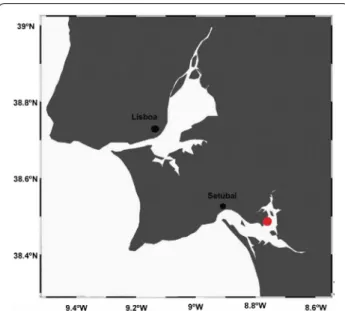
This study was carried out in an oyster bank located in the Sado Estuary Natural Reserve, on the West coast of Portugal (38.474857°N, 8.775255°W; Fig. 1). Given its elevation, this bank is submerged during high tides and emerged during low tides (< 0.8 m relative to Mean Lower Low Water), presenting a total emerged area of 1050 m2. The predominant substrate is sand and mud with a great amount of oyster and cockle shelves (Fig. 1).
Nudibranch abundance
Adult nudibranchs of the species D. herytra and D. gran-diflora were visually counted monthly, between January 2011 and June 2015. Surveys were carried out during the lowest tide of the month (< 0.8 m) and covered the entire emerged oyster bank. While looking for nudibranchs, we also looked for egg masses and sponges, the natural prey of Dendrodoris.
To evaluate if nudibranchs were sexually mature and if they die after spawning, 10 nudibranchs of each spe-cies were collected during the peak of abundance in April 2015 and transported to the aquaculture facilities of Laboratório Marítimo da Guia (Cascais, Portugal). They were kept in two separate groups aquaria, in recirculating systems under the same conditions as those observed in the study area (i.e. pH 8.0; salinity 35, temperature 21 °C). Individuals were not fed and were maintained for 15 days in those conditions. The occurrence of mating, spawn-ing and death after spawnspawn-ing was assessed. Organisms considered dead where normally found at the bottom upside down. Death was confirmed after loss of mobility, increase of mucus release, high loss of colour, and loss of muscular flexibility.
Environmental conditions
To establish a connection with the abundance of nudi-branchs, environmental data were collected between January 2011 and June 2015. Water temperature, tur-bidity and dissolved oxygen were measured with a mul-tiparameter probe (CTD YSI 6600 V2, Tropical Marine Centre, Portugal) and salinity was measured with a refractometer (V2 Refractometer, Tropical Marine Cen-tre, Portugal) with a precision of ± 1. Measurements were made in the surroundings of the emerged bank during low tide when nudibranchs were observed and collected.
Statistical analyses
To investigate the relation between D. herytra and D. grandiflora abundance and environmental variables, a generalized additive model (GAM) with a zero-inflated Poisson (ZIP) family was used for each species. The ZIP model is especially useful to analyse count data with many zero observations, such as our data [25]. Prior to statistical analyses, the independency of environmental variables was checked using a correlation matrix.
The method used to choose the best model was an “all possible subsets” method of analysis, in which several models were created for all possible combinations of variables. Akaike Information Criterion (AIC) was used to select the most parsimonious model. Based on these results, the final model included water temperature, salinity, turbidity and dissolved oxygen as independ-ent variables. A mix of smooth and parametric model components was used [26]. For D. grandiflora, a thin plate regression spline with “shrinkage” was fitted [26] to water temperature, turbidity and dissolved oxygen, while for D. herytra the same smooth parameter was fitted only to turbidity and dissolved oxygen.
All statistical analyses were implemented in R (ver-sion 3.1.1), using the mgcv package [26].
Results
Nudibranch abundance
Nudibranchs were mostly encountered emerged, but some were occasionally found in small tidal pools or under oyster shelves. Most of the individuals were found alone, static, and some upside down. No dead animals, egg masses or sponges (their natural prey) were encountered in any of the monthly surveys dur-ing the 5 years. The highest abundance of both species was observed during the first year of observations (i.e. 2011), followed by the year 2013 (Fig. 2). An accentu-ated decrease in nudibranch abundance was observed in 2012 and 2015. In general, D. grandiflora presented higher abundances than D. herytra (Fig. 2).
The appearance of emerged nudibranchs presented a marked seasonal pattern (Fig. 2). Nudibranchs were observed from March to June, mainly during April and May, and disappeared completely from July onwards. This pattern was consistent during the five consecu-tive years, with just a few small changes observed over time. For instance, in 2011 nudibranchs of both species started to appear emerged in April (Fig. 2), while in the following years (i.e. from 2012 to 2015) they started to appear earlier in March (Fig. 2), although in very low numbers. The maximum abundance was always reached in April (Fig. 2), except for 2014 when the peak was reached later in May (Fig. 2). Afterwards, nudibranchs’ abundance started to decrease until a complete disap-pearance in July (Fig. 2), although in 2014 they disap-peared abruptly in June (Fig. 2).
Nudibranchs captured in April 2015 and kept under laboratory conditions were seen copulating and spawning as soon as they arrived at the lab (Fig. 1), which indicates that the organisms from the study population were sexually mature during the peak of abundance of that year. More-over, we found no evidence of death after spawning, with some individuals spawning more than once.
Environmental conditions
Variation in the environmental parameters of the Sado estuary, from January 2011 to June 2015, is presented in Fig. 3. Water temperature, as well as turbidity, showed con-sistent patterns throughout the five years of observations.
As expected, water temperature showed an increasing trend from winter to summer months, almost like a bell-shaped graph (Fig. 3A1–A6). Maximum water tempera-tures occurred between June and August, depending on the year. Salinity showed no clear pattern (Fig. 3B1–B6). Tur-bidity varied generally between 1 and 5 NTU during most of the year, except for March and April, when it could reach values as high as 75 NTU (Fig. 3C1–C6). Dissolved oxygen varied between 60% (4.5 mg l−1 O
2 around 26 °C) and 150% (12.7 mg l−1 O
2 around 13 °C), with a sharp increase occur-ring in the beginning of the spoccur-ring season and reaching a peak in April or May depending on the year (Fig. 3).
Relationship between nudibranch abundance and environmental conditions
The explanatory ability of the models was good, with an explained deviance of 85.5% for D. herytra and 98.1% for D. grandiflora. For both species, water temperature, tur-bidity and dissolved oxygen showed significant effects on nudibranchs’ abundance (p < 0.05), but not salinity (p > 0.05; Table 2). Higher abundances occurred at temperatures generally between 17 °C and 21 °C (except for 2014, when it reached 24 °C), but only in spring and not during autumn months. On the other hand, higher abundances were pre-ceded by the peak in turbidity, coincided with the peak in dissolved oxygen (Fig. 3).
Discussion
Emersion and microhabitat selection
Nudibranchs are known for their sudden appearance and disappearance in intertidal areas (see Table 1), but reports of emerged nudibranchs are scarce [10, 11, 27]. The present work constitutes the first comprehensive report of the sea-sonal occurrence of emerged nudibranchs during low tides. In contrast to other molluscs, nudibranchs do not pos-sess a shell that protects them from desiccation and allows them to create a high humidity environment within their shells. Instead, they usually seek areas of great humidity and refuge beneath rocks or other shelters (see more about microhabitat selection in [28]). Although nudibranchs are generally not found in unsheltered and open areas, in the present study we showed that dozens of individuals were emerged at low tides during spring months. Nevertheless, it is worth mentioning that the texture of the substratum (i.e. oyster shell bank) seems to play an important role in micro-habitat selection by Dendrodoris species, since all the other intertidal banks in the surrounding area—without oyster shells coverage and mostly constituted by mud substrate with little sand—never revealed any emerged specimens. From this, we argue that oyster shells must provide some crypsis by providing a disrupted visual background that might contribute to a reduction in visual predation. Also, this could mean that oyster shells protect nudibranchs
Fig. 1 Map of the study area, an oyster sandbank located in the
Sado Estuary National Reserve, West coast of Portugal (38.474857°N, − 8.775255°W)
from dehydration. However, the fact that most nudibranchs were not beneath the shells makes this microhabitat selec-tion argument incomplete.
Horizontal migrations and spawning
There is a great diversity of theories that explain the sud-den appearance and disappearance of nudibranchs in intertidal areas (as synthesized in Table 1). However, it is still unknown if these events are related with horizontal migrations, and what are the causes that motivate these movements. Some authors state that, as a result of these horizontal migrations, nudibranchs seasonally appear as mass aggregations in intertidal areas to mate and spawn [4, 6]. In our surveys, organisms were mostly seen iso-lated and no egg masses were seen in the study site. This way, it seems unlikely that the nudibranchs were in the study area to mate or to spawn. Nonetheless, the indi-viduals that were brought to the laboratory immediately started to copulate and spawned, indicating that they were sexually mature. Thus, the hypothesis of a horizon-tal migration to intertidal areas to mate should not be set aside and further studies are necessary to clear this out.
The sudden disappearance of nudibranchs from inter-tidal areas has often been attributed to death after spawning [4, 6]. During our surveys, we did not observe dead individuals in the field or any evidence of death after spawning in the specimens kept in the laboratory, with some nudibranchs spawning more than once. This way, our results with Dendrodoris spp. do not support this hypothesis. However, and like other molluscs, death after spawning may be a species-specific trait. While a similar pattern was observed for Onchidoris bilamellata, a species that spawns several times before dying [29], other nudibranchs seem to experience death after spawn-ing (e.g. Archidoris montereyensis, in [11]).
Environmental determinants
The abundance of D. herytra and D. grandiflora was cor-related with most of the assessed environmental fac-tors, namely water temperature, turbidity and dissolved oxygen. Our long-term survey consistently showed that both species appeared emerged during the low tides of the spring months. They started to appear in March and their abundance was highest between April and May, when water temperatures were generally between 17 and 21 °C (except for 2014, when it reached 24 °C). Both
species completely disappear in July, before the high sum-mer temperatures. A study conducted in the western Atlantic revealed that most nudibranchs have high ther-mal sensitivity and that some species disappear with ris-ing summer temperatures [30]. A negative impact of high temperatures on D. herytra and D. grandiflora may in part explain their disappearance from the intertidal area at the end of the spring. Nevertheless, temperature alone cannot explain their presence only during spring, since no nudi-branchs were observed at similar temperatures in autumn. The presence of D. herytra and D. grandiflora in the intertidal area was consistently related with a peak in turbidity and dissolved oxygen. Elevated turbidity and oxygen super saturation (values exceeding 100%) can be related with spring blooms that result from an increase in phytoplankton biomass and photosynthesis during spring [31–33]. As a result, secondary productivity also increases, including zooplankton grazers [34], which benefits D. grandiflora’s planktotrophic larvae [22]. In addition, high turbidity and dissolved oxygen may be a result of turbulence which in turn will help the distri-bution of planktonic larvae in the water column [35]. This way, Dendrodoris planktonic life stages may benefit from increasing phytoplankton concentration. However, it is noteworthy that no sponges (the prey of the adults of Dendrodoris spp. [24]) were found in the study loca-tion during the 5 years of survey. It is also important to notice that elevated turbidity consistently preceded an increase in nudibranchs abundance (also accompanied by the peak of dissolved oxygen). Thus, we hypothesize that the increase in turbidity is the key environmental factor that triggers the migration of nudibranchs.
In conclusion, the present work constitutes an additional example of a nudibranch population that seasonally appears in intertidal areas, but the first com-prehensive report of nudibranchs under tidal emersion. The sudden appearance and disappearance of Dendro-doris nudibranchs in intertidal areas may result from a seasonal horizontal movement of adult nudibranchs from subtidal areas to mate in intertidal areas during spring, when phytoplankton production is enhanced and plank-totrophic larvae may benefit from greater food avail-ability. However, further studies are required to test this hypothesis.
(See figure on next page.)
Fig. 2 Monthly variations in the abundance of emerged Dendrodoris grandiflora (dark bars) and D. herytra (yellow bars) during low tide at the oyster
Additional file
Additional file 1: Table S1. List of the species analyzed in the four multi-species study synthesized in Table 1.
Authors’ contributions
RC, IR, FF, GD, MP and MB contributed with field work and paper review; AC contributed with Statistical Analysis; RR contributed with paper review,
field work and experimental design. All authors read and approved the final manuscript.
Author details
1 MARE - Marine and Environmental Sciences Centre, Laboratório Marítimo
da Guia, Faculdade de Ciências da Universidade de Lisboa, Av. Nossa Senhora do Cabo 939, 2750-374 Cascais, Portugal. 2 Departamento de Biologia
and CESAM, Universidade de Aveiro, Campus de Santiago, 3810-193 Aveiro, Portugal. 3 Departamento de Biología, Edificio de Biología, Campus de
Fig. 3 Environmental parameters in the study area from January 2011 to June 2015. Water temperature (A1–A5) and mean (A6), Salinity (B1–B5)
and mean (B6), Turbidity (C1–C5) and mean (C6), Dissolved oxygen (D1–D5) and average (D6). Error bars represent standard deviation. Grey areas represent the months in which nudibranchs were observed (dark and soft grey for higher and lower abundances, respectively)
Excelencia Internacional UAM+CSIC, Universidad Autónoma de Madrid, C/ Darwin 2, 28049 Madrid, Spain.
Acknowledgements
The authors would like to thank Vanessa Pires, Vanessa Lopes, Marta Pimentel and Luis Narciso for their help in the field work. The authors also acknowl-edge the suggestions of the anonymous reviewers that greatly improved this manuscript.
Competing interests
None of the authors have any kind of competing interests with any other author or Institution regarding the data presented in this work. Authors dis-close all relationships or interests that could have direct or potential influence or impart bias on the work.
Consent for publication Not applicable. Ethics approval
All the authors followed the Ethical Responsibilities according to the Commit-tee on Publication Ethics (COPE).
Funding
The Portuguese Foundation for Science and Technology (FCT) supported this study through the strategic project granted to MARE UID/Multi/04378/2013, FCT Investigator Consolidation Grant to R. Rosa, doctoral grants to G.D. (SFRH/ BD/73205/2010) and M.B. (SFRH/BD/88175/2012) and a post-doc grant (SFRH/ BPD/79038/2011) to F.F.
Publisher’s Note
Springer Nature remains neutral with regard to jurisdictional claims in pub-lished maps and institutional affiliations.
Received: 3 February 2018 Accepted: 23 August 2018
References
1. Wägele H, Klussmann-Kolb A, Verbeek E, Schrodl M. Flashback and foreshadowing-a review of the taxon Opisthobranchia. Org Divers Evol. 2014;14(1):133–49.
2. Dionisio G, Rosa R, Leal MC, Cruz S, Brandao C, Calado G, Serodio J, Calado R. Beauties and beasts: a portrait of sea slugs aquaculture. Aquaculture. 2013;408:1–14.
3. Behrens DW, Valdés A. A new species of Dendrodoris (Mollusca: Nudi-branchia: Dendrodorididae) from the Pacific coast of North America. Proc Calif Acad Sci. 2004;55:408–13.
4. Pelseneer P. Sur une habitude de Doris bilamellata. Ann Soc R Zool Belg. 1922;53:28–32.
5. Nybakken J. Abundance, diversity and temporal variability in a California intertidal nudibranch assemblage. Mar Biol. 1978;45:129–46.
6. Claverie T, Kamenos NA. Spawning aggregations and mass movements in subtidal Onchidoris bilamellata (Mollusca: Opisthobranchia). J Mar Biol Assoc UK. 2008;88(1):157–9.
7. Costello DP. Notes on the breeding habits of the nudibranchs of Monte-rey Bay and vicinity. J Morphol. 1938;63(2):319–43.
8. Willows AOD. Shoreward orientation involving geomagnetic cues in the nudibranch mollusc Tritonia diomedea. Mar Freshw Behav Phys. 1999;32(2–3):181–92.
9. Chambers LA. Studies on the organs of reproduction in the nudibranchi-ate mollusks. Bull Am Mus Nat Hist. 1934;66:599–641.
10. Miller MC. Annual cycles of some Manx nudibranchs, with a discussion of the problem of migration. J Anim Ecol. 1962;31(3):545–69.
11. Crane SV. Population ecology of the nudibranch Archidoris montereyensis. Simon Fraser University; 1972.
12. Domenech A, Avila C, Ballesteros M. Spatial and temporal variability of the opisthobranch molluscs of Port Lligat Bay, Catalonia, NE Spain. J Mol-luscan Stud. 2002;68:29–37.
13. Valdes A, Ortea J, Avila C, Ballesteros M. Review of the genus Dendrodoris Ehrenberg, 1831 (Gastropoda: Nudibranchia) in the Atlantic Ocean. J Mol-luscan Stud. 1996;62:1–31.
14. Brodie GD, Willan RC, Collins JD. Taxonomy and occurrence of
Dendrodo-ris nigra and DendrodoDendrodo-ris fumata (Nudibranchia: Dendrodorididae) in the
Indo-West Pacific region. J Molluscan Stud. 1997;63:407–23.
15. Hirose M, Hirose E, Kiyomoto M. Identification of five species of Dendro-doris (Mollusca: Nudibranchia) from Japan, using DNA barcode and larval characters. Mar Biodivers. 2015;45(4):769–80.
16. Fontana A, Ciavatta ML, Miyamoto T, Spinella A, Cimino G. Biosynthesis of drimane terpenoids in dorid molluscs: pivotal role of 7-deacetoxy-olepupuane in two species of Dendrodoris nudibranchs. Tetrahedron. 1999;55(18):5937–46.
17. Fontana A, Villani G. G. C. Terpene biosynthesis in marine molluscs: incorporation of glucose in drimane esters of Dendrodoris nudibranchs via classical mevalonate pathway. Tetrahedron Lett. 2000;41:2429–33. 18. Wägele H, Brodie GD, Klussmann-Kolb A. Histological investigations on
Dendrodoris nigra (Stimpson, 1855) (Gastropoda, Nudibranchia,
Dendro-dorididae). Molluscan Res. 1999;20:79–94.
19. Brodie GD. Some comparative histological aspects of the dendrodorid genera Doriopsilla and Dendrodoris (Opisthobranchia: Nudibranchia). Boll Malacol. 2001;37:99–104.
20. Gohar HAF, Soliman GN. The biology and development of Dendrodoris (= Doridopsis) fumata (Rüppell and Leuckart) (Gastropoda, Nudibranchia). Pub Mar Biol Stat, Al-Ghardaqa, Red Sea. 1967;14:31–54.
21. Shyamasundari K, Najbuddin M. Experimental investigations of salinity and temperature effects on early developmental stages in Dendrodoris
(Doriopsilla) miniata (Alder & Hancock) (Gastropoda Opisthobranchia).
Monit Zool Ital. 1976;10:93–104.
22. Goddard JH. Ametamorphic direct development in Dendrodoris behrensi (Nudibranchia: Dendrodorididae), with a review of developmental mode in the family. Proc Cal Acad Sci. 2005;59:201–11.
23. Brodie GD, Calado G. Dendrodoris arborescens (Collingwood, 1881) (Mol-lusca: Nudibranchia): larval characteristics reveal a masked porostome species. Rec West Aust Mus. 2006;69:119–26.
24. Calado G, Silva JP. Lesmas do Algarve—Guia de Moluscos Opistobrân-quios da Costa Sul do Algarve. Portimão: Subnauta; 2012.
25. Arab A, Wildhaber ML, Wikle CK, Gentry CN. Zero-inflated modeling of fish catch per unit area resulting from multiple gears: application to
Table 2 Results of Generalized additive models (GAMs)
Approximate significance levels (p) are displayed for each covariate (* represents a significance level of 0.05). Slope (β) and standard deviation (sd) are shown for parametric coefficients β sd p Dendrodoris herytra Parametric coefficients Water temperature − 0.0985 0.04 0.0096* Salinity 0.3413 0.15 0.2773 Smooth terms s (Turbidity) < 2.00e−16*
s (Dissolved oxygen) 1.05e−15*
Dendrodoris grandiflora
Parametric coefficients
Salinity 0.4638 0.25 0.0606
Smooth terms
s (Water temperature) 7.15e−07*
s (Turbidity) < 2.00e−16*
•fast, convenient online submission •
thorough peer review by experienced researchers in your field • rapid publication on acceptance
• support for research data, including large and complex data types •
gold Open Access which fosters wider collaboration and increased citations maximum visibility for your research: over 100M website views per year •
At BMC, research is always in progress. Learn more biomedcentral.com/submissions
Ready to submit your research? Choose BMC and benefit from: channel catfish and shovelnose sturgeon in the Missouri River. N Am J
Fish Manag. 2008;28(4):1044–58.
26. Wood SN. Generalized additive models: an introduction with R. Boca Raton, FL: Chapman Hall/CRC; 2006.
27. Swennen C. Data on distribution, reproduction and ecology of the nudibranchiate molluscs occurring in the Netherlands. Neth J Sea Res. 1961;1:191–240.
28. Barbeau MA, Durelle K, Aiken RB. A design for multifactorial choice experi-ments: an example using microhabitat selection by sea slugs Onchidoris
bilamellata (L.). J Exp Mar Biol Ecol. 2004;307(1):1–16.
29. Todd CD. Settlement-timing hypothesis: reply to Grant and Williamson. Mar Ecol Prog Ser. 1985;23:197–202.
30. Clark KB. Nudibranch life cycles in the Northwest Atlantic and their relationship to the ecology of fouling communities. Helgol Wiss Meeresunters. 1975;27:28–69.
31. Barlow RG, Mantoura RFC, Gough MA, Fileman TW. Pigment Signatures of the Phytoplankton Composition in the Northeastern Atlantic during the 1990 Spring Bloom. Deep-Sea Res Pt II. 1993;40(1–2):459–77.
32. Butler W, Coste JH. Seasonal variations in the dissolved oxygen content of the water of the Thames estuary. With special reference to the phenom-enon of supersaturation. Biochem J. 1923;17(1):49–58.
33. O’Boyle S, McDermott G, Wilkes R. Dissolved oxygen levels in estuarine and coastal waters around Ireland. Mar Pollut Bull. 2009;58(11):1657–63. 34. George JA, Lonsdale DJ, Merlo LR, Gobler CJ. The interactive roles of
temperature, nutrients, and zooplankton grazing in controlling the winter-spring phytoplankton bloom in a temperate, coastal ecosystem, Long Island Sound. Limnol Oceanogr. 2015;60(1):110–26.
35. Scheltema R. On dispersal and planktonic larvae of benthic inverte-brates: an ecletic overview and summary of problems. Bull Mar Sci. 1986;39:290–322.
36. Crozier WJ. On the periodic shoreward migrations of tropical nudi-branchs. Am Nat. 1917;51:377–82.
37. Thompson TE. Migrations of Onchidoris-Bilamellata during Tidal Emersion—a refutation. J Molluscan Stud. 1984;50:123.
38. Aerts LAM. Seasonal distribution of nudibranchs in the southern Delta area, SW Netherlands. J Molluscan Stud. 1994;60:129–39.
39. Knowlton AL, Highsmith RC. Convergence in the time–space continuum: a predator–prey interaction. Mar Ecol Prog Ser. 2000;197:285–91. 40. Shrinivaasu S, Venkatraman C, Rajan R, Padmanaban P, Venkataraman
K. Abundance and spawning of Kalinga ornata (Mollusca: Gastropoda: Opisthobranchia). CIBTech J Zool. 2013;56:2319–3883.
![Table 1 Summary of studies addressing the sudden appearance and/or disappearance of nudibranchs in intertidal areas ReferencesSpeciesLocationObservation datesEmersionMain findings on population fluctuation [36]Chromodoris zebraFairyland Creek and Mill- bro](https://thumb-eu.123doks.com/thumbv2/123dok_br/15190286.1016808/2.892.100.782.126.1099/addressing-disappearance-nudibranchs-referencesspecieslocationobservation-datesemersionmain-fluctuation-chromodoris-zebrafairyland.webp)
![Table 1 (continued) ReferencesSpeciesLocationObservation datesEmersionMain findings on population fluctuation [6]Onchidoris bilamellataMillport, ScotlandJul 2006NoSubtidal mass migration and aggregation for copulation and spawning due to magnetic cues or](https://thumb-eu.123doks.com/thumbv2/123dok_br/15190286.1016808/3.892.330.484.151.1083/referencesspecieslocationobservation-datesemersionmain-fluctuation-onchidoris-bilamellatamillport-scotlandjul-nosubtidal-aggregation.webp)