COMPETITION AND DECISION MAKERS IN MULTIPRODUCT
FIRMS
Francisco Vieira da Silva Aleixo
Dissertation
Master in Economics
Supervised by
João Correia da Silva
i
Biographical Note
Francisco Vieira da Silva Aleixo was born in Porto, 1995. He received a bachelor’s degree in Economics in 2016 from University of Porto, School of Economics and Management and decided to proceed with his studies. Francisco enrolled in the Master in Economics at University of Porto, School of Economics and Management in 2016 and since July, 2017 he starts working at Ibersol, SGPS. This dissertation is regarded as the last stage of his master program.
ii
Declaration
In accordance with my ethical and policy obligations, I am reporting that I have a business relationship since July 2017 with Ibersol Group – a player in the pizza industry through Pizza Hut brand. Ibersol Group develops a network of both own and franchisees Pizza Hut stores in Portugal, Spain and Angola. I am a member of management and control department with direct functions in Pizza Hut business. To avoid any potential conflict of interest that could arise from the report of this thesis, I declare that this dissertation reflects only my personal view.
iii
Acknowledgments
Firstly, I wish to thank Professor Isabel Mota for the helpful suggestions to find the matching between my research interests with those of the potential supervisor and Professor Joana Resende for her advices in the plan of dissertation course.
Secondly and foremost, I would like to express my gratitude to Professor João Silva for advising my thesis, for all suggestions, helpful comments and overall motivation throughout the evolution of this dissertation. Also, for the part professor João Silva has played in inspiring my interest in industrial organization and competition.
Any written acknowledgment is not enough to thank my mother and father, who inspire me every day.
Finally, I would like to thank my friends, co-workers, family and the Faculty of Economics of University of Porto, all Professors, colleagues and faculty staff with whom I have crossed paths throughout my academic journey.
iv
Abstract
Using a version of the duopoly model proposed by Singh and Vives (1984) with four products, this thesis develops a theoretical framework to understand how the number of decision makers in multiproduct firms – that have operations through multiple distribution channels – affects market competition. For motivation, it provides an illustrative analysis for pizza industry.
This dissertation finds that firms prefer to compete with a single manager for both channels if channels are close substitutes within a firm but not across firms. Otherwise, firms prefer a manager for each distribution channel. Furthermore, the performance of the industry is enhanced when both firms have only one decision maker. Consumers and society are better off if both firms compete with two decision makers, regardless the degree of product substitutability between channels and firms.
Keywords: multiproduct firms · product differentiation · pizza industry JEL codes: D43, L13, L66
v
Sumário
Considerando uma versão do modelo de duopólio proposto por Singh and Vives (1984) com quatro produtos, esta tese desenvolve uma ferramenta teórica para compreender de que forma o número de decisores em empresas multiproduto – que têm operações através de múltiplos canais de distribuição – afeta a concorrência no mercado. A título ilustrativo, esta tese analisa a indústria da pizza.
Esta dissertação mostra que as empresas preferem ter um decisor para os dois canais de distribuição se os canais de distribuição forem substitutos próximos numa dada empresa, mas não entre empresas. Caso contrário, as empresas preferem um decisor para cada canal de distribuição. Para além disso, a indústria apresenta um melhor desempenho quando as empresas optam por ter apenas um decisor. Os consumidores e a sociedade melhoram o seu bem-estar se as empresas competirem com dois decisores, independentemente do grau de substituição entre canais e empresas.
Palavras-Chave: empresas multiproduto · diferenciação produto · indústria pizza Classificação JEL: D43, L13, L66
vi
Contents
1. INTRODUCTION ... 1
2. LITERATURE REVIEW ... 2
2.1. MULTIPRODUCT FIRMS AND PRODUCT DIFFERENTIATION ... 2
2.2. TRADITIONAL MODELS OF FIRM COMPETITION AND PRODUCT DIFFERENTIATION ... 3
2.3. FIRMS AND MANAGERS OBJECTIVES ... 5
3. PIZZA INDUSTRY: BACKGROUND ... 8
3.1. OVERVIEW ... 8
3.2. MAIN PLAYERS ... 8
3.3. MARKET STRUCTURE AND BUSINESS MODEL ... 9
4. MODEL AND METHODOLOGY ... 11
4.1. METHODOLOGY ... 11
4.2. MODEL ... 11
4.2.1. Model Setup ... 11
4.3. PROFIT MAXIMIZATION OF DIFFERENT SCENARIOS ... 13
4.3.1. Single manager ... 13
4.3.2. Two managers ... 14
4.4. EQUILIBRIA OF THE DIFFERENT SCENARIOS ... 14
4.4.1. Both firms have single manager ... 15
4.4.2. Both firms have two managers ... 15
4.4.3. Firms with different number of managers ... 15
4.5. COMPARISON OF EQUILIBRIA AMONG THE DIFFERENT SCENARIOS ... 16
4.6. EQUILIBRIUM WHEN FIRMS OR CHANNELS ARE PERFECTLY SUBSTITUTES AND INDEPENDENT ... 17
4.6.1. Equilibrium with perfectly substitute firms ... 17
4.6.2. Equilibrium with perfectly substitute channels ... 19
4.6.3. Equilibrium with independent firms ... 20
4.6.4. Equilibrium with independent channels ... 21
5. INDUSTRY AND ENDOGENOUS FIRMS’ DECISION ... 22
5.1. EQUILIBRIUM CONDITIONS OF FIRMS’ DECISION. ... 22
5.1.1. Equilibrium when both firms compete with a single manager ... 22
5.1.2. Equilibrium when both firms compete with two managers ... 22
5.1.3. Equilibrium when a firm has one manager and the other firm has two managers ... 22
5.3. INDUSTRY AND FIRM PROFITS ... 23
6. WELFARE ANALYSIS ... 25
7. CONCLUSIONS ... 27
vii
List of figures
Figure 1. Equilibria when firms are perfect substitutes (δ = 1). ... 18
Figure 2. Equilibria when channels are perfect substitutes (γ = 1). ... 19
Figure 3. Equilibria when firms are independent (δ = 0). ... 20
Figure 4. Equilibria when channels are independent (γ = 0). ... 21
Figure 5. Equilibrium decision of firms. ... 23
List of tables
Table 1. Equilibrium Consumer, Producer and Total surplus ... 251
1. Introduction
It is commonly observed in the literature that the behaviour of multiproduct firms, the market structure or the objective function of firms and managers influence market competition. However, the impact of the number of decision makers in market competition did not attract a prominent attention in the literature so far. The number of decision makers takes a special relevance for multiproduct firms that have operations through many distribution channels, since in a single product firm (with only one distribution channel) the strategy of a manager for each distribution channel is undistinguishable from the strategy of a single manager for all distribution channels. Furthermore, products may be not only differentiated across firms but also within multiproduct firms, which have clear implications in the optimal number of managers of a firm.
Pizza industry illustrates an industry that operates through several distribution channels. It is a sector that relies on consumption of households and estimates show revenues of 134 billion dollars for the worldwide pizza market in 2017 (Pizza Pizza Magazine (2017)). Typically, pizza is distributed in more than one distribution channel such as delivery, takeaway and eat-in. Besides that, physical characteristics of the pizza, for instance, toppings or doughs, as well as quality, price, location, service and technology, makes pizza (and, consequently, the respective distribution channel) a differentiated product.
This thesis develops a theoretical framework to examine the following questions. Firstly, for firms with two distribution channels, should a firm have only one manager for both channels? Or should it have a manager for each distribution channel? Secondly, which are the welfare implications when firms have one or two managers on consumers, producers and society? Does the individual firm’s decision lead to the best performance of the industry?
This dissertation pays a special attention to the influence of the number of managers or decision makers in the resulting market outcome. It starts by introducing the topic and presenting the research questions and objectives. The next section consists on a review of the relevant literature that includes the main concepts and contributions related with the research questions and a critical analysis of the different contributions. Section 3 illustrates for pizza industry, presenting the main characteristics and players. Section 4 presents the model set up, the results and some specific cases. Section 5 studies the endogenous decision between one or two decision makers (managers) and section 6 provides a welfare analysis. Finally, section 7 concludes and makes some proposals for future research.
2
2. Literature review
This dissertation is mainly related to the theoretical literature on multiproduct firms and on product differentiation as well as the theoretical models to analyse firm’s decisions and competition. This section also covers the relevant branch of literature about the goals of managers and firms.
2.1. Multiproduct firms and product differentiation
Singh and Vives (1984) proposed a model of duopoly model with product differentiation in a two-stage game such that the two firms firstly choose the strategic variable and compete subsequently. They find that if products are substitutes, is a dominant strategy for a firm to compete in quantities and, for complementary products, by choosing the price contracts, firms enhance profits and consumer surplus. This influential paper inspired a rich literature still active today. However, it considers single-product firms.
Brandão, Correia-da-Silva, and Pinho (2014) highlight the importance of considering multiproduct firms. The literature analysing competition among multiproduct firms in multiple contexts, includes: spacial competition models (Lal and Matutes (1989), Giraud‐ Héraud, Hammoudi, and Mokrane (2003), Laussel (2006), Brandão et al. (2014)) or other model types (Beggs, 1994), competition either on department stores, shopping malls or both (Beggs (1994), Lal and Matutes (1989)), Brandão et al. (2014)), food industry (Azzam & Bouras, 2013), electronic sector (Aw & Lee, 2009), or hospitals (Hendricks, 2008).
One also might recognize the different hypothesis regarding consumer behaviour. A branch of literature that analyses multiproduct firms assumes that consumers buy one product of each kind that is available. Beggs (1994) analyses competition between two groups of firms producing differentiated products in a very particular way: the goods are complements or have a degree of substitution not too large within a group but are substitutes across groups. In his model consumers buy one unit of both goods from either group (perfect complements), and, therefore, care about the sum of prices in each group. Lal and Matutes (1989) introduce a multiproduct version of Hotelling (1929) model for two firms that sell two products and consumers buy one unit of each good. Their results highlight that market interactions among multiproduct firms might change the nature of competition and can intensify competition in a single brand rather than on both. Brandão et al. (2014) also consider a multiproduct version of Hotelling (1929) but analyse competition with more than two goods in different modes of retail: department stores and shopping malls. Their results
3 show how relevant it is to consider multiproduct firms because competition between two firms clearly depends on the number of goods. For few goods, all consumers shop at a single place but if the number of good is moderately high, some consumers travel to both places to buy each good where it is cheaper.
Another branch of literature assumes that consumers buy only one product of those offered by the firm. Laussel (2006) analyses product differentiation assuming a à la Hotelling city but he considers a vertical structure in which manufacturers produce two differentiated products and sell those products through two retailers. Laussel (2006) restricts consumers to visit only one of the two shops (‘‘one-stop shopping’’) and to buy only one good. His work allows to show that inter-brand competition is fiercer than inter-store competition. Instead of a linear city model, Giraud‐Héraud et al. (2003), use a Salop circle model of product differentiation in which consumers buy one unit of good from one of the 𝑁 market brands. Their work gives an insight on the importance of product coordination in multiproduct firms to extract the maximum surplus and the relevance of product differentiation to exert market power in some market segments.
It is interesting to note the similarities between a multiproduct firm analysis of whether a firm should have one or two decision makers for its distribution channels and the study of mergers with differentiated products (Shapiro, 1996). In a merger analysis, one compares the scenarios in which firms independently set prices or quantities of each of their brands to the scenario in which the merged firm sets prices or quantities of each of its brands. In the study the decision between one or two managers for its distribution channels, one compares the scenario in which two decision makers set independently quantities of the correspondent channel to the scenario in which a single manager decides the quantities of both channels. One recognizes distribution channels as products at a broader concept that includes all the service and all the consumer experience associated with the consumption. In his work, Shapiro (1996) underlines the importance of establishing a relation among merging brands and finds that if merger brands are close substitutes, there is a stronger likelihood of anticompetitive effects of mergers.
2.2. Traditional models of firm competition and product differentiation
Modelling firms’ strategic behaviour is a complex topic that has been subject to a vast exploration in the literature. The traditional models on competition between firms are Cournot (1838), in which firms compete in quantities, and Bertrand (1883), in which price is
4 the strategic variable. Both models have some drawbacks. The Cournot model assumes a price for which the aggregate production equals the demand. The Bertrand model assumes that firms can produce any amount of the good and the output can be obtained instantly. Economists use those types of theoretical models to represent firms’ interactions. The debate of the choice of strategic variable as price or quantity precedes the Bertrand (1883) discussion of Cournot (1838) analysis and it is relevant since that choice influences the nature of the competition. Following Bertrand (1883) and Cournot (1838), in the case of homogeneous products and symmetric costs, quantity competition is preferable to price competition because the former avoids the intense market competition and ensure firms profits. But in the presence of product differentiation the decision can be different (Singh & Vives, 1984). Product differentiation occurs when consumers perceive differences in products. One might recognize the address and non-address approach of product differentiation (Archibald, Eaton, & Lipsey, 1986). The address approach following Hotelling (1929), assumes that products and consumers are described by a characteristics space and consumer have preferences regarding product’s characteristics. The non-address approach assumes that product differentiation is exogenous and consumers have preferences regarding products and variety (Bowley, 1924). A further distinction is between vertical and horizontal differentiation. In a simplified version, if there is an agreement among consumers in the way they rank different products there is vertical differentiation. If that agreement does not exist, there is horizontal differentiation. Product differentiation is usually considered as exogenous, but there are models where the degree of differentiation is endogenous (Correia-da-Silva and Pinho (2011), Klemperer (1992)).
Singh and Vives (1984) introduce this concept and analyse the decision of the strategic variable. They built a two-stage game in which the two firms firstly choose the strategic variable and compete subsequently. The model shows that the degree of product differentiation affects the choice of the strategic variable. If products are substitutes, is a dominant strategy for a firm to compete in quantities regardless of the competitor's choice of the strategic variable because it keeps high prices and softens competition. When product are complements, by choosing the price contracts firms enhance profits and consumer surplus because it allows to produce high quantities and enlarge market shares. Singh and Vives (1984) also point out the duality between substitutes and complementary products and between Cournot and Bertrand competition.
5 Häckner (2000) extends Singh and Vives (1984) analysis and redefines their results showing that the dominant strategy of quantity competition no longer holds when brands are vertically differentiated. If quality differences are large enough, price competition is more profitable.
Although the previous two authors give a relevant insight to the debate, Klemperer and Meyer (1986) introduces uncertainty considering a one-shot game in which the choice of strategic variables is endogenous. Considering that model, a firm is indifferent to set quantities or charge prices under an environment of certainty that allow firms to know both the demand that they face and the strategic variable of the competitor in equilibrium because firms act as a monopolist given the expected residual demand curve. However, if there is uncertainty regarding competitors’ decision or residual demand, setting prices or quantities lead to different expected payoffs. In this context, the authors consider the exogenous demand uncertainty regarding the effects of the slope of the marginal cost and of the curvature of the demand on the decision of compete on quantities or prices. They show that, in this environment, a firm prefers to set quantities as the strategic variable when the demand curve is concave, and the steeper is the slope of marginal cost.
Reisinger and Ressner (2009) analyse the choice of strategic variables and extend the two-stage model built by Singh and Vives (1984) to include demand uncertainty due to shocks that affect its slope and its interception. The results show a preference to set prices if demand uncertainty is relatively high and to set quantities if the degree of substitutability is relatively high.
So, the importance of price or quantity as a strategic variable depends primarily on characteristics of the market, such as the product differentiation and characteristics of demand.
2.3. Firms and managers objectives
Most of the models in economics that examine firms competition, including Cournot (1838), Bertrand (1883) and Singh and Vives (1984) consider that firms aim to maximize profits. Profit maximization is the sole dominant assumption for firms objectives in the neoclassical theory (Marshall (1890), Robinson (1933)) and marginal differentiation (Jevons, 1871) is the tool used to achieve the point in which the firm obtains the maximum profits. Relying on the neoclassical assumptions, profits are determined by the difference between
6 the total revenue and the total costs and a firm decides its production or set the price such that the marginal revenue equals the marginal cost of production.
The contributions of behavioural economics challenge the profit maximizing behaviour of firms that neoclassical theory predicts. The supporters, namely Simon (1955), argue that it is not feasible practically because not only managers have other goals and take decisions that not lead to profit-maximization but also firms do not have full and perfect information available to it.
Simon (1955) claims that, even though agents are not perfectly rational, they do reasonable choices subject to some natural constraints. They are not optimizing, but rather satisficing. The same reasoning applies to firms. Firms might engage in a satisfying profit behaviour and ensure a target level of profits rather than a maximization one. Complexity, since firms do not have the capabilities to understand the complexity of the reality, as well as the insufficient motivation when there is a lack of property, for instance, might give an explanation to the non-profit-maximizing behaviour of firms.
Cyert and March (1963) support the previous conclusions and highlight that firms are coalitions in which the members have different motivations and goals that result in intra-firm conflicts. The assertion of a typically owner-managed intra-firm as the traditional economic models predict is not confirmed in many large firms, in which there is separation of ownership from management (Berle & Means, 1932).
When ownership is dissociated from management, firm’s objectives depend on the owner-manager relationship. The objectives of the manager, in turn, depend on the incentives that its owner provide. Furthermore, in an oligopolistic context, an individual owner-manager relationship is determined by the competing owner-manager relationships. Consequently, owner’s profits depend on all managers’ actions: own and rival manager’s actions. Fershtman and Judd (1987) and Sklivas (1987) study this strategic managerial delegation in oligopolistic markets with an objective function assigned to the manager that combines sales and profit maximization. Both authors demonstrate that the strategic selection of managers’ incentives gives managers the opportunity to depart from strict profit maximization even though it is the sole desire of the owner.
Many authors study deviations from profit maximization and provide alternative objectives for firms and managers. Williamson (1964) defines a model in which managers maximize a utility function subjected to a minimum profit constraint. The utility function depends, for instance, on staff expenditure, managerial emoluments and discretionary
7 investment. That model gives the insight that managers prefer to increase the staff expenditure since it increases its utility concerning status and power. Furthermore, firms might also have other objectives. According to Baumol (1959), a firm might aim to maximize its sales revenue which can be consistent with long run profit maximization or, following both Borges, Correia-da-Silva, and Laussel (2014) and Borges and Correia-da-Silva (2011), firms might maximize a weighted average of profit and sales volume. According to Marris (1964) a firm might aim to maximize the firm’s balance growth rate, that is, when the growth of demand for the firm’s product is equal to the growth of capital supply to the firm because a balance growth rate maximizes both the utility of managers and that of the owner.
Although other firm’s objectives might exist, the profit maximization goal is a more accurate and convenient objective than any other one (Friedman, 1953). As a rule to describe firm behaviour, the paradigm of profit maximization is valid if most of the firms in an industry aim to maximize profits. Due to so many uncontrolled factors, a theory of a firm that gives strong predictions about the effects of a change, which is the case of the profit maximization, might be suitable. As Machlup (1946, pp. 526-527) states:
“The purpose of the analysis of the firm is not to explain all actions of each and every firm in existence; we
are satisfied if we can explain certain strong tendencies in representative sectors of business”.
Deviations from the profit maximization are, in this context, mistakes (Bailey, 2015), even if those are attempts to maximize revenue or market share because they weaken the long run firm’s survival.
8
3. Pizza Industry: Background
This section presents the pizza industry and makes an overview of the market structure and the main characteristics.
3.1. Overview
Economic activity is recovering from years of collapses and the forecasts indicate a tendency of growth in the short term. The euro area go along with the projections and the real GDP is predicted to growth at, on average, 1.8% per year in the coming years (European Central Bank. (2017)). In this more favourable scenario, consumer’s confidence is reinforced and private consumption is expected to recover. Consumers look for convenient options, such as eating out and are willing to spend on foodservice.
These encouraging conditions support the pizza industry, a sector that relies on consumption of households. Pizza Magazine (2017) estimates show worldwide pizza sales of $134 billion in 2017, which make pizza a million-dollar business. Forecasts through 2021 point out the growth tendency of pizza industry and underline the growth rates in some international markets beyond U.S. borders such as China (28%) and Latin America (18%). Technology undoubtedly plays a role in this success since it allows quick and easy ordering which is compatible with the consumer’s preference for convenience.
3.2. Main players
Three major players in the pizza industry that are present in many international markets are Domino’s Pizza, Papa John’s and Pizza Hut chains besides some country-specific national and local pizzerias.
Domino’s Pizza has the goals to be become dominant global pizza brand and the leader company by 2020. With more than 14800 stores, it reaches 85 markets worldwide and achieves fast international growth with a well-succeed franchise model. Domino’s has a dominant position in the 100% home delivery/takeaway powered by the strong operations in its stores and the oriented strategy to digital technology which aims to ease the process of ordering and to create new delivery mechanisms. It invests in strong local store marketing that contributes to its broad brand awareness.
Papa John’s establishes a premium position in the market offering high quality menus and has high customer ratings. It pays particular attention to “Better Ingredients. Better Pizza” as its marketing tagline suggests. Unlike Domino’s and Pizza Hut, Papa John’s has a
9 slow expansion in some international core markets. Most of the sales come from its domestic US market despite it has almost 5200 stores in 44 markets worldwide.
Nowadays, Pizza Hut with operations established in 106 countries which results in almost 16750 units at the end of 2017, is considered the world’ largest restaurant chain that specializes in ready-to-eat pizza products. Pizza Hut operates in the delivery, take away and casual dining segments around the world, focus on product quality and, as well as its competitors Domino’s and Papa John’s, develops a variety of toppings suited to local preferences and tastes. Pizza hut promote incentives and training and has valuable staff with strong capabilities.
Besides these players in the pizza industry, there are some country-specific national and local pizzerias and other chains. An example of other chain is Telepizza, leading pizza delivery in its core markets, mostly in Latin American and Iberian Peninsula with more than 1600 stores globally. It is dedicated to local taste and product innovation, with a complete offer of different types of dough.
3.3. Market structure and business model
The global pizza market and the segments in which the firms operate are highly competitive. Generally, there is price and product quality competition as well as competition based on location, service and technology. The business is sensible, for instance, to the economic environment, to the disposable income and the preferences of consumers and to the demographic trends.
Furthermore, pizza sector is an interesting case to study because of the characteristics of distribution and business model. The sector is composed by independent pizzerias and chain stores which, in turn, develop a network of owned and franchisees stores. In the pizza industry, the product is typically distributed in more than one distribution channel. Although delivery is recently replicated to other industries, it is traditionally associated with pizza. In the delivery segment, the customer makes the order by phone or online and the driver or a third-party food delivery service delivers the product in the combined location. It is a prospective-growing channel because as ordering online gets easier and a well-known habit, more requests for delivery might be done. There are other channels, namely the takeaway channel in which the costumer picks up the pizza in the store and other casual dining segments such as the restaurants in which there is frequently a table service and the pizza is consumed at the store and the slice segment, which exists mostly in shopping centers and
10 consists in a set of menus that include not the whole pizza but the pizza slice and other complements.
11
4. Model and Methodology
This section presents the methodology and the model setup. It also discusses the main results and assumptions related to the research question.
4.1. Methodology
This dissertation recognizes game theory as the main tool to guide the analysis. Game theory is a formal methodology to analyse the interdependent interactions of the agents. The former contributions might be introduced by Cournot (1838) to analyse duopoly competition but the modern formulation is attributed to Von Neumann and Morgenstern (1944). In this methodology, the strategic choices of the agents are studied considering a game that represents a strategic environment. Players behave strategically because their actions are interdependent and common-knowledge. Typically, to describe the game one should specify the players, the payoffs and the strategies which prescribe a complete and contingent plan of action of a player. For a detailed description, see Gibbons (1992).
Game theory allows to make a formal and a mathematical representation of agents’ behaviour because it not only implies a logically consistent and mathematically defined structure that represent the interactions among players but also establishes a relationship between the adopted strategy and the consequently performance. However, the results are sensitive to the chosen model and the assumptions might be too strong and do not represent the reality properly.
4.2. Model
The model is a version of duopoly model with product differentiation proposed by Singh and Vives (1984) with four products. It studies Cournot competition (quantity-setting) associated with multiproduct firms. The concept of product is broader: not only includes the product itself but also all the inherent service and consumer experience.
4.2.1. Model Setup
Consider a market for pizza with only two firms indexed by 𝑖 ∈ {𝐴, 𝐵} at a given point in time. Both firms have two different channels for the distribution of its product: the delivery and the restaurant channels, indexed by 𝑗 ∈ {𝐷, 𝑅} respectively. Each firm’s pizza is differentiated and, therefore, the unit price 𝑝𝑖𝑗 of product 𝑗 of firm 𝑖 depends on the
12 production levels of all products supplied by the two firms, that is, 𝑝𝑖𝑗 = 𝑝𝑖𝑗(𝑞𝐴𝑅, 𝑞
𝐴𝐷, 𝑞𝐵𝑅, 𝑞𝐵𝐷). Consumers’ preferences are represented by an utility function. The utility function of the representative consumer is quadratic and strictly concave:
𝑈(𝑞𝐴𝑅, 𝑞𝐴𝐷, 𝑞𝐵𝑅, 𝑞𝐵𝐷) = 𝛼𝑞𝐴𝑅+ 𝛼𝑞 𝐴𝐷 + 𝛼𝑞𝐵𝑅+ 𝛼𝑞𝐵𝐷 −𝛽(𝑞𝐴 𝑅)2+ 𝛽(𝑞 𝐴𝐷)2 + 𝛽(𝑞𝐵𝑅)2+ 𝛽(𝑞𝐵𝐷)2+ 2𝛾(𝑞𝐴𝑅)(𝑞𝐴𝐷) + 2𝛾(𝑞𝐵𝑅)(𝑞𝐵𝐷) 2 −2𝛿(𝑞𝐴 𝑅)(𝑞 𝐵𝑅) + 2𝛿(𝑞𝐴𝐷)(𝑞𝐵𝐷) + 2𝜃(𝑞𝐴𝑅)(𝑞𝐵𝐷) + 2𝜃(𝑞𝐴𝐷)(𝑞𝐵𝑅) 2 (1)
that leads to the inverse consumer demand. The inverse consumer demand for pizza that is distributed in channel R of firm A is given by
𝑝𝐴𝑅 = 𝛼 − 𝛽𝑞𝐴𝑅− 𝛾𝑞𝐴𝐷− 𝛿𝑞𝐵𝑅 − 𝜃𝑞𝐵𝐷, (2)
where 𝑝𝑖𝑗 is the price that firm 𝑖 practices when it distributes a product in channel 𝑗 and 𝑞𝑖𝑗 is the quantity that firm 𝑖 produces when it distributes a product in channel 𝑗.
The parameters 𝛾, 𝛿, 𝜃 specify the relationship among products: 𝛽 measures the own price effect, 𝛿 measures the cross-price effect, 𝛾 measures the sensitivity of price to the quantity offered by the same firm in the other channel and 𝜃 measures the sensitivity of price to the quantity offered by the other firm in the other channel. The goods are substitutes, independent, or complements if parameters 𝛾, 𝛿, 𝜃 assume positive, zero or negative values respectively. If 𝛾 = 𝛿 = 𝜃 = 1, products are perfect substitutes.
Firms have 𝑛𝑖 = {1,2} decision makers that decide independently the quantity of pizza to sell through profit maximization. If firm 𝑖 has only one decision maker, that one decides the quantities that will be offered in each of the two channels to maximize firm’s profit. Otherwise, if firm 𝑖 has two decision makers, each one decides the quantity to offer in each channel to maximize that channel’s profit.
It is assumed that the unit cost is constant, which allows to normalize it to zero. Since both firms have zero marginal and no fixed costs, sales revenue is equal to profits. The payoff function of firm 𝑖 that results from selling the pizza in channel 𝑗 can be formulated as:
13 For theoretical tractability, I consider the normalization of parameters 𝛼 and 𝛽 (𝛼 = 1; 𝛽 = 1) and I will impose some restrictions on parameters. I assume that products across firms and channels are not complementary: 𝛾 ∈ [0,1] and 𝛿 ∈ [0,1] and the sensitivity of price to the quantity offered by the other firm in the other channel results from the interaction between the cross-price effect of a given firm’s channel and the sensitivity of price to the quantity offered by that firm but in the other channel (𝜃 = 𝛾𝛿).
4.3. Profit maximization of different scenarios
4.3.1. Single manager
When a firm has only one decision maker, that one aims to maximize the firm’s profit obtained by offering the product in the two channels 𝐷 e 𝑅: 𝜋𝑖 = 𝜋𝑖𝑅+ 𝜋𝑖𝐷. This means that the decision maker of firm 𝑖 chooses a quantity 𝑞𝑖 = 𝑞𝑖𝑅+ 𝑞𝑖𝐷 to maximize firm’s profit taking the quantities of the other products as given. The profit maximization leads to the following first order condition (for firm A):
𝜕𝜋𝐴 𝜕𝑞𝐴𝑅 = 0 ⇔ 𝑞𝐴𝑅 = 1 − 2𝛾𝑞𝐴𝐷− 𝛿𝑞𝐵𝑅− 𝛾𝛿𝑞𝐵𝐷 2 (4) Similarly, 𝜕𝜋𝐴 𝜕𝑞𝐴𝐷= 0 ⇔ 𝑞𝐴𝐷= 1 − 2𝛾𝑞𝐴𝑅− 𝛿𝑞𝐵𝐷− 𝛾𝛿𝑞𝐵𝑅 2 (5)
It is interesting to note that when firm 𝑚 ≠ 𝑛 (𝑚 = 𝐴, 𝐵; 𝑛 = 𝐴, 𝐵) that has a single manager decides the production of channel 𝑟 and knows its channel 𝑠’ best response for 𝑟 ≠ 𝑠 (𝑟 = 𝐷, 𝑅; 𝑠 = 𝐷, 𝑅), the decision about channel 𝑟 does not depend on the decision about channel 𝑠 of firm 𝑛. The equation (6) illustrates for firm A in channel R:
𝑞𝐴𝑅= 1 − 𝛾 + (𝛾
2− 1)𝛿𝑞 𝐵𝑅 2(1 − 𝛾2)
14
4.3.2. Two managers
If the number of decision makers in a firm is two, each one decides independently the quantity to produce in the correspondent channel. The objective of the decision maker is to maximize channel 𝑗’s profit (𝜋𝑖𝑗) rather than the overall profit of the firm 𝑖 (𝜋𝑖). Consequently, firm A ‘decision maker of channel R chooses only 𝑞𝐴𝑅 to maximize channel R’s profit taking the quantities of the competing products as given. This results in the following reaction function (for firm A):
𝜕𝜋𝐴𝑅 𝜕𝑞𝐴𝑅 = 0 ⇔ 𝑞𝐴𝑅= 1 − 𝛾𝑞𝐴𝐷− 𝛿𝑞𝐵𝑅− 𝛾𝛿𝑞𝐵𝐷 2 (7) Similarly, 𝜕𝜋𝐴 𝜕𝑞𝐴𝐷= 0 ⇔ 𝑞𝐴𝐷= 1 − 𝛾𝑞𝐴𝑅− 𝛿𝑞𝐵𝐷− 𝛾𝛿𝑞𝐵𝑅 2 (8)
Unlike the situation in which a firm have a single manager, when a firm has two decision makers the reaction function of a given channel between the two firms depends on the decision about both channels of the rival firm. The equation (9) illustrates for firm A in channel R: 𝑞𝐴𝑅 =2 − 𝛾 + (𝛾 2− 2)𝛿𝑞 𝐵𝑅− 𝛿𝛾𝑞𝐵𝐷 4 − 𝛾2 (9)
4.4. Equilibria of the different scenarios
In this subsection I consider the following scenarios: (1) both firms have one decision maker; (2) both firms have two decision makers; (3) one firm has one decision maker and the other firm has 2 decision makers. Combining the first order conditions for the two firms, and assuming that, in equilibrium, all firms produce the same quantity, one solve for the equilibrium quantities, prices and profits of the previous scenarios.
15
4.4.1. Both firms have single manager
Suppose that both firms have only one manager for both distribution channels and consider that a firm takes the decision of the other firm as given. Combining the first-order conditions for profit-maximization, e.g. (4), the equilibrium quantity in each channel is 𝑞𝑖𝑗1 =
1
2+2𝛾+𝛿+𝛾𝛿 and the equilibrium price is 𝑝𝑖𝑗
1 = 1+𝛾
2+2𝛾+𝛿+𝛾𝛿. The correspondent profit is 𝜋𝑖𝑗
1 =
1+𝛾 (2+2𝛾+𝛿+𝛾𝛿)2.
4.4.2. Both firms have two managers
When both firms have one decision maker for each distribution channel, each firm best response is given by, e.g. (7). Considering that firms decide independently the quantity to produce, the symmetric equilibrium quantity and price for channel 𝑗 of firm 𝑖 is given by 𝑞𝑖𝑗2 = 𝑝𝑖2 = 1
2+𝛾+𝛿+𝛾𝛿. In this case, the channel’s profit is 𝜋𝑖𝑗
2 = 1
(2+𝛾+𝛿+𝛾𝛿)2
4.4.3. Firms with different number of managers
Consider that firms have a different number of decision makers: one firm has a single manager for both channels and the other firm has one manager for each channel and both firms do not know the decision of the other firm when are taking the decision. Combining the reaction functions, e.g. (4) and (7), one obtains the equilibrium outcome.
If one firm has two decision makers and the other firm has only one, the equilibrium price and quantity of the firm with two decision makers is 𝑞𝑖𝑗2𝐷 = 𝑝
𝑖𝑗2𝐷 =
4+6𝛾+2𝛾2−2𝛿−3𝛿𝛾−𝛿𝛾2
(2 +𝛾)𝑍 in
each channel and makes a channel’s profit 𝜋𝑖𝑗2𝐷= (4+6𝛾+2𝛾2−2𝛿−3𝛿𝛾−𝛿𝛾2
(2 +𝛾)𝑍 )
2
. The firm that has only one decision maker decides to produce 𝑞𝑖𝑗1𝐷=2 +𝛾−𝛿−𝛿𝛾
𝑍 and charges a price 𝑝𝑖
1𝐷 =
4 +8𝛾+5𝛾2+𝛾3−2𝛿−5𝛾𝛿−4𝛿𝛾2−𝛿𝛾3
(2 +𝛾)𝑍 in each channel. The channel’s profit is given by 𝜋𝑖𝑗
1𝐷 =
(4 +4𝛾+𝛾2−2𝛿−3𝛿𝛾−𝛿𝛾2)(4 +8𝛾+5𝛾2+𝛾3−2𝛿−5𝛾𝛿−4𝛿𝛾2−𝛿𝛾3)
((2 +𝛾)𝑍)2 where 𝑍 = 4 + 6𝛾 + 2𝛾
2− 𝛿2−
16
4.5. Comparison of equilibria among the different scenarios
Proposition 1: If 0 < 𝛿 < 1 and 0 < 𝛾 < 1, the symmetric equilibrium quantity is ranked as
𝑞𝑖𝑗2𝐷 > 𝑞𝑖𝑗2 > 𝑞𝑖𝑗1 > 𝑞𝑖𝑗1𝐷.
This implies that a firm with two decision makers always prefer to set a higher quantity regardless the number of decision makers of the other firm and the degree of product substitutability between channels and firms, measured by the value of 𝛾 and 𝛿, respectively.
The intuition is the following. A manager that is responsible for two channels decides jointly the quantity for both channels to maximize firm’s profit. Since a higher quantity in one channel might have a cannibalization effect and decrease profits in the other channel, a single manager ends up with setting a lower quantity particularly when the competing firm has two decision makers. Consequently, even though a firm that has only one manager decides a higher quantity than a firm that has two managers, the firm that has a single manager is not able to keep, in equilibrium, such a high quantity. To sum up, a decision maker that manages only a specific channel sets a higher quantity and enlarges its market share.
Note that the analysis from the perspective of the firm or the channel is equivalent as the quantity or profit of a firm is twice as the channel’s profit or quantity for any scenario.
Proposition 2: For 0 < 𝛿 < 1 and 0 < 𝛾 < 1, 𝑝𝑖𝑗1 > 𝑝
𝑖𝑗2 and 𝑝𝑖𝑗1𝐷> 𝑝𝑖𝑗2𝐷.
Proposition 2 shows that if both firms have the same number of decision makers (both have one or two) firms that have one decision maker charge higher prices than those that have two decision makers, regardless the degree of product substitutability between channels and firms. It also illustrates that if firms have the opposite number of managers (one firm has a single manager, but the other firm has two managers), the firm with a single manager sets higher prices.
The intuition can be summarized as follows. A manager that is assigned specifically for one channel is more concerned about its market share to maximize profits. Therefore, in
17 equilibrium, that manager prefers to set a lower price that allows to capture a higher demand and, therefore, to enlarge the channel market share.
Proposition 3: For 0 < 𝛿 < 1 and 0 < 𝛾 < 1, 𝜋𝑖𝑗1 > 𝜋
𝑖𝑗2.
Proposition 3 implies that when firms have the same number of decision makers (both have one or two) firms that have one decision maker earn higher profits than firms that have two decision makers, regardless the degree of product substitutability between channels and firms. Although a firm with a single manager sets a lower equilibrium quantity than a firm that has two decision makers, it charges a higher price and the higher price effect outweighs the lower quantity. Consequently, when both firms have the same number of decision makers, a firm with a single manager for both channels earns higher profits than a firm with a manager for each channel.
Numerical simulations also suggest that 𝜋𝑖𝑗2𝐷 > 𝜋𝑖𝑗2 and 𝜋𝑖𝑗1 > 𝜋𝑖𝑗1𝐷, for 0 < 𝛿 < 1 and 0 < 𝛾 < 1.
4.6. Equilibrium when firms or channels are perfectly substitutes and independent
In this subsection I consider: firstly, that firms and channels are perfectly substitutes and, secondly, that firms and channels are independent.
4.6.1. Equilibrium with perfectly substitute firms
Consider the case in which the two firms are perfect substitutes (δ = 1). This means that consumers find the products offered by the two firms very similar such that they address the same utility when they consume a pizza from one or another firm. Nevertheless, consumers distinguish well the two channels of firm 𝑖.
18
Figure 1. Equilibria when firms are perfect substitutes (δ = 1).
The equilibrium outcomes are illustrated in Figure 1. It suggests that Proposition 1 still holds (excluding the scenario in which channels are independent: γ = 0) even though firms are perfect substitutes and, therefore, a firm with two decision makers always prefer to set a higher equilibrium quantity, particularly, when the competing firm has one decision maker. Is the scenario in which both firms have a single manager that allows firms to charge the highest price level and keep that price regardless the degree of substitutability between channels.
A manager for each channel is the unique equilibrium for perfectly substitutes firms, even though channels within a firm are almost independents. However, firms earn the highest profit when a firm has two managers, but the other firm has a single manager.
19
4.6.2. Equilibrium with perfectly substitute channels
When channels of a firm are perfect substitutes (γ = 1), consumers find the two channels of a given firm very similar and are indifferent from consume a pizza in one or in the other channel.
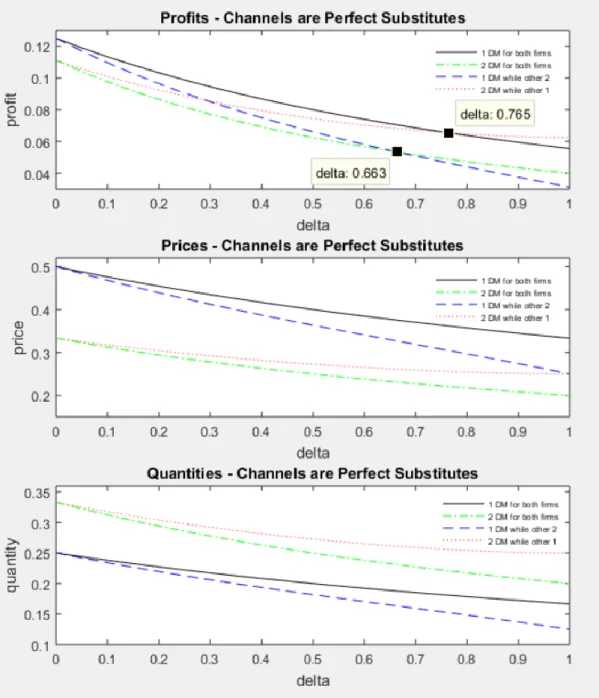
Figure 2. Equilibria when channels are perfect substitutes (γ = 1).
In this case, Figure 2 suggests that Proposition 1 still holds and, in equilibrium, firms that have two managers produce more than firms that have a single manager. Furthermore, when channels are perfect substitutes, equilibrium prices increase as the number of decision
20 makers in the industry decrease: 𝑃𝑖𝑗1 > 𝑃
𝑖𝑗1𝐷 > 𝑃𝑖𝑗2𝐷> 𝑃𝑖𝑗2 , where 𝑃𝑖𝑗1𝐷 denotes the equilibrium price of firm 𝑖 in channel 𝑗 when firm 𝑖 has one decision maker and the other firm has two and so on.
For 𝛿 < 0.66, one decision maker to both channels is the unique equilibrium. When the two channels are perfect substitutes and consumers distinguish sufficiently the products offered by the two firms, a firm decides to have only one decision maker for both channels. Although a firm with a single manager produces a lower quantity, the higher price charged outweighs the decrease in the quantity and allows firms to earn higher profits. For 𝛿 > 0.77 exists a unique equilibrium such that both firms decide for one decision maker for each channel. When consumers identify the products offered by the two firms more similar, market competition intensifies. In this context, two decision makers allow firms to earn higher profits because firms produce a higher quantity, charge lower prices and capture higher demand. For 0.68 < 𝛿 < 0.77, both equilibria with one and two managers exist.
4.6.3. Equilibrium with independent firms
Figure 3. Equilibria when firms are independent (δ = 0).
Consider the case in which firms are independent which means that δ = 0.When firms are independent, the number of decision makers of firm 𝑚 does not influence the decision of firm 𝑛 nor equilibrium price, quantity and, consequently, profits, for 𝑚 ≠ 𝑛
21 (𝑚 = 𝐴, 𝐵; 𝑛 = 𝐴, 𝐵). Only exists competition between the two channels of a given firm and, somehow, each firm is a monopolist for the goods it produces. Figure 3 shows that the higher the degree of substitutability between channels, the higher is the preference for a single decision maker. A single decision avoids the fiercer competition among channels and allow firms to charge higher prices, and consequently, to earn higher profits.
4.6.4. Equilibrium with independent channels
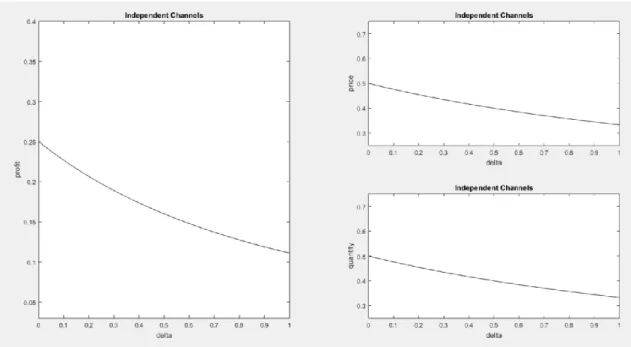
This subsection analyses the case in which channels of a firm are independent, that is, γ = 0. Therefore, channels of the same firm do not compete among each other as the demand of both channels is completely separated. One decision maker for both channels or one decision maker for each channel leads to the same profit level. Despite that, the higher the degree of substitution between a channel of a firm and the correspondent channel of the competing firm, the lower the profits of the former channel.
22
5. Industry and endogenous firms’ decision
This section aims to explore whether one should expect firms with one or two decision makers to emerge endogenously. Hence, this section analyses the endogenous decision of have a single manager for both channels or a manager for a specific channel. Until now, that decision was exogenous.
5.1. Equilibrium conditions of firms’ decision.
5.1.1. Equilibrium when both firms compete with a single manager
The notation (1 DM, 1 DM) means that it is an equilibrium for both firms to have one decision maker. The condition that ensure that (1 DM, 1 DM) is an equilibrium is 𝜋𝑖𝑗1 ≥ 𝜋𝑖𝑗2𝐷.
5.1.2. Equilibrium when both firms compete with two managers
The notation (2 DM, 2 DM) means that it is an equilibrium for both firms to compete with two decision makers. (2 DM, 2 DM) is an equilibrium if 𝜋𝑖𝑗2 ≥ 𝜋
𝑖𝑗 1𝐷.
5.1.3. Equilibrium when a firm has one manager and the other firm has two managers
Let (1 DM, 2 DM) denotes the equilibrium such that firm 𝑚 has one decision maker and firm 𝑛 has two decision makers for 𝑚 ≠ 𝑛 and 𝑚 = 𝐴, 𝐵, 𝑛 = 𝐴, 𝐵. (1 DM, 2 DM) is an equilibrium if both condition are satisfied: 𝜋𝑖𝑗2𝐷 ≥ 𝜋
𝑖𝑗1 and 𝜋𝑖𝑗1𝐷≥ 𝜋𝑖𝑗2.
5.2. Endogenous decision between one and two decision makers
The decision between one and two managers for firm’s channels crucially depends on the degree of product substitutability between channels (𝛾 ) and firms (𝛿 ). This is illustrated in Figure 5. The blue region illustrates the combinations (𝛿, 𝛾) such that (1 DM, 1 DM) is the unique equilibria, the green region represents the combinations (𝛿, 𝛾) such that (2 DM, 2 DM) is the unique equilibria and the yellow region shows the combinations (𝛿, 𝛾) such that one and two decision makers are both an equilibrium.
23
Figure 5. Equilibrium decision of firms.
Numerical simulations suggest that, for relatively low values of δ (γ > δ) (1 DM, 1 DM) is an equilibrium such that both firms decide for only one decision maker to both channels. This occurs when the channels of a firm have a higher degree of substitutability and, therefore, a given channel has a lower degree of substitutability across firms which allow firms to have some market power and charge higher prices.
For relatively high values of δ (δ > γ), (2 DM, 2 DM) is an equilibrium, that is, firms prefer one decision maker for each channel rather than a single manager. For a higher degree of substitutability of a given channel between but not within firms, consumers find the product offered by the two firms more similar and market competition intensifies. Hence, each firm decides to have a decision maker specifically for that channel and set a higher equilibrium quantity.
For some combinations (𝛿, 𝛾) both one and two decision makers are equilibria and none combination (𝛿, 𝛾) ensures that (1 DM, 2 DM) is equilibrium, for 0 < 𝛿 < 1 and 0 < 𝛾 < 1.
5.3. Industry and firm profits
As Proposition 3 states, firms earn higher profits if both firms have a single manager for both channels. Because the profits in the industry result from the joint profits of the two
24 competing firms, the industry achieves a higher profit level when both firms have a single manager than when both firms have two managers.
However, at firm level, when there is a relatively high degree of substitution across firms and, therefore, consumers do not distinguish sufficiently the products offered by the two firms, firms, deciding unilaterally, choose to compete with two decision makers. With a manager for each distribution channel, firms set lower prices and capture a higher demand. Nonetheless, if both firms cooperate and split equally industry ‘profits, firms end up with higher profits than they would earn if they not cooperate.
25
6. Welfare analysis
This section investigates the welfare implications for competition when both firms have one or two decision makers. Let 𝐶𝑆𝑛𝑖, 𝑃𝑆𝑛𝑖, 𝑊𝑛𝑖 denotes the equilibrium consumer,
producer and total surplus, respectively, in the case of 𝑛𝑖 = {1,2} decision makers. Equilibrium consumer surplus is such that 𝐶𝑆𝑛𝑖 = 𝑈(𝑞
𝐴𝑅, 𝑞𝐴𝐷, 𝑞𝐵𝑅, 𝑞𝐵𝐷) − ∑ 𝑝𝑖 𝑗
𝑞𝑖𝑗, 𝑖 = 𝐴, 𝐵, 𝑗 = 𝑅, 𝐷 and 𝑝𝑖𝑗 and 𝑞𝑖𝑗are the equilibrium prices and quantities, respectively, of firm 𝑖 in channel 𝑗 with 𝑛𝑖 decision makers. Producer surplus corresponds to the profits of the industry (𝑃𝑆𝑛𝑖 = 𝜋
𝐴 𝑛𝑖+ 𝜋
𝐵
𝑛𝑖) and total surplus is the sum of consumer surplus and producer
surplus (𝑊𝑛𝑖 = 𝐶𝑆𝑛𝑖+ 𝑃𝑆𝑛𝑖). Table 1 summarizes equilibrium consumer, producer and
total surplus for two scenarios: (1) both firms have a single manager, (2) both firms have a manager for each distribution channel.
Table 1. Equilibrium Consumer, Producer and Total surplus
(1) One decision maker (2) Two decision makers
𝐶𝑆1 = 2+2𝛾+2𝛿+2𝛾𝛿 (2+2𝛾+𝛿+𝛾𝛿)2 𝐶𝑆 2 =2+2𝛾+2𝛿+2𝛾𝛿 (2+𝛾+𝛿+𝛾𝛿)2 𝑃𝑆1 = 4+4𝛾 (2+2𝛾+𝛿+𝛾𝛿)2 𝑃𝑆 2 = 4 (2+𝛾+𝛿+𝛾𝛿)2 𝑊1 = 6+6𝛾+2𝛿+2𝛾𝛿 (2+2𝛾+𝛿+𝛾𝛿)2 𝑊2 = 6+2𝛾+2𝛿+2𝛾𝛿 (2+𝛾+𝛿+𝛾𝛿)2.
Proposition 4: Comparing the consumer, producer and total surplus in the two scenarios, one obtains:
𝐶𝑆2 > 𝐶𝑆1; 𝑃𝑆1 > 𝑃𝑆2; 𝑊2 > 𝑊1 for 0 < 𝛿 < 1 and 0 < 𝛾 < 1,
Consumers prefer a firm with two decision makers than a firm with a single manager regardless firms are substitutes, complements or independent. When a firm has two decision makers and channels within a firm are substitutes, market competition gets fiercer and prices decrease. Consequently, lower prices and higher quantities improve consumer welfare.
From the perspective of producers, a firm with a single manager is the most favourable scenario. Producer surplus is equal to industry’ profits that result from the profits of the two competing firms. Because both firms earn higher profits with only one manager than with two managers, producer surplus is higher with a single manager.
26 The consumer surplus with two decision makers offsets the producer surplus with one decision maker, and, therefore, social welfare is higher with two decision makers.
27
7. Conclusions
This dissertation contributes to find the consequences of the number of decision makers in multiproduct firms for market competition. Using a version of the duopoly model with product differentiation proposed by Singh and Vives (1984) with four products, this thesis characterizes the equilibrium and welfare outcomes that result from an industrial structure in which multiproduct firms have a manager for both distribution channels or a manager for each distribution channel. For motivation, this dissertation provides an illustrative analysis of multiproduct firms that have operations through multiple distribution channels for pizza industry.
The findings that this dissertation provide can enrich managerial insights. The key finding is that the endogenous decision of firms between one or two decision makers crucially depends on the degree of product substitutability between channels and firms. Firms decide to have a single manager for both channels when channels are close substitutes within a firm but not across firms. Otherwise, firms prefer a manager for each distribution channel. Furthermore, the findings have some policy implications as the decision between one or two decision makers not only has implications for the firm that takes the decision but also for the competing firms and consumers. The results are a direct consequence of the interplay between the managers rivalry and the existence of more than one distribution channel. Firstly, firm’s decision hurts industry’ performance when both firms have the same number of decision makers and decide to compete with two managers. A cooperation between the two firms to compete with a single manager rather than with two managers not only improves industry’ profits but also might enhance firms ‘profits if firms split equally the industry’ profits, for instance. Secondly, a firm with a single manager is more harmful for consumers than a firm with two decision makers because a firm with a single manager charges higher prices and produces lower quantities, which makes consumers worse off. Consequently, the total surplus, that is, society welfare will be reduced if firms compete with a single manager.
Limitations of this study include the assumption that firms are symmetric regarding cost and product quality. It is also assumed that production cost and product quality are symmetric across channels. Would be interesting in a future study relax those assumptions and consider not only one or two decision makers but also price discrimination among channels. For motivation, the delivery channel that embodies the transportation cost of the pizza to the costumer typically charges a higher price than if the costumer picks up the pizza
28 at the store. Another possible expansion of this dissertation is, rather than consider that all consumers have the same preferences that can be summarized by the utility of a representative consumer, develop a model that account for consumer heterogeneity. A possible methodology is to build a discrete choice model, using for instance, the random coefficient (probit or logit) specification as Berry (1994). Hence, would be interesting to go beyond the descriptive analysis of pizza sector and collect data that allow to implement the former recommendations.
29
Appendix
Proof of Proposition 1. From the transitivity property and since 0 < 𝛿 < 1 and 0 < 𝛾 <
1, if the following inequalities are satisfied:
1.1. 𝑞𝑖𝑗2𝐷 > 𝑞𝑖𝑗2
1.2. 𝑞𝑖𝑗2 > 𝑞𝑖𝑗1
1.3. 𝑞𝑖𝑗1 > 𝑞𝑖𝑗1𝐷
then the symmetric equilibrium quantity is ranked as 𝑞𝑖𝑗2𝐷> 𝑞
𝑖𝑗2 > 𝑞𝑖𝑗1 > 𝑞𝑖𝑗1𝐷. Note that 𝑍 = 4 + 6𝛾 + 2𝛾2− 𝛿2− 2𝛾𝛿2− 𝛿2𝛾2. 1.1. 𝑞𝑖𝑗2𝐷 > 𝑞𝑖𝑗2 ⇔4 + 6𝛾 + 2𝛾 2− 2𝛿 − 3𝛿𝛾 − 𝛿𝛾2 (2 + 𝛾)𝑍 > 1 2 + 𝛾 + 𝛿 + 𝛾𝛿 ⇔ 4 + 6𝛾 + 2𝛾 2− 2𝛿 − 3𝛿𝛾 − 𝛿𝛾2 8 + 16𝛾 + 10𝛾2− 2𝛿2− 5𝛿2𝛾 − 4𝛿2𝛾2+ 2𝛾3− 𝛿2𝛾3 > 1 2 + 𝛾 + 𝛿 + 𝛾𝛿 ⇔8 + 16𝛾 + 10𝛾 2+ 2𝛾3− 2𝛿2 − 5𝛿2𝛾 − 4𝛿2𝛾2− 𝛿2𝛾3+ 2𝛿𝛾 + 3𝛿𝛾2+ 𝛿𝛾3 8 + 16𝛾 + 10𝛾2+ 2𝛾3− 2𝛿2− 5𝛿2𝛾 − 4𝛿2𝛾2− 𝛿2𝛾3 > 1 ⇔ 1 + 2𝛿𝛾 + 3𝛿𝛾 2+ 𝛿𝛾3 8 + 16𝛾 + 10𝛾2+ 2𝛾3− 2𝛿2 − 5𝛿2𝛾 − 4𝛿2𝛾2− 𝛿2𝛾3 > 1
Because 8 + 16𝛾 + 10𝛾2+ 2𝛾3− 2𝛿2− 5𝛿2𝛾 − 4𝛿2𝛾2− 𝛿2𝛾3 is always positive, 𝑞𝑖𝑗2𝐷 > 𝑞𝑖𝑗2. 1.2. 𝑞𝑖𝑗2 > 𝑞 𝑖𝑗1 ⇔ 1 2 + 𝛾 + 𝛿 + 𝛾𝛿 > 1 2 + 2𝛾 + 𝛿 + 𝛾𝛿 ⇔2 + 2𝛾 + 𝛿 + 𝛾𝛿 2 + 𝛾 + 𝛿 + 𝛾𝛿 > 1 ⇔ 1 + 𝛾 2 + 𝛾 + 𝛿 + 𝛾𝛿 > 1 1.3. 𝑞𝑖𝑗1 > 𝑞𝑖𝑗1𝐷
30 ⇔ 1 2 + 2𝛾 + 𝛿 + 𝛿𝛾 > 2 + 𝛾 − 𝛿 − 𝛿𝛾 𝑍 ⇔ 1 2 + 2𝛾 + 𝛿 + 𝛿𝛾 > 2 + 𝛾 − 𝛿 − 𝛿𝛾 4 + 6𝛾 + 2𝛾2− 𝛿2− 2𝛿2𝛾 − 𝛿2𝛾2
Since 0 < 𝛿 < 1 and 0 < 𝛾 < 1, 2 + 𝛾 − 𝛿 − 𝛿𝛾 is always positive as well as 4 + 6𝛾 + 2𝛾2− 𝛿2− 2𝛿2𝛾 − 𝛿2𝛾2, ⇔ 4 + 6𝛾 + 2𝛾 2− 𝛿2− 2𝛿2𝛾 − 𝛿2𝛾2 4 + 6𝛾 + 2𝛾2− 𝛿2− 2𝛿2𝛾 − 𝛿2𝛾2− 𝛿𝛾 − 𝛿𝛾2 > 1 Proof of Proposition 2. 2.1. 𝑝𝑖𝑗1 > 𝑝 𝑖2 ⇔ 1 + 𝛾 2 + 2𝛾 + 𝛿 + 𝛾𝛿 > 1 2 + 𝛾 + 𝛿 + 𝛾𝛿 ⇔2 + 3𝛾 + 𝛿 + 𝛾 2+ 2𝛿𝛾 + 𝛿𝛾2 2 + 2𝛾 + 𝛿 + 𝛾𝛿 > 1 ⇔ 1 +𝛾 + 𝛾 2+ 𝛿𝛾 + 𝛿𝛾2 2 + 2𝛾 + 𝛿 + 𝛾𝛿 > 1 2.2. 𝑝𝑖𝑗1𝐷> 𝑝 𝑖𝑗2𝐷 ⇔4 + 8𝛾 + 5𝛾 2+ 𝛾3− 2𝛿 − 5𝛾𝛿 − 4𝛿𝛾2− 𝛿𝛾3 (2 + 𝛾)𝑍 > 4 + 6𝛾 + 2𝛾2− 2𝛿 − 3𝛿𝛾 − 𝛿𝛾2 (2 + 𝛾)𝑍 ⇔ 2𝛾 + 3𝛾2+ 𝛾3− 2𝛾𝛿 − 3𝛿𝛾2− 𝛿𝛾3 > 0 ⇔ 2𝛾(1 − 𝛿) + 3𝛾2(1 − 𝛿) + 𝛾3(1 − 𝛿) > 0 Proof of Proposition 3. 𝜋𝑖𝑗2 < 𝜋𝑖𝑗1 ⇔ 1 (2 + 𝛾 + 𝛿 + 𝛾𝛿)2 < 1 + 𝛾 (2 + 2𝛾 + 𝛿 + 𝛾𝛿)2 ⇔ (1 + 𝛾 2 + 𝛾 + 𝛿 + 𝛾𝛿) 2 < 1 + 𝛾
31 ⇔2𝛾(2 + 𝛾 + 𝛿 + 𝛾𝛿) + 𝛾 2 (2 + 𝛾 + 𝛿 + 𝛾𝛿)2 < 𝛾 ⇔4𝛾 + 2𝛾 2+ 2𝛾𝛿 + 2𝛾2𝛿 + 𝛾2− 𝛾(2 + 𝛾 + 𝛿 + 𝛾𝛿)2 (2 + 𝛾 + 𝛿 + 𝛾𝛿)2 < 0 ⇔4𝛾 + 3𝛾 2+ 2𝛾𝛿 + 2𝛾2𝛿 − (4𝛾 + 4𝛾2+ 4𝛿𝛾 + 6𝛾2𝛿 + 𝛾3+ 2𝛾3𝛿 + 𝛿2𝛾 + 2𝛾2𝛿2+ 𝛾3𝛿2) (2 + 𝛾 + 𝛿 + 𝛾𝛿)2 < 0 ⇔−(𝛾 2+ 2𝛿𝛾 + 4𝛾2𝛿 + 𝛾3+ 2𝛾3𝛿 + 𝛿2𝛾 + 2𝛾2𝛿2+ 𝛾3𝛿2) (2 + 𝛾 + 𝛿 + 𝛾𝛿)2 < 0
Because the denominator is always positive and the numerator is always negative, the ratio is always negative for 0 < 𝛿 < 1 and 0 < 𝛾 < 1. This is equivalent to demonstrate that 𝜋𝑖𝑗2 < 𝜋𝑖𝑗1. Proof of Proposition 4. 4.1. 𝐶𝑆2 > 𝐶𝑆1 ⇔2 + 2𝛾 + 2𝛿 + 2𝛾𝛿 (2 + 𝛾 + 𝛿 + 𝛾𝛿)2 > 2 + 2𝛾 + 2𝛿 + 2𝛾𝛿 (2 + 2𝛾 + 𝛿 + 𝛾𝛿)2 ⇔ (2 + 2𝛾 + 𝛿 + 𝛾𝛿 2 + 𝛾 + 𝛿 + 𝛾𝛿 ) 2 > 1 ⇔ 𝛾 > 0
4.2. From proposition 3, the profit of channel 𝑗 of firm 𝑖 is higher with a single manager
than with two managers (𝜋𝑖𝑗2 < 𝜋 𝑖𝑗
1). Producers surplus is equal to industry’ profits. Because a firm has two channels and there are two competing firms in the industry, producers surplus are higher with a single manager than with two managers (𝑃𝑆2 < 𝑃𝑆1).
4.3. 𝑊2 > 𝑊1 ⇔6 + 2𝛾 + 2𝛿 + 2𝛾𝛿 (2 + 𝛾 + 𝛿 + 𝛾𝛿)2 > 6 + 6𝛾 + 2𝛿 + 2𝛾𝛿 (2 + 2𝛾 + 𝛿 + 𝛾𝛿)2 ⇔ (1 + 𝛾 2 + 𝛾 + 𝛿 + 𝛾𝛿) 2 > 6 + 6𝛾 + 2𝛿 + 2𝛾𝛿 6 + 2𝛾 + 2𝛿 + 2𝛾𝛿
32 ⇔2𝛾(2 + 𝛾 + 𝛿 + 𝛾𝛿) + 𝛾 2 (2 + 𝛾 + 𝛿 + 𝛾𝛿)2 > 4𝛾 6 + 2𝛾 + 2𝛿 + 2𝛾𝛿 ⇔(4𝛾 + 3𝛾 2+ 2𝛾𝛿 + 2𝛿𝛾2)(6 + 2𝛾 + 2𝛿 + 2𝛾𝛿) (2 + 𝛾 + 𝛿 + 𝛾𝛿)2(6 + 2𝛾 + 2𝛿 + 2𝛾𝛿) − 4𝛾(2 + 𝛾 + 𝛿 + 𝛾𝛿) 2 (6 + 2𝛾 + 2𝛿 + 2𝛾𝛿)(2 + 𝛾 + 𝛿 + 𝛾𝛿)2 > 0 ⇔8𝛾 + 10𝛾 2 + 4𝛿𝛾 + 6𝛿𝛾2+ 2𝛾3+ 2𝛿𝛾3 (2 + 𝛾 + 𝛿 + 𝛾𝛿)2(6 + 2𝛾 + 2𝛿 + 2𝛾𝛿) > 0 ⇔ 2 ∗ 4𝛾 + 5𝛾 2+ 2𝛿𝛾 + 3𝛿𝛾2+ 𝛾3+ 𝛿𝛾3 (2 + 𝛾 + 𝛿 + 𝛾𝛿)2(6 + 2𝛾 + 2𝛿 + 2𝛾𝛿)> 0
33
References
Archibald, G. C., Eaton, B. C., & Lipsey, R. G. (1986). Address Models of Value Theory. London: Macmillan.
Aw, B. Y., & Lee, Y. (2009). Product Choice and Market Competition: The Case of Multiproduct Electronic Plants in Taiwan. The Scandinavian Journal of Economics, 111(4), 711-740.
Azzam, A., & Bouras, D. (2013). Market And Welfare Effects Of Multi-Product Mergers With Reference To Tyson-IBP Merger. Journal of Business & Economics Research, 11(12), 521-536.
Bailey, E. M. (2015). Behavioral Economics and U.S. Antitrust Policy. Review of Industrial
Organization, 47(3), 355-366.
Baumol, W. J. (1959). Business Behavior, Value and Growth: Macmillan.
Beggs, A. W. (1994). Mergers and Malls. The Journal of Industrial Economics, 42(4), 419-428. Berle, A. A., & Means, G. C. (1932). The Modern Corporation and Private Property: Macmillan. Berry, S. T. (1994). Estimating Discrete-Choice Models of Product Differentiation. The
RAND Journal of Economics, 25(2), 242-262.
Bertrand, J. (1883). Review of ‘Théorie Mathématique de la Richesse Sociale’ and ‘Recherches sur les Principes Mathématiques de la Richesse’. Journal des Savants, 499-508.
Borges, A., & Correia-da-Silva, J. (2011). Using Cost Observation To Regulate A Manager Who
Has A Preference For Empire-Building (Vol. 79).
Borges, A., Correia-da-Silva, J., & Laussel, D. (2014). Regulating a manager whose empire-building preferences are private information. Journal of Economics, 111(2), 105-130. Bowley, A. L. (1924). The mathematical groundwork of economics: An introductory treatise. Oxford:
Oxford University Press.
Brandão, A., Correia-da-Silva, J., & Pinho, J. (2014). Spatial competition between shopping centers. Journal of Mathematical Economics, 50, 234-250.
Correia-da-Silva, J., & Pinho, J. (2011). Costly horizontal differentiation. Portuguese Economic
Journal, 10(3), 165-188.
Cournot, A. A. (1838). Recherches sur les principes mathématiques de la théorie des richesses: L. Hachette.
Crossan, K. (2004). Theories of the firm and alternative theories of firm behaviour: a critique.
International Journal of Applied Institutional Governance, 1(1), 2-13.
Cyert, R., & March, J. (1963). A Behavioral Theory of the Firm. Englewood Cliffs: Prentice-Hall. Domino’s Pizza Inc. (2018). 2017 Annual Report. Retrieved 28.05.2018, from
http://phx.corporate-ir.net/phoenix.zhtml?c=135383&p=irol-reportsannual
Euromonitor International Ltd. (2012). All Things to All People: The Story of Pizza. Retrieved from Hong Kong:
European Central Bank. (2017). ECB staff macroeconomic projections for the euro area. Retrieved
30.11.2017, from
https://www.ecb.europa.eu/pub/pdf/other/ecb.ecbstaffprojections201709.en.pdf ?54903a0e77418d98625a1657335bc3bd
Fershtman, C., & Judd, K. (1987). Equilibrium Incentives in Oligopoly. American Economic
Review, 77(5), 927-940.
Friedman, M. (1953). Essays in Positive Economics. Chicago: Chicago University Press. Gibbons, R. (1992). A Primer in Game Theory. Harlow: Pearson Education