
2018
UNIVERSIDADE DE LISBOA FACULDADE DE CIÊNCIAS DEPARTAMENTO DE INFORMÁTICA
Security Auditing of a DLMS/COSEM Smart Grid
Communication Protocol Implementation
Henrique Califórnia Mendes
Mestrado em Engenharia Informática
Especialização em Arquitectura, Sistemas e Redes de Computadores
Dissertação orientada por:
Prof. Doutor Nuno Fuentecilla Maia Ferreira Neves
Prof. Doutora Ibéria Vitória de Sousa Medeiros
Resumo
Em anos recentes, empresas de utilidade p´ublica e governos de diversos pa´ıses tˆem vindo a promover a renovac¸˜ao e melhoria das infrastruturas de energia, de modo a au-mentar a eficiˆencia e funcionalidade da rede. As primeiras iterac¸˜oes da rede el´ectrica contavam apenas com contadores de electricidade locais que precisavam de ser lidos por um profissional no local. Os custos e falta de eficiˆencia deste sistema foram as motivac¸˜oes principais para a evoluc¸˜ao da tecnologia presente na rede. Com o avanc¸ar da tecnologia, tornou-se poss´ıvel efectuar a leitura dos valores dos medidores remotamente, aumentando a eficiˆencia da rede.
A rede el´ectrica inteligente est´a prevista ser instalada num futuro pr´oximo em muitos pa´ıses existindo j´a paises com regulac¸˜oes pertinentes que estipulam o tratamento, arma-zenamento, acesso e transporte dos dados. Esta rede ser´a possivel mediante a instalac¸˜ao de medidores inteligentes, capazes de comunicar com a rede e com outros dispositivos inteligentes presentes em habitac¸˜oes. H´a contudo um receio justificado relativamente `a introduc¸˜ao de problemas de seguranc¸a e privacidade, quer nos novos equipamentos que estar˜ao fisicamente acess´ıveis em muitos casos, quer na rede em si, e da comunicac¸˜ao que nela ir´a ocorrer.
O protocolo DLMS/COSEM ´e um protocolo especificamente desenvolvido para a smart grid, e ´e, de entre outras opc¸˜oes, o que tem vindo a ganhar mais popularidade devido principalmente a poder ser usado para a medic¸˜ao de energia, g´as natural, ou ´agua. A sua especificac¸˜ao separa os meios e tecnologias de comunic¸˜ao da modelac¸˜ao dos me-didores, dos seus dados e sua representac¸˜ao, o que permite que estas sejam desenvolvidas independentemente, permitindo assim que o protocolo se adapte `a evoluc¸˜ao ass´ıncrona destas duas partes. Isto permite que o suporte seja extendido para suportar mais meios tecnol´ogicos e pilhas de protocolos de comunicac¸˜ao que surgir˜ao no futuro. Um dos meios que est´a a ser bastante considerado pela ind´ustria el´ectrica ´e o de power-line com-munication, devido `a possibilidade de usar os pr´oprios meios de distribuic¸˜ao de energia para comunicar com os equipamentos da rede. Este protocolo goza tamb´em da disponibi-lidade de variados mecanismos de seguranc¸a, nomeadamente cifra autenticada de modo a permitir confidencialidade e autenticidade nas comunicac¸˜oes, assinatura digital para ga-rantir a integridade de dados, autenticac¸˜ao por chave p´ublica de forma a permitir aos n´os
da rede definirem chaves criptogr´aficas entre si, transporte de chaves criptogr´aficas de forma segura, e compress˜ao.
Devido `a natureza de necessidade cr´ıtica que representa para a sociedade, e em se-melhanc¸a com a rede atual, o seu correcto funcionamento deve ser assegurado com ele-vada confiabilidade. Para este fim, ´e necess´ario aferir se os protocolos usados para comunicac¸˜ao na rede s˜ao seguros na sua especificac¸˜ao, e posteriormente comprovar que a implementac¸˜ao do protocolo usada cumpre essa especificac¸˜ao. Se a rede el´ectrica inte-ligente for implementada de forma insegura, pode dar azo a uma pan´oplia de cat´astrofes, desde ataques `a privacidade e espionagem, at´e `a paralizac¸˜ao de servic¸os cr´ıticos como hospitais e preju´ızo econ´omico elevado.
A presente dissertac¸˜ao tem o intuito principal de avaliar a seguranc¸a do protocolo DLMS/COSEM, e de uma implementac¸˜ao do protocolo disponibilizada por um parceiro importante da ind´ustria de energia el´ectrica portuguesa.
Para levar a cabo o objetivo da tese, numa primeira fase, foi analisada a especificac¸˜ao do protocolo, com ˆenfase na seguranc¸a. Foram analisados com rigor especial as secc¸˜oes pertinentes aos mecanismos de encriptac¸˜ao autenticada e de autenticac¸˜ao utilizados na comunicac¸˜ao DLMS/COSEM. Tamb´em, foi realizado um levantamento das vulnerabi-lidades e fraquezas do protocolo j´a descritas na literatura existente e foi verificado que algumas delas ainda n˜ao tinham sido corrigidas ou colmatadas na vers˜ao mais recente da especificac¸˜ao do protocolo. Por exemplo, a especificac¸˜ao ainda permite o uso de al-gortimos criptogr´aficos atualmente considerados inseguros ou fracos, o que pode levar a ataques de downgrade mesmo havendo opc¸˜oes de algoritmos criptogr´aficos melhores na especificac¸˜ao. Verificou-se tamb´em que existia pouco trabalho cient´ıfico em torno do assunto, perante a iminente chegada desta tecnologia aos mercados de energia el´ectrica de muitos pa´ıses.
Para atingir esse objectivo foi desenhada a framework ValiDLMS, a qual ´e estratifi-cada para a integrac¸˜ao de ferramentas que permitem validar implementac¸˜oes quanto ao seu cumprimento da especificac¸˜ao do protocolo e testar a seguranc¸a das mesmas. Um prot´otipo da framework foi desenvolvido e avaliado usando tr´afego DLMS/COSEM do referido parceiro.
Numa segunda fase, e para atingir o objetivo de testar a implementac¸˜ao do protocolo segundo uma especificac¸˜ao, foi desenhada a plataforma arquitectural ValiDLMS, a qual ´e estratificada para a integrac¸˜ao de ferramentas que permitem validar implementac¸˜oes do protocolo segundo a especificac¸˜ao e testar a seguranc¸a destas. Tal arquitectura foi desenhada com base no conhecimento adquirido da literatura relevante existente, nos co-nhecimentos adquiridos na observac¸˜ao da implementac¸˜ao que nos foi disponibilizada, e do processo de desenvolvimento de uma ferramenta usando a nossa arquitectura. A arquitectura funciona escutando a rede e analisando o tr´afego capturado `a procura de ano-malias, podendo tamb´em gerar tr´afego de modo a causar a ocorrˆencia de anomalias que
n˜ao seriam detectadas apenas por observac¸˜ao. Isto permite que ferramentas que sigam a arquitectura sejam usadas de modo passivo e activo, e tamb´em em ambientes reais para monitorizac¸˜ao de uma rede de energia.
A arquitectura ValiDLMS ´e composta por trˆes camadas, nomeadamente, ambiente DLMS/COSEM, interacc¸˜ao, e teste. Esta estratificac¸˜ao permite maior facilidade de in-tegrac¸˜ao de ferramentas, sendo que estas posicionam-se de acordo com as funcionalidades das camadas. A camada de ambiente DLMS/COSEM representa o ambiente onde se en-contra a implementac¸˜ao DLMS/COSEM a ser testada pela ferramenta, ou seja, onde est˜ao inclu´ıdos os meios f´ısicos de comunicac¸˜ao, medidores de energia el´ectrica inteligente, e concentradores de dados. A camada de interacc¸˜ao inclui dois componentes essenciais `a interac¸˜ao da ferramenta com o ambiente DLMS/COSEM, um componente sniffer que consegue capturar todo o tr´afego DLMS/COSEM que ocorre no ambiente a ser testado, e um componente DLMS client capaz de estabelecer ligac¸˜oes e interagir completamente com os equipamentos presentes no ambiente, executando as ordens que recebe da camada de teste. A camada de teste usa uma base de dados para gerar interac¸˜oes pseudo-aleat´orias de modo a causar um comportamento errado do sistema e expor vulnerabilidades que n˜ao poderiam ser encontradas atrav´es da mera observac¸˜ao e adicionalmente investiga a fundo todo o tr´afego capturado.
Tendo por base a arquitetura, foi contru´ıda uma ferramenta que comporta um add-on para o programa de an´alise de tr´afego Wireshark, um dissecador de tr´afego do protocolo DLMS/COSEM, e um validador da implementac¸˜ao do protocolo programado, validando-o quer em especificac¸˜avalidando-o, quer em seguranc¸a. Em execuc¸˜avalidando-o a ferramenta analisa validando-os pacvalidando-otes capturados pelo Wireshark e s˜ao criados registos dos problemas de seguranc¸a e dos pro-blemas de n˜ao cumprimento da especificac¸˜ao do protocolo detectados, de forma v´ısivel no Wireshark, permitindo assim uma an´alise eficiente.
A ferramenta foi testada numa rede de teste do nosso parceiro da ind´ustria de energia, constitu´ıda por dois concentradores de dados e seis medidores inteligentes. A ferramenta encontrou dois problemas nas mensagens DLMS/COSEM. Em mensagens de criac¸˜ao de ligac¸˜oes foi detectado um byte adicional entre campos da mensagem que n˜ao constava na especificac¸˜ao e que inicialmente dificultou a correcta interpretac¸˜ao da ferramenta. Adi-cionalmente, foi detectada uma palavra-chave de autenticac¸˜ao a ser transmitida em claro no tr´afego capturado. A intercepc¸˜ao dessa chave por parte de um atacante permitiria a impersonificac¸˜ao do emissor, o que poderia ser usado para obter informac¸˜oes do uso de energia, ou mesmo enviar comandos para o equipamento da rede, dependendo das permiss˜oes do emissor original. Perante os resultados, a arquitectura desenvolvida apre-senta o potencial desejado para ser utilizada na ind´ustria, e para preencher o v´acuo de investigac¸˜ao acad´emica notado, quer em relac¸˜ao `a seguranc¸a da rede el´ectrica inteligente, quer em relac¸˜ao `a seguranc¸a do protocolo DLMS/COSEM.
Palavras-chave: Protocolo DLMS/COSEM, Seguranc¸a da Rede El´ectrica Inteligente, Seguranc¸a e Privacidade, Vulnerabilidades, Infraestruturas Cr´ıticas
Abstract
The electrical grid is a critical infrastructure for modern society. It has been evolv-ing into a smart(er) grid, allowevolv-ing infrastructure aware decisions based on data collected in real-time from smart meters and other devices. This enables better monitoring and management solutions which would result in higher efficiency in matching generation and consumption. Smart meters and their uplinks have, however, limited physical secu-rity due to their location within customer premises. Many of the proposed smart grid communication protocols are also being evaluated because of other security and privacy concerns, which were raised mainly due to the high probability for misuse of the extended capabilities of smart meters.
DLMS/COSEM is one of the emerging communication protocols designed for use in the smart grid, mainly for its energy-type-agnostic interface model, and the separation from the communication media which allows future expandability. The protocol allows remote interactions with smart meters, often being deployed above power-line communi-cation links.
The present dissertation aims to contribute to validity and security assessments of the DLMS/COSEM protocol and its implementations. In a first instance, an overview of the protocol is presented, followed by a compilation of information about the relevant vulner-abilities and attacks exposed in the existing literature. Then, we explain the design of our ValiDLMS framework, the first open source solution for validation and security auditing of DLMS/COSEM implementations using this communication profile. The framework was developed as an extension to Wireshark and was used to analyse an industry part-ner’s DLMS/COSEM implementation. The results show that ValiDLMS can effectively support the discovery of bugs and/or other non-conformance problems.
Keywords: DLMS/COSEM protocol, Smart Grid Security, Security and Privacy, Vulnerabilities, Critical Infrastructures
Contents
List of Figures xiii
List of Tables xv 1 Introduction 1 1.1 Motivation . . . 2 1.2 Objectives . . . 3 1.3 Contributions . . . 4 1.4 Organization . . . 4
2 Context and Related Work 7 2.1 Advanced Metering Infrastructure . . . 7
2.2 DLMS/COSEM Protocol . . . 10
2.2.1 Overview . . . 10
2.2.2 Security . . . 12
2.2.3 Vulnerabilities . . . 19
2.2.4 Attacks . . . 24
3 The ValiDLMS Framework 27 3.1 Framework Overview . . . 27 3.2 Interaction layer . . . 28 3.2.1 DLMS Client . . . 30 3.2.2 Sniffer . . . 30 3.3 Testing layer . . . 30 3.3.1 Fuzzing module . . . 31 3.3.2 Verification Module . . . 32 4 Proof of Concept 37 4.1 Testing Environment . . . 37 4.2 ValiDLMS Implementation . . . 37 4.3 Experimental Evaluation . . . 38 4.3.1 Validation . . . 39 ix
4.3.2 Security auditing . . . 41 4.3.3 Industry DLMS/COSEM implementations . . . 41
5 Conclusion 43
Bibliografia 47
´Indice 47
List of Figures
2.1 The SGAM smart grid plane [17]. . . 8
2.2 AMI simplified topology [15, 29]. . . 9
2.3 DLMS/COSEM simplified model and communication pattern. . . 12
2.4 Encoded DLMS APDU used to get the time attribute from a clock object. 12 2.5 Encoded DLMS APDU response for the one in Figure 2.4. . . 13
2.6 Overview of the levels of authentication supported by DLMS/COSEM. . . 13
2.7 Overview of the inputs and outputs of GCM [10, 12]. . . 15
2.8 Overview of GCM authenticated encryption [12]. . . 16
2.9 Structure of general-signing APDUs in DLMS/COSEM [10]. . . 17
2.10 Overview of the elliptic curve key agreement schemes present in DLMS/COSEM [6, 10]. . . 18
2.11 Overview of block structure of the authentication data used in GHASH to create authentication tags when also using encryption [29]. . . 18
2.12 Overview of the algorithm used for protecting APDUs in DLMS/COSEM [10]. . . 19
2.13 Procedure used to remove authentication from APDUs [29]. . . 24
3.1 Overview of the ValiDLMS architecture for DLMS/COSEM testing tools. 29 3.2 Attack DB entry example. . . 32
3.3 DLMS packet with content structured as a tree, for an example get request packet validation. . . 33
4.1 Packets marked in wireshark using colour schemes. . . 40
4.2 Packet details with messages indicating problems found. . . 40
4.3 Log entries produced by the tool. . . 41
List of Tables
2.1 Simplified description of SGAM zones [17]. . . 9 2.2 Available HLS authentication mechanisms [10]. . . 14 2.3 Available security suites [10]. . . 15
Chapter 1
Introduction
Electricity has become essential to human life in modern society. Thus the electrical grid is a critical infrastructure for society and without it many vital sectors would cease normal operation (e.g., communication, transportation, finances). Over the past century, utility grid technology has seen gradual advances, with the introduction of automatic me-ter reading (AMR), which allows utilities to collect readings that meme-tering equipments send periodically, removing thus the need of having to send meter reading personnel to customer premises. More recently, these advances are being done at a higher pace in order to build what is called as the smart grid.
The European Committee for Electrotechnical Standardization (CENELEC) defines smart grid as ”an electricity network that can cost efficiently integrate the behaviour and actions of all users connected to it – generators, consumers and those that do both – in order to ensure economically efficient, sustainable power system with low losses and high levels of quality and security of supply and safety” [16]. This suitable definition will be used throughout this document.
Smart grids are being deployed around the world as a direct upgrade from the tra-ditional grid. They characterize the evolution from AMR to the new advanced metering infrastructure (AMI), which allows two-way communication enabling interaction with the meters and access to on-demand information such as various usage statistics, load profile, peak demand, outage logs and tamper notifications. The smart grid also provides bet-ter management capabilities of distributed electrical resources and enables home owners (who produce excess energy) more options when selling energy to utilities.
The European Union and the United States have been pushing forward legislation and directives to support and compel this change in their territory. The National Institute of Standards and Technology produced a conceptual model focusing on smart grid interop-erability, which CENELEC later used as a basis for developing their own reference model [15, 17] for the European Union.
Since the smart meter equipment present in customer houses will have limited physical security, it is important to ensure that security mechanisms are employed to protect the
Chapter 1. Introduction 2
communications of smart grid networks. The imminent deployment of smart meters raises scepticism and concerns due to the potential security issues. If vulnerabilities are found after their deployment it could lead to, for example, widespread fraud, privacy breaches, or power outages in certain areas as a result of an attack. Over-regulation is also noted as one of the challenges, however, without standards the interoperability between home appliances and meters would be reduced [3].
There are already some protocols designed specifically for the smart grid. The proto-col we study in this thesis is the Device Language Message Specification and Companion Specification for Energy Metering (DLMS/COSEM). This protocol is a standard protocol for remote interaction in the smart grid, often being deployed above power-line commu-nication (PLC) links, and offering several advantages when compared to other protocols, including encoding and additional features such as push operations and digital signatures [8, 14].
The DLMS/COSEM protocol was designed following the OSI model. It is mainly an application layer protocol which provides services to establish logical connections be-tween a client and servers. Its application layer also performs some presentation layer functions such as encoding and encryption. Some of its communication profiles also cre-ate a sublayer in the transport layer that specifies how application layer messages can be transported over various communication media [10]. DLMS models the communication entities and defines how information is formatted, transported, and processed. COSEM specifies the COSEM interface classes, the Object Identification System (OBIS), and the use of interface objects to model functions for meters.
The main reasons why this protocol became the most favoured choice within smart grid protocols were its energy-type-agnostic interface model and its clear separation be-tween that interface model and the communication layers beneath it. For one, this allows DLMS/COSEM meters to have a very wide range of functionality, and allows both layers to evolve independently which is great due the rapid change communication protocols and media have been undertaking in the recent years.
1.1
Motivation
Electricity is a critical necessity of the modern world, and as such, its generation, distribu-tion, and consumption need to be protected at all cost. As governments and utilities push for the modernization of the existing infrastructure, we must consider how new technolo-gies to be inserted will be protected from attacks.
Laplante [21] provides a good set of stakeholder groups involved in the smart grid: consumer advocates, utilities, technology providers, regulators, policy makers, and envi-ronmental groups. The requirements each of them pose must be negotiated with the other groups to reach a common ground. The discussion will ultimately result in a set of
re-Chapter 1. Introduction 3
quirements accepted by the majority of the stakeholders. These requirements must be met in order to achieve the best solution, that will naturally gain popularity and acceptance from the industry and the consumers.
This has already happened in some countries, for example, Dutch utility providers have specified the Dutch Smart Meter Requirements (DSMR) which provides the specific requirements for Netherlands’ stakeholders [21]. DSMR is accompanied by four com-panion standards which define in detail the functional and security requirements of a set of four ports that must be present in smart meters deployed in the Netherlands. Its com-panion port P3 is implemented based on DLMS/COSEM protocol [22]. At the moment, the fifth major iteration of these requirements is being rolled out.
This thesis focuses on evaluating the security of the DLMS/COSEM protocol. En-suring the security on the communication layer of the smart grid is crucial since this is the layer which can be most easily observed by adversaries, and the one which such ad-versaries will use to try to interact with smart grid equipment. The communication layer is also what enables remote attacks to be carried out, and these are the most interesting attacks as they could scale easily to have a greater negative effect, such as cutting the energy supply of an entire region. Thus, it is important that the information exchanged, its format and the cipher suite (and its use) are carefully analysed.
1.2
Objectives
Since the smart grid is already being deployed as an experiment in some countries, there are reports about the security of the AMI. Such reports define good practices for smart grid protocol implementations and explain possible generic attacks. However, although the DLMS/COSEM protocol was already included in the nation-wide regulations of some countries, there is too little amount of work examining and ascertaining the effective-ness of its security features. Validation goes along with security, since it will verify if DLMS/COSEM implementations do not act in an erroneous manner.
The main objectives of this thesis are: to understand what security problems affect the DLMS/COSEM protocol; to design a framework capable of assessing the validity and security of DLMS/COSEM protocol implementations; and finally to develop a tool using the framework designed in order to test DLMS/COSEM protocol implementations. The DLMS/COSEM implementation we will be testing in our setup will be provided by a major industry partner, ensuring our results will be of practical use in real world scenarios. However, a few more preparations are needed to properly achieve our main objective. In a first phase, we study the protocol specification and survey the existing literature on attacks and vulnerabilities concerning the smart grid, and more specifically, in the DLMS/COSEM protocol. As our knowledge of the protocol solidifies, we also attempt to identify novel vulnerabilities.
Chapter 1. Introduction 4
We then look for solutions on how to evaluate the security of a DLMS/COSEM pro-tocol implementation. We define what needs to be tested and how it should be tested to guarantee accurate results until we reach one final solution. That solution will then be implemented as a tool, which will be used to test the DLMS/COSEM protocol implemen-tation against all the attacks we collected in the first phase of our work. The tool should be able to correctly identify problems in the implementation being tested.
1.3
Contributions
This dissertation presents the following contributions:
A summarized exposition of the available literature relevant to smart grid security, focused mainly on DLMS/COSEM, including our remarks about their relevance in face of the latest version of the DLMS/COSEM protocol specification. We include detailed explanations of known vulnerabilities and attacks, and their relevance in regard to protocol specification and individual implementation weaknesses.
This dissertation’s main contribution, a complete description of the ValiDLMS frame-work, a framework for designing tools for DLMS/COSEM implementation validation and security auditing. The framework includes the fuzzing and verification modules. The fuzzing module works using an attack database where known attacks are stored, and gen-erating semi-random attacks based on that database. The verifying module has several components that capture the traffic and analyse it to detect vulnerabilities as well as im-plementation deviations from the protocol specification.
A tool implemented using the ValiDLMS framework for proof of concept and ex-perimentation. This tool was implemented using Wireshark, a well-known mature open-source packet analyser, and is capable of analysing DLMS/COSEM traffic captured over a PLC network of smart grid components, thus becoming the first open-source tool capable of verifying DLMS/COSEM traffic over PLC networks.
An experimental evaluation from analysing a DLMS/COSEM implementation cur-rently being tested for a country wide deployment. Using our tool, errors in messages and security weaknesses were detected in the implementation.
A ValiDLMS and our experimental tool were submitted in a paper to the 3rd Workshop on Security and Dependability of Critical Embedded Real-Time Systems (CERTS 2018), located at the 48th International Conference on Dependable Systems and Networks (DSN-2018).
1.4
Organization
This document is organized as follows:
Chapter 1. Introduction 5
smart grids and DLMS/COSEM protocol, effectively summarizing vulnerabilities and attacks described, including relevant individual observations.
In Chapter 3, the ValiDLMS framework for DLMS/COSEM protocol testing tools is presented. It is explained in detail the motives behind the design choices taken and how they are useful and applicable in the pursuit of our goals.
In Chapter 4 our experimental evaluation of the tool is discussed, detailing our imple-mentation of the tool framework we propose. We then describe and discuss the tests made using it and the results obtained.
The final chapter presents the conclusion to this dissertation. The work developed throughout this dissertation is summarized and reflected upon. Some possibilities for future work are also discussed.
Chapter 2
Context and Related Work
In this chapter we introduce the advanced metering infrastructure, and provide an overview of the DLMS/COSEM protocol, focusing a bit more on its security aspects. We then pro-vide a compilation of the vulnerabilities and attacks found in the existing literature.
2.1
Advanced Metering Infrastructure
AMR is a technology that allows utility providers to collect data from metering equipment automatically. Consumption can be monitored without having to physically verify the meter, monitoring can be made in a timely manner to predict demand and avoid shortages, and billing is more accurate.
The AMI is the next step in metering sophistication. It enables two-way communi-cation with smart meters, which provides more capabilities than traditional meters. The AMI includes every part of the utilities infrastructure, from its meters and data concen-trators to the Head End System (HE) controlling the grid [25]. Although it can be used for any type of metering, electricity utilities are predominantly leading the push for smart grid implementation.
The AMI provides advantageous features to utilities such as remote connection man-agement capabilities and tariff programming. These and other features enable the utility to generate an accurate load profile for their grid and also remote access to their own grid equipment. The enhanced capabilities of smart meters also give way to new features, use-ful to motivate customers into adhering to the smart grid. For example, customers have more options for payment together with other service features, which provide a better un-derstanding of how the energy is being spent. Using this information, the consumers can better regulate their energy consumption.
Dynamic pricing (also known as time-of-use pricing) is one main advantage of the smart grid, where the price of the utility is different according to the load of the grid at the time. Customers are continuously informed of these dynamic prices and can choose to lower their consumption during demand peak times, effectively flattening the demand
Chapter 2. Context and Related Work 8
Figure 2.1: The SGAM smart grid plane [17].
during those periods while saving money and energy, both for themselves and for the grid [13].
Smart meters may also communicate with smart appliances taking advantage of dy-namic pricing. Smart appliances are home appliances which can adjust their energy con-sumption automatically based on the current price of energy by working only during off-peak times of the day when energy is cheaper or by lowering their energy usage during peak demand when energy is more expensive. The AMI will also better accommodate dis-tributed generation, where costumers who generate electricity may feed surplus energy to the grid.
The European Committee for Standardization, the European Committee for Elec-trotechnical Standardization, and the European Telecommunications Standards Institute are the responsible organizations for developing standards for smart grids in Europe. These organizations defined the Smart Grid Architecture Model (SGAM) [17] as a ref-erence model for smart grids based on the conceptual model published by the National Institute of Standards and Technology [24]. SGAM describes multiple layers of interop-erability but owing to the scope of this thesis we will only consider the communication layer (see Figure 2.1).
SGAM [17] is divided in domains and zones. Domains represent different parts of the energy conversion chain, while zones represent different hierarchical levels in the management of information used to control the domains. The smart grid plane (Figure 2.1) defined in the same technical report enables a high level view on the interactions between zones along the energy conversion chain. A service provider can be placed in any segment of the grid, depending on his role in any specific case. Zones are described in Table 2.1.
CEN-CENELEC-ESTI also produced Functional reference architecture for commu-nications in smart metering systems [15], which defines a reference architecture focused
Chapter 2. Context and Related Work 9
Zone Description
Process Includes equipment physically involved with the transformation of en-ergy, e.g., generators, transformers, circuit breakers, ...
Field Includes equipment that protects, controls and monitors the process zone, e.g., intelligent devices which process and acquire data from the power system, protection relays, ...
Station Functions as an aggregation level for Field zones, in this zone we have, for example, neighbourhood data concentrators and monitoring systems Operation Hosts equipment that manages entire domains in the power system op-eration, e.g., AMI HE System and Supervisory Control and Data Ac-quisition (SCADA) systems.
Enterprise Includes organizational processes, services and infrastructures for en-terprises, e.g., asset management, billing and procurement, logistics, customer relation management, ...
Market Systems that enable operations outside the scope of a single enterprise, e.g., energy trading, mass market, ...
Table 2.1: Simplified description of SGAM zones [17].
一攀椀最栀戀漀甀爀栀漀漀搀 䐀愀琀愀 䌀漀渀挀攀渀琀爀愀琀漀爀
Chapter 2. Context and Related Work 10
on communications in the smart grid. Figure 2.2 shows an overview of some devices and their connections in a smart grid that follows this reference architecture. Optionally, the smart grid may include smaller networks. Smart meters within the same household may communicate among each other using a Home Area Network (HAN). Local networks (LN) and neighbourhood networks (NN) may be used in cases where a dedicated WAN connection to a single meter/LN is not desired. Access points for these networks have gateway functionality because they need to interconnect different networks.
The AMI HE System is the central piece in the AMI architecture. It controls and communicates with the devices in the grid, sending pricing and other useful information, monitoring the system for device tampering, and so on. They provide the top interface to smart grid functions and applications.
2.2
DLMS/COSEM Protocol
2.2.1
Overview
The DLMS/COSEM protocol is comprised by the Device Language Message Specifi-cation and the Companion SpecifiSpecifi-cation for Energy Metering. DLMS models the com-munication entities and defines how information is formatted, transported and processed. COSEM specifies the COSEM interface classes, the OBIS identification system and the use of interface objects to model functions for meters.
The DLMS/COSEM specification is documented and maintained by the DLMS User Association, in the so-called ”coloured books”. The Blue Book[9] specifies the COSEM object model and OBIS system, the Green Book[10] specifies the communication model and process, the Yellow Book describes the conformance testing process of equipment implementing the DLMS/COSEM protocol, and the White Book compiles a glossary of DLMS/COSEM terms.
Excerpts of the first three books are available at the DLMS UA website [11], however, these versions have been heavily abridged. The full versions of these documents are only available to members of the DLMS UA.
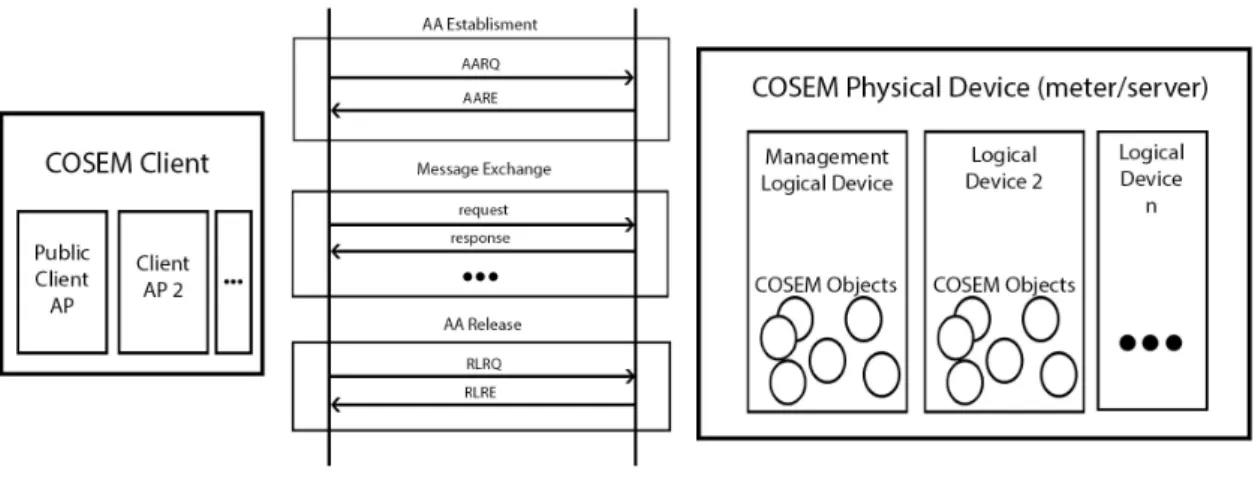
In DLMS/COSEM, a physical device (e.g., meter) holds one or more logical devices and each logical device contains a set of COSEM objects. Each logical device is bound to a Service Access Point (SAP). SAPs depend on the layer supporting the COSEM ap-plication layer, which is determined by the communication profile being used. COSEM objects are objects that instantiate the interface classes defined in the Blue Book. These objects have attributes and methods, and represent things like clocks, credit, associations, and setups.
The DLMS/COSEM application layer has one main component: the Application Service Object (ASO). This component provides services to its service user and other COSEM application processes (APs), and uses services provided by the underlying layer.
Chapter 2. Context and Related Work 11
The ASO can be divided in three mandatory components, offering one additional optional component for client APs. The three mandatory components are: the Association Control Service Element (ACSE) which provides services for establishing and releasing applica-tion associaapplica-tions, the extended DLMS Applicaapplica-tion Service Element (xDLMS ASE) which provides services to transport data between COSEM APs, and the Control Function (CF) which specifies how the ASO will invoke the appropriate service primitives of the other components.
The additional optional component for clients is a client Short Name (SN) mapper which provides a mapping between services using Logical Name (LN) and SN referenc-ing. This component is present when the server uses SN referencing, which uses only two bytes. In LN referencing, COSEM object attributes and methods are referenced by the logical name of the instance they belong to, using OBIS (OBject Identification System) codes. OBIS codes consist of a group of six bytes, and are defined in the Blue Book. In SN referencing, COSEM object attributes and methods are mapped to DLMS named variables. There are different xDLMS ASE service sets for each type of referencing. This component allow client applications to be unconcerned with the referencing type used by the server.
The Blue book defines COSEM Interface Classes (IC) as well, which work like in-terfaces in the Java language. COSEM objects instantiate ICs, each having their own attributes and methods. Different levels of access and visibility will be set depending on the application association established between the client and the server. Each IC is mapped to an unique class id, which identifies it.
The latest version of DLMS/COSEM defines four communication profiles: 3-layer, connection-oriented HDLC; TCP-UDP/IP; S-FSK PLC; and wired/wireless M-Bus. Us-ing one of these profiles, a client can connect to a server.
The client first connects to the Management Logical Device on the server using the public client Application Process (AP). The existence of this logical device on every server is mandatory and it always occupies the first logical device address. It allows the connection of public client APs using Lowest Security Authentication (no security). It then reads the ”SAP assignment” object which reveals the logical devices present in that physical device.
The client is then able to establish an Application Association (AA) with the server’s logical device via the ACSE protocol, negotiating his requirements and communication details, and creating an association object. This association object contains the application context, the xDLMS context, the authentication mechanism, and more. After setting up this object, the client and the server may perform authentication. The client may send his requests and obtain responses, and release the AA. This is illustrated in the central area of Figure 2.3.
spec-Chapter 2. Context and Related Work 12
Figure 2.3: DLMS/COSEM simplified model and communication pattern.
䌀
㠀
㠀
䘀䘀
㈀
䔀渀挀愀瀀猀甀氀愀琀椀渀最 瀀爀漀琀漀挀漀氀 栀攀愀搀攀爀猀 最攀琀ⴀ爀攀焀甀攀猀琀 最攀琀ⴀ爀攀焀甀攀猀琀ⴀ渀漀爀洀愀氀 椀渀瘀漀欀攀ⴀ椀搀 愀渀搀 瀀爀椀漀爀椀琀礀 椀渀琀攀爀昀愀挀攀 挀氀愀猀猀 㠀Ⰰ ᰠ挀氀漀挀欀ᴠ 氀漀最椀挀愀氀 渀愀洀攀Ⰰ 伀䈀䤀匀 挀漀搀攀 漀昀 琀栀攀 挀氀漀挀欀 愀琀琀爀椀戀甀琀攀 ㈀Ⰰ ᰠ琀椀洀攀ᴠ 刀攀猀琀 漀昀 攀渀挀愀瀀猀甀氀愀琀椀漀渀Figure 2.4: Encoded DLMS APDU used to get the time attribute from a clock object. ified in [10] using Abstract Syntax Notation 1 (ASN.1). The same manual provides a mapping from the ASN.1 definition to XML Schema Definition (XSD) for COSEM XML representation [5].
In terms of encoding, ACSE APDUs are encoded in BER [2] and xDLMS APDUs are encoded in A-XDR. The Adapted eXternal Data Representation (A-XDR) encoding rules are a special-purpose set of encoding rules defined specifically for optimizing DLMS PDUs [1]. Additionally, push notifications can be set up to encode the DataNotification APDU in XML using the COSEM XML representation.
We present encoded APDUs in Figures 2.4 and 2.5, to illustrate how encoded DLMS messages would be used to get the time from a server. The structure of the message is defined in the aforementioned ASN.1 specification, and the semantic meaning of the values can be consulted in the Blue book.
2.2.2
Security
Due to the nature of the information monitored and gathered by the grid, the DLMS/COS-EM specification includes several security mechanisms. These mechanisms are imple-mented in the DLMS/COSEM application layer and they can be used in any
communica-Chapter 2. Context and Related Work 13
䌀㐀
㠀
㤀 䌀
㜀䔀
䌀
䄀
㘀
㜀㜀㌀㔀
䘀䘀
䔀渀挀愀瀀猀甀氀愀琀椀渀最 瀀爀漀琀漀挀漀氀 栀攀愀搀攀爀猀 最攀琀ⴀ爀攀猀瀀漀渀猀攀ⴀ渀漀爀洀愀氀 椀渀瘀漀欀攀ⴀ椀搀 愀渀搀 瀀爀椀漀爀椀琀礀 最攀琀ⴀ搀愀琀愀ⴀ爀攀猀甀氀琀 搀愀琀愀 漀挀琀攀琀 猀琀爀椀渀最 猀椀稀攀 ㈀ ㈀ 㘀 ㈀ 匀愀琀 㜀㨀㈀㌀㨀㔀㌀ 栀甀渀搀爀攀搀琀栀猀 渀漀琀 猀瀀攀挀椀攀搀 匀琀愀琀甀猀 伀䬀 䐀攀瘀椀愀琀椀漀渀 ⠀昀爀漀洀 唀吀䌀⤀ 刀攀猀琀 漀昀 攀渀挀愀瀀猀甀氀愀琀椀漀渀
Figure 2.5: Encoded DLMS APDU response for the one in Figure 2.4.
䌀氀椀攀渀琀 匀攀爀瘀攀爀 䌀氀椀攀渀琀 匀䄀倀Ⰰ 匀攀爀瘀攀爀 匀䄀倀Ⰰ 嬀匀礀猀吀椀琀氀攀崀Ⰰ 嬀䌀攀爀琀椀挀愀琀攀崀Ⰰ 嬀䌀氀椀攀渀琀开唀猀攀爀开䤀搀崀Ⰰ 瀀爀漀瀀漀猀攀搀 挀漀渀琀攀砀琀猀 䌀氀椀攀渀琀 匀䄀倀Ⰰ 匀攀爀瘀攀爀 匀䄀倀Ⰰ 嬀匀礀猀吀椀琀氀攀崀Ⰰ 嬀䌀攀爀琀椀挀愀琀攀崀Ⰰ 渀攀最漀琀椀愀琀攀搀 挀漀渀琀攀砀琀猀 䰀漀眀攀猀琀 䰀攀瘀攀氀 匀攀挀甀爀椀琀礀 䌀氀椀攀渀琀 匀攀爀瘀攀爀 䌀氀椀攀渀琀 匀䄀倀Ⰰ 匀攀爀瘀攀爀 匀䄀倀Ⰰ 嬀匀礀猀吀椀琀氀攀崀Ⰰ 嬀䌀攀爀琀椀挀愀琀攀崀Ⰰ 渀攀最漀琀椀愀琀攀搀 挀漀渀琀攀砀琀猀 䌀氀椀攀渀琀 匀䄀倀Ⰰ 匀攀爀瘀攀爀 匀䄀倀Ⰰ 嬀匀礀猀吀椀琀氀攀崀Ⰰ 嬀䌀攀爀琀椀挀愀琀攀崀Ⰰ 嬀䌀氀椀攀渀琀开唀猀攀爀开䤀搀崀Ⰰ 瀀愀猀猀眀漀爀搀Ⰰ 瀀爀漀瀀漀猀攀搀 挀漀渀琀攀砀琀猀 䰀漀眀 䰀攀瘀攀氀 匀攀挀甀爀椀琀礀 䌀氀椀攀渀琀 匀攀爀瘀攀爀 昀⠀䌀琀漀匀⤀ 昀⠀匀琀漀䌀⤀ 䌀氀椀攀渀琀 匀䄀倀Ⰰ 匀攀爀瘀攀爀 匀䄀倀Ⰰ 嬀匀礀猀吀椀琀氀攀崀Ⰰ 嬀䌀攀爀琀椀挀愀琀攀崀Ⰰ 匀琀漀䌀Ⰰ 渀攀最漀琀椀愀琀攀搀 挀漀渀琀攀砀琀猀 䌀氀椀攀渀琀 匀䄀倀Ⰰ 匀攀爀瘀攀爀 匀䄀倀Ⰰ 嬀匀礀猀吀椀琀氀攀崀Ⰰ 嬀䌀攀爀琀椀挀愀琀攀崀Ⰰ 嬀䌀氀椀攀渀琀开唀猀攀开䤀搀崀Ⰰ 䌀琀漀匀Ⰰ 瀀爀漀瀀漀猀攀搀 挀漀渀琀攀砀琀猀 䠀椀最栀 䰀攀瘀攀氀 匀攀挀甀爀椀琀礀
Figure 2.6: Overview of the levels of authentication supported by DLMS/COSEM. tion profile.
During the AA establishment phase, the server and the client may authenticate with each other. After an AA between a client and a server has been established, that client’s interaction with COSEM objects in the server is subject to the security context and access rights of the AA. Furthermore, xDLMS APDUs and the COSEM data carried by them can be cryptographically protected. End-to-end security may also be configured to allow third-parties to use a client as a broker, in order to reach a server.
DLMS/COSEM supports three levels of authentication mechanisms: lowest level se-curity, low level security (LLS), and High Level Security (HLS). Figure 2.6 shows an overview of the DLMS/COSEM authentication mechanisms. Lowest level security au-thentication simply bypasses auau-thentication and is intended to allow the client to get only basic information about the server. LLS authentication enables the client to authenticate with the server by providing a password known to the server. HLS allows authentication of both the server and the client of an AA, by means of issuing challenges and verify-ing responses over four communication steps. HLS authentication may use one of five available mechanisms, presented in Table 2.2. The use of HLS MD5 and HLS SHA-1 mechanisms are discouraged in the latest version of the protocol specification, due to their vulnerability to collision attacks.
Chapter 2. Context and Related Work 14 Authentication mechanism Step 1 C → S Step 2 S → C Step 3 C → S Step 4 S → C HLS Man. Spec. CtoS StoC Manufacturer Specific Manufacturer Specific HLS MD5 (8-64 bytes) (8-64 bytes) MD5(StoC k
HLS Secret) MD5(CtoS k HLS Secret) HLS SHA-1 SHA-1(StoC k HLS Secret) SHA-1(CtoS k HLS Secret) HLS GMAC CtoS, SysTitle-C (optional) StoC, SysTitle-S (optional) SC kIC kGMAC (SC kAK kStoC) SC kIC kGMAC (SC kAK kCtoS) HLS SHA-256 SHA-256 (HLS Secret k SysTitle-C k SysTitle-S k StoC kCtoS) SHA-256 (HLS Secret kSysTitle-S k SysTitle-C k CtoS kStoC) HLS ECDSA CtoS, SysTitle-C (optional), Certificate-Signed-C (optional) StoC, SysTitle-C (optional), Certificate-Signed-C (optional) ECDSA (SysTitle-C k SysTitle-S k StoC kCtoS) ECDSA (SysTitle-S k SysTitle-C k CtoS kStoC) Legend: C - Client; S - Server; CtoS, StoC - Chalenge from client to server, and vice versa; IC - Invocation Counter; AK - Authentication Key
Table 2.2: Available HLS authentication mechanisms [10].
that model AAs contain reference to the security context of the AA. The security context holds the security suite, the security policy, and other security material such as keys, initialization vectors, and certificates.
The security policy defines if authentication, encryption, or digital signature are re-quired for request or response APDUs. Access rights determine access to COSEM at-tributes and methods, and the protection to be applied to APDUs that access particular COSEM attributes and methods. The protection applied to APDUs will be the stronger requirement between security policy and access rights. Moreover, APDUs with stronger protection than required are always allowed, while APDUs with weaker protection than required are rejected. The security policy can be set to require any or any combination of the following: authenticated requests, encrypted requests, digitally signed requests, au-thenticated responses, encrypted responses, or digitally signed responses. Access rights define the previous requirements, plus read-access and write-access to attributes, and ac-cess to methods.
COSEM objects present in servers can be protected through ”Data Protection” objects, which provide indirect access to attributes and methods while applying, verifying and removing cryptographic protection.
Chapter 2. Context and Related Work 15 Security Suite ID Authenticated Encryption Digital Signature Key Agreement Hash Key Transport Compression 0 AES-GCM-128 - - - AES-128 key wrap -1 AES-GCM-128 ECDSA P-256 ECDH P-256 SHA-256 AES-128 key wrap V.44 2 AES-GCM-256 ECDSA P-384 ECDH P-384 SHA-384 AES-256 key wrap V.44
Table 2.3: Available security suites [10].
吀 䌀 䔀䬀 䤀嘀 䄀䄀䐀 倀 䄀䔀匀ⴀ䌀䜀䴀 䄀甀琀栀攀渀琀椀挀愀琀攀搀 䔀渀挀爀礀瀀琀椀漀渀 吀 䄀䄀䐀 䌀 䔀䬀 䤀嘀 䘀愀椀氀 倀 䄀䔀匀ⴀ䌀䜀䴀 䄀甀琀栀攀渀琀椀挀愀琀攀搀 䐀攀挀爀礀瀀琀椀漀渀
Figure 2.7: Overview of the inputs and outputs of GCM [10, 12].
DLMS/COSEM provides three security suites for use in cryptographic protection, each specifying the algorithms for authentication, encryption, key agreement, digital sig-nature and hashing. Table 2.3 shows the currently available security suites.
DLMS/COSEM uses symmetric cryptography for authentication in HLS authentica-tion mechanisms, authenticaauthentica-tion and encrypauthentica-tion of xDLMS messages, and authenticaauthentica-tion and encryption of COSEM data. For these purposes, DLMS/COSEM uses the Advanced Encryption Standard (AES) in Galois/Counter Mode (GCM) to provide authenticated en-cryption. This mode of operation can protect authenticity and/or confidentiality. The GCM authenticated encryption operation takes as inputs: plaintext P, additional authen-ticated data AAD, an encryption key EK, and an invocation vector IV. The additional authenticated data consists of the security control byte and authentication key in most cases. The invocation vector includes the system title and invocation counter. The oper-ation produces a ciphertext C if encryption is required, and/or and an authenticoper-ation tag T, if authentication is required. Authentication tags are twelve bytes long. The GCM au-thenticated decryption operation takes as inputs: ciphertext, authentication tag, additional authentication data, encryption key, and invocation vector. If the decryption process was successful, a plaintext correspondent to the input ciphertext is produced. If this process fails, then the ciphertext has been either accidentally or intentionally modified, and GCM can detect both cases.
Chapter 2. Context and Related Work 16 挀漀甀渀琀攀爀 椀渀挀爀攀洀攀渀琀 挀漀甀渀琀攀爀 椀渀挀爀攀洀攀渀琀 挀漀甀渀琀攀爀 ㈀ 䔀欀 䔀欀 䔀欀 瀀氀愀椀渀琀攀砀琀 瀀氀愀椀渀琀攀砀琀 ㈀ 挀椀瀀栀攀爀琀攀砀琀 挀椀瀀栀攀爀琀攀砀琀 ㈀ 洀甀氀琀䠀 䄀䄀䐀 洀甀氀琀䠀 洀甀氀琀䠀 氀攀渀⠀䄀䄀䐀⤀ 簀簀 氀攀渀⠀挀椀瀀栀攀爀琀攀砀琀⤀ 洀甀氀琀䠀 愀甀琀栀攀渀琀椀挀愀琀椀漀渀 琀愀最
Figure 2.8: Overview of GCM authenticated encryption [12].
Operation: Galois/Counter Mode (GCM) and GMAC”, published by NIST [12]. Figure 2.7 illustrates the input and outputs of GCM operation, and figure 2.8 details the GCM authenticated encryption operation.
Between each DLMS/COSEM client-server pair, a master key and global keys are established. The master key is used as a key encryption key to encrypt other key material, and may be established through key wrap, key agreement, or out of band. Global keys are used over several AAs established between the same same client-server pair, and may be a unicast encryption key, a broadcast encryption key, or an authentication key. Global encryption keys are used to encrypt APDUs and COSEM data, and authentication keys are used in the AAD input of the GCM authenticated encryption and decryption operations if authentication is enabled. Dedicated unicast keys may be used o encrypt communication between parties during an AA. Dedicated keys are transported during the establishment of the AA in which they will be used. Ephemeral keys may be used for single exchanges within an AA.
Asymmetric cryptography is used in DLMS/COSEM to authenticate communicating entities, to digitally sign xDLMS APDUs and COSEM data, and to perform key
agree-Chapter 2. Context and Related Work 17 䔀氀椀瀀琀椀挀 䌀甀爀瘀攀 䐀椀最椀琀愀氀 匀椀最渀愀琀甀爀攀 䄀氀最漀爀椀琀栀洀 䄀搀搀椀琀椀漀渀愀氀 攀氀搀猀 匀攀挀甀爀椀琀礀 䌀漀渀琀攀砀琀 琀爀愀渀猀愀挀琀椀漀渀ⴀ椀搀 猀漀爀礀猀椀琀最椀攀洀ⴀ渀愀琀琀漀爀椀琀氀ⴀ攀 猀礀猀爀攀挀椀琀攀洀ⴀ瀀椀攀渀琀琀椀琀ⴀ氀攀 搀愀琀攀ⴀ琀椀洀攀 椀渀昀漀爀漀琀洀愀琀栀攀爀ⴀ椀漀渀 䌀漀渀琀攀渀琀 匀椀最渀愀琀甀爀攀 吀愀最 最攀渀攀爀愀氀ⴀ猀椀最渀椀渀最 䄀倀䐀唀
Figure 2.9: Structure of general-signing APDUs in DLMS/COSEM [10].
ment. DLMS/COSEM uses elliptic curve algorithms due to their suitableness for embed-ded devices, as they offer the same security level when compared with RSA, but with reduced key sizes. In DLMS/COSEM, the Elliptic Curve Digital Signature Algorithm (ECDSA) is used to to generate digital signatures using NIST Curves P-256 and P-384 [20]. Digitally signed data is protected against authenticity, integrity, and non-repudiation, as long as the private key remains secret.
DLMS/COSEM uses X.509 version 3 certificates, with extensions as defined in the Green Book [10]. Three types of certificates for end entities: digital signature certificate, static key agreement key certificate, and an optional TLS certificate. Trust anchors are first placed in servers during the manufacturing process using a trusted out of band process. DLMS/COSEM offers methods to provide the server with further certificates, to export certificates from servers to clients, to generate certificate requests that can be used to get new certificates from Certification Authorities (CA), and to remove certificates from servers. Figure 2.9 shows the structure of a general-signing APDU, showing also which parts of information contribute to the digital signature process.
Key agreement allows two entities to create a shared key, such that the created key remains a secret to eavesdroppers. This allows the two entities to communicate secretly afterwards using the established key. DLMS/COSEM provides three schemes of elliptic curve key agreement: the ephemeral unified model scheme, the one-pass Diffie-Hellman scheme, and the static unified model scheme. To use these, both parties must have a copy of the exact same set of domain parameters. These domain parameters holds the curve parameters such as cofactor, order and coordinates of its base point, and so on. The ephemeral unified model is used to agree on the master key, on global encryption keys, and on the authentication key. The one-pass Diffie-Hellman and static unified models are used to agree on ephemeral encryption keys, that will be used to protect xDLMS APDUs and COSEM data. These key agreement schemes work as shown in Figure 2.10. After the exchange shown, both entities apply the Elliptic Curve Cryptography Cofactor Diffie-Hellman (ECC CDH) primitive to compute a shared secret Z, which is then used together the other information to derive a key, by applying the NIST Concatenation Key Derivation Function (KDF) [6]. This other information provided to the function defines how and for
Chapter 2. Context and Related Work 18 䄀 䈀 䄀ᤠ猀 䔀瀀栀攀洀攀爀愀氀 倀甀戀氀椀挀 䬀攀礀 䈀ᤠ猀 䔀瀀栀攀洀攀爀愀氀 倀甀戀氀椀挀 䬀攀礀 ⠀娀䄀㴀娀䈀㴀娀⤀ 䔀瀀栀攀洀攀爀愀氀 唀渀椀昀椀攀搀 䴀漀搀攀氀 䄀 䈀 䄀ᤠ猀 䔀瀀栀攀洀攀爀愀氀 倀甀戀氀椀挀 䬀攀礀 䈀ᤠ猀 匀琀愀琀椀挀 倀甀戀氀椀挀 䬀攀礀 ⠀娀䄀㴀娀䈀㴀娀⤀ 伀渀攀ⴀ倀愀猀猀 䐀椀ϻ攀ⴀ䠀攀氀氀洀愀渀 䄀 䈀 䄀ᤠ猀 匀琀愀琀椀挀 倀甀戀氀椀挀 䬀攀礀 一漀渀挀攀䄀 䈀ᤠ猀 匀琀愀琀椀挀 倀甀戀氀椀挀 䬀攀礀 ⠀娀䄀㴀娀䈀㴀娀⤀ 匀琀愀琀椀挀 唀渀椀昀椀攀搀 䴀漀搀攀氀
Figure 2.10: Overview of the elliptic curve key agreement schemes present in DLMS/COSEM [6, 10]. 堀 䄀䄀䐀 堀愀 䄀䄀䐀愀 倀愀搀搀椀渀最 堀愀⬀ 䌀椀瀀栀攀爀琀攀砀琀 堀愀⬀戀 䌀椀瀀栀攀爀琀攀砀琀戀 倀愀搀搀椀渀最 堀渀 䄀䄀䐀 氀攀渀最琀栀 䌀椀瀀栀攀爀琀攀砀琀 氀攀渀最琀栀 䈀氀漀挀欀猀 甀猀攀搀 椀渀 䜀䠀䄀匀䠀
Figure 2.11: Overview of block structure of the authentication data used in GHASH to create authentication tags when also using encryption [29].
what purpose the key will be generated, and the public identifiers of the parties involved. Static keys are obtained in a trusted manner (e.g., from certificates signed by trusted certificate authorities).
The authentication tag is generated through the concatenation of additional authen-tication data, ciphertext, and their respective lengths. The concatenation uses padding if necessary at the end of each component to organize them in 128-bit blocks. The end result X is shown in figure 2.11. Using H = EncryptAES(key, 0128) and the previous result X, a polynomial Y is calculated as such:
Y = n X
i=1
Xi× Hi
The authentication tag is afterwards generated as: T = Yn+ EK(IV ||O31||1).
Chapter 2. Context and Related Work 19 䰀攀最攀渀搀㨀 匀䌀 ⴀ 猀攀挀甀爀椀琀礀 挀漀渀琀爀漀氀 戀礀琀攀㬀 䄀䬀 ⴀ 愀甀琀栀攀渀琀椀挀愀琀椀漀渀 欀攀礀㬀 ⠀䌀⤀ 倀 ⴀ ⠀挀漀洀瀀爀攀猀猀攀搀⤀ 瀀氀愀椀渀琀攀砀琀 䄀甀琀栀 吀愀最 䄀䄀䐀 䌀椀瀀栀攀爀琀攀砀琀 䔀渀挀爀礀瀀琀椀漀渀 䬀攀礀 䤀渀椀琀椀愀氀椀稀愀琀椀漀渀 嘀攀挀琀漀爀 䘀愀椀氀 䄀䔀匀ⴀ䌀䜀䴀 䄀甀琀栀攀渀琀椀挀愀琀攀搀 䐀攀挀爀礀瀀琀椀漀渀 䐀攀挀漀洀瀀爀攀猀猀椀漀渀 倀氀愀椀渀琀攀砀琀 倀氀愀椀渀琀攀砀琀 䌀漀洀瀀爀攀猀猀椀漀渀 䄀搀搀椀琀椀漀渀愀氀 䄀甀琀栀攀渀琀椀挀愀琀攀搀 䐀愀琀愀 䄀甀琀栀攀渀琀椀挀愀琀椀漀渀 漀渀氀礀㨀 匀䌀 簀簀 䄀䬀 簀簀 ⠀䌀⤀ 倀 䔀渀挀爀礀瀀琀椀漀渀 漀渀氀礀㨀 ⴀ 䄀甀琀栀攀渀琀椀挀愀琀攀搀 攀渀挀爀礀瀀琀椀漀渀㨀 匀䌀 簀簀 䄀䬀 匀䌀 簀簀 䄀䬀 䔀渀挀爀礀瀀琀椀漀渀 䬀攀礀 䤀渀椀琀椀愀氀椀稀愀琀椀漀渀 嘀攀挀琀漀爀 䌀椀瀀栀攀爀琀攀砀琀䄀甀琀栀 吀愀最 䄀䔀匀ⴀ䌀䜀䴀 䄀甀琀栀攀渀琀椀挀愀琀攀搀 䔀渀挀爀礀瀀琀椀漀渀 䌀椀瀀栀攀爀琀攀砀琀 䄀甀琀栀 吀愀最 匀攀挀 䠀攀愀搀攀爀 䄀甀琀栀攀渀琀椀挀愀琀攀搀 攀渀挀爀礀瀀琀椀漀渀㨀 䌀椀瀀栀攀爀琀攀砀琀 匀攀挀 䠀攀愀搀攀爀 䔀渀挀爀礀瀀琀椀漀渀 漀渀氀礀㬀 ⠀䌀⤀ 倀氀愀椀渀琀攀砀琀䄀甀琀栀 吀愀最 匀攀挀 䠀攀愀搀攀爀 䄀甀琀栀攀渀琀椀挀愀琀椀漀渀 漀渀氀礀㨀 倀爀漀琀攀挀琀攀搀 䄀倀䐀唀猀
Figure 2.12: Overview of the algorithm used for protecting APDUs in DLMS/COSEM [10].
xDLMS service being protected. Certain xDLMS APDUs use service-specific cipher-ing and have two ciphered APDU variants available, one uscipher-ing the global key, and one using the dedicated key. Other xDLMS APDUs use general global ciphering or general dedicated ciphering APDUs. There is also a general-ciphering APDU which carries the necessary information on the key to be used. The general-ciphering APDU may also be used between third parties and servers.
These protected APDUs include a security header which is composed by the security control byte and the invocation counter. The security control byte indicates the security suite being used, whether or not authentication or encryption are applied, if the key set being used is global or dedicated, and if compression is being used. The AAD used in the GCM authenticated encryption and decryption operations differs according to the protec-tion applied to APDUs. In authenticated APDUs, the AAD consists of the security control byte, the authentication key, and the information being authenticated in compressed for-mat. In encrypted and authenticated APDUs, the AAD consists of the security control byte and the authentication key. General-ciphering APDUs contain additional informa-tion in the AAD used. Figure 2.12 shows the algorithm used to protect APDUs.
2.2.3
Vulnerabilities
In this section we present the vulnerabilities relevant to DLMS/COSEM found in the literature. We make a distinction between practical vulnerabilities and theoretical
vul-Chapter 2. Context and Related Work 20
nerabilities. Practical vulnerabilities can be exploited to attack the security of a system. Theoretical vulnerabilities cannot be exploited yet due to technological restraints, de-spite the recent incidents of cryptographic hash functions have been showing of how the constant evolution of hardware and cryptanalysis techniques turn theoretical vulnerabili-ties into practical ones. For example, Stevens [26] could achieve a freestart collision on SHA-1 recently, claiming the first practical break of the full SHA-1. Hence, we believe theoretical vulnerabilities have a high probability of being exploited in the near future.
There is very little research published about the security of DLMS/COSEM. Most of the vulnerabilities exposed in this section were exposed by Weith [29], in the most complete security analysis of the DLMS/COSEM protocol available to date.
2.2.3.1 Protocol Vulnerabilities
This subsection lists vulnerabilities which originated from the protocol specification. It is important to note that these vulnerabilities were found in a version of the DLMS/COSEM protocol prior to the latest version available which adds a lot of security related mecha-nisms.
Removable authentication The security header is sent in plaintext in protected AP-DUs, which makes it prone to modification. By altering one bit in the security header, removing the last twelve bytes of an APDU, and updating its length, an attacker can transform an authenticated and encrypted APDU into an encrypted only APDU. If the security policy of the target device allows encrypted only APDUs, the attacker can down-grade the protection applied in APDUs, effectively resulting in a downdown-grade attack. It is also important to note that, since GCM encryption is a counter-based cipher, APDUs protected using it can be specially vulnerable to bit flipping attacks. Removing authenti-cation removes the ability to detect the alteration of an APDU. Weith [29] claims to have successfully exploited this vulnerability in their practical setup. Having reviewed the de-tails relevant to this attack in the specification, we have confirmed that this has not been addressed in its latest version.
Information leakage Some xDLMS services use service-specific ciphering that results in a ciphered variant of the normal xDLMS APDU. In this case, the tag which identifies the APDU type is left in plaintext, revealing which xDLMS service is being transported in the APDU. For example, a get-request APDU has two ciphered counterparts: glo-get-request and ded-get-glo-get-request, for encryption using global or dedicated keys, respectively. This makes it trivial for an attack to know when a get-request has been sent, regardless of APDU protection. Furthermore, Weith [29] claims that this information is leaked un-necessarily, due to observing that this information was just used to determine how to decrypt the APDU. This could have been avoided by using general ciphering, instead
Chapter 2. Context and Related Work 21
of service-specific ciphering. In his setup, Weith experienced no change in packet pro-cessing when he altered a message type from glo-get-request to glo-get-response, which further supports this conclusion. The fixed message sizes can also help an observer dis-cern which messages are being sent, especially when a message with an unique size is used. This helps in guessing plaintexts for those messages, which in turn is useful for use in known-plaintext attacks. Additionally, a lot of known plaintext can be gathered from other sources, such as the User-Information fields in AARQ responses which provide 15 bytes of known plaintext. [29] found that HLS 5 authentication responses were the most reliable source of known plaintext, providing 22 bytes of known plaintext.
HLS server impersonation According to [29], a malicious server could impersonate a legitimate server via replay of the client’s title, nonce, and hashed responses. This is said to be only plausible during a plaintext session since it requires the attacker to be able to read and respond to the client we would fake our authentication with. HLS requires mutual authentication between parties, using four steps for that. In the first two the parties exchange a challenge, and in the next two steps, the parties exchange the hashes of the challenge and other info received (depending on the method chosen) concatenated with a shared secret (HLS secret). The attacker would need to replay the answer to a nonce that was previously used, which is very unlikely assuming nonce generation is secure.
HLS offline dictionary attack If an attacker can sniff the authentication packets ex-changed during HLS authentication, he can read the challenges and their respective hashes. Knowing that the HLS MD5 and SHA-1 mechanisms produce hashes as h(challenge kHLS secret), an attacker may carry an offline dictionary attack by attempting to re-produce the hash using candidates for HLS secret until he can successfully generate it. He will then know the HLS secret used for between this client-server pair and this method of authentication will be unsafe from there on.
Responses not tied to requests There is nothing included in responses that allows a client to link the request he sent to the response he got. The client cannot differentiate between the real response and a valid response introduced by a possible attacker in a MITM attack.
MAC Forgery without Authentication Key Knowing that AAD blocks are fixed acro-ss multiple meacro-ssages, and having acceacro-ss to the encryption key K, and one ciphered and authenticated message, an attacker can forge an authentication tag without knowledge of the authentication key. This forgery is limited as the forged ciphertext must have be di-visible into the same number of 128-bit blocks. In a simplified manner, the authentication
Chapter 2. Context and Related Work 22
tag is calculated as:
T = K0+ n X
i=1
Xi× Hn−i+1
Since GF (2128) is commutative, and the elements are polynomials over Z
2, the order of additions does not matter, moreover, addition and subtraction are the same operation. We then can observe that for an example with two AAD blocks and one ciphertext block we have:
T = A1H4 + A2H3+ C1H2+ XnH + K0
The attacker first calculates H and K0using the key K and a known X. Next, he generates a forged ciphertext C0 and an updated Xn to account for length variations in the new forged blocks. It is then possible to substitute the legitimate parts with the forged ones because they can be subtracted as such:
T = A1H4+ A2H3+ C1H2+ XnH + K0 ≡ T + C1H2+ XnH = A1H4+ A2H3+ K0 = S Finally, the attacker is able to forge an authentication tag:
T0 = S + C10H2+ Xn0 = A1H4+ A2H3+ C10H 2
+ Xn0H + K0
The authentication tag produced looks legitimate and was generated without any knowl-edge of the authentication key. This is a vulnerability because the authentication key was not required to authenticate a message.
Plaintext APDUs accepted in a ciphered context According to the protocol specifi-cation, APDUs sent in a ciphered application context are accepted even if they contain plaintext messages and have encryption disabled in their security header. If a ciphered type APDU reaches the server with the encryption and authentication disabled in its se-curity header and plaintext content, it should not be parsed as if it was ciphered because it is malformed and likely to have been sent by an attacker. Implementations should be able to recognize this pattern and be resilient to it.
2.2.3.2 Potential Vulnerabilities in Implementation
This subsection lists vulnerabilities which could result from errors in implementing the protocol, and do not derive from weaknesses in the protocol specification.
Lack of Replay Protection If servers accept frame counters equal or lower than the expected frame counter for a certain device, they are left vulnerable to replay attacks and re-usage of certain elements that should not be re-used like the invocation counter.
Chapter 2. Context and Related Work 23
Predictable Nonces This enables challenge responses to be replayed if the attacker ob-served the nonce being used previously and captured the correspondent response packet. Nonces should be unique and avoid repetition to be secure.
Identical AA Titles Allowed Allowing identical AA titles would let an attacker use the HLS server impersonation attack. If an identical AP title is used when trying to establish an AA, this should be denied by default, by the server (responding AP).
Cipher-Only APDU’s Accepted The keystream can be recovered using a ciphertext and a known plaintext. If the application using GCM ignores the ICV (Integrity Check Value, acts like an incremental MAC), it is possible to create a forged message using this keystream and no authentication, and such message would be undetectable. The replacement message is, however, limited in that it cannot exceed the length of the original message (due to the retrieved keystream’s length).
Plaintext AARQ Elicits Ciphered AARE A plaintext AARQ could be used to obtain an encrypted AARE from the server. If paired with the allowance of identical AA titles and the acceptance of cipher-only APDUs, described above in this section, an attacker who knows the LLS password can obtain the necessary data to allow him to generate an AARQ which will be accepted by the server.
Plaintext Authentication Allowed LLS authentication is completely vulnerable to pas-sive interception, allowing for MITM attacks. HLS authentication using proprietary, MD5 or SHA-1 hashes are susceptible to the HLS server impersonation attack.
On-Line Dictionary Attack In [29], a different behaviour in the metering equipment between the response of inputting a wrong password and inputting a correct password was noticed, even after failing and disallowing login. The error message was even different. It is noted that if timing is also different in this case, then an online dictionary attack can also take place.
Insecure HLS Authentication Supported Bad regulations in some countries have for-ced grid operators to support it along with other insecure HLS security suites. All imple-mentations that follow regulations that similarly enforce support of insecure mechanisms hinder the efforts of securing the grid and allow for exploitation of said mechanisms. Arbitrary Client Titles Accepted The invocation counter is reset to 0 when the key is established. When the authenticated encryption function is used, the IC is used and then incremented by 1. The device maintains a data structure with the system titles and the
Chapter 2. Context and Related Work 24
氀攀渀最琀栀 挀漀甀渀琀攀爀 攀 愀 挀椀瀀栀攀爀琀攀砀琀 愀甀琀栀 琀愀最
氀攀渀最琀栀 ⴀ ㈀戀 挀漀甀渀琀攀爀 攀 愀 挀椀瀀栀攀爀琀攀砀琀
Figure 2.13: Procedure used to remove authentication from APDUs [29].
last IC used for their last authenticated interaction. If clients are allowed to connect using any system title, it will very likely reset the IC of the corresponding AA. The memory of the device might also exhausted by an attacker, by filling it with dummy system titles. This results in the meter erasing legitimate system titles. The attacker will then be able to connect using one of those previous legitimate system titles by replaying messages in order from the beginning, due to the IC always starting at 0 and due to its incremental nature. A possible way to thwart this replay attack is to configure servers to allow only certain system titles to connect with it.
Removable Authenticators It is possible to remove the authenticator from an authen-ticated APDU. The procedure to perform this action is shown in 2.13. First, the attacker removes the last 12 bytes effectively erasing the authentication tag from the APDU, then simply readjusts the length by subtracting the removed bytes, and lastly disables the secu-rity control byte to encryption-only. This is also a good reason why cipher-only APDUs should be rejected. Figure 2.13 shows the procedure described.
2.2.4
Attacks
In this section we expose some of the attacks described in [29], that use the vulnerabilities described in the previous section.
2.2.4.1 Message Replacement
If cipher-only messages are accepted, an attacker can replace a legitimate ciphertext with a malicious ciphertext generated from a plaintext of his choosing, as long as he knows or guesses the plaintext of the legitimate ciphertext. The keystream used to cipher the message can be recovered by applying the XOR operation on the know plaintext and the corresponding ciphertext, as such: C = P ⊕Ks → C⊕P = Ks. The recovered keystream can now be used to cipher a plaintext of the attacker’s choosing, since the legitimate IV
Chapter 2. Context and Related Work 25
can be used and no anomaly will be detected under normal conditions. If the message containing the legitimate ciphertext is authenticated the replacement could be detected, therefore the authenticator must be removed before the message is sent.
2.2.4.2 Command Injection Proxy
This attack depends on the lack of replay protection and on the server accepting cipher-only APDUs. A proxy is mounted between a legitimate server and a legitimate client. This proxy forwards messages unchanged except for the client’s HLS response message. This message is used to compute the keystream using the previous attack and stores it along with the title and IV. The connection then proceeds as normal and unchanged. After the connection is terminated, the attacker can re-use the keystream to connect with the server and send forged messages in order to execute commands, including disabling security mechanisms or setting passwords for other authentication mechanisms not used by the client. That way the attacker gets prolonged access to the server without interfering with normal access.
![Figure 2.1: The SGAM smart grid plane [17].](https://thumb-eu.123doks.com/thumbv2/123dok_br/15493113.1042471/26.892.191.704.114.365/figure-the-sgam-smart-grid-plane.webp)
![Figure 2.2: AMI simplified topology [15, 29].](https://thumb-eu.123doks.com/thumbv2/123dok_br/15493113.1042471/27.892.144.751.595.1050/figure-ami-simplified-topology.webp)

![Table 2.2: Available HLS authentication mechanisms [10].](https://thumb-eu.123doks.com/thumbv2/123dok_br/15493113.1042471/32.892.133.759.108.592/table-available-hls-authentication-mechanisms.webp)
![Figure 2.7: Overview of the inputs and outputs of GCM [10, 12].](https://thumb-eu.123doks.com/thumbv2/123dok_br/15493113.1042471/33.892.134.760.109.273/figure-overview-inputs-outputs-gcm.webp)
![Figure 2.9: Structure of general-signing APDUs in DLMS/COSEM [10].](https://thumb-eu.123doks.com/thumbv2/123dok_br/15493113.1042471/35.892.140.754.141.259/figure-structure-general-signing-apdus-dlms-cosem.webp)
![Figure 2.11: Overview of block structure of the authentication data used in GHASH to create authentication tags when also using encryption [29].](https://thumb-eu.123doks.com/thumbv2/123dok_br/15493113.1042471/36.892.153.733.446.678/figure-overview-structure-authentication-ghash-create-authentication-encryption.webp)
![Figure 2.12: Overview of the algorithm used for protecting APDUs in DLMS/COSEM [10].](https://thumb-eu.123doks.com/thumbv2/123dok_br/15493113.1042471/37.892.158.754.123.497/figure-overview-algorithm-used-protecting-apdus-dlms-cosem.webp)
![Figure 2.13: Procedure used to remove authentication from APDUs [29].](https://thumb-eu.123doks.com/thumbv2/123dok_br/15493113.1042471/42.892.179.712.122.326/figure-procedure-used-remove-authentication-apdus.webp)