UNIVERSIDADE DE LISBOA
FACULDADE DE CIÊNCIAS
DEPARTAMENTO DE BIOLOGIA ANIMAL
Tracing organic carbon cycling in agricultural soils of
different catch crop management systems by
13C pulse
labelling
Juan Daniel Kennedy Batalla
Mestrado em Ecologia e Gestão Ambiental
Dissertação orientada por:
Doutor Norman Gentsch - Intstitut für Bodenkunde, Leibniz Universität Hannover
Professora doutora Cristina Cruz - CE3C, Faculdade de Ciências de Universidade de
Lisboa
I I. Acknowledgements
First of all, I would like to thank my supervisor Norman Gentsch for accepting me to join him in the development of the part of the CATCHY project at the Institut für Bodenkunde in Hannover. His support during my stay, advice and support during data evaluation were of key importance. I have learnt a lot from him and I am really grateful.
I would also like to thank a number of other people that were key for the development and conclusion of this master thesis:
- Professor Georg Guggenberger, head of the institute during my stay, for giving me a chance to join them and making things easier for my stay in Hannover.
- Professor Cristina Cruz, internal supervisor at the Science Faculty of the University of Lisbon (FCUL), was of great help and support throughout the whole process, especially during the writing months. Her knowledge and capacity to see things from many different perspectives is always enriching and inspiring.
- Silke Bokeloh, laboratory technician with whom I worked hand in hand for many months at the institute in Hannover. The lab and field work wouldn´t have been possible if it weren´t for her. Her encouragement and warmth during the long German winter was also of great help.
- Alberto Andrino, post-doc researcher at the institute in Hannover, whose help and support was extremely important, especially regarding state of the art literature suggestions and gas chromatography data interpretation.
- Leopold Sauheitl, Jannis Thranitz, Inmaculada Martínez Morales and Roger-Michael Klatt, also from the institute in Hannover, that helped me with different aspects of the project without which it would have been much more difficult to develop.
And finally, I would like to thank Inês Cardoso Pacheco, master course colleague at the FCUL and friend. She always helped me in my comings and goings from Lisbon, bureaucracy, scientific assessment and encouragement. It would have been much harder for me to develop the thesis if she hadn’t been there for me.
II II. Abstracts in Portuguese and English
Abstract (English/Inglês)
The loss of nutrients from agricultural soils leads to environmental problems and the infraction of environmental laws. Catch crops are a type of cover crop that are used in rotations as a way of avoiding soil nutrients from leaching. These crops may enhance other properties of the soil regarding quality and biological activity. The aim of this thesis is to explore these benefits by comparing fallow soil, to that of a single-species catch crop (Mustard) and the soils of two multi-species catch crops (Mix4, containing four species, and a commercial mix TerraLife, containing thirteen), on the same agricultural soil in Lower Saxony, Germany.
A 13C pulse labelling experiment was conducted to trace C through the atmosphere-plant-soil
microbiome interphase. Net Ecosystem Production (NEP) of the different catch crops was calculated by monitoring gas fluxes. Soil microbial phospholipid fatty acids (PLFAs) were extracted, as a means of quantifying the relative amount of the microbial community and identifying relative differences among the soil samples.
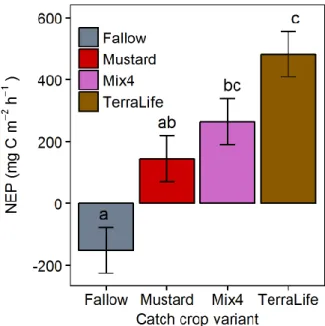
NEP was significantly higher in the TerraLife soil when compared to the fallow soil and the Mustard suggesting that the higher the plant diversity, the higher the C fixation. The TerraLife soil presented higher extracted PLFA values, being significantly higher than the fallow soil at 0-10 cm for total PLFAs and fungal PLFAs, suggesting that higher plant diversity induces higher microbial biomass. And the soil microbial community structure seemed to present two different trends, with a higher Fungi/Bacteria ratio in the TerraLife and Mix4 soils and similar values for the Mustard and fallow soils.
The results suggest that multi-species catch crops provide higher C fixation rates and promote soil microbiota when compared to single-species crops or fallow soil. Further research that focuses on functional traits between individual catch crops and their microbiome is still needed in order to contrast and better interpret the information currently available on the subject.
Key words: soil microbiota, 13C, PLFA, NEP, agricultural sustainability.
Resumo (Portuguese/Português)
A perda de nutrientes nos solos agrícolas provoca problemas ambientais e o incumprimento de leis de protecção do ambiente. As culturas de captura de nutrientes (“catch crops”) são culturas utilizadas nas rotações de cultivos para evitar a perda de nutrientes por infiltração. Estas culturas podem aumentar a qualidade ou a actividade biológica no solo. O objectivo desta dissertação é explorar aspectos relacionados com o ciclo do carbono ao comparar o efeito num solo agrícola da Baixa-Saxónia (Alemanha) de semear uma só espécie (Mostarda), semear mais do que uma (Mix4, mistura experimental de 4 espécies, e TerraLife, mistura comercial de 13 espécies) ou deixa-lo nu.
Para tal, foi dado às plantas um pulso de 13C para fazer o seguimento do C na interfase
atmosfera-planta-solo. A Produção Líquida do Ecossistema (NEP) foi calculada para as diferentes culturas de captura de nutrientes com recurso à monitorização dos fluxos de gases. Os ácidos gordos de fosfolípidos (PLFAs) dos microrganismos do solo foram extraídos para estimar a quantidade e diversidade relativas de distintos componentes do microbiota.
III A NEP foi significativamente maior na TerraLife do que no solo nu e no da Mostarda, o que sugere que a maior diversidade de plantas pode estar a aumentar a fixação de C. O solo da TerraLife apresentou valores maiores do que o resto para PLFAs, significativamente maiores para PLFA total e PLFA de fungos, pudendo o aumento da diversidade das plantas estar a aumentar a biomassa microbiana. Observaram-se duas tendências na estrutura da comunidade microbiana; a TerraLife e a Mix4 tiveram maiores valores na razão fungo/bactéria; e a Mostarda e o solo nu, valores menores. As “catch crops” com maior diversidade de plantas estudadas fixaram mais C da atmosfera e deram lugar a maior diversidade e abundância de microrganismos no solo que a de uma só espécie ou o solo nu. Ainda é preciso esclarecer as interacções específicas das plantas usadas com o microbiota do solo para comprovar os resultados e a interpretação dos mesmos.
IV III. Extended Portuguese abstract
Nos ecossistemas terrestres os solos são um local de circulação dos nutrientes entre matéria orgânica e inorgânica. Nos ecossistemas terrestres naturais, os microrganismos do solo são os principais responsáveis por essas transformações fechando o ciclo de nutrientes. Pelo que têm um papel fundamental na fertilidade dos solos. Contudo, nos solos de agricultura convencional a função dos microrganismos tem vindo a ser substituída pela intervenção humana, com a adição de nutrientes em formas mais ou menos disponíveis às plantas. Esta intervenção provoca uma mudança na reciclagem dos nutrientes, passando dum sistema com alta capacidade de regulação interna nos solos a um sistema aberto que precisa da adição regular de nutrientes para poder cobrir as necessidades nutricionais das plantas. Esta adição precisa de ser regular devido a perda da capacidade de retenção de nutrientes e carbono (C) no solo que seria fornecida pelo complexo sistema microbiano do mesmo.
A microbiota do solo é complexa e diversa, mas o foco nesta dissertação é nas bactérias e os fungos. Muitos estabelecem relações simbióticas com as raízes das plantas no solo, especialmente relevantes em ecossistemas pobres em nutrientes, influindo no seu desenvolvimento. Mas também os microrganismos que não estabelecem relações directas com elas (positivas ou negativas) influem de várias maneiras (por exemplo, bactérias que podem fixar azoto ou que competem com as plantas pelos mesmos nutrientes). Dos microrganismos simbióticos convém destacar os fungos micorrízicos arbusculares (AMF) pois estabelecem associações com a maioria de culturas agrícolas.
Dado que nem todas as plantas têm as mesmas necessidades ou estabelecem as mesmas associações com microrganismos, têm sido utilizadas rotações de cultivos em que diferentes plantas são semeadas umas a seguir às outras, com o objetivo de manter os solos férteis ao longo do tempo sem necessidade de adição excessiva de nutrientes. Além dos nutrientes, esta gestão de uso do solo permite manter o nível de matéria orgânica do solo (SOM) permitindo a existência de cadeias tróficas mais complexas e conferindo maior resiliência ao mesmo.
Com a adição massiva de nutrientes aos solos, os microrganismos perdem a funcionalidade que anteriormente tinham pelo que muda a composição microbiana e os nutrientes e a SOM não são retidos e atingem outros sistemas, nomeadamente as águas subterrâneas. Isto desestabiliza os ecossistemas que recebem os nutrientes provocando situações de eutrofização. As consequências provocam a perda de ecossistemas naturais, podendo impactar no curto e médio prazo nas economias locais. Para evitar estes problemas ambientais e as suas consequências, existem leis nacionais e supranacionais, notavelmente para os nitratos na Europa, que definem níveis máximos de substancias fertilizantes presentes nas águas de acordo com as suas funcionalidades.
Uma potencial solução para evitar estas perdas é a recuperação de culturas intercalares para a captura de nutrientes, chamadas em inglês “catch crops”. Estas plantas cultivam-se em épocas em que as condições não são boas para o cultivo de plantas comerciais em lugar de deixar o solo nu. As plantas utilizam os nutrientes presentes no solo para desenvolver o seu ciclo de vida evitando a sua perda a camadas inferiores, e quando morrem no inverno, pela sua decomposição, voltam os nutrientes ao solo. Existem numerosos estudos que defendem que além da maior eficiência do uso de nutrientes as "catch crops" podem estimular a actividade biológica do solo e melhorar as suas propriedades físicas e químicas (retenção de água, estrutura, etc.).
Este trabalho está enquadrado dentro de um projecto cujo objectivo é estudar as “catch crops” como ferramentas para manter a qualidade do solo e aumentar a produtividade (“Catch-Cropping as an Agrarian Tool for Continuing Soil Health and Yield Increase” ou “CATCHY”) desenvolvida por seis instituições alemãs parceiras. O objectivo específico deste trabalho é perceber a eficiência de
V diferentes “catch crops” na reciclagem de C e o efeito no microbioma do solo. As hipóteses colocadas foram:
I. As “catch crops” com várias espécies fixam mais C no solo do que as de uma só espécie II. Maior diversidade nas “catch crops” tem maior impacto positivo na biomassa microbiana do solo
III. A comunidade microbiana do solo apresenta diferenças em função da “catch crop” ser composta por uma só ou por várias espécies vegetais.
A experiência foi desenvolvida num Cambisolo Estágnico agrícola em Asendorf, na Baixa Saxónia (Alemanha). Neste campo, a rotação de cultivos, consistiu de fava, trigo de inverno e milho de forragem, e foram incluídas várias “catch crops” em diferentes parcelas de 9 m x 9 m. As “catch crops” estudadas nesta dissertação foram a Mostarda (Sinapis alba L.) e duas misturas de plantas; a “Mix4” com quatro espécies, e a “TerraLife”, uma mistura comercial com 13 espécies vegetais (tabela 2.2.).
Foi realizada uma marcação com 13C para observar o translocação de C na interfase
atmosfera-planta-solo. Para tal foi criado um compartimento estanque em redor da parte aérea das plantas no qual foi libertado 13CO
2, e monitorizada a sua fixação pelas plantas. Foram tomadas amostras de solo, plantas e
ar antes e após a marcação. As amostras de solo tomaram-se a duas profundidades diferentes. A respiração do solo foi determinada em simultâneo com a toma de amostras de ar. Foram, também, tomadas amostras de ar de diferentes profundidades do solo.
Das amostras de solo, além das análises químicas, foram extraídos ácidos gordos de fosfolípidos (PLFA) das membranas dos microrganismos do solo. Estas moléculas servem como indicadores da presença e abundância de microrganismos vivos no solo e algumas são utilizadas como bio-indicadores da presença de taxa específicos. Esta técnica tem ajudado no estudo da estrutura das comunidades microbianas sendo hoje em dia um método comum. A extracção dos PLFAs consiste em romper as membranas dos microrganismos e isolar os fosfolípidos do resto de lipídos extraídos num primeiro momento; e hidrolisar, metilar e separar os ácidos gordos dos grupos polares aos quais estão unidos, obtendo como resultado ésteres metilados de ácidos gordos (FAMEs). Finalmente estes são medidos mediante cromatografia de gases.
Através da marcação com 13CO
2, foi observada a presença de 13C a diferentes profundidades no solo e
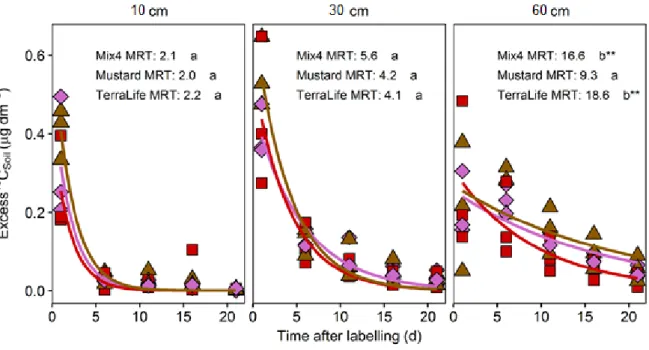
pôde-se calcular o tempo de residência média (MRT) em cada uma delas para as diferentes culturas. Observou-se que o 13C teve um maior MRT a 60 cm de profundidade nas “catch crops” com várias
espécies, podendo ser devido a uma maior reciclagem da parte da microbiota do solo dos exsudados das plantas. Também o MRT do 13C obtido dos dados de fluxo de CO
2 do solo para a “TerraLife”, é
maior do que nas outras “catch crops” o que sugere que a maior diversidade de plantas pode estar a induzir uma maior capacidade do solo para reter o C recentemente fixado da atmosfera.
Também se pôde estudar a incorporação e presença de carbono nas plantas e a produção líquida do ecossistema (NEP) para cada uma das “catch crops”. A “TerraLife” apresentou a maior taxa de marcação e maior NEP o que sugere que a maior diversidade de espécies vegetais das “catch crops” poderá ter vantagens para a incroporação de carbono no ecossistema.
Mediante a extracção de PLFAs das amostras do solo das diferentes “catch crops”, foi possível compará-las em função da quantidade total de PLFAs extraídos. A “TerraLife” teve um valor maior do que o resto, mas só significativamente diferente em relação ao solo nu. Integrando todos os resultados, parece muito provável que a maior heterogeneidade de espécies vegetais possa estar a potenciar
VI diferentes fungos e bactérias em diversos nichos ecológicos do solo, justificando uma maior abundância de biomasssa microbiana.
Também se pôde analisar a fracção dos PLFAs correspondentes exclusivamente a bactérias, fungos e o cálculo da razão fungo/bactéria para os diferentes solos. O solo que teve um valor maior para PLFA de fungos em baixa profundidade foi o da “TerraLife”. Uma das diferenças que pode ter influenciado no respeitante à Mostarda é o facto de conter na mistura espécies de plantas que formam micorrizas. Contudo, também a maior diversidade de plantas pode ter potenciado a presença de fungos, tanto saprófitos como micorrizas, devido à menor especificidade a espécie vegetal e à capacidade de formar redes. A razão fungo/bactéria apresentou duas tendências diferentes. Por um lado, a “TerraLife” e a “Mix4” com valores maiores e evolução semelhante ao longo do tempo, e por outro, a Mostarda e o solo nu. Os valores maiores para as misturas de plantas sugere sistemas no solo com maior tendência a fechar os ciclos dos nutrientes e a preservação do C.
Dos resultados obtidos, as “catch crops” com maior diversidade de plantas estudadas fixaram mais C da atmosfera e deram lugar a maior diversidade e abundância de microrganismos no solo que a de uma só espécie ou o solo nu. É preciso continuar no estudo destas culturas, para obter mais dados e com eles maior confiança nas conclusões. Contudo, a partir dos resultados e da bibliografia existente, as “catch crops” com misturas de espécies têm um grande potencial na agricultura na redução da perda dos nutrientes, na maior incorporação de C no solo, na promoção do seu microbiota e nos serviços que fornecem às plantas e, por tanto, nos serviços que fornecem às pessoas.
VII Index
I. Acknowledgements I
II. Abstracts (English and Portuguese) II
III. Extended Portuguese abstract IV
IV. Figure and table list IX
V. Abbreviation list XI
1. Introduction 1
1.1. Current situation 1
1.1.1 Soils 1
1.1.2. Soil microbiology and plant development 1 1.1.3. Crop rotations and biodiversity 3 1.1.4. Soil organic matter and soil organic carbon 3 1.1.5. Political context and sustainability 4
1.2. Management strategy 5
1.2.1. Catch cropping 5
1.2.2. General project objectives and aim of the thesis 6
2. Methods 8
2.1. Experimental site 8
2.2. Field experiment design 9
2.3. 13C labelling 11
2.4. Sampling 12
2.5. Soil respiration data 13
2.6. Gas samples 13 2.7. Plant material 14 2.8. Soil material 14 2.8.1. PLFAs 15 2.8.2. PLFA extraction 17 2.9. Calculations 20 2.10. Statistical Analyses 22 3. Results 23
3.1. Net ecosystem production (NEP) 23 3.2. Excess 13C in different compartments 23
VIII 3.2.1. Excess 13C in plant roots and shoots 23
3.2.2. Excess 13C at different soil depths 24
3.2.3. Excess 13C in soil CO
2 fluxes 26
3.3. PLFA analyses 27
3.4. Excess 13C in catch crop soil PLFAs 33
4. Discussion 36
4.1. Atmospheric C fixation 36
4.2. PLFA analyses 37
4.3. Conclusions 38
IX IV. Figure and table list
Figure 2.1. Asendorf soil profile 8
Figure 2.2. Month average temperature and precipitation in Asendorf from 1981 – 2015 9 Figure 2.3. Air and soil temperatures in the field site during sampling period 9 Table 2.1. Dated field activities before catch cropping 10 Table 2.2. Experiment catch crops´ species composition 10 Figure 2.4. Labelling polyethylene sealed metallic frame. 12 Figure 2.5. Schematic labelled area view from above. 13 Figure 2.6. Phospholipid chemical structure (Kandeler 2015). 15 Table 2.3. FA biomarkers analysed (adapted from Willers et al. 2015). 16 Figure 3.1. NEP values of the different catch crop treatments and the fallow soil. 23 Figure 3.2. Excess 13C in the different catch crop treatments´ plants´ shoots and roots after
labelling 24
Figure 3.3. Average δ13C values (±SE) in soil air sampled after labelling from 10, 20, and 60
cm soil depth 24
Figure 3.4. Evolution of excess 13C-CO
2 in soil air of different depths. 25
Figure 3.5. Evolution of excess 13C-CO
2 in soil respiration fluxes after labelling. 26
Figure 3.6. Total PLFA per each treatment group for and sampling date from surface to 10 cm depth (left) and 20 - 30 cm depth (right). 27 Figure 3.7. Sum of the considered fungal PLFA per each treatment group and sampling date
from surface to 10 cm depth (left) and 20 - 30 cm depth (right). 28 Figure 3.8. Sum of the considered bacterial PLFA per each treatment group and sampling date
from surface to 10 cm depth (left) and 20 - 30 cm depth (right). 29 Figure 3.9. Fungi/Bacteria ratio per each treatment group and sampling date from surface to
10 cm depth (left) and 20 - 30 cm depth (right). 30 Figure 3.10. PLFA Cy19:0 presence as Gram-negative bacteria biomarker ratio per each
treatment group and sampling date from surface to 10 cm depth (left) and 20 - 30 cm
depth (right). 31
Figure 3.11. PLFA 18:1w7c presence as AMF biomarker ratio per each treatment group for and sampling date from surface to 10 cm depth (left) and 20 - 30 cm depth (right). 32 Figure 3.12. Relative PLFA amounts for all soil samples after applying NMDS ordination
method. 33
Figure 3.13. Excess 13C of total PLFAs per catch crop treatment and sampling date from
X Figure 3.14. Excess 13C of fungal PLFAs per catch crop treatment and sampling date from
surface to 10 cm depth (left) and 20 - 30 cm depth (right). 34 Figure 3.15. Excess 13C of bacterial PLFAs per catch crop treatment and sampling date from
XI V. Abbreviation, acronym and symbol list (if necessary)
AIC, Akaike´s information criterion AMF, arbuscular mycorrhizal fungi BF3, boron trifluoride
C, carbon
13C, stable carbon isotope 13
CATCHY, “Catch-Cropping as an Agrarian Tool for continuing Soil Health and Yield Increase”, name of the broad research project where this thesis was developed.
CaCO3, calcium carbonate
CH4, methane
CHCl3, chloroform
CO2, carbon dioxide 13CO
2, carbon dioxide with isotope 13 carbon
δ13C, variation in isotope 13 carbon content
DW, dry weight
EMF, Ectomycorrhizal fungi FA, FAs, fatty acid, fatty acids
FAME, FAMEs, fatty acid methyl ester, fatty acid methyl esters
FEP, fluorinated ethylene propylene, material of which the plastic pipes for air samples is made of. GC, gas chromatograph, gas chromatography
HOS, high organic standard H2SO4, sulphuric acid
IRMS, infrared mass spectroscopy K+, potassium cation
LMM, linear mixed effects model MeOH, methanol
Mix4, multispecies catch crop used in our field experiment, containing field mustard, Egyptian clover, sorghum and Phacelia (check table 2.2. for more details)
MRT, mean residence time N, nitrogen
XII NaCl, sodium chloride
NaOH, sodium hydroxide NEP, net ecosystem production NH4SO4, ammonium sulphate
NLFA, NLFAs, neutral lipid fatty acid, neutral lipid fatty acids NMDS (ordination method), non-metric multidimensional scaling N2O, nitrous oxide
NPP, net primary production OC, organic carbon
OM, organic matter P, phosphorus
PLFA, PLFAs, phospholipid fatty acid, phospholipid fatty acids ppm, parts per million
qPCR, quantitative polymerase chain reaction (method in molecular biology related to DNA replication)
rpm, revolutions per minute Rs, respiration
RVPDB, standard δ13C value 0 used to measure stable carbon isotope ratio.
S, sulphur
S2-, sulphur anion
SE, standard error, standard errors SOC, soil organic carbon
SOM, soil organic matter SPE, solid phase extraction
TerraLife, multispecies catch crop used in our field experiment containing 13 plant species. The complete commercial name is “TerraLife-MaisPro TR Greening©”
TN, total nitrogen
UAN, urea and ammonium nitrate solution
VPDB, Vienna Pee Dee Belemnite, fossil whose δ13C content is used as δ13C value 0 when looking at
carbon stable isotope allocation.
Other abbreviations used in the text which are not included in this list, correspond to the International System of Units.
1
1. Introduction 1.1. Current situation
1.1.1 Soils
Soils are fundamental to life on Earth (FAO, 2015). They are the interface between the organic and inorganic world in terrestrial ecosystems and, as such, they provide important ecosystem services. Ecosystem services are the benefits ecosystems provide humans and they can be divided into provision services (e.g. water), regulating services (e.g. disease control), cultural services (e.g. sense of belonging) and supporting services (e.g. nutrient cycling) (Millennium Ecosystem Assessment, 2003). Soil biota is the key driver of many of these, it has been shown that soil biodiversity influences ecosystem functions and it is generally accepted that it confers soil resistance and resilience to environmental changes (Pascual et al. 2015). However, the role soil microorganisms play has long been disregarded in agricultural systems because their function was replaced by human inputs or actions, like the use of fertilisers and pesticides or soil tillage (Barrios, 2007). Thus, the intensification of agriculture has reduced the complexity of soil food webs and biodiversity (Pullman et al. 2012, Tsiafouli et al. 2015), making those soils fragile and dependant of high external input. Studying and understanding the potentialities of microorganisms´ diversity and function for internal regulation in soils, may offer some ideas for more sustainable ways of producing food as well as preserving human well-being in the medium to long term (Barrios, 2007).
Nutrient cycling, a supporting ecosystem service, has been altered in soils with agricultural intensification. Nitrogen (N), phosphorus (P) and carbon (C) biogeochemical cycles have been altered in the last century due to human activity (Galloway et al. 2008, Morris and Blackwood 2015). N fixation through the Haber-Bosch reaction increased the inputs of reactive plant available N, one of the leading causes to the fast intensification in agricultural practices (Gorman 2013). Similarly, the natural abundance of plant available P is low, requiring constant input of nutrients with available P, especially when there is no in situ regulation of these compounds. Intensive application of N and P fertilizers causes environmental problems by leaching of excess nutrients to aquatic systems (Smith et al. 1999, Pearl 2016). The combustion of fossil fuels and the higher livestock production has increased the global greenhouse gas concentrations of CH4, CO2 and N2O in the atmosphere in 35% (Le Quéré et al.
2016). This acceleration of the biogeochemical cycles threatens the ecological equilibrium that allows the survival of the human species, among many others.
As an important interface in terrestrial ecosystems, the role of soils as source or sink for greenhouse gases is crucial. Soils contain the largest terrestrial organic C reservoir holding 2060± 215 Pg C in the upper two meters (Batjes 2016). The use of cover crops in agricultural soils is a sustainable practice that can preserve or enhance C sequestration in agroecosystems (Poeplau and Don 2015).
1.1.2. Soil microbiology and plant development
Soil biota is the major driver in terrestrial biogeochemical nutrient cycles. Microorganisms in the soil play an important role by seeking their own survival within a community under a set of given conditions (Morris and Blackwood 2015). Individual microorganisms have different physiologies and are able to adapt to certain environmental conditions and specific nutrient sources. The whole microbial community itself responds to perturbations or changes of their habitat, shifting its composition and supporting the better adapted species.
2 The term soil microbiota will be used in the text mainly for bacteria and fungi, although other microscopic organisms are present in the soils; namely consumers (e.g. protozoans, rotifers) and some types of unicellular algae (Coleman and Wall 2015). Soil microbiota are in close contact with plant roots and are important regulators for plant nutrition, especially in nutrient poor environments (van der Heijden, 2008). Symbiotic microorganisms can have positive direct effects on plant growth and crop yields (van der Heijden, 2006). Mycorrhizal fungi are a group of symbionts that establish relationships with a great diversity of terrestrial plants. They provide a higher supply of limiting nutrients and, often, resistance to biotic or abiotic stress, in exchange for photosynthetic carbohydrates from the plant (van der Heijden, 2008, Balestrini 2015). There are a great number of different mycorrhizal fungi in the plant-soil system which can be divided into two main groups based of the position of the fungal structures (in the root tissues or mainly on the outside) and the taxonomy of the plant partners. These main groups are endomycorrhizal fungi, of which about two-thirds are arbuscular mycorrhizal fungi (AMF), and ectomycorrhizal fungi (EMF) (Balestrini 2015).
AMF belong to the Glomeromycota division, with about 220 species, and they are obligate biotrophs (they need their host plant to develop). They are important in agricultural systems because they form associations with most of the economically relevant crops enhancing their productivity (Balestrini 2015). EMF belong mainly to the Basidiomycota division but there are some belonging to the Ascomycota division too, with at least 6000 species. Their mycorrhizal mycelium is connected to an extended hyphal network in the soil involved in the search of nutrients and water. They are present in many different biomes and they are known for their fruiting bodies, some of which are edible (e.g. truffles or boletes) (van der Heijden, 2008, Ballestrini 2015).
Besides the various positive direct impacts on plant health, some soil microorganisms can also produce negative direct effects to the plant-soil system. Fungi and bacterial diseases are still the major cause for annual crop losses in low diversity agricultural systems (van der Heijden, 2008).
Apart from the direct effect of plant nutrition, microorganisms in the soil provide a number of indirect effects to plants. Detritus feeding microorganisms degrade plant residues and thereby transfer organic compounds inaccessible to plant nutrition into mineral compounds which can be taken up by plants. Among these microorganisms, bacteria and fungi that break down complex insoluble organic matter polymers containing nutrients into dissolved and plant accessible nutrients can be found. By fixing nutrients within their biomass, soil organisms prevent leaching losses to aquatic systems acting as a kind of nutrient buffer. Also many non-mycorrhizal fungi exudate organic acids for external digestion and leave available some of the more simple organic matter produced. There are other microorganisms that supress plant diseases because they produce specific antibiotic metabolites that benefit themselves (van der Heijden, 2008). Microorganisms can also have negative effects for plants indirectly, like the reduction of soil nutrients in certain conditions (competition with microbes for nutrients) or the mobilisation of N from the soil (van der Heijden, 2008).
Because of all these different direct and indirect effects on plants, it is often difficult to determine or even estimate the effects microorganisms have on plant productivity (Wardle et al. 2004). The aim of a sustainably managed soil should be, therefore, the establishment of a highly diverse and efficient soil microbial community with positive impacts on the plants and the suppression of potential pathogens. In this direction, concepts like ecological intensification or soil ecological engineering express the idea that agricultural systems that serve human interest as well as reducing negative environmental impacts are needed (Bender et al. 2016).
3 1.1.3. Crop rotations and biodiversity
Crop rotations have been used since the beginning of agriculture and often, when including legumes in the rotation, as a way of increasing available N compounds in the soil (Smith et al. 2015). In industrialised agriculture, cropping systems have been often simplified with a dramatic loss of biodiversity in the agroecosystems. The benefits of crop rotation to soil fertility depend on management, climatic and soil conditions. Crop rotation’s direct impact alone may be difficult to quantify. However, together with other management strategies such as catch cropping or green manure application, crop rotations may have a fundamental impact on long-term soil fertility (Coleman 1995) and it is widely accepted that they improve soil functioning (Buldock, 1992). Different crops can explore different soil niches for nutrients (e.g. via different rooting depth), have different nutrient demands and have different soil symbiotic partners and pests. So, by changing the plant species we sow, we may have positive impact on soil health in the long-term.
McDaniel et al. (2014) analysed a great number of studies to elucidate the effect of adding one or more crops in rotation to a monoculture and observed that there was a general increase in the soil C and N pools when plant diversity also increased. The authors concluded that the close association of roots, microorganisms and minerals could be affecting the saprophyte community and encouraging physical SOM stabilisation. Depending on the type of plant, there are different effects on the soil and its microbiome. Properties like the rooting depth, the quality and quantity of the plant litter added to the soil or the amount of root exudates (Smith et al. 2015) influence the soil microbial community directly. Plants can attract different organisms by altering the composition of root exudates released to the rooting zone (Raaijmakers et al. 2009). In this way, individual plant characteristics together with other species’ and plant community characteristics influence the microbial community composition and its functions (Smith et al. 2015).
1.1.4. Soil organic matter and soil organic carbon
There is more C in soils than in the World’s atmosphere and vegetation together and most of it is soil organic C (SOC) contained in SOM (FAO and ITPS, 2015). The SOC content serves as an approximate measure of the SOM, which contains about 50% of OC (FAO and ITPS, 2015). SOM controls a wide range of ecosystem services and responds rapidly to human-induced changes (FAO and ITPS, 2015). For instance, SOM influences soil structure and stability, the retention of water, promotes soil biodiversity and is a source of nutrients for plants (FAO and ITPS, 2015).
One of the major sources of organic carbon input in terrestrial ecosystems is through plant primary production. Through photosynthesis, plants fix CO2 from the atmosphere to obtain the C to build their
tissues. Then, by plant structure decomposition and root exudation, C is incorporated to the soil where soil fauna and microorganisms process the C rich molecules. SOC budget in the soil depends on various factors. Climate is one of these factors, because temperature and moisture limit or promote plant growth but also biomass mineralisation or decomposition due to soil microorganisms. The higher the temperature, given all other conditions are optimal, the faster the biological activity and thus the faster organic matter is mineralised. If the temperatures are lower, nutrient recycling is slower and promote SOC accumulation. The amount of water present in the soil limits (when high or low) or promotes (when high enough) the development of life, both for plants and microorganisms. So, as an extreme example, this is why in tropical rainforests there is a very high biomass production but, at the same time, a very high biomass mineralisation and, thus, low SOC. The complete opposite phenomenon happens in boreal and arctic ecosystems, where plant growth is slow and decomposition
4 is even slower (there is also low oxygen availability, that acts as a limiting factor), having as a result the highest SOC stocks on the planet.
Another factor is the quality of the litter of the above ground biomass, which will determine how easily it will be degraded in the soil. As well as regional climate, soil management is a factor that has a strong impact on quality and quantity of SOM, which normally decreases the higher the management intensity in conventional agricultural systems (Tsiafouli et al. 2015). The soil that will be used in the field study belongs to a conventional central European agricultural system, with relatively intense management and, thus, low quality and quantity of SOM.
All in all, the presence and even distribution of SOC in a given soil improves its chemical and physical properties, increasing nutrient retention and water holding capacity, making soils potentially more suitable for agricultural use (FAO and ITPS, 2015). So, not surprisingly, SOC and soil biodiversity have been directly related to the three aspects of food security; they could increase food availability, restore the productivity of degraded soils and make food production systems more resilient (FAO and ITPS, 2015). Given the current trend of soil degradation worldwide, maintaining and improving the SOC content of our soils is of extreme importance. 45% of all European soils are considered degraded when regarding indigenous OC content, and in agricultural soils, intensive land use is considered to have depleted their SOC down to 0-2%. (FAO and ITPS, 2015)
1.1.5. Political context and sustainability
Loss of C and N in agricultural soils, which has negative consequences for the environment, makes agricultural systems become less productive. High input agricultural systems have an excessively high leaching of N, P and K nutrients among others (Thorup-Kristensen et al. 2003), which leads to their accumulation in surface and ground waters. This boosts the excessive growth of opportunistic primary production species that cover water surfaces (such as algae), limiting the light and oxygen availability, which impede the normal development of the life forms that supported the original equilibrium of the newly polluted ecosystem. This process is known as eutrophication and has become a major threat to terrestrial aquatic ecosystems (Smith et al. 1999).
The low price of fertilisers and their intensive application for the short-term increase in crop production and profits are the main triggers for the intensive nutrient leaching. Apart from the environmental damage that it causes, there can also be negative socio-economic impacts and health related problems. As an example, socio-economic impacts are especially noticeable in areas that base their local economy on nature tourism. If their local environment is damaged, the local economy is damaged too. This situation has been raising concerns and has led to legal regulations in some areas of the world (Smith et al. 1999, Nett et al. 2011).
In 1991, the European Union approved the “Nitrates Directive” to protect waters of its member states through its transposition into each state’s legislation. The aim of the directive was to protect water quality across the EU, preventing nitrates from agricultural sources polluting ground and surface waters (European Union 2010). This directive is part of an EU environmental legislation framework. The transposition of the laws into national legislation establishes legal limits to N balance surpluses at the field scale (Nett et al. 2011). However, the enforcement of these measures is not easy (Liu et al. 2018).
In Germany, the EU has been increasing pressure on the federal government since 2012 because nitrate pollution in ground and surface waters has been increasing in recent years (Jobert 2016, Knight
5 2016, Schumacher 2016) and could lead to a fine for trespassing the established limits. Furthermore, a significant number of environmental organisations and companies in Germany (Bundesverbands der Energie- und Wasserwirtschaft e. V., 2018) directed a petition to the European Commission and the Federal Regional Government reporting this situation. They demand a real law enforcement of nitrate limits in continental waters, a tougher control on the fields and regarding the transport and distribution of animal slurry (used widely to fertilise fields) and, finally, a shift in subsidies to those food producers that run sustainable managed systems. In this petition they estimate the cost of removing nitrates from household water would increase the price of water for a domestic user in 50 to 60%. Removing nitrate from water would be very expensive for the public authorities who assume the cost (Jobert 2016), and it does not solve the costs of the environmental and potential socio-economic damage. This is why reduction of N pollution at the source is a better solution to solving the problem. Because of the complexity of soil processes and the numerous factors that intervene, there will not be one global miraculous solution; different locally developed management strategies must be found.
1.2. Management strategy
1.2.1. Catch cropping
A promising tool to improve soil nutrient cycling and reduce leaching losses are catch crops and green manures. These are crops used in temperate climates during seasons unsuitable for commercial crop growth (autumn and winter) instead of leaving the soil bare. Most of the following section is based on the review of Thorup-Kristensen et al. (2003).
Thorup-Kristensen et al. (2003) distinguish two types of cover crops: green manures and catch crops. Green manures refer to those cover crops that are planted with the objective of increasing soil fertility for following crops. The term catch crop, on the other hand, refers to a cover crop that is planted with the objective of preventing nutrient losses from the soil. By using these crops it is possible to prevent the loss of N to deeper soil layers, that would be inaccessible to plants, and thus avoiding excess leaching to aquifers (Thorup-Kristensen et al. 2003; Rinnofner et al. 2008; Dahlin and Stenberg 2010; Constantin et al. 2010; Nett et al. 2011; Piotrowska and Wilczewski 2012; Li et al. 2015).
Although these techniques have been used for a long time, and were a key tool in early intensive forms of agriculture (Thorup-Kristensen et al. 2003), these practices have been disappearing progressively due to the inexpensive access to fertilizers. However, recent environmental problems (as stated above) are increasing the relevance and importance of their use as an agrarian tool (Thorup-Kristensen et al. 2003).
There are a great number of factors that influence the productivity of the following crop. Some of these are soil type, temperature, sowing date, soil moisture, nutrients present in the soil at a given time, soil behaviour and characteristics of the commercial crop planted and other agricultural management practices (e.g. tillage vs. no tillage) are amongst the most important (Thorup-Kristensen et al. 2003; Net et al. 2011). This is why the effect of catch crop influence on the following commercial crop is difficult to establish. However, regarding N uptake exclusively, the main sources of this variation, according to Thorup-Kristensen et al. (2003), seem to be plant growth potential, N-uptake potential, root growth and the relationship between soil depletion and nitrate leaching loss. In any case, the N field effects of catch crops in the short term can be quite variable, which is why long-term data is necessary to test the potential benefit of catch cropping on the soil nutrient budget and the economic value of this management practice (Thorup-Kristensen et al. 2003; Constantin et al. 2010).
6 Some effects of catch crops have been proven at the field scale. Thorup-Kristensen et al. 2003, include a number of effects of catch crops apart from N retention:
1. Effects on nutrients other than N. Catch crops can increase P plant availability by converting from inorganic to available organic forms, especially by catch crop species that have long root hairs that acidify the rhizosphere or that are supported by mycorrhizal fungi association. The plant P is released slowly and is not as susceptible to adsorption and precipitation as inorganic P forms added in commercial chemical fertilisers. They can also affect potassium (K+) content
and that of other cations in the soil water by their active uptake or indirectly by taking up nitrate and sulphate anions that would bind to them. Sulphur (S) can easily be lost by leaching and has a similar behaviour to nitrogen in soils. Some catch crop species have a high uptake of S, like crucifers, which could influence its availability in the subsequent crops.
2. Effects on soil microbiological and faunal activity are evident in both the short and long-term. The effect generally depends on crop biomass inputs; the higher the inputs via root exudation, root turnover or leaf litter loss, the higher the increase in microbial activity.
3. Improvement of soil structure and water retention by catch crops, among other physical properties, may also improve commercial crop establishment and root development, and decrease soil losses. Regarding the soil’s water content, when a catch crop is growing, it will take water from the field. This is why it is important to bear in mind the growing conditions and the growth period of these.
The possibility of propagating certain soil-borne pathogens is a common concern amongst farmers. Although there could be a potential risk, catch crops can have a suppressive effect instead if used as break crops via the release of certain organic compounds with toxic effects for certain pathogens or the stimulation of microbial activity increasing competition or antagonistic suppression of pathogenic organisms in the soil (Thorup-Kristensen et al. 2003).
As mentioned above, different catch crop species determine different soil effects. Catch crops can be sowed in the fields on their own (single-species) or together with other species (multi-species). The latter appear to be promising because they can combine the positive effects on the soil of various single species within a plant community. Leguminous green manures, apart from fixing atmospheric N, have a high N uptake, and growing them with non-legumes in mixtures may be a viable solution for improving, not only the N leaching loss potential, but also to reduce the amount of N fertilizer purchase and application in the fields. Crucifer catch crops have been seen to have deeper rooting systems than monocots, thus increasing the N uptake of the plant and the access to other nutrients that are lower in the soil profile. (Thorup-Kristensen et al. 2003). So, for example, a diverse catch crop mixture could include:
Legumes, that can fix nitrogen via rhizobia (if required) and have a high N uptake potential;
Crucifers, that have deep roots thus increasing nutrient acquisition, and
Cereals which establish symbiotic relationships with mycorrhizal fungi and are used as green manures and nutrient storage.
Rooting density and rooting depth is increased in a mixture, so different nutrient niches could also be explored more intensively and mycorrhizal fungi would help extend further the exploration.
7 1.2.2. General project objectives and aim of the thesis
This thesis is part of the project “Catch-Cropping as an Agrarian Tool for Continuing Soil Health and Yield Increase” (“CATCHY”) which is a consortium of six interdisciplinary project partners. The project aims to study the long-term effects of catch cropping on the stabilisation and improvement of soils, regarding biological, chemical and physical properties. The main objective of the project is “to employ catch cropping for developing innovative farming systems to preserve and improve soil fertility” (BONARES, 2015). With the project it is expected to achieve a better understanding of cause-effect relationships affecting soil fertility parameters, biological functions and interactions in soil and rhizosphere. It has a functional orientation, for it interacts with agronomic and economic factors, and the results are expected to provide information on system-optimised commercial catch crop mixtures and information for the development of guidelines for sustainable and efficient agronomic practices. The project is funded by the German Federal Ministry of Education and Research, it started on the 1st of April 2015 and it is intended to run in 3 blocks of 3 years each.
The specific aim of this thesis, is to understand the efficiency of C cycling in differently managed catch crop systems. Therefore, the study compares and evaluates the effect of single and multiple catch crop treatments, in comparison to fallow soil, all of which included in the same crop rotation. The focus is on understanding the carbon cycling and translocation through the atmosphere-plant-soil microbiome interphase. For this, we conducted an in situ 13C pulse labelling experiment. We combined
solid-state 13C analyses in plants and soil, with CO
2 from soil respiration and phospholipid fatty acid
(PLFA) analyses of the microbiome to compare its biomass and diversity. Regarding this, the following hypotheses have been raised:
I. Multi-species catch crops will fix more atmospheric C than single-specie catch crops.
II. High species diversity in the catch crops will have a positive impact on soil microbial biomass.
III. The soil microbiome composition will be different in multi-species catch crops when compared to single-specie catch crops.
8
2. Methods
2.1. Experimental site
The experiment was conducted at a long term experimental field in Asendorf, Lower Saxony, Germany (52º 45’ 48.5” N, 9º 01’ 27.8” E, WGS 84 reference system), which is maintained by the DSV breading station (Deutsche Saatveredlung AG - Lippstadt Bremen) in Asendorf. The soil can be classified as a Stagnic Cambisol, which is a moderately developed soil with stagnic properties and reducing conditions in some parts for some time during the year (IUGS, 2014). Cambisols provide excellent sites for agriculture, especially those with a high base saturation in the temperate zone which are among the most productive soils on Earth. The soil profile is presented in figure 2.1.
Figure 2.1. Asendorf soil profile. Photo taken by Norman Gentsch, Ap refers to the uppermost ploughed A horizon, Bw indicates the weathered B horizon and Bg2, the B horizon of different origin which presents stagnic conditions.
The location presents an oceanic temperate climate with a clear summer-winter temperature difference and precipitation spread out throughout the year. Climograph is shown in figure 2.2, where average temperature and precipitation per month of the last 34 years is presented.
9 Figure 2.2. Month average temperature and precipitation in Asendorf from 1981 – 2015. Data from Hof Steimke station
(Asendorf) and BASSUM Station.
Temperature during the sampling days is presented in figure 2.3. Air and soil temperature decreased during the second half of our sampling days.
Figure 2.3. Air and soil temperatures in the field site during sampling period. Data from Asendorf field station (DSV). Soil temperature is for 15 cm depth.
2.2. Field experiment design
A fully randomised split-plot field experiment was conducted, where each plot had a size of 9 m x 9 m. The crop rotation in the field comprises field bean, winter wheat and silage maize, in that order. The catch crops were sowed after harvest of silage maize. Information on sowing, fertiliser and pesticide application before catch cropping is included in table 2.1.
-5,0 -3,0 -1,0 1,0 3,0 5,0 7,0 9,0 11,0 13,0 15,0 17,0 19,0 0,0 10,0 20,0 30,0 40,0 50,0 60,0 70,0 80,0 90,0 100,0 J F M A M J J A S O N D Pr e ci p itat io n ( m m /m 2)
Asendorf (1981-2015)
Precipitation (in mm) T (in°C)10 Table 2.1. Dated field activities before catch cropping.
Date Activity on the field site March 2016 Winter wheat harvest April 2016 Soil is mixed.
UAN (urea and ammonium nitrate solution) is applied. 406 l/ha May 2016 Silage maize is sowed.
Fertilization with underfoot fertilizer “NP 18/46”
Herbicides "Callisto" (100 g/l mesotrione) and "Gardo Gold" (S-metolachlor 312,5 g/l, terbuthylazine 187,5 g/l) are sprayed on silage maize plots to control dicotyledonous weeds in each case at a rate of 1.1 l/ha.
17th August 2016 Harvest of Silage maize
22nd August 2016
7th September 2016
Sowing of catch crops
UAN (urea and ammonium nitrate solution) fertilised application. 50kg/ha.
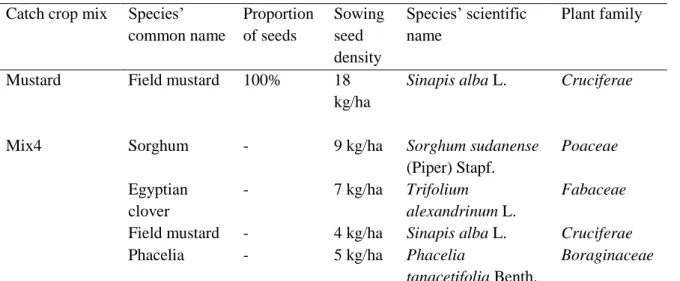
The catch crops of this study were mustard (Sinapis alba L.), an experimental mix (“Mix4”) containing four different species and a commercial cover crop mix called “TerraLife-MaisPro TR Greening©” (“TerraLife”) containing a mix of thirteen different species. The Mix4 species were
selected in order to observe combined effect of different soil resource acquisition strategies. It includes a type of cereal, which establishes relationships with mycorrhizal fungi, a leguminous specie, that has a high N uptake capacity, a cruciferous specie, that has deep rooting, and a tough flowering plant often used in Germany as a cover crop (see section 1.2.1.). The idea of using a mix with fewer but representative specie types (regarding soil resource nutrient acquisition strategies) and a mix with higher diversity, is to see if there are significant differences amongst them, as well as comparing them with a single-specie catch crop and fallow soil. Description of the catch crop species composition, proportion of seed in each mix and sowing seed density are included in table 2.2.
Table 2.2. Experiment catch crops’ species composition. Catch crop mix Species’
common name Proportion of seeds Sowing seed density Species’ scientific name Plant family Mustard Mix4 Field mustard Sorghum 100% - 18 kg/ha 9 kg/ha Sinapis alba L. Sorghum sudanense (Piper) Stapf. Cruciferae Poaceae Egyptian clover - 7 kg/ha Trifolium alexandrinum L. Fabaceae
Field mustard - 4 kg/ha Sinapis alba L. Cruciferae
Phacelia - 5 kg/ha Phacelia
tanacetifolia Benth.
11
TerraLife-MaisPro TR Greening
Pea 38% Pisum sativum L. Fabaceae
Sorghum 14% Sorghum sudanense
(Piper) Stapf.
Poaceae
Phacelia 7% Phacelia
tanacetifolia Benth.
Boraginaceae
Common flax 6% Linum usitatissimum
L. Linaceae Crimson clover 6% Trifolium incarnatum L. Fabaceae Hungarian vetch 6% 35 kg/ha Vicia pannonica Crantz Fabaceae
Alsike clover 5% (of mix) Trifolium hybridum L.
Fabaceae
Radish 5% Raphanus sativus L. Cruciferae
Persian clover 4% Trifolium resupinatum L.
Fabaceae
Ramtil 4% Guizotia abyssinica
(L.f.) Cass.
Asteraceae
Sunflower 2% Helianthus annuus
L.
Asteraceae
Camelina 2% Camelina sativa (L.)
Crantz Brassicaceae Safflower 1% Carthamus tinctorius L. Asteraceae 2.3. 13C labelling
Pulse labelling of plants in artificial 13CO
2 atmosphere with subsequent tracing of 13C in the plant-soil
system is a common approach in ecosystem studies (Kuzyakov and Gavrichkova, 2010). There are different ways of adding the label into the plant-soil-microorganism system; one pulse labelling, continuous steady state labelling and series of repeated pulse labelling periods (Yao, 2015). We conducted a one-pulse labelling experiment, creating a 13CO
2 rich atmosphere where plants could take
up the label via photosynthesis. By adding 13C, the intention is to track the C from uptake through the
plant system into the soil. By analysing the excess 13C in plants, in soil air at different depths and in
CO2 “respired” from the soil, it is possible to infer the newly translocated C’s utilisation. Three
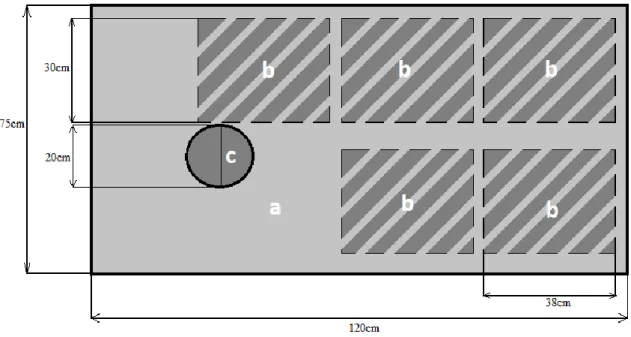
separate plots with the same catch crop were used as replicates. In each of these, an area of 75 cm x 120 cm was selected for a one-time pulse labelling with 13CO
2(see area “a” figure 2.5). The same area
was selected in three fallow soil plots (control) and were not labelled. The selected subarea in the field was labelled with a polyethylene sealed metallic frame of 75 cm x 120 cm x 110 cm (see figure 2.4). The real air volume inside the frame, after deducting the area occupied by the inside structure parts, was 997 200 cm³.
After installing the frame, the label was applied by adding 20 ml of 4M sulphuric acid (H2SO4) to 2 g
Na213CO3 (based on Hafner et al., 2012). The air inside the frame was kept circulating with a set of 4
cm x 4 cm x 2 cm vents (NB-BlackSilentPRO UntraSilent Premium Fan) connected to a 12 V rechargeable lead acid battery. The air flow each vent could produce was 188 330 cm3/min. CO
2
12 CO2 Flux System using LI-8100 20 cm Survey Chamber, LI-COR Inc., Lincoln, NE), connected to the
frame through 3 mm flexible plastic pipes. The air was taken from the frame into the infrared gas analyser at a height of about 82 cm from the ground (28 cm from the top) and then released back in, forming a closed loop. To minimise differences on photosynthetic activity due to environmental conditions on the different labelling days, we provided artificial white light on the frame during the labelling with 6 fluorescent bulbs (Philips 36W/840).
The labelling was conducted on the 18th, 19th and the 24th of October 2016, when the catch crops were
fully developed. On each day, we labelled three different catch crop plots.
Figure 2.4. Labelling polyethylene sealed metallic frame. LI-COR analyser. On top, lighting structure, LI-COR analyser (left, yellow case) and Survey Chamber (right).
2.4. Sampling
Samples of soil, plants and air were taken before labelling (day 0), on the days 1, 6, 11, 16 and 21 after labelling. On each sampling day, plant and soil samples were taken from 30 cm x 38 cm subareas (see subareas “b” in figure 2.5). Plant samples were taken by harvesting the total biomass in the subareas, including roots and shoots. Soil samples were taken at 0 – 10 cm and 20 – 30 cm depth. Additionally, soil respiration on each plot was measured using the LI-COR 20 cm Survey Chamber (LI-COR Inc., Lincoln, NE) attached to soil rings which were fixed to the ground (6 cm offset). The soil rings were installed 2 weeks before starting the measurements and plant material within them was removed and discarded (see subarea “c” in figure 2.5).
13 Figure 2.5. Schematic labelled area view from above. Area “a” corresponds to the total area within the labelling chamber; “b”, the area where plant and soil samples were removed on each sampling day; and “c”, the area where ring was installed for
soil respiration measurements and gas sampling.
2.5. Soil respiration data
Soil respiration on each plot was measured using the LI-COR 20 cm Survey Chamber (LI-COR Inc., Lincoln, NE) attached to soil rings, which were fixed to the ground with a 6 cm offset, leaving a total volume inside the measurement chamber of 6 749.7 cm3. The CO
2 efflux was monitored via the App
(LI-8100A version 1.0.6) on an external mobile device connected to the LI-COR via Wi-Fi.
The soil respiration for a given treatment at day 0 was calculated from the fallow plot plus the factor by which the catch crops increase the respiration. The photosynthetic C uptake on the labelling days was calculated by the negative CO2 flux inside the chamber plus the flux of the soil respiration. This C
uptake is called Net Ecosystem Production (NEP) and it can be defined as the net organic carbon production via plant photosynthetic activity minus the C lost due to plant respiration and due to the degradation of its structures as a result of the activity of heterotrophic organisms in the soil (Kirschbaum et al., 2001).
2.6. Gas samples
Three types of gas samples were taken. Those taken during 13C label application, the ones taken during
soil respiration measurements, and finally air from different soil depths. All samples were stored in pre-evacuated exetainers for isotope coupled gas chromatography analyses. The exetainers were evacuated, flushed with helium, and evacuated again for three times. During the labelling, samples were taken at four different time points: before the label was released, after the label was released and at two other time points after labelling.
14 During the soil respiration measurements, a t-connector with a septum was installed between the chamber and the instrument. 12 ml air samples were taken with an airtight syringe at increasing CO2
concentrations (25, 50 or 100 ppm intervals).
Gas samples were taken at different soil depths (10, 30, 60 ± 2.5 cm). Soil air suction cups (ecoTech GmbH, Bonn, Germany) 2.5 cm in diameter were installed 2 weeks before start of the experiment. In order to minimise disturbances on the vertical soil column, the suction cups were installed by coring 2.5 cm wide holes at an angle of 45° until the appropriate soil depth. The suction cups were equipped with FEP pipes which were closed at the surface by two-way valves. Sampling occurred at the same time as the flux measurement by connecting a syringe to the valve. The first approximately 12 ml were discarded in order to get rid of the already accumulated gasses inside the pipes. The samples were injected in 12 ml pre-evacuated exetainers to be taken to the laboratory. Samples were then analysed with a gas chromatograph coupled to an isotope mass spectrometer (GC-Box coupled to a Delta plus XP system, Thermo Fisher Sientific, Bremen, Germany) to identify the CO2 ppm and its isotopic
composition.
2.7. Plant material
All plants within each subarea (represented as “b” in figure 2.5) were carefully harvested in order to avoid breaking the roots and we removed roughly the soil attached to them. In the lab, roots were washed with tap water and separated into roots and shoots. The plant material was coarsely cut by a scissor, dried for the first few days at ambient temperature and then in oven at 40 ºC. Once they were dry, they were weighed to calculate the dry weight per square metre, taking into account the sampling area. After this they were chopped finely with a blender and then ground using a ceramic ball mill (MM400, Retsch GmbH, Haan, Germany) at frequency 30/s for 1.5 minutes. From this, fine dust like particles were obtained for each sample, which were dried once more at 40 ºC overnight to remove any excess water. For element analyses the samples were weighed (scales used, Mettler-Toledo GmbH, Gießen, Germany) into tin boats (10-15 mg for roots and 5-10 mg for shoots). The C and N content as well as the δ13C isotopic ratio was measured on an Elementar IsoPrime 100 IRMS
(IsoPrime Ltd, Cheadle Hulme, UK) coupled to an Elementar vario MICRO cube EA C/N analyser (Elementar Analysensysteme GmbH, Hanau, Germany). The following standards were used, in the order of appearance: quartz (blank) 10 mg, quartz (blank) 10 mg (again), HOS (high organic standard) 20 mg, USGS 25 (NH4SO4) 2.4 mg, cellulose 4.8 mg, CaCO3 16 mg, caffeine 4 mg, nitrogen standard
1 2.4 mg, nitrogen standard 2 2.4 mg, CaCO3 16 mg, pine needle 5-10 mg and HOS 20 mg. Every 15
samples, we weighed again 20 mg of HOS. The measurements were done in groups of maximum 64 samples, before which a set of standards was run each time.
2.8. Soil material
After removing the plants, the top 10 cm of soil within the sample area was mixed, sample was taken as randomly as possible and put in 100 ml plastic cups with screw-on lid. After this, the soil was dug out until there was a flat area at 20 cm depth equivalent to that on the surface, the soil was mixed at 20-30 cm depth and a sample was taken as randomly as possible in 100 ml plastic cups. All samples were immediately frozen for further analysis.
From the soil material, OC, total nitrogen (TN) and δ13C ratio were measured via elemental analysis.
15 sample weighed in each tin boat was between 50 and 100 g. These samples were ground and measured like the plant material samples.
For measuring pH and conductivity, 10 g of dry soil were suspended in 25 ml distilled water, the sample was properly shook and then measured on the following day. We used a conductivity measurer (Cond 340i (de-vice) and TetraCon® (electrode), Xylem Analytics Germany Sales GmbH & Co. KG, WTW, Weilheim, Germany) and pH measurer (inoLab® pH 720, Xylem Analytics Germany Sales GmbH & Co. KG, WTW, Weilheim, Germany).
Fatty acids (FAs) from phospholipids of the soil microbiota were extracted from the soil samples as a way of having an insight on the abundance and diversity of soil microbiota among the different soil treatments.
2.8.1. PLFAs
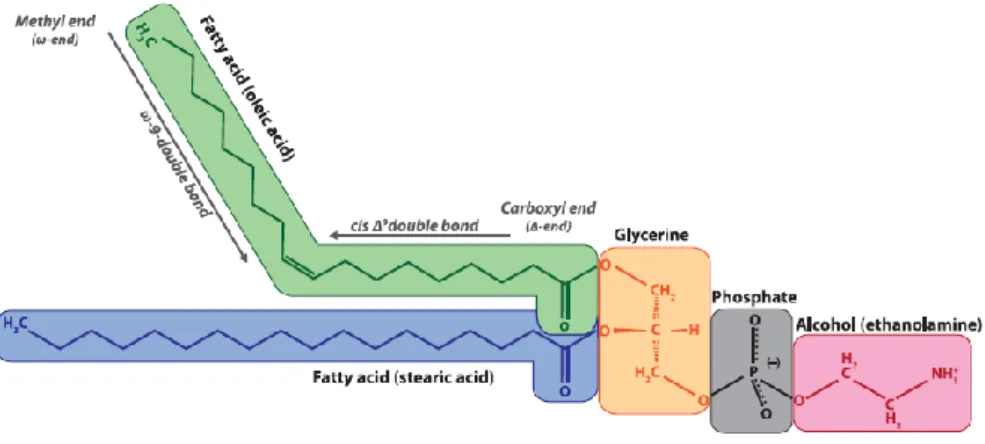
Phospholipids are the main components of all living cell membranes. They are constituted by a polar phosphorous group and two apolar FAs, all of which are linked together with a glycerol group (figure 2.6.) (Kandeler 2015). When in the cell membrane, which is a lipidic bilayer, the polar phosphorous groups face outwards (towards the outside and the inside of the cell) whereas the apolar FAs face inwards forming a barrier that cannot be trespassed by charged substances. The degree of unsaturation of the fatty acids affects the fluidity of the cell membranes, due to their spatial configuration. Thus, unsaturated fatty acids, those that present double bonds in the C chain, do not have a straight spatial configuration, establishing weaker interactions with the other fatty acids within the lipidic bilayer and, in doing so, increasing the fluidity of the membrane (Lodish et al. 2008).
Figure 2.6. Phospholipid chemical structure (Kandeler 2015). The polar phosphorous group is composed of the phosphate (grey) and, in this case, alcohol (pink) groups shown above; and it faces out of the cell membrane. The glycerine group
(yellow) links the phosphorous group to the fatty acids. The fatty acids may be saturated (blue) or unsaturated (green) influencing the lipidic bilayer´s fluidity.
Neutral lipids mainly refers to energy storage triglycerides. These have a similar structure as the membranes phospholipids but, instead of having one of the glycerol´s carbons forming a bond with the phosphorous group, it is linked to another fatty acid. In this way, energy storage triglycerides are constituted by a group of three fatty acids linked to a glycerol group (Lodish et al. 2008).
16 FAs are synthesised by organisms although heterotrophs can incorporate them directly from their diet. When synthesised, FAs can have a longer or a shorter C chain and present unsaturations at different positions depending of the path way of biosynthesis. This is why FAs can be classified according to their unsaturations in different omega (ω - end) groups (Kandeler 2015), for we count the number of C atoms from the terminal methyl group to the position of the unsaturation(s). PLFAs and NLFAs (FAs obtained from neutral lipids) that have been obtained from pure culture studies can be used as biomarkers of specific taxa (Kandeler 2015).
The PLFA pattern of soil organisms is a tool that has helped to open the “black-box” of soil microbiota and is a common method used to study microbial community structure (Ruess 2010, Frostegard, 2011, Kandeler 2015, Willers et al. 2015) for it offers a number of advantages when compared to others. It is a method that it is rapid, relatively cheaper than other methods, such as qPCR, and reproducible (Frostegard, 2011, Willers et al. 2015). What is most interesting is that the FAs present in a soil at a given moment provide information on the microbiota that is actually present in that soil at that given moment (Kandeler 2015). This is due to the rapid release and degradation through enzymatic reactions that FA experiment in the soil after cell death (Olson, 1999; Ruess and Chamberlain 2010; Frostegard 2011, Kandeler 2015, Willers et al. 2015).
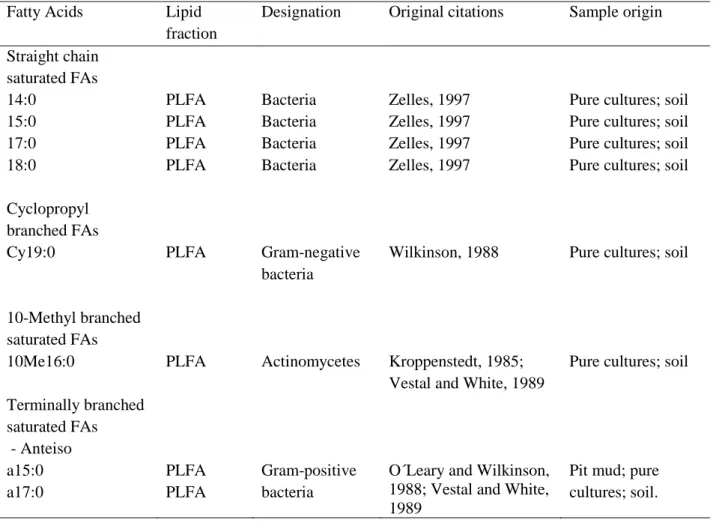
In Table 2.3 the different PLFAs used as biomarkers in this study are presented, with the species they designate and references to the original citations. Willers et al. 2015 compiles information on recent studies that establish these PLFA biomarkers and others that are used.
Table 2.3. FA biomarkers analysed (adapted from Willers et al. 2015) Fatty Acids Lipid
fraction
Designation Original citations Sample origin
Straight chain saturated FAs 14:0 15:0 17:0 18:0 Cyclopropyl branched FAs PLFA PLFA PLFA PLFA Bacteria Bacteria Bacteria Bacteria Zelles, 1997 Zelles, 1997 Zelles, 1997 Zelles, 1997
Pure cultures; soil Pure cultures; soil Pure cultures; soil Pure cultures; soil
Cy19:0 PLFA Gram-negative bacteria
Wilkinson, 1988 Pure cultures; soil
10-Methyl branched saturated FAs 10Me16:0
Terminally branched saturated FAs
PLFA Actinomycetes Kroppenstedt, 1985; Vestal and White, 1989
Pure cultures; soil
- Anteiso a15:0 a17:0 PLFA PLFA Gram-positive bacteria
O´Leary and Wilkinson, 1988; Vestal and White, 1989
Pit mud; pure cultures; soil.