CERN-PH-EP/2013-075 2013/12/03
CMS-SMP-12-005
Measurement of the W
√
+
W
−
cross section in pp collisions at
s = 7 TeV and limits on anomalous WWγ and WWZ
couplings
The CMS Collaboration
∗Abstract
A measurement of W+W− production in pp collisions at √s = 7 TeV is presented.
The data were collected with the CMS detector at the LHC, and correspond to an in-tegrated luminosity of 4.92±0.11 fb−1. The W+W− candidates consist of two oppo-sitely charged leptons, electrons or muons, accompanied by large missing transverse
energy. The W+W− production cross section is measured to be 52.4±2.0 (stat.)±
4.5 (syst.)±1.2 (lum.) pb. This measurement is consistent with the standard model
prediction of 47.0±2.0 pb at next-to-leading order. Stringent limits on the WWγ and WWZ anomalous triple gauge-boson couplings are set.
Published in the European Physical Journal C as doi:10.1140/epjc/s10052-013-2610-8.
c
2013 CERN for the benefit of the CMS Collaboration. CC-BY-3.0 license
∗See Appendix A for the list of collaboration members
1
Introduction
The standard model (SM) description of electroweak and strong interactions can be tested
through measurements of the W+W− production cross section at a hadron collider. The
s-channel and t-s-channel qq annihilation diagrams, shown in Fig. 1, correspond to the dominant process in the SM, at present energies. The gluon-gluon diagrams, which contain a loop at
lowest order, contribute only 3% of the total cross section [1] at√s = 7 TeV. WWγ and WWZ
triple gauge-boson couplings (TGCs) [2], responsible for s-channel W+W−production, are sen-sitive to possible new physics processes at a higher mass scale. Anomalous values of the TGCs
would change the W+W−production rate and potentially certain kinematic distributions from
the SM prediction. Aside from tests of the SM, W+W− production represents an important
background source for new particle searches, e.g. for Higgs boson searches [3–5]. Next-to-leading-order (NLO) calculations of W+W−production in pp collisions at√s = 7 TeV predict a cross section of σNLO(pp→W+W−) =47.0±2.0 pb [1].
γ, Z
q
q
W
−W
+q
q
W
−W
+Figure 1: Leading order Feynman diagrams for qq annihilation, for s-channel (left) and t-channel (right) production of W pairs. The triple gauge-boson vertex corresponds to the WWγ(Z) interaction in the first diagram.
This paper reports a measurement of the W+W−cross section in the W+W− → `+ν`−νfinal
state in pp collisions at√s=7 TeV and constraints on anomalous triple gauge-boson couplings. The measurement is performed with the Compact Muon Solenoid (CMS) detector at the Large Hadron Collider (LHC) using the full 2011 data sample, corresponding to an integrated lumi-nosity of 4.92±0.11 fb−1, more than two orders of magnitude larger than data used in the first measurements with the CMS [6] and ATLAS [7] experiments at the LHC, and comparable in size to the data sets more recently analysed by ATLAS [8, 9].
2
The CMS detector and simulations
The CMS detector is described in detail elsewhere [10] so only the key components for this anal-ysis are summarised here. A superconducting solenoid occupies the central region of the CMS detector, providing an axial magnetic field of 3.8 T parallel to the beam direction. A silicon pixel and strip tracker, a crystal electromagnetic calorimeter, and a brass/scintillator hadron calorimeter are located within the solenoid. A quartz-fiber Cherenkov calorimeter extends the coverage to|η| < 5.0, where pseudorapidity is defined as η= −ln[tan(θ/2)], and θ is the
po-lar angle of the particle trajectory with respect to the anticlockwise-beam direction. Muons are measured in gas-ionization detectors embedded in the steel magnetic-flux-return yoke outside the solenoid. The first level of the CMS trigger system, composed of custom hardware proces-sors, is designed to select the most interesting events in less than 3 µs using information from
2 3 Event selection
the calorimeters and muon detectors. The high-level trigger processor farm further decreases the rate of stored events to a few hundred hertz for subsequent analysis.
This measurement exploits W+W−pairs in which both bosons decay leptonically, yielding an
experimental signature of two isolated, high transverse momentum (pT), oppositely charged
leptons (electrons or muons) and large missing transverse energy (EmissT ) due to the undetected neutrinos. The ETmissis defined as the modulus of the vectorial sum of the transverse momenta of all reconstructed particles, charged and neutral, in the event. This variable, together with the full event selection, is explained in detail in Section 3.
Several SM processes constitute backgrounds for the W+W− sample. These include W+jets
and quantum chromodynamics (QCD) multijet events where at least one of the jets is
misiden-tified as a lepton, top-quark production (tt and tW), Drell–Yan Z/γ∗ → `+`−, and diboson
production (Wγ(∗), WZ, and ZZ) processes.
A number of Monte Carlo (MC) event generators are used to simulate the signal and
back-grounds. The qq→W+W−signal, W+jets, WZ, and Wγ(∗)processes are generated using the
MADGRAPH5.1.3 [11] event generator. The gg→W+W−signal component is simulated using
GG2WW[12]. ThePOWHEG2.0 program [13] provides event samples for the Drell–Yan, tt, and
tW processes. The remaining background processes are simulated usingPYTHIA6.424 [14].
The default set of parton distribution functions (PDFs) used to produce the LO MC samples is CTEQ6L [15], while CT10 [16] is used for NLO generators. The NLO calculations are used for background cross sections. For all processes, the detector response is simulated using a detailed description of the CMS detector, based on the GEANT4 package [17].
The simulated samples include the effects of multiple pp interactions in each beam crossing (pileup), and are reweighted to match the pileup distribution as measured in data.
3
Event selection
This measurement considers signal candidates in three final states: e+e−, µ+µ−, and e±µ∓. The
W → `ν`(` = e or µ) decays are the main signal components; W → τντ events with leptonic
τ decays are included, although the analysis is not optimised for this final state. The trigger
requires the presence of one or two high-pT electrons or muons. For single lepton triggers the
pT threshold for the selection is 27 (15) GeV for electrons (muons). For double lepton triggers,
the pTthresholds, for pairs of leptons of the same flavour, are lowered to 18 and 8 GeV for the
first and second electrons respectively, and to 7 GeV for the each of the two muons. Different flavour lepton triggers are also used. The overall trigger efficiency for signal events is measured to be approximately 98% using data.
Two oppositely charged lepton candidates are required, both with pT > 20 GeV. Electron
can-didates are selected using a multivariate approach that exploits correlations between the selec-tion variables described in Ref. [18] to improve identificaselec-tion performance, while muon candi-dates [19] are identified using a selection close to that described in Ref. [6]. Charged leptons from W boson decays are expected to be isolated from any other activity in the event. The lep-ton candidates are required to be consistent with originating at the primary vertex of the event, which is chosen as the vertex with the highest∑ p2T of its associated tracks. This criterion pro-vides the correct assignment for the primary vertex in more than 99% of events for the pileup distribution observed in the data. The efficiency is measured by checking how often a primary vertex with the highest∑ P2
T of the constituent tracks is consistent with the vertex formed by
The particle-flow (PF) technique [20] that combines the information from all CMS subdetectors to reconstruct each individual particle is used to calculate the isolation variable. For each lep-ton candidate, a cone around the leplep-ton direction at the event vertex is reconstructed, defined
as∆R = p
(∆η)2+ (∆φ)2, where ∆η and ∆φ are the distances from the lepton track in η and
azimuthal angle, φ (in radians), respectively;∆R takes a value of 0.4 (0.3) for electrons (muons). The scalar sum of the transverse momentum is calculated for the particles reconstructed with the PF algorithm that are contained within the cone, excluding the contribution from the lep-ton candidate itself. If this sum exceeds approximately 10% of the candidate pT, the lepton is
rejected; the exact requirement depends on the lepton flavour and on η.
Jets are reconstructed from calorimeter and tracker information using the PF technique [21].
The anti-kT clustering algorithm [22] with a distance parameter of 0.5, as implemented in the
FASTJETpackage [23, 24], is used. To correct for the contribution to the jet energy from pileup, a median energy density ρ, or energy per area of jet, is determined event by event. The pileup contribution to the jet energy is estimated as the product of ρ and the area of the jet and sub-sequently subtracted [25] from the jet transverse energy ET. Jet energy corrections are also
applied as a function of the jet ETand η [26]. To reduce the background from top-quark decays,
a jet veto is applied: events with one or more jets with corrected ET>30 GeV and|η| <5.0 are
rejected.
To further suppress the top-quark background, two top-quark tagging techniques based on soft-muon and b-jet tagging [27, 28] are applied. The first method vetoes events containing
muons from b-quark decays, which can be either low-pTmuons or nonisolated high-pTmuons.
The second method uses information from tracks with large impact parameter within jets, and applies a veto on those with the b-jet tagging value above the selected veto threshold. The combined rejection efficiency for these tagging techniques, in the case of tt events, is about a factor of two, once the full event selection is applied.
The Drell–Yan background has a production cross section some orders of magnitude larger than the W+W−process. To eliminate Drell–Yan events, two different EmissT vectors are used [29]. The first is reconstructed using the particle-flow algorithm, while the second uses only the charged-particle candidates associated with the primary vertex and is therefore less sensitive to pileup. The projected ETmissis defined as the component of EmissT transverse to the direction of the nearest lepton, if it is closer than π/2 in azimuthal angle, and the full EmissT otherwise. A lower cut on this observable efficiently rejects Z/γ∗ → τ+τ−background events, in which the
Emiss
T is preferentially aligned with leptons, as well as Z/γ∗ → `+`−events with mismeasured
Emiss
T associated with poorly reconstructed leptons or jets. The minimum of the projections of
the two EmissT vectors is used, exploiting the correlation between them in events with significant genuine ETmiss, as in the signal, and the lack of correlation otherwise, as in Drell–Yan events. The requirement for this variable in the e+e− and µ+µ− final states is projected EmissT > (37+
Nvtx/2)GeV, which depends on the number of reconstructed primary vertices (Nvtx). In this
way the dependence of the Drell–Yan background on pileup is minimised. For the e±µ∓final
state, which has smaller contamination from Z/γ∗ → `+`− decays, the threshold is lowered
to 20 GeV. These requirements remove more than 99% of the Drell–Yan background, the actual number of accepted background events is obtained from the data, as explained below.
Remaining Z/γ∗ → `+`− events in which the Z boson recoils against a jet are reduced by
requiring the angle in the transverse plane between the dilepton system and the most energetic jet to be smaller than 165 degrees. This selection is applied only in the e+e−and µ+µ− final
states when the leading jet has ET >15 GeV.
4 4 Estimation of backgrounds
a dilepton mass within±15 GeV of the Z mass are rejected. Events with dilepton masses
be-low 20 GeV are also rejected to suppress contributions from be-low-mass resonances. The same requirement, where the threshold is lowered to 12 GeV, is also applied in the e±µ∓ final state.
Finally, the transverse momentum of the dilepton system (p``T) is required to be above 45 GeV to reduce both the Drell–Yan background and the contribution from misidentified leptons. To reduce the background from other diboson processes, such as WZ or ZZ production, any event that has an additional third lepton with pT > 10 GeV passing the identification and
iso-lation requirements is rejected. Wγ(∗)background, in which the photon is misidentified as an electron, is suppressed by stringent γ conversion rejection requirements [18].
4
Estimation of backgrounds
A combination of techniques is used to determine the contributions from backgrounds that
remain after the W+W− selection. The major contribution at this level comes from the
top-quark processes, followed by the W+jets background.
The normalisation of the top-quark background is estimated from data by counting top-quark-tagged events, with the requirements explained in Section 3, and applying the corresponding tagging efficiency. The top-quark tagging efficiency (etop tagged) is measured in a data sample,
dominated by tt and tW events, that is selected from a phase space close to that for W+W−
events, but instead requiring one jet with ET > 30 GeV. The residual number of top-quark
events (Nnot tagged) in the signal sample is given by
Nnot tagged= Ntagged× (1−etop tagged)/etop tagged,
where Ntagged is the number of tagged events. The total uncertainty on this background
esti-mation is about 18%. The main contribution comes from the statistical and systematic uncer-tainties related to the measurement of etop tagged.
The W+jets and QCD multijet background with jets misidentified as leptons are estimated by
counting the number of events containing one lepton that satisfies the nominal selection criteria and another lepton that satisfies relaxed requirements on impact parameter and isolation but not the nominal criteria. This sample, enriched in W+jets events, is extrapolated to the signal region using the efficiencies for such loosely identified leptons to pass the tight selection. These efficiencies are measured in data using multijet events and are parametrised as functions of the
pTand η of the lepton candidate. QCD backgrounds are found to be negligible. The systematic
uncertainties stemming from this efficiency determination dominate the overall uncertainty, which is estimated to be about 36%. The main contribution to this uncertainty comes from the
differences in the pT spectrum of the jets in the measurement data sample, composed mainly
of QCD events, compared to the sample, primarily W+jets, from which the extrapolation is
performed.
The residual Drell–Yan contribution to the e+e− and µ+µ− final states outside of the Z boson
mass window (Nout``,exp) is estimated by normalising the simulation to the observed number of events inside the Z boson mass window in data (Nin``). The contribution in this region from other processes where the two leptons do not come from a Z boson (Ninnon-Z) is subtracted before performing the normalisation. This contribution is estimated on the basis of the number of
e±µ∓ data events within the Z boson mass window. The WZ and ZZ contributions in the Z
mass window (NZV
in ) are also subtracted, using simulation, when leptons come from the same
data outside the Z boson mass window is thus expressed as
Nout``, exp =R``out/in(Nin``−Ninnon-Z−NinZV), with R``out/in= Nout``,MC/Nin``,MC.
The systematic uncertainty in the final Drell–Yan estimate is derived from the dependence of R``out/inon the value of the EmissT requirement.
Finally, a control sample with three reconstructed leptons is defined to rescale the estimate,
based on the simulation, of the background Wγ∗ contribution coming from asymmetric γ∗
decays, where one lepton escapes detection [30].
Other backgrounds are estimated from simulation. The Wγ background estimate is cross-checked in data using the events passing all the selection requirements except that the two
leptons must have the same charge; this sample is dominated by W+jets and Wγ events. The
Z/γ∗ → τ+τ−contamination is also cross-checked using Z/γ∗ → e+e− and Z/γ∗ → µ+µ−
events selected in data, where the leptons are replaced with simulated τ-lepton decays, and the results are consistent with the simulation. Other minor backgrounds are WZ and ZZ diboson production where the two selected leptons come from different bosons.
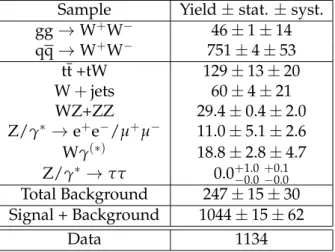
The estimated event yields for all processes after the event selection are summarised in Table 1. The distributions of the key analysis variables are shown in Fig. 2.
Table 1: Signal and background predictions, compared to the yield in data. The prediction for
the W+W−process assumes the SM cross section value.
Sample Yield±stat. ±syst.
gg→W+W− 46±1±14 qq→W+W− 751±4±53 tt +tW 129±13±20 W+jets 60±4±21 WZ+ZZ 29.4±0.4±2.0 Z/γ∗→e+e−/µ+µ− 11.0±5.1±2.6 Wγ(∗) 18.8±2.8±4.7 Z/γ∗ →ττ 0.0+−1.00.0+−0.10.0 Total Background 247±15±30 Signal + Background 1044±15±62 Data 1134
5
Efficiencies and systematic uncertainties
The signal efficiency, which includes the acceptance of the detector, is estimated using
simula-tion and including both the qq→W+W−and gg→W+W−processes. Residual discrepancies
in the lepton reconstruction and identification efficiencies between data and simulation are
cor-rected by determining data-to-simulation scale factors measured using Z/γ∗ → `+`− events
in the Z peak region [31] that are recorded with unbiased triggers. These factors depend on the lepton pT and|η|and are within 4% (2%) of unity for electrons (muons). Effects due to
W → τντ decays with τ leptons decaying into lower-energy electrons or muons are included
in the signal efficiency.
The experimental uncertainties in lepton reconstruction and identification efficiency, momen-tum scale and resolution, EmissT modeling, and jet energy scale are applied to the reconstructed
6 5 Efficiencies and systematic uncertainties (GeV) Tmax p 20 40 60 80 100 120 140 160 180 200 Events / 5 GeV 0 20 40 60 80 100 120 140 160 180 200 Data WW Drell-Yan Lepton mis-ID Top VV syst.) ⊕ (stat. σ -1 = 7 TeV, L = 4.92 fb s CMS (GeV) Tmax p 20 40 60 80 100 120 140 160 180 200 data/MC 0 1 2 (GeV) Tmin p 20 40 60 80 100 120 140 Events / 5 GeV 0 50 100 150 200 250 300 350 400 Data WW Drell-Yan Lepton mis-ID Top VV syst.) ⊕ (stat. σ -1 = 7 TeV, L = 4.92 fb s CMS (GeV) Tmin p 20 40 60 80 100 120 140 data/MC 0 1 2 (GeV) ll T p 40 60 80 100 120 140 Events / 5 GeV 0 50 100 150 200 250 300 Data WW Drell-Yan Lepton mis-ID Top VV syst.) ⊕ (stat. σ -1 = 7 TeV, L = 4.92 fb s CMS (GeV) ll T p 40 60 80 100 120 140 data/MC 0 1 2 (GeV) ll M 20 40 60 80 100 120 140 160 180 200 Events / 5 GeV 20 40 60 80 100 120 140 Data WW Drell-Yan Lepton mis-ID Top VV syst.) ⊕ (stat. σ -1 = 7 TeV, L = 4.92 fb s CMS (GeV) ll M 20 40 60 80 100 120 140 160 180 200 data/MC 0 1 2
Figure 2: Distributions of the maximum lepton transverse momentum (pTmax), the minimum
lepton transverse momentum (pTmin), the dilepton transverse momentum (p``T), and invariant
mass (M``) at the final selection level. Some of the backgrounds have been rescaled to the
estimates based on control samples in data, as described in the text. All leptonic channels are combined, and the uncertainty band corresponds to the statistical and systematic uncertainties in the predicted yield. The last bin includes the overflow. In the box below each distribution, the ratio of the observed CMS event yield to the total SM prediction is shown.
objects in simulated events by smearing and scaling the relevant observables and propagat-ing the effects to the kinematic variables used in the analysis. A relative uncertainty of 2.3% in the signal efficiency due to multiple collisions within a bunch crossing is taken from the observed variation in the efficiency in a comparison of two different pileup scenarios in simu-lation, reweighted to the observed data.
The relative uncertainty in the signal efficiency due to variations in the PDFs and the value of
αsis 2.3% (0.8%) for qq (gg) production, following the PDF4LHC prescription [16, 32–36]. The
effect of higher-order corrections, studied using the MCFM program [1], is found to be 1.5%
(30%) for qq annihilation (gg) by varying the renormalisation (µR) and factorisation (µF) scales
in the range (µ0/2, 2µ0), with µ0equal to the mass of the W boson, and setting µR = µF. The
W+W− jet veto efficiency in data is estimated from simulation and multiplied by a
data-to-simulation scale factor derived from Z/γ∗→ `+`−events in the Z peak,
edataW+W− =eMCW+W−×edataZ /eMCZ ,
where edataW+W− and eMCW+W− (edataZ and eMCZ ) are the efficiencies for the jet veto on the W+W− (Z) process for data and MC, respectively. The uncertainty in this efficiency is factorised into the uncertainty in the Z efficiency in data and the uncertainty in the ratio of the W+W− ef-ficiency to the Z efef-ficiency in simulation (eMCW+W−/eMCZ ). The former, which is dominated by statistics, is 0.3%. Theoretical uncertainties due to higher-order corrections contribute most to the eWMC+W−/eMCZ ratio uncertainty, which is 4.6%. The data-to-simulation correction factor is close to unity, using the Z/γ∗ → `+`−events.
The uncertainties in the W+jets and top-quark background predictions are evaluated to be
36% and 18%, respectively, as described in Section 4. The total uncertainty in the Z/γ∗ → `+`− normalisation is about 50%, including both statistical and systematic contributions.
The theoretical uncertainties in the diboson cross sections are calculated by varying the renor-malisation and factorisation scales using theMCFMprogram [1]. The effect of variations in the
PDFs and the value of αson the predicted cross section are derived by following the same
pre-scription as for the signal acceptance. Including the experimental uncertainties gives a
system-atic uncertainty of around 10% for WZ and ZZ processes. In the case of Wγ(∗)backgrounds, it
rises to 30%, due to the lack of knowledge of the overall normalisation. The total uncertainty in the background estimates is about 15%, which is dominated by the systematic uncertainties in
the normalisation of the top-quark and W+jets backgrounds. A 2.2% uncertainty is assigned
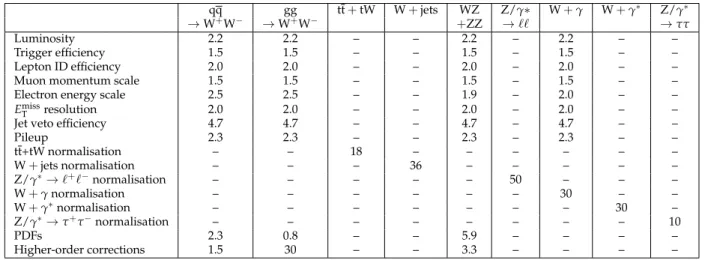
to the integrated luminosity measurement [37]. A summary of the uncertainties is given in Table 2. For simplicity, averages of the estimates for WZ and ZZ backgrounds are shown.
6
The WW cross section measurement
The number of events observed in the signal region is Ndata = 1134. The W+W− yield is
calculated by subtracting the expected contributions of the various SM background processes, Nbkg = 247±15 (stat.)±30 (syst.) events. The inclusive cross section is obtained from the
expression
σW+W− =
Ndata−Nbkg Lint·e· (3· B(W → `ν))2
, (1)
where the signal selection efficiency e, including the detector acceptance and averaging over all lepton flavours, is found to be(3.28±0.02 (stat.)±0.26 (syst.))% using simulation and taking into account the two production modes. As shown in Eq. (1), the efficiency is corrected by
8 6 The WW cross section measurement
Table 2: Relative systematic uncertainties in the estimated signal and background yields, in units of percent. qq gg tt+tW W+jets WZ Z/γ∗ W+γ W+γ∗ Z/γ∗ →W+W− →W+W− +ZZ → `` →ττ Luminosity 2.2 2.2 – – 2.2 – 2.2 – – Trigger efficiency 1.5 1.5 – – 1.5 – 1.5 – – Lepton ID efficiency 2.0 2.0 – – 2.0 – 2.0 – –
Muon momentum scale 1.5 1.5 – – 1.5 – 1.5 – –
Electron energy scale 2.5 2.5 – – 1.9 – 2.0 – –
EmissT resolution 2.0 2.0 – – 2.0 – 2.0 – –
Jet veto efficiency 4.7 4.7 – – 4.7 – 4.7 – –
Pileup 2.3 2.3 – – 2.3 – 2.3 – – tt+tW normalisation – – 18 – – – – – – W+jets normalisation – – – 36 – – – – – Z/γ∗→ `+`−normalisation – – – – – 50 – – – W+γnormalisation – – – – – – 30 – – W+γ∗normalisation – – – – – – – 30 – Z/γ∗→τ+τ−normalisation – – – – – – – – 10 PDFs 2.3 0.8 – – 5.9 – – – – Higher-order corrections 1.5 30 – – 3.3 – – – –
the branching fraction for a W boson decaying to each lepton family, B(W → `ν) = (10.80±
0.09)% [38], to estimate the final inclusive efficiency for the signal.
The W+W−production cross section in pp collision data at√s=7 TeV is measured to be
σW+W− =52.4±2.0 (stat.)±4.5 (syst.)±1.2 (lum.) pb.
The statistical uncertainty is due to the total number of observed events. The systematic uncer-tainty includes both the statistical component from the limited number of events and systematic uncertainties in the background prediction, as well as the uncertainty in the signal efficiency.
This measurement is consistent with the SM expectation of 47.0±2.0 pb, based on qq
annihi-lation and gluon-gluon fusion. For the event selection used in the analysis, the expected
theo-retical cross section may be larger by as much as 5% because of additional W+W−production
processes, such as diffractive production [39], double parton scattering, QED exclusive
pro-duction [40], and Higgs boson propro-duction with decay to W+W−. The dominant contribution
of about 4% would come from SM Higgs production, assuming its mass to be near 125 GeV [4].
The measured W+W−cross section can be presented in terms of a ratio to the Z boson
produc-tion cross secproduc-tion in the same data set. The W+W−to Z cross section ratio, σW+W−/σZ, provides
a good cross-check of this W+W−cross section measurement, using the precisely known Z
bo-son production cross section as a reference. This ratio has the advantage that some systematic effects cancel. More precise comparisons between measurements from different data-taking periods are possible because the ratio is independent of the integrated luminosity. The PDF uncertainty in the theoretical cross section prediction is also largely cancelled in this ratio,
since both W+W− and the Z boson are produced mainly via qq annihilation. The estimated
theoretical value for this ratio is[1.63±0.07 (theor.)] ×10−3 [31], where the scale uncertainty between both processes is considered uncorrelated, while the PDF uncertainty is assumed fully correlated.
The Z boson production process is measured in the e+e−/µ+µ−final states using events
pass-ing the same lepton selection as in the W+W−measurement and lying within the Z mass
win-dow, where the purity of the sample is about 99.8% [31]. Nonresonant backgrounds (including
Z/γ∗ →τ+τ−) are estimated from eµ data, while the resonant component of WZ and ZZ
experimental uncertainties between the two processes is taken into account. An additional 2% uncertainty in the shape of the Z resonance due to final-state radiation and higher-order effects is assigned. The latter is based on the difference between the next-to-next-to-leading-order
pre-diction fromFEWZ2.0 [41] simulation code and the MC generator used in the analysis, and on
the renormalisation and factorisation scale variation given by FEWZ.
The ratio of the inclusive W+W−cross section to the Z cross section in the dilepton mass range between 60 and 120 GeV is measured to be
σW+W−/σZ = [1.79±0.16(stat.⊕syst.)] ×10−3,
in agreement with the theoretical expectation. The Z cross section resulting from this ratio, assuming the standard model value for the W+W−cross section, is 1.1% higher than the inclu-sive Z cross section measurement in CMS using the 2010 data set [31], which had an integrated luminosity of 36 pb−1, but well within the systematic uncertainties of both measurements.
7
Limits on the anomalous triple gauge-boson couplings
A search for anomalous TGCs is done using the effective Lagrangian approach with the LEP parametrisation [2] without form factors. The most general form of such a Lagrangian has 14 complex couplings (7 for WWZ and 7 for WWγ). Assuming electromagnetic gauge invariance and charge and parity symmetry conservation, that number is reduced to five real couplings: ∆κZ,∆g1Z,∆κγ, λZ, and λγ. Applying gauge invariance constraints leads to
∆κZ=∆gZ1 −∆κγtan2(θW),
λZ=λγ,
which reduces the number of independent couplings to three. In the SM, all five couplings are zero. The coupling constants∆gZ1 and∆κγparametrise the differences from the standard model
values of 1 for both g1Zand κγ, which are measures of the WWZ and WWγ coupling strengths,
respectively.
The presence of anomalous TGCs would enhance the production rate for diboson processes at high boson pT and high invariant mass. The effect of these couplings is ascertained by
evalu-ating the expected distribution of pTmax, the transverse momentum of the leading (highest-pT)
lepton, and by comparing it to the measured distribution, using a maximum-likelihood fit. The pTmaxis a very sensitive observable for these searches, and it is widely used in the fully leptonic
final states, since the total mass of the event cannot be fully reconstructed. The likelihood L is defined as a product of Poisson probability distribution functions for the observed number of events (Nobs) and the combined one for each event, P(pT):
L=e−Nexp(N exp)Nobs Nobs
∏
i=1 P(pT), (2)where Nexp is the expected number of signal and background events. The leading lepton pT
distributions with anomalous couplings are simulated using theMCFMNLO generator, taking
into account the detector effects. The distributions are corrected for the acceptance and lepton reconstruction efficiency, as described in Section 5. The uncertainties in the quoted integrated luminosity, signal selection, and background fraction are assumed to be Gaussian. These un-certainties are incorporated in the likelihood function in Eq. (2) by introducing nuisance pa-rameters with Gaussian constraints. A set of points with nonzero anomalous couplings is used
10 8 Summary
and distributions between the points are extrapolated assuming a quadratic dependence of the differential cross section as a function of the anomalous couplings.
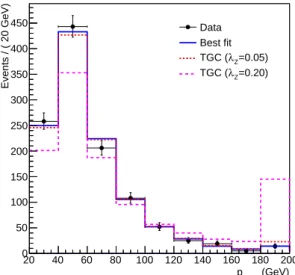
Figure 3 shows the measured leading lepton pT distributions in data and the predictions for
the SM W+W− signal and background processes, as well as the expected distributions with
non-negative anomalous couplings, in the two-dimensional model λZ-∆g1Z.
(GeV) Tmax p 20 40 60 80 100 120 140 160 180 200 Events / ( 20 GeV) 0 50 100 150 200 250 300 350 400 450 Data Best fit =0.05) Z λ TGC ( =0.20) Z λ TGC ( -1 = 7 TeV, L = 4.92 fb s CMS
Figure 3: Leading lepton pT distribution in data (points with error bars) overlaid with the best
fit using a two-dimensional λZ-∆gZ1 model (solid histogram) and two expected distributions
with anomalous coupling value, λZ 6=0 (dashed and dotted histograms). In the SM, λZ = 0.
The last bin includes the overflow.
No evidence for anomalous couplings is found. The 95% confidence level (CL) intervals of allowed anomalous couplings values, setting the other two couplings to their SM expected values, are
−0.048≤ λZ≤0.048, −0.095≤ ∆gZ
1 ≤0.095,
−0.21≤ ∆κγ ≤0.22.
The results presented here are comparable with the measurements performed by the ATLAS Collaboration [8] using the LEP parametrisation. These results are also comparable upon those obtained at the Tevatron [42, 43], which are based on the HISZ parametrisation [44] and LEP parametrisation with form factors, but they are not as precise as the combination of the LEP experiments [45–47]. Recently, CMS has set limits on these couplings [48], using different final state channel. Our measurements clearly demonstrate that both the WWZ and WWγ couplings exist, as predicted in the standard model (gZ1 = 1, κγ =1). Figure 4 displays the contour plots at the 68% and 95% CL for the∆κγ =0 and∆gZ1 =0 scenarios.
8
Summary
This paper reports a measurement of the W+W−cross section in the W+W− → `+ν`−νdecay
Z λ -0.1 -0.05 0 0.05 0.1 1 Z g ∆ -0.15 -0.1 -0.05 0 0.05 0.1 0.15 2D 68% CL 2D 95% CL 1D 95% CL -1 = 7 TeV, L = 4.92 fb s CMS Z λ -0.1 -0.05 0 0.05 0.1 γ κ ∆ -0.3 -0.2 -0.1 0 0.1 0.2 0.3 2D 68% CL 2D 95% CL 1D 95% CL -1 = 7 TeV, L = 4.92 fb s CMS
Figure 4: The 68% (solid line) and 95% CL (dashed line) limit contours, as well as the central value (point) of the fit results using unbinned fits, for∆κγ = 0 (left) and∆gZ1 = 0 (right). The one-dimensional 95% CL limit for each coupling is also shown.
data set of 2011. The W+W− cross section is measured to be 52.4±2.0 (stat.)±4.5 (syst.)± 1.2 (lum.) pb, consistent with the NLO theoretical prediction, σNLO(pp → W+W−) = 47.0± 2.0 pb. No evidence for anomalous WWZ and WWγ triple gauge-boson couplings is found, and stringent limits on their magnitude are set.
Acknowledgements
We congratulate our colleagues in the CERN accelerator departments for the excellent perfor-mance of the LHC and thank the technical and administrative staffs at CERN and at other CMS institutes for their contributions to the success of the CMS effort. In addition, we gratefully ac-knowledge the computing centres and personnel of the Worldwide LHC Computing Grid for delivering so effectively the computing infrastructure essential to our analyses. Finally, we ac-knowledge the enduring support for the construction and operation of the LHC and the CMS detector provided by the following funding agencies: BMWF and FWF (Austria); FNRS and FWO (Belgium); CNPq, CAPES, FAPERJ, and FAPESP (Brazil); MEYS (Bulgaria); CERN; CAS, MoST, and NSFC (China); COLCIENCIAS (Colombia); MSES (Croatia); RPF (Cyprus); MoER, SF0690030s09 and ERDF (Estonia); Academy of Finland, MEC, and HIP (Finland); CEA and CNRS/IN2P3 (France); BMBF, DFG, and HGF (Germany); GSRT (Greece); OTKA and NKTH (Hungary); DAE and DST (India); IPM (Iran); SFI (Ireland); INFN (Italy); NRF and WCU (Re-public of Korea); LAS (Lithuania); CINVESTAV, CONACYT, SEP, and UASLP-FAI (Mexico); MSI (New Zealand); PAEC (Pakistan); MSHE and NSC (Poland); FCT (Portugal); JINR (Arme-nia, Belarus, Georgia, Ukraine, Uzbekistan); MON, RosAtom, RAS and RFBR (Russia); MSTD (Serbia); SEIDI and CPAN (Spain); Swiss Funding Agencies (Switzerland); NSC (Taipei); ThEP-Center, IPST and NSTDA (Thailand); TUBITAK and TAEK (Turkey); NASU (Ukraine); STFC (United Kingdom); DOE and NSF (USA).
Individuals have received support from the Marie-Curie programme and the European Research Council and EPLANET (European Union); the Leventis Foundation; the A. P. Sloan Foundation; the Alexander von Humboldt Foundation; the Belgian Federal Science Policy Office; the Fonds pour la Formation `a la Recherche dans l’Industrie et dans l’Agriculture
12 References
(FRIA-Belgium); the Agentschap voor Innovatie door Wetenschap en Technologie
(IWT-Belgium); the Ministry of Education, Youth and Sports (MEYS) of Czech Republic; the Council of Science and Industrial Research, India; the Compagnia di San Paolo (Torino); the HOMING PLUS programme of Foundation for Polish Science, cofinanced by EU, Regional Development Fund; and the Thalis and Aristeia programmes cofinanced by EU-ESF and the Greek NSRF.
References
[1] J. M. Campbell, R. K. Ellis, and C. Williams, “Vector boson pair production at the LHC”, JHEP 07 (2011) 018, doi:10.1007/JHEP07(2011)018, arXiv:1105.0020.
[2] G. Gounaris et al., “Triple Gauge Boson Couplings”, Physics at LEP2 (1996) 52,
doi:10.5170/CERN-1996-001-V-1, arXiv:hep-ph/9601233.
[3] CMS Collaboration, “Search for the standard model Higgs boson decaying to W+W−in
the fully leptonic final state in pp collisions at√s = 7 TeV”, Phys. Lett. B 710 (2012) 91,
doi:10.1016/j.physletb.2012.02.076, arXiv:1202.1489.
[4] CMS Collaboration, “Observation of a new boson at a mass of 125 GeV with the CMS experiment at the LHC”, Phys. Lett. B 716 (2012) 30,
doi:10.1016/j.physletb.2012.08.021, arXiv:1207.7235.
[5] ATLAS Collaboration, “Observation of a new particle in the search for the Standard Model Higgs boson with the ATLAS detector at the LHC”, Phys. Lett. B 716 (2012) 1, doi:10.1016/j.physletb.2012.08.020, arXiv:1207.7214.
[6] CMS Collaboration, “Measurement of W+W−production and search for the Higgs boson
in pp collisions at√s = 7 TeV”, Phys. Lett. B 699 (2011) 25,
doi:10.1016/j.physletb.2011.03.056, arXiv:1102.5429.
[7] ATLAS Collaboration, “Measurement of the W+W−cross section in√s = 7 TeV pp
collisions with ATLAS”, Phys. Rev. Lett. 107 (2011) 041802,
doi:10.1103/PhysRevLett.107.041802, arXiv:1104.5225.
[8] ATLAS Collaboration, “Measurement of the W+W−cross section in√s = 7 TeV pp
collisions with the ATLAS detector and limits on anomalous gauge couplings”, Phys. Lett. B 712 (2012) 289, doi:10.1016/j.physletb.2012.05.003,
arXiv:1203.6232.
[9] ATLAS Collaboration, “Measurement of W+W−production in pp collisions at√s = 7
TeV with the ATLAS detector and limits on anomalous WWZ and WWγ couplings”, Phys. Rev. D 87 112001, doi:10.1103/PhysRevD.87.112001, arXiv:1210.2979. [10] CMS Collaboration, “The CMS experiment at the CERN LHC”, JINST 3 (2008) S08004,
doi:10.1088/1748-0221/3/08/S08004.
[11] J. Alwall et al., “MadGraph 5: going beyond”, JHEP 06 (2011) 128, doi:10.1007/JHEP06(2011)128, arXiv:1106.0522.
[12] T. Binoth, M. Ciccolini, N. Kauer, and M. Kr¨amer, “Gluon-induced W-boson pair production at the LHC”, JHEP 12 (2006) 046,
[13] S. Frixione, P. Nason, and C. Oleari, “Matching NLO QCD computations with parton shower simulations: the POWHEG method”, JHEP 11 (2007) 070,
doi:10.1088/1126-6708/2007/11/070, arXiv:0709.2092.
[14] T. Sj ¨ostrand, S. Mrenna, and P. Skands, “PYTHIA 6.4 physics and manual”, JHEP 05 (2006) 026, doi:10.1088/1126-6708/2006/05/026, arXiv:hep-ph/0603175. [15] H.-L. Lai et al., “Uncertainty induced by QCD coupling in the CTEQ global analysis of
parton distributions”, Phys. Rev. D 82 (2010) 054021,
doi:10.1103/PhysRevD.82.054021, arXiv:1004.4624.
[16] H.-L. Lai et al., “New parton distributions for collider physics”, Phys. Rev. D 82 (2010) 074024, doi:10.1103/PhysRevD.82.074024, arXiv:1007.2241.
[17] GEANT4 Collaboration, “GEANT4—a simulation toolkit”, Nucl. Instrum. Meth. A 506 (2003) 250, doi:10.1016/S0168-9002(03)01368-8.
[18] CMS Collaboration, “Electron Reconstruction and Identification at√s=7 TeV”, CMS
Physics Analysis Summary CMS-PAS-EGM-10-004, (2010).
[19] CMS Collaboration, “Performance of CMS muon reconstruction in pp collision events at√
s =7 TeV”, JINST 7 (2012) P10002, doi:10.1088/1748-0221/7/10/P10002,
arXiv:1206.4071.
[20] CMS Collaboration, “Particle Flow Event Reconstruction in CMS and Performance for Jets, Taus, and MET”, CMS Physics Analysis Summary CMS-PAS-PFT-09-001, (2009).
[21] CMS Collaboration, “Jet Performance in pp Collisions at√s = 7 TeV”, CMS Physics
Analysis Summary CMS-PAS-JME-10-003, (2010).
[22] M. Cacciari, G. P. Salam, and G. Soyez, “The anti-ktjet clustering algorithm”, JHEP 04
(2008) 063, doi:10.1088/1126-6708/2008/04/063, arXiv:0802.1189. [23] M. Cacciari, G. P. Salam, and G. Soyez, “FastJet user manual”, Eur. Phys. J. C 72 (2012)
1896, doi:10.1140/epjc/s10052-012-1896-2, arXiv:1111.6097v1.
[24] M. Cacciari and G. P. Salam, “Dispelling the N3myth for the ktjet-finder”, Phys. Lett. B
641(2006) 57, doi:10.1016/j.physletb.2006.08.037,
arXiv:hep-ph/0512210.
[25] M. Cacciari and G. P. Salam, “Pileup subtraction using jet areas”, Phys. Lett. B 659 (2008) 119, doi:10.1016/j.physletb.2007.09.077, arXiv:0707.1378.
[26] CMS Collaboration, “Determination of jet energy calibration and transverse momentum resolution in CMS”, JINST 6 (2011) 11002, doi:10.1088/1748-0221/6/11/P11002,
arXiv:1107.4277.
[27] CMS Collaboration, “Identification of b-quark jets with the CMS experiment”, JINST 8 (2013) P04013, doi:10.1088/1748-0221/8/04/P04013, arXiv:1211.4462.
[28] CMS Collaboration, “Commissioning of b-jet identification with pp collisions at√s = 7
TeV”, CMS Physics Analysis Summary CMS-PAS-BTV-10-001, (2010).
[29] CMS Collaboration, “Missing transverse energy performance of the CMS detector”, JINST 6 (2011) P09001, doi:10.1088/1748-0221/6/09/P09001,
14 References
[30] R. C. Gray et al., “Backgrounds to Higgs Boson Searches from Asymmetric Internal Conversion”, (2011). arXiv:1110.1368.
[31] CMS Collaboration, “Measurements of inclusive W and Z cross sections in pp collisions
at√s=7 TeV”, JHEP 11 (2011) 080, doi:10.1007/JHEP01(2011)080,
arXiv:1012.2466.
[32] M. Botje et al., “The PDF4LHC Working Group Interim Recommendations”, (2011). arXiv:1101.0538.
[33] S. Alekhin et al., “The PDF4LHC Working Group Interim Report”, (2011).
arXiv:1101.0536.
[34] A. D. Martin, W. J. Stirling, R. S. Thorn, and G. Watt, “Parton distributions for the LHC”, Eur. Phys. J. C 63 (2009) 189, doi:10.1140/epjc/s10052-009-1072-5,
arXiv:0901.0002.
[35] NNPDF Collaboration, “Impact of heavy quark masses on parton distributions and LHC phenomenology”, Nucl. Phys. B 849 (2011) 296,
doi:10.1016/j.nuclphysb.2011.03.021, arXiv:1101.1300.
[36] LHC Higgs Cross Section Working Group, “Handbook of LHC Higgs Cross Sections: Inclusive Observables”, (2011). arXiv:1101.0593.
[37] CMS Collaboration, “Absolute Calibration of the Luminosity Measurement at CMS: Winter2012 Update”, CMS Physics Analysis Summary CMS-PAS-SMP-12-008, (2012). [38] Particle Data Group, J. Beringer et al., “Review of particle physics”, Phys. Rev. D 86,
010001(2012) doi:10.1103/PhysRevD.86.010001.
[39] P. Bruni and G. Ingelman, “Diffractive hard scattering at ep and pp colliders”, in Int. Europhysics Conference on High Energy Physics, p. 595. Marseilles, France, 1993. Conf. Proc. C 722.
[40] A. Pukhov, “CalcHEP 2.3: MSSM, structure functions, event generation, batchs, and generation of matrix elements for other packages”, (2004). arXiv:hep-ph/0412191. [41] R. Gavin, Y. Li, F. Petriello, and S. Quackenbush, “FEWZ 2.0: A code for hadronic Z
production at next-to-next-to-leading order”, Comput. Phys. Commun. 182 (2011) 2388,
doi:10.1016/j.cpc.2011.06.008, arXiv:1011.3540v1.
[42] CDF Collaboration, “Measurement of the WZ cross section and triple gauge couplings in pp collisions at√s=1.96 TeV”, Phys. Rev. D 86 (Aug, 2012) 031104,
doi:10.1103/PhysRevD.86.031104.
[43] D0 Collaboration, “Limits on anomalous trilinear gauge boson couplings from WW, WZ and Wγ production in pp collisions at s=1.96 TeV”, Physics Letters B 718 (December, 2012) 451, doi:10.1016/j.physletb.2012.10.062, arXiv:1208.5458. [44] K. Hagiwara, S. Ishihara, R. Szalapski, and D. Zeppenfeld, “Low energy effects of new
interactions in the electroweak boson sector”, Phys. Rev. D 48 (1993) 2182,
doi:10.1103/PhysRevD.48.2182.
[45] ALEPH Collaboration, “Improved measurement of the triple gauge-boson couplings
γWW and ZWW in e+e−collisions”, Phys. Lett. B 614 (2005) 7,
[46] L3 Collaboration, “Measurement of triple-gauge-boson couplings of the W boson at LEP”, Phys. Lett. B 586 (2004) 151, doi:10.1016/j.physletb.2004.02.045, arXiv:hep-ex/0402036.
[47] OPAL Collaboration, “Measurement of charged current triple gauge boson couplings using W pairs at LEP”, Eur. Phys. J. C 33 (2004) 463,
doi:10.1140/epjc/s2003-01524-6, arXiv:hep-ex/0308067.
[48] CMS Collaboration, “Measurement of the sum of WW and WZ production with W+dijet
events in pp collisions at√s=7 TeV”, Eur. Phys. J. C 73 (2013) 2283,
A
The CMS Collaboration
Yerevan Physics Institute, Yerevan, Armenia
S. Chatrchyan, V. Khachatryan, A.M. Sirunyan, A. Tumasyan Institut f ¨ur Hochenergiephysik der OeAW, Wien, Austria
W. Adam, T. Bergauer, M. Dragicevic, J. Er ¨o, C. Fabjan1, M. Friedl, R. Fr ¨uhwirth1, V.M. Ghete, N. H ¨ormann, J. Hrubec, M. Jeitler1, W. Kiesenhofer, V. Kn ¨unz, M. Krammer1, I. Kr¨atschmer,
D. Liko, I. Mikulec, D. Rabady2, B. Rahbaran, C. Rohringer, H. Rohringer, R. Sch ¨ofbeck,
J. Strauss, A. Taurok, W. Treberer-Treberspurg, W. Waltenberger, C.-E. Wulz1 National Centre for Particle and High Energy Physics, Minsk, Belarus V. Mossolov, N. Shumeiko, J. Suarez Gonzalez
Universiteit Antwerpen, Antwerpen, Belgium
S. Alderweireldt, M. Bansal, S. Bansal, T. Cornelis, E.A. De Wolf, X. Janssen, A. Knutsson, S. Luyckx, L. Mucibello, S. Ochesanu, B. Roland, R. Rougny, H. Van Haevermaet, P. Van Mechelen, N. Van Remortel, A. Van Spilbeeck
Vrije Universiteit Brussel, Brussel, Belgium
F. Blekman, S. Blyweert, J. D’Hondt, A. Kalogeropoulos, J. Keaveney, M. Maes, A. Olbrechts, S. Tavernier, W. Van Doninck, P. Van Mulders, G.P. Van Onsem, I. Villella
Universit´e Libre de Bruxelles, Bruxelles, Belgium
B. Clerbaux, G. De Lentdecker, L. Favart, A.P.R. Gay, T. Hreus, A. L´eonard, P.E. Marage, A. Mohammadi, L. Perni`e, T. Reis, T. Seva, L. Thomas, C. Vander Velde, P. Vanlaer, J. Wang Ghent University, Ghent, Belgium
V. Adler, K. Beernaert, L. Benucci, A. Cimmino, S. Costantini, S. Dildick, G. Garcia, B. Klein, J. Lellouch, A. Marinov, J. Mccartin, A.A. Ocampo Rios, D. Ryckbosch, M. Sigamani, N. Strobbe, F. Thyssen, M. Tytgat, S. Walsh, E. Yazgan, N. Zaganidis
Universit´e Catholique de Louvain, Louvain-la-Neuve, Belgium
S. Basegmez, C. Beluffi3, G. Bruno, R. Castello, A. Caudron, L. Ceard, C. Delaere, T. du Pree, D. Favart, L. Forthomme, A. Giammanco4, J. Hollar, V. Lemaitre, J. Liao, O. Militaru, C. Nuttens, D. Pagano, A. Pin, K. Piotrzkowski, A. Popov5, M. Selvaggi, J.M. Vizan Garcia
Universit´e de Mons, Mons, Belgium
N. Beliy, T. Caebergs, E. Daubie, G.H. Hammad
Centro Brasileiro de Pesquisas Fisicas, Rio de Janeiro, Brazil
G.A. Alves, M. Correa Martins Junior, T. Martins, M.E. Pol, M.H.G. Souza Universidade do Estado do Rio de Janeiro, Rio de Janeiro, Brazil
W.L. Ald´a J ´unior, W. Carvalho, J. Chinellato6, A. Cust ´odio, E.M. Da Costa, D. De Jesus Damiao, C. De Oliveira Martins, S. Fonseca De Souza, H. Malbouisson, M. Malek, D. Matos Figueiredo, L. Mundim, H. Nogima, W.L. Prado Da Silva, A. Santoro, L. Soares Jorge, A. Sznajder, E.J. Tonelli Manganote6, A. Vilela Pereira
Universidade Estadual Paulistaa, Universidade Federal do ABCb, S˜ao Paulo, Brazil
T.S. Anjosb, C.A. Bernardesb, F.A. Diasa,7, T.R. Fernandez Perez Tomeia, E.M. Gregoresb, C. Laganaa, F. Marinhoa, P.G. Mercadanteb, S.F. Novaesa, Sandra S. Padulaa
Institute for Nuclear Research and Nuclear Energy, Sofia, Bulgaria V. Genchev2, P. Iaydjiev2, S. Piperov, M. Rodozov, G. Sultanov, M. Vutova
18 A The CMS Collaboration
University of Sofia, Sofia, Bulgaria
A. Dimitrov, R. Hadjiiska, V. Kozhuharov, L. Litov, B. Pavlov, P. Petkov Institute of High Energy Physics, Beijing, China
J.G. Bian, G.M. Chen, H.S. Chen, C.H. Jiang, D. Liang, S. Liang, X. Meng, J. Tao, J. Wang, X. Wang, Z. Wang, H. Xiao, M. Xu
State Key Laboratory of Nuclear Physics and Technology, Peking University, Beijing, China C. Asawatangtrakuldee, Y. Ban, Y. Guo, Q. Li, W. Li, S. Liu, Y. Mao, S.J. Qian, D. Wang, L. Zhang, W. Zou
Universidad de Los Andes, Bogota, Colombia
C. Avila, C.A. Carrillo Montoya, J.P. Gomez, B. Gomez Moreno, J.C. Sanabria Technical University of Split, Split, Croatia
N. Godinovic, D. Lelas, R. Plestina8, D. Polic, I. Puljak University of Split, Split, Croatia
Z. Antunovic, M. Kovac
Institute Rudjer Boskovic, Zagreb, Croatia
V. Brigljevic, S. Duric, K. Kadija, J. Luetic, D. Mekterovic, S. Morovic, L. Tikvica University of Cyprus, Nicosia, Cyprus
A. Attikis, G. Mavromanolakis, J. Mousa, C. Nicolaou, F. Ptochos, P.A. Razis Charles University, Prague, Czech Republic
M. Finger, M. Finger Jr.
Academy of Scientific Research and Technology of the Arab Republic of Egypt, Egyptian Network of High Energy Physics, Cairo, Egypt
Y. Assran9, A. Ellithi Kamel10, M.A. Mahmoud11, A. Mahrous12, A. Radi13,14 National Institute of Chemical Physics and Biophysics, Tallinn, Estonia M. Kadastik, M. M ¨untel, M. Murumaa, M. Raidal, L. Rebane, A. Tiko Department of Physics, University of Helsinki, Helsinki, Finland P. Eerola, G. Fedi, M. Voutilainen
Helsinki Institute of Physics, Helsinki, Finland
J. H¨ark ¨onen, V. Karim¨aki, R. Kinnunen, M.J. Kortelainen, T. Lamp´en, K. Lassila-Perini, S. Lehti, T. Lind´en, P. Luukka, T. M¨aenp¨a¨a, T. Peltola, E. Tuominen, J. Tuominiemi, E. Tuovinen, L. Wendland
Lappeenranta University of Technology, Lappeenranta, Finland A. Korpela, T. Tuuva
DSM/IRFU, CEA/Saclay, Gif-sur-Yvette, France
M. Besancon, S. Choudhury, F. Couderc, M. Dejardin, D. Denegri, B. Fabbro, J.L. Faure, F. Ferri, S. Ganjour, A. Givernaud, P. Gras, G. Hamel de Monchenault, P. Jarry, E. Locci, J. Malcles, L. Millischer, A. Nayak, J. Rander, A. Rosowsky, M. Titov
Laboratoire Leprince-Ringuet, Ecole Polytechnique, IN2P3-CNRS, Palaiseau, France
S. Baffioni, F. Beaudette, L. Benhabib, L. Bianchini, M. Bluj15, P. Busson, C. Charlot, N. Daci, T. Dahms, M. Dalchenko, L. Dobrzynski, A. Florent, R. Granier de Cassagnac, M. Haguenauer, P. Min´e, C. Mironov, I.N. Naranjo, M. Nguyen, C. Ochando, P. Paganini, D. Sabes, R. Salerno, Y. Sirois, C. Veelken, A. Zabi
Institut Pluridisciplinaire Hubert Curien, Universit´e de Strasbourg, Universit´e de Haute Alsace Mulhouse, CNRS/IN2P3, Strasbourg, France
J.-L. Agram16, J. Andrea, D. Bloch, D. Bodin, J.-M. Brom, E.C. Chabert, C. Collard, E. Conte16, F. Drouhin16, J.-C. Fontaine16, D. Gel´e, U. Goerlach, C. Goetzmann, P. Juillot, A.-C. Le Bihan,
P. Van Hove
Centre de Calcul de l’Institut National de Physique Nucleaire et de Physique des Particules, CNRS/IN2P3, Villeurbanne, France
S. Gadrat
Universit´e de Lyon, Universit´e Claude Bernard Lyon 1, CNRS-IN2P3, Institut de Physique Nucl´eaire de Lyon, Villeurbanne, France
S. Beauceron, N. Beaupere, G. Boudoul, S. Brochet, J. Chasserat, R. Chierici, D. Contardo, P. Depasse, H. El Mamouni, J. Fay, S. Gascon, M. Gouzevitch, B. Ille, T. Kurca, M. Lethuillier, L. Mirabito, S. Perries, L. Sgandurra, V. Sordini, Y. Tschudi, M. Vander Donckt, P. Verdier, S. Viret
Institute of High Energy Physics and Informatization, Tbilisi State University, Tbilisi, Georgia
Z. Tsamalaidze17
RWTH Aachen University, I. Physikalisches Institut, Aachen, Germany
C. Autermann, S. Beranek, B. Calpas, M. Edelhoff, L. Feld, N. Heracleous, O. Hindrichs, K. Klein, J. Merz, A. Ostapchuk, A. Perieanu, F. Raupach, J. Sammet, S. Schael, D. Sprenger,
H. Weber, B. Wittmer, V. Zhukov5
RWTH Aachen University, III. Physikalisches Institut A, Aachen, Germany
M. Ata, J. Caudron, E. Dietz-Laursonn, D. Duchardt, M. Erdmann, R. Fischer, A. G ¨uth, T. Hebbeker, C. Heidemann, K. Hoepfner, D. Klingebiel, P. Kreuzer, M. Merschmeyer, A. Meyer, M. Olschewski, K. Padeken, P. Papacz, H. Pieta, H. Reithler, S.A. Schmitz, L. Sonnenschein, J. Steggemann, D. Teyssier, S. Th ¨uer, M. Weber
RWTH Aachen University, III. Physikalisches Institut B, Aachen, Germany
V. Cherepanov, Y. Erdogan, G. Fl ¨ugge, H. Geenen, M. Geisler, W. Haj Ahmad, F. Hoehle, B. Kargoll, T. Kress, Y. Kuessel, J. Lingemann2, A. Nowack, I.M. Nugent, L. Perchalla, O. Pooth,
A. Stahl
Deutsches Elektronen-Synchrotron, Hamburg, Germany
M. Aldaya Martin, I. Asin, N. Bartosik, J. Behr, W. Behrenhoff, U. Behrens, M. Bergholz18,
A. Bethani, K. Borras, A. Burgmeier, A. Cakir, L. Calligaris, A. Campbell, F. Costanza, C. Diez Pardos, T. Dorland, G. Eckerlin, D. Eckstein, G. Flucke, A. Geiser, I. Glushkov, P. Gunnellini, S. Habib, J. Hauk, G. Hellwig, H. Jung, M. Kasemann, P. Katsas, C. Kleinwort, H. Kluge,
M. Kr¨amer, D. Kr ¨ucker, E. Kuznetsova, W. Lange, J. Leonard, K. Lipka, W. Lohmann18,
B. Lutz, R. Mankel, I. Marfin, I.-A. Melzer-Pellmann, A.B. Meyer, J. Mnich, A. Mussgiller, S. Naumann-Emme, O. Novgorodova, F. Nowak, J. Olzem, H. Perrey, A. Petrukhin, D. Pitzl, R. Placakyte, A. Raspereza, P.M. Ribeiro Cipriano, C. Riedl, E. Ron, M. ¨O. Sahin, J. Salfeld-Nebgen, R. Schmidt18, T. Schoerner-Sadenius, N. Sen, M. Stein, R. Walsh, C. Wissing
University of Hamburg, Hamburg, Germany
V. Blobel, H. Enderle, J. Erfle, U. Gebbert, M. G ¨orner, M. Gosselink, J. Haller, K. Heine, R.S. H ¨oing, G. Kaussen, H. Kirschenmann, R. Klanner, R. Kogler, J. Lange, T. Peiffer, N. Pietsch, D. Rathjens, C. Sander, H. Schettler, P. Schleper, E. Schlieckau, A. Schmidt, M. Schr ¨oder,
20 A The CMS Collaboration
T. Schum, M. Seidel, J. Sibille19, V. Sola, H. Stadie, G. Steinbr ¨uck, J. Thomsen, D. Troendle, L. Vanelderen
Institut f ¨ur Experimentelle Kernphysik, Karlsruhe, Germany
C. Barth, C. Baus, J. Berger, C. B ¨oser, T. Chwalek, W. De Boer, A. Descroix, A. Dierlamm,
M. Feindt, M. Guthoff2, C. Hackstein, F. Hartmann2, T. Hauth2, M. Heinrich, H. Held,
K.H. Hoffmann, U. Husemann, I. Katkov5, J.R. Komaragiri, A. Kornmayer2, P. Lobelle Pardo,
D. Martschei, S. Mueller, Th. M ¨uller, M. Niegel, A. N ¨urnberg, O. Oberst, J. Ott, G. Quast, K. Rabbertz, F. Ratnikov, S. R ¨ocker, F.-P. Schilling, G. Schott, H.J. Simonis, F.M. Stober, R. Ulrich, J. Wagner-Kuhr, S. Wayand, T. Weiler, M. Zeise
Institute of Nuclear and Particle Physics (INPP), NCSR Demokritos, Aghia Paraskevi, Greece
G. Anagnostou, G. Daskalakis, T. Geralis, S. Kesisoglou, A. Kyriakis, D. Loukas, A. Markou, C. Markou, E. Ntomari
University of Athens, Athens, Greece
L. Gouskos, T.J. Mertzimekis, A. Panagiotou, N. Saoulidou, E. Stiliaris University of Io´annina, Io´annina, Greece
X. Aslanoglou, I. Evangelou, G. Flouris, C. Foudas, P. Kokkas, N. Manthos, I. Papadopoulos, E. Paradas
KFKI Research Institute for Particle and Nuclear Physics, Budapest, Hungary
G. Bencze, C. Hajdu, P. Hidas, D. Horvath20, B. Radics, F. Sikler, V. Veszpremi,
G. Vesztergombi21, A.J. Zsigmond
Institute of Nuclear Research ATOMKI, Debrecen, Hungary N. Beni, S. Czellar, J. Molnar, J. Palinkas, Z. Szillasi
University of Debrecen, Debrecen, Hungary J. Karancsi, P. Raics, Z.L. Trocsanyi, B. Ujvari
National Institute of Science Education and Research, Bhubaneswar, India S.K. Swain22
Panjab University, Chandigarh, India
S.B. Beri, V. Bhatnagar, N. Dhingra, R. Gupta, M. Kaur, M.Z. Mehta, M. Mittal, N. Nishu, L.K. Saini, A. Sharma, J.B. Singh
University of Delhi, Delhi, India
Ashok Kumar, Arun Kumar, S. Ahuja, A. Bhardwaj, B.C. Choudhary, S. Malhotra, M. Naimuddin, K. Ranjan, P. Saxena, V. Sharma, R.K. Shivpuri
Saha Institute of Nuclear Physics, Kolkata, India
S. Banerjee, S. Bhattacharya, K. Chatterjee, S. Dutta, B. Gomber, Sa. Jain, Sh. Jain, R. Khurana, A. Modak, S. Mukherjee, D. Roy, S. Sarkar, M. Sharan
Bhabha Atomic Research Centre, Mumbai, India
A. Abdulsalam, D. Dutta, S. Kailas, V. Kumar, A.K. Mohanty2, L.M. Pant, P. Shukla, A. Topkar Tata Institute of Fundamental Research - EHEP, Mumbai, India
T. Aziz, R.M. Chatterjee, S. Ganguly, S. Ghosh, M. Guchait23, A. Gurtu24, G. Kole,
S. Kumar, M. Maity25, G. Majumder, K. Mazumdar, G.B. Mohanty, B. Parida, K. Sudhakar,
Tata Institute of Fundamental Research - HECR, Mumbai, India S. Banerjee, S. Dugad
Institute for Research in Fundamental Sciences (IPM), Tehran, Iran
H. Arfaei27, H. Bakhshiansohi, S.M. Etesami28, A. Fahim27, H. Hesari, A. Jafari, M. Khakzad,
M. Mohammadi Najafabadi, S. Paktinat Mehdiabadi, B. Safarzadeh29, M. Zeinali
University College Dublin, Dublin, Ireland M. Grunewald
INFN Sezione di Baria, Universit`a di Barib, Politecnico di Baric, Bari, Italy
M. Abbresciaa,b, L. Barbonea,b, C. Calabriaa,b, S.S. Chhibraa,b, A. Colaleoa, D. Creanzaa,c, N. De
Filippisa,c,2, M. De Palmaa,b, L. Fiorea, G. Iasellia,c, G. Maggia,c, M. Maggia, B. Marangellia,b, S. Mya,c, S. Nuzzoa,b, N. Pacificoa, A. Pompilia,b, G. Pugliesea,c, G. Selvaggia,b, L. Silvestrisa, G. Singha,b, R. Vendittia,b, P. Verwilligena, G. Zitoa
INFN Sezione di Bolognaa, Universit`a di Bolognab, Bologna, Italy
G. Abbiendia, A.C. Benvenutia, D. Bonacorsia,b, S. Braibant-Giacomellia,b, L. Brigliadoria,b, R. Campaninia,b, P. Capiluppia,b, A. Castroa,b, F.R. Cavalloa, M. Cuffiania,b, G.M. Dallavallea, F. Fabbria, A. Fanfania,b, D. Fasanellaa,b, P. Giacomellia, C. Grandia, L. Guiduccia,b,
S. Marcellinia, G. Masettia,2, M. Meneghellia,b, A. Montanaria, F.L. Navarriaa,b, F. Odoricia, A. Perrottaa, F. Primaveraa,b, A.M. Rossia,b, T. Rovellia,b, G.P. Sirolia,b, N. Tosia,b, R. Travaglinia,b
INFN Sezione di Cataniaa, Universit`a di Cataniab, Catania, Italy
S. Albergoa,b, M. Chiorbolia,b, S. Costaa,b, F. Giordanoa,2, R. Potenzaa,b, A. Tricomia,b, C. Tuvea,b
INFN Sezione di Firenzea, Universit`a di Firenzeb, Firenze, Italy
G. Barbaglia, V. Ciullia,b, C. Civininia, R. D’Alessandroa,b, E. Focardia,b, S. Frosalia,b, E. Galloa, S. Gonzia,b, V. Goria,b, P. Lenzia,b, M. Meschinia, S. Paolettia, G. Sguazzonia, A. Tropianoa,b INFN Laboratori Nazionali di Frascati, Frascati, Italy
L. Benussi, S. Bianco, F. Fabbri, D. Piccolo
INFN Sezione di Genovaa, Universit`a di Genovab, Genova, Italy
P. Fabbricatorea, R. Musenicha, S. Tosia,b
INFN Sezione di Milano-Bicoccaa, Universit`a di Milano-Bicoccab, Milano, Italy
A. Benagliaa, F. De Guioa,b, L. Di Matteoa,b, S. Fiorendia,b, S. Gennaia, A. Ghezzia,b, P. Govoni, M.T. Lucchini2, S. Malvezzia, R.A. Manzonia,b,2, A. Martellia,b,2, A. Massironia,b, D. Menascea, L. Moronia, M. Paganonia,b, D. Pedrinia, S. Ragazzia,b, N. Redaellia, T. Tabarelli de Fatisa,b
INFN Sezione di Napoli a, Universit`a di Napoli ’Federico II’ b, Universit`a della
Basilicata (Potenza)c, Universit`a G. Marconi (Roma)d, Napoli, Italy
S. Buontempoa, N. Cavalloa,c, A. De Cosaa,b, F. Fabozzia,c, A.O.M. Iorioa,b, L. Listaa, S. Meolaa,d,2, M. Merolaa, P. Paoluccia,2
INFN Sezione di Padovaa, Universit`a di Padovab, Universit`a di Trento (Trento)c, Padova,
Italy
P. Azzia, N. Bacchettaa, P. Bellana,b, D. Biselloa,b, A. Brancaa,b, R. Carlina,b, P. Checchiaa, T. Dorigoa, M. Galantia,b,2, F. Gasparinia,b, U. Gasparinia,b, P. Giubilatoa,b, F. Gonellaa,
A. Gozzelinoa, K. Kanishcheva,c, S. Lacapraraa, I. Lazzizzeraa,c, M. Margonia,b,
A.T. Meneguzzoa,b, F. Montecassianoa, M. Passaseoa, J. Pazzinia,b, N. Pozzobona,b,
22 A The CMS Collaboration
INFN Sezione di Paviaa, Universit`a di Paviab, Pavia, Italy
M. Gabusia,b, S.P. Rattia,b, C. Riccardia,b, P. Vituloa,b
INFN Sezione di Perugiaa, Universit`a di Perugiab, Perugia, Italy
M. Biasinia,b, G.M. Bileia, L. Fan `oa,b, P. Laricciaa,b, G. Mantovania,b, M. Menichellia, A. Nappia,b†, F. Romeoa,b, A. Sahaa, A. Santocchiaa,b, A. Spieziaa,b
INFN Sezione di Pisaa, Universit`a di Pisab, Scuola Normale Superiore di Pisac, Pisa, Italy
K. Androsova,30, P. Azzurria, G. Bagliesia, T. Boccalia, G. Broccoloa,c, R. Castaldia, R.T. D’Agnoloa,c,2, R. Dell’Orsoa, F. Fioria,c, L. Fo`aa,c, A. Giassia, A. Kraana, F. Ligabuea,c, T. Lomtadzea, L. Martinia,30, A. Messineoa,b, F. Pallaa, A. Rizzia,b, A.T. Serbana, P. Spagnoloa, P. Squillaciotia, R. Tenchinia, G. Tonellia,b, A. Venturia, P.G. Verdinia, C. Vernieria,c
INFN Sezione di Romaa, Universit`a di Romab, Roma, Italy
L. Baronea,b, F. Cavallaria, D. Del Rea,b, M. Diemoza, C. Fanellia,b, M. Grassia,b,2, E. Longoa,b, F. Margarolia,b, P. Meridiania, F. Michelia,b, S. Nourbakhsha,b, G. Organtinia,b, R. Paramattia, S. Rahatloua,b, L. Soffia,b
INFN Sezione di Torino a, Universit`a di Torino b, Universit`a del Piemonte Orientale
(No-vara)c, Torino, Italy
N. Amapanea,b, R. Arcidiaconoa,c, S. Argiroa,b, M. Arneodoa,c, C. Biinoa, N. Cartigliaa, S. Casassoa,b, M. Costaa,b, G. Dellacasaa, N. Demariaa, C. Mariottia, S. Masellia, E. Migliorea,b, V. Monacoa,b, M. Musicha, M.M. Obertinoa,c, N. Pastronea, M. Pelliccionia,2, A. Potenzaa,b, A. Romeroa,b, M. Ruspaa,c, R. Sacchia,b, A. Solanoa,b, A. Staianoa, U. Tamponia
INFN Sezione di Triestea, Universit`a di Triesteb, Trieste, Italy
S. Belfortea, V. Candelisea,b, M. Casarsaa, F. Cossuttia,2, G. Della Riccaa,b, B. Gobboa, C. La
Licataa,b, M. Maronea,b, D. Montaninoa,b, A. Penzoa, A. Schizzia,b, A. Zanettia Kangwon National University, Chunchon, Korea
T.Y. Kim, S.K. Nam
Kyungpook National University, Daegu, Korea
S. Chang, D.H. Kim, G.N. Kim, J.E. Kim, D.J. Kong, Y.D. Oh, H. Park, D.C. Son
Chonnam National University, Institute for Universe and Elementary Particles, Kwangju, Korea
J.Y. Kim, Zero J. Kim, S. Song Korea University, Seoul, Korea
S. Choi, D. Gyun, B. Hong, M. Jo, H. Kim, T.J. Kim, K.S. Lee, S.K. Park, Y. Roh University of Seoul, Seoul, Korea
M. Choi, J.H. Kim, C. Park, I.C. Park, S. Park, G. Ryu Sungkyunkwan University, Suwon, Korea
Y. Choi, Y.K. Choi, J. Goh, M.S. Kim, E. Kwon, B. Lee, J. Lee, S. Lee, H. Seo, I. Yu Vilnius University, Vilnius, Lithuania
I. Grigelionis, A. Juodagalvis
Centro de Investigacion y de Estudios Avanzados del IPN, Mexico City, Mexico
H. Castilla-Valdez, E. De La Cruz-Burelo, I. Heredia-de La Cruz31, R. Lopez-Fernandez,
Universidad Iberoamericana, Mexico City, Mexico S. Carrillo Moreno, F. Vazquez Valencia
Benemerita Universidad Autonoma de Puebla, Puebla, Mexico H.A. Salazar Ibarguen
Universidad Aut ´onoma de San Luis Potos´ı, San Luis Potos´ı, Mexico E. Casimiro Linares, A. Morelos Pineda, M.A. Reyes-Santos
University of Auckland, Auckland, New Zealand D. Krofcheck
University of Canterbury, Christchurch, New Zealand A.J. Bell, P.H. Butler, R. Doesburg, S. Reucroft, H. Silverwood
National Centre for Physics, Quaid-I-Azam University, Islamabad, Pakistan
M. Ahmad, M.I. Asghar, J. Butt, H.R. Hoorani, S. Khalid, W.A. Khan, T. Khurshid, S. Qazi, M.A. Shah, M. Shoaib
National Centre for Nuclear Research, Swierk, Poland
H. Bialkowska, B. Boimska, T. Frueboes, M. G ´orski, M. Kazana, K. Nawrocki, K. Romanowska-Rybinska, M. Szleper, G. Wrochna, P. Zalewski
Institute of Experimental Physics, Faculty of Physics, University of Warsaw, Warsaw, Poland G. Brona, K. Bunkowski, M. Cwiok, W. Dominik, K. Doroba, A. Kalinowski, M. Konecki, J. Krolikowski, M. Misiura, W. Wolszczak
Laborat ´orio de Instrumenta¸c˜ao e F´ısica Experimental de Part´ıculas, Lisboa, Portugal
N. Almeida, P. Bargassa, A. David, P. Faccioli, P.G. Ferreira Parracho, M. Gallinaro, J. Rodrigues Antunes, J. Seixas2, J. Varela, P. Vischia
Joint Institute for Nuclear Research, Dubna, Russia
S. Afanasiev, P. Bunin, M. Gavrilenko, I. Golutvin, I. Gorbunov, A. Kamenev, V. Karjavin, V. Konoplyanikov, A. Lanev, A. Malakhov, V. Matveev, P. Moisenz, V. Palichik, V. Perelygin, S. Shmatov, N. Skatchkov, V. Smirnov, A. Zarubin
Petersburg Nuclear Physics Institute, Gatchina (St. Petersburg), Russia
S. Evstyukhin, V. Golovtsov, Y. Ivanov, V. Kim, P. Levchenko, V. Murzin, V. Oreshkin, I. Smirnov, V. Sulimov, L. Uvarov, S. Vavilov, A. Vorobyev, An. Vorobyev
Institute for Nuclear Research, Moscow, Russia
Yu. Andreev, A. Dermenev, S. Gninenko, N. Golubev, M. Kirsanov, N. Krasnikov, A. Pashenkov, D. Tlisov, A. Toropin
Institute for Theoretical and Experimental Physics, Moscow, Russia
V. Epshteyn, M. Erofeeva, V. Gavrilov, N. Lychkovskaya, V. Popov, G. Safronov, S. Semenov, A. Spiridonov, V. Stolin, E. Vlasov, A. Zhokin
P.N. Lebedev Physical Institute, Moscow, Russia
V. Andreev, M. Azarkin, I. Dremin, M. Kirakosyan, A. Leonidov, G. Mesyats, S.V. Rusakov, A. Vinogradov
Skobeltsyn Institute of Nuclear Physics, Lomonosov Moscow State University, Moscow, Russia
A. Belyaev, E. Boos, M. Dubinin7, L. Dudko, A. Ershov, A. Gribushin, V. Klyukhin, O. Kodolova, I. Lokhtin, A. Markina, S. Obraztsov, S. Petrushanko, V. Savrin, A. Snigirev
24 A The CMS Collaboration
State Research Center of Russian Federation, Institute for High Energy Physics, Protvino, Russia
I. Azhgirey, I. Bayshev, S. Bitioukov, V. Kachanov, A. Kalinin, D. Konstantinov, V. Krychkine, V. Petrov, R. Ryutin, A. Sobol, L. Tourtchanovitch, S. Troshin, N. Tyurin, A. Uzunian, A. Volkov University of Belgrade, Faculty of Physics and Vinca Institute of Nuclear Sciences, Belgrade, Serbia
P. Adzic32, M. Ekmedzic, D. Krpic32, J. Milosevic
Centro de Investigaciones Energ´eticas Medioambientales y Tecnol ´ogicas (CIEMAT), Madrid, Spain
M. Aguilar-Benitez, J. Alcaraz Maestre, C. Battilana, E. Calvo, M. Cerrada, M. Chamizo Llatas2,
N. Colino, B. De La Cruz, A. Delgado Peris, D. Dom´ınguez V´azquez, C. Fernandez Bedoya, J.P. Fern´andez Ramos, A. Ferrando, J. Flix, M.C. Fouz, P. Garcia-Abia, O. Gonzalez Lopez, S. Goy Lopez, J.M. Hernandez, M.I. Josa, G. Merino, E. Navarro De Martino, J. Puerta Pelayo, A. Quintario Olmeda, I. Redondo, L. Romero, J. Santaolalla, M.S. Soares, C. Willmott
Universidad Aut ´onoma de Madrid, Madrid, Spain C. Albajar, J.F. de Troc ´oniz
Universidad de Oviedo, Oviedo, Spain
H. Brun, J. Cuevas, J. Fernandez Menendez, S. Folgueras, I. Gonzalez Caballero, L. Lloret Iglesias, J. Piedra Gomez
Instituto de F´ısica de Cantabria (IFCA), CSIC-Universidad de Cantabria, Santander, Spain J.A. Brochero Cifuentes, I.J. Cabrillo, A. Calderon, S.H. Chuang, J. Duarte Campderros, M. Fernandez, G. Gomez, J. Gonzalez Sanchez, A. Graziano, C. Jorda, A. Lopez Virto, J. Marco, R. Marco, C. Martinez Rivero, F. Matorras, F.J. Munoz Sanchez, T. Rodrigo, A.Y. Rodr´ıguez-Marrero, A. Ruiz-Jimeno, L. Scodellaro, I. Vila, R. Vilar Cortabitarte
CERN, European Organization for Nuclear Research, Geneva, Switzerland
D. Abbaneo, E. Auffray, G. Auzinger, M. Bachtis, P. Baillon, A.H. Ball, D. Barney, J. Bendavid, J.F. Benitez, C. Bernet8, G. Bianchi, P. Bloch, A. Bocci, A. Bonato, O. Bondu, C. Botta, H. Breuker,
T. Camporesi, G. Cerminara, T. Christiansen, J.A. Coarasa Perez, S. Colafranceschi33,
D. d’Enterria, A. Dabrowski, A. De Roeck, S. De Visscher, S. Di Guida, M. Dobson, N. Dupont-Sagorin, A. Elliott-Peisert, J. Eugster, W. Funk, G. Georgiou, M. Giffels, D. Gigi, K. Gill, D. Giordano, M. Girone, M. Giunta, F. Glege, R. Gomez-Reino Garrido, S. Gowdy, R. Guida, J. Hammer, M. Hansen, P. Harris, C. Hartl, B. Hegner, A. Hinzmann, V. Innocente, P. Janot, E. Karavakis, K. Kousouris, K. Krajczar, P. Lecoq, Y.-J. Lee, C. Lourenc¸o, N. Magini, M. Malberti, L. Malgeri, M. Mannelli, L. Masetti, F. Meijers, S. Mersi, E. Meschi, R. Moser, M. Mulders, P. Musella, E. Nesvold, L. Orsini, E. Palencia Cortezon, E. Perez, L. Perrozzi, A. Petrilli, A. Pfeiffer, M. Pierini, M. Pimi¨a, D. Piparo, G. Polese, L. Quertenmont, A. Racz, W. Reece, G. Rolandi34, C. Rovelli35, M. Rovere, H. Sakulin, F. Santanastasio, C. Sch¨afer, C. Schwick,
I. Segoni, S. Sekmen, A. Sharma, P. Siegrist, P. Silva, M. Simon, P. Sphicas36, D. Spiga, M. Stoye,
A. Tsirou, G.I. Veres21, J.R. Vlimant, H.K. W ¨ohri, S.D. Worm37, W.D. Zeuner Paul Scherrer Institut, Villigen, Switzerland
W. Bertl, K. Deiters, W. Erdmann, K. Gabathuler, R. Horisberger, Q. Ingram, H.C. Kaestli, S. K ¨onig, D. Kotlinski, U. Langenegger, D. Renker, T. Rohe
Institute for Particle Physics, ETH Zurich, Zurich, Switzerland
F. Bachmair, L. B¨ani, P. Bortignon, M.A. Buchmann, B. Casal, N. Chanon, A. Deisher, G. Dissertori, M. Dittmar, M. Doneg`a, M. D ¨unser, P. Eller, C. Grab, D. Hits, P. Lecomte,