EUROPEAN ORGANISATION FOR NUCLEAR RESEARCH (CERN)
CERN-PH-EP-2014-162
Submitted to: EPJC
Measurement of distributions sensitive to the underlying event
in inclusive Z-boson production in pp collisions at
√
s
= 7
TeV
with the ATLAS detector
The ATLAS Collaboration
Abstract
A measurement of charged-particle distributions sensitive to the properties of the underlying event
is presented for an inclusive sample of events containing a Z-boson, decaying to an electron or muon
pair. The measurement is based on data collected using the ATLAS detector at the LHC in proton–
proton collisions at a centre-of-mass energy of 7 TeV with an integrated luminosity of 4.6 fb
−1.
Dis-tributions of the charged particle multiplicity and of the charged particle transverse momentum are
measured in regions of azimuthal angle defined with respect to the Z-boson direction. The measured
distributions are compared to similar distributions measured in jet events, and to the predictions of
various Monte Carlo generators implementing different underlying event models.
c
2015 CERN for the benefit of the ATLAS Collaboration.
Reproduction of this article or parts of it is allowed as specified in the CC-BY-3.0 license.
Noname manuscript No. (will be inserted by the editor)
Measurement of distributions sensitive to the underlying event in
inclusive Z-boson production in pp collisions at
√
s
= 7 TeV with the
ATLAS detector
The ATLAS Collaboration
1CERN, CH-1211 Geneva 23. Switzerland
Received: 12 September 2014 / Accepted: 23 November 2014
Abstract A measurement of charged-particle distributions sensitive to the properties of the underlying event is presented for an inclusive sample of events containing a Z-boson, de-caying to an electron or muon pair. The measurement is based on data collected using the ATLAS detector at the LHC in proton–proton collisions at a centre-of-mass energy of 7 TeV with an integrated luminosity of 4.6 fb−1. Distributions of the charged particle multiplicity and of the charged particle trans-verse momentum are measured in regions of azimuthal angle defined with respect to the Z-boson direction. The measured distributions are compared to similar distributions measured in jet events, and to the predictions of various Monte Carlo generators implementing different underlying event models. Keywords QCD · Underlying Event · Monte Carlo
1 Introduction
In order to perform precise Standard Model measurements or to search for new physics phenomena at hadron collid-ers, it is important to have a good understanding of not only the short-distance hard scattering process, but also of the accompanying activity – collectively termed the underlying event(UE). This includes partons not participating in the hard-scattering process (beam remnants), and additional hard scatters in the same proton-proton collision, termed multi-ple parton interactions (MPI). Initial and final state gluon radiation (ISR, FSR) also contribute to the UE activity. It is impossible to unambiguously separate the UE from the hard scattering process on an event-by-event basis. However, dis-tributions can be measured that are sensitive to the properties of the UE.
The soft interactions contributing to the UE cannot be calculated reliably using perturbative quantum chromody-namics (pQCD) methods, and are generally described using different phenomenological models, usually implemented in
Monte Carlo (MC) event generators. These models contain many parameters whose values and energy dependences are not known a priori. Therefore, the model parameters must be tuned to experimental data to obtain insight into the nature of soft QCD processes and to optimise the description of UE contributions for studies of hard-process physics.
Measurements of distributions sensitive to the proper-ties of the UE have been performed in proton-proton (pp) collisions at√s= 900 GeV and 7 TeV in ATLAS [1–5], AL-ICE [6] and CMS [7, 8]. They have also been performed in pp¯collisions in events with jets and in Drell-Yan events at CDF [9, 10] at centre-of-mass energies of√s= 1.8 TeV and 1.96 TeV.
This paper reports a measurement of distributions sensi-tive to the UE, performed with the ATLAS detector [11] at the LHC in pp collisions at a centre-of-mass energy of 7 TeV. The full dataset acquired during 2011 is used, corresponding to an integrated luminosity of 4.64 ± 0.08 fb−1. Events with a Z-boson candidate decaying into an electron or muon pair were selected, and observables constructed from the final state charged particles (after excluding the lepton pair) were studied as a function of the transverse momentum1of the
Z-boson candidate, pZT.
This paper is organised as follows: the definitions of the underlying event observables are given in Sect. 2. The ATLAS detector is described in Sect. 3. In Sect. 4, the MC models used in this analysis are discussed. Section 5 and Sect. 6 describe the event selection, and the correction for
1The ATLAS reference system is a Cartesian right-handed
coordi-nate system, with the nominal collision point at the origin. The anti-clockwise beam direction defines the positive z-axis, while the positive x-axis is defined as pointing from the collision point to the center of the LHC ring and the positive y-axis points upwards. The azimuthal angle φ is measured around the beam axis, and the polar angle θ is measured with respect to the z-axis. The pseudorapidity is given by η = − ln tan(θ /2). Transverse momentum is defined relative to the beam axis.
the effect of multiple proton-proton interactions in the same bunch crossing (termed pile-up). The correction of the data to the particle level, and the combination of the electron and muon channel results are described in Sect. 7. Section 8 contains the estimation of the systematic uncertainties. The results are discussed in Sect. 9 and finally the conclusions are presented in Sect. 10.
2 Underlying event observables
Since there is no final-state gluon radiation associated with a Z-boson, lepton-pair production consistent with Z-boson decays provides a cleaner final-state environment than jet production for measuring the characteristics of the underlying event in certain regions of phase space. The direction of the Z-boson candidate is used to define regions in the azimuthal plane that have different sensitivity to the UE, a concept first used in [12]. As illustrated in Fig. 1, the azimuthal angular difference between charged tracks and the Z-boson, |∆ φ | = |φ − φZ-boson|, is used to define the following three azimuthal
UE regions:
– |∆ φ | < 60◦, the toward region,
– 60◦< |∆ φ | < 120◦, the transverse region, and – |∆ φ | > 120◦, the away region.
These regions are well defined only when the measured pZTis large enough that, taking into account detector resolu-tion, it can be used to define a direction. The away region is dominated by particles balancing the momentum of the Z-boson except at low values of pZT. The transverse region is sensitive to the underlying event, since it is by construction perpendicular to the direction of the Z-boson and hence it is expected to have a lower level of activity from the hard scat-tering process compared to the away region. The two opposite transverse regions may be distinguished on an event-by-event basis through their amount of activity, as measured by the sum of the charged-particle transverse momenta in each of them. The more or less-active transverse regions are then referred to as trans-max and trans-min, respectively, with the difference between them on an event-by-event basis for a given observable defined as trans-diff [13, 14]. The activ-ity in the toward region, which is similarly unaffected by additional activity from the hard scatter, is measured in this analysis, in contrast to the underlying event analysis in dijet events [5].
The observables measured in this analysis are derived from the number, Nch, and transverse momenta, pT, of
sta-ble charged particles in each event. They have been studied both as one-dimensional distributions, inclusive in the prop-erties of the hard process, and as profile histograms which present the dependence of the mean value of each observable (and its uncertainty) on pZT. The observables are summarised in Tab. 1. The mean charged-particle transverse momentum is
∆ φ −∆ φ Z-boson Toward |∆ φ | < 60◦ Away |∆ φ | > 120◦ Transverse 60◦< |∆ φ | < 120◦ Transverse 60◦< |∆ φ | < 120◦
Fig. 1 Definition of UE regions as a function of the azimuthal angle with respect to the Z-boson.
constructed on an event-by-event basis and is then averaged over all events to calculate the observable mean pT.
Table 1 Definition of the measured observables. These are defined for each azimuthal region under consideration except for pZ
T.
Observable Definition
pZT Transverse momentum of the Z-boson Nch/δ η δ φ Number of stable charged particles
per unit η–φ
∑ pT/δ η δ φ Scalar pT sum of stable charged
particles per unit η–φ
Mean pT Average pT of stable charged
particles
3 The ATLAS detector
The ATLAS detector [11] covers almost the full solid angle around the collision point. The components that are relevant for this analysis are the tracking detectors, the liquid-argon
(LAr) electromagnetic sampling calorimeters and the muon spectrometer.
The inner tracking detector (ID) has full coverage in az-imuthal angle φ and covers the pseudorapidity range |η| < 2.5. It consists of a silicon pixel detector (pixel), a semicon-ductor tracker (SCT) and a straw-tube transition radiation tracker (TRT). These detectors are located at a radial distance from the beam line of 50.5–150 mm, 299–560 mm and 563– 1066 mm, respectively, and are contained within a 2 T axial magnetic field. The inner detector barrel (end-cap) consists of 3 (2 × 3) pixel layers, 4 (2 × 9) layers of double-sided silicon strip modules, and 73 (2 × 160) layers of TRT straw-tubes. These detectors have position resolutions typically of 10 µm, 17 µm and 130 µm for the r–φ coordinates (only for TRT barrel), respectively. The pixel and SCT detectors provide measurements of the r–z coordinates with typical resolutions of 115 µm and 580 µm, respectively. The TRT acceptance is |η| < 2.0. A track traversing the barrel typically has 11 silicon hits (3 pixel clusters and 8 strip clusters) and more than 30 straw-tube hits.
A high-granularity lead, liquid-argon electromagnetic sampling calorimeter [15] covers the pseudorapidity range |η| < 3.2. Hadronic calorimetry in the range |η| < 1.7 is pro-vided by an iron scintillator-tile calorimeter, consisting of a central barrel and two smaller extended barrel cylinders, one on either side of the central barrel. In the end-caps (|η| > 1.5), the acceptance of the LAr hadronic calorimeters matches the outer |η| limits of the end-cap electromagnetic calorimeters. The LAr forward calorimeters provide both electromagnetic and hadronic energy measurements, and extend the coverage to |η| < 4.9.
The muon spectrometer (MS) measures the deflection of muon tracks in the large superconducting air-core toroid magnets in the pseudorapidity range |η| < 2.7. It is instru-mented with separate trigger and high-precision tracking chambers. Over most of the η-range, a precision measure-ment of the track coordinates in the principal bending di-rection of the magnetic field is provided by monitored drift tubes. At large pseudorapidities, cathode strip chambers with higher granularity are used in the innermost plane over the range 2.0 < |η| < 2.7.
The ATLAS trigger system consists of a hardware-based Level-1 (L1) trigger and a software-based High Level Trigger, subdivided into the Level-2 (L2) and Event-Filter (EF) [16] stages. In L1, electrons are selected by requiring adjacent electromagnetic (EM) trigger towers exceed a certain ET
threshold, depending on the detector η. The EF uses the offline reconstruction and identification algorithms to apply the final electron selection in the trigger. The Z → e+e− events are selected in this analysis by using a dielectron trigger in the region |η| < 2.5 with an electron transverse energy, ET, threshold of 12 GeV. The muon trigger system,
which covers the pseudorapidity range |η| < 2.4, consists
of resistive plate chambers in the barrel (|η| < 1.05) and thin gap chambers in the end cap regions (1.05 < |η| < 2.4). Muons are reconstructed in the EF combining L1 and L2 information. The Z → µ+µ−events in this analysis are selected with a first-level trigger that requires the presence of a muon candidate reconstructed in the muon spectrometer with transverse momentum of at least 18 GeV. The trigger efficiency for the events selected as described in Sect. 5 is very close to 100%.
4 Monte Carlo simulations
Monte Carlo event samples including a simulation of the AT-LAS detector response are used to correct the measurements for detector effects, and to estimate systematic uncertain-ties. In addition, predictions of different phenomenological models implemented in the MC generators are compared to the data corrected to the particle level. Samples of in-clusive Z → e+e−and Z → µ+µ− events were produced using the leading order (LO) PYTHIA6 [17], PYTHIA8 [18], HERWIG++[19, 20], Sherpa [21], ALPGEN[22] and next to leading order (NLO) POWHEG[23] event generators, includ-ing various parton density function (PDF) parametrisations. The ALPGENand Sherpa matrix elements are generated for up to five additional partons, thereby filling the phase space with sufficient statistics for the full set of measured observ-ables. It should be noted, that since the measurements are all reported in bins of pZT, the results presented in this paper are not sensitive to the predicted shape of the pZ
Tspectrum, even
though they are sensitive to jet activity in the event. Table 2 lists the different MC models used in this paper.
PYTHIA6, PYTHIA8 and HERWIG++ are all logarithmic parton shower (PS) models matched to leading-order matrix element (ME) calculations, but with differ-ent ordering algorithms for parton showering, and differdiffer-ent hadronization models. In scattering processes modelled by lowest-order perturbative QCD two-to-two parton scatters, with a sufficiently low pTthreshold, the partonic jet
cross-section exceeds that of the total hadronic cross-cross-section. This can be interpreted in terms of MPI. In this picture, the ratio of the partonic jet cross-section to the total cross-section is interpreted as the mean number of parton interactions per event. This is implemented using phenomenological mod-els [24], which include (non-exhaustively) further low-pT
screening of the partonic differential cross-section, and use of phenomenological transverse matter-density profiles in-side the hadrons. The connection of colour lines between partons, and the rearrangement of the colour structure of an event by reconnection of the colour strings, are implemented in different ways in these phenomenological models.
The PYTHIA6 and PYTHIA8 generators both use pT
-ordered parton showers, and a hadronisation model based on the fragmentation of colour strings. The PYTHIA8 generator
adds to the PYTHIA6 MPI model by interleaving not only the ISR emission sequence with the MPI scatters, but also the FSR emissions. The HERWIG++generator implements a cluster hadronization scheme with parton showering ordered by emission angle. The Sherpa generator uses LO matrix ele-ments with a model for MPI similar to that of PYTHIA6 and a cluster hadronisation model similar to that of HERWIG++. In ALPGENthe showering is performed with the HERWIG gen-erator. The original Fortran HERWIG[25] generator does not simulate multiple partonic interactions; these are added by the JIMMY[26] package. The ALPGENgenerator provides leading-order multi-leg matrix element events: it includes more complex hard process topologies than those used by the other generators, but does not include loop-diagram con-tributions. The ALPGENpartonic events are showered and hadronised by the HERWIG+JIMMYgenerator combination, making use of MLM matching [22] between the matrix el-ement and parton shower to avoid double-counting of jet production mechanisms. A related matching process is used to interface PYTHIA6 to the next-to-leading-order (NLO) POWHEGgenerator, where the matching scheme avoids both double-counting and NLO subtraction singularities [27, 28]. Different settings of model parameters, tuned to repro-duce existing experimental data, have been used for the MC generators. The PYTHIA6, PYTHIA8, HERWIG+ JIMMY, HERWIG++ and Sherpa tunes have been performed using mostly Tevatron and early LHC data. The parton shower generators used with ALPGEN and POWHEG do not use optimised tunes specific to their respective parton shower matching schemes.
For the purpose of correcting the data for detector effects, samples generated with Sherpa (with the CTEQ6L1 PDF and the corresponding UE tune), and PYTHIA8 tune 4C [36] were passed through ATLFAST2 [37], a fast detector simulation software package, which used full simulation in the ID and MS and a fast simulation of the calorimeters. Comparisons between MC events at the reconstructed and particle level are then used to correct the data for detector effects. Since the effect of multiple proton-proton interactions is corrected using a data-driven technique (as described in Sect. 6), only single proton-proton interactions are simulated in these MC samples.
5 Event selection
The event sample was collected during stable beam con-ditions, with all detector subsystems operational. To reject contributions from cosmic-ray muons and other non-collision backgrounds, events are required to have a primary vertex (PV). The PV is defined as the reconstructed vertex in the event with the highest ∑ p2Tof the associated tracks,
consis-tent with the beam-spot position (spatial region inside the
detector where collisions take place) and with at least two associated tracks with pT> 400 MeV.
Electrons are reconstructed from energy deposits mea-sured in the EM calorimeter and associated to ID tracks. They are required to satisfy pT> 20 GeV and |η| < 2.4, excluding
the transition region 1.37 < |η| < 1.52 between the barrel and end-cap electromagnetic calorimeter sections. Electron identification uses shower shape, track-cluster association and TRT criteria [38]. Muons are reconstructed from track segments in the MS associated to ID tracks [39]. They are required to have pT> 20 GeV and |η| < 2.4. Both electrons
and muons are required to have longitudinal impact param-eter multiplied by sin θ of the ID track, |z0| sin θ < 10 mm
with respect to the PV. The dilepton invariant mass of op-positely charged leptons, mll, is required to be in the region
66 < mll< 116 GeV at this stage. No explicit isolation
re-quirement is applied to the muons, but in the case of electrons, some isolation is implied by the identification algorithm. The correction for this effect is discussed in Sect. 7.3.
The tracks in the calculation of UE observables satisfy the following criteria [40]:
– pT> 0.5 GeV and |η| < 2.5;
– a minimum of one pixel and six SCT hits;
– a hit in the innermost pixel layer, if the corresponding pixel module was active;
– transverse and longitudinal impact parameters with re-spect to the PV, |d0| < 1.5 mm and |z0| sin θ < 1.5 mm,
respectively;
– for tracks with pT> 10 GeV, a goodness of fit probability
greater than 0.01 in order to remove mis-measured tracks. The tracks corresponding to the leptons forming the Z-boson candidate are excluded.
6 Correction for pile-up
The average expected number of pile-up events per hard-scattering interaction (µ) was typically in the range 3 − 12 in the 2011 dataset. Of the tracks selected by the proce-dure described above and compatible with the PV of the hard-scattering event, up to 15% originate from pile-up, as described below. Due to the difficulty in modelling accu-rately the soft interactions in pp collisions and the fact that pile-up conditions vary significantly over the data-taking pe-riod, a data-driven procedure has been derived to correct the measured observables for the pile-up contribution.
The measured distribution of any track-based observ-able can be expressed as the convolution of the distribution of this variable for the tracks originating from the Z-boson production vertex, with the distribution resulting from the superimposed pile-up interactions. The pile-up contribution is estimated from data by sampling tracks originating from a vertex well separated from the hard-scattering PV. In each
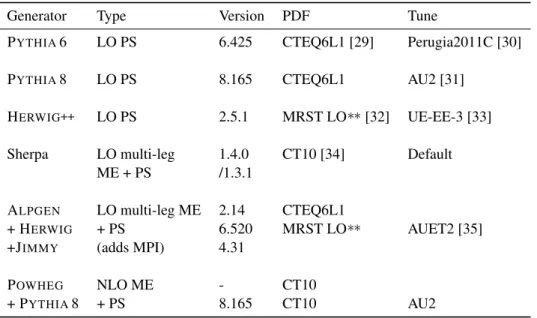
Table 2 Main features of the Monte-Carlo models used. The abbreviations ME, PS, MPI, LO and NLO respectively stand for matrix element, parton shower, multiple parton interactions, leading order and next to leading order in QCD.
Generator Type Version PDF Tune
PYTHIA6 LO PS 6.425 CTEQ6L1 [29] Perugia2011C [30]
PYTHIA8 LO PS 8.165 CTEQ6L1 AU2 [31]
HERWIG++ LO PS 2.5.1 MRST LO∗∗ [32] UE-EE-3 [33]
Sherpa LO multi-leg 1.4.0 CT10 [34] Default
ME + PS /1.3.1
ALPGEN LO multi-leg ME 2.14 CTEQ6L1
+ HERWIG + PS 6.520 MRST LO∗∗ AUET2 [35]
+JIMMY (adds MPI) 4.31
POWHEG NLO ME - CT10
+ PYTHIA8 + PS 8.165 CT10 AU2
event, the pile-up contribution to a given observable is de-rived from tracks selected with the same longitudinal and transverse impact parameter requirements as the PV tracks, but with respect to two points located at z distances of +2 cm and −2 cm from the hard-scattering PV. The shift of 2 cm relative to the PV introduces a bias in the density of the pile-up interactions. This is corrected on the basis of the shape of the distribution of the z distance between pairs of interactions in the same bunch crossing. This distribution is well approximated by a Gaussian with variance σ =√2σBS,
where σBS≈ 6 cm is the effective longitudinal variance of
the interaction region averaged over all events. Pile-up distri-butions are thus obtained for each observable and are decon-voluted from the corresponding measured distributions at the hard-scattering PV.
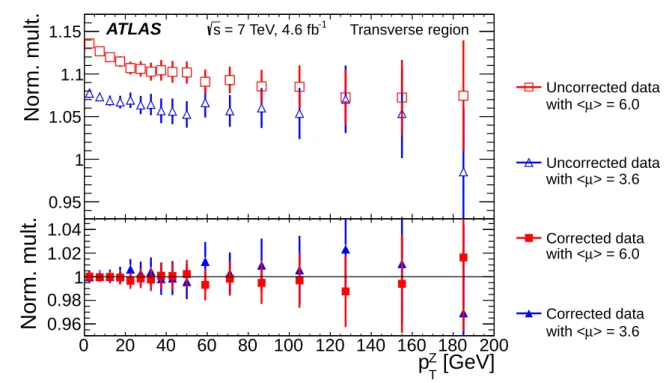
The stability of the pile-up correction for different beam conditions is demonstrated in Fig. 2. The figure compares the distributions of the average charged particle multiplicity density, hNch/δ η δ φ i as a function of pZT, before and after
pile-up correction, for two sub-samples with an average of 3.6 and 6 interactions per bunch crossing (hµi), respectively. Each distribution is normalised to that obtained for the full sample after pile-up correction. The dependence of the nor-malised charged multiplicity distributions on pZTwhich can be seen before correction in Fig. 2 reflects the fact that actual contributions to this observable depend on pZT, while the pile-up contribution is independent of pZT. The pile-up corrected results agree to better than 2%, a value much smaller than the size of the correction, which may be as large as 20% for this observable in low pZTbins for the data-taking periods with
the highest values of hµi. The systematic uncertainty arising from this procedure is discussed in Sect. 8.
7 Unfolding to particle level, background corrections and channel combination
After correcting for pile-up, an iterative Bayesian unfold-ing [41] of all the measured observables to the particle level is performed. This is followed by a correction of the un-folded distributions for the small amount of background from other physics processes. At this point, the electron and muon measurements are combined to produce the final results.
7.1 Unfolding
The measurements are presented in the fiducial region de-fined by the Z-boson reconstructed from a pair of oppositely charged electrons or muons each with pT> 20 GeV and
|η| < 2.4 and with a lepton pair invariant mass in the range 66 < mll< 116 GeV.
The results in Sect. 9 are presented in the Born approxi-mation, using the leptons before QED FSR to reconstruct the Z-boson. These results are also provided in HEPDATA [42] using dressed leptons. These are defined by adding vectori-ally to the momentum of each lepton after QED FSR the 4-momenta of any photons not produced in hadronic decays and found within a cone of ∆ R = 0.1 around the lepton, where the angular separation ∆ R is given byp(∆η)2+ (∆ φ )2.
[GeV] Z T p
0
20
40
60
80
100 120 140 160 180 200
Norm. mult.
0.95
1
1.05
1.1
1.15
ATLAS
s = 7 TeV, 4.6 fb-1 Transverse region[GeV]
Z Tp
0
20
40
60
80
100 120 140 160 180 200
Norm. mult.
0.96
0.98
1
1.02
1.04
Uncorrected data Uncorrected data Corrected data Corrected data > = 6.0 µ with < > = 6.0 µ with < > = 3.6 µ with < > = 3.6 µ with <Fig. 2 Average charged particle multiplicity density, hNch/δ η δ φ i in the transverse region for two samples with different average numbers of
interactions, hµi, normalised to the average density in the full sample after pile-up correction, before (top) and after (bottom) pile-up correction. The data are shown as a function of the transverse momentum of the Z-boson, pZT. Only statistical uncertainties are shown.
The UE observables are constructed from stable charged particles with pT> 0.5 GeV and |η| < 2.5, excluding
Z-boson decay products. Stable charged particles are defined as those with a proper lifetime τ > 0.3 × 10⁻¹⁰s, either directly produced in pp interactions or from the subsequent decay of particles with a shorter lifetime.
Bayesian iterative unfolding was used to correct for resid-ual detector resolution effects. This method requires two in-puts: an input distribution of the observable (the MC generator-level distribution is used for this), and a detector response matrix which relates the uncorrected measured distribution in this observable to that defined at the event generator level, also termed the particle level. The detector response matrix element, Si j is the probability that a particular event from
bin i of the particle-level distribution is found in bin j of the corresponding reconstructed distribution, and is obtained using simulation. For the profile histogram observables in this paper, a two-dimensional (2D) histogram was created with a fine binning for the observable of interest, such that each unfolding bin corresponds to a region in the 2D space.
The unfolding process is iterated to avoid dependence on the input distribution: the corrected data distribution pro-duced in each iteration is used as the input for the next. In this analysis, four iterations were performed since this resulted only in a small residual bias when tested on MC samples while keeping the statistical uncertainties small. The unfold-ing uses the Sherpa simulation for the input distributions and
unfolding matrix. In the muon channel, the MC events are reweighted at the particle level in terms of a multi-variable distribution constructed for each distribution of interest using the ratio of data to level MC, so that the detector-level MC closely matches the data. This additional step is omitted in the electron channel for the reasons discussed in Sect. 7.3.
The dominant correction to the data is that related to track reconstruction and selection efficiencies, in particular at low-pT. After the selection described in Sect. 5, the rate of fake
tracks (those constructed from tracker noise and/or hits which were not produced by a single particle) is found to be very small. This, as well as a small contribution of secondaries (i.e. tracks arising from hadronic interactions, photon conversions to electron-positron pairs, and decays of long-lived particles) is corrected for by the unfolding procedure.
7.2 Backgrounds
The background to the Z-boson signal decaying into a lepton pair consists of a dominant component from multijet produc-tion, smaller components from other physics sources, and a very small component from non-collision backgrounds. A fully data-driven correction procedure has been developed and applied directly to the unfolded distributions to take into account the influence of the backgrounds.
[GeV]
llm
∆
0
5
10
15
20
25
Tp
Σ
d
evdN
evN
1
Norm.
0.9
0.95
1
1.05
1.1
1.15
1.2
1.25
data
µ
µ
ee data
fit
µ
µ
ee fit
-1= 7 TeV, 4.6 fb
s
ATLAS
< 32 GeV T p Σ 30 GeV < < 35 GeV Z T 30 GeV < pToward region
Fig. 3 Impact of non-resonant backgrounds on the measurement of ∑ pTin the bin 30 GeV < Σ pT< 32 GeV and in the toward region for
30 GeV < pZ
T< 35 GeV. This is shown separately for the electron and muon channels as a function of the window applied to the dilepton mass
|mll− MZ| < ∆ mll. The unfolded value for each channel is normalised to the corrected combined result. The statistical uncertainties at individual
∆ mllpoints are strongly correlated within each channel. The uncertainty range of the linear fit is shown by hatched bands for each channel. This
includes the statistical and systematic uncertainties from the fit itself, as well as the relevant correlations. The vertical line at ∆ m``= 0 marks the
points to which the extrapolations are made.
The primary vertex requirement removes almost all of the beam-induced non-collision background events. Similarly, the impact parameter requirements on the leptons reduce the cosmic-ray background to a level below 0.1% of the signal. These residual backgrounds were considered as negligible in the analysis.
The pp collision backgrounds to Z → e+e− or Z → µ+µ−decays were found to be of the order of a few percent of the signal in the mass window [43]. The resonant back-grounds from W Z, ZZ and Zγ pair production with a Z boson decaying into leptons were estimated from simulated sam-ples and found to amount to less than 0.2% of the selected events. Their impact on the underlying event observables is negligible and they were not considered further here.
The contribution from the non-resonant backgrounds (i.e. from all other pp collision processes) is larger, typically be-tween 1% and 2% of the signal, depending on the pZTrange considered, and is dominated by multijet production with a combination of light-flavour jets misidentified as electrons and heavy-flavour jets with a subsequent semileptonic decay of a charm or beauty hadron. This contribution is estimated to correspond to 0.5% of the signal for Z → e+e−decays
and to 1 − 2% of the signal for Z → µ+µ−decays. The back-ground in the electron channel is somewhat lower because of the implicit isolation requirement imposed on the electrons through the electron identification requirements. Smaller con-tributions to the non-resonant background arise from diboson, t ¯tand single top production and amount to less than 0.3% of the signal, increasing to 1% at pZT> 50 GeV. The still smaller contributions from processes such as W or Z production with jets, where a jet is misidentified as a lepton, are treated in the same way as the multijet background. These contributions amount to less than 0.1% of the signal sample.
The non-resonant background is corrected for by studying the UE observables as a function of ∆ mll, the half-width of
the mass window around the Z-boson signal peak. Since the distributions of UE observables in non-resonant background processes are found to be approximately constant as a func-tion of the dilepton mass and the background shape under the Z-boson mass peak is approximately linear, the background contribution to any UE observable is approximately propor-tional to ∆ mll. Thus, the background contribution can be
corrected for by calculating the UE observables for different values of ∆ mll, chosen here to be between 10 and 25 GeV,
and extracting the results which could be measured for a pure signal with ∆ mll→ 0. This procedure is performed separately
for each bin of the distributions of interest.
The validity of the linear approximation for the ∆ mll
de-pendence of the background contribution was checked for all observables studied in this analysis. An example is presented in Fig. 3, where the ∆ mlldependence is shown for one bin of
the ∑ pTdifferential distribution, as obtained in the toward
region for 30 < pZT< 35 GeV and shown separately for the electron and muon channels. The values plotted in Fig. 3 are normalised to the corrected combined value. The values of the observables in the muon channel increase linearly with ∆ mll. The difference in the slope observed between the muon
and the electron samples is due to the larger background in the muon channel, as discussed above. A straight line is fitted through the points obtained for the various ∆ mllvalues
shown in Fig. 3 for each channel. For each bin in the observ-able and pZT, the muon and electron channels values agree with each other after extrapolating to ∆ mll= 0 within the
uncertainties of the fit procedure, which are represented by the shaded areas and include the statistical and systematic uncertainties from the fit itself (as discussed in Sect. 8, as well as the relevant correlations.
The effect of the background on the unfolded distribu-tions can be summarised as follows: in the case of the elec-tron channel, which has less background than the muons, the background in the average values of ∑ pTand Nchis below
1%. The absence of any isolation requirement applied to the muons leads to significantly higher background levels in cer-tain regions, with corrections ranging from as high as 6 − 8% for the average values of ∑ pTin the toward region at high pZT,
to about 1% for the average values of Nch. The background
correction is done after unfolding to avoid resolution issues present at the detector level.
7.3 Combination of the electron and muon channels Before combining the electron and muon channels, the anal-ysis must correct for a bias over a limited region of the phase space which affects the measurements in the electron channel when one of the electrons is close to a jet produced in asso-ciation with the Z boson. This bias is observed at high pZT, mostly in the toward region and to a lesser extent in the trans-verse region, and affects the ∑ pTdistribution for high values
of ∑ pT, typically ∑ pT> 30 GeV. It arises from the
imper-fect modelling of the electron shower shape variables in the simulation, which leads to an underestimate of the electron identification efficiency for electrons close to jets. The bias on the observable can be as large as 50% for ∑ pT= 100 GeV.
Since it is not reproduced precisely enough by the simula-tion of the electron shower, in the relevant narrow regions of phase space a tightened isolation criterion was applied to electrons to exclude the mismodelled event configurations
and the proper geometric correction was deduced from the muon channel unaffected by jet overlap. The combined re-sults for electrons and muons in the affected bins are assigned a larger uncertainty, since the contribution of events from the electron-decay channel is significantly reduced leading to a larger overall uncertainty. The most significant effect is ob-served for the ∑ pT> 100 GeV in the toward and transverse
region.
As discussed in Sect. 2 and in Sect. 7.1, the electron and muon results are unfolded and then combined, both as Born-level lepton pairs and as dressed lepton pairs, and ac-counting for the uncorrelated and correlated terms in the systematic uncertainties between the channels (as described in Sect. 8). Combining the dressed electron and muon pairs induces < 0.1% additional systematic uncertainty on the UE observables compared to the Born level results.
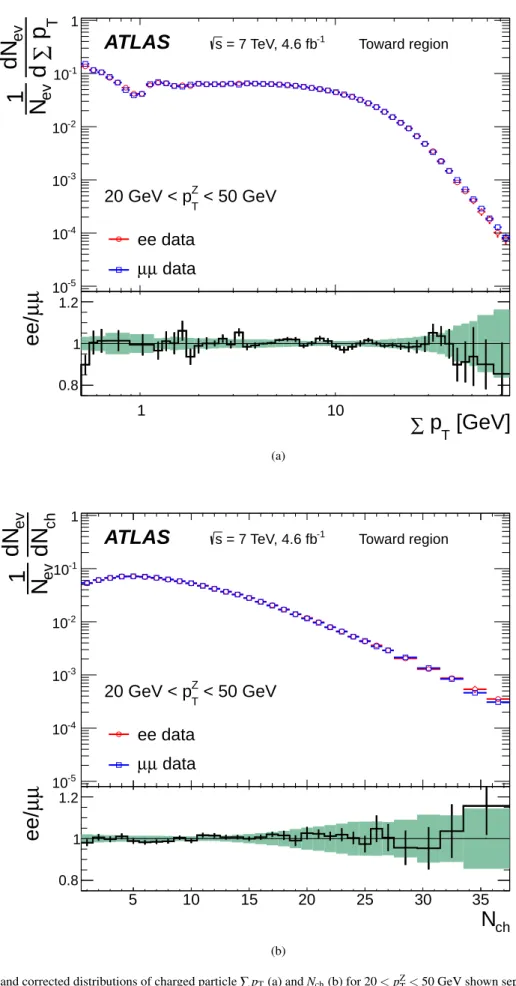
Figure 4 illustrates the excellent agreement between the fully unfolded and corrected UE observables for the electron and muon channels, once the specific correction procedure described above has been applied to the electron channel in the limited phase space regions where significant hadronic activity occurs close to one of the electrons. As shown for the specific region 20 < pZT< 50 GeV in Fig. 4, the differ-ential distributions for ∑ pTand Nchagree within statistical
uncertainties over most of the range of relevance, except for high values of ∑ pT, where the electron bias has been
cor-rected as described above, and where the total uncertainty on the combined measurement has been enlarged as shown by the shaded error band in the ratio plot. The shape of the ∑ pTdistribution in the region around 1 GeV reflects the pT
threshold of 0.5 GeV applied in the track selection.
8 Systematic Uncertainties
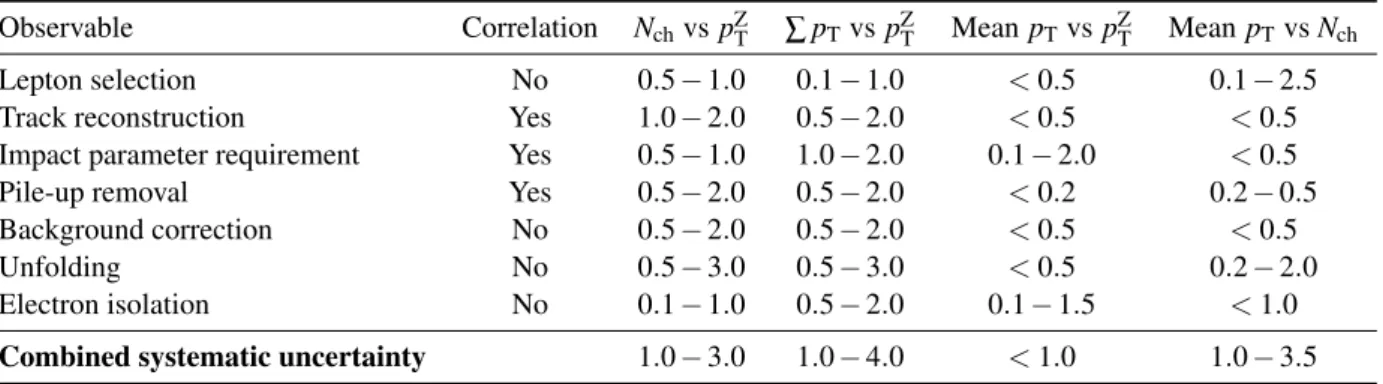
The following sources of uncertainty have been assessed for the measured distributions after all corrections and unfold-ing. Table 3 summarises the typical sizes of the systematic uncertainties for the UE observables as a function of pZT. Lepton selection - systematic uncertainties due to the
lep-ton selection efficiencies have been assessed using MC simulation. The data are first unfolded using the nominal MC samples, then with samples corresponding to a ±1σ variation of the efficiencies [43]. These uncertainties are assumed to be uncorrelated between the electron and muon channels. The resulting uncertainty is less than 1% for all observables over most of the kinematic range. Track reconstruction - the systematic uncertainty on the track
reconstruction efficiency originating from uncertainties on the detector material description is estimated as in Ref. [44] for particles with |η| < 2.1 and as in Ref. [40] for |η| > 2.1. The typical value for |η| < 2.1 is ±1% while it is approximately 5% for |η| > 2.1. The effect of
[GeV]
Tp
∑
1 10µµ
ee/
0.8 1 1.2 1 10 Tp
∑
d
evdN
evN
1
-5 10 -4 10 -3 10 -2 10 -1 10 1< 50 GeV
Z T20 GeV < p
-1 = 7 TeV, 4.6 fb sATLAS
Toward regionee data
data
µ
µ
(a) chN
5 10 15 20 25 30 35µµ
ee/
0.8 1 1.2 5 10 15 20 25 30 35 chdN
evdN
evN
1
-5 10 -4 10 -3 10 -2 10 -1 10 1< 50 GeV
Z T20 GeV < p
-1 = 7 TeV, 4.6 fb sATLAS
Toward regionee data
data
µ
µ
(b)
Fig. 4 Unfolded and corrected distributions of charged particle ∑ pT(a) and Nch(b) for 20 < pZT< 50 GeV shown separately for the Z → e +e−
and Z → µ+µ−samples after all corrections have been applied. The bottom panels show the ratios between the electron and the muon distributions where the error bars are purely statistical and the shaded areas represent the total uncertainty, including systematic, on the combined result.
Table 3 Typical contributions to the systematic uncertainties (in %) on the unfolded and corrected distributions of interest in the toward and transverse regions for the profile distributions. The range of values in the columns 3 − 5 indicate the variations as a function of pZT, while those in the last column indicate the variations as a function of Nch. The column labelled Correlation indicates whether the errors are treated as correlated or not
between the electron and muon channels.
Observable Correlation Nchvs pZT ∑ pTvs pZT Mean pTvs pZT Mean pTvs Nch
Lepton selection No 0.5 − 1.0 0.1 − 1.0 < 0.5 0.1 − 2.5
Track reconstruction Yes 1.0 − 2.0 0.5 − 2.0 < 0.5 < 0.5
Impact parameter requirement Yes 0.5 − 1.0 1.0 − 2.0 0.1 − 2.0 < 0.5
Pile-up removal Yes 0.5 − 2.0 0.5 − 2.0 < 0.2 0.2 − 0.5
Background correction No 0.5 − 2.0 0.5 − 2.0 < 0.5 < 0.5
Unfolding No 0.5 − 3.0 0.5 − 3.0 < 0.5 0.2 − 2.0
Electron isolation No 0.1 − 1.0 0.5 − 2.0 0.1 − 1.5 < 1.0
Combined systematic uncertainty 1.0 − 3.0 1.0 − 4.0 < 1.0 1.0 − 3.5
this uncertainty on the final results is less than 2%. This uncertainty is fully correlated between the electron and muon channels.
Impact parameter requirement - the fraction of secondary par-ticles (i.e. those originating from decays and interactions in the inner detector material) in data is reproduced by the MC simulation to an accuracy of ∼ 10 − 20%, obtained by comparing d0distributions in MC and in the data
cor-rected for pile-up. To assess the corresponding systematic uncertainty, the track impact parameter requirements on |d0| and |z0|sinθ are varied from the nominal values of
1.5 mm to 1.0 mm and 2.5 mm, resulting in fractions of secondaries varying between 0.5% to 4.0%, and the resulting distributions are unfolded using MC samples selected with the same impact parameter requirements. The maximum residual difference of 2% or less between these unfolded distributions and the nominal unfolded distribution is taken as the uncertainty arising from this requirement. This uncertainty is also fully correlated be-tween the electron and muon channels.
Pile-up correction - the pile-up correction uncertainty orig-inates from the uncertainty in the pile-up density fitted along with the spatial distribution of tracks originating from pile-up, and the difference between the pile-up den-sities measured for Z-boson and for randomly triggered events. In addition to these, the stability of the correc-tion method with respect to the instantaneous luminosity was estimated by performing the correction procedure independently on datasets with different average numbers of reconstructed vertices, as shown in Fig. 2. The total uncertainty due to the pile-up correction is taken to be the quadratic combination of the uncertainties from these sources, and it is at most 2% for the average underly-ing event observables. The overall uncertainty is fully correlated between the electron and muon channels.
Background correction - the uncertainty is evaluated by com-paring the results of the linear fit to those obtained using a second-order polynomial. This uncertainty is at most 2% for the maximum background uncertainty on ∑ pT, which
is the most strongly affected variable, and is assumed to be uncorrelated between the electron and muon channels. Any potential correlation arising from the common tt and diboson backgrounds is neglected because they become sizable only for pZT> 100 GeV, where the total uncer-tainty is dominated by the statistical uncertanty on the background.
Unfolding - the uncertainty due to the model-dependence of the unfolding procedure is taken from the degree of non-closure between the PYTHIA8 initial particle-level distri-butions and the corresponding detector-level PYTHIA8 distributions unfolded and corrected using the Sherpa sample, which was reweighted to agree with PYTHIA8 at the detector level. This uncertainty varies between 0.5% and 3% for the profile distributions, and is assumed to be uncorrelated between the electron and muon channels. Bias due to implicit isolation - this uncertainty is estimated
by varying the electron isolation requirement used to de-rive the correction discussed in Sect. 7.3. The uncertainty is assigned to the electron channel and does not exceed ∼ 1% for the profile distributions.
Other potential sources of systematic uncertainty have been found to be negligible. The total uncertainty in each measured bin is obtained by propagating the systematic com-ponent of the error matrix through the channel combination. For the differential distributions in Sect. 9.2, the unfolding model dependent uncertainty increases to about 5%, resulting in slightly larger overall systematic uncertainties.
9 Results
9.1 Overview of the results
The results are shown in Sect. 9.2, first for the differential distributions of charged particle ∑ pTand Nchin intervals of
pZT, and then for the same distributions for a representative pZT range compared to MC model predictions. The normalised quantities, Nch/δ η δ φ and ∑pT/δ η δ φ , are obtained by
dividing Nchor ∑ pTby the angular area in η–φ space. This
allows for direct comparisons between the total transverse and trans-min/max quantities, and between the current result and experiments with different angular acceptances. The angular areas for the transverse, toward, and away region observables are δ φ δ η = (2 × π/3) × (2 × 2.5) = 10π/3, while for trans-max/min/diff, δ φ δ η = 5π/3.
Since the away region is dominated by the jets balanc-ing the pZ
T[43], the focus will be on the toward, transverse,
trans-max and trans-min regions. In the transverse region, the extra jet activity is more likely to be assigned to the trans-max region. Assuming the same flat UE activity in trans-min and trans-max regions, the trans-diff region, the difference between the observables measured in trans-max and trans-min regions, is expected to be dominated by the hard scattering component. In Sect. 9.3 profile histograms are shown. Finally, in Sect. 9.4, the results are compared to previous measurements from ATLAS where distributions sensitive to the underlying event were measured as a function of the kinematics of either the leading charged particle [1], or the leading jet [5].
9.2 Differential distributions
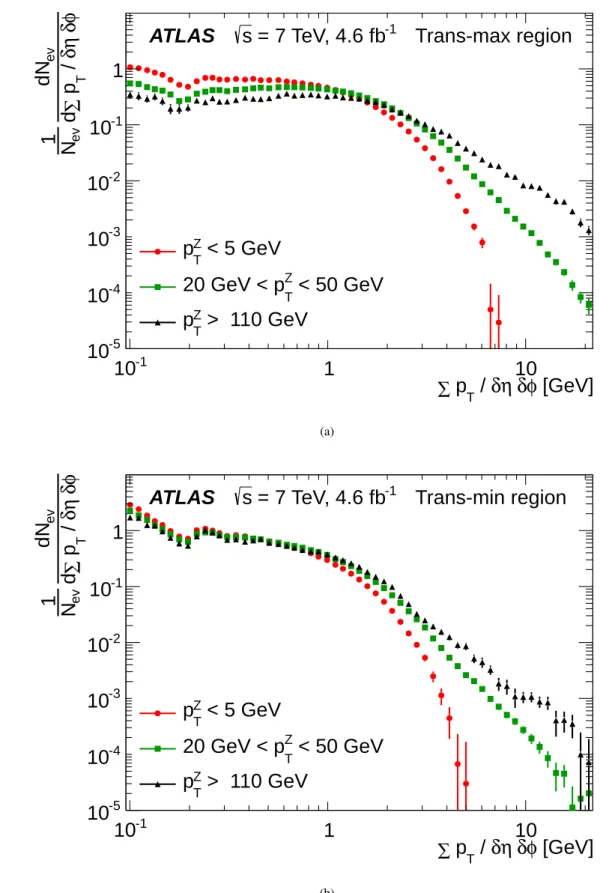
The distributions of the charged-particle ∑pT/δ η δ φ and
Nch/δ η δ φ in intervals of pZTshow the dependence of the
event activity on the hard scale. The distributions of ∑pT/δ η δ φ
in three different pZTranges are shown in Fig. 5 and in Fig. 6. At values below ∑pT/δ η δ φ of 0.1 GeV, the distributions
exhibit a decrease, which is independent of pZT. This is fol-lowed by a sharp increase at higher ∑pT/δ η δ φ , which is
an artifact of requiring at least two tracks with pTof at least
0.5 GeV in every event. Then a broad distribution can be seen extending to ∑pT/δ η δ φ of about 1 GeV, followed by a
steep decrease, the rate of which depends on the pZ
Tinterval.
For lower pZTvalues, the decrease is faster. These features are fairly independent of the UE regions, with the exception of the trans-min region, in which the ∑pT/δ η δ φ distribution
is approximately independent of pZT up to ∑pT/δ η δ φ of
1 GeV. If there were no hard scattering contributions in the trans-min region and the remaining underlying event activ-ity were independent of the hard scattering scale then this pZTindependence of the ∑pT/δ η δ φ distribution would be
expected [45].
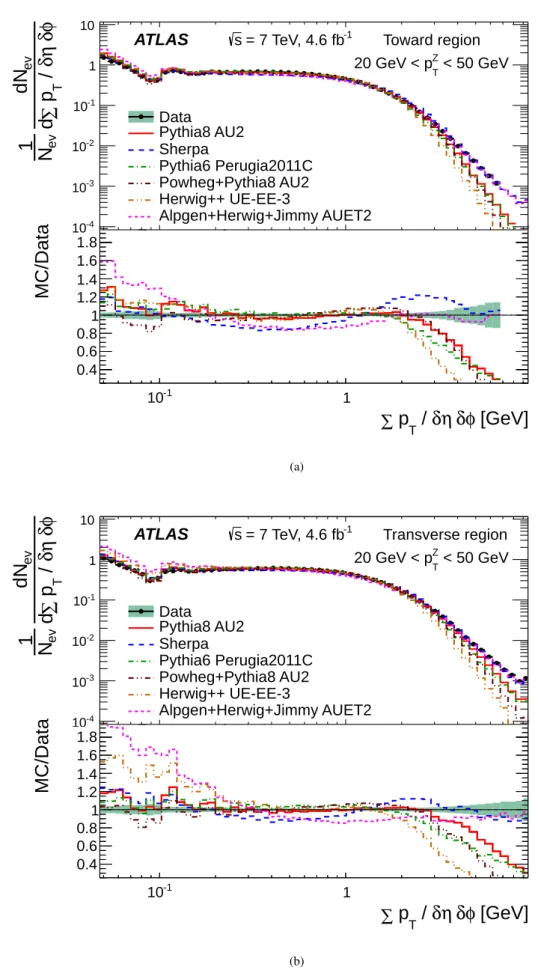
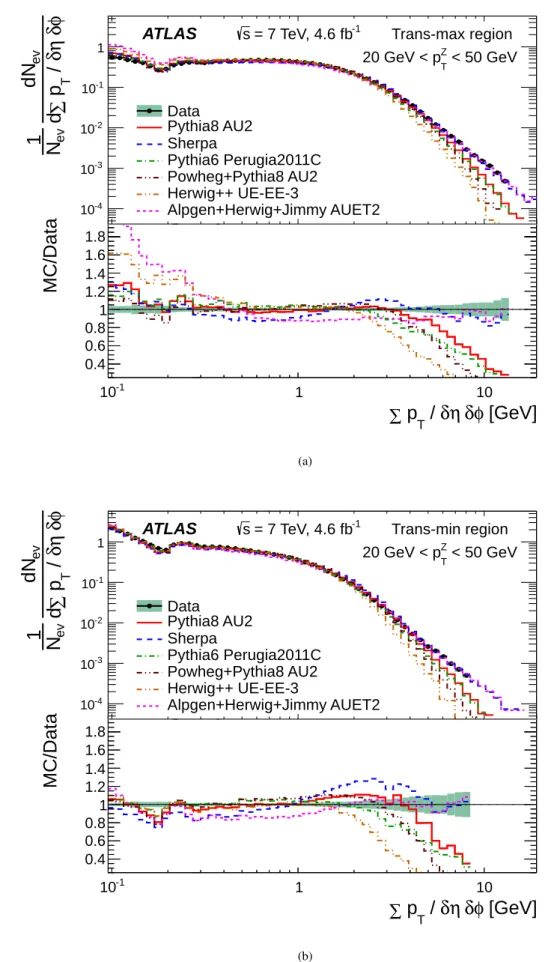
In Fig. 7 and Fig. 8, for a selected interval of pZT, be-tween 20 − 50 GeV, the ∑pT/δ η δ φ distributions in all the
UE regions are compared to various MC model predictions (as described in Tab. 2). For ∑pT/δ η δ φ < 0.1 GeV, there is
a large spread in the predictions of the MC models relative to the data, with POWHEGproviding the best description. The intermediate region with 0.1 < ∑pT/δ η δ φ < 1 GeV, is
well reproduced by most of the MC models. For the higher ∑ pT/δ η δ φ ranges, most of the MC models underestimate
the number of events, with the exception of Sherpa and ALPGEN, which have previously been shown to provide good models of multi-jet produced in association with a Z-boson [43]. This observation may indicate that even the trans-min region is not free of additional jets coming from the hard scatter.
The distributions of the charged particle multiplicity den-sity in the four UE regions are shown in Fig. 9 and Fig. 10 for the same pZ
Tintervals used in Fig. 5 and Fig. 6,
respec-tively. The distributions in the transverse, toward and trans-max regions exhibit similar features, with the exception of the largest multiplicities, which are suppressed in the min region, compared to the max one. In the trans-min region, as for the ∑pT/δ η δ φ distribution, limited
de-pendence on pZ
T is observed at low multiplicity. The
sup-pression of large multiplicities in the trans-min region is more pronounced in the lower pZT intervals. The compari-son of these multiplicity distributions to various MC models, in the same pZT interval, between 20 − 50 GeV, is shown in Fig. 11 and Fig. 12 for all the UE regions. In contrast to the ∑pT/δ η δ φ distributions, none of the MC models,
ex-cept PYTHIA8, describes the data distributions, in particular for Nch/δ η δ φ > 2.
9.3 Average distributions
The evolution of the event activity in the four UE regions with the hard scale can be conveniently summarised by the average value of the UE observables as a function of pZT.
In Fig. 13(a) the dependence of h∑pT/δ η δ φ i on pZTis
compared in different UE regions. The activity levels in the toward and transverse regions are both small compared to the activity in the away region. This difference increases with increasing pZ
T. The away region density is large due to
the presence in most cases of a jet balancing the Z-boson in pT. The density in the transverse region is seen to be
systematically higher than that in the toward region, which can be explained by the fact that for high pZT , additional radiated jets balancing pZTaffect the transverse region more than the toward region [43]. The difference between the three regions disappears at low pZT due to the fact that the UE regions are not well defined with respect to the actual Z-boson direction.
In Fig. 13(b), h∑pT/δ η δ φ i is seen to rise much faster as
a function of pZTin the trans-max region than in the trans-min region. The slowing down of the rise of h∑pT/δ η δ φ i at high
pZTin the most UE-sensitive toward and trans-min regions is consistent with an assumption [46] of a full overlap between the two interacting protons in impact parameter space at high hard scales.
The comparison of the h∑pT/δ η δ φ i distribution as a
function of pZTwith the predictions of various MC models is shown in Fig. 14 and Fig. 15 in the UE regions sensitive to the underlying event characteristics. For clarity of com-parison, the statistically least significant pZT> 210 GeV bin is omitted. The variation in the range of predictions is quite wide, although less so than for the differential ∑ pT
distribu-tions. The best description of the transverse and trans-max regions is given by Sherpa, followed by PYTHIA8, ALPGEN
and POWHEG. The observation that the multi-leg and NLO generator predictions are closer to the data than most of the pure parton shower generators suggests that these regions are affected by the additional jets coming from the hard in-teraction. Jet multiplicities in events with a Z-boson have been studied by the LHC experiments [43], and they are well described by Sherpa and ALPGEN.
The discrepancy between the PYTHIA8 AU2 tune and the PYTHIA6 Perugia tune possibly indicates the effect of using LHC UE data for the former in addition to the shower model improvement. In the trans-min region, which is the most sensitive to the UE, none of the models fully describe the data. Apart from HERWIG++, and Sherpa, which predicts a faster rise of ∑ pTthan observed in data, the other generators
model the data better in the trans-min region than they do in the transverse or trans-max regions. This possibly indicates that in the LO shower generators the underlying event is well modelled but perturbative jet activity is not.
In Fig. 16, hNch/δ η δ φ i is shown as a function of pZTin
the different UE regions. The profiles behave in a similar way to h∑pT/δ η δ φ i. However, the trans-diff hNch/δ η δ φ i
ac-tivity is lower than that for trans-min, while for h∑pT/δ η δ φ i,
it is the other way around. This indicates that the trans-diff region, which is a measure of extra activity in the trans-max region over the trans-min region, is populated by a few par-ticles with high transverse momentum, as expected for the leading constituents of jets.
In Fig. 17 and Fig. 18, in which various MC model pre-dictions are compared to hNch/δ η δ φ i as a function of pZT,
a different pattern from that of h∑pT/δ η δ φ i is observed.
The PYTHIA6 Perugia 2011C tune and ALPGENprovide the closest predictions in all three regions. Sherpa, PYTHIA8
and POWHEG predict higher average multiplicities, with Sherpa being the farthest from the data. On the other hand, HERWIG++mostly underestimates the data.
The h∑pT/δ η δ φ i and hNch/δ η δ φ i distributions as
functions of pZTin the trans-diff region are compared with
the MC model predictions in Fig. 19. While all MC models, except for HERWIG++ predict the multiplicity fairly well, only Sherpa and ALPGENpredict the ∑ pTaverage values
well in certain ranges. The better modelling of this region by MC models with additional jets coming from matrix element rather than from parton shower again confirms that the trans-diff region is most sensitive to the additional radiated jets.
The difficulty of describing the h∑pT/δ η δ φ i and
hNch/δ η δ φ i average values simultaneously in MC models
is reflected in the comparison of data and MC model pre-dictions for hpTi in Fig. 20. The hpTi as a function of pZTis
reasonably described by ALPGENand Sherpa for high pZT, while all the other models predict softer spectra. The correla-tion of hpTi with Nch, shown in Fig. 21, follows the pattern
established by previous experiments, with a slow increase in mean pTwith increasing Nch. This observable is sensitive
to the colour reconnection model in the MC generators. No MC model is able to predict the full shape in either region. Overall the PYTHIA8 prediction is the closest to the data, followed by PYTHIA6 and POWHEG, although for Nch< 5,
all three have much softer distributions than the data. The other models do well in this low Nch region, but are then
much lower than the data for high Nch.
From all the distributions considered, it can be inferred that the jets radiated from the hard scatter will affect the underlying event observables and therefore these must be properly reproduced in order to obtain an accurate MC de-scription of the UE. The UE region least affected by the presence of extra jets is the trans-min region.
9.4 Comparison with other ATLAS measurements
The results from this analysis are compared to the results ob-tained when the leading object is either a charged particle [1] or a hadronic jet [5]. The underlying event analysis with a leading charged particle was performed with the early 2010 data, while the analysis using events with jets utilises the full 2010 dataset.
The differential Nch/δ η δ φ and ∑pT/δ η δ φ
distribu-tions for leading jet and Z-boson events are compared in Fig. 22 and Fig. 23 for the trans-max and trans-min regions. While the Nch/δ η δ φ distributions are similar, a clear difference
is observed in the high tails of the ∑pT/δ η δ φ distribution,
which are more populated in Z-boson events than in jet events. This difference was traced to the definition of the leading ob-ject. In the case of jets, the accompanying activity can never contain jets with a pT higher than that of the leading jet,
whereas there is no such restriction for Z-boson events. As a test, the average ∑ pTwas determined for Z-boson events
after rejecting all events in which at the detector level there was a jet with pThigher than the pZT, with jets selected as
than for the standard selection, and the average values in jet and Z-boson events are in close agreement in this case.
The hard scales used for the analyses are different and the choice of the main observable used to assess the evolution of the underlying event reflects this to a certain extent in the fig-ures. Nevertheless, certain common qualitative features can be observed by comparing h∑pT/δ η δ φ i and hNch/δ η δ φ i
as functions of the leading object pTin the transverse region,
and also separated into the trans-max/min regions as shown in Fig. 24 and Fig. 25. The measurements with a leading jet are complementary to the measurements with a leading track, and a smooth continuation at 20 GeV is observed (in Fig. 24), corresponding to the lowest jet pT for which the jet
mea-surement could be performed and the highest leading track momentum included in the leading track analysis. Where the pTof the leading object is less than 50 GeV, a large difference
is observed both for the Nchand ∑ pTaverage values between
the jet and Z-boson measurements in Fig. 24; the increase of the associated activity as a function of the hard scale pTis
very different in track/jets events from the Z-boson events. Although the Nch density is similar in the underlying
event associated with a jet to that with a Z-boson for higher values of the hard scale (≥ 50 GeV), there are residual dif-ferences in the average ∑ pTdensities. The activity in events
with a Z-boson is systematically higher than that in events with jets. From the behaviour of the underlying event proper-ties in the trans-max/min regions in Fig. 25, this difference originates mostly from the trans-max region, due to selection bias discussed previously in this section. The trans-min re-gion is very similar between the two measurements, despite the different hard scales, indicating again that this region is least sensitive to the hard interaction and most sensitive to the MPI component.
[GeV]
φ
δ
η
δ
/
Tp
∑
-110
1
10
φδ
ηδ
/
Tp
∑
d
evdN
evN
1
-510
-410
-310
-210
-110
1
Toward region
-1= 7 TeV, 4.6 fb
s
ATLAS
< 5 GeV
Z Tp
< 50 GeV
Z T20 GeV < p
> 110 GeV
Z Tp
(a)[GeV]
φ
δ
η
δ
/
Tp
∑
-110
1
10
φδ
ηδ
/
Tp
∑
d
evdN
evN
1
-510
-410
-310
-210
-110
1
Transverse region
-1= 7 TeV, 4.6 fb
s
ATLAS
< 5 GeV
Z Tp
< 50 GeV
Z T20 GeV < p
> 110 GeV
Z Tp
(b)Fig. 5 Distributions of the scalar pTsum density of charged particles, ∑pT/δ η δ φ , in three different Z-boson transverse momentum, pZT, intervals,
[GeV]
φ
δ
η
δ
/
Tp
∑
-110
1
10
φδ
ηδ
/
Tp
∑
d
evdN
evN
1
-510
-410
-310
-210
-110
1
Trans-max region
-1= 7 TeV, 4.6 fb
s
ATLAS
< 5 GeV
Z Tp
< 50 GeV
Z T20 GeV < p
> 110 GeV
Z Tp
(a)[GeV]
φ
δ
η
δ
/
Tp
∑
-110
1
10
φδ
ηδ
/
Tp
∑
d
evdN
evN
1
-510
-410
-310
-210
-110
1
Trans-min region
-1= 7 TeV, 4.6 fb
s
ATLAS
< 5 GeV
Z Tp
< 50 GeV
Z T20 GeV < p
> 110 GeV
Z Tp
(b)Fig. 6 Distributions of the scalar pTsum density of charged particles, ∑pT/δ η δ φ , in three different Z-boson transverse momentum, pZT, intervals,
[GeV]
φ
δ
η
δ
/
Tp
∑
-1 10 1MC/Data
0.4 0.6 0.8 1 1.2 1.4 1.6 1.8 10-1 1φδ
ηδ
/
Tp
∑
d
evdN
evN
1
-4 10 -3 10 -2 10 -1 10 1 10 < 50 GeV Z T 20 GeV < p -1 = 7 TeV, 4.6 fb sATLAS
Toward regionData Pythia8 AU2 Sherpa Pythia6 Perugia2011C Powheg+Pythia8 AU2 Herwig++ UE-EE-3 Alpgen+Herwig+Jimmy AUET2 (a)
[GeV]
φ
δ
η
δ
/
Tp
∑
-1 10 1MC/Data
0.4 0.6 0.8 1 1.2 1.4 1.6 1.8 10-1 1φδ
ηδ
/
Tp
∑
d
evdN
evN
1
-4 10 -3 10 -2 10 -1 10 1 10 < 50 GeV Z T 20 GeV < p -1 = 7 TeV, 4.6 fb sATLAS
Transverse regionData Pythia8 AU2 Sherpa Pythia6 Perugia2011C Powheg+Pythia8 AU2 Herwig++ UE-EE-3 Alpgen+Herwig+Jimmy AUET2 (b)
Fig. 7 Comparisons of data and MC predictions for the scalar pTsum density of charged particles, ∑pT/δ η δ φ , for Z-boson transverse momentum,
pZT, in the interval 20 − 50 GeV, in the the toward (a) and transverse (b) regions. The bottom panels in each plot show the ratio of MC predictions to
[GeV]
φ
δ
η
δ
/
Tp
∑
-1 10 1 10MC/Data
0.4 0.6 0.8 1 1.2 1.4 1.6 1.810-1 1 10φδ
ηδ
/
Tp
∑
d
evdN
evN
1
-4 10 -3 10 -2 10 -1 10 1 < 50 GeV Z T 20 GeV < p -1 = 7 TeV, 4.6 fb sATLAS
Trans-max regionData Pythia8 AU2 Sherpa Pythia6 Perugia2011C Powheg+Pythia8 AU2 Herwig++ UE-EE-3 Alpgen+Herwig+Jimmy AUET2 (a)
[GeV]
φ
δ
η
δ
/
Tp
∑
-1 10 1 10MC/Data
0.4 0.6 0.8 1 1.2 1.4 1.6 1.810-1 1 10φδ
ηδ
/
Tp
∑
d
evdN
evN
1
-4 10 -3 10 -2 10 -1 10 1 < 50 GeV Z T 20 GeV < p -1 = 7 TeV, 4.6 fb sATLAS
Trans-min regionData Pythia8 AU2 Sherpa Pythia6 Perugia2011C Powheg+Pythia8 AU2 Herwig++ UE-EE-3 Alpgen+Herwig+Jimmy AUET2 (b)
Fig. 8 Comparisons of data and MC predictions for the scalar pTsum density of charged particles, ∑pT/δ η δ φ , for Z-boson transverse momentum,
pZT, in the interval 20 − 50 GeV, in the trans-max (a) and trans-min (b) regions. The bottom panels in each plot show the ratio of MC predictions to
φ
δ
η
δ
/
chN
0
0.5
1
1.5
2
2.5
3
3.5
4
4.5
φδ
ηδ
/
chdN
evdN
evN
1
-510
-410
-310
-210
-110
1
Toward region
-1= 7 TeV, 4.6 fb
s
ATLAS
< 5 GeV
Z Tp
< 50 GeV
Z T20 GeV < p
> 110 GeV
Z Tp
(a)φ
δ
η
δ
/
chN
0
0.5
1
1.5
2
2.5
3
3.5
4
4.5
φδ
ηδ
/
chdN
evdN
evN
1
-510
-410
-310
-210
-110
1
Transverse region
-1= 7 TeV, 4.6 fb
s
ATLAS
< 5 GeV
Z Tp
< 50 GeV
Z T20 GeV < p
> 110 GeV
Z Tp
(b)Fig. 9 Distributions of charged particle multiplicity density, Nch/δ η δ φ , in three different Z-boson transverse momentum, pZT, intervals, in the
φ
δ
η
δ
/
chN
0
0.5
1
1.5
2
2.5
3
3.5
4
4.5
φδ
ηδ
/
chdN
evdN
evN
1
-510
-410
-310
-210
-110
1
Trans-max region
-1= 7 TeV, 4.6 fb
s
ATLAS
< 5 GeV
Z Tp
< 50 GeV
Z T20 GeV < p
> 110 GeV
Z Tp
(a)φ
δ
η
δ
/
chN
0
0.5
1
1.5
2
2.5
3
3.5
4
4.5
φδ
ηδ
/
chdN
evdN
evN
1
-510
-410
-310
-210
-110
1
Trans-min region
-1= 7 TeV, 4.6 fb
s
ATLAS
< 5 GeV
Z Tp
< 50 GeV
Z T20 GeV < p
> 110 GeV
Z Tp
(b)Fig. 10 Distributions of charged particle multiplicity density, Nch/δ η δ φ , in three different Z-boson transverse momentum, pZT, intervals, in the
φ
δ
η
δ
/
chN
0.5 1 1.5 2 2.5 3 3.5 4 4.5MC/Data
0.4 0.6 0.8 1 1.2 1.4 1.6 1.8 0.5 1 1.5 2 2.5 3 3.5 4 4.5φδ
ηδ
/
chdN
evdN
evN
1
-4 10 -3 10 -2 10 -1 10 1 10 < 50 GeV Z T 20 GeV < p -1 = 7 TeV, 4.6 fb sATLAS
Toward regionData Pythia8 AU2 Sherpa Pythia6 Perugia2011C Powheg+Pythia8 AU2 Herwig++ UE-EE-3 Alpgen+Herwig+Jimmy AUET2 (a)
φ
δ
η
δ
/
chN
0.5 1 1.5 2 2.5 3 3.5 4 4.5MC/Data
0.4 0.6 0.8 1 1.2 1.4 1.6 1.8 0.5 1 1.5 2 2.5 3 3.5 4 4.5φδ
ηδ
/
chdN
evdN
evN
1
-4 10 -3 10 -2 10 -1 10 1 10 < 50 GeV Z T 20 GeV < p -1 = 7 TeV, 4.6 fb sATLAS
Transverse regionData Pythia8 AU2 Sherpa Pythia6 Perugia2011C Powheg+Pythia8 AU2 Herwig++ UE-EE-3 Alpgen+Herwig+Jimmy AUET2 (b)
Fig. 11 Comparisons of data and MC predictions for charged particle multiplicity density, Nch/δ η δ φ , for Z-boson transverse momentum, pZT, in
the interval 20 − 50 GeV, in the toward (a) and transverse (b) regions. The bottom panels in each plot show the ratio of MC predictions to data. The shaded bands represent the combined statistical and systematic uncertainties, while the error bars show the statistical uncertainties.
φ
δ
η
δ
/
chN
0.5 1 1.5 2 2.5 3 3.5 4 4.5MC/Data
0.4 0.6 0.8 1 1.2 1.4 1.6 1.8 0.5 1 1.5 2 2.5 3 3.5 4 4.5φδ
ηδ
/
chdN
evdN
evN
1
-4 10 -3 10 -2 10 -1 10 1 < 50 GeV Z T 20 GeV < p -1 = 7 TeV, 4.6 fb sATLAS
Trans-max regionData Pythia8 AU2 Sherpa Pythia6 Perugia2011C Powheg+Pythia8 AU2 Herwig++ UE-EE-3 Alpgen+Herwig+Jimmy AUET2 (a)
φ
δ
η
δ
/
chN
0.5 1 1.5 2 2.5 3 3.5 4 4.5MC/Data
0.4 0.6 0.8 1 1.2 1.4 1.6 1.8 0.5 1 1.5 2 2.5 3 3.5 4 4.5φδ
ηδ
/
chdN
evdN
evN
1
-4 10 -3 10 -2 10 -1 10 1 < 50 GeV Z T 20 GeV < p -1 = 7 TeV, 4.6 fb sATLAS
Trans-min regionData Pythia8 AU2 Sherpa Pythia6 Perugia2011C Powheg+Pythia8 AU2 Herwig++ UE-EE-3 Alpgen+Herwig+Jimmy AUET2 (b)
Fig. 12 Comparisons of data and MC predictions for charged particle multiplicity density, Nch/δ η δ φ , for Z-boson transverse momentum, pZT, in
the interval 20 − 50 GeV, in the trans-max (a) and trans-min (b) regions. The bottom panels in each plot show the ratio of MC predictions to data. The shaded bands represent the combined statistical and systematic uncertainties, while the error bars show the statistical uncertainties.
[GeV]
Z Tp
0
50
100 150 200 250 300 350 400 450 500
> [GeV]
φδ
ηδ
/
Tp
∑
<
2
4
6
8
10
12
14
16
18
20
22
24
-1= 7 TeV, 4.6 fb
s
ATLAS
Transverse region Toward region Away region (a)[GeV]
Z Tp
0
50
100 150 200 250 300 350 400 450 500
> [GeV]
φδ
ηδ
/
Tp
∑
<
0.5
1
1.5
2
2.5
3
3.5
4
4.5
5
-1= 7 TeV, 4.6 fb
s
ATLAS
Trans-max region Trans-min region Trans-diff region (b)Fig. 13 The average values of charged particle scalar ∑ pTdensity, h∑pT/δ η δ φ i, as a function of Z-boson transverse momentum, pZT, in the
transverse, toward and away regions (a), and in the trans-max, trans-min and trans-diff regions (b). The results are plotted at the center of each pZT bin. The error bars depict combined statistical and systematic uncertainties.
[GeV]
Z Tp
0 20 40 60 80 100 120 140 160 180 200MC/Data
0.8 0.85 0.9 0.95 1 1.05 1.10 20 40 60 80 100 120 140 160 180 200> [GeV]
φδ
ηδ
/
Tp
∑
<
0.4 0.6 0.8 1 1.2 1.4 1.6 1.8 2 -1Toward region
= 7 TeV, 4.6 fb
s
ATLAS
Data Pythia8 AU2 Powheg+Pythia8 AU2 Sherpa Pythia6 Perugia2011C Herwig++ UE-EE-3 Alpgen+Herwig+Jimmy AUET2 (a)[GeV]
Z Tp
0 20 40 60 80 100 120 140 160 180 200MC/Data
0.8 0.85 0.9 0.95 1 1.05 1.10 20 40 60 80 100 120 140 160 180 200> [GeV]
φδ
ηδ
/
Tp
∑
<
0.5 1 1.5 22.5
ATLAS
s
= 7 TeV, 4.6 fb
-1Transverse region
Data Pythia8 AU2 Powheg+Pythia8 AU2 Sherpa Pythia6 Perugia2011C Herwig++ UE-EE-3 Alpgen+Herwig+Jimmy AUET2 (b)
Fig. 14 Comparison of data and MC predictions for charged particle scalar ∑ pTdensity average values, h∑pT/δ η δ φ i, as a function of Z-boson
transverse momentum, pZT, in the toward (a) and transverse (b) regions. The bottom panels in each plot show the ratio of MC predictions to data. The
[GeV]
Z Tp
0 20 40 60 80 100 120 140 160 180 200MC/Data
0.8 0.85 0.9 0.95 1 1.05 1.10 20 40 60 80 100 120 140 160 180 200> [GeV]
φδ
ηδ
/
Tp
∑
<
0.5 1 1.5 2 2.5 3 3.5 4Trans-max region
-1= 7 TeV, 4.6 fb
s
ATLAS
Data Pythia8 AU2 Powheg+Pythia8 AU2 Sherpa Pythia6 Perugia2011C Herwig++ UE-EE-3 Alpgen+Herwig+Jimmy AUET2 (a)[GeV]
Z Tp
0 20 40 60 80 100 120 140 160 180 200MC/Data
0.8 0.85 0.9 0.95 1 1.05 1.10 20 40 60 80 100 120 140 160 180 200> [GeV]
φδ
ηδ
/
Tp
∑
<
0.4 0.6 0.8 1 1.2 1.4Trans-min region
-1= 7 TeV, 4.6 fb
s
ATLAS
Data Pythia8 AU2 Powheg+Pythia8 AU2 Sherpa Pythia6 Perugia2011C Herwig++ UE-EE-3 Alpgen+Herwig+Jimmy AUET2 (b)Fig. 15 Comparison of data and MC predictions for charged particle scalar ∑ pTdensity average values, h∑pT/δ η δ φ i, as a function of Z-boson
transverse momentum, pZT, in the trans-max (a) and trans-min (b) regions. The shaded bands represent the combined statistical and systematic