EUROPEAN ORGANIZATION FOR NUCLEAR RESEARCH (CERN)
CERN-PH-EP/2012-343 2013/06/05
CMS-QCD-11-004
Measurements of differential jet cross sections in
proton-proton collisions at
√
s
=
7 TeV with the CMS
detector
The CMS Collaboration
∗Abstract
Measurements of inclusive jet and dijet production cross sections are presented. Data
from LHC proton-proton collisions at√s = 7 TeV, corresponding to 5.0 fb−1of
inte-grated luminosity, have been collected with the CMS detector. Jets are reconstructed up to rapidity 2.5, transverse momentum 2 TeV, and dijet invariant mass 5 TeV,
us-ing the anti-kT clustering algorithm with distance parameter R =0.7. The measured
cross sections are corrected for detector effects and compared to perturbative QCD predictions at next-to-leading order, using five sets of parton distribution functions.
Submitted to Physical Review D
c
2013 CERN for the benefit of the CMS Collaboration. CC-BY-3.0 license
∗See Appendix A for the list of collaboration members
1
1
Introduction
Events with high transverse momentum jets in proton-proton collisions are described by quan-tum chromodynamics (QCD) in terms of parton-parton scattering, where the outgoing scat-tered partons manifest themselves as hadronic jets. Measurements of the inclusive jet and dijet cross sections can be used to test the predictions of perturbative QCD, constrain parton dis-tribution functions (PDFs) of the proton, differentiate among PDF sets, and look for possible deviations from the standard model.
In this paper, measurements of the double-differential inclusive jet (p+p→jet+X) and dijet
(p+p→jet+jet+X) production cross sections are reported as functions of jet rapidity y and
either jet transverse momentum pT or dijet invariant mass Mjj, at
√
s = 7 TeV. The data were
collected with the Compact Muon Solenoid (CMS) detector at the CERN Large Hadron Collider
(LHC) during the 2011 run and correspond to an integrated luminosity of 5.0 fb−1, two orders of
magnitude larger than the published LHC results from the 2010 run [1–3]. Jets are reconstructed up to rapidity 2.5, transverse momentum 2 TeV, and dijet invariant mass 5 TeV. The measured cross sections are corrected for detector effects and compared to the next-to-leading-order QCD predictions.
2
Apparatus
The CMS coordinate system has its origin at the center of the detector, with the z axis pointing along the direction of the counterclockwise beam. The azimuthal angle is denoted as φ, the
polar angle as θ, and the pseudorapidity is defined as η = −ln[tan(θ/2)]. The central feature
of the CMS detector is a superconducting solenoid, of 6 m internal diameter, that produces an axial magnetic field of 3.8 T. Within the field volume are a silicon pixel and strip tracker, a lead tungstate crystal electromagnetic calorimeter (ECAL) and a brass/plastic scintillator hadronic
calorimeter. Outside the field volume and in the forward region (3< |η| <5) is an
iron/quartz-fiber hadronic calorimeter. Muons are measured in gas ionization detectors embedded in the
steel return yoke outside the solenoid, in the pseudorapidity range |η| < 2.4. A detailed
de-scription of the CMS apparatus can be found in Ref. [4].
3
Jet reconstruction
The rapidity y and the transverse momentum pT of a jet with energy E and momentum~p =
(px, py, pz)are defined as y = (1/2)ln[(E+pz)/(E−pz)]and pT =
q
p2
x+p2y. The inputs to
the jet clustering algorithm are the four-momentum vectors of the reconstructed particle can-didates. Each such candidate is constructed using the particle-flow technique [5], which com-bines the information from several subdetectors and is calibrated to account for the nonlinear and nonuniform response of the CMS calorimetric system to hadrons. Jets are reconstructed
using the anti-kT clustering algorithm [6] with distance parameter R = 0.7. The clustering is
performed using four-momentum summation with the FASTJET package [7], where the
cho-sen distance parameter allows for the capture of most of the parton shower and improves
the dijet mass resolution with respect to smaller sizes. The total transverse energy Σ ET and
missing transverse energy~Emiss
T are used in the event selection and are derived from the
re-constructed particle-flow objects. They are defined asΣ ET = ∑iETi, with ETi = Eisin θi, and
~
Emiss
T = −∑i(Eisin θicos φiˆx+Eisin θisin φiˆy), where the sum refers to all particle candidates
2 4 Data samples and event selection
The reconstructed jets require a small additional energy correction, mostly due to thresholds on reconstructed tracks and clusters in the particle-flow algorithm, and various reconstruc-tion inefficiencies. These jet energy correcreconstruc-tions are derived using simulated events, generated
byPYTHIA6 (version 6.4.22) [8] and processed through the CMS detector simulation based on
GEANT4 [9], and in situ measurements with dijet, photon+jet, and Z+jet events [10]. These
jet energy corrections correct reconstructed jets to the hadron level, as opposed to the par-ton level. An offset correction is also applied to account for the extra energy from additional proton-proton interactions within the same or neighboring bunch crossings (in-time and
out-of-time pileup) [10]. The pileup effects are important for the lowest-pT jets (10% jet energy
scale correction and 1% systematic uncertainty [11] for jets with pT ∼ 100 GeV) and
progres-sively decrease with jet pT. For jets with pT > 200 GeV the pileup effects are negligible. The
jet energy correction depends on η and pT of the jet, and is applied as a multiplicative factor to
the jet four-momentum vector. The factor is typically between 1.0 and 1.2 and is approximately
uniform in η. For a jet pT = 100 GeV the factor is 1.1, decreasing towards 1.0 with increasing
pT. The typical jet pTresolution is 10% at pT = 100 GeV. The dijet mass Mjjis calculated from
the corrected four-momentum vectors of the two jets with the highest pT (leading jets). The
relative dijet-mass resolution, estimated from the simulation, ranges from 7% at Mjj= 0.2 TeV
to 3% at Mjj=3 TeV.
4
Data samples and event selection
The data samples used for this measurement were collected with single-jet high-level triggers
(HLT) [12] that require at least one jet in the event to have pT > 60, 110, 190, 240, or 370 GeV,
respectively, in corrected jet transverse momentum. The online jet reconstruction uses only calorimetric information and the resulting HLT jets typically have worse energy resolution than
the offline particle-flow jets. The lower-pTtriggers were prescaled and the corresponding
inte-grated luminosity of each trigger sample,Leff, is listed in Table 1. In the offline analysis, events
are required to have at least one well reconstructed proton-proton interaction vertex [13]. In order to suppress nonphysical jets, i.e., jets resulting from noise in the electromagnetic and/or hadronic calorimeters, the jets are required to satisfy the following identification criteria. Each jet should contain at least two particles, one of which is a charged hadron, and the jet energy fraction carried by neutral hadrons and photons should be less than 90%. These criteria have an efficiency of greater than 99% for physical jets, while the probability for a nonphysical jet to
pass the criteria is less than 10−6.
Table 1: The integrated luminosity for each of the data samples.
Min. jet trigger pT 60 110 190 240 370
(GeV)
Jet trigger name Jet60 Jet110 Jet190 Jet240 Jet370
Leff(pb−1) 0.41 7.3 152 512 4980
The inclusive single-jet cross section measurements are made in five rapidity regions of size
∆|y| = 0.5 over the range 0.0–2.5. Jets that do not satisfy the jet identification criteria are
discarded and events are required to contain at least one jet that satisfies these criteria. In order
to avoid any trigger bias, the jets are additionally required to have pT >110, 200, 300, 360, and
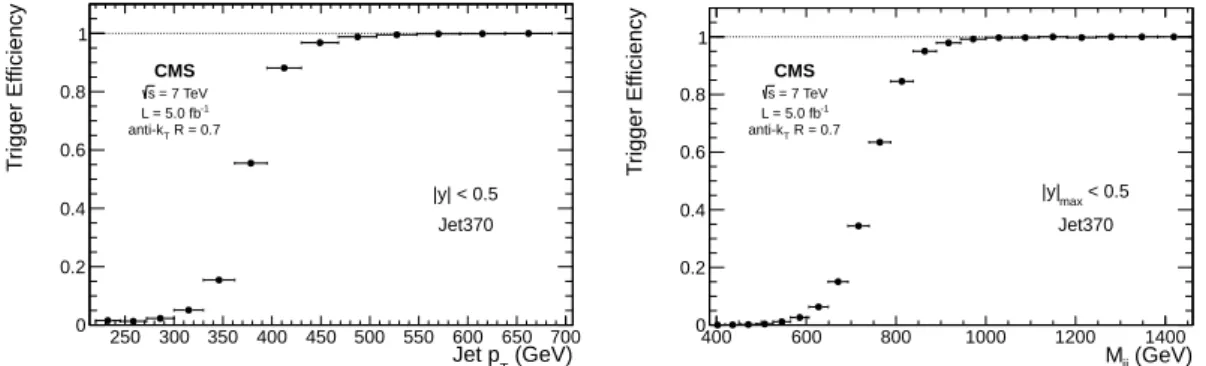
510 GeV for the five single-jet HLT triggers used, respectively. Figure 1 (left) shows the trigger
efficiency as a function of the jet pT, for the central rapidity bin|y| < 0.5 and for the highest
3
with a lower threshold single-jet trigger and confirmed with events collected with single-muon triggers.
Background events due to instrumental noise, beam halo effects, or proton-proton collisions with leptons in the final state that might survive the jet identification criteria are further
sup-pressed by requiring EmissT /Σ ET < 0.3. Hard QCD processes do not generate true EmissT and
because of the good energy resolution the measured values of ETmiss in such events are small
compared to the total transverse energy. Hence, the distribution of the variable ETmiss/Σ ET
peaks close to zero for QCD events, while some background events give larger values.
Fig-ure 2 (left) shows a typical distribution of the variable EmissT /Σ ETfor events with at least one
jet with pT >510 GeV, collected with the 370 GeV single-jet trigger. The data points exceed the
QCD predictions at large values of Emiss
T . This tail is dominated by processes such as Z+jet(s),
where the Z boson decays to neutrinos, and W+jet(s), where the W boson decays to leptons. No events from instrumental and beam halo effects were found to survive the jet identification
criteria, and therefore the additional EmissT /Σ ETselection only removes events from processes
that produce true ETmiss.
For the dijet measurement, at least two jets with pT1 > 60 GeV and pT2 > 30 GeV and
sat-isfying the tight identification criteria are required. If either of the two leading jets fails the identification criteria, the event is discarded. The dijet measurement is performed in five
rapidity regions of size ∆|ymax| = 0.5, defined by the maximum absolute rapidity ymax =
sign(|max(y1, y2) | − |min(y1, y2) |) ·max(|y1|,|y2|)of the two leading jets in the event. The
use of the variable |y|max ≡ |ymax|divides the phase space of the dijet system into exclusive
rapidity bins, which correspond to different scattering angles in the center-of-mass frame.
Low values of |y|max probe s-channel scattering at large angles, while large values of|y|max
probe t-channel scattering at small angles. For each rapidity bin the trigger efficiency is
ex-pressed as a function of Mjj, and the events are required to satisfy a minimum mass threshold,
which increases with|y|max. Figure 1 (right) shows the trigger efficiency for the central rapidity
bin and for the highest trigger threshold. Because of the dijet topology, no further cut is needed
on the EmissT /Σ ETvariable, as can be seen in Fig. 2 (right).
(GeV) T Jet p 250 300 350 400 450 500 550 600 650 700 T ri g g e r E ff ic ie n c y 0 0.2 0.4 0.6 0.8 1 |y| < 0.5 Jet370 CMS = 7 TeV s -1 L = 5.0 fb R = 0.7 T anti-k (GeV) jj M 400 600 800 1000 1200 1400 T ri g g e r E ff ic ie n c y 0 0.2 0.4 0.6 0.8 1 < 0.5 max |y| Jet370 CMS = 7 TeV s -1 L = 5.0 fb R = 0.7 T anti-k
Figure 1: Trigger efficiency as a function of the jet pT (left) and dijet mass Mjj (right) for the
370 GeV single-jet trigger and for the central rapidity bins.
5
Measurement of the differential jet and dijet cross sections
In this section the reconstruction of the jet transverse momentum and dijet mass spectra from the different samples is presented. Then the unfolding procedure, which translates the recon-structed spectra into true spectra, is described. Finally, the experimental uncertainties related to the measurements are described and discussed.
4 5 Measurement of the differential jet and dijet cross sections T E Σ / miss T E 0 0.2 0.4 0.6 0.8 1 Events 1 10 2 10 3 10 4 10 5 10 6 10 > 510 GeV T Leading jet p ) -1 Data ( 5.0 fb QCD Simulation < 0.3 T E Σ / miss T E = 7 TeV s CMS T E Σ / miss T E 0 0.2 0.4 0.6 0.8 1 Events 1 10 2 10 3 10 4 10 > 910 GeV jj < 0.5, M max |y| ) -1 Data ( 5.0 fb QCD Simulation = 7 TeV s CMS
Figure 2: Distribution of EmissT /Σ ET for data events (black points) and simulated QCD events
(continuous line) with at least one jet with pT >510 GeV (left) and for dijet events with|y|max<
2.5 and Mjj > 910 GeV (right), collected with the 370 GeV single-jet trigger. The distribution
from the inclusive-jet selection is shown before the offline selection Emiss
T /Σ ET < 0.3. The
larger tail in the data is caused by other processes with true EmissT (such as Z+jet(s), where the
Z boson decays to neutrinos, and W+jet(s), where the W boson decays to leptons).
5.1 Determination of transverse momentum and dijet mass spectra
(GeV) T Jet p 200 300 400 1000 2000 Prescale / GeV × Jets -3 10 -1 10 10 3 10 5 10 7 10 8 10 |y| < 0.5 Jet60 Jet110 Jet190 Jet240 Jet370 CMS = 7 TeV s -1 L = 5.0 fb R = 0.7 T anti-k (GeV) jj M 200 300 400 1000 2000 3000 Prescale / GeV × Events -3 10 -1 10 10 3 10 5 10 6 10 < 0.5 max |y| Jet60 Jet110 Jet190 Jet240 Jet370 CMS = 7 TeV s -1 L = 5.0 fb R = 0.7 T anti-k
Figure 3: Spectrum construction from individual trigger paths. Left: inclusive jet pTspectrum
for |y| < 0.5. Right: dijet mass spectrum for |y|max < 0.5. The different markers indicate
different trigger paths.
The jet pT(dijet invariant mass) spectrum is obtained by populating each bin with the number
of jets (events) collected using the highest threshold trigger which gives more than 99% trigger efficiency. Then, the yields from each trigger path are scaled according to the corresponding prescale value for this path (effective luminosity), as shown in Table 1. Figure 3 shows the reconstructed spectra for inclusive jets (left) and dijets (right), in the central rapidity bin, de-composed into the five contributing trigger paths.
The observed inclusive jet yields are transformed into double-differential cross sections as fol-lows: d2σ dpTdy = 1 e· Leff Njets ∆pT (2·∆|y|) , (1)
where Njets is the number of jets in the bin,Leffis the integrated luminosity of the data sample
from which the events are taken, e is the product of the trigger and event selection efficiencies,
both of which are greater than 99%, and∆pTand∆|y|are the transverse momentum and
rapid-ity bin widths, respectively. The width of the pT bins is proportional to the pT resolution and
so increases with pT. The statistical uncertainty assigned to each pT bin takes into account the
number of independent events that contribute at least one jet in the bin. The largest fraction
5.2 Unfolding 5
a small fraction of events contribute more than one jet. Such events are typically back-to-back
dijet events, so closely balanced in pTthat both jets end up in the same|y|and pTbin.
The statistical uncertainty in the number of jets in a bin is estat =
p
(4−3 f)/(2− f) ·p Njets,
where f =N1/Nevis the fraction of events that contribute one jet in the given bin. The formula
is valid under the assumption that the number of events that contribute more than two jets in each bin is negligible, which has been verified for the current measurement.
The observed dijet yields are transformed into double-differential cross sections as follows:
d2σ dMjjdymax = 1 e· Leff · N ∆Mjj (2·∆|y|max) , (2)
where∆Mjjand∆|y|maxare the mass and rapidity bin widths, respectively. The size of the dijet
mass bins is approximately equal to or larger than the mass resolution at the bin center, while the bins at the edge of the spectrum have been merged to assure a minimal number of events in each bin.
5.2 Unfolding
Because of the detector resolution and the steeply falling spectra, the measured differential
cross sections are smeared with respect to the particle-level cross sections. Each pT and mass
bin contains events that have migrated in from neighboring bins and is missing events that have migrated out. For a steeply falling spectrum more events migrate into a bin than out. In order to allow for a direct comparison of experimental measurements with corresponding results from other experiments and with QCD predictions, the spectra are unfolded in order to correct for detector effects. The response matrix is obtained from the detector simulation and corrected for the measured differences in the resolution between data and simulation [10].
Figure 4 shows the response matrices for the jet pT(left) and the dijet mass (right) in the central
rapidity bins. The unfolding is done with the RooUnfold package [14] using the D’Agostini method [15]. 0 0.1 0.2 0.3 0.4 0.5 0.6 0.7 (GeV) T Measured Jet p 200 300 1000 2000 (GeV) T T ru e J e t p 200 1000 2000 |y| < 0.5 = 7 TeV s R = 0.7 T anti-k CMS Simulation 0 0.1 0.2 0.3 0.4 0.5 0.6 0.7 0.8 0.9 (GeV) jj Measured M 200 300 1000 2000 (GeV)jj T ru e M 200 1000 2000 3000 4000 < 0.5 max |y| = 7 TeV s R = 0.7 T anti-k CMS Simulation
Figure 4: Response matrices for the inclusive jet pTspectrum (left) and the dijet mass spectrum
6 5 Measurement of the differential jet and dijet cross sections
5.3 Experimental uncertainties
The dominant experimental uncertainties are related to the jet energy scale (JES), the
luminos-ity, and the jet pT resolution. Other sources of systematic uncertainty, such as the jet angular
resolution, are negligible. The agreement of the results for positive and negative rapidities has also been confirmed. Figure 5 shows the effects of the experimental uncertainties in all rapidity
bins for the cross section measurements. For rapidities up to|y| = 1.5 the total uncertainty of
both cross sections ranges from 5% at low pT or Mjjto 20% at high pT or Mjj, respectively. For
higher rapidities the total uncertainty increases to 10–30% in both cases, with the exception of
the highest dijet mass bin in the outer rapidity region of 2.0 < |y|max < 2.5, where the
uncer-tainty is substantially larger. A discussion of the individual contributions to the unceruncer-tainty follows.
5.3.1 Jet energy scale (JES) uncertainty
The jet energy scale is the dominant source of systematic uncertainty. Because of the steep slope
of the pTspectrum, a small uncertainty in the pT scale translates into a large uncertainty in the
cross section for a given value of pT. The jet energy scale uncertainty is dependent on pTand η
and has been estimated to be 2.0–2.5% [11]. The individual, uncorrelated contributions to the JES uncertainty have been estimated and are discussed below.
The JES uncertainty sources account for the pT and η dependence of the JES within the total
uncertainty. For the phase space of jets considered here, 16 mutually uncorrelated sources con-tribute to the total uncertainty, where each such source represents a signed 1σ variation from
a given systematic effect for each point in(pT, η). Summing up separately the positive or
neg-ative variations of the sources in quadrature will reproduce the total upward and downward JES uncertainties at each point. The uncertainties from all 16 independent sources are included in the supplemental material [URL will be inserted by publisher] submitted with this paper and in the HEPDATA record for this paper; the cross section measurements and other details are also tabulated therein.
The uncertainty sources are divided into four broad categories: pileup effects, relative
calibra-tion of jet energy scale versus η, absolute energy scale including pTdependence, and differences
in quark- and gluon-initiated jets. The first category, containing pileup effects, has relatively little impact on the analyses presented in this paper.
The second category, containing η-dependent effects, parameterizes the possible relative varia-tions in JES, which for the dijet and inclusive jet analyses lead to correlavaria-tions between rapidity
bins. In principle these effects could also have a pT dependence, but systematic studies on
data and Monte Carlo (MC) events indicate that the pTand η dependence of the uncertainties
factorize to a good approximation.
The third category deals with the uncertainty in the absolute energy scale and its pT
depen-dence and is the most relevant one for these analyses. The photon+jet and Z+jet events only
constrain the JES directly in a limited jet pT range of about 30–600 GeV, and the response at
higher (and lower) pT is estimated by MC simulation. The pT-dependent uncertainty arising
from modeling of the underlying event and jet fragmentation is obtained by comparing
pre-dictions fromPYTHIA6 andHERWIG++. Most studies show that both generators agree with the
data with differences comparable to those seen between data and MC. The uncertainty arising from the calorimeter response to single hadrons is estimated by varying the response
parame-terization by±3% around the central value. The final uncertainty arises from differences in the
5.3 Experimental uncertainties 7
(GeV)
T
Jet p
200 300 400 1000 2000
Cross section uncertainty
-0.3 -0.2 -0.1 0 0.1 0.2 0.3 0.4 |y| < 0.5 Total JES Unfolding Luminosity CMS = 7 TeV s -1 L = 5.0 fb R = 0.7 T anti-k (GeV) jj M 200 300 400 1000 2000 3000
Cross section uncertainty
-0.2 -0.1 0 0.1 0.2 0.3 < 0.5 max |y| Total JES Unfolding Luminosity CMS = 7 TeV s -1 L = 5.0 fb R = 0.7 T anti-k (GeV) T Jet p 200 300 400 1000
Cross section uncertainty
-0.3 -0.2 -0.1 0 0.1 0.2 0.3 0.4 0.5 < |y| < 1.0 Total JES Unfolding Luminosity CMS = 7 TeV s -1 L = 5.0 fb R = 0.7 T anti-k (GeV) jj M 300 400 500 1000 2000 3000
Cross section uncertainty
-0.2 -0.1 0 0.1 0.2 0.3 < 1.0 max 0.5 < |y| Total JES Unfolding Luminosity CMS = 7 TeV s -1 L = 5.0 fb R = 0.7 T anti-k (GeV) T Jet p 200 300 400 500 1000
Cross section uncertainty
-0.3 -0.2 -0.1 0 0.1 0.2 0.3 0.4 1.0 < |y| < 1.5 Total JES Unfolding Luminosity CMS = 7 TeV s -1 L = 5.0 fb R = 0.7 T anti-k (GeV) jj M 500 1000 2000 3000 4000
Cross section uncertainty
-0.2 -0.1 0 0.1 0.2 0.3 < 1.5 max 1.0 < |y| Total JES Unfolding Luminosity CMS = 7 TeV s -1 L = 5.0 fb R = 0.7 T anti-k (GeV) T Jet p 200 300 400 500 1000
Cross section uncertainty
-0.4 -0.2 0 0.2 0.4 0.6 1.5 < |y| < 2.0 Total JES Unfolding Luminosity CMS = 7 TeV s -1 L = 5.0 fb R = 0.7 T anti-k (GeV) jj M 600 1000 2000 3000 4000
Cross section uncertainty
-0.4 -0.2 0 0.2 0.4 0.6 < 2.0 max 1.5 < |y| Total JES Unfolding Luminosity CMS = 7 TeV s -1 L = 5.0 fb R = 0.7 T anti-k (GeV) T Jet p 200 300 400 500 600
Cross section uncertainty
-0.6 -0.4 -0.2 0 0.2 0.4 0.6 0.8 1 2.0 < |y| < 2.5 Total JES Unfolding Luminosity CMS = 7 TeV s -1 L = 5.0 fb R = 0.7 T anti-k (GeV) jj M 2000 3000 4000 5000
Cross section uncertainty
-0.6 -0.4 -0.2 0 0.2 0.4 0.6 0.8 1 < 2.5 max 2.0 < |y| Total JES Unfolding Luminosity CMS = 7 TeV s -1 L = 5.0 fb R = 0.7 T anti-k
Figure 5: Effect of the relative experimental uncertainties for the inclusive jet (left column) and
dijet (right column) cross section measurements, and for all five|y|and|y|maxbins, respectively.
8 6 Theoretical predictions
5.3.2 Luminosity uncertainty
The luminosity uncertainty is estimated to be 2.2% [16], which can be directly translated into a
2.2% uncertainty on the cross section normalization. It is fully correlated across all pTand mass
bins.
5.3.3 Unfolding uncertainty
The unfolding correction is closely related to the dependence on the pT and Mjjresolution and
the spectrum slope. For the inclusive jet pT spectrum it varies between 5% and 10%, while for
the dijet mass spectrum it ranges between 2% and 5%. The shape of the unfolding correction and uncertainty as displayed in Fig. 5 is understood as follows: the resolution in the
observ-able, pT or Mjj, improves when going from low to high values. As a consequence the effect of
smearing is more pronounced in the lower pTor Mjjregion. On the other hand the pT and Mjj
spectra become steeper when approaching the kinematic limit at high pTor Mjj, leading again
to a larger smearing effect than observed at medium values.
The uncertainty introduced by the unfolding is caused by the modeling of the jet pT(dijet mass)
resolution and the jet pT(dijet mass) spectrum in the simulation. In order to estimate the
sensi-tivity of the correction to these inputs, the jet pTresolution is varied by±10% and the jet (dijet
mass) spectrum slope by±5%. The former is motivated by the observed difference between
data and simulation in the jet energy resolution [10], and the latter is a conservative estimate based on comparisons of the theoretical and measured spectrum shapes. An additional con-stant 2% uncertainty is assigned to the dependence on the unfolding method. Overall, the
unfolding uncertainty is of the order of 3–4%, and is fully correlated across the pT and mass
bins.
5.3.4 Other uncertainty sources
The contributions from small trigger and jet identification inefficiencies, time dependence of
the jet pT resolution, and uncertainty on the trigger prescale factor have been shown to be
much smaller than 1%. To account for these residual effects a conservative uncertainty of 1% is
assigned to each jet pTand dijet mass bin, uncorrelated across the bins.
6
Theoretical predictions
The theoretical predictions for the jet cross sections consist of a next-to-leading-order (NLO) QCD calculation and a nonperturbative (NP) correction to account for the multiparton interac-tions (MPI) and hadronization effects.
6.1 NLO calculations
The NLO calculations are performed using the NLOJet++ program (v2.0.1) [17] within the framework of the fastNLO package (v1.4) [18]. The renormalization and factorization scales
(µR and µF) for the inclusive and dijet measurements are identified with the jet pT and the
average transverse momentum paveT of the two jets, respectively. The NLO calculation is
per-formed using five different PDF sets: CT10 [19], MSTW2008NLO [20], NNPDF2.1 [21], HER-APDF1.5 [22], and ABKM09 [23] at the corresponding default values of the strong coupling
6.2 Systematic uncertainties 9
6.2 Systematic uncertainties
The PDF variation introduces uncertainties in the theoretical prediction of up to 30%, while
the variation of αS(MZ)by±0.001 introduces an additional 1–2% uncertainty. The uncertainty
due to the choice of factorization and renormalization scales is estimated as the maximum
deviation at the six points (µF/µ, µR/µ) = (0.5, 0.5),(2, 2),(1, 0.5),(1, 2),(0.5, 1),(2, 1), where
µ = pT (inclusive) or µ = paveT (dijet). An additional uncertainty of at most 10% is caused by
the nonperturbative correction. The scale uncertainty ranges from 5% to 10% for|y| <1.5 but
increases to 40% for the outer|y|bins and for high dijet masses and jet pT. Overall, the PDF
uncertainty is dominant for the high pTand high dijet mass regions. Figure 6 shows the effect of
the systematic uncertainties for the two observables in all rapidity bins and for the NNPDF2.1 PDF set.
6.3 Nonperturbative corrections
The nonperturbative effects are estimated from the simulation, using the event generators
PYTHIA6 (tune Z2) andHERWIG++ 2.4.2 [24]. (ThePYTHIA6 Z2 tune is identical to the Z1 tune
described in [25] except that Z2 uses the CTEQ6L PDF while Z1 uses CTEQ5L.) These models are representative of the possible values of the nonperturbative corrections, due to their dif-ferent physics descriptions. The nonperturbative correction is defined as the ratio of the cross section predicted with the nominal generator settings divided by the cross section predicted with the MPI and hadronization switched off. The central value of the nonperturbative correc-tion is calculated from the average of the two models considered, and ranges from 1% to 20%,
being larger in the dijet spectrum because of the involvement of lower pTjets.
7
Results
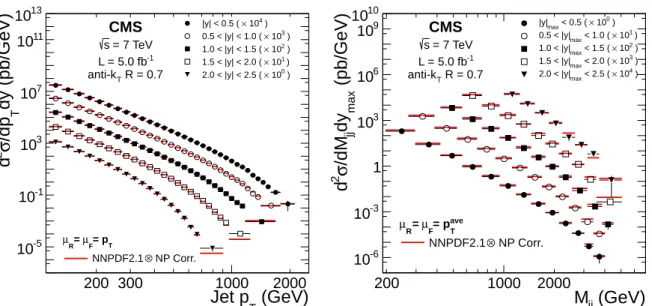
The unfolded inclusive jet and dijet spectra are shown in Fig. 7, compared to the theoretical predictions.
To compare the CMS data and the theoretical prediction, the ratio of the two is taken. Fig-ures 8–9 show this ratio using the central value of the NNPDF2.1 PDF set, accompanied by the total experimental and theoretical uncertainties. The theoretical uncertainties vary
consider-ably among the different PDF sets, and in particular in the high-pT and high-Mjj region. The
experimental uncertainty is comparable to the theoretical uncertainty. The additional curves represent the ratio of the central values of the other PDF sets to NNPDF2.1. Agreement is observed between data and theory in all rapidity bins, given the statistical and systematic un-certainties, with the various theoretical predictions showing differences of the order of 10%.
8
Summary
Measurements of the double-differential inclusive jet and dijet cross sections are presented
us-ing 5.0 fb−1of data collected with the CMS detector in proton-proton collisions at√s =7 TeV.
The measurements cover the jet pT range from 0.1 TeV to 2 TeV, and the dijet-mass range from
0.3 TeV to 5 TeV in five rapidity bins up to|y| = 2.5. The measured cross sections agree with
the predictions of perturbative QCD at next-to-leading order obtained with five different PDF sets. Theoretical and experimental uncertainties are comparable, even at the limits of the ex-perimental phase space, so these results may be used to constrain global PDF fits.
10 8 Summary
(GeV)
T
Jet p
200 300 400 1000 2000
Cross section uncertainty
-0.3 -0.2 -0.1 0 0.1 0.2 0.3 |y| < 0.5 Total PDF Nonpert. Scale NNPDF2.1 = 7 TeV s R = 0.7 T anti-k (GeV) jj M 200 300 400 1000 2000 3000
Cross section uncertainty
-0.3 -0.2 -0.1 0 0.1 0.2 0.3 0.4 < 0.5 max |y| Total PDF Nonpert. Scale NNPDF2.1 = 7 TeV s R = 0.7 T anti-k (GeV) T Jet p 200 300 400 1000
Cross section uncertainty
-0.3 -0.2 -0.1 0 0.1 0.2 0.3 0.5 < |y| < 1.0 Total PDF Nonpert. Scale NNPDF2.1 = 7 TeV s R = 0.7 T anti-k (GeV) jj M 300 400 500 1000 2000 3000
Cross section uncertainty
-0.3 -0.2 -0.1 0 0.1 0.2 0.3 0.4 < 1.0 max 0.5 < |y| Total PDF Nonpert. Scale NNPDF2.1 = 7 TeV s R = 0.7 T anti-k (GeV) T Jet p 200 300 400 500 1000
Cross section uncertainty
-0.3 -0.2 -0.1 0 0.1 0.2 0.3 1.0 < |y| < 1.5 Total PDF Nonpert. Scale NNPDF2.1 = 7 TeV s R = 0.7 T anti-k (GeV) jj M 500 1000 2000 3000 4000
Cross section uncertainty
-0.3 -0.2 -0.1 0 0.1 0.2 0.3 0.4 < 1.5 max 1.0 < |y| Total PDF Nonpert. Scale NNPDF2.1 = 7 TeV s R = 0.7 T anti-k (GeV) T Jet p 200 300 400 500 1000
Cross section uncertainty
-0.4 -0.3 -0.2 -0.1 0 0.1 0.2 0.3 0.4 1.5 < |y| < 2.0 Total PDF Nonpert. Scale NNPDF2.1 = 7 TeV s R = 0.7 T anti-k (GeV) jj M 600 1000 2000 3000 4000
Cross section uncertainty
-0.4 -0.3 -0.2 -0.1 0 0.1 0.2 0.3 0.4 < 2.0 max 1.5 < |y| Total PDF Nonpert. Scale NNPDF2.1 = 7 TeV s R = 0.7 T anti-k (GeV) T Jet p 200 300 400 500 600
Cross section uncertainty
-1 -0.5 0 0.5 1 2.0 < |y| < 2.5 Total PDF Nonpert. Scale NNPDF2.1 = 7 TeV s R = 0.7 T anti-k (GeV) jj M 2000 3000 4000 5000
Cross section uncertainty
-0.8 -0.6 -0.4 -0.2 0 0.2 0.4 0.6 0.8 < 2.5 max 2.0 < |y| Total PDF Nonpert. Scale NNPDF2.1 = 7 TeV s R = 0.7 T anti-k
Figure 6: Effect of the relative theoretical uncertainties for the inclusive jet (left column) and
dijet (right column) cross section measurements for all five |y| and|y|max bins, respectively.
11 (GeV) T Jet p 200 300 1000 2000 dy (pb/GeV) T /dp σ 2 d -5 10 -1 10 3 10 7 10 11 10 13 10 |y| < 0.5 ( × 104 ) ) 3 10 × 0.5 < |y| < 1.0 ( ) 2 10 × 1.0 < |y| < 1.5 ( ) 1 10 × 1.5 < |y| < 2.0 ( ) 0 10 × 2.0 < |y| < 2.5 ( CMS = 7 TeV s -1 L = 5.0 fb R = 0.7 T anti-k T = p F µ = R µ NP Corr. ⊗ NNPDF2.1 (GeV) jj M 200 1000 2000 (pb/GeV) max dyjj /dM σ 2 d -6 10 -3 10 1 3 10 6 10 9 10 10 10 0 ) 10 × < 0.5 ( max |y| ) 1 10 × < 1.0 ( max 0.5 < |y| ) 2 10 × < 1.5 ( max 1.0 < |y| ) 3 10 × < 2.0 ( max 1.5 < |y| ) 4 10 × < 2.5 ( max 2.0 < |y| CMS = 7 TeV s -1 L = 5.0 fb R = 0.7 T anti-k ave T = p F µ = R µ NP Corr. ⊗ NNPDF2.1
Figure 7: Inclusive jet (left) and dijet (right) cross sections for the five different rapidity bins, for data (markers) and theory (thick lines) using the NNPDF2.1 PDF set.
Acknowledgements
We congratulate our colleagues in the CERN accelerator departments for the excellent perfor-mance of the LHC and thank the technical and administrative staffs at CERN and at other CMS institutes for their contributions to the success of the CMS effort. In addition, we gratefully acknowledge the computing centers and personnel of the Worldwide LHC Computing Grid for delivering so effectively the computing infrastructure essential to our analyses. Finally, we acknowledge the enduring support for the construction and operation of the LHC and the CMS detector provided by the following funding agencies: the Austrian Federal Ministry of Science and Research; the Belgian Fonds de la Recherche Scientifique, and Fonds voor Wetenschap-pelijk Onderzoek; the Brazilian Funding Agencies (CNPq, CAPES, FAPERJ, and FAPESP); the Bulgarian Ministry of Education, Youth and Science; CERN; the Chinese Academy of Sciences, Ministry of Science and Technology, and National Natural Science Foundation of China; the Colombian Funding Agency (COLCIENCIAS); the Croatian Ministry of Science, Education and Sport; the Research Promotion Foundation, Cyprus; the Ministry of Education and Re-search, Recurrent financing contract SF0690030s09 and European Regional Development Fund, Estonia; the Academy of Finland, Finnish Ministry of Education and Culture, and Helsinki Institute of Physics; the Institut National de Physique Nucl´eaire et de Physique des Partic-ules / CNRS, and Commissariat `a l’ ´Energie Atomique et aux ´Energies Alternatives / CEA, France; the Bundesministerium f ¨ur Bildung und Forschung, Deutsche Forschungsgemeinschaft, and Helmholtz-Gemeinschaft Deutscher Forschungszentren, Germany; the General Secretariat for Research and Technology, Greece; the National Scientific Research Foundation, and Na-tional Office for Research and Technology, Hungary; the Department of Atomic Energy and the Department of Science and Technology, India; the Institute for Studies in Theoretical Physics and Mathematics, Iran; the Science Foundation, Ireland; the Istituto Nazionale di Fisica Nu-cleare, Italy; the Korean Ministry of Education, Science and Technology and the World Class University program of NRF, Republic of Korea; the Lithuanian Academy of Sciences; the Mex-ican Funding Agencies (CINVESTAV, CONACYT, SEP, and UASLP-FAI); the Ministry of Sci-ence and Innovation, New Zealand; the Pakistan Atomic Energy Commission; the Ministry of Science and Higher Education and the National Science Centre, Poland; the Fundac¸˜ao para a
12 8 Summary (GeV) T Jet p 200 300 400 1000 2000 Ratio to NNPDF2.1 0.6 0.8 1 1.2 1.4 1.6 |y| < 0.5Data CT10 HERA1.5 MSTW2008 ABKM09 CMS = 7 TeV s -1 L = 5.0 fb R = 0.7 T anti-k Exp. Uncertainty Theo. Uncertainty (GeV) jj M 200 300 400 1000 2000 3000 Ratio to NNPDF2.1 0.5 1 1.5 < 0.5 max |y| Data CT10 HERA1.5 MSTW2008 ABKM09 CMS = 7 TeV s -1 L = 5.0 fb R = 0.7 T anti-k Exp. Uncertainty Theo. Uncertainty (GeV) T Jet p 200 300 400 1000 Ratio to NNPDF2.1 0.6 0.8 1 1.2 1.4 1.6 0.5 < |y| < 1.0Data CT10 HERA1.5 MSTW2008 ABKM09 CMS = 7 TeV s -1 L = 5.0 fb R = 0.7 T anti-k Exp. Uncertainty Theo. Uncertainty (GeV) jj M 300 400 500 1000 2000 3000 Ratio to NNPDF2.1 0.5 1 1.5 < 1.0 max 0.5 < |y| Data CT10 HERA1.5 MSTW2008 ABKM09 CMS = 7 TeV s -1 L = 5.0 fb R = 0.7 T anti-k Exp. Uncertainty Theo. Uncertainty (GeV) T Jet p 200 300 400 500 1000 Ratio to NNPDF2.1 0.6 0.8 1 1.2 1.4 1.6 1.0 < |y| < 1.5Data CT10 HERA1.5 MSTW2008 ABKM09 CMS = 7 TeV s -1 L = 5.0 fb R = 0.7 T anti-k Exp. Uncertainty Theo. Uncertainty (GeV) jj M 500 1000 2000 3000 4000 Ratio to NNPDF2.1 0.5 1 1.5 < 1.5 max 1.0 < |y| Data CT10 HERA1.5 MSTW2008 ABKM09 CMS = 7 TeV s -1 L = 5.0 fb R = 0.7 T anti-k Exp. Uncertainty Theo. Uncertainty
Figure 8: Ratio of inclusive jet (left) and dijet (right) cross sections to the theoretical prediction
using the central value of the NNPDF2.1 PDF set for the first three|y|and|y|maxbins
respec-tively. The solid histograms show the ratio of the cross sections calculated with the other PDF sets to that calculated with NNPDF2.1. The experimental and theoretical systematic uncertain-ties are represented by the continuous and hatched bands, respectively.
13 (GeV) T Jet p 200 300 400 500 1000 Ratio to NNPDF2.1 1 1.5 2 2.5 3 1.5 < |y| < 2.0 Data CT10 HERA1.5 MSTW2008 ABKM09 CMS = 7 TeV s -1 L = 5.0 fb R = 0.7 T anti-k Exp. Uncertainty Theo. Uncertainty (GeV) jj M 600 1000 2000 3000 4000 Ratio to NNPDF2.1 0.5 1 1.5 < 2.0 max 1.5 < |y| Data CT10 HERA1.5 MSTW2008 ABKM09 CMS = 7 TeV s -1 L = 5.0 fb R = 0.7 T anti-k Exp. Uncertainty Theo. Uncertainty (GeV) T Jet p 200 300 400 500 600 Ratio to NNPDF2.1 0.5 1 1.5 2 2.5 3 2.0 < |y| < 2.5 Data CT10 HERA1.5 MSTW2008 ABKM09 CMS = 7 TeV s -1 L = 5.0 fb R = 0.7 T anti-k Exp. Uncertainty Theo. Uncertainty (GeV) jj M 1000 2000 3000 4000 5000 Ratio to NNPDF2.1 0 1 2 3 2.0 < |y|max < 2.5 Data CT10 HERA1.5 MSTW2008 ABKM09 CMS = 7 TeV s -1 L = 5.0 fb R = 0.7 T anti-k Exp. Uncertainty Theo. Uncertainty
Figure 9: Ratio of inclusive jet (left) and dijet (right) cross sections to the theoretical prediction
using the central value of the NNPDF2.1 PDF set for the last two|y|and|y|maxbins respectively.
The solid histograms show the ratio of the cross sections calculated with the other PDF sets to that calculated with NNPDF2.1. The experimental and theoretical systematic uncertainties are represented by the continuous and hatched bands, respectively.
14 References
Ciˆencia e a Tecnologia, Portugal; JINR (Armenia, Belarus, Georgia, Ukraine, Uzbekistan); the Ministry of Education and Science of the Russian Federation, the Federal Agency of Atomic En-ergy of the Russian Federation, Russian Academy of Sciences, and the Russian Foundation for Basic Research; the Ministry of Science and Technological Development of Serbia; the Secretar´ıa de Estado de Investigaci ´on, Desarrollo e Innovaci ´on and Programa Consolider-Ingenio 2010, Spain; the Swiss Funding Agencies (ETH Board, ETH Zurich, PSI, SNF, UniZH, Canton Zurich, and SER); the National Science Council, Taipei; the Thailand Center of Excellence in Physics, the Institute for the Promotion of Teaching Science and Technology of Thailand and the Na-tional Science and Technology Development Agency of Thailand; the Scientific and Technical Research Council of Turkey, and Turkish Atomic Energy Authority; the Science and Technology Facilities Council, UK; the US Department of Energy, and the US National Science Foundation. Individuals have received support from the Marie-Curie programme and the European Re-search Council (European Union); the Leventis Foundation; the A. P. Sloan Foundation; the Alexander von Humboldt Foundation; the Belgian Federal Science Policy Office; the Fonds pour la Formation `a la Recherche dans l’Industrie et dans l’Agriculture (FRIA-Belgium); the Agentschap voor Innovatie door Wetenschap en Technologie (IWT-Belgium); the Ministry of Education, Youth and Sports (MEYS) of Czech Republic; the Council of Science and Industrial Research, India; the Compagnia di San Paolo (Torino); and the HOMING PLUS programme of Foundation for Polish Science, cofinanced from European Union, Regional Development Fund.
References
[1] ATLAS Collaboration, “Measurement of inclusive jet and dijet production in pp collisions at 7 TeV using the ATLAS detector”, Phys. Rev. D 86 (2012) 014022,
doi:10.1103/PhysRevD.86.014022.
[2] CMS Collaboration, “Measurement of the differential dijet mass cross section in
proton-proton collisions at√s=7 TeV”, Phys. Lett. B 700 (2011) 187,
doi:10.1016/j.physletb.2011.05.027.
[3] CMS Collaboration, “Measurement of the Inclusive Jet Cross Section in pp Collisions at 7 TeV”, Phys. Rev. Lett. 107 (2011) 132001, doi:10.1103/PhysRevLett.107.132001. [4] CMS Collaboration, “The CMS experiment at the CERN LHC”, JINST 03 (2008) S08004,
doi:10.1088/1748-0221/3/08/S08004.
[5] CMS Collaboration, “Particle–Flow Event Reconstruction in CMS and Performance for
Jets, Taus, and EmissT ”, CMS Physics Analysis Summary CMS-PAS-PFT-09-001, (2009).
[6] M. Cacciari, G. P. Salam, and G. Soyez, “The anti-ktjet clustering algorithm”, JHEP 04
(2008) 063, doi:10.1088/1126-6708/2008/04/063.
[7] M. Cacciari and G. P. Salam, “Dispelling the N3myth for the ktjet-finder”, Phys. Lett. B
641(2006) 57, doi:10.1016/j.physletb.2006.08.037.
[8] T. Sj ¨ostrand, S. Mrenna, and P. Skands, “PYTHIA6.4 physics and manual”, JHEP 05
(2006) 026, doi:10.1088/1126-6708/2006/05/026.
[9] S. Agostinelli et al., “GEANT4—a simulation toolkit”, Nucl. Inst. Meth. A 506 (2003) 250,
References 15
[10] CMS Collaboration, “Determination of Jet Energy Calibration and Transverse Momentum Resolution in CMS”, JINST 6 (2011) P11002,
doi:10.1088/1748-0221/6/11/P11002.
[11] CMS Collaboration, “Jet Energy Scale performance in 2011”, CMS Detector Performance Summary CMS DP-2012/006, (2012).
[12] CMS Collaboration, “The CMS High Level Trigger”, Eur. Phys. J. C 46 (2006) 605,
doi:10.1140/epjc/s2006-02495-8.
[13] CMS Collaboration, “Tracking and Primary Vertex Results in First 7 TeV Collisions”, CMS Physics Analysis Summary CMS-PAS-TRK-10-005, (2010).
[14] T. Adye, “Unfolding algorithms and tests using RooUnfold”, (2006). arXiv:1105.1160.
[15] G. D’Agostini, “A multidimensional unfolding method based on Bayes’ theorem”, Nucl. Instrum. Meth. A 362 (1995) 487, doi:10.1016/0168-9002(95)00274-X.
[16] CMS Collaboration, “Absolute Calibration of the Luminosity Measurement at CMS: Winter 2012 Update”, CMS Physics Analysis Summary CMS-PAS-SMP-12-008, (2012). [17] Z. Nagy, “Next-to-leading order calculation of three jet observables in hadron-hadron
collisions”, Phys. Rev. D 68 (2003) 094002, doi:10.1103/PhysRevD.68.094002. [18] T. Kluge, K. Rabbertz, and M. Wobisch, “fastNLO: Fast pQCD calculations for PDF fits”,
(2006). arXiv:hep-ph/0609285v2.
[19] H.-L. Lai et al., “New parton distributions for collider physics”, Phys. Rev. D 82 (2010) 074024, doi:10.1103/PhysRevD.82.074024.
[20] A. D. Martin et al., “Parton distributions for the LHC”, Eur. Phys. J. C 63 (2009) 189, doi:10.1140/epjc/s10052-009-1072-5.
[21] R. D. Ball et al., “A first unbiased global NLO determination of parton distributions and their uncertainties”, Nucl. Phys. B 838 (2010) 136,
doi:10.1016/j.nuclphysb.2010.05.008.
[22] F. D. Aaron et al., “Combined Measurement and QCD Analysis of the Inclusive ep Scattering Cross Sections at HERA”, JHEP 01 (2010) 109,
doi:10.1007/JHEP01(2010)109.
[23] S. Alekhin et al., “The 3- , 4- , and 5-flavor NNLO Parton from Deep-Inelastic-Scattering Data and at Hadron Colliders”, Phys. Rev. D 81 (2010) 014032,
doi:10.1103/PhysRevD.81.014032.
[24] M. B¨ahr et al., “Herwig++ Physics and Manual”, Eur. Phys. J. C 58 (2008) 639, doi:10.1140/epjc/s10052-008-0798-9.
[25] R. Field, “Early LHC Underlying Event Data-Findings and Surprises”, (2010).
17
A
The CMS Collaboration
Yerevan Physics Institute, Yerevan, Armenia
S. Chatrchyan, V. Khachatryan, A.M. Sirunyan, A. Tumasyan Institut f ¨ur Hochenergiephysik der OeAW, Wien, Austria
W. Adam, E. Aguilo, T. Bergauer, M. Dragicevic, J. Er ¨o, C. Fabjan1, M. Friedl, R. Fr ¨uhwirth1,
V.M. Ghete, J. Hammer, N. H ¨ormann, J. Hrubec, M. Jeitler1, W. Kiesenhofer, V. Kn ¨unz,
M. Krammer1, I. Kr¨atschmer, D. Liko, I. Mikulec, M. Pernicka†, B. Rahbaran, C. Rohringer,
H. Rohringer, R. Sch ¨ofbeck, J. Strauss, A. Taurok, W. Waltenberger, C.-E. Wulz1
National Centre for Particle and High Energy Physics, Minsk, Belarus V. Mossolov, N. Shumeiko, J. Suarez Gonzalez
Universiteit Antwerpen, Antwerpen, Belgium
M. Bansal, S. Bansal, T. Cornelis, E.A. De Wolf, X. Janssen, S. Luyckx, L. Mucibello, S. Ochesanu, B. Roland, R. Rougny, M. Selvaggi, H. Van Haevermaet, P. Van Mechelen, N. Van Remortel, A. Van Spilbeeck
Vrije Universiteit Brussel, Brussel, Belgium
F. Blekman, S. Blyweert, J. D’Hondt, R. Gonzalez Suarez, A. Kalogeropoulos, M. Maes, A. Olbrechts, W. Van Doninck, P. Van Mulders, G.P. Van Onsem, I. Villella
Universit´e Libre de Bruxelles, Bruxelles, Belgium
B. Clerbaux, G. De Lentdecker, V. Dero, A.P.R. Gay, T. Hreus, A. L´eonard, P.E. Marage, A. Mohammadi, T. Reis, L. Thomas, C. Vander Velde, P. Vanlaer, J. Wang
Ghent University, Ghent, Belgium
V. Adler, K. Beernaert, A. Cimmino, S. Costantini, G. Garcia, M. Grunewald, B. Klein, J. Lellouch, A. Marinov, J. Mccartin, A.A. Ocampo Rios, D. Ryckbosch, N. Strobbe, F. Thyssen, M. Tytgat, S. Walsh, E. Yazgan, N. Zaganidis
Universit´e Catholique de Louvain, Louvain-la-Neuve, Belgium
S. Basegmez, G. Bruno, R. Castello, L. Ceard, C. Delaere, T. du Pree, D. Favart, L. Forthomme,
A. Giammanco2, J. Hollar, V. Lemaitre, J. Liao, O. Militaru, C. Nuttens, D. Pagano, A. Pin,
K. Piotrzkowski, J.M. Vizan Garcia Universit´e de Mons, Mons, Belgium
N. Beliy, T. Caebergs, E. Daubie, G.H. Hammad
Centro Brasileiro de Pesquisas Fisicas, Rio de Janeiro, Brazil
G.A. Alves, M. Correa Martins Junior, T. Martins, M.E. Pol, M.H.G. Souza Universidade do Estado do Rio de Janeiro, Rio de Janeiro, Brazil
W.L. Ald´a J ´unior, W. Carvalho, A. Cust ´odio, E.M. Da Costa, D. De Jesus Damiao, C. De Oliveira Martins, S. Fonseca De Souza, H. Malbouisson, M. Malek, D. Matos Figueiredo, L. Mundim, H. Nogima, W.L. Prado Da Silva, A. Santoro, L. Soares Jorge, A. Sznajder, A. Vilela Pereira Universidade Estadual Paulistaa, Universidade Federal do ABCb, S˜ao Paulo, Brazil
T.S. Anjosb, C.A. Bernardesb, F.A. Diasa,3, T.R. Fernandez Perez Tomeia, E.M. Gregoresb,
C. Laganaa, F. Marinhoa, P.G. Mercadanteb, S.F. Novaesa, Sandra S. Padulaa
Institute for Nuclear Research and Nuclear Energy, Sofia, Bulgaria
V. Genchev4, P. Iaydjiev4, S. Piperov, M. Rodozov, S. Stoykova, G. Sultanov, V. Tcholakov,
18 A The CMS Collaboration
University of Sofia, Sofia, Bulgaria
A. Dimitrov, R. Hadjiiska, V. Kozhuharov, L. Litov, B. Pavlov, P. Petkov Institute of High Energy Physics, Beijing, China
J.G. Bian, G.M. Chen, H.S. Chen, C.H. Jiang, D. Liang, S. Liang, X. Meng, J. Tao, J. Wang, X. Wang, Z. Wang, H. Xiao, M. Xu, J. Zang, Z. Zhang
State Key Lab. of Nucl. Phys. and Tech., Peking University, Beijing, China
C. Asawatangtrakuldee, Y. Ban, Y. Guo, W. Li, S. Liu, Y. Mao, S.J. Qian, H. Teng, D. Wang, L. Zhang, W. Zou
Universidad de Los Andes, Bogota, Colombia
C. Avila, J.P. Gomez, B. Gomez Moreno, A.F. Osorio Oliveros, J.C. Sanabria Technical University of Split, Split, Croatia
N. Godinovic, D. Lelas, R. Plestina5, D. Polic, I. Puljak4
University of Split, Split, Croatia Z. Antunovic, M. Kovac
Institute Rudjer Boskovic, Zagreb, Croatia
V. Brigljevic, S. Duric, K. Kadija, J. Luetic, D. Mekterovic, S. Morovic University of Cyprus, Nicosia, Cyprus
A. Attikis, M. Galanti, G. Mavromanolakis, J. Mousa, C. Nicolaou, F. Ptochos, P.A. Razis Charles University, Prague, Czech Republic
M. Finger, M. Finger Jr.
Academy of Scientific Research and Technology of the Arab Republic of Egypt, Egyptian Network of High Energy Physics, Cairo, Egypt
Y. Assran6, S. Elgammal7, A. Ellithi Kamel8, M.A. Mahmoud9, A. Radi10,11
National Institute of Chemical Physics and Biophysics, Tallinn, Estonia M. Kadastik, M. M ¨untel, M. Raidal, L. Rebane, A. Tiko
Department of Physics, University of Helsinki, Helsinki, Finland P. Eerola, G. Fedi, M. Voutilainen
Helsinki Institute of Physics, Helsinki, Finland
J. H¨ark ¨onen, A. Heikkinen, V. Karim¨aki, R. Kinnunen, M.J. Kortelainen, T. Lamp´en, K. Lassila-Perini, S. Lehti, T. Lind´en, P. Luukka, T. M¨aenp¨a¨a, T. Peltola, E. Tuominen, J. Tuominiemi, E. Tuovinen, D. Ungaro, L. Wendland
Lappeenranta University of Technology, Lappeenranta, Finland K. Banzuzi, A. Karjalainen, A. Korpela, T. Tuuva
DSM/IRFU, CEA/Saclay, Gif-sur-Yvette, France
M. Besancon, S. Choudhury, M. Dejardin, D. Denegri, B. Fabbro, J.L. Faure, F. Ferri, S. Ganjour, A. Givernaud, P. Gras, G. Hamel de Monchenault, P. Jarry, E. Locci, J. Malcles, L. Millischer, A. Nayak, J. Rander, A. Rosowsky, M. Titov
Laboratoire Leprince-Ringuet, Ecole Polytechnique, IN2P3-CNRS, Palaiseau, France
S. Baffioni, F. Beaudette, L. Benhabib, L. Bianchini, M. Bluj12, P. Busson, C. Charlot, N. Daci,
T. Dahms, M. Dalchenko, L. Dobrzynski, A. Florent, R. Granier de Cassagnac, M. Haguenauer, P. Min´e, C. Mironov, I.N. Naranjo, M. Nguyen, C. Ochando, P. Paganini, D. Sabes, R. Salerno, Y. Sirois, C. Veelken, A. Zabi
19
Institut Pluridisciplinaire Hubert Curien, Universit´e de Strasbourg, Universit´e de Haute Alsace Mulhouse, CNRS/IN2P3, Strasbourg, France
J.-L. Agram13, J. Andrea, D. Bloch, D. Bodin, J.-M. Brom, M. Cardaci, E.C. Chabert, C. Collard,
E. Conte13, F. Drouhin13, J.-C. Fontaine13, D. Gel´e, U. Goerlach, P. Juillot, A.-C. Le Bihan, P. Van
Hove
Centre de Calcul de l’Institut National de Physique Nucleaire et de Physique des Particules, CNRS/IN2P3, Villeurbanne, France
F. Fassi, D. Mercier
Universit´e de Lyon, Universit´e Claude Bernard Lyon 1, CNRS-IN2P3, Institut de Physique Nucl´eaire de Lyon, Villeurbanne, France
S. Beauceron, N. Beaupere, O. Bondu, G. Boudoul, J. Chasserat, R. Chierici4, D. Contardo,
P. Depasse, H. El Mamouni, J. Fay, S. Gascon, M. Gouzevitch, B. Ille, T. Kurca, M. Lethuillier, L. Mirabito, S. Perries, L. Sgandurra, V. Sordini, Y. Tschudi, P. Verdier, S. Viret
Institute of High Energy Physics and Informatization, Tbilisi State University, Tbilisi, Georgia
Z. Tsamalaidze14
RWTH Aachen University, I. Physikalisches Institut, Aachen, Germany
C. Autermann, S. Beranek, B. Calpas, M. Edelhoff, L. Feld, N. Heracleous, O. Hindrichs, R. Jussen, K. Klein, J. Merz, A. Ostapchuk, A. Perieanu, F. Raupach, J. Sammet, S. Schael,
D. Sprenger, H. Weber, B. Wittmer, V. Zhukov15
RWTH Aachen University, III. Physikalisches Institut A, Aachen, Germany
M. Ata, J. Caudron, E. Dietz-Laursonn, D. Duchardt, M. Erdmann, R. Fischer, A. G ¨uth, T. Hebbeker, C. Heidemann, K. Hoepfner, D. Klingebiel, P. Kreuzer, M. Merschmeyer, A. Meyer, M. Olschewski, P. Papacz, H. Pieta, H. Reithler, S.A. Schmitz, L. Sonnenschein, J. Steggemann, D. Teyssier, S. Th ¨uer, M. Weber
RWTH Aachen University, III. Physikalisches Institut B, Aachen, Germany
M. Bontenackels, V. Cherepanov, Y. Erdogan, G. Fl ¨ugge, H. Geenen, M. Geisler, W. Haj Ahmad,
F. Hoehle, B. Kargoll, T. Kress, Y. Kuessel, J. Lingemann4, A. Nowack, L. Perchalla, O. Pooth,
P. Sauerland, A. Stahl
Deutsches Elektronen-Synchrotron, Hamburg, Germany
M. Aldaya Martin, J. Behr, W. Behrenhoff, U. Behrens, M. Bergholz16, A. Bethani, K. Borras,
A. Burgmeier, A. Cakir, L. Calligaris, A. Campbell, E. Castro, F. Costanza, D. Dammann, C. Diez Pardos, G. Eckerlin, D. Eckstein, G. Flucke, A. Geiser, I. Glushkov, P. Gunnellini, S. Habib, J. Hauk, G. Hellwig, H. Jung, M. Kasemann, P. Katsas, C. Kleinwort, H. Kluge,
A. Knutsson, M. Kr¨amer, D. Kr ¨ucker, E. Kuznetsova, W. Lange, J. Leonard, W. Lohmann16,
B. Lutz, R. Mankel, I. Marfin, M. Marienfeld, I.-A. Melzer-Pellmann, A.B. Meyer, J. Mnich, A. Mussgiller, S. Naumann-Emme, O. Novgorodova, J. Olzem, H. Perrey, A. Petrukhin, D. Pitzl,
A. Raspereza, P.M. Ribeiro Cipriano, C. Riedl, E. Ron, M. Rosin, J. Salfeld-Nebgen, R. Schmidt16,
T. Schoerner-Sadenius, N. Sen, A. Spiridonov, M. Stein, R. Walsh, C. Wissing University of Hamburg, Hamburg, Germany
V. Blobel, H. Enderle, J. Erfle, U. Gebbert, M. G ¨orner, M. Gosselink, J. Haller, T. Hermanns, R.S. H ¨oing, K. Kaschube, G. Kaussen, H. Kirschenmann, R. Klanner, J. Lange, F. Nowak, T. Peiffer, N. Pietsch, D. Rathjens, C. Sander, H. Schettler, P. Schleper, E. Schlieckau, A. Schmidt,
M. Schr ¨oder, T. Schum, M. Seidel, J. Sibille17, V. Sola, H. Stadie, G. Steinbr ¨uck, J. Thomsen,
20 A The CMS Collaboration
Institut f ¨ur Experimentelle Kernphysik, Karlsruhe, Germany
C. Barth, J. Berger, C. B ¨oser, T. Chwalek, W. De Boer, A. Descroix, A. Dierlamm, M. Feindt,
M. Guthoff4, C. Hackstein, F. Hartmann4, T. Hauth4, M. Heinrich, H. Held, K.H. Hoffmann,
U. Husemann, I. Katkov15, J.R. Komaragiri, P. Lobelle Pardo, D. Martschei, S. Mueller,
Th. M ¨uller, M. Niegel, A. N ¨urnberg, O. Oberst, A. Oehler, J. Ott, G. Quast, K. Rabbertz, F. Ratnikov, N. Ratnikova, S. R ¨ocker, F.-P. Schilling, G. Schott, H.J. Simonis, F.M. Stober, D. Troendle, R. Ulrich, J. Wagner-Kuhr, S. Wayand, T. Weiler, M. Zeise
Institute of Nuclear Physics ”Demokritos”, Aghia Paraskevi, Greece
G. Anagnostou, G. Daskalakis, T. Geralis, S. Kesisoglou, A. Kyriakis, D. Loukas, I. Manolakos, A. Markou, C. Markou, C. Mavrommatis, E. Ntomari
University of Athens, Athens, Greece
L. Gouskos, T.J. Mertzimekis, A. Panagiotou, N. Saoulidou University of Io´annina, Io´annina, Greece
I. Evangelou, C. Foudas, P. Kokkas, N. Manthos, I. Papadopoulos, V. Patras KFKI Research Institute for Particle and Nuclear Physics, Budapest, Hungary
G. Bencze, C. Hajdu, P. Hidas, D. Horvath18, F. Sikler, V. Veszpremi, G. Vesztergombi19
Institute of Nuclear Research ATOMKI, Debrecen, Hungary N. Beni, S. Czellar, J. Molnar, J. Palinkas, Z. Szillasi
University of Debrecen, Debrecen, Hungary J. Karancsi, P. Raics, Z.L. Trocsanyi, B. Ujvari Panjab University, Chandigarh, India
S.B. Beri, V. Bhatnagar, N. Dhingra, R. Gupta, M. Kaur, M.Z. Mehta, N. Nishu, L.K. Saini, A. Sharma, J.B. Singh
University of Delhi, Delhi, India
Ashok Kumar, Arun Kumar, S. Ahuja, A. Bhardwaj, B.C. Choudhary, S. Malhotra, M. Naimuddin, K. Ranjan, V. Sharma, R.K. Shivpuri
Saha Institute of Nuclear Physics, Kolkata, India
S. Banerjee, S. Bhattacharya, S. Dutta, B. Gomber, Sa. Jain, Sh. Jain, R. Khurana, S. Sarkar, M. Sharan
Bhabha Atomic Research Centre, Mumbai, India
A. Abdulsalam, D. Dutta, S. Kailas, V. Kumar, A.K. Mohanty4, L.M. Pant, P. Shukla
Tata Institute of Fundamental Research - EHEP, Mumbai, India
T. Aziz, S. Ganguly, M. Guchait20, A. Gurtu21, M. Maity22, G. Majumder, K. Mazumdar,
G.B. Mohanty, B. Parida, K. Sudhakar, N. Wickramage
Tata Institute of Fundamental Research - HECR, Mumbai, India S. Banerjee, S. Dugad
Institute for Research in Fundamental Sciences (IPM), Tehran, Iran
H. Arfaei23, H. Bakhshiansohi, S.M. Etesami24, A. Fahim23, M. Hashemi25, H. Hesari, A. Jafari,
M. Khakzad, M. Mohammadi Najafabadi, S. Paktinat Mehdiabadi, B. Safarzadeh26, M. Zeinali
INFN Sezione di Baria, Universit`a di Barib, Politecnico di Baric, Bari, Italy
M. Abbresciaa,b, L. Barbonea,b, C. Calabriaa,b,4, S.S. Chhibraa,b, A. Colaleoa, D. Creanzaa,c, N. De
21
S. Mya,c, S. Nuzzoa,b, N. Pacificoa, A. Pompilia,b, G. Pugliesea,c, G. Selvaggia,b, L. Silvestrisa,
G. Singha,b, R. Vendittia,b, P. Verwilligen, G. Zitoa
INFN Sezione di Bolognaa, Universit`a di Bolognab, Bologna, Italy
G. Abbiendia, A.C. Benvenutia, D. Bonacorsia,b, S. Braibant-Giacomellia,b, L. Brigliadoria,b,
P. Capiluppia,b, A. Castroa,b, F.R. Cavalloa, M. Cuffiania,b, G.M. Dallavallea, F. Fabbria,
A. Fanfania,b, D. Fasanellaa,b, P. Giacomellia, C. Grandia, L. Guiduccia,b, S. Marcellinia,
G. Masettia, M. Meneghellia,b,4, A. Montanaria, F.L. Navarriaa,b, F. Odoricia, A. Perrottaa,
F. Primaveraa,b, A.M. Rossia,b, T. Rovellia,b, G.P. Sirolia,b, N. Tosi, R. Travaglinia,b
INFN Sezione di Cataniaa, Universit`a di Cataniab, Catania, Italy
S. Albergoa,b, G. Cappelloa,b, M. Chiorbolia,b, S. Costaa,b, R. Potenzaa,b, A. Tricomia,b, C. Tuvea,b
INFN Sezione di Firenzea, Universit`a di Firenzeb, Firenze, Italy
G. Barbaglia, V. Ciullia,b, C. Civininia, R. D’Alessandroa,b, E. Focardia,b, S. Frosalia,b, E. Galloa,
S. Gonzia,b, M. Meschinia, S. Paolettia, G. Sguazzonia, A. Tropianoa,b
INFN Laboratori Nazionali di Frascati, Frascati, Italy
L. Benussi, S. Bianco, S. Colafranceschi27, F. Fabbri, D. Piccolo
INFN Sezione di Genovaa, Universit`a di Genovab, Genova, Italy
P. Fabbricatorea, R. Musenicha, S. Tosia,b
INFN Sezione di Milano-Bicoccaa, Universit`a di Milano-Bicoccab, Milano, Italy
A. Benagliaa, F. De Guioa,b, L. Di Matteoa,b,4, S. Fiorendia,b, S. Gennaia,4, A. Ghezzia,b,
S. Malvezzia, R.A. Manzonia,b, A. Martellia,b, A. Massironia,b, D. Menascea, L. Moronia,
M. Paganonia,b, D. Pedrinia, S. Ragazzia,b, N. Redaellia, S. Salaa, T. Tabarelli de Fatisa,b
INFN Sezione di Napoli a, Universit`a di Napoli ’Federico II’ b, Universit`a della
Basilicata (Potenza)c, Universit`a G. Marconi (Roma)d, Napoli, Italy
S. Buontempoa, C.A. Carrillo Montoyaa, N. Cavalloa,c, A. De Cosaa,b,4, O. Doganguna,b,
F. Fabozzia,c, A.O.M. Iorioa,b, L. Listaa, S. Meolaa,d,28, M. Merolaa, P. Paoluccia,4
INFN Sezione di Padovaa, Universit`a di Padovab, Universit`a di Trento (Trento)c, Padova, Italy
P. Azzia, N. Bacchettaa,4, D. Biselloa,b, A. Brancaa,b,4, R. Carlina,b, P. Checchiaa, T. Dorigoa,
F. Gasparinia,b, U. Gasparinia,b, A. Gozzelinoa, K. Kanishcheva,c, S. Lacapraraa, I. Lazzizzeraa,c,
M. Margonia,b, A.T. Meneguzzoa,b, J. Pazzinia,b, N. Pozzobona,b, P. Ronchesea,b, M. Sgaravattoa,
F. Simonettoa,b, E. Torassaa, M. Tosia,b, S. Vaninia,b, P. Zottoa,b, G. Zumerlea,b
INFN Sezione di Paviaa, Universit`a di Paviab, Pavia, Italy
M. Gabusia,b, S.P. Rattia,b, C. Riccardia,b, P. Torrea,b, P. Vituloa,b
INFN Sezione di Perugiaa, Universit`a di Perugiab, Perugia, Italy
M. Biasinia,b, G.M. Bileia, L. Fan `oa,b, P. Laricciaa,b, G. Mantovania,b, M. Menichellia,
A. Nappia,b†, F. Romeoa,b, A. Sahaa, A. Santocchiaa,b, A. Spieziaa,b, S. Taronia,b
INFN Sezione di Pisaa, Universit`a di Pisab, Scuola Normale Superiore di Pisac, Pisa, Italy
P. Azzurria,c, G. Bagliesia, J. Bernardinia, T. Boccalia, G. Broccoloa,c, R. Castaldia,
R.T. D’Agnoloa,c,4, R. Dell’Orsoa, F. Fioria,b,4, L. Fo`aa,c, A. Giassia, A. Kraana, F. Ligabuea,c,
T. Lomtadzea, L. Martinia,29, A. Messineoa,b, F. Pallaa, A. Rizzia,b, A.T. Serbana,30, P. Spagnoloa,
P. Squillaciotia,4, R. Tenchinia, G. Tonellia,b, A. Venturia, P.G. Verdinia
INFN Sezione di Romaa, Universit`a di Romab, Roma, Italy
22 A The CMS Collaboration
P. Meridiania,4, F. Michelia,b, S. Nourbakhsha,b, G. Organtinia,b, R. Paramattia, S. Rahatloua,b,
M. Sigamania, L. Soffia,b
INFN Sezione di Torino a, Universit`a di Torino b, Universit`a del Piemonte Orientale (No-vara)c, Torino, Italy
N. Amapanea,b, R. Arcidiaconoa,c, S. Argiroa,b, M. Arneodoa,c, C. Biinoa, N. Cartigliaa,
S. Casassoa,b, M. Costaa,b, N. Demariaa, C. Mariottia,4, S. Masellia, E. Migliorea,b, V. Monacoa,b,
M. Musicha,4, M.M. Obertinoa,c, N. Pastronea, M. Pelliccionia, A. Potenzaa,b, A. Romeroa,b,
M. Ruspaa,c, R. Sacchia,b, A. Solanoa,b, A. Staianoa
INFN Sezione di Triestea, Universit`a di Triesteb, Trieste, Italy
S. Belfortea, V. Candelisea,b, M. Casarsaa, F. Cossuttia, G. Della Riccaa,b, B. Gobboa,
M. Maronea,b,4, D. Montaninoa,b,4, A. Penzoa, A. Schizzia,b
Kangwon National University, Chunchon, Korea T.Y. Kim, S.K. Nam
Kyungpook National University, Daegu, Korea
S. Chang, D.H. Kim, G.N. Kim, D.J. Kong, H. Park, D.C. Son, T. Son
Chonnam National University, Institute for Universe and Elementary Particles, Kwangju, Korea
J.Y. Kim, Zero J. Kim, S. Song Korea University, Seoul, Korea
S. Choi, D. Gyun, B. Hong, M. Jo, H. Kim, T.J. Kim, K.S. Lee, D.H. Moon, S.K. Park University of Seoul, Seoul, Korea
M. Choi, J.H. Kim, C. Park, I.C. Park, S. Park, G. Ryu Sungkyunkwan University, Suwon, Korea
Y. Choi, Y.K. Choi, J. Goh, M.S. Kim, E. Kwon, B. Lee, J. Lee, S. Lee, H. Seo, I. Yu Vilnius University, Vilnius, Lithuania
M.J. Bilinskas, I. Grigelionis, M. Janulis, A. Juodagalvis
Centro de Investigacion y de Estudios Avanzados del IPN, Mexico City, Mexico
H. Castilla-Valdez, E. De La Cruz-Burelo, I. Heredia-de La Cruz, R. Lopez-Fernandez, J. Mart´ınez-Ortega, A. Sanchez-Hernandez, L.M. Villasenor-Cendejas
Universidad Iberoamericana, Mexico City, Mexico S. Carrillo Moreno, F. Vazquez Valencia
Benemerita Universidad Autonoma de Puebla, Puebla, Mexico H.A. Salazar Ibarguen
Universidad Aut ´onoma de San Luis Potos´ı, San Luis Potos´ı, Mexico E. Casimiro Linares, A. Morelos Pineda, M.A. Reyes-Santos
University of Auckland, Auckland, New Zealand D. Krofcheck
University of Canterbury, Christchurch, New Zealand A.J. Bell, P.H. Butler, R. Doesburg, S. Reucroft, H. Silverwood
23
National Centre for Physics, Quaid-I-Azam University, Islamabad, Pakistan
M. Ahmad, M.I. Asghar, J. Butt, H.R. Hoorani, S. Khalid, W.A. Khan, T. Khurshid, S. Qazi, M.A. Shah, M. Shoaib
National Centre for Nuclear Research, Swierk, Poland
H. Bialkowska, B. Boimska, T. Frueboes, M. G ´orski, M. Kazana, K. Nawrocki, K. Romanowska-Rybinska, M. Szleper, G. Wrochna, P. Zalewski
Institute of Experimental Physics, Faculty of Physics, University of Warsaw, Warsaw, Poland G. Brona, K. Bunkowski, M. Cwiok, W. Dominik, K. Doroba, A. Kalinowski, M. Konecki, J. Krolikowski, M. Misiura
Laborat ´orio de Instrumenta¸c˜ao e F´ısica Experimental de Part´ıculas, Lisboa, Portugal
N. Almeida, P. Bargassa, A. David, P. Faccioli, P.G. Ferreira Parracho, M. Gallinaro, J. Seixas, J. Varela, P. Vischia
Joint Institute for Nuclear Research, Dubna, Russia
P. Bunin, M. Gavrilenko, I. Golutvin, I. Gorbunov, V. Karjavin, V. Konoplyanikov, G. Kozlov, A. Lanev, A. Malakhov, P. Moisenz, V. Palichik, V. Perelygin, S. Shmatov, S. Shulha, V. Smirnov, A. Volodko, A. Zarubin
Petersburg Nuclear Physics Institute, Gatchina (St. Petersburg), Russia
S. Evstyukhin, V. Golovtsov, Y. Ivanov, V. Kim, P. Levchenko, V. Murzin, V. Oreshkin, I. Smirnov, V. Sulimov, L. Uvarov, S. Vavilov, A. Vorobyev, An. Vorobyev
Institute for Nuclear Research, Moscow, Russia
Yu. Andreev, A. Dermenev, S. Gninenko, N. Golubev, M. Kirsanov, N. Krasnikov, V. Matveev, A. Pashenkov, D. Tlisov, A. Toropin
Institute for Theoretical and Experimental Physics, Moscow, Russia
V. Epshteyn, M. Erofeeva, V. Gavrilov, M. Kossov, N. Lychkovskaya, V. Popov, G. Safronov, S. Semenov, I. Shreyber, V. Stolin, E. Vlasov, A. Zhokin
Moscow State University, Moscow, Russia
A. Belyaev, E. Boos, M. Dubinin3, L. Dudko, A. Ershov, A. Gribushin, V. Klyukhin, O. Kodolova,
I. Lokhtin, A. Markina, S. Obraztsov, M. Perfilov, S. Petrushanko, A. Popov, L. Sarycheva†,
V. Savrin, A. Snigirev
P.N. Lebedev Physical Institute, Moscow, Russia
V. Andreev, M. Azarkin, I. Dremin, M. Kirakosyan, A. Leonidov, G. Mesyats, S.V. Rusakov, A. Vinogradov
State Research Center of Russian Federation, Institute for High Energy Physics, Protvino, Russia
I. Azhgirey, I. Bayshev, S. Bitioukov, V. Grishin4, V. Kachanov, D. Konstantinov, V. Krychkine,
V. Petrov, R. Ryutin, A. Sobol, L. Tourtchanovitch, S. Troshin, N. Tyurin, A. Uzunian, A. Volkov University of Belgrade, Faculty of Physics and Vinca Institute of Nuclear Sciences, Belgrade, Serbia
P. Adzic31, M. Djordjevic, M. Ekmedzic, D. Krpic31, J. Milosevic
Centro de Investigaciones Energ´eticas Medioambientales y Tecnol ´ogicas (CIEMAT), Madrid, Spain
M. Aguilar-Benitez, J. Alcaraz Maestre, P. Arce, C. Battilana, E. Calvo, M. Cerrada, M. Chamizo Llatas, N. Colino, B. De La Cruz, A. Delgado Peris, D. Dom´ınguez V´azquez, C. Fernandez
24 A The CMS Collaboration
Bedoya, J.P. Fern´andez Ramos, A. Ferrando, J. Flix, M.C. Fouz, P. Garcia-Abia, O. Gonzalez Lopez, S. Goy Lopez, J.M. Hernandez, M.I. Josa, G. Merino, J. Puerta Pelayo, A. Quintario Olmeda, I. Redondo, L. Romero, J. Santaolalla, M.S. Soares, C. Willmott
Universidad Aut ´onoma de Madrid, Madrid, Spain C. Albajar, G. Codispoti, J.F. de Troc ´oniz
Universidad de Oviedo, Oviedo, Spain
H. Brun, J. Cuevas, J. Fernandez Menendez, S. Folgueras, I. Gonzalez Caballero, L. Lloret Iglesias, J. Piedra Gomez
Instituto de F´ısica de Cantabria (IFCA), CSIC-Universidad de Cantabria, Santander, Spain J.A. Brochero Cifuentes, I.J. Cabrillo, A. Calderon, S.H. Chuang, J. Duarte Campderros,
M. Felcini32, M. Fernandez, G. Gomez, J. Gonzalez Sanchez, A. Graziano, C. Jorda, A. Lopez
Virto, J. Marco, R. Marco, C. Martinez Rivero, F. Matorras, F.J. Munoz Sanchez, T. Rodrigo, A.Y. Rodr´ıguez-Marrero, A. Ruiz-Jimeno, L. Scodellaro, I. Vila, R. Vilar Cortabitarte
CERN, European Organization for Nuclear Research, Geneva, Switzerland
D. Abbaneo, E. Auffray, G. Auzinger, M. Bachtis, P. Baillon, A.H. Ball, D. Barney, J.F. Benitez,
C. Bernet5, G. Bianchi, P. Bloch, A. Bocci, A. Bonato, C. Botta, H. Breuker, T. Camporesi,
G. Cerminara, T. Christiansen, J.A. Coarasa Perez, D. D’Enterria, A. Dabrowski, A. De Roeck, S. Di Guida, M. Dobson, N. Dupont-Sagorin, A. Elliott-Peisert, B. Frisch, W. Funk, G. Georgiou, M. Giffels, D. Gigi, K. Gill, D. Giordano, M. Girone, M. Giunta, F. Glege, R. Gomez-Reino Garrido, P. Govoni, S. Gowdy, R. Guida, S. Gundacker, M. Hansen, P. Harris, C. Hartl, J. Harvey, B. Hegner, A. Hinzmann, V. Innocente, P. Janot, K. Kaadze, E. Karavakis, K. Kousouris, P. Lecoq, Y.-J. Lee, P. Lenzi, C. Lourenc¸o, N. Magini, T. M¨aki, M. Malberti, L. Malgeri, M. Mannelli, L. Masetti, F. Meijers, S. Mersi, E. Meschi, R. Moser, M.U. Mozer, M. Mulders, P. Musella, E. Nesvold, T. Orimoto, L. Orsini, E. Palencia Cortezon, E. Perez, L. Perrozzi, A. Petrilli, A. Pfeiffer, M. Pierini, M. Pimi¨a, D. Piparo, G. Polese, L. Quertenmont, A. Racz,
W. Reece, J. Rodrigues Antunes, J. Rojo, G. Rolandi33, C. Rovelli34, M. Rovere, H. Sakulin,
F. Santanastasio, C. Sch¨afer, C. Schwick, I. Segoni, S. Sekmen, A. Sharma, P. Siegrist, P. Silva,
M. Simon, P. Sphicas35, D. Spiga, A. Tsirou, G.I. Veres19, J.R. Vlimant, H.K. W ¨ohri, S.D. Worm36,
W.D. Zeuner
Paul Scherrer Institut, Villigen, Switzerland
W. Bertl, K. Deiters, W. Erdmann, K. Gabathuler, R. Horisberger, Q. Ingram, H.C. Kaestli, S. K ¨onig, D. Kotlinski, U. Langenegger, F. Meier, D. Renker, T. Rohe
Institute for Particle Physics, ETH Zurich, Zurich, Switzerland
L. B¨ani, P. Bortignon, M.A. Buchmann, B. Casal, N. Chanon, A. Deisher, G. Dissertori, M. Dittmar, M. Doneg`a, M. D ¨unser, J. Eugster, K. Freudenreich, C. Grab, D. Hits, P. Lecomte,
W. Lustermann, A.C. Marini, P. Martinez Ruiz del Arbol, N. Mohr, F. Moortgat, C. N¨ageli37,
P. Nef, F. Nessi-Tedaldi, F. Pandolfi, L. Pape, F. Pauss, M. Peruzzi, F.J. Ronga, M. Rossini, L. Sala,
A.K. Sanchez, A. Starodumov38, B. Stieger, M. Takahashi, L. Tauscher†, A. Thea, K. Theofilatos,
D. Treille, C. Urscheler, R. Wallny, H.A. Weber, L. Wehrli Universit¨at Z ¨urich, Zurich, Switzerland
C. Amsler39, V. Chiochia, S. De Visscher, C. Favaro, M. Ivova Rikova, B. Kilminster, B. Millan
Mejias, P. Otiougova, P. Robmann, H. Snoek, S. Tupputi, M. Verzetti National Central University, Chung-Li, Taiwan