CUIDADO É FUNDAMENTAL
UNIVERSIDADE FEDERALDO ESTADODO RIODE JANEIRO. ESCOLADE ENFERMAGEM ALFREDO PINTO
R E V I S T A O N L I N E D E P E S Q U I S A
RESEARCH
CUIDADO É FUNDAMENTAL
UNIVERSIDADE FEDERALDO ESTADODO RIODE JANEIRO. ESCOLADE ENFERMAGEM ALFREDO PINTO
DOI: 10.9789/2175-5361.2018.v10i2.465-473
DOI: 10.9789/2175-5361.2018.v10i2.465-473 | Silva AF; Silveira CA; Robazzi MLCC | Health, work and quality...
Condições de saúde, trabalho e qualidade de vida
de trabalhadores de serviços de embelezamento e de terapias
complementares e estéticas
Health, work and quality of life beautification service workers
and complementary therapies and aesthetic
Condiciones de salud, trabajo y calidad de vida de los trabajadores
del servicio de embellecimiento y terapias complementarias y estética
Andressa Fernanda Silva1; Cristiane Aparecida Silveira2; Maria Lúcia do Carmo Cruz Robazzi3How to quote this article:
Silva AF; Silveira CA; Robazzi MLCC. Health, work and quality of life beautification service workers and complementary therapies and aesthetic. Reav Fund Care Online. 2018 abr/jun; 10(2):465-473. DOI: http:// dx.doi.org/10.9789/2175-5361.2018.v10i2.465-473
ABSTRACT
Objective: The study’s goal has been to identify the profile of beauty and wellness workers regarding their health and working conditions, and also for the workers engaged in complementary and aesthetic therapies, as well as assessing their life quality. Methods: It is a descriptive and epidemiological study carried out in a city from Minas Gerais State, which used the following two instruments for data collection: the first was a semi-structured form aiming to know the reality of those subjects, and the second was the World Health Organization Quality of Life-BREF (WHOQOL- BREF), created by the World Health Organization aiming to assess the people’s life quality. The research was approved by the Research Ethics Committee of the Pontifícia
Universidade Católica from Minas Gerais State (CAAE No. 22580913.9.0000.5137). Results: Among the study’s
participants, it was observed a female predominance with 72 (98.63%) and an average age of 33.81 years old. The most reported comorbidity was Repetitive Strain Injuries/Work-Related Osteomuscular Diseases in 21 (28.77%) and 38 (52.05%) reported pain, and 31 (31.63%) reported specifically low back pain. Regarding the quality of life, the education, the family income, and the presence of both comorbidities and pain influenced the individuals’ perception of life quality. Conclusion: It is emphasized the need for public policies towards the worker health, as well as health education initiatives with prophylactic actions.
Descriptors: Occupational health; beauty and wellness centers; women’s health.
1 Nursing Graduate by the PUC from Minas Gerais in Poços de Caldas Campus, MSc student by the Ribeirão Preto Nursing School
at USP.
2 Nursing Graduate by the Ribeirão Preto Nursing School at USP, PhD by the Ribeirão Preto Nursing School at USP, Adjunct Professor
of the PUC from Minas Gerais in Poços de Caldas Campus.
3 Nursing Graduate by the Ribeirão Preto Nursing School at USP, PhD by the Ribeirão Preto Nursing School at USP, Full Professor of
RESUMO
Objetivo: foi identificar as condições de saúde, trabalho e qualidade de vida de trabalhadores de serviços de embelezamento e de terapias complementares e estéticas e avaliar sua qualidade de vida. Métodos: trata-se de um estudo descritivo, epidemiológico, realizado em 2015 um município de Minas Gerais, com os dados coletados por: o primeiro, semiestruturado visou conhecer a realidade desses sujeitos e o segundo o WHOQOL-BREFF, criado pela Organização Mundial em Saúde, que objetivou avaliar a qualidade de vida. A pesquisa foi aprovado pelo Comitê de Ética em Pesquisa da Pontifícia Universidade Católica de Minas Gerais (CAAE 08180012.3.0000.5137). Resultados: constatou-se, entre os participantes, a predominância feminina 72 (98,63%) e idade média de 33,81 anos. A comorbidade mais relatada foi Lesões por esforço repetitivo/Doenças Osteomusculares Relacionadas ao Trabalho em 21 (28,77%) e 38 (52,05%) referiram dor, sendo 31 (31,63%) lombalgias. A escolaridade, a renda familiar, a presença de comorbidades e a presença de dor influenciaram na percepção da qualidade de vida dos indivíduos. Conclusões: evidencia-se a necessidade de políticas públicas voltadas a saúde desses trabalhadores e ações de educação sanitária com medidas profiláticas.
Descritores: Saúde do Trabalhador; Centros de Embelezamento e Estética; Saúde das Mulheres.
RESUMEN
Objetivo: identificar el perfil de la salud y la manicura de trabajo y evaluar su calidad de vida. Métodos: se realizó un estudio epidemiológico descriptivo realizado en una ciudad en Minas Gerais, el uso de dos instrumentos: la primera semi-estructurada con el fin de conocer la realidad de estos temas y la segunda WHOQOL-Breff, creado por objetivo el Mundial de la Salud evaluación de la calidad de vida. La investigación fue aprobado por el Comité de Ética de Investigación de la Pontificia Universidad Católica de Minas Gerais (CAAE 0026.0.213.000-09).
Resultados: se observó predominio femenino 72 (98,63%); promedio de edad de 33,81 años. La comorbilidad más reportado fue RSI / TME en 21 (28,77%) y 38 (52,05%) informaron de dolor, y 31 (31,63%) el dolor de espalda. En cuanto a la calidad de vida: la educación, el ingreso familiar, la presencia de comorbilidades y la presencia de dolor influyeron en la percepción de la calidad de vida de los individuos. Conclusión: Se destaca la necesidad de políticas públicas destinadas a iniciativas de salud y educación para la salud de los trabajadores con medidas profilácticas.
Descriptores: Salud Ocupacional; Embellecimiento y estética centros; Salud de la Mujer.
INTRODUCTION
Sickness and health problems of workers caused by labor disorder issues are the result of precarious work, economic changes resulting from deregulation and loss of labor and social rights, and legalization of temporary work, resulting in increased informal employment, underemployment, intensification and/or an increase in working hours.1 This may favor workers’ illness and Workplace Accident (WA).
The WA is one that occurs through the exercise of the work at the service of the company, causing either bodily injury or functional disturbance that causes death, loss, or reduction (permanent or temporary) of the capacity for work. WA is also considered to be what happens on the way from the residence to work and vice-versa.2
Among the informal and precarious professions are those of the workers in the services of beauty and hygiene, and also of the technologists and technicians in complementary and aesthetic therapies. Among the first are the manicures and pedicures, and among the second the podiatrists. The work context of these professionals is characterized, for the most part, through deleterious working conditions through long journeys, uncomfortable positions, repetitive movements and the consequent Repetitive Strain Injuries/Work-Related Osteomuscular Diseases (RSI/WRODs), in addition to labor informality. Furthermore, it is possible to address low incomes, high turnover, small possibilities for advancement, and low labor protection conditions.3
The Brazilian Classification of Occupations describes both manicure and pedicure as multipurpose professionals, capable of performing various tasks, at irregular times and uncomfortable positions. Podiatrists, conversely, apply aesthetic and therapeutic manipulative, energetic, vibrational and non-pharmaceutical procedures; the therapeutic procedures aim at the treatments of psycho-neuro-functional, musculoskeletal and energetic diseases; besides pathologies and deformities of the feet.4
Through this explanation, there is a concern about the risks to which these professionals are exposed.4 It is fundamental to know the profile of the workers, the forms of work, the risks to which they submit, their behavior in the face of risks and their knowledge for the prevention of diseases. The construction of knowledge for prevention and health promotion contributes to increase the visibility of these subjects, who often, due to gender and subcontracting, may be exposed to occupational diseases and the degeneration of their health conditions.5,6
Given the aforementioned, the study’s aim was to identify the profile of beauty and wellness workers regarding their health and working conditions, also for the workers engaged in complementary and aesthetic therapies, as well as assessing their life quality.
METHODS
It is a descriptive and epidemiological study carried out in a city from Minas Gerais State, which has approximately 60 thousand citizens.
The procedure adopted to obtain the sample included all beauty establishments in the city, as well as visits to those who attended the clients either in their own homes or in the workers’ house, resulting in 73 workers (n = 73).
The research was approved by the Research Ethics Committee through the Certificado de Apresentação para
Apreciação Ética (CAAE) [Certificate of Presentation for
Ethical Appraisal] No. 22580913.9.0000.5137, in accordance with the guidelines of the Resolution No. 466/12 from the National Health Council.7
Data collection occurred between June and August 2014; All workers answered the questionnaire after signing
a Free and Informed Consent Term. For the characterization of the sample, a sociodemographic and occupational questionnaire was used as a data collection tool, which was tested and validated by specialists in the theme of Worker’s Health, composed of open and closed questions, addressing demographic, labor and health status: age, marital status, schooling, family income, social security and vaccination status, occurrence of WA, presence of pain and use of Personal Protective Equipment (PPE).
The World Health Organization Quality of Life-BREF (WHOQOL-BREF), which is an abbreviated version of the WHOQOL-100, an instrument created by the WHOQOL Group was used in order to assess people’s life quality. It is a generic, multidimensional and multicultural measure for a subjective evaluation of the quality of life, being able to be used in a wide spectrum of psychological and physical disorders, as well as with healthy individuals.8
The WHOQOL-BREF consists of 26 questions, with 24 facets related to quality of life and grouped into four domains, as follows: physical health, psychological, social relationships and environment. Each domain is made up of facets of quality of life that would add to the particular domain of quality of life in which they are inserted, allowing the calculation of a global indicator, the general perception of quality of life. The quality of life evaluation is verified by means ranging from 26 to 130 points and from 0 to 100 for each domain, with no cut-off point indicating desirable averages; yet, the higher
the means, the better the perception of quality of life has the individual. Such assessment focuses on what is perceived by respondents and is not considered a means of measuring all symptoms in detail, diseases or conditions, but in the effects of disease interventions and health on the life quality.8
Data collection was performed exclusively by the first author of this study, from June to August 2014.
For the analysis of the information collected, a database was built in the program Excel for Windows 2008, with double feed of the data and statistical analysis was performed, using the Statistical Package for the Social Sciences (SPSS).
Correlation of data on the domains of quality of life was performed. The internal consistency of the construct and the calculation of the Cronbach’s alpha reliability index were evaluated, with values greater than 0.65 found in 4 components, which in the case of human sciences constructs can be considered as satisfactory (8.9). Only the social component presented a lower value (0.58). Values not too high may be a probable result of reduced sample size.
RESULTS
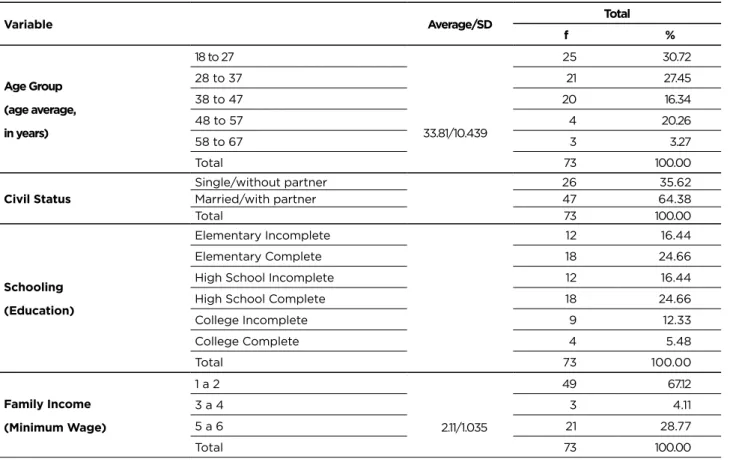
A total of 73 workers were surveyed, 72 of which worked with beauty and health services, specifically manicures, and the another one worked with complementary and esthetic therapies, a podiatrists. The participants’ sociodemographic data are presented in Table 1.
Table 1 - Distribution of workers in the services of beauty and hygiene, and technologists and technicians in complementary
and aesthetic therapies in relation to sociodemographic data. Minas Gerais, 2014. (n=73)
Variable Average/SD Total
f % Age Group (age average, in years) 18 to 27 33.81/10.439 25 30.72 28 to 37 21 27.45 38 to 47 20 16.34 48 to 57 4 20.26 58 to 67 3 3.27 Total 73 100.00 Civil Status Single/without partner 26 35.62 Married/with partner 47 64.38 Total 73 100.00 Schooling (Education) Elementary Incomplete 12 16.44 Elementary Complete 18 24.66
High School Incomplete 12 16.44
High School Complete 18 24.66
College Incomplete 9 12.33 College Complete 4 5.48 Total 73 100.00 Family Income (Minimum Wage) 1 a 2 2.11/1.035 49 67.12 3 a 4 3 4.11 5 a 6 21 28.77 Total 73 100.00 (To be continued)
Variable Average/SD Total
f %
People living on income
Up to 2 3.38/1.186 17 21.92 From 3 to 4 46 35.62 From 5 or more 10 13.70 Total 73 100.00
It was observed the predominance of female workers (72, 98.63%) performing the manicure function; the only male participant (1.37%) was a podiatrist. Regarding the total participant number, 51 (69.86%) of the interviewees did not engage in any physical activity; 21 (28.77%) had RSI/WRODs and 12 (14.63%) had high blood pressure; 38 (52.05%) reported pain, 31 (31.63%) in the spine and 11.24% in the neck.
Concerning the total participant number, 28 (38.36%) used medications routinely, mostly analgesics and muscle relaxants; 38 (52.05%) reported having received the complete hepatitis B/anti-tetanus vaccination scheme and 18 (24.66%) reported not having received any doses of these vaccines.
When asked about the PPE use, 46 (63.01%) wore gloves, 19 (26.03%) aprons, 7 (9.59%) masks and 6 (8.22%) glasses.
In relation to the activity time in these studies, the average was 8.79 years (median of 6 years). The majority, 61 (83.57%) worked from 6 to 8 hours a day and 29 (39.73%) worked, up to three times a week, more than 8 hours a day. Out of the total, 64 (87.67%) do not have an official work record, but 21 (28.77%) are individual (self-employed) taxpayers insured by the Instituto Nacional de Seguro Social (INSS) [Social Security National Institute]. Still, 43 are informal workers, that is, they do not contribute to Social Security and 9 (12.33%) are full-time employees (ruled by the Consolidation of Labor Laws), two of them are working as manicures for the first time. About previous labor experiences, only 7 (9.59%) had already worked as manicures, with a formal contract.
Regarding the diseases that may arise in the future, 25.61% mentioned RSI/WRODs; 42 (17%) bone diseases; 49 (19.84%) hepatitis B and C; 39 (15.79%) Acquired Immunodeficiency Syndrome (AIDS); 48 (19.43%) mycoses, eight (3.24%) tuberculosis and two (0.81%) believe that they will not acquire any disease. Four (5.48%) reported the occurrence of WA, three with sharps and one burn injury.
Considering the total participant number, 15 (20.55%) stated that they had withdrawn from work due to reasons related to some disability, and 11 (15.49%) had departures of up to 60 days and four (5.48%) for more than 6 months. Among those who reported leaving work, four (5.48%) received sickness insurance by Social Security and another 11 (15.07%) did not receive it, showing a possible fragility, since the vast majority of respondents were informal workers.
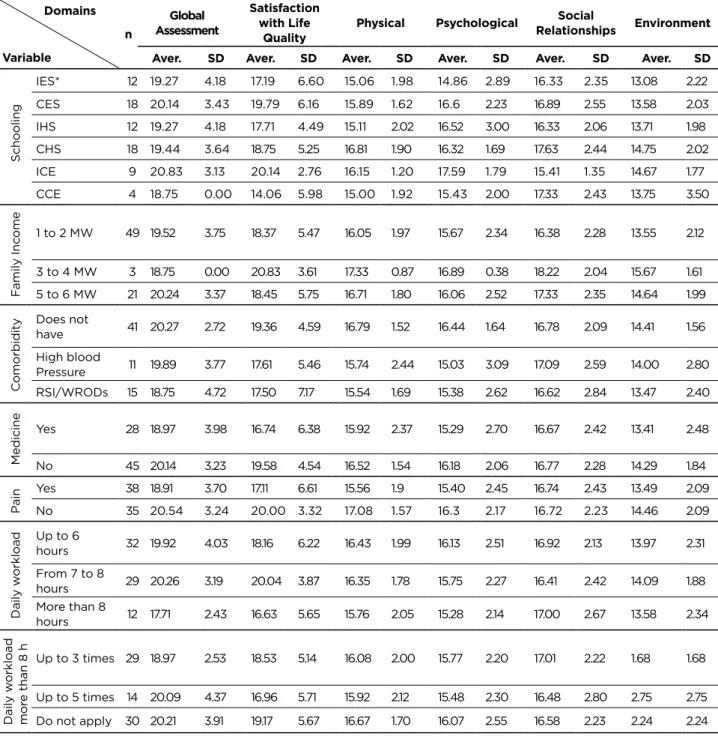
As for the overall evaluation of these workers, a difference of average between the schooling of the participant and the physical component of quality of life was observed (F =
2.793; p = 0.024, ω2 = 0.11), where people with incomplete college education (M = 17.59; SD = 1.20) presented an average higher than the incomplete elementary school (M = 14.86; SD = 1.98).
In terms of family income and life quality, there was a difference in the average between the family income of the participant and the environmental component of quality of life (t (68) = -2.009; p = 0.048; d = 0.49), where people who received between 1 and 2 minimum wages (M = 14.64, SD = 1.99) presented an average lower than the group that received between 5 and 6 minimum wages (M = 14.86; SD = 1.98).
In relation to comorbidities, we can identify that there was a mean difference between the existence of comorbidity of the participant and the physical component of quality of life (Fw (2.20) = 3.596; p = 0.046; ω2 = 0.08), where people who do not have comorbidities (M = 16.44; SD = 1.64) presented an average higher than the group with RSI (M = 15.54; SD = 1.68).
Analyzing the variable of routine medication use, there was a difference in mean between medication use and overall quality of life (t (71) = -2.140; p = 0.036; d = 0.51), where people that did not use medication (M = 16.71; SD = 2.97) presented an average higher than the group that used medication (M = 16.71; SD = 2.13).
Domain-related scores and overall WHOQOL-BREF assessment are presented sequentially in Table 2.
Table 2 - Scores related to the domains and the WHOQOL-BREF global assessment in relation to workers in the services of
beauty and hygiene, and technologists and technicians in complementary and aesthetic therapies. Minas Gerais, 2014 (n=73)
Domains Variable n Global Assessment Satisfaction with Life
Quality Physical Psychological
Social
Relationships Environment
Aver. SD Aver. SD Aver. SD Aver. SD Aver. SD Aver. SD
Schooling IES* 12 19.27 4.18 17.19 6.60 15.06 1.98 14.86 2.89 16.33 2.35 13.08 2.22 CES 18 20.14 3.43 19.79 6.16 15.89 1.62 16.6 2.23 16.89 2.55 13.58 2.03 IHS 12 19.27 4.18 17.71 4.49 15.11 2.02 16.52 3.00 16.33 2.06 13.71 1.98 CHS 18 19.44 3.64 18.75 5.25 16.81 1.90 16.32 1.69 17.63 2.44 14.75 2.02 ICE 9 20.83 3.13 20.14 2.76 16.15 1.20 17.59 1.79 15.41 1.35 14.67 1.77 CCE 4 18.75 0.00 14.06 5.98 15.00 1.92 15.43 2.00 17.33 2.43 13.75 3.50 F amily Inc ome 1 to 2 MW 49 19.52 3.75 18.37 5.47 16.05 1.97 15.67 2.34 16.38 2.28 13.55 2.12 3 to 4 MW 3 18.75 0.00 20.83 3.61 17.33 0.87 16.89 0.38 18.22 2.04 15.67 1.61 5 to 6 MW 21 20.24 3.37 18.45 5.75 16.71 1.80 16.06 2.52 17.33 2.35 14.64 1.99 C omorbidity Does not have 41 20.27 2.72 19.36 4.59 16.79 1.52 16.44 1.64 16.78 2.09 14.41 1.56 High blood Pressure 11 19.89 3.77 17.61 5.46 15.74 2.44 15.03 3.09 17.09 2.59 14.00 2.80 RSI/WRODs 15 18.75 4.72 17.50 7.17 15.54 1.69 15.38 2.62 16.62 2.84 13.47 2.40 Medicine Yes 28 18.97 3.98 16.74 6.38 15.92 2.37 15.29 2.70 16.67 2.42 13.41 2.48 No 45 20.14 3.23 19.58 4.54 16.52 1.54 16.18 2.06 16.77 2.28 14.29 1.84 P ain Yes 38 18.91 3.70 17.11 6.61 15.56 1.9 15.40 2.45 16.74 2.43 13.49 2.09 No 35 20.54 3.24 20.00 3.32 17.08 1.57 16.3 2.17 16.72 2.23 14.46 2.09 Daily w orkload Up to 6 hours 32 19.92 4.03 18.16 6.22 16.43 1.99 16.13 2.51 16.92 2.13 13.97 2.31 From 7 to 8 hours 29 20.26 3.19 20.04 3.87 16.35 1.78 15.75 2.27 16.41 2.42 14.09 1.88 More than 8 hours 12 17.71 2.43 16.63 5.65 15.76 2.05 15.28 2.14 17.00 2.67 13.58 2.34 Daily w orkload mor e than 8 h Up to 3 times 29 18.97 2.53 18.53 5.14 16.08 2.00 15.77 2.20 17.01 2.22 1.68 1.68 Up to 5 times 14 20.09 4.37 16.96 5.71 15.92 2.12 15.48 2.30 16.48 2.80 2.75 2.75 Do not apply 30 20.21 3.91 19.17 5.67 16.67 1.70 16.07 2.55 16.58 2.23 2.24 2.24 *IES: Incomplete Elementary School; CES: Complete Elementary School; IHS: Incomplete High School; CHS: Complete High School; ICE: Incomplete College Education; CCE: Complete College Education.
Concerning the medication use and satisfaction with life quality, a difference was observed in the average between medication use and satisfaction regarding the life quality (t
(44.017) = -2.057; p = 0.046; d = 0.53), and the participants who
did not use medication (M = 19.58; SD = 4.53) had an average higher than the group that used (M = 16.74; SD = 6.38).
In terms of the number of working hours, we have observed a difference in the average between the existence of the number of working hours per day; the overall life quality
(Fw(2.29) = 3.866; p = 0.032; ω2 = 0.06), the perception of life
quality (Fw (2.36) = 4.142; p = 0.024; ω2 = 0.03) and satisfaction with health (Fw (2.28) = 3.399; p = 0.047; ω2 = 0.05), with people working between 7 and 8 hours per day presenting averages higher than the group that works more than 8 hours.
No statistical significance was observed between the average number of days with more than eight hours of work and the components of the life quality.
DISCUSSION
The participants studied perform a feminine activity; perhaps because it is understood as activity of the “care” and continuity of the domestic activities, without the needed training/qualification, what is proven that reduces the exposure to risks.10
Professions considered masculine, such as: medicine and engineering are the most valued while those considered as female occupy a place of subordination in the labor market. This segmentation between activities seen as masculine and feminine exposes women to risks and professional devaluation, since in the so-called female professions, safety and well-being are neglected, and there are no policies aimed at improving the working class.4
This group of workers usually faces double or triple working hours, needing to give up their health care due to daily stress.4 Age is an important factor to consider, since it predisposes, particularly women, to the various pathologies, especially when already if you have more than five years of professional experience.4 The longer time in the activity can be related to the occurrence of pain due to the posture, uncomfortable positions and long working hours, besides the natural wear of the body that can be exacerbated by the working environment. Thus, age is one of the most important factors associated with the occurrence of pain due to the conjunction of biological and labor factors.3
Some women feel safer and more comfortable when they are in stable relationship or married, as they share the concerns and stress of everyday life with their partners. Nonetheless, marital life can also be a contributing factor to stress in some individuals.11 Women have greater exposures to occupational psychosocial risk factors and the occurrence of depressive symptoms, as compared to men.12 In general, there is an adding effect regarding the responsibilities to which the woman submits, where still remain under her
responsibility the care with the house and the family, in parallel with the participation in the labor market.
The schooling may influence the occurrence of some diseases. In addition to deregulation, job insecurity and occupational risks, susceptibility in the female population for diseases such as hypertension, diabetes and musculoskeletal problems is higher.13
The family income of the interviewees coincided with a survey conducted in the interior of São Paulo with professionals of the field, corresponding to a factor of social vulnerability, depriving the individual of having access to goods and services that could improve their quality of life, such as: leisure, culture, education and health.6
There were only two beauty centers registered in the trade representative body in the municipality. As there are workers who attend at home there may be greater vulnerability of disease transmission in the practices of professionals who are ambulant, since they go from house to house carrying their material, making the most varied contacts with clients who may or may not be sick and transmit some type sickness to the workers. On the other hand, it is difficult for workers, in this case, to comply with the biosafety norms, taking with them, in the attendance made in the customers’ homes, sufficient instruments for the exchange to each person attended or carrying sterilizer due to the difficulty of cleaning, disinfecting and sterilizing their instruments.
The sedentary lifestyle characteristic of contemporary society combined with the accumulation of daily tasks and lack of time make it difficult to practice activities.14
The RSI/WRODs is a health issue of public concern, since they compromise daily life activities and are characterized mainly by the presence of chronic pain, directly impacting public expenditures with these pathologies.3 Considering that manicures face long and exhausting working hours in uncomfortable positions, they are characterized as a large risk group for RSI/WRODs.3 The people suffering of these pathologies undergo changes in their field of work and in their daily life; simple tasks such as self care or caring for children are affected or hindered due to musculoskeletal conditions. Diagnosis by means of complementary examinations is not always possible; it is necessary to consider the risks present in the work and to understand the occupational history of the subject to establish the diagnosis of RSI/WRODs.2 An important fact that differentiates RSI/WRODs from other similar syndromes is that it can be prevented if their risk factors are properly identified and controlled.4
In relation to workers with hypertension, it is important to consider the cardiovascular factors, since these correspond to the major cause of mortality, mainly among women, being aggravated by lifestyle, sedentarism, among others.15 Low back pain is characterized as chronic and worrying pain, due to the limitations that can be imposed on the worker.3
The occurrence of chronic or acute pain can influence the functional capabilities of the individual, and may or may not be related to functional disability. Another factor
that can influence psychological status is a predictor of depression. Musculoskeletal pain is also associated with depression and fatigue.16
Musculoskeletal pain has multidimensional etiology involving a broad environmental, structural and biopsychosocial field. Women have factors other than biological ones such as mass and body composition that make them more susceptible to musculoskeletal pain. Other factors such as seated position and the use of inappropriate footwear, sometimes with heels, can cause damage to the posture and muscular shortening.3
It is important to consider the various aspects of professional and household routine to understand the full range of risks and vulnerability being assessed,3 such as unreasonable use of medicines, inadequate lifestyle and lack of prevention and vaccination. It was also verified the low knowledge regarding the importance of vaccination coverage, devaluing it as a means of protection to the pathogens to which they may be exposed due to their activities.17
In addition to polypharmacy and non-vaccination, there is a low adherence to the use of PPE. The need for training of skilled human resources has proved to be clear, which is essential for the correct prevention of the transmission of these pathogens by contaminated piercings.18
As they do not have an established income, I have a variable income according to the number of clients that attend, many work too much, and also without intervals. These conditions are aggravated by the informality of the occupational sector,17 because if they are unprotected from any regulations that guarantee them important social rights, such as a signed work permit, maternity leave, this fact is reflected in the increase in domestic employment coupled with the increase in self-employment.19 The greater flexibility of the market and the precariousness of labor relations constitute a dynamic that fosters the growth of female employment, increasing self-employment and informality in general.4
The legislation covers the worker with a formal contract (automatically affiliated to Social Security) as an employee. If you are not employed but have income (for instance, who owns the salon itself) and you must contribute and be registered as an individual contributor. Nevertheless, there are those who do not have any social security assistance, that is, they are in informality. Informal workers have lower levels of schooling and poorer health indicators compared to formal workers.13 Harmful working conditions are factors that can make the health of the individual vulnerable and regular working conditions can be factors of greater perception and health promotion. One can verify this situation of legal protection by analyzing the social security and labor information of the workers studied.3
The perception of the risks to which the worker is exposed influences the prevention of WA and the use of PPE, since the manicures and podiatrists of the present study are not aware of the perception about the risks they could acquire and transmit to their clients during their activities. It
is important not only to understand exposure to diseases and risks, but also the possibility of WA.2
Accidents are the most frequent among manicures. There are no reliable levels that quantify WAs in this category due to high underreporting; then making it difficult to establish means of prevention.3 Furthermore, the WA term is difficult to understand in both legal characterization and identification: distinguishing an WA from other characteristic events of the activity may be beneficial, influencing the use of PPE, enabling the realization of preventive practices.20
With regards to the people’s life quality, it was identified that factors such as schooling, family income, comorbidities and hours of work can directly influence the perception of quality of life, factors already demonstrated in the literature.8
Individuals with college education levels have more access to health services, better jobs and goods, and can result in a more positive perception of quality of life when compared to people with lower levels of education.22 This can be explained by the quality of life to be influenced by sociodemographic and economic characteristics; there is a relation between low income and compromises in the general state of health which can affect the perception of life quality.23
The presence of some musculoskeletal disorders such as RSI/WRODs may correspond to the individual’s functional impairments.24 In people affected by musculoskeletal disorders, the presence of pain is a preponderant factor, which may be a justification for the reduction or inability of the individual to perform their daily tasks, is a source of great psychological stress on these workers.25
The use of medications in these individuals can be a way to ease or eradicate pain and general health problems that can alter the life quality. Indiscriminate medicine use can be harmful, including pain treatments. The search for rapid analgesia and the negative impact that pain causes in these individuals may justify the high use of medication.26
Knowledge of the interaction between psychosocial work factors and mental health is still scarce. In French research it has been found that long hours of work may be linked to anxiety; the negative presence of psychosocial factors may be influences on the perception of life quality.27
The work organization interferes with the worker’s life, as follows: the longer the journey, the less time will be available for family life, and the greater the fatigue, the more the worker’s relationship with his family will be affected, since irritability and discouragement impair interpersonal contacts.28 Moreover, excessive work hours interfere with job satisfaction and increase the level of occupational stress.29
Considering the whole health context of these workers and the conceptual bases, principles, directives and strategies of the Política Nacional de Saúde do Trabalhador
e da Trabalhadora do Sistema Único de Saúde (PNST-SUS)
[National Health Policy for the Workers from the Unified Health System], the need to provide integral health care of the workers.30 However, the actual insertion of workers’ health actions in SUS is directly related to the possibility of their
assimilation by primary care. In addition to organizational factors, the growth of informal, family and home-based work reinforces the role of Primary Care in bringing health care as close as possible to where people live and work. The reception of workers at the entrance to the system, the investigation of work as a determinant of health/disease processes and the evaluation of risk situations at work are concrete possibilities at the primary level of attention.30
As limitations of the study, it is important to underline the difficulty of estimating the real quantitative of existing workers in these professions, since the expressive majority is informal, attend in the homes of their clients or in their own homes, and also do not have fixed and/or identifiable working place.
CONCLUSION
The study identified the profile of workers regarding the health and working conditions in the services of beauty, hygiene, and both complementary and aesthetic therapies, and also evaluated their quality of life in a city from Minas
Gerais State.
Among the study’s participants, it was observed a female predominance with 72 (98.63%) and an average age of 33.81 years old. The most reported comorbidity was RSI/ WRODs in 21 (28.77%) and 38 (52.05%) reported pain, and 31 (31.63%) reported specifically low back pain. It was noted the fragilities to which these workers are exposed as the incorrect or absent use of PPE, the lack of ergonomic principles, the ignorance of the risks and WA that in the course of the activities can influence the emergence of the RSI/WRODs.
Regarding the quality of life, the education, the family income, and the presence of both comorbidities and pain influenced the individuals’ perception of life quality.
The strengthening of prophylactic actions with these workers is necessary in order to alleviate the impacts of the labor activities on these individuals. Further research about the subject is suggested, since its work activities can significantly impact every society if the principles of biosafety are not respected. Professional appreciation and improvements in working conditions should be sought, recognizing the importance of labor characteristics in the perception of life quality.
The study showed that there is a need for public policies focused on the health of these workers, along with health education and prophylactic actions.
REFERENCES
1. Van der Klauw M, Hengel KO, Roozeboom MB, Koppes L, Venema A. Occupational accidents in the Netherlands: incidence, mental harm, and their relationship with psychosocial factors at work incidence. Int J Inj Contr Saf Promot. [Internet]. 2014[cited 2014 Dec 15];1–6. Available from: http://www.tandfonline.com/doi/pdf/10.108 0/17457300.2014.966119.
2. Mendes R. Patologia do trabalho. 3a ed. Rio de Janeiro: Atheneu; 2013. 2070 p.
3. De Menezes Kinote APB, Garcia AEA, Vidal LMD, Melo LTM, dos Santos Vasconcelos R, Abdon APV. Ocorrência de dor na coluna vertebral e sua relação com a qualidade de vida de manicures e pedicures. Rev Bras Em Promoção Saúde [Internet]. 2014 [cited 2014 Dec 15];26(3):318–24. Available from: http://ojs.unifor.br/index.php/ RBPS/article/view/2933/pdf.
4. Garbaccio JL, Oliveira AC. Accidents with exposure to biological stuff, vaccine coverage and procedures after accidents among manicure/pedicure professionals. J Nurs UFPE Line [Internet]. 2013 [cited 2014 Dec 15];7(6):4421–9. Available from: http://www.revista. ufpe.br/revistaenfermagem/index.php/revista/article/view/4466/ pdf_2755.
5. Brasil. Classificação Brasileira de Ocupações (CBO). [cited 2014 Dec 15]. Available from: http://www.mtecbo.gov.br/cbosite/pages/ pesquisas/BuscaPorTituloResultado.jsf.
6. Yoshida CH, Oliveira RA de, Coelho PG, Fonseca FLA, Filipini R, Yoshida CH, et al. Process of instrument sterilization in shops with manicure and pedicure services. Acta Paul Enferm. [Internet]. 2014[cited 2014 Dec 15]; 27(1):18–22. Available from: http://www.scielo.br/scielo.php?script=sci_arttext&pid=S0103-21002014000100005&lng=en&nrm=iso&tlng=en.
7. Brasil. Resolução Conselho Nacional de Saúde n. 466, de 12 de dezembro de 2012.Estabelece as diretrizes e normas brasileiras regulamentadoras de pesquisas envolvendo seres humanos. 2012. Available from: http://conselho.saude.gov.br/resolucoes/2012/ Reso466.pdf.
8. Palhares V de C, Corrente JE, Matsubara BB, Palhares V de C, Corrente JE, Matsubara BB. Association between sleep quality and quality of life in nursing professionals working rotating shifts. Rev Saúde Pública [Internet]. 2014[cited 2014 Dec 15]; 48(4):594–601. Available from: http://www.scielo.br/scielo.php?pid=S0034-89102014000400594&script=sci_arttext.
9. Field A. Descobrindo a estatística usando o SPSS. 2o ed. Porto Alegre: Artmed; 2009.
10. Rincón Cuervo CG, Ortiz Vásquez AM. Descripción de la jerarquía de controles frente al peligro químico por exposición a compuestos orgánicos volátiles generados por procesos de pintura en el sector industrial. Investig Enferm. Imagen Desarr. 2015;17(1):149-69. http:// dx.doi.org/10.11144/Javeriana.IE17-1.djcp.
11. Heidemann ITSB, Wosny A de M, Boehs AE, Heidemann ITSB, Wosny A de M, Boehs AE. Health promotion in primary care: study based on the Paulo Freire method. Ciênc Amp Saúde Coletiva [Internet]. 2014 [cited 2014 Dec 15];19(8):3553–9. Available from: http://www.scielo.br/scielo.php?script=sci_arttext&pid =S1413-81232014000803553.
12. Ansoleaga E, Vezina M, Montano R, Ansoleaga E, Vezina M, Montano R. Depressive symptoms and work-related stress in Chilean workers: differential conditions for males and females. Cad Saúde Pública [Internet]. 2014 [cited 2014 Dec 15];30(1):107–18. Available from: http://www.scielo.br/scielo.php?pid=S0102-311X2014000100107&script=sci_arttext.
13. Miquilin I de OC, Marín-León L, Monteiro MI, Filho C, Rodrigues H. Inequalities in health services access and use among formal, informal, and unemployed workers, based on data from the Brazilian National Household Sample Survey. Cad Saúde Pública [Internet].2013[cited 2014 Dec 15]; 29(7):1392–406. Available from: http://www.scielo.br/scielo.php?pid=S0102-311X2013000700013&script=sci_arttext.
14. Vázquez-Nava F, Treviño-Garcia-Manzo N, Vázquez-Rodríguez CF, Vázquez-Rodríguez EM. Association between family structure, maternal education level, and maternal employment with sedentary lifestyle in primary school-age children. J Pediatr [Internet] 2013 [cited 2014 Dec 15];89(2):145–50. Available from: http://www.ncbi. nlm.nih.gov/pubmed/23642424.
15. Pereira IVS, Rocha M de JL, Silva VM da, Caldeira AP, Pereira IVS, Rocha M de JL, et al. Self-reported morbidity by workers in the Family Health Teams. Ciênc Amp Saúde Coletiva [Internet]. 2014[cited 2014 Dec 15] ;19(2):461–8. Available from: http://www.scielo.br/scielo.php?script=sci_arttext&pid =S1413-81232014000200461.
16. Snekkevik H, Eriksen HR, Tangen T, Chalder T, Reme SE. Fatigue and depression in sick-listed chronic low back pain patients. Pain Med Malden Mass 2014[cited 2014 Dec 15] ;15(7):1163–70. Available from: http://www.ncbi.nlm.nih.gov/pmc/articles/ PMC4265279/.
17. Moraes JT, Barbosa FI, Costa TRS, Ferreira AF. Hepatite B: percepção de risco e adoção de medidas de biossegurança por manicures/pedicures de Itaúna-MG. Rev Enferm Cent-Oeste Min [Internet]. 2013[cited 2014 Dec 15] Available from: http://www.seer. ufsj.edu.br/index.php/recom/article/viewArticle/225.
18. Souza-Borges FRF de, Ribeiro LA, Oliveira LCM de, Souza-Borges FRF de, Ribeiro LA, Oliveira LCM de. Occupational exposures to body fluids and behaviors regarding their prevention and post-exposure among medical and nursing students at a brazilian public university. Rev Inst Med Trop São Paulo [Internet]. 2014[cited 2014 Dec 15] ;56(2):157–63. Available from: http://www.ncbi.nlm.nih.gov/ pmc/articles/PMC4085846/.
19. Hanklang S, Kaewboonchoo O, Silpasuwan P, Mungarndee SS. Musculoskeletal disorders among Thai women in construction-related work. Asia-Pac J Public Health Asia-Pac Acad Consort Public Health [Internet]. 2014[cited 2014 Dec 15] ;262:196–202. Available from: http://aph.sagepub.com/content/26/2/196.short.
20. Alves AP, Ferreira MD, Prearo MF, Gir E, Canini SRM da S. Subnotificação de acidentes ocupacionais com material biológico pela enfermagem no bloco cirúrgico. Rev Eletrônica Enferm [Internet]. 30 de junho de 2013[cited 2014 Dec 15] ;152. Available from: http:// www.fen.ufg.br/revista/v15/n2/pdf/v15n2a09.pdf.
21. Alcântara MA de, Nunes G da S, Ferreira BCM. Distúrbios osteomusculares relacionados ao trabalho: o perfil dos trabalhadores em benefício previdenciário em Diamantina (MG, Brasil). Ciênc Saúde Coletiva [Internet].2011[cited 2014 Dec 15] ;16(8):3427–36. Available from: http://www.scielo.br/scielo.php?script=sci_arttext&pi d=S1413-81232011000900010.
22. Parente C, Neto HV, Ramos M, Cruz SA, Marcos V. Os jovens pouco escolarizados no mercado de trabalho português. Análise Soc. [Internet]. 2014[cited 2014 Dec 15];(210):74–102. Available from: https://repositorio.iscte-iul.pt/bitstream/10071/8172/3/RamosM_ AS_210_d01.pdf.
23. Okuno MFP, Gomes AC, Meazzini L, Scherrer Júnior G, Belasco Junior D, Belasco AGS, et al. Quality of life in elderly patients living with HIV/AIDS. Cad Saúde Pública [Internet].2014[cited 2014 Dec 15] ;30(7):1551–9. Available from: http://www.scielo.br/scielo. php?script=sci_arttext&pid=S0102-311X2014000701551. 24. Phongamwong C, Mungkumpa A, Pawapootanon W, Saiyotha D,
Duangtapha C. The impact of musculoskeletal pain on health-related quality of life in Fort Prajaksilapakom Hospital. J Med Assoc Thail Chotmaihet Thangphaet [Internet].2014 [cited 2014 Dec 15] ;97 Suppl 2:S181–7. Available from: http://occup-med.biomedcentral. com/articles/10.1186/s12995-015-0063-8.
25. Chang J-H, Wu J-D, Chen C-Y, Sumd S-B, Yin H-I, Hsu D-J. Risks of musculoskeletal disorders among betel quid preparers in Taiwan. Am J Ind Med. [Internet]. 2014 [cited 2014 Dec 15];57(4):476–85. Available from: https://www.researchgate.net/profile/Jer-Hao_Chang/publication/259919001_Risks_of_Musculoskeletal_ Disorders_among_Betel_Quid_Preparers_in_Taiwan/ links/0c9605340104de6eb1000000.pdf.
26. Martinez JE, Pereira GAF, Ribeiro LGM, Nunes R, Ilias D, Navarro LGM, et al. Study of self-medication for musculoskeletal pain among nursing and medicine students at Pontifícia Universidade Católica - São Paulo. Rev Bras Reumatol [Internet]. 2014 [cited 2014 Dec 15] ;54(2):90–4. Available from: http://ac.els-cdn.com/ S0482500414000357/1-s2.0-S0482500414000357-main.pdf?_ tid=53f8ac46-d739-11e5-8a11-00000aacb35d&acdnat=1455907872_5 223b7dae07c022a0021fdae640f7686.
27. Niedhammer I, Lesuffleur T, Algava E, Chastang JF. Classic and emergent psychosocial work factors and mental health. Occup Med Oxf Engl. [Internet]. 2014[cited 2014 Dec 15]. Available from: http:// occmed.oxfordjournals.org/content/early/2014/12/21/occmed. kqu173.full.pdf.
28. Goulart CT, Guido L de A, Silva RM da, Bublitz S, Grazziano E da S. Effects of stress management programs in health workers: integrative review. J Nurs UFPE Line [Internet].2014[cited 2014 Dec 15];9(4):7431–8. Available from: http://www.revista.ufpe.br/ revistaenfermagem/index.php/revista/article/view/5675/pdf_7573. 29. Kang SH, Boo YJ, Lee JS, Han HJ, Jung CW, Kim CS. High
Occupational Stress and Low Career Satisfaction of Korean Surgeons. J Korean Med Sci [Internet]. 2015[cited 2014 Dec 15] ;30(2):133–9. Available from: http://www.ncbi.nlm.nih.gov/pmc/articles/ PMC4310937/.
30. Ministério da Saúde. Portaria no 1.823, de 23 de agosto de 2011. Institui a Política Nacional de Saúde do Trabalhador e da Trabalhadora. Portaria 1823 ago 23, 2012. Available from: http://bvsms.saude.gov.br/ bvs/saudelegis/gm/2012/prt1823_23_08_2012.html. Received on: 08/11/2016 Reviews required: 09/03/2017 Approved on: 31/03/2017 Published on: 10/04/2018 _________
Author responsible for correspondence:
Fabiana Medeiros de Brito Federal University of Paraíba – UFPB Artur Santos Viana street no.31 Centro, Cabedelo/PB Telephone number: (+55 83) 9608-2544/8824-0023 ZIP Code: 58100-575