J. res.: fundam. care. online 2014. jul./set. 6(3):897-908
897
RESEARCH
Processo de enfermagem segundo o modelo do autocuidado em um paciente cardiopata restrito ao leito
Nursing process according the model of self-care in a cardiac bedridden patient
Proceso de enfermería según el modelo de auto-cuidado en un paciente cardíaco postrado en cama Lorena Cabral Felipe 1 , Aryele Rayana Antunes de Araújo 2 , Allyne Fortes Vitor 3
Objective: it objects the application of the nursing process according to the self-care model proposed by Dorothea Orem. Method: case study with descriptive character and qualitative approach, which allows a deep analysis of the subject and of the complexity determined by the proposed model. The data analysis showed the ability of self-care and the need for self-care of the subject being watched. Results: patient showed interest in the dynamic of the procedures by which it was submitted. However, there was four self-care deficits diagnosed by the researchers, both according to the model studied as well as according to the NANDA-I taxonomy, which ought to be remedied by the nursing staff. Conclusion: it was noticed that the model of self-care proposed by Orem is applicable, of simple understanding, and therefore, viable to practice daily care of the nursing staff to a cardiac bedridden patient. Descriptors: nursing, self-care, nursing process, heart failure.
Objetivo: aplicar o processo de enfermagem segundo o modelo do autocuidado, proposto por Dorothea Orem. Método: estudo de caso de caráter descritivo com abordagem qualitativa, que permite uma análise profunda do sujeito e da complexidade determinada pelo modelo proposto. Na análise dos dados, observou-se a capacidade e a necessidade de autocuidado do sujeito a ser assistido. Resultados: paciente mostrava-se interessada na dinâmica dos procedimentos aos quais era submetida. No entanto, apresentava quatro déficits de autocuidados diagnosticados pelas pesquisadoras, tanto de acordo com o modelo estudado e a taxonomia NANDA-I, que deveriam ser supridos pela equipe de enfermagem. Conclusão: percebeu-se que o modelo do autocuidado proposto por Orem é aplicável, de simples entendimento, e por isso viável para a prática do cuidado cotidiano da equipe de enfermagem a um paciente cardiopata restrito ao leito. Descritores: enfermagem, autocuidado, processo de enfermagem, insuficiência cardíaca.
Objetivo: aplicación del proceso de enfermería, de acuerdo con el modelo de autocuidado propuesto por Dorothea Orem. Método: estudio de caso con un enfoque descriptivo cualitativo, que permite un análisis profundo del tema y la complejidad determinada por el modelo. En el análisis de los datos se observó la capacidad y la necesidad de autocuidado del sujeto observado. Resultados: los pacientes se presentaron interesados en la dinámica de los procedimientos a los cuales eran sometidos. Sin embargo, presentó cuatro déficits de autocuidado diagnosticados por los investigadores, con el modelo estudiado por la taxonomía NANDA-I como, que debe ser suministrada por el personal de enfermería. Conclusión: se observó que el modelo de auto-cuidado propuesto por Orem es aplicable, de comprensión simple, y por lo tanto factible para practicar el cuidado diario del personal de enfermería a un paciente cardíaco postrado en cama. Descriptores: enfermería, autocuidado, procesos de enfermería, insuficiencia cardíaca.
1Student of the Nursing Graduation Course. Federal University of Rio Grande do Norte. Brasil. Health Science; Nursing. E-mail: [email protected]. 2Student of the Nursing Graduation Course. Federal University of Rio Grande do Norte. Brasil. Health Science; Nursing. E-mail: [email protected]. 3Doctor of Nursing. Fedral University of Rio Grande do Norte. Brasil. Health Science; Nursing. E-mail: [email protected].
ABSTRACT
RESUMEN RESUMO
J. res.: fundam. care. online 2014. jul./set. 6(3):897-908
898
T
he use of the theories of nursing provides the operationalization of nursing practice, which is one of the instruments used in the systematization of the assistance, which significantly contributes to the development of the profession. The consolidated practice in the theories of nursing provides a critical action and creatively reflective by the professional developing his work process. Therefore, the objective of this study is the application of the nursing process according to the model of Self-care proposed by Dorothea Orem.Notably, the Self-care Model suggests a focus on observation, analysis and action on the need to be assisted holistically. The response to this need embraces the domain of three main theories discussed by the author, which are: theory of self-care, self-care deficit theory and systems theory of nursing.1
Orem believes that all have potential, in varying degrees, to take care of themselves and those who are under their responsibility. Among the various application contexts, it is highlighted the cardiovascular disease, due to the possibility of compromising the ability for self-care.2
In this context, it is highlighted the patient with clinical diagnosis of congestive heart failure (CHF). This is the impossibility of the cardiac pump eject satisfactorily the blood that the ventricle receives during diastole, leading to pulmonary edema with consequent dyspnea, orthopnea, activity intolerance and fatigue to small efforts.
In addition, in an attempt to compensate for decreased cardiac output for the body, the kidneys retain sodium and water, mainly causing edema in upper and lower limbs.3
On top of this, a study on the applicability of Orem model in cardiac patients points out that the cardiopathy generally involved negative impact on the ability to perform self-care and, consequently the interpersonal relationships performed by the individual. For this reason, it is important that the team is attentive to the new forms of communication that can be established seeking to meet the demands of the patient self-care.1
The individual who enjoys perfect health conditions is able to perform his self-care activities. When affected by a fragility new self-care needs will emerge as well as to present a difficulty to perform ancient actions already performed. The self-care model of Orem says that nursing is necessary where the ability to develop self-care actions of the individual by himself are inferior to his needs, being those distinguished in quantity, quality or technical specificity.4
Thus, the objective is the application of the nursing process according to the model of self-care of Dorothea Orem, justifying its use the hospital routine by nursing professionals.
The study stresses that the nursing process recommended by the North American Association of nursing is commonly consisting of five steps: data collection, nursing diagnosis, planning, implementation and evaluation. Distinctively, the process according to
INTRODUCTION
J. res.: fundam. care. online 2014. jul./set. 6(3):897-908
899
METHOD
the model of Orem is grouped into three steps: Step 1- Nursing Diagnosis and prescription, that involves prior investigation by the professional; Step 2- Draft for the Regulatory Operation, where the system of nursing required to assistance is set to guide the planning of the action currently performed; Step 3-Production and Control of Nursing Systems, which is configured in the action of the nurse to intervene on the needs of self-care, as well as to assess continuously the effects of his action.5
To Dorothea Orem the self-care is defined as the "performance or practice activities that individuals perform on their behalf to maintain the life, health and welfare". Age, stage of development and state of health are conditions that determine the ability of the individual to engage in his own self-care actions. The needs not met feature a self-care deficit which imposes a therapeutic demand of self-care, which should be assisted by the deliberate action of a group on enjoyment of another.4
Orem classifies self-care requirements into three subgroups, the universal self-care, relative to that which is associated to the vital processes intrinsic to the human being like water, air, feeding and excretion; the developmental requirements, including requirements that arise when there are new situation being faced by the individual; and the self-care requirements of health deviation, dismissed in affection condition and/or diagnosis.
The self-care model is based on the need and ability of the individual to perform his own actions of self-care, as well as in the need of nursing intervention in providing such actions. Nursing systems were subdivided according to the lack of self-care of the individual in: 1. Fully compensatory system, where the individual is unable to engage in any form of deliberate action by being unconscious, or unable to maintain an auto-run handling, or those who are able to perform actions, but are unable to decide for them; 2. Partially compensatory system when the professional and the patient at the same time engage in the action of self-care; 3. Education support system, in which the nurse is a vehicle of information that will prepare the patient to adequately develop his actions of self-care.
This is a case study of descriptive character with a qualitative approach, which allows an in-depth analysis of the subject and the complexity determined by the proposed model. It was developed in a university hospital, located in a city of the Northeast of Brazil, between April and May 2012, by applying an itinerary of physical examination and semi-structured interview form.6
The patient discussed in this study was chosen randomly in the Clinical Cardiology unit at the hospital and he was selected by meeting the inclusion criteria: 1. To be the bearer of cardiopulmonary diseases; 2. To be bedridden; 3. To accept the research participation by signing the Free and Clarified Consent Statement. By impossibility of writing by the patient, the Statement was signed by the family after the appropriate clarifications about the goals, risks and benefits of the research.
J. res.: fundam. care. online 2014. jul./set. 6(3):897-908
900
RESULTS AND DISCUSSION
The research applied the nursing process according to Dorothea Orem Self-care model to emphasize the observation, analysis and action on the need to be assisted holistically. The data collection instrument was adapted from the example proposed by the model and covered the following aspects: 1. Personal factors: age, sex, height, weight, marital status, race, culture, religion and occupation; 2. universal self-care: air, water, excrement, activity/rest, loneliness/social interaction, risk life and welfare, promotion of functioning and human development; 3. Auto developmental care: specialized needs for the developmental process, new requirements of a condition, requirements associated with an event; 4. Misuse of health: disease conditions, treatment to correct condition;5. Plan and
medical problem: diagnosis and treatment;6. Self-care deficits: differences between the
needs of self-care and the self-care abilities.
As a way to assess the patient's self-care demands under the optics of the classification systems applied in the Systematization of Nursing Care, the nursing diagnoses had been raised with the use of the NANDA-I Taxonomy and nursing interventions identified as NIC classification.
To this end, an instrument was adapted from Dorothea Orem Self-care Model with: 1. NANDA-I nursing diagnoses; 2. demands of self-care; 3. Plans: goals and objectives; 4. Implementation: proposed interventions by NIC.
The research is part of a larger project, referring to the Systematization of Nursing Care to patients with heart problems, carried out with the approval of the Research Ethics Committee of the hospital, according to the opinion embodied 121,028 and CAAE 07614812.6.0000.5537.
Survey data (Patient history)
M.C., Brazilian, married, housewife, 64-year-old mother of five children. SHE sought the health service of her town after a vaginal bleeding. At that moment, a hysterectomy surgery has been requested. For the preoperative to surgical risk assessment, serious changes of electrocardiogram were detected. She received medical diagnosis of left heart failure with diastolic regurgitation caused by a mitral insufficiency with tendons rupture and aortic insufficiency caused by a valve calcification. The patient was transferred to the university hospital located in a city of the Northeast of Brazil for monitoring and treatment.
At the time of data collection, the patient evolved into a regular general state, conscious, oriented, responsive and collaborative. She complained of pain in right upper limb to sudden movement. Bedridden, she received a hypo-sodium diet via nasogastric probe. She was hydrated, normal colored, with an edema in the right upper limb 3+/4+ and the right lower limb 2+/4+, without the presence of ulcers. She had peripheral venous access was in the left upper limb with hydration. She was using mechanical
J. res.: fundam. care. online 2014. jul./set. 6(3):897-908
901
ventilation by tracheostomy to 35% O2, with productive cough and without effectiveexpectoration, diuresis and spontaneous elimination in diapers.
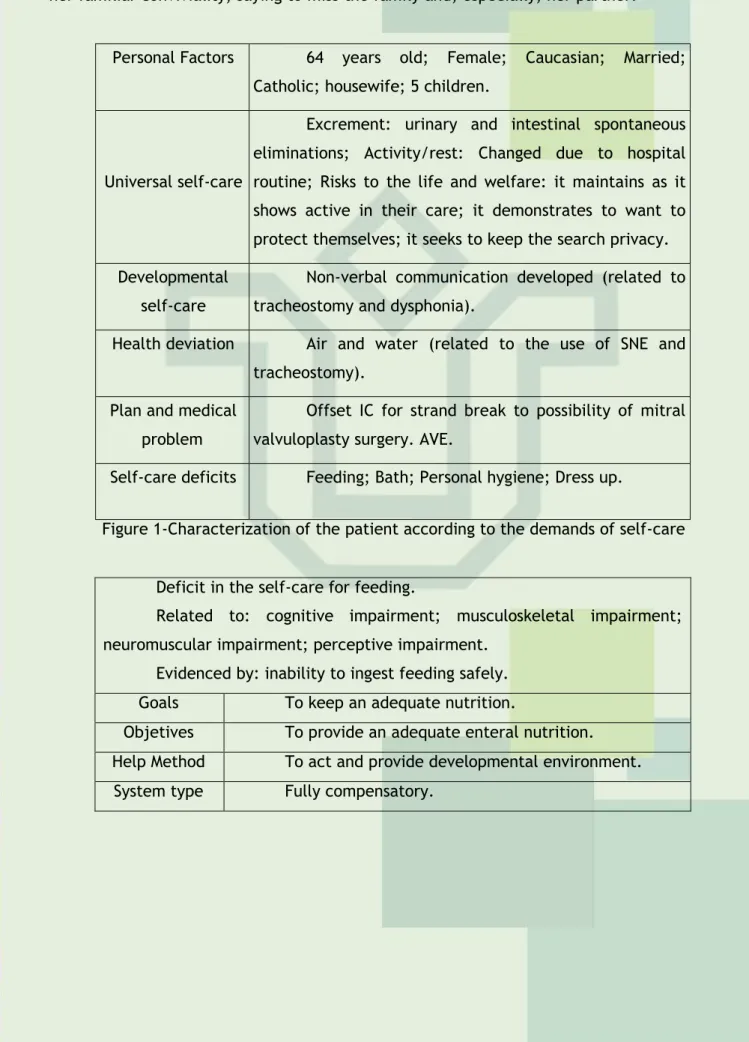
The patient was interested in the dynamics of the procedures by which she was subjected. She demonstrated effort in understanding her clinical picture, as well as examinations and procedures. Despite the dysphonia aggravated by tracheostomy, her communication was efficient. Due to the instability of her clinical condition and the prolongation of hospitalization, she expressed disquiet concerning the dismemberment of her familiar conviviality, saying to miss the family and, especially, her partner.
Personal Factors 64 years old; Female; Caucasian; Married; Catholic; housewife; 5 children.
Universal self-care
Excrement: urinary and intestinal spontaneous eliminations; Activity/rest: Changed due to hospital routine; Risks to the life and welfare: it maintains as it shows active in their care; it demonstrates to want to protect themselves; it seeks to keep the search privacy. Developmental
self-care
Non-verbal communication developed (related to tracheostomy and dysphonia).
Health deviation Air and water (related to the use of SNE and tracheostomy).
Plan and medical problem
Offset IC for strand break to possibility of mitral valvuloplasty surgery. AVE.
Self-care deficits Feeding; Bath; Personal hygiene; Dress up.
Figure 1-Characterization of the patient according to the demands of self-care Deficit in the self-care for feeding.
Related to: cognitive impairment; musculoskeletal impairment; neuromuscular impairment; perceptive impairment.
Evidenced by: inability to ingest feeding safely. Goals To keep an adequate nutrition.
Objetives To provide an adequate enteral nutrition. Help Method To act and provide developmental environment.
J. res.: fundam. care. online 2014. jul./set. 6(3):897-908
902
Nursinginterventions
-To monitor the correct placement of the probe, examining the oral cavity by checking the gastric residue, or listening while the air is injected and withdrawn, according to institutional protocol.
- To monitor the presence of intestinal sounds every 4-8 h, where appropriate.
-To irrigate the catheter every 4-6 h during feedings and after each intermittent feeding.
-To check the drip flow or flow of pumping every hour.
-To check the waste every 4-6 h during continue feeding and before intermittent feeding.
-To keep the tracheal probe or tracheostomy cuff inflated during feeding, when appropriate.
Figure 2: Systematization of nursing care for the self-care deficit nursing diagnosis for feeding.
Deficit in the self-care for bath.
Related to: cognitive impairment; musculoskeletal impairment; neuromuscular impairment; perceptive impairment.
Evidenced by: inability to wash the body.
Goals To provide a proper body hygiene.
Objetives To perform an adequate personal hygiene.
Help Method To act for help and to provide developmental environment.
System type Partly compensatory. Nursing
interventions
-To provide the desired personal items;
-To facilitate the patient brushing of teeth, when appropriate;
-To monitor the nails cleaning, depending on the patient's self-care capacity;
Figure 3: Systematization of nursing care for the self-care deficit nursing diagnosis for bath.
Deficit in the self-care for intimate hygiene.
Related to: cognitive loss, neuromuscular loss, tiredness, pain, state of impaired mobility.
Evidenced by: inability to do a proper hygiene.
Goals To provide personal hygiene when required. Objetives To keep a proper hygiene.
Help method To act and to provide developmental environment. System type Partly compensatory.
J. res.: fundam. care. online 2014. jul./set. 6(3):897-908
903
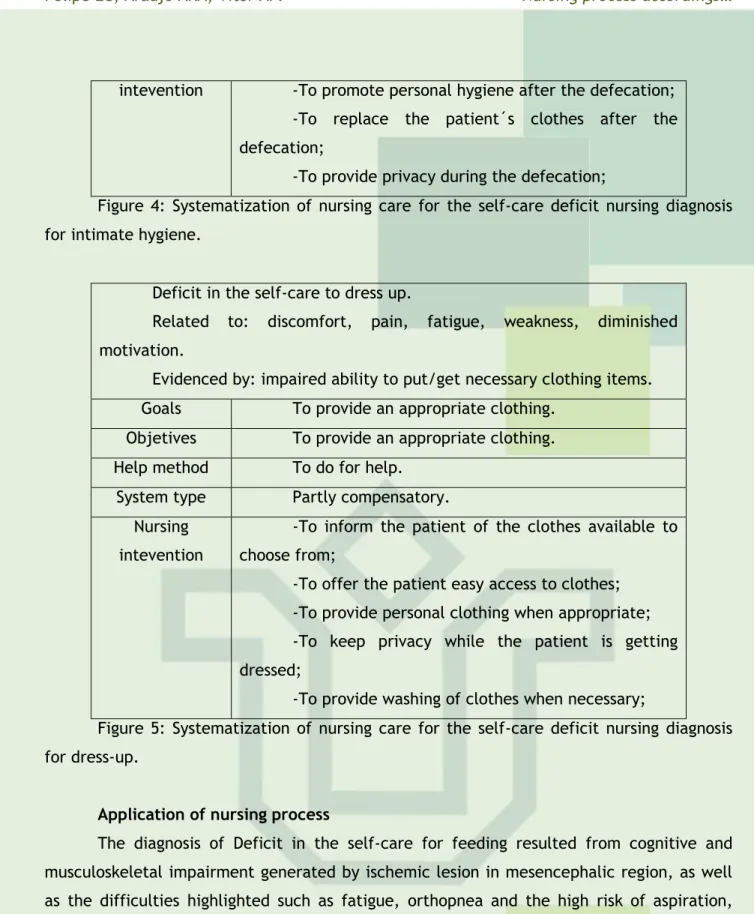
intevention -To promote personal hygiene after the defecation;-To replace the patient´s clothes after the defecation;
-To provide privacy during the defecation;
Figure 4: Systematization of nursing care for the self-care deficit nursing diagnosis for intimate hygiene.
Deficit in the self-care to dress up.
Related to: discomfort, pain, fatigue, weakness, diminished motivation.
Evidenced by: impaired ability to put/get necessary clothing items. Goals To provide an appropriate clothing.
Objetives To provide an appropriate clothing.
Help method To do for help.
System type Partly compensatory. Nursing
intevention
-To inform the patient of the clothes available to choose from;
-To offer the patient easy access to clothes; -To provide personal clothing when appropriate; -To keep privacy while the patient is getting dressed;
-To provide washing of clothes when necessary;
Figure 5: Systematization of nursing care for the self-care deficit nursing diagnosis for dress-up.
Application of nursing process
The diagnosis of Deficit in the self-care for feeding resulted from cognitive and musculoskeletal impairment generated by ischemic lesion in mesencephalic region, as well as the difficulties highlighted such as fatigue, orthopnea and the high risk of aspiration, which made the oral feeding infeasible to patient. Due to the total loss of the ability to feed by herself and even to decide about the diet, nursing care spent on parenteral nutrition fit in the nursing system fully compensatory. In order to provide and keep an adequate parenteral nutrition, the nursing interventions implemented sought to correct the placement of the probe as well as the maintenance of its patency rates, assessing the quantity of food infused and if this was being adequately absorbed by the gastrointestinal tract. Thereby, it was used the Model itself with the purpose to evaluate the interventions implemented by the team.
The diagnostics for “deficit in the self-care for the bath”, "deficit in the self-care for intimate hygiene" and "deficit in the self-care to dress up" also related to musculoskeletal impairment and due to the fatigue generated by the IC, became tiring activities and waist a lot of energy. Suitable with the system partially compensatory, the bath activities, personal hygiene and dressing up were performed by the nursing staff together with the patient who could decide on the needs of such activities, on some actions to be performed during procedures, as well as participated actively within their restrictions, changing of decubitus,
J. res.: fundam. care. online 2014. jul./set. 6(3):897-908
904
raising or removing members. For the purpose of conducting a personal hygiene and intimate suitable and to provide the active participation in their clothing choices, at the same time promoted a developmental environment, it was sought to give the comfort of such actions.The patient had medical diagnosis of IC which, in turn, it is a disease that has commonly self-care needs that must be met, by the patient or caregiver, to maintain or recover the state of health, as well as to provide a better quality of life for these people. In this sense, an American study discusses the self-care as core in improving health of this population, to emphasize the importance of managing care as cardio-protective measure to slow the progression of the IC. Soon, in spite of small efforts, the study argues the stimulus by the team for the implementation of self-care.7-8
The IC submitted by the patient has pulmonary congestion, which raises difficulties the hematosis in alveoli, and, consequently, the dyspnea. A study published in 2007 shows that the mechanical ventilator support installed as therapeutic measure decreases the degree of Dyspnea installation, in addition to increasing the participation of the individual in self-care activities.9
Such therapeutic measure is maintained through an artificial tracheal prosthesis, whose distal portion contains a cuff, which has the function to seal the airway, preventing the escape of air, thereby maintaining proper ventilation and decreasing the incidence of pulmonary aspiration. It is known, however, that due to the presence of tracheal prosthesis together with an excessive production of mucus, there is usually an accumulation of secretions in the full extent of the respiratory tract. Thus, when there is the accumulation and the patient is unable to eliminated it, the nurse should act to remove the secretions in order to facilitate the passage of air and to promote gas exchange.10-11
In corroboration with the clinical manifestations presented by the patient, the study relates to decreased ability to perform functional activities and self-care with the reduction of sensory skills and motor function of limbs affected by Cerebrovascular Accident, what makes more dependent care patients.12
The other self-care demands presented by the patient can be justified by the condition of senescence that naturally leads to a loss of the ability to engage in self-care, which worsens the further development of the diseases of the old age. So self-care demands are generated in greater quantity and higher degree of specificity that must be remedied by the nursing staff.13
With respect to the bedridden in this patient research, a study published in 2010 says that the prolonged immobilization in bed represents for the patient at high risk of developing the disuse syndrome, which is defined as a reduction in the functional capacity of all systems of the organism. Such a situation is intensified by the body's natural condition senile, developing in the patient complications that generate demands of more complex self-care, making required the attention of a larger number of professionals, as well as procedures, medications and hospitalization time.13-14
On the last day of data collection in this case, it was found that this patient was in the 80th day of hospitalization. Long periods of hospitalization entail an emotional stress to the patient and the family, harmful to the control of the disease. Therefore, nursing has the
J. res.: fundam. care. online 2014. jul./set. 6(3):897-908
905
CONCLUSION
role to reduce such stress, when it proposes to develop actions planned in order to integrate the family in the process.15-16
Before such conditions detrimental to the maintenance of self-care and as regards the nursing system partially compensatory, nursing diagnoses self-care deficit in for bath, self-care deficit for intimate hygiene and self-care deficit to dress up were identified. This is because, as it was verified, in spite of the unfavorable clinical condition, the patient could act in a participative manner during nursing care. The encouragement of nursing staff in this sense provided the patient greater autonomy and empowerment with respect to her recovery.
With respect to the compensatory system, it was checked on the patient self-care deficit diagnosis for feeding, because the patient was absolutely restricted to the participation of feeding activity. this difficulty was due to the AVE (neuromuscular facial impairment and esophageal), the long periods of exposure to VM and stimulus to cough during the procedure of aspiration of airway. Moreover, the patient demanded a greater caloric intake required on the bedridden, the condition of the heart pump, the cardiac output and consequently irrigation and proper nutrition of organic tissues.8,10
In this respect, it is the responsibility of the nurse to repeal the need of self-care of feeding by educational measures to clarify the patient about the necessity of having the nasogastric probe, and guide her on the care for the maintenance of the equipment.
It is important to highlight that the self-care deficit can encourage the patient to the idea of social dependency and in this sense, the nursing care act as a means of promotion and rehabilitation of the autonomy to facilitate the promotion of her health and well-being. A similar idea was highlighted by a study to emphasize the contribution of the application of the Self-care Model as a possibility to offer healthier conditions and greater autonomy to the individual with heart disease.1
Based on the case study developed, it was realized that, in the context of the cardiac patients care affected by a Cerebrovascular Accident, the Self-care Model proposed by Orem is applicable, from simple understanding, and therefore viable for everyday care of nursing staff. In this way, together with the clinical competence of the professional and the patient's values and preferences within the context of health, this model has the potential to provide mental and physical wellbeing and comfort to the patient.
While applying the nursing process according to this model, there was the possibility of individualized assessment from the clinical manifestations of heart disease and, thus, their demands of self-care. Among the demands of self-care observed, it was understood that those related to mechanical ventilation, the bedridden and the long period of hospitalization, were the most influenced negatively the bio-psychosocial being.
J. res.: fundam. care. online 2014. jul./set. 6(3):897-908
906
By applying the model, it was understood that the nursing staff had greater autonomy in carrying out the actions of self-care for the bath, airway suction and feeding. On the other hand, there was less participation in decision-making regarding drug and clinical treatment pertaining to interventions relating to the assessment and control of ventilator support.Given this, it is recommended the elaboration and validation of data collection instrument to ally the Self-care Model proposed by Orem to the nursing process suggested by him, with the objective of facilitating the implementation of this. To this end, it is believed to be essential the prior understanding of the nursing process according to Orem, to meet adequately the needs of cardiac patients affected by AVE.
J. res.: fundam. care. online 2014. jul./set. 6(3):897-908
907
REFERENCES
1. Vitor AF, Lopes MVO, Araujo TL. Teoria do déficit de autocuidado: análise da sua importância e aplicabilidade na prática de enfermagem. Esc Anna Nery (impr.). 2010 jul-set; 14 (3): 611-16.
2. Pivoto FL, Lunardi Filho WD, Santos SSC, Almeida MA, Silveira RS. Diagnósticos de enfermagem em pacientes no período pós-operatório de cirurgias cardíacas. Acta Paul Enferm. 2010; 23(5):665-70.
3. Rodríguez-Gázquez MA, Arredondo-Holguín E, Herrera-Cortés R. Efetividade de um programa educativo em enfermagem no autocuidado em pacientes com insuficiência cardíaca: ensaio clínico randomizado. Rev Latino Am Enfermagem [online]. 2012 mar-abr; 20(2):[11telas]
4. Orem DE. Nursing: concepts of practice. New York: McGrau-Hill. 1980.
5. Garcia TR, Nóbrega MML, Carvalho EC. Nursing process: application to the professional practice. Online Braz J Nurs [Online]. 2004; 3(2).
6. Polit DF, Beck CT, Hungler BP. Fundamentos da pesquisa em enfermagem: método, avaliação e utilização. São Paulo: Artmed, 2004.
7. Lee CS, Tkacs NC, Riegel B. The influence of heart Failure self-care on health outcomes: hypothetical cardioprotective mechanisms. J Cardiovasc Nurs. 2009; 24(3): 179-189.
8. Lessmann JC, Conto F, Ramos G, Borenstein MS, Meirelles BHS. Atuação da enfermagem no autocuidado e reabilitação de pacientes que sofreram acidente vascular encefálico. Rev Bras Enferm. Brasília. 2011 jan-fev; 64(1): 198-202.
9. Barros AF, Barros LC, Sangean MC, Vega JM. Análise das alterações ventilatórias e hemodinâmicas com utilização de ventilação mecânica não-invasiva com binível pressórico em pacientes com insuficiência cardíaca congestiva. Arq Bras Cardiol. 2007; 88(1): 96-103. 10. Penitenti RM, Vilches JIG, Oliveira JSC, Mizohata MGG, Correa DI, Alonso TRMB. Controle da pressão do cuff na unidade terapia intensiva: efeitos do treinamento. Rev Bras Ter Intensiva. 2010; 22(2):192-5.
11. Martins I, Gutiérrez MGR. Intervenções de enfermagem para o diagnóstico de enfermagem desobstrução ineficaz de vias aéreas. Acta Paul Enferm. 2005; 18(2):143-9. 12. Scalha TB, Miyasaki E, Lima NMFV, Borges G. Correlations between motor and sensory functions in upper limb chronic hemiparetics after stroke. Arq Neuropsiquiatr. 2011; 69(4). 13. Cade NV. A teoria do déficit de autocuidado de orem aplicada em hipertensas. Rev Latino Am Enfermagem. 2001 maio; 9(3): 43-50
14. Cazeiro APM, Peres PT. A terapia ocupacional na prevenção e no tratamento de complicações decorrentes da imobilização no leito. Cadernos de Terapia Ocupacional da UFSCar, São Carlos. 2010 mai-ago; 18(2):149-167.
15. MilhomemI ACM, Mantelli FF, Lima GAV, Bachion MM, Munari DB. Diagnósticos de enfermagem identificados em pessoas com diabetes tipo 2 mediante abordagem baseada no Modelo de Orem. REE. 2008; 10(2):321-336
J. res.: fundam. care. online 2014. jul./set. 6(3):897-908
908
16. Kumar CP. Application of Orem’s self-care deficit theory and standardized nursing languages in a case study of a woman with diabetes. Int J Nurs Terminol Classif. 2007 Jul-Sep; 18(3).Received on: 08/03/2013 Required for review: No Approved on: 17/11/2013 Published on: 01/07/2014
Contact of the corresponding author:
Lorena Cabral Felipe Rua Jornalista Francisco Sinedino 1140 ap 1102 /Lagoa Nova CEP 59062570-Natal-RN E-mail: [email protected]