J. res.: fundam. care. online 2015. jul./set. 7(3):3063-3075
3063
RESEARCH
Produção científica acerca do modelo calgary de avaliação da família: um estudo bibliométrico
Scientific production about calgary model for evaluation of the family: a bibliometric study Producción científica sobre el modelo calgary de evaluación de la familia: un estudio bibliométrico Francileide de Araújo Rodrigues 1 , Solange Fátima Geraldo da Costa 2 , Maria Andréa Fernandes 3,Ana
Aline Lacet Zaccara 4 , Marcella Costa Souto Duarte 5 , Cristiani Garrido de Andrade 6
Objective: To characterize the scientific production available in online journals about the Calgary Model
of Family Assessment. Method: A bibliometric research with a sample of 52 articles published between 2004 and 2013 in nursing journals in the period 2004-2013, disseminated in LILACS and BDENF Digital Library and SciELO. Data were collected from March to April 2014. Results: The data showed that in 2009 had the highest quantity of articles (15.38%). The journals with the highest number of publications were the Journal of Research: Cuidado é Fundamental Online and Anna Nery School of Nursing Magazine. Most of the articles investigated obtained QUALIS B1 and B2. The database of a larger number of articles was LILACS. Regarding the mode of publications, original studies predominated. Researchers with master degree have produced most articles. Conclusion: The results showed scientific production investigated like a topic of interest and growth in the field of nursing. Descriptors: Nursing, Family, Family relations, Bibliometrics.
Objetivo: Caracterizar a produção científica disponibilizada em periódicos online sobre o Modelo Calgary
de Avaliação da Família. Método: Pesquisa bibliométrica, cuja amostra correspondeu a 52 artigos publicados entre 2004 e 2013 em periódicos de enfermagem, nas bases de dados LILACS, BDENF e na Biblioteca Digital SciELO. Os dados foram coletados nos meses de março e abril de 2014. Resultados: Os dados evidenciaram que o ano de 2009 teve o maior quantitativo de trabalhos (15.38%). Os periódicos com maior número de publicações foram a Revista de Pesquisa: Cuidado é Fundamental e a Revista da Escola Anna Nery Revista de Enfermagem. O maior quântico dos artigos obteve Qualis B2 e B1, com destaque para base de dados LILACS. Quanto à modalidade das publicações, predominaram estudos originais. Ressalta-se a titulação de mestre entre os pesquisadores dos estudos. Conclusão: Os resultados evidenciaram a produção científica investigada como uma temática de interesse e crescimento no campo da Enfermagem.
Descritores: Enfermagem, Família, Relações familiares, Bibliometria.
Objetivo: Identificar los indicadores bibliométricos de la producción científica sobre el Modelo Calgary de
Evaluación de la Familia. Método: Investigación bibliométrica con una muestra de 52 artículos publicados entre 2004 y 2013 en revistas de enfermería, en LILACS, BDENF Biblioteca Digital y SciELO. Los datos fueron recogidos de marzo a abril de 2014. Resultados: Los datos muestran que en 2009 tuvo la mayor cantidad de trabajos (15,38%). Las revistas que más se destacaron fueron la Revista de Pesquisa: Cuidado é Fundamental (Online) y Revista da Escola Anna Nery Revista de Enfermagem. La mayoría de los artículos obtuvieron QUALIS B1 y B2. La base de datos de un mayor número de trabajos fue LILACS. Predominaron estudios originales. La mayoría de los artículos han sido elaborados por los investigadores con maestría.
Conclusión: Los resultados mostraron la producción científica como un tema de interés y el crecimiento en
el campo de la Enfermería.Descriptores: Enfermería, Familia, Relaciones familiares, Bibliometría.
1Nurse. Master degree in Nursing. Ph.D. student of the Graduate Program in Nursing from the Federal University of Paraíba – UFPB. Paraíba, Brazil. Professor from the Nursing Graduate Course of UFPB. E-mail: [email protected]. 2Nurse. Master degree in Nursing. Ph.D. student of the Graduate Program in Nursing from the Federal University of Paraíba – UFPB. Paraíba, Brazil. Professor from the Nursing Graduate Course of UFPB. E-mail: [email protected]; 3Nurse. Master degree student of the Graduate Program in Nursing of the Federal University of Paraíba- UFPB. Paraíba, Brazil. Researcher of the Center for Studies and Research in Bioethics of UFPB. E-mail: [email protected]; 4Nurse. Master degree in Nursing by the Federal University of Paraíba - UFPB. Paraíba, Brazil. Researcher of the Center for Studies and Research in Bioethics of UFPB. Paraíba, Brazil. E-mail: [email protected]; 5Nurse. Master degree in Nursing. Ph.D. student of the Graduate Program in Nursing - UFPB. Paraíba, Brazil. Professor or the Nursing Graduate Course of UNIPÊ. Researcher of the Center for Studies and Research in Bioethics of UFPB. E-mail: [email protected]; 6Nurse. Master degree in Nursing of the Federal University of Paraíba - UFPB. Paraíba, Brazil. Professor of the Nursing Graduate Course of the School of Medical Science. Researcher of the Center for Studies and Research in Bioethics of UFPB. E-mail: [email protected]
ABSTRACT
RESUMEN RESUMO
J. res.: fundam. care. online 2015. jul./set. 7(3):3063-3075
3064
T
he family as a unit is mainly characterized by interaction among its members, in a specific context of organization, structure and functionality, considering its complexity, global and diversity, beyond the dimensions associated with consanguinity and affinity.1
In the past, the concept of family was associated with the family unit - a couple who lived with their biological children and possibly with a parent of a spouse. Currently, there are considerations that include others such as family members, a self-definition of trend increasingly by the diversity of ties characterizing the family as a group. There is a great diversity of types and family structures that are integrated not only changes in gender roles, but also the diversity of marital interactions and family recovery processes.2
A study highlighted that among the new forms of family organizations commonly observed, there are the single parents and the reconstituted families, with adults and children with no blood ties.1 In this sense, when understanding this new family, it can be
conceptualized in a context of diversity that exceeds the family unit point of view and monitor the evolution of the family concept transformed and recovered with the evolution of the contexts and social structures.3
Although there are such transformation processes in the organization and in the family structure, it is considered as the main caregiver of its members, both in health and in disease situations, and its importance has been related to greater adherence to the treatment of individuals experiencing a health problem, especially when it is included as a member of the health-disease process, since it contributes substantially to the promotion of health.4
Therefore, the family is an important link for people living in a situation of crisis, specifically in accidental crisis that causes hospitalization of a member, since the support that it provides is an incentive to conserve the treatment and welfare of its members.2,5
However, it is emphasized that the impact that the disease causes in the family environment and the ways of coping are particular to each family, with their own beliefs, history and routines.6
Thus, the family can be understood as the primary unit of care, since through the experiences lived in it, values and beliefs that work together for the formation of its members are created and grown, which interact with each other, protecting them and exchanging experiences, and together seek to overcome limits and solve problems.3
It is important to clarify that the care for the families has developed through evolution of nursing care, since nurses take care in the context where people were inserted7, with the existence of practices for the families, since Florence Nightingale,
evidenced by the concern to include family members in the development of care.
INTRODUCTION
J. res.: fundam. care. online 2015. jul./set. 7(3):3063-3075
3065
METHOD
Therefore, the family nursing emerges as an art and science, based on systems thinking as an approach that goes beyond the traditional paradigm of science, providing an understanding of all the factors that are in the family unit.2
In this context, it is important the Model Calgary of Family Assessment (MCAF), in the area of nursing, being possible to know, study and evaluate the family in a broader view, including its internal and external relationships, strengths and weaknesses.8
The MCAF is a multidimensional structure, consisting of three main categories: structural, developmental and functional and its various subcategories8 facilitating the
understanding of its operating in an interactive way, in order to acquire knowledge and skills necessary for possible interventions.9
It should be noted that the MCAF is guided by a systemic approach and meets the family´s needs, and not each member in particular. It is a systemic approach, with easy application tools, approaching several issues in the family context.10 The use of MCAF allows
nurses to propose interventions that answer the needs of families in care, identifying those needs accurately.8
Considering that MCAF has become an emerging topic in the area of Nursing and needs to be more widespread and known by professionals, it is appropriate to investigate bibliometric indicators about this topic.
It is noteworthy that the bibliometric research provides the ability to compare different situations of scientific development in the country. It is important to recognize that the bibliometric studies have limitations as the variety of ways in which the names are indexed and free descriptor use hampering the recovery of documents in information sources available in virtual libraries. Despite objections, it can and should be realized the indicators to understand the bibliometric of an area or research knowledge discipline such as nursing.
Based on all these, this study had the following objective: To characterize the scientific production available in online journals about the Calgary Model of Family Assessment.
This is a bibliometric research, a study of the quantitative aspects of production, dissemination and use of information recorded, which develops standards and mathematical models to measure processes, using the results to develop predictions and support decision making.11
The bibliometric research is supported by studies in bibliographic databases, indexes and abstracts, directories and catalogs of journal titles, references and citations. Among others, its most common field of application is the identification of thematic characteristics in the literature.12
J. res.: fundam. care. online 2015. jul./set. 7(3):3063-3075
3066
RESULTS AND DISCUSSION
The bibliometric indicators are used to evaluate the results of investments in studies to answer the questions about the impact of the research in the scientific community.13 In
nursing, it is worth noting that works of this nature have been used to indicate the characteristics of the scientific production in the area.14
To perform this work, the following operational steps are considered, based on the guidelines proposed by Vanz and Stumpf15:
Step 1 - Bibliographic survey and sample selection: This step is the survey of the literature about publications on the Calgary Model. Therefore, the search was conducted in the Virtual Health Library (BVS), the database on Latin American and Caribbean Literature - LILACS, on the database of Nursing (BDENF) and the Digital Library, Scientific Electronic Library Online (SciELO).
It should be highlighted that, to find the articles in these databases and digital library SciELO, the following keywords were used: “Nursing Model” and “Calgary Model”. Thus, it was possible to identify 75 publications.
To select the sample, the following inclusion criteria were adopted: publications in the form of articles, full-text, that addressed the Calgary Model, published from 2004 to 2013. In this way, the exclusion of twenty-three studies was done, by not meeting the selected criteria. Therefore, the study sample consisted of 52 works organized and stored in folders and named according to the databases and the digital library in which they were located.
Step 2 - Collection and organization of data: Data were collected from March to April 2014. It consisted in the data collection process, mediated by a script prepared by the researchers, composed of the following: journal name, qualis and year, database or virtual library, academic background of the authors, research form and keywords. However, in order to facilitate the collection of information necessary to conduct this research, a table subsidized by that script was built. Data were obtained through the detailed reading of each of the selected articles.
Step 3 - Treatment of recorded data: At this time, the processing of data obtained was made using the Excel program as a tool, possible to calculate the simple and relative frequency of the data. The use of the conceptual map for the distribution of keywords was used.
Step 4 - Presentation and analysis of data: In this work, the data collected were processed using descriptive statistical analysis, with frequency distribution in absolute numbers and percentages based on the relevant literature of the topic researched.
The universe researched in this study were articles published about the Calgary Model of Family Assessment. The time studied was from 2004 to 2013. There were 52 scientific works analyzed that met the previously established inclusion criteria. Thus, the
J. res.: fundam. care. online 2015. jul./set. 7(3):3063-3075
3067
data obtained allowed to quantify, characterize and discuss important aspects of the mentioned topic. For better visualization of these indicators, the results were grouped in graphics, tables and a conceptual map.
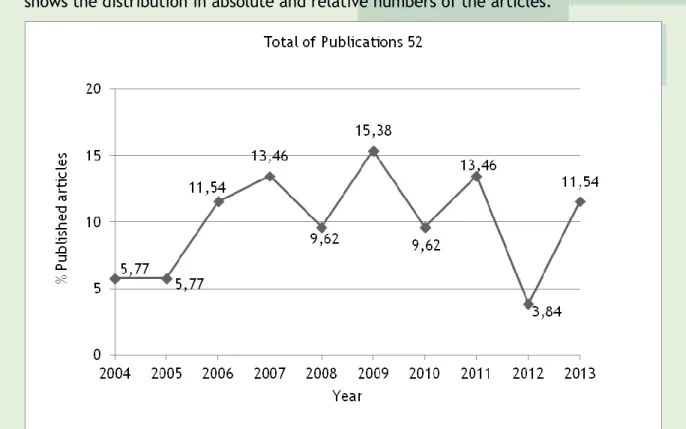
As regards the year of publication, a cut in the scientific literature on the subject Model Calgary was done of ten years period from 2004 to 2013 as shown in figure 1, which shows the distribution in absolute and relative numbers of the articles.
Figure 1. Distribution of studies abouth the Calgary Modelo f Family Assessment, regarding year of publication, from 2004 to 2013. (n=52)
The intellectual production about the Calgary Model of Family Assessment in a period of ten years does not show uniform distribution, as observed in Figure 1, showing that 2004 and 2005 had the same frequency of publications of 5.77% each one, following a quantitative evolution in 2006 with 11.54% and 2007 with 13.46%. However, 2008 presents a significant decrease with 9.62%.
The year 2009 reached the highest number of publications (15.38%) in the investigated period. In 2010, there was the same percentage than in 2008. In 2011, there was a considerable increase over the previous year, obtaining 13.46%. It should be noted that 2012 presented only 3.84% of publications that represents the lowest rate over the past ten years. However, in 2013 there was a significant increase with 11.54% of the publications.
Although there have been quantitative fluctuations of publications during the period of ten years, the recognition is evident from nurse researchers of the importance of disseminating guided studies in Calgary Model, and the commitment of these professionals socialize the results of their research to the improved performance of care practice.
In this sense, a study on the production of knowledge about theories and nursing models published in journals in the area between 1998 and 2007, showed that the application of models and theories provides a structural basis for nurses in performing their functions, both in health care as in the intellectual production.16,17 This result corroborates
J. res.: fundam. care. online 2015. jul./set. 7(3):3063-3075
3068
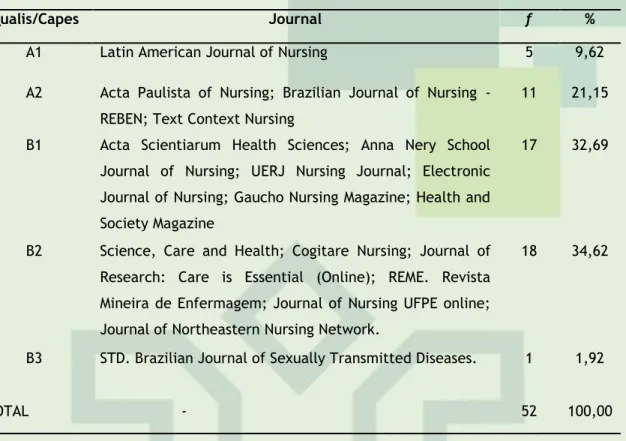
Table 1 highlights the distribution of the 52 works of the sample of the research, classification and names of journals that published studies on the Calgary Model of Family Assessment from 2004 to 2013.
Table 1. Distribution of the studies about Calgary Model of Family Assessment, according to Qualis/CAPES and the jornal where the articles were published, from 2004 to 2013. (n=52)
Qualis/Capes Journal ƒ %
A1 Latin American Journal of Nursing 5 9,62 A2 Acta Paulista of Nursing; Brazilian Journal of Nursing -
REBEN; Text Context Nursing
11 21,15 B1 Acta Scientiarum Health Sciences; Anna Nery School
Journal of Nursing; UERJ Nursing Journal; Electronic Journal of Nursing; Gaucho Nursing Magazine; Health and Society Magazine
17 32,69
B2 Science, Care and Health; Cogitare Nursing; Journal of Research: Care is Essential (Online); REME. Revista Mineira de Enfermagem; Journal of Nursing UFPE online; Journal of Northeastern Nursing Network.
18 34,62
B3 STD. Brazilian Journal of Sexually Transmitted Diseases. 1 1,92
TOTAL - 52 100,00
Regarding to the bibliometrical indicators for classification of the selected periodic for the study showed in Table 1, Qualis CAPES was used. It is noteworthy that it employs the Journal Citation Report (JCR) of the Institute for Scientific Information (ISI) for classification of journals in CAPES Journal Portal. Currently, the journals with impact factor equal or greater than 0.5 are classified as “A”. To classified the Journals “B” or “C” is used the least impact factor than 0.5 or other criteria of the area.18
Based on the Qualis CAPES periodic list, Nursing area in 2014, there were 5 articles available in regular Qualis A1 (9.62%); 11 articles in magazines A2 (21.15%); 17 publications in journals B1 (32.69%); 18 studies Qualis B2 (34.62%) and only a manuscript on the subject investigated was released in Qualis B3 magazine, with only 1 (1.92%) published in this topic. These data show that the nurse researchers sought to publish their studies on the subject investigated in Qualis A and B.
Regarding the quantity of publications in the journals, there were more journals with Qualis B2 and B1. This result is justified by the fact that researchers have greater access to journals with Qualis B in relation to magazines with Qualis A.
Regarding for bibliometric indicators related to journals in the studies that were disseminated, it can be seen that the highlighted magazines were the Journal of the Anna Nery School Journal of Nursing (Qualis B1) and the Journal of Research: Care is Essential Online (QUALIS B2) with 7 (13.46%) articles each one. Next, there were highlighted the Latin American Journal of Nursing (Qualis A1), the Nursing Journal of Rio Grande do Sul (Qualis B1), and the Science, Care and Health (Qualis B2), each one having 5 articles (9, 62%). Such journals are scientific forums for discussions, debates, exhibition of new ideas for Nursing.
J. res.: fundam. care. online 2015. jul./set. 7(3):3063-3075
3069
In addition, they are very important for dissemination of studies that contribute to support the practice of nurses both in caring for patients, as in teaching and research.
With regard to the virtual library database in which the studies were disseminated, there was the Latin American Literature in Health Sciences (LILACS), with 20 (38.46%) of the sample publications investigated, followed by the virtual Scientific Electronic Library Online (SciELO), with 15 articles (28.85%), as highlighted in Table 2.
Table 2. Distribution of studies on the Calgary Model of Family Assessment in nursing, according to the database in which the articles were disseminated from 2004 to 2013 (n=52)
Datebase/Virtual Library ƒ %
LILACS 23 44,23
SciELO 17 32,59
BDENF 8 23,08
TOTAL 52 100
It should be noted that LILACS database is important dissemination way of scientific and technical literature in Latin America and the Caribbean, which has contributed, for 28, to improve visibility, access and quality of information on health, covering 27 countries, 877 journals in the area and articles, dissertations and theses.19
SciELO is an electronic library that includes a selected collection of Brazilian scientific journals. Its goal is to develop a common methodology for the preparation, storage, dissemination and evaluation of scientific literature in electronic format, providing broad access to journal collections as a whole, to individual issues and journal title, as well as to complete text of articles.20 These facts justify the higher quantity of articles in this
study found in these data sources.
The Nursing Database (BDENF) is a source of information with references of the Brazilian technical and scientific literature in Nursing, publications containing the most relevant journals in Nursing, and other documents such as theses, books, chapters books, congress and conference proceedings, technical and scientific reports and governmental publications.21
Regarding the selected studies of research modalities for the proposed research, shown in Table 3.
Table 3. Distribution of studies about Calgary Modelo f Family Assessment according to thr research modality, from 2004 to 2013. (n=52) Modality ƒ % Original 37 71,15 Experience Report 8 15,38 Case study 7 13,46 TOTAL 52 100
As for the published modality, there were the original studies, with 37 (71.15%) of the articles included in the sample. In addition, publications were also identified in the modalities experience report and case study, but with a reduced quantitative.
The relevance of the original article modality in the present study is justified by the fact that investigations of original nature are unprecedented, aimed at broadening the
J. res.: fundam. care. online 2015. jul./set. 7(3):3063-3075
3070
frontiers of knowledge and establish new relations of causality to known facts and phenomenon or have new achievements for the respective area of knowledge. They are works of this nature that preferably are together for progress of science with new discoveries and new theories.22
In nursing, original works are in broad development, contributing to care practice of these professionals.
Quanto aos resultados sobre a formação acadêmica dos autores dos artigos da amostra do estudo proposto, identificou-se que 18 (34,61%) autores, têm título de mestre; seguidos de doutor, 14 (26,92%), graduado, 10 (19,23%), especialista, 5 (9,62%), residente, 3 (5,77%) e pós-doutor, 2 (3,85%). Tais dados evidenciam de certa forma, a vinculação da produção acadêmica aos cursos de pós-graduação de natureza Strictu sensu.
As for the results on the academic background of the authors of the sample articles of the proposed study, we found that 18 (34.61%) authors have master's degree; followed doctor, 14 (26.92%), graduate, 10 (19.23%), specialist, 5 (9.62%), resident, 3 (5.77%) and doctor, 2 (3, 85%). These data show in a way, linking the academic production to post-graduate courses Strictly speaking nature.
In this context, research on the training of specialists, Nursing masters and doctors highlighted the main importance for the advancement and consolidation of science and technology of the profession and to contribute to improving the work of attention/care to society. The area of Nursing in Higher Education Personnel Training Coordination (CAPES) has been growing in Programs and Doctoral Degrees, graduate masters from the 1970s and doctors since 1980, expanding in this way, scientific research. Therefore, the quantitative masters in the study is explained by the longer period of training of health professionals.23
It should be noted, that in the academic education, the high development of professors show the positive results of the institutional policy of qualification of higher education professionals. Furthermore, in recent years, some institutions created to promote training programs (graduate courses and authorization of professors for courses at other institutions).24
Regarding the most prevalent keywords, it is emphasized that the keyword “family” was mentioned in 32 works (61.53%). It is also observed, using the keyword “family health” in seven studies (13.46%) and “family nursing” in six research (11.53%). Analyzing the keywords, a conceptual map emerged, shown in Figure 2 below.
J. res.: fundam. care. online 2015. jul./set. 7(3):3063-3075
3071
Figure 2 is a conceptual map that allows the identification of four important thematic groups of words directed to characterize the main topics discussed by the selected articles.
Therefore, the terms listed above demonstrate the application of Calgary Model of Family Assessment to study the support and social inclusion, playing the role of social network and configured as areas of education and health for their participants. These factors indicate that health services should direct their actions to socialization skills and intervention to help improve the quality of links and eventually expand the social network.25
In addition, the role of the nurse is highlighted, proposing strategies aimed at solving the difficulties faced not only the patient but also the family and mainly by the caregiver.26
In this sense, an experience report about a educational program for nurses on family care in hospital states that the impact of the disease occurs in all family members, as well as the influence of family interaction in their healing.1
Thus, reducing the risk factors these caregivers are exposed is essential, as a short support relevance to safety and the psycho-emotional well-being of patients.26 It is
therefore emerging a change in this care context, since the family is an essential component in the society.
This topic is of great complexity, since most health professionals focus mainly on the practice of individual nursing care, and were not holders of knowledge to practice this Model of Assessment, leading them to employ methods based on their own experiences on the family.1 In addition, the keywords related to the areas of nursing were formed as
specific areas within the general context, emphasizing the interactions of family members, in a systemic perspective of care, using the Calgary Model: rehabilitation, geriatric and pediatric family nursing.
The nursing intervention requires the use of models to care guided for data collection and planning of interventions with a view to understanding the family in its multidimensionality and health conditions that determine the required nursing care.3
The family nursing was established as a specific area in general nursing context that emphasizes the interactions of family members, in a systemic perspective of care.3 A study
J. res.: fundam. care. online 2015. jul./set. 7(3):3063-3075
3072
based on the Calgary model as a teaching and learning strategy states that this methodology promoted more reflections on the problems presented by the family, a relationship of dialogue, of self self-knowlegde and family structure change, better understanding of the family network and how the family culture influences the practices of care provided to patients.27
For the role of nursing about the elderly and his family, the role is to strengthen the ability to assist him and meet the needs and care of the elderly, as a source of family support, and not replacing the ability and the power of the primary caregiver. It is important to highlight that the members of the families establish and maintain bonds of affection and gratitude, favoring for the family caregiver perform the actions of caring for the elderly pleasurable.28
The Calgary model was also used in studies aimed to know the structure and relationships of families in rehabilitation process of their loved one. Among the issues discussed in the study, there were the participation and the willingness of families in this process by identifying various ways to the co-involvement, despite the burden they experienced. Among the forms of support, there is the recognition of people in psychological distress as productive human beings, restoring their power to participate in social exchanges, as the true meaning of rehabilitation.29
With regard to pediatric nursing, a study says that the Calgary model enables to understand the family in its multidimensionality, and the use of the genogram and eco-map allows the visualization of family relationships, in order to preserve the life and health of each of its members, especially the child. The solutions to the problems and difficulties that arise during this process are obtained when the family tries to offer the resources available in its context, to meet the needs of the child.9
It is noteworthy the group of related keywords to the problems of individuals that affect their families. In this field, alcoholism, congenital heart diseases, sexually transmitted diseases, congenital malformations, chronic renal failure, child abuse, diabetic nephropathy, schizophrenia and teenage pregnancy are worth mentioning. This type of model is intended both to the study of families of people with acute or chronic illnesses as in various situations, such as pregnancy ibn adolescence and maltreatment10,30, since
although they are not diseases, they include physical, emotional and social changes.
Other group are directed to the people of the Calgary Model assessment, in which the following terms are highlighted: newborn, children, adolescent, elderly, man, woman, and pregnant women. This model offers a possibility of expanded approach to living conditions and health. For this model, the family is considered from a long-term commitment, where different family conformations must be understood in the context of each population.
J. res.: fundam. care. online 2015. jul./set. 7(3):3063-3075
3073
CONCLUSION
Studies of Calgary Model of Family Assessment are recent. This shows the concern of researchers on this phenomenon, seeking more visibility to this issue in academic area.
The bibliometric indicators investigated emphasize that intellectual production on the Calgary Model of Family Assessment in the 2004-2013 period, is not evenly distributed. With regard to Qualis of the jorunals, B2 was highlighted. As for journals, the Journal of Research: Care is Fundamental (Online) and the Anna Nery School Journal of Nursing were the most highlighted. The database that prevailed was LILACS. The largest quantity of original studies and the keyword family in the studies investigated were highlighted.
The bibliometric indicator about the keywords points out that there is evidence that the subject is in broad development, according to the investigated variation. It should be noted that the number of topics from the keywords presented by the work demonstrates the variety of its scope.
The data on the characterization of scientific literature on the Calgary Model of Family Assessment showed an area of knowledge in construction, as presented a small number of jobs in relation to the period investigated. It is hoped that this research will contribute to the further spread of new studies, since it is a very important model to support nursing practice in assistance to the family group.
J. res.: fundam. care. online 2015. jul./set. 7(3):3063-3075
3074
REFERENCES
1. Martins MM, Fernandes CS, Gonçalves LHT. A família como foco dos cuidados de enfermagem em meio hospitalar: um programa educativo. Rev bras enferm. 2012; 65(4): 685-90.
2. Figueiredo MHJS, Martins MMFS. Dos contextos da prática à (co)construção do modelo de cuidados de enfermagem de família. Rev Esc Enferm USP. 2009; 43(3): 615-21.
3. Figueiredo MHJS, Martins MMFS. Avaliação familiar: do modelo Calgary de avaliação da família aos focos da prática de enfermagem. Ciênc cuid saúde. 2010 jul-set; 9(3): 552-9.
4. Squarcini CFR, Silva LWS, Reis JF, Pires EPOR, Tonosaki LMD, Ferreira GA. A pessoa idosa, sua família e a hipertensão arterial: cuidados num programa de treinamento físico aeróbio. Rev Kairós. 2011 [acesso em 10 out 2014]; 14(3): 105-25. Disponível em: http://revistas.pucsp.br/index.php/kairos/article/view/6492/4708.
5. Di Primio AO, Shwartz E, Bieleman VLM, Burille A, Zillmer JGV, Feijó AM. Rede social e vínculos apoiadores das famílias de crianças com câncer. Texto & contexto enferm [Online]. 2010 [acesso em 10 out 2014]; 19(2): 334-42. Disponível em: http://www.scielo.br/pdf/tce/v19n2/15.pdf. 6. Domingues MARC, Santos CF, Quintans JR. Doença de Alzheimer: o perfil dos cuidadores que utilizam o serviço de apoio telefônico da ABRAz - Associação Brasileira de Alzheimer. Mundo Saúde [Online]. 2009 [acesso em 10 out 2014]; 33(1): 161-9. Disponível em: http://www.saocamilo-sp.br/pdf/mundo_saude/67/161a169.pdf
7. Montefusco SRA, Bachion MM, Carvalho EC, Munari DB. Comunicação verbal prejudicada da família: evidenciando a necessidade de desenvolver um novo diagnóstico de enfermagem. Ciênc cuid saúde. 2009; 8(4): 622-9.
8. Wright LM, Leahey M. Enfermeiras e famílias: um guia para avaliação e intervenção na família. 5.ed. São Paulo (SP): Roca; 2012.
9. Sassá AH, Marcon SS. Avaliação de famílias de bebês nascidos com muito baixo peso durante o cuidado domiciliar. Texto & contexto enferm. 2013; 22(2): 442-51.
10. Diógenes MAR, Oliveira MG, Yandara AXBC. Aspectos estruturais, desenvolvimentais e funcionais da família de adolescente grávida fundamentados no modelo Calgary. Rev RENE. 2011; 12(1): 88-96. 11. Draganov PB, Friedländer MR, Sanna MC. Andragogia na saúde: estudo bibliométrico. Esc Anna Nery Rev Enferm. 2011; 15(1): 149-56.
12. Nassar PR, Porto F. Produção científica em auditoria em enfermagem na revista eletrônica de enfermagem. Rev pesqui cuid fundam (Online). 2011; 3(2): 1873-8.
13. Marziale MHP. Indicadores de la producción científica iberoamericana [Editorial]. Rev Latino-am Enfermagem. 2011 [acesso em 10 out 2014]; 19(4): [02 pantallas]. Disponível em: http://www.scielo.br/pdf/rlae/v19n4/es_01.pdf
14. Reibnitz KS, Prado ML, Lima MM, Kloh D. Pesquisa convergente-assistencial: estudo bibliométrico de dissertações e teses. Texto & contexto enferm. 2012; 21(3): 702-7.
15. Vanz SAS, Stumpf IRC. Colaboração científica: revisão teórico-conceitual. Perspectivas em Ciência da Informação. 2010 mai-ago; 15(2): 42-55.
16. Crossetti MGOC, Bittencourt GKGD, Schaurich D, Tanccini TAM. Estratégias de ensino das habilidades do pensamento crítico na enfermagem. Rev gaúch enferm. 2009; 30(4): 732-41.
17. Schaurich D, Crossetti MGO. Produção do conhecimento sobre teorias de enfermagem: análise de periódicos da área, 1998-2007. Esc Anna Nery Rev Enferm. 2010; 4(1):182-8.
J. res.: fundam. care. online 2015. jul./set. 7(3):3063-3075
3075
18. Beuren IM, Souza JC. Em busca de um delineamento de proposta para classificação dos periódicosinternacionais de contabilidade para o qualis capes. Revista de Contabilidade e Finanças da USP. 2008; 19(46): 44-58.
19. Literatura Latino-Americana e do Caribe em Ciências da Saúde (Lilacs) [Internet]. São Paulo: BIREME - Centro Latino-Americano e do Caribe de Informação em Ciências da Saúde. [acesso em 20
jul 2014]. Disponível em:
http://bases.bireme.br/cgibin/wxislind.exe/iah/online/?IsisScript=iah/iah.xis&base=LILACS&lang=p 20. Scientific Eletronic Library Online (Scielo) [Internet]. São Paulo: BIREME; 2013. [acesso em 20 jul 2014]. Disponível em: http://www.scielo.org/php/index.php
21. Base de dados de enfermagem (BDENF) [Internet]. São Paulo: BIREME; 2013. [acesso em 20 jul
2014]. Disponível em:
http://bases.bireme.br/cgi-bin/wxislind.exe/iah/online/?IsisScript=iah/iah.xis&base=BDENF&lang=p&form=F
22. GS de Souza, AR dos Santos, VB Dias. Metodologia da pesquisa científica: a construção do conhecimento e do pensamento científico no processo de aprendizagem. Campinas: Animal, 2013. 23. Erdmann AL, Andrade SR, Santos JLG, Oliveira RJT. Perfil dos egressos de gerenciamento de enfermagem dos programas da área de enfermagem da região sul. Rev Esc Enferm USP. 2011; 45(spe): 1551-7.
24. Araújo TM, Sena IP, Viana MA, Araújo EM. Mal-estar docente: avaliação de condições de trabalho e saúde em uma instituição de ensino superior. Rev baiana saúde pública. 2005; 29(1): 6-21.
25. Souza J, Kantorski LP, Vasters GP, Luis MAV. Rede social de usuários de álcool, sob tratamento, em um serviço de saúde mental. Rev Latino-am Enfermagem. 2011; 19(1): [08 telas].
26. Montefusco SRA, Bachion MM, Vera I, Caixeta C, Munari DB. Tensão do papel de cuidador: ocorrência em familiares de Pessoas com doenças crônicas hospitalizadas. Ciênc cuid saúde. 2011; 10(4): 828-835.
27. Christoffel MM, Pacheco STA, Reis CSC. Modelo Calgary de avaliação da família de recém-nascidos: estratégia pedagógica para alunos de enfermagem. Esc Anna Nery Rev Enferm. 2008; 12(1): 160–5.
28. Leite MT, Flores JS, Hildebrandt LM, Perlini NMG, Linck CL. Oldest old in the household: the family as unit of care. Rev pesqui cuid fundam (Online). 2012; 4(4): 2816-31.
29. Filizola CLA, Teixeira IMC, Milioni DB, Pavarini SCI. Saúde mental e economia solidária: a família na inclusão pelo trabalho. Rev Esc Enferm USP. 2011; 45(2): 411-8.
30. Vieira LJES, Pordeus AMJ, Ferreira RC, Moreira DP; Maia PB, Saviolli KC. Fatores de risco para violência contra a mulher no contexto doméstico e coletivo / Risk factors for violence against women in the domestic and collective contexts. Saúde Soc. 2008; 17(3):113-25.
Received on: 06/11/2014 Required for review: No Approved on: 11/05/2015 Published on: 01/07/2015
Contact of the corresponding author: Francileide de Araújo Rodrigues Rua Joaquim Borba Filho, 555 Apto. 104, Bloco 04. CEP: 58053-110. João Pessoa, Pb. Fone: (83) 8828-8233. [email protected].