Deposited in Repositório ISCTE-IUL:
2019-03-13
Deposited version:
Post-print
Peer-review status of attached file:
Peer-reviewed
Citation for published item:
Oliveira, H. M., Albuquerque, P. B. & Saraiva, M. (2019). Associative strength or gist extraction: which matters when DRM lists have two critical lures?. Quarterly Journal of Experimental Psychology. 72 (3), 570-578
Further information on publisher's website:
10.1177/1747021818761002
Publisher's copyright statement:
This is the peer reviewed version of the following article: Oliveira, H. M., Albuquerque, P. B. & Saraiva, M. (2019). Associative strength or gist extraction: which matters when DRM lists have two critical lures?. Quarterly Journal of Experimental Psychology. 72 (3), 570-578, which has been published in final form at https://dx.doi.org/10.1177/1747021818761002. This article may be used for non-commercial purposes in accordance with the Publisher's Terms and Conditions for self-archiving.
Use policy
Creative Commons CC BY 4.0
The full-text may be used and/or reproduced, and given to third parties in any format or medium, without prior permission or charge, for personal research or study, educational, or not-for-profit purposes provided that:
• a full bibliographic reference is made to the original source • a link is made to the metadata record in the Repository • the full-text is not changed in any way
Associative strength or gist extraction: which matters when DRM lists have two critical lures?
Journal: Quarterly Journal of Experimental Psychology Manuscript ID QJE-STD 17-121.R2
Manuscript Type: Standard Article Date Submitted by the Author: 14-Nov-2017
Complete List of Authors: Oliveira, Helena; Universidade do Minho Escola de Psicologia Albuquerque, Pedro; Universidade do Minho Escola de Psicologia Saraiva, Magda; Instituto de Arte Design e Empresa - Universitario, UNIDCOM/IADE
Keywords: DRM, false memories, fuzzy-trace theory, activation/monitoring framework, critical lure
Associative strength or gist extraction: Which matters when DRM lists
have two critical lures?
Helena M. Oliveira
1, Pedro B. Albuquerque
1, and Magda Saraiva
21
School of Psychology, University of Minho, Braga, Portugal
2 CIS-IUL – Centro de Investigação e Intervenção Social, Instituto Universitário de
Lisboa (ISCTE-IUL), Lisbon, Portugal
Corresponding author: Helena M. Oliveira. Address: Escola de Psicologia,
Universidade do Minho, Campus de Gualtar, 4710-057, Braga, Portugal. Telephone: +351 253 604 612. Email: [email protected] 3 4 5 6 7 8 9 10 11 12 13 14 15 16 17 18 19 20 21 22 23 24 25 26 27 28 29 30 31 32 33 34 35 36 37 38 39 40 41 42 43 44 45 46 47 48 49 50 51 52 53 54 55
Associative strength or gist extraction: Which matters when DRM lists
have two critical lures?
The DRM paradigm is often used in the study of false memories. This paradigm typically uses lists of words associated with one critical lure. The primary objective of our study was to understand the production of false memories using the DRM paradigm when lists of words are associated with two critical lures. Three experiments were performed, and it was observed that the critical lures associated with the first set were significantly more frequently recalled than the critical lures associated with the second set. This result was verified when the words were presented in descending order of association with the critical lure (Exp. 1), when the words of the second set were presented in ascending order of association with the critical lure (Exp.2), and when all the words in the list had the same associative strength (Exp. 3). Results are explained by the
activation/monitoring and fuzzy-trace theories.
Keywords: DRM; false memories; fuzzy-trace theory; activation/monitoring framework; critical lure
Introduction
One of the most commonly used means to study false memories is the Deese-Roediger-McDermott (DRM) paradigm (Deese, 1959; Roediger & Deese-Roediger-McDermott, 1995). The paradigm involves the presentation of a list of words (e.g., table, sit, legs, seat, soft, desk, arm, sofa, wood, cushion, rest, and stool), all of which are associated with a non-presented word, termed the critical lure (e.g., chair). The word presentation is followed by a free recall task or a recognition task. According to this approach, a false memory is produced when the critical lure is recalled or falsely recognised as belonging to the presented word list. According to Deese (1959), the rate of critical lure recall can reach 44%. 2 3 4 5 6 7 8 9 10 11 12 13 14 15 16 17 18 19 20 21 22 23 24 25 26 27 28 29 30 31 32 33 34 35 36 37 38 39 40 41 42 43 44 45 46 47 48 49 50 51 52 53 54 55 56 57
Over the years, several studies have identified the processes and the variables involved in the production of false memories in the DRM paradigm. Deese (1959) argued that backward associative strength1 (BAS) is the variable that best explains this phenomenon. However, other variables have been identified as influencing the
production of false memories, such as forward associative strength2 (FAS) (e.g., Brainerd & Wright, 2005), connectivity (e.g., McEvoy, Nelson, & Komatsu, 1999), the number of presented words per list (e.g., Robinson & Roediger, 1997), and the order of presentation of words (Toglia, Neuschatz, & Goodwin, 1999).
Two explanatory theories have emerged regarding the production of false memories in the DRM paradigm: the fuzzy-trace theory (Brainerd & Reyna, 1998; Reyna & Brainerd, 1995) and the activation/monitoring framework (Meade, Watson, Balota, & Roediger, 2007; Roediger, Balota, & Watson, 2001; Roediger & McDermott, 2000; Roediger, Watson, McDermott, & Gallo, 2001).
According to the fuzzy-trace theory, when the list of words is presented, two types of trace are encoded: verbatim (i.e., specific features of each word, such as word size or colour) and gist (i.e., the theme of the list of words). The recall of presented words results from the retrieval of verbatim and gist traces because the individual has cues for each presented word (verbatim trace) that are all associated with a theme (gist trace). In contrast, the gist trace is responsible for the production of false memories
1
BAS: Backward associative strength is the association between the words of the list and the critical lure. It expresses the probability that the critical lure will be recalled after the presentation of each word on the list.
2
FAS: Forward associative strength represents the relation between the critical lure and words of the list. It expresses the probability that the words of the list will be recalled after the presentation of the critical
3 4 5 6 7 8 9 10 11 12 13 14 15 16 17 18 19 20 21 22 23 24 25 26 27 28 29 30 31 32 33 34 35 36 37 38 39 40 41 42 43 44 45 46 47 48 49 50 51 52 53 54 55
because the critical lure is consistent with the gist trace. Although there is no verbatim trace for the critical lure (because it was not previously presented), the critical lure is recalled because it is highly associated to the presented words. In sum, verbatim traces are used to reject false memories and gist traces are important in the acceptance of critical lures (Brainerd & Reyna, 1998; 2002; 2005; Reyna & Brainerd, 1995).
According to the activation/monitoring framework, since all words are
associated with a critical lure, this word is accumulatively activated by the presentation of each word in the list. This process generates a higher activation of the critical lure, and consequently, the critical lure becomes more likely to be recalled (in a free recall task) or to be falsely recognised (in a recognition task) due to its association with the other presented words. According to Roediger, Balota, and Watson (2001), the
activation/monitoring framework predicts that the production of false memories can be eliminated through adequate source-monitoring mechanisms. That is, if an individual can correctly identify the source of the information activated at the time of the recall/recognition task, he/she can distinguish between words that were actually presented (list words) and words that were only activated due to the presentation of words from the list (the critical lure). If this monitoring is successful, it is possible to eliminate the production of false memories. If monitoring fails, the critical lure is more likely to be recalled or recognised.
The two theories have some points in common, since both predict the occurrence of two opponent processes: stimulation of the critical lure during the encoding phase; and it elimination during retrieval phase. According to the fuzzy-trace theory, critical lure is stimulated due to the extraction of the gist trace, whereas for the
activation/monitoring framework, critical lure is activated by the presentation of the words of the list that are strongly associated with it. On the other hand, the elimination
2 3 4 5 6 7 8 9 10 11 12 13 14 15 16 17 18 19 20 21 22 23 24 25 26 27 28 29 30 31 32 33 34 35 36 37 38 39 40 41 42 43 44 45 46 47 48 49 50 51 52 53 54 55 56 57
of critical lure occurs during retrieval phase. In the case of activation/monitoring framework, this occurs through the monitoring process (to determine the origin of critical lure activation) and for fuzzy-trace theory this occurs because there is no verbatim trace for critical lure (because it has never been presented). Notwithstanding the similarities between the two theories, they differ in some respects. One of them is the nature of the associative relations between the presented words and the critical lure. The fuzzy-trace theory, argues that the recall/recognition of the critical lure is due to the semantic relation existing between the presented words and the critical lure, a relation that leads to the formation of the gist trace and consequently the production of the false memory (Brainerd & Reyna, 2005). On the other hand, the activation/monitoring framework argues that the relationship between presented words and critical lures is associative (although the nature of these associations is not specified) and it is the associative strength the main explanatory variable for the production of false memories (Roediger et al., 2001).
These two theories have been widely studied and tested in connection with the production of false memories (e.g., Brainerd & Reyna, 2005; Colombel, Tessoulin, Gilet, & Corson, 2016; Meade et al., 2007; Reyna, Corbin, Weldon, & Brainerd, 2016; Roediger et al., 2001). Occasionally, study results can be explained by both theories (e.g., Cann, McRae, & Katz, 2011).
Typically, studies on the production of false memories using the DRM paradigm employ lists of words associated with only one critical lure (e.g., twelve words
associated with one critical lure - for exceptions, see Cadavid and Beato [2016] and Jou, Arredondo, Li, Escamilla, and Zuniga [2016]), and the critical lure is never presented - (for an exception see Dodhia & Metcalfe [1999)]). In our study, we conducted three experiments in which the primary objective was to understand the production of false
3 4 5 6 7 8 9 10 11 12 13 14 15 16 17 18 19 20 21 22 23 24 25 26 27 28 29 30 31 32 33 34 35 36 37 38 39 40 41 42 43 44 45 46 47 48 49 50 51 52 53 54 55
memories using DRM lists associated with two critical lures that are never presented. That is, lists of twelve words, six associated with one critical lure (i.e., 1st set) and the other six (i.e., 2nd set) associated with another critical lure (e.g., rapid, snail, softly, turtle, calm, tardy - associated with slow - and cake, good, bitter, sugar, chocolate, honey - associated with sweet).
Two critical lures per list would enable us to understand if both are activated and if this activation occurs in the same degree, as postulated by the activation/monitoring framework, or if it is the extraction of the theme of the list that explains the production of false memories, as argued by the fuzzy-trace theory (since for the participants it is only one list of words, they will extract only one theme based on the first words of the list).
Additionally, we controlled for important variables that influence the production of false memories, such as the number of words per list (e.g., Robinson & Roediger, 1997) and their associative strength with the critical lure (e.g., Deese, 1959; McEvoy et al., 1999; Roediger, Watson, McDermott, & Gallo, 2001).
Experiment 1
This experiment had two main objectives: (1) to replicate the DRM effect with lists of words associated with two critical lures and (2) to understand if the proportion of correct recall of the presented words varies as a function of the set in which the words were presented.
Method
Participants
Forty university students volunteered for the experiment, thirty-three female (82.5%)
2 3 4 5 6 7 8 9 10 11 12 13 14 15 16 17 18 19 20 21 22 23 24 25 26 27 28 29 30 31 32 33 34 35 36 37 38 39 40 41 42 43 44 45 46 47 48 49 50 51 52 53 54 55 56 57
and seven male (17.5%), with an average age of 21.13 years (SD = 3.62). The
participants did not receive monetary compensation or course credits for participating in this experiment.
Stimuli
We used six lists of words selected from the Portuguese normative study developed by Albuquerque (2005). Each list contained 12 words, with the first six words associated with one critical lure (1st set) and the remaining six (2nd set) associated with another critical lure (e.g., rapid, snail, softly, turtle, calm, tardy - associated with slow - and cake, good, bitter, sugar, chocolate, honey - associated with sweet). The words in each set were presented in decreasing order of forward associative strength (FAS) of
association with the critical lure. The presentation order of the lists and the presentation of the sets were counterbalanced.
The words of each list and their respective associative strengths with the critical lures are presented in Appendix 1.
Design
The independent variable was the set in which words were presented (i.e., the first six words, or 1st set, vs. the second six words, or 2nd set), using a within-subject design. The dependent variables were the proportion of presented words recalled (correct recall) and critical lures recalled (false recall).
Procedure
Data were collected in small groups of five to ten participants, and the word lists were presented using Microsoft PowerPoint. The participants were told they would be presented with a set of words to which they should pay attention because they would
3 4 5 6 7 8 9 10 11 12 13 14 15 16 17 18 19 20 21 22 23 24 25 26 27 28 29 30 31 32 33 34 35 36 37 38 39 40 41 42 43 44 45 46 47 48 49 50 51 52 53 54 55
later be asked to recall the words. At the end of the presentation of each list, the instruction "RECALL NOW" was presented, and the participants had 90 seconds to write down as many words as they remembered. The procedure was repeated for each list from a total of six lists. Words were presented visually using a data-show, one at a time, centred and in 54-pt black Arial font, at rate of 1.5 seconds per word. The entire procedure required approximately 15 minutes.
Results
The data were analysed using SPSS v23, and an alpha level of .05 was used for all inferential analyses.
In the analysis of the results, the recall proportion of presented words (correct recall) and the recall of critical lures (false recall) were considered. The proportion of correct recall was calculated by dividing the number of presented words that were recalled by the total number of presented words (N = 36). The analysis of correct recall was considered separately for the words presented in each set. Concerning false
memories, the proportion was calculated by dividing the number of critical lures that were recalled by the total number of critical lures associated with the presented lists (N = 6).
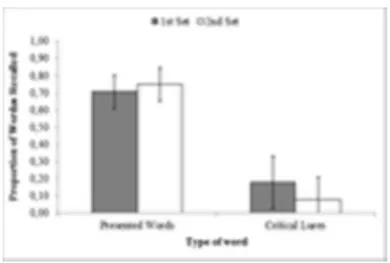
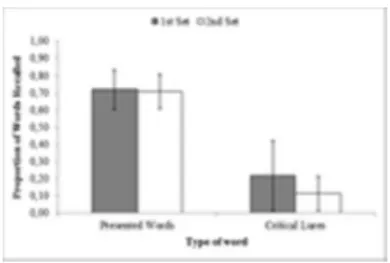
The results of Experiment 1 are presented in Figure 1.
---- Insert Figure 1 approximately here ----
A 2 X 2 ANOVA for repeated measures (i.e., Word type: presented words vs. critical lures and Set: 1st set vs. 2nd set) revealed a significant main effect of the word type, F (1, 39) = 656.84, MSE = .022, p < .001, η2 = .94. That is, presented words were
2 3 4 5 6 7 8 9 10 11 12 13 14 15 16 17 18 19 20 21 22 23 24 25 26 27 28 29 30 31 32 33 34 35 36 37 38 39 40 41 42 43 44 45 46 47 48 49 50 51 52 53 54 55 56 57
significantly more frequently recalled (M = .73; SD = .10) than critical lures (M = .13; SD = .14). The main effect of the set was not significant, F (1, 39) = 3.34, MSE = .10, p = .08, η2 = .08. This outcome revealed that there were no differences between the number of words more frequently recalled (presented words and critical lures) in the 1st set (M1stSet = .44; SD = .13) and in the 2nd set (M2ndSet = .41; SD = .11). However, a significant interaction effect was found between word type and set, F (1, 39) = 24.71, MSE = .008, p < .001, η2 = .39. Pairwise comparisons revealed that the words presented in the 2nd set (M2ndSet = .75; SD = .10) were significantly more frequently recalled (p = .009) than the words presented in the 1st set (M1stSet = .71; SD = .10). However, for critical lures, the result was the opposite. That is, the critical lures associated with the 1st set (M1stSet = .18; SD = .15) were more frequently recalled (p < .001) than the critical lures associated with the words presented in the 2nd set (M2ndSet = .08; SD = .13).
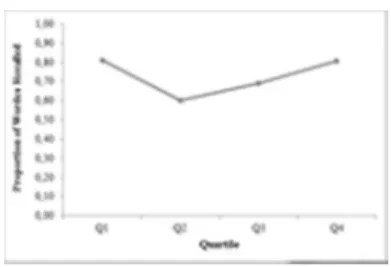
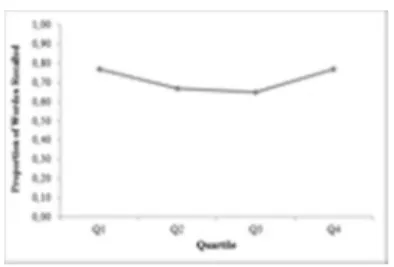
To analyse the impact that the primacy and recency effects might have had in the recall task, we examined the serial position by quartile. An ANOVA for repeated measures revealed differences depending on the quartile of the presentation of words in the lists, F (3, 117) = 332.28, MSE = .012, p < .001, ƞ2 = .45. Pairwise comparisons revealed that there were no differences between the words presented in Q1 (1st to 3rd position) and Q4 (10th to 12th position, p = 1.000) but that both were significantly more frequently recalled than the words presented in Q2 and Q3: p < .05 (i.e., primacy and recency effects). The results are presented in Figure 2.
---- Insert Figure 2 approximately here ----
Discussion 3 4 5 6 7 8 9 10 11 12 13 14 15 16 17 18 19 20 21 22 23 24 25 26 27 28 29 30 31 32 33 34 35 36 37 38 39 40 41 42 43 44 45 46 47 48 49 50 51 52 53 54 55
With this experiment, we intended to replicate the DRM effect using lists associated with two critical lures. We consider that the effect was observed. The amount of false recall found was slightly lower (M1stSet = .18; M2ndSet = .08) than the values typically found in DRM studies. This finding may be observed because the presented words associated with the critical lure in each set were fewer (six words) than in other studies that used this paradigm (12 to 15 words) (e.g., Albuquerque, 2005; Roediger &
McDermott, 1995). This result was similar to those found by other authors using lists with the same length. Robinson and Roediger (1997) concluded that the probability of recalling the critical lure increased as a function of the number of associates per list and the total associative strength of the lists. In that study, the probability of recalling the critical lures increased from .03 in lists with three words to .30 for lists with fifteen words. Although the study does not provide precise data for the lists with intermediate sizes, we can infer that the rates of the critical lures for lists with six words (M ≈ .15) were highly similar to our results.
The results of our experiment revealed that the words presented in the 2nd set (i.e., the 7th to 12th positions) were significantly more frequently recalled than the words presented in the 1st set (1st to 6th positions). However, the critical lures associated with the 1st set were more often falsely recalled than the critical lures associated with the 2nd set. This result can be related to the occurrence of primacy and recency effects. In our experiment, the participants were better at recalling the first and last words of the lists. Regarding the 1st set, primacy corresponds to those words that are more strongly associated with the respective critical lure. Participants also accurately recalled the last words of the lists. However, in this case, the words were weakly associated with the critical lure of the 2nd set, which may explain the differences in false memory production between the two sets.
2 3 4 5 6 7 8 9 10 11 12 13 14 15 16 17 18 19 20 21 22 23 24 25 26 27 28 29 30 31 32 33 34 35 36 37 38 39 40 41 42 43 44 45 46 47 48 49 50 51 52 53 54 55 56 57
Although the associative strength of the two sets was identical, the fact that the participants were better at recalling the first and the last words of the lists makes a difference in the associative strength of the recalled words associated with each set. In this sense, the critical lure of the 1st set was recalled significantly more because the words that were most strongly associated with it were the most recalled (primacy effect). According to the activation/monitoring framework, the recall of words strongly associated with the critical lure increases the critical lure’s activation, which results in more frequent recall of those words, i.e., a higher production of false memories. In addition, the words most strongly associated with the critical lure of the 2nd set corresponded to the words in the middle of the list. That is, the words with more associative strength were not the most recalled, which results in a lower activation of the critical lure and consequently their less frequent recall. However, according to this theory, since recall occurs immediately after the list is presented, it is easier to monitor the source of the critical lure. That is, the participant is more likely to identify the critical lure as not belonging to the list of words presented in the 2nd set, which results in a decrease in the production of false memories compared to those produced for the 1st set.
However, our results can also be explained by the fuzzy-trace theory. According to this theory, gist traces are more stable than verbatim traces since the latter are more susceptible to interference (Brainerd, Gomes, & Nakamura, 2015). Therefore,
differences in the gist trace between the two sets of words (i.e., at the level of the production of false memories) are not expected. The same does not occur for the verbatim traces that (because they suffer more interference) make the participants less able to use them to remember the words presented in the 1st set (because of interference from the words presented in the 2nd set). This phenomenon also makes the participants
3 4 5 6 7 8 9 10 11 12 13 14 15 16 17 18 19 20 21 22 23 24 25 26 27 28 29 30 31 32 33 34 35 36 37 38 39 40 41 42 43 44 45 46 47 48 49 50 51 52 53 54 55
less able to use the verbatim traces of the words from the 1st set to identify and
consequently reject the critical lure. It is more difficult to reject the critical lure of the 1st set (than of the 2nd set) due to the weakening of the verbatim traces (Brainerd, Gomes, & Nakamura, 2015). Additionally, the fuzzy-trace theory also predicts that monitoring has an important role in the rejection of critical lure, i.e., as the recall is immediate after the presentation of the 2nd set, the participant identifies the critical lure (gist trace) and reject it (Brainerd, Reyna, Wright, & Mojardin, 2003; Reyna, 2000).
According to previous studies (McEvoy et al., 1999, Robinson & Roediger, 1997; Roediger, Watson, et al., 2001), there is a negative correlation between the
number of presented words that are recalled and false recall. That is, the correct recall of presented words makes it easier to reject the critical lure, thereby decreasing the
production of false memories (Brainerd et al., 2003; Reyna, 2000). In our results, this phenomenon occurred for the 2nd set, with a greater proportion of the presented words being recalled and a smaller recall of critical lures than for the 1st set.
Considering these results, in Experiment 2, we aimed to analyse if the differences in the production of false memories are due to the primacy and recency effects.
Experiment 2
This experiment aimed to test the hypothesis that the greater recall of critical lures associated with the 1st set, when compared to the critical lures recalled in the 2nd set, may be due to primacy and recency effects. We hypothesise that the words of the 1st set that were more frequently recalled were the primacy words, which were strongly associated with the critical lure, and that they consequently produce higher levels of false memories. Conversely, the words of the 2nd set that were more frequently recalled were the recency words, which were weakly associated with the critical lure.
2 3 4 5 6 7 8 9 10 11 12 13 14 15 16 17 18 19 20 21 22 23 24 25 26 27 28 29 30 31 32 33 34 35 36 37 38 39 40 41 42 43 44 45 46 47 48 49 50 51 52 53 54 55 56 57
Consequently, they produced lower levels of false memories.
In Experiment 2, the words of the 2nd set were presented in ascending order of association with the critical lure. That is, the last words of the 2nd set had an associative strength with the critical lure similar to the first words of the 1st set. In this way, we ensured that the words most frequently recalled for each set of the lists were equivalent with respect to associative strength with their respective critical lures.
Method
Participants
Forty university students volunteered for this experiment, all of whom were different from the students who participated in Experiment 1. In this sample, thirty-two participants were female (80%), and eight were male (20%), with an average age of 22.90 years (SD = 7.73). The participants did not receive monetary compensation or course credits for participating in the experiment.
Stimuli
The same six lists used in Experiment 1 were used in Experiment 2. However, the words of the 2nd set were presented in ascending order of association with the critical lure (see Appendix 2).
Design
As in Experiment 1, the manipulated independent variable was the set in which the words were presented (1st set or 2nd set), and the dependent variables were the proportion of presented words that was recalled (correct recall) and the proportion of critical lures that was recalled (false recall). The independent variable was manipulated
3 4 5 6 7 8 9 10 11 12 13 14 15 16 17 18 19 20 21 22 23 24 25 26 27 28 29 30 31 32 33 34 35 36 37 38 39 40 41 42 43 44 45 46 47 48 49 50 51 52 53 54 55
within participant.
Procedure
The procedure was similar to that used in Experiment 1.
Results
The data were analysed using SPSS v23, and an alpha level of .05 was used for all inferential analyses.
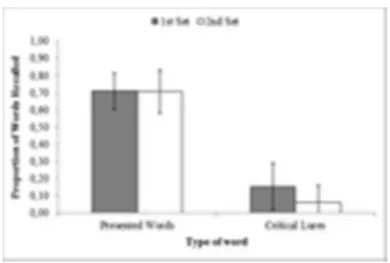
A 2 X 2 ANOVA for repeated measures (Word type: presented words vs. critical lures; Set: 1st set vs. 2nd set) revealed a significant main effect of the word type, F (1, 39) = 725,67, MSE = .20, p < .001, η2 = .95. That is, presented words were significantly more frequently recalled (M = .71; SD = .12) than critical lures (M = .11; SD = .12). A significant main effect of the set was also found, F (1,39) = 8.65, MSE = .010, p = .005, η2 = .18. That is, significantly more words of the 1st set were recalled (M1stSet = .43; SD = .12) than of the 2nd set (M2ndSet = .39; SD = .11). Finally, a significant interaction effect was found between word type and set, F (1, 39) = 24.71, MSE = .007, p < .001, η2 = .39. Pairwise comparisons revealed no differences (p = .88) between the number of presented words recalled in the 1st set (M1stSet = .71; SD = .11) and in the 2nd set (M2ndSet = .71; SD = .13). However, similarly to Experiment 1, the critical lures associated with the 1st set (M1stSet = .15; SD = .14) were more frequently recalled (p < .001) than the critical lures associated with the 2nd set (M2ndSet = .06; SD = .10).
The results are presented in Figure 3.
---- Insert figure 3 approximately here ----
2 3 4 5 6 7 8 9 10 11 12 13 14 15 16 17 18 19 20 21 22 23 24 25 26 27 28 29 30 31 32 33 34 35 36 37 38 39 40 41 42 43 44 45 46 47 48 49 50 51 52 53 54 55 56 57
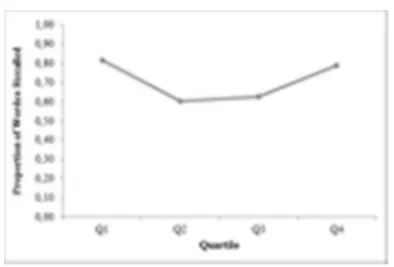
To understand the influence of primacy and recency effects on correct recall, we examined the serial position by quartile. An ANOVA for repeated measures revealed a main effect of the position of the words in the list, F(3, 117) = 31.02, MSE = .015, p < .001, ƞ2 = .44. Pairwise comparisons revealed that the words presented in Q1 (the 1st to 3rd positions) and Q4 (the 10th to 12th positions) were better recalled than the words presented in the intermediate positions (Q2 and Q3, p < .001). However, we found no difference between the number of words recalled in Q1 and Q4 (p = 1.000) (Figure 4).
---- Insert figure 4 approximately here ----
Discussion
In this experiment, we expected that there would be no difference in the recall of critical lures. Since the most recalled words were the words more strongly associated with the critical lures (primacy and recency effect), the activation of the critical lures should occur at the same level in both sets. However, similarly to what occurred in Experiment 1, the critical lures related to the 1st set were more frequently recalled than those of the 2nd set. That is, changing the presentation order of the words of the 2nd set depending on the degree of association with the critical lure favoured their recall due to the recency effect. Our results resemble those of Prohaska, Delvalle, Toglia, and Pittman (2016), who manipulated the order of words in their lists, successively changing the position of words most strongly associated with the critical lure. Their results revealed that this manipulation had no effect on false memory production.
Thus, this manipulation does not explain the difference in the production of false memories between the two sets. In our view, the fact that the participants first viewed a word more strongly associated with the critical lure (associated with the 1st set)
3 4 5 6 7 8 9 10 11 12 13 14 15 16 17 18 19 20 21 22 23 24 25 26 27 28 29 30 31 32 33 34 35 36 37 38 39 40 41 42 43 44 45 46 47 48 49 50 51 52 53 54 55
followed by words with smaller degrees of association may potentiate the recall of the critical lure insofar as it can promote the extraction of the theme of the list (e.g., Albuquerque & Resende, 2011; Brainerd et al., 2001; Carneiro & Fernandez, 2013). One way to clarify this phenomenon would involve the use of lists in which all of the words had the same associative strength with the critical lure. Therefore, we conducted Experiment 3.
Experiment 3
Associative strength, particularly backward associative strength (BAS), is a strong predictor of critical lure recall. The aim of this experiment was to characterise the production of false memories when all the words of a list have the same BAS with respect to their critical lure. In this sense, the order of the presentation of words (ascending or descending) was no longer a relevant variable.
As in Experiment 2, we intended to test the hypothesis that the difference in critical lure recall rates was due to the primacy and recency effects. In the previous experiments, this difference resulted in a greater recall of the critical lure associated with the 1st set. If this hypothesis were confirmed, it would be expected that there would be no differences between the halves of the lists because there was no possibility of the words most strongly associated with a critical lure being better remembered.
Method
Participants
Forty college students volunteered for this experiment. In this sample, thirty three participants were female (82.5%), and seven were male (17.5%), with an average age of
2 3 4 5 6 7 8 9 10 11 12 13 14 15 16 17 18 19 20 21 22 23 24 25 26 27 28 29 30 31 32 33 34 35 36 37 38 39 40 41 42 43 44 45 46 47 48 49 50 51 52 53 54 55 56 57
21.13 years (SD = 3.62). The participants did not receive monetary compensation or course credits for participating in the experiment. None of the participants participated in Experiments 1 or 2.
Stimuli
We constructed 12 word lists using the same BAS per word and consequently per list. The construction and presentation of the lists resembled those of the previous
experiments.
The words of each list and the respective associative strengths with the critical lures are presented in Appendix 3.
Design
The manipulated independent variable was the set of the list in which the words were presented (1st set or 2nd set). The variable was manipulated within subjects. The proportion of presented words (correct recall) and critical lures (false recall) that were recalled were the dependent variables.
Procedure
The procedure was the same as that used in Experiments 1 and 2.
Results
A 2 X 2 ANOVA for repeated measures (Word type: presented words vs. critical lures; Set: 1st set vs. 2nd set) revealed a significant main effect of the word type, F (1, 39) = 495.91, MSE = .024, p < .001, η2 = .93. That is, presented words were significantly more frequently recalled (M = .71; SD = .11) than critical lures (M = .17; SD = .17). A significant main effect of the set was also found, F (1, 39) = 6.36, MSE = .020, p = .02,
3 4 5 6 7 8 9 10 11 12 13 14 15 16 17 18 19 20 21 22 23 24 25 26 27 28 29 30 31 32 33 34 35 36 37 38 39 40 41 42 43 44 45 46 47 48 49 50 51 52 53 54 55
η2 = .14. That is, the participants significantly recalled more words in the 1st set (M1stSet = .47; SD = .16) than in the 2nd set (M2ndSet = .41; SD = .12). The interaction effect between word type and set was only marginally significant, F (1, 39) = 3.86, MSE = .023, p = .06, η2 = 09. However, pairwise comparisons revealed that although there were no differences (p = .69) between the recall rate of words presented in the 1st set (M1stSet = .72; SD = .12) and in the 2nd set (M2ndSet = .71; SD = .11) the critical lures associated with the 1st set (M1stSet = .22; SD = .21) were significantly more frequently recalled (p = .01) than the critical lures associated with the 2nd set (M2ndSet = .11; SD = .13) (Figure 5).
---- Insert figure 5 approximately here ----
An ANOVA based on the serial position of the words (Q1 vs. Q2 vs. Q3 vs. Q4) enabled us to again establish the effects of primacy and recency: there was a main effect of the quartile, F(3, 117) = 9.18, MSE = .019, p < .001, ƞ2 = .19. Pairwise comparisons revealed that the words presented in Q1 (the 1st to 3rd positions) were more frequently recalled than the words presented in the intermediate positions (Q2 and Q3, p < .05). The words recalled in Q4 (the 10th to 12th positions) were more frequently recalled than in Q3 (p = .001). However, there were no significant differences between Q4 and Q2 (p = .06). Finally, there was no difference between the number of words recalled in Q1 and Q4 (p = 1.000) (Figure 6).
---- Insert figure 6 approximately here ----
Discussion 2 3 4 5 6 7 8 9 10 11 12 13 14 15 16 17 18 19 20 21 22 23 24 25 26 27 28 29 30 31 32 33 34 35 36 37 38 39 40 41 42 43 44 45 46 47 48 49 50 51 52 53 54 55 56 57
The results of this experiment confirm the results of Experiment 2. There were no differences in the recall of presented words as a function of set. Again, the proportion of false recall associated with the words presented in the 1st set was significantly higher than that of the 2nd set. In the 1st set, the proportion of false recall for the critical lure was nearly double that of the 2nd set. Based on these results, we reject the hypothesis that the difference in the production of false memories is due to the primacy and recency effects because all words in the list had the same degree of association with the respective critical lure. According to the fuzzy-trace theory, at the time of presentation of the lists, participants extract the list theme, which may result in a subsequent recall of the critical lure (Brainerd & Reyna, 1998, 2005; Reyna & Brainerd, 1995). It seems that the extracted theme corresponds to the words presented in the 1st set. This hypothesis is consistent with the results of Resende and Albuquerque (2011), who demonstrated that the identification of the theme of the list occurs after the presentation of the first words of the list. As argued by Brainerd et al. (2015), participants are less able to use verbatim traces of the 1st set (due to the interference caused by the presentation of the words in the 2nd set) to identify and reject the critical lure. However, according to the
activation/monitoring framework, one would not expect any difference between sets because the BAS was similar in the two sets (e.g., Gallo & Roediger, 2002; Roediger, Balota, & Watson, 2001; Roediger & McDermott, 1995, 2000; Roediger, Watson, et al, 2001).
General Discussion
The primary purpose of this study was to understand the production of false memories using the DRM paradigm when word lists are associated with two critical lures. The results of our experiments verify that with only six associated words the DRM effect is
3 4 5 6 7 8 9 10 11 12 13 14 15 16 17 18 19 20 21 22 23 24 25 26 27 28 29 30 31 32 33 34 35 36 37 38 39 40 41 42 43 44 45 46 47 48 49 50 51 52 53 54 55
presented in the 1st sets were more frequently recalled than those associated with the words presented in the 2nd sets. In trying to understand this result, it is important to note that both the activation/monitoring framework and the fuzzy-trace theory consider that false memories in the DRM paradigm could be due to activation and monitoring mechanisms. Therefore, the higher rates of false recall found for the 1st sets could be explained by a higher level of activation of the critical lures associated with the presented words in this half of the list or with higher difficulty in monitoring them.
Considering the activation mechanisms, the higher rate of false recall for the critical lures associated with the presented words in the 1st set could be explained by a higher level of activation of these critical lures, both in coding and recall processes. Therefore, we determined to control for the BAS because this variable has been identified as the best predictor for the production of false memories (e.g., Gallo & Roediger, 2002; Roediger, Balota, & Watson, 2001; Roediger & McDermott, 1995, 2000; Roediger, Watson, et al., 2001). Because the results of Experiment 3 revealed no differences in the levels of correct recall for both sets of the lists, one could not predict any superiority of one set over the other. According to the activation/monitoring framework, the recall of the critical lure occurs because at the time of recall it is
strongly activated (because of its association with the presented words) and because of a monitoring failure. This recall should occur indiscriminately for the two critical lures in each set. However, our results reveal that the critical lures of the 1st set were
significantly more frequently recalled. These results can be explained by the fact that the recall occurs immediately after the presentation of the lists. That is, the critical lure of the 2nd set can be more easily monitored and rejected by the participants than the critical lure of the 1st set. This result contradicts the result of the study of Dodhia and Metcalfe (1999). In their study, two DRM lists were presented to the participants. List 1
2 3 4 5 6 7 8 9 10 11 12 13 14 15 16 17 18 19 20 21 22 23 24 25 26 27 28 29 30 31 32 33 34 35 36 37 38 39 40 41 42 43 44 45 46 47 48 49 50 51 52 53 54 55 56 57
consisted of a set of words associated with a critical lure. The critical lure associated with List 1 was presented in List 2 composed by words not associated with this critical lure (experimental group). In control group, in List 2, nothing related to the List 1was presented (this group is comparable to our study, because the critical lure is never presented). After the presentation of the lists, participants performed yes/no recognition task or a source judgement task. The results revealed, for the control group, equal likelihood of endorsing the critical lure as presented in the List 1 or in the List 2, which suggests equivalent activation of critical lures from two different lists shown in
sequence. However, the authors used a recognition task while in our study the participants were subject to a recall task, which may explain the differences in the results of the two studies, since the processes of source monitoring underlying recall tasks and recognition tasks may be different.
However, our results can also be explained using the fuzzy-trace theory. According this theory, at the time of the presentation of the words, the theme of the list is extracted (i.e., gist trace), which may result in its subsequent recall (Brainerd & Reyna, 1998, 2005; Reyna & Brainerd, 1995). Participants extracted the theme of the list that corresponded to the critical lure associated with the words presented in the 1st sets. (Although each word list had two critical lures, for the participants, it is only one list. Therefore, after the presentation of the first words, a single theme is extracted). At the time of retrieval, the critical lure is recalled because it is associated with the gist trace, which does not occur with the critical lure of the second half of the list. This result is supported by Resende and Albuquerque (2011), who demonstrated that the identification of the theme of the lists tends to occur during the presentation of the first words of the lists.
3 4 5 6 7 8 9 10 11 12 13 14 15 16 17 18 19 20 21 22 23 24 25 26 27 28 29 30 31 32 33 34 35 36 37 38 39 40 41 42 43 44 45 46 47 48 49 50 51 52 53 54 55
The results of our study, may be due to potential advantages in monitoring of the critical lures of the 2nd set. As recall began immediately after presentation of lists, it is possible that participants could more effectively monitor the critical lure of this set. This monitoring advantage is often associated with activation/monitoring framework,
however it can also be applied to fuzzy-trace theory, once which does not exclude the possibility of monitoring having an important role in the rejection of the critical lure (i.e., identify to reject). Consequently, to understand the results that were found, it seems necessary to consider the contributions of both the activation/monitoring
framework and the fuzzy-trace theory (see Oliveira & Albuquerque, 2015). Thus, there is a need to adopt a theoretical approach that integrates the perspectives of the two theories if a more complete explanation of the production of false memories using the DRM paradigm is sought.
Acknowledgements: This study was conducted at the Psychology Research Centre
(UID/PSI/01662/2013), University of Minho, and supported by the Portuguese Foundation for Science and Technology and the Portuguese Ministry of Science, Technology and Higher Education through national funds. Co-financing was provided by FEDER through
COMPETE2020 under the PT2020 Partnership Agreement (POCI-01-0145-FEDER-007653). 2 3 4 5 6 7 8 9 10 11 12 13 14 15 16 17 18 19 20 21 22 23 24 25 26 27 28 29 30 31 32 33 34 35 36 37 38 39 40 41 42 43 44 45 46 47 48 49 50 51 52 53 54 55 56 57
Supplementary Material
Appendix 1 – Word lists used in Experiment 1, with the associative strength for each word and the total forward associative strength (FAS), in Portuguese and in English Appendix 2 – Word lists used in Experiment 2, with the associative strength for each word and the total forward associative strength (FAS), in Portuguese and in English Appendix 3 – Word lists used in Experiment 3, with the associative strength for each word and the total backward associative strength, in Portuguese and in English This Supplementary Material is available at: qjep.sagepub.com
3 4 5 6 7 8 9 10 11 12 13 14 15 16 17 18 19 20 21 22 23 24 25 26 27 28 29 30 31 32 33 34 35 36 37 38 39 40 41 42 43 44 45 46 47 48 49 50 51 52 53 54 55
References
Albuquerque, P. B. (2005). Produção de evocações e reconhecimentos falsos em 100 listas de palavras associadas portuguesas. Laboratório de Psicologia, 3, 3-12.
Albuquerque, P. B. & Resende, A. (2011, August). The relation between theme
identifiability and false memories: Exacerbating positions… reducing the effect. Poster presented at International Conference on Memory - ICOM 5, York, England.
Brainerd, C., Gomes, C., & Nakamura, K. (2015). Dual Recollection in Episodic Memory. Journal of Experimental Psychology: General, 144, 816-843. Doi: 10.1037/xge0000084
Brainerd, C. J. & Reyna, V. F. (1998). When things that were never experienced are easier to “remember” than things that were. Psychological Science, 9, 484-489. doi:10.1111/1467-9280.00089
Brainerd, C. J. & Reyna, V. F. (2002). Fuzzy-Trace Theory and False Memory. Current Directions in Psychological Science, 11, 164-169.
Brainerd, C. J. & Reyna, V. F. (2005). The science of false memory. New York: Oxford University Press. doi:10.1093/ acprof:oso/9780195154054.001.0001
Brainerd, C. J., Reyna, V. F., Wright, R., & Mojardin, A. H. (2003). Recollection rejection: False-memory editing in children and adults. Psychological Review, 110, 762-784. doi:10.1037/0033-295X.110.4.762 2 3 4 5 6 7 8 9 10 11 12 13 14 15 16 17 18 19 20 21 22 23 24 25 26 27 28 29 30 31 32 33 34 35 36 37 38 39 40 41 42 43 44 45 46 47 48 49 50 51 52 53 54 55 56 57
Brainerd, C. J. & Wright, R. (2005). Forward association, backward association, and the false-memory illusion. Journal of Experimental Psychology: Learning, Memory, and Cognition, 31, 554-567. doi:10.1037/0278-7393.31.3.554
Cadavid, S., & Beato, M. S. (2016). Memory Distortion and its Avoidance: An Evented-Related Potentials Study on False Recognition and Correct Rejection. PLoS ONE, 11(10): e0164024. doi:10.1371/journal.pone.0164024
Cann, D. R., McRae, K., & Katz, A. N. (2011). False recall in the Deese-Roediger-McDermott paradigm: The roles of gist and associative strength. The Quarterly Journal of Experimental Psychology, 64, 1515–42. doi:
10.1080/17470218.2011.560272
Carneiro, P. & Fernandez, A. (2013). Retrieval dynamics in false recall: revelations from identifiability manipulations. Psychonomic Bulletin & Review, 20, 488-495. doi: 10.3758/s13423-012-0361-4
Colombel, F., Tessoulin, M., Gilet, A.-L., & Corson, Y. A. I. (2016). False memories and normal aging: Links between inhibitory capacities and monitoring processes. Psychology and Aging, 31, 239–248. doi: 10.1037/pag0000086
Deese, J. (1959). On the prediction of occurrence of particular verbal intrusions in immediate recall. Journal of Experimental Psychology, 58, 17-22.
doi:10.1037/h0046671
Dodhia, R. M., & Metcalfe, J. (1999). False memories and source monitoring. Cognitive Neuropsychology, 16, 489-508. 3 4 5 6 7 8 9 10 11 12 13 14 15 16 17 18 19 20 21 22 23 24 25 26 27 28 29 30 31 32 33 34 35 36 37 38 39 40 41 42 43 44 45 46 47 48 49 50 51 52 53 54 55
Gallo, D. A., & Roediger, H. L. (2002). Variability among word lists in eliciting
memory illusions: evidence for associative activation and monitoring. Journal of Memory and Language, 47, 469-497. doi:10.1016/S0749-596X(02)00013-X
Jou, J., Arredondo, M. L., Li, C., Escamilla, E. E., & Zuniga, R. (2016). The effects of increasing semantic-associate list length on the Deese–Roediger–McDermott false recognition memory: Dual false-memory process in retrieval from sub- and supraspan lists. The Quarterly Journal of Experimental Psychology, 1–18. doi: 10.1080/17470218.2016.1222446
McEvoy, C. L., Nelson, D. L., & Komatsu, T. (1999). What is the connection between true and false memories? The differential roles of inter-item associations in recall and recognition. Journal of Experimental Psychology: Learning, Memory, and Cognition, 25(5), 1177-1194. doi:10.1037/0278-7393.25.5.1177
Meade, M. L., Watson, J. M., Balota, D. A., & Roediger H. L. (2007). The roles of spreading activation and retrieval mode in producing false recognition in the DRM paradigm. Journal of Memory and Language, 56, 305-320.
doi:10.1016/j.jml.2006.07.007
Oliveira, H. & Albuquerque, P. B. (2015). Mecanismos explicativos das falsas
memórias no Paradigma DRM. Psicologia: Reflexão e Crítica, 28, 554-564. doi: 10.1590/1678-7153.201528314
Prohaska, V., Delvalle, D., Toglia, M. P., & Pittman, A. E. (2016). Reported serial positions of true and illusory memories in the Deese/Roediger/McDermott paradigm. Memory, 24(7), 865–883. doi:10.1080/09658211.2015.1059455
2 3 4 5 6 7 8 9 10 11 12 13 14 15 16 17 18 19 20 21 22 23 24 25 26 27 28 29 30 31 32 33 34 35 36 37 38 39 40 41 42 43 44 45 46 47 48 49 50 51 52 53 54 55 56 57
Reyna, V. F. (2000). Fuzzy-trace theory and source monitoring: An evaluation of theory and false-memory data. Learning and Individual Differences, 12(2), 163-175. doi:10.1016/S1041-6080(01)00034-6
Reyna, V. F., & Brainerd, C. J. (1995). Fuzzy-trace theory: An interim synthesis. Learning & Individual Differences, 7, 1-75. doi:10.1016/1041-6080(95)90031-4
Reyna, V. F., Corbin, J. C., Weldon, R. B., & Brainerd, C. J. (2016). How fuzzy-trace theory predicts true and false memories for words, sentences, and narratives. Journal of Applied Research in Memory and Cognition, 5, 1–9. doi:
10.1016/j.jarmac.2015.12.003
Robinson, K. J., & Roediger H. L. (1997). Associative processes in false recall and false recognition. Psychological Science, 8(3), 231-237. doi:
10.1111/j.1467-9280.1997.tb00417.x
Roediger, H. L., Balota, D. A., & Watson, J. M. (2001). Spreading activation and the arousal of false memories. In H. L. Roediger, J. S. Nairne, I. Neath, & A. M. Suprenant (Eds.), The nature of remembering: Essays in honor of Robert G. Crowder (p. 95-115). Washington, DC: American Psychological Association Press. doi: 10.1037/10394-006
Roediger, H. L., & McDermott, K. B. (1995). Creating false memories: Remembering words not presented in lists. Journal of Experimental Psychology: Learning, Memory, and Cognition, 21(4), 803-814. doi: 10.1037/0278-7393.21.4.803
Roediger, H. L., & McDermott, K. B. (2000). Distortions of memory. In E. Tulving & F. I. M. Craik (Eds.), The Oxford handbook of memory (pp. 149-162). New
3 4 5 6 7 8 9 10 11 12 13 14 15 16 17 18 19 20 21 22 23 24 25 26 27 28 29 30 31 32 33 34 35 36 37 38 39 40 41 42 43 44 45 46 47 48 49 50 51 52 53 54 55
Roediger, H. L., Watson, J. M., McDermott, K. B., & Gallo, D. A. (2001). Factors that determine false recall: a multiple regression analysis. Psychonomic Bulletin & Review, 8(3), 385-407. doi: 10.3758/BF03196177
Toglia, M. P., Neuschatz, J. S., & Goodwin, K. A. (1999). Recall accuracy and illusory memories: When more is less. Memory, 7(2), 233-256. doi:10.1080/741944069
2 3 4 5 6 7 8 9 10 11 12 13 14 15 16 17 18 19 20 21 22 23 24 25 26 27 28 29 30 31 32 33 34 35 36 37 38 39 40 41 42 43 44 45 46 47 48 49 50 51 52 53 54 55 56 57
Figure Captions
Figure 1 – Proportion of correct and false recall in Experiment 1 Figure 2 – Serial Position Curve in Experiment 1
Figure 3 – Proportion of correct and false recall in Experiment 2 Figure 4 – Serial Position Curve in Experiment 2
Figure 5 – Proportion of correct and false recall in Experiment 3 Figure 6 – Serial Position Curve in Experiment 3
3 4 5 6 7 8 9 10 11 12 13 14 15 16 17 18 19 20 21 22 23 24 25 26 27 28 29 30 31 32 33 34 35 36 37 38 39 40 41 42 43 44 45 46 47 48 49 50 51 52 53 54 55
Figure 1. Proportion of correct and false recall in Experiment 1 14x9mm (300 x 300 DPI) 2 3 4 5 6 7 8 9 10 11 12 13 14 15 16 17 18 19 20 21 22 23 24 25 26 27 28 29 30 31 32 33 34 35 36 37 38 39 40 41 42 43 44 45 46 47 48 49 50 51 52 53 54 55 56 57
Figure 2 – Serial Position Curve in Experiment 1 14x9mm (300 x 300 DPI) 3 4 5 6 7 8 9 10 11 12 13 14 15 16 17 18 19 20 21 22 23 24 25 26 27 28 29 30 31 32 33 34 35 36 37 38 39 40 41 42 43 44 45 46 47 48 49 50 51 52 53 54 55
Figure 3 – Proportion of correct and false recall in Experiment 2 14x9mm (300 x 300 DPI) 2 3 4 5 6 7 8 9 10 11 12 13 14 15 16 17 18 19 20 21 22 23 24 25 26 27 28 29 30 31 32 33 34 35 36 37 38 39 40 41 42 43 44 45 46 47 48 49 50 51 52 53 54 55 56 57
Figure 4 – Serial Position Curve in Experiment 2 14x9mm (300 x 300 DPI) 3 4 5 6 7 8 9 10 11 12 13 14 15 16 17 18 19 20 21 22 23 24 25 26 27 28 29 30 31 32 33 34 35 36 37 38 39 40 41 42 43 44 45 46 47 48 49 50 51 52 53 54 55
Figure 5 – Proportion of correct and false recall in Experiment 3 14x9mm (300 x 300 DPI) 2 3 4 5 6 7 8 9 10 11 12 13 14 15 16 17 18 19 20 21 22 23 24 25 26 27 28 29 30 31 32 33 34 35 36 37 38 39 40 41 42 43 44 45 46 47 48 49 50 51 52 53 54 55 56 57
Figure 6 – Serial Position Curve in Experiment 3 14x9mm (300 x 300 DPI) 3 4 5 6 7 8 9 10 11 12 13 14 15 16 17 18 19 20 21 22 23 24 25 26 27 28 29 30 31 32 33 34 35 36 37 38 39 40 41 42 43 44 45 46 47 48 49 50 51 52 53 54 55