UNIVERSIDADE DA BEIRA INTERIOR Faculdade de Engenharia
Departamento de Informática
A comprehensive IVR (Interactive
Voice Response) analysis model using
online analytical processing (OLAP)
on a multidimensional data cube
Hugo Alexandre Carvalheira Veiga
Submitted to the University of Beira Interior in candidature for the Degree of Master of Science in Computer Science and Engineering
Supervised by Professor Nuno M. Garcia
Department of Computer Science University of Beira Interior
Covilhã, Portugal http://www.di.ubi.pt
i
Acknowledgements
Ten years and two kids after, I’m at the edge of fulfilling a personal dream. This requires real celebration and by the way Howards and Johnnie you guys are invited. My thanks goes to everyone at Sinclair, without you guys I would probably be a famous neurosurgeon.
A very great thanks to all my colleagues and coworkers, in particular Professor J. Canavilhas, which gave me this idea. This dissertation would not have been possible without the guidance and the help of “A” special friend and mentor, Professor Nuno Garcia, your valuable assistance in the preparation and completion of this study is priceless. A special thanks to all my family, it’s a big family, I will only point a few, my grandfather Higino without you and your constant support this wouldn’t happen, my grandmother Fernanda that prays a lot for my salvation – I really hope it works grandma, my uncles Juca and Getty that write English a lot better than me, my father Joaquim, my mother Graça and my sister Rebeca that are always there when I need, my loving wife Luísa that sacrificed every time I needed, staying with the kids, cooking, doing the laundry, cleaning the house and the most important of them all, taking care of me. I almost forgot, a big thanks to my dog Nuchy Maria Cunixo de Belldogs that managed to stay away from my papers – those anger lessons are really paying out. Gabriel and Miguel this one is for you both.
iii
Abstract
Private Branch eXchange (PBX) is a tool indispensable in the business world. The telephone exchanges allow employees to perform internal connections between telephones, or make calls to the external network also known as Public Switched Telephone Network (PSTN). With increasing Internet usage, there is interest in understanding what services are offered. Enterprise Courier is a commercial Internet Protocol Private Branch eXchange (IP PBX) based on open source Asterisk web-based PBX software for Linux, which supports multiple protocols and services, like Interactive Voice Response (IVR). Cisco Unified Communications Manager (CUCM) or CallManager, is a software based call-processing system (IP PBX) developed by Cisco Systems. CUCM tracks all active Voice over IP (VoIP) network components; including phones, gateways, conference bridges, among others. IVR is part of the Academic Services costumer contact and ticketing of University of Beira Interior (UBI). IVR monitoring and analysis are essential for effective operation and resource management, in particular, multidimensional analysis for long-term data is necessary for comprehensive understanding of the trend, the quality of customer service and costumer experience. In this paper, we propose a new IVR analysis model for large volumes of IVR data accumulated over a long period of time. The IVRCube proposed is an analysis model using online analytical processing (OLAP) on a multidimensional data cube that provides an easy and fast way to construct a multidimensional IVR analysis system for comprehensive and detailed evaluation of long-term data. The feasibility and applicability are validated, as the proposed IVRCube analysis model is implemented and applied to Academic Services costumer contact and ticketing IVR data.
v
Resumo
A Private Branch eXchange (PBX) é uma ferramenta indispensável no mundo dos negócios. As centrais telefónicas permitem que os funcionários realizem chamadas internas entre telefones, ou façam chamadas para a rede externa, também conhecida como Public Switched Telephone Network (PSTN). Com o aumento sistemático da utilização da Internet, há um interesse acrescido em entender quais os serviços que são oferecidos nas redes baseadas em Internet
Protocol (IP). Um destes serviços é o Voice over IP (VoIP).
O Enterprise Courier é um software IP PBX comercial para VoIP baseado na aplicação de código aberto Asterisk, que opera sobre Linux. O IP PBX
Enterprise Courier suporta vários protocolos e serviços, por exemplo o Interactive Voice Response (IVR). O Cisco Unified Communications Manager
(CUCM) também chamado de CallManager, é um sistema de processamento de chamadas IP, ou IP PBX, desenvolvido pela Cisco Systems. O CUCM permite fazer a gestão e operação de todos os componentes ativos de voz, incluindo telefones, gateways, equipamentos de conferência entre outros.
Estes sistemas coexistem na rede de gestão de comunicações de voz da Universidade da Beira Interior (UBI), sendo que o sistema automatizado utilizado para o encaminhamento de chamadas dos Serviços Académicos na UBI utiliza a tecnologia IVR. Este serviço da UBI é uma das formas que os clientes da Universidade (alunos e não alunos) têm para obter informações e resolver questões de forma rápida e simples usando o telefone.
Por ser um importante ponto de interface entre a universidade e a comunidade, a monitorização e análise de desempenho do IVR são essenciais para o funcionamento eficaz e gestão de recursos humanos atribuídos a este serviço, o que torna a tarefa de extrair os dados do sistema de VoIP e apresentá-los de forma a poder extrair deles informação útil à gestão, o centro deste trabalho de investigação. Para a análise dos dados, foi usada uma técnica de análise multidimensional de dados a longo prazo, necessária para uma compreensão abrangente da evolução e qualidade de serviço prestada ao cliente tendo como objetivo a melhor experiência possível por parte do cliente.
Neste trabalho, propomos um novo modelo de análise de IVR para grandes volumes de dados acumulados ao longo de um extenso período de tempo. O IVRCube é um modelo de análise utilizando online analytical processing (OLAP) num cubo de dados multidimensional que fornece uma forma fácil e rápida de construir um sistema de análise multidimensional para avaliação exaustiva e pormenorizada dos dados ao longo do tempo. A viabilidade e aplicabilidade deste modelo são validadas, uma vez que o modelo de análise IVRCube proposto é implementado e aplicado ao serviço de contacto telefónico (IVR) dos Serviços Académicos da UBI.
vii
Keywords
Call Center, Contact Center, Customer Contact Transformation, Customer Self-Service, Customer Service, IVR, IVR Design, Customer Care, Business Intelligence, OLAP, Multidimensional information systems, Data Warehousing, Decision Support Systems, Business Analytics, Knowledge Management
ix
Contents
Acknowledgements ...i Abstract ... iii Resumo ... v Keywords ... vii Contents ... ix List of Figures ... xiList of Tables ... xiii
Acronyms ... xv
Extended Abstract in Portuguese ... xvii
1.Introduction ... 1
1.1. Technological background ... 1
1.2. IVR a new offered service ... 3
1.3. Motivation and problem... 5
1.4. Organization of the Thesis ... 6
2.State of the art ... 7
2.1. Telephony Evolution ... 7
2.2. Unified Communications ... 12
2.4. Cisco UC solution ... 16
2.5. Avaya UC solution ... 18
2.6. Mitel UC solution ... 19
2.7. Asterisk UC solution ... 20
2.8. Call Center Management and Reporting ... 22
3.Architecture and solution to the problem: a comprehensive IVR analysis model using online analytical processing on a multidimensional data cube ... 23
3.1. Requirements ... 23
3.2. Call Detail Record structure ... 24
3.3. Retrieved fields to Data WareHouse ... 24
3.4. Cube Structure ... 27
4.Results and Discussion ... 31
5.Conclusions and future work ... 51
5.1. Future Work ... 53
References ... 55
xi
List of Figures
FIGURE 1.1–SCHEME DEPICTING CALLMANAGER INTEGRATION. ... 1
FIGURE 1.2–INTEGRATION OF VOIP@RCTS IN UBI INFRASTRUCTURE. ... 2
FIGURE 1.3–FLOWCHART FOR THE IVRACADEMIC SERVICES COSTUMER CONTACT AND TICKETING. ... 4
FIGURE 2.1–DIGITAL AMPLIFICATION VS ANALOG AMPLIFICATION. ... 7
FIGURE 2.2–SCHEME DEPICTING DIALUP CONNECTION TO NEAREST POP. ... 8
FIGURE 2.3–GARTNER MAGIC QUADRANT FOR UNIFIED COMMUNICATIONS. ... 14
FIGURE 2.4–EXAMPLE OF IVRLYNC REPORTING USING POWERSHELL. ... 16
FIGURE 2.5–REPORT GENERATION FOR ABANDONED CALLS. ... 17
FIGURE 2.6–REPORT GENERATION USING UNIFIED INTELLIGENCE CENTER. ... 18
FIGURE 2.7–REPORT EXAMPLE ON AGENT PERFORMANCE. ... 19
FIGURE 2.8–ASTERISK IVRHELLO WORLD, USING DIALPLAN LANGUAGE. ... 21
FIGURE 2.9–SCHEME DEPICTING QUEUEMETRICS ANSWERED CALL DISTRIBUTION PER HOUR. ... 22
FIGURE 3.1–DATA RETRIEVAL SCHEME. ... 25
FIGURE 3.2–CUBE STRUCTURE VIEW. ... 29
FIGURE 4.1–TOTAL CALLS (ANSWERED AND UNANSWERED) DISTRIBUTION BY IVR OPTION. ... 31
FIGURE 4.2–TOTAL (ANSWERED AND UNANSWERED) CALLS DISTRIBUTION BY MONTH. ... 33
FIGURE 4.3–TOTAL CALLS DISTRIBUTION BY IVR OPTION AND BY MONTH. ... 34
FIGURE 4.4–CALLS DISTRIBUTION BY OPERATOR EXTENSION. ... 35
FIGURE 4.5–CALLS DISTRIBUTION BY ANSWERED AND UNANSWERED TYPE. ... 36
FIGURE 4.6–ANSWERED AND UNANSWERED CALLS DISTRIBUTED BY IVR OPTION. ... 36
FIGURE 4.7–ANSWERED AND UNANSWERED CALLS DISTRIBUTED BY IVR OPTION, A DIFFERENT PERSPECTIVE. ... 37
FIGURE 4.8–CALLS DISTRIBUTION BY IVR OPTION AND BY OPERATOR. ... 38
FIGURE 4.9 – ANSWERED AND UNANSWERED CALLS DISTRIBUTED BY AGENT FOR IVR OPTION "APPLICATION AND ENROLLMENT" ... 39
FIGURE 4.10–AVERAGE CONVERSATION AND AVERAGE WAITING TIME BY ANSWERED AND UNANSWERED CALLS. ... 40
FIGURE 4.11–AVERAGE ANSWERED AND UNANSWERED WAITING TIME DISTRIBUTED BY IVR OPTION. ... 40
FIGURE 4.12–ANSWERED AND UNANSWERED CALLS WAITING TIME (OVER 10 MINUTES) BY IVR OPTION. ... 41
FIGURE 4.13–NUMBER OF UNANSWERED CALLS WITH WAITING TIME BIGGER THAN 3 MINUTES. ... 42
FIGURE 4.14–ANSWERED AND UNANSWERED MAXIMUM WAITING TIME BYE IVR OPTION. ... 43
FIGURE 4.15–AVERAGE CONVERSATION TIME BY IVR OPTION. ... 44
FIGURE 4.16–CUMULATIVE CONVERSATION TIME DISTRIBUTED BY AGENTS... 44
FIGURE 4.17–NUMBER OF CALLS, AVERAGE WAITING TIME AND IVR OPTION “ACCESS TO UNIVERSITY” DISTRIBUTED BY HOURLY BUCKET. ... 45
FIGURE 4.18 – NUMBER OF CALLS, AVERAGE WAITING TIME AND IVR OPTION “APPLICATION AND ENROLLMENT” DISTRIBUTED BY HOURLY BUCKET. ... 46
FIGURE 4.19–NUMBER OF CALLS, AVERAGE WAITING TIME AND IVR OPTION “CERTIFICATES AND DIPLOMAS” DISTRIBUTED BY HOURLY BUCKET. ... 46 FIGURE 4.20– NUMBER OF CALLS, AVERAGE WAITING TIME AND IVR OPTION “EQUIVALENCE AND RECOGNITION OF ACADEMIC DEGREES” DISTRIBUTED BY HOURLY BUCKET. ... 47 FIGURE 4.21–NUMBER OF CALLS, AVERAGE WAITING TIME AND IVR OPTION “OTHER ISSUES” DISTRIBUTED BY HOURLY BUCKET. ... 48 FIGURE 4.22–NUMBER OF CALLS, AVERAGE WAITING TIME AND IVR OPTION “TARIFF AND ACCREDITATIONS” DISTRIBUTED BY HOURLY BUCKET. ... 48
xiii
List of Tables
TABLE 2.1–COMPARISON OF THE MOST WELL-KNOWN VOICE CODECS. ... 10
TABLE 2.2–SUBJECTIVE SPEECH QUALITY MEASUREMENT. ... 11
TABLE 2.3–FIVE COMPONENTS THAT CONTRIBUTE TO THE MOUTH-TO-EAR DELAY... 12
TABLE 2.4–DELAY LIMITS FOR ONE-WAY TRANSMISSION. ... 12
TABLE 2.5–UC COMMUNICATIONS AREAS. ... 13
TABLE 3.1–RECORDS REPRESENTING ONE ANSWERED CALL. ... 26
TABLE 3.2–RECORD REPRESENTING ONE UNANSWERED CALL. ... 27
xv
Acronyms
AM Amplitude Modulation CDR Call Detail Record Codec Coder-decoder
CUCM Cisco Unified Communications Manager CUCS Cisco Unified Computing System
DDI Direct Dial-In
DID Direct Inward Dialing
FCCN Fundação para a Computação Científica Nacional FM Frequency Modulation
FR Functional Requirements
HCS Cisco Hosted Collaboration Solution IP Internet Protocol
IP PBX Internet Protocol Private Branch eXchange ISDN Integrated Services Digital Network
ISP Internet Service Provider IVR Interactive Voice Response MOS Mean opinion Score
ms Milliseconds
NFR Non-Functional Requirements
NREN National Research and Education Network OLAP Online Analytical Processing
OSI Open Systems Interconnection PBX Private Branch Exchange POP Point of Presence
PRI Primary Rate Interface
PSTN Public Switched Telephone Network SBC Session Border Controller
TCP Transmission Control Protocol TV Television
UC Unified Communications
UCaaS Unified Communications as a Service UDP User Datagram Protocol
UHF Ultra High Frequency VHF Very High Frequency VoIP Voice over IP
xvii
Extended Abstract in Portuguese
Introdução
Esta secção apresenta, em português, o resumo alargado da dissertação de mestrado intitulada “A comprehensive IVR (Interactive Voice Response)
analysis model using online analytical processing (OLAP) on a multidimensional data cube” (“Modelo de análise abrangente de sistemas de
resposta de voz interativa usando processamento analítico em tempo real num sistema de cubo de dados multidimensional”).
O seu propósito é o de enunciar o problema a ser tratado, os principais objetivos e as suas contribuições para o avanço da ciência.
Este resumo alargado tem a seguinte organização: em primeiro lugar, são apresentados uma pequena introdução tecnológica, o problema e objetivo desta dissertação. Seguidamente a solução abordada e na secção resultados são apresentados alguns resultados relevantes. A finalizar são descritas as conclusões deste trabalho e propostas linhas de investigação para trabalho futuro.
Introdução Tecnológica e objetivos
Durante o ano de 2005 a Universidade da Beira Interior (UBI) iniciou o seu processo de convergência da rede telefónica e da rede de dados, após ter adquirido uma solução Internet Protocol Private Branch Exchange (IP PBX) da Cisco Systems. Esta solução foi interligada com o PBX existente e através de um media gateway foi também interligado com a rede Public switched
telephone network (PSTN). Após dois anos, em 2007, a UBI integrou um
projeto à escala nacional denominado VOIP@RCTS, que foi liderado pela Fundação para a Computação Científica Nacional (FCCN). Este projeto consistiu em interligar todos os PBX existentes através de media gateways e encaminhar o tráfego sempre que possível por IP. O software escolhido é denominado de Enterprise Courier e é baseado na plataforma Asterisk. Com o novo IP PBX Enterprise Courier novas funcionalidades tornaram-se disponíveis, nomeadamente a possibilidade de utilizar Interactive Voice
Response (IVR). Esta funcionalidade permite que as chamadas sejam
atendidas automaticamente pelo sistema e após a seleção de uma opção do menu, a chamada seja encaminhada para um agente ou operador que vai atender o assunto em causa. Esta seleção permite que o agente que atenda a chamada seja o mais capacitado para o assunto em causa.
Problema e motivação
A UBI procura melhorar de forma continuada a sua estrutura organizacional, os seus processos e seus métodos de controlo, com o objetivo de satisfazer e antecipar as necessidades dos seus clientes e outras partes interessadas. O novo serviço IVR do IP PBX Enterprise Courier não tem nenhuma forma de análise estatística dos dados que gera e portanto não existem métricas que permitam a UBI avaliar e planear melhorias na área do atendimento telefónico automático.
Em 2013, o Sr. Vice-Reitor responsável pelos Serviços Académicos requereu que fosse implementada monitorização neste sistema para uma correta gestão e supervisão do mesmo. Tendo isto em consideração, este estudo descreve a investigação levada a cabo que permitirá no futuro ter estatísticas do serviço IVR e assim contribuir para a tomada de decisões de gestão melhor informadas.
xix
IVRCube: um modelo de análise IVR usando online
analytical processing (OLAP) num cubo de dados
multidimensional
Baseado num conjunto de entrevistas efetuadas, foi criado um conjunto de requisitos funcionais e não funcionais. Estes requisitos foram fundamentais para o desenvolvimento deste trabalho, pois indicam sob um aspeto geral as funcionalidades mais relevantes do sistema.
O sistema Enterprise Courier guarda os registos Call Detail Record (CDR) de todas as chamadas, incluindo as chamadas que entram no sistema IVR, em base de dados MySQL. A primeira fase do trabalho foi identificar quais os dados relevantes constantes dos CDR e importar esses dados para o data
warehouse institucional. Com esses dados foi criada uma estrutura
multidimensional, normalmente denominada de cubo ou hipercubo, que contém medidas ou factos e inclui dimensões ou perspetivas. O hipercubo construído tem seis dimensões e duas medidas.
Resultados e discussão
Os decisores normalmente pretendem ter acesso à informação de forma simples, generalizada e rápida. Nesta seção são apresentados vários resultados em forma de gráfico e tentou-se de uma forma geral que esses mesmos resultados fossem expostos a partir das várias perspetivas do hipercubo construído.
A partir da informação recolhida foi possível identificar imediatamente duas situações no IVR que necessitam ser modificadas:
1. A ordem do menu não está de acordo com o que vários estudos indicam, ou seja, no menu a opção mais solicitada deve ser colocada em primeiro lugar, a segunda opção mais solicitada em segundo lugar e assim sucessivamente.
2. O período matinal de atendimento automático termina às 13h, isto permite que chamadas que entrem muito próximo do fecho sejam atendidas durante o intervalo de almoço dos funcionários deste serviço. Tendo em conta tempo médio que um cliente está disposto a esperar para ser atendido e o tempo médio mais longo de conversação das várias opções IVR, identificou-se que o sistema deve deixar de aceitar novas chamadas antes das 12 horas 52 minutos e 25 segundos.
Conclusões e trabalho futuro
Os estudos indicam que grande maioria das pessoas ainda prefere utilizar o telefone em detrimento das novas tecnologias. Os sistemas de atendimento telefónico IVR são desta forma um dos principais e normalmente o primeiro ponto de contato e pretende-se que a experiência do utilizador seja a melhor possível.
Este estudo permitiu a resposta a várias questões normalmente colocadas pelos decisores e poderá ser usado para ajustar a mão-de-obra disponível de acordo com os meses de maior afluxo de chamadas, as horas a que estas normalmente ocorrem, materializar estímulos positivos aos agentes que interagem com atendimento automático e de uma forma recursiva melhorar o desempenho global.
Trabalho futuro
Como trabalho a curto prazo será a definição de um dashboard para que o Sr. Vice-Reitor possa ter acesso a informação de gestão de uma forma rápida e efetiva. Esta informação poderá então ser usada para fazer decisões baseadas no conhecimento adquirido.
Existe ainda a oportunidade de utilizar esta tecnologia e esta abordagem em vários sistemas informáticos, por exemplo, ligados às redes de computadores, que tipicamente geram um grande volume de dados e que raramente são analisados, não contribuindo assim para a extração de novo conhecimento.
1
Chapter 1
1.
Introduction
1.1. Technological background
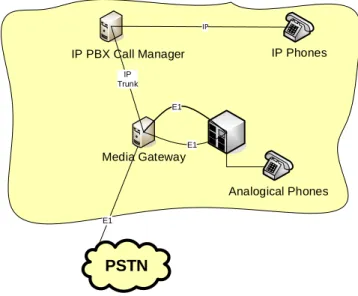
University of Beira Interior (UBI) [1] started the convergence of the phone system and the data network in 2005, after acquiring a commercial Internet Protocol (IP) Private Branch Exchange (PBX) software from Cisco called CallManager [2]. The long term objective to UBI, was to have 100% Voice over IP (VoIP) network until 2020. The Internet Protocol Private Branch eXchange (IP PBX) was integrated with the analog PBX’s and with the Public switched telephone network (PSTN). Figure 1.1 presents a scheme depicting CallManager integration in UBI voice architecture. In Figure 1.1, E-carrier (E1) represents a Primary Rate Interface (PRI). PRI is a standardized telecommunications service level within the Integrated Services Digital Network (ISDN). E1 provides 30 communication channels and 2 signaling channels, this is also referred to as 30B channels plus 2D channels. In this case Media Gateway has 60 voice channels to interconnect VoIP and legacy telephony. E1 Media Gateway E1 IP PBX Call Manager E1 PSTN IP Trunk IP Phones IP Analogical Phones
In 2007, Portuguese Universities started changing their phone systems into a converged system using the data network to route phone calls. This project, named VoIP@RCTS [3] was launched by the Fundação para a Computação
Científica Nacional (FCCN), the Portuguese National Research and Education
Network (NREN). The chosen solution was a software platform based on FreePBX [4] which uses the Asterisk core [5]. This software, although based on FreePBX, it has been redesigned to suite Universities’ specifications. This new software is called Enterprise Courier from itCenter [6]. UBI integrated that same project and the system was incorporated in its telephone network. Figure 1.2 illustrates UBI integration of VoIP@RCTS in the existing infrastructure of UBI. In Figure 1.2 we can also see the Session Border Controller (SBC) that acts as a firewall for the VoIP world.
Telephony Operators E1 SBC IP Trunk IP PBX Enterprise Courier IP PBX Call Manager IP Trunk IP Trunk IP Trunk PSTN Backup IP Trunk IP Phones IP Analogical Phones Media Gateway E1 E1
Figure 1.2 – Integration of VoIP@RCTS in UBI infrastructure.
Although the provided solution was based on open source software, it was customized for the universities specific needs permitting further use of the new features offered by Enterprise Courier. One of these possibilities is the use of Interactive Voice Response (IVR), which suited some of the specific services, allowing for example, the calling user select the most adequate operator for his/her particular call motivation.
3
1.2. IVR a new offered service
Interactive Voice Response play an important and increasingly role in today’s business world and global economy. Indeed, they serve as the primary customer-contact channel, for companies in many different industries. IVR systems, if properly designed, can increase customer satisfaction and loyalty, cut staffing costs and increase revenue by extending business hours and market reach [7].
Poorly designed IVR systems, on the other hand, will cause the opposite effect and lead to dissatisfied customers, increased call volume and even increased agent turnover, as customers take out their frustrations on the agents. A study from Purdue University, revealed that 92% of US consumers evaluate a company based on their experience using the company's call center. More surprisingly, the study found that 63% of consumers stop using a company's products based on a negative call center experience. That number could raise to 100% for consumers with ages between 18 and 25 years old [8].
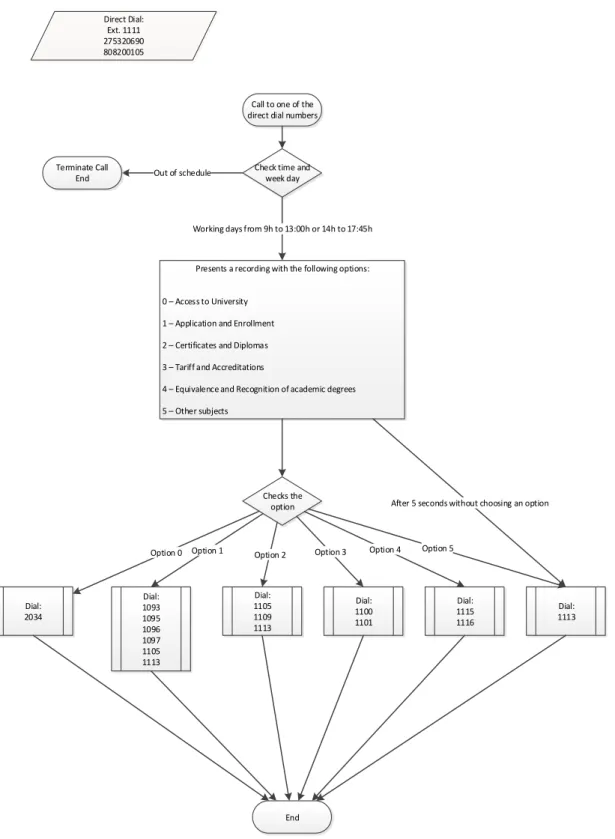
There are two options to create an IVR: deep divided design or broad design. Deep divided design is used in order to limit the number of options in every menu, but it can have many submenus. This can increase the complexity and create confusion because it might not fit the user's mental model [9]. Experimental results showed that users who used broad IVR design performed tasks faster and with greater satisfaction than users who used deep IVR design [10]. In this study it was preferred a broad design, as it is showed in Figure 1.3.
Figure 1.3 – Flowchart for the IVR Academic Services costumer contact and ticketing.
According to Figure 1.3, there are two direct inward dialing (DID), also called direct dial-in (DDI) and one internal extension to reach Academic Services
Call to one of the direct dial numbers
Check time and week day Out of schedule
Presents a recording with the following options:
0 – Access to University 1 – Application and Enrollment 2 – Certificates and Diplomas 3 – Tariff and Accreditations
4 – Equivalence and Recognition of academic degrees 5 – Other subjects
Working days from 9h to 13:00h or 14h to 17:45h Terminate Call End Checks the option Dial: 2034 Option 0 Option 1 Dial: 1093 1095 1096 1097 1105 1113 Option 2 Dial: 1105 1109 1113 Option 3 Dial: 1100 1101 Option 4 Dial: 1115 1116 End Direct Dial: Ext. 1111 275320690 808200105 Dial: 1113 Option 5
5 costumer contact and ticketing. The date and time are only checked at the beginning.
To increase customer satisfaction, there were great concerns ordering the six menu options. According to the latest studies, the most frequent options must be placed in first place [11]. In this way, users calling the service can identify their option and don’t have to wait until the recording. This ordering was done empirically without previous knowledge and will be discussed later in the results section.
There was also a great concern about the recordings. The first challenge had to do with the tone, pitch and accent. The chosen voice had to transmit a feeling of sympathy, had to be sharp and without any accent.
The second concern was related to what to present first, the textual description or the option number itself. The goal-action sequence (e.g., "To do x, press y") was preferred, rather than the action-goal sequence (e.g., "Press y to do x"), for options. Most researchers and standards agree with the goal-action sequence because it seems more consistent with the cognitive makeup of the task [12]. The goal-action sequence seems to encourage dial-through and was shown slightly faster response times than the action-goal sequence [13].
After the initial greeting, it’s usual to prompt the user to indicate whether touch-tone service is being used. Many IVR systems instruct users to press 1 as evidence of a Dual-Tone Multi-Frequency (DTMF). Instead of asking users to press a key for evidence of DTMF, it’s used the timeout value for key insertion. According to Figure 1.3, after five seconds the system will timeout and automatically choose option 5 [14].
After the option is chosen, the call is inserted in a first-come first-served (FCFS) queue. The ring strategy used is ring all, i.e., the call that is leaving the queue is placed simultaneously in all phones identified for that option,
i.e., a call living option’s 3 queue will dial extensions “1100” and “1101”.
The first operator to pick up the handset gets the call.
1.3. Motivation and problem
UBI seeks to continuously improve its organizational structure, its processes and its control methods, aiming to satisfy and anticipate the requirements of its customers and other stakeholders.
Yet, the Enterprise Courier IP PBX does not provide IVR statistics, and therefore, there are no metrics that allow UBI to evaluate and plan improvements in the area of automated telephone response.
Therefore, in 2013, the Vice-Rector for Academic Affairs, recognized as the main stakeholder, required that monitoring and supervision would need to be implemented in the Academic Services costumer contact and ticketing IVR system.
Having this in consideration, this paper describes the carried out research that will allow the future creation of a solution that allows monitoring and supervision, for example, get a relationship between how many calls an option receives and which operator takes it, or how many minutes does a call last, or how many seconds is a client on hold until he starts to talk with the operator, on an Asterisk based software.
1.4. Organization of the Thesis
The remainder of this paper is organized as follows: this paragraph concludes section 1, the Introduction, where the problem, motivations and objectives of the research were outlined; section 2 follows, describing the state of the art; section 3 presents the architecture and the solution; section 4 describes and discusses the results obtained; section 5 concludes de the paper presenting conclusions and future work; and finally in the appendices section a paper with the title “A comprehensive IVR (Interactive Voice Response) analysis model using online analytical processing (OLAP) on a multidimensional data cube” fruit of this work.
7
Chapter 2
2.
State of the art
2.1. Telephony Evolution
The first voice transmission was accomplished on 10 March 1876 through a ring down circuit, in which two devices were connected by wire, but there was no dialing numbers and it just worked one-way. Inventor Alexander Graham Bell called out to his assistant Thomas Watson, “Mr. Watson, come here! I want to see you.” This transmission took place in their attic laboratory. Over time, one-way voice transmission transformed to bi-directional voice transmission using wired networks. Before adopting the circuit switched technology has the basis of the telecommunication services there where human operators making the connections. Until several decades ago, the communication services were based on analog infrastructure, but the analog communication is neither robust nor efficient at recovering from the line noise (Figure 2.1). In digital communication, the line noise is less of an issue because digital amplifiers also known as repeaters not only amplify the signal, but also clean it to its original condition (Figure 2.1).
Figure 2.1 – Digital amplification vs Analog amplification.
Original signal
Original signal
Signal with noise
Signal with noise
Signal with noise amplified Signal amplified Talker Talker Analog Amplifier Digital Amplifier
Signal with noise Signal with noise amplified
Public switched telephone network (PSTN) system sampled the voice stream at 8 kHz and transmits the digitized voice over the circuit switched network with bit rate of 64 kb/s [15].
At the end of the 20th century, analog radio, television (TV) and telephony services stood out in particular. Most of the audio distribution in home was centered in radio, and for this purpose different modulation standards were used, as is the case of frequency modulation (FM) and amplitude modulation (AM). Regarding the TV, different signal transmission technologies were used. One example of this was the use of analog TV broadcasting on the very high frequency (VHF) and ultra-high frequency (UHF) wavebands. After that, the satellite broadcasting technology made possible the transmission of audiovisual content over very long distances, thus encouraging cultural diversity and enabling new business models to be set up. Traditionally, telephony services have been provided by telecom operators through the PSTN infrastructure.
High-quality voice services had been provided by the traditional PSTN system, since this system was built for switching voice calls over the network. The connection between the end points is established before starting the voice communications and that connection remains in use until the end of communication. This makes the bandwidth unavailable for the other services over this established circuit. The architecture built for voice is not flexible to converge data, video and voice traffic at the same time.
Interestingly, it was the PSTN that made possible many of the IP data transmissions. In the 90s it was common to have a home computer and a dialup modem connected to the nearest point of presence (POP), as showed in Figure 2.2.
Figure 2.2 – Scheme depicting dialup connection to nearest POP. Dialer cloud
PSTN
Nearest
Point of Presence (POP) Communications Server
Dialup modem
Dialup modem
Personal computer
9 Modern networks are constantly evolving to meet user demands. Initial data networks were limited to exchanging character-based information between connected computer systems. Traditional telephone, radio, and television networks were maintained separately from data networks. In the past, every one of these services required a dedicated network, with different communication channels and different technologies to carry a particular communication signal. Each service had its own set of rules and standards to ensure successful communication.
The Open Systems Interconnection (OSI) transport layer protocols, transmission control protocol (TCP) and user datagram protocol (UDP) are being used to overcome the drawbacks. Nowadays, VoIP is one of the prominent and fastest growing telecommunication service based on an Internet protocol suite. VoIP enables the users to use the Internet as the transmission medium for voice communication. The general architecture of the VoIP system presented in Figure 1.2 demonstrates some of the basic requirements for implementing a VoIP system.
Advances in technology are enabling us to consolidate these different kinds of networks onto one platform referred to as the “converged network”. Unlike dedicated networks, converged networks are capable of delivering voice, video streams, text, and graphics between many different types of devices over the same communication channel and network structure. Previously separate and distinct communication forms have converged into a common platform [16].
In traditional systems, increasing the connectivity, means more ports to connect in telephones which leads to an increase in cost. But in the VoIP system, no extra cost would be paid to increase the connectivity. In VoIP, increase in cost relay on the functionality improvement. VoIP is software based, so any type of addition can be done just by upgrading the software. The hardware cost is also very low because it runs on computer platforms [17].
The VoIP system has a lot of advanced features, which makes the VoIP system the best alternative to the traditional circuit network. These features attract the communication industries and business community towards the new telephony.
Low cost is the main advantage of the VoIP system. The long distance calls can be made at very low cost through the VoIP system, since it can access the public Internet and the low cost broadband connection, increases the
adaptation of VoIP system in the small business world, too. It uses the existing infrastructure such as computer system and Internet to provide the communication without any addition cabling cost [15].
Data networks are based on packet switching and can be architected to be reliable and resilient, providing alternative paths to data in case of failure. VoIP systems benefit from that design and are less susceptible to total failure. Because the sound must be digitally encoded to be packetized, the resulting sound is more robust compared to the traditional analog systems, as showed in Figure 2.1. Although digitally encoded speech has many advantages over its analog counterpart, it nevertheless requires extra bandwidth for transmission, if it is applied without compression. To counteract this, VoIP systems use coder-decoder (codec) through software and hardware to compress and decompress sound. The selection of a suitable codec for the VoIP system is of much importance, since this selection may affect the system performance. Table 2.1 describes some codecs and various characteristics [18].
Table 2.1 – Comparison of the most well-known voice codecs. Codec Year Bit rate (kb/s) Algorithmic delay (ms) Mean Opinion Score (MOS)
G.711 1972 64 0.125 4.1 GSM-FR 1987 13 20 3.6 G.722 1988 48, 56, 64 1.5 4.1 G.726 1990 24 0.125 3.5 G.726 1990 32 0.125 4.1 GSM-HR 1994 5.6 24.4 3.5 G.723.1 1995 6.3 30 3.8 G.723.1 1995 5.3 30 3.6 G.729 1996 8 15 3.92 G.729A 1996 8 15 3.7 GSM-EFR 1998 12.2 20 4.1 AMR-NB 1999 4.75 – 12.2 25 3.5 – 4.1 G.722.1 1999 24, 32 40 4.0 Speex (NB) 2002 2.15 – 24.6 30 2.8 – 4.2 iLBC 2004 13.33 40 3.8 iLBC 2004 15.2 25 3.9 BV32 2005 32 5 4.1
The most obvious way to measure speech quality is to go right to the source and use human subjects to rate the quality of the telephone calls. This is a
11 subjective method, described in two ITU recommendations [19] [20]. The primary results of the subjective test are mean opinion score (MOS), which rate the quality of a telephone call from an end-user perspective. The MOS score is a subjective score of voice quality as perceived by a large number of people listening to speech over a communication system.
To determine the MOS for a particular phone connection, a statistically valid group of males and females rate the quality of special test sentences read aloud over the connection. This recommendation uses the scale from 1 to 5 and the MOS of the voice transmission is the average estimate of voice quality rates assigned by this statistical group as presented in Table 2.2.
Table 2.2 – Subjective speech quality measurement.
Speech quality MOS
Excellent 5
Good 4
Fair 3
Poor 2
Bad 1
An MOS of 4.0, is considered toll quality (PSTN quality) within the telephone industry and anything below MOS of 4.0 would then be below toll quality level. Subjective testing includes both listening opinion and conversation opinion tests.
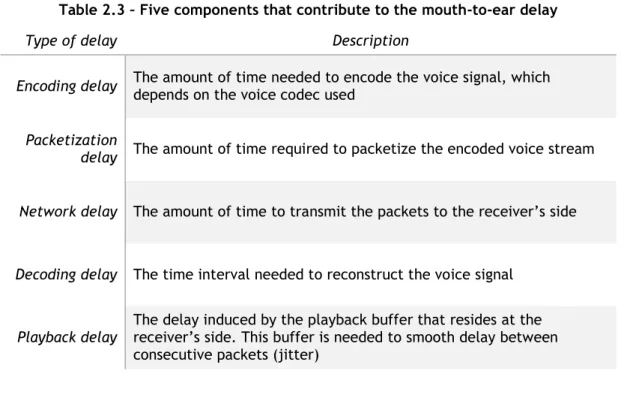
Delay is the time taken by the voice to reach from the talker's mouth to the listener's ear. Round trip delay is the sum of two one-way delays that occur in the user's call. In a VoIP system, beside the encoding delay and decoding delay, the propagation delay is also affected by three additional delays, packeting delay, network delay and playback delay. These delays may be variable during the transmission [21]. Table 2.3 resumes the general five components that contribute to the overall delay.
Table 2.3 – Five components that contribute to the mouth-to-ear delay
Type of delay Description
Encoding delay The amount of time needed to encode the voice signal, which depends on the voice codec used Packetization
delay The amount of time required to packetize the encoded voice stream Network delay The amount of time to transmit the packets to the receiver’s side
Decoding delay The time interval needed to reconstruct the voice signal
Playback delay
The delay induced by the playback buffer that resides at the receiver’s side. This buffer is needed to smooth delay between consecutive packets (jitter)
One-way delay, i.e, from mouth-to-ear, should be less than 150 milliseconds, latency greater than 400 milliseconds is unacceptable [22]. Table 2.4 describes the delay according to the user's satisfaction.
Table 2.4 – Delay limits for one-way transmission. One-way delay
milliseconds (ms) Description
0-150 Acceptable for most users
150-400 Acceptable but with impact
Above 400 Unacceptable
Compared to traditional telephony (circuit switching), VoIP is now more scalable, robust, reliable, allows the integration of new features and the possibility of reducing costs. From the perspective of data networks, VoIP has transformed the voice into just another application [5].
2.2. Unified Communications
VoIP as evolved on the last years and today offers a complete set of tools called unified communications (UC). UC integrates real-time communication services such as instant presence information, messaging (chat), desktop sharing, telephony, video conferencing, data sharing, call control and speech
13 recognition. UC isn’t necessarily a single product, instead, it’s a set of products that provides a consistent unified interface and user-experience across multiple devices and media-types.
UC products facilitate the use of multiple enterprise communications methods to improve user productivity and to enhance business processes. This can include the management, control and integration. UC products integrate communications channels, networks and systems, as well as IT business applications, consumer applications and devices. Offers the ability to significantly improve how individuals, groups and companies interact and perform. The UC products may be composed of a single vendor suite, or may span multiple platforms and vendors. These products are used by individuals to facilitate personal communications, and by enterprises to support collaborative communications and business workflows. Some products may even extend UC to the cloud.
Table 2.5 – UC communications areas.
Telephony This area includes mobile, fixed and soft telephony.
Conferencing This area includes videoconferencing, voice conferencing and Web conferencing. Includes application sharing and document sharing.
Messaging This area includes voice mail and email.
Presence and IM
Presence allows individuals to see the status of other people and resources. Instant messaging allows individuals or groups to send and receive text information in real time.
Clients
Unified clients enable access from various platforms from a consistent interface. May include thin browser clients, thick desktop clients, and mobile clients in smartphones and tablets.
Communications-enabled applications
Communications-enabled applications include key application in collaboration area. This area includes contact center, notification, and consolidated administration, reporting and analytics tools.
Many authors find it useful to divide UC into six broad communication areas, according to Table 2.5.
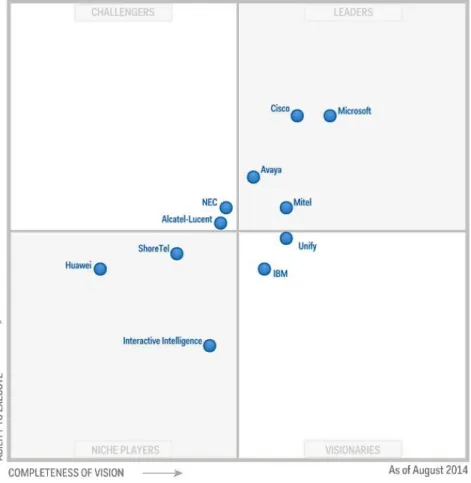
Gartner is the world's leading information technology research and advisory company, delivering the technology-related insight necessary to make the right decisions. Figure 2.3 presents the major players for UC [23].
Figure 2.3 – Gartner magic quadrant for unified communications.
The leader’s quadrant will be used to focus the best solutions available in the market [23]. Asterisk UC will also be included in this study for its popularity in the open source community.
All UC solutions in study allow IVR configuration. IVR allows call handling, in order to give some sort of response to them without human interaction. Being the caller responsible to choose one of the options that are presented. IVR is usually presented in a form of a menu that can have many layers or submenus and are composed by audio files played to the caller, witch, through touch keys on the phone can interact with the system, for example, allowing the creation of a voting system via phone, money transfer from a bank account or to choose the more skilled operator in certain subject [24].
15
2.3. Microsoft UC solution
Microsoft Lync offers UC functionality. Microsoft continues to improve UC functionality with each release and integrates with Active Directory, Office applications and Skype. Microsoft has a large set of business applications that will increasingly be leveraged, including Cortana (a digital assistant) and Office Graph (which uses machine learning to define the context and connect users with relevant documents, conversations and people).
Microsoft Lync federation capabilities are an effective way for groups to collaborate. Microsoft Lync Online is part of Office 365, however, Lync Online only offers a subset of the on-premises solution, with limited PSTN connectivity.
According to its manufacturer, organizations with a significant number of employees that can benefit from Lync's collaboration model, should consider the Lync solution. Organizations that use advanced telephony feature requirements should also ensure that the needed functions are supported. Also according to its manufacturer Microsoft Lync continues to make significant gains in the market and is attractive to a broad range of enterprises. In many cases, it is initially deployed for its IM, presence and Web conferencing functionalities, with gradual incremental deployments of telephony and video added as follow-on phased deployments for specifically targeted groups or regions.
Microsoft has added video capabilities. Support for Lync room-based video systems and interoperability of standards-based video endpoints were included.
Customers report that Lync functions can be readily integrated into business processes and applications, providing new, different and effective ways to perform tasks. Often, these new functions are achieved by deploying Lync enhancements from a growing list of ecosystem partners.
Lync implementation might not eliminate legacy PBXs. Usually, Lync Web conferencing and IM/presence are deployed across the organization, while telephony is deployed only for a subset of employees. Telephony implementation will include third party’s software and hardware. Deploying Lync might be a challenge, multiple partners may be required to obtain a complete deployment, for example, different partners for telephones, gateways, servers, remote support and network monitoring. This can lead to incompatibilities on software from any of these partners.
According to the documentation it’s possible to do IVR reporting. Documentation indicates the need to export the data and then run the analyses using PowerShell. A PowerShell example would be [25]:
$calls = Import-Csv -Path
"C:\Response_Group_Call_List_Report_export.csv"
$calls | Group-Object Workflow | Select-Object Count, Name | Sort-Object Count –Descending
The resulting information would be similar to Figure 2.4 [25].
Figure 2.4 – Example of IVR Lync reporting using PowerShell.
2.4. Cisco UC solution
Cisco offers a full UC suite, and as part of it a broad range of communications functions. Key parts of the UC suite include Cisco Jabber, CUCM, Cisco Unity Connection and Cisco WebEx. The entire portfolio is available on VMware, operating on Cisco Unified Computing System (CUCS) servers or other qualified servers. Cisco leverages its UC software into a cloud portfolio branded Cisco Hosted Collaboration Solution (Cisco HCS), which allows to build Unified Communications as a Service (UCaaS) or hybrid options on premises.
According to the vendor, Cisco UC has strong voice and video capabilities and solutions from midsize to multinational sites. It’s very attractive for enterprises that wish to leverage Cisco's networking infrastructure or that require full UC client integration on leading mobile platforms. A full UC suite is offered with IM/presence, video, multiple conferencing options and telephony, also available on leading mobile platforms.
Through Internet service providers (ISP), Cisco is advancing hybrid on-premises and cloud options. Cisco HCS is based on the on-on-premises software and both support the same Jabber client, there are also the possibility to transfer licenses from on-premises to hosted environments.
17 Cisco UC solution is based on a set of distinct products and acquisitions over the years, as a result some administrator and user experiences are fragmented.
IVR possibility comes in two flavors Unified Contact Center Express, for small implementations and Unified Contact Center Enterprise for larger deployments [2].
The ability to create IVR reports is given by one add-on tool called Cisco Unified IP IVR. This tool can create reports for application performance analysis report, detailed call by call report and traffic analysis report for answered and unanswered calls [2].
Figure 2.5 – Report generation for abandoned calls.
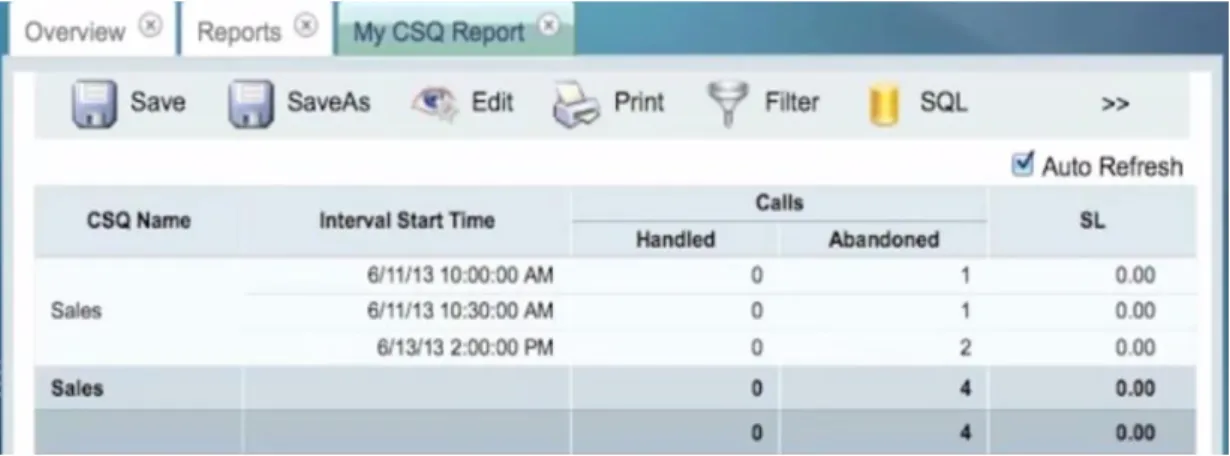
Figure 2.5 show’s how to create a report for Cisco Contact Center Express. There’s also the possibility to schedule reports and load existing reports. For Enterprise version the Unified Intelligence Center is a more complete tool. It’s possible to create Dashboards, and reporting is more flexible. Figure 2.6 show’s a simple example.
Figure 2.6 – Report generation using Unified Intelligence Center.
In Figure 2.6 the report was manipulated by the administrator just to show handled calls, abandoned calls and service level for the analyzed period. Reports still have to pass through a configuration menu indicating start and end date, similar to Figure 2.5. For advanced users there’s also the possibility to run SQL queries.
2.5. Avaya UC solution
Avaya is one of the leaders in Gartner review and has a wide set of communications products. The UC product is Avaya Aura Platform. Other elements in the UC portfolio are: Avaya Aura Conferencing, Avaya Aura Messaging, Scopia Video Conferencing and the Avaya Aura Collaboration Environment. There are also available UC applications for desktop, mobile, phone and video. Avaya Aura is considered a good solution in the presence of heterogeneous environments (systems, services and devices). The vendor's strength and brand recognition in telephony and contact center are central key elements for Avaya's products. The UC solution is advancing to the cloud and is based on the same solution as the on-premises version.
Avaya is expanding its portfolio in Avaya Aura Collaboration, expanding middleware integration options there for enabling a broader ecosystem of partner applications. The expansion on the integration capabilities, allows a stronger multivendor UC integration, for example, integration with Microsoft Lync. The multivendor integration and the portfolio redundant capabilities (Scopia, Aura Conferencing and Avaya one-X Communicator) might lead to client confusion in the sales process and the Avaya solutions themselves appears individual point solutions, rather than as a comprehensive UC suite.
19 Avaya's contact center solutions are: Aura Contact Center and Aura Call Center Elite, both capable of IVR. Reports are also available in this solution but have to pass through a few configuration menus indicating the kind of report and the span date.
Figure 2.7 – Report example on agent performance.
2.6. Mitel UC solution
In 2013, Mitel changed its offerings, simplifying the buy experience. In the end of 2013 Mitel and Aastra entered in a merge process. The deal was closed in January 2014 and gave birth to a new company under the name of Mitel, while continuing to leverage Aastra’s strong brand recognition in European markets. Aastra had a strong portfolio for telephony, video, call centers and UC. Mitel pretends to use MiCollab suite as the common UC solution across the various call management platforms. MiCloud service is also available as UCaaS based on MiCollab, MiVoice and MiContact Center. The incorporation of Aastra video capabilities into the existing MiCollab video option and into MiVoice Video Unit are on track. One big concern about Mitel and their products is that the expanded portfolio may reduce Mitel ability to research, development and support.
The Mitel MiVoice, MiCollab and MiContact Center solutions provide a mature and comprehensive software suite. The common based software architecture makes it possible to use a distributed solution or centralized solution in a data center. They run on industry-standard servers, and are certified for virtualizations on VMware environments. The same solutions are also available as cloud offerings.
Mitel MiContact Center sits on top of MiVoice product and has two versions, Business Edition delivers robust contact center, IVR, multimedia functionality and reporting but packaged specifically for small contact centers. For large scale Mitel MiContact Center Enterprise Edition is a robust, highly flexible solution that delivers feature-rich IVR capabilities, contact center monitoring and reporting. Reporting can be made by request or by schedule. It’s very similar to other vendors solutions, in this case the result is an excel file that can be later worked by a statistician or imported to data warehouse for data mining. Mitel also allows access to its database raw data, for custom reports.
2.7. Asterisk UC solution
Asterisk system is built by a community of developers and is targeted to communication systems developers. The result is an engine that is able to handle the low-level details of initiating, maintaining and manipulating calls between endpoints (phone terminals). Since the initial release it’s been tested and refined by a community of more than 80,000 developers. With the right developer skills, raw configuration files and custom scripts, it’s possible to provide UC capabilities like: voice messaging, instant messaging, desktop fax, drag/drop call control, multi-party conferencing and IVR [5].
There are many forks from Asterisk, some are free to use and usually have no support, like: FreePBX or Trixbox CE, while others, are commercial versions and typically provide software, hardware and support for both. Some commercial versions of Asterisk are: Switchvox, Masip, Zycoo, Enterprise Courier and Xorcom, among many others.
Asterisk includes a wealth of functions that make it a powerful IVR platform: audio playback, audio recording, queues and calendar integration. For Asterisk, IVR is just a special use of the Dialplan, as showed in Figure 2.8 [26].
21
Figure 2.8 – Asterisk IVR Hello World, using Dialplan language.
Figure 2.8, shows how the Dialplan can be used to create IVR function in Asterisk. In this example, if someone dials the extension 90, the system will pick up the call and will play the audio file called hello_world_audio_file. Meanwhile if the key 1 is pressed the system will play the audio file called you_pressed_1_audio_file and afterwards the system will hang-up the call. A similar action will occur if key number 2 is pressed.
IVR are just calls and being so, one could think about using Call Detail Record (CDR) for reporting.
In Asterisk based systems, CDR-stats [27] is a separate application that analyses the CDR and creates statistics from there. There are two options: professional support (commercial version) or community support (free to use). It’s one interesting tool for CDR reporting, but it’s not by any mean IVR specialized, the report will have inconsistent results. Being IVR just a special use of the Dialplan, creates a few difficulties for IVR reporting, because generally calls that enter IVR will generate more than one CDR record. QueueMetrics is a call center analysis, monitoring and reporting software application for Asterisk. Because it is specialized for call centers it has a special treatment for IVR. QueueMetrics can be integrated with some Asterisk based systems and it’s a commercial solution with a license renewal every four years. This software creates reports for total calls, answered calls, unanswered calls, Call distribution, Agents and Call detail, as showed in Figure 2.9 [28].
Figure 2.9 – Scheme depicting QueueMetrics Answered call distribution per hour.
Figure 2.9 shows peak hours of IVR use, in this example, peak hours are between 17:00 and 22:00, this can be very useful for assigning more workforce at this hours.
2.8. Call Center Management and Reporting
Call Center or Contact Center equipment currently available generates vast amounts of data related to the daily operation of a call center. This data is used by the UC equipment to route calls and logging, but also has the potential to reveal important details about agent's productivity and performance. This data can reveal user experience provided by the contact center to each person that placed a call in the system. To date there has been no public system or method which has been able to gather, organize, interpret, and report vital data to managers and supervisors in a manner which unleashes the full potential and value of such data [29].
23
Chapter 3
3.
Architecture and solution to the problem: a
comprehensive IVR analysis model using online
analytical processing on a multidimensional data cube
3.1. Requirements
As presented in the introduction section, there was a need to develop new solutions for a system analysis approach in order to respond to the UBI’s 2020 mission call for constant improvement on all University services.
The relevant stakeholders were, primarily, the Vice-Rector for the Academic Affairs, and also, too much lesser extent, the users at the Academic Services, and external users that contact UBI using the telephone.
Based on the interviews conducted with the stakeholders, the following list of functional requirements (FR) and non-functional requirements (NFR) was produced for the answered and unanswered calls:
FR1: The system must be able to provide metrics on the efficiency of the incoming calls, e.g., the system must provide information about the answered and unanswered calls per day or set of consecutive days, month or set of consecutive months, quarter or set of consecutive quarters and year or set of consecutive years;
FR2: The system must be able to provide information about the answered calls per operator number;
FR3: The system must be able to provide information about the distribution of the incoming calls, i.e. the system must provide information about the answered and/or unanswered calls per IVR menu option;
FR4: The system must be able to provide information about the time spent, i.e. the system must provide information about the waiting time and conversation time.
NRF1: The system must not install any software in the IP PBX Enterprise Courier.
NRF2: The system must not interfere with the IP PBX system, e.g. the system must not alter the IP PBX databases.
NRF3: The system must not interfere with the VoIP performance. It must be noted that this list of requirements is not final, as the approach to the development of the system was performed in a prototyping manner, thus allowing the stakeholders to refine the requirements list, i.e., the results that the system must output will be subject of continuous improvement.
3.2. Call Detail Record structure
The IP PBX Enterprise Courier stores locally, in a MySQL database, information about all calls in a format named Call Detail Record (CDR) and in particular, calls that enters into the IVR. The CDR structure has the following fields: cdr_id, calldate, clid, src, dst, dcontext, channel, dstchannel, lastapp, lastdata, duration, billsec, disposition, amaflags, accountcode, uniqueid and userfield.
3.3. Retrieved fields to Data WareHouse
From all of the fields, there are a few with special interest for this study: cdr_id, calldate, src, dst, duration, billsec, disposition and uniqueid.
The cdr_id field is a sequential number generated when the database record is created.
The calldate field has the timestamp for the call beginning and is a datetime type.
25 The src field has the call source, e.g. “+351275319700” and is of varchar type.
The dst field has the call destination, e.g. “1113” and is a varchar type. The duration field has the call total time in seconds and it is of int type. The billsec field has the call conversation time in seconds and it is of int type.
The disposition field is a varchar type and can take two possible strings: “ANSWERED” or “UNANSWERED”.
The uniqueid field has the id for the call in question and is a varchar type. The relevant data fields [30] for this study are retrieved from Enterprise Courier IP PBX by the data warehouse and are stored for comprehensive and detailed analysis as it is showed in Figure 3.1. The data warehouse retrieval SQL job, fetches new data, based on CDR_id, i.e, twice a day and it can be adjusted for more sensitive real-time data, if required.
Figure 3.1 – Data retrieval scheme.
As stated before in Chapter 2, usually there are two database rows for the same call. Actually, this only occurs if the call is answered. The first CDR is generated for the receiving call stating the queue of the call. This queue can then be translated to the appropriate IVR option. The second CDR record is generated for the operator that took the call, as showed in Table 3.1.
Table 3.1 – Records representing one answered call.
cdr_id calldate src dst duration billsec disposition
2448554 2014- 07-15 15:57:01 91XXX6962 9000005 223 223 ANSWERED 2448239 2014- 07-15 15:57:34 91XXX6962 1113 192 188 ANSWERED
In Table 3.1 it was omitted the field uniqueid, the value is “asterisk-1405436252.64896” for both records.
The total call length, since the system pick up the call, until the operator or user ended the call, is given by the first record in the duration field, in this case 223 seconds.
Total conversation time is given by the second record, in the field billsec, that in this example is 188 seconds.
The waiting time for answered calls is defined in this study as showed in Equation 3.1 and Equation 3.2.
𝑤𝑎𝑖𝑡_𝑡𝑖𝑚𝑒 = 𝑇𝑜𝑡𝑎𝑙_𝑐𝑎𝑙𝑙_𝑙𝑒𝑛𝑔ℎ − 𝐶𝑜𝑛𝑣𝑒𝑟𝑠𝑎𝑡𝑖𝑜𝑛_𝑡𝑖𝑚𝑒. (3.1)
Substituting with the values of Table 3.1, the result will be:
𝑤𝑎𝑖𝑡_𝑡𝑖𝑚𝑒 = 223 − 188 = 34 𝑠𝑒𝑐𝑜𝑛𝑑𝑠. (3.2)
The destination field (dst), in the first record with the value “9000005” represents the queue that took the call. This value can be translated to IVR option number “5”, and according to Figure 1.3, represents “Other issues”. The destination field (dst), in the second record with the value “1113” represents the actual phone extension that took this call.
27 The source field (src), in both records was partially omitted for privacy reasons.
Table 3.2 – Record representing one unanswered call.
cdr_id calldate src dst duration billsec disposition
1847989
2014- 04-22 15:13:37
24XXX5728 9000005 173 173 ANSWERED
Unanswered calls only generate one record, like it’s showed in Table 3.2. The disposition field shows the value “ANSWERED” because the system picked up the call and presented the IVR menu options to the user. The second record doesn’t exist because the operator didn’t took this call. The duration field represents the total time of this call. This value is defined for this study, as the waiting time, that in this case was 173 seconds, approximately 2 minutes and 53 seconds.
The destination field (dst), with the value “9000005” represents the queue that took the call. This value can be translated to IVR option number “5”, and according to Figure 1.3, represents “Other issues”.
In Table 3.2 it was omitted the field uniqueid, the value is “asterisk-1398176017.17671” and in the case of unanswered calls, this value is in fact unique.
3.4. Cube Structure
Online Analytical Processing (OLAP) is a technology that is used to organize large business databases and support business intelligence. OLAP databases are constituted by cubes.
Online Analytical Processing (OLAP) databases facilitate business intelligence queries. OLAP is a database technology that has been optimized for querying and reporting, instead of processing transactions.
OLAP data results from historical data and is aggregated into structures that permit sophisticated analysis. OLAP data is also organized hierarchically and
stored in cubes instead of tables. It is a sophisticated technology that uses multidimensional structures to provide rapid analysis.
With the imported data, a multidimensional data model is constructed at the institutional data warehouse. This model views data in the form of a data cube [31] [32] [33]. A data cube allows data to be modeled, viewed and filtered in multiple dimensions.
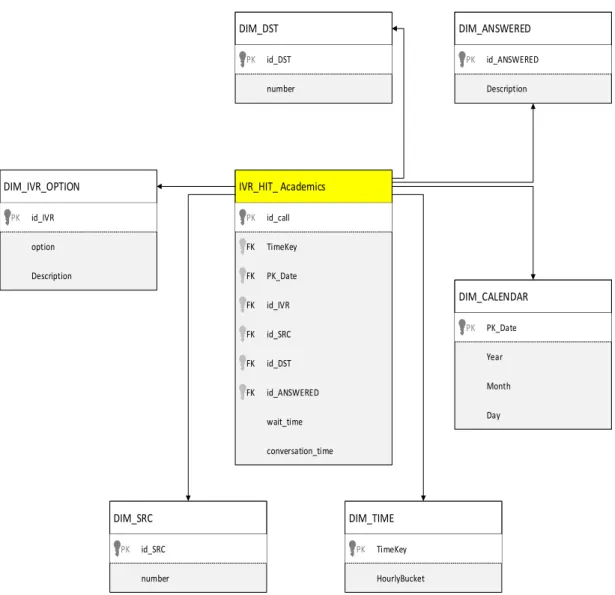
Cube is a data structure that aggregates measures by the levels and hierarchies of each of the dimensions that are needed to analyze. Cubes combine several dimensions, such as time, geography, and product lines, with summarized data. Cubes are not "cubes" in the strictly mathematical sense, however, they are an appropriate representation for the concept. The cube is defined by dimensions and facts [34]. Dimension tables are integral companions to a fact table. Dimensions are a set of one or more organized hierarchies of levels in a cube that a user understands and uses as the base for data analysis. The dimension tables contain the textual descriptors. Each dimension is defined by its single primary key, designated by the PK notation in Figure 3.2, which serves as the basis for referential integrity with any given fact table to which it is joined. Dimension table attributes play a vital role in the data warehouse, since they are the source of virtually all interesting constraints [35].
29
Figure 3.2 – Cube structure view.
A fact table is the primary table in a dimensional model [34]. The fact table contains the names of the facts, or measures, according to Figure 3.2, “wait_time” and “conversation_time”. Measures are the central values in the cube that are processed, aggregated and analyzed.
In addition to these measures, calculated measures were introduced based on this two primary measures, MAX_wait_time as the maximum value for wait_time, MIN_wait_time as the minimum value for wait_time, Avg_wait_time as the average value for wait_time, MAX_conversation_time as the maximum value for conversation_time, MIN_conversation_time as the minimum value for conversation_time and Avg_conversation_time as the average
IVR_HIT_ Academics id_call PK wait_time conversation_time TimeKey FK PK_Date FK id_IVR FK id_SRC FK id_DST FK DIM_IVR_OPTION id_IVR PK option Description DIM_SRC id_SRC PK number DIM_DST id_DST PK number DIM_CALENDAR PK_Date PK Year Month DIM_TIME TimeKey PK HourlyBucket Day DIM_ANSWERED id_ANSWERED PK Description id_ANSWERED FK