THE BENEFITS OF E-RECRUITMENT:
WEB 1.0 & WEB 2.0
Lídia Pinto Ribeiro Marques
A Dissertation presented as partial fulfilment of the Requirements for the Degree of Master in Human Resources Management
Supervisor:
Professor Carla F. Gomes da Costa, Invited Assistant Professor, ISCTE-IUL Business School
ACKNOWLEDGMENTS
This thesis is a result of a combination of factors. It was a long trajectory that required a lot of self-motivation, constantly overcoming challenges and making sacrifices. This would not have been possible without the presence of others in this path:
To Professor Carla Gomes da Costa, my Supervisor, I am so grateful for the encouragement words and for her precious guidance and wisdom.
I would also like to thank Professor Alzira Duarte for her constructive feedback in the definition of the thesis’ direction.
And finally, to my loving family specially my parents Armanda and Paulo who were always present with emotional support and my aunt Dina who keeps pushing me forward.
RESUMO
O uso da internet espalhou-se para muitas esferas da nossa vida. Esta afirmação é também verdadeira para o mundo empresarial onde o Recrutamento tem visto a internet revolucionar os processos e atividades desta área. O Recrutamento Online refere-se às atividades de recrutamento feitas através e com o apoio da internet. Em primeiro lugar, com a adoção de ferramentas da Web 1.0 foi possível atingir candidatos em todo o mundo através da publicação de anúncios de emprego nos Sites Corporativos das empresas e em Sites de Emprego especializados. A introdução de métodos online também permitiu aos recrutadores receber candidaturas através de sistemas integrados online onde filtrar e rever candidaturas tornou-se mais fácil e mais rápido para os profissionais de recrutamento. A Web 2.0 e o surgimento das Redes Sociais trouxe mais uma vez mudanças significativas aos processos de recrutamento e é ainda um fenómeno sob investigação. Apesar disso, organizações e recrutadores já usam as Redes Sociais nas suas atividades de atração de talento o que torna importante compreender o porquê e como estas novas ferramentas podem ser melhor utilizadas. Usando uma escala existente de benefícios da Web 1.0, o objetivo deste estudo é compreender que benefícios advêm do uso das diferentes ferramentas de recrutamento online, e como as duas gerações da web se podem complementar uma à outra nos processos de recrutamento. Para além disso, irão ser providenciadas algumas indicações para o futuro desenvolvimento de uma escala de benefícios de ferramentas da Web 2.0.
Palavras-Chave: Recrutamento Online, Redes Sociais, Sites Corporativos, Sites de Emprego
JEL Classificações: M51 Decisões de Emprego, Promoções; O33 Mudança Tecnológica: Escolhas e Consequências, Processos de Difusão.
ABSTRACT
The use of the internet has spread to many spheres of our lives. This is also true in the business world and Recruitment has seen the internet revolutionize the processes and activities in this field. E-Recruitment relates to the recruitment activities done through and with the support of the internet. First with the adoption of Web 1.0 tools, it was possible to reach candidates across the world through advertisement of jobs in companies’ Career Websites and in specialized Job Boards. The introduction of online methods further allowed recruiters to receive applications through online tracking systems where screening and filtering applications became easier and less time consuming for recruitment professionals. The Web 2.0 and the arrival of Social Media again brought significant changes, and this is still a phenomenon under research. Despite that, organisations and Recruiters are already using Social Networking Sites in their talent acquisition activities, which makes it important to understand why and how these new tools can best be utilized. Using an existing scale of benefits of Web 1.0, the goal of this study is to understand what benefits come from the use of different e-recruitment tools and how these two generations of the web can be complementary to each other in a recruitment process. Additionally, some insights will be provided for the future development of a scale of benefits for Web 2.0 tools.
Key-Words: E-Recruitment, Social Networking Sites, Career Websites, Job Boards
JEL Classifications: M51 Firm Employment Decisions; Promotions (Recruitment), O33 Technological Change: Choices and Consequences; Diffusion Processes (Technology and Employment)
CONTENTS
INDEX OF FIGURES ... III INDEX OF TABLES ... IV
INTRODUCTION ... 1
CHAPTER I. LITERATURE REVIEW ... 4
1.1 Recruitment within HRM ... 4
1.2 E-Recruitment – The rise of technology and internet in Recruitment activities ... 7
1.3 Web 1.0 – Career Websites & Job boards ... 9
1.4 Web 2.0 – Social (Media) Recruitment ... 11
1.5 Benefits of E-Recruitment ... 13
1.6 Challenges of E-Recruitment ... 16
CHAPTER II. RESEARCH PROBLEM ... 18
2.1 Research problematic ... 18
2.2 Research goals ... 19
2.3 Hypotheses ... 19
CHAPTER III. METHODOLOGY ... 23
3.1 Sample ... 23
3.1.1 Socio-demographics and occupation analysis ... 23
3.2 Procedures ... 26
3.3 Measures ... 28
3.4 Results ... 30
3.4.1 Descriptive Statistics and Correlation ... 30
3.4.2 Test of Hypotheses ... 35
CHAPTER IV. DISCUSSION ... 42
4.1 Limitations ... 44
4.2 Future research ... 45
CHAPTER V. CONCLUSIONS ... 46
REFERENCES ... 48
APPENDIX A. Questionnaire (English Version) ... 51
INDEX OF FIGURES
Figure 1 - Socio-demographic analysis - Age Distribution ... 23
Figure 2 - Socio-demographic analysis - Nationality Distribution ... 24
Figure 3 - Occupational analysis - Company Size Distribution ... 25
Figure 4 - Occupational analysis - Company Sector Distribution ... 25
Figure 5 - E-recruitment tools - Most used ... 31
Figure 6 - E-recruitment tools - Most used In-House VS In-Agency ... 31
Figure 7 - E-recruitment tools - Most used per qualification level (mean) ... 32
Figure 8 - E-recruitment tools - Most used per seniority level (mean) ... 33
Figure 9 - Aboul-Ela scale - Agreement with Web 1.0 benefits ... 36
Figure 10 - Aboul-Ela scale - Agreement with Web 2.0 benefits ... 37
Figure 11 - E-recruitment Benefits - Web 1.0 vs Web 2.0 ... 37
INDEX OF TABLES
Table 1 - Most effective methods of attracting applicants – 2013 and 2017 ... 5
Table 2 - Computed Variables and Cronbach's Alpha Scores for Scale ... 28
Table 3 - Correlation Analysis – Web 1.0 and Web 2.0 benefits ... 34
INTRODUCTION
An organisation’s key asset is its people. Attracting and retaining the best employees is crucial, especially in an extremely competitive labour world. Top talent is scarce and companies need to use the best tools and develop more efficient processes to target, attract and hire the best talent available (Cappelli, 2001). Recruitment and the activities around this function have experienced substantial changes, not only with the implementation of technology in the workplace, but also through the generalized use of the internet in our society (Girard and Fallery, 2010; Lin & Lu, 2011; Stopfer & Gosling, 2013). E-Recruitment has become a common practice among all size organisations across industries, and the benefits of using technology and the internet in recruitment activities have been a hot topic for researchers (Aboul-Ela, 2014; Broughton et al., 2013; Jeske and Shultz, 2015; Melanthiou et al., 2015, etc.). In an initial phase, the web allowed users to share information with each other (Aghaei et al., 2012). For organisations, this meant moving from paper job ads and applications to posting jobs online and receiving applications through the web. This changed recruitment processes massively, and brought substantial benefits to organisations (Aboul-Ela, 2014; Melanthiou et al., 2015). The improved efficiency of recruitment activities is the leading benefit brought by the first web generation, including the cost and time savings; the possibility to reach a much higher pool of talent, with no geographical restrictions and the reduction of human efforts put into recruitment activities (Cappelli, 2001; Galanaki, 2002; Parry and Tyson, 2008).
A new generation of the web, the Web 2.0, arrived with the creation of platforms that allow users to not only share information, but give feedback and communicate with each other (Aghaei et al., 2012). This two-way communication gives companies the opportunity to develop what Girard and Fallery (2010) call a relationship approach with candidates (contrasting with a one-way, exchange based approach fostered by the Web 1.0). The Web 2.0 and its implementation in recruitment processes also brought changes and benefits to organisations. The closer interaction with candidates is one of them (Allden and Harris, 2013; Broughton et al., 2013; Thielsch, Träumer, and Pytlik, 2012), but also the access to better quality applications, reaching passive candidates (Melanthiou et al., 2015) and the possibility to spread the organisation’s brand widely (Allden and Harris, 2013; Galanaki, 2002; Girard and Fallery, 2010) are other consequences of the implementation of the Web
2.0 in recruitment processes. The use of this newer generation of the web is also called Social Recruitment due to the use of Social Networking Sites, such as LinkedIn and Facebook (Caers and Castelyns, 2010; Broughton et al., 2013; Jeske and Shultz, 2015).
E-recruitment has been widely studied in the past years, with particular emphasis on the transition from more traditional methods of recruiting to the implementation of online methods. These include research on the impact, benefits, challenges, the effectiveness and success of online tools in different environments (Aboul-Ela, 2014; Galanaki, 2002; Parry and Tyson, 2008, etc.). For the new web generation and the use of social media in recruitment, research has focused again on the impact, advantages and consequences of these tools (Broughton et al., 2013; Girard and Fallery, 2010; etc.), with a special concern for the ethical implications of recruiting and screening applications using social media channels (Jeske and Shultz, 2015; Melanthiou et al., 2015; Parez et al., 2013). Referring to the network society or information society Alden and Harris (2013) mention the need to infiltrate and understand the networks where applicants are moving as well as their expectations. At the same time, Tielsch et al. (2012) talk about the current sense of urgency and speed in all life situations, and the fact that candidates want immediate and personalized feedback. With this awareness and the fact that talent is found in these social networking sites (460 million users on LinkedIn and over 2 billion on Facebook), this study aims to compare the two web generations and their benefits in an attempt to understand how the use of Web 2.0 tools can be integrated with Web 1.0 tools, and thus complementing each other in an efficient and goal oriented recruitment process. This comparison will be based on the scale of benefits developed by Aboul-Ela (2014). As this scale was originally developed with Web 1.0 tools in mind, there are other specific benefits to Web 2.0 tools that are not included. As such, it is intended to gather information on these specific benefits in order to provide insights that can be used to develop a scale of benefits of Web 2.0 in the future. To achieve the goals above, this study targeted talent acquisition professionals as respondents of an online survey distributed via direct email and though
research problematic, the goals of this study and the developed hypothesis to test with the data collected. The third chapter presents the methodology chosen for this study, including a description of our sample, the instruments and procedures used, as well as the tests and results of the analysis of the data collected. In the fourth chapter, there can be found a deeper discussion of the results achieved and the fifth chapter closes this dissertation with the main conclusions of the research, limitations of this study and suggestions for future research.
CHAPTER I. LITERATURE REVIEW
1.1 Recruitment within HRM
The Recruitment function is crucial for organizations as it is responsible for attracting, selecting and on-boarding the company’s talents (Armstrong, 2014). Particularly in a global, competitive and fast-paced world, companies’ success heavily depends on having the right employees, as hiring the wrong person for a job might imply great costs for employers (Newell, 2005; Ployart, 2006; Roberts, 2005). According to Heery and Noon’s (2008) definition, recruitment is the process by which companies gather a pool of talent and select the best fit for a specific job. Moreover, Newell (2005) states that companies also seek to promote their image and have positive and lasting interactions with potential future applicants. Typically, the recruitment process starts when someone leaves their job or when the company goes through a transformation or expansion and needs to add more human resources to reach the business goals (Newell, 2005). Roberts (2005) states that the talent planning must be integrated in a broader HR plan and reality, to address and fulfil the business needs. Having a clear understanding of where the vacancy fits within the organization, depends on a thorough job analysis and a person specification (Armstrong, 2014; Newell, 2005; Roberts, 2005). The Job Analysis includes the definition of the job purpose, the tasks and responsibilities under such role, how to assess performance (expected performance goals), the position within the organization (reporting line) and remuneration. The “Person Specification” (Roberts, 2005) involves the needed qualifications, knowledge, experience, abilities, skills, values, motivations and behaviours from the ideal candidate. Roberts (2005) speaks of the importance of defining competencies to correctly identify the right person for the job. The author argues that using
competency-check the talent pools built from previous contacts. If these approaches do not work, then the organization can move to an external recruitment. Again, this type of recruitment can be done using different channels. Armstrong (2014) refers to the CIPD (Chartered Institute of Personnel and Development) survey to rank the most effective sources of recruitment in 2013. Below can be seen a table showing the most effective methods for attracting applicants and its evolution, based on the CIPD analysis and reports, comparing results from 2013 and 2017.
Table 1 - Most effective methods of attracting applicants – 2013 and 2017 (Adapted from Armstrong, 2014; CIPD 2013 and CIPD 2017)
CIPD 2013 (%) CIPD 2017 (%)
Own Corporate Websites 62 74
Recruitment Agencies 49 52
Commercial Job Boards 38 58
Employee Referral Scheme 33 26
Professional networks, e.g. LinkedIn 32 60
Local newspaper ads 29 21
Specialist Journals 24 28
Search Consultants 17 20
Links with educational establishments 14 28
National newspaper advertisements 12 12
Social Networking Sites, e.g. Facebook 9 40
The most significant change has happened in the use of Networking Sites (LinkedIn and Facebook) with an increase of 30 percentage points each. Corporate websites, recruitment agencies, and commercial job boards are likewise among the most efficient methods for attracting applicants.
Armstrong (2014) furthermore outlines, that companies choose either one tool or a combination of the tools that are most suitable to them, taking into consideration three factors: the probability of attracting good quality applications, the methods that will be the fastest to successfully complete the recruitment process, and the costs associated with each method adopted.
Still regarding the types of recruitment, Roberts (2005) describe how organizations face the choice of either developing an in-house department dedicated to recruiting activities, or outsource this function to a third party. If outsourcing is the best option, the recruitment department can be completely replaced by an external agency or it can be done by contracting recruitment consultants for specific assignments (for example executive roles or others where there is a need for specific experience/skills).
Recruitment and Selection go hand in hand as a process for attracting candidates and deciding who will be the best fit for the job vacancy. Roberts (2005) suggests that there is a need for a balance between quantity and quality when considering the attraction and selection of candidates. In other words, the recruitment/attraction part of the process will determine how meaningful and successful the selection of candidates will be. The Selection works as a funnel, reducing the number of applications in each step, until the decision for the one candidate that will get the job has been made. Among those steps or selection methods, Newell (2005) lists among others: biodata and other pre-selection methods (e.g. application forms), interviews, psychological testing (personality tests, cognitive tests, psychometric tests) and assessment centres. Roberts (2005) mentions a survey from 1996, conducted in US companies, where executives rated different selection techniques regarding their effectiveness in identifying high performers. The results identified the following methods: work samples, references and recommendations, unstructured interviews, structured interviews, assessment centres, specific aptitude tests, personality tests, cognitive ability tests and biodata. More recently other selection methods have been implemented by companies, instigated by the use of technology. Poepplman and Blacksmith (2014), for example talk about online testing and videoconference interviews.
The use of technology in recruitment processes will be discussed over the next pages, focusing on the attraction phase of the process. This new trend in recruitment has brought several significant improvements and benefits to organizations that can also impact other
1.2 E-Recruitment – The rise of technology and internet in Recruitment activities
The emergence of the Web occurred in the early 90’s with the development of a common information space where people could publish information/documents for everyone to access at any time (Aghaei et al., 2012). From an initial one-way-directional web, the possibilities of an online presence started to shift to a two-way-directional web. Aghaei et al. (2012:3) refer to this new paradigm as “the wisdom web, people-centric web, participative web, and read-write web”, a platform where there is interaction between users. In the organizational context, the use of the web allowed for a number of improvements including costs and time savings, mass reaching communication, and increasing the company’s competitive advantage. The same can be said for HR departments. The adoption of technology in HR functions has leveraged a faster, more strategic, and time and cost efficient environment (Mishra and Akman, 2010; Parry and Tyson, 2011). Parry and Tyson (2011) defined e-HRM as the implementation of “web-technology-based channels” to support HR departments in their activities, policies and strategies. According to Lepak and Snell (1998) e-HRM and the implementation of technology in HR functions can have a three-level effect in organizations. The operational level refers to the automation of processes which save costs and increase productivity, and thereby making HR more efficient. The relational level implies a greater interaction and the possibility for managers and employees to access and maintain a shared virtual database which reduces the time for HR personnel to respond to queries and thus improves HR service delivery. Mishra and Akman (2010) add that the implementation of HR information systems (HRIS) for collecting, storing and maintaining data not only provides a solid storage of data but also provides insightful information for strategic decision making. The
transformational level of technology within HR eliminates geographical and time
constraints by connecting teams from all over the world.
The Recruitment function has likewise seen the effects of the implementation of technology within its processes and activities. Before the internet, recruiters had access to limited pools of talent: active job seekers and recent graduates. Now, recruiters can not only find thousands of potential qualified applicants, they can also screen them and contact them immediately (Girard and Fallery, 2010). From posting jobs online to receiving, screening
and managing applications electronically, the use of the internet has significantly changed the way recruitment activities are done. E-recruitment relates to all recruitment activities done online, including job postings in corporate and commercial websites, receiving applications virtually, searching for candidates and screening profiles in social networks, and web-based assessments and interviews (Aboul-Ela, 2014; Wolfswinkel et al., 2010). Recent studies on recruitment have focused on the use of internet and how e-recruitment is taking over from the more traditional recruitment methods (Aboul-Ela, 2014; Broughton et al., 2013; Jeske and Shultz, 2015; Melanthiou et al., 2015, etc.).
However, even within e-recruitment one can find different ways to go about the recruitment process. Girard and Fallery (2010) distinguish between the Web 1.0 and the Web 2.0 recruitment approaches. E-recruitment through Web 1.0 is described as an exchange-based recruitment where organizations relate to applicants by putting information on the web, making information on the company and the vacancies available online to everyone and managing applications also online. The authors mention this approach has evolved into a relationship-based approach fostered by the Web 2.0, where different tools increase a two-way communication between organization and applicants (and potential applicants). Other authors refer to the Web 2.0 recruitment as Social Recruitment (Caers and Castelyns, 2010; Broughton et al., 2013; Jeske and Shultz, 2015), which in sum is recruiting using Social Media or the Social Networking Sites (SNS’s). Within the next pages the definition of Web 1.0 and Web 2.0 are explored as important concepts for this study.
1.3 Web 1.0 – Career Websites & Job boards
The first generation of the Web, the Web 1.0, started as a space where information could be shared and read, with limited interactions between the content maker and reader (Aghaei et al., 2012). Even with its limitations, the Web 1.0 revolutionized the way businesses promoted their services and the number of people they reached. The same could be said about recruitment and the labour market which, in Cappelli’s (2001:140) words “has at last become a true market: wide open, uncontrolled by individual companies, and unconstrained by geography”. The author sees this new perspective of the labour market as an eye opener for executives to refashion recruitment from a clerical and reactive function to one more similar to the marketing function. After all, the Cappelli (2001) argues, applicants are seen as prospective customers, that are targeted, attracted and sold a job. Lievens et al. (2002, cited in Parry & Tyson, 2008) also present this argument, stating that organizations need to shift from selecting employees to attracting employees approach. This means that, in a very competitive market and with the desire to hire and retain the best talents, companies need to adapt and absorb the new trends and needs of the working population. Technology has become part of the every-day activities of people, both in professional environments but also in the private sphere. As such, it is expected that organizations implement technology in their interactions with external stakeholders. As put by Cappelli (2001:140), “in an environment with fierce competition for talent, companies that master the art and science of online recruiting will attract and keep the best people”. But what does “master the art and science of online recruiting” mean? Wolfswinkel et al. (2010) defined e-recruitment based in three aspects: 1) job posting in careers websites, commercial websites or other advertising websites; 2) candidate assessment through interviews and other assessment methods remotely and 3) electronic communication channels between recruiter and candidate. These can be completely done online or in a combination of online channels with more traditional methods. Ruël (2004) refers to the use of technology in recruitment function as an alternative to the “paper-approach” in what concerns job advertisement and application forms. Studying the application of e-recruitment tools in organizations, Parry and Tyson (2008) analysed the perceived success of using “electronic advertisement” in both the “corporate websites” and “commercial job
boards”. Girard and Fallery (2010) summarize Web 1.0 recruitment in three aspects: Career Sites, Job Boards and Recruitment Systems. These tools allow organizations to attract candidates at a lower cost than with the traditional methods, like paper adverts and application forms or using third-parties like recruitment agencies, thus making it an easy way for candidates and organizations to manage applications and access to a larger pool of talent (Parry and Tyson, 2008).
Some concerns have been brought up by Parry and Tyson (2008) in regard to the use of the web in recruitment. The authors state that bigger and better-known companies in the market are most likely to be more successful with using their career websites than smaller less well-known companies. At the same time, the use of internet practices for recruitment purposes are not seen as suitable to approach all kinds of applicants, for example blue-collar jobs, older workers, “housewives” and also high-level management (Parry and Tyson, 2008). To become more successful in the use of online tools for recruitment purposes, the authors identified the following steps: the use of more automated systems (as the posting of job ads online might significantly increase the number of applications), the use of other online channels to direct applicants to the company website (especially in the case of the smaller, less well-known companies), using the online tools to promote employer branding and getting information out that will help applicants self-select themselves and finally using these systems to create a talent pool for the future.
1.4 Web 2.0 – Social (Media) Recruitment
The Web 2.0, or the second generation of the world-wide web, brought new possibilities to the way users communicate. Through the web 2.0 tools it is possible to gather and manage groups of individuals with “common interests in social interactions” (Aghaei et al., 2012). The idea behind it is that these platforms/tools will work better the more users participate in them.
Creese (2007) mentions the Web 2.0 has immense appeal for businesses due to its focus on the collaboration, connection, flexibility and two-way communication between users. The Web 2.0 tools allow greater interaction and personalization of networking on the web and are “becoming almost a status symbol of progressive corporate management” (Creese, 2007:1). Within the Web 2.0 technology, Social Media has had a significant importance both for individuals as for organizations, facilitating the creation and exchange of information rapidly among users (Melanthiou et al., 2015; Nikolaou, 2014; Stopfer & Gosling, 2013). For organizations, the Social Networks have been implemented into the recruitment function as a means to strengthen the company’s image as well as to connect to individuals, which are two key actions for developing a successful recruitment strategy (Melanthiou et al., 2015). At the same time the social networking sites allow recruiters to research candidates and potential candidates at reduced costs, for example when comparing with the use of job boards, where companies usually pay fees to have access to job seekers’ CVs and personal data (Nikolaou, 2014).
Among the Social Networking Sites (SNS’s), one can find more professional oriented sites, such as LinkedIn, or more social oriented sites, such as Facebook (Caers and Castelyn, 2010; Nikolaou, 2014; Stopfer & Gosling, 2013). Melanthiou et al. (2015) mention that organizations and recruiters realize more and more that the use of social media sites such as Facebook and LinkedIn is widely spread and this new digital space is where the best talent can be found. Also worth noticing, according to Broughton et al. (2013), the easiest target groups in SNS’s are graduates, or the “millennials” generation. Additionally, other technology-literate groups such as skilled workers, managers or executives are targeted on social media. LinkedIn is focused on professional networking and both individuals and organizations can have their personal profile. It can be used to post jobs,
search for jobs or search for candidates (Caers and Castelyn, 2010). Facebook is mostly used to connect socially, however organizations can also use it as a recruitment tool, publishing relevant information about the company, posting job ads and redirecting people to their careers website (Caers and Castelyn, 2010). Companies also use SNS’s such as Facebook for screening and conducting cost reduced reference checks on candidates (Melanthiou et al., 2015; Stopfer & Gosling, 2013), as it will be discussed later on. Besides LinkedIn and Facebook, Twitter and YouTube are also broadly used SNS’s in organizations (Hood et al., 2014; Melanthiou et al., 2015; Girard & Fallery, 2010).
Similarly to Parry and Tyson (2008), Allden and Harris’ (2013) study identified that companies are not as active in social media recruitment as they are in Web 1.0 tools such as career websites and job boards. Despite LinkedIn being a trusted tool for recruitment, it is not the primary source of recruitment activity. Recruiters prefer to redirect candidates to their careers sites where they feel more in control and can link profiles to their applicant tracking systems. This is the same argument presented by Cairns (2015) when stating that, despite the use of SNS’s being spread, only a few companies recruit using social media and even in those the number of hires coming from SNS’s is not higher than 3%. The author claims that “the real impact of social media may be its indirect effect on traditional recruiting sources, such as employee referrals, company career websites, job boards, and the like – where 60 percent of hires are presently generated” (Cairns, 2015:29), and where recruiters feel more in control of the recruitment process.
1.5 Benefits of E-Recruitment
As seen in the previous chapters, the internet has revolutionized the way organizations recruit, bringing with it changes in the recruitment processes. The main advantages and benefits mentioned in the literature are: cost efficiency (Aboul-Ela, 2014; Galanaki, 2002; Girard and Fallery, 2010; Melanthiou et al., 2015; Parry and Tyson, 2008), time efficiency (Aboul-Ela, 2014; Galanaki, 2002; Girard and Fallery, 2010; Melanthiou et al., 2015; Parry and Tyson, 2008), bigger geographical outreach (Aboul-Ela, 2014; Broughton et al., 2013; Cappelli, 2001; Galanaki, 2002; Girard and Fallery, 2010; Melanthiou et al., 2015,), improved quality of applicants (Aboul-Ela, 2014; Galanaki, 2002), better candidate relationship management (Broughton et al., 2013; Girard and Fallery, 2010; Thielsch, Träumer, and Pytlik, 2012), targeted communication/search (Broughton et al, 2013; Galanaki, 2002; Melanthiou et al., 2015) and employer branding reinforcement (Aboul-Ela, 2014; Cairns, 2015; Cappelli, 2001; Galanaki, 2002; Girard and Fallery, 2010; Melanthiou et al., 2015; Parry and Tyson, 2008).
The foremost mentioned benefit is indeed the cost savings organizations experience when using the internet for recruitment activities. Both in the findings of Parry and Tyson (2008, researching several UK companies over a period of six years) and Aboul-Ela (2014, researching several companies in Egypt), this was the most referred reason for implementation, and the main success factor of using e-recruitment tools. Melanthiou et al. (2015) add that costs can also be cut when the first contact with applicants comes through web-conference calls/interviews. Speed of hire is also a consequence of e-recruitment as recruiters spend less time with procedures (Parry and Tyson, 2008). Melanthiou et al. (2015) furthermore mention, that online recruitment has reduced the duration of the recruitment cycle by 30%, eliminating intermediaries and making all the relevant information easily available for both candidates and recruiters. This is supported by Aboul-Ela (2014) who describes how online methods allow a faster recruitment process when compared with more traditional methods.
Another commonly mentioned benefit, is the new potential outreach to a global audience. The web extinguished the geographical barriers (Cappelli, 2001) and thus gives access to a large and global pool of talent (Melanthiou et al., 2015). Aboul-Ela (2014)
refers that with the use of technology, companies can reach and contact a large and diverse pool of candidates by exploring different recruitment sources. With a bigger geographical reach the quality of applicants is also affected. Aboul-Ela’s (2014) study concludes that the use of technology allows the organization to attract more competent and qualified applicants. This was also the case in Galanaki’s (2002) research, where different organizations emphasised that e-recruitment tools provide better qualified candidates. Broughton et al. (2013) also saw that recruiters implementing social recruitment tools (using SNS’s) experienced an improved quality of candidates.
Broughton et al. (2013) mention a list of features that the use of e-recruitment tools allow, suggesting the closer relationship management between recruiters and applicants (personalized communication between recruiter and candidates, better integration of communication systems, improved candidate experience). Girard and Fallery’ (2010) exploratory study emphasizes that technology has the potential of improving the management of applications during the recruitment process, and of developing long-term relationships with active and passive candidates. On the applicants’ side, Thielsch, Träumer, and Pytlik (2012) identified “immediate feedback” as a very important feature that the use of the internet has allowed. Allden and Harris’ (2013) highlight that a positive “candidate experience” has cost advantages and increases engagement with top talent.
The literature also explores the fact that e-recruitment allows recruiters to target specific groups of individuals. Melanthiou et al. (2015:38) argue that e-recruitment methods target computer-literate individuals and also reach the passive applicant whom are “the most highly prized catch by recruiters as they are experienced, skilled, and already employed individuals who could consider a job if the right opportunity was provided”. Regarding the Web 2.0 recruitment tools, Broughton et al. (2013) add that it is possible to target specific groups with specific backgrounds, using social media to communicate with candidates in a more informal and approachable way which reduces the distance between
corporate websites and commercial job boards allows companies to promote their image as an employer, however the authors also concluded that less well-known companies are less successful in using corporate websites and commercial job boards. Galanaki (2002) reinforces that the decision to use e-recruitment tools is not completely focused on the recruitment process itself, but rather on corporate image. Employer branding goes hand-in-hand with the internet capabilities and companies need to use it to their advantage. Social Media and social recruitment has brought a fresh view on the employer brand promotion. Most participants of Allden and Harris’ (2013) study felt that employer branding is key to attract the best talent, and the use of LinkedIn, Facebook and Twitter could help build stronger relationships with applicants.
Girard and Fallery (2010) present the argument that employer branding can be an opportunity and a challenge with the web 2.0. It makes communication go in two ways (not just one to many, but many to many), it gives better interaction between recruiters and applicants (active and passive), it can improve candidates’ experiences and make companies seem more attractive and open. On the other hand, it poses a risk as candidates have a lot of power on their side as well, and a single post online can denigrate a company’s image. Broughton et al. (2013) also raises awareness of this fact, however emphasizes that SNS’s can act as a brand developer for companies, help them stay active among potential candidates, spread useful information about themselves and redirecting interested applicants to their webpage. As Aboul-Ela (2014) puts it, a “sounder image” of the organization helps attracting better qualified candidates.
1.6 Challenges of E-Recruitment
Another perspective to all of this, is how the changes brought by the use of the web in recruitment can raise a few concerns of negative consequences. The challenges or concerns identified in the literature are: costs with technology and training, overload of useless applications (Galanaki, 2002; Melanthiou et al., 2015), security, data protection issues, privacy, ethics, legal issues and accuracy of information online (Broughton et al., 2013; Caers and Castelyns, 2010; El Ouirdi et al., 2015; Jeske and Shultz, 2015; Stopfer & Gosling, 2013).
The costs associated with developing and integrating e-recruitment systems are the first concern explored by Melanthiou et al. (2015). The authors argue that there are several costs involved in implementing an e-recruitment methodology, costs with software instalment and monitoring, but also costs with training HR employees and maintaining the job posts updated in all the different channels online. They also mention that the wrong use of the tools, such as posting jobs in the wrong websites, can bring a lot of useless applications that will bring no results to the search, or not bring as many applications as expected (Cappelli, 2001; Galanaki, 2002).
When focusing on the use of Web 2.0 - social recruitment tools, there is a big concern with the invasion of privacy and biased selection of candidates through their social media profiles (Broughton et al., 2013; Caers and Castelyns, 2010; El Ouirdi et al., 2015; Jeske and Shultz, 2015). Talking about the ethical concern of the invasion of privacy and the need to respect the difference between public and private spheres, Jeske and Shultz (2015) mention that through an analysis of the applicants’ LinkedIn and Facebook pages, the recruiter can have access to information that would not be accessible otherwise, things that recruiters are not allowed to ask during an interview (gender, race, marital status, nationality, political affiliation, religious believes…). This, according to Parez et al. (2013),
reliable it is (El Ouirdi et al., 2015). Even though companies find the information contained in SNS’s advantageous and useful for fact-checking, Jeske and Shultz (2015) counter-argue that the content of social media profiles is questionable in terms of accuracy (especially if candidates are expecting to get checked by potential employer) and/or relevance to the job itself. Broughton et al. (2013) also question the accuracy of what is displayed on individuals’ social media channels as it cannot be guaranteed to be the full truth. Jeske and Shultz (2015) add the fact that social media does not have standardized ways of displaying users’ information, as such it poses difficulties for recruiters to compare profiles, as information may be missing or it may be shared in different ways.
Even though these questions need to be taken into consideration when implementing e-recruitment processes, it was clear from the research done so far that recruiting online is more and more the usual practice among small, medium and large organizations (Galanaki, 2002; Girard and Fallery, 2010; Melanthiou et al, 2015). Parez et al. (2013) stated that despite organizations needing to be alert for discrimination claims, college students and graduates seem to view LinkedIn as an ethical platform and did not show any concerns about privacy or data security issues.
CHAPTER II. RESEARCH PROBLEM
2.1 Research problematic
The use of technology resources in HR is now a given (Parry and Tyson 2011; Ruël, 2004; Strohmeier, 2007). Most organizations have implemented technology tools into their HR departments, which has brought significant changes for the HR practices, including in the recruitment function. E-Recruitment relates to the recruitment activities done through and with the support of the internet. Girard and Fallery (2010) distinguish between two generations of e-recruitment: the Web 1.0 has been extensively debated in the e-recruitment literature (Aboul-Ela, 2014; Cappelli, 2001; Parry and Tyson, 2008; Thielsch, Träumer, and Pytlik, 2012; Wolfswinkel et al., 2010, etc.) while the Web 2.0 is a fairly new trend in research on e-recruitment (Broughton et al., 2013; Girard and Fallery, 2010; Jeske and Shultz, 2015; Melanthiou et al., 2015, etc.). If Web 2.0 is being more and more used in organizations and implemented by HR departments for recruitment purposes (CIPD, 2017), it is extremely important that research on this topic is done. Why and how are Social Networking Sites being used by recruiters? What are the potential outcomes of this usage? How can organizations make the best out of using these tools? The existing research has answered a few of these questions in some environments. However, little has been done in integrating the two generations of e-recruitment, understanding how they differentiate and/or complement each other and identifying what recruiters see as benefits of Web 1.0 and benefits of Web 2.0 tools. Also important is the fact that individuals move within social media (460 million users on LinkedIn and over 2 billion on Facebook). If recruitment processes are becoming more and more a “war for talent”, organizations need to infiltrate these new channels and understand the best way to reach candidates. For organizations to be more attractive and capture the attention of the best talent, the Web 2.0 is key. Melanthiou et al. (2015) highlight this new trend and mention that organizations are still
2.2 Research goals
Using Aboul-Ela’s (2014) scale, this study attempts to compare the perceived benefits of Web 1.0 (corporate career websites and job boards) and Web 2.0 (social networking sites) in recruitment activities, with the goal of providing insights into how to best utilize and combine these tools in a complete and well integrated recruitment process.
Based on the reviewed literature, specific benefits of Web 2.0 are also observed (Allden and Harris, 2013; Broughton et al., 2013; Girard and Fallery, 2010; Melanthiou et al., 2015; Parry and Tyson, 2011; Tielsch et al., 2012) and will therefore be explored in this dissertation. The goal is to gather useful and real information that can later on be used for further research into the development of a scale of benefits for Web 2.0 usage in recruitment processes.
Another goal of the research is to understand which e-recruitment tools are used for different vacancies, both in terms of seniority of the role (junior roles and senior roles) and degree of qualification of applicants (not-qualified, qualified and highly qualified).
2.3 Hypotheses
Process efficiency, costs and time savings, are not a new topic. Especially when speaking of departments that are not a direct source of revenue. Organizations introduce technology into their HR activities to optimize and improve the speed in their processes. The introduction of Web 1.0 tools brought significant operational efficiency to recruitment, and Time Saving is the first benefit pointed out in Aboul-Ela’s (2014) scale. The author compared the use of career websites and job boards with more traditional methods and concluded the time spent in the recruitment process is shorter with the use of the web. What about when comparing Web 1.0 with Web 2.0? Does Social Media Recruitment in the same way bring more Time Savings to recruitment operations? The hypothesis explored in this dissertation is that it does. Posting jobs in social media channels, connecting with applicants on LinkedIn and increasing the awareness of the organization’s brand through social media can make recruitment processes more efficient. Melanthiou et.al. (2015) studied the impact of SNS’s in recruitment activities in Cypriot organizations and concluded that time and cost efficiency were present, as qualified candidates were reached
with little effort. The authors also mention the easy access to social media through smartphones, tablets and laptops allows candidates to show interest in a job post immediately. Companies can eliminate intermediaries and shorten their recruitment cycle. Given the presented arguments the first hypothesis is the following:
H1: Using Web 2.0 tools saves more time to a recruitment process than using Web 1.0 tools.
The second benefit from e-recruitment pointed by Aboul-Ela (2014) is the bigger Geographical Outreach. Technology and the use of the web allowed recruiters to have access to a bigger and global pool of candidates in an easy way. It is possible for everyone with a computer and access to the internet to visit a company’s careers websites and different job boards. Cappelli (2001) mentions that companies’ geographical constraints are even non-existent. However, as seen in the literature (Galanaki, 2001; Parry and Tyson, 2008), Web 1.0 tools work best when companies have already an established and known brand in the market. Melanthiou et al. (2015) state that more companies are using social media channels to promote and expand their brand awareness; and being that the usage of social media is spread worldwide this means organisations will have a greater potential to reach more applicants using Web 2.0.
H2: Using Web 2.0 tools increases a company’s geographical outreach in a recruitment process more than using Web 1.0 tools.
Technology replaces human hands. The use of the web and technology in HR departments has reduced the number of headcounts needed to do the same job. Both Parry and Tyson (2008) and Aboul-Ela (2014) emphasize that HR can become more strategic and focused on more complex matters with the implementation of technology and the web in
H3: Using Web 2.0 tools will not reduce the human efforts needed in a recruitment
department, compared to using Web 1.0 tools.
The Web 1.0 made it possible for recruiters to reach a larger pool of applicants geographically and in quality, targeting the computer-literate population (Aboul-Ela, 2014; Galanaki, 2002; Melanthiou et al., 2015). The Web 2.0 added the possibility of being even more narrow in the target population to recruit, posting jobs in different groups where individuals with a specific background can be found (Broughton et al., 2013). Aboul-Ela’s (2014) fourth benefit of e-recruitment is the improvement of the quality of applications. Companies can attract and filter more qualified and competent candidates, by using web 1.0 tools. What about with Web 2.0 tools? Allen and Harris (2013) mention the possibility of increasing engagement with top talent and Melanthou et al. (2015:38) argue that with the use of social media, recruiters can reach passive applicants which are “the most highly prized catch by recruiters as they are experienced, skilled, and already employed individuals who could consider a job if the right opportunity was provided”. Girard and Falerry (2010) also state that the talent force can be found nowadays in social media channels. LinkedIn counts over 460 million users and Facebook over 2 billion users (LinkedIn: April 2017; Facebook: July 2017). Broughton et al. (2013) reinforce this idea, mentioning the Millennials’ generation as the easiest target group on SNS’s, together with the technology literate individuals, which means most of the desirable talent is there.
H4: Using Web 2.0 tools improves the quality of applications, more than using Web
1.0 tools.
The last benefit pointed out by Aboul-Ela (2014) is the improvement of the organizational image. The author mentions that companies using e-recruitment tools “enjoy an improved organizational image” which is created by the use of the Web in the recruitment process. The recruitment function has a privileged place in the influence of the organizational image as it deals directly with external stakeholders. Word of mouth is a powerful tool and still a very efficient way to recruit (Cairns, 2015), however, the web has brought the potential of increasing the organizational image to another level. Career websites are a privileged channel for employer branding promotion. These channels are the
first thing applicants visit when considering applying for a job (Capelli, 2001). Advertising a job in the top job boards for the industry/function gives visibility to organizations (Aboul-Ela, 2014). The Web 2.0 has an even greater potential in fostering the employer image/reputation/brand. Broughton et al. (2013), Allden and Harris’ (2013) and Girard and Fallery (2010) all state that using social media to communicate with candidates makes the company seem more open and modern, reduces the distance between the recruiter and the candidate and can make people more interested and motivated to work there. Based on the above arguments, the fifth hypothesis is:
CHAPTER III. METHODOLOGY
3.1 Sample
The targeted population for this study are all talent acquisition professionals with no geographical, age or sector restrictions. The only criteria applied, was for respondents to have a current professional occupation related to recruitment activities.
As such, the chosen sampling technique was the Convenience Sampling, a non-probability sampling method which collects data from people that are available and willing to participate in the study. This method was chosen as it was impossible to calculate and reach the entire population with the limited available resources for this study. Personal contacts of the researcher were used as well as LinkedIn connections to reach out to relevant individuals. The survey collected 202 responses in total and, excluding incomplete responses, 135 could be used for analysis.
3.1.1 Socio-demographics and occupation analysis
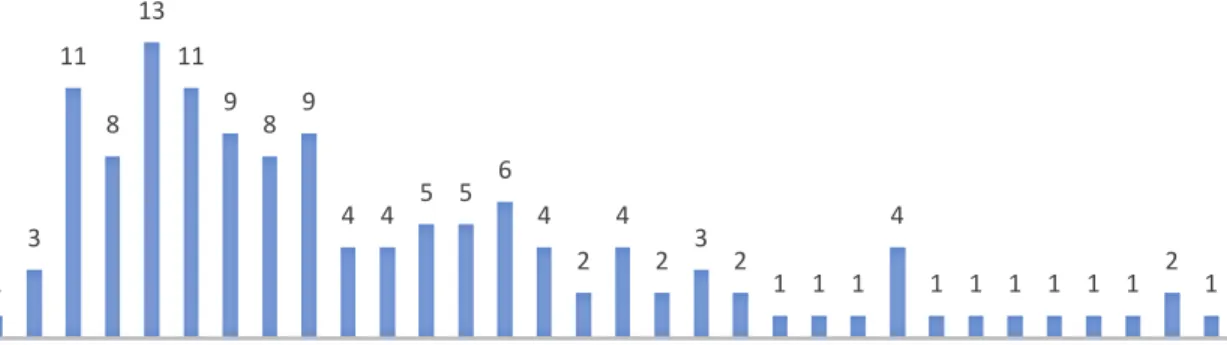
The gender distribution of the sample is 71% female (96 women) and 29% male (39 men). In terms of Age distribution, the responses come from people with ages between 22 and 62 years old. The most represented age is 26 years old and the average age of respondents is 32 years old.
Figure 1 - Socio-demographic analysis - Age Distribution
1 3 11 8 13 11 9 8 9 4 4 5 5 6 4 2 4 2 3 2 1 1 1 4 1 1 1 1 1 1 2 1 22 23 24 25 26 27 28 29 30 31 32 33 34 35 36 37 38 39 40 41 43 44 45 46 47 51 52 53 57 58 60 62
Regarding the qualification level of the study’s sample, most (80 respondents) have a Master’s degree (59,3%) followed by the Bachelor degree qualification with 45 respondents (33,3%). The 3% that answered with “Other”, have a Post-Graduation degree. This means that almost the entire sample has a higher university education (1,5% have high-school degree).
Geographically, there was a global reach with the online survey and from the entire sample, 126 respondents shared their nationality. It can be seen that 89% of respondents are European, 6% are North American, 3% South American and 2% from Asia Pacific. The number of answers per country can be seen below in in Figure 2.
Figure 2 - Socio-demographic analysis - Nationality Distribution
5 2 1 1 1 2 4 2 1 7 1 7 1 1 1 6 2 73 2 1 1 4 American Argentinian Australian Austrian Belgian Brazilian British Canadian Chinese Danish French German Greek Holandese Indian Italian Polish Portuguese Romanian Spanish Swedish Swiss
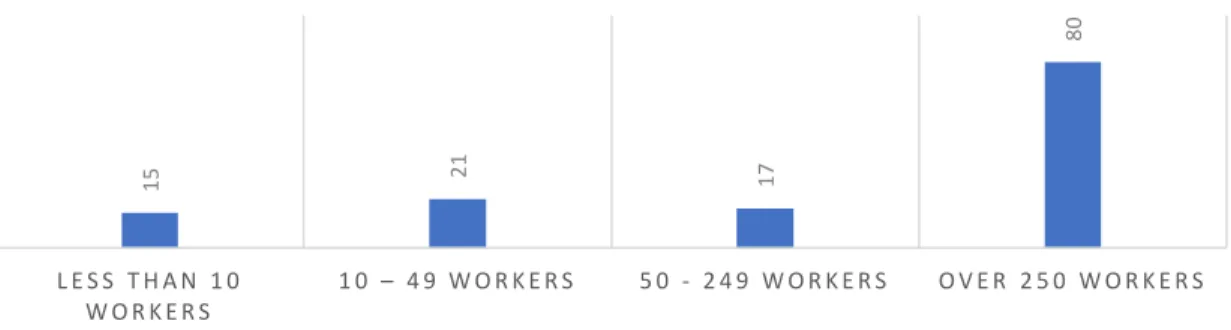
(64 people, 47%). The distribution of responses for the company size can be seen in Figure 3 below. The majority of respondents work in companies with over 250 employees.
Figure 3 - Occupational analysis - Company Size Distribution
In terms of Industry distribution, there are 44 respondents working within IT sector, followed by 40 in Consultancy services. The respondents that checked the answer “Other” specified their sectors as Human Resources (6 answers), Fast Moving Consumer Goods (3 answers), Retail (2 answers), Pharma (2 answers), Contact Centre (2 answers), Marketing (1 person), Real Estate (1 person), E-Commerce (1 person).
Figure 4 - Occupational analysis - Company Sector Distribution
15 21 17 80 L E S S T H A N 1 0 W O R K E R S 1 0 – 4 9 W O R K E R S 5 0 - 2 4 9 W O R K E R S O V E R 2 5 0 W O R K E R S 0,7% 1,5% 13,3% 19,3% 29,6% 32,6% Education Banking Healthcare Other Consultancy Services Information Technology
3.2 Procedures
The present study aims to analyse the use of technology in recruitment activities, as such it was decided to use a tool that could be spread using the web. For that purpose, an online survey was the instrument chosen to collect data. Surveys are a relevant and broad instrument for data collection which allows for quantitative and qualitative analysis. Surveys are an easy and flexible way to collect data due to their unique characteristics: it gives respondents the possibility to answer at any time of their day and taking as long time as they want/need to answer. There is no need for the researcher to be present which allows for more impartial and unbiased answers. By privileging closed questions, the survey makes it easier to aggregate and analyse responses in a standardized matter, using tools such as Excel or SPSS.
The survey included 18 questions (full English version of the questionnaire is available in Appendix A), with 17 closed questions and only one open question. This allowed for an easier and standardized analysis of results. All questions were of mandatory response except the open question.
The survey started with an introduction to the research goals, some instructions on how to fill the questionnaire, and a statement about anonymity and confidentiality of the responses. After that, the survey was structured in four sections. The first section addressed the frequency of use of the different e-recruitment tools. Question one asked respondents to select one or more tools used in their recruitment processes, questions 2 to 6 asked how frequently (1. Never, 2. Rarely, 3. Occasionally, 4. Most of the time, 5. Always or 6. Not Applicable) respondents use the different tools for different qualification levels (not skilled, skilled or highly skilled professionals) and different seniority levels (junior professionals and senior professionals).
In the second section of the survey, respondents were asked to state their level of agreement with Aboul-Ela’s (2014) 24 statements about e-recruitment, having in mind
The third section focused on the topic of Social Media recruitment and had 3 questions. Questions 9 and 10 asked the respondents to sort 10 different e-recruitment benefits by order of importance. Question 11 was the only open question in the entire survey and asked respondents to mention any other benefit of social media recruitment that was not identified in the previous questions.
The last section, questions 12 to 18, focused on socio-demographics (gender, age, education, nationality) and professional status (type of company, number of employees and company sector).
The survey was available in both Portuguese and English. Originally the questionnaire was developed in English and checked by a native English speaker (personal connection to the researcher) and was afterwards translated into Portuguese. The translation was obtained by undergoing the translation and back-translation method by Brislin (1980) to ensure accuracy in both versions of the questionnaires.
A pre-test was conducted with 10 respondents (5 Portuguese speakers and 5 English speakers), who completed the questionnaire and provided feedback on the questions’ phrasing and structure. After the pre-test, minor changes were done to the questionnaire to make it more understandable and less confusing. No changes were done in section two, where the original phrasing of Aboul-Ela’s (2014) scale was kept.
The channels used to distribute the survey were direct emails and social media channels; LinkedIn and Facebook. Initially the survey was built in the platform Qualtrics but to increase the number of responses another platform, SurveyMonkey, was later also used. Both platforms allowed the distribution of a message via emails and social media platforms where respondents could access the survey by clicking on a link. The message stated the context for the approach, the scope of the research and the researcher’s contact details. The questionnaire was available online for 3 months, from 23rd of May to 26th of August 2017, and distributed regularly during that period. With every survey sent, there was a request for re-distribution of the message through the respondents’ networks. The respondents were targeted based on their current occupation / job title and presence in talent acquisition and HR themed groups on social media.
Being the scope of the present study, the use of technology and internet in the recruitment processes, it was considered that the relevant population would also be found
online (emails and social media channels). There were no geographical restrictions which enriched the analysis.
3.3 Measures
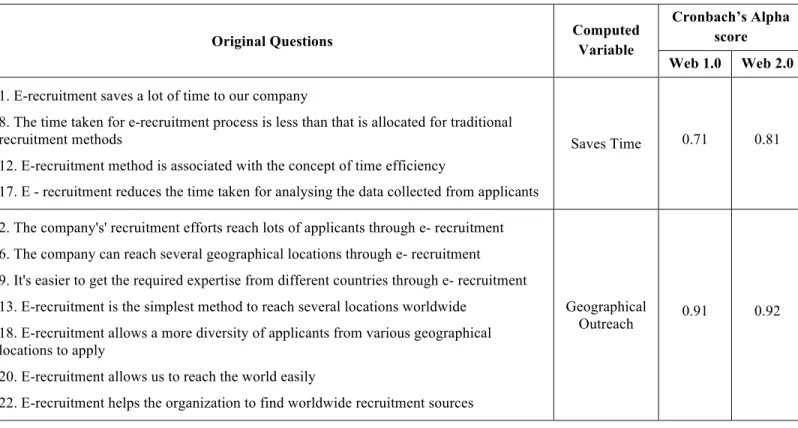
As measures of data collection and analysis, the scale developed by Aboul-Ela (2014) was used to measure the agreement level of participants with five benefits (Saving Time, Bigger Geographical Outreach, saving Efforts, Increasing Quality of Applications and Improving Organizational Image) and comparing the agreement level considering Web 1.0 tools (Career Websites and Job Boards – the same as the ones considered in Aboul-Ela’s study) and Web 2.0 tools (Social Media Websites – Facebook, LinkedIn, YouTube and Twitter). The scale consisted in 24 statements that were grouped into the five benefits, as per Aboul-Ela’s work. A reliability test was conducted for the five computed variables from the 24 items’ scale. Table 2 shows Cronbach’s Alpha scores for Web 1.0 and Web 2.0 answers.
Table 2 - Computed Variables and Cronbach's Alpha Scores for Scale
Original Questions Computed Variable
Cronbach’s Alpha score Web 1.0 Web 2.0
1. E-recruitment saves a lot of time to our company
8. The time taken for e-recruitment process is less than that is allocated for traditional recruitment methods
12. E-recruitment method is associated with the concept of time efficiency
17. E - recruitment reduces the time taken for analysing the data collected from applicants
Saves Time 0.71 0.81
2. The company's' recruitment efforts reach lots of applicants through e- recruitment 6. The company can reach several geographical locations through e- recruitment
3. E-recruitment helps our company to save lots of efforts through the utilization of technology
10. Using e-recruitment consumes less efforts as technology makes things easier 14. Using e-recruitment, will lead to a reduction in human efforts
16. E-recruitment saves lots of efforts that are further utilized by the organization towards efficiency
19. E-recruitment is a fast and an easy way to save human efforts
Saves Efforts 0.80 0.86
4. E-recruitment provides better quality of applicants
5. E-recruitment can save the organization the costs of attracting unqualified applicants 11. E-recruitment allows the company to filter the qualified applicants through the adoption of technology buffers
21. E-recruitment increases the opportunity of attracting competent applicants 23. E-recruitment can reduce the chances of attracting unqualified applicants
Increases Quality of Applications
0.77 0.79
7. E-recruitment helps to create a sound image for the organization
15. Companies adopting e-recruitment enjoy an improved organizational image
24. E-recruitment reduces the barrier of attracting unqualified applicants through improved organizational image
Improves Organisational
Image
0.62 0.68
All variables (except “Improves Organisational Image”) for both Web 1.0 and Web 2.0 present Cronbach’s Alpha scores higher than 0.70, meaning they are strongly reliable. The new variable “Improves Organisational Image” has lower score, 0.62 for Web 1.0 and 0.68 for Web 2.0. For the purpose of this study, the scores will be considered acceptable as the variable was used and validated in a previous research (Aboul-Ela, 2014). Also, Peterson’s (1994) meta-analysis of Cronbach’s Coefficient Alpha, states that a scale-item with fewer categories can have lower alpha scores than 0.70, where a 0.60 score can be considered acceptable as the minimum threshold. The variable “Improves Organisational Image” is the category with less items, three, as such it will be accepted and considered reliable for the purpose of this study.
3.4 Results
The data collected was stored and analysed using SPSS (Statistical Package for Social Sciences) software and Microsoft Excel program. In the following sections, several analyses will be conducted. First a description of the most used e-recruitment tools in general, for different levels of seniority and qualification; secondly, using Aboul-Ela’s (2014) scale, the hypothesis will be tested, comparing the perceived benefits of using Web 1.0 and Web 2.0 tools. After that, an analysis of the perceived benefits of Social Recruitment (using examples from the literature) will be done to provide insights for a future development of a scale, similar to Aboul-Ela’s (2014) but for the benefits of using Web 2.0 recruitment tools.
3.4.1 Descriptive Statistics and Correlation
The most used e-recruitment tool is LinkedIn, the professional social networking site. Nearly the entire sample of this study (98%) stated they use LinkedIn as a recruitment tool. After this follows the use of Job Boards with 87% of respondents using this tool, the Career Websites with 76% and the social networking site Facebook with 52%. Only 14 people use Twitter and 13 use YouTube as a recruitment tool (10% each). The respondents that selected the option “others” mentioned other social networking sites (e.g. Xing, specific for the DACH region – Germany, Austria and Switzerland), other job boards used in different countries (NetEmpregos, Monster, Indeed…), databases and application tracking systems (e.g. Taleo).
Figure 5 - E-recruitment tools - Most used
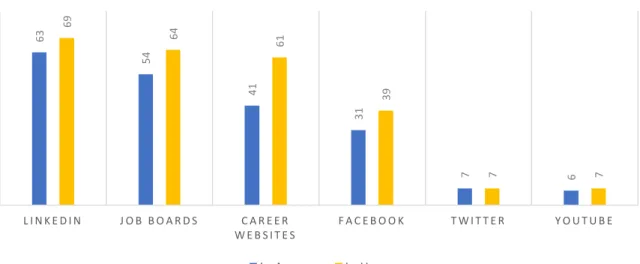
In Figure 6 a comparison of the most used tools in-house and in-agency is done. The ranking coincides, being that LinkedIn is the most used tool for both, followed by Job Boards and Career Websites. The most visible difference between in-house recruitment and in-agency recruitment seems to be the use of Career Websites, where 45% of in-house respondents use it compared to the 30% usage of agency respondents. The social networking sites Twitter and YouTube are the least used by both in-house and in-agency respondents.
Figure 6 - E-recruitment tools - Most used In-House VS In-Agency 10% 10% 21% 52% 76% 87% 98% Y O U T U B E T W I T T E R O T H E R F A C E B O O K C A R E E R W E B S I T E S J O B B O A R D S L I N K E D I N 63 54 41 31 7 6 69 64 61 39 7 7 L I N K E D I N J O B B O A R D S C A R E E R W E B S I T E S F A C E B O O K T W I T T E R Y O U T U B E in-Angency in-House
Regarding the use of e-recruitment tools for different levels of qualification, the respondents were asked to classify on a scale from 1 to 6 (1- Never, 2-Rarely, 3- Occasionally, 4- Most of the time, 5- Always and 6- Not applicable), how frequently they used the different tools for recruiting Unskilled Professionals (considering these to be individuals without studies), Skilled Professionals (individuals with studies) and Highly Skilled Professionals (individuals with specialized studies). The complete distribution of the answers (percentage) can be found below on table 1. Figure 7 compares the mean value for the usage of the different e-recruitment tools per qualification level. For calculating the mean, the answers with value 6 (“not applicable”) were not included. In average, the respondents always use LinkedIn for recruiting highly skilled professionals, and Job Boards and Career Websites occasionally. For recruiting Skilled professionals, LinkedIn, Job Boards and Career Websites are used most of the time. The tools used to recruit unskilled professionals are Job Boards and Career Websites (occasionally) and rarely the social networking sites, LinkedIn and Facebook. Twitter and YouTube are, on average, never used for recruitment purposes.
Figure 7 - E-recruitment tools - Most used per qualification level (mean)
3,0 3,4 2,4 2,7 1,0 1,0 3,8 3,9 2,5 4,4 1,4 1,0 3,4 3,5 1,9 4,6 1,0 0,9 C A R E E R W E B S I T E S J O B B O A R D S F A C E B O O K L I N K E D I N T W I T T E R Y O U T U B E
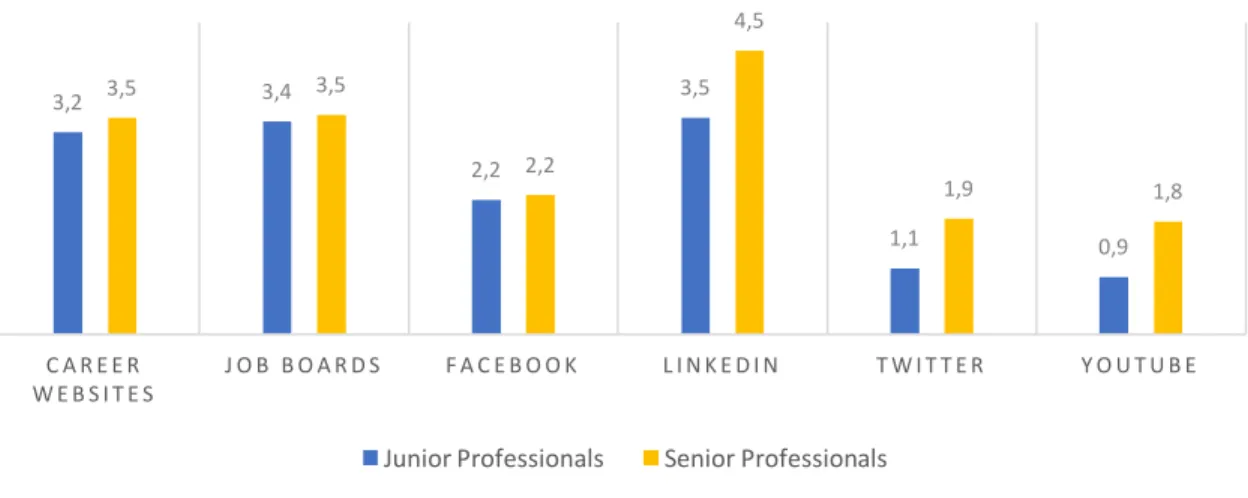
time, 5- Always and 6- Not applicable). Table 2 contains the detailed percentage distribution of answers by level of seniority and scale. Figure 7 gives the comparison of usage of the different e-recruitment tools, using the average of responses. LinkedIn seems to be used more for recruiting senior professionals, however it is the most used tool for recruiting junior professionals as well. Job Boards and Career Websites are used both for junior and senior professionals (occasionally for junior and most of the time for senior professionals). Facebook is rarely used for either seniority level and Twitter and YouTube are never used for junior professionals and rarely used for senior professionals.
Figure 8 - E-recruitment tools - Most used per seniority level (mean)
A Correlation between variables was also conducted and results can be seen on Table 7, below. All variables present a positive correlation with each other at a 5% significance level (some at 1%), which means that these results are likely to be representative of the population. For example, a person who considers “saving time” a benefit of Web 1.0 also considers it a benefit of Web 2.0 (r = 0.569, a positive moderate correlation). The same can be said about “geographical outreach” (r = 0.618), “saving efforts” (r = 0.722, positive strong correlation), “quality of applications” (r = 0.653) and “organisational image” (r = 0.674). The weakest correlation presented happens between the consideration of “organisational image” as a benefit of Web 1.0 and “geographical outreach” a benefit of Web 2.0. This can also be indicative of the lower reliability score of this item as shown previously on table 2.
3,2 3,4 2,2 3,5 1,1 0,9 3,5 3,5 2,2 4,5 1,9 1,8 C A R E E R W E B S I T E S J O B B O A R D S F A C E B O O K L I N K E D I N T W I T T E R Y O U T U B E Junior Professionals Senior Professionals
Table 3 - Correlation Analysis – Web 1.0 and Web 2.0 benefits WEB 1.0 WEB 2.0 1 2 3 4 5 1 2 3 4 5 WEB 1.0 1. Save Time 1 2. Geo Outreach .490** 1 3. Save Efforts .661** .493** 1 4. Quality App .471** .443** .479** 1 5. Org Image .479** .414** .480** .528** 1 WEB 2.0 1. Save Time .569** .355** .506** .467** .434** 1 2. Geo Outreach .330** .618** .351** .287** .196* .421** 1 3. Save Efforts .518** .415** .722** .446** .478** .709** .393** 1 4. Quality App .354** .273** .395** .653** .478** .577** .407** .511** 1 5. Org Image .385** .202* .351** .374** .674** .319** .257** .339** .408** 1 ** p < 0.01 * p < 0.05