Near-exact distributions for positive linear combinations of independent non-central
Gamma random variables
Filipe J. Marques, and Carlos A. Coelho
Citation: AIP Conference Proceedings 1738, 190005 (2016); doi: 10.1063/1.4951972
View online: https://doi.org/10.1063/1.4951972
View Table of Contents: http://aip.scitation.org/toc/apc/1738/1
Published by the American Institute of Physics
Articles you may be interested in A note on the Jackson exponentiality test
AIP Conference Proceedings 1790, 080005 (2016); 10.1063/1.4968686
A note on the distribution of the linear combination of independent Gamma random variables AIP Conference Proceedings 1618, 527 (2014); 10.1063/1.4897791
Asymmetry of ARCH effects and natural resources disease or virtue: Mozambique experience AIP Conference Proceedings 1738, 190004 (2016); 10.1063/1.4951971
An open Markov chain scheme model for a credit consumption portfolio fed by ARIMA and SARMA processes AIP Conference Proceedings 1738, 190003 (2016); 10.1063/1.4951970
Robust statistical approaches to assess the degree of agreement of clinical data AIP Conference Proceedings 1738, 470005 (2016); 10.1063/1.4952235
Near-exact Distributions for Positive Linear Combinations of
Independent Non-central Gamma Random Variables
Filipe J. Marques and Carlos A. Coelho
Departamento de Matemática and Centro de Matemática e Aplicações Faculdade de Ciências e Tecnologia – Universidade Nova de Lisboa, Portugal1
Abstract. In this paper near-exact distributions for positive linear combinations of independent non-central Gamma random
variables are developed. The authors show that through an adequate factorization of the characteristic function it is possible to obtain precise near-exact distributions which correspond to mixtures of Generalized Near-Integer Gamma distributions. Numerical studies are conducted in order to assess the precision of these approximations.
Keywords: Characteristic function, Gamma distribution, Generalized Near-Integer Gamma distribution, Mixtures.
AMS:62E10, 62E15, 62E20
INTRODUCTION
The non-central Gamma distribution has the Gamma distribution as a particular case which is one of the most important distributions in Statistics. Results on the sum and linear combinations of independent Gamma random variables can be found, for example, in [6] and [9]. In this work the authors study the distribution of the linear combination of independent non-central Gamma random variables. Let us consider pindependent random variables,Xi,i=1, . . . ,p, with a non-central Gamma distribution, denoted here byXi∼Γ(ri,λi)(δi)whereri>0 is the shape parameter,λi>0 is the rate parameter andδi>0 is the non-central parameter withi=1, . . . ,p, then the density function ofXiis given by
fXi(x) =
λri
i
Γ(ri)
exp{−λix}xri−1exp{−δ
iλi}0F1(ri;δiλi2x),x>0
where0F1 is the confluent hypergeometric function. As it is clear for δi =0 we have the density of the Gamma distribution. It can be shown that the characteristic function ofXiis given by
ΦXi(t) =λri
i (λi−it)−riexp
{δ
iλiit
λi−it
}
,t∈IRand i= (−1)1/2.
We should note that a non-central Gamma random variable multiplied by a scalar is still a non-central Gamma random variable with different rate and non-central parameters. For positiveα1, . . . ,αp, the characteristic function of the linear combination ofpindependent non-central Gamma random variables,W =α1X1+· · ·+αpXp, is given by
ΦW(t) =
p
∏
i=1
λri
i (λi−αiit)−riexp
{α
iδiλiit
λi−αiit
}
,t∈IR. (1)
In the following Section, using an adequate factorization of the characteristic function in (1) and by asymptotically approximating a part of it, the authors are able to obtain near-exact distributions for the linear combination of independent non-central Gamma random variables. These near-exact distributions assume the form of mixtures of Generalized Near-Integer Gamma (GNIG) distributions [1, 2], and are built ensuring that a given number of the moments of the approximating distributions are equal to exact ones. In Section “Numerical studies”, numerical studies are conducted in order to analyze the performance of the near-exact distributions developed. The conclusions are presented in Section “Conclusions”.
NEAR-EXACT DISTRIBUTIONS FOR POSITIVE LINEAR COMBINATIONS OF
INDEPENDENT NON-CENTRAL GAMMA RANDOM VARIABLES
If we considerr⋆i =⌊ri⌋andci=ri−r⋆i, the characteristic function ofW in (1) may be written as
ΦW(t) =
p
∏
i=1
(λ
i
αi
)r⋆i (λ
i
αi−it
)−ri⋆
| {z }
ΦW
1(t)
p
∏
i=1
(λ
i
αi
)ci(λ
i
αi−it
)−ci exp
{α
iδiλiit
λi−αiit
}
| {z }
ΦW
2(t)
(2)
where the characteristic function ofW1in (2),ΦW1(t), is the characteristic function of the sum of independent Gamma random variables with rate parameters λi
αi and with integer shape parametersri⋆,i=1, . . . ,p. The characteristic function ofW2in (2),ΦW2(t), may also be written as
ΦW 2(t) =
p
∏
i=1
(λ
i
αi
)ci(λ
i
αi−it
)−ci exp
{
αiδiλi
αiit λi
αi −it
}
(3)
which is the characteristic function of the sum of independent non-central Gamma random variables with rate parameters λi
αi, non-integer shape parameters ci and non-central parameters αiδi, i=1, . . . ,p. Since the ex-act distribution of the sum of independent Gamma random variables may be represented as an infinite mixture of Gamma random variables all with the same rate parameter and with shape parameters equal to a given parameter successively increased by one [9], in order to compensate for the effect of the exponential part in the characteristic function of a non-central Gamma random variable, we propose as an approximation for the characteristic function in (3) a characteristic function of a finite mixture of Gamma distributions matchingm⋆of the first exact moments, also with the same rate parameter, and with shape parameters equal tor⋆, successively added by a unit divided by a given numberd, that is,r⋆+j/dfor j=0. . . ,m⋆. Thus, we will approximateΦW
2(t)in (3) byΦ
⋆
W2(t)which is given by
Φ⋆W 2(t) =
m⋆
∑
j=0
πj(λ⋆)r⋆+j/d(λ⋆−
it)−(r⋆+j/d) (4)
wherer⋆andλ⋆are chosen to be equal, respectively, to the smallest shape parameter and to the rate parameter of
a mixture of two Gamma distributions matching the first four moments of the exact distribution ofW2, that is the
parametersr⋆andλ⋆are obtained as solutions of
∂h
∂thΦW2(t)
t=0
= ∂
h
∂th
{
p(λ⋆)s1(λ⋆−it)−s1+ (1−p)(λ⋆)s2(λ⋆−it)−s2}
t=0
,h=1, . . . ,4 (5)
wherer⋆=min{s1,s2}, and the weightsπjin (4) are determined in order to ensure that the approximating distribution has the firstm⋆moments equal to the exact moments ofW2, as suchπj(j=0, . . . ,m⋆−1), are the real solution of the system
∂h
∂thΦW2(t)
t=0
= ∂
h
∂thΦ
⋆
W2(t)
t=0
,h=1, . . . ,m⋆ with πm⋆=1−
m⋆−1
∑
j=0
πj. (6)
Following this procedure we will have, as an approximating characteristic function ofΦW in (1), the characteristic function
Φ⋆W(t) = ΦW1(t)×ΦW⋆ 2(t) =
m⋆
∑
j=0
πj
p
∏
i=1
(λ
i
αi
)r⋆i (λ
i
αi−it
)−r⋆i
(λ⋆)r⋆+j/d(λ⋆−it)−(r⋆+j/d)
theorem, where, using the notation in Appendix 3 in [7], the authors present the probability density and cumulative distribution functions ofW .
Theorem 1 If we replaceΦW
2(t)given in(3)byΦ
⋆
W2(t)in(4)we obtain, for r non-integer, near-exact distributions
for W with cumulative distribution and density functions given respectively by
F(z) =
m⋆
∑
j=0
πjFGNIG
(
z|ri⋆,r⋆+
j d ;λi
⋆,λ⋆;p+1) and f(z) = m
⋆
∑
j=0
πjfGNIG
(
z|ri⋆,r⋆+
j d ; λi
⋆,λ⋆;p+1)
where
ri⋆={r⋆i,i=1, . . . ,p}, and λi⋆=
{λ
i
αi,i=1, . . . ,p
}
,
z>0, r⋆andλ⋆are obtained as a solution of the system in (5) and the values ofπ
jare obtained from the numerical
solution of the system of equations in(6).
Some comments are in order:
– As already mentioned, ifXi∼Γ(ri,λi)(δi)thenαiXi∼Γ
(
ri,λαii
)
(αiδi),i=1, . . . ,p, we may reduce the case of the linear combination of independent non-central Gamma random variables to the case of the sum of independent non-central Gamma random variables. As such, in next section we will consider in all casesαi=1.
– If kshape parameters,ri, in (1) are integer thenci=0. Without loss of generality if we have the lastkshape parameters integers we should write
ΦW2(t) =
p−k
∏
i=1
(λ
i
αi
)ci(λ
i
αi−it
)−ci p
∏
i=1
exp
{
αiδiλi
αiit λi
αi+it
}
.
– The value ofdin (4) is chosen as the value that minimizes the proximity between the approximating and the exact distribution according to the measure∆in (7) of the following Section.
– The system in (5) may, in some cases, provide a negative solution for the shape parameter of interest,r⋆, in the mixture of two Gamma distributions. In these cases the authors have chosen to use a single Gamma distribution as a basis to determine the values of the parametersλ⋆andr⋆.
NUMERICAL STUDIES
To analyze the performance of the approximation proposed for the linear combination of independent non-central Gamma random variables we use a measure that gives an upper bound on the proximity between two distribution functions and which is based on the respective characteristic functions. The measure has already been used in many related studies, [5, 3, 4, 8], and is given by
∆= 1
2π
∫ ∞
−∞
ΦW(t)−Φ⋆
W(t)
t
dt, (7)
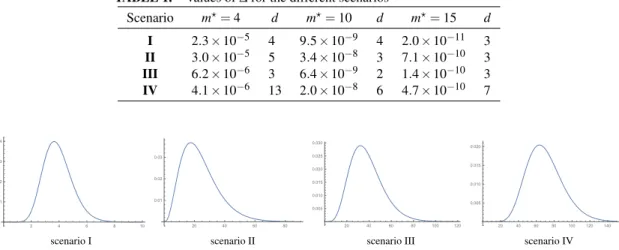
whereΦW(t)represents the exact characteristic function of the linear combination of independent non-central Gamma random variables andΦW⋆(t)represents the approximating characteristic function ofΦW(t). In Table 1 we consider four different scenarios:
I)ri={144,323},λi={307,256}andδi={15,13};
II)ri={104,54},λi={51,16}andδi={32,73};
III)ri={104,54,176},λi={15,16,123}andδi={32,73,145};
IV)ri={104, 7
2,
5
4,
9
5,
17
6},λi={15,
1
6,
1
7,
1
4,
1
2}andδi={32,
7
3,
14
5,3,5}.
TABLE 1. Values of∆for the different scenarios
Scenario m⋆=4 d m⋆=10 d m⋆=15 d
I 2.3×10⁻⁵ 4 9.5×10⁻⁹ 4 2.0×10⁻¹¹ 3
II 3.0×10⁻⁵ 5 3.4×10⁻⁸ 3 7.1×10⁻¹⁰ 3
III 6.2×10⁻⁶ 3 6.4×10⁻⁹ 2 1.4×10⁻¹⁰ 3
IV 4.1×10⁻⁶ 13 2.0×10⁻⁸ 6 4.7×10⁻¹⁰ 7
2 4 6 8 10 0.1
0.2 0.3 0.4
20 40 60 80 0.01
0.02 0.03
20 40 60 80 100 120 0.005
0.010 0.015 0.020 0.025 0.030
20 40 60 80 100 120 140 0.005
0.010 0.015 0.020
scenario I scenario II scenario III scenario IV
FIGURE 1. Near-exact densities for positive linear combinations of independent non-central Gamma random variables
In Figure 1 we present the plots of the near-exact densities for the four different scenarios when 15 moments are matched and for the corresponding value ofdin Table 1.
CONCLUSIONS
Near-exact distributions in the form of mixtures of GNIG distributions were developed for linear combinations of independent non-central Gamma distributions. In order to better control the precision of these approximations a parameter, d, was introduced in the shape parameters of the GNIG distributions involved in the mixtures. The numerical studies conducted illustrate the high precision of these approximations in different scenarios.
ACKNOWLEDGMENTS
Research partially supported by National Funds through FCT Fundação para a Ciência e a Tecnologia, project UID/MAT/00297/2013 (CMA/UNL).
REFERENCES
1. C. A. Coelho, The Generalized Integer Gamma Distribution – A basis for distributions in Multivariate Statistics.J. Multivariate Anal.64, 1998, pp. 86–102.
2. C. A. Coelho, The Generalized Near-Integer Gamma distribution: a basis for near-exact approximations to the distribution of statistics which are the product of an odd number of independent Beta random variables.J. Multivariate Anal.89, 2004, pp. 191–218.
3. C. A. Coelho and F. J. Marques, The advantage of decomposing elaborate hypotheses on covariance matrices into conditionally independent hypotheses in building near-exact distributions for the test statistics.Linear Algebra Appl.430, 2009, pp. 2592–2606.
4. C. A. Coelho, B. C. Arnold and F. J. Marques, Near-exact distributions for certain likelihood ratio test statistics.J. Stat. Theory Pract.4, 2010, pp. 711–725.
5. L. M., Grilo and C. A., Coelho, Development and Comparative Study of two Near-exact Approximations to the Distribution of the Product of an Odd Number of Independent Beta Random Variables.Journal of Statistical Planning and Inference137, 2007, pp. 1560–1575.
6. F. J. Marques and C. A. Coelho, A note on the distribution of the linear combination of independent Gamma random variables.
AIP Conf. Proc., 1618, 2014, pp. 527–530.
7. F. J. Marques and C. A. Coelho, Obtaining the exact and near-exact distributions of the likelihood ratio statistic to test circular symmetry through the use of characteristic functions.Comput. Statist.28, 2013, pp. 2091–2115.
8. F. J. Marques, C. A. Coelho and B. C. Arnold, A general near-exact distribution theory for the most common likelihood ratio test statistics used in Multivariate Analysis.Test20, 2010, pp. 180–203.