Catch composition, catch rates and size selectivity
of three long-line methods in the Algarve
(southern Portugal)
K. Erzini, J. M. S. Gonçalves, L. Bentes, P. J. Lino and J. Ribeiro
Unidade de Ciências e Tecnologias Aquáticas (UCTRA). Universidade do Algarve. 8000 Faro, Portugal Received September 1997. Accepted March 1998.ABSTRACT
Three long-line methods have been studied in the Algarve: 1) small-hook long-line for inshore (less than 30 m) ‘white’ sea breams (Sparidae); 2) small-hook long-line for deeper water (40-60 m) ‘red’ sea breams; and 3) deep water (500-700 m) semi-pelagic long-line for hake Merluccius mer-luccius (Linnaeus, 1758). Selectivity studies were carried out with three hook sizes in the first two cases: Mustad round-bent Quality 2369 hooks, numbers 15, 13, and 11, baited with a standard-sized razor-shell Ensis siliqua (Linnaeus, 1758). Four hook sizes (numbers 10, 9, 7, and 5) of Stell round-bent, eyed hooks were used in the semi-pelagic long-line selectivity study, baited with a half of a standard-sized sardine. Some factors affecting catch composition and catch rates of the small hook long-lines were also evaluated: bait, gangion length, setting time, fishing ground, and depth.
Species diversity was relatively high, with 40, 36 and 27 species, respectively, in the three stud-ies. However, the catches were dominated by a limited number of specstud-ies. Catch rates (number of fish per 100 hooks) were variable (< 5 %; > 20 %), with a general decrease in catch rate with increasing hook size in all the studies. In general, the catch size distributions for the different hook sizes for each species were highly overlapping, with little or no evidence of differences in size selectivity. Hooks caught a wide size-range for each species, with few or no illegal-sized fish, in most cases. Some implications of these results for the management of multi-species, multi-gear fisheries are discussed.
Key words:Long-line, hooks, methods, artisanal, fishery, Algarve, Portugal.
RESUMEN
Composición, tasa de captura y estudio de la selectividad mediante tres métodos de vida larga en Algarve (sur de Portugal)
Tres artes de palangre han sido estudiados en Algarve: 1) palangre de anzuelo pequeño para espáridos de aguas costeras (menos de 30 m); 2) palangre de anzuelo pequeño para espáridos rojos de aguas mas profun-das (40-60 m); y 3) palangre semipelágico de profundidad para merluza Merluccius merluccius (Linnaeus, 1758). En los dos primeros casos, los estudios de selectividad han utilizado anzuelos de tres ta-maños: round bent marca Mustad modelo 2369 (números 15, 13 y 11), utilizando como cebo pedazos de navajas Ensis siliqua (Linnaeus, 1758) de la misma talla. En el estudio de selectividad con el palangre semi-pelágico se han utilizado cuatro tamaños de anzuelo (números 10, 9, 7 y 5) round hook de la marca Stell, con media sardina como cebo. Se evaluán, también, otros factores que afectan a la composición y a la tasa de captura de los palangres equipados con anzuelo pequeño: cebo, longitud de la puntera, hora de largada del aparejo, área de pesca y profundidad.
La diversidad de especies en los tres estudios ha sido relativamente elevada: 40, 36 y 27 especies, respecti-vamente. Sin embargo, las capturas han sido dominadas por un número reducido de especies. Las tasas de
captura (número de peces por 100 anzuelos) han variado (< 5 %; > 20 %), observándose en los tres estu-dios un descenso general de las tasas de captura con el aumento del tamaño del anzuelo. De forma general, se ha observado una fuerte sobreposición de las distribuciones de las capturas con los diferentes tamaños de anzuelo para cada especie, con poca o ninguna evidencia de diferencias en la selectividad por talla. Los ta-maños de anzuelo probados han capturado un rango de tallas amplio para cada especie, con escasa o nin-guna captura de peces de talla ilegal en la mayoría de los casos. Se discuten alnin-gunas implicaciones de estos resultados en la gestión de pesquerías incluyendo varias especies y varios artes de pesca.
Palabras clave: Palangre, anzuelos, artes, artesanal, pesquerías, Algarve, Portugal.
INTRODUCTION
Long-lines are widely used in Portuguese fish-eries. In the Algarve (southern Portugal), 1 300 long-line licences were issued in 1993, and 1 232 in 1996; they accounted for 31 % and 27 % of all commercial fishing licences, respectively, in those years (Portuguese Department of Fisheries, pers. comm.). Long-lines are used to catch a wide variety of species, including many species of sea breams (Sparidae), hake Merluccius merluccius (Linnaeus, 1758), conger eel Conger conger (Linnaeus, 1758), and wreckfish Polyprion americanus (Oken, 1817).
Long-line methods can be classified based on the following criteria and characteristics: 1) type (bot-tom, semi-pelagic, pelagic); 2) mainline (material, diameter); 3) gangion (material, diameter, spacing); 4) hook type and size; 5) bait; 6) target species; and 7) fishing strategy (fishing grounds, depth, bottom type, season, time of set, duration of set).
In the Algarve, a number of different long-line methods have been identified. The four main methods are: 1) small-hook long-line for inshore, ‘white’ sea breams; 2) small-hook long-line for deeper water, ‘red’ sea breams; 3) semi-pelagic
pe-dra e bola line for hake; and 4) bottom
long-line for large demersals.
The first method’s inshore targets are know as white sea breams; namely, Diplodus sargus (Linnaeus, 1758), D. vulgaris (E. Geoffrey Saint-Hilaire, 1817), Lithognathus mormyrus (Linnaeus, 1758), and Spondyliosoma cantharus (Linnaeus, 1758). The long-line consists of a monofilament mainline, 1.1 or 1.2 mm in diameter, with 0.5 to 0.6 diameter monofilament gangions spaced 1.5-3 m apart. The most commonly used hooks are Mustad round-bent spade-end hooks, sizes 13 and 12. The length of the gangion is usually 0.5-1 m. A variety of baits are used, including mud shrimp Upogaebia spp., razor-shell Ensis siliqua (Linnaeus, 1758) and
sipunculids. The long-line is coiled in tubs contain-ing 300 to 400 hooks. The number of hooks fished is variable, with 3 000 to 4 000 hooks per set being a maximum (pers. obs.). The pre-baited long-line is set in relatively shallow water, generally between depths of 10-30 m, on rocky or patchy bottoms. The long-line may be set around sunrise or sunset, or during the day. The duration of the set can vary from less than 1 h to 3-4 h.
The second long-line method differs from the first only in terms of the target species and the fish-ing strategy, with the long-line, hooks and baits used being essentially identical. In this fishery, the target species are Pagellus acarne (Risso, 1826) and
Pagellus erythrinus (Linnaeus, 1758). Fishing takes
place at greater depths (40-70 m), and the long-line is usually set one to two hours before sunrise.
Whereas the latter small-hook long-lines involve small boats, 5-6 m in length, with crews of two or three, vessels in the semi-pelagic long-line hake fishery are much larger, and have crews of at least five to six fishermen. Fishing takes place at much greater depths (500-700 m) and the long-line is lift-ed off the bottom by glass buoys attachlift-ed at regu-lar intervals along the mainline. The most com-monly used hook sizes are 8, 7, and 6, and the main target species is M. merluccius. The number of hooks per set is usually between 6 000 and 8 000, giving a total long-line length of 10-15 km.
The last method uses essentially the same type of long-line as the semi-pelagic long-line, except that no buoys are used to lift the hooks off the bottom. A wider depth- range is fished with this gear, with considerable diversity in terms of target species.
The first three of these methods have been stud-ied as part of an ongoing series of projects on the small-scale multi-species fisheries of the Algarve funded by the European Commission (Erzini et al., 1995, 1996a, 1996b, 1997a, 1997b). The objective of the present paper is to review the results of the
selectivity studies carried out to date in Algarve (southern Portugal) waters, with particular empha-sis on catch compositions, catch rates, size distribu-tions, factors affecting catch rates, and discards/by-catches. Some implications of the main findings of these studies for the management of small scale, multi-species, multi-gear fisheries are discussed.
MATERIALS AND METHODS
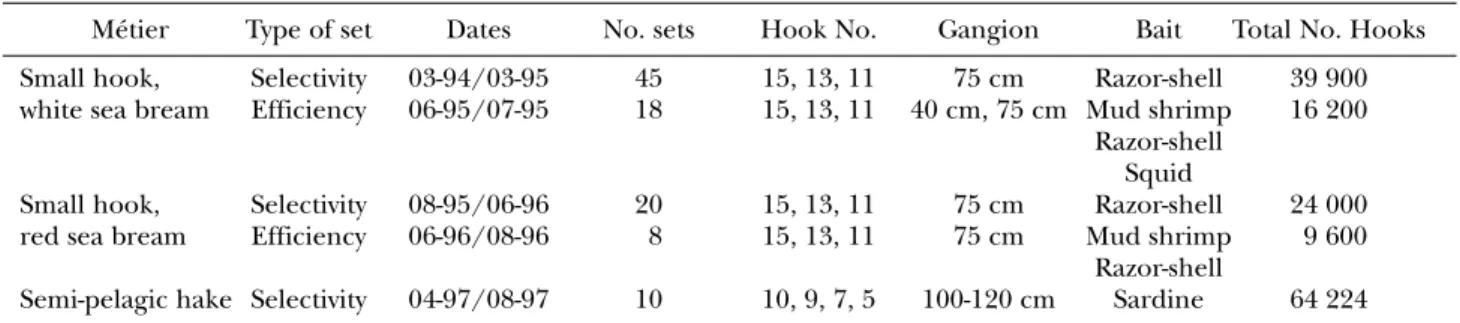
Three long-line selectivity studies have been car-ried out since 1994 (table I). For each method, lo-cal fishermen were consulted prior to the design of the experimental fishing gear used in the selectivi-ty studies. This preliminary survey enabled us to fully characterise the different methods.
Small-hook white sea bream method
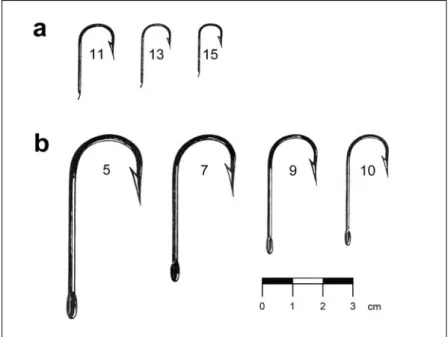
In the first study, concerning the small-hook white sea bream method, Mustad round-bent spade-end Quality 2316 DT hooks were used (sizes 15, 13 and 11). The characteristics of the experi-mental long-line, the hooks, and a summary of the experiments carried out are given in figures 1a and 2a and table I. The long-line consisted of monofil-ament mainline having a diameter of 1.1 mm, with 75 cm gangions of 0.5 mm monofilament, and a distance of 1.75 m between gangions.
Forty-five long-line sets were made for the selec-tivity part of the project, baited with standard-sized razor-shells. The first two sets consisted of 600 hooks, with 200 hooks of each size. The remaining sets consisted of 900 hooks, with series of 100 hooks of each size. The long-lines were set in the morning and retrieved after a period of 2-4 h.
A further 18 sets were made to evaluate some fac-tors that may affect catch rates and catch
composi-tion. In these efficiency trials, hook size, bait (mud shrimp, razor-shell, squid), and gangion length (40 cm, 75 cm) were the variables, for a total of 18 different combinations.
Fishing took place within a restricted area at depths of 10-20 m (figure 3). All fish were trans-ported to the laboratory for measurement, weigh-ing, and biological studies. For detailed descrip-tions of the methodologies used in the present study, see Erzini et al. (1995, 1996a, 1997a).
Small-hook red sea bream method
The same Mustad hook sizes and experimental long-lines were used in this study. However, the number of hooks was increased to 1 200, for a total of four tubs with 300 hooks (Erzini et al., 1997b). Each tub consisted of three sections with 100 hooks of each size. In this study, two different boats/fish-ermen were used. The first 18 selectivity sets were carried out by the first boat in fishing grounds A and B (figure 3) using razor-shell bait. The re-maining selectivity and efficiency sets were carried out by another boat in fishing grounds C and D (table I, figure 3). In the efficiency trials, the only variables were hook size and bait (mud shrimp, ra-zor-shell), giving six different possible combina-tions.
In this study, fishing took place at greater depths and the fishing strategy also differed. Most of the long-line sets were made one to two hours before dawn, and the long-lines were generally retrieved within an hour of being set. As in the white sea bream study, the fishermen were always accompa-nied by at least one member of the project team, who recorded location, depth, time of set, duration of set, gear loss, and ensured that the catch was sep-arated according to each hook/bait/gangion com-bination. Whereas all the fish caught in the first
se-Table I. Summary of long-line selectivity studies carried out in the Algarve
Métier Type of set Dates No. sets Hook No. Gangion Bait Total No. Hooks Small hook, Selectivity 03-94/03-95 45 15, 13, 11 75 cm Razor-shell 39 900 white sea bream Efficiency 06-95/07-95 18 15, 13, 11 40 cm, 75 cm Mud shrimp 16 200
Razor-shell Squid
Small hook, Selectivity 08-95/06-96 20 15, 13, 11 75 cm Razor-shell 24 000 red sea bream Efficiency 06-96/08-96 8 15, 13, 11 75 cm Mud shrimp 9 600
Razor-shell
a
Surface
Bottom
1
2
5
7
8
1.7 m3
300hooks≈
550 mb
1
2
3
4
5
6
7
24 h ook s8
Surface
Bottom
ries of fishing trials (selectivity A) were transported to the laboratory for sampling, this took place at
the landing site for the other selectivity (B) and ef-ficiency sets (table I).
Figure 1. Schematic representations of: (a): one unit −3 glass buoys, 138 hooks−of semi-pelagic long-line; (b): a section of long-line used in the white and the red sea bream studies. (1): buoy; (2): rope; (3): weight −poita−; (4): glass buoy −bola−; (5) weight −pedra−; (6): mainline; (7): gangion; (8): hook. The mainline and the gangions used had diameters of 1.60 mm and
Semi-pelagic long-line hake method
Four hook sizes of Stell hooks were used in this study (figure 1b). The experimental long-line con-sisted of 56 units, each unit comprising 144 same-sized hooks coiled in one tub (figure 2b). The mainline consisted of monofilament with a diame-ter of 1.60 mm, and the gangions were 0.90-mm monofilament, approximately 1 m in length. Hooks were baited with standard-sized half sar-dines. A total of 10 sets were made, using 38 to 48 units of long-line per set; the same order of hooks was used along the length of the long-line (i.e. 10, 5, 9, 7). Fishing generally took place at depths of
500-600 m (figure 3), with the long-line set starting around dawn. All catches were measured on board and the hook size was recorded.
RESULTS
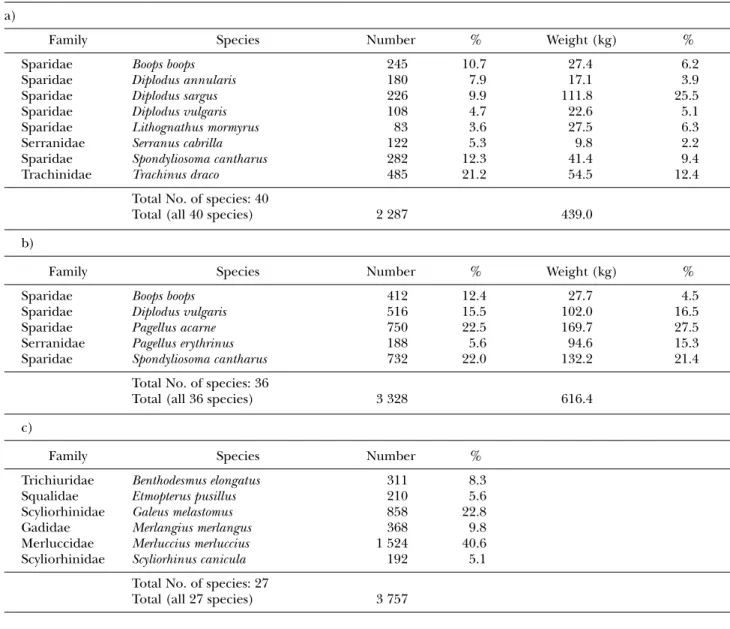
Species diversity of the catches was relatively high, with 40, 36, and 27 species, respectively, in the white sea bream, red sea bream and semi-pelag-ic long-line hake studies (table II). However, catch-es were dominated by a few specicatch-es only. In the first study, eight species (6 Sparidae, 1 Serranidae, and 1 Trachinidae) accounted for 76 % by number and
Figure 2. Shapes and dimensions of: (a): Siapal brand hooks used in the semi-pelag-ic long-line hake study; (b): Mustad brand
−Quality 2316 DT− hooks used in the se-lectivity and efficiency studies for the white
and the red sea bream methods
9 .20 9 .00 8 .80 8 .60 8 .40 8 .20 8 .00 7 .80 7 .60 7 .40 Lon gitud e (°W ) 36 .8 0 37 .0 0 37 .2 0 L a ti tu d e ( ° N) S agre s La go s Po rti mã o A lbu feira Q ua rteira Fa ro O lhã o F uz e ta T a vi ra V R S A A B C D E
Figure 3. Map showing the location of the fishing grounds for the different selectivity and efficiency studies. (A): small-hook white sea bream method; (B): small-hook red sea bream method −selectivity−; (C) and D): small-hook red sea bream method
71 % by weight. Overall, sea breams (Sparidae), dominated the catches, with the valuable common or white sea bream D. sargus alone accounting for 26 % of the total catch by weight.
In the red sea bream study, five species of Sparidae dominated the catch, with 78 % by num-ber and 85 % by weight (table II). The axillary sea bream, P. acarne, was the most important species, with a total catch of 169.7 kg (27.5 %).
M. merluccius was by far the most important
species in the semi-pelagic long-line selectivity study, with 40.6 % of the total catch in numbers (table II). This and five other species accounted for 92.2 % of the combined total catch for all four hook sizes.
In terms of by-catch and discards, the highest amounts were in the latter study, where, of the main species other than the hake, only
Benthodesmus elongatus (Clarke, 1879) was retained.
Some other species which were rarely caught (< 5 % of the catch) but had commercial value included
Brama brama (Bonnaterre, 1788), Polyprion ameri-canus, Lepidopus caudatus (Euphrasen, 1788), Conger conger, Raja spp., Prionace glauca (Linnaeus, 1758),
and Mustelus mustelus (Linnaeus, 1758). In the two sea bream selectivity and efficiency studies, fewer species were of no commercial value and would normally have been discarded: Calyonimus lyra (Linnaeus, 1758), Coris julis (Linnaeus, 1758),
Labrus spp., Scorpaena notata (Rafinesque, 1810),
Table II. Catches of the most important species (> 5 % of the total catch in number and/or weight) in three long-line se-lectivity studies. (a): white sea bream métier; (b): red sea bream métier; (c): semi-pelagic long-line hake métier (weights not
available) a)
Family Species Number % Weight (kg) %
Sparidae Boops boops 245 10.7 27.4 6.2
Sparidae Diplodus annularis 180 7.9 17.1 3.9
Sparidae Diplodus sargus 226 9.9 111.8 25.5
Sparidae Diplodus vulgaris 108 4.7 22.6 5.1
Sparidae Lithognathus mormyrus 83 3.6 27.5 6.3
Serranidae Serranus cabrilla 122 5.3 9.8 2.2
Sparidae Spondyliosoma cantharus 282 12.3 41.4 9.4
Trachinidae Trachinus draco 485 21.2 54.5 12.4
Total No. of species: 40
Total (all 40 species) 2 287 439.0
b)
Family Species Number % Weight (kg) %
Sparidae Boops boops 412 12.4 27.7 4.5
Sparidae Diplodus vulgaris 516 15.5 102.0 16.5
Sparidae Pagellus acarne 750 22.5 169.7 27.5
Serranidae Pagellus erythrinus 188 5.6 94.6 15.3
Sparidae Spondyliosoma cantharus 732 22.0 132.2 21.4 Total No. of species: 36
Total (all 36 species) 3 328 616.4
c)
Family Species Number %
Trichiuridae Benthodesmus elongatus 311 8.3 Squalidae Etmopterus pusillus 210 5.6 Scyliorhinidae Galeus melastomus 858 22.8 Gadidae Merlangius merlangus 368 9.8 Merluccidae Merluccius merluccius 1 524 40.6 Scyliorhinidae Scyliorhinus canicula 192 5.1
Total No. of species: 27
Anthias anthias (Linnaeus, 1758), and Serranus he-patus (Linnaeus, 1758).
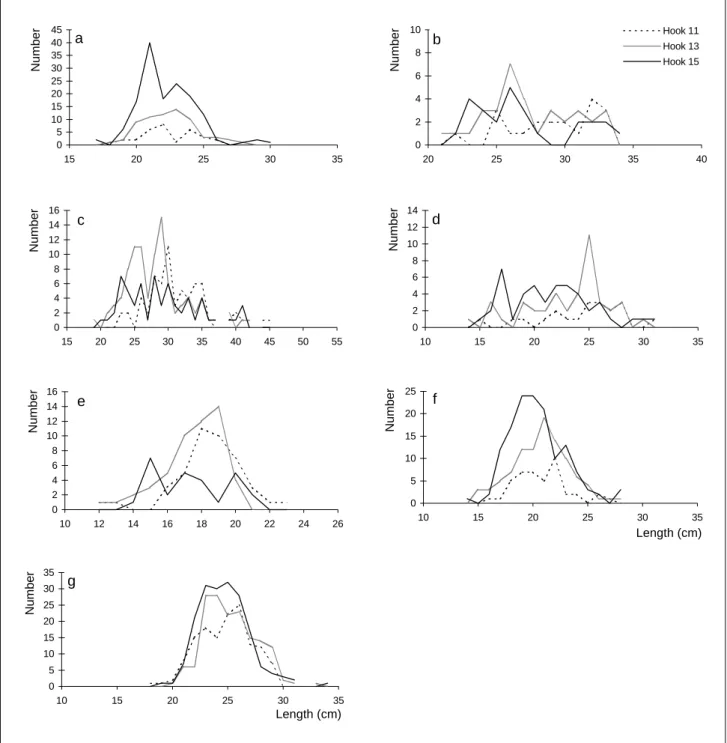
Catch size-frequency distributions of the most important species for different hook sizes are given in figures 4, 5, and 6. In most cases, the distribu-tions are highly overlapping, with all hook sizes catching a similarly wide size-range for each species. For species having a minimum legal size,
few or no illegal-sized individuals were caught, even with the smallest hooks in each study. The only ex-ception was the black sea bream S. cantharus, which has a minimum legal size of 23 cm. Catch rates (number of fish per 100 hooks) varied consider-ably between and within the three studies (table III). However, in general, catch rates decreased with increasing hook size. The highest catch rates
0 2 4 6 8 10 12 14 10 15 20 25 30 35 Number 0 5 10 15 20 25 30 35 40 45 15 20 25 30 35 Number 0 2 4 6 8 10 20 25 30 35 40 Number Hook 11 Hook 13 Hook 15 0 2 4 6 8 10 12 14 16 15 20 25 30 35 40 45 50 55 Number 0 2 4 6 8 10 12 14 16 10 12 14 16 18 20 22 24 26 Number 0 5 10 15 20 25 10 15 20 25 30 35 Length (cm) Number 0 5 10 15 20 25 30 35 10 15 20 25 30 35 Length (cm) Number a b d c e f g
Figure 4. Catch size-frequency distributions of three hook sizes for seven of the most important species in the white sea bream study: (a): Boops boops; (b): Lithognathus mormyrus; (c): Diplodus sargus; (d): Diplodus vulgaris; (e): Serranus cabrilla; (f):
were obtained in the red sea bream study, where catch rates with the smallest hook (no. 15) were greater than 30 % in a significant number of long-line sets (Erzini et al., 1997b).
In terms of catch size-distributions and catch rates of different hook sizes per species, four dis-tinct patterns can be identified in these studies:
1) Highly overlapping catch size-frequency dis-tributions (i.e. no evidence of differences in size se-lectivity), and decreasing catch rates with increas-ing hook size (e.g. M. merluccius, Trachinus draco (Linnaeus, 1758), Boops boops (Linnaeus, 1758).
2) Highly overlapping catch size-frequency dis-tributions, with catch rate increasing to a maxi-mum for intermediate-sized hooks (e.g. P. acarne).
3) Small displacement of the catch size-frequen-cy distributions with increasing hook size (i.e. dif-ferences in size selectivity), along with a decrease in
catch rate with increasing hook size (e.g. D.
vul-garis, S. cantharus).
4) Displacement of the catch size-frequency dis-tributions with increasing hook size, but no de-crease in catch rate with increasing hook size (e.g.
P. erythrinus).
DISCUSSION
Despite the major socio-economic importance of small-scale fisheries in this region, many aspects have not been studied comprehensively. In particu-lar there is a lack of information on size selectivity of hook and line gear, catch composition, catch rates and factors which affect these, and gear over-lap and competition. Little is known concerning the amount of long-line gear in use, since there is
0 10 20 30 40 50 60 70 10 12 14 16 18 20 22 24 26 28 30 Number 0 10 20 30 40 50 60 70 10 15 20 25 30 35 Number Hook 11 Hook 13 Hook 15 0 5 10 15 20 25 30 35 40 10 15 20 25 30 35 40 Number 0 2 4 6 8 10 20 25 30 35 40 45 50 55 Number 0 2 4 6 8 10 12 14 16 10 12 14 16 18 20 22 24 26 28 30 Length (cm) Number 0 10 20 30 40 50 60 70 80 10 15 20 25 30 35 Length (cm) Number a a a a a a b e d f c
Figure 5. Catch size-frequency distributions of three hook sizes for six of the most important species in the red sea bream se-lectivity study: (a): Boops boops; (b): Diplodus vulgaris; (c): Pagellus acarne; (d): Pagellus erythrinus; (e): Serranus cabrilla; (f):
no legislation limiting hook and line gear. Our per-sonal observations of small-scale fishermen suggest that 1 000-3 000 hooks per set is typical in small-hook long-line methods, while 6 000-8 000 small-hooks per set is more common in the semi-pelagic long-line hake method. Considering the potential fish-ing effort in terms of total numbers of hooks of boats using long-lines in Algarve waters, and the fact that catch rates may be as high as 20 % to 30 % (i.e. 20-30 fish for every 100 hooks), long-line gear may be a significant source of fishing mortality, es-pecially for the larger individuals of many com-mercially important species.
Catch rates, species composition and size selec-tivity in hook-and-line fisheries are influenced by a number of variables (Bjordal and Løkkeborg, 1996). These include: hook size and design (Forster, 1973; Anon., 1983; Skeide, Bjordal and
Løkkeborg, 1986; Bjordal and Løkkeborg, 1996), fishing strategy (Bjordal and Løkkeborg, 1996), bait and bait size (Moreno, Pol and González, 1992; Bjordal and Løkkeborg, 1996), and the use of accessories, e.g. swivels and floats (Bjordal and Løkkeborg, 1996). Given the large number of po-tentially important variables, any experimental study must be limited in terms of design. In our studies we have focused on hook size because of the implications for management, and on a few other factors which we consider to be potentially the most important in terms of affecting catch com-position and catch rate (bait and fishing strategy).
In our studies of three long-line methods, an ap-parent lack of evidence for differences in size se-lectivity due to hook size was a common result for many of the species. In the two sea bream studies, several factors may contribute to explaining the
ap-0 5 10 15 60 65 70 75 80 85 90 95 100 105 110 115 Number 0 2 4 6 8 10 15 20 25 30 35 40 45 50 55 Number Hook 5 Hook 7 Hook 9 Hook 10 0 5 10 15 15 20 25 30 35 40 45 50 55 60 65 70 75 Number 0 5 10 15 20 25 30 35 40 45 25 30 35 40 45 50 55 Number 0 5 10 15 20 25 30 35 40 45 50 25 30 35 40 45 50 55 60 65 70 75 80 85 90 95 Length (cm) Number 0 2 4 6 8 20 25 30 35 40 45 50 55 60 Length (cm) Number a b d e c f
Figure 6. Catch size-frequency distributions of four hook sizes for six of the most important species in the semi-pelagic hake selectivity study: (a): Benthodesmus elongatus; (b): Etmopterus pusillus (Lowe, 1839); (c): Galeus melastomus Linnaeus, 1758; (d):
parent lack of selectivity. Firstly, most of the species caught in these long-lines are small, with maximum reported sizes of less than 45-60 cm, in most cases. Secondly, smaller individuals may not be well rep-resented at the depths that were fished in this study. Thus, the populations that were fished may have been fairly limited in terms of size structure, consisting mainly of large individuals. This may have been particularly true for D. sargus and P.
ery-thrinus. With such limited size distributions, it is not
surprising that the catch size-frequency distribu-tions of the different-sized hooks were often highly overlapping (Erzini et al., 1996a, 1996b, 1997a). In the case of the hake, fishing took place at depths of 500-600 m, while small individuals are found on the continental platform and the upper continental slope and would not have been accessible to the gear used in our study. Furthermore, M. merluccius is a highly predatory species with a very large mouth, meaning that even the smaller individuals caught in this study could take the largest hook
(no. 5), thereby ensuring that no differences were found between the hook sizes used.
The general decrease in catch rate with increas-ing hook size indicates that there is a limited effec-tive hook-size range in these fisheries. It is interest-ing to note that our highest catch rates were obtained with hook sizes that are not used by the Algarve fishermen: number 15 in the sea bream methods, and no.10 in the semi-pelagic long-line hake method. In particular, the number 10 hook had significantly higher catch rates for M.
merluc-cius than the larger hook sizes that are normally
used in this method. Fishermen may be reluctant to use small hooks for a number of reasons. These include: higher catches of less desirable species, e.g. B. boops, which are time-consuming to remove and may twist and tangle the gangions; small hooks are generally more difficult to bait and to handle; they are more easily damaged; and because they are weaker and straighten under pressure, they may not hold exceptionally large fish.
Table III. Mean catch rates (No. of fish/100 hooks) ±1 S.D. by hook size in the different selectivity and efficiency studies. (a): white sea bream métier; (b): red sea bream métier; (c): semi-pelagic long-line hake métier. A and B refer to selectivity
trials with two different boats, in different areas a)
Catch rate ± 1 S.D.
Type of set Gangion Bait Hook No. 15 Hook No. 13 Hook No. 11 Selectivity 75 cm Razor-shell 5.0 ± 2.39 4.4 ± 2.09 2.8 ± 1.49 Efficiency 40 cm Mud shrimp 6.1 ± 4.98 2.0 ± 2.63 1.4 ± 2.16 Efficiency 75 cm Mud shrimp 5.6 ± 3.44 3.4 ± 2.60 2.4 ± 2.94 Efficiency 40 cm Razor-shell 5.3 ± 3.64 3.4 ± 2.70 4.5 ± 4.53 Efficiency 75 cm Razor-shell 7.6 ± 6.25 4.8 ± 6.19 2.1 ± 2.59 Efficiency 40 cm Squid 5.3 ± 10.09 3.4 ± 3.48 1.9 ± 1.86 Efficiency 75 cm Squid 5.5 ± 6.91 4.6 ± 4.83 1.8 ± 1.77 b) Catch rate ± 1 S.D.
Type of set Gangion Bait Hook No. 15 Hook No. 13 Hook No. 11 Selectivity (A) 75 cm Razor-shell 9.4 ± 2.88 6.8 ± 2.68 4.7 ± 1.52 Selectivity (B) 75 cm Razor-shell 27.5 ± 6.55 19.3 ± 3.42 11.3 ± 0.89 Efficiency 75 cm Mud shrimp 12.3 ± 5.24 10.3 ± 4.37 5.3 ± 3.03 Efficiency 75 cm Razor-shell 15.7 ± 6.99 15.7 ± 9.76 7.4 ± 5.34 c)
Catch rate ± 1 S.D.
Type of set Gangion Bait Hook No. 10 Hook No. 9 Hook No. 7 Hook No. 5
Despite the small size of the number 15 hook in the sea bream studies and the number 10 hook in the
M. merluccius study, the capture of illegal-sized fish was
minimal, with only the black sea bream (S. cantharus) being the exception. As discussed in Erzini et al. (1995, 1996a and 1997b), the minimum legal size for this species may be inappropriate, given current pop-ulation size structures and size at maturity.
Long-lines have a number of characteristics that are highly favourable in terms of the rational use and management of living resources. These include the minimal capture of undersized fish, essentially no harmful effects in terms of the environment, low energy costs, low discard rates, and the capture of a high quality product. This study is part of ongoing research on the small-scale fisheries of southern Portugal, which will hopefully contribute to the im-proved management and utilisation of demersal species, which are increasingly scarcer.
REFERENCES
Anon. 1983. Circle hooks outfish traditional halibut hooks.
Mar. Fish. Rev. 45: 10-12.
Bjordal, Å. and S. Løkkeborg. 1996. Longlining. Fishing News Books. Oxford: 156 pp.
Erzini, K., J. M. S. Gonçalves, L. Bentes and P. G. Lino. 1995.
Small hook long-line selectivity study. Final Report.
Commission of the European Communities, DG XIV/C/1, Ref. BIOECO 93/004: 62 pp. + appendices. Erzini, K., J. M. S. Gonçalves, L. Bentes and P. G. Lino.
1997a. Mouth size and hook selectivity in a multispecies artisanal long-line fishery. J. Appl. Ichthyol. 13: 41-44. Erzini, K., J. M. S. Gonçalves, L. Bentes, P. G. Lino and J.
Cruz. 1996a. Species and size selectivity in a Portuguese multispecies artisanal long-line fishery. ICES. J. Mar. Sci. 53: 811-819.
Erzini, K., J. M. S. Gonçalves, L. Bentes, P. G. Lino and J. Ribeiro. 1997b. Long-line selectivity and biology of ‘red’ sea
breams (Sparidae). Final Report. Commission of the
European Communities DG XIV/C/1, Ref. 94/059: 100 pp. + appendices.
Erzini, K., M. N. Santos, C. C. Monteiro, J. M. S. Gonçalves, L. Bentes and P. G. Lino. 1996b. A comparison of species and size selectivity of monofilament gillnets and small hook long-lines. Naga, the ICLARM Quarterly 19: 29-32. Forster, G. R. 1973. Line fishing on the continental slope:
the selective effect of different hook patterns. J. Mar. Biol.
Ass. UK 53: 749-751.
Moreno, S., J. Pol and C. González. 1992. Selection proper-ties of the baited hooks used in the Cuban long-line fish-ery of Campeche bank, Gulf of Mexico. Naga, The
ICLARM Quarterly 15: 28-29.
Skeide, R., Å. Bjordal and S. Løkkeborg. 1986. Testing of a new hook design (E-Z-Baiter) through comparative long-line fishing trials. ICES C.M. 1986/B:25.