CREATE, BUILD AND MANAGE ONLINE BRANDS
FOR INTERNET COMPANIES
Ricardo Jorge Godinho Bilro
Dissertação submetida como requisito parcial para obtenção do
grau de Mestre em Marketing
Orientador:
Prof.ª Doutora Sandra Loureiro, Prof. Auxiliar, ISCTE Business School, Departamento de Marketing, Operações e Gestão Geral
I to my daughter Margarida, undoubtedly the best part of me
II
Acknowledgements
Preparing my master's thesis was to me a very important milestone, and get to this moment I write the acknowledgments makes me to go back in time to the moment I decided to start my master’s thesis. If I'm here today writing these words I owe it to many people. As stated by the English poet John Donne, no man is an island.
I would like to gratefully thank to my supervisor Prof.ª Drª. Sandra Loureiro for all the guidance she gave me and for never giving up on me. Her message of encouragement, always with a positive and confident attitude, acted as an incentive for me. This thesis would not exist without her guidance.
A thank full of gratitude to my parents. Was them who brought me to this point in my life, through the way they raised me and because of all they have done for me.
A special thanks to my wife Cidália, my lifemate on this incredible journey that life is. On this track full of turns and constraints, knowing that you are by my side gives me the courage and strength I need to continue pursuing our dreams and goals.
III
Abstract
The purpose of this dissertation is to analyse and identify the main constructs that leads to successfully create, build and manage online brands for internet-only companies. Based on this, an online brand management explanatory model can be it generated.
In order to do so, two different but sequential approaches were used: was developed an extensive and systematic literature review in order to explore the research theoretical background and identify literature main findings; from this review eighteen papers were selected and from those some preliminary reflections were taken. Then, a focus group session was performed in order to do an empirical research and test preliminary findings; from these some conclusions can be drawn.
Based on these conclusions were possible to identify several constructs responding to the research question: trust, which stands out as the prominent construct, purchase and repurchase intentions, which are linked to other aspects as loyalty, achieved experience or ease of use and consumer satisfaction reflecting assets as privacy, commitment and consumer engagement. All of those constructs stands out as those who influence the most the success when creating, building and managing online brands for internet companies.
Keywords: internet marketing; online marketing; digital marketing; brand; online brand
management;
IV
Resumo
O objetivo desta dissertação é o de analisar e identificar as principais variáveis que conduzem à criação, construção e gestão com sucesso de marcas online para empresas de internet. Baseado nisso, poderá ser gerado um modelo explicativo da gestão de marcas online.
Neste sentido, duas abordagens diferentes mas sequenciais foram adotadas: foi desenvolvida uma extensa revisão sistemática da literatura com o objetivo de explorar os fundamentos teóricos da pesquisa; desta revisão foram selecionados dezoito artigos e a partir destes alguns resultados preliminares puderam ser retirados. Posteriormente, foi realizado uma sessão de ‘focus group’ com o objetivo de efetuar uma pesquisa empírica e testar os resultados preliminares alcançadas. Destas, foram possíveis retirar-se conclusões.
Baseado nestas conclusões foram possíveis identificar algumas variáveis que respondem à pergunta da pesquisa: a confiança, a qual se destaca como uma variável proeminente, a intenção de compra e de recompra, as quais se encontram ligadas a outros aspectos como a lealdade, experiência obtida ou facilidade de utilização e a satisfação do consumidor que reflete ativos como a privacidade, o compromisso ou o envolvimento do consumidor. Todas estas variáveis sobressaem como aquelas que mais influenciam o sucesso quando estamos a criar, construir ou gerir marcas online para empresas de internet.
Palavras-chave: marketing de internet; marketing online; marketing digital; marca;
gestão de marcas online;
V
Table of Contents
Chapter 1: Introduction ... 1
1.1 Research question and objectives ... 3
1.2 Literature review objectives and empirical objectives ... 3
1.3 Methodology ... 4
1.4 Dissertation structure and structural framework ... 4
Chapter 2: Theoretical Background: Systematic Literature Review ... 7
2.1 Research Interest ... 7
2.2 Objective of this systematic literature review ... 8
2.3 Defining study subject ... 8
2.4 Defining the key words in this research ... 9
2.5 Systematic Literature review versus narrative literature review... 10
2.6 Search strategy for quality papers ... 10
2.6.1. Search for the best quality papers ... 10
2.7 The Harzing Quality List of Journals ... 11
2.8 Scope of study for the selected journals ... 11
2.9 Specification and justification of the time frame to be examined by the Systematic literature review ... 12
2.10 Papers languages use ... 12
Chapter 3 – Systematic Literature Outcome ... 13
3.1 Several researches for the literature review ... 13
3.2 The primary outcome of each search strategy ... 13
3.3 The aggregate outcome of the search strategy ... 19
3.4 Data extraction form ... 20
Chapter 4: Preliminary Findings ... 30
Chapter 5: Qualitative Research ... 33
VI
5.2 Objectives and procedures ... 33
5.3 Group general characteristics ... 34
5.4 Focus Group Session ... 35
5.4.1 Group specific characteristics ... 35
5.4.2 Focus Group discussion and findings ... 37
5.5 Main conclusions and discussion ... 40
Chapter 6: Conclusions and implications ... 43
6.1 Theoretical and managerial implications ... 48
6.2 Limitations and future research ... 49
References ... 50
APPENDICES ... 53
VII
List of Figures
Figure 1: Conceptual framework of this dissertation ... 6
Figure 2: Search A selection process ... 14
Figure 3: Search B selection process ... 15
Figure 4: Search C selection process ... 16
Figure 5: Search D selection process ... 17
Figure 6: Search E selection process ... 18
Figure 7: Sum of Searches selection process... 19
Figure 8: Online brand management preliminary explanatory model ... 32
VIII
List of Tables
Table 1: Systematic literature review data extraction form ... 29 Table 2: Characteristics of focus group members ... 36
1
Chapter 1: Introduction
In 1899, Charles H. Duell (Director of U.S. Patent Office) allegedly stated that "Everything that can be invented has been invented". Although there is no evidence that this statement was asserted by this author (Sass, 1989), it is outstanding to reflect about all the evolution that mankind has witnessed since 1899.
Actually, we are living in an unparalleled period in history, especially since the passage of the so-called information society to the knowledge society. In this, person generates, processes, shares and makes available to all members of the society knowledge that may be used to improve the human condition.
This knowledge society has benefited greatly from the growth of Information Technology and Communication. Indeed, in terms of technology much has been changed since the Atanasoff–Berry computer - ABC (the first automatic electronic digital computer, conceived in 1937) to the cutting-edge technology present nowadays on our smartphones.
The advent of the internet delivered enormous amounts of information to people. The evolution of the internet from Web 1.0 to Web 2.0 offered persons ways to connect with each other worldwide as well as become content users and producers (Constantinides and Fountain, 2007). Innovation in digital technologies and mobile devices offers individuals a means to connect anywhere, anytime, where digital technologies are accessible.
In Western societies, the changes we have witnessed lead people to change (not so) slowly their habits and customs. People move from buying their groceries at the neighbourhood store to buy in food retail stores, and are nowadays moving from these to the online buying process through electronic platforms from e-suppliers, who deliver the groceries at our front door.
Shopping websites have become a fairly universal marketing channel and the Internet as well as information technologies have taken on a very important role in the global
2 economic system, as e-stores becomes mainstream economic entities, with the assistance of technology. Also, the Internet as a shopping channel has improved consumers’ lives and spending habits, making businesses face an inevitable revolution and challenging their methods of operation (Fan and Tsai, 2010).
At present time we are moving forward a direction where the presence in virtual space is becoming increasingly vital. In most areas of business is unthinkable not to be online and in many of these not being online is synonymous with nonexistence. As suggested by Weill and Woerner (2013), we are moving from ‘Placement’ to ‘Spacement’, from a world that was tangible, product-based and oriented toward customer transactions to a world more intangible, more service-based and oriented toward customer experience.
This changing world leads us to profound transformation on brand management. As referred by Leone et al. (2006), effective brand management is critical, and it’s a mistake to ignore its important role in developing long-term profit streams for firms, whether they are manufacturers or retailers.
Brands are used by consumers as an important tool for organizing information and simplifying their decision making process both in cyber and traditional marketplaces (Merrilees and Fry, 2002). Today’s consumers are increasingly likely to first encounter a brand online than offline, which means companies need to make sure potential clients get a favourable first impression of their brands.
This change also alters the equilibrium between consumers and brands, and even the brand equity has been influenced by this new perspectives. As referred by Aaker (1991: 15) “brand equity can be defined as a set of brand assets and liabilities linked to a brand, its name and symbol that add to or subtract from the value provided by a product or service to a firm and/or to that firm’s customer the added value endowed to products and services”. As defined by Kotler and Keller (2012), it may be reflected in the way consumers think, feel, and act with respect to the brand, as well as in the prices, market share and profitability the brand commands.
3 Nowadays every company made a huge effort in order to properly manage their brand in a fast moving environment. As an example, we can see that several years ago brand communication was based on the triumvirate press, television and radio and technology evolves at a slower rhythm. Today, brand communication is based on multiple platforms, increasingly digital. Technology evolves at a considerable rhythm and almost every day something new is born, invented or discovered.
1.1 Research question and objectives
The question we are hypothetical to answer in this dissertation is: which are the constructs that leads to successfully create, build and manage online brands for internet companies.
Regular brands export their brand awareness and brand image to online life, working as an extension of their offline awareness and image. However, a new brand that only exists in online environment doesn’t have offline assets to export. Understand which are constructs that lead to successfully create, build and manage an online brand for stand-alone internet companies is the main objective of this dissertation.
So, the objective is to identify the key features that should be taken into consideration when we want to create and manage an online brand and what features emerge as more important. Based on this, we should be able to generate an explanatory model with the identified constructs that we should take into consideration when creating, building and managing an online brand for a company that only exists on the Internet.
1.2 Literature review objectives and empirical objectives
In order to achieve the expressed objectives it was decided to move forward in two different paths: to do a systematic literature review and to do a qualitative research based on a focus group.
4 Concerning the systematic literature review, the aim was to develop an extensive research that could lead by relevant existing literature to understand how we can create, build and manage a brand for internet companies.
After the conclusion of the systematic literature review it was decided to do a focus group. The option for performing this qualitative research was linked to the importance of testing the preliminary reflections and validates or rejects these findings. It was considered important to do so in order we could test and move forward with a proposal for an explanatory model for the research question under consideration.
1.3 Methodology
Concerning the methodology adopted was chose to carry out a systematic literature review about the subject in study, and export their findings into a data extraction form. From this systematic literature review we were able to find preliminary reflections that were tested in a qualitative research through performing a focus group.
In the focus group were tested the systematic literature review preliminary findings and new findings could be reached. From this range of findings, conclusions could be taken and an explanatory model for the constructs that influences online brand management could be presented.
1.4 Dissertation structure and structural framework
This dissertation is divided in six chapters, as follows:
The first chapter is dedicated to the introduction where are underlined the importance of the research, identified the research question and the general and specific objectives as well as the literature review objectives and empirical objectives. The used methodology is explained, the dissertation structure is detailed and a structural framework is presented.
5 The second chapter is devoted to the systematic literature review where the definition of the study subject is presented, as well as the key words to be used in the research. It’s also presented the used strategy for identifying the best quality papers and underlined the research specifications.
The third chapter is dedicated to the systematic literature review outcomes, which is presented in a data extraction form. In this was decided to use a data extraction form composed by the author’s name and year of publication, name of the journal, the base theory of the study or construct, the adopted methodology and sample, the main conclusions of each paper, as well as research limitations, future research and managerial implications.
In the fourth chapter are presented the preliminary reflections reached through the systematic literature review. Three constructs were identified and a preliminary online brand management explanatory model is advanced.
The fifth chapter is dedicated to the focus group. The objectives and procedures are presented, the group characteristics are identified and the focus group session is described. Conclusions have been reached and presented.
In the sixth chapter dissertation conclusions are presented, as well as limitations of the study. Future researches are highlighted and managerial implications are also identified.
6 Figure 1: Conceptual framework of this dissertation
Source: own elaboration
Research Question Conclusions \ Explanatory Model Systematic Literature Review Preliminary
Findings Focus Group
Focus Group Findings
7
Chapter 2: Theoretical Background: Systematic Literature Review
2.1 Research Interest
With the evolution of humanity, technology and internet usage in particular, the relationship between the market, consumers and brands are constantly being challenged. In this increasingly changing world consumers make choices that comprise within themselves more and more variables that influence their decisions.
As Internet usage grows, brands are becoming even more important than they have been in other channels or environments. With new options emerging every day from many unknown providers from all over the world, customers want to choose a supplier that represents a set of values or attributes that are meaningful, clear and trusted.
With the proliferation of this competition, products and services are easily duplicated or replaceable; brands become in this way an important asset for simplifying the decision-making process for consumers. If we are able to properly manage this asset, this can create difference, relevance and affinity (Otim and Grover, 2006). In fact, one of the main factors that consumers use for first distinguishing providers is brand name, which is known to be positively related to perceived levels of brand trust (Ruparelia et al., 2010).
The interest of studying only internet companies comes from the fact that both the brick-and-mortar companies as well as hybrid companies (both physical and internet presence) benefit from the use of same brand offline and online. Internet companies do not have values or attributes to import from the physical world and they have to create those assets from scratch.
Concerning the offline brands import benefits, many authors identify several effects from the use of the brand in both environments, such as halo effect, dilution effect, the spill over effect or the feed-back effect (Kwon and Lennon, 2009). Most hybrid retailers (or brick-and-click as mentioned in several literature) operate under the same retail brand name in both channels to exploit the halo effect from their existing offline image, despite running the risk that retailer’s online performance may dilute the brand’s
8 positive image if the online performance fails to meet consumers’ high expectations that are based on the retailer’s positive offline brand image (Kwon and Lennon, 2009).
Stand-alone internet companies such as major players like Google, Facebook, Twitter, Amazon or eBay and even smaller internet businesses all over the world faces the challenge of creating, building and managing a brand that doesn’t import attributes or values from the physical world. Many authors confirm that the ease of establishing a brand and the significance of branding in cyberspace are more difficult and more important than many initially suggested (Delgado-Ballester and Hernández-Espallardo, 2008). However, the reasons for building a brand and the process and discipline to manage one are based on the same principles that have been proven over time.
2.2 Objective of this systematic literature review
The aim of this systematic literature review is to develop an extensive research that can lead by relevant existing literature to understand how we can create, build and manage a brand for internet companies.
For this propose it was defined several criteria in terms of quality, time range, scope of study, language of the papers and others, which will be detailed as follows.
2.3 Defining study subject
The proposed study subjects in this dissertation are the factors that drive to successfully create, build and manage online brands for internet-only companies.
The question of brand management in the online context appears in this study as the core element. Actually, since the early stage of internet that this topic has been subject of interest and study, largely because much starts changing in how consumers look and interact with brands and products.
Many authors refer to different aspects as notably significant questions in online brand performance. Although we can identify different variables among several authors, it’s
9 common to identify brand-consumer interaction and consumer behaviour as central aspects that influences online brand management.
Thereby, we can observe De Chernatony and Christodoulides (2004) suggesting that consumer evaluate brands through a hierarchy structure, emphasising the rational values first (functional values, emotional values and promised experienced). On the other hand, if we observe the key conclusions reached by Delgado-Ballester and Hernández-Espallardo (2008), we can identify consumers’ beliefs, attitudes and intention as main factors on building online brands. Other authors, as Da Silva and Alwi (2008) states that for the online context the brand characteristics that emerge are personalisation, customer service, ease of use and security.
Trying to reach conclusions and identify the different variables that are constructs to successfully manage online brands for internet companies is the subject under study in this dissertation.
2.4 Defining the key words in this research
Defining the terms in this research emerges as an important fact in order to have a unified vision of what we are referring to and what we are studying.
The terms create, build and manage are linked to the brand lifecycle. Create is linked to the introduction on the market, build is linked to the growth on the market and manage is linked to the maturity phase of the brand in the market. In the study presented here, it seems to be important to cover the life cycle of the brand.
Regarding online brands we're referring to those who do not have physical existence and as such cannot export those assets from the physical to the virtual world.
Concerning internet companies, we can identify in the literature three types of existence: the traditional brick-and-mortar companies (traditional brands with physical presence), the hybrid companies (also referred as ‘brick-and-click’, due to fact they have physical and virtual presence) and pure internet companies which are our scope of
10 study; several internet companies can be identified as Google, Facebook, Twitter, Amazon, Spotify or Whatsapp among others.
2.5 Systematic Literature review versus narrative literature review
The type of literature review adopted in this dissertation is the systematic literature review in order to fulfil the objective of systematic reviewing of the existing literature regarding creation, building and manage online brands for internet companies.
Following this intention, the main objectives concerning this review are:
- A thorough examination of the existing literature review with the aim of having a profound vision of current research on this subject
- Understanding the key milestones for create, build and manage successful brands for online-only companies
- Identify the constructs that influences consumers perception regarding online brands
2.6 Search strategy for quality papers
The searches for papers with relevance for this investigation were made in ABI/INFORM Complete.
2.6.1. Search for the best quality papers
Having as starting point that the purpose of this Systematic Literature Review was to use only the best quality papers available were used several filters to leach the database:
- Full-text papers: with this first filter it was guaranteed that we were working only with full-text papers available
- Peer-reviewed papers: with this second filter it was guaranteed that the papers used were scientific papers
- Scholarly journals: with this third filter it was guaranteed that it was only considered papers published on scientific journals
11
2.7 The Harzing Quality List of Journals
With the intention of having the best quality papers available, it was defined to use only best quality papers published in the best quality journals.
In order to be able to carry out the quality journals selection, it was used the Journal Quality List – Fiftieth Edition, 5th July 2013, compiled and edited by Professor Anne-Wil Harzing. From this one, it was chosen to use the WIE 2008 — WU Wien Journal Rating May 2008 List.
The chosen WIE 2008 list includes only A/A+ journals, and from this was considered all the journals that are under the decided scope of study.
2.8 Scope of study for the selected journals
Knowing that the subject under study involve several scientific study areas, it was defined to choose all the papers from the following subject areas:
- Marketing - Entrepreneurship
- General Management & Strategy
- Management Information Systems - Knowledge Management
With this choice was attempted to cover the maximum possible study areas that could address this topic.
Nonetheless, and aware that this is an increasingly multidisciplinary field which is studied by different disciplines, care was taken to divert from areas of study related to technology or engineering, which do not represent our scope of study
12
2.9 Specification and justification of the time frame to be examined by the Systematic literature review
For the time frame to be examined in this systematic literature it was considered the web 2.0 phenomenon as a starting point of date range to be examined.
Web 2.0 describes sites that use the technology beyond static pages from previous sites and is commonly accepted by the community to define Web 2.0 as a collection of open-source, interactive and user controlled online applications expanding the experiences, knowledge and market power of the users as participants in business and social processes. Web 2.0 applications support the creation of informal users’ networks facilitating the flow of ideas and knowledge by allowing the efficient generation, dissemination, sharing and editing / refining of informational content (Constantinides and Fountain, 2007).
The term Web 2.0 was proposed by O’Reilly in 2005 and it has quickly become the new buzzword of Silicon Valley (Constantinides and Fountain, 2007), and references to a turning-point O'Reilly identify in 2004.
Therefore, it was choose 2004 as starting point and 2014 as the ending point in order to reflect the peak investigation available.
2.10 Papers languages use
They were considered only papers written in English or in Portuguese, due to languages limitations of the researcher.
13
Chapter 3 – Systematic Literature Outcome
3.1 Several researches for the literature review
Since the beginning of this literature review, numerous researches were conducted to find the best words that would meet the object of study. Some expressions like "Digital" or "Digital Marketing" were dropped because too often reflect studies in the field of engineering or development of electronic equipment.
As time passed and the research deepened, it follows that the expressions that best defined the subject of the study were linked to "online" and "internet". Thus, it was concluded that the core of the research would take place with the keywords "online", "brand" and "internet companies". These keywords were joined by terms that reflect the scope of the study, i.e., how to "create", "build" and "manage" online brands.
This way we have reached the terms used in the five researches carried out in this literature review. The choice to perform of this strategy was taken in order to fulfil the objective of trying to include as many articles available on the subject.
Therefore, the following searches were conducted:
Search A: online + brand* + internet companie* Search B: online + brand equity + internet companie*
Search C: brand + online + create* OR creating + internet companie* Search D: brand + online + build* OR building + internet companie* Search E: brand + online + manage* OR managing + internet companie*
3.2 The primary outcome of each search strategy
The results obtained with each of the five studies are shown separately and illustrated in figures as a flow diagram.
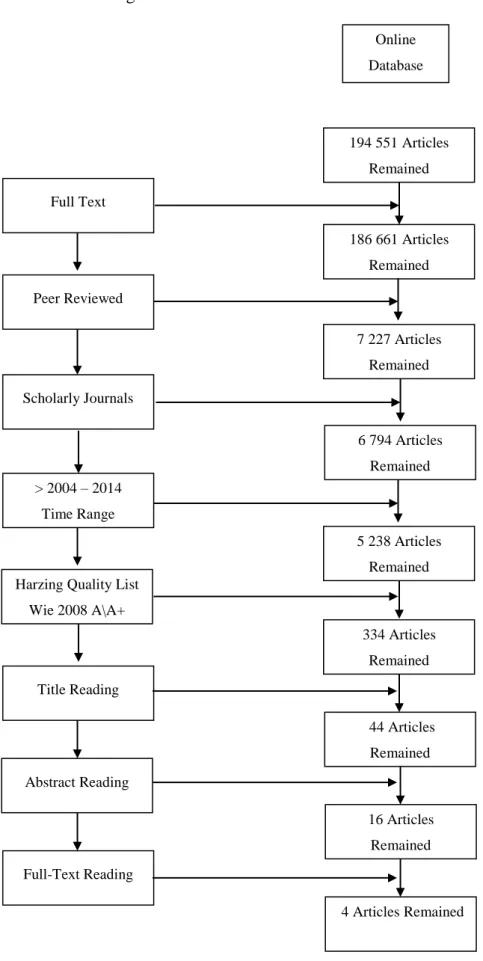
14 For the Search A: online + brand* + internet companie*, the results are illustrated in Figure 1 as a flow diagram.
Figure 2: Search A selection process
Online Database Full Text Peer Reviewed Scholarly Journals > 2004 – 2014 Time Range 194 551 Articles Remained 186 661 Articles Remained 7 227 Articles Remained 6 794 Articles Remained 5 238 Articles Remained Harzing Quality List
Wie 2008 A\A+ Title Reading Abstract Reading Full-Text Reading 334 Articles Remained 44 Articles Remained 16 Articles Remained 4 Articles Remained
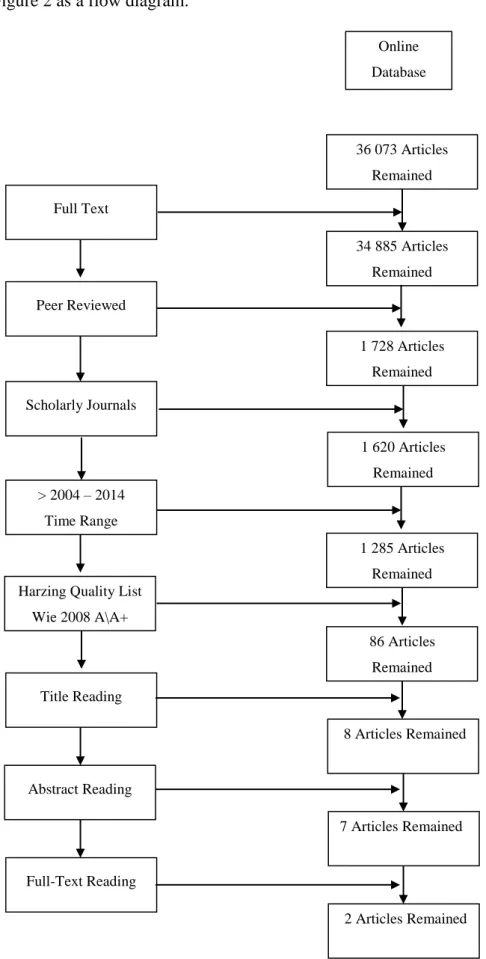
15 For the Search B: online + brand equity + internet companie*, the results are illustrated in Figure 2 as a flow diagram.
Figure 3: Search B selection process
Online Database Full Text Peer Reviewed Scholarly Journals > 2004 – 2014 Time Range 36 073 Articles Remained 34 885 Articles Remained 1 728 Articles Remained 1 620 Articles Remained 1 285 Articles Remained Harzing Quality List
Wie 2008 A\A+ Title Reading Abstract Reading Full-Text Reading 86 Articles Remained 8 Articles Remained 7 Articles Remained 2 Articles Remained
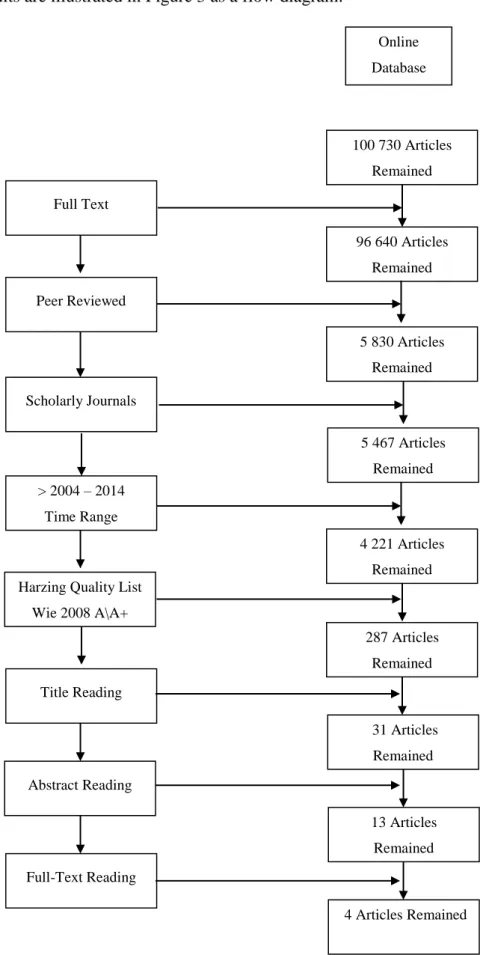
16 For the Search C: brand + online + create* OR creating + internet companie*, the results are illustrated in Figure 3 as a flow diagram.
Figure 4: Search C selection process
Online Database Full Text Peer Reviewed Scholarly Journals > 2004 – 2014 Time Range 100 730 Articles Remained 96 640 Articles Remained 5 830 Articles Remained 5 467 Articles Remained 4 221 Articles Remained Harzing Quality List
Wie 2008 A\A+ Title Reading Abstract Reading Full-Text Reading 287 Articles Remained 31 Articles Remained 13 Articles Remained 4 Articles Remained
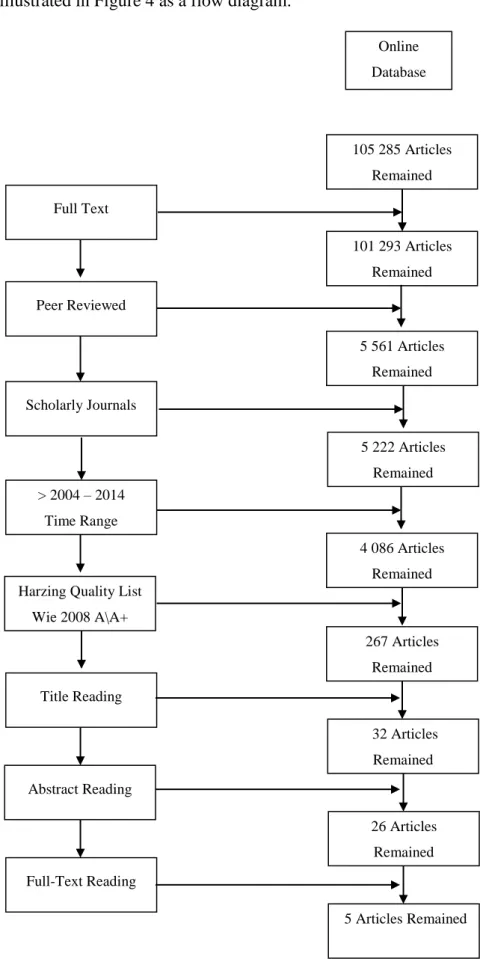
17 For the Search D: brand + online + build* OR building + internet companie*, the results are illustrated in Figure 4 as a flow diagram.
Figure 5: Search D selection process
Online Database Full Text Peer Reviewed Scholarly Journals > 2004 – 2014 Time Range 105 285 Articles Remained 101 293 Articles Remained 5 561 Articles Remained 5 222 Articles Remained 4 086 Articles Remained Harzing Quality List
Wie 2008 A\A+ Title Reading Abstract Reading Full-Text Reading 267 Articles Remained 32 Articles Remained 26 Articles Remained 5 Articles Remained
18 For the Search E: brand + online + manage* OR managing + internet companie*, the results are illustrated in Figure 5 as a flow diagram.
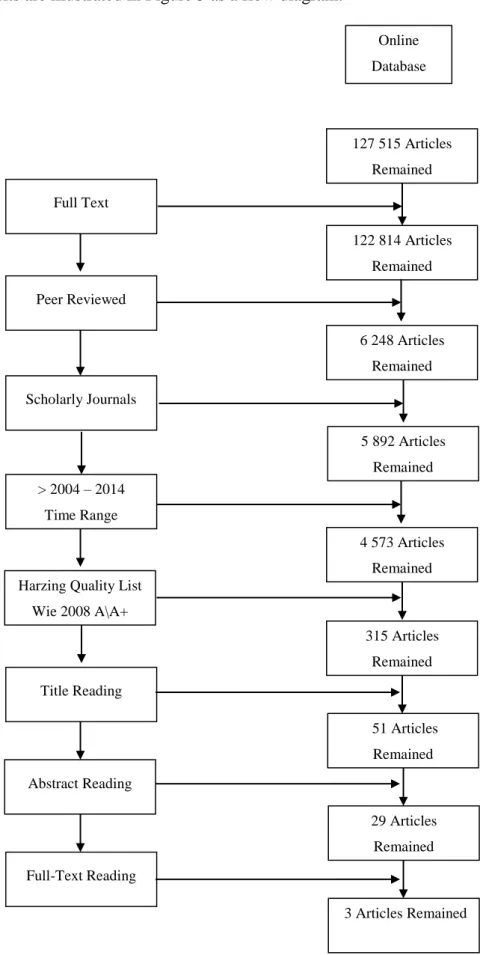
Figure 6: Search E selection process
Online Database Full Text Peer Reviewed Scholarly Journals > 2004 – 2014 Time Range 127 515 Articles Remained 122 814 Articles Remained 6 248 Articles Remained 5 892 Articles Remained 4 573 Articles Remained Harzing Quality List
Wie 2008 A\A+ Title Reading Abstract Reading Full-Text Reading 315 Articles Remained 51 Articles Remained 29 Articles Remained 3 Articles Remained
19
3.3 The aggregate outcome of the search strategy
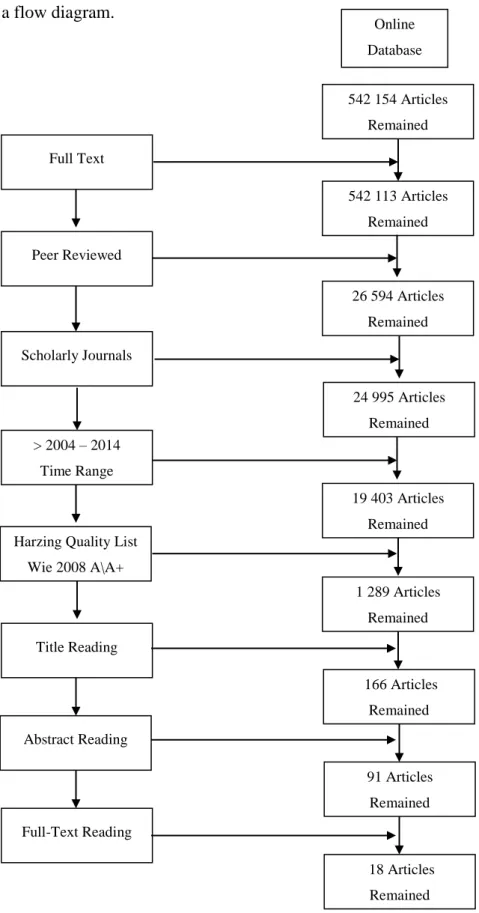
The sum of the results retrieved from the literature review search is illustrated in Figure 6 as a flow diagram.
Figure 7: Sum of Searches selection process
Online Database Full Text Peer Reviewed Scholarly Journals > 2004 – 2014 Time Range 542 154 Articles Remained 542 113 Articles Remained 26 594 Articles Remained 24 995 Articles Remained 19 403 Articles Remained Harzing Quality List
Wie 2008 A\A+ Title Reading Abstract Reading Full-Text Reading 1 289 Articles Remained 166 Articles Remained 91 Articles Remained 18 Articles Remained
20 In the analysis of the sum of different search results we must have to take into account that some articles found in the different searches were repeated. These articles were being purged as they were being detected. As an example we can say that of the 91 articles that remained in abstract reading, 46 were repeated.
3.4 Data extraction form
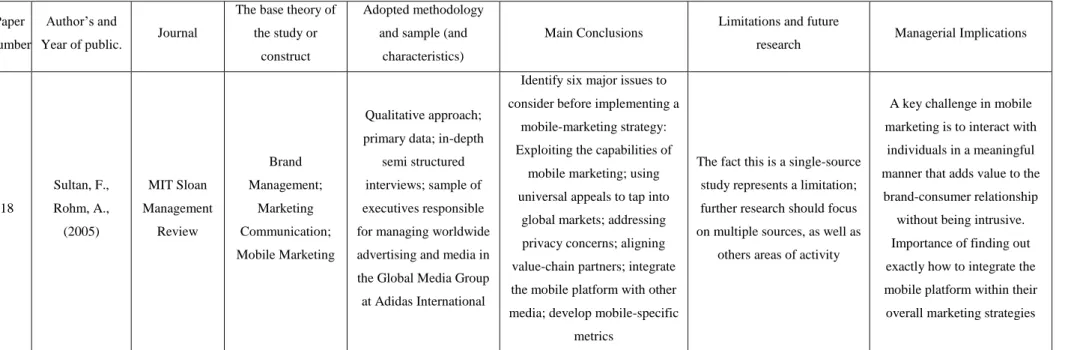
In this systematic literature review was created and used a data extraction form in order to extract the data from the selected papers and also to be able to document the process of data extraction. As for the elements extracted from the papers, they were divided in three main groups: general information, study characteristics and main results.
About General Information were taken in account three fundamental elements: Author’s, Year of publication and name of the journal that published the article. Regarding the studies characteristics, were taken in account the base theory of the study or construct and the adopted methodology and sample (and characteristics). Concerning on key results were highlighted the main conclusions, the limitations and future research and managerial implications.
21 Paper
Number
Author’s and
Year of public. Journal
The base theory of the study or
construct
Adopted methodology and sample (and
characteristics)
Main Conclusions Limitations and future
research Managerial Implications
1 Otim, S., Grover, V., (2006) European Journal of Information Systems Theory of Reasoned Action (TRA); Consumer Behaviour Quantitative approach; Secondary data, sample
size of 150 stores
Web-based companies can foster customer loyalty by focusing mainly on post-purchase customer service
dimensions, especially customer support; pre-purchase and transaction-related services
are somewhat important, support product search and evaluation have a weaker effect
on customer repeat purchase intentions
Limited to computer purchases; future research can address other durable products
as well as nondurable transactions goods and examine the capabilities needed for offering web-based
services
Companies must follow an integrated approach to managing a customer’s relationship; post-purchase
services are the most important in fostering customer loyalty; trust in the relationship is fundamental to its longevity 2 Hur, W.-M., et al., (2011) Management Decision Brand Community Commitment; Loyalty Behaviours; Brand Loyalty Quantitative approach; Primary data; Partial Least Squares (PLS) Analysis; one-on-one
personal interviews; sample size of 200
Chinese female online brand community
users (based on Beijing or Shangai)
Identified that brand community trust and affect
leads to brand community commitment; and that brand community commitment leads
to brand loyalty behaviours; brand community commitment
have a strong effect on word-of-mouth
Limited to treat brand community commitment as a
unidimensional construct; future research may consider
Multidimensional constructs and relational variables, such as self-congruity; consider
generate more valid measurement items for WOM
through other measurement scales in communication and
loyalty areas
Brand community activities influence the relationships
among community participants, brand and the company; having a space in which customers can directly participate is very effective in enhancing customers’ loyalty;
trust and affect are vital factors in enhancing customers’ brand community;
22 Paper
Number
Author’s and
Year of public. Journal
The base theory of the study or
construct
Adopted methodology and sample (and
characteristics)
Main Conclusions Limitations and future
research Managerial Implications
marketing mediated by brand communities very effective
3 Benedicktus, R. L., et al (2010) Journal of Retailing Trust Construct; Purchase Intentions Quantitative Approach; Hypotheses testing through online scaled response questionnaire;
Primary data; Study 1: sample size of 302 undergraduate students;
Study 2: sample size of 261 nonstudent
respondents
Favourable consensus information led to increased trustworthiness perceptions and
purchase intentions; physical presence stimulates trustworthiness of unknown retailers, but brand familiarity
presents similar level of benefits (convey trustworthiness with consumers
and increase purchase intentions)
Both studies examined effects for only one product category; Future research can compare physical store presence effect across products with search-dominant versus experience-dominant attribute; and also include other trust cues as price disclosure, real-time advice and ease-of-navigation
Consumers are cautious when making purchases on the Internet, therefore retailers should develop trust with their
consumers through brand familiarity, physical presence
and consensus information.
4 Sashi, C.M., (2012) Management Decision Customer Engagement; Relationship Marketing Examination of practitioner views of customer engagement followed by a discussion
of its links to the relationship marketing;
Formulation of a conceptual model.
Customer engagement focus on costumers and their needs, provide superior value relative
to competitors (generating, disseminating, and responding
to customer needs and market orientation) and build trust and
commitment with costumers
Implicit hypothesis need empirical studies; Future research can examine the mix
of social media, other digital media, and non-digital media
appropriate for each stage of the customer engagement
cycle
Connect and interact between sellers or current customers with potential customers and succeed in turning them into
transactional customers creates the possibility of their transition through subsequent
stages of the customer engagement cycle, with some of them eventually becoming
23 Paper
Number
Author’s and
Year of public. Journal
The base theory of the study or
construct
Adopted methodology and sample (and
characteristics)
Main Conclusions Limitations and future
research Managerial Implications
fans; Customer engagement turns customers into fans.
5 William, K., et al (2008) European Journal of Information Systems Theory of interaction design; design dimension and design objectives for digital services Iterative process of observation and analysis;
identification of fundamental design dimensions; creation of a
design taxonomy of digital services
Creation of a Digital service design taxonomy, thru analysis
of four design dimensions (Service delivery, Malleability,
Pricing/funds and Service maturity) and their dependencies of design
objectives (business, interaction and technology)
In order to strength actual taxonomy, empirical studies should be considered; Future research should consider qualitative interviews and quantitative data collection
from digital service companies
Useful tool in evaluating the market presence and trajectory
of digital service providers; these must be aware to concepts of service maturity,
service delivery, as well as malleability and effective pricing/funding in order to
improve the possibility of success 6 Fueller, J, Von Hippel, E., (2009) MIT Sloan Management Review Brand creation theory; Online communities brand creation Quantitative Approach; primary data; online
scaled response questionnaire; sample size of 216 members of
‘outdoorseiten.net’
Online communities have the potential to create strong brands at low cost; high brand engagement from communities
members to communities brands
The study was conducted online at a community brand
web site; future research should analyze major markets
(such as software markets) and understand the relative competitive positions of commercial brands and user
community brands
Traditional companies would be wise to pay attention to
community brands phenomenon; commercial brands should evaluate the creation of cobranded products 7 Laroche, M., et al, (2004) Journal of Service Research Intangibility and Perceived risk construct Quantitative Approach; primary data; structured,
non disguised
Significant strong impact of mental intangibility on
perceived risk; the
Use of student sample, the set of goods and services selected
and the use of paper
Companies can adopt two non mutually exclusive strategies
24 Paper
Number
Author’s and
Year of public. Journal
The base theory of the study or
construct
Adopted methodology and sample (and
characteristics)
Main Conclusions Limitations and future
research Managerial Implications
questionnaire; sample of 783 college students.
intangibility-perceived risk model had a stronger relationship with generic products than with brand products; in the online environment, factors as privacy, security, assurance and
trust also influence perceived risk
questionnaire for the online environment results appears as main study limitations; future research should include different products and test the online environment using an
online questionnaire
implement initiatives that directly address the risk (e.g., guarantees) or create solutions for the factors that contribute to intangibility (e.g., increase
tangibility) 8 Pan, Yue, Zinkhan, G., (2006) Journal of Retailing Social contract theory; privacy policies and trust
constructs
Quantitative Approach; primary data; pretested questionnaire; sample of
150 respondents out of 525 potential subjects contacted via telephone
An e-tailer site should have a clearly stated privacy policy; the mere existence of such
privacy policy increase consumer trust
Hypothetic buying scenario as a limitation of this study; further research should imitate
a real complete transaction, and investigate the root causes
of privacy risks
The shopper’s privacy concerns should mainly arise
from their evaluations of the store itself and not from the lack of privacy disclosures
9 White, T. B., et al, (2008) Marketing Letters Effect of degree of personalization Quantitative Approach; Multiple factorial experiment; Primary data; Study 1: sample size of 86 undergraduate
students; Study 2: sample size of 354 undergraduate students
Consumers’ responses to highly personalized messages
are dependent on their perceived of being justified; high distinctive personalized
messages had, at best, equal click-through intentions than lower distinctiveness messages.
Use of student sample is a limitation of this study; the
second study were largely exploratory in nature, and the
demonstrated effects were relatively small; Further research should use a
student sample in a non-laboratory setting, and
Consumers reaction to exchanges involving personal
information follow a utility maximization principle, in which they are willing to incur
the costs of personalized messages only if they perceived net benefits of that
25 Paper
Number
Author’s and
Year of public. Journal
The base theory of the study or
construct
Adopted methodology and sample (and
characteristics)
Main Conclusions Limitations and future
research Managerial Implications
research on factors such as message matches consumers’
personal preferences. 10 Collier, J. E., Bienstock, C. C., (2006) MIT Sloan Management Review Consumer quality evaluation; Quality construct; consumer behavior Quantitative Approach; Primary data; online questionnaire; sample of
338 consumers who has completed an online
transaction before.
A consumer evaluates an online retailer’s through five website attributes (ease of use,
privacy, simple design, consistency and flexibility, and
good information), the capability to deliver the product (time frame between placing the order and receiving
the product, accuracy of the order and the condition of the order received) and the ability
to solve a problem.
One limitation of the study concerns the discrepancy in
experience in online transactions among the sample; Further research
could measure the same quality construct for online
auctions sites
Consumers’ judge quality through interaction with the website, the outcome of the retail transaction and the
successful resolution of problems when they occur.
Consumer trust in online retailers appear as a success
factor and linked to the perception of high-quality 11 Urban, G. L., et al., (2009) MIT Sloan Management Review Bayes’ Theorem (to infer cognitive
styles)
Quantitative Approach; Primary data; online questionnaire; sample of 835 current and potential
broadband users
Marketing is communication, and morphing to cognitive
styles enhances communication. Ratings increase significantly from a
nonmorphing site to a morphing site on the relevant
measures: trust, helpfulness,
Cultural limitation (UK potential clients only), field of study (broadband clients) and
website design focus as limitations for this study. Future research should extend
the EGI algorithm to other marketing-mix elements, as
Confirm that website characteristics can affect purchase probabilities; “One
size fits all” may not be the most effective advertising strategy. Targeted messages
can build empathy and increase sales.
26 Paper
Number
Author’s and
Year of public. Journal
The base theory of the study or
construct
Adopted methodology and sample (and
characteristics)
Main Conclusions Limitations and future
research Managerial Implications
ease of use and information identification
well as cultural dimension
12 Khalifa, Mohamed, Liu, Vanessa, (2007) European Journal of Information Systems Customer retention phenomenon construct Quantitative Approach; Primary data; online survey study of 122
online shoppers
Experience and habit appears as important effects on repurchased intention, which is
indicative of online consumer retention
The research is limited to the online factors (doesn’t reflect product delivery or other
related issues); further research should consider online and contingent offline
factors simultaneously; this study can be replicated in
emerging and innovative online channel activities
Online costumers may be segmented into four major
profiles, according to experience and shopping habit; to each of these profiles
should be assigned different marketing objectives and priority of retention efforts
13 Rose, Susan, et al, (2012) Journal of Retailing Customer Experience Construct Quantitative Approach; Primary data; online questionnaire; sample of
220 online customers based on USA and
Europe
Perceived control affects customers’ affective state and
their confidence in online shopping decision (thru connectedness, customization
and ease-of-use); Cognitive Experiential State and Affective Experiential State are
identified as part of Online Customer Experience; confirm
the relationship between the main Online Customer
The sample does not include a significant number of emerging Generation Y group
of young people; greater geographic reach could help
understand cross-cultural differences in a global e-retailing market. The study explores the online repurchase
intention; further studies should consider test the online
purchase behaviour model
Online shoppers sense of control and empowerment appears as main variables for Online Customer Experience; Emphasis on three sources of
control: ease-of-use, customization and C2C interaction (connectedness
27 Paper
Number
Author’s and
Year of public. Journal
The base theory of the study or
construct
Adopted methodology and sample (and
characteristics)
Main Conclusions Limitations and future
research Managerial Implications
Experience outcomes: satisfaction, trust and repurchase intention. 14 Weill, P., Woerner, S. L., (2013) MIT Sloan Management Review Customer Value Proposition; Customer Experience; Quantitative and qualitative approach; Primary and secondary data; survey; sample of
118 companies; companies financial data
analysis; companies news reports and other
public information analysis; case studies
analysis; in-depth interviews;
Three main trends: every aspect of business becomes
increasingly digital; the increasing number of “digital
natives” (young current and future customers and employees); dawning of the age of customer voice; Many industries are moving quickly from “Place” to “Space” (from
physical content, packaging and infrastructures) to a hybrid
or pure-online offer of products, services and contents
Further research should consider focus on determine the degree of interdependency
for each business model (see if interdependency is another
channel to explain performance), and understand
how the superior business models drive performance, through the advantage of scale
A Digital Business Model has three components: content (creation of unique content), customer experience (improve
most frequently performed tasks and eliminate most
frustrating customers’ experience) and platform
(complete update of technology and processes,
mobile and mobile apps oriented). 15 Lwin, M. O., Williams, J. D., (2006) The Journal of Consumer Affairs Perceived Risk, Product Quality, Purchase Intention Quantitative Approach; Primary data; online experiment; sample of 240 internet users in a
simulated online shopping context
The presence or absence of brand name was found to
influence perceived risk, product quality and purchase intention. The interaction with
the warranty information was consider insignificant (retailer
Use of simulated environment as a limitation of this study;
further research should observe a real transaction experience, and investigate the source causes of perceived
risks, product quality
Differential impact on consumers’ perceptions of the web site warranty information based on the reputation on the
retailer; Brand name knowledge appears to be a
28 Paper
Number
Author’s and
Year of public. Journal
The base theory of the study or
construct
Adopted methodology and sample (and
characteristics)
Main Conclusions Limitations and future
research Managerial Implications
reputation moderates the effect of expressed warranty)
assumption and purchase intention perception regardless of warranty information 16 Garrigos-Simon, F. J., et al, (2012) Management Decision Social networks; relationship marketing Qualitative approach; secondary data; examination of previous literature
The impact of social networks and especially the new context Web 3.0 in organizations is increasing and supplant other
areas in organizational structures. Community managers and crowdsourcing
process are acquiring increasing importance
The fact we are in the presence of an exploratory analysis appears as a limit to this study and requires further
studies, such as concentrate on the impact of community managers on organizations or
analyze how to use the crowdsourcing at every step
of the value chain
Possible sources of competitive advantages through crowdsourcing and community managers need to
be studied for each organization 17 Constantinides, E., (2004) Management Decision Strategic management (for electronic commerce)
Analysis and comparison of two case studies,
through a six step methodological process
Fast paced environment of the online business requires continuous evaluation of market conditions, frequent strategy assessment and close
monitoring of competitive moves; Permanent orientation
towards innovation and expansion as a prime strategic
as a mean of surviving, maintaining competitive
advantages and growth
The study is limited to the internet mediated marketplaces; Further research should try to answer the question: do internet firms follow different approaches
than traditional ones in formulating their corporate
strategy?
High performance in dynamic environments is a characteristic that must be constantly pursued through an
ongoing process of change which is in line with changes in the competitive advantages;
reluctance to undertake any long-term strategy
29 Paper
Number
Author’s and
Year of public. Journal
The base theory of the study or
construct
Adopted methodology and sample (and
characteristics)
Main Conclusions Limitations and future
research Managerial Implications
18 Sultan, F., Rohm, A., (2005) MIT Sloan Management Review Brand Management; Marketing Communication; Mobile Marketing Qualitative approach; primary data; in-depth
semi structured interviews; sample of executives responsible for managing worldwide advertising and media in the Global Media Group at Adidas International
Identify six major issues to consider before implementing a
mobile-marketing strategy: Exploiting the capabilities of
mobile marketing; using universal appeals to tap into
global markets; addressing privacy concerns; aligning value-chain partners; integrate the mobile platform with other media; develop mobile-specific
metrics
The fact this is a single-source study represents a limitation; further research should focus on multiple sources, as well as
others areas of activity
A key challenge in mobile marketing is to interact with
individuals in a meaningful manner that adds value to the brand-consumer relationship
without being intrusive. Importance of finding out exactly how to integrate the mobile platform within their overall marketing strategies
Table 1: Systematic literature review data extraction form Source: own elaboration
30
Chapter 4: Preliminary Findings
At this point, we can draw preliminary findings and synthesis.
The first construct that was identified through the literature review was ‘trust’. In fact, this category is identified in 10 of the 18 selected papers which highlight the trust as an important asset in managing brands online.
Trust emerges as an important role in managing the life cycle of online brands, whether we are referring to online retailers, services providers or product suppliers. In fact, trust appears by far as the main positive indicator for online brand loyalty and costumer quality judgment (Collier and Bienstock, 2006).
Because we're dealing with an intangible world the consumer presents different behaviours and perceptions from the tangible world. The perception of risk is presented as a very important concern and trust appears as a factor that reduces perceived risk (Laroche et al., 2004) and increase consumers’ purchase intentions (Benedicktus et al., 2010). The presence or absence of brand name was also found to influence perceived risk, product quality and purchase intention and appears to be a strong influence for trust (Lwin and Williams, 2006).
Trust is also presented in the literature as an attribute that influences consumers in dealing with online brands, whether we are referring to brand communities and the effects on increasing the brand's relationship with customers (Hur et al., 2011) or the connectivity and interaction between sellers and current customers (or potential customers), which leads to the creation of the necessary engagement to brands over time, with some of them even becoming fans (Sashi, 2012) in the social networks.
Another construct that is not to ignore at this moment is repurchase intentions, which appears as an important variable in this research field. As suggested by Otim and Grover (2006), repurchased intention can be used as a measure for consumer loyalty. Although companies must follow an integrated approach to managing a customer’s
31 relationship, post-purchase services are the most important in the development of customer loyalty (Otim and Grover, 2006).
Loyalty also appears in the literature as a variable that influences the consumer repurchase intention. In this sense, we can find that brand loyalty behaviours can be translated into repurchase intention (Hur et al., 2011), and that emotional state of customers and their trust in a brand influence their decision to shop online (Rose et al., 2012).
Still in respect of repurchase intention, experience and habit also appears as factors that influences consumers (Khalifa and Liu, 2007) and can be used as an indicator of online consumer’s retention. Brands that are able to develop different costumer experience strategies to respond to different online costumers profiles and shopping habit can gain advantage in repurchased intention.
The third underlined construct is consumer satisfaction. Indeed, customer satisfaction appears as a variable that influences any transaction or use of a service, independently of his physical or virtual nature. However, in the online environment, the consumer satisfaction and consumer relationship has strengthened due to the multiplicity of existing competitors and the ease with which consumers can change suppliers.
One of the world's major concerns regarding the use of internet (whether in seeking information, use of social networks or online purchases, as examples) relates to privacy issues. Thus, consumers’ satisfaction will be greater as greater the feeling of existing privacy. Every internet company should have a clearly privacy policy, and existing literature states that the mere existence of privacy policy increase consumer trust (Pan and Zinkhan, 2006).
Related to consumer satisfaction consumer engagement arises. As suggested by Sashi (2012), costumer engagement focuses on costumers and their needs and represents an important role for generating higher corporate performance, including sales growth, superior competitive advantage and profitability. The justification underlying these assertions is that engaged customers play a key role in viral marketing activity by
32 providing referrals and recommendations for specific products, services or brands to others. With the proliferation of social networks, these activities have become even more important, rapid and effective; In fact, online communities have the potential to create strong brands at low cost (Fueller and Von Hippel, 2009).
To complete the analysis of customer satisfaction we must underline that also arises from the literature the importance of ‘adaptative’ strategies, i.e., brands increasingly focus on customer satisfaction by adapting their content to consumers. Literature confirms that website characteristics can affect purchase probabilities and that ‘one size fits all’ may not be the most effective strategy. In fact, targeted messages can build empathy and increase sales (Urban et al., 2009).
Based on these preliminary findings and having identified ‘satisfaction’, ‘trust’ and ‘repurchased intentions’ as those constructs that arise in a more consistent manner from the systematic literature review, it is possible to advance with an ‘online brand management’ preliminary explanatory model, as follows:
Source: own elaboration
Trust
Repurchased
Intention
Satisfaction
Figure 8: Online brand management preliminary explanatory model
Online
33
Chapter 5: Qualitative Research
5.1 Focus group
In order to consolidate the initial findings of this research, it was considered useful to have a qualitative research. The purpose of this qualitative study was to test the preliminary results and confirm or refute the main conclusions obtained from the systematic literature review. Thus, was decided to conduct focus group to achieve this qualitative research.
As proposed by Malhotra (2007), a focus group is an interview conducted by a trained moderator in a non-structured and natural manner with a small group of respondents. The main purpose of the focus group is to get insights on issues of interest and can lead to achieving a common finding or generate some kind of consensus on the issues discussed.
Malhotra (2007) emphasizes that a focus group generally includes 8 to 12 members, should last between 1 to 3 hours and should be homogeneous in terms of demographic and socioeconomics representing a wide spectrum of opinions and personal characteristics, which provides enough different opinions to stimulate a discussion without making each participant compete for time to talk.
5.2 Objectives and procedures
The decision for conducting the focus group was related to the importance of testing the preliminary findings reached on the systematic literature review, along with a small sample of the target audience of this study, and to verify if their opinions validate or reject these findings. It was considered important to perform this confirmation in order to support a proposal for an explanatory model for the question under consideration.
The original purpose behind the session was to gain a better understanding of what online consumers and customers perceive regarding online brands from internet companies, as well as to confirm if the attributes and constructs that emerged from the systematic literature review were validated.
34 Krueger (1994) suggests that focus group should be characterized by homogeneity, but with sufficient variation among participants to allow for contrasting opinions. In this focus group, participants were recruited to reflect a range of different attitudes (and skills levels) towards online brands, with different academic areas but all participants were college graduates (except one professional graduate), aged 28 to 49 years.
Group size was eight, with four male and four female participants, and the discussion followed a semi-structured route as literature reports that less-structured approaches should be considered when exploratory purposes need the group to reveal more of their perspective on the research topic (Morgan et al., 1997). Specific guidelines were however prepared and used to prevent that the debate follow an unreliable course.
The discussion was recorded and fully transcribed, so that comments could be linked to individual participants.
5.3 Group general characteristics
It was decided to choose people with a diversity of characteristics within a standard group.
In this group the age range varies between 28 and 49 years, allowing us to achieve important age diversity. We are also in the presence of people with higher education, income above the national average, mostly members of households with children and seekers of technological and cultural goods. These characteristics lead us to a group with very significant levels of consumption.
During the planning of the focus groups was noted that would be useful to distinguish between different levels of internet usage among group participants. Thus, we chose to distinguish as suggested by Emmanouilides and Hammond (2000) into low users, moderate users or heavy users.
With respect the specific characteristics of this group, we can say that we are talking about individuals who collaborate with a local development association and are in
35 constant contact with new developments and new procedures. We can say that we have an up-to-date group of people.
Another interesting feature of this group is related to the fact that we are in the presence of a group of people seeking cultural products (books, music, etc...), which use internet to buy those due to fact they have not much offer in traditional stores in their city.
5.4 Focus Group Session
The Focus Group occurred on March, 31th, 2014. This Focus group was conducted with
8 participants in the city of Moura (Beja District, Portugal) and lasted for about two hours. It was choose to identify the person with letters in order to respect their privacy but may identify each one of them and their sentences.
5.4.1 Group specific characteristics
There follows a brief summary of the participants in terms of internet usage in order to have a succinct description of the experience and exposure regarding the subject under study. Therefore, we may state that:
- A is a frequent internet user, in a daily basis, using mainly search engines, social networks and on-line shopping; she considers herself as a moderate user.
- B is a heavy internet user, also on a daily basis, using several service and product providers, search engines, and he’s an online consumer with at least one purchase per month.
- C is a low internet user, although he uses internet on a daily basis. He uses search engines and news services; he never had an online shopping experience, and he doesn’t forecast to do any online buy in the near future.
- D is a heavy internet user (the most heavy on this group), using internet also on a daily basis, from several service and products providers either for personal and professional proposes; he shops online in average more than once a month. - E is a moderate internet user, using internet also on a daily basis, either for
36 and news services; in what professional proposes concerns she uses internet for keeping up updated regarding legislation and accounting procedures.
- F is a heavy internet user, using internet also on a daily basis, via different types of services, social networks, news services aggregators; he’s also an online buyer, doing at least two transactions a month (the most active concerning online shopping experience).
- G is a moderate internet user, also using on a daily basis, using search engines, social networks, but not online shopping; she is also news services consumer. - H is a moderate internet user, using also on a daily basis. She uses mainly for
search engines and social networks; although she’s not a regular online consumer, she already made some online buys.
The socio-demographic characteristics of this group are express in table 1:
Group
Member Age Gender City
Level of
Education Field of Study Occupation
Internet Usage
A 40 F Moura Master Degree Psychology Superior Technical
Staff Moderate
B 28 M Moura Professional
Graduate
Construction
Drawing Individual Entrepreneur Heavy
C 49 M Moura Honours Degree Philosophy Middle Management Staff Low D 32 M Moura Honours Degree Socio and Cultural Animation Superior Technical Staff Heavy E 37 F Moura Honours
Degree Management Financial Department Moderate
F 38 M Moura Honours
Degree Sociology
Superior Technical
Staff Heavy
G 45 F Moura Honours
Degree Economics Superior Management Moderate
H 39 F Moura Honours
Degree
Agricultural
Engineering Training Coordinator Moderate
Table 2: Characteristics of focus group members Source: own elaboration