Working Paper CEsA CSG 156 / 2017
INSTITUTIONS AND
ECONOMIC GROWTH
OF LANDLOCKED
NATIONS
–
part of
dissertation
Subarna BASNET
Abstract
The study tries to scratch the relationship between institutions and economic growth under the
landlocked constraint through empirically growing correlated random effect model with the base
of pooled ordinary least square model and supporting models of fixed and random effect model.
It includes a balance panel of 134 nations for 16 periods (2144 observations). It concludes that
both landlocked and institutions are important variables to increase the output of the country.
Landlocked nation decreases economic growth by 36% than no-landlocked nations, but the
estimation of remoteness from the center to nearest sea becomes insignificance. Similarly, one
standard deviation increase in nine institutional variables individually, out of the seventeen
variables, estimates ranges from 3%-9% increase in a standard deviation of the dependent variable
WORKING PAPER
CEsA neither confirms nor informs any opinions expressed by the authors in this document.
CEsAis a research Centre that belongs to CSG/Research in Social Sciences and Management that is hosted by the Lisbon School of Economics and Management of the University of Lisbon an institution dedicated to teaching and research founded in 1911. In 2015, CSG was object of the international evaluation process of R&D units carried out by the Portuguese national funding agency for science, research and technology (FCT - Foundation for Science and Technology) having been ranked as “Excellent”.
Founded in 1983, it is a private institution without lucrative purposes, whose research team is composed of ISEG faculty, full time research fellows and faculty from other higher education institutions. It is dedicated to the study of economic, social and cultural development in developing countries in Africa, Asia and Latin America, although it places particular emphasis on the study of African Portuguese-speaking countries, China and Pacific Asia, as well as Brazil and other Mercosur countries. Additionally, CEsA also promotes research on any other theoretical or applied topic in development studies, including globalization and economic integration, in other regions generally or across several regions.
From a methodological point of view, CEsA has always sought to foster a multidisciplinary approach to the phenomenon of development, and a permanent interconnection between the theoretical and applied aspects of research. Besides, the centre pays particular attention to the organization and expansion of research supporting bibliographic resources, the acquisition of databases and publication exchange with other research centres.
AUTHOR
Subarna BASNET
CONTENTS
INTRODUCTION ... 4
LITERATURE REVIEW ... 9
METHODOLOGY ... 16
SUMMARY AND CONCLUSION ... 27
REFERENCES ... 30
Appendix-A ... 33
Appendix-B ... 35
INTRODUCTION
Although the impact of economic growth is not absolutely debate-free because of the inequality, economic growth is generally accepted as an economic barometer that indicates the direction of a country's prosperity. The sustainable higher growth rate over the long periods will have positive multiplier effect throughout the development1 of the country.
It will take off from the path of low income country to the middle income country and the middle income to the high income country. Historically, the frontier (USA economy) has raised its per capita income by nearly 17 fold from $ 3000 to more than $ 50000 during the period of 1870 to 2014 (about 150 years) because of an average 2% sustainable economic growth, (Jones 2015). Similarly, Hong Kong, South Korea, Singapore and Taiwan are known
as four Asian Dragons from their high growth rates (above an average 7%) between 60’s and
90’s. Japan become world’s second largest economy between 1978-2010 from its post war economic miracle of growth rate 10% in the 1960’s , 5% in the 1970’s and 4% in the 1980’s. In Europe, the republic of Ireland is known as Celtic tiger due to its rapid growth rate (average 5.9%) between years 1995 to 2008. China becomes the second largest country after the year 2010 due to its 30 years of growth rate of average 10% in between 1978-2007. India will be the future economic powerhouse and known as new India due to its continuous higher economic growth rate average 8.2 % from 2006-2011. All these episodes say that the sustainable compounded economic growth makes countries shifting from lower step of development ladder towards the upper steps of development ladder or it helps towards
convergence of poor economies to frontier. Interestingly, it is deducing the pace of convergence for the newly growing economies than the past pace of frontier.
The dark part of this story is that practicing development about 60 years after the Second World War, economic development has left relatively huge spots of divergences such as per capita income, living standard, poverty and social welfare between the OECD members and the majority of Asia, Latin America and very poor Africa. Most of the nations lying in Africa, Asia and Latin America moving towards black hole of economic development because of their slow and unsustainable economic growth. Unfortunately, beyond Europe (Switzerland, Austria etc.), all most all landlocked countries (LLCs)2 Afghanistan, Nepal,
Ethiopia, Botswana, Malawi, Paraguay Burundi, and Zambia are very poor and may call as a backwater in economic performances. It has seen that landlocked developing nations are relatively growing very poor condition than no-landlocked nations in this world trading system. They have borne additional costs (double cost: distance cost of its own and distance cost up to the sea port of the transit neighbors and uncertainty of sea access: transit cost of official and unofficial embargo). It is arguing that the physical barriers collapse the competitiveness (limited of market) in trade within and outside the region and hence it adversely affects to economic progress. Now, the question comes. Is landlocked a destiny for economic growth and development? Or is geography3 (Ecological zone, landlockedness,
diseases, and land productivity) matters for growth and development of the nation? If it matters, how much geography matters for the economic progress? Therefore, one of the concern of this paper is: Is it true that landlocked developing countries (LLDCs) have higher
2Nations do not have sea access or sea port. Excluding the territory of the West Bank, there are 45
landlocked nations, described from CIA World Fact Book, The Central Intelligence Agency. Non-European landlocked nations are known as poor or underdeveloped nations.
3 The study, however, uses only the narrow definition of geography which is landlockedness and
cost than no-landlocked nations (NLLCs)4 to produce economic output? It supports or
against to the geography matters hypothesis.
Empirical reports have no support that landlockedness as a sole barrier because some European landlocked nations are well developed and also the highest HDI value than USA. These nations are not feeling any form of geographical barriers for development. Of the last decades, it has been observed an interesting and encouraging improvement in poorly located African landlocked economies. A landlocked Ethiopia, called as an African Lion, is reported a third fastest growing economy (10% average per annum) of the world. It is the 3rd largest coffee producer, 4th largest sesame exporter and the 2nd largest horticulture exporter in Africa and has the largest livestock population. Similarly, most of the big investors and companies are selecting this nation as a new potential country because of market of 85 million population, political stability, huge investment in hydropower, education and infrastructure and low labour cost than current Asia and Latin America PIC (2015). In a list of 10 fastest growing African economies of KPMG (2014), four landlocked Nations (Rwanda, Botswana, Zambia and Uganda) are reported. Similarly, Holodny (2015) has listed 5 LLDCs out of 13 fastest growing nations are Rwanda, Bhutan, Uzbekistan, Turkmenistan, and Ethiopia ranking in the 12th, 9th, 5th, 2nd, 1st positions respectively. On the other hands, some NLLCs such as Mozambique, Guinea, Eritrea, D.R. Congo, Sierra lone are not only growing less but also some are performing lower than landlocked nations. Therefore, it is very hard to believe that landlockedness is a sole matters for economic growth and development.
Some other scholars are not agreed that landlockedness is a big matters. Beyond the distance and transit access, there are many other constraints envisages by scholars. Bloch and
4 It is defined as a sea coast or sea port nations, described from CIA World Fact Book, The Central
Tang (2004) have found that countries with superior geography suffering from falling real income while others with poor geography are prospering. Instead of geographical hypothesis many scholars such as North (1991) and Acemoglu and et. al. (2005) are arguing for institutions (private property rights, rule of law, government form, corruption, civil liberty, press freedom and so forth) matter greater than geography. Ades Alberto and Chua Hak B. (1997) and Paul Collier (2007) are arguing about the issue of bad neighbour rather than geography. This is also supported from the report of United Nation, UN (2003), that landlocked nations should have good relationship with transit neighbors in order to get the sustainable growth and development. Similarly, the hypothesis of infrastructure poor rather than landlockedness problem have been discussed by Limão and Venables (2001), Grigoriou (2007). An empirical study of Thomas Snow and et. al. (2003) argue that there is no straight connectivity problem of distance. Kazakhstan has long distance to move to get neighbor port for international trade among the other landlocked nations, but it is enjoying the second lowest freight cost. On the other hands, the Malawi is suffered from the highest freight cost even in an 803 K. M. port access because its primary trade route blocked by the civil war of Mozambique. All these episodes again raise some other questions: Do quality institutions matter for economic growth and development? If yes, how much institutions matter for the economic progress? Or how much institutions influence to the economic performances of the nations? As a result, it is hypothesizing that Good institutions are able to correct the impact of bad neighbors, trade barriers, political instability and infrastructure barrier both internal and external, and deficiency of other endogenous variables (physical capital, human capital, and technology).
for economic prosperity instead of the renowned exogenous and endogenous growth models. The growing empirical papers are still in inconclusive crossroad between the triumph of geography or institutions for economic growth and development. There are two polarized groups: first group are arguing that geographical factors as a triumph and the second group are arguing for institutions as a triumph for higher output and economic performances so that the study is trying to scratch the impact of institutions on economic growth under the landlocked barriers (fusion experiment, a mechanical relationship among income, institution and geography, Rodrik, 2000). It is because the past models of development have not changed well the face of geographically back-warded and institutionally trapped nations of the world. Consequently, it accepts both institutions and geography are the key determinants for higher and sustainable economic growth.
The output of this explanatory paper will be important because it will estimate the degree and direction between geography economic growth, and also the relationship between predictor of institutions and predicted of economic growth through the new methodology. The guideline of this study would be helpful for the policy implications of very poor and terribly vulnerable nations of the world. The foundation of the study will call upon additional deep research in this area in future too.
models, fixed effect model (FEM) and random effect model (REM), and the desired of correlated random effect model (CREM). More importantly, all explanatory variables are standardized, except the landlocked dummy variable, in order to minimize the different scales of measurement. Finally, it is provided summarization and conclusion.
LITERATURE REVIEW
Myriad of literatures are available from geography and institutions to economic growth and development. Therefore, this research topic has divided into three parts: Geography Matter, Institution Matter and Institution Matter but Unclear.
Geography Matters. Officially, the first General Assembly of UN (1957) have officially realized the problems of landlocked nations and passed the resolution act 1105(XI) as a special act among the members’ states to establish and to practice the law of sea access to the landlocked nations. The gravity equation, an influential model, argues that the volume of bilateral trade determining by two factors: income or GDP between countries and distance between the countries. Former factor is directly proportionate and later is inversely proportionate with the volume of trade between the countries. James Anderson (2010) cited that Tinbergen in 1962 has first coined an empirical gravity model which is Xij= A YiαYjβ
/Dijγ. Here, the α, β and γ are elasticity of exporting countries and importing country’s GDP
On the contrary of geography matters hypothesis, Nurske (1961) believes that there is a rising possibility of cheap transport and free trade which decreases both natural and artificial costs of transport linking to international trade. It is followed by two important studies of complementary geographical aspects: Limão and Venables (2001) and Paul Collier (2007). The first paper has argued that infrastructure is an important indicator for landlocked nations to integrate its economy. Quantitatively, they have said that "poor infrastructure accounted 60 % transport cost for landlocked nations and 40% for coastal nations. An improvement in own and transit countries' infrastructure from the 25th percentile to 75th percentile overcomes more than half of the disadvantage associated with being landlocked." The second paper has portrayed that landlocked nations are poor because of the bad neighbors and lack of valuable natural resources.
productivity and economic prosperity." They have also described the episodes of historically poor countries USA, Canada, New Zealand and Australia comparing to the richer territories of Mughal in India, Aztecs and Inca empires of Americas 1500 years ago. Likewise, Acemoglu, and Robinson (2008) argued again that in order to get the successful economic results, country should change economic institutions and political institutions (de jure political power) together with distribution of political power into the society (de facto political power), otherwise, it will be trapped by the de facto political power and hence dragging towards the persistence instability and economic doldrums. William Easterly and Ross Levine (2002) have strongly argued that institutions matters than geography or location. Jones and Romer (2010) have argued that there is four pillars of endogenous variables of economic growth: Ideas, Institutions, Population, and Human Capital.
Institutions Matter, but Unclear. The vague definition of institutions and some empirical difficulties of reverse causality, endogeneity and trap of cross country analysis put enough room for the criticisms against the power of institutions matter. Institutions (political, economic and social) can change the government policies or fiscal policy of the country which ultimately moves together favourable to economic growth and development, but, there is not clear understanding of the meaning and menu of institutions. Therefore, the relationship between institutions and economic growth are not seen straight forward.
Przewoski (2004) has published a lecture note and questions about the working mechanism of institutions. He has strongly shown deep endogeneity (potential bias) issues in the empirical analysis of the relationship between institution and economic growth. He said the observed case study is wrong or bias because it is not included the counterfactual
leadership’ is the influencing factor to economic growth rather than political regime (democracy or dictatorship). He confirms there are some counterfactual issues in the relationship between institutions and economic growth so that comparative analysis is the last resort for the statistical inference, however, it has also suffered from five difficulties: baseline difference, effect of the treatment on the treated, post treatment effect, distance effect and aggregate effect. To sum up, he is quite pessimistic on the strong relationship between institutions and economic growth. Similarly, under the criticism of institutions matter, Chang (2006) argues that institutions do not describe fully for the matter of economic growth and development. He has pointed out three things: First, the causality is not only one way from institution to growth and development but also the reverse causality. Second, the foundation of institutions, liberal policy, mostly property rights (private property rights) are
not successful for all countries for the policy implications “against the same size fits all”
Mechanism of Institutions. D.C. North and other institutional pundits are arguing that good institutions such as rule of laws, private property rights are the key to provide incentives of business environment to grow private sectors into the economy. These quality institutions are link to expand the economy through trade and investment environment. Jeffrey Sachs and Andrew Warner (1995) have concluded that if laggard countries want to jump successfully from non-qualifying to qualifying categories, convergence of their economy with higher level of economic growth of developed nations, they have to follow the path of four pillars: reasonable sets of economic and political policies, civil peace, political and civil rights, and free economy. Similarly, Rodrik (2002) has shown the deep mechanical relationship among income, geography and institutions and also the reverse causality of income to integration and institutions and also suggesting that institutions are working for endogenous and geography, both direct (Agricultural productivity and morbidity) and indirect (distance or sea access), are working for exogenous. In a nutshell, some broader working mechanisms are:
Protection of the property rights increases incentives to private investment and hence booming the economic Growth and development.
Good institution means greater efficiency for the use and mobilization of resources such as technological progress, innovation and hence leading to economic performances.
Institutions provide environment for innovation, creating new ideas which increases productivity and hence shifting the production frontier upward.
Quality financial institutions (banks, co-operatives, stock markets, and credit institutions) help to bring financial stability as well as help to the national international trade.
Quality of Institutions. There are no unique lists of quality institutions. Literatures have included different lists of predictors relating to institutions for the economic growth. However, they are broadly similar in major indicators such as rule of law, private property rights, free trade, freedom of policy, control of corruption, civil rights and political stability. The Worldwide Government Indicator (WGI) as an institutional Index published by Kaufmann, Kraay and Zoido-Lobatón, (1999) have strongly supported by W. Easterly and R. Levine (2002) for the data of 31 sources into 6 categories: Voice and accountability (form of government, political rights, civil liberties, and independent press); Political stability and absence of violence (government thrown by unconstitutional and violent manners); Government Effectiveness (quality of public services delivery, competence of civil servants, and politicization on civil services); Regularity Quality (government control in market, government interference in banking system, regulation in new business and international trade); Rule of Law (private property rights, independent and effective judges, contract information) and control of Corruption.
“Institutions mean various aspects of law enforcement (Property rights, the rule of
well as government institutions ( the size of bureaucracy and red tape, government
corruption)”, Sala-i- Martin (2002).
Basu Sudip Ranjan (2008) have included 8 types indicators of Economic Institutional Quality Index (legal & property rights, law and order, bureaucratic quality, corruption, democratic accountability, government stability, independent judiciary and regulation), 8 types of Social Institution Quality Index (press freedom, civil liberties, physical integrity index, empowerment rights index, freedom of association, women’s political rights, women’s
economic rights and women’s social rights) and 7 types of Political Institution Quality Index
(executive constraint, political rights, index of democracy, polity score, lower legislative, upper legislative, independent sub-federal units).
METHODOLOGY
There are several econometric difficulties such as unavailability of unique data, issue of cross section data, non-linearity, unobserved variables, and reverse causality. However, this academic paper will use balance panel data and divided into baseline regression model, POLS, with two supporting models FEM and REM, and at last the desired of CREM. More importantly, it removes the different scales of measurement by standardizing all variables except landlocked dummy variable before the analysis. Therefore, it will try to mitigate the unobserved variables issues such as time invariant variables and unmeasured variables, cross section issues, and problem of scale effects, different than previous literature, in order to get the proximate conclusions.
𝐺𝐷𝑃𝑃𝐶 = 𝑓(∑ 𝑋𝑖 17
𝑖
, 𝐿𝐿𝐶)
GDPPC= Gross Domestic Product Per Capita as proxy variables to economic growth and development. LLC=Dummy Variables, Landlockedness=1, 0 otherwise; the LLC dummy variable has replaced by distance proxy variable in order to get the proximate conclusions. All Xi are explanatory institution variables. It is assuming that they are varying
both individual dimension (within country) and time dimension (multiple time periods), and the variable landlockedness and distance are varying only between individuals.
ccest = Control of Corruption Estimates (X1)
geest = Government Effectiveness Estimates (X2)
pvest = Political Stability and absence of violence Estimates (X3)
rgest = Regularity Quality Estimates (X4)
rlest = Rule of Law Estimates (X5)
vaest = Voice and Accountability Estimates (X6)
polr = Political Rights (X7)
civl = Civil Liberty (X 8)
pror = Property Rights (X9)
corf = Freedom from Corruption (X10)
fiscf = Fiscal Freedom (X11)
govs = Government Spending (X12)
bisf = Business Freedom (X13)
monf = Monetary Freedom (X14)
traf = Trade Freedom (X15)
invf = Investment Freedom (X16)
finf = Financial Freedom (X17)
cenc = Distance from centered of a country to nearest coast or sea-navigable river (kilometer)
Where, data X1 to X6 from WGI; X7 and X8 from FH; andX9 to X17 from HF and it
is hypothesizes, by theory, that quality Institution > 0; Geography (landlockedness) < 0; cenc < 0, and physical capital, human capital and technology are positive but they are assuming as proxy variables from the theory of institutions so that they are not included in the model.
the study. The path starts from bench mark model of POLS towards the supporting models FEM and REM and comparing with the desired CREM at 5% level of significance.
Suppose, the linear random-intercept model is explain for two variables (y: dependent variable and x: independent variable and zi fixed effect time-invariant variable) case.
Yit=β0+ β1xit+ ...+β2zi ...+µi+Ɛit... (*)
Where, xit are explanatory variables which are varying both individual and time
dimension, zi is a fixed effect time-invariant variables varies only between cluster; βi
coefficients are required to predict. µi is an unobserved fixed effect error and random
intercept, and Ɛit is a white noise error terms. The strong assumptions of this model is (µi/xit,
zi) ~ N (0, σ2µ), E (xit, zi) ≠ 0 and E (µi/xit, zi) =0. The FEM model estimated unbiased and
efficient coefficient through time mean deem or difference approach, but it has collapsed both fixed effect time invariant variables zi together with fixed effect error term µi
(unobserved). The intercept is random because intercept is equal to the sum of intercept plus unobserved random fixed effect variables (β0 + µi). Therefore, the model has transformed
by decomposing the assumed correlated explanatory variables of xit with zi into between
(x̅i = ni−1∑t=1ni xit) and a cluster (xit − x̅i) component and the model with single time-variant and single time-intime-variant variable becomes:
𝑦𝑖𝑡 = 𝛽0+ 𝛽1(𝑥𝑖𝑡 − 𝑥̅𝑖) + 𝛽2𝑧𝑖 + 𝛽3𝑥̅𝑖+ µ𝑖 + Ɛ𝑖𝑡… … … (1)
Whereas β1 provides fixed effect estimate (within-effect exactly the same with FEM)
and the β2 is an unbiased estimation of coefficient zi because it assumes (µi/xit, zi) ~ N (0, σ2µ) and E (µi /xit, zi) = 0 and the coefficient β3 is for between effect. It looks like below:
Where, µi = πx̅i+ vi and is not the equivalent of model (1) (i. e. between effect), but it is a difference of between effects and within effect model i. e.(β3− β1). More importantly, there is exact generalization for more explanatory variables as of this study.
EMPIRICAL RESULTS AND ANALYSIS
In Macro economic analysis, FEM estimation has taken as an unbiased predictor than REM while analyzing panel data because they control for all measured or unmeasured time invariant variables. It is also agreed by the Hausman test (1) (183.59, Prob. > chi2=0.0000) (Appendix-A). The statistics reject the null hypothesis meaning that FEM is more suitable model over REM. Therefore, the following table is comparing and analyzing fixed effect estimations over the estimations of REM and POLS under the controlled landlocked dummy variable.
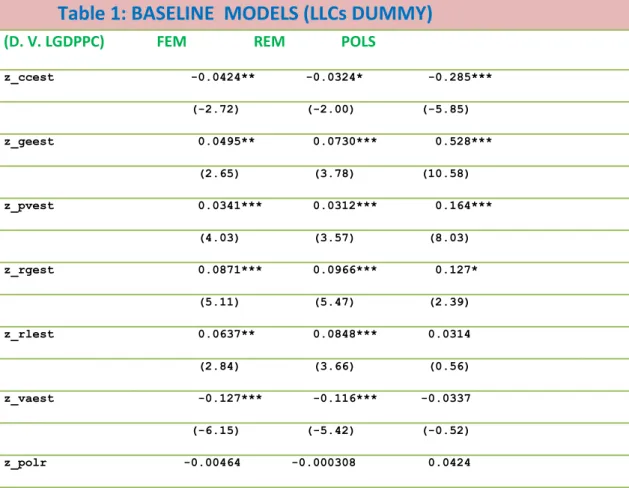
Table 1: BASELINE MODELS (LLCs DUMMY)
(D. V. LGDPPC) FEM REM POLS
Table 1: BASELINE MODELS (LLCs DUMMY)
(D. V. LGDPPC) FEM REM POLSIn OPLS estimations, five explanatory variables ccest, vaest, govs, monf, and invf are indicating direction against the institution theory of relationship with GDPPC (negative relationship) but except the variable monf above all four predictors are consistency in FEM and REM. Similarly, six predictors geest, pvest, corf, fiscf, bisf, and traf are supporting the hypothesis of institution theory. However, comparing two models FEM and REM, nine out of seventeen predictors are indicating institutions matter. Observing the FEM, A one standard deviation increase in independent variables Government Effectiveness Estimates (geest), Political Stability and Absence of Violence Estimates (pvest), Regularity Quality Estimates(rgest), Rule of Law Estimates (rlest), Freedom From Corruption (corf), Fiscal Freedom(fiscf), Business Freedom(bisf), Monetary Freedom(monf) and Trade Freedom(traf), individually, will be predicted to rise 5%, 3%, 9%, 6%, 5%, 5%, 4%, 4% and 7% unit of standard deviation of dependent variable of GDPPC respectively. Interestingly, It has been seen that POLS estimation are quite higher than the coefficients of FEM. Likewise, there is a different condition between landlocked and no landlocked nations in the rise of per capita income (output). Landlocked nations are 35% (POLS) to 46% (REM)5 less
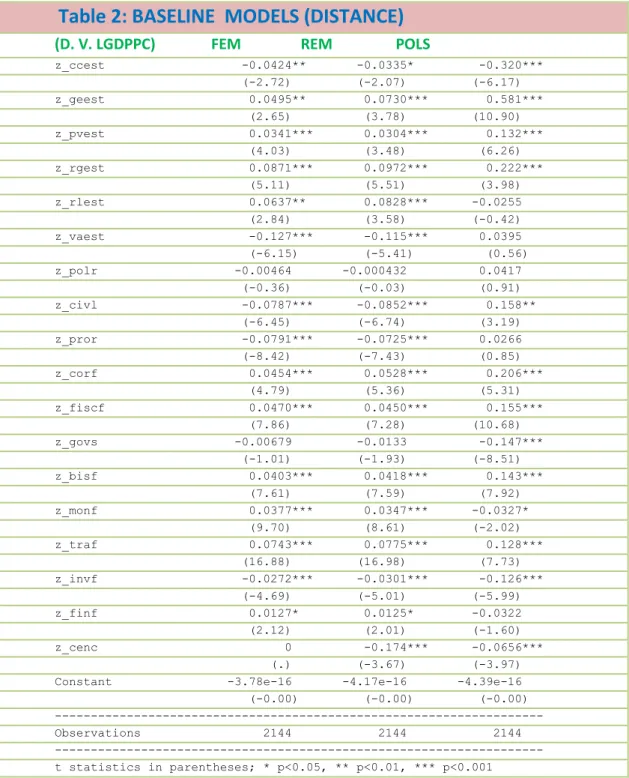
capable of producing per capita income (output) than no landlocked nations. In order to make better prediction, the study has replaced landlocked dummy variable by the proxy distance variable (Distance from center of a country to nearest coast or sea-navigable river (kilometer)) to control the influences of institutions on the output of the countries and comparing the POLS model with FEM and REM again below.
Table 2: BASELINE MODELS (DISTANCE)
(D. V. LGDPPC) FEM REM POLSz_ccest -0.0424** -0.0335* -0.320*** (-2.72) (-2.07) (-6.17) z_geest 0.0495** 0.0730*** 0.581*** (2.65) (3.78) (10.90) z_pvest 0.0341*** 0.0304*** 0.132*** (4.03) (3.48) (6.26) z_rgest 0.0871*** 0.0972*** 0.222*** (5.11) (5.51) (3.98) z_rlest 0.0637** 0.0828*** -0.0255 (2.84) (3.58) (-0.42) z_vaest -0.127*** -0.115*** 0.0395 (-6.15) (-5.41) (0.56) z_polr -0.00464 -0.000432 0.0417 (-0.36) (-0.03) (0.91) z_civl -0.0787*** -0.0852*** 0.158** (-6.45) (-6.74) (3.19) z_pror -0.0791*** -0.0725*** 0.0266 (-8.42) (-7.43) (0.85) z_corf 0.0454*** 0.0528*** 0.206*** (4.79) (5.36) (5.31) z_fiscf 0.0470*** 0.0450*** 0.155*** (7.86) (7.28) (10.68) z_govs -0.00679 -0.0133 -0.147*** (-1.01) (-1.93) (-8.51) z_bisf 0.0403*** 0.0418*** 0.143*** (7.61) (7.59) (7.92) z_monf 0.0377*** 0.0347*** -0.0327* (9.70) (8.61) (-2.02) z_traf 0.0743*** 0.0775*** 0.128*** (16.88) (16.98) (7.73) z_invf -0.0272*** -0.0301*** -0.126*** (-4.69) (-5.01) (-5.99) z_finf 0.0127* 0.0125* -0.0322 (2.12) (2.01) (-1.60) z_cenc 0 -0.174*** -0.0656*** (.) (-3.67) (-3.97) Constant -3.78e-16 -4.17e-16 -4.39e-16 (-0.00) (-0.00) (-0.00) ---Observations 2144 2144 2144 ---t s---ta---tis---tics in paren---theses; * p&l---t;0.05, ** p&l---t;0.01, *** p&l---t;0.001
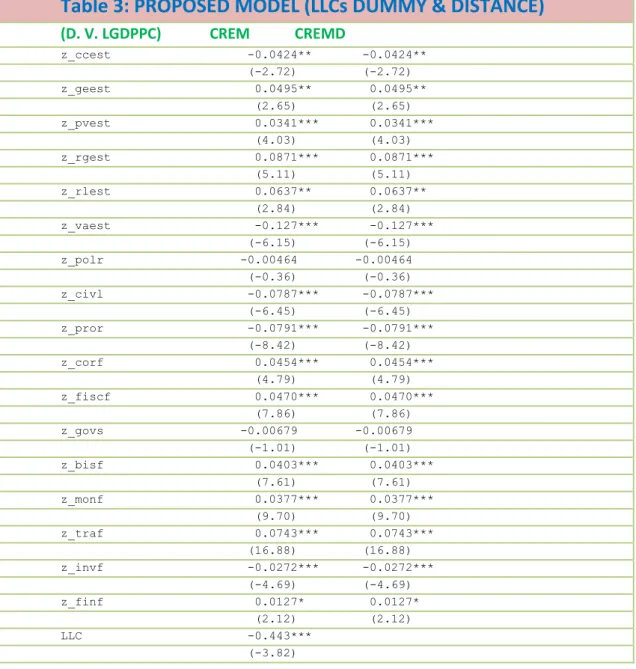
chi2=0.0000) reject the null hypothesis meaning that FEM is again more suitable model over REM. In addition that the influence of distance is 7% (POLS) and 17% (REM). It does not disagree that geographical difficulties matters to the influence of country´s output or per capita income. The estimation is indicating very lower percentage of influence of distance to dependent variable, GDPPC, than dummy landlocked variables. Furthermore, the following table has compared the desired CREM both landlocked dummy variable and proxy distance variable.
Table 3: PROPOSED MODEL (LLCs DUMMY & DISTANCE)
(D. V. LGDPPC) CREM CREMD
z_ccest -0.0424** -0.0424** (-2.72) (-2.72)
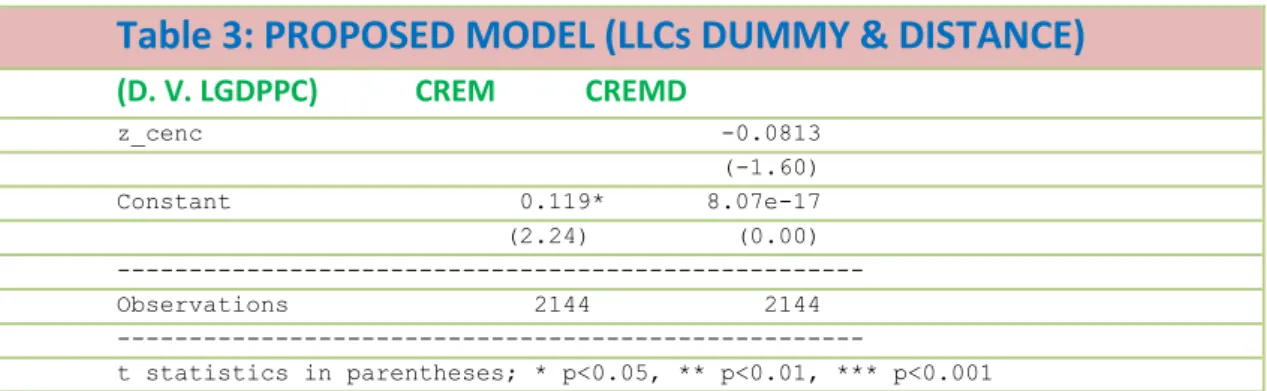
Table 3: PROPOSED MODEL (LLCs DUMMY & DISTANCE)
(D. V. LGDPPC) CREM CREMDz_cenc -0.0813 (-1.60) Constant 0.119* 8.07e-17 (2.24) (0.00) --- Observations 2144 2144 ---
t statistics in parentheses; * p<0.05, ** p<0.01, *** p<0.001
Prediction of the relative effect of institutional variables (both degree and direction) in CREM and FEM are exactly the same. Nine institutional variables are capable of estimating ranges from 3% to 9% of standard deviation on dependent variable GDPPC, while the independent variables are partially rising by one standard deviation. The goodness of this model is that without losing the unbiased estimators as of FEM, it predicts the time invariant variables (landlocked dummy). Therefore, the degree of reduction on GDPPC due to the landlockedness than no landlockedness is approximately 36% which is nearly equal to the value of POLS i. e. 35 % (See table 1) but proxy landlocked (distance) variable is not statistically significant.
SUMMARY AND CONCLUSION
empirical study of Thomas Snow and et. al. (2003), distance does not matter to increase the economic output. However, there is an indication that GDP per capita income is decreased by approximately 7% and 17% in POLS and REM respectively (see table 2).
The result is suggesting that physical geography (landlockedness) is an obstacle which is estimated approximately one third amount for the economic growth and development. It supports to the "geography matters completely hypothesis" of Tinbergen (1962), Sachs (1997) United Nation (1957), Chowdhary and Erdenebileg (2006), and Carcamo-Diaz Rodrigo (2004). Similarly, the trade elasticity due to the distance, Disdier and Head (2009) and Moore, has portrayed higher than 50%. One may argue that landlockedness is a serious cause of poor economic performance outside the Europe but it is equally unanswered why are European landlocked nations rich?
The study has also estimated that institutions are other important factors for economic growth and development. More than 50% (9/17 institutional variables) of the included numbers of predictors such as geest, pvest, rgest, rlest, corf, fiscf, bisf, monf, and traf have exposed the appreciable economic value and desirable direction. And, some five variables cccest, ccest, civl, pror, and invf are statistically significant but the direction is indicating against the institution theory (inverse relationship with growth and development). Similarly, the influence of the institution variables ranges from 3% , political stability and absence of violence estimates (pvest), to 9%, regularity quality estimates (rgest),on GDPPC. Therefore, no one can absolutely disagree that institutions do not matter, but one can argue the partial influences of institutions to GDPPC as of the conclusion of Chang (2006) and Przewoski (2004).
suggested that landlockedness reduces the capacity of growing approximately one third than the costal benefits and the proxy distance variable has not shown any clear influences on economic performances. Similarly, approximately half numbers of included institutional variables are clearly indicating the favor of institution theory. In this situation, It is not an easy job to suggest that geography triumph over institutions or the opposite. However, it can be argued that unless and until landlocked countries improve their geographical and institutional obstacles, there will not have any sign of output or per capita income convergence with the frontier. In order to shift the production possibility curve upward or to increase the per capita income, landlocked nations have to be focused on reducing both of these issues.
REFERENCES
Alberto Ades, and Hak B.Chua . “Thy Neighbor´s Curse: Reasional Instability and Economic Growth.” Journal of Economic Growth (1997): 279-304.
Anderson, James. “Gravity Model.” NEBR Working Paper series 16576 (2010).
Anne-Célia Disdier, Keith Head. “The Puzzling Persistence of the Distance Effect on Bilateral Trade.” 29 de July de 2006. 1-30.
Anwarul K. Chowdhury and Sandagdori Erdenebileg. Geography Against Development. New York: UN-OHRLLS, 2006.
Basu, Sudp Ranjan. “A New Way to Link Development to Institutions, Policies and Geography.” Policy Issues in International Trade and Commodities Study Series No. 37, United Nations Conference on Trade and Development (2008): 1-42.
Bloch and Sam Hak Kan Tang. “Deep Determinants of Economi Growth: Institutions, Geography, and Openness to Trade.” Progress Development Studies (2004): 245-255.
Cárcamo-Díaz, Rodrigo. “Towards Developmnet in Landlocked Economies.” CEPAL, Series (2004): 1-34.
Chang, Ha-Joon. “Understanding the Relationship between Institutions and Economic Development.” Discussion Paper No. 2006/05 (2006).
Charles I. Jones and Paul Romer. “The New Kaldor Facts: Ideas, Institutions, Population, and Human Capital.” American Economic Journal (2010): 224-245.
Collier, Paul. The Bottom of Billion:Why the Poorest Countries are Failing and What can be done about It. Oxford University Press, 2007.
D. C., North. “The Role of Institutions in Economic Development.” Discussion Paper Series, No.2003.2 (2003).
Dani Rodrik, Arvind Subramanian, and Francesco Trebbi. “Institution Rule: The Primacy of Institutions over Geography and Integration in Economic Development.” Harvard-MIT Development Seminar and Hardvard Econometrics Workshops. 2002.
Dani, Rodrik. “Institutions for High-Quality Growth:What They are and How to Acquire them.”
NBER Working Paper Series 7540 (2000): 1-48.
—. “Second Best Institutiion.” NEBER Working Paper Series, No. 14050 (2008).
Daniel Kaufmann, Aart Kraay and Pablo Zoido-Labatón. “Governance Matters.” Policy Research Working Paper (1999).
Daron Acemoglu, and J. Robinson. “The Role of Institutions in Growth and Development.”
Daron Acemoglu, Simon Johnson, James A. Robinson. “Reversal of Fortune: Geography and Institutions in the Making of the Modern World income Dristribution.” The Quaterly Journal of Economics, vol.117,no.4 (2002): 1231-1294.
Daron, Acemoglu; Johnson; and James A., Robinson. “Institution as a Fundamental Cause of Long Run Growth.” Philippe, Aghion and N. Durlauf and Steven. Handbook of Economic Growth. Elsevier, 2005. Vol. 1A .
Gallup John Luke, Sachs Jeffery D. and Mellinger Andrew D. “Geography and Economic Development.” NBER Working Paper, NO. 6849, JEL NO. 011, 013,057,R11 (1998). Grigoriou, Christopher. “Landlockedness, Infrastructure and Trade: New Estimates for Central
Asian Countries.” Policy Research Working Paper, World Bank, 4335 (2007): 1-42. Holodny, Elena. “The Fastest Growing Economies in the World.” 2015.
International Precise Consult (PIC). “Ethiopia: World´s Third Fastest Growing Economy.” The African Executive (2015).
www.africanexecutive.com/modules/magazine/article_print.php?article=6489 . Jeffery Sachs and Andrew Warner. “Economic Convergence and Economic Policies .” CASE,
Center for Social and Economic Research (1995): 1-30.
Jeffrey Sachs, and Andrew M.Warner. “Sources of Slow Growth in African Economics.” Journal of African Economics, Vol. 6,No.3, (1997): 335-376.
Jones, Charles I. The Facts of Economic Growth. Paper for a New Volume of the Handbook of Macroeconomics , 2015.
KPMG, Institute. “Africa´s Top 10 Fastest Growing Economies .” 2014.
North, D.C. “Institutions.” Vol. 5, No.1, pp.97-112 (1991).
Nuno Limão and Anthony J.Venables,. “Infrastructure, Geographical Disadvantage, Transport Costs, and Trade.” The World Bank Economic Review, Vol. 15, No.3 (2001): 451-479. Nurkse, Ragnar. “Problems of Capital Formation in Underdeveloped Countries.” (1961): 17-20.
Przewoski, Adam. “Institution Matters?” Leonard Schapiro Lecture. England: The British Political Science Association, Lincoln, 2004.
Robert E. Hall, and Charles I. Jones. “Why do Some Countries Produce so much more Output Per Worker than Others?” NEBR, Jel Code: E23, 047 (1998).
Sala-i-Martin, Xavier. “15 Years of New Growth Economics: What Have We Learnt .” Central Bank of Chile Working Papers, No.:172 (2002).
Thomas Snow, Michael Faye, John McArthur and Jeffery Sachs. “Country Case Studies on The Challenges Facing Landlocked Developing Countries.” Occasional Paper, Backgrowund Paper of Human Development Report Office. 2003.
“UN Conference on the Law of Sea.” Preparatory Document NO. 23, A/CONF.13/29 and Add.1. Geneva, Switzerland: United Nations, 1957. 306-335.
United, Nation. “Almaty Programme of Action: Addressing the Sepecial Needs of Landlocked Developing Countries Within a New Global Framework for Transit Transport
Cooperation for Landlocked and Transit Developing Countries.” A/Conf 202/3, Annex I. 2003.
UN-OHRLLS, United Nations Office of the High Representative for the Least Developed Countries, Landlocked Developing Countries and Small Island Developing States. The Development Economics of Landlockedness:Understanding the Development Costs of being Landlocked. New York, NY 10017, USA: UN-OHRLLS, 2013.
William Easterly and Ross Levine. “Tropics, Germs, and Crops: How Endowments Influence Economic Development.” NEBR Working Paper 9106, Cambridge, MA 02138 (2002). Williams, Richard. “Fixed Effect vs Random Effects Models.” (2016): www3.nd.edu/~rwilliam/.
Appendix-A
Hausman Test Result (1)
. hausman FIXED_Eff RANDOM_Eff,sigmamore ---- Coefficients ----
| (b) (B) (b-B) sqrt(diag(V_b-V_B)) | FIXED_Eff RANDOM_Eff Difference S.E.
---+--- z_ccest | -.0424249 -.0323681 -.0100568 .0017503 z_geest | .0495251 .0730147 -.0234895 .0023516 z_pvest | .034077 .0312424 .0028347 .001087 z_rgest | .0871351 .0966365 -.0095014 .0018643 z_rlest | .0636781 .0847806 -.0211026 .0030006 z_vaest | -.127122 -.1156974 -.0114246 .0027538 z_polr | -.0046353 -.0003079 -.0043273 .0009444 z_civl | -.0787231 -.0857969 .0070738 .0013761 z_pror | -.0791307 -.0718681 -.0072626 .0008227 z_corf | .0453865 .0528909 -.0075044 .0008412 z_fiscf | .0469704 .0448243 .0021461 .0007114 z_govs | -.0067854 -.0144021 .0076167 .0008571 z_bisf | .0403236 .0418018 -.0014782 .0002873 z_monf | .0377444 .0345035 .0032409 .0003196 z_traf | .0743251 .078017 -.0036919 .000373 z_invf | -.0271653 -.0302565 .0030913 .0004028 z_finf | .0126788 .0127278 -.000049 .0003823 --- b = consistent under Ho and Ha; obtained from xtreg B = inconsistent under Ha, efficient under Ho; obtained from xtreg Test: Ho: difference in coefficients not systematic
chi2(17) = (b-B)'[(V_b-V_B)^(-1)](b-B) = 183.59
Hausman Test Result (2)
. hausman FIXED_EffD RANDOM_EffD,sigmamore ---- Coefficients ----
| (b) (B) (b-B) sqrt(diag(V_b-V_B)) | FIXED_EffD RANDOM_EffD Difference S.E.
---+--- z_ccest | -.0424249 -.0334828 -.0089421 .0016614 z_geest | .0495251 .0730474 -.0235223 .0022897 z_pvest | .034077 .0304057 .0036713 .0010603 z_rgest | .0871351 .0972298 -.0100946 .001802 z_rlest | .0636781 .0827712 -.0190932 .0028461 z_vaest | -.127122 -.1153023 -.0118197 .0026249 z_polr | -.0046353 -.0004321 -.0042032 .0008987 z_civl | -.0787231 -.0851667 .0064436 .0012841 z_pror | -.0791307 -.0724534 -.0066773 .0007832 z_corf | .0453865 .0527533 -.0073668 .0008101 z_fiscf | .0469704 .0450392 .0019311 .0006753 z_govs | -.0067854 -.0133075 .0065221 .0008022 z_bisf | .0403236 .0417606 -.0014371 .000274 z_monf | .0377444 .0347474 .002997 .0003038 z_traf | .0743251 .0775272 -.0032021 .0003532 z_invf | -.0271653 -.0301494 .0029841 .0003839 z_finf | .0126788 .0124768 .000202 .0003654 --- b = consistent under Ho and Ha; obtained from xtreg B = inconsistent under Ha, efficient under Ho; obtained from xtreg
Test: Ho: difference in coefficients not systematic chi2(17) = (b-B)'[(V_b-V_B)^(-1)](b-B) = 178.10
Appendix-B
Dependent Variable z_lgdppc
--- Fixed Effect Random Eff~t CORR_Rando~t --- z_ccest -0.0424** -0.0330* -0.0424** (-2.72) (-2.04) (-2.72)
z_geest 0.0495** 0.0742*** 0.0495** (2.65) (3.83) (2.65)
z_pvest 0.0341*** 0.0300*** 0.0341*** (4.03) (3.43) (4.03)
z_rgest 0.0871*** 0.0984*** 0.0871*** (5.11) (5.56) (5.11)
z_rlest 0.0637** 0.0838*** 0.0637** (2.84) (3.62) (2.84)
z_vaest -0.127*** -0.113*** -0.127*** (-6.15) (-5.29) (-6.15)
z_polr -0.00464 -0.000615 -0.00464 (-0.36) (-0.05) (-0.36)
z_civl -0.0787*** -0.0864*** -0.0787*** (-6.45) (-6.83) (-6.45)
(-8.42) (-7.39) (-8.42)
z_corf 0.0454*** 0.0531*** 0.0454*** (4.79) (5.39) (4.79)
z_fiscf 0.0470*** 0.0448*** 0.0470*** (7.86) (7.23) (7.86)
z_govs -0.00679 -0.0138* -0.00679 (-1.01) (-2.00) (-1.01)
z_bisf 0.0403*** 0.0418*** 0.0403*** (7.61) (7.57) (7.61)
z_monf 0.0377*** 0.0346*** 0.0377*** (9.70) (8.56) (9.70)
z_traf 0.0743*** 0.0777*** 0.0743*** (16.88) (16.97) (16.88)
z_invf -0.0272*** -0.0301*** -0.0272*** (-4.69) (-4.99) (-4.69)
Appendix-C
Data Using Only for WGI
Dependent Variable z_lgdppc
--- Fixed Effect Random Eff~t CORR_Rando~t --- z_ccest -0.114*** -0.102*** -0.114*** (-5.72) (-5.04) (-5.72)
z_geest 0.102*** 0.129*** 0.102*** (4.27) (5.31) (4.27)
z_pvest 0.0260* 0.0228* 0.0260* (2.39) (2.06) (2.39)
z_rgest 0.138*** 0.150*** 0.138*** (6.86) (7.32) (6.86)
z_rlest 0.111*** 0.144*** 0.111*** (4.00) (5.12) (4.00)
z_vaest -0.0931*** -0.0758*** -0.0931*** (-4.64) (-3.78) (-4.64)
Data Using Only for HF
Dependent Variable z_lgdppc
--- Fixed Effect Random Eff~t CORR_Rando~t --- z_pror -0.0732*** -0.0598*** -0.0732*** (-7.70) (-6.04) (-7.70)
z_corf 0.0568*** 0.0730*** 0.0568*** (5.87) (7.25) (5.87)
z_fiscf 0.0578*** 0.0542*** 0.0578*** (9.50) (8.55) (9.50)
z_govs -0.00549 -0.0149* -0.00549 (-0.79) (-2.07) (-0.79)
z_bisf 0.0458*** 0.0500*** 0.0458*** (8.47) (8.84) (8.47)
z_monf 0.0475*** 0.0477*** 0.0475*** (12.14) (11.63) (12.14)
z_traf 0.0785*** 0.0839*** 0.0785*** (17.34) (17.76) (17.34)
z_invf -0.0129* -0.0128* -0.0129* (-2.27) (-2.15) (-2.27)
Dummy variable lan.. 0 -0.683*** -0.468***
(.) (-6.32) (-4.18)
Data Using Only for FH
Dependent Variable z_lgdppc
--- Fixed Effect Random Eff~t CORR_Rando~t --- z_polr 0.0775*** 0.0730*** 0.0775*** (5.73) (5.39) (5.73)
z_civl -0.192*** -0.200*** -0.192*** (-13.01) (-13.61) (-13.01)
Dummy variable lan.. 0 -0.685*** -0.528**