António Afonso, Luís Martins
M
onetary
D
evelopments and
E
xpansionary
F
iscal
C
onsolidations
: E
vidence from the
EMU
WP12/2014/DE/UECE
_________________________________________________________
De pa rtme nt o f Ec o no mic s
W
ORKINGP
APERS
1
M
ONETARY
D
EVELOPMENTS AND
E
XPANSIONARY
F
ISCAL
C
ONSOLIDATIONS
:
E
VIDENCE FROM THE
EMU
*
António Afonso
$, Luís Martins
#June 2014
Abstract
This paper provides new insights about the existence of expansionary fiscal consolidations in the Economic and Monetary Union, using annual panel data for 14 European Union countries over the period 1970-2012. Different measures for assessing fiscal consolidations based on the changes in the cyclically adjusted primary balance were calculated. A similar ad-hoc
approach was used to compute monetary expansions, in order to include them in the assessment of non-Keynesian effects for different budgetary components. Panel Fixed Effects estimations for private consumption show that, in some cases, when fiscal consolidations are coupled with monetary expansions, the traditional Keynesian signals are reversed in the cases of general government final consumption expenditure, social transfers and taxes. Keynesian effects prevail when fiscal consolidations are not matched by monetary easing. Panel probit estimations suggest that longer and expenditure-based consolidations contribute positively for its success, whilst the opposite is the case for tax-based ones.
Keywords: fiscal consolidation, monetary expansion non-Keynesian effects, panel data, probit JEL: C23, E21, E5, E62, H5, H62
* The opinions expressed herein are those of the authors and do not necessarily reflect those of the ECB, or the Eurosystem.
$ ISEG/ULisboa –Universidade de Lisboa, Department of Economics; UECE – Research Unit on Complexity and Economics, R. Miguel Lupi 20, 1249-078 Lisbon, Portugal, email: [email protected]. UECE is supported by the Fundacão para a Ciência e a Tecnologia (Portuguese Foundation for Science and Technology) through the PEst-OE/EGE/UI0436/2011 project, European Central Bank, Directorate General Economics, Kaiserstraße 29, D-60311 Frankfurt am Main, Germany.
2
1. Introduction
Keynesian theory gives us some insights into the expected effect of government
budgetary components’ changes on income. It postulates that an increase in government
spending should stimulate the economy, via the multiplier mechanism, thus increasing disposable income and private consumption. Based on this reasoning, an increase in taxation should lead to a decrease in private consumption.
Nevertheless, since the early 90’s, having studied the case studies of Denmark and
Ireland1, some literature has been discussing the possible non-Keynesian effects of fiscal policy, especially during fiscal consolidation periods.
The theoretical underpinnings stemmed from the German Council of Economic experts in their reports of 1981 and 1982, and are referred to as the “expectational view of
fiscal policy”.2
Arguably, the standard Keynesian relationship between private consumption and government budgetary components may be reversed under certain circumstances. A deterioration of the fiscal position today (resulting in a budget deficit), may lead to an increase in taxation in the future, in order to comply with the government budget constraint,
therefore reducing agents’ permanent income. If such expectations are accepted by
individuals, then this could lead to a decrease in private consumption today. The reverse reasoning is the case for fiscal consolidation, whereby an improvement in the fiscal position may lead to an increase in private consumption today. Some empirical research presents evidence that supports this view.3
The expectational view of fiscal policy relies on the assumption of Ricardian households, which have a smoothing effect on consumption and do not have liquidity constraints. This motivates a thorough assessment of monetary developments when expansionary fiscal consolidations are being studied. Moreover, according to the Keynesian view, under the IS-LM framework, a fiscal consolidation may lead to an increase in private consumption, if it is accompanied by a strong enough monetary expansion that offsets the detrimental effects of fiscal policy developments on disposable income and private consumption.
1 See Giavazzi & Pagano (1990). 2 See Hellwig & Newmann (1987).
3
3
Arguably, while neglecting the monetary policy stance, one could find themselves in a
situation described by Ardagna (2004): “In this case, the coefficients of fiscal policy variables
can be biased, capturing the effect of monetary, rather than fiscal policy”.
The importance of this issue within the Economic and Monetary Union (EMU) context is fairly obvious, since the expectational view of fiscal policy was to some extent reflected in the fiscal convergence criteria of the Maastricht Treaty. Additionally, the monetary policy
stance is outside the national governments’ sphere of influence.
This paper contributes to existing literature by providing some new insights about the importance of the monetary stance for the relationship between fiscal developments and private consumption during fiscal consolidation periods. It does so by notably expanding
Afonso’s (2006, 2010) and Afonso & Jalles’s (2014) core specification, in order to take into
account monetary policy developments. We conduct an assessment of the fiscal episodes, using the same criteria. However, and in addition, we also identify monetary episodes for 14 European Union countries from 1970 to 2012, and study their relationship with fiscal developments.
The paper is organised as follows. Section two presents the review of the main related literature. Section three presents an identification of the fiscal and monetary episodes and their respective relationship. In section four, we conduct an empirical analysis of expansionary fiscal consolidations for the EMU, resorting to panel estimations, taking into account the developments of monetary policy, followed by a discussion of the results. We also assess, relying on a probit estimation, the factors that may impinge on the success of the fiscal consolidations, namely expenditure based versus revenue based consolidations, using the fiscal and monetary episodes identified in the earlier sections. Section five concludes with some final remarks and points out some possible subjects for future research on this topic.
2. Literature
Hellwig & Neumann (1987) were pioneers with regard to the postulation of the expansionary fiscal consolidation hypothesis. They argue that fiscal consolidation in Germany
in the 1980’s under Chancellor Kohl had such a positive impact on private sector confidence
4
Giavazzi & Pagano (1990) test this hypothesis for Denmark and Ireland for the mid and late 1980's, respectively. For Denmark, they report that the thriving consumption experienced in 1983-1986 cannot be explained by the decline in interest rates alone, and that such an occurrence is related to fiscal consolidation through the increase in revenue from income taxation and the decrease in public investment. Regarding the Irish case, the fast growth of consumption during the second stabilization was due to the government’s focus on decreasing spending, instead of increasing taxation, and also due to the liberalisation of the credit markets. In these cases, as a whole, expansionary fiscal consolidation is linked to an adjustment on the side of public spending, rather than on revenues, although in Denmark, the adjustment was through investment spending and in Ireland, it was through current spending.
Alesina & Ardagna (1998) investigate the expansionary fiscal consolidation possibility, using an analysis of OECD countries from 1960 to 1994. According to the
General Council of Economic Experts’ expectational view of fiscal policy addressed in
Hellwig and Neumann (1987), fiscal adjustments that occur when the debt level is high, or growing rapidly, should be expansionary, whereas others should not. Nevertheless the authors
don’t find evidence that confirms this view. On the other hand, they found strong evidence of
the effect of the composition of the adjustment in the outcome of fiscal consolidation: all of the non-expansionary adjustments were tax-based and all of the expansionary ones were based on expenditure cuts. Expenditure adjustments that were accompanied by wage moderation and by nominal exchange rate devaluation, turned out to be expansionary.
Perroti (1999) addresses the same issue for nineteen OECD countries from 1965 to 1994, and, according to his findings, substantial deficit cuts can lead to booms in private consumption. The likelihood of an expansionary fiscal consolidation increases in times of
“fiscal stress”, which the author defines as periods of high debt-to-GDP ratio or following
periods of exceptionally high debt-accumulation rates. His findings differ for other periods, as
in “normal” times, the Keynesian effects of fiscal consolidation on private consumption
predominate (either through spending cuts, or tax increases).
5
effects occur not only during periods of fiscal contractions, but also during fiscal expansions, and when countries are accumulating debt rapidly, regardless of its level.
Using panel data from OECD countries from 1970 to 2002, Ardagna (2004) investigates the effect of fiscal consolidations on debt-to-GDP ratio and GDP growth. Regarding debt-to-GDP ratio, the success of fiscal consolidation depends more on the size of the adjustment, rather than its composition. On the other hand, the likelihood of fiscal consolidation being expansionary, increases when it is based on public spending cuts, rather than on increased taxation. Concerning the role of monetary policy, there was evidence that neither successful (leading to decrease in debt-to-GDP ratio), or expansionary (leading to increase in GDP growth) consolidations, need to be met by expansionary monetary policies, nor by exchange rate devaluations.
Giudice et al. (2004) address the matter of non-Keynesian effects in fourteen European Union countries, in an ex-post and ex-ante analysis. Ex-post analysis consisted on studying the period from 1970 to 2002 to see whether fiscal consolidation episodes were followed by an increase in GDP growth. Results show that this occurred in about half the cases. The ex-ante analysis carried out was based on simulations by the European Commission QUEST model and suggested that short-term non-Keynesian effects can occur, if consolidation is mainly on the spending side. The latter is also true in the ex-post case, which is in line with most empirical studies.
Afonso (2006, 2010) conducted a panel analysis for 15 EU countries from 1970 to 2005, having found some evidence of non-Keynesian effects in private consumption for some government spending items, namely final consumption and social transfers. Results show that a decrease in government consumption leads to an increase in private consumption in the long run, and the magnitude of this effect is higher when a fiscal consolidation episode occurs.
Devries et al. (2011) construct a database for fiscal consolidation measures taken by 17 OECD countries from 1978 to 2009, based on the premise that computing fiscal consolidations from changes of the cyclically adjusted primary balance may be problematic. Arguably, such an approach may be biased, in the sense that it may capture changes that are not related to policy actions due to its inability to remove sharp fluctuations in economic activity. Therefore, they identify fiscal consolidations through an historical approach, based on policy documents. This database has been widely used in subsequent literature that concerns expansionary fiscal consolidations.4
6
Erceg & Lindé (2012) use a New Keynesian DSGE model to assess the differences of fiscal consolidation effects in an open economy for countries with an independent monetary policy vis-à-vis a currency union. If inflation is fairly sensitive to the output gap the output contracts more deeply in countries with an independent monetary policy. On the other hand, for a flatter Phillips Curve, the output contraction tends to be smaller in the independent monetary policy case, reflecting a real exchange rate depreciation even if the monetary policy is constrained by the zero lower bound.
Afonso & Jalles (2012) analyse a panel of OECD countries from 1970 to 2010, to assess whether the composition and duration of fiscal consolidations contribute to their success. Consolidation episodes lead to a decrease in debt ratios, only if they are accompanied by strong economic growth and an increased output gap. Increased duration contributes to the success of the fiscal consolidation episode. Fiscal consolidation success depends on the composition of the adjustment: consolidations based mainly on tax increases, contribute negatively to its success.
Alesina & Ardagna (2013) use a Devries et al. (2011) policy action-based approach to identify the fiscal episodes for 21 OECD countries from 1970 to 2010. They conclude that expenditure based adjustments are more likely to be successful and expansionary. Monetary policy is not significant for explaining the differences between expenditure-based and tax-based adjustments.
On the other hand, Erceg & Lindé (2013) conducted an assessment based on a two country DSGE model and their findings favour tax-based consolidations within a currency union, since those have smaller adverse effects on output than the expenditure-based ones, at least in the term. Expenditure-based consolidations seem counterproductive in the short-term if the monetary policy is near the zero lower bound.
To sum up, most of the research seems to support, or at least not to reject, the idea of expansionary fiscal episodes.5 Also, some findings6 suggest that expansionary and successful fiscal episodes are more likely when there is consolidation on the spending side.
Moreover, some of the literature, such as Perroti (1999) and Giavazzi et al. (2000) propose that non-Keynesian effects are more likely to, or only occur, during periods of high debt-to-GDP ratio or when debt is accumulating quickly.
5 As seen in Giavazzi & Pagano (1990), Alesina & Ardagna (1998), Perroti (1999), Giavazzi et al. (2000), van Aarle & Garretsen (2003), Ardagna (2004), Giudice et al. (2004) and Afonso (2006, 2010).
7
3. Identification of fiscal and monetary episodes in the EMU
3.1. Fiscal Episodes
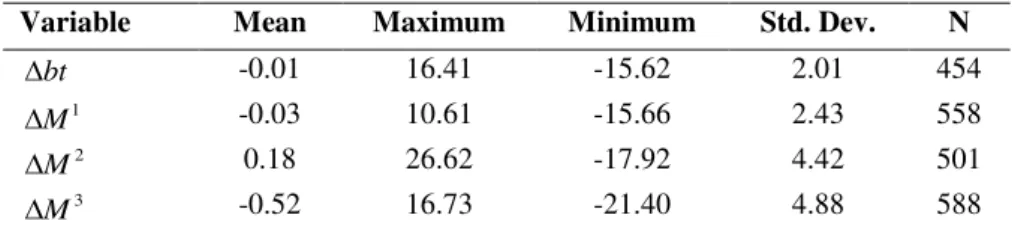
Most of the empirical literature relies on the change in the cyclically adjusted primary balance (CAPB) as a percentage of GDP, as measure of governments’ structural budget balance. It extracts those elements of the primary balance that are due to the business cycle, from the total balance, in order to obtain an indicator that has been corrected for the effects of changes in economic activity, and that thus reflects the discretionary part of the fiscal policy. Table XI in the Appendix shows some descriptive statistics of this indicator.
One can assess the existence of fiscal episodes – either contractions or expansions – by studying the behaviour of this indicator over time. In Giavazzi & Pagano (1996), a fiscal episode occurs when the cumulative change in the cyclically adjusted primary balance is at least 5, 4, or 3 percentage points of GDP in 4, 3 or 2 years respectively, or 3 percentage points in one year. Alesina & Ardagna (1998) identify the periods of occurrence of fiscal episodes by looking for the periods when the change in the cyclically adjusted primary balance was greater than 2 percentage points in one year, or at least 1.5 percentage points of GDP on average in the last two years. Afonso’s (2006, 2010) assessment of fiscal episodes relies on a different method: a fiscal episode occurs when the change in the cyclically adjusted primary balance is greater than 1.5 times the panel standard deviation of this indicator, or when the average absolute change in the last two years is greater than the standard deviation of the full panel. Table I shows the fiscal expansions and contractions according to the different criteria.7
The measures used by Giavazzi & Pagano (1996), Alesina & Ardagna (1998) and Afonso (2006, 2010), were labelled respectively as 1
FE , 2
FE and 3
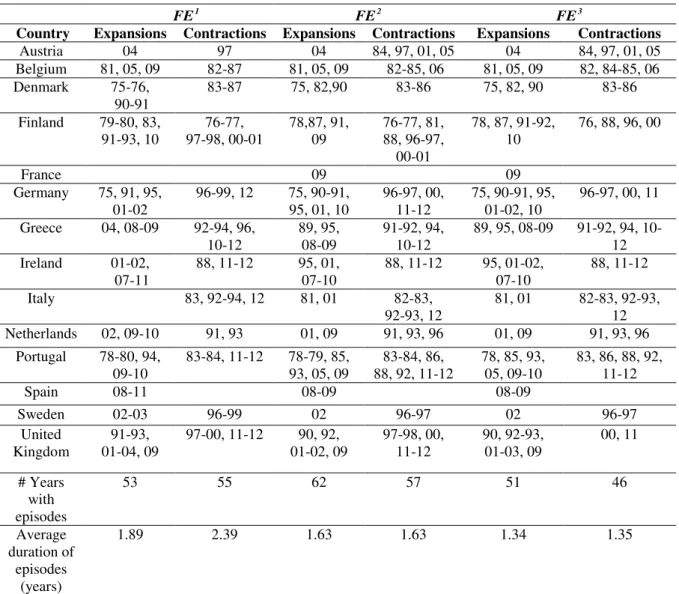
FE . Overall, there is a considerable overlapping of episodes according to the different criteria:- there is a coincidence of 82 and 63 percent between fiscal episodes 1 and 2 and 1 and 3, respectively and 82 percent between criteria 2 and 3 (see Table I). The highest number of episodes is given by the criteria used by Alesina & Ardagna (1998), although the methodology followed by Giavazzi & Pagano (1996) leads to higher duration in both expansions and contractions.
All the criteria reflect the cases studied by Giavazzi and Pagano (1990), as fiscal contractions in Denmark in 1983-86 and in Ireland in 1988 were identified. Also, there is a clear identification of fiscal expansions in 2009 across the EMU countries, which followed the European Commission policy recommendations after the 2007-08 financial crisis. Furthermore, the different methodologies also identify the consolidation efforts made by those
8
countries that were subject to financial assistance in 2011-2012, namely Ireland, Greece and Portugal.
Table I - Identification of fiscal episodes according to different criteria
(1970-2012)
1
FE 2
FE 3
FE
Country Expansions Contractions Expansions Contractions Expansions Contractions
Austria 04 97 04 84, 97, 01, 05 04 84, 97, 01, 05 Belgium 81, 05, 09 82-87 81, 05, 09 82-85, 06 81, 05, 09 82, 84-85, 06 Denmark 75-76,
90-91
83-87 75, 82,90 83-86 75, 82, 90 83-86
Finland 79-80, 83, 91-93, 10
76-77, 97-98, 00-01
78,87, 91, 09
76-77, 81, 88, 96-97,
00-01
78, 87, 91-92, 10
76, 88, 96, 00
France 09 09
Germany 75, 91, 95, 01-02
96-99, 12 75, 90-91, 95, 01, 10
96-97, 00, 11-12
75, 90-91, 95, 01-02, 10
96-97, 00, 11
Greece 04, 08-09 92-94, 96, 10-12
89, 95, 08-09
91-92, 94, 10-12
89, 95, 08-09 91-92, 94, 10-12 Ireland 01-02,
07-11
88, 11-12 95, 01, 07-10
88, 11-12 95, 01-02, 07-10
88, 11-12
Italy 83, 92-94, 12 81, 01 82-83, 92-93, 12
81, 01 82-83, 92-93, 12 Netherlands 02, 09-10 91, 93 01, 09 91, 93, 96 01, 09 91, 93, 96
Portugal 78-80, 94, 09-10
83-84, 11-12 78-79, 85, 93, 05, 09
83-84, 86, 88, 92, 11-12
78, 85, 93, 05, 09-10
83, 86, 88, 92, 11-12
Spain 08-11 08-09 08-09
Sweden 02-03 96-99 02 96-97 02 96-97
United Kingdom
91-93, 01-04, 09
97-00, 11-12 90, 92, 01-02, 09
97-98, 00, 11-12
90, 92-93, 01-03, 09
00, 11
# Years with episodes
53 55 62 57 51 46
Average duration of
episodes (years)
1.89 2.39 1.63 1.63 1.34 1.35
Recent studies, such as Afonso & Jalles (2012) and Alesina & Ardagna (2013), also include a criterion for identifying fiscal consolidations referred to as IMF’s “Action Based
Approach”, which was computed by Devries et al. (2011). It identifies fiscal consolidations
based, not on the changes in CAPB, but on an historical approach through the analysis of policy documents. Arguably CAPB-based fiscal consolidations may be biased, in the sense that they may capture changes that are not related to policy actions due to their inability to remove sharp fluctuations in economic activity. Unfortunately, the database is still not
up-to-Source: Author’s computations. Notes: 1
FE - Measure based on Giavazzi & Pagano (1996); 2
FE - Measure based on Alesina & Ardagna (1998); 3
9
date so we would have to discard the most recent years (2010-2012) in order to use that approach. Therefore, we will not include it at this point, but we intend to do so in future research.
3.2. Monetary episodes
One of the main points in this paper is the study of the coupling of fiscal and monetary policy, in order to assess whether monetary expansions have an impact on the relationship between government budgetary components and private consumption during fiscal consolidation episodes. Therefore, it is crucial to establish a clear identification of the monetary episodes in the EMU countries. We chose three indicators that could be used as a measure of the monetary stance for the different countries, namely: the real short term money market interest rate, and the nominal and real effective exchange rates.
The change in the real short term interest rate is a widely used measure of monetary policy easing or tightening8, as it accounts not only for money market rates, but also for price developments. Therefore, a negative variation in this indicator signals a real monetary easing, rather than a nominal one.9
Both the nominal and the real effective exchange rate assess the currency value in a country vis-à-vis a weighted average of other selected countries’ currencies, which is commonly used to assess a country’s competitiveness. The nominal effective exchange rate has been used by Ardagna (2004) as an indicator of the monetary stance. A negative change in this indicator corresponds to currency depreciation and therefore monetary expansion. We also included the real effective exchange rate, with the purpose of accounting for possible differences in monetary episodes-identification due to price developments, which links to the arguments presented about the interest rates case.
In order to define monetary episodes, we relied on a similar strategy as Afonso (2006, 2010) and identified an episode when the absolute change in one year, or the average change in two years, in the different indicators was greater than 1.5 times, or 1 times the panel standard deviation respectively:
8 See, for instance, Afonso & Sousa (2011).
10
1
1, 1,5
1, 1, 2,3
2 0,
l l
t
l l
l t t l
t
if M
M M
ME if l
otherwise
. (1)
l t
ME denotes a monetary episode in period t, according to criterion l and l t
M
corresponds to the change of indicator l in period t. For real short term interest rate, we have an absolute change, whilst for the nominal and real effective exchange rates, we used the percentage change of the respective indexes. stands for the panel standard deviation of the relevant indicator.
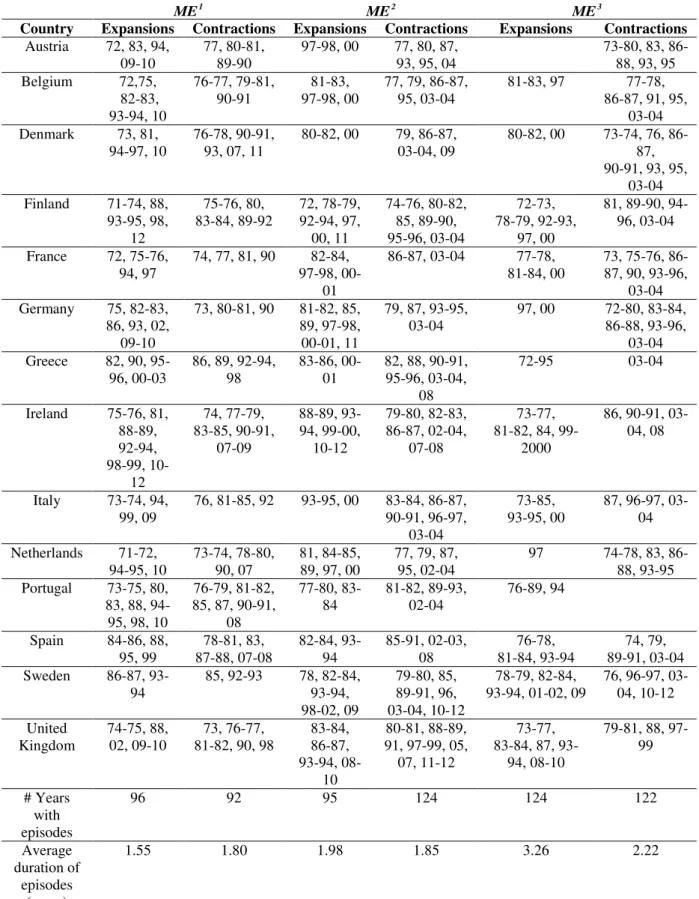
Table II shows the monetary episodes identified according to the different indicators.
1
ME , 2
ME and 3
ME correspond to the use of the methodology across the changes in the real short term interest rate, and the percent changes in the real and nominal effective exchange rate, respectively.
One of the main findings, is that there are considerably more monetary episodes than fiscal ones. The duration of monetary episodes also changes significantly across the different criteria. If we look at the monetary episodes based on the change in the real short term interest rate (ME1), it is possible to see that the expansions and contractions last 1.5 and 1.8 years on average, respectively. If we consider the changes in the nominal effective exchange rates, then the duration of expansions more than doubles, and in the case of contractions, it also increases significantly.
Moreover, while in the case of fiscal episodes, there is significant overlapping across the different criteria, in this case it is much lower, with the matching being only 38, 51 and 63 percent between ME1 and ME2, ME1 and ME3 and ME2 and ME3, respectively. The splitting between expansions and contractions is fairly even, with the exception of 3
ME ,
which registered considerably more contractions than expansions. Also, we can see that there are episodes labelled as expansions in 1
ME that show up as contractions in 2
ME and 3
ME ,
which further motivates the inclusion and analysis of all the different criteria.10
The descriptive statistics of the indicators used to identify both fiscal and monetary episodes can be consulted in table XI in the Appendix.
10 For instance, in Austria, monetary expansion in 1983 expansion is shown according toME1, but it shows up as
a contraction in 3
11
Table II – Identification of monetary episodes according to different criteria
(1970-2012)
1
ME 2
ME 3
ME
Country Expansions Contractions Expansions Contractions Expansions Contractions
Austria 72, 83, 94, 09-10
77, 80-81, 89-90
97-98, 00 77, 80, 87, 93, 95, 04
73-80, 83, 86-88, 93, 95 Belgium 72,75,
82-83, 93-94, 10 76-77, 79-81, 90-91 81-83, 97-98, 00
77, 79, 86-87, 95, 03-04
81-83, 97 77-78, 86-87, 91, 95,
03-04 Denmark 73, 81,
94-97, 10
76-78, 90-91, 93, 07, 11
80-82, 00 79, 86-87, 03-04, 09
80-82, 00 73-74, 76, 86-87, 90-91, 93, 95,
03-04 Finland 71-74, 88,
93-95, 98, 12 75-76, 80, 83-84, 89-92 72, 78-79, 92-94, 97, 00, 11 74-76, 80-82, 85, 89-90, 95-96, 03-04 72-73, 78-79, 92-93, 97, 00
81, 89-90, 94-96, 03-04
France 72, 75-76, 94, 97
74, 77, 81, 90 82-84, 97-98,
00-01
86-87, 03-04 77-78, 81-84, 00
73, 75-76, 86-87, 90, 93-96,
03-04 Germany 75, 82-83,
86, 93, 02, 09-10
73, 80-81, 90 81-82, 85, 89, 97-98, 00-01, 11
79, 87, 93-95, 03-04
97, 00 72-80, 83-84, 86-88, 93-96,
03-04 Greece 82, 90,
95-96, 00-03
86, 89, 92-94, 98
83-86, 00-01
82, 88, 90-91, 95-96, 03-04,
08
72-95 03-04
Ireland 75-76, 81, 88-89, 92-94, 98-99, 10-12 74, 77-79, 83-85, 90-91, 07-09 88-89, 93-94, 99-00, 10-12 79-80, 82-83, 86-87, 02-04, 07-08 73-77, 81-82, 84,
99-2000
86, 90-91, 03-04, 08
Italy 73-74, 94, 99, 09
76, 81-85, 92 93-95, 00 83-84, 86-87, 90-91, 96-97,
03-04
73-85, 93-95, 00
87, 96-97, 03-04
Netherlands 71-72, 94-95, 10
73-74, 78-80, 90, 07
81, 84-85, 89, 97, 00
77, 79, 87, 95, 02-04
97 74-78, 83, 86-88, 93-95 Portugal 73-75, 80,
83, 88, 94-95, 98, 10
76-79, 81-82, 85, 87, 90-91,
08 77-80, 83-84 81-82, 89-93, 02-04 76-89, 94
Spain 84-86, 88, 95, 99 78-81, 83, 87-88, 07-08 82-84, 93-94 85-91, 02-03, 08 76-78, 81-84, 93-94 74, 79, 89-91, 03-04 Sweden 86-87,
93-94
85, 92-93 78, 82-84, 93-94, 98-02, 09 79-80, 85, 89-91, 96, 03-04, 10-12 78-79, 82-84, 93-94, 01-02, 09
76, 96-97, 03-04, 10-12 United Kingdom 74-75, 88, 02, 09-10 73, 76-77, 81-82, 90, 98
83-84, 86-87, 93-94,
08-10
80-81, 88-89, 91, 97-99, 05, 07, 11-12
73-77, 83-84, 87,
93-94, 08-10
79-81, 88, 97-99
# Years with episodes
96 92 95 124 124 122
Average duration of
episodes (years)
1.55 1.80 1.98 1.85 3.26 2.22
Source: Author’s computations. Notes: ME1- Measure based on the changes in the real short term interest
rate; ME2- Measure based on changes in the real effective exchange rate; ME3- Measure based on the
12
4. Empirical assessment
4.1. Data description
The data consists on an annual frequency time series ranging from 1970 to 2012 for private consumption, GDP, general government final consumption, social transfers, taxes, cyclically adjusted primary balance, general government debt, revenue and expenditure, that was taken from the AMECO database.11 We used 11 countries that belong to the EMU,12 namely Austria, Belgium, Germany, Finland, France, Greece, Ireland, Italy, The Netherlands, Portugal and Spain and also Denmark, Sweden and The United Kingdom, which are not in the EMU, but are geographically and politically linked to the remaining countries. This means that a maximum of 602 observations are available per variable, throughout the entire panel.
Tables XI-XIII in the Appendix show the descriptive statistics and unit root tests for the series used in the estimations.
The unit root tests in table XII in the Appendix show that most series are stationary. For those that are not, it makes sense to include all the series in levels, as we have already computed significant changes on the original series, to such a degree that what we have, are the logarithms of the real per capita values. Otherwise we would risk losing some of the intuition behind the variable relationship, thus making the model more difficult to interpret.13
4.2. Modelling expansionary fiscal consolidations
The strategy for accessing the potential differences between fiscal expansions and fiscal contractions is based on Afonso (2006, 2010). It consists on estimating the variation of private consumption, using budgetary variables and dummies for assessing fiscal and monetary episodes. The core specification will be:
1 0 1 1 0 1 1
1 1 3 1 1 3 1 1 3
2 1 4 2 1 4 2 1 4
( )
( ) (1 )
av av
it i it it it it it
m
it it it it it it it
m
it it it it it it it it
C c C Y Y Y Y
FCE FCE TF TF TAX TAX FC
FCE FCE TF TF TAX TAX FC
(2)
11 For full description of the original series, see table X in the Appendix.
13
wherei i( 1,..., )N indicates the different countries and t t( 1,..., )T stands for the period. We also used: C– private consumption; Y – GDP; av
Y – panel’s GDP average;14 FCE – general
government final consumption expenditure; TF – social transfers; TAX – taxes. All variables displayed correspond to the natural logarithm of the real per capita values.15 FCmis a dummy variable, which identifies a fiscal consolidation episode, according to the three different criteria mentioned in the previous section(m1, 2,3). Therefore, when m
it
FC is equal to one, there is a fiscal consolidation in period t, for country i, according to the criterion m.ciis an
autonomous term which captures each country’s individual characteristics, being the source of
cross-country heterogeneity in a Fixed Effects model, which will be our estimation choice. The disturbances it are assumed to be independent and identically distributed across
countries with zero mean and constant variance.
4.2.1. Core specification outputs
According to Greene (2012), we use the Fixed Effects (FE) estimation whenever we want to analyse the impact of variables that change over time. This explores the relationship between predictor and dependent variables within a country. The FE model removes the effect of time-invariant characteristics from the predictor variables, so that we can assess the independent variables net effect. An important assumption of the model is that time invariant characteristics are country-specific, and should not be correlated with other individual features. In other words, each country has unique attributes that are not the result of random variation and do not vary across time. The source of country heterogeneity is provided by the intercept ci in specification (1), with Fixed Effects allowing for correlation between the latter
and the repressors.16
We perform redundant FE likelihood ratio tests for all estimations, with the null hypothesis being that there is no unobserved heterogeneity and so the model can be estimated by pooled OLS. If we reject this hypothesis, then fixed effects is more adequate than pooled
14 The original specification in Afonso (2006, 2010), used the OECD’s GDP, instead of the panel average. Nevertheless, since OECD only displays that series starting from 1995, we followed Afonso & Jalles (2011), and used the panel average GDP.
15 For instance, in order to obtain the variable Y , we make the following calculations:
/ ln GDP DEF
Y
N
, where GDP stands for the GDP at current prices, DEF and N correspond to the
GDP deflator and total population, respectively.
14
OLS, since it allows for cross country heterogeneity by permitting each one to have its own intercept value (ci).
17
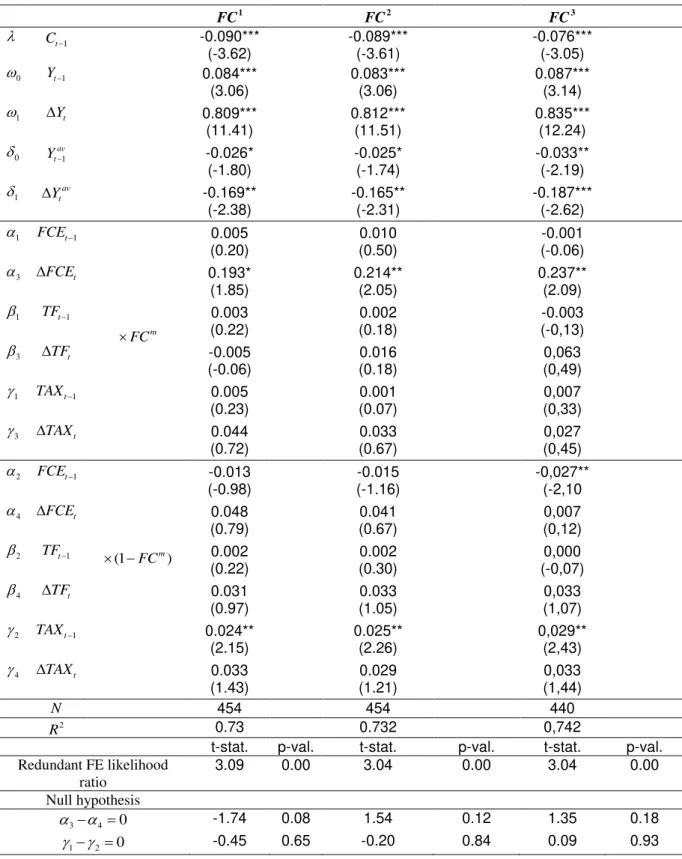
Table III presents the estimation results for specification (2), according to the different criteria for identifying fiscal consolidation episodes. Both consumption and income are statistically significant across the different specifications. The negative sign for consumption in t-1 () has obviously to do with the fact that lagged consumption has been considered an independent variable, therefore increasing consumption in period t-1 reduces its difference between t and t-1. The short-run elasticity of private consumption to income is similar across specifications, ranging between 0.083 and 0.087.
There is a positive statistically significant relationship between the first difference of general government final consumption expenditure (FCEt) and private consumption (Ct), when a fiscal consolidation ( m
FC 1) occurs, across all of the estimations based on (2), with coefficients between 0.193 and 0.237. Such a relationship is in line with the traditional Keynesian effects, indicating that consumers are not behaving in a Ricardian way, since they do not seem to anticipate the need for increased taxation in the future, to compensate for an increase in government spending today.
The previous relationship does not hold in the absence of a fiscal consolidation episode. Moreover, there is some evidence of non-Keynesian effects in the absence of fiscal consolidations ( m
FC 0), if we look at the final consumption expenditure (FCEt 1 ) and
taxes (TAXt 1 ) in column 3, and across the three different estimations, respectively. The
negative sign in the short-run elasticity of general government final consumption expenditure to private consumption suggests a Ricardian behaviour, in the absence of fiscal consolidations. Similar non-Keynesian reasoning prevails for the relationship between taxes and consumption, meaning that an increase in taxes today, leads to increased spending, as consumers anticipate that there is no need for increased taxation in the future.
15
Table III – Fixed Effects estimation results for specification (2)
1
FC FC2 FC3
Ct1 -0.090***
(-3.62) -0.089*** (-3.61) -0.076*** (-3.05) 0
Yt1 0.084***
(3.06) 0.083*** (3.06) 0.087*** (3.14) 1
Yt 0.809***
(11.41) 0.812*** (11.51) 0.835*** (12.24) 0
av1
t
Y -0.026*
(-1.80) -0.025* (-1.74) -0.033** (-2.19) 1 av t Y -0.169** (-2.38) -0.165** (-2.31) -0.187*** (-2.62) 1
FCEt1
m FC 0.005 (0.20) 0.010 (0.50) -0.001 (-0.06) 3
FCEt 0.193*
(1.85) 0.214** (2.05) 0.237** (2.09) 1
TFt1 0.003
(0.22) 0.002 (0.18) -0.003 (-0,13) 3
TFt -0.005
(-0.06) 0.016 (0.18) 0,063 (0,49) 1
TAXt1 0.005
(0.23) 0.001 (0.07) 0,007 (0,33) 3
TAXt 0.044
(0.72) 0.033 (0.67) 0,027 (0,45) 2
FCEt1
(1 FCm)
-0.013 (-0.98) -0.015 (-1.16) -0,027** (-2,10 4
FCEt 0.048
(0.79) 0.041 (0.67) 0,007 (0,12) 2
TFt1 0.002
(0.22) 0.002 (0.30) 0,000 (-0,07) 4
TFt 0.031
(0.97) 0.033 (1.05) 0,033 (1,07) 2
TAXt1 0.024**
(2.15) 0.025** (2.26) 0,029** (2,43) 4
TAXt 0.033
(1.43)
0.029 (1.21)
0,033 (1,44)
N 454 454 440
2
R 0.73 0.732 0,742
t-stat. p-val. t-stat. p-val. t-stat. p-val.
Redundant FE likelihood ratio
3.09 0.00 3.04 0.00 3.04 0.00
Null hypothesis
3 4 0
-1.74 0.08 1.54 0.12 1.35 0.18
1 2 0
-0.45 0.65 -0.20 0.84 0.09 0.93
Notes: Used robust heteroskedastic-consistent standard errors. The t-statistics are in parentheses. *, ** and ***
denotes statistically significant at a 10, 5 and a 1 percent level, respectively. FC1- Measure based on Giavazzi &
Pagano (1996); FC2- Measure based on Alesina & Ardagna (1998); FC3- Measure based on Afonso (2006,
16
However, the Wald coefficient statistical tests suggest that there is no significant difference between the presence or absence of fiscal consolidations in relation to the short-run effects of government final consumption expenditure and taxation on private consumption (the null hypothesis: 3 4 0and 1 2 0 are not rejected on the third, and all
specifications, respectively).
Compared with the literature that used similar methodology, as a whole, our results differ from Afonso (2006, 2010) and Afonso & Jalles (2012), since we find no evidence of non-Keynesian effects with regards to general government final consumption expenditure or taxes in the presence of fiscal consolidations ( m
FC 1). However, our findings are similar for periods of no fiscal consolidation ( m
FC 0), as there is some evidence of non-Keynesian effects in this case, for the mentioned budgetary variables.
4.2.2. Fiscal consolidations and monetary expansions.
The following specification is one of the main contributions of this paper, adding each
country’s monetary developments to specification (2). It will permit a breakdown of all the
possible combinations between fiscal contractions and monetary expansions, thus allowing for the study of the possible differences between them:
1 0 1 1 0 1 1 10 1 30 10 1 30 10 1 30 50
20 1 40 20 1 40 20 1 40 60
( )
(
av av
it i it it it it it
l m l
it it it it it it it it it
it it it it it it i
C c C Y Y Y Y
FCE FCE TF TF TAX TAX M FC MX
FCE FCE TF TF TAX TAX M
11 1 31 11 1 31 11 1 31 51
21 1 41 21 1 41 21 1 41 61
) (1 )
( ) (1 )
( ) (1 )(1 )
l m l
t it it
l m l
it it it it it it it it it
l m l
it it it it it it it it it it
FC MX
FCE FCE TF TF TAX TAX M FC MX
FCE FCE TF TF TAX TAX M FC MX
(3)
In addition to the repressors previously explained, l it
MX denotes a monetary expansion in
period t (t1,..., )T for country i (i1,..., )N , according to the criteria l(l 1, 2,3). l
M
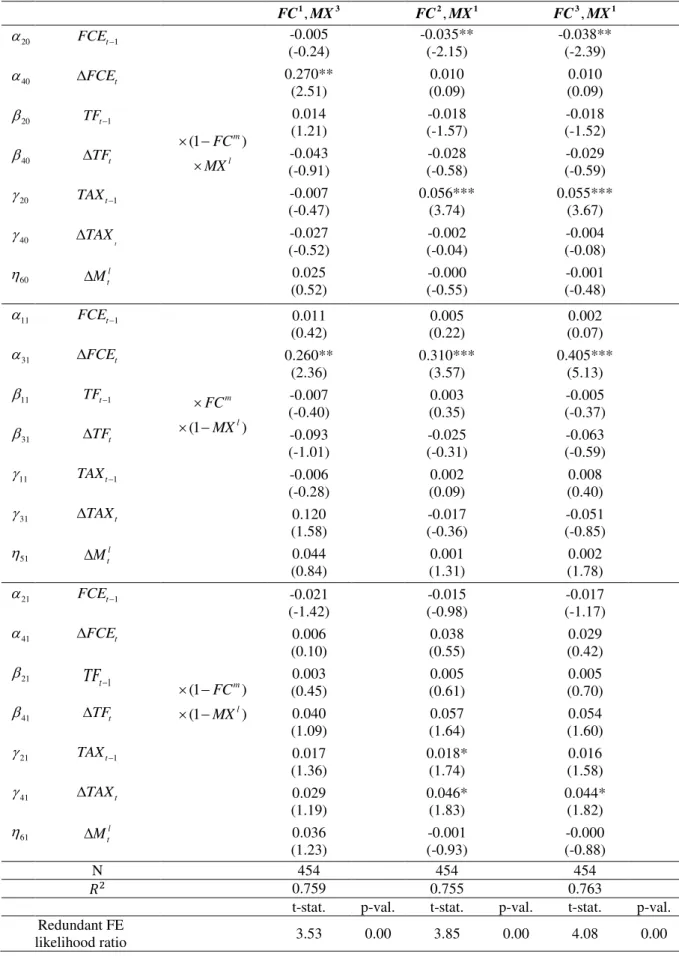
corresponds to the relevant indicator used to calculate the monetary episodes on (1). We have found some evidence of non-Keynesian effects during fiscal consolidations in 5 out of the 9 possible estimations.18 Tables IV and V show some of the most relevant estimation results.
17
Table IV – Fixed Effects estimation for specification (3): 1st output
, 1 3
FC MX FC2,MX1 FC3,MX1
Ct1 -0.096***
(-3.80)
-0.097*** (-4.05)
-0.097*** (-4.10)
0
Yt1 0.093***
(3.25)
0.099*** (3.64)
0.102*** (3.82)
1
Yt 0.803***
(10.93)
0.799*** (11.14)
0.789*** (11.17)
0
1
av t
Y -0.019
(-1.22)
-0.029** (-2.06)
-0.0294** (-2.06)
1
av
t
Y
-0.181**
(-2.53)
-0.155** (-2.22)
-0.145** (-2.08)
10
FCEt1
m
FC
l
MX
0.050 (1.40)
0.200 (1.33)
-0.840*** (-14.24)
30
FCEt -0.213***
(-3.58)
-0.369* (-1.72)
-0.039 (-0.30)
10
TFt1 0.010
(0.69)
0.026 (0.84)
1.293*** (21.38)
30
TFt -0.130*
(-1.83)
0.034 (0.12)
-11.42*** (-19.53)
10
TAXt1 -0.051**
(-2.06)
-0.206* (-1.71)
-0.552*** (-9.29)
30
TAXt -0.132***
(-3.07)
0.484*** (4.55)
2.694*** (17.32)
50
l
t
M
0.096**
(2.08)
0.003 (0.49)
18
Table V – Fixed Effects estimation for specification (3): 1st output (cont.)
, 1 3
FC MX FC2,MX1 FC3,MX1
20
FCEt1
(1 m)
FC l MX -0.005 (-0.24) -0.035** (-2.15) -0.038** (-2.39) 40
FCEt 0.270**
(2.51) 0.010 (0.09) 0.010 (0.09) 20
TFt1 0.014
(1.21) -0.018 (-1.57) -0.018 (-1.52) 40
TFt -0.043
(-0.91) -0.028 (-0.58) -0.029 (-0.59) 20
TAXt1 -0.007
(-0.47) 0.056*** (3.74) 0.055*** (3.67) 40 t TAX -0.027 (-0.52) -0.002 (-0.04) -0.004 (-0.08) 60 l t M 0.025 (0.52) -0.000 (-0.55) -0.001 (-0.48) 11
FCEt1
m
FC
(1 l)
MX 0.011 (0.42) 0.005 (0.22) 0.002 (0.07) 31
FCEt 0.260**
(2.36) 0.310*** (3.57) 0.405*** (5.13) 11
TFt1 -0.007
(-0.40) 0.003 (0.35) -0.005 (-0.37) 31
TFt -0.093
(-1.01) -0.025 (-0.31) -0.063 (-0.59) 11
TAXt1 -0.006
(-0.28) 0.002 (0.09) 0.008 (0.40) 31
TAXt 0.120
(1.58) -0.017 (-0.36) -0.051 (-0.85) 51 l t M 0.044 (0.84) 0.001 (1.31) 0.002 (1.78) 21
FCEt1
(1 m)
FC
(1 l)
MX -0.021 (-1.42) -0.015 (-0.98) -0.017 (-1.17) 41
FCEt 0.006
(0.10) 0.038 (0.55) 0.029 (0.42) 21 1 t
TF 0.003
(0.45) 0.005 (0.61) 0.005 (0.70) 41
TFt 0.040
(1.09) 0.057 (1.64) 0.054 (1.60) 21
TAXt1 0.017
(1.36) 0.018* (1.74) 0.016 (1.58) 41
TAXt 0.029
(1.19) 0.046* (1.83) 0.044* (1.82) 61 l t M 0.036 (1.23) -0.001 (-0.93) -0.000 (-0.88)
N 454 454 454
0.759 0.755 0.763
t-stat. p-val. t-stat. p-val. t-stat. p-val. Redundant FE
likelihood ratio 3.53 0.00 3.85 0.00 4.08 0.00
19
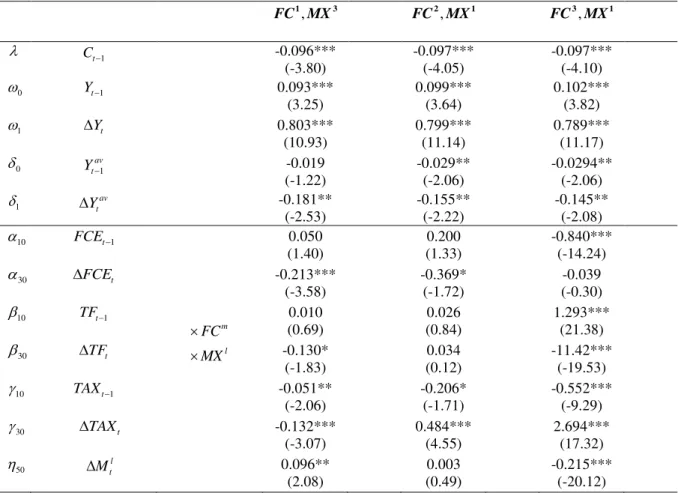
We can see that when fiscal consolidations are matched by monetary expansion, there is a negative and statistically significant short-term elasticity between the government final consumption expenditure and private consumption (30 0 in the first and second outputs
and 10 0 in the third output). This doesn’t hold when fiscal consolidations that are not accompanied by a monetary easing as 31is positive and statistically significant, and 11is not
statistically significant across the respective outputs. The second and third estimation results also show some evidence of non-Keynesian elasticity on taxes, when there are both fiscal contractions and monetary expansions (30 0). Just like in previous cases, such effects seem
to disappear when fiscal consolidations take place, without the respective monetary easing, as
31
is not statistically significant. The same pattern emerges again for social transfers on the first and third outputs (30 is negative and statistically significant, but 31 is not statistically
significant).
The Wald coefficient restriction tests, in table XVIII in the Appendix, show that the difference between these coefficients is statistically significant in all cases, except for social transfers in the first output (30310is not rejected at a 10% level in this case).
A possible explanation relates to liquidity restrictions, which may prevent a Ricardian behaviour, thus undermining the permanent income hypothesis. If households do have liquidity constrains, a fiscal consolidation could indeed signal a future tax decrease and a permanent income rise, which is perceived by households, but does not materialize in current private consumption increase, due to limitations in access to credit markets. Such is summarised by Alesina & Ardagna (1998) as “the size of the increase in private consumption [following government spending cuts] depends on the absence of liquidity-constrained
consumers”.
20
4.3. Measuring the success of fiscal consolidations
In this section we will investigate what the factors are that may contribute to the success of fiscal consolidations. We computed dummy variables for successful fiscal adjustments in two different ways based on the literature, in order to assess whether our findings are robust across different criteria. The first measure ( 1
t
SU ), is based on Afonso & Jalles (2012), who define a fiscal consolidation as being successful, if the change in the cyclically adjusted primary balance (bt) for two consecutive years is greater than the
standard deviation () of the full panel sample:
1
1
0
1,
0,
t i i t
if b SU
otherwise
. (4)We have also included a measure computed by Alesina & Ardagna (2013) which is based on the level of debt as a percentage of GDP. A fiscal consolidation is successful if the debt-to-GDP ratio two years after the end of the fiscal adjustment (Debtt2) is lower than the
debt-to-GDP ratio in the last year of the adjustment (Debtt):
2
2 1,
0,
t t
t
if Debt Debt
SU
otherwise
(5)
The identification of the leading policy option for the fiscal consolidation – either expenditure or revenue based – is also assessed through dummy variables. Therefore, a fiscal consolidation on period t is defined as being expenditure based (EXPt), if the change in the
total expenditure of the general government as a percentage of GDP in that period (expt)
accounts for a proportion greater than of the change in the cyclically adjusted primary balance (bt):
exp 1,
0,
t t t
if b EXP
otherwise
21
Following Afonso & Jalles (2012) we computed the composition of the adjustment for three different thresholds, so that assumes the values of 1/2, 2/3 and 3/4. A similar process was conducted for the revenue based consolidations. Table VI shows the number of fiscal consolidation episodes and their respective success rate (successes / total events), based on the criteria defined in the earlier sections. The identification of the successful episodes follows specifications (4) and (5). Table XIX in the Appendix shows the successful fiscal episodes for each country according to the different criteria.
Table VI – Fiscal consolidation events and success rates
If we look at the successful events based on the change in CAPB for two consecutive years, 1
SU , it can be seen that the success rates range from 51% to 61%, according to 1
FC
and 3
FC , respectively. Although 2
FC registers the highest number of successful consolidations, the success rate is slightly lower than in 3
FC (57% vs 61%), and is thus penalised by the higher number of consolidation events (56 vs 46). Nevertheless, success rates are similar to the ones found in Afonso & Jalles (2012).
In the case of 2
SU , it can be seen that there are significant differences across the criteria used to identify fiscal consolidations, namely between 1
FC and the remainder. This is actually the only criterion that has a success rate which is similar to the one found in the 1
SU
case, whilst 2
FC and 3
FC are below their peers, by more than 20 percentage points.
On the one hand, the main explanation for the difference between the success rates within 2
SU , has to do with the duration of the fiscal consolidations, coupled with its lower flexibility, vis-à-visSU1. As seen earlier in Table I, the fiscal consolidations based on 1
FC
have a much higher duration than those of either 2
FC or 3
FC . The only requirement for a fiscal consolidation to be successful according to 2
SU , is that the level of debt-to-GDP in two years after the end of the adjustment has to be lower than the one in the last year of the adjustment. Therefore, longer periods of adjustment will necessarily result in more successful
1
SU SU2
Total events Successes Success rate (%) Successes Success rate (%)
1
FC 49 25 51% 29 59%
2
FC 56 32 57% 19 34%
3
FC 46 28 61% 17 37%
Source: Author’s computations. Notes: SU1- Measure of success based on (4); 2
SU -
22
years of fiscal consolidation. The same does not occur in 1
SU , as this allows for successful and non-successful years within the same adjustment period.19
On the other hand, since the success rates based on 1
SU are generally higher than those in 2
SU , one can argue that, based on these results, countries have been more successful in improving their fiscal position rather than their levels of debt ratio. This points to the possibility that, although there are improvements in the CAPB during fiscal consolidation periods, this does not necessarily result in a fiscal surplus, at least during the two years following on from the end of the adjustment. This ultimately impacts on countries’ debt ratios during that period.
In Table VII we present some facts about the expenditure and revenue-based consolidations, which were computed for the three different criteria used to identify fiscal contractions. By disentangling these, we can assess the possible differences regarding the criteria used to define fiscal consolidations as being successful and also the possible implications for GDP growth. This table shows the results computed for a threshold of =2/3, while the results for the other thresholds can be consulted in tables XX and XXI in the Appendix.
Table VII – Expenditure and revenue based consolidations: =2/3
Total Events
Average Size of the
Consolidation
10
t i i
b
2
t t
Debt Debt
Expenditure
Based 1 23 2.36 2.87 -2.50 Expenditure
Based 2 23 2.83 3.07 -0.74 Expenditure
Based 3 18 3.49 3.65 -0.34 Revenue
Based 1 13 0.84 1.91 -1.06 Revenue
Based 2 15 1.64 1.32 4.49 Revenue
Based 3 13 1.93 1.71 4.77
We can see that in our panel there are significantly more expenditure-based consolidation events, rather than revenue-based ones. The number of expenditure-based
19 This is a consequence that derives from the fact that Alesina & Ardagna (2013) treat multi-year periods as a single episode and define all those years as either being successful, or not altogether, which might have some implications on the results. Perotti (2012) provides a detailed description of this issue.
23 consolidations range between 18, in 3
FC and 23, both in criteria one and two. The revenue-based consolidations account for 13 and 15 events, revenue-based on both 1
FC and 3
FC , and 2
FC
respectively.
The average size of the consolidations (based on the change in the CAPB) is also higher in the expenditure-based cases across all the different criteria, compared to revenue-based ones. The minimum difference is 1.19 percentage points (pp.) in case 2, but it can get as high as 1.56 pp. in case 3. Overall, there are stronger adjustments for the expenditure-based consolidations. These findings differ from Afonso & Jalles (2012), who report no significant difference between the size of the consolidation whether it is made via the expenditure, or the revenue side of the budget.
The next column (
1
0
t i i
b
) reports the changes in the cyclically adjusted primarybalance for two consecutive years, used in 1
SU . The differences between expenditure and revenue based consolidations lie roughly between 0.96 and 1.94 p.p., in cases one and three, respectively.
We can also look at the difference between the debt-to-GDP ratio two years after the end of the adjustment, and in the last year of the adjustment, in the following column, which was used to compute 2
SU . All of the criteria report that, on average, the expenditure-based consolidations led to a decrease in the debt-to-GDP ratio over that period. On the revenue-based side, there are significant differences between 1
FC and the remainder. Whilst in the case of the latter there was a decrease in the debt-to-GDP ratio, in 2
FC and 3
FC it actually increased more than 4 percentage points. Nevertheless, even in the first case, we can see that there was a more significant improvement in the debt-to-GDP ratio for the expenditure-based consolidation.20
Following the results in table VII, we estimated a probit model based on Afonso & Jalles (2012), in order to assess if the reported differences between the expenditure and revenue-based consolidations are statistically relevant and impact on the success of the fiscal adjustments:
Pri SU 1|Zi E SU[ 1|Zi] Zi (7)
24
whereE SU[ 1|Zi] is the conditional expectation of the success of fiscal consolidation,
given that Ziand SUrefer to the dummy variables defined in (4) and (5). Zi is defined as
follows:
1 2 3 4 5
i i i i i
Z D b EXP MX (8)
i
D is the duration of fiscal consolidation, birefers to the change in the cyclically adjusted
primary balance, which accounts for the size of the consolidation. EXPi was defined in (6) as
a dummy variable that accounts for expenditure-based consolidations, according to different thresholds, while the same was done on the revenue side.
We also includedMXi, which refers to the dummy variable used to identify the
monetary expansions computed earlier, according to (1). The motivation behind this addition has to do with an issue raised in the recent literature, which is whether there is a possible influence by monetary expansions in determining the success of fiscal consolidations.
For instance, Devries et al. (2011) suggest that expenditure-based consolidations were more successful because they were complemented by monetary expansions, in the form of strong currency devaluations. Alesina et al. (2012) mention the importance of accompanying monetary policy in determining the possible heterogeneous effects of expenditure-based and revenue-based consolidations. Alesina & Ardagna (2013) also argue for the possible role of monetary policy in differentiating the effects of expenditure versus revenue-based adjustments.21
Table VIII shows the results for the success measure constructed by Afonso & Jalles (2012), based on 2
FC .22 The results for the other criteria used to compute fiscal consolidations can be consulted in tables XXII and XXIII in the Appendix.
We can see that according to the measure first computed by Afonso & Jalles (2012), the success of the fiscal consolidations seems to be enhanced if they are based on expenditure cuts. On the other hand, we find no statistically significant results for the revenue-based consolidations. Moreover, both the duration and size of the consolidations seem to play a
21 However, in this case they found that monetary policy had no significant impact.
22
Some observations were excluded, due to the fact that they occur in the last years of the sample and therefore
25
significant role: longer and stronger consolidations appear to contribute positively for the success of the fiscal consolidations. These results are consistent for all of the reported thresholds in 2
FC and 3
FC . In the 1
FC case, we only find statistically significant results for the size of the consolidations.23 With regard to the role of monetary policy, we find no statistically significant results.24
Table VIII – Success of fiscal consolidations forSU1
, based on FC2
Expenditure Revenue
Specification 1 2 3 4 5 6
constant -4.930*** (-3.17)
-3.842*** (-2.93)
-3.851*** (-2.97)
-3.171*** (-2.79)
-2.962** (-2.48)
-2.962** (-2.48)
duration 1.177** (1.99)
0.974* (1.93)
0.975* (1.94)
0.860* (1.87)
0.828* (1.72)
0.828* (1.72)
Δcapb 1.178*** (3.34)
1.006*** (3.23)
1.009*** (3.29)
0.873*** (3.01)
0.870*** (2.89)
0.870*** (2.89)
exp12 1.443*** (3.14)
exp23 0.783*
(1.70)
exp34 0.783*
(1.70)
rev12 0.059
(0.12)
rev23 -0.296
(-0.62)
rev34 -0.296
(-0.62)
mx2 0.031 (0.06)
0.055 (0.11)
0.059 (0.11)
0.343 (0.57)
0.243 (0.46)
0.243 (0.46)
2
R 0.487 0.414 0.414 0.381 0.386 0.386
N 50 50 50 50 50 50
Table IX shows the results for the success criterion 2
SU , based on 1
FC . The results for
2
FC and 3
FC can be consulted in tables XXIV and XXV in the Appendix. The results are similar to the ones found in the 1
SU case and are related to the role of duration and expenditure-based adjustments in the success of fiscal consolidations. Moreover, we have found some evidence that the revenue-based consolidations have a negative impact on the
23 See tables XXII and XXIII in the Appendix for 1
FC and 3
FC .
24 Results for MX3are available on request and do not alter the overall findings. We could not compute the
estimations for 1
MX , as it predicts perfectly the success of the fiscal consolidations.
Notes: Used robust heteroskedastic-consistent standard errors. The t-statistics are in parentheses. *, ** and *** denotes statistically significant at a 10, 5 and 1 percent level, respectively. 12, 23 and 34 next to exp and
26
success of the adjustment. On the other hand, contrary to the findings for 1
SU , it seems that the size of the consolidation has a negative impact on the success of the consolidation and is not robust across the different criteria.
Table IX - Success of fiscal consolidations forSU2
, based on FC1
Expenditure Revenue
Specification 1 2 3 4 5 6
constant -1.672 (-1.41)
-1.690 (-1.42)
-1.884 (-1.41)
-0.850 (-0.90)
-0.519 (-0.52)
-0.519 (-0.52)
duration 0.821** (2.56)
0.832*** (2.61)
0.860** (2.42)
0.720*** (3.06)
0.923*** (3.41)
0.923*** (3.41)
Δcapb -0.262** (-2.03)
-0.263** (-2.04)
-0.221* (-1.87)
-0.233* (-1.70)
-0.404*** (-2.65)
-0.404*** (-2.65)
exp12 1.600** (2.48)
exp23 1.601**
(2.46)
exp34 1.938**
(2.49)
rev12 -0.317
(-0.55)
rev23 -1.571**
(-1.99)
rev34 -1.571**
(-1.99)
mx2 -0.382 (-0.69)
-0.389 (-0.70)
-0.238 (-0.40)
-0.175 (-0.33)
-0.410 (-1.67)
-0.410 (-1.67) 0.478 0.477 0.511 0.352 0.440 0.440
N 39 39 39 39 39 39
Regarding the role of monetary policy, if we look at the 2
FC case in table XXIV in the Appendix, there seems to be some evidence that real currency devaluations (MX2) contribute negatively to the success of the adjustments. However, since we cannot check the robustness of these results with monetary expansion based on real short term interest rate (
1
MX ), on account of the same problem that was reported earlier forSU1, we were unable to extract a clear conclusion here. Furthermore, the fact that MX1 predicts perfectly the success of the fiscal consolidations, could actually lead to conclusions opposed to the ones found for eitherMX2, or MX3. So we would rather say that the impact of monetary easing on the success of the fiscal consolidations is not clear.
Notes: Used robust heteroskedastic-consistent standard errors. The t-statistics are in parentheses. *, ** and *** denotes statistically significant at a 10, 5 and 1 percent level, respectively. 12, 23 and 34 next to exp and