UNIVERSIDADE DE LISBOA FACULDADE DE CIÊNCIAS
A dependability framework for WSN-based aquatic monitoring systems
“ Documento Definitivo”
Doutoramento em Informática
Especialidade de Engenharia Informática
Gonçalo João Vitorino de Jesus
Tese orientada por: Prof. Doutor António Casimiro
Doutora Anabela Oliveira
UNIVERSIDADE DE LISBOA FACULDADE DE CIÊNCIAS
A dependability framework for WSN-based aquatic monitoring systems Doutoramento em Informática
Especialidade de Engenharia Informática Gonçalo João Vitorino de Jesus
Tese orientada por: Prof. Doutor António Casimiro
Doutora Anabela Oliveira Júri:
Presidente:
● Doutor Nuno Fuentecilla Maia Ferreira Neves, Professor Catedrático, Faculdade de Ciências da Universidade de Lisboa
Vogais:
● Doutor Marco Paulo Amorim Vieira, Professor Catedrático, Faculdade de Ciências e Tecnologia da Universidade de Coimbra
● Doutor Luís Miguel Pinho de Almeida, Professor Associado, Faculdade de Engenharia da Universidade do Porto
● Doutor André Bustorff Fortunato, Investigador Principal com Habilitação,
Departamento de Hidráulica e Ambiente do Laboratório Nacional de Engenharia Civil (LNEC)
● Doutor Luís Miguel Parreira e Correia, Professor Associado com Agregação, Faculdade de Ciências da Universidade de Lisboa
● Doutor António Casimiro Ferreira da Costa, Professor Associado, Faculdade de Ciências da Universidade de Lisboa (Orientador)
● Doutor Pedro Miguel Frazão Fernandes Ferreira, Professor Auxiliar, Faculdade de Ciências da Universidade de Lisboa
Documento especialmente elaborado para a obtenção do grau de doutor Laboratório Nacional de Engenharia Civil
Acknowledgements
Este estudo que realizei foi uma experiência que exigiu bastante de mim ao longo dos últimos anos e não teria sido possível sem a ajuda, directa e indi-recta, das seguintes pessoas e instituições a quem quero agradecer o apoio, acompanhamento e ajuda.
À Doutora Anabela Pacheco de Oliveira, co-orientadora e chefe de núcleo no LNEC, agradeço o apoio incondicional, a amizade e a possibilidade de levar a cabo a investigação a nível aplicado que este estudo exigiu.
Ao Professor António Casimiro, orientador científico da tese, agradeço a super-visão e ajuda prestada. O meu sincero agradecimento pelas opiniões críticas e partilha de conhecimento, bem como a disponibilidade para a correcção dos vários artigos e relatórios.
Agradeço o apoio financeiro do Laboratório Nacional de Engenharia Civil e da Fundação para a Ciência e Tecnologia, através da bolsa de doutoramento. À FCT, em particular pelo financiamento da bolsa SFRH/BD/82489/2011. Ao LNEC, muito além da bolsa de doutoramento, a oportunidade, os projectos e os recursos que disponibilizaram e que permitiram a realização deste estudo. Agradeço também à Fundação Luso-Americana para o Desenvolvimento pelo financiamento de viagens de cooperação ao Center for Coastal Margin Ob-servation & Prediction (CMOP). E ao CMOP, especialmente ao Professor António Melo Baptista pela sua generosidade, simpatia, motivação, e que me acolheu e disponibilizou todos os meios para que pudesse estudar e aplicar as contribuição deste trabalho. Ainda um agradecimento ao Paul Turner pela disponibilidade em partilhar o seu conhecimento.
Um obrigado a todos os meus colegas do núcleo de Tecnologias de Informação, sem esquecer os que seguiram o seu caminho para outras áreas. À Doutora Maria Alzira, ex-chefe do núcleo, pelas suas palavras amigas e apoio que sem-pre demonstrou. Ao Nuno, Palha Fernandes, Américo e Ana, pela grande amizade e partilha de conhecimento. Agradeço ainda a companhia amiga dos meus colegas informáticos, João Gomes e Jonez por confiarem em mim, por me desafiarem tecnicamente e pelas muitas discussões construtivas que tivemos. A todos os colegas com os quais pude privar de perto nos projectos em que tra-balhámos, em especial, ao Alberto, Marta, André, Manuel, Paula e Armando, pela partilha de experiências.
Aos meus amigos João, Sílvia e Adelaide, por me fazerem sentir em casa, no LNEC, desde o momento em que vos conheci em 2007. Um grande obrigado pela vossa amizade que muito prezo.
A todos os meus amigos de Alcobaça, Cape Town, Coimbra e Lisboa, Ana Teresa, André Amador, André Correia, Andrew, Ângelo, Catarina, Cristina, Dani, Drop, Fernandos, Filipe, Filipa, Henrique, Hugo, Kai, Joel, Juneid, Malhão, Maria, Maria Joana, Óscar (sempre desaparecido), Pedro (vários), Penas, Sam, Ricardo, Rodrigo, Ruben, Teles, Vanessa, . . . , pelo vosso com-panheirismo, amizade e paciência. Um obrigado também por todos os planos sociais que tivemos e que serão repetidos no futuro, dos quais destaco as vi-agens, idas à neve, surf, jogos de futebol ou as muitas frutíferas conversas infindáveis.
Agradeço também a todos os colegas do LNEC que me enchem o coração cada vez que entro nesta instituição. Obrigado pelo acolhimento e toda a força que fizeram para que eu realizasse este estudo.
À Tia Graciete, Tio Alberto, Padrinho Vítor e Madrinha Deolinda, agradeço o vosso carinho e peço desculpa pela minha ausência, que espero poder corrigir de futuro. Peço ainda desculpa às minhas primas Marina, Beatriz e Alicia, por ter sido complicado estar presente nas vossas vidas nos últimos anos. Aos meus pais, um agradecimento eterno. é impossível descrever e retribuir o vosso apoio incondicional e a disponibilidade imensa que tiveram sempre para comigo. Este último ano foi ainda mais atípico, invadi o vosso espaço (e obrigado Tia Graciete pela cedência do escritório) após tantos anos fora, e a Mãe e o Pai acolheram-me e fizeram tudo para que eu pudesse focar-me apenas na conclusão deste estudo.
Para finalizar, gostaria de dedicar este trabalho à memória da minha avó Celeste e do meu avô Maca, duas das pessoas mais importantes da minha vida, que acompanharam as minhas escolhas e que infelizmente não podem celebrar comigo agora.
Abstract
Wireless Sensor Networks (WSN) are being progressively used in several ap-plication areas, particularly to collect data and monitor physical processes. Moreover, sensor nodes used in environmental monitoring applications, such as the aquatic sensor networks, are often subject to harsh environmental con-ditions while monitoring complex phenomena. Non-functional requirements, like reliability, security or availability, are increasingly important and must be accounted for in the application development. For that purpose, there is a large body of knowledge on dependability techniques for distributed systems, which provides a good basis to understand how to satisfy these non-functional requirements of WSN-based monitoring applications. Given the data-centric nature of monitoring applications, it is of particular importance to ensure that data is reliable or, more generically, that it has the necessary quality.
The problem of ensuring the desired quality of data for dependable monitoring using WSNs is studied herein. With a dependability-oriented perspective, it is reviewed the possible impairments to dependability and the prominent existing solutions to solve or mitigate these impairments. Despite the variety of components that may form a WSN-based monitoring system, it is given particular attention to understanding which faults can affect sensors, how they can affect the quality of the information, and how this quality can be improved and quantified. Open research issues for the specific case of aquatic monitoring applications are also discussed.
One of the challenges in achieving a dependable system behavior is to over-come the external disturbances affecting sensor measurements and detect the failure patterns in sensor data. This is a particular problem in environmen-tal monitoring, due to the difficulty in distinguishing a faulty behavior from the representation of a natural phenomenon. Existing solutions for failure detection assume that physical processes can be accurately modeled, or that there are large deviations that may be detected using coarse techniques, or more commonly that it is a high-density sensor network with value redundant sensors.
This thesis aims at defining a new methodology for dependable data quality in environmental monitoring systems, aiming to detect faulty measurements and increase the sensors data quality. The framework of the methodology is overviewed through a generically applicable design, which can be employed to any environment sensor network dataset.
The methodology is evaluated in various datasets of different WSNs, where it is used machine learning to model each sensor behavior, exploiting the existence of correlated data provided by neighbor sensors. It is intended to explore the data fusion strategies in order to effectively detect potential failures for each sensor and, simultaneously, distinguish truly abnormal measurements from deviations due to natural phenomena. This is accomplished with the successful application of the methodology to detect and correct outliers, offset and drifting failures in real monitoring networks datasets.
In the future, the methodology can be applied to optimize the data quality control processes of new and already operating monitoring networks, and assist in the networks maintenance operations.
Keywords: Dependability, Data quality, Fault detection, Machine learning, Aquatic monitoring
Resumo
As redes de sensores sem fios (RSSF) têm vindo cada vez mais a serem utili-zadas em diversas áreas de aplicação, em especial para monitorizar e capturar informação de processos físicos em meios naturais. Neste contexto, os senso-res que estão em contacto direto com o senso-respectivo meio ambiente, como por exemplo os sensores em meios aquáticos, estão sujeitos a condições adversas e complexas durante o seu funcionamento. Esta complexidade conduz à necessi-dade de considerarmos, durante o desenvolvimento destas redes, os requisitos não funcionais da confiabilidade, da segurança ou da disponibilidade elevada. Para percebermos como satisfazer estes requisitos da monitorização com base em RSSF para aplicações ambientais, já existe uma boa base de conhecimento sobre técnicas de confiabilidade em sistemas distribuídos. Devido ao foco na obtenção de dados deste tipo de aplicações de RSSF, é particularmente im-portante garantir que os dados obtidos na monitorização sejam confiáveis ou, de uma forma mais geral, que tenham a qualidade necessária para o objetivo pretendido.
Esta tese estuda o problema de garantir a qualidade de dados necessária para uma monitorização confiável usando RSSF. Com o foco na confiabilidade, re-vemos os possíveis impedimentos à obtenção de dados confiáveis e as soluções existentes capazes de corrigir ou mitigar esses impedimentos. Apesar de exis-tir uma grande variedade de componentes que formam ou podem formar um sistema de monitorização com base em RSSF, prestamos particular atenção à compreensão das possíveis faltas que podem afetar os sensores, a como estas faltas afetam a qualidade dos dados recolhidos pelos sensores e a como po-demos melhorar os dados e quantificar a sua qualidade. Tendo em conta o caso específico dos sistemas de monitorização em meios aquáticos, discutimos ainda as várias linhas de investigação em aberto neste tópico.
Um dos desafios para se atingir um sistema de monitorização confiável é a deteção da influência de fatores externos relacionados com o ambiente moni-torizado, que afetam as medições obtidas pelos sensores, bem como a deteção de comportamentos de falha nas medições. Este desafio é um problema par-ticular na monitorização em ambientes naturais adversos devido à dificuldade da distinção entre os comportamentos associados às falhas nos sensores e os comportamentos dos sensores afetados pela à influência de um evento natural. As soluções existentes para este problema, relacionadas com deteção de faltas,
assumem que os processos físicos a monitorizar podem ser modelados de forma eficaz, ou que os comportamentos de falha são caraterizados por desvios ele-vados do comportamento expectável de forma a serem facilmente detetáveis. Mais frequentemente, as soluções assumem que as redes de sensores contêm um número suficientemente elevado de sensores na área monitorizada e, con-sequentemente, que existem sensores redundantes relativamente à medição. Esta tese tem como objetivo a definição de uma nova metodologia para a obtenção de qualidade de dados confiável em sistemas de monitorização ambi-entais, com o intuito de detetar a presença de faltas nas medições e aumentar a qualidade dos dados dos sensores. Esta metodologia tem uma estrutura ge-nérica de forma a ser aplicada a uma qualquer rede de sensores ambiental ou ao respectivo conjunto de dados obtido pelos sensores desta.
A metodologia é avaliada através de vários conjuntos de dados de diferentes RSSF, em que aplicámos técnicas de aprendizagem automática para modelar o comportamento de cada sensor, com base na exploração das correlações exis-tentes entre os dados obtidos pelos sensores da rede. O objetivo é a aplicação de estratégias de fusão de dados para a deteção de potenciais falhas em cada sensor e, simultaneamente, a distinção de medições verdadeiramente defeituo-sas de desvios derivados de eventos naturais. Este objectivo é cumprido atra-vés da aplicação bem sucedida da metodologia para detetar e corrigir outliers, offsets e drifts em conjuntos de dados reais obtidos por redes de sensores. No futuro, a metodologia pode ser aplicada para otimizar os processos de controlo da qualidade de dados quer de novos sistemas de monitorização, quer de redes de sensores já em funcionamento, bem como para auxiliar operações de manutenção das redes.
Palavras Chave: Confiabilidade, Qualidade de dados, Aprendizagem auto-mática, Deteção de falhas, Monitorização aquática
Resumo Alargado
Os desastres naturais e provocados pelo homem causam em todo o mundo uma destruição generalizada de bens materiais e serviços, bem como ferimentos e mortes na população. A gestão e os procedimentos de mitigação destes riscos visam reduzir as perdas humanas e a diminuição dos estragos causados pelos desastres. Estas ações de prevenção e mitigação de riscos são tradicionalmente auxiliadas por uma monitorização adequada e meios eficazes de aviso e alerta. A disponibilidade de sistemas que fornecem informação confiável de fontes de confiança é vital para a proteção de vidas humanas, bem como de bens ma-teriais e naturais. No entanto, soluções para a monitorização em tempo real e a sua integração com os métodos de previsão em tempo real, dos eventos aquáticos potencialmente perigosos, têm que ser otimizadas para os requisitos específicos dos meios aquáticos e até mesmo para os corpos de água indi-vidualmente monitorizados. Para isso, as entidades de gestão destes corpos de água, bem como as empresas de serviços públicos relacionados, fazem uso
de ferramentas de monitorização online e de sistemas de aviso prévio [160]
integrados em plataformas inteligentes que apoiam a gestão em tempo real dos ambientes aquáticos tanto nas tarefas do dia-a-dia como em situações de
emergência [79]. Neste contexto, a integração das ferramentas de
monitoriza-ção com redes de sensores sem fios (RSSF) e com sistemas de apoio à decisão
baseados na Web [160] desempenha um papel vital na monitorização, controlo,
atenuação e avaliação do desastre. Na camada de monitorização, as medições individuais e coletivas obtidas pelas redes de sensores devem ser validadas de forma a garantir que existe uma base suficientemente sólida para o aviso pré-vio. Desta forma, a qualidade e a validade das medições obtidas pelos sensores são requisitos importantes para sustentar o aviso e alerta.
Apesar da existência de vários estudos sobre a deteção de situações anóma-las ou faltas em redes de sensores, a maioria destes estudos foca-se em redes de sensores que se encontram em ambientes controlados e em que os dados obtidos através dos sensores representam de forma completa e precisas o sis-tema monitorizado. Além disso, estes estudos não consideram a presença de fenómenos ou eventos que podem interferir nas medições obtidas pelos
sen-sores [63], ou apenas consideram faltas relacionadas com a comunicação que
é feita sem fios [39]. Adicionalmente, as redes de sensores ambientais, como
alargadas [157], podendo ser compostas por vários aglomerados de sensores distando uns dos outros várias centenas de metros. Esta configuração implica geralmente um custo avultado para a operação, de forma a cumprir os requi-sitos críticos relativos à obtenção de medições precisas, confiáveis e em tempo útil.
Consequentemente, existe uma preocupação de qualidade relativa aos dados obtidos pelas redes de sensores, implicando uma intervenção humana extensa e frequente por parte de técnicos especializados, quer na manutenção periódica dos sensores, quer em tarefas de validação dos dados obtidos. Apesar dos vários estudos na área da confiabilidade de sistemas distribuídos, ou mais especificamente em arquitecturas de computadores para operações confiáveis e em tempo real, os sistemas de monitorização representam vários desafios de
confiabilidade [52]. Nestes sistemas, as tecnologias sensoriais e relativas a redes
de sensores (agora cada vez mais acessíveis) são vulneráveis perante os vários riscos e podem não ser suficientemente confiáveis e robustas para as condições adversas e factores externos dos ambientes aquáticos. Portanto, nesta tese, a qualidade e a validade das medições obtidas pelos sensores assumem um papel central, sem nunca ignorar os requisitos específicos do ambiente monitorizado. Para lidar com o problema da qualidade dos dados, é necessário estar continu-amente, de forma automática, a caracterizar as medições obtidas. Para isso, a aplicação de técnicas e estratégias com base na exploração de redundância ao nível da camada da obtenção de medições é uma abordagem explorada aqui. Nesta tese, propomos uma metodologia genérica para a monitorização confiável em redes de sensores ambientais, bem como um conjunto de soluções concretas para instanciar esta metodologia em casos de uso reais. A natu-reza altamente dinâmica das variáveis monitorizadas e a ocorrência incerta de eventos, que afectam o ambiente e os sensores neste incluídos, são impedimen-tos para a confiança na obtenção de medições com qualidade. Portanto, com a metodologia proposta e as respetivas instanciações, pretendemos colmatar estes impedimentos e com isso atingir três objectivos.
Em primeiro lugar, promovemos a deteção, categorização e correção de medi-ções defeituosas obtidas pelas redes de sensores ambientais. As faltas nestas redes podem ter diversas origens e, consequentemente, afetar os sensores de várias formas, originando diferentes comportamentos de falha que se refletem nas medições obtidas. Devido à multitude de fatores que podem interferir nas redes de monitorização, não existe nenhum processo bem caracterizado para
a deteção automática de falhas em sensores, nem para a correção dos respeti-vos erros nas medições. Além disso, as soluções existentes não consideram a complexidade dos processos monitorizados, nem contemplam todas as falhas típicas que afetam os sensores nestes ambientes adversos.
O segundo objetivo prende-se com a definição de soluções que exploram múl-tiplas formas de redundância para mitigar o impacto de fatores externos na percepção correta do verdadeiro estado dos sensores e a respetiva análise da verdade subjacente relativa ao ambiente monitorizado. Dada a existência de eventos potencialmente impactantes, é necessário distinguir entre o impacto destes nas medições e as verdadeiras falhas nos sensores. Tipicamente, as so-luções de deteção e correção de faltas não consideram a possibilidade de que as medições que aparentem ser defeituosas podem na realidade ser motiva-das pelo impacto dos eventos que afetam o ambiente monitorizado. Ignorar estas situações pode levar à deteção incorreta de falhas e, portanto, a falsos positivos. Além disso, as soluções típicas para fusão de dados apenas têm em conta os dados obtidos pelos sensores e não exploram a utilização de outras formas de redundância, como a fornecida por sensores virtuais obtidos através de modelos de simulação e previsão.
Por último, para automatizar os procedimentos típicos para o controlo da qua-lidade, que incluem uma análise manual dos vários conjuntos de dados obtidos pela rede de sensores para a verificação da existência de falhas nesses dados, é necessário definirmos soluções orientadas à confiabilidade para a automação da avaliação e correção de medições afetadas por erros conjuntamente com a caraterização da qualidade dos dados. Com estas soluções conseguimos me-lhorar os processos manuais e, adicionalmente, fornecer uma indicação quanti-tativa sobre a caracterização da qualidade das medições, apropriada para uma perspectiva de confiabilidade.
Para o cumprimento dos objetivos mencionados, procedemos à identificação e caracterização dos vários tipos de faltas que podem afetar os sensores e o funcionamento da rede, bem como o levantamento das soluções existentes para a mitigação dos efeitos das faltas nas medições obtidas. Ainda, tendo em vista a deteção deste comportamentos de falta, avaliámos a adequação de diferentes técnicas de fusão de dados para a modelação do comportamento de sensores, nomeadamente utilizando os filtros de Kalman, fusão estatística e redes neuronais para explorar as correlações espaço-temporais existentes entre os sensores de uma rede. Neste contexto, explorámos também a utilização de
sensores virtuais, com base em modelos computacionais complexos aplicados especificamente para o ambiente monitorizado, como uma fonte adicional de redundância para melhorar os resultados da fusão de dados.
Com base na caracterização dos vários tipos de faltas e na avaliação das estra-tégias de fusão de dados, estruturámos a metodologia orientada à qualidade de dados confiável para a definição de sistemas de monitorização ambientais. Esta metodologia proposta divide-se em vários blocos de construção, cuja im-plementação pode ser feita através da definição e aplicação de estratégias ba-seadas em aprendizagem automática. Estas estratégias exploram a fusão de dados e, consequentemente, as correlações existentes entre os sensores, para melhorar a qualidade de dados do sistema de monitorização.
A metodologia foi inicialmente avaliada através da sua instanciação e apli-cação a diferentes sistemas de monitorização, utilizando conjuntos de dados provenientes de casos de uso reais, para a deteção e correção de outliers, offsets e drifts existentes. A sucessiva validação da metodologia foi efetuada através da comparação da solução baseada na instanciação para a deteção de outliers com três técnicas de última geração. Esta validação realizou-se num mesmo conjunto de dados e permitiu comparar a eficácia na deteção de outliers. A solução proposta foi pelo menos tão eficaz quanto a melhor das três outras técnicas.
Desta forma, a presente tese endereçou a necessidade de soluções automati-zadas para uma qualidade de dados confiável para ambientes aquáticos que podem ser afetados por fatores externos. A metodologia proposta permite as-sim a implementação de soluções baseadas em aprendizagem automática que detetam de forma eficaz falhas espúrias e sistemáticas em sistemas de moni-torização ambientais. Além disso, estas soluções são capazes de lidar com as características altamente dinâmicas das variáveis monitorizadas e, ao mesmo tempo, distinguir as falhas de possíveis ocorrências de fenómenos externos imprevisíveis.
Tendo em conta que as soluções de fusão de dados existentes apenas conside-ram as correlações entre as medidas dos sensores da rede, esta tese permitiu explorar a inclusão, nas técnicas de fusão de dados, de informação relacionada com o ambiente monitorizado a fim de melhorar o processo de fusão. Com a disponibilidade de modelos de simulação e previsão para o ambiente em ques-tão, somos capazes de caracterizar quais os sensores que oferecem melhor nível de correlação relativamente a cada sensor, possibilitando uma melhor eficácia
no emprego das técnicas de aprendizagem automática. Esta informação adici-onal e a possível utilização de sensores virtuais (para além dos sensores físicos) permitem-nos obter melhores resultados na fusão dos dados dos sensores que, consequentemente, suportam uma melhor distinção entre eventos e falhas. Por fim, um dos blocos da metodologia proposta é dedicado à estimação e quantificação da qualidade para cada medição obtida pelos sensores. Esta qualidade é caracterizada por um coeficiente que reflete também o estado do sensor. O coeficiente é determinado com base nas estratégias de aprendizagem automática para a fusão de dados e tem em consideração a existência de falhas
no sensor em questão. Esta contribuição é uma inovação nas soluções de
Contents
Contents xviii
List of Figures xxi
List of Tables xxiv
List of Publications xxv
1 Introduction 1
1.1 Background . . . 1
1.2 Motivation . . . 4
1.3 Objectives and approach . . . 5
1.4 Contributions . . . 7
1.5 Structure of the document . . . 8
2 Context and state-of-the-art 9 2.1 Introduction . . . 9
2.2 Sensor data quality . . . 10
2.2.1 Dependability strategies . . . 11
2.2.2 Expressing data quality . . . 12
2.2.3 Sensor level faults . . . 14
2.2.3.1 Sensor model . . . 14
2.2.3.2 Sensor characteristics . . . 16
2.2.3.3 Sensor failure modes . . . 19
2.2.3.4 Mitigation techniques . . . 20
2.2.4 Communication faults in WSNs . . . 22
2.3 Solutions for dependable data quality . . . 23
2.3.1 Exploiting redundancy . . . 23
2.3.1.1 Spatial redundancy . . . 24
CONTENTS
2.3.1.3 Temporal redundancy . . . 27
2.3.2 A taxonomy for dependability-oriented data quality in WSNs . . . . 28
2.3.2.1 Supervised techniques . . . 30
2.3.2.2 Unsupervised techniques . . . 32
2.4 Data quality in aquatic environments monitoring . . . 33
2.5 Sensor networks datasets for quality evaluation . . . 37
2.5.1 Public datasets . . . 38
2.5.2 Aquatic monitoring datasets . . . 39
2.6 Summary . . . 43
3 Multi-sensor fusion 46
3.1 Introduction . . . 46
3.2 Framework for a dependable monitoring methodology . . . 47
3.3 Comparison of data-fusion techniques . . . 51
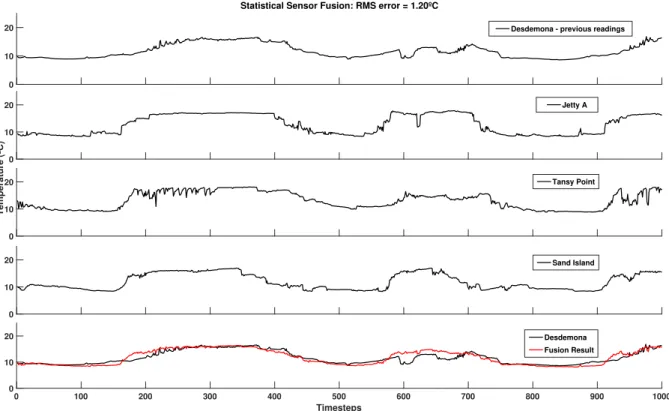
3.3.1 Kalman filters . . . 51
3.3.2 Statistical fusion . . . 55
3.3.3 Artificial neural networks . . . 60
3.4 Environmental dynamics . . . 66
3.4.1 Model-based fusion . . . 67
3.4.2 Virtual sensors . . . 67
3.5 Summary . . . 71
4 Dependable data quality oriented methodology 74
4.1 Introduction . . . 74
4.2 Problem decomposition . . . 75
4.2.1 Spurious and systematic errors . . . 75
4.2.2 Failures and events . . . 77
4.2.3 Estimation for detection and correction of failures . . . 79
4.3 Methodology overview . . . 80
4.3.1 System model . . . 81
4.3.2 Framework . . . 82
4.3.3 Building blocks . . . 83
4.4 Summary . . . 86
5 Dependable outlier detection 88
5.1 Introduction . . . 88
5.2 Related work . . . 89
CONTENTS
5.3.1 Case study description . . . 92
5.3.2 Outlier detection solution . . . 92
5.3.3 Application results . . . 102
5.4 Validation . . . 108
5.5 Summary . . . 112
6 Offset and drifting failures detection 114
6.1 Introduction . . . 114
6.2 Related work . . . 115
6.3 Instantiation and results . . . 117
6.3.1 Dataset and injected failures . . . 117
6.3.2 Systematic failures solution . . . 119
6.3.3 Application results . . . 125
6.4 Summary . . . 130
7 Conclusions and future work considerations 132
7.1 Conclusions . . . 132
7.2 Future work considerations . . . 135
List of Figures
1.1 General framework of the work. . . 6
2.1 Generic sensor model. . . 15
2.2 Sensors failure modes. The faulty sensor output is represented with a filled
line, whereas the real values are depicted with a dashed line. . . 19
2.3 Schema of the categories of solutions for dependable WSNs. . . 29
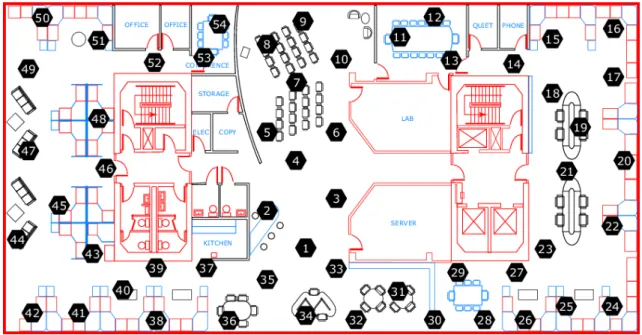
2.4 Location of the motes inside the lab. . . 40
2.5 Monitored area of the SATURN network highlighted in red (image taken
using Google Maps). . . 41
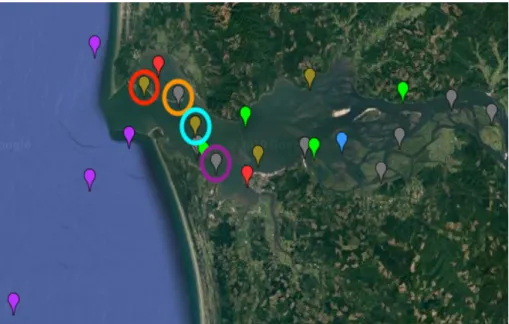
2.6 SATURN with highlighted stations Jetty A, Lower Sand Island light,
Des-demona Sands light and Tansy Point. . . 41
2.7 Temperature (Celsius degrees) measured for 2 days in Lower Sand Island
light. . . 42
2.8 Temperature (◦C) measured for 2 years in Desdemona Sands Light. . . 43
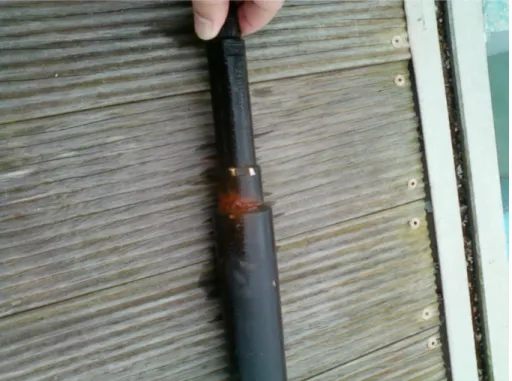
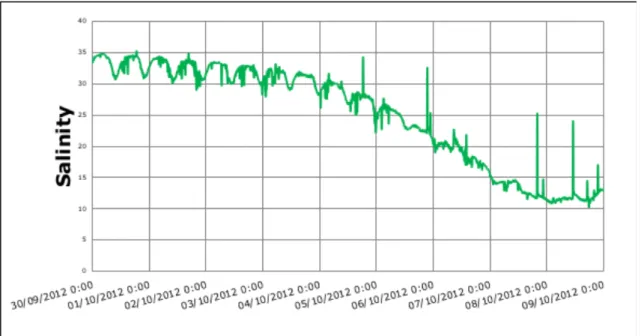
3.1 Oxidation of a water quality probe caused by the harsh aquatic environment. 48
3.2 Algae and small organisms attached to the sensor casing. . . 48
3.3 Sensor malfunction after accumulation of micro-organisms in the sensor. . . 49
3.4 Sensor malfunction during and after a severe meteorological event. . . 49
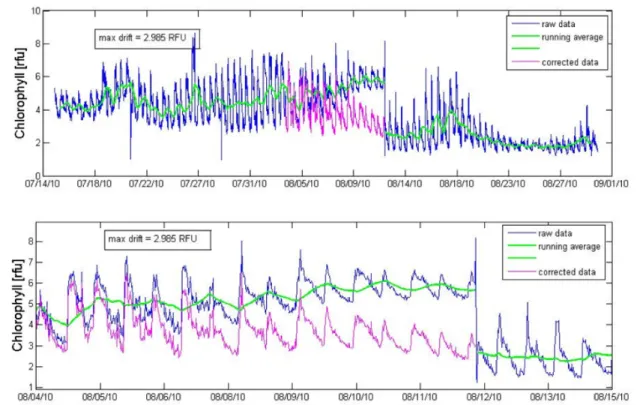
3.5 Detection and correction of drift failures in a SATURN dataset. . . 50
3.6 Kalman equations and iteration steps. . . 54
3.7 Results with sensor fusion through basic Kalman filter for Tansy Point sensor 56
3.8 Results with sensor fusion through basic Kalman filter for Sand Island sensor 56
3.9 Results with sensor fusion through basic Kalman filter for Desdemona sensor 57
3.10 Results with sensor fusion through basic Kalman filter for Jetty A sensor . 57
3.11 Results with sensor fusion through statistical technique for Desdemona sensor 60
3.12 An example of a MLP feedforward neural network. . . 61
LIST OF FIGURES
3.14 First results with sensor fusion through ANNs technique for Desdemona
sensor . . . 65
3.15 Results with sensor fusion through ANNs technique with 20 inputs from
each sensor, for Desdemona sensor . . . 65
3.16 Results with sensor fusion through ANNs technique with 60 inputs from
target sensor and 20 inputs from the neighbors, for Desdemona sensor . . . 66
3.17 Hydrodynamics circulation outputs at Columbia River in the area of the
case study sensor nodes. . . 68
3.18 Jetty A sensor in the red circle, Saturn07 in the green circle and Sand
Island sensor in the pink circle. . . 68
3.19 Hydrodynamics circulation outputs at Columbia River with the location of
the sensor nodes. . . 69
3.20 Results with sensor fusion through ANNs technique with 20 inputs from Desdemona sensor and 20 inputs from the neighbors, including a virtual
sensor instead of Jetty A sensor. . . 70
3.21 Results with sensor fusion through ANNs technique with 20 inputs from Desdemona sensor and 20 inputs from the neighbors, excluding the Jetty
A sensor. . . 71
4.1 Flow diagram of the methodology. . . 83
5.1 Prediction models training dataset . . . 93
5.2 Outlier testing dataset . . . 94
5.3 ANN MLP structure. . . 95
5.4 Comparison method training dataset . . . 98
5.5 Log-logistic probability fit for the square errors. . . 99
5.6 Cumulative Density Function of the distribution probability of the square
errors. . . 99
5.7 Example with the probability threshold of 0.8. . . 100
5.8 Detected outliers. . . 105
5.9 QE output. . . 106
5.10 FD output without MR strategy. . . 108
5.11 MR output for sensors Desdemona and Tansy Point. . . 109
6.1 Testing dataset. . . 118
6.2 Categories of Drifting failures. . . 119
6.3 Prediction subsets of a network, for a target sensor w. . . 121
LIST OF FIGURES
6.5 Offset +2◦C and linear drift failures (injected). . . 126
6.6 Number of false positives detected in a batch of 50 different thresholds. . . 127
6.7 Detection of the failure scenarios. . . 129
6.8 Final signal with MR outputs versus original dataset without failures
List of Tables
2.1 Advantages and disadvantages of the various displacement effects . . . 18
5.1 Experimental results for all sensors and thresholds. . . 104
5.2 Number of detected outliers for all sensors according to the MR strategy. . 107
5.3 Normal Distributions of the experimental datasets. . . 110
5.4 Comparison between ANNODE and other approaches. . . 111
List of Publications
The following is a list of publications containing the work presented in this thesis as well as some additional results.
1. Gonçalo Jesus, António Casimiro, and Anabela Oliveira. Towards dependable measurements in coastal sensors networks. In European Workshop on Dependable Computing, pages 190–193. Springer, 2013
2. Gonçalo Jesus, Anabela Oliveira, and António Casimiro. Ensuring reliable mea-surements in remote aquatic sensor networks. In 2014 International Conference on Hydroinformatics. CUNY Academic Works, 2014
3. Gonçalo Jesus, Anabela Oliveira, Alberto Azevedo and António Casimiro. Im-proving sensor-fusion with environmental models. In 2015 IEEE SENSORS, Busan, pages 1–4. IEEE, 2015
4. Gonçalo Jesus, António Casimiro, and Anabela Oliveira. A survey on data quality for dependable monitoring in wireless sensor networks. Sensors, 17(9):2010, 2017 5. Gonçalo Jesus, António Casimiro, and Anabela Oliveira. Dependable outlier
de-tection in harsh environments monitoring systems. In Computer Safety, Reliabil-ity, and Security – SAFECOMP 2018 Workshops, ASSURE, DECSoS, SASSUR, STRIVE, WAISE, and ICCS, Trento, Italy, September 18, 2018, Proceedings, pages 224–233. Springer, 2018
The following list contains all the publications during the period of the thesis regarding related work in which the author participated but it was not included here.
1. Gonçalo Jesus, João Gomes, NA Ribeiro, and Anabela Oliveira. Custom deploy-ment of a Nowcast-forecast information system in coastal regions. In Proceedings of Geomundus. 2012
2. Anabela Oliveira, LM David, M Rodrigues, Gonçalo Jesus, J Rogeiro, J Costa, JL Gomes, JP Fernandes, JS Matos, F Ferreira and others. Sistema Inteligente de Apoio à Gestão Avançada de Sistemas Urbanos de Aguas Residuais. LNEC, 2012 3. Luís Mesquita David, Anabela Oliveira, José Saldanha Matos, Pedro Póvoa, José
Menaia, R Carvalho, Marta Rodrigues, Gonçalo Jesus, André B Fortunato, Carla Rodrigues and others. Metodologia de desenvolvimento de sistemas integrados de alerta em tempo real da qualidade de águas estuarinas. APRH, 2012
4. Marta Rodrigues, J Costa, Gonçalo Jesus, AB Fortunato, J Rogeiro, JL Gomes, Anabela Oliveira, and LM David. Application of an estuarine and coastal nowcast-forecast information system to the Tagus estuary. In 6th SCARC. 2013
5. Alberto Azevedo, S Boer, Gonçalo Jesus, JL Gomes, Anabela Oliveira, AB For-tunato. Sistema computacional de alta resolução para planeamento e resposta a derrames de hidrocarbonetos em aplicações oceânicas, costeiras e estuarinas. Con-gresso das Zonas Costeiras 2013, 2013
6. Anabela Oliveira, L David, M Rodrigues, J Santos, P Póvoa, C David, JS Matos, F Ferreira, Gonçalo Jesus, J Costa and others. Sistema de previsão em tempo real da dinâmica e qualidade da água de sistemas de drenagem urbanos e respetivos meios recetores. In Proceedings of SILUSBA. 2013
7. Alberto Azevedo, Gonçalo Jesus, JL Gomes, Anabela Oliveira, and AB Fortunato. RDFS-PT: A nowcast-forecast system for high resolution coastal applications. In Book of Abstracts of The Future of Operational Oceanography 2013 Conference. 2013 8. Luís Mesquita David, Anabela Oliveira, Marta Rodrigues, Gonçalo Jesus, Pedro Póvoa, Conceição David, Ricardo Costa, AB Fortunato, José Menaia, A Frazão, and others. Development of an integrated system for early warning of recreational waters contamination. In NOVATECH 2013. GRAIE, 2013
9. Marta Rodrigues, LM David, Anabela Oliveira, AB Fortunato, J Menaia, J Costa, T Mota, J Rogeiro, Gonçalo Jesus, P Morais and others. Deliverable 4.3. 4-On-line monitoring of CSO: sewer and receiving waters. PREPARED Project Deliverable. 2013
10. Gonçalo Jesus, JL Gomes, Anabela Oliveira, S Boer and Alberto Azevedo. From a nowcast-forecast information system to an oil spill risk assessment and response tool. In Proceedings of Geomundus. 2013
11. João Gomes, Marta Rodrigues, Alberto Azevedo, Gonçalo Jesus, João Rogeiro and Anabela Oliveira. From a nowcast-forecast information system to an oil spill risk assessment and response tool. In 2013 Eighth International Conference on Broadband and Wireless Computing, Communication and Applications, pages 518– 523. IEEE, 2013
12. Anabela Oliveira, J Rogeiro, Gonçalo Jesus, AB Fortunato, LM David, M Ro-drigues, J Costa, T Mota, JL Gomes and RS Matos. Deliverable 4.3. 5 Real-time monitoring and forecast platform to support early warning of faecal contamination in recreational waters. 2014
13. Luís Mesquita David, Anabela Oliveira, Marta Rodrigues, AB Fortunato, J Rogeiro, Gonçalo Jesus, T Mota, J Costa, J Menaia, P Póvoa, and others. Real-time moni-toring and forecasting system for early warning of recreational waters contamination. 2014
14. Rafaela Matos, F Ferreira, J Saldanha Matos, Anabela Oliveira, L David, M Ro-drigues, Gonçalo Jesus, J Rogeiro, J Costa, T Mota, and others. Implementation of an early warning system in urban drainage infrastructures for direct discharges and flood risk management. WIT Transactions on The Built Environment,139. WIT Press, 2014
15. Alberto Azevedo, André B Fortunato, Bruno Epifânio, Sérgio den Boer, Eduardo R Oliveira, Fátima L Alves, Gonçalo Jesus, João L Gomes, Anabela Oliveira. WIFF - Oil spill forecast framework: application to the Aveiro lagoon. In 13th International Workshop on Multiscale (Un)-structured mesh numerical ocean modeling LNEC, 2014
16. Marta Rodrigues, Anabela Oliveira, AB Fortunato, H Queiroga, LM David, V Bro-tas, J Costa, J Rogeiro, Gonçalo Jesus, JL Gomes, and others. Management of estuarine and coastal ecosystems: observatories as effective tools to predict and an-ticipate changes. In ECSA 54 Conference - Coastal systems under change: tuning assessment and management tools. LNEC, 2014
17. Marta Rodrigues, André B Fortunato, Bruno Epifânio, Sérgio den Boer, Gonçalo Jesus, João L Gomes, Anabela Oliveira. A real-time water quality model of the Tagus estuary. In 13th International Workshop on Multiscale (Un)-structured mesh numerical ocean modeling. LNEC, 2014
18. Marta Rodrigues, Anabela Oliveira, LM David, AB Fortunato, J Costa, J Rogeiro, JL Gomes, Gonçalo Jesus, T Mota, P Póvoa, and others. Real-time observatory of
the water quality in the Tagus estuary. Operational Oceanography for Sustainable Blue Growth. In Proceedings of the Seventh EuroGOOS International Conference, pages 535–544. 2014
19. Alberto Azevedo, André B Fortunato, Bruno Epifânio, Sérgio den Boer, Eduardo R Oliveira, Fátima L Alves, Gonçalo Jesus, João L Gomes, Anabela Oliveira. WIFF - A Nowcast-Forecast system for high-resolution coastal applications. In Proceedings of the Seventh EuroGOOS International Conference. 2014
20. Anabela Oliveira, Gonçalo Jesus, JL Gomes, J Rogeiro, A Azevedo, M Rodrigues, AB Fortunato, JM Dias, LM Tomas, and L Vaz and others. An interactive WebGIS observatory platform for enhanced support of integrated coastal management. Jour-nal of Coastal Research, 70(sp1):507–513. BioOne, 2014
21. Luís M David, Anabela Oliveira, Marta Rodrigues, André B Fortunato, José Menaia, Pedro Póvoa, Conceição David, Filipa Ferreira, Joana Costa, Tiago Mota, and oth-ers. Plataforma de previsão e monitorização em tempo real para gestão operacional de sistemas de drenagem urbana. LNEC, 2014
22. Tiago Mota, LM David, A Rocha, Gonçalo Jesus, Anabela Oliveira. Assessment of the flow predictions from a large urban drainage model forced by distinct spatial resolution weather forecasts. LNEC, 2014
23. João L Gomes, Gonçalo Jesus, João Rogeiro, Anabela Oliveira, Ricardo Tavares da Costa, André B Fortunato. Molines-towards a responsive web platform for flood forecasting and risk mitigation. In 2015 Federated Conference on Computer Science and Information Systems (FedCSIS), pages 1171–1176. IEEE, 2015
24. João L Gomes, Gonçalo Jesus, João Rogeiro, Anabela Oliveira, Ricardo Tavares da Costa, André B Fortunato. An Innovative Web Platform for Flood Risk Manage-ment. In International Conference on Innovative Network Systems and Applications, pages 217–231. Springer, 2015
25. Marta Rodrigues, Gonçalo Jesus, J Rogeiro, AB Fortunato, JL Gomes, Anabela Oliveira. RealQual: Towards real-time high-resolution monitoring and prediction of water quality in estuaries and coastal areas. LNEC, 2015
26. Luis David, M Rodrigues, AB Fortunato, Anabela Oliveira, T Mota, J Costa, J Rogeiro, Gonçalo Jesus, JL Gomes, J Menaia, and others. Demonstration system for early warning of faecal contamination in recreational waters in Lisbon. Climate
Change, Water Supply and Sanitation: Risk Assessment, Management, Mitigation and Reduction. IWA Publishing, 2015
27. Paula Freire, AB Fortunato, Ana Rilo, K Li, R Costa, Anabela Oliveira, Gonçalo Jesus, JL Gomes, J Rogeiro, P Pinto, and others. Project Molines: Modelling
floods in estuaries. From the hazard to the critical management-Final Report.
LNEC, 2016
28. Alberto Azevedo, André B Fortunato, Bruno Epifânio, Sérgio den Boer, Eduardo R Oliveira, Fátima L Alves, Gonçalo Jesus, João L Gomes, Anabela Oliveira. An oil risk management system based on high-resolution hazard and vulnerability calculations. Ocean & coastal management, 136:1–18. Elsevier, 2017
29. André B Fortunato, Anabela Oliveira, João Rogeiro, Ricardo Costa, João L Gomes, Kai Li, Gonçalo Jesus, Paula Freire, Ana Rilo, Ana Mendes, and others. Opera-tional forecast framework applied to extreme sea levels at regional and local scales. Journal of Operational Oceanography, 10(1):1–15. Taylor & Francis, 2017
Chapter 1
Introduction
1.1
Background
Natural and man-made disasters worldwide cause widespread destruction of property, human injuries and deaths. Risk management and hazard mitigation procedures aim to reduce human losses and diminish the damages related to these disasters. In fact, risk management is a consequence of three fundamental aspects: i) a structure is always a po-tential hazard, ii) natural hazards are unpredictable and iii) the necessity to guarantee the safety of the population, in case of a hazard. Moreover, hazards prevention and mitigation actions are greatly supported by adequate monitoring and timely early warning.
Recently, the processes of event detection, early alert and population warning have evolved from traditional approaches, to be assured by automated systems, with more or
less human assistance. SAGE-B [61], for instance, was developed to support all
fundamen-tal data related to dams and to the emergency elements in case of a dam-break flood, such as the dynamic information about the population in the areas at risk or the rescue vehicles located in the predicted flooded areas. Information systems such as the one mentioned can also be used for natural floods, accounting for existence of the protection structures (dikes and levees) and the flooding events resulting from their breach and failure, forced by multiple drivers (river flows, storm surges, sea waves) that can induce floods from the hydrographic basin to the coast.
Unfortunately, many disaster management systems worldwide suffer significant func-tional limitations, due to the difficulties in accessing realtime monitoring data overcoming unreliable and inconsistent multiple-source information, and dealing with insufficient
ca-pacity for sharing this information across multiple emergency actors [137]. For instance,
in a natural or man-induced flood, the factors that influence the exposure can be
evalu-ated before the event [72] through prediction of the water dynamics [69], which can be
anticipated. Therefore, any limitation in information management has negative impacts on the quality of decision-making and hence on the success of disaster response.
The availability of systems delivering reliable information from dependable sources is vital for the protection of human lives as well as material and natural assets. Anticipating the occurrence or early detecting hazardous events in real-time is the most optimal way to ensure an appropriate and timely response. However the methodology for real-time monitoring and its support to real-time forecasting of the hazardous events should be optimized for the requirements of specific water-related problems and even of individual water bodies. Water management entities and utilities worldwide therefore employ on-line
monitoring tools and early warning systems [160], integrated into intelligent platforms that
support real-time management of water systems both for daily tasks and in emergency
situations [79].
Frequently, danger events occur due to combined sources of danger. Additionally, the approaches used for one type of event cannot be used for other events as their character-istics and risk requirements are distinct. Floods will be taken as an example, which is one of the major natural hazards in most of the countries around the world. The focus of most past flood analysis has been the slow-onset fluvial floods and the combination of surge and tidal floods (especially in areas where coastal flood risk is high), which are simpler to monitor and predict. However, many countries face dangerous risks with other types of floods, most associated with human activities, such as urban drainage floods, flash
floods, dam (artificial and natural) break floods or even ice-ham back water floods [131].
A common denominator is the need for robust, timely and dependable data on the forcing factors on the consequences in the field.
Although it is possible to forecast most physical phenomena accurately (at least at large scales), dependable real-time monitored data, such as water level, flow or precipita-tion, is essential in order to confirm predictions and to support the issuing of alerts and support decisions on mitigation measures to be performed in areas at risk. Phenomena forecasting and monitoring, simulation, evaluation and analysis of the derived risks are of the utmost importance in losses prevention.
Integrating wireless sensors and web-based decision support systems [160] plays a
main role in monitoring, controlling, relieving, and assessing disasters. This combination together with large-scale computation either for forecasting/simulations or data analysis, facilitates decisions needed to manage environmental threats.
The time dimension is critical for such systems. All the components of risk man-agement system operate within a constrained time frame, which is desirably short, for the successful protection of people and assets. When an alarm response time exceeds the target response time, warnings are useless. Furthermore, because disaster-warning applications are safety critical and might carry significant financial penalties and loss of human lives in case of failure, they must meet all the appropriate criticality constraints.
They should be able to tolerate both hardware and software failures and not fail at critical moments in any of the tiers. Forecast simulations may also present errors due to insuf-ficient physics, poor numerical formulations, inadequate model applications or cascading errors from the long scale atmospheric modeling down to the water dynamics at the scale of interest. On the monitoring side, which in turn support the simulation results, the individual and collective readings from the network of sensors on-site must be validated in association with the simulation results, in order to sustain a scientific basis for the early warning. Therefore, the quality and validity of monitored measurements is an important component for the warning and alert issuing.
However, when monitoring harsh environments, the deployed sensors have to perform under unfavorable conditions, producing several types of uncertainties:
• Measurements may be imprecise, incorrect, incomplete, incoherent or inappropriate to the problem at hand;
• Ambiguous observations (for instance if another object or event interferes with the one in question);
• Reduced or limited representation of the reality.
Most of these situations happen from sensor malfunction due to continuous exposure to the environment or negative impact of environment-related phenomena. Though the goal of detecting faulty situations in sensor networks is a well-known research subject, the majority of the works in this area is focused on controlled environment setups, where the sensors represent a reliable view to the monitored system. Additionally, these works do not consider the presence of environmental interference events on sensor measurements
[63], while other studies that consider it are mainly focused on wireless communication
faults [39].
Therefore, increasing sensor data quality in the scenarios of environment monitoring networks is an important asset for the stakeholders, with particular challenges that are not studied in most of network setups. In these setups, the operational conditions are challenging and ensuring their reliability is often hard or costly, with severe consequences to sensor data collection or the sensor data itself.
Environment network setups are meant to monitor and cover a usually large area [157],
being comprised of clusters of sensors widespread, sometimes with hundreds of meters dis-tance between them. This setup requires large maintenance operations costs in particular to maintain tight requirements in providing accurate, reliable and timely information to assist the stakeholders. This availability, coupled with reliability, of the near real-time monitoring information is a difficult requirement in real implementations of monitoring
networks. Building and maintaining these high-quality data networks is thus a complex and challenging task.
1.2
Motivation
A reliable continuous flow of real-time data is dependent on complex and powerful forecast systems that are now able to predict environmental variables such as storm events with small errors. Reliable real-time monitoring data, such as surface water elevation, flow or water quality variables rely on the sensor hardware and the communication networks in place at the physical environment (oceans, river, lakes, etc.) and its proper maintenance. The effectiveness of existing emergency warning and forecast procedures for natural and man-made hazardous events may thus be limited by several factors, including an often sparse and unreliable real-time observational network, use of coarse-resolution pre-diction models, and the reliance on traditional approaches to convey warning and forecast information.
Ensuring the quality of monitoring data is fundamental to avoid false alarms or to ignore relevant data. However, because these sensors are located in the physical envi-ronment, they are constantly being subjected to factors that directly interfere with the data quality, such as potentially strong currents, debris accumulation and tough weather conditions. Consequently, there is a trust issue related to the collected data, which de-mands an extensive human intervention in terms of time and knowledge specialization, data validation tasks and periodic maintenance of sensors.
In fact, several authors confirmed that environment monitoring networks datasets
contain a relatively large presence of faulty data. In [155], the authors verified that the
range of faulty data can reach up to 20% of outputted sensors datasets, which include multiple types of errors. Also, in another experiment including a 33 sensors network
deployed in a forest for the period of 44 days [171], 51% of the collected data contained
different data anomalies. Similar conclusions to the previous studies were reached in the
Great Duck Island deployment [161], where data from each sensor was considered faulty
in a range from 3% to 60%.
In spite of the vast research on the dependability of distributed systems, in particular on computational architectures/frameworks for reliable and timely operations,
monitor-ing systems pose new challenges to dependability [52]. The sensory and sensor network
technologies, that are now becoming widely available, are subject to diverse hazards and may not be sufficiently reliable and robust against harsh exogenous and/or environmen-tal factors. There is still a lack of architectural, fault-tolerance and system management solutions, which are essential for dependable, robust remote monitoring, necessary for
adequate water management.
There is a need to support the stakeholders with tools that allow a better decision-making, by combining robust, reliable and validated sensor networks, which may integrate both conventional (expensive) and novel (low-cost) sensor nodes of wireless sensor net-works. Herein, the validity of the sensing information assumes a central role without neglecting the specific requirements of the monitored environment.
To deal with this problem it is necessary to continuously and automatically charac-terize the quality of collected data. Therefore, the application of techniques based in the existence of redundancy at the data collection and data processing levels is a promising approach.
1.3
Objectives and approach
This work aims at the design and validation of a general methodology that frameworks data quality-oriented solutions for dependable monitoring in environmental sensor net-works.
The methodology aims at fulfilling three objectives. The main objective is to detect, categorize and correct faulty measurements in environment monitoring sensor networks. Faults in both sensors and networks have different natures and consequently produce different outputs in the respective measurements datasets. In the context of environment monitoring networks, due to the multitude of external factors that may interfere with the sensor readings, there is not a well-defined process to automatically produce a correction or an estimation to replace the faulty measurement. Current solutions either do not contemplate all types of failures or are not adequate to environment monitoring networks. The second objective is the analysis of the impact of the environment in the monitoring network and, specifically, in the sensors measurements. Moreover, focusing on the effects of environmental factors in sensing data, there is a particular interest in the environmental-related and impactful events, and its distinction from sensor failures. Generally, faults detection and correction solutions do not account for the presence of external events, which eventually may lead to false positive detection situations.
Finally, the third objective is the automated analysis of the data quality, regarding sensor readings. The typical quality control procedures include a manual overview of the network datasets to analyze correlated sensors and the existence of failures within those datasets. Given the nature of such procedures, one of the requirements for its execution is the expert-knowledge on the monitoring site and network deployment. The automation of the quality control and subsequent data quality evaluation can be performed using the intelligent establishment of sensors correlations and the detection of existing failures.
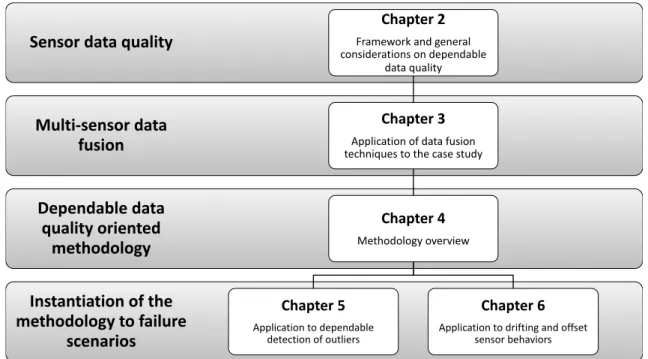
Instantiation of the methodology to failure scenarios Dependable data quality oriented methodology Multi-sensor data fusion Sensor data quality
Chapter 2
Framework and general considerations on dependable
data quality
Chapter 3
Application of data fusion techniques to the case study
Chapter 4 Methodology overview Chapter 5 Application to dependable detection of outliers Chapter 6
Application to drifting and offset sensor behaviors
Figure 1.1: General framework of the work.
To address the problem considered in this thesis and achieve the stated objectives, we
defined an approach including the following steps, also outlined in Figure 1.1:
• Identification and characterization of existing solutions to dependable monitoring in sensor networks, through the analysis of the several types of faults that affect the sensors and network operation, and the respective strategies to mitigate the effects on sensor data and relevant failure modes;
• Gathering of the effects of the aquatic environment and related phenomena on the sensors deployed on those environments;
• Evaluation of the feasibility of data fusion strategies based on machine learning for the modeling of sensors behavior through the exploitation of spatiotemporal correlations between neighbor sensors within a sensor network. And study of the introduction of environment-specific and complex computational model products as a redundancy strategy to improve data fusion results;
• Design of a dependable data quality oriented methodology for the application to environmental monitoring systems, that are subjected to harsh and highly dynamic conditions. The aim is to provide a basis to increase data quality in sensor networks, considering intelligent techniques that explore and analyze the correlations between neighbor sensors;
• Evaluation of the methodology through the application and setup of the methodol-ogy in building specific solutions for various datasets and types of failures;
• Validation of a solution according the proposed methodology, based in machine learning data fusion, in particular using artificial neural networks, for the detection and correction of outliers, drifts and offsets in sensor networks datasets.
1.4
Contributions
With the overall goal of presenting a set of procedures that underline the need for au-tomation and intelligent perception of affecting factors in the design of solutions for failure detection and mitigation in environmental sensor networks, the work herein provides the following contributions as an advance to the state-of-the-art:
• The problem decomposition, namely the efficient detection of the failure modes via a new generically applicable methodology to environment monitoring networks (systems that may be subject of unpredictable external phenomena). Although works on fault detection are common, there is a overall emphasis on outliers when other types of failures are relatively ignored and dealt with lightly. The proposed procedures enable the detection of sensor faults affecting sensor measurements, using machine learning techniques;
• The inclusion of environment-related information in the sensor data fusion mecha-nism, in order to improve the overall fusion process. Existing approaches ignore this type of information, using mainly the sensor measurements and its inherent corre-lations. This traditional approach may impact negatively the fusion result either by the possible masking of undetected failures in neighbor sensors or by ignoring false positive failures information in relevant sensors. Such information is processed by the data fusion approaches generating false outcomes on both detection and correction mechanisms. A methodology proposed in this thesis, comprising fusion approaches with relevant information, provides a monitoring data quality increase when comparing to the typical methods;
• A data quality coefficient is assigned to each new measurement. Typically, failure detection and correction solutions are only focused on producing a corrected value or detecting a failure occurrence disregarding the associated quality of the outcome. In the proposed methodology, the quality coefficient is dynamically attributed to each new measurement based on the methods used to detect and correct failures,
considering not only their outcome but also additional information regarding neigh-bor sensors performance, including in particular if there is any failure affecting its measurements.
1.5
Structure of the document
The document is structured in seven chapters. The initial and present chapter,
Chap-ter 1, corresponds to a general introduction of objectives, final contributions and general
context.
An overview of the following chapters and their sequence is highlighted in Figure1.1,
from the problem statement to the definition of the methodology proposed herein and its instantiations.
In Chapter 2 an extensive perspective of the multiple sides of sensor data quality
issues in monitoring sensor networks is presented. This chapter has a clear focus on the dependability aspects concerning the sensor devices, the interconnecting network, and the resulting monitoring data to further processing systems. Additionally, multiple sensor networks datasets are presented, and in particular the thesis case study is described.
Chapter 3 discusses the importance of sensor data fusion with the goal of increasing
data quality. Several applications of data fusion techniques are presented, mainly in the context of modeling sensor behaviors and learning environment dynamics.
In Chapter 4 a novel dependable data quality oriented methodology is proposed for
environmental monitoring sensor networks.
Chapter 5instantiates the methodology from Chapter 4 to setup and validate a new
solution for the detection and correction of outliers (ANNODE) in two different environ-ments.
While in the previous chapter the focus is on outliers, Chapter 6 focuses on failures
that are systematic or continuous during a determined period of time, in particular the detection of drifts and offsets.
Finally, Chapter 7states the conclusions drawn from the study and proposes possible
Chapter 2
Context and state-of-the-art
2.1
Introduction
In order to increase the dependability of monitoring applications in wireless sensor network (WSN) settings, one must be aware that the quality of monitoring data can be affected by faults. In essence, there is a problem of data quality assurance, which can be faced taking two main perspectives: by deploying dependability techniques to handle faults and enforce the reliability of the system, or by enhancing the system with means to continuously assess
and characterize the quality of data [41]. In the former case, the system will not be aware
about the quality of data. Therefore, if a certain quality is needed, it must be enforced by design, confining the effects of faults a priori. Considering sensors to be one of the main sources of data, errors in sensing measurements are handled by procedures that are
established based on a deep understanding of the characteristics of the sensors [64]. For
instance, missing readings may be handled by oversampling, while outliers and noise can be handled through averaging over a window of samples. In the latter case, the system will be aware of data quality through the use of data analysis techniques and will then be able to adapt its behavior or apply mitigation measures when this quality is deemed not adequate. For instance it may be possible to exploit knowledge about the physical processes being monitored to determine appropriate data corrections in order to obtain the needed data quality. Given that no system can be built to exhibit 100% reliability, the two perspectives can be combined. In this chapter, the latter perspective was selected considering that the quality of sensor data can be assessed, providing an indication of the overall system health, encompassing sensors, the wireless network and the processing tasks.
Assuring the quality of sensor data for a dependable operation is particularly chal-lenging in some WSN-based monitoring applications. In fact, it is often the case that the sensors and the WSN are deployed in harsh environments and exposed to extreme
phys-ical conditions, thus being more likely affected by faults. The problem becomes critphys-ical when dependability is an important application requirement. For instance, in water-related information systems, inaccurate information in aquatic monitoring may lead to false warnings being issued, or harmful situations not being detected early enough (e.g.,
floods or pollution events) [150]. Therefore, ensuring the accuracy of collected data is
also necessary for effectiveness reasons. In this example, the operational conditions are typically hard to accurately predict, ensuring the reliability of operations is often hard or costly, and the consequences of inaccurate sensor data collection can be severe.
Herein, existing solutions to assure dependable monitoring in WSNs are characterized and systematized in a two steps procedure. In the first step, the root cause of dependabil-ity problems is analyzed concerning the qualdependabil-ity of sensor data. Moreover, several kinds of faults that may affect the system operation are identified, in particular at sensor and
network levels, with their effect on sensor data and in the relevant failure modes [57].
When appropriate, mitigation solutions for the adjustment of the sensors measurements according to each disturbance are referred. Then, a comprehensive overview is provided regarding solutions to achieve improved sensor data quality and a dependable operation of WSN-based monitoring applications. In addition to detection and correction strategies, fault-tolerance strategies based on sensor data fusion procedures are portrayed, exploiting the availability of redundant measurements or available modelling surrogates. However, we only overview works and solutions related to monitoring in aquatic environments, not-ing that these solutions are also applicable in many other contexts, but that the opposite might not be true, in particular concerning solutions that are not agnostic to the semantics of the monitored data.
The chapter is organized as follows. Section 2.2 describes the concept of data quality
and the main aspects that may affect this quality during monitoring. Section2.3presents
an overview on solutions for dependable sensor networks. Section 2.4 introduces the
applications that motivated this study, and the open research issues associated with it.
Section2.5discusses the existence of datasets for fault detection and aquatic environment
monitoring datasets. The chapter concludes in Section 2.6, with a discussion on the
possible results from the solutions mentioned herein.
2.2
Sensor data quality
When the quality of sensor data is an important attribute for the dependability of the application, it becomes necessary to express this quality through indicators, which can be done in various ways. Additionally, a priori knowledge about the possible causes of quality degradation, translated into faults and a corresponding fault model, is also relevant. This
knowledge will enable a more accurate characterization of the quality of sensor data. Moreover it enables to incorporate in the system techniques to mitigate the effects of specific faults, assumed in the fault model. These aspects are addressed in the following sections.
2.2.1
Dependability strategies
When designing a fault-tolerant and dependable system, the typical means to deal with
system errors and faults include error detection and fault handling. In this context,
endowing the system with redundant components can be instrumental to compensate existing errors or faults affecting a component. The affected component can be replaced in its tasks by the spare, redundant component, which will ensure that the system function will remain being provided. However, redundancy does not refer solely to having multiple similar hardware and/or software components, which is just one type of redundancy. There are also forms of redundancy in the time (e.g., repeating some action multiple
times) and in the value domains (e.g., adding extra information) [174].
Some examples of space redundancy include storing information in several disks, ma-chines or data centres, having multiple nodes performing the same computation (either in parallel, called active replication, or with some nodes in stand-by mode, called passive
replication), or sending a network message through multiple network paths [26].
Temporal redundancy is typically explored in reliable communication systems that retransmit messages when they suspect that these messages might have been lost in previous transmissions. Restarting an aborted transaction or a deadlocked computation
are also examples of temporal redundancy [108].
Lastly, redundancy in the value domain, sometimes referred to as data or information redundancy, is observed in data storage and communication systems that use error correct-ing codes associated to the stored or transmitted data, allowcorrect-ing the original information
to be reconstructed when some bits or parts of the information become corrupted [108].
To deal with malicious forms of information corruption, cryptographic signatures may be used.
In the application of these concepts to sensor validation, [91] stated that there are two
classical approaches widely used: a) analytical redundancy and b) hardware redundancy. Analytical redundancy uses mathematical relationships between measurements to predict or infer a sensor’s value. One disadvantage of this approach is the possible inefficiency of the mathematical processes when there exists a large number of sensors and the model complexity increases. Another disadvantage is the fact that the mathematical relation-ships can be very data specific and a slight modification may require significant efforts. Hardware redundancy is not always possible because of the costs implied by additional