Forging a New Middle Class in Emerging Democracies
JAIRO BAQUERO MELO
ABSTRACT In diesem Artikel analysiere ich die Beziehung zwischen Ruralität und Mittelklassen. Wenige rezente Studien zu Mittelklassen haben die Bedeutung der Ruralität im Prozess der Mittelklassen-Expansion auf globaler Ebene analysiert. Die vorliegende kritische Analyse der Beziehung von Ruralität und Mittelklassen entstand vor dem Hintergrund eines starken Anstieges an Studien über globale Mittelklassen in den letzten Jahren. Dieser Anstieg spiegelt möglicherweise den sich entwickelnden politischen und akad-emischen Diskurs innerhalb von Mainstream-Organisationen wider, durch den die Expansion der urbanen Mittelklassen befördert werden soll. Deshalb ist eine kritische Analyse dieser politischen und akademischen Diskurse zu den vielfältigen Auswirkungen der Expansion der urbanen Mittelklassen auf Natur und ländliche Gebiete sowie die ländliche Bevölkerung notwendig. In einer Fallstudie zu Kolumbien verwendete ich ein Set unterschiedlicher Forschungsmethoden. Die Ergebnisse deuten auf ein Paradoxon hin, das mit der Expansion der Mittelklassen einhergeht. Die Expansion zielt zum einen auf die allgemeine Reduktion sozialer Ungleichheit ab, befördert zum anderen aber Ungleichheiten in ländlichen Regionen und im Verhältnis von Stadt und Land. Darüber hinaus vermehrt die Expansion der urbanen Mittelk-lassen Landkonzentration und hat negativen Einfluss auf die Natur. Zugleich fungieren die Beziehungen zwischen urbaner und ländlicher Bevölkerung, und auch neue Formen der Ruralität, die städtische Mittelklasse-Gruppen miteinschließt, unter dem Banner der Nachhaltigkeit. Diese Entwicklungen verdeutlichen die Komplexität von Ungleichheitsstrukturen in Verbindung mit ländlichen und städtischen Bevölkerungsgruppen.
Jairo Baquero Melo
School of Human Sciences, Universidad del Rosario, Colombia [email protected]
JOURNAL FÜR ENTWICKLUNGSPOLITIK XXXIII 4-2017, S. 85–XX
SONIA FLEURY
Forging a New Middle Class in Emerging Democracies
ABSTRACT The article details the production of a narrative about the New Middle Class (NMC) that is recently articulated in academic articles (see among others Neri 2016) and promotes a perspective disseminated by the World Bank, OECD, and The Economist. This narrative also supports governmental strategy to fight poverty. Fighting poverty has been on the Brazilian political agenda since the democratisation process began. However, there are different strategies to deal with this situation, one of which is specified in the Federal Constitution in terms of universal social rights for citizens’ status. The other is based on increasing the consumption power of the poor and is identified by the label of the NMC policies. Each of them has different consequences in terms of subjectivity and sociability.
KEYWORDS Brazil, new middle class, social development, social rights, social mobility
1. Introduction
In recent years, Brazilian society has witnessed one of the most successful cases of reducing poverty. Those who crossed the poverty line were designated as the New Middle Class (NMC) by experts and the government.
The emergence of the NMC is attributed to the recent robust growth in developing countries which has been accompanied by the expansion of the intermediate layers between the poor and the rich. Members of the NMC should have access to a consumption pattern that goes beyond basic needs of food and housing.
SONIA FLEURY Forging a New Middle Class in Emerging Democracies The debate on the NMC challenged disciplines and theoretical
approaches worldwide. While sociologists tend to define the NMC in terms of social mobility based on criteria such as educational level, occupa-tional position and access ownership, economists tend to focus on income levels (Castellani and Parent 2011). More recently, stability, resilience and security of middle class characteristics assumed prominence in the discus-sion on poverty and NMC vulnerability (Ferreira et al. 2012; UNDP 2014; Stampini et al. 2015).
This article seeks to demonstrate the weaknesses of the concept of the NMC, confronting it with theoretical approaches on social classes. In the first part, we highlight that the development model that underlies this concept is focused on consumption, but not on well-being. Consequently, it is incapable of promoting social cohesion, assuring better quality of public services, reducing discrimination or avoiding conflicts and violence.
In the second part, we show that the NMC emerged in late-come democracies with an elevated level of social exclusion in a context of economic growth, due to the commodities boom in the global trade. Never-theless, there is no theoretical basis to sustain the assumption that indi-viduals leaving poverty and becoming new consumers are also becoming new political actors who share democratic values, which aspirations would propel countries’ development.
In the third part we explain how the concept of the NMC was appro-priated by the government and became a mark of its affirmative actions and redistributive policies, launched to fight poverty and inequality. We want to highlight the fact that fighting poverty and promoting social inclusion has been on the political agenda since the democratisation process began in Brazil. However, there are different strategies to generate a more inclu-sive and less unequal society in Brazil. One of them is the so-called NMC proposal. The other we can call the citizenship expansion process, included in the Federal Constitution in 1988 (Fleury 2013a).
While the concept of the NMC obscures the discussion on poverty from the point of view of occupational structures and social relations, policies aiming to increase consumption lead to the promotion of market values such as individualism and competitiveness. Lack of more skilled jobs and safer working conditions, as well as poor access to better public services, demon-strates the inability to treat as NMC those who go beyond the poverty line.
In conclusion, we discuss the unsustainability of this model of social protection, evidenced by the emergence of what is now called the new poor. We affirm the multidimensional character of social mobility that goes far beyond consumption, involving structural, cultural and social transformations.
2. A misleading concept
The NMC is a misleading concept as far as it is understood exclusively as the movement upward between income stratum, without considering multiple aspects involved in social mobility. Theoretical approaches about social classes help to demonstrate some of the conceptual fragilities of the NMC.
The NMC has been used to designate the emergence of new consumers in emerging economies with large populations in an ascendant movement from poverty to middle class. Based exclusively on income and purchasing power, this concept isolated social climbers, ignoring history and the position inside a given class structure, and, therefore, disconnecting structural determinants from their current conditions and hindering the capacity to predict future opportunities to move up and/ or sustain current positions. Forging the NMC is a response to the need to build a political project to face the current global capitalist crisis that has been reducing growth in developed countries. The expansion of new markets with a substantial number of potential consumers seems to be a possible solution.
Market expansion is considered the main condition to achieve an affluent society, where incorporation of technology in production is responsible for increasing competitiveness and reducing the wealth gap between countries, thereby improving participation in the global economy. Therefore, a model of development lies beneath the economic debate on the NMC, comprising both the means to accelerate economic growth and that to increase per capita income. However, development must be considered according to the fundamental double process represented by increasing material wealth and by using the resources generated in the production to improve quality of life.
SONIA FLEURY Forging a New Middle Class in Emerging Democracies Development embraces intertwined relations including aspects of
material production and human well-being facilitated by extensive extrac-tion of natural resources and within an instituextrac-tional framework. Because of the emphasis on growing consumption the discussion on the emergence of the NMC is blind to development sustainability. For example, the increase in cars selling is seen as a positive sign of consumption growth, not consid-ering the effects on pollution and the increasing number of traffic jams.
Castells and Himanen (2014) state that human well-being, far more importantly than achiving a higher level of income, is the improvement of human quality of life according to the cultural values and personal pref-erences embedded in a given social organisation (Castells/Himanen 2014: 9). Hence, development must add values related to sustainability, as well as reconciling liberal values of dignity, encompassing autonomy and freedom, with social principles of justice, recognition and solidarity.
However, persistent exclusion based on race, gender or rural settlement or unfavourable inclusion due to access to poor public services and very narrow income benefit as well as environmental degradation is observed as results of global economic volatility and risk, defining new political conflicts in developing countries. In the present phase of financial capi-talism, national states are limited to the roles of interest payers and currency controllers, therefore becoming incapable of efficiently promoting public policies that assure citizens’ dignity and sustainable development (Streeck 2015). Consequently, these limitations can jeopardise young democracies, which are unable to expand citizenship and reduce class conflict by estab-lishing an egalitarian principle for social inclusion. For example, in Brazil, improvement in social conditions has had no impact on the reduction in violence. The homicide rate increased 10 per cent between 2005 and 2015 (IPEA 2017). In the same period, the Gini index fell from 0.570 in 2004 to 0.515 in 2014, and the extreme poverty rate saw an average reduction of around 10 per cent per year (IPEA 2014).
The definition of a middle class based exclusively on consumption is different from classical social class definition because it comprises a wide variety of position in the productive structure. In spite of these variations, there is a presumption that they share a common comfortable and some-what stable economic situation, a certain degree of autonomy and the embracement of bourgeois values.
Since Wright Mills’ work in the 1950s, sociologists have designated as upper middle class those individuals that present a high degree of education and autonomy in their work, mostly white-collar professionals, earning annual incomes that permit a comfortable standard of living and economic security. These are features associated with high status, indicating powerful positions and the capacity to influence and shape public opinion. ‘Lower middle class’ is used to designate families with an annual income roughly above the poverty level but more likely than the poorest families to be headed by married couples and to benefit from two incomes. Since they are more likely to include a family head who has attended college and provides economic safety, intergenerational mobility is expected in these families.
However, a recent report concluded that more than 30 per cent of the lower middle class in the US receives food stamps, unemployment benefits, welfare, or other social benefits. The report highlighted struc-tural limitations to social mobility even in families whose choices reflect traditional values, as they are married, college educated, and working (see the Hamilton Project Report cited by Vara 2013). Therefore, autonomy, presupposed in the definition of middle class, is absent both in developing countries and in those developed ones, where the lower middle class is dependent on welfare programmes.
Traditional social theory, such as Marxist and Weberian approaches, highlighted some key features of class analysis that are absent in the recent debate on the NMC. From a Marxist perspective, it is possible to say that the individual’s insertion in the production system and the circumstances of their social reproduction establish conditions of relative deprivation, leading to the development of collective identification and social action. Based on Weber’s sociology, it is important to consider, more than prop-erty or consumption power, individuals’ lifestyles and the value (honour) attributed to them in order to understand power distribution in each society. None of these aspects are considered in the debate on the NMC, because the income criteria is not a relational approach, neither based on an individual’s insertion in the productive process nor on how they are valued in society.
Bourdieu’s work added to the understanding of class, the need to consider attributes that go beyond social status, arguing that class forma-tion is related to shared disposiforma-tions and practices (habitus) and to capital
SONIA FLEURY Forging a New Middle Class in Emerging Democracies (economic, social and symbolic). Habitus is the incorporated class –
product of a lasting subjection to conditions similar to the ones they are placed in – described as systems of durable dispositions that generate and organise practices and representations without presupposing a conscious aim (Bourdieu 1990: 53). Bourdieu stresses the need to understand indi-vidual and group positions as relationships inside a structure. He also remarks on the need to consider that this position is just one point in a social trajectory. Social trajectories are superior, medium or inferior, yet regarding the future, they are ascendant or descendent. Thus, ascendant and descendant can be at the same point, but on different trajectories (Bourdieu 1974: 8). Regarding Brazil, Quadros (2015) explains that the recent growth of the lower middle class is partially due to the impoverish-ment of the upper middle class stratum, moveimpoverish-ment that is only possible to be perceived analysing the occupational structures to capture upward and downward movements.
The complexity of class analysis put forward by Bourdieu is absent in the NMC debates, because most of the studies are unable to examine the relations between income improvement and different habitus and capital access, more properly associated with universal access to public services. The low quality of public schooling in Brazil is a determinant factor in class segregation and the biggest obstacle to social mobility. According to PISA-Program for International Student Assessment1, the Brazilian effort to increase expenditure per student was not followed by a corresponding better performance, and still the difference between the performance of public and private school students is still abysmal.
It is hard to predict the collective action of a group knowing only their consumption patterns and ignoring their trajectories, habitus and values. Sousa (2014) criticises economic studies which are based solely on family income, since they are incapable of contributing, in this way, to under-standing social classes. His sociological studies identified among the poor Brazilians, the socially very precarized ones, provocatively named rabble, and the strugglers, that is, the socially precarious ones, but with greater resources and possibility of social ascension (Sousa 2014: 60). The variable that allows us to differentiate them into these two groups is the ability of the strugglers to incorporate the cultural capital necessary for their compet-itive insertion into the modern capitalist market.
Most of the characteristics attributed more properly to the emergent bourgeoisie were extended to the NMC in the recent debate, characteristics such as entrepreneurship and innovation. Its relevance for economic devel-opment is due to its capacities to foster savings and human capital accumula-tion. By sharing political stability and social mobility values, middle classes tend to support democracy and development (Castelani/ Parent 2011:8).
However, there is no consensus about the link among how middle classes attitudes and political behavior could foster economic development. In order to understand how democracy may affect economic growth, Prez-erworski and Limongi (1993: 64) developed a cross-country study which concluded that it is not possible to affirm that democracy fosters or hinders economic growth, firstly because the determinants of growth are unknown, and, secondly because there is no evidence that politics, particularly polit-ical regimes, affect growth.
Leventoglu (2014) shows that social mobility is potentially related to middle class attitudes towards democracy and democratisation. However, the author remarked that the middle class is not a single actor. For example, according to Koo (1991) in the context of South Korea, the old middle class is more likely to support democratisation than the new version of middle class. Other features attributed to the middle class are entrepreneurship, capacity for saving, and development of human capital. Kharas (2010: 7) found evidence in the literature that contradicts those arguments, since the middle class is better defined by consumerism, by running small and not very profitable businesses, and making no significant contribution to savings and human capital. For the author, therefore, what steadily defines the middle class is consumption. Analysing Kenyan middle class support for democracy, Cheeseman (2014) concluded that class is a significant factor, but it continues to intersect with other identities, such as ethnicity. Regarding the role of the middle class in fostering democracy in recent transitions from authoritarian regimes in Latin America and Asia, Ozbudun (2005) argues that middle classes are not always, and under all circumstances, a democratic force. The role of the middle class varies according to several factors, mostly dependent of the importance of the country’s stage of development and its model of development. He argues that the middle class may favour authoritarian solutions for the country at an intermediate level of economic development, after a prolonged period of
SONIA FLEURY Forging a New Middle Class in Emerging Democracies import-substitution-based industrialisation such as in Latin America; or, it
can promote the emergence and consolidation of democracy in countries with a market-oriented and export promoting strategy, as in recent experi-ences in East Asia.
It is possible to say that the NMC emerged in young democracies with an elevated level of social exclusion, in a context of economic growth, due to the commodities boom in the global trade. However, social theory does not support the assumption that individuals leaving poverty and becoming new consumers also become new political actors who share democratic values and have aspirations that would propel a country’s development.
3. Crafting the NMC
With the article The New Middle-Class Rise Up The Economist (3 September 2011) helped to spread all over the developing world the World Bank studies about the middle class upsurge. It is estimated that middle class population trebled in number between 1990 and 2005 in Asia, reaching 1.5 billion; it rose from 277 to 362 million in Latin America, and from 117 to 197 million in sub-Saharan Africa in the same period. It accounted for a third of Africa’s population in 2008, three-quarters of Latin America’s and almost 90 per cent of China’s. The size of the NMC is projected by economists in a broader range that can vary from people living on 2-20 per day $PPP to 10-100 $PPP (Purchasing Power Parity) (Kharas 2010), or being defined as those people who have roughly a third of their income left for discretionary consumption after paying for basic food and shelter (The Economist, 2009). Independently of how restrictive or broad, simple or complex, the operationalisation of middle class is, the main criteria are based on consumption capacities.
The NMC rise unfolded in the middle of the crisis of the global economy, when the recent economic downward period faced by the affluent devel-oped countries contrasts with the striking growth of developing countries in Asia and Latin America, driven largely by China’s outstanding devel-opment. This disparity regarding economic trends highlights and draws worldwide attention to the emerging economies in the South, and simul-taneously to the rise of a new middle class (NMC).
In 2010, the OECD reported that the rich countries of the world only account for 53 per cent of global output, and, with the economic centre shifting to Asia, it is expected that Asia will reach 57 per cent of global output by 2034 (Kharas 2010). Based on the World Bank’s house-hold survey, a comparative study estimated the size of the middle class for 145 countries, and concluded with a very optimistic scenario, that might only be constricted by conflicts, due to the rise of new Asian giants, which would require a new global political balance to spread benefits to the world economy (Nederveen Pieterse/Cardoso, 2014):
“This scenario, importantly does not depend on a rebound in US consumer demand. Instead, it depends on a sharp upsurge in demand from a new Asian middle-class. I suggest that this new Asian middle-class is large and growing rapidly, and that it is of sufficient size to provide the impetus for demand growth that the world needs.” (Kharas 2010: 38)
Concerning Latin America, the concept of the middle class is used to qualify the move from a middle income to a middle class region, due to fast upward mobility (Ferreira et al. 2013). The study concluded that at least 43 per cent of all Latin Americans changed social classes between the mid-1990s and the end of the 2000s, and that most of this change was upwards, because of an impressive degree of income mobility in Latin America, associated with GDP growth (Ferreira et al. 2013: 5).
However, when adding the criterion of economic security to the traditional income levels to analyse the NMC in Latin America, Ferreira et al. (2013) could identify distinct groups, respectively named as poor (US$ 0-US$ 4 a day), vulnerable (US$4 -US$10 a day), and middle class (US$10- US$ 50 a day). Considering that economic stability presumes a certain degree of resilience to shocks, Ferreira et al. (2013) concluded that the vulnerable class is still the largest social class in Latin America, accounting for 38 per cent of the population.
Nevertheless, the decrease in poverty resulted in the ascension of the middle class to about 30 per cent of the population (Ferreira et al. 2013: 3). This movement occurred during the decade between 2000 and 2010, reflecting both the economic growth and the declining inequality
SONIA FLEURY Forging a New Middle Class in Emerging Democracies in Latin America, although they identify that there is still the possibility
to suffer a reversion in this situation.
This possibility is due to the dependency on economic growth, on commodity demands and price in the global trade market, shocks (reces-sion), absence of public policies to promote emancipation – especially good education – and vast numbers of social climbers in a state of vulnera-bility (unemployment, illness, retirement). In addition, the authors high-light limits to upward mobility, such as the fact that family background is a bigger determinant of student learning in Latin America than in other regions, due to the low quality of public schools (Ferreira et al. 2013).
The importance of protective policies is evidenced when comparing Latin America and OECD countries, leading to the conclusion that while the potential for middle class mobility is not very different between the two regions, the potential mobility of the poor as well as the resilience of the middle class are significantly higher in OECD countries (Castellani/ Parent 2011: 34). This result highlights the vulnerability of some households that are usually considered NMC but have a relatively high probability of experiencing spells of poverty in the future. Therefore, the indispensability of launching public policies to protect the more vulnerable from these hazards impacts both groups in terms of economic and social issues.
Considering that higher incomes alone are not enough to reduce vulnerability, ECLAD (2014) asks for more policies aimed at promoting social pacts, shifting norms to build tolerance, deepening social cohesion, and enhancing resilience. Examples of this kind of policy include commit-ting to universalism regarding the provision of social services, strength-ening social protection, and assuring full employment; building responsive institutions and cohesive societies; and preventing crises and responding to natural disasters.
However, the commitment to a fiscal pact – based on progressive taxa-tion, in order to increase social investments and distributive policies – is far from being a reality in societies with widely accepted and persistent inequal-ities. Dealing with contradictory guidelines, such as keeping austerity in economic policies at the same time as promoting greater social investment, has produced changes in the above-mentioned principles. Universalism has been detached from the notion of citizens’ social rights, becoming universal coverage, in which each particular part of society receives differentiated
benefits, according to consumers’ purchase power (Fleury et al. 2013b). When it comes to social protection, the emphasis was put on Conditioned Cash Transfer (CCT) programmes. In both options, social cohesion is not necessarily achieved, since these programmes segment the population into distinct groups and modalities of access to social protection.
Social cohesion is based on cooperation developed inside a normative framework and in a shared system of value and beliefs within a commu-nity, assured by a legitimated authority. Social pacts are both condition and result of social cohesion. There is no evidence that Latin America is arriving at a social pact capable of overcoming obstacles and thus to launch a new sustainable and inclusive model of development. On the contrary, the economic vulnerability and the instability of political systems in the region indicate the high probability of reversing the expectations created by social mobility in the last decades, accentuating class tensions and distributive conflicts.
The ECLAD – Economic Commission for Latin America Develop-ment – reports that the limits to maintain a sustainable and inclusive model of development are drawn by a combination of external constraints and endogenous features.
“External constraints include slowing international trade, fluctuating commodity prices, volatile financial signals and the reordering of production into transna-tional value chains in which the countries of the region run the risk, once more, of missing an opportunity to gain a less asymmetric position. Among the endog-enous problems are the region’s disjointed and outmoded production structure, the low levels of investment with little embedded technological progress, the high degree of informality in the labor market, welfare and capacity gaps, weak natural resource governance, consumption patterns that reflect large shortfalls in public services, serious environmental and energy pressures and persistent insti-tutional shortcomings in terms of the ability to capture, regulate and allocate resources. Notwithstanding the differences between subregions, the region as a whole must address the challenge of closing the gaps posed by structural hetero-geneity, external vulnerability and stark inequality.” (ECLAD 2014:13)
SONIA FLEURY Forging a New Middle Class in Emerging Democracies 4. The Brazilian NMC showcase
Since redemocratisation, Brazil has experienced a steady improvement with regards to the decline of poverty and inequality, despite maintaining unaccep-table levels of inequality in comparison with other middle income countries.
Reviewing different studies on poverty in Brazil, Rocha (2015) concluded that there is enough empirical evidence that poverty incidence was reduced even before the establishment of the democratic regime, particularly due to the economic boom in the 1970s. Nevertheless, there was a rupture in this trend in the 1980s, a period of economic crisis. However, social indicators for the poor “have presented a steady improvement in the post-war period and even a faster pace in the eighties” (Rocha 2015: 16). This paradoxical result is explained by various factors such as rapid urbanisation, access to information, and social policies.
UNDP (2016) reports that between 1980 and 2013, Brazilian life expec-tancy at birth increased by 11.2 years, mean years of schooling increased by 4.6 years, and expected years of schooling by 5.3 years. Brazil’s GNI per capita increased by about 55.9 percent between 1980 and 2013. Since the 1990s the trends for improvements have been stable, as seen in Table 1.
Life expectancy at birth Expected years of schooling Mean years of schooling GNI per capita (2011 PPP$) HDI value 1990 65.3 12.3 3.8 10,746 0.611 1995 67.6 13.3 4.6 11,238 0.649 2000 70.1 14.3 5.6 11,339 0.685 2005 71.9 13.8 6.1 12,117 0.698 2010 73.3 14.0 6.9 14,173 0.724 2011 73.6 14.2 7.0 14,580 0.730 2012 73.9 14.2 7.2 14,472 0.734 2013 74.2 15.2 7.3 14,582 0.747 2014 74.5 15.2 7.7 14,858 0.754 2015 74.7 15.2 7.8 14,145 0.754
Tabel 1: Brazil’s HDI trends based in consistent time series data Source: United Nations Development Programme, UNDP 2016: 3
According to a UNDP report (2015) Brazil’s HDI for 2015 was 0.754. However, when the value is discounted for inequality, the HDI falls to 0.561, a loss of 25.6 percent, due to inequality in the distribution of the HDI dimension indices.
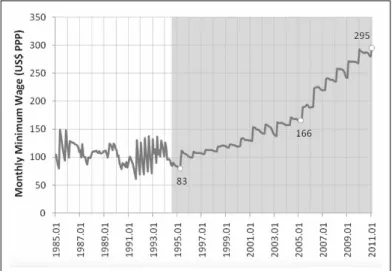
The social results are correlated to the sustainable growth in the minimum wage, as seen in Graph 1. Most social benefits have the minimum wage as a floor.
Graph 1: Real monthly minimum wage (US$ PPP) – Brazil, 1985/2011 Source: Pesquisa Nacional por Amostra de Domicílios, 1995/20092, Souza 2011: 21
The most prominent study on social mobility in Brazil was developed by Marcelo Neri (2010), based on per capita household income, claiming that the NMC in Brazil is “the bright side of the poor” (his book is enti-tled A Nova Classe Média: O Lado Brilhante dos Pobres). He states that in the first decade of this century, social class stratification changed, since the “size of the Brazilian pie is growing faster while providing larger slices for the poor” (Neri 2010: 10). Consequently, between 2003 and 2009, 29 million people entered the so-called new middle class (Neri 2010: 12).
SONIA FLEURY Forging a New Middle Class in Emerging Democracies The illustration of this movement is shown as a demonstration that
during this period the number of Brazilians in the middle class (Class C) grew, surpassing the population in other social classes (AB – richer and DE – poor).
Graph 2: Population Pyramid and Economic Classes 2003, 2011 and 2014 Source: CPS/FGV from microdata by PNAD/IBGE, Neri 2010: 12
His study had such a political impact that he became, in 2012, Presi-dent of IPEA, the most important governmental think tank on economic and social issues, and Minister of Strategic Secretary in 2013. As he affirmed in his work, Brazil was “booming!” and so was he (Neri 2010: 10).
Many experts criticised his approach from different points of view. Pochman (2012) argues that Brazil has experienced a unique situation in terms of its social structure transformation, due to the increased share of labour income in national income. He complains that labour market dynamics are neglected in the studies of the NMC, and calls attention to the fact that the salary increases occurred, predominantly, at the bottom
of the pyramid. By ignoring this fact, studies on the NMC arrived at a completely distinct perspective on Brazilian development. Moreover, he points out the political consequences of the NMC studies: “It is not about the emergence of a new class, much less an NCM. That is an alienating position that attempts to depoliticize the class discussion about the recent transformation of the social structure.” (Pochman 2012: Introduction) In other words, the emphasis on the NMC is a way of avoiding the class discussion in Brazil.
Kertenetsky, Uchoa and Silva (2015) avoided developing an alternative classification of the middle class, but tried to check the strength of this classification, comparing, for the same group, results based on the income criterion against consumption patterns criteria. Considering other criteria, such as access to public services, they found that “this social stratum is markedly heterogeneous, most of it being similar in their consumption patterns to the economically vulnerable or outright poor strata” (Kerten-etsky/Uchoa/Silva 2015: 22). In their research, they considered sociological criteria used to define middle class consumption patterns: stable standard of living; home ownership and dwelling conditions; university education; access to leisure, and spare time; and access to good schools, as well as to information and communication technology. They demonstrated that the lower part of this group (more than 60 per cent of households) has no economic security and does not present a distinctive consumption pattern or a lifestyle that characterises it as middle class. They argued that people that were classified under the middle class label based on income criteria are “more like a vulnerable social stratum than a well-established middle class stratum when consumption patterns are considered” (Kertenetsky/ Uchoa/Silva 2015: 7).
Sociologist Sousa (2013) made the point that the concept of the NMC represents an intention to disguise class struggle by stressing merito-cratic ideology as a way to isolate social climbers from the disqualified poor. Brazilian society was strongly framed by slavery and discrimination against black people; most of them are poor and continue to be discrimi-nated against. This veiled social apartheid had an important impact on shrinking the public sphere and denying for the poor the status of ‘citizen’, as well as establishing a corporative Welfare State comprising only the better-off workers in the formal market.
SONIA FLEURY Forging a New Middle Class in Emerging Democracies While Neri (2010) emphasises that his concept of classes is only
economic, by doing so to avoid criticism, the government assumes that the NMC is a political concept:
“The concept of the middle class is only an analytical tool capable of organ-izing and prioritorgan-izing heterogeneity of Brazilian families in order to identify the group in the middle of the social pyramid. Its validity should be evaluated not in terms of its reliability, but in terms of its analytical utility, either for the under-standing of the dynamics Brazilian society, or for the improvement of the design and adaptation of the various social programs, therefore, for its greater effective-ness.” (BRASIL, SAE 2013: 13)
The Brazilian governmental survey “Voices of Middle-Class” (BRASIL, SAE 2013), repeats the same discourse about the expansion of the NMC, asserting that, in 2012, for the first time, more than half of Brazil’s popula-tion was categorized as middle class. Over the span of 10 years, (2002-2012) 35 million people joined the middle class in Brazil. While in 2002 this class represented 38 per cent of the population of the country, in 2012, 104 million Brazilians, or 53 per cent of the population, were considered to be middle class. During the same period, inequality was also reduced, since more people left the lower class than joined the upper class: 21 per cent of the population (42 million Brazilians) rose from the lower class to the middle class, while 6 per cent rose from the middle class to the upper class3. This position was also supported by experts from the World Bank, who asserted that the Brazilian middle class alone contributed to more than 40 per cent of the overall increase of people in this class in the region, and that in 2009 the middle class comprised nearly a third of Brazil’s 190 million inhabitants (Ferreira at al. 2013).
Other data show the potential of the middle class as consumers, since this socio-economic group accounts for 38 per cent of the nation’s income and household consumption, 58 per cent of its credit, and, according to a government study, have a low probability of becoming poor in the near future. Based on data from the World Bank, the “C” Class in Brazil is estimated to occupy 18th position in a comparative international scale of consumption, surpassing entire countries such as the Netherlands and Switzerland (Secretaria do Tesouro Nacional 2015).
Compared to other BRIC countries, Brazil has a set of favourable condi-tions such as a democratic regime, no ethnic cleavages, natural resources, high urbanisation, a extensive public service network, etc. However, GNP growth was the worst among the BRIC countries in the last decades.
President Lula was elected on the promise of poverty reduction, supported by a left-centre social coalition. To ensure governability, he has built a very broad base in Congress, and undertook, in the so-called Letter to Brazilians, a commitment not to make structural reforms that would adversely affect the financial market and other elite interests such as agro-business.
In its second government the country went through a period of economic growth due to the increase in the price of commodities. With his charisma, Lula achieved great national and international projection. He knew how to channel all the economic and social successes to his govern-ment, as if they were, basically, the result of the distributive measures he implemented.
In the face of the global economic crisis of 2008, the government of the workers’ party (PT) adopted a neo-developmental strategy promoting the increase of domestic consumption through public investments and redis-tributive policies (Pinho/Moura 2017). The contribution of intellectuals who asserted that the NCM had surpassed the strata of the rich and the poor was important in giving visibility to government actions in affirma-tive, distribuaffirma-tive, and economic policies that favoured the poor: quotas regulating access to University, cash transfer for the poorest and minimum salary growth above inflation. At the end of 2014 the crisis became endog-enous, and the government changed the economic model into a new liberal perspective that jeopardised every social policy.
By making use of the NMC, a theoretically fragile concept with great political potential, the government ended up promoting a narrative about Brazilian social policies that ignored its history and institutional frame-work, which was based on universal social rights.
The Brazilian social protection model originated in the struggles for democratic transition in the 1970s, based on demands and proposals from social movements. The crisis of the authoritarian regime in the 1970s coin-cided with the collaps of the national developmentalism pact. It fueled huge activism of different social actors and movements, which aligned
pro-tran- SONIA FLEURY Forging a New Middle Class in Emerging Democracies sition impulses toward a democracy, founded under the principles of social
justice and social inclusion. The struggle for a new comprehensive social protection model had included an initial component of social mobilisation in favour of expanding social rights as part of the transition to democracy.
The Federal Constitution of 1988 represented a profound transforma-tion in the Brazilian social protectransforma-tion model, legally consolidating social rights in response to the pressures that had already been felt for over a decade (Fleury 2014). A new period began, in which the model of social security started to structure the organisation and format of the Brazilian welfare system towards a model of universal citizenship. Since then, Brazil has been building a welfare system based on the principle of extending social rights to all citizens through universal social policies. The singu-larity of having a social policy project designed by social movements, and its strong association with the transformation of the state and society in a democracy, added some important characteristics to the Brazilian welfare system. The outstanding features are the combination of a highly decen-tralised and hierarchically organised network of services.
Different arenas for consensus building and participatory decision-making process were created for each social policy, with the participation of subnational unities and social movements (Fleury 2011).
In addition to the challenge to increase social inclusion and fight poverty, the construction of new democratic and inclusive institutions took off in an adverse context of macroeconomic adjustment, during the 1990s (Pinho/Moura 2017). This austerity programme aimed to combat hyper-inflation, reduce public expenditure and downsize the state. The possibili-ties to make social investments were severely reduced since the government gave in on international pressure and kept the primary surplus designated to pay interest on the public debt (Pinho/Moura 2017).
Therefore, in parallel to universal social rights assured by the new democratic architecture, the government priorities were conveyed to a target model designed to fight poverty through CCT programmes. In Brazil, the well-known “Bolsa Familia” was the best example of this kind of policy, aiming to alleviate poverty, empower women who receive the benefit, and improve the education and health conditions of their children (indicators related to education and health are monitored and represent the conditions for families to remain in the programme). It reached an
enor-mous number of beneficiaries (13,936,791 families in 2015) and gave great prestige to the government, with a public expenditure that did not exceed 0.5 per cent of the public budget (Secretaria do Tesouro Nacional 2015). This minimal impact on budget is because the amount transferred to each family is very low. Moreover, all the cash benefits that were established by the Constitution cannot be lower than the minimum wage.
As well as Bolsa-Familia, the government of the Worker’s Party (PT) launched several initiatives to promote social inclusion, mainly through the consumption of goods and services. These measures included: popular credit, special conditions on mortgages, quotas for black and indigenous people and poor students in public universities, financing for students in private universities, credit for small rural producers, a network of Technical Graduation Schools, and subsidies for food. Most important was the estab-lishment of legal parameters for the annual definition of minimum wage, taking into account inflation and growth. The improvement of minimum wage is very important because it is the base for most of the social benefits.
At the same time, the federal government transferred to municipalities and states several attributions in the provision of primary and secondary education and the operation of the local universal health care system. However, the resources have not been properly allocated to these subna-tional entities, jeopardising the delivery of public services.
The result of the co-existence of these two social protection models – one universal, guaranteeing legal rights, and the other offering relief according to means testing – is that it is possible to find rights without bene-fits and benebene-fits without rights. In the first case, the existence of universal rights does not assure citizens they will access and use services according to their needs. In the second, the beneficiaries of target programmes feel insecure regarding the programmes’ continuity (Fleury 2014).
Moreover, these two models hint at different social projects to build sociability. Universal systems underline the need to increase solidarity and to belong to an egalitarian community. Social protection, based on the increase of consumption power, presupposes a competitive society, where the better off will achieve their goals according to their capacities. While the universal paradigm of social protection is based on public services and decommodification, the cash transfer archetype implies the prevalence of the market in social provision.
SONIA FLEURY Forging a New Middle Class in Emerging Democracies Comparing this system to the Welfare State, Lavinas (2013: 40)
describes the new paradigm for social protection:
“By contrast, the hegemonic paradigm of the 21st century holds that market mechanisms are the key to improving general welfare; cash transfers and expanded household debt, the latter underwritten by the former, are the key elements in this framework, in which decommodified provision is to be pared to the barest bones.”
5. Concluding remarks
In the last two decades, Brazil has become a show case of successful NMC crafting. Poverty reduction and increasing consumption of those that surpass the poverty line were indicators used by NMC defenders to prove their thesis about the optimistic scenario for country development. This bizarre coalition encompasses academic studies, government surveys, World Bank papers and The Economist articles.
What happened to cause the Brazilian Miracle to end in just a few years? The World Bank now talks about the new poor and the need to protect them, in sharp contrast with the previous success:
“Brazil is in the midst of a deep recession, beginning in late 2015, with the economy contracting 3.5 per cent in 2016, unemployment surging from 4.3 in December 2014 to 11.9 per cent in November 2016, and real wages declining. With wages as the major source of income of poor and vulnerable households, Brazil’s gains in poverty and inequality reduction are at risk. World Bank esti-mates reveal that Brazil’s decline in poverty has reversed, with extreme poverty increasing to 3.4 per cent in 2015 (from 2.8 per cent in 2014), and the overall poverty rate in 2015 increasing to 8.7 per cent (from 7.4 per cent in 2014). At the same time, inequality reduction seems to have stabilized between 2014 and 2015.” (Skoufias 2017: 1)
Many factors can explain the turmoil that Brazil is facing, due to polit-ical and ethpolit-ical mistakes and misguided economic strategies. Sustainability was not guaranteed, because the economic model based on commodities
exportation was extremely vulnerable to international market volatility, as well as threatening the environmental balance. It led to a dangerous reduc-tion in industry participareduc-tion in the producreduc-tion sector.
Regarding social policies, one can discuss the governmental strategy of giving priority to CCT, affirmative action and credit programmes, while neglecting structural reforms that could provoke rupture in the poverty reproduction cycle.
On the one hand, the promises of agrarian reform and demarcation of indigenous lands have not been fulfilled. On the other, urban and housing policies that met the demands of millions of inhabitants of the favelas and suburbs of the metropoles were timid in the face of the immensity of the problem.
The universal public health and education services are unable to meet people demands and do not offer services of the necessary quality to promote well-being and social emancipation. Instead of strengthening them, governments have promoted policies that have strengthened private provision funded by public funds.
The emphasis on mass consumption, through income transfers or subsidised credit, grounded the treatment of social mobility within the narrow lens of the market. However, social mobility is a multidimen-sional phenomenon, which requires promotion of worker qualifica-tions, new opportunities for better jobs, and more security in the labour market. Moreover, it implies cultural and social transformations capable of reducing discrimination, increasing people’s social value, and assuring better opportunities to enjoy public services of decent quality. Therefore, the treatment given to the NMC growth, as an increase in family income per capita, despite its political potential, has been conceptually fragile and incapable of offering political sustainability.
The emphasis on consumption has, as social consequence, the repro-duction of market logic through social policies. Values such as individu-alism and competition come to overshadow the public ethics of equality and solidarity.
Thus, social policies must be seen as instruments to produce subjects and sociability, while rearranging the relationships among state, market and community. In a recent study, beneficiaries of targeted programmes declared that they didn’t vote for the Workers’ Party, indicating that they
SONIA FLEURY Forging a New Middle Class in Emerging Democracies consider their improvement as a result, exclusively, of their own efforts and
that they see social mobility as a way to differentiate them from the poor (Fundação Perseu Abramo 2017).
At the same time, we are witnessing in the outskirts of the big cities a great effervescence among young people who seek, through cultural collectives, ways to increase their self-esteem and overcome the condi-tions of social exclusion to which they were destined (Fleury 2013c). The complexity of the process that the country has been facing has demon-strated that the expectations of overcoming poverty and being recognised as a citizen are definitely rooted in Brazilians’ thoughts. There is an impor-tant social transformation in process in the country, and although redis-tributive policies may have influenced it, the NMC approach is clearly insufficient to explain what is going on.
1 OECD (2017): Program for International Student Assessment, http://www.oecd. org/pisa/, December 4, 2017.
2 The shaded area marks the post-stabilisation period. PPP factors from: World Bank. Global Purchasing Power Parities and Real Expenditures - 2005 Interna-tional Comparison Program. Updated by average annual inflation for Brazil and the United States: International Monetary Fund. World Economic Outlook 2009. 3 In this study, the middle class encompasses people who live in households with a
per capita monthly income between R$291 (US$145) and R$1,019 (US$500).
References
Bourdieu, Pierre (1990): The Logic of Practice. Stanford: Stanford University Press. Bourdieu, Pierre (1974): A Economia das Trocas Simbólicas. São Paulo: Editora
Perspectiva.
Castells, Manuel/Himanen, Pekka (eds.) (2104): Reconceptualizing Development in the Global Information Age. Oxford: Oxford University Press.
Cerqueira, Daniel et al. (2017): Atlas da Violência 2017. Brasília: IPEA. http://www. ipea.gov.br/portal/images/170609_atlas_da_violencia_2017.pdf, 3. 10. 2017. Cheeseman, Nic (2014): Does the African middle-class defend democracy? Working
Paper 150. Afrobarometer. www.afrobarometer.org, 22. 11. 2016. Castellani, Francesca/Parent, Gwenn (2011): Being “Middle-class” in Latin
America, Working Paper No. 305. Paris: OECD.
Costa, Lucia (2013): Classes Médias e as Desigualdades sociais no Brasil. In: Bartelt, Dawid (ed.): A Nova Classe Média como Conceito e Projeto Político. Rio de Janeiro: Fundação Heinrich Böll, 43-54.
ECLAD (2014): Compacts for Equality Towards a Sustainable Future. Santiago: ECLAD.
Fleury, Sonia (2003): La Expansión de la Ciudadanía in Seminario International Inclusión Social y Nuevas Ciudadanías. Bogotá: Pontificia Universidad Jave-riana, 167-194.
Fleury, Sonia (2011): Brazil’s health-care reform: social movements and civil society. In: The Lancet 377 (9779), 1724-1725.
Fleury, Sonia (2013a) A Fabricação da Classe Média: Projeto Político para uma Nova Sociabilidade in Dawid Bartelt (ed.): A Nova Classe Média como Conceito e Projeto Político, Rio de Janeiro: Fundação Heinrich Böll, 69-83.
Fleury, Sonia et al. (2013b). Right to Health in Latin America: Beyond Universaliza-tion. Series Financing for Development No. 249. Santiago: ECALD.
Fleury, Sonia (2013c): Seminar “The Favela is the City”. www.youtube.com/ watch?v=uKYULpmrRaI, 8. 3. 2014.
Fleury, Sonia (2014): Building Democracy in an Emerging Society: Challenges of the Welfare State in Brazil. In: Nederveen Pieterse, Jan/Cardoso, Adalberto (eds.): Brazil Emerging – Inequality and Emancipation. London: Routledge. https://doi.org/10.1016/S0140-6736(11)60318-8
Ferreira, Francisco H. G./Messina, Julian/Rigolini, Jamele/López Calva, Luis-Felipe/ Lugo, Maria Ana/Vakis, Renos (2013): Economic Mobility and the rise of the Latin America Middle-Class. Washington DC: World Bank. Fundação Perseu Abramo
Fundação Perseu Abramo (2017): Percepções e Valores Políticos nas Periferias de São Paulo. https://fpabramo.org.br/2017/03/25/percepcoes-na-periferia-de-sao-paulo/, 12. 5. 2017.
FOCUS - Institute for Research on Poverty (2010): Middle Class in Latin America. In: FOCUS 27 (1), 1-9.
IPEA (2015): Nota técnica PNAD 2014. http://www.ipea.gov.br/portal/images/ stories/PDFs/nota_tecnica/151230_nota_tecnica_pnad2014.pdf, 15. 8. 2016. Kerstenetzky, Celia Lessa/Uchôa, Christiane/Valle Silva, Nelson do. (2015): The
Elusive New Middle Class in Brazil In: Brazilian Political Science Review 9 (3). http://www.scielo.br/pdf/bpsr/v9n3/1981-3821-bpsr-9-3-0021.pdf, 2. 5. 2016. Kharas, Homi (2010): The Emerging Middle-Class in Developing Countries.
Working Paper 285. Paris: OECD
Koo, Hagen (1991): Middle classes, democratization, and class formation: The case of South Korea. Theory and Society 20 (4): 485-509. https://doi.org/10.1007/ BF00157323
Lavinas, Lena (2013): 21st Century Welfare. In: New Left Review 84, 5-40. Leventoglu, Bahar (2014): Social Mobility, Middle-class and Political
Tran-sitions. In: Journal of Conflict Resolution 58 (5), 825-864. https://doi. org/10.1177/0022002713478563
Nederveen Pieterse, Jan/Cardoso, Adalberto (2014): Brazil Emerging – Inequality and Emancipation. London: Routledge.
SONIA FLEURY Forging a New Middle Class in Emerging Democracies Neri, Marcelo (2010): A Nova Classe Média: O Lado Brilhante dos Pobres. Rio de
Janeiro: FGV/CPS. http://www.fgv.br/cps/ncm/, 2. 3. 2016.
Ozdubu, Ergun (2005): The Role of the Middle-class in the Emergence and Consol-idation of a Democratic Civil Society. In: Ankara Law Review 2 (2), 95-107. Pinho, Carlos/Moura, Rafael (2017): O Brasil nos contextos internacional e
domé-stico: Crises e Resiliência do Neoliberalismo 2003. In: Revista Brasileira de Administração Política 9 (2), 89-134.
Pochman, Marcio (2012): Nova classe Média – o Trabalho na Base da Pirâmide Social Brasileira. São Paulo: Boitempo.
Przeworski, Adam/Limongi, Fernando (1993): Political Regimes and Economic Growth. In: The Journal of Economic Perspectives 7 (3), 51-69. https://doi. org/10.1257/jep.7.3.51
Quadros, Waldir (2015): Paralisia econômica, retrocesso social e eleições. Textos para discussão 249. São Paulo: UNICAMP
Secretaria do Tesouro Nacional (2015): Gasto Social do Governo Central 2002 a 2015. http://www.tesouro.fazenda.gov.br/documents/10180/318974/
Gasto+Social+Governo+Central/c4c3d5b6-8791-46fb-b5e9-57a016db24ec, 6. 12. 2016.
Skoufias, Emmanuel (2017): Protecting the “New Poor” During Brazil’s Economic Crisis. The World Bank. 24. 2. 2017. http://blogs.worldbank.org/latinamerica/protecting-new-poor-during-brazil-s-economic-crisis, 9. 6. 2017.
Sousa, Jessé (2013): A Invisibilidade da Luta de Classe ou a Cegueira do Economi-cismo. In: Dawid Bartelt (ed.) A Nova classe Média como Conceito e Projeto Político. Rio de Janeiro: Fundação Heinrich Böll, 69-83.
Souza, Pedro Ferreira (2011): Poverty, Inequality and Social Policies in Brazil, 1995-2009. Brasília: IPEA.
Rocha, Sonia (2015): Poverty Studies in Brazil – A Review. Discussion Paper 61. Brasília: IPEA.
Streeck, Wolfgang (2011): The Crisis of Democratic Capitalism. New Left Review 71, 5-29.
Stampini, Marco/Robles, Marcos/Sáenz, Mayra/Ibarrarán, Pablo/Medellín, Nadin (2015): Poverty, Vulnerability and the Middle Class in Latin America. IDB Working Paper Series No. 591. Washington: IDB.
UNDP (2014): Human Development Report 2014 – Sustaining Human Progress – Reducing Vulnerabilities and Building Resilience. New York: UNDP. UNDP (2016): Human Development Report 2016 Human Development for
Everyone Briefing note for countries. Human Development Report Brazil. New York: UNDP.
Vara, Vauhini (2013): Who Belongs to the Lower Middle-Class, and Why Does It Matter? In: The New Yorker, December, 4th.
ABSTRACT Der Beitrag veranschaulicht die Hervorbringung eines Narra-tivs über die Neue Mittelklasse (NMC), das in wissenschaftlichen Artikeln arti-kuliert wird und die Perspektive von Weltbank, OECD und The Economist übernimmt. Dieses Narrativ befürwortet auch Eingriffe von Regierungsseite, um Armut zu bekämpfen. Die Bekämpfung der Armut gehört seit der Demok-ratisierung zur politischen Agenda Brasiliens. Allerdings gibt es verschiedene Strategien, mit dieser Problematik umzugehen. Eine ist in der brasilianischen Verfassung in Form von universellen sozialen Rechten einer staatsbürgerli-chen Teilhabe festgeschrieben. Eine andere basiert darauf, die Konsumkraft der Armen zu steigern, und kann als Muster von Politiken der Neuen Mittelk-lasse identifiziert werden. Beide haben unterschiedliche Folgen für die Fragen von Subjektivität und Gesellschaftsform.
Sonia Fleury
Escola Brasileira de Administração Pública e de Empresas (EBAPE), Getulio Vargas Foundation
View publication stats View publication stats