Vol.54, n. 1: pp. 107-112, January-February 2011
ISSN 1516-8913 Printed in Brazil BRAZILIAN ARCHIVES OF
BIOLOGY AND TECHNOLOGY
A N I N T E R N A T I O N A L J O U R N A L
Effect of a Phosphonium Salt Grafted on Polymers on
Cucumber Germination and Initial Growth
Adriana Popa, Manulela Crisan, Aurelia Visa and Gheorghe Ilia
*Institute of Chemistry Timisoara of Romanian Academy; 24 Mihai Viteazul Blv., RO-300223; Timisoara - Romania
ABSTRACT
The aims of this study were the synthesis, characterization and the testing of vinyldiphenylphosphonium salt phytotoxicity. Phytotoxicity of the synthesised salt was tested on Cucumis sativus L. seed germination and early seedling growth, at five different concentrations, using a standardized toxicity test. Endpoints included the determination of some seedling parameters: root and shoot length, root and shoot biomass, root and shoot dry weight ratio and final germination percentage. The vinyldiphenylphosphonium salt showed moderate to strong root length and root biomass inhibition, which increases progressively with the increasd of the concentration level.
Key words: vinyldiphenylphosphonium salt, phytotoxicity, Cucumis sativus L.
*Author for correspondence: [email protected]
INTRODUCTION
Phosphonium compounds offer a vast and attractive field of research for the chemists and biologists. For many years, solid polymers have been dominant both as supports for organic reagents and in combinatorial synthesis
(Shuttleworth et al., 1997; Sherrington et al., 1988). However, there are concerns associated with the use of insoluble polymeric derivatives such as lowered reactivity; site-site interactions, extended reaction times and diffusion limited reactivity. The use of soluble matrices such as poly (ethylene glycol) (Gravert et al., 1997), (Geckeler, 1995) circumvents these problems while also allowing for routine monitoring of reaction progress.
Soluble polymer-supported organic chemistry, dubbed “liquid-phase” synthesis, is developing as an increasingly useful adjunct to the more classical heterogeneous resin-supported approaches across
The phytotoxic effects of phosphonium functionalized polymers have been less studied so far. They have previously been used as biocide in order to remove the bacteria and living organisms from the surfaces (Popa et al., 2003a; Kanazawa et al., 1993). The biocides are useful for protecting the plants against fungi, bacteria, viruses and other microbial plant pathogens, by application to the plants and/or to the soil in which they are growing or to be grown, or for use in a seed dressing. The control of phytopathogenic fungi has a great economic importance since fungal growth on the plants or on parts of plants inhibits the production of foliage, fruit or seed, and the overall quality of a cultivated crop.
The phytotoxicity tests, especially the seed germination and root elongation tests, have more advantages (such as sensitivity, simplicity, low cost) than toxicity tests which use animals and algae (Wang, 1991; Hulzebos et al.,1991; Wang et al., 2001).
Cucumber is one of the common plant species recommended by the US Environmental Protection Agency (USEPA, 1982), the U.S. Food and Drug Administration (USFDA, 1987) and the Organization for Economic Cooperation and Development (OECD, 1984) for seed germination and root and shoot elongation tests (Wang et al., 2001).
Arylphosphonium salts are compounds that have both lipophilic and cationic character, allowing a facile transport through plasma membranes or cell walls. The synthesis, characterization (FT-IR, UV and RMN spectra) and evaluation of the phytotoxicity order of poly (oxyethylene) functionalized with vinyldiphenylphosphonium salt on Cucumis sativus L. seed germination and seedling development were the aims of the paper.
MATERIALS AND METHODS
Materials
Polyethyleneglycol (PEG1000, Merck),
Vinyldiphenylphosphine (Aldrich), benzene (Merck), hydrogen chloride (Reactivul, 33% (w)), ethyl ether (Reactivul). All reagents were used as received from the suppliers.
Synthesis of the poly (oxyethylene)
functionalized with vinyldiphenyl phosphonium salt
In a 100 ml round-bottom flask fitted with a reflux condenser with mini trap, mechanical stirrer, thermometer and previously purged with nitrogen, 4g of polyethylene glycol and vinyldiphenylphosphine were added in 50 ml of benzene. A concentrated solution of hydrogen chloride was added in three portions. First, the system was heated at 70oC when the distilation of the water/benzene azeotrope began. When the aqueous phase evolvement stopped, the round-bottom flask was cooled at 40oC and a second portion of hydrogen chloride was added. The reaction was continued at the distilation temperature of the azeotope and under nitrogen atmosphere. This sequence was repeated with a third portion of acid, and the reaction was finished after 40 h. Poly (oxyethylene) functionalized with vinyldiphenyl phosphonium salt precipitated during synthesis. The quaternary phosphonium salt bonded on poly (ethylene glycol) was separated by filtration, washed with ethyl ether and dried under a vacuum at 45oC for 28 h.
The polymer-analogous quaternization reaction is presented in the following reaction:
where: R : C6H5
HO-(EO)n-OH + HX + PR3-nR'n XR'n'R3-n'P-(EO)n-P R3-n'R'n'X
- + +
-R': -CH=CH 2
n' : 1 X=Cl
Characterization
Plant material and seed germination
The biotest (Crisan et al., 2007) was performed on cucumber (C. sativus L. var. ‘Piccolo di Parigi’) seeds, purchased from Franchi Sementi, Bergamo, Italy. The seeds were washed with tap water for 4 h, and then placed on 12x12 cm Petri dishes. Each dish contained two paper filters saturated with 12 ml of 5 mM MES (2[N’-morpholino]ethansulfonic acid) buffer pH 6.0, containing 0.5 mM CaSO4 and
vinyldiphenylphosphonium salt. Each compound was tested at five different concentrations (0.00001, 0.0001, 0.001, 0.01 and 0.1 %). Concentration range was selected based on a literature concentration-response study which showed that at higher concentrations (more than 0.2%) the biocides could be used as total herbicides (US patent 5385896). For the treatments and control, 30 undamaged seeds of almost identical size were placed evenly on the filter paper in Petri dish, and then incubated in the dark at 28°C. The control test was run to investigate the stability and reproducibility of germination capacity, and root and shoot length of C. sativus seeds in the absence of xenobiotics. Three repetitions for each experiment were done. After three days of incubation, the final germination percentages (FG%) (Pennacchio et al., 2005), root and shoot dry biomass, as well as
shoot/root dry weight ratio (SRW) were calculated, and primary root and the shoot length of each seedling were measured, using ImageJ software package. Seed germination was defined as a root length of 5 mm or more.
Data analysis
The overall data were statistically analysed, using SYSTAT version 10. All results were expressed as a mean ± S.E. A one-way ANOVA, followed by t-test using the Bonferroni correction, was used to find the differences between means for primary root and shoot length, and final germination percentages at three days for treatment (vinyldiphenylphosphonium salt) at five different concentrations and its control. The final germination percentages were converted to arcsin values according to Ott (1998) before statistical analysis. The difference between the variances was assessed by F-test, indicating the homoscedasticity of the data.
RESULTS AND DISSCUSION
Synthesis and characterization
The main characteristics of the poly(oxyethylene) functionalized with vinyldiphenyl phosphonium salts are presented in Table 1.
Table 1 - Characteristics of the vinyldiphenylphosphonium salt bonded on poly(oxyethylene). Code Prod. X-R’nR3-nP+ P (%, w)a yb GM
mmoles X-R’nR3-nP+ / g. of polymerc
ηF (%)d
PEGP+ Cl-(CH=CH2)(C6H5)2P+ 2.29 0.89 0.63 89
a.
The phosphorus content in the functionalized copolymers was used in order to determine their functionalization degrees (Popa et al., 2003b; Popa et al., 2003c),
b ) ( % 100 % Gi Gf P mi M M P m A m M P y − ⋅ ⋅ − ⋅ ⋅ ⋅
= ,
M
mi=
M
EO+
m
⋅
x
⋅
M
Gi,cmf M
M
y
G
=
,)
( Gf Gi
mi
mf M m y M M
M = + ⋅ ⋅ − , d
η
F=
y
×
100
The degree of the chemical modification with quaternary phosphonium salts were relatively high. The yield of the quaternization reaction was 89%, which was good for a polymer - analogous reaction.
The main absorption band in the IR spectra of the source polymers was at 1430 cm-1 assignment P-C (phenyl), which demonstrated that the reaction of the quaternization took place. The presence of
the aromatic rings of the phenylphosphonium quaternary salt bonded on poly (oxyethylen) was proved through the analysis of the UV spectra. Bound for π - π* transition was determined at 271 nm. The structure of the product was confirmed by
31
Effect of poly(oxyethylene) functionalized with vinyldiphenylphosphonium salt on seed germination
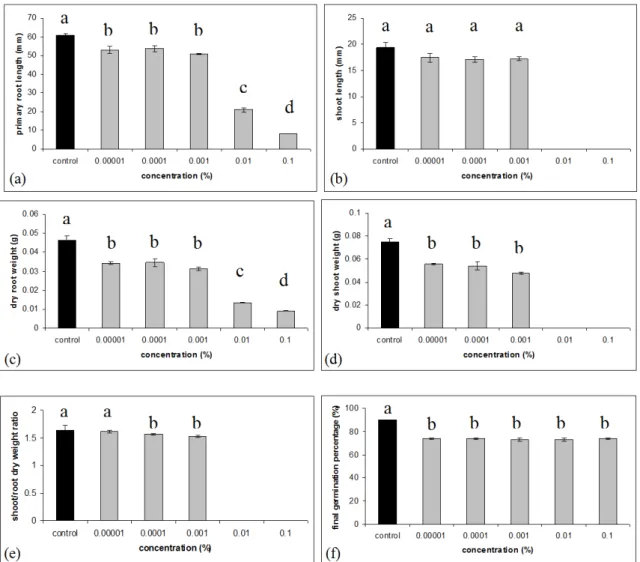
The phytotoxicity effect of the synthesized compound on C. sativus L. was determined. Data on root and shoot length, as well as biomass and final germination percentages were collected and compared with the untreated control. The morphology of untreated C. sativus seedling roots was compared with the roots from seedlings grown in the presence of the synthesised compound at different concentrations after three days of incubation. The effects of the range of concentrations used (0.1 - 0.00001%) on root length and dry root weight of cucumber seedlings are shown in Figure 1a,c. Data showed a decrease of primary root length and of dry weight root in
accordance with the increase of concentration (particularly at 0.001, 0.01 and 0.1% of concentration). The inhibition at higher concentrations suggested a direct effect of synthesised compound on the growth and development processes. Regarding the shoot length (Fig. 1b), the compound showed a similar effect to control at lower concentrations (0.00001, 0.0001 and 0.001%) and a completely abolished development at higher two concentrations. The dry weight of roots and shoots and the shoot/root dry weight ratio (Fig. 1c-e) were the suitable parameters for determining the phytotoxicity of synthesised compound. The SRW decrease confirmed that at the high concentrations the shoot were more affected than roots.
In comparison with the control, final germination percentages (Fig. 1f) for all the compounds tested were calculated (Pennacchio et al. 2005) and data showed an inhibition effect for all the treatments. The measurement of root length are typically used to describe the root distribution in the soil profile, but the analysis of root morphology and
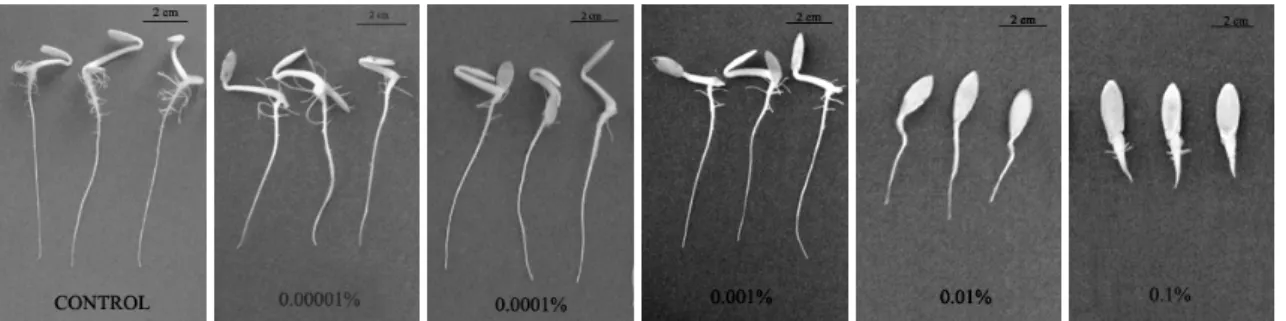
architecture can improve the understanding of water and nutrient extraction from soil. In the present study, the seedlings treated with PEGP+, especially at 0.1%, presented a morphological characteristic with respect to the control: a thickened primary root effect (Fig. 2).
Figure 2 - Effects of PEGP+ in comparison with control on root development and growth of C. sativus L. seedlings. Scale bars, 2 cm.
CONCLUSIONS
The proposed procedure for the preparation of phosphonium salts bonded on poly(oxyethylene)s by polymer-analogous reactions is simple and efficient. The functionalization degree with quaternary phosphonium salts is well suited for the subsequent use of the product as antibacterial agents. The results indicated that poly(oxyethylene) functionalized with vinyldiphenylphosphonium salt affected the C. sativus L. root growth and development. The effects were either similar with the control or negative in terms of growth stimulation, depending on the concentration level of the compound.
REFERENCES
Crisan, M., Grozav, M., Kurunczi, L., Ilia, G., Bertea, C. (2007), Inhibitory effects of some synthetic monoethanolamine salts of para-substituted benzoic acids and corresponding benzoic acids on cucumber seed germination. J.Plant Interact., 2(1), 53-61
Geckeler, K.E. (1995), Soluble PolymerSupports for Liquid-Phase Synthesis. Adv. Polym. Sci., 121, 31-79
Gravert, D.J., Janda, K.D. (1997), Organic synthesis on soluble polymer supports: Liquid phase methodologies. Chem. Rev., 97, 489-509
Harris, R.K., Becker, E.D., Cabral de Menezes, S.M., Goodfellow, R., Granger, P. (2001), NMR nomenclature. Nuclear spin properties and conventions for chemical shifts. Pure and Appl. Chem., 73, 1795-1818
Hulzebos, E.M., Ademn, D.M.M., Dirten-van Breemen, Henzen, L., Van Gestel, C.A.M. (1991), QSARs in phytotoxicity. Sci. Total Environ.,
109/110, 493–497
Kanazawa, T., Ikeda, T. and Endo, T. (1993), Polymeric phosphonium salts as a novel class of cationic biocides. II. Effects of counter anion and molecular weight on antibacterial activity of polymeric phosphonium salts. J. Polym. Sci. A: Polym. Chem., 31, 1441–1447
OECD (Organization for Economic Cooperation and Development). 1984. Terrestrial plants: OECD Guideline for Testing of Chemicals. No. 2.8, Paris. Ott, L. (1998), An Introduction to Statistical Methods
and Data Analysis. PWS-Kent Publishing Company, Boston
Patent 5385896, Biocidal compositions and treatments, United States
Popa, A., Davidescu, C.M., Trif, R., Ilia, G., Iliescu, S., Dehelean, G. (2003a), Study of quaternary „onium” salts grafted on polymers: Antibacterial activity of quaternary phosphonium salts grafted on „gel-type” styrene-divinylbenzene copolymers. Reactive and Functional Polymer, 55(2), 151-158 Popa, A., Davidescu, C.M., Ilia, G., Iliescu, S.,
Dehelean, G., Trif, R., Pacureanu, L., Macarie, L. (2003b), Synthesis, characterization and antibacterial activity of quaternary phosphonium salts bonded on poly(oxyethylene)s. Rev. Roum. Chim., 48(1), 41-48
Popa, A., Ilia, G., Iliescu, S., Davidescu, C.M., Pascariu, A., Bora, A. (2003c), The Arbuzov reaction used in synthesis of phosphonates-based resins. Rev.Chim., 54(10), 834-836
Sherrington, D.C., Hodge, P. (1988), Synthesis and Separations Using Functional Polymers. John Wiley and Sons, Inc.: New York
Shuttleworth, S.J., Allin, S.M., Sharma, P.K. (1997), Functionalised Polymers: Recent Developments and New Applications in Synthetic Organic Chemistry. Synthesis, 27, 1217-1239
Wang ,W. (1991), Literature review on higher plants for toxicity testing. Water Air Soil Poll., 59, 381– 400
Wang, X., Sun, C., Gao, S., Wang, L., Shuokui, H. (2001), Validation of germination rate and root elongation as indicator to assess phytotoxicity with Cucumis sativus. Chemosphere, 44, 1711-1721 USEPA (US Environmental Protection Agency).
1982. Seed germination/root elongation toxicity test. EG-I2, Office of Toxic Substances, Washington DC.
USFDA (US Food and Drug Administration). 1987. Seed germination and root elongation. FDA Environmental Assessment Technical Guide No. 4. 06. Center for Food Safety and Applied Nutrition and Center for Veterinary Medicine, US Department of Health and Human Services, Washington DC.