Feed transition in larval rearing of bocudo, Steindachneridion scripta (Pisces, Pimelodidae), using Artemia spp. nauplii and artificial diet
[Transição alimentar na larvicultura do bocudo, Steindachneridion scripta (Pisces, Pimelodidae), com o uso de náuplios de Artemia spp. e dieta artificial]
W.B. Adamante1,3, M. Weingartner2, A.P.O. Nuñer2*
1
Aluno de pós-graduação – CCA – UFSC – Florianópolis, SC
2
Departamento de Aqüicultura – UFSC Rodovia SC 406, nº 3532, 88066-000 – Florianópolis, SC
3
Bolsista do CNPq
ABSTRACT
Feed transition of Steindachneridion scripta larvae was investigated using seven treatments in which the
reference diet, Artemia spp. nauplii, was totally substituted for a 56% crude protein artificial diet in
two-day intervals. Initially, all treatments were fed with Artemia spp. nauplii and, subsequently, during the
transition period, feed was equally composed by Artemia sp. nauplii and artificial diet. Everyday, one of
the treatments began the feed transition, which was implemented between the second and the eighth days
of culturing. Two treatments were used as control: one exclusively fed Artemia spp. nauplii and another
only with artificial diet. Total weight, total length, and survival rate were not influenced by the day in
which feed transition was implemented (P>0.05), and their mean values (± SD) were 31.1±25.0mg,
13.3±1.5mm and 58.8±12.0%, respectively. This suggests that Steindachneridion scripta larvae adapted
well the transition to artificial diet.
Keywords: bocudo, Steindachneridion scripta, feed transition, larval feeding
RESUMO
A transição alimentar de larvas de Steindachneridion scripta foi investigada utilizando-se sete tratamentos, nos quais a dieta básica, composta por náuplios de Artemia spp., foi integralmente substituída, em intervalo de dois dias, por uma dieta artificial contendo 56% de proteína bruta. Inicialmente, todos os tratamentos receberam náuplios de Artemia spp. No período de transição alimentar, metade da alimentação foi formada por náuplios de Artemia spp. e metade por dieta artificial. A cada dia, um dos tratamentos entrou na fase de transição, que foi implementada entre o segundo e o oitavo dia de cultivo. Utilizaram-se dois tratamentos como controle; em um as larvas foram alimentadas, exclusivamente, com náuplios de Artemia spp. e em outro, somente, com dieta artificial. Peso total, comprimento total e sobrevivência não foram influenciados pelo dia de implantação da transição alimentar (P>0,05) e, apresentaram valores médios iguais a (± desvio padrão) 31,1±25,0mg, 13,3±1,5mm e 58,8±12,0%, respectivamente, sugerindo que as larvas Steindachneridion scripta
aceitaram bem a transição alimentar para a dieta artificial.
Palavras-chave: bocudo, Steindachneridion scripta, transição alimentar, alimentação de larvas
Recebido em 30 de agosto de 2005 Aceito em 21 de agosto de 2007
*Autor para correspondência (Corresponding author)
INTRODUCTION
A feeding strategy often adopted in fish larval rearing consists in offering live prey to the larvae (Sipaúba-Tavares and Rocha, 2003). Live prey could be, for example, foraging larvae or zooplankton, whose use will depend on the adequate size of fish larvae and also on its availability.
Feeding with live prey is extremely important because larvae of several fish species do not present a completely developed digestory tract in the first days of life, i. e., they do not have the enzymes required to digest artificial diets (Zavala-Camin, 1996; Sipaúba-Tavares and Rocha, 2003). Furthermore, live prey promotes visual stimulus (Ortega, 2000), which increases feeding by predatory larvae, thus reducing cannibalism in some species and enhancing larval production.
Hogendoorn (1980) and Knud-Hansen et al. (1990) reported the successful use of live or frozen zooplankton as feed in larval rearing of Clarias gariepinus and Clarias batrachus, respectively. Among zooplankton species,
cladocerans of the genus Moina were
successfully used in larval rearing of Chanos
chanos (Villegas, 1990) and Clarias macrocephalus (Fermin and Bolivar, 1991).
Despite the availability of wild zooplankton, the use of Artemia spp. nauplii as feed in the larval rearing of marine or freshwater fish has become common and widely practiced (Kurunuma and Fukusho, 1984; Lavens and Sorgeloos, 1996; Kolkovsky et al., 1997) because it is readily available in the market and practical to use.
Nevertheless, in spite of the advantages, the use of Artemia nauplii increases the cost of production. Thus, in order to reduce such costs and provide economic return, fish larvae should
be fed Artemia nauplii for a period as short as
possible.
Although good results have been achieved with live prey during larviculture, some freshwater fish larvae can be successfully reared exclusively with artificial diet since the first feeding, as
reported for C. gariepinus (Uys and Hecht, 1985;
Appelbaum and Van Damme, 1988), Coregonus
spp. (Bergot et al., 1986; Dabrowski et al., 1986)
and Cyprinus carpio (Bergot, 1986; Charlon et al., 1986 apud Kerdechuen and Legendre, 1994).
However, for carnivorous species such as
bocudo, Steindachneridion scripta (Miranda
Ribeiro, 1918), that presents cannibalism during larviculture, feed transition strategies have been successfully practiced, as in the case of pintado,
Pseudoplatystoma spp. (Machado et al., 1998;
Smerman et al., 2002), and tucunaré, Cichla spp.
(Cyrino and Kubitza, 2003). Feed transition period usually consists in initially providing zooplankton, foraging larvae or ground meat (fish fillet, cattle heart etc.) and, gradually, replacing it with artificial diet.
Transition period aims at avoiding that a sudden change in feeding causes cannibalism among larvae or impairment of growth and survival
rates at the end of the larviculture. S. scripta
species is native from Prata basin (Ringuelet et al., 1967), and in the Uruguay River it is important for local fisheries (Meurer e Zaniboni Filho, 2000).
The objective of the present study was to assess different feed transition periods for S. scripta, gradually replacing live food to artificial diet in order to enhance larviculture.
MATERIAL AND METHODS
Bocudo larvae hatched in the laboratory after induced spawning that followed the protocol described by Zaniboni Filho and Barbosa (1996).Larvae were kept in cylindroconical incubators until the final absorption of the vitellus. Then, larvae of the same bulk, with mean weight and length of 7.7±1.4mg and 8.6±0.42mm, respectively, were randomly transferred to 4-L water round plastic aquaria and stocked at a density of 10 larvae/l. Aquaria were kept inside 1000-L fiber tanks in a water-bath system supplied with heaters, to minimize temperature variation.
1) and the other fed Artemia spp. nauplii (control 2) throughout the experimental period.
On the first day of larval rearing, all
experimental units received Artemia spp. nauplii
at a rate of 100 nauplii/larvae/day, except control 1, that received 5g/day of a 56% ground crude protein commercial diet. Feed was offered at 8am, 4pm and 12pm. Until the beginning of the feed transition period, experimental units were
fed Artemia spp. nauplii, in each treatment, at the same rate as the first day.
From the second day of larval rearing onward, feed transition was implemented in different experimental units, which received transition management between the second and eighth day of culturing (Table 1). During the feed transition
period, larvae were fed a diet of 50% Artemia
spp. nauplii and 50% artificial diet for two days.
Table 1. Feeding strategy adopted in the treatments to start feeding transition (FT) of bocudo larvae
Feeding strategy Treatment
0 1 2 3 4 5 6 7 8 9
2nd day AN AN FT FT AD AD AD AD AD AD
3rdday AN AN AN FT FT AD AD AD AD AD
4thday AN AN AN AN FT FT AD AD AD AD
5thday AN AN AN AN AN
FT FT AD AD AD
6thday AN AN AN AN AN AN FT FT AD AD
7thday AN AN AN AN AN AN AN
FT FT AD
8thday AN AN AN AN AN AN AN AN FT FT
Artemia spp. nauplii (AN) AN AN AN AN AN AN AN AN AN AN
Artificial diet (AD) AD AD AD AD AD AD AD AD AD AD
AN (Artemia nauplii); AD (artificial diet).
Following transition, larvae received 5g/day of artificial diet, the same amount offered to control
1 throughout the experiment. Artemia spp. cysts
were daily incubated to hatch in two periods and,
for this reason, only newly hatched Artemia spp.
were used.
The protocol described by Lavens and Sorgeloos (1996) was used for cyst hatchering. Salinity in the experimental units was 1.0‰ to allow higher
Artemia nauplii survival and also more time for bocudo larvae to feed without reduction in survival, since Schütz et al. (2000) observed lower survival during bocudo larval rearing only when larvae were kept in salinity equal or above 2.0‰. All experimental units were daily siphoned to remove debris and also half of the water volume was replaced. Water temperature, dissolved oxygen concentration and pH were measured twice a day, in the morning and in the
afternoon, using digital oxymeter YSI-551 and
pHmeter YSI-601, respectively, and total
ammonia and nitrite concentrations were measured once a day, using the colorimetric method. These variables were daily analyzed, in the morning and afternoon.
1YSI Incorporated, Yellow Springs, OH, USA.
No-ionized ammonia (NH3) in the water was
calculated from total ammonia according to pH, temperature and salinity, using the equation proposed by Johansson and Wedborg (1980), as
follows: %NH3= 100/[1+10(logK1-pH)], with
logK1= -0.467+0.00113 S + 2,887.9/T, in which
K1 is the dissociation constant, S (g/l) the
salinity, and T the temperature (ºK).
At the end of the experiment, all remained larvae were counted and their length and weight were measured. Data on water quality variables, mean total length and weight and survival rates were
analyzed by ANOVA (α=0.05) and Tukey test
(Zar, 1996).
RESULTS AND DISCUSSION
Throughout the experiment, mean values (± standard deviation) of water temperature (24.9±1.4ºC), dissolved oxygen concentration (7.2±0.4mg/l) and pH (7.8±0.1) were similar (P>0.05) among the treatments (Fig. 1).
A)
18.0 20.0 22.0 24.0 26.0 28.0 30.0
1st 2nd 3rd 4th 5th 6th 7th 8th 9th 10th days
temp
erat
ure (
oC)
B)
5.0 5.5 6.0 6.5 7.0 7.5 8.0 8.5 9.0 9.5 10.0
1st 2nd 3rd 4th 5th 6th 7th 8th 9th 10th days
dis
s
o
lv
ed o
x
y
g
e
n
(m
g L
-1)
C)
5.0 5.5 6.0 6.5 7.0 7.5 8.0 8.5 9.0 9.5 10.0
1st 2nd 3rd 4th 5th 6th 7th 8th 9th 10th days
pH
Figure 1. Mean (± standard deviation) temperature (A), dissolved oxygen concentration (B) and pH (C) for all treatments during the experiment.
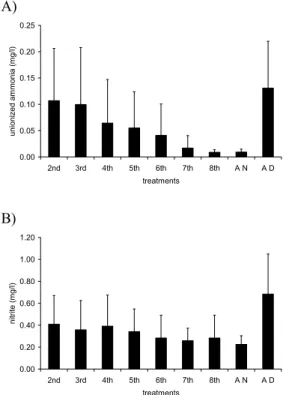
Non-ionized ammonia (NH3) and nitrite (NO2-)
levels in water (Fig. 2) remained within acceptable levels for most of fish species and did not reach critical values (Boyd, 1979; Badisserotto, 2002) for the time of exposure
used. In general, water NH3 concentrations
tended to accumulate (Fig. 2) in treatments with earlier feed transition and in AD treatment. This is probably due to the decay of uneaten artificial diets, which also contributed to the increase of the water nitrite concentration.
A)
0.00 0.05 0.10 0.15 0.20 0.25
2nd 3rd 4th 5th 6th 7th 8th A N A D
treatments
unioniz
ed am
monia (m
g/l)
B)
0.00 0.20 0.40 0.60 0.80 1.00 1.20
2nd 3rd 4th 5th 6th 7th 8th A N A D
treatments
nitrite (m
g/l)
Figure 2. Mean (± standard deviation) concentration of unionized ammonia (A) and nitrite (B) in each treatment.
Mean values (± standard deviation) of total weight and length, and survival rate were of 31.1±25.0mg, 13.3±1.5mm and 58.8±12.0%, respectively, which were similar (P>0.05) (Table 2). Kerdechuen and Legendre (1994) tested different feeds during larval rearing of
African catfish, Heterobranchus longifilis, such
as live zooplankton, frozen zooplankton and commercial artificial diet, and observed that total weight and survival rates were significantly lower when fed artificial diet.
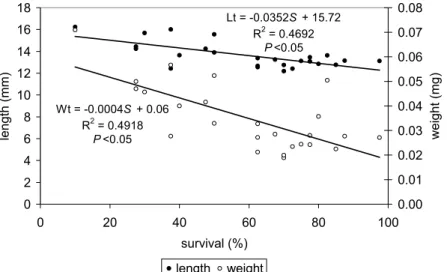
Final length and weight were inversely related to survival (Fig. 3), showing the influence of density on fish growth. Comparing larval
performance of four Coregonus species fed
Table 2. Mean values (± standard deviation) of initial and final weight, total length and survival rate of bocudo larvae
Treatment
2nd 3rd 4th 5th 6th 7th 8 th AN AD
Initial weight (mg) 7.7 (1.4) 7.7 (1.4) 7.7 (1.4) 7.7 (1.4) 7.7 (1.4) 7.7 (1.4) 7.7 (1.4) 7.7 (1.4) 7.7 (1.4) Final weight (mg) 32.3 (16.8) 34.5 (11.2) 44.4 (35.8) 36.6 (33.2) 31.5 (16.0) 45.1 (22.1) 24.6 (5.8) 31.8 (8.8) 38.4 (22.4) Initial length (mm) 8.6 (4.4) 8.6 (4.4) 8.6 (4.4) 8.6 (4.4) 8.6 (4.4) 8.6 (4.4) 8.6 (4.4) 8.6 (4.4) 8.6 (4.4) Final length (mm) 13.2 (1.5) 13.9 (1.2) 13.7 (1.5) 13.2 (1.4) 13.7 (1.7) 14.7 (1.8) 12.9 (1.1) 13.8 (1.0) 13.8 (2.3)
Survival (%) 57.5
(26.5) 75.0 (23.8) 57.5 (27.8) 56.7 (26.7) 60.0 (14.1) 38.8 (1.8) 78.6 (6.3) 53.3 (20.4) 51.7 (36.2) AN= Artemia nauplii; AD= artificial diet.
Wt = -0.0004S + 0.06 R2 = 0.4918
P<0.05
Lt = -0.0352S + 15.72 R2 = 0.4692
P<0.05 0 2 4 6 8 10 12 14 16 18
0 20 40 60 80 100
survival (%) length ( m m) 0.00 0.01 0.02 0.03 0.04 0.05 0.06 0.07 0.08 weight ( m g) length weight
Figure 3. Relationship between final survival (S)and length (Lt) or weight (Wt).
Machado et al. (1998) tested a gradual feed transition for fingerlings of pintado,
Pseudoplatystoma corruscans, using ground cattle heart and artificial diet, found survival rates close to 80% after 25 days. In a study with
the same species, Smermam et al. (2002)
described a survival rate of 6.5% when larvae were fed zooplankton and blood meal during the feed transition period.
Results showed that bocudo larvae tend to easily accept artificial diet when submitted to a feed transition period, without impairing either performance or survival, thus reducing costs in the larval rearing phase of the species. However,
even with satisfactory survival rates when compared to other carnivorous species, cannibalism among larvae was observed during the experimental period, therefore suggesting that the results can be enhanced with new studies aiming to improve the management practices in larval rearing and, consequently, reducing larval cannibalism.
ACKNOWLEDGMENTS
REFERENCES
APPELBAUM, S.; VAN DAMME, P. The feasibility of using exclusively artificial dry feed
for the rearing of Israeli Clarias gariepinus
(Burchell, 1822) larvae and fry. J. Appl.
Ichthyol., v.4, p.105-110, 1988.
BALDISSEROTTO, B. (Ed). Fisiologia de
peixes aplicada à piscicultura. Santa Maria: UFSM, 2002. 212p.
BARCELLOS, L.G.; KREUTZ, L.C.; QUEVEDO, R.M. et al. Nursery rearing of
jundiá, Rhamdia quelen (Quoy & Gaimard), in
cages: cage type, stocking density and stress
response to confinement. Aquaculture, v.232,
p.383-394, 2004.
BERGOT, P. Élevage larvaire de la carpe
commune (Cyprinus carpio L.): alimentation
artificielle. In: BILLARD, R.; MARCEL, J.
(Eds). Aquaculture of cyprinids. Paris: INRS,
1986. p. 227-234.
BERGOT, P.; CHARLON, N.; DURANTE, H. The effect of compound diets feeding on growth
and survival of coregonid larvae. Arch.
Hidrobiol. Beich., v.22, p.265-272, 1986.
CHARLON, N.; DURANTE, H.; ESCAFFRE, A.M. et al. Alimentation artificielle dês larves de
carpe (Cyprinus carpio L.). Aquaculture, v.54,
p.83-88, 1986.
BOYD, C.E. (Ed). Water quality in warmwater
fish ponds. Alabama: Craftmaster, 1979. 359p.
CYRINO, J.E.P.; KUBITZA, F. Dietas para
condicionamento alimentar do tucunaré Cichla
sp. Sci. Agric., v.60, p.609-613, 2003.
DABROWSKI, K.; TAKASHIMA, F.; STRÜSSMANN, C. et al.. Rearing of coregonid
larvae with live and artificial diets. Bull. Jpn.
Soc. Sci. Fish, v.52, p.23-30, 1986.
FEIDEN, A.; REIDEL, A.; SIGNOR, A.
Desenvolvimento do jundiá, Rhamdia quelen
(Pisces, Pimelodidae), cultivado em tanques-rede
num reservatório do rio Iguaçu, Paraná. In:
CONGRESSO BRASILEIRO DE ENGENHARIA DE PESCA, 12., 2001, Foz do Iguaçu. Anais... Foz do Iguaçu, 2001.
FERMIN, A.C.; BOLIVAR, M.E.C. Larval rearing of the Philippine freshwater catfish,
Clarias macrochepalus (Gunther), fed live
zooplankton and artificial diet: a preliminary study. Isr. J. Aquac., v.43, p.87-94, 1991.
HOGENDOORN, H. Controlled propagation of the African catfish, Clarias lazera (C&V) III.
Feeding and growth of fry. Aquaculture, v.21,
p.233-241, 1980.
JOHANSSON, O.; WEDBORG, M. The ammonia-ammonium equilibrium in seawater at
temperatures between 5 and 25ºC. J. Solut.
Chem., v.9, p.37-44, 1980.
KERDCHUEN, N.; LEGENDRE, M. Larval
rearing of an African catfish, Keterobranchus
longifilis (Teleostei, Clariidae): a comparison between natural and artificial diet. Aquat. Living Res., v.7, p.247-253, 1994.
KNUD-HANSEN, C.F.; BATTERSON, T.R.; MCNABB, C.D. et al. Hatchery techniques for
egg and fry production of Clarias batrachus
(Linnaeus). Aquaculture, v.89, p.9-19, 1990.
KOLKOVSKI, S.; KOVEN, W.; TANDLER, A.
The mode of action of Artemia in enhancing
utilization of microdiet by gilthead seabream
Sparus aurata larvae. Aquaculture, v.155, p.193-205, 1997.
KURUNUMA, K.; FUKUSHO, K. (Eds).
Rearing of marine fish larvae in Japan. Ottawa: IDCR, 1984. 109p.
LAVENS, P.; SORGELOOS, P. (Eds). Manual
on the production and use of live food for aquaculture. Rome: FAO, 1996. 295p. (FAO Fisheries Technical Paper 361)
LUCZYNSKI, M.; MAJKOWSKI, P.; BARDEGA, R. et al. Rearing of larvae of four coregonid species using dry and live food.
Aquaculture, v.56, p.179-185, 1986.
LUZ, R.K.; ZANIBONI FILHO, E. Utilização de diferentes dietas na primeira alimentação do
mandi-amarelo (Pimelodus maculatus,
Lacépède). Acta Scient., v.23, p.483-489, 2000.
MACHADO, J.H.; DEL CARRATORE, C.R.; GAROSSINO, A.P.R. et al. Treinamento alimentar para aceitação de rações artificiais em
alevinos de pintado (Pseudoplatystoma
coruscans). In: AQÜICULTURA BRASIL,
1998, Recife. Anais... Recife, 1998. v.2,
p.101-107.
MEURER, S.; ZANIBONI FILHO, E. O suruvi
espécie alternativa para a piscicultura sul brasileira. In: SIMPÓSIO BRASILEIRO DE AQÜICULTURA, 11., 2000, Florianópolis.
Anais... Florianópolis, 2000.
ORTEGA, A.G. Valor nutricional de los quistes de Artemia y su uso como fuente de proteína en dietas artificiales para larvas de peces. In: CRUZ-SUÁREZ, L.E.; RICQUE-MARIE, D.;
TAPIA-SALAZAR, M. et al. (Eds). Avances en
nutrición acuícola. Yucatán: Mérida, 2000. p.287-299.
RINGUELET, R.A.; ARAMBURÚ, R.A.;
ARAMBURÚ, A.A. (Ed). Los pecesargentinos
de agua dulce. La Plata: Comisión de Investigación Científica, 1967. 602p.
SCHÜTZ, J.H.; NUÑER, A.P.O.; ZANIBONI FILHO, E. et al. Avaliação do desempenho e da sobrevivência de pós-larvas de suruvi,
Steindachneridion scripta (Pimelodidae), em diferentes salinidades. In: SIMPÓSIO BRASILEIRO DE AQÜICULTURA, 11., 2000, Florianópolis. Anais... Florianópolis, 2000.
SIPAÚBA-TAVARES, L.H. (Ed). Limnologia
aplicada à aqüicultura. Jaboticabal: FUNEP, 1994. 72p.
SIPAÚBA-TAVARES, L.H.; ROCHA, O. (Ed).
Produção de plâncton (fitoplâncton e zooplâncton) para alimentação de organismos aquáticos. São Carlos: Rima, 2003. 106p.
SMERMAN, W.; CASTRO, J.G.D.; TOLEDO, J.J. et al. Larvicultura de Pintado (Pseudoplatystoma sp) em Alta Floresta - Mato
Grosso. Rev. Biol. Cienc. Terra, v.2, 2002.
Available at <http://www.uepb.edu.br/eduep/rbct/sumarios/pd
f/larvicultura.pdf> acessado em 18 mai. 2006.
UYS, W.; HECHT, T. Evaluation and preparation of an optimal dry feed for the
primary nursing of Clarias gariepinus larvae
(Pisces, Clariidae). Aquaculture, v.47,
p.173-183, 1985.
VILLEGAS, C.T. The effects on growth and
survival of feeding water fleas (Moina
macrocopa Straus) and rotifers (Brachionus pricatilis) to milkfish (Chanos chanos Forsskal) fry. Isr. J. Aquac., v.42, p.10-17. 1990.
VINATEA, L.A. (Ed). Princípios químicos de
qualidade de água em aqüicultura: uma revisão para peixes e camarões. Florianópolis: UFSC, 1997. 166p.
WEINGARTNER, M.; ZANIBONI FILHO, E. Efeito de fatores abióticos na larvicultura de
pintado amarelo Pimelodus maculatus
(Lacépède, 1803): salinidade e cor de tanque.
Acta Scient., v.26, p.151-157, 2004.
ZANIBONI FILHO, E.; BARBOSA, N.D.C. Priming hormone administration to induce
spawning of some Brazilian migratory fish. Rev.
Bras. Biol., v.56, p.655-659, 1996.
ZAR, J.H. (Ed). Biostatistical analysis. 3.ed.
New Jersey: Prentice Hall, 1996. 662p.
ZAVALA-CAMIN, L.B. Introdução aos estudos