Isolation of endophytic actinomycetes from roots and
leaves of maize (Zea mays L.)
Janete M. de Araújo
1, Adilson C. da Silva
2and João L. Azevedo
2*1Departamento de Antibióticos, Universidade Federal de Pernambuco, 50670-901, Recife - PE, Brazil; 2Escola
Superior de Agricultura "Luiz de Queiroz", Universidade de São Paulo, Caixa postal 83 13400970, Piracicaba -SP, Brazil
ABSTRACT
Actinomycetes were isolated from surface sterilized leaves and roots of maize. A total of 53 isolates were obtained, 31 of them from leaves and 22 from roots. The genus Microbispora was the most frequently found followed by the genera Streptomyces and Streptosporangium. From the isolated actinomycetes, 43.4% showed antimicrobial activity against one or more tested bacteria and yeast.
Key words: Endophytes, maize, actinomycetes, Microbispora, Streptomyces,Streptosporangium
*
Author for correspondence
INTRODUCTION
Endophytic microorganisms are those which inhabitat the internal part of plants, causing apparently no visible changes to their hosts. Although known since long time, their importance become evident only more recently when it was shown that they play specific roles as for instance, protecting the host-plants against insects and diseases. It has been found also that some endophytic microorganisms can produce valuable pharmaceutical substances of biotechnological interest (Strobel et al, 1996; Strobel & Long, 1998). The main roles of endophytic microorganisms are discussed in the reviews of ISaac (1992), Redlin & Carris (1996), Baldani et al (1997) and Azevedo (1998).
Actinomycetes are bacteria known to constitute a large part of the rhizosphere microbiota. Their isolation is an important step for screening of new bioactive compounds. Actinomycetes are also found inside plants but, excluding the coryneform bacteria, the only extensively studied species are from the genus Frankia, a nitrogen fixing bacteria of non-leguminous plants (Benson & Silvester, 1993) and a few species of the genus Streptomyces that are phytopathogens (Bradbury, 1986). Mundt & Hinckle (1976) isolated the genera Nocardia
and Streptomyces from seed and ovules of 27
plant species. Sardi et al. (1992) isolated and observed by direct microscope examination endophytic actinomycetes from the roots of 28 plant species from the northwestern Italy. Most of the isolates were classified as Streptomyces but the genera Streptoverticillium, Nocardia,
Micromonospora and Streptosporangium were
also found. More recently Matsukuma et al, (1995) isolated few actinomycetes from leaves of
Camellia japonica and citrus, Maitan (1998)
observed rare actinomycetes isolated as endophytes of Solanum lycocarpum in middlewest Brazil and Matsumoto et al (1998) isolated also actinomycetes from fallen leaves and the genus
Microbispora was the most frequently found,
accounting for 44% of all isolates.
MATERIALS AND METHODS
Plant material : Seeds from the Zea mays variety Piranão were planted in a non fertilized soil, free from insecticides and other chemicals in an experimental field of the "Universidade Federal de Pernambuco ", Recife, located in a tropical area in the northeast Brazil during the summer and plants were sampled 7, 14 and 21 days after the emergence. Only plants exhibiting healthy vegetative growth were used.
External sterilization of leaves and roots: Two leaves and two segments of roots from each collected plant were used. Samples were sterilized according to FISHER et al. (1992) with modiifications (PEREIRA et al.,1993; 1999). They were washed in water following surface sterilization with ethanol 70% for 30 seconds and then treated with sodium hypochloride (3%-5% available chlorine) for 3 minutes. Samples were exaustively rinsed with sterile water. Sterility checks and reconstruction experiments showed that most or all epiphytic microorganisms were eliminated during this treatment. Each root was divided into pieces of ca. 1 cm and each leaf was divided into fragments of about 1 cm2. Root and leaf fragments were assepticaly transferred to petri dishes containing starch-casein-agar medium (Kuster & Williams, 1964) and 2.5% water-agar medium. Nystatin and cycloheximide (50µg/ml of each) were added to both media to suppress fungal growth (Williams & Davies, 1965).Plates were incubated at 280 C for a maximum of three weeks. Actinomycetes growing on the media were isolated, purified and identified.
Identification of isolates: Each isolate was inoculated on specific ISP media (ISP 2, ISP 3, ISP 4 and ISP 5) according to Shirling & Gottlieb (1966) to determine cultural and micromorphological characteristics (Williams et al, 1989; Holt et al., 1994).. The chemical composition of the cell wall from the isolates was also determined (Lechevalier & Lechevalier, 1970; Goodfellow & Minnikin, 1985).
Antimicrobial activity: Antimicrobial activity against the bacteria Staphylococcus aureus, Micrococcus luteus, Bacillus subtilis and the yeast Candida albicans, all from the collection of the " Departamento de Antibióticos, Universidade Federal de Pernambuco " were tested on ISP 3 solid medium according to Ichikava at al. (1971). Results were scored after 24-48 hours incubation at 370 C.
RESULTS AND DISCUSSION
Table 1 - Genera and number of endophytic actinomycetes isolated from Zea mays
Genera Number of isolates from Total
Leaves Roots
Microbispora 21 12 33
Streptomyces 3 3 6
Total 31 22 53
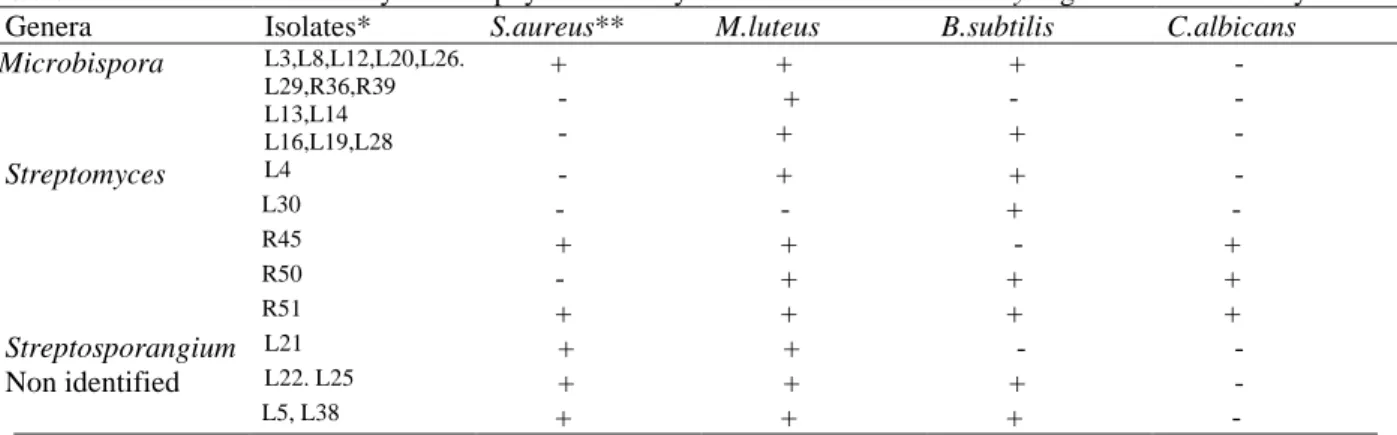
Results giving in Table 2 show that from the 53 isolates tested against bacteria and C. albicans, 23 of them (43.4%) presented antimicrobial activity against one or more microorganisms used. Antimicrobial activity was also found in
endophytic actinomycetes (Sardi et al,1992 and Maitan,1998) and thus, actinomycetes may play a role protecting the plant host against pathogenic microorganisms.
Table 2 - Antimicrobial activity of endophytic actinomycetes isolated from Zea mays against bacteria and yeast. Genera Isolates* S.aureus** M.luteus B.subtilis C.albicans
Microbispora + + +
- + -
-L3,L8,L12,L20,L26. L29,R36,R39 L13,L14
L16,L19,L28 - + +
-Streptomyces L4 - + +
-L30 - - + -R45 + + - + R50 - + + + R51 + + + +
Streptosporangium L21 + + -
-Non identified L22. L25 + + +
-L5, L38 + + +
-* L are isolates from leaves and R are isolates from roots. ** + and - = inhibition and absence of inhibition respectively.
The results here described showed that actinomycetes can be isolated as endophytes not only inside maize roots but also inside leaves. The presence of actinomycetes mainly inside root tissues may play an important role in plant development and health. Several reports refer to actinomycetes acting in plant protection against pathogens and the influence of their metabolic products on plant growth and physiology (Katznelson & Cole, 1965 ; Gupta et al,1995 and Kolomiets et al, 1997). In the present work, the presence of actinomycetes inside roots and leaves of a widely cultivated crop and from a tropical region was confirmed. Certain genera isolated as maize endophytes by us, were also found in the roots of plants from temperate climate (Sardi et al, 1992; Matsumoto et al, 1998). Other genera as
Streptosporangium seems to be more frequently
found in maize, from a tropical region than in other plants from temperate climate. The results are also as indication of the endophytic diversity that can be found and explored for biotechnological purposes.
ACKNOWLEDGEMENTS
This work was supported by FAPESP (Fundação de Amparo à Pesquisa do Estado de Sâo Paulo, Brazil). We also would like to acknowledge CNPq (Conselho Nacional de Desenvolvimento Científico e Tecnológico) for fellowships given to the authors.
RESUMO
frequente (62%), seguido dos gêneros
Streptomyces e Streptosporangium. Dos
actinomicetos isolados, 43,4% apresentaram atividade antimicrobiana contra um ou mais microrganismos ensaiado.
REFERENCES
Azevedo, J.L. Microrganismos endofíticos. In : Ecologia Microbiana (I.S Meloj. L. Azevedo, Edts.) Jaguariuna, Editora Embrapa, 1998. 117-137
Baldani, J.I.; Olivares, F.L.; Hemerly, A. S.; Reis Jr., F.B.; Oliveira, A. L. M.; Baldani, V.D. L.; Goi, S.R.; Reis V.M.; Dobereiner, J. Nitrogen-fixing endophytes: Recent advances in the association with graminaceous plants grown in the tropics. In : Biological Nitrogen Fixation for the 21st Century (C. Elmerich; A. Konderosi; W.E. Newton, Edts.) Dordrecht, Kluvier, Academic Publishers, 1997. 203-296
Benson D. R.; Silvester, W.B. Biology of Frankia
strains, actinomycete symbionts of actinorhizal plants.Microbiol, 1993. Rev. 28: 293-319
Bradbury, J.F. Guide to plant pathogenic bacteria. London, CAB International Mycological Institute Publ. 1986.
Fisher, P.J.; Petrini, O.; Lappin-Scott, H. M. The distribution of some fungal and bacteria endophytes in maize (Zea mays L.) New Phytol, 1992. 122: 299-305
Goodfellow M.; Minnikin, D. E. Chemical Methods in Bacteria Systematics. London, Academic Press, 1985 Gupta, R.; Saxena, R.K.; Chaturverde, P.; Virdi, J. S.
Chitinase production by Streptomycesviridificans: its potencial in fungi cell wall lysis. J. Appl. Bacteriol, 1995. 78: 378-383
Hallmann, J.; Quadt-Hallmann, A. ; Mahaffe, W.F.; Kloepper, J.W. Bacterial endophytes in agricultural crops. Can. J. Microbiol, 1997. 43: 895-914
Holt, J.G.; Krieg, N.R.; Sneath, P.H. A.; Stanley,J.T.;Williams, S.T. Bergeys Manual of Determinative Bacteriology (9th Ed.) Baltimore, Williams & Wilkins, 1994
Ichikawa. T.; Ishikura, T. Ozaki, A. Improvement of kasugomycin-producing strain by the agar piece method and the prototroph method. Folia Microbiol, 1971. 16: 218-224
Isaac, S. Fungal-plant interactions. London, Chapman & Hall, 1992.
Katznelson, H.; Cole S.E.Production of giberellin-like substances by bacteria and actinomycetes. Can. J. Microbiol, 1965. 11: 733-741
Kolomiets, E.I.; Zdor, N. A. Romanovskaya, T.V.; Lobanok, A. G. Certain aspects of the phytoprotective activity of Streptomyces flavescens
an antagonist of phytopathogenic fungi. Appl. Biochem. Microbiol, 1997. 33: 451-454
Kuster, E.; Williams, S.T. Selection of media for isolation of streptomycetes. Nature, 1964. 202: 928-929
Lechevalier M.P.; Lechevalier H. Chemical composition as a criterion in the classification of aerobic actinomycetes. Int. J. Syst. Bacteriol, 1970. 20: 435-443
Leslie, J.F.; Pearson, C. A .S.; Nelson, P. E.; Tousson, T. A. Fusarium spp. from corn, sorghum and soybean fields in the central and eastern United States. Phytopathology, 1990. 80: 343-350
Maitan, V. R. Isolamento e caracterização de actinomicetos endofíticos isolados de Solanum lycocarpum (lobeira). Goiânia, Tese de Mestrado, Universidade Federal de Goiás, 1998.
Matsukuma, S.; Okuda, T.; Watanabe, S. Isolation of actinomycetes from pine litter layers.Actinomycetol, 1995. 8: 57-65
Matsumoto, A.;Takahashi, Y.; Mochizuki, M; Seino, A.; Iwai, Y.; Omura, S. Characterization of actinomycetes isolated from fallen leaves. Actinomycetol, 1998. 12: 46-48
Mundt, J. O.; Hinckle, N. F. Bacteria within ovules and seeds. Appl. Environ. Microbiol, 1976. 32: 694-698 Pereira, J. O, ; Azevedo, J.L.; Petrini, O. Endophytic
fungi from stylosantes: a preliminary report. Mycologia, 1993. 85: 362-364
Pereira, J.O.; Carneiro-Vieira, M.L.; Azevedo, J.L. Endophytic fungi from Musa acuminata and their reintroduction in axenic plants. World J. Microbiol. Biotechnol, 1999. 15: 47-51
Redlin, S. C.; Carris, L. M. Endophytic fungi in grasses and woody plants. St. Paul, The American Phytopathological Society, 1996.
Sardi, P.; Saracchi, M.; Quaroni, B.; Borgonovi, G.E.; Merli, S. Isolation of endophytic Streptomyces
strains from surface-sterilized roots. Appl. Environ. Microbiol, 1992. 58: 2691-2693
Shirling, E. B.; Gottlieb, D. Methods of characterization of Streptomyces species. Int. J. Sys. Bacteriol, 1966. 16: 313-349
Silva, A. C. Isolamento de fungos endofíticos de milho (Zea mays, L.) Piracicaba, Tese de Mestrado, Universidade de São Paulo, ESALQ, 1997.
Souza, A. Bactérias endofíticas de milho (Zea mays
Stamford, T. L. M.; Coelho, L. C. B. B.; Araujo, J.M. Actinomicetos endofíticos isolados de tubérculos de jacatupé (Pachyrhisus erosus L., Urban) produtores de enzimas amilolíticas. Braz. J. Genet, 1997. 20: 200
Strobel, G. A.; Hess, W.M.; Ford, E.; Sidhu, R.S.W.; Yang, X. Taxol from fungal endophytes and the issue of biodiversity. J. Ind. Microbiol, 1996. 17: 417-423 Strobel, G. A.; Long, D. M. Endophytic microbes
embody pharmaceutical potential. Amer. Soc. Microbiol News, 1998. 64: 263-268
Williams, S. T.; Davies F. L. Use of antibiotics for selective isolation and enumeration of actinomycetes in soil. J. Gen. Microbiol, 1965. 38: 251-261
Williams, S. T.; Goodfellow, M.; Alderson, G. Genus
Streptomyces. In: Bergey ' s Manual of Systematic Bacteriology, v.4 (S.T. Williams; M. E. Sharpe; J. Holt, Edts.) Baltimore, Williams and Wilkins, 1989. 2452-2468