so
cié
té
p
r
é
his
t
o
ri
q
ue
fr
an
çais
e
LA SOCIÉTÉ PRÉHISTORIQUE FRANÇAISE
La Société préhistorique française, fondée en 1904, est une des plus anciennes sociétés d’archéologie. Reconnue d’utilité publique en 1910, elle a obtenu le grand prix de l’Archéologie en 1982. Elle compte actuellement plus de mille membres, et près de cinq cents bibliothèques, universités ou associations sont, en France et dans le monde, abonnées au Bulletin de la Société préhistorique française.
Tous les membres de la Société préhistorique française peuvent participer :
– aux séances scientifiques de la Société – Plusieurs séances ont lieu chaque année, en France ou dans les pays limitrophes. Le programme annuel est annoncé dans le premier Bulletin et rappelé régulièrement . Ces réunions portent sur des thèmes variés : bilans régionaux ou nationaux sur les découvertes et travaux récents ou synthèses sur une problématique en cours dans un secteur de recherche ou une période en particulier ;
– aux Congrès préhistoriques de France – Ils se déroulent régulièrement depuis la création de la Société, actuellement tous les quatre ans environ. Leurs actes sont publiés par la Société préhistorique française. Depuis 1984, les congrès se tiennent sur des thèmes particuliers ;
– à l’assemblée générale annuelle – L’assemblée générale se réunit en début d’année, en région parisienne, et s’accompagne toujours d’une réunion scientifique. Elle permet au conseil d’administration de rendre compte de la gestion de la Société devant ses membres et à ceux-ci de l’interpeller directement. Le renou-vellement partiel du conseil se fait à cette occasion.
Les membres de la Société préhistorique française bénéficient :
– d’information et de documentation scientifiques – Le Bulletin de la Société préhistorique française com-prend, en quatre livraisons de 200 pages chacune environ, des articles, des comptes rendus, une rubrique d’actualités scientifiques et une autre sur la vie de la Société. La diffusion du bulletin se fait par abonnement annuel. Les autres publications de la SPF – Mémoires, Travaux, Séances, fascicules des Typologies de la Commission du Bronze, Actes des Congrès, Tables et index bibliographiques ainsi que les anciens numé-ros du Bulletin – sont disponibles au siège de la Société préhistorique française, sur son site web (avec une réduction de 20 % pour les membres de la SPF et téléchargement gratuit au format PDF lorsque l’ouvrage est épuisé) ou en librairie.
– de services – Les membres de la SPF ont accès à la riche bibliothèque de la Société, mise en dépôt à la bibliothèque du musée de l’Homme à Paris.
Régie par la loi de 1901, sans but lucratif, la Société préhistorique française vit des cotisations
versées par ses adhérents. Contribuez à la vie de notre Société par vos cotisations, par des
dons et en suscitant de nouvelles adhésions autour de vous.
LES SÉANCES DE LA SOCIÉTÉ PRÉHISTORIQUE FRANÇAISE
Les Séances de la Société préhistorique française sont organisées deux à trois fois par an. D’une durée d’une ou deux journées, elles portent sur des thèmes variés : bilans régionaux ou nationaux sur les décou-vertes et travaux récents ou synthèses sur une problématique en cours dans un secteur de recherche ou une période en particulier.
La Société préhistorique française considère qu’il est de l’intérêt général de permettre un large accès aux articles et ouvrages scientifiques sans en compromettre la qualité ni la liberté académique. La SPF est une association à but non lucratif régie par la loi de 1901 et reconnue d’utilité publique, dont l’un des buts, défi-nis dans ses statuts, est de faciliter la publication des travaux de ses membres. Elle ne cherche pas le profit par une activité commerciale mais doit recevoir une rémunération pour compenser ses coûts de gestion et les coûts de fabrication et de diffusion de ses publications.
Conforméméent à ces principes, la Société préhistorique française a décidé de proposer les actes des Séances en téléchargement gratuit sous forme de fichiers au format PDF interactif. Bien qu’en libre accès, ces publications disposent d’un ISBN et font l’objet d’une évaluation scientifique au même titre que nos publication papier périodiques et non périodiques. Par ailleurs, même en ligne, ces publications ont un coût (secrétariat d’édition, mise en page, mise en ligne, gestion du site internet) : vous pouvez aider la SPF à poursuivre ces activités de diffusion scientifique en adhérent à l’association et en vous abonnant au Bulletin de la Société préhistorique française (voir au dos ou sur http://www.prehistoire.org/form/515/736/formu-laire-adhesion-et-ou-abonnement-spf-2014.html).
société pr
é
hist
orique française
NOM : ... PRÉNOM : ... ADRESSE COMPLÈTE : ... TÉLÉPHONE : ... DATE DE NAISSANCE : ⎵ ⎵ / ⎵ ⎵ / ⎵ ⎵ ⎵ ⎵ E-MAIL : ...VOUS ÊTES : q « professionnel » (votre organisme de rattachement) : ...
q
« bénévole »q
« étudiant »q
« autre » (préciser) : ...Date d’adhésion et / ou d’abonnement : ⎵ ⎵ / ⎵ ⎵ / ⎵ ⎵
Merci d’indiquer les période(s) ou domaine(s) qui vous intéresse(nt) plus particulièrement :
... Date ..., signature :
Paiement par chèque libellé au nom de la Société préhistorique française, par carte de crédit (Visa, Mastercard et Eurocard) ou par virement à La Banque Postale • Paris IDF centre financier • 11, rue Bourseul, 75900 Paris cedex 15, France • RIB : 20041 00001 0040644J020 86 • IBAN : FR 07 2004 1000 0100 4064 4J02 086 • BIC : PSSTFRPPPAR.
Toute réclamation d’un bulletin non reçu de l’abonnement en cours doit se faire au plus tard dans l’année qui suit. Merci de toujours envoyer une enveloppe timbrée (tarif en vigueur) avec vos coordonnées en précisant vous souhaitez recevoir un reçu fiscal, une fac-ture acquitée ou le timbre SPF de l’année en cours, et au besoin une nouvelle carte de membre.
q Carte bancaire : q CB nationale q Mastercard q Visa N° de carte bancaire : ⎵ ⎵ ⎵ ⎵ ⎵ ⎵ ⎵ ⎵ ⎵ ⎵ ⎵ ⎵ ⎵ ⎵ ⎵ ⎵
Cryptogramme (3 derniers chiffres) : ⎵ ⎵ ⎵ Date d’expiration : ⎵ ⎵ / ⎵ ⎵ signature :
* : Pour une meilleure gestion de l’association, merci de bien vouloir envoyer par courrier ou par e-mail en fin d’année, ou en tout début de la nouvelle année, votre lettre de démission.
** : Zone euro de l’Union européenne : Allemagne, Autriche, Belgique, Chypre, Espagne, Estonie, Finlande, France, Grèce, Irlande, Italie, Lettonie, Lituanie, Luxembourg, Malte, Pays-Bas, Portugal, Slovaquie, Slovénie.
*** : Pour les moins de 26 ans, joindre une copie d’une pièce d’identité ; pour les demandeurs d’emploi, joindre un justificatif de Pôle emploi ; pour les membres de la Prehistoric Society, joindre une copie de la carte de membre ; le tarif « premier abonnement » profite exclusivement à des membres qui s’abonnent pour la toute première fois et est valable un an uniquement (ne concerne pas les réabonnements).
**** : L’abonnement électronique n'est accessible qu’aux personnes physiques ; il donne accès également aux numéros anciens du Bulletin. L'abonnement papier donne accès aux versions numériques (numéros en cours et anciens).
aDhéSiOn ET abOnnEMEnT 2017
1. PERSONNES PHYSIQUES Zone €** Hors zone €
Adhésion à la Société préhistorique française et abonnement au Bulletin de la Société préhistorique française ➢ tarif réduit (premier abonnement, étudiants, moins de 26 ans,
demandeurs d’emploi, membres de la Prehistoric Society***)
q
40 €q
45 €➢ abonnement papier et électronique / renouvellement
q
75 €q
80 €➢ abonnement électronique seul (PDF)****
q
50 €q
50 €OU
Abonnement papier et électronique au Bulletin de la Société préhistorique française****
➢ abonnement annuel (sans adhésion)
q
85 €q
90 €OU
Adhésion seule à la Société préhistorique française
➢ cotisation annuelle
q
25 €q
25 €2. PERSONNES MORALES
Abonnement papier au Bulletin de la Société préhistorique française****
➢ associations archéologiques françaises
q
110 €➢ autres personnes morales
q
145 €q
155 €Adhésion à la Société préhistorique française
➢ cotisation annuelle
q
25 €q
25 €Le réabonnement est reconduit automatiquement d’année en année*. Paiement en ligne sécurisé sur
www.prehistoire.org
ou paiement par courrier : formulaire papier à nous retourner à l’adresse de gestion et de correspondance de la SPF : BSPF, Maison de l’archéologie et de l’ethnologie
ARCHÉOLOGIE DES
CHASSEURS-CUEILLEURS MARITIMES
DE LA FONCTION DES HABITATS À
L’ORGANI-SATION DE L’ESPACE LITTORAL
ARCHAEOLOGY OF MARITIME
HUNTER-GATHERERS
FROM SETTLEMENT FUNCTION
TO THE ORGANIZATION OF THE COASTAL ZONE
ACTES DE LA SCÉANCE DE LA SOCIÉTÉ PRÉHISTORIQUE FRANÇAISE
RENNES
10-11 AVRIL 2014
Textes publiés sous la direction de
Catherine Dupont et Gregor Marchand
Société préhistorique française
Paris
2016
SÉANCES DE LA SOCIÉTÉ PRÉHISTORIQUE FRANÇAISE
Les « Séances de la Société préhistorique française »
sont des publications en ligne disponibles sur :
www.prehistoire.org
Illustration de couverture : d’après l’affiche de la séance de G. Musch, FreshStudio.
•
Responsables des réunions scientifiques de la SPF :
Jacques Jaubert, José Gomez de Soto, Jean-Pierre Fagnart et Cyril Montoya Directeur de la publication : Jean-Marc Pétillon
Secrétariat de rédaction, maquette et mise en page : Martin Sauvage et Frank Barbery (CNRS, USR 3225, Nanterre) Correction et vérification : Karolin Mazurié de Keroualin (www.linarkeo.com)
Mise en ligne : Ludovic Mevel •
Société préhistorique française
(reconnue d’utilité publique, décret du 28 juillet 1910). Grand Prix de l’Archéologie 1982. Siège social : 22, rue Saint-Ambroise, 75011 Paris
Tél. : 01 43 57 16 97 – Fax : 01 43 57 73 95 – Mél. : [email protected] Site internet : www.prehistoire.org
Adresse de gestion et de correspondance Maison de l’archéologie et de l’ethnologie,
Pôle éditorial, boîte 41, 21 allée de l’Université, F-92023 Nanterre cedex Tél. : 01 46 69 24 44
La Banque Postale Paris 406-44 J
Publié avec le concours du ministère de la Culture et de la Communication (sous-direction de l’Archéologie), du Centre national de la recherche scientifique,
de la direction des Affaires culturelles de Bretagne, de la région Bretagne, de l’université Rennes 1, de l’UMR 6566 « Centre de recherches en archéologie, archéosciences, histoire (CReAAH) », Rennes,
et de la Maison des sciences de l’homme en Bretagne, Rennes. © Société préhistorique française, Paris, 2016.
Tous droits réservés, reproduction et diffusion interdite sans autorisation. Dépôt légal :4e trimestre 2016
SOMMAIRE/CONTENTS
Remerciements / Acknowledgements ... 7 Catherine Dupont et Gregor Marchand — Les chasseurs-cueilleurs maritimes entre terre et mer,
entre diversité et complexité / Maritime hunter-gatherers between land and sea,
between diversity and complexity ... 9
P
remièrePartieL
eschasseurs-
cueiLLeursmaritimesduP
LeistocèneJean-Marc Pétillon — Life on the Shores of the Bay of Biscay in the Late Upper Palaeolithic: towards a New Paradigm / Vivre au bord du golfe de Gascogne au Paléolithique supérieur récent :
vers un nouveau paradigme ... 23 Véronique Laroulandie, Mikelo Elorza Espolosin et Eduardo Berganza Gochi — Les oiseaux marins du Magdalénien supérieur de Santa Catalina (Lekeitio, Biscaye, Espagne) : approches taphonomique et archéozoologique / Seabirds from the Upper Magdalenian of Santa Catalina (Lekeitio, Biscay, Spain):
Taphonomic and Zooarchaeological Approaches ... 35 David Cuenca-Solana, Igor Gutiérrez-Zugasti and Manuel R. González-Morale — Shell Tools
and Subsistence Strategies during the Upper Palaeolithic in Northern Spain / Outils sur coquille
et stratégies de subsistance pendant le Paléolithique supérieur dans le nord de l’Espagne ... 59 J. Emili Aura Tortosa, Jesús F. Jordá Pardo, Esteban Álvarez-Fernández, Manuel Pérez Ripoll,
Bár-bara Avezuela Aristu, Juan V. Morales-Pérez, María José Rodrigo García, Ricard Marlasca, Josep Antoni Alcover, Paula Jardón, Clara I. Pérez Herrero, Salvador Pardo Gordó, Adolfo Maestro, María Paz Villalba Currás and Domingo Carlos Salazar-García — Palaeolithic - Epipalaeolithic Seapeople
of the Southern Iberian coast (Spain): an overview /Chasseurs-cueilleurs maritimes
du Paléolithique-Épipaléolithique de la côte sud de la péninsule Ibérique (Espagne) : une synthèse ... 69 Garry Momber, Lauren Tidbury and Julie Satchell — The submerged lands of the Channel and North Sea: evidence of dispersal, adaptation and connectivity / Les zones submergées de la Manche et de la mer du Nord :
indices de peuplement, d’adaptation et de connectivité ... 93
d
euxièmePartieL
eschasseurs-
cueiLLeursmaritimesdeL’h
oLocèneCyrille Billard et Vincent Bernard — Les barrages à poissons au Mésolithique : une économie de prédation ou de production ?/The Mesolithic Fishing Weirs: an Economy Based on Foraging or on Production? ... 113 Ana Cristina Araújo — The Significance of Marine Resources during the Early Mesolithic in Portugal /
L’importance des ressources marines pendant le Mésolithique ancien au Portugal ... 127 Mariana Diniz — Between Land and Sea: Assessing Hunter-Gatherer Subsistence Practices
and Cultural Landscapes in Southern Portugal during the Final Mesolithic / Entre terre et mer:
débattre des pratiques de subsistance et des paysages culturels des chasseurs-cueilleurs du Mésolithique final dans le Sud du Portugal ...145
Pablo Arias, Miriam Cubas, Miguel Ángel Fano, Esteban Álvarez-Fernández, Ana Cristina Araújo, Marián Cueto, Carlos Duarte, Patricia Fernández Sánchez, Eneko Iriarte, Jesús F. Jordá Pardo, Inés L. López-Dóriga, Sara Núñez de la Fuente, Christoph Salzmann, Jesús Tapia, Felix Teichner, Luis C. Teira, Paloma Uzquiano and Jorge Vallejo — Une nouvelle approche pour l’étude de l’habitat mésolithique dans le Nord de la péninsule Ibérique : recherches dans le site de plein air d’El Alloru (Asturies, Espagne) / A New Approach to the Study of Mesolithic Settlement in the Northern Part of the Iberian Peninsula:
Research Carried Out at the Open Air Site of El Alloru (Asturias, Spain) ... 159 Ana Catarina Sousa and António M. Monge Soares — Continuity or Discontinuity? The Exploitation of Aquatic Resources in the Portuguese Estremadura during the Atlantic Period: the São Julião and Magoito Shell Middens as Case Studies /Continuité ou discontinuité ? L’exploitation des ressources aquatiques dans l’Estrémadure
portugaise pendant la période atlantique : les amas coquillers de São Julião et de Magoito comme études de cas .... 191 Dominique Bonnissent, Nathalie Serrand, Laurent Bruxelles, Pierrick Fouéré, Sandrine Grouard,
Nathalie Sellier et Christian Stouvenot — Archéoécologie des sociétés insulaires des Petites Antilles au Mésoindien : l’enjeu des ressources à Saint-Martin / Archaeoecology of the Island Societies
during the Archaic Age in the Lesser Antilles: the Issue of Resources in Saint-Martin ... 213 Claire Houmard— L’exploitation technique des ressources animales des premiers peuples de l’Arctique
de l’Est canadien (env. 2500 BC - 1400 AD) / The Technical Exploitation of Animal Resources
among the Early Arctic People in Eastern Canada (c. 2500 BC - 1400 AD) ... 261 Grégor Marchand, Catherine Dupont, Claire Delhon, Nathalie Desse-Berset, Yves Gruet, Marine Laforge, Jean-Christophe Le Bannier, Camille Netter, Diana Nukushina, Marylise Onfray, Guirec Querré,
Laurent Quesnel, Rick Schulting, Pierre Stéphan et Anne Tresset — Retour à Beg-er-Vil. Nouvelles approches des chasseurs-cueilleurs maritimes de France atlantique / Beg-er-Vil Revisited. New Methodological approaches
of the maritime hunter-gatherers in Atlantic France ... 283
t
roisièmePartied
esPêcheursdansunmonded’
agricuLteursSophie Méry, Dalia Gasparini, Gautier Basset, Jean-François Berger, Adrien Berthelot, Federico Borgi, Kevin Lidour, Adrian Parker, Gareth Preston et Kathleen McSweeney— Mort violente en Arabie : la sépulture multiple d’Umm al Quwain UAQ2 (Émirats arabes unis), VIe millénaire BC / Violent Death in Arabia:
the Multiple Burial of Umm al Quwain UAQ2 (United Arab Emirates), 6th Millennium BCE ... 323 Vincent Charpentier, Jean-François Berger, Rémy Crassard, Federico Borgi, Philippe Béarez— Les premiers chasseurs-collecteurs maritimes d’Arabie (IXe-IVe millénaires avant notre ère) / Early Maritime Hunter-
Gatherers in Arabia (9th – 4th Millennium before the Current Era) ... 345 Robert Vernet— L’exploitation ancienne des ressources du littoral atlantique mauritanien (7500 - 1000 cal. BP) / The Ancient Exploitation of Resources on the Mauritanian Atlantic Coast (7500 - 1000 cal. BP ... 367 Alexander N. Popov and Andrey V. Tabarev— Lords of the Shell Rings: Boisman Neolithic Culture, Russian Far East /
Seigneurs des anneaux sur coquilles : la culture néolithique de Boismanskaya, Extrême-Orient russe ... 393 Paul Wallin — The Use and Organisation of a Middle-Neolithic Pitted Ware Coastal Site on the Island of Gotland in the Baltic Sea / Fonction et organisation d’un site côtier de la culture à Céramique à Fossettes du Néolithique moyen
REMERCIEMENTS
N
ous souhaitons remercier tous les participants à cette séance de la Société préhistorique française, tenue en avril 2014 à Rennes, qu’ils fussent orateurs ou auditeurs. Tous ont participé à la qualité des échanges scientifiques durant ces deux journées.Cette manifestation scientifique internationale n’aurait pas pu se dérouler sans le soutien logistique de l’UMR 6566 « CReAAH ». Plusieurs de nos collègues du laboratoire Archéosciences (université Rennes 1) ont assuré à la fois l’ac-cueil et le déroulement des pauses de cette séance, avec leur efficacité et leur bonhommie légendaire : Francis Bertin, Annie Delahaie, Catherine Louazel, Catherine Gorlini et Laurent Quesnel. Nous remercions également Diana Nukushina et Helena Reis pour leur aide au bon déroulement des séances. Nous sommes gré à Franck Wellmann de l’université Rennes 1 qui nous a apporté le support informatique et multimédia de la salle de conférence. Nous remercions Louise Byrne pour la correction et la révision des textes en anglais.
L’organisation de cet évènement a également été soutenue financièrement par de nombreux organismes publics et des projets de recherche : le projet européen « Arch-Manche » (Interreg IVA 2 Mers, fonds FEDER), le projet « SeaMeso » de la Maison des sciences de l’homme en Bretagne, le CNRS (DR 17), l’Observatoire des sciences de l’Univers de Rennes (OSUR), le ministère de la Culture (service régional de l’Archéologie de Bretagne) et la région Bretagne. L’université Rennes 1 a permis l’utilisation de l’amphithéâtre Donzelot. Enfin, nous tenons à remercier la Société préhistorique fran-çaise d’avoir accepté de labelliser cet évènement « Séance de la Société préhistorique franfran-çaise ».
ACKNOWLEDGEMENTS
W
e wish to thank all the orators and auditors who participated in this session of the Société préhistorique française, held in April 2014 in Rennes. The quality of their presentations and questions, during the session or in the corridors, resulted in pertinent exchanges during these two days.This international scientific event could not have taken place without the logistic support of the UMR 6566 ’CReAAH’. Several of our colleagues from the Archaeosciences laboratory (Rennes 1 University) oversaw the reception of partici-pants and the breaks during the session with their legendary efficiency and good nature: Francis Bertin, Annie Delahaie, Catherine Louazel, Catherine Gorlini and Laurent Quesnel. We also thank Diana Nukushina and Helena Reis for their help with the smooth running of the sessions. We are grateful to Franck Wellmann from the Rennes 1 University of for looking after the computer and multimedia installations in the conference room. We thank Louise Byrne for the correction in english of the abstracts and the texts.
The organization of this event also received financial support from a number of public bodies and research proj-ects: UMR 6566 ’CReAAH’, the European ’Arch-Manche’ project (Interreg IVA 2 Mers, FEDER funds), the project ’SeaMeso’ from the Maison des Sciences de l’Homme en Bretagne, the CNRS (DR 17), the Rennes Observatory of the Sciences of the Universe (Observatoire des sciences de l’Univers de Rennes, OSUR), the French Ministry of Culture (Regional Archaeology Service of Brittany) and the Brittany region. The Rennes 1 University kindly let us use the Don-zelot amphitheatre. Finally, we wish to thank the Société préhistorique française for accepting to categorize this event as a ’French Prehistoric Society session’.
Between Land and Sea
Assessing Hunter-Gatherer Subsistence Practices and Cultural
Landscapes in Southern Portugal during the Final Mesolithic
Abstract: The longstanding relationship between human groups and the sea continues to shape European culture today, as we can see from Eurostat data. A large proportion of the present-day population could be classified as maritime and the goals for Horizon 2020 reflect the major role of the sea in the contemporary economy, sciences and ways of life.
Among the questions to be addressed when looking at the relationship between the last hunter-gatherer groups and the sea — which means assessing how the sea and coastal regions were used and explored — we can ask what role the sea played in the cultural matrix of these groups?
In order to define some starting points for this analysis, it is important to briefly sum up some general assumptions relating to this subject: 1) along European coasts, Final Mesolithic hunter-gatherers were traditionally described as relying heavily on a maritime economy; a situation that is supposed to change with the Neolithisation process and the dominance of agro-pastoral and land-based economies. Therefore, a major breakdown in the long-term ’maritime relation’ is assumed to be related to cultural factors as part of a chronological process; when domesticates arrived the sea lost its dominance; 2) traditionally, maritime hunter-gatherer economies are generally defined as an Atlantic phenomenon and groups in the Mediterranean Basin are thought to be characterized by less dense occupation patterns and a less marked maritime character. Debating why this major difference arose and why maritime economies are environmentally dependent – not only on the distance from the sea, which is an expected dependency — but mainly on which is the nearest sea, is a question to be explored in this paper. This assumption raises the problem as to how coastal zones were defined during the Final Mesolithic and how the different coastal hunter-gatherer groups settled along European shorelines, considering that recent data point to clear asymmetries between North Atlantic and Mediterranean hunter-gatherers.
Southern Portugal is a privileged area for discussing these questions on account of its Atlantic position, but also due to the fact that the clearly Mediterranean environment of this region makes it a pertinent territory for examining Final Mesolithic hunter-gatherer beha-viour in a mixed landscape, between land and sea, between Atlantic and Mediterranean settings.
In order to understand the data from southern Portugal and to establish the ’maritime index’ of this zone, it is necessary to compare Western Iberian hunter-gatherers with other Final Mesolithic groups in Atlantic and Mediterranean areas, by addressing topics such as site location patterns, site distance to the sea and dietary isotopic analysis. In this way, we can define a first comprehensive model of settlement purposes.
Differences in Atlantic and Mediterranean cultural patterns will be explored by relating archaeological data to environmental possibilit-ies. The primary productivity of oceans is considered here to be a relevant issue to explain variances in Final Mesolithic hunter-gatherer behaviour.
Keywords : Final Mesolithic, hunter-gatherers, Mesolithic diets, North Atlantic, Mediterranean Basin.
Résumé : Les relations entre les groupes humains et la mer est une question ancienne que nous pouvons aborder désormais à partir des données de Eurostat qui montrent par exemple comment la mer façonne la culture européenne encore aujourd’hui. Ainsi, une grande partie d’entre nous peut être classée comme des personnes dépendantes d’un environnement maritime, et les objectifs adoptés par l’ERC dans l’Horizon 2020 reflètent le grand rôle attribué à la mer dans l’économie contemporaine, les sciences et les modes de vie. Parmi plusieurs questions qu’évoque ce thème chez les derniers chasseurs-cueilleurs, se pose celle de l’influence de la mer sur les populations des régions côtières et comment cet environnement a influencé leur matrice culturelle.
À l’heure actuelle, plusieurs idées préconçues existent sur ce sujet : 1) le long des côtes européennes les chasseurs-cueilleurs du Méso-lithique final ont été traditionnellement décrits comme ayant une économie maritime qui va changer avec le processus de néolithisation et la domination des économies agro-pastorales. Celles-ci vont établir une rupture majeure dans cette longue « relation maritime » : quand les espèces domestiquées sont arrivées, la mer a perdu sa position dominante dans l’économie des populations côtières ; 2) tra-ditionnellement, ces chasseurs-cueilleurs des régions côtières basés sur une économie maritime sont définis en grande partie comme
Archéologie des chasseurs-cueilleurs maritimes. De la fonction des habitats à l’organisation de l’espace littoral
Archaeology of maritime hunter-gatherers. From settlement function to the organization of the coastal zone
Actes de la séance de la Société préhistorique française de Rennes, 10-11 avril 2014 Textes publiés sous la direction de Catherine Dupont et Gregor Marchand Paris, Société préhistorique française, 2016 (Séances de la Société préhistorique française, 6), p.145-158 www.prehistoire.org
ISSN : 2263-3847 – ISBN : 2-913745-2-913745-65-2
146 Mariana Diniz
un phénomène atlantique. En effet, les populations côtières du bassin méditerranéen révèlent une occupation moins dense et maritime de ces territoires.
Cet article débat de ces différences majeures et des raisons pour lesquelles cette dépendance se produit, non pas seulement la question de la distance à la mer mais plus généralement celle de la nature du proche océan. Il s’agit en effet ici de mieux définir les différents groupes de chasseurs-cueilleurs du Mésolithique final évoluant le long des côtes européennes, notamment en abordant l’origine des variabilités observées entre les chasseurs-cueilleurs de la façade atlantique et ceux du bassin méditerranéen. Pour répondre à ces ques-tions, le Sud du Portugal constitue une aire privilégiée, en raison de sa position atlantique soumise à des conditions environnementales clairement méditerranéennes. On peut alors se demander comment les chasseurs-cueilleurs du Mésolithique final se sont comportés dans ce paysage mixte situé entre la terre et la mer, entre l’Atlantique et le Méditerranée.
Pour comprendre le contexte archéologique du Sud du Portugal et mettre en place son « indice maritime », il est nécessaire de comparer les derniers chasseurs-cueilleurs de la péninsule ibérique occidentale avec d’autres groupes du Mésolithique final de la façade Atlan-tique et des régions méditerranéennes, notamment du point de vue de la localisation des sites, de leur distance à la mer et du résultats des analyses isotopiques témoignant des régimes alimentaires. Cela devrait permettre d’obtenir des modèles de peuplement distincts. Pour débattre des causes complexes à l’origine de ces différences économiques et culturelles, la disponibilité des ressources environ-nementales, comme la productivité primaire des océans seront prises en compte.
Mots-clés : Mésolithique Final, chasseurs-cueilleurs, diètes mésolithiques, Atlantique Nord, Bassin méditerranéen.
I
n europe, the transition from a hunter-gatherer to an agro-pastoralist way of life is thought to entail major changes in lifestyles, particularly in food procure-ment strategies. A new and more distant relationship with the sea and sea resources is considered to emerge while domesticates — animals and plants — arrived and dissem-inated throughout the land. Thus, a major breakdown in the Holocene ’maritime relation’ is assumed to be related to cultural factors as part of a chronological process; when domesticates arrived the sea lost its dominance.The Neolithic economic system in Europe is predom-inantly based on farming, even though a complete change in the subsistence model could have taken several mil-lennia to occur, particularly in some coastal areas where maritime resources continue to play a significant role in the local economy.
In addition, Final Mesolithic hunter-gatherers in coastal Atlantic and Mediterranean coastal regions show significant differences as regards their dependence on the sea. These differences persist today since Eurostat data show that the two areas do not display the same rela-tionship with the sea (European Commission – Euro-stat, 2014). Analysing the different behavioural patterns of Atlantic and Western Mediterranean Final Mesolithic groups as regards subsistence practices and landscape use is the main aim of this paper. For this purpose, isotopic data from human diets and regional settlement patterns will be used to determine how these groups interacted with their biological and cultural environments.
After more than 150 years of continuous and inter-disciplinary research, Final Mesolithic maritime hunter-gatherer economies are largely defined as an Atlantic phe-nomenon and the distribution of large shell middens along coastal areas from Scandinavia to the Iberian Peninsula plays a key role in this depiction. This clear preference for Atlantic environments reflected by Mesolithic settlement maps (for a review see e.g. Gutiérrez Zugasti et al., 2011) points to sparser occupation and the decrease of maritime activities as regards the human groups that settled in the Mediterranean basin. These southern hunter-gatherers
seem to be peripheral to the ’dominant’ Final Mesolithic cultural model (for a review of the Mesolithic Mediter-ranean shell middens, see e.g. Colonese et al., 2011) and debating why this major difference between Atlantic and Mediterranean areas arose is a central issue here.
Even if we assume that multiple biases could affect this image — in Mediterranean regions, archaeologists are traditionally more oriented towards other cultural peri-ods than the Mesolithic period — differences in coastline dynamics during the Holocene period and the possibil-ity that new data may modify the current situation — it is still possible to take into account a model that predicts that maritime economies are based on environmental dependency, not only in relation to their distance from the sea — which is an expected dependency — but also, and above all, depending on what is the nearest sea.
Therefore, the starting point of this discussion is to define how coastal dependencies were indeed different among the coastal hunter-gatherer groups established along European shorelines. It is essential to address to what extent environmental and/or cultural aspects are responsible for the differences in maritime behaviour between Atlantic and Mediterranean Final Mesolithic groups.
Southern Portugal is a privileged area for discussing these questions since this region presents a mixed char-acter deriving from its geographical Atlantic position alongside a Mediterranean environment, due to geolo-gical, climatic, faunal-botanical and historical/sociolo-gical features. This region is therefore a relevant territory for analysing Final Mesolithic hunter-gatherer behaviour at this crossroads, between land and sea, and between the Atlantic Ocean and the Mediterranean Sea.
Differences in cultural patterns can be explained using different arguments, ranging from environmental determ-inism to systems theory, to symbolic and identity issues that post-modern archaeologists tend to adopt as the main proxy for interpreting human behaviour. Here, an inter-mediate position is proposed. Without arguing for a priori environmental determinism, landscape analyses are
con-Between Land and Sea: Assessing Hunter-Gatherer Subsistence Practices and Cultural Landscapes 147
sidered as being crucial for understanding archaeological records, in the same way as social choices and cultural patterns are essential for assessing past cultural diversity.
In order to comprehend the data from Southern Por-tugal and to establish the ’maritime index’ of this region, it is necessary to compare western Iberian hunter-gather-ers with other Final Mesolithic groups in Atlantic and Mediterranean areas, focusing on topics such as: 1) the primary productivity of coastal areas; 2) site location pat-terns and site distance from the sea and 3) isotopic ana-lysis of human diets, so that a comprehensive model of group dependence on maritime resources can be defined.
ON THE PRIMARY PRODUCTIVITY OF OCEANS AND SEAS
I
n order to establish the primary productivity (PP) of the North Atlantic Ocean and the Mediterranean Sea during the first millennia of the Holocene, contemporary marine phytoplankton data — the sustenance of marine food webs — can be used to define general values since marine environments present long-term trend values (Abrantes, 2000; Cermeño et al., 2010) and the main factors correlated to phytoplankton distribution — light and nutrients (Ramos Pereira, 2001, p. 29-31) — do not present major changes since the Atlantic climatic period. Historical data confirm that differences in ocean PP pred-ate anthropogenic factors, such as pollution or overex-ploitation. This is corroborated by the virtual absence of Roman cetariae (fish salting installations) in the Medi-terranean Sea. The examination of figure 1, presenting ocean primary productivity, reflects marked asymmetries between North Atlantic and Mediterranean areas, with environments such as the Scandinavian or British areas showing the highest global values of primary productiv-ity, reaching more than 800 g C m−2 y−1, whereas someMediterranean coastal areas fall within the lower range with values between 226 and 103 g C m−2 y−1 (Longhurst
et al., 1995).
This has environmental consequences on Final Meso-lithic settlement distribution and it is no coincidence that the Mesolithic map corresponds to European coastal areas with higher primary productivity and that hunter-gatherer maritime economies were developed in primary productivity hot spots. Shell middens are a major archae-ological marker of this link with the sea.
In addition to the marked asymmetry between North Atlantic and Mediterranean areas, primary productivity can be used to explain some trans-regional tendencies in the Western European and Maghreb Final Mesolithic archaeological record. A small-scale analysis shows that other productivity gradients in North Atlantic coastal areas should be highlighted in order to clarify some aspects of western Iberian Final Mesolithic archaeological data, in particular concerning shell middens in Southern Portugal.
In the North Atlantic, the 40ºN parallel establishes a line in primary productivity that rises above that parallel
from 45 g to more than 90 g (Johnsen et al., 2010, p. 5). This line coincides with the boundary between “Mediter-ranean and Atlantic Portugal”, a distinction made several decades ago by O. Ribeiro (Ribeiro, 1991), who poin-ted out that in spite of a geographical Atlantic position, Southern Portugal is indeed geologically, climatically and culturally, a Mediterranean landscape. This north-ern increase in productivity along the Portuguese west coast may be considered as an explanation for Mesolithic diversity in the archaeological record. We will come back to this point below.
Thus, global scenarios relating to the PP of oceans can contribute to explaining why the Mediterranean Mesolithic is not correlated to an aquatic shell midden record and why the Maghreb escargotières (snail-shell middens) — even if they reflect the same broad spectrum economy as shell middens — depend on land species (Lubell, 2004a and 2004b). Even in coastal and slightly later occupations, such as the Cimetière des Escargots site (Bou-Sfer, Oran), marine shells are well represented but land snails abound (Goetz et al., 1964), reflecting the pre-dominant role of land-based food procurement strategies in these coastal groups. Generally speaking, and consid-ering that PP values from the southern Mediterranean coast (fig. 1) range from 98 g C m−2 y−1 to 193 g C m−2 y−1,
the scarcity of marine resources seems to be a reason-able argument to explain why large Capsian shell mid-dens point towards inland sources and why these groups depend on land-dwelling mollusc exploitation (Lubell, 2004a and 2004b).
The outcome of the analysis of ocean primary pro-ductivity values reveals a very clear contrast between Atlantic and European Mediterranean environmental conditions. This enables or constrains the different dependencies on maritime economies shown by the Final Mesolithic settlement map. Within this area, the marked asymmetry detected between some of the most productive environments, like those recorded in Scandinavia with PP values reaching 800 g C m−2 y−1, and the lowest along the
southern Mediterranean shore, can be used as a proxy to predict that Final Mesolithic hunter-gatherers developing an opportunistic economy will adapt differently to land-scape possibilities and produce an archaeological record where sea resources have different roles, as site location and dietary analysis — discussed below — reveal.
ON SITE LOCATION PATTERNS
D
iscussing coastal European Final Mesolithicsettle-ment patterns can be considered a difficult matter since postglacial transgression dynamics were still active during that period and detailed shoreline reconstitutions do not exist for the whole area under study. It is cur-rently almost impossible to establish a general picture of where exactly the shifting coastline was during the Final Mesolithic (c. 7500-5500 cal. BCE), in different parts of Europe. Consequently, extreme caution is required in
148 Mariana Diniz
attempts to define the coastal/inland status of a particu-lar site. Nevertheless, the bathymetry of the areas under analysis, together with some available regional coastline reconstructions, points to major changes in northern lat-itudes, particularly in Brittany and southern Scandinavia (fig. 2), with the first line of coastal Mesolithic sites now submerged (e.g. Fischer et al., 2007, fig. 1; Marchand, 2007, fig. 3). Minor effects are documented on Mediter-ranean coastal areas (fig. 3), where almost abrupt margins and the extension of former coastal platforms were not so strongly affected by the post-glacial rise in sea level. For instance, data from the Pleniglacial period for Medi-terranean Spain — when differences in landscape were at their peak — predict a coastal strip 10 – 20 km wider that today on the Gulf of Valencia, but only 5 km wider in eastern Andalucía (Aura Tortosa et al., 1998, p. 97).
Moreover, the definition of coastal/inland areas can also be problematic, since geographic descriptions often involve qualitative criteria (for some discussion of this issue, see Arias Cabal et al., 2009, p. 304), with coastal/ inland categories being defined on occasion using attrib-utes other than just the physical distance to the sea. In this paper, the principles of the site catchment analysis model
will be followed to define coastal sites that should be no more than 10 km from the shore (Roper, 1979), meaning that to be considered a coastal site, seafood must be avail-able in the immediate resource exploitation area.
It becomes clear from this analysis that even if more detailed geomorphological analysis is required and more data concerning the regional contours of sea level rises are needed, a global and predictable trend emerges from the study of Atlantic and Mediterranean Final Mesolithic site location patterns.
The comparisons of data from some Final Mesolithic key settlement areas in both Atlantic and Mediterranean environments evidence an almost perfect correlation between ocean primary productivity values and the pres-ence of coastal settlements.
If we consider Northwest Scotland, the Ertebølle region, and Brittany as North Atlantic case studies corres-ponding to red ocean primary productivity areas (fig. 1), intensive coastal exploitation is recorded and major sites with settlements and cemeteries are located near the sea.
Through the detailed examination of the cartography available for these regions, a clear picture emerges of North Atlantic hunter-gatherers intensively exploiting
0 500 1000 km
Phytoplankton pigment concentration (mg/m3)
NASA/GSFC
N
Fig. 1 – Map of the main Mesolithic settlements in Western Europe and the Maghreb with colour references to ocean primary productivity (after Lubell, 2004; Dupont et al., 2009; Fontanals-Coll et al., 2014; http://geosci.sfsu.edu/courses/geol103/labs/ upwelling/images/world_summer.gif).
Fig. 1 – Carte des principaux sites mésolithiques en Europe de l’Ouest et au Maghreb avec les couleurs des références de la produc-tivité primaire des océans (d’après Lubell, 2004 ; Dupont et al., 2009 ; Fontanals-Coll et al., 2014 ; http://geosci.sfsu.edu/courses/ geol103/labs/upwelling/images/world_summer.gif).
Between Land and Sea: Assessing Hunter-Gatherer Subsistence Practices and Cultural Landscapes 149
coastal areas for logistic, residential and symbolic pur-poses. This implies that the classical post-glacial mari-time/broad spectrum economy models developed since the 1960s (Binford, 1968; Flannery, 1969) are still valid for the archaeological record of the area.
The distribution of sites in Western Scotland shows that Mesolithic settlement occupied a coastal fringe, almost without exception. As expected, the archaeolo-gical record indicates important links with the sea, and marine resources are a key element in shaping cultural patterns (Mithen et al., 2007).
This same image also emerges in Southern Scand-inavia, where, as notes L. Larsson, “an intensive use of the coastline is well known from the Late Mesolithic
when most sites are situated above present sea level.” (Larsson, 2003). In Southern Scandinavia and consid-ering local bathymetry, the Final Mesolithic landscape included territories that are now submerged but the available archaeological record reflects strong relation-ships between groups settled near the coast and the sea, marking an important split with groups established inland (Larsson, 2003, p. 10).
The third North Atlantic area considered here rein-forces this pattern. In Brittany, settlement patterns show that Final Mesolithic groups selected coastline areas or territories between 20 m and 1 km from the sea for implanting large settlements and cemeteries, whereas they developed a more mobile way of life in inland zones, Fig. 2 – Bathymetry of the North Sea (adapted from Bathymetry Maps of Continental Margins: http://cmtt.tori.org.tw/data/ App_map/maplist.htm).
Fig. 2 – Bathymétrie de la mer du Nord (modifié d’après Bathymetry Maps of Continental Margins : http://cmtt.tori.org.tw/data/ App_map/maplist.htm).
150 Mariana Diniz
with no burial places (Ghesquière and Marchand, 2010, p. 49).
A cultural and settlement model developed in these North Atlantic areas, where populations exploited local features, revealing opportunistic behaviour, particularly in rich coastal landscapes. The sea was thus clearly a decisive factor in North Atlantic settlement patterns.
The comparison of these data with Western Mediter-ranean settlement patterns, and in particular the Iberian Peninsula archaeological record, yielded a less maritime picture, where site locations point to different strategies of resource exploitation and land use.
In southern Mediterranean regions, as already men-tioned above, coastal areas seem to be peripheral to dom-inant settlement patterns and Capsian site distribution clearly reveals a terrestrial economic system. It is import-ant to recall that the lowest levels of ocean primary pro-ductivity are registered in this area, making coastal envir-onments less attractive to human settlement than inland locations.
For the northern Mediterranean margin, based on the Final Mesolithic record in Liguria (Nisbet, 2008, p. 196) and Southern France, it is clear that this particular period is practically unknown in the region and available data do not point to any particular link to coastal areas. In fact, recent evidence points towards a land-based economy,
with shell consumption at the Lavérune (Pouget, Hérault) open-air site, located around 8 km from the sea. However, given the scarcity of shell remains, it is not possible to classify this occupation as a shell midden ( Guilbert-Ber-ger et al., this meeting).
It is impossible to define Final Mesolithic settlement in Mediterranean Spain, on account of many gaps in the record. As Juan Cabanilles and Martí Oliver emphasize: “(…) el Epipaleolítio reciente es praticamente descono-cido en Cataluña, asi como en la Andalucía mediterránea, si exceptuarmos el foco interior y aislado de la Sierra de Cazorla.” (Juan Cabanilles and Martí Oliver, 2007-2008, p. 618).
In Central Catalonia, coastal areas do not reveal any particular Final Mesolithic occupation, and most of the currently available data come from further inland (Utrilla and Martínez-Béa, 2007; Arias Cabal et al., 2009;
Fernández López de Pablo and Gómez Puche, 2009). Final Mesolithic groups are not linked to an aquatic eco-nomy and the dominance of land-based hunter-gatherer behaviour is reflected in the archaeological material, as documented by the geometric projectiles stemming from the Costalena and Botiqueria sites (Martínez Béa, 2004).
In Valencia, which is a key area for understanding the process of neolithisation in the Iberian Peninsula due to chronometric and cultural data available for the Early Fig. 3 – Bathymetry of the Mediterranean Sea (adapted from Bathymetry Maps of Continental Margins: http://cmtt.tori.org. tw/data/App_map/maplist.htm).
Fig. 3 – Bathymétrie de la mer Méditerranée (modifié d’après Bathymetry Maps of Continental Margins : http://cmtt.tori.org.tw/ data/App_map/maplist.htm).
Between Land and Sea: Assessing Hunter-Gatherer Subsistence Practices and Cultural Landscapes 151
Neolithic groups, the picture is even clearer. Apart from El Collado, the other Mesolithic sites are located inland (Aura Tortosa et al., 2009), and the eponymous Final Mesolithic site in Valencia, Cueva de la Cocina, is situ-ated around 30 km from the sea.
In Andalucía, a mixed picture emerges with no clear preference for the exploitation of coastal or inland areas (Ramos Muñoz, 2007).
In Nerja Cave, intense maritime exploitation is docu-mented (Aura Tortosa et al., 2009, p. 356), but it is import-ant to be cautious when extrapolating these behaviours to other areas as aquatic resources do not appear to play a major role in diets in other Mediterranean coastal caves, such as at Arene Candide or Grotta del Uzzo (Craig et al., 2006, p. 71).
In Western Andalusia, at open air sites like El Embar-cadero del Rio Palmones, marine faunal remains are very rare in spite of its coastal location (Casimiro-Soriguer et al., 2005, p. 338). At El Retamar (Cádiz), marine resources were exploited but the overall picture from
these sites does not correspond to that of Atlantic shell middens (Ramos Muñoz and Lazarich González, 2002).
Thus, a pattern of more limited coastal settlement emerges from the Western Mediterranean data, and it is important to emphasize that even if coastal locations are included in these distribution patterns, the sea does not play a crucial role in food procurement strategies.
In Southern Portugal, like in other Mediterranean areas, the current shoreline was not predominantly selec-ted for settlement purposes. In fact, apart from the open air site of Samouqueira, Sines (Soares, 1995), other set-tlement sites, like Muge, Sado and Mira, with large shell middens, are located in former estuaries in inland areas, ranging from 40 km to 10 km from the sea (fig. 4).
This estuarine pattern fits well with an aquatic eco-nomy, but shows however important differences in relation to North Atlantic areas, which require further discussion.
Using only settlement pattern data, it appears that, like with primary productivity, North Atlantic and Medi-terranean hunter-gatherers behave differently when
Fig. 4 – Final Mesolithic sites in Southern Portugal mentioned in the text.
152 Mariana Diniz
choosing site locations. During the Final Mesolithic, proximity to the sea does not influence the human set-tlement of North Atlantic and Mediterranean areas in the same way, and even when the sea is close by, this does not necessarily mean that food acquisition is focused on mar-ine products. Again, North Atlantic and Mediterranean areas exhibit different cultural patterns as regards settle-ment locations. Submerged landscapes seem to hardly provide an explanation for this, since greater changes in coastlines due to postglacial transgressive dynamics are known to have occurred in North Atlantic areas where the first line of Final Mesolithic settlement is now sub-merged. However, the archaeological record documents close relationships with the sea, indicating sharp contrast with Mediterranean economic patterns.
ON DIET AND ISOTOPE ANALYSIS
R
econstructing human diets from the archaeologicalrecord was traditionally approached through the ana-lysis of faunal and botanic remains, combined with lithic typo-technological descriptions, micro-wear studies and considerations of site locations and environmental possib-ilities, in order to obtain a more accurate image. In south-ern European records, and in particular those from the Iberian Peninsula, faunal remains are abundant but plant-based food was not directly documented until the begin-ning of the Sado-Meso (Diniz and Arias Cabal, 2012) and Muge (Bicho et al., 2011) team projects. The latter supply new data on a predictable major group of food resources in Mediterranean areas, as argued by D. Clarke (Clarke, 1978), and reveal by trace element analysis of popula-tions from Sado (Soares Umbelino, 2006).
It was however difficult to apply quantitative analysis to earlier data relating to human diets, due to multiple factors: samples recovered from former excavations with unknown field procedures generate data with uncon-trolled biases and the taphonomic conditions differen-tially affecting distinct food remains were not always observed and recorded.
Since the 1980s, it has become clear that the archae-ological record can lead to misinterpretations of human behaviour as regards the diet and food remains. The clas-sic calculation establishing that a single red deer has the same caloric value as 52,267 oysters (Osborn, 1980), leaves no doubt — even if in reality a red deer corresponds to only 8,522 oysters and not to 52,267 (Churchill, 2014, p. 190) — as to how careful we should be about identify-ing human diets from archaeological remains. Over the past decades, stable isotope analysis has confirmed some scenarios and reordered some local trends, but it has also provided new insights into human behaviour even for archaeological contexts where organic material is pre-served. From this perspective, recent data ( Fontanals-Coll et al., 2014) yield a comprehensive picture of the stable isotopic panorama in Final Mesolithic diets. But it is considered here that further debate is possible
con-cerning both the evidence from Southern Portugal and the Atlantic/Mediterranean discrepancy.
Results obtained on North Atlantic diets clearly revealed that settlement patterns developed around very rich coastal ecosystems and the analysis of stable car-bon and nitrogen isotopes (δ13C and δ15N) from human
remains, reflects the importance of seafood in diets. In Western Scotland, seafood percentages could account for more than 90% of the diet (Mithen et al., 2007, p. 516).
The same situation is observed in Scandinavia, where the Ertebølle groups also show high dependency on aquatic products, and a real shift in the Neolithic diet is also visible through stable isotope analysis (Fisher et al., 2007, fig. 5;
Robson et al., 2012). Even so in Scandinavia, like in Scot-land, terrestrial products are well represented in the diet of hunter-gatherers buried in inland sites, suggesting a less mobile way of life than expected among Mesolithic groups, as reflected in the regionalisation of diets.
In Brittany, as in other North Atlantic coastal necro-polises, stable isotopic analysis yielded a similar outcome: “At Téviec and Hoëdic, the previously reported average values on human bone collagen indicated a high reliance on marine protein, estimated at 60 – 80%” (Schulting and Richards, 2001).
These results are in accordance with most of the res-ults from the European Atlantic coast, from Britain and Ireland “in showing a high dependence of coastal Meso-lithic populations on marine (…) resources.” (Dupont et al., 2009, p. 100). This scenario represents a global and predictable trend among European Atlantic Final Meso-lithic hunter-gatherers where ocean primary productivity, settlement patterns and diets match perfectly in a coher-ent way to define a world of sea people.
Considering Mediterranean data relating to Final Mesolithic diets, a completely different picture emerges. The δ13C and δ15N values mainly reflect terrestrial diets
not only from inland sites, but also from coastal occu-pations, like Arene Candide, Grotta del Uzzo or El Col-lado (Garcia Guixé et al., 2006, p. 554), where marine resources were never predominant, even if they were consumed.
Thus isotope analysis reveals a clear division between Atlantic and Mediterranean hunter-gatherer lifestyles and diet. The sea does not play a key role in the economy of Mediterranean groups, and this appears to be connected to the low levels of Mediterranean primary productivity.
If we consider the available data from the southern-most North Atlantic Final Mesolithic settlement area in Southern Portugal, a more complex situation emerges with δ13C and δ15N values reflecting different trends
between two core areas: Tagus and Sado shell middens. Both shell middens are respectively located at 40 km and 30 km from the coast, and occupy the inner area of the Tagus and Sado paleoestuaries, where high levels of primary productivity were expected (Clarke, 1978, p. 20;
Rowley-Conwy, 1986, p. 118) and where marine/estuar-ine resources should accordingly play a central role in human diets. The first stable isotope analysis on humans from the Moita do Sebastião shell midden (Tagus cluster)
Between Land and Sea: Assessing Hunter-Gatherer Subsistence Practices and Cultural Landscapes 153
Fig. 5 – Sado valley Final Mesolithic shell middens (map E. Cerrillo, adapted from Diniz and Arias Cabal, 2012). Fig. 5 – Amas coquilliers du Mésolithique final de la vallée du Sado (carte E. Cerrillo, d’après Diniz et Arias Cabal, 2012). goes back to 1986 (De Niro, 1986), and indicated a clear
mixed economic pattern. Moita do Sebastião individuals associated with marine carnivores feeding on vertebrates and invertebrates, reflecting a true aquatic and North Atlantic diet which will be described here under the ’seal index’ label. Further analysis carried out by C. Soares Umbelino (Soares Umbelino, 2006) corroborates these first results and a balanced land and sea economy charac-terises Tagus shell midden subsistence practices.
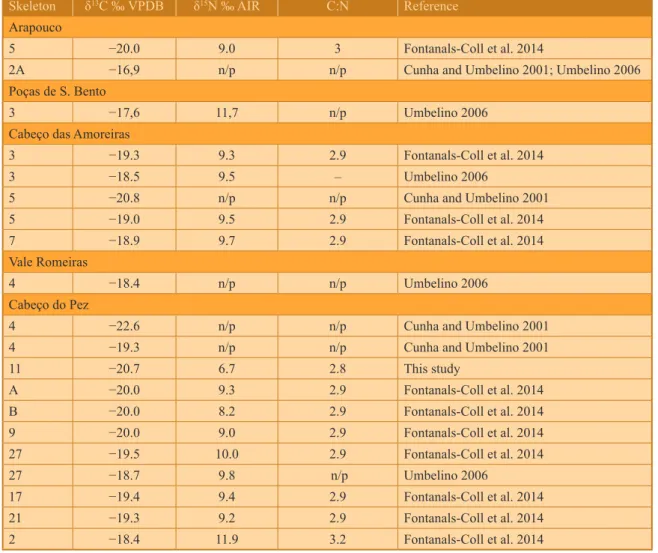
Further south, data from the Sado shell midden reveal a totally different situation (fig. 5). The first stable isotope analyses were presented by Cunha and Soares Umbelino (Cunha and Soares Umbelino, 2001), but the contrast between the Tagus and Sado diets, with average marine diet values of 50% and 30% respect-ively, was only mentioned later by C. Soares Umbelino in his PhD thesis, in 2006 (Soares Umbelino, 2006, p. 16). This contrast appears to be even stronger if we take into account recently published data by M. Fontanals-Coll and co-workers (Fontanals-Coll et al., 2014, p. 543) concerning Sado diets. The marine sig-nal drops, pointing to a predominantly terrestrial diet among these riverside hunter-gatherers, described here under the ’olive index’ label. The average δ13C
and δ15N values from the Sado shell middens (Cunha
and Soares Umbelino, 2001; Soares Umbelino, 2006;
Fontanals-Coll et al., 2014) are much closer to other Mediterranean assemblages than to the nearby Tagus shell middens. In the Sado valley, the average δ13C
value from human bones is −18.7 δ13C (table 1), placing
Sado hunter-gatherer diets between those of terrestrial carnivores and terrestrial herbivore consumers, and detaching them from those of marine fauna consumers (Fontanals-Coll et al., 2014, fig.3).
In fact, the Tagus and Sado inner estuary shell middens reveal — as J. Moráis Arnaud already pointed out in 1987 when discussing similarities and discrepancies between Tagus and Sado (Moráis Arnaud, 1987) — differences in resource exploitation and diet connected with the differ-ent ecological conditions of both paleoestuaries. Whether the northern latitude of the Tagus shell middens closer to the 40ºN parallel — where an important North Atlantic primary productivity increase occurs — and/or some geo-morphological features of Sado Valley were responsible for this different dietary pattern is for the moment an open question, currently under study as part of the Sado-Meso project (Diniz and Arias Cabal, 2012).
ON DEPENDENCY ON MARINE RESOURCES
F
inal Mesolithic cultural patterns are more than a strictly environmental solution; they also point to the capacity to deal with environmental opportunities. In Western Europe, Final Mesolithic sea people emerged when the neighbouring sea was rich enough to sustain the economic dependency of the group, and several proxies, such as site locations, shell middens, the main domestic154 Mariana Diniz
Table 1 – Stable isotopic δ13 C and δ15 N values from human remains of the Sado valley.
Tabl. 1 – Valeurs des isotopes stables de δ13 C et δ15 N des restes humains de la vallée du Sado.
Skeleton δ13C ‰ VPDB δ15N ‰ AIR C:N Reference
Arapouco
5 −20.0 9.0 3 Fontanals-Coll et al. 2014
2A −16,9 n/p n/p Cunha and Umbelino 2001; Umbelino 2006 Poças de S. Bento
3 −17,6 11,7 n/p Umbelino 2006 Cabeço das Amoreiras
3 −19.3 9.3 2.9 Fontanals-Coll et al. 2014 3 −18.5 9.5 – Umbelino 2006
5 −20.8 n/p n/p Cunha and Umbelino 2001 5 −19.0 9.5 2.9 Fontanals-Coll et al. 2014 7 −18.9 9.7 2.9 Fontanals-Coll et al. 2014 Vale Romeiras
4 −18.4 n/p n/p Umbelino 2006 Cabeço do Pez
4 −22.6 n/p n/p Cunha and Umbelino 2001 4 −19.3 n/p n/p Cunha and Umbelino 2001 11 −20.7 6.7 2.8 This study A −20.0 9.3 2.9 Fontanals-Coll et al. 2014 B −20.0 8.2 2.9 Fontanals-Coll et al. 2014 9 −20.0 9.0 2.9 Fontanals-Coll et al. 2014 27 −19.5 10.0 2.9 Fontanals-Coll et al. 2014 27 −18.7 9.8 n/p Umbelino 2006 17 −19.4 9.4 2.9 Fontanals-Coll et al. 2014 21 −19.3 9.2 2.9 Fontanals-Coll et al. 2014 2 −18.4 11.9 3.2 Fontanals-Coll et al. 2014
refuse sites and isotopic values from human diets, reflect this deep connection with the sea.
In addition to this pragmatic relationship with the sea visible in the archaeological record, marine objects such as shells — used as adornments, as kitchen waste, as material to cover the dead — also served as an iden-tity marker for these Final Mesolithic hunter-gatherers, in addition to their economic/non-economic value as sug-gested by North Atlantic and Mediterranean data.
As a case study, the Sado Valley Final Mesolithic exhibits complex behaviour blending both Mediterranean and Atlantic cultural and environmental traits, producing an almost unique situation where shells – which made up a minor part or were even absent from human diets – were nevertheless accumulated in shell mounds covering the dead, thereby representing qualitative territorial land use inextricably linked to prehistoric necropolises.
For instance, in the Sado Valley, aquatic resources were exploited in particular at the Arapouco site (fig. 5), and Scrobicularia plana and Cerastoderma edule shells were discarded after being consumed, giving rise to small mounds that covered habitat remains and funerary depos-its, just like in any other North Atlantic Final Mesolithic
shell midden. Simultaneously, in Sado Valley, hunter-gatherer bone collagen displays very low proportions of marine protein, and some skeletons reveal a total absence of marine resources in their diet, as attested in other Medi-terranean groups (table 1). Environmental conditions related to the Sado paleoestuary marine signal — cur-rently under study as part of the Sado-Meso project (see
Arias Cabal et al., this volume), seem for the moment to represent the most plausible explanation for these dietary values. These values situate the Sado hunter-gatherers in a Mediterranean circle with an ’olive index’, which indic-ates the importance of land-based resources in the diet (fig. 6).
Neighbouring and contemporaneous Tagus shell mid-dens just 40 km to the north — and closer to the 40ºN par-allel — depict a different scenario. Here, diets are balanced between terrestrial and marine proteins and shell mounds can attain heights of several meters. An Atlantic pattern is perceptible and Tagus paleo-estuary primary productivity, reflected in the shell midden faunal list, sustains a marine strategy, which is responsible for the inclusion of these shell middens in the Atlantic circle where hunter-gatherer con-sumption behaviour could be described under a ’seal index’.
Between Land and Sea: Assessing Hunter-Gatherer Subsistence Practices and Cultural Landscapes 155
CONCLUSION AND FINAL REMARKS
A
s anticipated, data from Southern Portugal data arecrucial for establishing a connection, although it is a discontinuous one, between Atlantic and Mediterranean Final Mesolithic hunter-gatherers, settling in cultural spheres associated with different environmental con-ditions related to ocean primary productivity. Although human groups tend to develop cultural strategies to overcome landscape bias, environmental conditions still played a major role in establishing economic patterns among predatory groups depending solely on the natural status quo.
Another set of questions related to diet, resources and territoriality, can be tested on Mediterranean Final Mesolithic cemeteries, like those detected in the Sado or El Collado shell middens. It is also a possibility to explain the presence of individuals with terrestrial diets in coastal/estuarine necropolises that these middens do not contain ’locals only’, but also individuals from inland areas who exploited the estuaries or coastal facades for symbolic purposes, creating a cosmogony where shells
and dead people are entangled, even if the sea does not play a major economic role in their lives below the 39ºN parallel. To sum up, we want to point out the following conclusions:
– Atlantic hunter-gatherers are much more marine-ori-ented than their Mediterranean counterparts. This cultural facet seems to rely heavily on different environmental opportunities related to ocean primary productivity.
– Land-based diets, correlated in North Atlantic Europe to a major transition phase, like the shift caused by the Neolithisation process (Schulting and Richards, 2001; Fischer et al., 2007), are not a Neolithic trait in the Western Mediterranean region, since they prevailed among Final Mesolithic hunter-gatherers. Sweeping presumptions about changes in diet from the Mesolithic to the Neolithic (Carvalho and Petchey, 2013, p. 379) regarding Southern Portugal can no longer be upheld given the major contribution of land-based food recorded in Sado Mesolithic diets.
– Southern Portugal is indeed a core area for enhan-cing our understanding of this process due to its Atlantic position combined with a Mediterranean environment, which produced a mixed archaeological record pointing to
0 500 1000 km Phytoplankton pigment concentration (mg/m3) NASA/GSFC Atlantic circle “Seal índex” ≥ 50% marine diet Mediterranean circle “Olive índex” 30%-0% marine diet N
Fig. 6 – Atlantic and Mediterranean circles plotted on the map of the main Mesolithic settlements in Western Europe and the Maghreb with colour references to ocean primary productivity (after Lubell, 2004; Dupont et al., 2009; Fontanals-Coll et al., 2014; http://geosci.sfsu.edu/courses/geol103/labs/upwelling/images/world_summer.gif).
Fig. 6 – Cercles de l’océan Atlantique et de la mer Méditerranée reportés sur la carte des principaux sites mésolithiques en Europe de l’Ouest et du Maghreb avec les couleurs des références de la productivité primaire des océans (d’après Lubell, 2004; Dupont et al., 2009 ; Fontanals-Coll et al., 2014 ; http://geosci.sfsu.edu/courses/geol103/labs/upwelling/images/world_summer.gif).