Contents lists available atScienceDirect
Global and Planetary Change
journal homepage:www.elsevier.com/locate/gloplachaRe-evaluation of the
“elevated epifauna” as indicator of Mediterranean
Out
flow Water in the Gulf of Cadiz using stable isotopes (δ
13
C,
δ
18
O)
Ángela García-Gallardo
a,⁎, Patrick Grunert
a, Antje H.L. Voelker
b,c, Isabel Mendes
d,
Werner E. Piller
aaInstitute of Earth Sciences, University of Graz, NAWI Graz Geocenter, Graz, Austria
bInstituto Português do Mar e da Atmosfera (IPMA), Div. of Geology and Marine Georesources, Lisbon, Portugal cCentre of Marine Sciences (CCMAR), University of Algarve, Faro, Portugal
dCIMA, University of Algarve, Campus de Gambelas, Faro, Portugal
A R T I C L E I N F O
Keywords: Benthic foraminifera Elevated epifauna
Mediterranean Outflow Water Stable isotopes
Early Pliocene Holocene
A B S T R A C T
The presence and high abundances of the benthic foraminiferal group“elevated epifauna” has been proposed as indicator of the existence of Mediterranean Outflow Water (MOW) in the Gulf of Cadiz. Here we intend to use this potential proxy to reconstruct MOW in the early Pliocene at the Integrated Ocean Drilling Program (IODP) Hole U1387C. Cibicides lobatulus, Planulina ariminensis and Cibicides refulgens were found at this site, but high abundances of C. lobatulus and C. refulgens coincide with increases of shelf taxa and grain size, related to episodes of downslope transport. This issue calls into question the applicability of these species as MOW proxies. The present study therefore reassesses the role of these three elevated epifaunal species by means of stable isotope analyses (δ18O,δ13C) by contrasting their isotopic signature with that of shelf dwellers and deep-water taxa from
Pliocene and Recent sediments from the Gulf of Cadiz and the western Iberian margin. Since foraminiferal calcite does not always precipitate in equilibrium with seawater, substantial efforts have been taken in order to de-termine species-specific offset values and to correct the isotopic signature for vital effects. Our corrected results demonstrate that C. lobatulus and C. refulgens are isotopically similar to the shelf dwellers in the Pliocene data-set, eliminating them as MOW indicators. Recent samples from the Gulf of Cadiz and the western Portugal shelf corroborate the wide bathymetric range of C. lobatulus from the shelf to the slope. Our results thus warrant for caution when considering C. lobatulus and C. refulgens as indicators of bottom current strength in unstable slope settings, particularly when co-occurring with allochthonous shelf dwellers. In contrast, P. ariminensis shows a signature close to deep-water taxa, corroborating its reliability as indicator of MOW.
1. Introduction
Exploring the history of Mediterranean Outflow Water (MOW), a warm and saline water mass that enters the North Atlantic through the Strait of Gibraltar (Fig. 1) and being considered a contributor to the Atlantic Meridional Overturning Circulation (AMOC), has been the primary objective of the Integrated Ocean Drilling Program (IODP) Expedition 339 (Stow et al., 2013). The opening of the Strait of Gi-braltar occurred at 5.33 Ma (Hsü et al., 1978; Comas et al., 1999; Maldonado et al., 1999; Duggen et al., 2003; García-Castellanos et al., 2009; Hernández-Molina et al., 2014; Roveri et al., 2014; Flecker et al., 2015), leading to the re-establishment of Mediterranean-Atlantic cir-culation. Sedimentological evidence indicates the presence of MOW in the Gulf of Cadiz since the mid-Pliocene (Hernández-Molina et al.,
2014). Little, however, is known for the time interval between the opening of the Strait of Gibraltar and the onset of continuous contourite deposition at ~ 4.5 Ma due to poor core recovery and the presence of turbidites masking the original signal (Stow et al., 2013; Hernández-Molina et al., 2014). In a recent study at IODP Hole U1387C (Fig. 1), Van der Schee et al. (2016) concluded from sedimentological and geochemical evidence that Mediterranean-Atlantic exchange was es-tablished very quickly after 5.33 Ma but remained weak in thisfirst stage. In a related study byGarcía-Gallardo et al. (2017), benthic for-aminiferal assemblages from the same core intervals have been ana-lyzed with a particular focus on species known to occupy elevated epifaunal microhabitats where they were exposed to strong bottom currents such as MOW. This group of suspension feeding benthic for-aminifers is commonly termed the“elevated epifauna” and considered
http://dx.doi.org/10.1016/j.gloplacha.2017.06.005
Received 16 February 2017; Received in revised form 7 June 2017; Accepted 19 June 2017 ⁎Corresponding author.
E-mail addresses:[email protected](Á. García-Gallardo),[email protected](P. Grunert),[email protected](A.H.L. Voelker),
[email protected](I. Mendes),[email protected](W.E. Piller).
Available online 23 June 2017
0921-8181/ © 2017 The Authors. Published by Elsevier B.V. This is an open access article under the CC BY-NC-ND license (http://creativecommons.org/licenses/BY-NC-ND/4.0/).
to take advantage of elevated substrates to harvest organic matter particles carried by bottom currents (Lutze and Thiel, 1989; Schönfeld, 1997, 2002a; Diz et al., 2004; Schönfeld et al., 2011). In the Gulf of Cadiz it has been demonstrated that present-day abundance patterns of the elevated epifauna are directly related to MOW strength and po-tentially provides a powerful proxy for the reconstruction of MOW in the past (Schönfeld, 1997, 2002a, 2002b; Schönfeld and Zahn, 2000; Rogerson et al., 2011; Singh et al., 2015). The application of this method to lower Pliocene sediments of IODP Hole U1387C, however, shows that highest abundances of the elevated epifauna parallel maxima of allochthonous shelf taxa and sand content (García-Gallardo et al., 2017), indicating a potential bias of the proxy by downslope transport. As gravity deposits are documented for this site up to the Pleistocene (Alonso et al., 2016; Ducassou et al., 2016), the application of the proxy method may be problematic in younger time intervals as well.
The present study compares the stable isotope (δ13
C, δ18O) sig-nature of the elevated epifauna to those of benthic foraminifera living in either shelf or deep-water environments from Recent and lower Pliocene samples. The new data shed light on the provenance of in-dividual species associated with the elevated epifauna and help to re-fine the applicability of the proxy to the fossil record. The comparison of stable isotope data from autochthonous shelf and deep-water species of both investigated time slices further provides new insights into Mediterranean-Atlantic exchange after the opening of the Strait of Gibraltar and before the onset of contourite drift deposition in the Gulf of Cadiz.
2. Regional setting
In this study, samples from different locations and age along the southern (Gulf of Cadiz) and western Iberian margin (Portuguese margin) are analyzed (Fig. 1). In both study areas, sites from the con-tinental slope have been compared to sites from the shelf.
2.1. Continental slope
Most investigated sites on the continental slope are under the in-fluence of MOW. While less saline Atlantic water enters the Mediterranean basin through the Strait of Gibraltar at the surface, warm and highly saline Mediterranean deep waters exit the basin below and form MOW (e.g.Millot, 1999). The complex morphology of the continental slope in the Gulf of Cadiz causes the splitting of MOW into two main plumes with different hydrographic properties: the upper plume,flowing between 500 and 800 m along the SW Iberian Margin, which is warmer and less saline (13–14 °C and 35.7–37) than the lower plume (10.5–11.5 °C and 36.5–37.5), flowing deeper between 800 and 1400 m toward the NW Atlantic (Madelain, 1970; Zenk, 1975; Ambar and Howe, 1979; Borenäs et al., 2002; Serra et al., 2005; Llave et al., 2007; Marchès et al., 2007; García et al., 2009). The influence of MOW in the Gulf of Cadiz has been documented since the mid-Pliocene, which together with tectonic activity results in a complex depositional en-vironment characterized by moats, channels, contourite drifts, turbi-dites, and debrites (Hernández-Molina et al., 2006, 2014).
Three of the investigated sites are located on the continental slope of
Fig. 1. Location of samples from IODP Sites U1386, U1387, U1389 (IODP Expedition 339), the Guadiana shelf (CRIDA cruises), and the western Portugal shelf and Estremadura promontory (PALEO I POS 287) used in this study. Arrows indicate MOW pathway. The map was generated with GeoMapApp (http://www.geomapapp.org), using the default basemap, the Global Multi-Resolution Topography (GMRT) Synthesis (Ryan et al., 2009).
the southern Iberian margin in the Gulf of Cadiz. IODP Sites U1386 and U1387 are situated on the Faro Drift at ~ 562 and 559 m water depth, respectively (Fig. 1;Table 1). Today, these sites are bathed by the upper MOW plume with bottom current speeds in the order of 20 cm/s (Zenk, 1975; Nelson et al., 1999; Stow et al., 2013). IODP Site U1389 is located to the southeast on the Huelva Drift at a water depth of ~ 643 m (Fig. 1; Table 1). It is influenced by the lower MOW plume, and bottom current velocities of ~ 50–100 cm/s have been reported from this area due to its more proximal position with respect to the Strait of Gibraltar (Madelain, 1970; Kenyon and Belderson, 1973; Zenk, 1975; Nelson et al., 1999; Stow et al., 2013).
On the western Portuguese continental slope, sites PO287-45-1B, PO287-03-1B and PO287-44-1B are located on the Estremadura pro-montory at water depths of 1216, 1505 and 1866 m, respectively, and under the influence of MOW, within the MOW/Northeast Atlantic Deep Water (NEADW) mixing zone and within the NEADW, respectively (Fig. 1; Table 1; Daniault et al., 1994). Submarine canyons (Porto, Aveiro Nazaré, Lisboa, Setúbal and São Vicente) might promote trans-port of shelf material to deeper settings (Mil-Homens et al., 2006b; de Stigter et al., 2007, 2011; Puig et al., 2014).
2.2. Shelf
The Guadiana shelf is located in the northern Gulf of Cadiz (Fig. 1). The surface circulation is governed by a branch of the larger-scale Portuguese-Canary Eastern Boundary Current, which leads to a general anticyclonic circulation due to the southeastward movement of the Surface Atlantic Water (SAW) (Criado-Aldeanueva et al., 2006; García-Lafuente et al., 2006). Major river discharges occur during winter months associated with high-precipitation episodes of negative North Atlantic Oscillation (NAO) phases, in contrast to significant decrease in river flows favored during the positive phase of NAO (Trigo et al., 2004). Positive NAO predominated during sampling of sediment cores 1/2-3, 3/1-2 and 6/3-4 (July 2002; Hurrell and National Center for Atmospheric Research Staff, 2016), while negative NAO prevailed during sampling of sediment core 14/2-3 (April 2005; Hurrell and National Center for Atmospheric Research Staff, 2016). All of them are located in the northern Gulf of Cadiz off the Guadiana River mouth, at water depths of 90, 85, 40 and 80 m, respectively (Fig. 1;Table 1).
The western Iberian margin is in general affected by high levels of precipitation and discharges from the Ave, Douro, Lis, and Mira rivers. This area is characterized by the occurrence of seasonal coastal up-welling during spring and summer, induced by northern winds (Fiúza,
1983) and favored during the positive phase of NAO (Lebreiro et al., 2006). Sites PO287-15-1B and PO287-21-1B are located on the western Portugal shelf, north of the Nazare Canyon close to the Lis river mouth at water depths of 111 and 128 m (Fig. 1;Table 1;Mil-Homens et al., 2006a).
3. Material and methods 3.1. Pliocene samples
Upper Miocene to Holocene sediment cores from IODP Hole U1387C were recovered in the Gulf of Cadiz during IODP Expedition 339 with a total drilling depth of 870 m below sea-floor (mbsf). Lower Pliocene hemipelagic sediments of cores 51R to 30R (764.92–625.7 mbsf;Stow et al., 2013; Hernández-Molina et al., 2013; Van der Schee et al., 2016) have been analyzed. Based on the available stratigraphic data, this in-terval ranges from ~5.1 to 4.5 Myrs (Stow et al., 2013; Van der Schee et al., 2016). The lower interval is mainly composed of nannofossil-rich mud with intercalated silty beds. Some beds offine and medium sands, interpreted as turbidites, occur in cores 50R and 49R (Stow et al., 2013; Van der Schee et al., 2016). Core 47R consists of silty mud with medium sand while cores 42R, 37R and 33R are composed of nannofossil and silty mud. Samples were collected at the Bremen Core Repository. They were freeze-dried overnight, weighed, disaggregated in water, and the re-sidues > 63μm were weighed.
3.2. Surface sediment samples 3.2.1. Gulf of Cadiz
Mudline samples from IODP Holes U1386B, U1387A, U1387B, and U1389C have been recovered during IODP Expedition 339 (Table 1). Samples were stained with Rose Bengal, washed over a 63μm sieve and dried. Based on the absence of stained (live) epifaunal species and the presence of intermediate (Melonis barleeanum) and deep infaunal ele-ments (Chilostomella oolina, Globobulimina affinis), the mudline samples most likely represent unconsolidated sediment 1–2 cm below the sur-face layer (Grunert et al., 2015; Balestra et al., 2017). Holocene sedi-mentation rates in the order of 16–30 cm/kyr suggest a modern age < 100 years for the samples (Stow et al., 2013; Singh et al., 2015). Unstained benthic foraminifera > 125μm have been picked for this study as stained specimens of the herein analyzed species are rare or absent.
Sediment cores from the Guadiana shelf were retrieved aboard the
Table 1
Age, study area, Site ID, coordinates, water depth (WD; m: meters) and indication of MOW influence (Y: yes; N: no) for each of the drilled sites used in this study.
Time frame Study area Site ID Latitude (°N) Longitude (°W) WD (m) MOW influence Pliocene Faro Drift
(Gulf of Cadiz)
U1387C 36.8052 −7.7188 558 Y
Recent Faro Drift (Gulf of Cadiz)
U1386B 36.8281 −7.7753 562 Y U1387A 36.8054 −7.7190 559 Y U1387B 36.8054 −7.7188 558 Y U1389C 36.4253 −7.2779 642 Y Recent Guadiana shelf
(Gulf of Cadiz)
Core 3/1-2 36.9842 −7.2441 85 N Core 14/2-3 37.0444 −7.4446 80 N Core 1/2-3 36.9999 −7.3330 90 N Core 6/3-4 37.0634 −7.3459 40 N Recent Estremadura promontory
(western Portuguese slope)
PO287-45-1B 39.0833 −10.3742 1216 Y PO287-03-1B 39.0738 −10.4993 1505 Y PO287-44-1B 39.0425 −10.6607 1866 N Recent Shelf north of the Nazare Canyon
(western Portuguese shelf)
PO287-21-1B 39.9667 −9.3750 128 N PO287-15-1B 39.7367 −9.2533 111 N
vessel Aguayo during campaigns CRIDA0702 and CRIDA0405, in July 2002 and April 2005, respectively, in the frame of Project CRIDA (POCTI/P/MAR/15289/99). The cores were retrieved using a light-weighted vibro-corer with water injection, characterized by a core barrel of 4 m length and an inner diameter of 9 cm. Core-tops were sampled in 1 cm slices, stained with Rose Bengal, washed over a 63μm sieve and dried. Samples from levels 1–2 cm (core 3), 2–3 cm (cores 1 and 14) and 3–4 cm (core 6), were used in this study (Table 1). Within the middle shelf mud body, late Holocene sedimentation rates ranged between 61 and 166 cm/kyr indicating a modern age for these samples (Mendes et al., 2012b; Rosa, 2014).
3.2.2. Western Portuguese margin
Box cores PO287-15-1B and PO287-21-1B from the western coast of Portugal and PO287-45-1B, PO287-03-1B and PO287-44-1B from the Estremadura promontory were retrieved during the scientific cruise POS287-PALEO I aboard the RV POSEIDON during April–May 2002 (Monteiro et al., 2002). Sedimentation rates and dry bulk density are unpublished. Based on a14C age at 3.5–4.0 cm depth (KIA 26157:
un-corrected 14C age of 1890 ± 25 yr BP for a Globorotalia inflata >
315μm sample), the surface of core PO287-44-1B is recent ( Mil-Homens et al., 2006b).
3.3. Benthic foraminifera selected for analyses
Twelve benthic foraminiferal taxa are compared in the present study. Each species is assigned to one of the following groups based on a thorough review of available biogeographic, bathymetric and ecolo-gical data (e.g.,Berggren and Haq, 1976; Corliss, 1985; Van Morkhoven et al., 1986; Murray, 1991; Jones and Brady, 1994; Schönfeld, 1997; González-Regalado et al., 2001; Schönfeld, 2002a, 2002b; Mendes et al., 2004; Murray, 2006; Schönfeld, 2006; Rogerson et al., 2011; Mendes et al., 2012a): shelf taxa; deep-water taxa; elevated epifaunal taxa. Shelf taxa comprise Ammonia spp., Asterigerinata spp., Elphidium crispum, and Nonion fabum. Ammonia beccarii and its varieties (e.g., A. beccarii forma parkinsoniana) are the most abundant in our samples, including closely related species such as A. falsobeccarii. Due to the scarcity of individuals in some cases and identification problem due to abrasion, it is probable that some other varieties were included for analysis. The same applies for Asterigerinata. Cassidulina laevigata is characteristic from the slope; however, it occurs only in our surface sediment samples from the Guadiana shelf, where it was also recorded in the living assemblage and throughout the Middle-Late Holocene, with peaks of abundance associated with upwelling processes and in-creased silt and clay content (Mendes et al., 2012a, 2013). For this reason, C. laevigata has been included in the shelf group. Cibicidoides pachyderma, Globobulimina spp., Uvigerina celtica, and U. pigmea are considered to have their upper depth limit at the shelf break and are autochthonous to the continental slope. The elevated epifauna is re-presented by Cibicides lobatulus, Cibicides refulgens and Planulina ar-iminensis. Those species were picked separately from the 150–250 μm and > 250μm fraction to address potential ontogenetic effects on the isotopic signal. Scanning electron microscope pictures of representative specimens from each setting are displayed inPlate 1.
3.4. Isotope analyses (δ13
C,δ18O)
Isotopic data for C. pachyderma from the herein studied samples of IODP Hole U1387C have been taken fromVan der Schee et al. (2016). For the rest of the samples, the following analytical protocols have been applied: 10 to 20 foraminiferal tests with suitable preservation, minimum fillings and no overgrowths were picked, crushed between glass slides, and transferred into vials containing an H2Odest: Methanol
(2:1) mixture. These vials were put in an ultrasonic bath for 1 min to
remove sediment andfillings from the tests. Once the liquid was re-moved and the clean fragments were dry, they were transferred into a vial for isotopic measurements.
Pliocene and Recent samples from the Gulf of Cadiz and Recent samples from the Estremadura promontory and the shelf north of the Nazare Canyon were reacted with oversaturated 100% orthophosphoric acid at 70 °C in a Kiel II automated reaction system and measured with a Delta Plus isotope-ratio mass spectrometer at the Institute of Earth Sciences, University of Graz. Reproducibility of replicate analyses for standards (in-house and NBS 19) was better than ± 0.1‰ for δ13C
and ± 0.15‰ for δ18
O. All carbonate isotopic values are quoted re-lative to Vienna Pee Dee Belemnite (VPDB).
In samples from the Guadiana shelf, the fraction > 63μm was covered with ethanol (99.9%) and dried in open air. This procedure was repeated to make sure all the water has been removed, in order to avoid dissolved carbonates within the sediment to crystalize and disturb the original isotopic signal. Five to ten foraminiferal specimens were picked, stored in vials and sent for analyses to the Leibniz-Laboratory for Radiometric Dating and Stable Isotope Research at Kiel University (Germany). Isotope measurements were conducted with the automated Finnigan-MAT Kiel Device Type I, coupled to a Finnigan-MAT 251 mass spectrometer and calibrated to the VPDB (Vienna Pee Dee Belemnite) scale by means of the NBS-19 carbonate isotope standard and several other lab-internal standard compounds. The analytical precision was < ± 0.04‰ for δ13C and < ± 0.07‰ for δ18O.
Specimens from the Estremadura promontory (western Portuguese slope) were picked from the fraction > 315μm and analyzed in the Finnigan MAT 252 mass spectrometer at Marum (University Bremen, Germany), which is coupled to an automated Kiel carbonate prepara-tion system. Based on repeated analyses of internal (Solnhofen lime-stone) and external (NBS-19) carbonate standards the long-term pre-cision is ± 0.05‰ for δ13C and ± 0.07‰ for δ18O (Voelker et al.,
2010).
The obtained isotopic data must be corrected for species-specific offsets from the equilibrium due to vital effects. Correction values ap-plied to the individual taxa are described and discussed inChapters 5.1 and 5.2.
3.5. Modern hydrographic data
A summary of modern hydrographic parameters (bottom water temperature (BWT), salinity,δ18O
sw (seawater)) for the Gulf of Cadiz and
the Western Iberian margin have been compiled fromDaniault et al. (1994), Mendes et al. (2012a), Stow et al. (2013), Voelker et al. (2015b), Balestra et al. (2017) and the World Ocean Atlas (WOA) (Table 2). For the three sites from the western Iberian slope (Table 2), seawater was analyzed on the DeltaPlusXL mass spectrometer coupled to a Gasbench II of the Leibniz Laboratory of Kiel University (see Voelker et al., 2015bfor details on standards and precision). In this context, it is important to consider thatδ18O
c (calcite)is reported relative
to the Vienna Pee-Dee Belemnite (VPDB) standard, whileδ18O swis
re-ported in reference to Standard Mean Ocean Water (VSMOW) (Craig, 1961). Differential CO2liberated from VPDB CaCO3and CO2
equili-brated with VSMOW results in an offset between both standards (Coplen et al., 1983).δ18Osw(‰ VSMOW) has been thus converted to
δ18
Osw(‰ VPDB) by subtracting 0.27‰ from the VSMOW value (Hut,
1987) (Table 2). Predictedδ18O (‰ VPDB) of foraminiferal calcite at
equilibrium with seawater has been calculated for each sampling point by using the paleotemperature equation (t = 16.9–4.0 (δ18O
c− δ18Osw+ 0.2)) in Marchitto et al. (2014) derived from
Shackleton (1974) (t is temperature in degrees Celsius, δ18O c is the
predicted foraminiferalδ18O calcite composition relative to VPDB, and δ18O
PLIOCENE GULF OF CADIZ (IODP HOLE U1387C)
RECENT GULF OF CADIZ
(IODP SITES U1386, U1387, U1389)
RECENT WESTERN PORTUGAL SHELF
1
2
3
4
5
6
8
10
13 b
14
15
16
17
18
19
20
7
9
a
a
a
b
b
b
3
6
9
13 a
11
12
21b
21a
(caption on next page) 82
4. Results
4.1. Pliocene Gulf of Cadiz
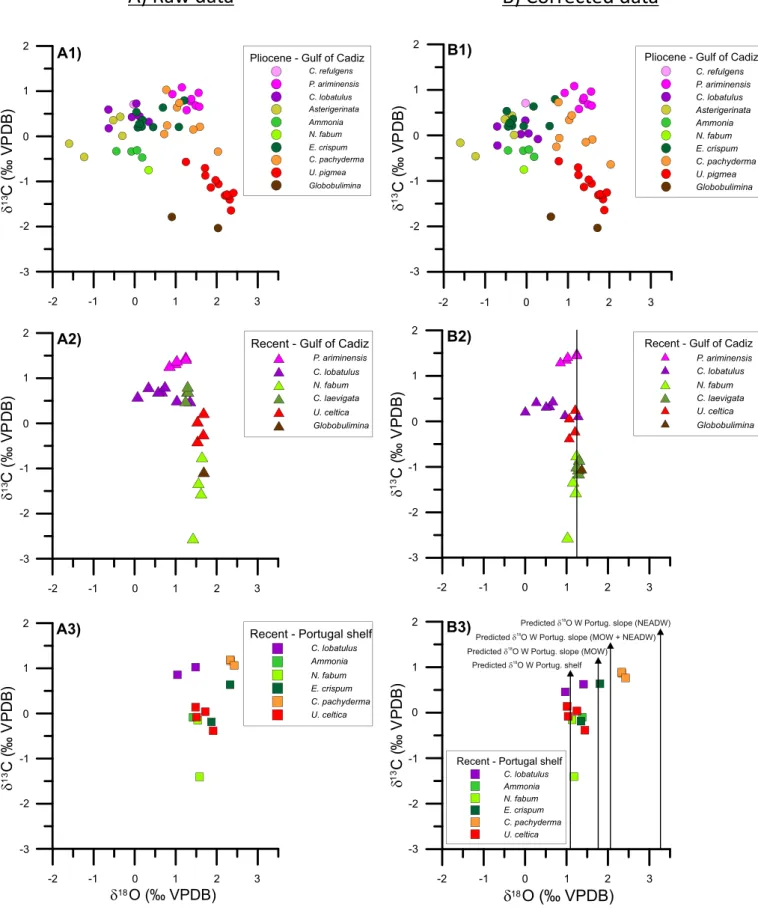
In the Pliocene samples, tests of Ammonia spp., Asterigerinata spp., C. lobatulus, C. refulgens, C. pachyderma, E. crispum, Globobulimina spp., N. fabum, P. ariminensis, and U. pigmea have been analyzed (Fig. 2-A1, Table 3a). Carbon and oxygen isotope values show a range of−2.03 to + 1.08‰ and from −1.60 to +2.41‰, respectively.
The ranges and mean values of δ13C and δ18O values for each
analyzed species are: Ammonia spp. (δ13
C:−0.47 to −0.31‰, mean: −0.36‰; δ18O:−0.45 to +0.18‰, mean: −0.07‰) Asterigerinata
spp. (δ13C: −0.46 to +0.43‰, mean: +0.03‰; 18O: −1.6 to
−0.3‰, mean: −0.8‰), C. lobatulus (δ13C: + 0.18 to + 0.73‰, mean:
+ 0.45‰; δ18 O: −0.64 to +0.34‰, mean: −0.14‰), C. refulgens (δ13C: +0.71‰, δ18O: −0.03‰) C. pachyderma (δ13C: −0.34 to + 1.03‰, mean: +0.34‰; δ18O: + 0.72 to + 2.03‰, mean: + 1.18‰), E. crispum (δ13C: +0.2 to +0.79‰, mean: +0.38‰; δ18 O: + 0.04 to +1.21‰, mean: +0.45‰), Globobulimina spp. (δ13C:−2.03 to −1.79‰, mean: −1.91‰; δ18O: +0.91 to +2.03‰, mean: + 1.47‰), N. fabum (δ13 C:−0.75‰, δ18O: + 0.34‰) P. ariminensis (δ13C: + 0.58 to + 1.08‰, mean: +0.81‰; δ18O: + 0.92 to +1.57‰,
mean: +1.34‰) and U. pigmea (δ13C: −1.64 to −0.57‰, mean:
−1.13‰; δ18O: + 1.25 to +2.41‰, mean: +2.03‰).
4.2. Recent Gulf of Cadiz
In the mudline and core-top samples from the Gulf of Cadiz, C. laevigata, C. lobatulus, Globobulimina spp., N. fabum, P. ariminensis, and U. celtica have been analyzed (Fig. 2-A2,Table 3b). C. lobatulus, Glo-bobulimina spp., P. ariminensis, and U. celtica come from the IODP Holes U1386B, U1387A, U1387B and U1387C, while C. laevigata and N. fabum are samples from the Guadiana shelf (Table 1). Carbon and oxygen isotopes show a total range from−2.54‰ to +1.47‰ and from 0.07‰ to +1.69‰, respectively. The range and mean values of δ13
C andδ18O values for each analyzed species are: C. laevigata (δ13C: −1.14 to −0.84‰, mean: −1‰; δ18O: + 1.24 to + 1.3‰, mean: + 1.28‰), C. lobatulus (δ13C: + 0.5 to + 0.82‰, mean: +0.67‰; δ18O: + 0.07 to + 1.35‰; mean: +0.68‰), Globobulimina spp. (δ13 C: −1.07‰, δ18O: + 1.69‰), N. fabum (δ13 C:−2.54 to −0.74‰, mean: −1.54‰; δ18O: + 1.42 to + 1.64‰, mean: +1.56‰), P. ariminensis (δ13C: + 1.28 to +1.47‰, mean: +1.39‰; δ18O: +0.85 to + 1.25‰,
mean: + 1.08‰), and U. celtica (δ13
C: −0.39 to +0.24‰, mean: −0.09‰; δ18O: + 1.53 to + 1.68‰, mean: +1.61‰).
4.3. Recent western Portugal shelf
In the samples from the western Portugal shelf, Ammonia spp., C. lobatulus, C. pachyderma, E. crispum, N. fabum, and U. celtica have been analyzed (Fig. 2-A3,Table 3c). Carbon and oxygen isotopes show a
Plate 1. Scale bar = 100μm.
1. Asterigerinata sp.
2. Elphidium crispum (Linnaeus, 1758).
3. Ammonia beccarii forma parkinsoniana (d'Orbigny, 1839). a) Umbilical side. b) Spiral side. 4. Planulina ariminensis (d'Orbigny, 1826).
5. Cibicides refulgens (de Monfot, 1808).
6. Cibicides lobatulus (Walker and Jakob, 1798). a) Umbilical side. b) Spiral side. 7. Praeglobobulimina ovata (d'Orbigny, 1846).
8. Uvigerina pigmea (d'Orbigny, 1826).
9. Cibicidoides pachyderma (Rzehak, 1886). a) Umbilical side. b) Spiral side. 10. Nonion fabum (Fichtel and Moll, 1978).
11. Cassidulina laevigata (d'Orbigny, 1826). 12. Planulina ariminensis (d'Orbigny, 1826).
13. Cibicides lobatulus (Walker and Jakob, 1798). a) Umbilical side. b) Spiral side. 14. Praeglobobulimina ovata (d'Orbigny, 1846).
15. Uvigerina celtica (Schönfeld, 2006).
16. Ammonia falsobeccarii (Rouvillois, 1974). Spiral side. 17. Nonion fabum (Fichtel and Moll, 1798).
18. Elphidium crispum (Linnaeus, 1758).
19. Cibicides lobatulus (Walker and Jakob, 1798). Spiral side. 20. Uvigerina celtica (Schönfeld, 2006).
21. C. pachyderma (Rzehak, 1886). a) Umbilical side. b) Spiral side.
Table 2
Hydrographic parameters in the Gulf of Cadiz (deep slope and Guadiana shelf) and Western Iberian Margin (slope and shelf north of the Nazare Canyon). WD: water wepth. BWT: bottom water temperature.
Expedition Area Site WD BWT Salinity δ18Osw (‰ VSMOW) δ18Osw (‰ VPDB) Predictedδ18Oc (‰ VPDB) Source
IODP 339 Gulf of Cadiz/Slope U1386 562 13.1 36.1 0.84 0.57 1.32 Stow et al. (2013),
Voelker et al. (2015b),
Balestra et al. (2017)
U1387 559 13.1 36 0.8 0.53 1.28 U1389 644 13.4 36 0.8 0.53 1.21
CRIDA 0405 Gulf of Cadiz/Guadiana shelf Core 3/1-2 85 13.5 36.1 0.9 0.63 1.28 Mendes et al. (2012a),
Voelker et al. (2015b), WOA
Core 14/2-3 80 13.5 36.2 0.9 0.63 1.28 Core 1/2-3 90 13.5 36.2 0.9 0.63 1.28 Core 6/3-4 40 14 36.2 0.9 0.63 1.16
PALEO I (POS 287) Western Portuguese slope 45-1B 1216 11.1 36.2 0.72 0.45 1.7 Daniault et al. (1994),
Voelker et al. (2015b), WOA
03-1B 1505 9.2 35.9 0.66 0.39 2.12 44-1B 1866 5.1 35.3 0.42 0.15 2.90
PALEO I (POS 287) Western Portuguese shelf 21-1B 128 14.1 35.9 0.8 0.53 1.03 Voelker et al. (2015b), WOA
Fig. 2. Isotopic composition on A) raw data of A1) Pliocene samples from IODP Hole U1387C, A2) Mudline (Recent) samples from IODP Sites U1386, U1387 and U1389 in the Gulf of Cadiz (IODP Expedition 339) and the Guadiana shelf samples (CRIDA cruises), A3) Recent western Portugal shelf samples from the shelf north of the Nazare Canyon and Estremadura promontory (PALEO I POS 287 cruise); B) corrected data of B1) Pliocene samples from IODP Hole U1387C, B2) Mudline (Recent) samples from IODP Sites U1386, U1387 and U1389 in the Gulf of Cadiz (IODP Expedition 339) and the Guadiana shelf samples (CRIDA cruises), B3) Recent western Portugal shelf samples from the shelf north of the Nazare Canyon and Estremadura promontory (PALEO I POS 287 cruise). Black vertical bars in Figs. B2 and B3 indicates the Predictedδ18Osw(‰ VPDB) according toTable 2.
Table 3
Raw and correctedδ13C andδ18O data-set obtained from isotopic measurements for a) Pliocene Gulf of Cadiz; b) recent Gulf of Cadiz; c) recent western Portugal shelf. Corrected values are the result after offset correction. Location area, core ID and size fraction are indicated.
3a) Pliocene Gulf of Cadiz
Raw data Corrected Core-section Top-bottom (cm) Fraction (μm) δ13C (‰ VPDB) δ18O (‰ VPDB) δ13C (‰ VPDB) δ18O (‰ VPDB) Ammonia spp. −0.33 −0.45 −0.33 −0.45 49R-1 10–12 > 250 −0.34 −0.08 −0.34 −0.08 50R-1 83–85 150–250 −0.47 0.18 −0.47 0.18 51R-3 42–44 150–250 −0.31 0.06 −0.31 0.06 49R-5 71–73 > 250 Min. −0.47 −0.45 −0.47 −0.45 Max. −0.31 0.18 −0.31 0.18 Average −0.36 −0.07 −0.36 −0.07 Standard deviation 0.07 0.27 0.07 0.27 Asterigerinata spp. −0.16 −1.6 −0.16 −1.6 30R-5 82–84 150–250 −0.46 −1.23 −0.46 −1.23 48R-5 60–62 150–250 0.43 −0.35 0.43 −0.35 50R-1 83–85 150–250 0.01 −0.3 0.01 −0.3 51R-3 42–44 150–250 0.35 −0.52 0.35 −0.52 48R-5 60–62 150–250 Min. −0.46 −1.6 −0.46 −1.6 Max. 0.43 −0.3 0.43 −0.3 Average 0.03 −0.8 0.03 −0.8 Standard deviation 0.37 0.58 0.37 0.58 C. lobatulus 0.18 −0.63 −0.22 −0.7 48R-4 40–42 150–250 0.43 −0.07 0.03 −0.14 48R-5 60–62 > 250 0.73 0.04 0.33 −0.03 49R-1 10–12 > 250 0.32 0.34 −0.08 0.27 49R-5 71–73 > 250 0.6 −0.64 0.2 −0.71 50R-1 83–85 150–250 0.44 0.12 0.04 0.05 49R-5 71–73 > 250 Min. 0.18 −0.64 −0.22 −0.71 Max. 0.73 0.34 0.33 0.27 Average 0.45 −0.14 0.05 −0.21 Standard deviation 0.2 0.41 0.19 0.41 C. refulgens 0.71 −0.03 0.71 −0.03 50R-1 83–85 150–250 C. pachyderma 0.21 1.59 −0.09 1.59 48R-3 100–102 > 315 0.64 1.03 0.34 1.03 48R-4 50–52 > 315 0.24 0.79 −0.06 0.79 48R-5 10–12 > 315 0.15 1.43 −0.15 1.43 49R-1 30–32 > 315 1.03 0.77 0.73 0.77 49R-3 0–2 > 315 0.05 0.72 −0.25 0.72 49R-5 90–92 > 315 0.74 1.09 0.44 1.09 50R-1 83–85 > 315 −0.34 2.03 −0.64 2.03 51R-3 122–124 > 315 Min. −0.34 0.72 −0.64 0.72 Max. 1.03 2.03 0.73 2.03 Average 0.34 1.18 0.04 1.18 Standard deviation 0.44 0.47 0.44 0.47 E. crispum 0.36 0.19 0.36 −0.33 49R-1 10–12 > 250 0.21 0.17 0.21 −0.35 49R-5 71–73 > 250 0.53 0.04 0.53 −0.48 50R-1 83–85 150–250 0.2 0.07 0.2 −0.45 47R Shipboard 150–250 0.28 0.11 0.28 −0.41 42R-2 3–5 150–250 0.79 1.21 0.79 0.69 33R-5 82–84 150–250 0.2 0.45 0.2 −0.07 51R-3 42–44 150–250
Table 3 (continued) 3a) Pliocene Gulf of Cadiz
Raw data Corrected Core-section Top-bottom (cm) Fraction (μm) δ13C (‰ VPDB) δ18O (‰ VPDB) δ13C (‰ VPDB) δ18O (‰ VPDB) 0.21 1.08 0.21 0.56 50R Shipboard 150–250 0.64 0.69 0.64 0.17 49R-5 71–73 150–250 Min. 0.2 0.04 0.2 −0.48 Max. 0.79 1.21 0.79 0.69 Average 0.38 0.45 0.38 −0.07 Standard deviation 0.22 0.45 0.22 0.45 Globobulimina spp. −1.79 0.91 −1.79 0.59 48R-5 60–62 150–250 −2.03 2.03 −2.03 1.71 48R-1 110–112 150–250 Min. −2.03 0.91 −2.03 0.59 Max. −1.79 2.03 −1.79 1.71 Average −1.91 1.47 −1.91 1.15 Standard deviation 0.17 0.8 0.17 0.8 N. fabum −0.75 0.34 −0.75 −0.06 49R-5 71–73 150–250 P. ariminensis 0.78 1.36 0.78 1.36 42R-2 3–5 150–250 0.96 1.56 0.96 1.56 42R-1 10–12 150–250 1.08 1.15 1.08 1.15 30R-5 42–44 150–250 0.58 1.27 0.58 1.27 48R-5 60–62 > 250 0.93 0.92 0.93 0.92 49R-3 30–32 150–250 0.68 1.49 0.68 1.49 50R-1 83–85 150–250 0.83 1.38 0.83 1.38 51R-5 2–4 150–250 0.65 1.57 0.65 1.57 49R-5 0–2 150–250 Min. 0.58 0.92 0.58 0.92 Max. 1.08 1.57 1.08 1.57 Average 0.81 1.34 0.81 1.34 Standard deviation 0.17 0.22 0.17 0.22 U. pigmea −1.4 2.32 −1.4 1.85 48R-2 140–142 > 250 −1.06 2.04 −1.06 1.57 49R-1 10–12 > 250 −0.57 1.25 −0.57 0.78 49R-3 30–32 150–250 −1.31 2.2 −1.31 1.73 49R-5 71–73 > 250 −1.31 2.29 −1.31 1.82 51R-3 42–44 150–250 −0.87 1.72 −0.87 1.25 37R-1 20–22 150–250 −1.13 1.86 −1.13 1.39 42R-2 03–05 150–250 −0.97 1.97 −0.97 1.5 33R-5 82–84 150–250 −1.64 2.35 −1.64 1.88 48R-2 140–142 > 250 −1.29 2.25 −1.29 1.78 51R-3 42–44 150–250 −1.26 2.41 −1.26 1.94 49R-5 0–2 > 250 −0.71 1.72 −0.71 1.25 51R-1 42–44 150–250 Min. −1.64 1.25 −1.64 0.78 Max. −0.57 2.41 −0.57 1.94 Average −1.13 2.03 −1.13 1.56 Standard deviation 0.31 0.35 0.31 0.35
3b) Recent Gulf of Cadiz
Raw data Corrected Site/core ID Fraction (μm) δ13C (‰ VPDB) δ18O (‰ VPDB) δ13C (‰ VPDB) δ18O (‰ VPDB) C. laevigata −1.05 1.28 −1.05 1.28 Core 3/1-2 > 63 (continued on next page)
Table 3 (continued) 3b) Recent Gulf of Cadiz
Raw data Corrected Site/core ID Fraction (μm) δ13C (‰ VPDB) δ18O (‰ VPDB) δ13C (‰ VPDB) δ18O (‰ VPDB) −0.84 1.3 −0.84 1.3 Core 14/2-3 > 63 −1.14 1.29 −1.14 1.29 Core 1/2-3 > 63 −0.98 1.24 −0.98 1.24 Core 6/3-4 > 63 Min. −1.14 1.24 −1.14 1.24 Max. −0.84 1.3 −0.84 1.3 Average −1 1.28 −1 1.28 Standard deviation 0.13 0.03 0.13 0.03 C. lobatulus 0.71 0.66 0.31 0.59 U1386B > 250 0.71 0.58 0.31 0.51 U1386B 150–250 0.82 0.74 0.42 0.67 U1387B 150–250 0.5 1.35 0.1 1.28 U1389C 150–250 0.52 1.03 0.12 0.96 U1389C 150–250 0.81 0.34 0.41 0.27 U1389C 150–250 0.6 0.07 0.2 0 U1386B 150–250 Min. 0.5 0.07 0.1 0 Max. 0.82 1.35 0.42 1.28 Average 0.67 0.68 0.27 0.61 Standard deviation 0.13 0.42 0.13 0.39 Globobulimina spp. −1.07 1.69 −1.07 1.37 U1386B 150–250 N. fabum −1.55 1.62 −1.55 1.22 Core 3/1-2 > 63 −0.74 1.64 −0.74 1.24 Core 14/2-3 > 63 −1.32 1.56 −1.32 1.16 Core 1/2-3 > 63 −2.54 1.42 −2.54 1.02 Core 6/3-4 > 63 Min. −2.54 1.42 −2.54 1.02 Max. −0.74 1.64 −0.74 1.24 Average −1.54 1.56 −1.54 1.16 Standard deviation 0.75 0.1 0.75 0.1 P. ariminensis 1.34 1 1.34 1 U1389C > 250 1.47 1.25 1.47 1.25 U1387A > 250 1.28 0.85 1.28 0.85 U1387B > 250 1.44 1.25 1.44 1.25 U1389C 150–250 1.4 1.03 1.4 1.03 U1386B 150–250 Min. 1.28 0.85 1.28 0.85 Max. 1.47 1.25 1.47 1.25 Average 1.39 1.08 1.39 1.08 Standard deviation 0.08 0.17 0.08 0.17 U. celtica 0.24 1.68 0.24 1.21 U1389C 150–250 −0.39 1.53 −0.39 1.06 U1386B 150–250 −0.24 1.68 −0.24 1.21 U1387B 150–250 0.05 1.53 0.05 1.06 U1389C 150–250 Min. −0.39 1.53 −0.39 1.06 Max. 0.24 1.68 0.24 1.21 Average −0.09 1.61 −0.09 1.14
Table 3 (continued) 3b) Recent Gulf of Cadiz
Raw data Corrected Site/core ID Fraction (μm) δ13C (‰ VPDB) δ18O (‰ VPDB) δ13C (‰ VPDB) δ18O (‰ VPDB) Standard deviation 0.28 0.08 0.28 0.08
3c) RECENT WESTERN PORTUGAL SHELF
Raw data Corrected Core ID Fraction (μm) δ13C (‰ VPDB) δ18O (‰ VPDB) δ13C (‰ VPDB) δ18O (‰ VPDB) Ammonia spp. −0.09 1.42 −0.09 1.42 PO287-15-1B > 250 C. lobatulus 1.02 1.48 0.62 1.41 PO-287-21-1B 150–250 0.86 1.04 0.46 0.97 PO-287-21-1B > 250 Min. 0.86 1.04 0.46 0.97 Max. 1.02 1.48 0.62 1.41 Average 0.94 1.26 0.54 1.19 Standard deviation 0.12 0.31 0.12 0.22 C. pachyderma 1.17 2.34 0.87 2.34 PO287-45-1B 1.19 2.33 0.89 2.33 PO287-03-1B 1.06 2.43 0.76 2.43 PO287-44-1B Min. 1.06 2.33 0.76 2.33 Max. 1.19 2.43 0.89 2.43 Average 1.14 2.36 0.84 2.36 Standard deviation 0.07 0.05 0.07 0.05 E. crispum −0.19 1.87 −0.19 1.35 PO-287-21-1B 150–250 0.64 2.33 0.64 1.81 PO-287-21-1B > 250 Min. −0.19 1.87 −0.19 1.35 Max. 0.64 2.33 0.64 1.81 Average 0.22 2.1 0.22 1.58 Standard deviation 0.58 0.32 0.58 0.32 N. fabum −0.15 1.53 −0.15 1.13 PO-287-21-1B > 250 −1.41 1.58 −1.41 1.18 PO-287-15-1B 150–250 Min. −1.41 1.53 −1.41 1.13 Max. −0.15 1.58 −0.15 1.18 Average −0.78 1.56 −0.78 1.16 Standard deviation 0.88 0.03 0.88 0.03 U. celtica −0.38 1.91 −0.38 1.44 PO-287-15-1B 125 0.04 1.72 0.04 1.25 PO-287-15-1B > 250 (continued on next page)
range from−1.41‰ to +1.19‰ and +1.04‰ to +2.43‰, respec-tively. The range and averageδ13C andδ18O values for each analyzed species are: Ammonia spp. (δ13C:−0.09, δ18O: +1.42‰), C. lobatulus
(δ13C: + 0.86 to + 1.02‰, mean: +0.94‰; δ18O: + 1.04 to +1.48‰,
mean: + 1.26‰), C. pachyderma (δ13C: +1.06 to + 1.19‰, mean:
+ 1.14‰; δ18O: + 2.33 to + 2.43‰, mean: +2.36‰), E. crispum
(δ13C:−0.19 to +0.64‰, mean: +0.22‰; δ18O: + 1.87 to +2.33‰,
mean: + 2.1‰), N. fabum (δ13
C:−1.41 to −0.15‰, mean: −0.78‰; δ18O: + 1.53 to +1.58‰, mean: +1.56‰), and U. celtica (δ13
C: −0.38 to +0.14‰, mean: −0.07‰; δ18O: + 1.48 to + 1.91‰, mean:
+ 1.66‰). 5. Discussion
The isotopic signature of benthic foraminifera theoretically reflects the composition of the ambient seawater in which they live. However, it is usually biased as a result of different factors that divert the isotopic composition of the shell calcite from equilibrium (e.g.,Duplessy et al., 1970; Woodruff et al., 1980; Vincent et al., 1981; Wefer and Berger, 1991; Bemis et al., 1998). For benthic foraminifera, in particular, it has been demonstrated that vital effects (e.g., ontogeny, carbonate ion concentration) and microhabitat effects may cause species-specific de-viations from isotopic equilibrium (Emiliani, 1954; Grossman, 1987; McCorkle et al., 1990; Spero et al., 1997; Fontanier et al., 2006; Rogerson et al., 2011). For this reason, and before any meaningful deduction from our multi-species data-set, these biases on the isotopic signals have to be constrained.
5.1. Species-specific corrections of δ18O
For the purpose of our study, we have accounted for vital effects in δ18O in two ways to ensure a meaningful interpretation. First, a
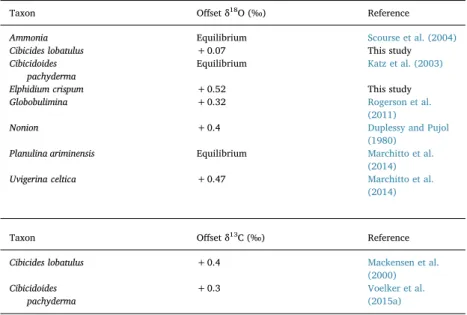
thor-ough review of available data shows that many of the herein analyzed species are well studied with respect to their specific offsets from iso-topic equilibrium, and respective correction values have been suggested (Table 4). Second, information on the oxygen isotope composition of the seawater (δ18
Osw;Table 2) enable us to critically evaluate the
ap-plicability of published species-specific correction values at our sites as well as to estimate offset values for those taxa which have not been considered in previous studies.
The herein analyzed deep-water species and some elevated epi-faunal species are particularly well studied with respect to vital effects. C. pachyderma and P. ariminensis have been considered to calcify at isotopic equilibrium with the ambient bottom water due to their epi-faunal microhabitat (Zahn et al., 1986; Bemis et al., 1998; Rohling and Cooke, 1999; Katz et al., 2003; Marchitto et al., 2014). Accordingly,
δ18O of C. pachydermafits perfectly into the predicted δ18O values for
Estremadura promontory today (Table 2) and no offset correction has been applied to their isotopic values.
Correction values for U. pigmea and U. celtica have not been estab-lished, whereas a wide number of studies have focused on the closely related shallow infaunal species U. peregrina. It has been suggested that this species calcifies in equilibrium with pore water δ18O (e.g.
Shackleton, 1974; Woodruff et al., 1980; Grossman, 1987; McCorkle et al., 1990). However, in a recent study that re-evaluates the tem-perature dependency of foraminiferal δ18O from a global data-set,
Marchitto et al. (2014)suggest that U. peregrina shows a positive offset of 0.47‰ from isotopic equilibrium. In the present study, this correc-tion value is applied to U. pigmea and U. celtica from the Pliocene and Recent samples. Both species are considered closely related species of U. peregrina (Schönfeld, 2006) and our isotopic data from the surface samples in the Gulf of Cadiz and the shelf area north of the Nazare Canyon (Table 2) are in the range of the correction value established for U. peregrina.
Species of Globobulimina precipitate their tests in a deep infaunal microhabitat and are thus considered to reflect pore water rather than bottom waterδ18O. Available studies suggest that Globobulimina pre-cipitates its tests with a positive offset from equilibrium between ~0.1 to 0.3‰ (McCorkle et al., 1990, 1997; Rogerson et al., 2011).Rogerson et al. (2011)determined an offset value of −0.15‰ with respect to U. peregrina. This correction value has been used in this study, resulting in the offset value applied to Globobulimina (Table 4).
For C. lobatulus, a negative offset up to ~−1‰ with respect to equilibrium has been proposed by Vilks and Deonarine (1988), McCorkle et al. (1997) and Scourse et al. (2004). Cage and Austin (2008)revealed an offset from equilibrium of −0.24‰ to −0.21‰ with a signature close to equilibriumδ18O seawater in summer. They state thatδ18O
foramdeviations are more influenced by a seasonal
iso-topic effect rather than vital effects. A negative offset-value of −0.55‰ was further proposed byMackensen and Nam (2014)for C. lobatulus and C. refulgens from Arctic regions. In contrast, positive offset- values between +0.3 and + 0.8‰ are suggested inPolyak et al. (2003),Hald and Vorren (1987)andPoole et al. (1995); however, the former does not report direct measurements and the latter studies are performed in Northern regions. Since these previous studies do not reach a consensus for an offset value of C. lobatulus, probably related to low sample numbers (McCorkle et al., 1997) or samples from regions of variable temperatures and salinity, further assessment of offset values is re-quired for this species. A new offset value for C. lobatulus has been estimated in this study with respect to the average value of the shallow infaunal U. celtica from the western Portugal shelf data-set considering that all species are autochthonous. According to this, the difference
Table 3 (continued)
3c) RECENT WESTERN PORTUGAL SHELF
Raw data Corrected Core ID Fraction (μm) δ13C (‰ VPDB) δ18O (‰ VPDB) δ13C (‰ VPDB) δ18O (‰ VPDB) −0.08 1.51 −0.08 1.04 PO-287-21-1B 150–250 0.14 1.48 0.14 1.01 PO-287-21-1B > 250 Min. −0.38 1.48 −0.38 1.01 Max. 0.14 1.91 0.14 1.44 Average −0.07 1.66 −0.07 1.19 Standard deviation 0.23 0.2 0.23 0.2
Fig. 3. Correlation C. lobatulus Elphidium spp. and P. ariminensis -Elphidium spp. from the Pliocene samples of IODP Hole U1387C (top panel) and the mudline samples of U1387C and surface sedi-ment samples ofRogerson et al. (2011; bottom).
Table 4
Offset values used to correct δ18O andδ13C deviations from equilibrium. Equilibrium reference indicates the reference object to which the offset value is applied for each species.
Taxon Offset δ18O (‰) Reference Ammonia Equilibrium Scourse et al. (2004)
Cibicides lobatulus +0.07 This study Cibicidoides
pachyderma
Equilibrium Katz et al. (2003)
Elphidium crispum +0.52 This study Globobulimina +0.32 Rogerson et al.
(2011)
Nonion +0.4 Duplessy and Pujol (1980)
Planulina ariminensis Equilibrium Marchitto et al. (2014)
Uvigerina celtica +0.47 Marchitto et al. (2014)
Taxon Offset δ13C (‰) Reference Cibicides lobatulus +0.4 Mackensen et al.
(2000) Cibicidoides pachyderma +0.3 Voelker et al. (2015a) 90
between the average un-correctedδ18O values of C. lobatulus and cor-rected ones of U. celtica results in the offset value for C. lobatulus applied in this study (Table 4).
For shelf dwellers, it is important to consider that variable en-vironmental conditions (e.g. salinity, temperature) in shallow-water settings complicate the calculation of a reliable offset value, and scarce information on correction values is available. A. beccarii has been de-monstrated to calcify enriched by + 0.29‰ inCage and Austin (2008) with seasonal variability. However, in a study byScourse et al. (2004) A. batavus has been considered to calcify in or close to equilibrium with seawater. This could be caused by a difference of δ18
O due to vital effects between either species or seasonality. In our dataset, Ammonia is close to equilibrium with the rest of taxa in the Portuguese shelf (Fig. 2 -B3).
A correction factor of +0.4‰ for Nonion has been adopted from Duplessy and Pujol (1980). This offset value is consistent with our data from the Guadiana and the shelf north of the Nazare Canyon areas.
In the case of Elphidium, E. crispum is the predominant species in the present study. No data are available for this specific species, but pre-vious studies have evaluated several other Elphidium species.McCorkle et al. (1990)revealed a negative offset for δ18O of E. excavatum.Lécuyer et al. (2012)suggested a negativeδ18O offset of −0.7‰ for Elphidium
sp. Other studies (Erlenkeuser and von Grafenstein, 1999; Polyak et al., 2003; Bauch et al., 2004) are focused on Elphidium excavatum forma clavata from the Laptev Sea and Arctic environments and reveal positive and negative offsets for that taxon that varies seasonally due to a vital effect. Therefore, local differences in temperatures and salinities be-tween the Arctic and Gulf of Cadiz shelf areas may cause different isotopic disequilibria of Elphidium species in particular and/or shallow water taxa in general. Consequently, values and considerations in-dicated in these studies should not be directly comparable with our results. Thus, it is necessary to reconsider this value. The offset value for E. crispum has been calculated with respect to theδ18O from Ammonia
in the Pliocene Gulf of Cadiz data-set since their abundances are similar and the number of data-points is larger than the Recent data-sets (see Table 3). The difference between the average original (not corrected) δ18O values of E. crispum and Ammonia spp. results in an offset value for
E. crispum of + 0.52‰ in this study.
For some species, subsamples from different fractions (150–250 μm, > 250 μm) were analyzed (Table 3) in order to evaluate if ontogeny affects isotopic composition. Results reveal that the isotopic composition, while showing some scatter, does not show any systematic positive or negative offset between both fractions. Thus, potential variations on the isotopic signature due to ontogeny have been dis-carded.
5.2. Species-specific corrections of δ13
C
In contrast to oxygen isotopes, little information was found in re-lation to theδ13C offsets from isotopic equilibrium; available data was found only for C. lobatulus and C. pachyderma (Table 4). A positive offset of +0.4‰ was estimated for δ13C of C. lobatulus byMackensen
et al. (2000)andWilfert et al. (2015)and also applied to our specimens (Table 4). C. pachyderma has been suggested to be offset from δ13CDIC (Dissolved Organic Carbon)andVoelker et al. (2015a)estimated this value in
samples from IODP Site U1387, resulting in a positive deviation of + 0.3‰ that has been assumed in this study (Table 4).
5.3. Corrected isotopic values
Correcting the isotopic data results in a different arrangement of the isotopic composition of each taxon (Fig. 2-B;Table 3).
In the Pliocene Gulf of Cadiz, two groups of taxa can be dis-tinguished. C. pachyderma, Globobulimina spp., P. ariminensis, and U. pigmea group together within a larger δ13C gradient (−2.03 to
+ 1.08‰;Fig. 2-B1,Table 3a) and narrower range ofδ18O (+ 0.59 to
+ 2.03‰). The second group comprises Ammonia, Asterigerinata spp., C. lobatulus, C. refulgens, E. crispum, and N. fabum, characterized byδ13C values ranging from−0.75 to +0.79‰ and lighter δ18O values with a
comparably wider range of−1.60 to +0.69‰.
In the Recent data-set from the Guadiana shelf, all species show corrected values within a small range of δ18O from + 0.85‰ to
+ 1.37‰, except C. lobatulus which shows a wider range (0.00‰ to + 1.28‰). P. ariminensis is considered to calcify in equilibrium with seawater and deeper settings in the Gulf of Cadiz at IODP Sites U1386, U1387 and U1389 (Table 2) verify it reflecting δ18O values of +1.03,
+ 1.05 and + 1.12‰ (average for each site inTable 3b, respectively), a bit lighter to the predictedδ18O values for the area (+ 1.32, + 1.28 and
+ 1.21‰, respectively;table 2). Similarly, C. laevigata recorded in the Guadiana shelf at depths of 85, 80, 90 and 40 m values of +1.28, + 1.30, + 1.29, and +1.24‰, respectively (Table 3b), that match the corresponding + 1.28, + 1.28, + 1.28, and 1.16‰ predicted values (Fig. 2-B2;Table 2).
On the western Portugal shelf and margin, no distinct differentiation occurs between species, except for C. pachyderma (Estremadura pro-montory) which shows heavierδ13C average composition (0.84‰) than
the rest (δ13
C:−0.08‰;Fig. 2-B3;Table 3c). In the shelf samples from north of the Nazare Canyon, at 128 and 111 m, respectively,δ18O
va-lues from N. fabum are + 1.13 and + 1.18‰, fitting the predicted va-lues for this setting (+ 1.03 and +1.18‰;Fig. 2-B3;Table 2). At the Western Iberian Margin slope (Estremadura promontory), heavierδ18O
values of C. pachyderma (+ 2.34, +2.33 and +2.43‰) are consistent with predictedδ18O values (+ 1.70, + 2.12 and +2.90‰;Fig. 2-B3; Table 2). The shelf-slope gradient onδ18O is probably resulting from
the different water masses affecting each sample location since it gets heavier with more NEADW influence (seeChapter 2.1;Table 2). 5.3.1. Microhabitat effect on δ13C
A distinct δ13C gradient between epifaunal and infaunal for-aminifers is well known (Corliss, 1985; McCorkle et al., 1990; Rathburn et al., 1996; McCorkle et al., 1997; Mackensen et al., 2000; Ravelo and Hillaire-Marcel, 2007). This microhabitat effect reflects the depletion of pore waters inδ13C relative to seawater due to respiration of organic
matter in the sediment and it is clearly reflected in all our data-sets. In the Pliocene samples from IODP Hole U1387C (Fig. 2-B1), the deep-water taxa Globobulimina spp., U. pigmea, C. pachyderma, and P. ar-iminensis display a wide range of 3.11‰ in their δ13C values with a
clear gradient along microhabitat preferences. Lightestδ13C values of
the deep-water taxa are recorded by the deep infaunal Globobulimina, while the elevated epifaunal P. ariminensis shows highest values.δ13C
values of the shallow infaunal U. pigmea and epifaunal C. pachyderma are intermediate between those two taxa, whereby the C. pachyderma δ13C values from the Estremadura promontory in Recent samples from
the western Iberian margin agree well with the seawaterδ13C
DICvalues
for that region (unpublished results). The characteristic gradient be-tween epifaunal and infaunal species has been described frequently in studies on Recent foraminifera and support the reliability of our iso-topic signal (Shackleton, 1974; Woodruff et al., 1980; Dunbar and Wefer, 1984; Zahn et al., 1986; Van der Zwaan and Jorissen, 1991; Sen Gupta and Machain-Castillo, 1993; Loubere, 1994; Jorissen et al., 1995; Loubere, 1996, 1997; Kaiho, 1999; Van der Zwaan et al., 1999; Schönfeld, 2001; Fontanier et al., 2006; Okazaki et al., 2016). A similar trend occurs between the deep-water taxa Globobulimina spp., U. celtica and P. ariminensis in the Recent samples from the deep Gulf of Cadiz (Fig. 2-B2).
Microhabitat effects can be observed in the shelf taxa as well (Fig. 2 -B3). Probably due to its infaunal character with a more depletedδ13C
environment of N. fabum (Moodley, 1990; Fontanier et al., 2002; Hill et al., 2003; Duchemin et al., 2008; Mojtahid et al., 2010), they show the lightestδ13C in contrast to the epifaunal Elphidium spp. and
5.4. Applicability of the elevated epifauna as a proxy for bottom currents 5.4.1. Potential bias of downslope transport on abundances of elevated epifaunal foraminifera
Abundances of the elevated epifauna in the Gulf of Cadiz have been linked to MOW strength today and have been proposed as a proxy for the reconstruction of bottom current strength (Schönfeld, 1997, 2002a, 2002b). Of this group, only C. lobatulus, C. refulgens and P. ariminensis were present in lower Pliocene samples of IODP Site U1387C. García-Gallardo et al. (2017) have observed a positive correlation between maximum abundances of C. lobatulus and C. refulgens, shelf taxa and grain-size whereas no such correlation occurs with P. ariminensis. The positive correlation between the abundances of C. lobatulus and Elphi-dium spp. in IODP Hole U1387C (R2= 0.85; p = 4.21 × 10− 24) is highlighted inFig. 3. In contrast, no correlation occurs between P. ar-iminensis and Elphidium spp. (R2= 8.65E-05, p = 0.95). It is well
known (and corroborated by our own samples from the Portuguese shelf) that C. lobatulus and C. refulgens show a broad bathymetric range with an upper depth limit extending into shelf areas < 100 m of the Atlantic and the Mediterranean Sea (Murray, 1973; Alexander and DeLaca, 1987; Polyak et al., 2003; Diz et al., 2004; Murray, 2006; Dorst and Schönfeld, 2013). In contrast, P. ariminensis is most commonly
recorded at settling heights > 550 m (e.g.,Schönfeld, 2002a, 2002b). García-Gallardo et al. (2017)thus concluded that in tectonically active settings such as the Gulf of Cadiz the applicability of the elevated epi-fauna proxy might be at times compromised by downslope transport. Ducassou et al. (2016)include C. lobatulus and Elphidium in the species group that indicates downslope transport from the shelf in the early Pleistocene sediments of nearby Site U1386. The trends observed in the Pliocene samples are further supported by a re-evaluation of quantita-tive data-sets of benthic foraminifera from core tops in the Gulf of Cadiz presented byRogerson et al. (2011). Correlations obtained were posi-tive (R2: 0.70; p: 2.17 × 10− 18) for C. lobatulus– Elphidium spp. and non-existent (R2= 0.03; p = 0.17) for P. ariminensis– Elphidium spp.
(Fig. 3).
On the basis of correctedδ13C andδ18O data, the isotopic signal of the elevated epifauna present in our samples can now be assessed in order to identify their provenance in either shallow or deep waters in the Pliocene and Recent Gulf of Cadiz.
5.4.2. Pliocene - Gulf of Cadiz
In the Pliocene samples,δ18O values show a clear gradient between
shelf (lighterδ18O:−1.60 to +0.69‰) and deep-water taxa (heavier δ18O: + 0.59 to + 2.03‰). We interpret this gradient as a substantial
difference in temperature between warmer waters (lighter δ18O c) on the
shelf and colder waters (heavierδ18Oc) on the slope. While salinity may
affect the δ18O signal to some degree, the large gradient nonetheless
suggests a primary control of temperature (Voelker et al., 2015a). In this setting, the corrected isotope values of C. lobatulus (mean δ13C: + 0.05‰, mean δ18O: −0.21‰) and C. refulgens (δ13C:
+ 0.71‰, δ18O:−0.03‰) range well within those of the shelf dwellers
Ammonia spp. (meanδ13C:−0.36‰, mean δ18O:−0.07‰), E. crispum
(mean δ13C: +0.38‰, mean δ18O: −0.07‰), N. fabum (δ13C: −0.75‰, δ18O: −0.06‰), and Asterigerinata spp. (mean δ13C:
+ 0.03‰, mean δ18O:−0.80‰). The evidence thus strongly supports
the allochthonous nature of C. lobatulus and C. refulgens hypothesized byGarcía-Gallardo et al. (2017). It is reasonable to assume that large amounts of tests of these two species have been transported from the shelf during periods of downslope transport. In contrast, the isotopic signal of P. ariminensis (meanδ13C: +0.81‰, mean δ18O: +1.34‰)
appears within the range of deep-water taxaδ18O, showing values only
slightly higher than those of C. pachyderma (mean δ13C: + 0.04‰, mean δ18O: +1.18‰; see Fig. 2-B1). The data spread observed for deep-water taxa is best explained by calcification during different gla-cial and interglagla-cial stages covered by our data-set (Van der Schee et al., 2016; García-Gallardo et al., 2017). Notably, the clear separation betweenδ18O values of shelf and deep-water taxa is evident in spite of
the data spread (Fig. 2-B1). For this reason, P. ariminensis is interpreted as an autochthonous deep-water taxon in this setting and remains the only component of the elevated epifauna at this site useful as a possible indicator of enhanced bottom current strength related to Mediterra-nean-derived waters in the early Pliocene Gulf of Cadiz.
5.4.3. Recent - Gulf of Cadiz
Theδ18O gradient observed for the Pliocene samples is not apparent in the present-day samples from IODP Sites U1386, U1387 and U1389 from the Gulf of Cadiz. Shelf dwellers Elphidium, Ammonia and Asterigerinata were absent or too scarce to obtain reliable data in the recent samples from the Gulf of Cadiz. Instead, N. fabum and C. laevigata from the Guadiana shelf have been used (Table 1). N. fabum is con-sidered intermediate infaunal and associated with eutrophic environ-ments and high organic matter of low quality from terrestrial runoff (Fontanier et al., 2002; Duchemin et al., 2008; Mojtahid et al., 2010; Pérez-Asensio and Aguirre, 2010; Pérez-Asensio et al., 2012). C. laevi-gata is a shallow infaunal taxon living under high supply of organic matter frequent in muddy sediments off the Guadiana River and found in samples until 2520 m depth (Corliss, 1991; de Rijk et al., 2000;
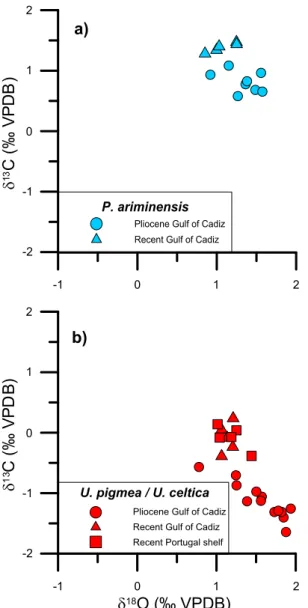
Fig. 4. Pliocene and Recent isotopic composition of a) P. ariminensis and b) U. pigmea (Pliocene) and U. celtica (Recent).
Mendes et al., 2004, 2012a; Pérez-Asensio et al., 2012). Although this taxon is commonly considered a deep dweller, in this case it occurs in our recent samples from the Guadiana shelf as a response to high silt and clay content and increased nutrient availability due to upwelling processes (Mendes et al., 2012a, 2013). For this reason, the isotopic composition of both species would be expected to reflect lower δ18O
than the deep-water taxa. However, the isotopic signature is similar to that of the deep-water taxa (Fig. 2-B2) as it is measured in the Gulf of Cadiz, showing that temperature and salinity values are indistinguish-able between the Guadiana shelf and the IODP Sites (Table 2). From these deductions,Fig. 2-B2 thus shows the differential δ13C signature likely due to microhabitat and carbonflux on the shelf reflected by the shelf taxa.
The elevated epifaunal elements C. lobatulus and P. ariminensis were also evaluated within this context. The assessment ofδ18O signals of C. lobatulus is complicated in this case. InFig. 4b, C. lobatulus from U1386 and U1387 shows slightly heavier δ13C (0.31‰) and lower δ18O
(0.44‰ in average) than specimens from U1389 (0.21‰ and 0.84‰, respectively; seeTable 3b), which have similar values to the infaunal U. celtica andfit well into the narrow range of δ18O in which deep taxa
appear. At first glance, those samples showing lighter δ18O may be interpreted to reflect higher temperatures due to their origin in shelf areas and have been later transported, such as in the Pliocene setting. However, this idea is not consistent since shelf taxa (e.g. Elphidium spp., Ammonia spp., Asterigerinata spp.) are absent in samples from U1386 and U1387, and most importantly, there is noδ18O gradient observed.
If the isotopic values of C. lobatulus are not related to a transport from the shelf, one possible explanation could be the differential position of the upper and lower plumes of MOW. IODP Site U1389, affected by lower MOW is 80–90 m deeper than Sites U1386 and U1387, within upper MOW (Table 1). Considering that Sites U1386 and U1387 are affected by the upper MOW plume while U1389 by the lower MOW plume (Stow et al., 2013), they may reflect different isotopic compo-sition. However, hydrographic measurements (Table 2) show similar δ18O composition for all sites (U1386: 0.84‰, U1387: 0.8‰ and
U1389: 0.8‰ VSMOW). A third explanation for these lower δ18O values
of C. lobatulus is their possible transport from upper parts of the slope, which would be affected by NACW that has a similar δ18O composition
(~ 0.5‰,Voelker et al., 2015b). Nevertheless, in our records, the iso-topic composition of C. lobatulus is closer to theδ18O composition of the deep-water taxa and predictedδ18O. With respect toδ13C, C. lobatulus appears closer to those from the deep-water U. celtica instead of the shelf infaunal taxon C. laevigata, which appearsδ13C depleted by 1‰
with respect to U. celtica. For these reasons, we tempt to state that the isotopic composition of this taxon is responding to MOW influence in the present day in the Gulf of Cadiz, according to Schönfeld (1997, 2002a, 2002b). Finally, the spread ofδ18O values could result from time averaging (i.e. the samples integrate variations of MOW, probably on seasonal to decadal scales) and/or the location in relation to their po-sition within MOW. In any case, theδ18O data for C. lobatulus together with its correlation to shelf taxa (Fig. 3) in the Gulf of Cadiz warrant for caution in general.
P. ariminensis is spatially restricted to the northern Gulf of Cadiz under the influence of strong MOW (Rogerson et al., 2011). It has been previously observed that P. ariminensis prefers elevated positions above the sediment surface having the opportunity to catch suspended food particles from enhanced current systems (Altenbach et al., 1987; Lutze and Thiel, 1989; Linke and Lutze, 1993). Our results are accordingly explained by this feature. In addition, this taxon, calcifying in equili-brium with seawater, shows average δ18O values close to the MOW δ18O composition (Table 2). For these reasons, we conclude that P.
ariminensis is the most reliable taxon that can be used as proxy for MOW reconstruction in the Gulf of Cadiz, always under a cautious analysis of the settings.
5.5. Implications for early Mediterranean-Atlantic exchange
Present-day hydrographic parameters (bottom-water temperature, salinity,δ18O
sw(VSMOW)) were accessible for the locations and water
depths used in this study (seeChapter 3.5.;Table 2). Obtaining those parameters is not directly possible in the Pliocene setting, but they can be inferred from the isotopic composition of foraminiferal calcite. The good correspondence betweenδ18Osw(VSMOW) and predictedδ18OC
(VPDB), as well as the differential δ18O in the western Portugal
shelf-slope due to influences of different water masses (e.g. MOW-NEADW) has been demonstrated in Chapter 3.5. This means that δ18OCfrom
autochthonous taxa from the Pliocene samples probably provide rea-sonable estimates of the hydrographic parameters in the Pliocene. Following this assumption, the difference between shelf and deep-water δ18O is on average +1.62‰ in the Pliocene Gulf of Cadiz, contrasting
rather uniformδ18O values of the present-day water column (Fig. 2
-A2). A larger difference in the δ18O values from the early Pliocene
might reflect a larger temperature offset, suggesting that either deep waters in the Gulf of Cadiz were colder and thus not influenced by warm Mediterranean water, or that Pliocene surface waters were warmer by several degrees (Tzanova and Herbert, 2015).
Pliocene and Recentδ18O
c from P. ariminensis and U. pigmea/U.
celtica have been compared separately (Fig. 4) in order tofigure out water temperature differences between the Pliocene and the present-day and possible influence of MOW. P. ariminensis values from the Pliocene and the present-day samples in the Gulf of Cadiz are displayed inFig. 4a. We consider this elevated epifaunal species autochthonous to deeper settings. Higherδ18O and lowerδ13C suggest a colder and lesser
ventilated environment in the early Pliocene (meanδ13C: + 0.81‰,
mean δ18O: + 1.34‰), indicating a major influence of the colder
Atlantic water and a eutrophic environment in the early Pliocene Gulf of Cadiz (García-Gallardo et al., 2017). Today there is a shift toward warmer and better ventilated waters likely due to the influence of MOW (meanδ13C: + 1.39‰, mean δ18O: + 1.08‰). A similar trend can be observed for Uvigerina (Fig. 4b). U. celtica values from the present-day Mudline samples from the Gulf of Cadiz (meanδ13C:−0.09‰, mean
δ18O: + 1.14‰) are higher in δ13
C and lower inδ18O than U. pigmea in the Pliocene deep Gulf of Cadiz samples (meanδ13C:−1.13‰, mean
δ18O: + 1.56‰). However, since Uvigerina is considered a shallow
in-faunal taxon, differences in the carbon isotope composition are affected by the microhabitat effect and should be treated with caution (Zahn et al., 1986).
In summary, the isotopic data together with diminished occurrences of P. ariminensis (García-Gallardo et al., 2017) suggest the presence of relatively cold and poorly ventilated bottom waters and reduced bottom current strength in the early Pliocene compared to today. This water mass was likely primarily sourced from the Atlantic; if and to which degree Mediterranean-sourced waters might have contributed cannot be determined from our data.
6. Conclusions
The elevated epifauna, which has been suggested as proxy for MOW reconstruction, has been re-assessed in this study using stable isotopes (δ13C,δ18O). Species-specific offset values have been determined in
Pliocene and Recent samples and contrasted with recent hydrographic data. After correction, results show good correspondence between Recent foraminiferalδ18O and seawaterδ18O.
Corrected isotopic values reveal that C. lobatulus and C. refulgens in the Pliocene slope of the Gulf of Cadiz have been transported from the shelf to greater depths, thus they do not provide suitable indicators of thefirst Mediterranean Outflow. Isotope data from Recent samples from the Gulf of Cadiz and the western Portugal shelf have also demonstrated that C. lobatulus can either inhabit shelf and deep environments. The