QUANTITATIVE AND QUALITATIVE PROFILE OF DAIRY
PRODUCTION OF RIO GRANDE DO SUL, BRAZIL
¹Fernando Zocche, ²Elisângela Sordi, ³Fernando Skonieski, 4Ivan Ricardo Carvalho, 4Maicon Nardino, 4Tamires da Silva Martins, 4Alan Junior de Pelegrin, 4Vinicius Jardel Szareski, 4Nathan Lobler dos
Santos, 4Tiago Corazza da Rosa, 4Giordano Gelain Conte, ¹Velci Queiróz de Souza
¹Federal University of Pampa; ²University of Passo Fundo; ³Federal University of Fronteira do Sul; 4Federal University of Pelotas
ABSTRACT: Milk is among the most important foods, being one of the main protein and nutrients source for human consumption. It is considered an essential food for human diet. In Brazil, the population expenses with this product are significant and range from 9.4% to 13.3% of family expenses with food. Rio Grande do Sul is the second state with the largest dairy production in Brazil, surpassed only by Minas Gerais, which is responsible for 26.8% of the national production. Milk production in Brazil and Rio Grande do Sul state shows a steady growth, despite great challenges faced to attend consumers’ demand. Milk quality is dependent on the efficiency of all veins in the production chain, with points that should be optimized regarding the profile of different dairy from the Erechim - RS dairy basin, which require higher investments regarding product quality control and distribution.
Keywords: farming, agricultural sciences, animal husbandry, veterinary medicine
PERFIL QUANTITATIVO E QUALITATIVO DA BACIA LEITERIA DO RIO GRANDE DO SUL, BRASIL
RESUMO: O leite é um dos principais alimentos, sendo fonte de proteína e nutrientes para o consumo humano, sendo considerado um alimento essencial para a dieta humana. No Brasil, as despesas da população com este produto são significativas e variam de 9,4% a 13,3% das despesas familiares com alimentos. O Rio Grande do Sul é o segundo estado com a maior produção de lácteos no Brasil atrás apenas de Minas Gerais responsável por 26,8% da produção nacional. A produção de leite no Brasil e no estado do Rio Grande do Sul mostra crescimento constante, apesar dos grandes desafios enfrentados para atender a demanda do consumidor. Desta forma, a qualidade do leite depende da eficiência de todos as ligações da cadeia de produção, com pontos que devem ser otimizados quanto ao perfil de diferentes produtos lácteos da bacia Erechim - RS, que exigem maiores investimentos em relação ao controle e distribuição da qualidade do produto.
Palavras-chave: agropecuária, ciências agrárias, zootecnia, medicina veterinária INTRODUCTION
Milk is among the most important foods, being one of the main protein and nutrients source for human consumption. It is considered an essential food for human
diet. In Brazil, the population's expenses with this product are significant and range from 9.4% to 13.3% of family expenses with food (MARTINS, 2005). Milk is used as raw material for several dairy products such as milk caramel sauce, yogurts, cheeses, milk cream, whey, dairy desserts, UHT milk, dairy beverage, ricotta, fermented milk, whey powder, pasteurized milk, condensed milk, milk powder and curd (ALVES, 2008). The dairy agri-industrial system is present in all national territory, in more than one million rural properties, which makes Brazilian production superior to the world average, placing Brazil in the fourth position of milk producers. This sector generates more than three million jobs and adds billions to the economic scenario, being one of the most important contributors of livestock to the agribusiness gross domestic product (GDP)(CONAB, 2016).
Rio Grande do Sul is the second state with the largest dairy production in Brazil, behind only of Minas Gerais, which is responsible for 26.8% of the national production (CONAB, 2016). According to a research conducted in 2015 by the Instituto Gaucho do Leite (IGL), the number of producers in the state is over 130 thousand, and it directly and indirectly involves more than 200 thousand workers. Dairy production in the state is concentrated in the northern region, more precisely in the northwest region´s dairy basin, where the dairy products complement the income of rural families (EMATER/ASCAR, 2015). About 65% of producers from Rio Grande do Sul state commercialize dairy to industry, and the rest is destined for own consumption or direct sale to final consumers. This fact worries the authorities, given the great risk of contamination of dairy products (IGL, 2015).
Quality management in dairy products is linked to the consumer market and its competitiveness. In this way, a dairy product has two perspectives regarding its quality, a subjective one that refers to personal aptitudes of consumers, and another objective that concerns hygienic patterns, physical and nutritional features of the product (SCALCO and TOLEDO, 2001). These characteristics directly influence quality, and may assure valorization and competitiveness of producers in the national and world dairy sector. Therefore, the need of modernizing the production line has been one great challenge for Brazilian producers, especially those from Rio Grande do Sul, most of which are characterized as small producers (BREITENBACH, 2012; MARTINS, 2004). In order to ensure quality and safety for the final consumer, the milk must undergo a heat treatment for elimination of micro-organisms, and then be
kept at low temperature to ensure its preservation, as this product is highly perishable (ALVES, 2008). In this context, this work aims to reveal the quantitative and qualitative profile of the dairy basins of Rio Grande do Sul state, and the main factors that influence milk productivity.
BRAZILIAN DAIRY BASIN CHARACTERIZATION
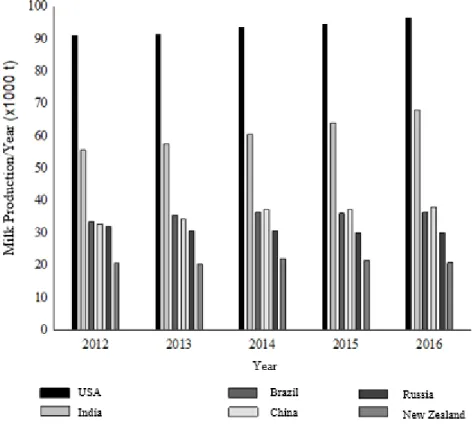
Dairy cattle in Brazil has been growing steadily since 1974 until today, despite some difficulties in the sector, Brazil is still among the world's largest producers and occupies the fourth place (Figure 1) in production volume according to data for 2016 year (CONAB, 2016).
Figure 1. Main milk producing countries per year in tons (CONAB, 2016).
It is estimated that the dairy market has grown around 78% between 2011 and 2015, moving nearby 60 billion reals in 2015, as well as providing a satisfactory increase in the number of producers (about 1.3 million), and a herd of 23 million dairy cows. Studies show that with increased income, population will show a growth in dairy consumption, considering that consumption of fluid milk is approximately of 60 liters/inhabitant/year, which is fairly similar to developed countries (VILELA and RESENDE, 2015).
In Brazil, the southeast region stands out with a production of 41.1% of the total, with the state of Minas Gerais being the largest producer, followed by the southern region with production of 36.6%, the central-west region with 13.3% of production, and the Northeast and North regions contributing with 5.2 and 4.4%, respectively. The increase in Brazilian production reflects the dairy production chain efficiency, and according to Canziani (2003), it may be divided into four categories. Inputs suppliers: which provide inputs, machines and equipment to producers; Rural producers: who are divided into specialized and non-specialized producers; Industry: who links producers and market, playing the role of milk collection and distribution; trade market: retailers, supermarkets and other establishments, which distribute to final consumer.
DAIRY PRODUCTION IN RIO GRANDE DO SUL STATE
Rio Grande do Sul has a herd of 1.5 million dairy cows, with 198,817 producers, producing a volume of 4.6 billion liters of milk per year, with average of 12.62 million liters of milk per day. Milk production was introduced in Rio Grande do Sul since the occupation of the national territory, being intensified in the nineteenth century with the arrival of immigrants and growing accordingly to the state´s population, in this manner, milk becomes a basic food in the diet of humans and an income alternative for small producers (BREITENBACH, 2012). With the expansion of dairy basins and industries in Brazil, milk production becomes a complementary income for farmers. It is given emphasis for the Northwest Meso-region of Rio Grande do Sul, due to its great production and size of dairy herd, standing out the municipalities of Ijuí - RS and Santa Rosa - RS, with production of 883 and 679 million liters per year, respectively (MILKPOINT, 2015).
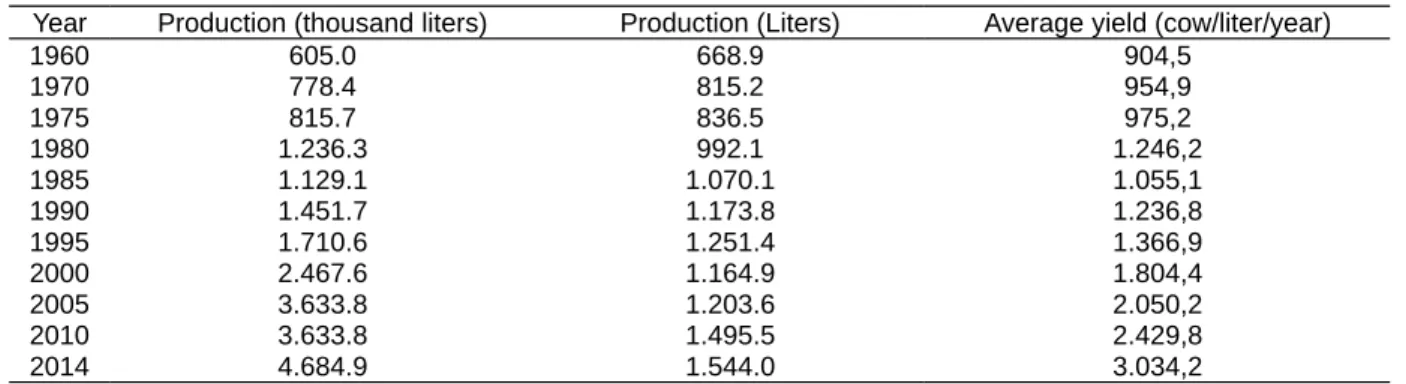
When evaluating milk production in Rio Grande do Sul, from 1970 to 2014 (Table 1), there is an increase of 674% in the state production, ranging from 668.9 thousand to 1.54 million liters of milk. Regarding the daily average, there was a growth of 235% when comparing 1960 to 2014. This increase in production is followed by the growth of national dairy industry, due to an intense process of transformation and modernization, pressured by external and internal factors of the country's economy. These transformations are present in every vein of the productive
chain. Many technologies were inserted such as mechanical milking, what increased the scale of production, including the better quality and quickness, when compared to manual milking. Another factor that contributed for production increase is the use of artificial insemination techniques and embryos transfer, enhancing the herd yield potential, besides the investment in nutrition quality of dairy cattle. The new facilities of processing industries contributed to increase product´s price, resulting in a positive influence on the state's dairy chain (BREITENBACH, 2012).
Table 1. milk production in Rio Grande do Sul from 1960 to 2014.
Year Production (thousand liters) Production (Liters) Average yield (cow/liter/year)
1960 605.0 668.9 904,5 1970 778.4 815.2 954,9 1975 815.7 836.5 975,2 1980 1.236.3 992.1 1.246,2 1985 1.129.1 1.070.1 1.055,1 1990 1.451.7 1.173.8 1.236,8 1995 1.710.6 1.251.4 1.366,9 2000 2.467.6 1.164.9 1.804,4 2005 3.633.8 1.203.6 2.050,2 2010 3.633.8 1.495.5 2.429,8 2014 4.684.9 1.544.0 3.034,2
*Source: IBGE, Research of local livestock 1970-2014.
MILK QUALITY INFLUENCING FACTORS
Milk is a food that provides indispensable macro and micronutrients for growth, development and maintenance of human health. Its composition brings to diet complete proteins, vitamins A, B1 complex, B2 complex and minerals. However, it is considered vulnerable to physic-chemical changes and highly deteriorative by microorganisms, which limits durability of its derivatives, causing economic and public health problems. This fact drives the creation of measures for quality control throughout the productive chain. In Brazil, this control occurs through Normative Instruction number 62 that regulates milk production, identity, quality, collection and transportation, pasteurization and cooling (BRASIL, 2011).
The changes imposed to dairy farming in Brazil have led to a new production profile in order to meet the demands of quality. Being initiated in 1952, the first milestone of the new organization was the governmental decree 30.691, which regulates the Industrial and Sanitary Inspection of Products of Animal Origin (RIISPOA), being applied to interstate and / or international trade establishments, making pasteurization mandatory, as well as inspection and stamp of the Federal Inspection Service (SIF). This decree was the first government measure regarding
the quality of milk production in Brazil, remaining in force until the present day. It presents requirements for dairy products industry and commercialization as the obligation to perform quality control, producing species, fat content and adequate processing. In addition, this decree introduces a classification of milk according to sanitary conditions of its production, processing, commercialization, durability and microbial count, being classified in types A, B or C (GOMES, 2012).
Many methods have been studied to ensure the good quality of milk, which concerns market acceptability, commercialization value and the guarantee of a product with quality for consumers. Among the factors that influence milk quality, genetics stands out. According to researches, 60% of the final product is influenced by the animal genetic factors. Likewise, regarding the environment, lactation stage, lactation order, milking practice, climate, nutritional management and incidence of diseases (SILVIA and VELOSO, 2011). Fat and protein control are among the characteristics most emphasized by dairy control services (SANTOS and FONSECA, 2002), due to population consumption habits and protein content in milk, which are determining factors for yield of dairy products (MONARDES, 1998).
Genetic factors
There is a large difference in milk composition among dairy breeds as well among individuals of the same breed. This difference is due to oscillation of milk fat, lactose and mineral contents (SILVA and VELOSO, 2011). Study by Lopes and Carvalho (2000), comparing milk quality and constitution between Holstein Friesian and Jersey breeds, evidenced that Jersey milk fat content is superior to Holstein Friesian, however, less protein.
Environment
Fat content may also be influenced by air temperature in which the animal is exposed to, as well as the oscillation from one season of the year to the next. The heat may promote a decrease in milk fat content, while low temperatures may increase this trait (SILVA and VELOSO). The abiotic stresses due to high air temperatures can modify the energy utilization by the animal, and thus qualitatively modify the milk composition (NORO, 2004).
Stage and lactation order
Unlike water, milk consists mainly of fat, protein and lactose. Protein and lactose contents decrease according to the stage of lactation. They decrease during
the first three months followed by the increase in fat content. Similarly, the order of lactation alters milk quality, where a first calf heifer produce milk of higher fat, protein and lactose contents (SILVA and VELOSO, 2011).
Milking practices
This topic is one of the main external factors that directly affect milk quality, being necessary the adequate hygiene of the facility and equipment. The fat content is inversely proportional to the milking intervals, i.e. it is higher when the animals are milked more frequently (SILVA & VELOSO, 2011).
Diseases
Among the diseases that most affect the achievement of a final product with high quality, the mastitis also influences in a quantitative way, being characterized as an inflammation in the mammary gland that causes physic-chemical and bacteriological changes in milk (RODOSTITS et al., 2007).
Animal diet
Animal nutrition is one of the main determining factors for milk quality and quantity, where the animal quickly adjusts itself to the increase of metabolic rate that occurs during lactation period, demanding greater nutritional intake (FONTANELI, 2001). The knowledge about diet influence on milk quality provides an easy way to solve problems caused by this factor, which is easy to handle. The main influence of animal nutrition occurs in the fat content of milk, because the supply of concentrate in the diet is inversely proportional to fat content in milk, so the higher concentrate content results in lower milk fat. The percentage of dietary fiber affects the dynamics of rumen fermentation, which produces higher amounts of propionic acid and protein in milk, although, a lower percentage of fat (NORO, 2004).
CASE OF STUDY
Characterization of dairy quality management from the Erechim municipality -RS
In partnership with the Secretary of Agriculture, Food Supply and Food Security, the Federal University of the Southern Border (UFFS) conducted a descriptive research with the aim of characterizing the quality management of dairy products in the municipality of Erechim – RS. It was evaluated the entire production process of six dairy companies from the region, regarding quality of the milk received, considering delivery, industrialization processes, environmental control,
quality management, transportation and final distribution. When evaluating the production chain of these companies, it was observed that only 33.3% of these establishments offered technical assistance to the producer or supplier, and some cases do not evaluate the quality of the product received. Regarding equipment periodic maintenance, all dairy affirmed to perform maintenance according to technical working standards.
The cleaning and hygiene of equipment is fundamental for quality control of the products, and must be done in a pre and post-operational way to avoid possible contamination inside the dairy (SCALCO and TOLEDO, 2001). A worrying factor that stands out in this research is that only one dairy performs pre and post-operational cleaning, another dairy cleans some equipment daily, and the other companies claim to perform cleaning every 10 days. Regarding quality control evaluated through mandatory nutritional and sensory analyzes, all companies perform according to required, as well as microbiological analyzes to evaluate contamination by some microorganism. These techniques of microorganism determination are of great importance, because, in addition of evaluating milk quality control, also evaluate the efficiency of hygienic practices during production and processing (FRANCO and LANDGRAF, 1996).
Transportation is the last step for the milk to reach suppliers, being of great importance for the quality, as well the other stages. Therefore, the carrier must work uniformed and perform routine analyzes (TEIXEIRA and RIBEIRO 2000). In the municipality of Erechim – RS, only 16.6% of the companies use outsourced transportation, which have responsibility about the product packaging during transportation, requiring training for these employees about handling and transportation. In a survey performed by Scalco and Toledo (2001) in São Paulo state, about the characterization of dairy products, 42.2% of companies used outsourced transportation, and less than 5% of companies applied training to outsourced employees.
CONCLUSION
Milk production in Brazil and Rio Grande do Sul state shows a steady growth, despite great challenges faced to attend consumer´s demand. Milk quality is dependent on the efficiency of all veins in the production chain, with points that should be optimized regarding the profile of different dairy from the Erechim - RS
dairy basin, which requires higher investments concerning product quality control and distribution.
REFERENCES
BREITENBACH, R. Estrutura, conduta e governança na cadeia produtiva do
leite:um estudo multicaso no Rio Grande do Sul. 2012. 272 f. Tese (Doutorado
em Extensão Rural) - Universidade Federal de Santa Maria, Santa Maria. 2012. ALVES, A. E. S. Dairy industry: work organization and qualification.UEPG: Ciências
Sociais Aplicadas, v. 16, n. 2, 2009.
BRASIL, Instrução Normativa. 62-Aprovar o Regulamento Técnico de Produção, Identidade e Qualidade do Leite tipo A, o Regulamento Técnico de Identidade e Qualidade de Leite Cru Refrigerado, o Regulamento Técnico de Identidade e Qualidade de Leite Pasteurizado e o Regulamento Técnico da Coleta de Leite Cru Refrigerado eseu Transporte a Granel.MAPA (ed.), Diário Oficial da União. Brasil, Brasília, DF, 2011.
CONAB- NationalSupplyCompany – Perspectivas Agropecuárias 2015/16 – Produtos. Perspectivapara a agropecuária, Brasília, v.3, p. 1-130, set. 2016. CANZIANI, J.R. Programa Empreendedor Rural: Cadeias Agroindustriais. Curitiba: Senar-PR, 2003.
IGL- INSTITUTO GAÚCHO DO LEITE. Relatório socioeconômico da cadeia
produtiva do leite no Rio Grande do Sul. Porto Alegre, RS: Emater/RS-Ascar,
2015.76p.
FONTANELI, R. S. Fatores que afetam a composição e as características
físico-químicas do leite, 2001.25 f. Seminário (Mestrado) – Programa de Pós –
Graduação em Ciências Veterinárias. Faculdade de Medicina Veterinária. Universidade Federal do Rio Grande do Sul. Porto Alegre, RS, 2001. FRANCO, B. D. G. M.; LANDGRAF, M. Microrganismos indicadores. In: Microbiologia dos Alimentos. São Paulo: Ateneu, p. 27-31, 1996
GOMES, S. T. Produção de leite no Brasil. Departamento de Economia Rural, Centro de Ciências Agrárias-UFV, 2012.
LOPES, M. A.; CARVALHO, F. de M. Custo de produção do leite. Lavras: UFLA, 2000. 42 p. (Boletim Agropecuário, 32)
MARTINS, M. C. Competitividade da cadeia produtiva do leite no Brasil.Revista de
Política Agrícola, v. 13, n. 3, p. 38-51, 2004.
MARTINS, P. C. Oportunidades e desafios para a cadeia produtiva do leite. In:
Juiz de Fora: Embrapa Gado de Leite, 2005
MILKPOINT–Disponível em: <www.milkpoint.com.br/cadeia-do-leite>. Acesso em 28 de Fevereiro de 2017.
MONARDES, H. Programa de pagamento de leite por qualidade em Quebec, Canadá. In: Simpósio internacional sobre qualidade do leite, 1., 1998, Curitiba. Anais... Curitiba: Universidade Federal do Paraná, 1998. p. 40-43.
NORO, G. Fatores que afetam a produção e a qualidade do leite em rebanhos
ligados a cooperativas gaúchas. 92 f. Dissertação (mestrado) – Programa de Pós
– Graduação em Ciências Veterinárias. Faculdade de Veterinária, Universidade Federal do Rio Grande do Sul. Porto Alegre, RS. 2004.
RODOSTITS, O. M.; GAY, O. M.; HINCHELIFF, K. W.; COSTSTABLE, K. W.
Veterinary Medicine. A text book of the cattle, horses, sheep, pigs and goats.8ª
Ed. Slsevier – USA. 2007.
SANTOS, M.V.; FONSECA, L.F. 2° Curso on-line de qualidade do leite. Disponível em: <http:www.milkpoint.com.br>Acesso em: 20/07/2017.
SILVA, J. C. P. M.; VELOSO, C. M. Manejo para maior qualidade do leite. Viçosa: Aprenda Fácil, 2011, 182p.
SCALCO, A. R.; TOLEDO, J. C. Gestão da qualidade em laticínios do estado de
São Paulo: situação atual e recomendações. Rev. Adm., v. 37, n. 2, p. 17-25,
2002.
TEIXEIRA, S. R.; RIBEIRO, M. T.Transporte do leite a granel. Embrapa Gado de Leite, 2000.
VILELA, D.; RESENDE, J. C. Cenário para a produção de leite no Brasil na