
Pedro Miguel Silvestre Machado
Self-Secured Devices:
Securing shared device access
on TrustZone-based systems
Outubro de 2018
Pedro Miguel Silvestre Machado
Self-Secured Devices:
Securing shared device access
on TrustZone-based systems
Dissertação de Mestrado em Engenharia Eletrónica Industrial
e Computadores
Trabalho efectuado sob a orientação do
Professor Doutor Sandro Pinto Outubro de 2018
Nome: Pedro Miguel Silvestre Machado
Correio Eletrónico: [email protected] Cartão de Cidadão: 14390510 4ZY0
Titulo da dissertação: Self-Secured Devices: Securing shared device access
on TrustZone-based systems
Ano de conclusão: 2018
Orientador: Professor Doutor Sandro Pinto
Designação do Mestrado: Ciclo de Estudos Integrados Conducentes ao Grau
de Mestre em Engenharia Eletrónica Industrial e Computadores
Área de Especialização: Sistemas Embebidos e Computadores Escola de Engenharia
Departamento de Eletrónica Industrial
De acordo com a legislação em vigor, não é permitida a reprodução de qualquer parte desta dissertação.
Universidade do Minho, 29/10/2018
Assinatura: Pedro Miguel Silvestre Machado
It has been a challenging journey, but there is no easy path to success. And in the end, I’m really grateful for this journey becoming into a personally rewarding one. Nothing would be possible without the people that surrounded me throughout it, and I will hereby try to express my gratitude towards them.
Firstly, I would like to thank my advisor Dr. Sandro Pinto, who challenged me with his pioneer ideas, always made himself available when I most needed, provided me opportunities to improve myself, for all the inexhaustible support that gave me, and for treating me not only as a student but also as a friend. Thanks to Dr. Adriano Tavares for also giving me advice and insight at our meetings and for sharing his extensive knowledge during my master’s.
I would also like to thank all my lab colleagues, my companions throughout this journey: Ailton Lopes, Ângelo Ribeiro, David Cerdeira, Franciso Petrucci, Hugo Araújo, José Martins, José Ribeiro, José Silva, Nuno Silva, Ricardo Roriz, and Sérgio Pereira. That proved that the ESRG is more than just a group of extremely competent people, it’s a family. Where we all support each other and overcome obstacles as one, with each of these individuals’ skill set combined great things can be accomplished.
Thanks to my long-term friends: Álvaro Silvestre, Diogo Pinto, João Peixoto, João Santos, João Coutinho, Jorge Carvalho, Jorge Pereira, Miguel Rego, Paulo Pontes, Ricardo Marques, and Tiago do Val with whom, lately, I was not able to spend as much time as I would like, but were always there for me.
Special thanks to my family for being my biggest supporters and to my girl-friend, Carolina Guimarães, who unconditionally supported me all along and gave me strength to carry on, especially in those moments I was feeling down, sorry for my absense during this period.
With the advent of the Internet of Things (IoT), security emerged as a sig-nificant requirement in the embedded systems development. Attacks against em-bedded systems infrastructures have been increasing, because security is being misconstrued as the addition of features to the system in a later stage of the sys-tem development. A new change in the way that syssys-tems are being developed is needed, to start guaranteeing security from the outset.
ARM Trustzone is a hardware technology that adds significant value to the security picture. TrustZone promotes hardware as the initial root of trust and has been gaining particular attention in the embedded space due to the massive presence of ARM processors into the market. TrustZone technology splits the hardware and software resources into two worlds - the secure world, dedicated to the secure processing, and the non-secure world for everything else. A lot of research has been done around TrustZone technology, ranging from efficient and secure virtualization solutions to trusted execution environments (TEE). Both cases, despite targeting different applications with different requirements, consoli-date multiple virtual environments into the same platform and necessarily need to share resources among them. Currently, hardware devices on TrustZone-enabled system-on-chips (SoC) can only be configured as secure or non-secure, which means the dual-world concept of TrustZone is not spread to the devices itself. With this direct assignment method both worlds are unable to use the same device unless it is entirely duplicated, significantly increasing overall hardware costs. Existing shared device access on TrustZone-based architectures have been shown to neg-atively impact the overall system in terms of security and performance, besides often come with associated engineering effort or substantial hardware costs.
This thesis proposes the concept of self-secured devices, a novel approach for shared device access in TrustZone-based architectures. Self-secured devices ex-tend the TrustZone dual-world concept to the inner logic of the device by split-ting the device’s hardware logic into a secure and non-secure interface. The implemented solution was deployed on LTZVisor, an open-source and in-house lightweight TrustZone-assisted hypervisor, and the achieved results are encourag-ing, demonstrating that we increase the security properties of the system for an acceptable cost in terms of hardware.
Com o advento da Internet das Coisas (IoT), começaram a surgir mais pre-ocupações relativas à segurança no desenvolvimento de sistemas embebidos. Os ataques contra infraestruturas deste tipo de sistemas têm vindo a aumentar expo-nencialmente, dado que a segurança tem vindo a ser reforçada através da adição de várias funcionalidades ao invés de ser considerada desde a fase inicial de desen-volvimento do sistema.
ARM TrustZone, é um exemplo de uma tecnologia de hardware que veio con-tribuir significativamente para o panorama de segurança. A tecnologia TrustZone promove o hardware como base inicial de segurança, tendo vindo a ganhar partic-ular relevância em soluções de sistemas embebidos devido à presença massiva dos processadores ARM no mercado. A tecnologia TrustZone separa todos os recursos de software e hardware em dois ambientes de execução diferentes, os quais são denominados de mundo seguro, onde é realizado todo o processamento seguro, e o mundo não seguro para tudo o resto. Esta tecnologia já foi alvo de bastante investi-gação e tem sido explorada na implementação de soluções seguras de virtualização ou até mesmo ambientes seguros de execução (TEE). Apesar de ambos os casos visarem diferentes aplicações com diferentes requisitos, ambos consistem em con-solidar vários ambientes virtuais numa só plataforma e inerentemente necessitam de partilhar recursos entre os mesmos. Contudo, atualmente, os dispositivos em
system-on-chips (SoC) habilitados com TrustZone podem somente ser
configura-dos como seguros ou não seguros, o que significa que o conceito de duplo ambiente de execução da TrustZone não está estendido aos próprios dispositivos. Com este método de atribuição direta, ambos os mundos não podem utilizar simultanea-mente o mesmo dispositivo a não ser que o mesmo seja duplicado, aumentando significativamente os custos de hardware. Atualmente, os métodos existentes de acesso a dispositivos partilhados em sistemas com TrustZone demonstram ter um impacto negativo no sistema em termos de segurança, desempenho e por vezes requerem um grande esforço de engenharia ou custos de hardware excessivos.
Esta tese propõe desenvolver o conceito de dispositivos self-secured, um novo método de acesso a dispositivos partilhados em sistemas com TrustZone. Estes dispositivos estendem o conceito da TrustZone à logica interna dos dispositivos, dividindo a sua lógica numa interface segura e não segura. A solução implementada foi integrada no LTZVisor, um hipervisor em código aberto e de baixo overhead assistido por TrustZone, demonstrando que a segurança do dispositivo partilhado é assegurada com reduzidos custos de hardware.
List of Figures xix
List of Tables xxi
List of Listings xxiii
Glossary xxv
1 Introduction 1
1.1 Motivation . . . 2
1.2 Objectives . . . 3
1.3 Document Structure . . . 4
2 Background, Context, and State of the Art 7 2.1 Background . . . 7
2.1.1 Virtualization . . . 7
2.1.2 ARM TrustZone . . . 15
2.1.3 TrustZone-assisted Virtualization . . . 17
2.2 Related Work . . . 18
2.2.1 Devices Access in TrustZone . . . 19
2.2.2 Proxy Task . . . 20 2.2.3 Device Emulation . . . 21 2.2.4 Device Para-Virtualization . . . 23 2.2.5 Device Para-TrustZone . . . 24 2.2.6 Device re-Partitiong . . . 25 2.2.7 Self-virtualizing . . . 27 2.3 Gap Analysis . . . 29
3 Platform and Tools 31 3.1 Platform Requirements . . . 31
3.2 AMBA Advanced eXtensible Interface . . . 32 xiii
3.3.1 Zynq-7000 family . . . 35
3.3.2 TrustZone technology Support in Zynq-7000 AP SoC . . . . 37
3.4 Development Toolchain . . . 39
3.4.1 Vivado Design Suite . . . 39
3.4.2 Xilinx SDK . . . 39
3.5 LTZVisor . . . 40
3.5.1 CPU virtualization . . . 41
3.5.2 Scheduler . . . 42
3.5.3 Memory isolation . . . 42
3.5.4 MMU and Cache . . . 43
3.5.5 Device partitioning . . . 43
3.5.6 Interrupt managment . . . 44
3.5.7 Time management . . . 46
3.5.8 Execution Flow . . . 46
3.6 Operating System stacks . . . 47
3.6.1 FreeRTOS . . . 47
3.6.2 Linux . . . 48
4 Self-Secured Devices 51 4.1 Overview . . . 51
4.2 Self-Secured Private Timer . . . 53
4.2.1 Device driver . . . 56
4.2.2 Self-Securing the Private Timer: Minimal Approach . . . 57
4.2.3 Self-Securing the Private Timer: Default Approach . . . 60
4.3 Self-Secured UART . . . 63
4.3.1 Control and Status Module . . . 64
4.3.2 Baud rate generator Module . . . 68
4.3.3 Transmitter and transmitter FIFO modules . . . 68
4.3.4 Receiver and receiver FIFO modules . . . 70
4.3.5 Mode switch module . . . 72
4.3.6 Modem control module . . . 73
4.3.7 Device driver . . . 74
4.3.8 Self-Securing the UART . . . 75
4.4 LTZVisor Integration . . . 84
4.4.1 FreeRTOS . . . 86
4.4.2 Linux . . . 87 xiv
5.1.1 Hardware Modifications . . . 95 5.1.2 LTZVisor Modifications . . . 96 5.1.3 FreeRTOS Modifications . . . 97 5.1.4 GPOS Modifications . . . 98 5.2 Memory Footprint . . . 98 5.3 Performance . . . 100 5.4 Hardware Costs . . . 101
5.4.1 Self-Secured: Private Timer . . . 102
5.4.2 Self-Secured: UART . . . 102 5.5 Security . . . 103 5.5.1 Security Guarantees . . . 103 5.5.2 Security Experiments . . . 104 5.6 Discussion . . . 107 6 Conclusion 109 6.1 Future Work . . . 110 References 111 xv
1.1 Motivational example for shared device access. . . 2
2.1 System Virtualization Stack. . . 8
2.2 CPU protection ring levels. . . 10
2.3 Trap and emulate technique. . . 11
2.4 System calls in native and para-virtualized systems. . . 12
2.5 Virtualization Topologies. . . 14
2.6 Arm TrustZone hardware Architecture. . . 15
2.7 Direct assignment access method. . . 19
2.8 Proxy Task method. . . 21
2.9 Device emulation method. . . 22
2.10 Ideal device emulation flow control. . . 22
2.11 Device Para-Virtualization method. . . 23
2.12 Device Para-TrustZone method. . . 25
2.13 Device Re-partitioning method. . . 26
2.14 Self-virtualized devices method. . . 28
3.1 The ZYBO Zynq-7000 development board. . . 35
3.2 Zynq-7000 SoC overview . . . 36
3.3 Advanced eXtensble Interface (AXI) non-secure control signals. . . 38
3.4 LTZVisor architecture overview. . . 40
3.5 LTZVisor memory configuration. . . 43
3.6 LTZVisor interrupt management when RTOS is runnning. . . 45
3.7 LTZVisor interrupt management when GPOS is running. . . 45
3.8 LTZVisor execution flow. . . 47
3.9 FreeRTOS software layers. . . 48
4.1 Self-Secured Device Generic Architecture . . . 51
4.2 Private Timer: Control Register. . . 53
4.3 Private Timer Counter finite state machine. . . 54 xvii
4.6 Private Timer Block diagram. . . 56
4.7 Self-Secured Private Timer: Minimal Approach architecture. . . 58
4.8 Minimal Approach control and interrupt status register. . . 59
4.9 Self-Secured Private Timer: Minimal Approach register access flow. 60 4.10 Self-Secured Private Timer: Default Approach architecture. . . 61
4.11 Default Approach control register. . . 62
4.12 Self-Secured Private Timer: Default Approach register access flow. . 62
4.13 UART block diagram. . . 64
4.14 UART Control register layout. . . 65
4.15 UART Mode register layout. . . 66
4.16 UART Interrupt enable/disable/mask registers layout. . . 66
4.17 UART Channel status register layout. . . 66
4.18 UART Baudrate generator. . . 68
4.19 Transmitter finite state machine. . . 69
4.20 Transmitter data stream. . . 70
4.21 Receiver finite state machine. . . 71
4.22 Resynchronized baud rate at data bit mid-point. . . 71
4.23 UART operation modes. . . 73
4.24 UART modem registers layout. . . 73
4.25 Self-Secured UART architecture. . . 76
4.26 Self-secured UART register access flow. . . 80
4.27 Self-Secured UART application example. . . 81
5.1 LoC of the Verilog files, with and without the self-secured imple-mentation. . . 96
5.2 Number of LTZVisor lines of source code for each approach. . . 96
5.3 Number of FreeRTOS and SW device driver LoC for each approach. 97 5.4 GPOS Device drivers number of lines of code on each approach. . . 98
5.5 Number of clock cycles for write/read device operations and in-curred device latency. . . 101
5.6 Self-Secured private timer post-implementation hardware costs. . . 102
5.7 Self-Secured UART post implementation hardware costs. . . 103
5.8 Protection mechanisms of the Self-Secured Timer upon FreeRTOS accesses. . . 105
5.9 Protection mechanisms of the Self-Secured Timer upon GPOS ac-cesses. . . 106
2.1 Existing shared device access methods comparison . . . 29
3.1 AXI-lite signals. . . 33
3.2 AXI access protection levels. . . 37
4.1 Private Timer register map. . . 53
4.2 Self Secured Private Timer: Default Approach register map. . . 61
4.3 UART register map. . . 65
4.4 Self-Secured UART register map. . . 79
5.1 LTZVisor and FreeRTOS memory footprint (bytes). . . 99
5.2 Device drivers memory footprint (bytes). . . 100
5.3 Evaluation results comparison. . . 108
4.1 TxFIFO write enable upon AXI TxFIFO register write. . . 67 4.2 RxFIFO read enable upon AXI RxFIFO register read. . . 67 4.3 Example of overflow interrupt management on the Control and
sta-tus module. . . 67 4.4 Tx signal set according to current state. . . 70 4.5 Secure data transmission prioritization. . . 82 4.6 Secure data reception prioritization. . . 83 4.7 Resources security configuration at board inialitzion. . . 85 4.8 LTZVisor GIC hardware initial security configuration. . . 86 4.9 FreeRTOS interrupt setup. . . 87 4.10 Private Timer entry on Linux device tree. . . 88 4.11 Example of an user application to access a device driver. . . 88 4.12 Platform driver code extract. . . 91 4.13 Example of Para-TrustZone driver assembly functions. . . 92 4.14 Board handler function in board.c. . . 92
ABI Application binary interface
ACP Accelerator Coherency Port
ACTLR Auxiliary Control Register
AMBA Advanced Microcontroller Bus Architecture
APB Advanced Peripheral Bus
API Application Programming Interface
APU Accelerated Processing Unit
ASIC Application-Specific Integrated Circuit
AXI Advanced eXtensible Interface
blob Binary Large OBject
BRAM Block RAM
BUFG Global buffer
CLB Bonfigurable Logic Blocks
CPU Central Processing Unit
DECERR Decode error
DMA Direct memory access
DRAM Dynamic random-access memory
DSP Digital signal processing
DTS Device tree source
FF Flip-flop
FIFO First In, First Out
FIQ Fast Interrupt Requests
FPGA Field Programmable Gate Array
GIC Generic Interrupt Controller
GPOS General-purpose operating system
HDL Hardware description language
I/O Input/Output
IDE Integrated Development Environment
IoT Internet of Things
IPI Inter-processor interrupt
IRQ Interrupt Request Line
ISA Instruction set architecture
ISR Interrupt Status Register
KB Kilobyte
LoC Lines-of-Code
LTZVisor Lightweight TrustZone-assisted Hypervisor
LUT Look up Table
MB Megabyte
MMU Memory Managment Unit
NS Non-Secure
NSW Non-Secure World
OCM On-chip memory
OS Operating System
PC Program counter
PL Programmable logic
PLL Phase-locked loop
PMU Performance Monitor Unit
PS Processing system
QSPI Quad serial peripheral interface
RAM Random-access memory
RO Read only
ROM Read only memory
RTOS Real Time Operating System
RW Read/Write
SCR Secure Configuration Register
SCTLR System Control Register
SCU Snoop control unit
SDIO Secure Digital Input Output
SLCR System level control register
SLVERR slave error
SMC Secure Monitor Call
SoC System on a chip
SRAM Static Random Access Memory
SW Secure World
TLB Translation lookaside buffer
TTC Triple Timer Counter
TXT Intel Trusted Execution Technology
TZ TrustZone
TZASC TrustZone Address Space Controller
TZMA TrustZone Memory Adapter
TZPC TrustZone Protection Controller
UART Universal asynchronous receiver-transmitter
UCB Untrusted Computing Base
UI User interface
VIF Virtual Interface
VM Virtual Machine
VMCB Virtual Machine Control Block.
VMM Virtual Machine Monitor
WO Write only
XSDK Xilinx Software Development Kit
With the rise of embedded system’s complexity, the demand for solutions to ful-fill security and real-time requirements has been escalating [SYKS14]. For decades virtualization technology has been used by the scientific community to efficiently exploit hardware resources between multiple virtual environments [PBB13]. While the advantages of virtualization are quite clear in embedded systems where size, weight, power, and cost (SWaP-C) are important considerations, it also enforces the overall system’s security [MJNH16].
Upon the advent of the Internet of Things (IoT), security emerged even further as a significant requirement in the embedded systems development. Ensuring se-curity in such systems is extremely crucial, as they play an important role in many mission and safety-critical systems (aviation, medical, transportation, military), and prior attacks on cyber systems have proven that can even cause physical harm [Lan11]. However, attacks against embedded systems infrastructures have been increasing because security is being misconstrued as the addition of features (e.g., cryptographic algorithms and security protocols) to the system [USK11, PMB15]. A new change in the way that systems are being developed is needed, to start guaranteeing security from the outset [OGP18].
ARM Trustzone [ARM09] and Intel TXT (Intel Trusted Execution Technol-ogy) are examples of security-oriented technologies which promote hardware as the initial root of trust. The former is gaining particular attention in the embedded space due to the massive presence of ARM processors in the market. TrustZone technology splits the hardware and software resources into two worlds - the secure
world (SW), dedicated to the secure processing, and the non-secure world (NSW)
for everything else. A lot of research has been done around TrustZone technology, ranging from efficient and secure virtualization solutions [FLWH10, PPG+17b,
MAC+17, POP+17, PPG+17a, PTM16] to trusted execution environments (TEE)
[SRSW14, PGP+17, POP+15]. Both cases, despite targeting different applications
with different requirements, consolidate multiple virtual environments in the same platform and necessarily need to share resources among them. Ideally, hardware
devices should also be capable of being shared between this virtual environments. However, in TrustZone-enabled SoCs, hardware devices can only be configured as secure or non-secure, which means the dual-world concept of TrustZone is not spread to the devices itself. Consequently, with this direct assignment method, if both worlds require a certain device it needs to be completely duplicated, signifi-cantly increasing the overall hardware cost.
1.1
Motivation
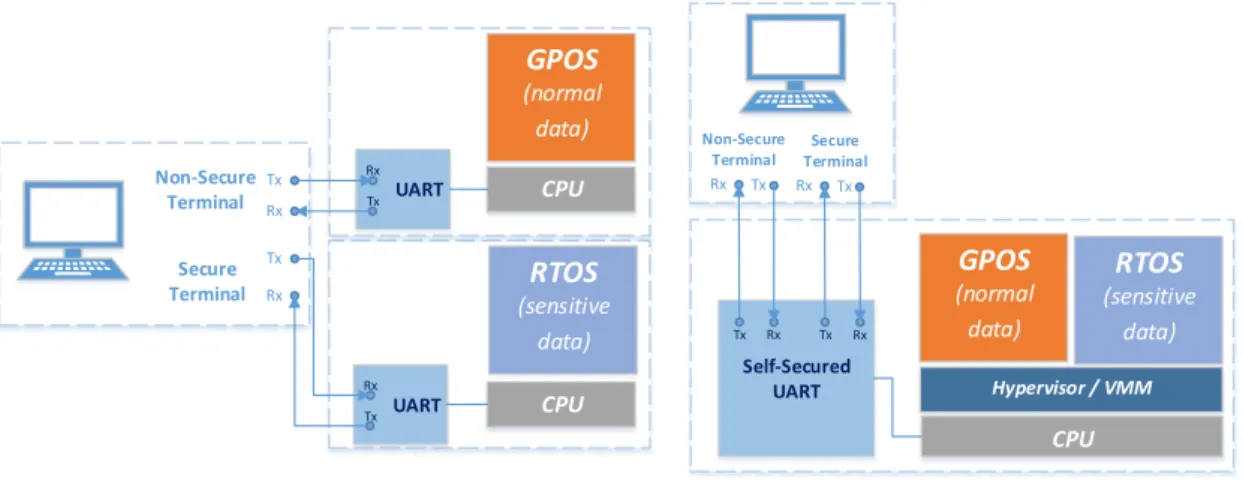
Figure 1.1 illustrates a motivation example with a shared universal asyn-chronous receiver-transmitter (UART). In this scenario, a computer terminal re-quires simultaneously to communicate and exchange data with two separate oper-ating systems: a Real-Time Operoper-ating System (GPOS), and a General purpose op-erating system (RTOS). Given the security-critical nature of an RTOS [YBW10], sensitive data exchanged between the computer terminal cannot be accessed or compromised in any way. With the former presented solution shown in Figure 1.1a, the computer terminal exchanges data between two separate terminal inter-faces and two individual UART devices. Although this approach can satisfy the design requirements, it requires duplication of the hardware device, considerably increasing the hardware costs. In contrast, the latter solution presented in Fig-ure 1.1b, is based on a virtualized system with device sharing capabilities. This solutions allows consolidating both operations systems in the same platform and avoids duplicating the device.
Tx Rx Secure Terminal Non-Secure Terminal Tx UART Rx GPOS (normal data) RTOS (sensitive data) CPU UART Tx Rx CPU Tx Rx
(a) Solution with device duplication.
Tx Rx Secure Terminal Non-Secure Terminal Self-Secured UART GPOS (normal data) RTOS (sensitive data) CPU Hypervisor / VMM Tx Rx Tx Rx Tx Rx
(b) Solution with shared device access. Figure 1.1: Motivational example for shared device access.
Herewith, the RTOS can exchange its sensitive data through the secure ter-minal interface, while simultaneously allowing the GPOS also exchanging its data
through the non-secure interface, using the exact same device. With this approach, the GPOS cannot compromise the device, neither can access or compromise the sensitive data being exchanged by the RTOS.
Currently, shared device access on TrustZone-based architectures can follow different approaches:(i) Proxy task [LMH+14]; (ii) Device emulation [SVL01]; (iii) Device Para-virtualization [FLWH10, KLJ+13]; (iv) Device Para-TrustZone [Pin17]; (v) Device repartitioning [SHT12b]; and (vi) Self-virtualizing devices [RS07, WSC+07]. Among all these methods, some bring platform independence
and flexibility, with an expense in the TCB size and execution overhead. Others, although presenting less execution overhead, require a considerable engineering-effort or/and hardware costs and may present limitations in the number of func-tionalities. Most importantly, several aforementioned approaches allow the device to be intentionally manipulated and cause failure or do not even take security into consideration, compromising the secure state of a device. Therefore, there is a need for a new shared device method that can fully and simultaneously address security while not compromising performance.
1.2
Objectives
This thesis proposes the concept of self-secured devices, a novel approach for shared device access in TrustZone-based architectures. Self-secured devices extend the TrustZone concept to the device itself by separating the device’s hardware logic into a secure and non-secure interface.
Under the light of the above arguments, this thesis proposes to achieve the following goals:
• Study and in-depth analysis of Virtualization and ARM TrustZone technol-ogy;
• In-depth review and comparison of existing state-of-the-art methods; • Familiarization with the platform and tools employed throughout this
the-sis development, including the Zynq7000 SoC, LTZVisor, as well as a deep understanding of the used hardware mechanisms;
• Implementation of the Self-Secured approach on devices of different com-plexity levels;
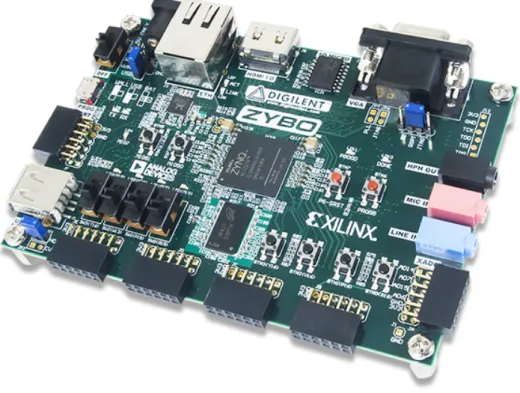
• Integration of the implemented solution on LTZVisor, an open-source and in-house lightweight TrustZone-assisted hypervisor, which will be deployed on the Xilinx Zybo board featuring the ARM TrustZone technology;
• Conducting quantitative studies about the hardware costs introduced by the Self-Secured approach, relatively to the device complexity level;
• Extensive evaluation of the Self-Secured devices comparatively to relevant existing state-of-the-art methods in terms of engineering effort, memory foot-print, achieved speedup, and security enhancements.
1.3
Document Structure
This thesis is structured as follows:
• Chapter 1: The first chapter presents the motivation, goals and the struc-ture of the thesis.
• Chapter 2: The second chapter is divided into two sub-chapters, the first part covers up theoretical concepts of virtualization and ARM TrustZone technology, highlighting the relevant features for this thesis implementation. The second sub-chapter, the state-of-art, describes and compares existing shared device access methods on TrustZone-based systems.
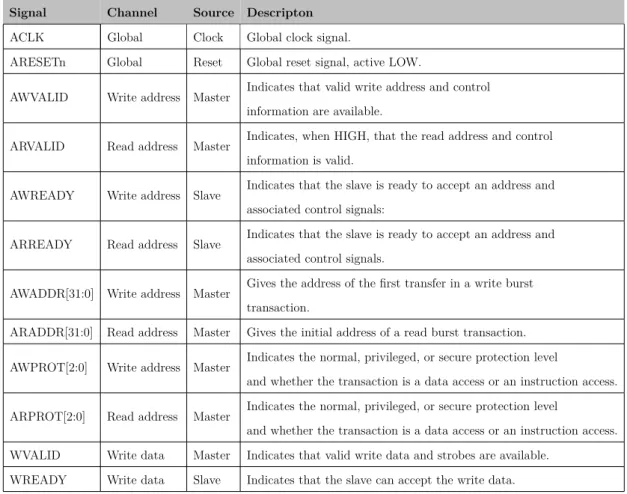
• Chapter 3: The third chapter describes the platform and tools. Firstly, the platform requirements are identified and the development platform cho-sen according to those requirements. Thereafter, the Advanced eXtensible Interface (AXI) bus protocol is discussed, given its relevance for the devel-opment process. Then, the Zybo platform and main features are laid out, highlighting the platform features that were used throughout the develop-ment process. Lastly, the LTZVisor, the hypervisor where the developed work is integrated and tested is carefully analyzed and OSes used as guest OSes are justified.
• Chapter 4: The fourth chapter proposes the development of the self-secured approach and the approach application to devices with different complexity level. This chapter also encapsulates the developed device drivers for man-aging the devices. Finally, it describes the performed modifications to the LTZVisor and hosted guests OSs, in order to integrate and test the developed devices in this hypervisor.
• Chapter 5: The fifth chapter addresses the evaluation. It describes the performed experiments comparing different state-of-the-art solutions. • Chapter 6: The sixth chapter concludes this thesis, presenting the
ob-tained conclusions derived from this research and tangible results, identify-ing the limitations, and suggestidentify-ing future work towards further development on identified limitations.
of the Art
2.1
Background
This chapter is divided into two sub-chapters. Firstly, some background regard-ing virtualization, ARM TrustZone and shared device access is described. Then, the state of art, presents up-to-date methods for sharing devices on TrustZone-based systems, while comparing them among each other, considering their pros and cons.
2.1.1
Virtualization
A computer system is usually represented as consisting of several abstraction levels arranged in a hierarchy that allows the separation of concerns and ease platform independence. The lower layers are implemented in hardware and relate to the operating system and hardware platforms providing the application binary interface (ABI) and instruction set architecture (ISA), interfaces that applications depend on to run. Virtualization technology allows conceiving multiple emulated environments from a single, physical hardware system. This layers can be vir-tualized and their available resources and interfaces are simulated and mapped onto the interface and resources of the real system [SN05]. This concept of vir-tualization can be applied not only to subsystems but to an entire machine. By adding a software layer to the real system to support the desired architecture it appears as an emulated different machine, or even a set of multiple machines, duplicates of the original one. These machines, so-called virtual machines can be classified as: Process VMs, providing a virtual ABI or API environment for user applications delivering replication, emulation, and optimization; or System VMs [Hei08], the relevant type for this thesis context, providing a complete environ-ment in which a single-host hardware platform is partitioned into several virtual
machines supporting the concurrent execution of multiple, isolated guest operat-ing system simultaneously. In Figure 2.1, it is demonstrated the basic software stack for system virtualization. The Virtual Machine Monitor (VMM) or hyper-visor component is the software layer that provides the VM environment. The hypervisor normally runs with full privileges, having access to, and managing all the hardware resources. While the guest operating system and its application processes run with lower privilege and are managed under control of the VMM, which in some cases can verify and perform privileged operations in behalf of the unprivileged guest, upon a request for shared hardware resources.
Hardware Platform
Virtual Machine
Virtual Machine
Virtual Machine
Hypervisor / VMM
App App App
Guest OS
App App App
Guest OS
App App App
Guest OS
Figure 2.1: System Virtualization Stack.
The classical Popek and Goldberg virtualization requirements [PG74], derived under simplifying assumptions, identify the three essential properties of virtual machines:
• Equivalence: The virtualized environment running under the VMM should have identical behavior to that demonstrated when running on the original machine. This also minimizes the engineering effort of porting guest software to the VM.
• Resource Control: It must be impossible to an arbitrary guest to affect other guests resources. The VMM must be in complete control of all the virtualized resources.
• Efficiency: All harmless instructions must be executed by the hardware directly without VMM intervention, minimizing the overhead mechanisms of the VMM. Guest software must show none or only a slight deterioration from their native performance.
In the Popek and Goldberg’s terminology, a VMM must present all of the above mentioned properties. This guarantees an acceptable performance without con-siderable deterioration, mutual isolation among guests while minimizing porting efforts.
2.1.1.1 Classical Software Virtualization Techniques
To achieve the necessary technical requirements for virtualization, the target processor must have several modes with different privilege levels that implicate different access rights to the system resources, also known as protective rings in a ring model, illustrated in Figure 2.2. For instance, the well known x86 architecture has four execution modes (or four rings). Typically, the OS running in a phys-ical machine is executed in kernel-mode and the user applications in user-mode. The OS kernel runs with the highest privilege and has access to the full set of instructions (privileged and unprivileged) of the physical processor. Differently, applications running in the unprivileged user mode have no direct access to the privileged instructions, [RHFN+12]. The hypervisor must run on an additional
privileged mode, in order to be protected from the guest OSs, and guest OSs from their applications, guaranteeing the second property of virtual machines. When a guest OS executes a privileged instruction and does not have the required priv-ilege it creates traps, also known as processor exceptions, which are events that turn control over to the privileged software (hypervisor) by changing the processor mode and setting the program counter (PC) to a known entry point. This extra layer that has an extra privileged mode is provided by CPU extensions for virtu-alization support. When this extra layer is not provided, implementations often recur to a technique named ring decompression or ring deprivileging [UNR+05]. In
such approach, the hypervisor is placed in kernel mode and both the OS kernel and user code are pushed back to the unprivileged mode. However, in many processors, only two privilege levels are provided. In that scenario, through a simple technique called trap-and-emulate, an extra virtual privileged level is created, subdividing the OS and user code into two separate privileged layers. Upon the occurrence of a trap, the hypervisor checks the current state of the VM: if it is running on kernel mode it performs the required action, otherwise, it emulates a trap in the VM by changing its state and forwarding the exception to the guest OS. Therefore, both ring compression and trap-and-emulate techniques incur considerable performance costs due to every crossing of modes or execution of a sensitive instruction having to go through the hypervisor, breaking one of the essential properties of virtual machines [PG74].
VMM
VM
Virtualized Non-Virtualized Guest OS Apps Host OS Apps Virtualization extensions Trap-and-EmulateFigure 2.2: CPU protection ring levels. Adapted from [RHFN+12].
Popek and Goldberg [PG74], introduced a classification of instructions of an ISA into different groups, according to their behavior when executed in different processor modes:
• Privileged: Instructions that trap if the machine is in user mode, and do not trap if it is in kernel mode.
• Control sensitive: Instructions that attempt to change the configuration of resources in the system.
• Behavior sensitive: Instructions whose behavior or result depends on the configuration of the system’s resources.
• Innocuous: Instructions which are not sensitive, do not require a privileged processor mode to run, and cannot change hardware resources context. That said, to apply classic virtualization to an architecture all sensitive instruc-tions in its ISA must be privileged. The rest of the sensitive instrucinstruc-tions which are not privileged are considered critical instructions. These requirements, guar-antee the resource control property, above mentioned, by running the hypervisor with a higher privilege level than the guests. Consequently, in a trap-and-emulate approach, depicted in Figure 2.3, whenever a guest executes a sensitive instruc-tion (in user mode), the following acinstruc-tions are performed in the stated order: the hypervisor takes full control of that action; the instruction is decoded; the trap originating instruction is interpreted; the instruction is emulated; the VM state is updated.
To comply with the efficiency property, most of the hosted virtual machines ISA instruction should be identical to the physical underlying hardware in order to be considered innocuous, consequently enabling their execution directly by the hardware.
Guest OS code in VM
VMM code
Kernel Mode
User Mode
Trap
Privileged Instruction
Instruction decoding
Next Instruction
...
...
Instruction interpreting
Emulation Routine
Figure 2.3: Trap and emulate technique.
2.1.1.2 Para-Virtualization
Until this point, the term virtualization has been used to refer to the classic virtualization, known as full-virtualization [RHFN+12]. With full-virtualization guest run unmodified and not aware of their virtualization, which may cause per-formance deterioration for not being able to easily take advantage of virtualization features. Nonetheless, full-virtualization has to possess the strict requirements of classic virtualization (previously described) or hardware virtualization support. Para-virtualization [Chi07, Kai09, VMw06, WSG02] offers potential performance benefits, a consequence of modifying the guest by exploiting its virtualization awareness. Modifications to the guest OS code consist in adding a special set of instructions (named hypercalls) for the execution of critical instructions, replacing instructions of the real machine’s ISA. These hypercalls are conceptually equal to a system call. Figure 2.4 shows the difference between system calls and hypercalls and the ring transitions when a system call from an application is issued. An extra transition between layers allows applications to run without modification with the cost of a small speed penalty.
P
ro
te
ct
io
n
r
in
g
le
v
el
s
P
ro
te
ct
io
n
r
in
g
le
v
el
s
Native
Paravirtualized
Kernel
Application
Kernel
Application
Hypervisor
Hypercall
System call
Figure 2.4: System calls in native and para-virtualized systems. Adapted from [Chi07].
A single hypercall can replace a set of many sensitive instructions [Chi07], re-ducing the frequency of switches between modes and consequently the overhead incurred by the decoding of those instructions and hardware emulation. Overall, para-virtualization can provide a solution for non-virtualizable architectures that do not provide any hardware virtualization support and performance enhance-ments. Also, due to guest awareness, efficient communication and synchroniza-tion mechanisms (IPC) among guests can be implemented. One of the biggest bottlenecks in many full-virtualized systems is device emulation. Device para-virtualization, later scrutinized, replaces the device driver for the emulated device with a front-end device driver removing the emulation associated overhead. De-spite all advantages, para-virtualization implicates high engineering effort and can break the resource control property of virtual machines, violating guest isolation.
2.1.1.3 Hardware-Assisted Virtualization
All of the virtualization methods formerly referred are still too inefficient due to the high overhead associated with processor exception mechanisms and con-text save and restore operations necessary whenever the hypervisor takes control.
At some point, different manufacturers have extended the architecture in differ-ent ways to overcome the overhead introduced by these mechanisms and decrease VMM complexity, providing virtualization hardware support extensions to aid virtualization adding a set of instructions that makes virtualization considerably easier. These extensions target a wide range of architectures, such as server, desk-top architectures (Intel’s VT-x [UNR+05]) and embedded architectures as AMR’s VE [VH11] or Imagination Technologies’ MIPS VZ [ZMH15]. Conceptually, virtu-alization extensions can be thought as adding a new privilege processor mode, in which, the hypervisor is expected to run and can trap-and-emulate operations that previously, would have failed silently. This added mode, also allows the OS to stay at the same level it expects to be without virtualization and catching attempts to access the hardware directly. However, these extensions also provide other different features, such as replicating and multiplexing important hardware configuration registers, two-level address translation, and virtual interrupt support. In the con-text of this thesis, is also worth mentioning ARM TrustZone hardware extensions. Even though ARM TrustZone is a security extension and not a virtualization extension, some of the provided features are very similar, for instance, much of the critical hardware is replicated and also adds an extra privileged mode. ARM TrustZone is widely spread and available in low-end and mid-end range micro-processors, contrariwise to virtualization hardware extensions. Hence, it has been exploited to also enable embedded virtualization [FLWH10, HGX+17]. Compared
to para-virtualization, hardware assisted virtualization allows running unmodified OSs. However, given that the guest is not aware that is running in a virtual en-vironment it cannot take easy advantage of virtualization features which makes it more likely to be slower. Nevertheless, a hybrid approach might be advantageous, for instance, taking advantage of hardware assisted faster system calls and support for nested page tables, and para-virtualization better I/O performance due to its lightweight interfaces to devices.
2.1.1.4 Hypervisor Architectures
Based on the location of the virtualization layer in the system stack and on the permission of the VMM accesses to the hardware resources, hypervisor topologies [RHFN+12, SGB+16], despited in Figure 2.5, can be categorized as:
Hardware Platform
Virtual Machine
Virtual Machine
Virtual Machine
VMM
App App App
Guest OS
App App App
Guest OS
App App App
Guest OS
Type-1
Hardware Platform
Virtual Machine
Virtual Machine
Host OS
Hosted VMM
App App App
Guest OS
App App App
Guest OS
App
Type-2
App App
Figure 2.5: Virtualization Topologies.
• Type-1, or bare-metal Hypervisors, run in a higher privileged mode than the guest OSs, directly over the hardware where it can manage and access every hardware resource of the system.
• Type-2, or hosted Hypervisors, run in an unprivileged mode over the priv-ileged host OS that is already executing, with no direct permissions to the hardware.
Bare-metal hypervisors also referred to as native virtualization, are more suit-able for time-critical systems due to the performance degradation of guest OSs only depending on the hypervisor performance. In addition, hosted hypervisors lack of privilege and security is not adequate for embedded devices where criti-cal applications will run, and usually exhibit a poorer performance compared to type-1 hypervisors.
2.1.2
ARM TrustZone
TrustZone technology [ARM09, ARM16] refers to security extensions available in all ARM Application-processors (Cortex-A) for several years, since the ARMv6 architecture. This hardware security extension splits all hardware resources and virtualizes a physical core into two virtual cores, providing two completely sepa-rated execution environments: the secure and the non-secure worlds, as illustsepa-rated in Figure 2.6. Hardware mechanisms are provided, to ensure secure world resources are not accessible by the non-secure world, while the secure world can access any resource. This strong isolation is important in scenarios where a trusted OS with a small TCB, executing time-critical and security-critical applications, runs in the secure side, alongside a rich untrusted GPOS running in the non-secure world. With the addition of a new architectural feature at the processor level, the 33rd bit, also referred as the NS (Non-Secure) bit, provides separation between these two worlds, indicating in which world the processor is currently executing. This bit is accessible through the added Secure Configuration Register (SCR) present in the System Control Co-processor (CP15) and exclusively accessible by the se-cure world. Some of the System Control Co-processor (CP15) registers and other critical processor bits are banked in both worlds. The remaining registers which are not duplicated, are either non-accessible by the non-secure world or kept under close supervision of the secure world.
AMBA Interconnect
CPU
Flash
Non-secure Peripherals Secure PeripheralsSRAM
Secure world Non-Secure worldDMA
Figure 2.6: Arm TrustZone hardware Architecture. Adapted from [ARM15].
new mode is used for bridging transactions between both worlds, while preserving the processor state. Unlike other processor modes, monitor mode is only present in the secure world, hence always considered secure. A new privileged instruction was also specified, SMC (Secure Monitor Call) analogous to system calls, through this instruction the non-secure world is able to enter monitor mode. The monitor mode can also be enabled by configuring it to handle interrupts (IRQs, FIQs) and exceptions in the secure side.
Secure and non-secure world partitioning is not only restricted to the proces-sor, but also propagated to other system resources such as memory, peripherals and buses. Memory infrastructure can also be partitioned into distinct memory regions, which can be configured to be used by both worlds or exclusively by the secure world. If the non-secure world tries to access the secure address space, an abort routed to the monitor mode is triggered. The processor also provides two virtual Memory Management Units (MMUs), delivering separate virtual-to-physical memory address translation tables to each world. Even though the NS bit is still available in the non-secure side, from the non-secure world perspec-tive is transparent, since accesses are always performed with with NS set. This memory isolation is extended and still available at cache level, with the NS bit tagging each entry with the processor state upon the access. At the cache-level, entries from both worlds can coexist removing the need for duplication and cache flushing, consequently accelerating world switching.
To provide the aforementioned memory infrastructure isolation, TrustZone features hardware peripherals such as the TrustZone Address Space Controller (TZASC) and the TrustZone Memory Adapter (TZMA). The TZASC hardware controller provides a programming interface, only accessible by the secure world, that can configure specific memory regions of the DRAM, after being partitioned into different memory segments, whose granularity depends on the SoC imple-mentation. If the TZASC configures one of these memory regions as secure, non-secure attempts to access it will be denied. TZMA provides the same function-alities, but targeted at the on-chip memory, such as ROM or SRAM. However, TZMA cannot be used for partitioning dynamic memories or memories that re-quire multiple secure regions, unlike TZASC. Additionally, through TrustZone Protection Controller (TZPC), which is a configurable signal control block placed on Advanced Peripheral Bus (APB), system devices can be dynamically config-ured as secure or non-secure. Moreover, to avoid overloading the processor, direct memory access (DMA) controller can be used for moving data around physical memory. TrustZone is also extended to this engine, featuring both a secure and
non-secure concurrent channels with independent interrupts and controlled by a dedicated APB interface. TZASC, TZMA and TZPC components are all optional and implementation-specific.
The TrustZone-enabled AMBA Advanced eXtensible Interface (AXI) system bus, carries extra control signals to restrict access on the main system bus, includ-ing an additional control bit, the non-secure bit, for each of the read and write channels on the main system interconnect. This enables TrustZone architecture to also secure peripherals (e.g. interrupt controllers, timers, and user I/O devices) through this additional non-secure bit.
To support the robust management of secure and non-secure interrupts, the Generic Interrupt Controller (GIC) provides both secure and non-secure priori-tized interrupt sources. Through the Interrupt Security Register of the GIC an interrupt can be configured as either secure or non-secure. Interrupt prioritiza-tion is available, allowing to configure secure interrupts as higher priory than the non-secure interrupts. An important feature that allows secure interrupts to be handled with higher priority than non-secure interrupts, preventing potential denial-of-service attacks. Among other possible interrupt models the GIC allows to configure FIQs as secure and IRQs as non-secure interrupt sources, as suggested by ARM and adopted by LTZVisor.
2.1.3
TrustZone-assisted Virtualization
Even though ARM TrustZone hardware extension is security-oriented, some of its features are very familiar to other hardware-assisted virtualization exten-sions. In particular, the existence of an extra higher privileged mode (monitor mode) where the hypervisor can run; the ability to have full control over the ex-ception system; and being able to execute OSs in the other remaining processor modes. However, classical hardware virtualization depends on two-level address translation which, in fact, is not provided by TrustZone. Instead, the TZASC enables memory segmentation for isolation. Nevertheless, unmodified guest OSes need to cooperate in order to be executed in the respective preassigned segments achieving memory isolation. TrustZone can be efficiently exploited to assist vir-tualization with the enormous advantage of being widely spread to most low-end and mid-range microprocessors used in embedded devices. The segmented mem-ory model should not impose any problem, given the reduced and fixed number of VMs normally deployed in embedded use-cases.
TrustZone-assisted virtualization can support systems with different OS con-figurations [PS18], such as single-guest, dual-guest, and multi-guest systems. The
simplest architectures use a single-guest setup [FLWH10], in which the single guest OS and its applications run in the non-secure side and the hypervisor in monitor mode. The hypervisor has full access to the whole system, composing the entire system’s TCB, and has the responsibility of keeping the secure resources under its close supervision. In contrast, the non-secure guest may only manage and access resources (i.e. devices, memory, and interrupts) configured as non-secure. However, if the non-secure guest requires accessing secure resources, it is able to perform those accesses through para-virtualized drivers, under the hypervisor’s supervision.
Most of the existing solutions commonly implement a dual-OS configuration in order to have one processor virtual state (non-secure and secure state) dedicated to each guest OS. In this manner, the hypervisor also runs in the monitor mode, while each guest OS runs individually in each world. This type of configuration is ideal in scenarios where an RTOS with real-time functionalities and requirements runs in the secure world, isolated from the GPOS, which runs in the non-secure world, usually during the RTOS idle periods to ensure timing requirements are meet. The LTZVisor [PPG+17b], is an example of an open-source lightweight
TrustZone-assisted hypervisor mainly targeting the consolidation of mixed-criticality systems, and supports the coexistence of two OSs, one secure RTOS side by side with an untrusted, rich GPOS.
The number of supported guest OSs on TrustZone-enabled systems has been a setback for perceiving TrustZone has a viable virtualization solution. However, recent solutions [MAC+17, PPG+17a] were able to demonstrate how TrustZone-enabled platforms are capable of hosting several guest OSs without compromising isolation between guest OSs, neither interfering with their proper execution, by attentively managing shared resources and the security configurations of memory, devices, and interrupts at runtime.
2.2
Related Work
Currently shared device access can essentially follow the approaches: (i) Proxy task; (ii) Device emulation; (iii) Device Dara-virtualization; (iv) Device Para-TrustZone; (v) Device re-partitioning; (vi) Self-virtualizing devices. In this sec-tion, the existing shared access methods will be thoroughly analyzed and com-pared.
2.2.1
Devices Access in TrustZone
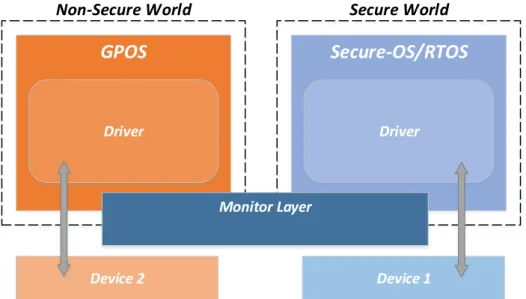
When multiple virtual environments are consolidated in the same platform there is a need to share resources among them. Ideally, hardware devices should also be capable of being shared between these virtual environments. However, in TrustZone-enabled SoCs, hardware devices can only be configured as secure or non-secure, which means the dual-world concept of TrustZone is not extended to the devices itself. So, if both worlds require a certain device, it needs to be completely duplicated. Likewise, typically in dual-OSs systems, devices are usually duplicated and assigned exclusively to each guest OS: devices that are critical for the reliability of the system are assigned to the RTOS and the remainder devices are assigned to the GPOS. This method, denominated direct assignment or pass-through access only allows the non-secure world to access devices configured as non-secure and the secure world to access devices configured as secure, as illustrated in Figure 2.7. Device 2
GPOS
Secure-OS/RTOS
Monitor Layer Secure World Non-Secure World Device 1 Driver DriverFigure 2.7: Direct assignment access method.
When both OSes need to make use of the exact same device it becomes neces-sary duplicating the device, which is useful for ensuring the RTOS reliability, and maximizing the system performance. However, it also adds a significant increase in the total hardware cost.
For achieving a reliable device sharing mechanism the following requirements must be satisfied:
• Real-time: Timing requirements are really critical for a RTOS. Device shar-ing mechanisms must ensure that the SW has full control over the shared
device and the successful completion of its operations. Meaning that an operation performed by SW must be completed, regardless of operation re-quests coming from the NSW. Any action from the NSW that may prevent the SW use of the shared device for an unbounded amount of time should not be possible.
• Security: Secure resources and logic must be protected against both mali-cious and accidental accesses from the non-secure world. The shared device cannot be, in any way, compromised by the NSW.
• Overhead: The introduced overhead of a device sharing mechanism (e.g., due to data copies, data exchange, access policies or context switches) must be minimized. The device’s native performance should not be affected by the method application and introduce performance degradation.
• Device latency: Access to the device when a valid request is issued must be performed as fast as possible.
• Modifications: Modifications to the TCB software and monitor must be minimized or ideally, avoided. Otherwise, it could incur overhead and require considerable engineering effort. Moreover, device drivers should be generic and should not require modifications, regardless of the OS that is using them. • Hardware Costs: Hardware modifications to the device’s logic must also be minimized, to prevent a significant increase in terms of hardware costs when comparing with the native device.
2.2.2
Proxy Task
Proxy Task [LMH+14] illustrated in Figure 2.8, is the most basic shared device method, which consists in a SW OS client task that can send a request to a proxy task in the NSW OS, through a communication channel [SHT12a, OMC+18], in
order to take advantage of the GPOS libraries and drivers richness. The intro-duced overhead is fairly low due to the high level of abstraction of the request. Despite this method’s performance being ideal, it is completely unreliable. The SW OS requests might be ignored or act differently than expected due to the GPOS software being untrusted, excluding this method as a viable secure shared device access approach.
Device
GPOS
Secure-OS/RTOS
Monitor Layer
Secure World
Non-Secure World
Proxy Task Client Task
Communication
Figure 2.8: Proxy Task method.
2.2.3
Device Emulation
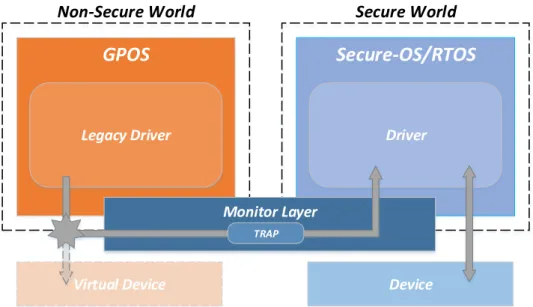
Device emulation, depicted in Figure 2.9, is typically used in full-virtualization solutions [SVL01] and follows the classical Popek and Goldberg’s trap-and-emulate approach for virtualization [PG74]. From the GPOS point of view, it owns all the devices, tricked to think there is a provided legacy driver. However, when the GPOS tries to make any access to the virtual device, it results in being trapped by the monitor layer. After being trapped, the hypervisor is responsible for em-ulating the functionality that the GPOS was intended to perform on the device. Once the GPOS access is trapped in the monitor layer where security and access permissions issues will be accounted for, it is forwarded to the SW OS (RTOS), where a driver will handle the physical device. This method delivers the GPOS platform independence and flexibility and does not require any changes to guest OSs. Nonetheless, it comes associated with significant execution overhead and TCB size expense, due to the required complex extensions in order to implement the trap mechanism. Moreover, traps are typically delivered to the SW OS as interrupts, and the interrupt rate must be limited in order to prevent frequent ac-cesses from the GPOS to the device, that may result in a performance bottleneck.
Virtual Device
GPOS
Secure-OS/RTOS
Monitor Layer Secure World Non-Secure World DeviceLegacy Driver Driver
TRAP
Figure 2.9: Device emulation method.
As shown in Figure 2.10, the NSW OS can trigger external aborts, which are exceptions generated by accessing secure or invalid device memory. Such aborts trap directly in the monitor if the secure world OS has this feature enabled. This mechanism could be used to emulate access to devices.
GPOS
Su p er vi so r M o d e GPOSDevice access
RTOS
DATA
ABORT
M o n it o r M o d e Device TRAP Emulate Invalid AccessFigure 2.10: Ideal device emulation flow control.
However, using these trap-and-emulate techniques is not possible, due to Trust-Zone protection mechanisms [Kal14]. Consequently, device emulation on TrustTrust-Zone- TrustZone-based systems cannot be implemented, as a result of most sensitive instruction in the non-secure world not having the necessary security privilege to be detected by the hypervisor. Even so, for those that manage to get detected, such as load/store instruction to access secure device registers, the CPU will not immediately enter
the hypervisor when the fault occurs. Instead, the bus transaction will still be attempted, triggering an external data abort, similar to a device interrupt. Even though the violation can be detected and can generate an exception, this exception is imprecise and not always immediate. This leaves no chance to reconstruct what happened in between the invalid access and the reception of the external abort ex-ception in the hypervisor, neither can the hypervisor restore the non-secure world to a useful state.
2.2.4
Device Para-Virtualization
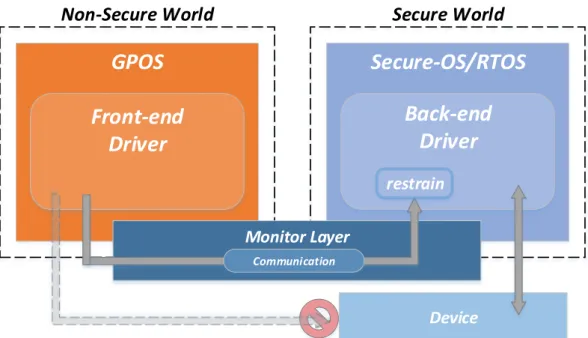
The para-virtualization approach [FLWH10, KLJ+13, Chi07] shown in
Fig-ure 2.11, follows the para-virtualization concept, consists in slight modifying the GPOS driver (i.e., front-end driver) to send requests to the SW OS driver (back-end), through hardware-like interfaces that exchange data between NSW and SW, like a communication channel [SHT12a, OMC+18].
GPOS
Secure-OS/RTOS
Monitor LayerSecure World
Non-Secure World
DeviceFront-end
Driver
Back-end
Driver
Communication restrainFigure 2.11: Device Para-Virtualization method.
Both the GPOS and the SW OS (normally a RTOS) are modified in order to support devices allocated to the secure world. If a device is configured as non-secure both the NSW and SW can access it directly without requiring SW intervention except for the interrupt delivery. However, if the device is configured as secure, an access driver (i.e., front-end driver) that sends requests to the secure world is required. The SW request will be interpreted and the correspondent action executed or mediated by the secure driver (back-end). The request from
the NSW is validated and verified according to the specified security policy. Access to a secure device is not as fast as access to non-secure devices because it evolves communication between NSW OS and SW OS. This access generally involves the following steps:
• The access driver in NSW issues a request to the SW;
• The monitor saves the NSW processor state and sends a message to the SW; • The SW selects the device and handles the request;
• After finishing the request the SW sends a reply message to the monitor; • The hypervisor restores NSW processor state and initiates the NSW entry. This method presents less hardware costs relatively to device duplication, less execution overhead than emulation, and protects shared devices from po-tential bugs which might arise from software modifications or extensions, unlike re-partitioning. Although, still requires a considerable engineering-effort like mod-ifying the OSs (the effort required to modify a kernel can be high), presents limi-tations in the number of functionalities (the GPOS is limited to the functionality supported by the RTOS driver) and its performance is still far from native. Also, this approach comes with associated overhead, which might cause real-time per-formance issues on the trusted domain, and also a considerable increase in the TCB complexity.
2.2.5
Device Para-TrustZone
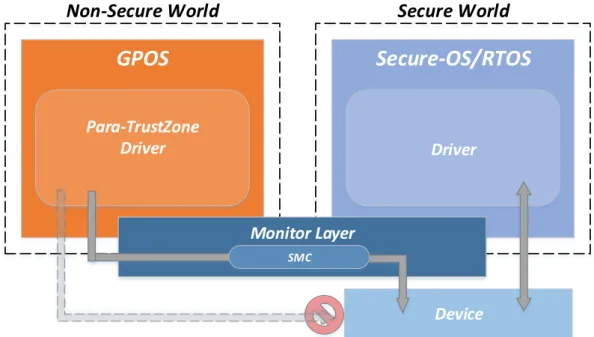
The para-TrustZone approach [Pin17] illustrated in Figure 2.14, is based on the para-virtualization approach, which consists in slight modifying the GPOS driver to send requests for the secure device. However, with this approach, instead of sending the request over to the SW OS, the requests are directly sent to the hy-pervisor itself, which handles the requests and carries them out. It is implemented through the added TrustZone privileged instruction SMC (Secure Monitor Call), which enables the non-secure world entering monitor mode. The SMC instruction requires kernel privilege to be executed, hence the GPOS driver must be modified to add the supported instructions.
GPOS
Secure-OS/RTOS
Monitor LayerSecure World
Non-Secure World
Device Para-TrustZone Driver Driver SMCFigure 2.12: Device Para-TrustZone method.
This method can out-perform the para-virtualization by removing the overhead incurred by the communication mechanisms and OSs context switches. However, a considerable engineering-effort is still required due to the required modifications at the OS and hypervisor level. The number of functionalities is limited to the ones supported by the SMC handler within the hypervisor. Most importantly, this method has security issues, due to not protecting the device against the GPOS misbehavior and not limiting the performed accesses in any way. Consequently, once the GPOS is running it can perform massive SMCs, intentionally causing device failure.
2.2.6
Device re-Partitiong
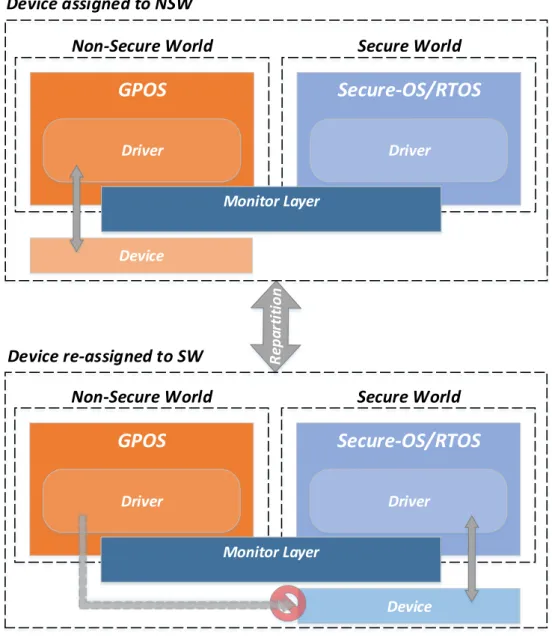
Figure 2.13 depicts the re-partitioning approach [SHT12b], implemented in SafeG, with this approach a device that has been already assigned to a certain OS can be dynamically re-assigned at run-time. Devices can be configured and re-configured as part of the secure or non-secure world through the TrustZone Protection Controller (TZPC). This re-assignment occurs with a trigger condition from the SW OS.
As a result, devices can be directly accessed by both the SW and NSW con-siderably reducing overhead. Additionally, the monitor requires few or even none modifications at all. The re-partitioning approach can be implemented in a pure and hybrid form. A module named Re-partition manager present in both OSs
is responsible for managing the device sharing through a communication channel [SHT12a]. The SW OS Re-partition manager is activated whenever a condition is triggered. Device Device
GPOS
Secure-OS/RTOS
Monitor Layer Secure World Non-Secure World Driver Driver Device assigned to NSW Device re-assigned to SWGPOS
Secure-OS/RTOS
Monitor Layer Secure World Non-Secure World Driver DriverFigure 2.13: Device Re-partitioning method.
In the pure form, when a device must be re-partitioned to the TCB, the RTOS sends an "UNPLUG" event to the GPOS manager. To guarantee that the SW OS usage of the shared device cannot be compromised and is reliable, the RTOS manager is completely independent of the GPOS manager state. Following the trigger event, the RTOS manager needs to perform a full reset on the device to a predefined state, and then the RTOS re-partition manager configures the device as part of the TCB, finishing the re-partition process and making the device now able to be reliably used by the RTOS. On the other hand, when the RTOS no longer
![Figure 2.6: Arm TrustZone hardware Architecture. Adapted from [ARM15].](https://thumb-eu.123doks.com/thumbv2/123dok_br/17268273.788963/43.892.175.780.702.1019/figure-arm-trustzone-hardware-architecture-adapted-arm.webp)
![Figure 3.2: Zynq-7000 SoC overview [Xil18].](https://thumb-eu.123doks.com/thumbv2/123dok_br/17268273.788963/64.892.110.735.121.610/figure-zynq-soc-overview-xil.webp)