Effect of Extended Cooking and Oxygen
Prebleaching on the Surface Energy of
Eucalyptus globulus
Kraft Pulps
M.G. CARVALHO, P.J. FERREIRA, J.M.R.C.A. SANTOS,
J.L. AMARAL and M.M. FIGUEIREDO
The aim of this work was to investigate the influence of introducing an oxygen prebleaching stage and of extending the cooking process on the surface and papermaking properties of elemental chlorine-free bleached kraft pulps produced with Portuguese Eucalyptus globulus. Inverse gas chromatog-raphy was used to evaluate the suiface energy as well as the Lewis acid/base character of the pulps, taking as reference one pulp cooked and bleached under standard conditions. The dispersive component of the surface tension, y~, was found to be highest for the pulp prepared under standard condi-tions, lowest for the pulp prepared by extended cooking and intermediate for the oxygen-prebleached pulp. Although all pulps exhibited a dominant acidic character (K)Kb > 1 ), the oxygen stage was found to enhance this character due to the higher surface concentration of oxygen-containing functional groups. Furthermore, oxygen prebleaching led to the formation of bulkier handsheets and it increased the beating energy. The opposite behaviour was found for the pulp produced by increasing the Hjactor to extend the cooking.
Dons le prisent travail, flOUS avions
a
analyser /'influence de /'introduction d'une itape de pre blanchimenta
l'oxygime et du prolongement de la cuisson sur les proprietes de sU/face et de fabrication des pG.tes kraft blanchies sans chlore elemelllaire produites il partir d'Eucalyptus globulusportugais. Nous avons utilise la chromatographie inversee en phase gazeuse pour evaluer la tension super:ficielle ainsi que les caractdristiques acide-base de Lewis des pdtes, en prenant corn me rejdrence une pdte cuite et b!anchie dans des conditions standard. Nous a vans trouve que la composante dispersive de la tension super:ficiel/e, y~, etait la plus ilevee pour la pfite pdparee dans des conditions standard, la plusfaible pour la pG.te prepanfe par une cuissonprolongee, et intermediaire pour la pG.te preblanchie
a
l'oxygime. Bien que toutes les pdtes aient presente un caracti!re acide dominant(Kjl<b> 1 ), now; avons trouve que l'etape de l'oxygi!ne accroissait cette caracteristique en raison de la plus grande concentration
a
la surface des groupes fonctionnels contenant de l'oxygene. De plus, le prr! blanchiment ii l'oxygene a produit des formettes plus bouffantes et exigi davantage d'energie de raffinage en pile. Now; avons aussi obtenu un comportement oppose de la pG.te produite en accroissant le facteur H pour prolonger la cuisson.INTRODUCTION
90
Ink-jet printing has been considered one
M. G. Ca!Valho, P.J. Ferreira and M.M. Figueiredo
Univ. Coimbra Dept. Chem. Engh P6lo 11, Pinhal de Marrocos 3030-290 Coimbra, Portugal ([email protected])
J.M.R.C.A. Santos
Polytechnic Inst. Braganga Dept. Chemical T echnol. Campus de Santa Apo16nia 5301-857 Braganc;a, Portugal J.L. Amaral
RAlZ- Forest Paper Res. Inst. Quinta de S. Francisco Apartado 15
3801-501 Eixo, Portugal
of the leading printing processes and, accord-ingly, has been the subject of many research studies. Terms such as printability, which de-scribes the paper surface characteristics that in-fluence the quality of the printed surface in relation to ink and press combinations, are now in current use by papermakers [I
J.
To under-stand the printing process, it is necessary to ex-amine the surface properties of paper, especially its surface free energy [2,3], which affects the adhesive properties and also the spreading of a liquid over the surface and its penetration into the fibre network.It is well known that the surface energy of the paper sheet, as well as the chemical char-acteristics of the paper surface and of the ink, is important in printing. However, other physical properties, such as the nature of fibres and the structure of the fibre network, must also be
taken into consideration to establish correla-tions with the interfacial phenomena that affect the interactions between paper and ink.
Portuguese Eucalyptus globulus fibres are generally considered of good quality for the production of printing papers, particularly for those intended to be used with ink-jet printers. Although the fibrous component is a major de-tem1inant of the paper surface properties and their interaction with binders, additives and inks, differences in cooking, bleaching and papermaking will also affect the ink-jet printing quality of the paper, since they influence the surface chemical composition and, conse-quently, the surface free energy. A number of studies have been carried out to investigate and modify the surface properties of fibres aiming at the identification of the major factors that af-fect the aforementioned interfacial phenomena
[4J. Properties such as surface free energy and Lewis acid/base character have been used as crucial tools to investigate the surface composi-tion of cellulosic fibres and to understand the way in which different pu1ping processes as well as different treatments will affect the pulp surface chemical composition [5-9].
Due to environmental concerns, at-tempts have been made worldwide to reduce the amount of adsorbable organic halogen
(AOX) compounds and the chemical oxygen demand load in an elemental chlorine-free (ECF) bleach plant by decreasing the kappa number prior to bleaching. One way to achieve this is to extend the cooking process. In fact, several modified kraft processes have been de-veloped to reach that objective without losing pulp yield, but the pulp quality is always nega-tively affected. Alternatively, oxygen delignification has been introduced by many pulp mills into the conventional ECF bleaching process (for instance, using ODEDED instead of the DEDED sequence), although the intro-duction of this stage also causes a deterioration in pulp quality. The main objective of the pres-ent work was to study the influence of these two strategies on the surface energetics of Eucalyp-tus globulus bleached pulps and on correspond-ing papermakcorrespond-ing properties. The properties that most affect the printability have been studied thoroughly already, but little work has been done concerning their relationship to the sur-face characteristics of fibres and paper.
METHODOLOGY
Pulps Production
Portuguese Eucalyptus globulus chips were used to produce three different samples of bleached kraft pulp. As indicated in Table I, two of them (EG-1 and EG-2) were obtained by us-ing the same cookus-ing conditions in an MK lab-oratory digester (model 409 MII from M/K Systems, Inc., Danvers, MA, USA, with a ea~ pacity of -7 L) whereas, for the third case (pulp EG-3), a higher H-factor was used (by increas-ing cookincreas-ing temperature and time), resultincreas-ing in an unbleached pulp with a lower kappa number. To study the influence of a predelignification stage with oxygen, pulps EG-1 and EG-2 were bleached by applying DEDED and ODEDED sequences, respectively. Pulp EG-3 also was bleached by the conventional ECF sequence (DEDED). A value of90% ISO final brightness was achieved for the three pulps. Due to the standard cooking and bleaching conditions, pulp EG-1 was considered the reference pulp. For inverse gas chromatography (IGC) mea-surements, all the bleached pulps were dried at room temperature, oven dried at I 05°C for 2 h and milled.
Measurements of physical properties were performed on handsheets of unbeaten and beaten pulps. The latter were obtained in a PFI laboratory mill to achieve a Schopper-Riegler freenessof30 (ISO 5263 [10], ISO 5264/2 [!I], ISO 5267/1 [ 12]). For both the unbeaten and the beaten pulps, fibre length and fines content were measured using the Fiber Quality Ana-lyzer (FQA), OpTesl Inc., Hawkesbury, ON, Canada. 1-Iandsheets were prepared and tested
TABLE I
PROCESS CONDITIONS FOR THE VARIOUS E, g/obu/us PULPS (ACTIVE ALKALI CHARGE 16% Na20, SULPH!DlTY 30%, LIQUOR TO WOOD RATIO 4, HEATING RATE 1'/min)
Temperature,
oc
Time at temperature, min Kappa numberBleaching sequence (90% ISO brightness)
-EG-1
160 45 14.8 DEDED
-E-G-2
160 45 14_8 ODEDED
-EG-3
165 50 12.5 DEDED
TABLE 11
CHARACTERISTICS OF !GC PROBES [2,24]
A
r1
AN' DNnm' mJim2 kJ/mol kJ/mol
Atkanes
CeH14 0.514 18.4
C1H1e 0.570 20.3
CsH1a 0.628 21.3
CgH2o 0.689 22.7
C10H22 0.750 23.9
Polar probes
Chloroform 0.440 25.0 22.7 0
Tetrahydrofuran 0.450 22.5 2.1 84.1
Acetone 0.425 16.5 10.5 71.2
A= cross-sectional area,
11
=dispersive component of the surface tension, AN"= Gut-mann's modified acceptor number and DN = Gutmann's donor number.against the most common structural, optical and mechanical standards (bulk, Gurley air re-sistance, Bendtsen roughness, light scattering coefficient, tensile and tear strength - ISO 5269/1 [13], ISO 534 [14], ISO 536 [15], ISO 5636/5 [16], ISO 87912 [17], ISO 9416 [18], ISO 1924/2 [19], ISO 1974 [20]).
IGC Technique
IGC has been reported as a powerful tool to study surface energetics and Lewis acid/base character for
a
large number of materials [2-5,21]. According to the Fowkes theory [22], the surface free energy can be considered as the sum of components of various origins, the most relevant being the dispersive component arising from London and Van der Waals forces, and the specific component due to Lewis acid/base in-teractions and hydrogen bonding. To evaluate the surface interaction capability of cellulosic fibres, IGC was used to determine the disper-sive component of their surface tensioner:)
and to analyze their Lewis acid/base character.roe
is similar to conventional gas chro-matography, the main difference being the fact that the material under study is the stationary phase inside the chromatographic column and the compounds injected (probes) have well-known properties. A Perkin Elmer (Boston, MA, USA) 8410 gas chromatograph equipped with a hydrogen flame ionization detector was used for IGC data collection. This instrument was connected to a Kompensograph Siemens (Berlin, Germany) integrator. Stainless steel columns 0.5 m long and 0.4 mm ID, degreased, washed and dried, were packed with the oven-dried milled pulp using a vacuum pump. The packed columns were conditioned at l 05°C overnight under a helium flow before any mea-surements were taken.Measurements were carried out at
col-umn temperatures that ranged from 40 to 600C, at 5°C intervals. The injector and detector were kept at 180 and 200°C, respectively. The carrier gas (helium) flow in each column was opti-mized to ensure that neither absorption nor dif-fusion of the probes would. occur in the column stationary phase. This was ·achieved by deter-mining the retention volume of octane at sev-eral helium flow rates for the temperature range in which the experiments were undertaken.
Minute quantities of probe vapour (<1
~L) were injected into the carrier gas flow to ensure that the experiments take place at infi-nite dilution. Chromatographic grade (Sigma-Aidrich Ltd., St. Louis, MO, USA) probes were used without further purification. Their rele-vant properties are listed in Table IL Natural gas with 83.7% methane was used to determine the dead retention volume. Replicate measure-ments were perfmmed using two columns pre-pared in the same way. Retention times were the average of at least five injections. The peaks obtained using the modified gas chromatograph unit were reproducible and the retention times were independent of the probe quantity in-jected. Reproducibility between runs was al-ways better than 2%. The retention times were determined graphically according to the Conder and Young method [23].
IGC Data Analysis
The theory relating thermodynamic functions to IGC experimental data is discussed thoroughly and reported in the literature [2-5,21] and will be mentioned only briefly here. For each probe tested, the retention time, t,., is used to calculate the net retention volume, Vn, as:
Vn =
(t,. -t
0 )F·l (I)where t0 is the dead retention time of the marker probe (methane), F is the carrier gas flow rate (measured with a digital flow meter) and J is the correction factor for gas compressibility which
is related to the inlet pressure,
Pi,
and the outlet
pressure, Po, by:
J =
]_l(Pii Po
)"
-1]
(l)
2(Pi!Po)
3-1
Assuming that the experiments take place at infinite dilution, the free energy of ad-sorption of the probe on the stationary phase surface per mole, D.G, can be determined from the retention volume, Vn, according to:
D.G = -RT1n(Vn)+C1 (3)
where R is the gas constant, T is the absolute column temperature and C 1 is a constant which depends on the chromatographic column and on the reference state. Considering, as suggested by Fawkes [22], that the dispersive and specific components, !J.Gd and /J.G\ respectively, are ad-ditive, Eq. (3) can be rewritten as:
!J.Gd
+
!J.G·1· = -RTin( Vn)
+
C1(4)
On the other hand, the free energy of adsorption can be related to the work of adhesion, Wa [251. according to:
-D.G = N· A· Wa +C2 (5)
where N is Avogadro's number, A is the cross-sectional area of the probe to be tested (Table II) and C2 is a constant. If nonpolar components
(such as n-alkanes) are used, only dispersive in-teractions occur and the work of adhesion is given by:
( )
1/2
Wa = 2 y~rl' (6)
where
r1
andyf
1 are the dispersive components of surface free energy of the solid (stationary phase) and of the liquid surfaces, respectively. Substituting Eqs. (5) and (6) in Eq. (3) leads to:( )1/2 ( )1/2
2Ny~ Ayf +C=RT!n(Vn) (7)
The slope of the straight line obtained by plot-ting R7ln(Vn) ver<us 2N(y)l)li2A, for a homolo-gous n-alkane series, leads to the determination of 'Y.~.t for a given temperature.
The Lewis acid/base characteristics of a fibre surface are determined by analyzing the interaction of the polar probes with the solid surface and by quantifying the deviation from the reference line (obtained with the n-alkane probe series), leading to the estimation of the specific free energy, /::,.G\ as:
-D.G·'
= RT!n(Vn) -RTln( Vn,.,1 ) (8)where Vnref is the retention volume obtained us-ing then-alkane reference line (Eq. I) and Vn is the retention volume of the polar probes. The , work of adhesion between the probes tested and the fibres can be evaluated from the free energy, by combining Eqs. (5) and (8):
92
TABLE 111
VlSCOS!TY AND CHLORINE DIOXIDE CONSUMPTION FOR THE PULPS
Viscosity, dm"ikg
C!02 charge, %as Clz
Viscosity after bleaching, dm3Jkg
1478 4.30 1245
EG-2
1478 2.37 1127
EG-3
1335 3.45 1193
TABLE !V
!GC RESULTS FOR PULPS EG-1, EG-2 AND EG-3
EG-1 EG-2 EG-3
,"{g
(40°C)
(mJ/m')
41.3 35.1 12.6
dygtdT
(mJ/m'T)
-0.25 -0.62 -0.35
Wa(THF)/Wa(CHCl,)
(at 40°C)
2.3 3.7 1.5
KJK,
2.8 6.1 2.6
y~ =dispersive component of surtace tension, Wa(THF)/Wa(CHCI3) =work of adhesion ratio and Ki/Kb = Lewls acid/base character.
W RT
1(V")
a= N·A n Vnref (9)
If the experiments take place at different temperatures, it is possible to determine the enthalpy of adsorption, t:,.Hs and the entropy of adsorption, b.SS, by plotting b.G~rr versus I IT according to the following equation:
f::..Gs f::,.H·1·
--=---D.S·' (10)
T
T
The acidic and basic constants, Ka and K1)' re-spectively, are calculated using
Eq.
(11) from the plot of t:,.HsfAN* versus DNIAN*. AN* and DN are, respectively, the modified acceptor and donor numbers of the pmbes tested (Table II).(-D.H')
DN-'---L = K - - -+ K1
AN* a A N * ) (11)
RESULTS AND DISCUSSION
As expected, extended cooking leads to a reduction not only of the kappa number but also of the pulp viscosity (Table Ill). In addi-tion, this strategy diminishes (-20%) the chlo-rine dioxide charge needed to reach the same brightness, but tl;e bleached pulp exhibits a lower viscosity ( .... 52 units) compared to the ref-erence pulp. On the other hand, oxygen delignification allows a greater reduction inCI02 charge ( -45%) but, nevertheless, leads to
the highest decrease in pulp viscosity (~120 units). Usually, these 0 pulps correspond to lower physical-mechanical quality, since vis-cosity has been related to polysaccharide degra-dation [26]. In fact, as will be shown later, the oxygen stage reduces pulp fibre length, beatability and tensile strength. In some cases, these features may be considered as a real hand-icap for incorporating an oxygen stage into the ECF bleaching sequence in spite of the positive influence of this procedure on the reduction of the AOX level in the mill effluent.
IGC Results
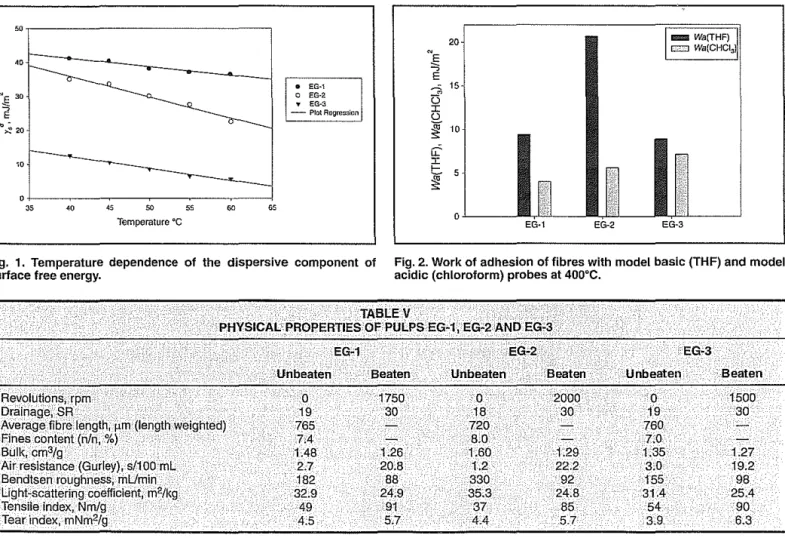
Table IV summarizes the IGC results
ob-tained for the pulps tested with respect to the dispersive component of surface tension (y~), its variation with temperature (dy~/dn, as well as the Lewis acid/base character, given by the ratio between the work of adhesion for the model basic probe and the model acidic probe (tetrahydrofuran (THF) and chloroform, re-spectively). In addition, the Lewis acidic and basic constants (K0 and K 1) of the fibre surface were calculated, their ratio 'being also listed in Table IV.
With regard to the dispersive component of the surface tension, it was found that the value obtained for pulp EG-1 is comparable to that reported in the literature for a fully bleached kraft pulp produced with Australian eucalypt (y~ 1 = 38.4 mlfm2 at 40°C) [6]. The ox-ygen predelignified pulp (EG-2) exhibited a slightly lower value that could be due to the higher content of residual lignin and extractives (both with lower surface energy than that of cel-lulose) found in nonconventional bleached pulps, which tend to accumulate on the fibre surface [7,27]. Besides, as will be seen later, this pulp also possesses a higher content of fines, which most certainly contributes to en-hance these effects [6]. The value found for y~t in pulp EG-3, at 40°C, is significantly lower than those for pulps EG-1 and EG-2. Extrapola-tion of the
r1
value for sample EG-3 to room temperature (22°C) yields the value of 19 mJfm2. Although unusual for eucalypt pulps, these low y~ values are in agreement with those reported in the literature for kraft and explosion pulps [28]. Moreover, the value ofy~ relates to the dispersive component of the surface tension only and, thus, the total surface tension value is expected to be somewhat greater due to the con-tribution of the Lewis acid/base intermolecular forces to the surface free energy. The value of the ratio K0/Kb for this sample is in the sameor-der of magnitude as that of sample EG-1. This fact, along with the good correlation coeffi-cients obtained from the linear regressions per-formed in the experimental data, indicate~ that the IGC technique and data reduction proce-dures are valid. One possible cause for this
decrease in
r1
is the fact that, due to the high cooking temperature, the residual lignin or ex-tractives could react further, leading to the for-mation of more condensed structures. The concentration of these structures at the fibre surface renders more difficult their removal by the bleaching chemicals and, thus, tends to re-duce the surface energy. Finally, it should be mentioned that additional measurements con-ducted on samples EG-1 and EG-3 extracted with dichlorornethane resulted in a very signifi-cant increase ofr1
for the EG-3 fibres (38.6 mJfm2 after extraction) whereas, for EG-1, only a slight increase was observed (43.3 mJ/m2). The work of adhesion and KafKb ratios were not changed significantly. This evidence further supyorts the interpretation that the low value of y s for the EG-3 fibres is due to the presence of extractives and residual lignin at the surface.Figure I illustrates the linear decrease of
r1
with temperature for the various pulps stud-ied, quantified in Table IV (dy11dT). The nega-tive slope reflects an entropic contribution to the surface free energy and is in agreement with results published for other eucalypt kraft pulps [6,7]. These slopes are smaller (and closer to each other) for pulps EG-1 and EG-3 than for pulp EG-2, suggesting that the surface of the fibres of the latter pulp has a higher degree of freedom and is more sensitive to an entropic contribution of the surface free energy [7].Regarding the Lewis acid/base charac-teristics of the fibre surface, all pulps showed a
"'~ 30
"
,..::> 20Temperature •c
dominant acidic behaviour. As a matter of fact, both Wa(THF)/Wa(CHCl3) ratios listed in Table IV as well as the work of adhesion pre-sented in Fig. 2 indicate a stron.ger interaction with the model basic probe (THF), especially that of pulp EG-2. This is most certainly due to the incorporation of an oxygen stage in the bleaching process, which causes a stronger oxi-dation of the surface, increasing the amount of oxygen-containing functional groups such as the carboxylic group [27]. Besides. Fig. 2 also shows that the work of adhesion with the model basic probe (THF) is much higher for the oxy-gen-bleached pulp (about twice) than for the other pulps, whereas the work of adhesion be~
tween the model acidic probe (CHCJ3) and the fibres gradually increases from pulp EG-1 to pulp EG-3. Consequently, the latter pulp exhib-its the lowest Wa(THF)/Wa(CHCI3) ratio. As mentioned before, the acid/base character was assessed alternatively by the values of the
KiKb ratios, also presented in Table IV. How-ever, it should be pointed out that the work of adhesion, determined from the free energy of adsorption, includes the entropic effect in-volved in the acid-base interaction, whereas the calculation of acidic and basic constants is based on the adsorption enthalpy. The two methods are generally in good agreement with respect to relative variations, but the absolute values may not be directly correlated [8]. In~
deed, as can be seen from Table IV, the KafKb
ratios reveal the same tendency as those ob-tained for the work of adhesion, confirming that
• EG-1 0 EG·2. ,. EG·3
- Plot Rlljjresslon
20
0
all pulps exhibited a chiefly acidic character, the highest value corresponding to pulp EG-2.
Physical Properties
Table V summarizes some of the most important physical properties of the pulps stud-ied and reveals that, before beating, pulp EG-2 is quite different from pulps EO-I and EG-3. In fact, the amount of fines of pulp EG-2 is higher than that of the other two pulps and, accord-ingly, the average fibre length is shorter. This is probably the result of the oxygen predelig-nification stage which increases the detachment of some additional fibre wall material of very small dimensions. Furthermore, the unbeaten pulp EG-2 is also the one in which fibre bond-ing is less effective, as can be concluded from the properties of the corresponding handsheets: higher values for bulk, light-scattering coeffi-cient and surface roughness and smaller values for air resistance and tensile index. This behav-iour is related to the very strong Lewis acid character observed for this pulp, which disturbs the development of hydrogen bonds. However, in spite of producing bulkier handsheets, the drainability of this pulp is close to that of the other unbeaten pulps, most likely as a conse-quence of the greater amount of fines and of the important role of these in wate~ retention. In ad-dition, the stronger oxidation of pulp EG-2 af-fects its beatability, as can be seen from the higher amount of beating energy needed to achieve 30 SR (2000 rpm, compared to 1750 and 1500 rpm for pulps EG-1 and EG-3,
lllilllll
Wa(THF)c:::J Wa(CHCI3 )
~
EG·t EG·2 EG-3
Fig. 1. Temperature dependence of the dispersive component of surface free energy.
Fig. 2. Work of adhesion of fibres with model basic (THF) and model acidic (chloroform) probes at 400°C,
•.. . ... ·· ... · ·•··••··•·· ·...• TABLE V ; ···•: ·•. • .> • ( • . . . ·· PHYSICAL•PROPERTIESOF PULPSEG-1; EG'2 -AND EG'3 .•
EG-1 .EG-2.
·,-Unbeaten ''Beaten Unbeaten
:B'eaten-Revoluti~ns,:rpm .0 1750
·o
2000Drainage, SR --- : ___ _ -:- , __ :_ , 19 30 18 30
Averag~fibie length, ~m (length weighted) . 765 .720
Fines content (n/11_, --%) 7A 8.0
Bulk, cm3/g · • • .. • 1.48 :1.26 1.60 .. 1.29 Air .resistance(Gurley), s/1 00 mL 2.7 .20:8 1.2 22.2
Bendtsen roughness; mUmin 182 88 330 92
Ught~scattering coefficient, m2JkQ 32.9 24.9 35.3 24:8
Tensile-index, Nm/g · · 49 91 37 85
Tear index,- mNm2/g 4.5 5.7 4.4 5.7
JOURNAL OF PULP AND PAPER SCIENCE: VOL. 31 NO. 2 APRIUMAY/JUNE 2005
0 .19 760
7:0 1.35
3:0
·rss
31.4 54 3.9.
; seaten
1500 30 . 1.27
19.2 98 25:4
90 6.3
respectively). Nevertheless, as expected, the ODEDED pulp is the one which has better in~ corporated the changes promoted by the beat-ing action, suggestbeat-ing that, by external and internal fibrillation, more functional groups be-come available, resulting in an increment of
fi-bre bonding.
The unbeaten pulp EG-3, obtained by using a higher H-factor, produces denser handsheets with increased bonded area and re-duced air-fibre interfaces. This is explained by the more evenly bipolar surface of the fibres of this pulp (Fig. 2) that facilitates fibre bonding. Moreover, the degradation of the fibre wall structure during cooking, which improves the flexibility and collapsibility of these fibres, en-hances their conformability. Accordingly, the extension of the beating action required by this pulp to reach the same Schopper-Riegler num-ber as the other two pulps is smaller and the handsheet properties ofthe beaten pulp are sim-ilar to those of pulp EG-1.
CONCLUSIONS
The present work has shown that the sur-face of eucalypt kraft fibres has a strong Lewis acid character and that the introduction of an oxygen stage prior to the ECF bleaching pro-cess greatly increases this character. On the contrary, the dispersive component of the sur-face tension after delignification with oxygen slightly decreases as a result of the deposi-tion/migration to the fibre surface of some residual low-energy compounds, such as lignin and extractives. Besides, this pulp appears to be more sensitive to an entropic contribution to the surface free energy than conventionally bleached pulp fibres.
The stronger surface acidic character of the oxygen-delignified pulp fibres contributes to the formation of bulkier handsheets with higher surface roughness, air permeability and light scattering, as well as lower tensile resis-tance. This pulp also possesses the highest per-centage of fines and, accordingly, the shortest average fibre length. On the other hand, al-though requiring more energy than the other pulps (bleached by the conventional bleaching sequence, DEDED) to reach 30 SR, the corre~ sponding handsheet properties change more significantly with beating.
A moderately higher cooking tempera-ture and time, although reducing the interac-tions of a dispersive nature, promote fibre bonding, either because of the more evenly bi-polar surface of the fibres or the increase in
fi-bre flexibility and collapsibility. The unbeaten fibres so produced give a more compact fibre network. Moreover, in these circumstances, beating energy decreases but the changes in pa-per propa-perties induced by beating are more moderate than for the reference pulp.
ACKNOWLEDGEMENTS
Thanks are due to Sapiens Program for the research grant (PE044-PE/PPQ/34!59/99). The skillful work of A. Aquino (grant holder,
94
Dept. Chem. Engin., University ofCoimbra) in IGC analysis is also acknowledged.
REFERENCES
I. BANERJEE, R.K., "Surface Characterization of Paper and Printability", Proc.lndian Pulp Paper Tech. Assoc. Ann. Gen. Mtg., Developments in Pulp Mil! and Paper Machine Clothings, New Delhi, India, 75-90 (1991).
2. SANTOS, J.M.R.C.A, OIL, M.H., PORTUGAL, A. and GUTHRIE, J.T., "Characterization of the Surface of a Cellulosic Multi-Purpose Office Paper by Inverse Gas Chromatography'',
Cellu-lose 8:217-224 (2001).
3. SANTOS, J.M.R.C.A., FAGELMAN, K. and GUTHRIE, J.T., "Characterisation of the Surface Lewis Acid/Base Properties of Poly(butylene terephthalate) by Inverse Gas Chromatography",
1. Chromatography A 969(1-2):111-118 (2002).
4. BELGACEM, M.N., "Characterization of Poly-saccharides, Lignin and Other Woody Compo· nents by Inverse Gas Chromatography: A Review", Cellulose Chem. Technol. 34:357-383
(2000).
5. BELGACEM, M. N., CZEREMUSZKIN, G. and SAPIEHA S., "Surface Characterization of Cel-lulose Fibres by XPS and Inverse Gas Chroma-tography", Cellulose 2:145-157 (1995).
6. SHEN, W. , YAO, W., Ll, M. and PARKER, l., "Characterization of Eucalypt Fibre Surface Using Inverse Gas Chromatography and X-Ray Photoelectron Spectroscopy", Appita 1.
51(2),47-51 (1998).
7. SHEN, W., PARKER, l.H., and SHENG, Y.J., "The Effects of Surface Extractives and Lignin on the Surface Energy of Eucalypt Kraft Pulp Fibres",}. Adhesion Sci. Teclmol. 12(2): 161-174
(1998).
8. SHEN, W. and PARKER, I.H., "Surface Compo-sition and Surface Energetics of Various Eucalypt Pulps", Cellulose 6:41-55 (1999). 9. LIU, F.P. and RIALS, T.G., "Relationship of
Wood Surface Energy to Surface Composition",
Langmuir 14:536-541 (1998).
10. "Pulps- Laboratory Wet Disintegration", ISO 5263, lot\. Org. Standardiz., Geneva, Switzer-land (1995).
11. "Pulps -Laboratory Beating- Part 2: PFI Mill Method", ISO 5264-2, Intl. Org. Standardiz., Geneva, Switzerland (2002).
12. "Pulps- Determination of Drainability- Part I: Schopper-Riegler Method", ISO 5267-1, lntl. Org. Standardiz., Geneva, Switzerland (1999). 13. ''Pulps- Preparation of Laboratory Sheets for
Physical Testing - Part I: Conventional Sheet· Former Method", ISO 5269-1, Intl. Org. Standardiz., Geneva, Switzerland ( 1998). 14. "Paper and Board - Determination of Thickness
and Apparent Bulk Density or Apparent Sheet Density", ISO 534, lntl. Org. Standardiz.,
Geneva, Switzerland ( 1988).
15. "Paper and Board - Determination of Grammage", ISO 536, Intl. Org. Standardiz., Geneva, Switzerland ( 1995).
16. "Paper and Board - Determination of Air Permeance and Air Resistance (Medium Range) -Part 5: Gurley Method", ISO 5636-5, loll. Org. Srandardiz., Geneva, Switzerland (2003). 17. "Paper and Board - Determination of
Rough-ness/Smoothness (Air Leak Methods) - Part 2: Bendtsen Method", ISO 8791-2, Intl. Org. Standardiz., Geneva, Switzerland (1990). 18. "Paper- Determination of Light Scattering and
Absorption Coefficients (Using Kubelka-Munk Theory)", ISO 9416, Intl. Org. Standardiz., Geneva, Switzerland ( 1998).
19. "Paper and Board - Determination of Tensile Properties- Part 2: Constant Rate of Elongation Method", ISO 1924-2, Intl. Org. Standardiz., Geneva, Switzerland (1994).
20. "Paper - Determination of Tearing Resistance (Elmendorf Method)", ISO 1974, Intl. Org. Standardiz., Geneva, Switzerland (1990). 21. SANTOS, J.M.R.C.A., FAGELMAN, K. and
GUTHRIE, J .T., "Characterisation of the Surface Lewis Acid/Base Properties of the Components ofPigmented, Impact-Modified, PC/PBTBlends by Inverse Gas Chromatography- Phase Separa-tion and Phase Preference", J. Chromatography
A 969(1-2):119-132 (2002).
22. FOWKES, F.M., "Role of Acid-Base Interfacial Bonding in Adhesion", J. Adhesion Sci. Technol.
1(1):7 (1987).
23. KAMDEM, D.P. and RIEDL, B., "Inverse Gas Chromatography of Lignicellulosic Fibres Coated with a Thermosetting Polymer: Use of Peak Maximum and Conder and Young Methods", J. Colloid Interface Sci. 150:507-516
(1992).
24. KAMDEM, D.P., BOSE, S.K. and LUNER, P., "Inverse Gas Chromatography Characterization of Birch Wood Meal", Langmuir
9(11 ):3039-3044 (1993).
25. DORRIS, G.M. and GRAY, D.G., "Adsorption of n-Alkanes at Zero Surface Coverage on Cellu-lose Paper and Wood Fibres", J. Colloid
filter-face Sci. 77(35):353-362 (1980).
26. CARVALHO, M.G .. FERREIRA, P.J. and FIGUEIREDO, M.M., "Cellulose Depolymeri-sation and Paper Properties in E. gfobulus Kraft Pulps", Cellulose 7:359-368 (2000).
27. LUNDQVJST, A., ODBERG, L. and BERG, J.C., "Surface Characterization of Non-Chlorine-Bleached Pulp Fibres and Calcium Carbonate Coatings Using Inverse Gas Chroma-tography", Tappi J. 78(5): 139-142 (1995). 28. CHTOUROU, H., RIEDL. B. and KO KT A, B.V.,
"Surface Characterization of Modified Polyeth· ylene Pulp and Wood Pulp Fibres Using XPS and Inverse Gas Chromatography", J. Adhesion Sci.
Tee/mol. 9(5):551-574 ( 1995).
REFERENCE: CARVALHO, M. G., FERREIRA, P.J., SANTOS, J.M.R.C.A., AMARAL, J .. L. and FIGUEIREDO, M.M,, Effect of Extended Cooking and Oxygen Prebleaching on the Surlace En-ergy. of Eucalyptus globulus Kraft Pulps, Journal of Pulp and Paper Science, 31 (2):90-'94 Aprii/May/June'2005.-Paper offered as,a ccmtribution bthe,Journal of Pulp and Paper-Bcience. Not tO' be reproduced without permission from the Pulp and Paper Technical Association of Can-ada: Manuscript received May 5, 2004; revised manuscript approved for publication by the Review
Panel March 31, 2005.
KEYWORDS: EUCALYPTUS GLOBULUS, KRAFT PULPS, PRETREATMENT, OXYGEN, BLEACHED PULPS, ·PULP . PROPERTIES, DISPERSION, SURFACE TENSION, OXYGEN PREBLEACHING.