Food Science and Technology Students Self-Evaluate Soft and
Technical Skills
Katherine M. Flynn
a*, Peter Ho
b, Margarida C. Vieira
c, Paola Pittia
d, and
Marco Dalla Rosa
eaThe European Association for Food Safety, SAFE consortium, Rue Vanderborght, 20, 1081, Brussels, Belgium bUniversity of Leeds, School of Food Science and Nutrition, Leeds LS2 9JT, United Kingdom
c
Universidade do Algarve, Instituto Superior de Engenharia, Campus da Penha, 8005-139 Faro, Portugal
dUniversity of Teramo, Faculty of Bioscience and Technology for Food Agriculture and Environment, Via R.
Balzarini 1, 64100, Teramo, Italy
e
University of Bologna, Interdepartmental Centre for Agri-Food Industrial Research, Alma Mater Studiorum, Piazza Goidanich 60, Cesena (FC)
*
Corresponding author
Received: 15 November 2016; Published online: 18 October 2017
Invited paper from the 4th International ISEKI Food Conference - ISEKI Food 2016 - Bridging Training and Research for Industry and the Wider Community - Responsible Research and Innovation in the Food Value
Abstract
Food Scientists and Technologists (FS&T) need diverse skills in the globalized food and drink sector: Food-specific or scientific / technical skills and generic or intuitive soft skills. This study determined how satisfied FS&T students were with overall improvement, and in key technical and soft skills, based on their university work; and if satisfaction was linked to geography, degree in progress, anticipated degree, anticipated work place or anticipated job responsibility. An on-line survey was completed by 267 students in over 20 countries using a 5-point Likert scale to evaluate satisfaction. Responses were analyzed by the Friedman or Kruskal Wallis tests for more than two groups, otherwise by the Wilcoxon Signed Rank or Mann-Whitney tests. There were no differences in Overall Satisfaction with technical and soft skills training. Among soft skills, training in Working with Others and Being Responsible were more often rated “Excellent” and students were more satisfied with their training than with Solving Problems, Communication and Positive Attitude. Students anticipating a job with high responsibility were more satisfied with overall soft skill training and with 3 of the 5 specific soft skills. Among technical skills, students were more satisfied with improvement in basic sciences (Microbiology, Chemistry, Processing, Safety ), and those in Northern Europe were more satisfied with overall technical training. These data show variations in perception and/or efficacy of technical and soft skill training in Food Science programmes and underline the need for separate attention to the incorporation of soft skill training into the design of FS&T courses.
Keywords: Education; Soft skills; Food science; Satisfaction
1
Introduction
Food Scientists and Technologists (FS&T) need many diverse skills to meet the needs of a glob-alized food and drink sector: Food-specific or
scientific / technical skills and the more re-cently recognized generic or intuitive soft skills, which are broadly applicable across job titles and include interpersonal, communication and social skills. When FS&T employers in Europe
brainstormed ideal employee skills, 76% of these were soft skills (Flynn, Wahnstrom, Popa, Ruiz-Bejarano, & Quintas,2013). Despite this desire, employers tended to believe their FS&T employ-ees do not have sufficient soft skills, while the employees stated that they do: e.g., only 42% of FS&T employers found their employees suffi-cient in Group Leadership while 92% of employ-ees rated themselves as sufficient (Mayor et al.,
2015). The importance of soft skills to food and drink employers and the disconnect on their pres-ence in current employees merits further investi-gation and attention to soft skill acquisition for future FS&Ts.
One of the goals of the ISEKI Food 4 project (https://www.iseki-food4.eu) was the “develop-ment of learning and teaching approaches and activities able to improve and exploit the new skills for students in food studies in EU”. This study was one of several addressing the broad ISEKI Food 4 theme and the specific aim here was to determine how satisfied FS&T students were with their improvement in key technical and soft skills. Furthermore, students were classi-fied by demographic groups (geography, degree in progress, expected degree, expected place of employment, expected level of job responsibility) to see if satisfaction varied based on these vari-ables. Satisfaction is a readily accepted concept that applies to all populations. Critics of restau-rants, hotels, and movies often summarize their experience by stating their satisfaction. It is pre-cisely this “personal” aspect of satisfaction that carries the most weight when evaluating student perception of their education. Measures of grad-uation and employment may be more common, but they lack the emotional impact of satisfac-tion.
The food and drink sector of the future will re-quire employees with competencies in both tech-nical and soft skills, and levels of student satis-faction can be instrumental in understanding the strengths and weaknesses of current food science curricula in meeting these requirements. Student self-assessment has been used for decades and was shown to accurately reflect learning (Brown & Harris, 2013), and a meta-analysis showed the most accurate self-assessments among stu-dents in more advanced courses in the sciences (Falchikov & Boud, 1989). The knowledge
gained from student self-assessment can be used by food science educators to improve curricula and produce the food scientists and technologists needed for this rapidly changing sector.
2
Materials and Methods
2.1
Questionnaire
An online survey entitled “Training Tomorrow’s Food Scientist & Technologist” was available from May to November 2012 via the ISEKI Food 4 website and advertised by email and other dis-semination tools both within and outside of the ISEKI Food 4 European project. Instructions guaranteed confidentiality and specified that the questionnaire was for current students of food science and food technology and that its ultimate aim was to generate innovative approaches in the training of FS&Ts. The survey was ethically ap-proved by the institutions involved and it con-tained information and consent elements. Survey respondents were required to examine two lists of skills: seven technical skills divided into two categories and five soft skills divided into two categories. These skills were those previously identified as most desirable by FS&T employ-ers (Flynn, Ruiz-Bejarano, Wahnstrom, Echim, & Quintas,2013), complemented by several tech-nical skills added by FS&T faculty members (Ta-ble 1). Respondents were asked to give a grade to each skill indicating how satisfied s/he was with improvement based on work in university courses. A 5-point Likert scale, where A = Ex-cellent, B = Good, C = Fair, D = Minimal and 5 = Failing, was used. Respondents then gave an overall grade for level of satisfaction for both technical and soft skill improvement and listed the three technical and three soft skills believed to be most important for future jobs.
The following demographic information was col-lected: Country of study (open question), Degree in progress (Ph.D., Master, Bach-elor, Technical), Anticipated highest degree (Ph.D., Master, Bachelor, Technical), Antic-ipated employer (Large Enterprise, Small or Medium Enterprise, Academic/Research, Gov-ernment, Consultancy, Other) and Desired job responsibility (High=Responsible for several
teams, Medium=Responsible for several people, Low=Responsible for self).
2.2
Data treatment and statistical
analysis
Percent of students choosing ‘Excellent’ for Over-all Technical Skill Improvement was compared with percent choosing ‘Excellent’ for each of the 7 technical skills using the ‘One sample t-test be-tween percents’ in StatPac©statistical software. The same procedure was applied to compare in-dividual soft skills to overall. The Bonferroni cor-rection for multiple tests was applied, requiring p ≤ 0.007 for technical skills (7 comparisons) and p ≤ 0.01 for soft skills (5 comparisons).
Rank sums from the Likert scale responses were calculated using the Real Statistics© add-on in Excel©for each of the 7 technical and 5 soft skills and these data were analysed by the same pro-gram using the non-parametric, repeated mea-sures Friedman test for differences in satisfaction among the 7 technical and the 5 soft skills. If significant, this was followed by a post-hoc, the conservative 2-tailed Wilcoxon Signed Rank test for paired samples. The Bonferroni correction for multiple tests was applied, requiring p ≤ 0.005 for comparing each soft skill to each other (10 comparisons) and p ≤ 0.002 for comparing tech-nical skills (21 comparisons) to determine if any differences existed between specific skills. The overall difference in satisfaction between tech-nical and soft skills was compared using the 2-tailed Wilcoxon Signed Rank test for paired sam-ples.
For determining differences among demographic groups, the non-parametric Kruskal-Wallis test was used when students were divided into more than two groups (four geographical regions, four anticipated employment sectors, three antici-pated degrees), followed by the 2-tailed Mann-Whitney post-hoc using the Bonferroni correc-tion for multiple tests if the Kruskal-Wallis showed significance. Analysis of differences be-tween two groups (current degree, desired level of job responsibility) used the 2-tailed Mann-Whitney test alone.
The uncorrected level of significance for each test
was 95% confidence or p = 0.05.
3
Results and Discussion
3.1
Questionnaires
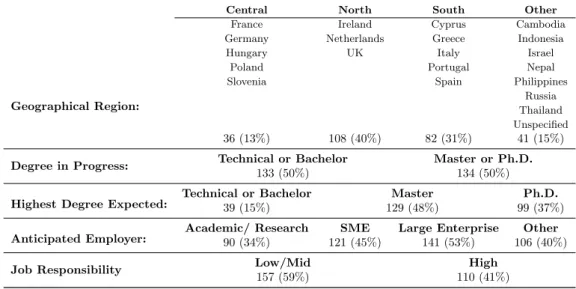
From May through November 2012, 267 ques-tionnaires were collected from students (Table 2). All responding students answered all ques-tions and there were no missing data. Responses came from over 21 countries and these were or-ganized into 4 geographical regions. Northern and Southern Europe were well represented, with 71% of the responses coming from these two re-gions, likely due to the higher level of participa-tion of higher educaparticipa-tion institutes in these coun-tries in the ISEKI Food 4 project. Nonetheless, the geographical spread of respondents gives a good sample of food science students, with the exception of a lack of representation from Africa. Respondents were equally divided between un-dergrads, that is those working towards a tech-nical or Bachelor degree, and postgrads, that is those working towards a Master or Ph.D. A large majority of the students, 85%, expected to even-tually earn a postgraduate degree. This may in-dicate a trend towards growing professionalism in food science and technology. A recent study showed most employees with a university degree in food science had a Bachelor (Flynn, Ruiz-Bejarano, et al., 2013) while a later study, in which 75% of respondents were under 40 years old, showed equal numbers with a Bachelor and with a Master degree (Mayor et al., 2015), and here, most current students expect either a Mas-ter or a Ph.D. degree. Of course, what a person expects and what actually occurs may not be the same. Currently, the Bachelor and Master de-grees are leading not only to different knowledge and skills but also to different specialisations within the broad area of Food Science and Tech-nology disciplines. Only future surveys can con-firm if FS&Ts are truly trending towards higher levels of education.
The most popular response to the question planned place of employment was “enterprise”, 57% of responses, of which almost half planned to work for small and medium sized enterprise (SME) and half for large enterprise. For this
Table 1: List of technical and soft skills as presented to respondents
TECHNICAL SKILLS SOFT SKILLS
Research & Development: Product Development
Fundamental:
Demonstrating Positive Attitudes & Behaviour Food Microbiology
Food Chemistry
Food Processing Being Responsible
Research, inc. Design & Execution of Experiments
Personal Management:
Communication
Food Quality & Food Safety: Food Safety Management, Food Hygiene & Food Safety Control Thinking & Solving Problems Quality Management, Quality Assurance & Quality Control Working with Others
question, more than one response was accepted; the 267 respondents gave a total of 458 responses or an average of 1.7 responses per student, in-dicating that most students had a clear idea of where they plan to work. In fact, 70% of respon-dents gave only one answer for planned place of employment. Important for the European food and drink industry is that half of the food science students who would like to work for enterprise would like to work for an SME. SMEs are 99% of all European food and drink companies (FDE,
2015) and generate almost 50% of the food and drink industry turnover and value added and pro-vide two thirds of the employment of the sector. Adding well educated FS&Ts to these smaller food companies will surely contribute to main-taining Europe’s position as a leader in the food sector, particularly for region-specific and tradi-tional foods. Thus, encouragement of already in-terested food science students should be pursued at the university level and incorporation of work with and about food sector SMEs should be a continued segment of the food science university curriculum.
Respondents were almost equally divided on the amount of desired job responsibility once estab-lished in their career, with 59% desiring positions with low or mid responsibility, i.e., responsible for themselves or for several people, respectively, and 41% desiring high responsibility positions, i.e., responsible for several teams. The desire for high responsibility may be linked to the de-sire for a high level of education, although pro-gressing towards executive positions has more so been linked to a “proactive” personality, includ-ing takinclud-ing personal responsibility and lookinclud-ing for self-improvement (Seibert, Kraimer, & Crant,
2001), and not necessarily to education. Thus, it appears here that the 41% of students desiring
a high level of job responsibility are not neces-sarily a subset of the 85% desiring a high level of education; we should be careful to avoid the com-mon perception, in the food and drink sector and elsewhere, that high job responsibility and high levels of education are linked.
3.2
Satisfaction with skills
Rank sums for Overall Satisfaction with improve-ment in technical skills and Overall Satisfaction with improvement in soft skills were not signifi-cantly different, p=0.78. The percentage of stu-dents rating their Overall Satisfaction as “Ex-cellent” for technical and soft skills training was also not significantly different, p=0.21, with “Ex-cellent” satisfaction reported by 19% and 24% of students for technical and soft skills, respectively (Figure 1)., and “Excellent” or “Good” satis-faction by 73% and 72%, respectively (data not shown). In health care surveys, levels of satis-faction of 87% and above are not uncommon (Di Palo, 1997), and these authors suggested a ten-dency for ratings of general satisfaction to clus-ter at the high end of the scale. For the speci-fied skills within the “Technical” and “Soft” cat-egories there was not the same equality of sat-isfaction as seen for Overall. The percent stat-ing “Excellent” improvement in the specific soft skills Working with Others, 44% at p=0.0001, and Being Responsible, 39% at p=0.0019, was higher than the percentage stating “Excellent” satisfaction for Overall, 24%. Conversely, there were no differences between the percent of stu-dents stating “Excellent” satisfaction with im-provement in specific technical skills versus over-all technical improvement. This result may re-flect unfamiliarity with the term “soft skills”; students were less likely to rate their overall
im-Table 2: Questionnaire responses categorised by demographics
Geographical Region:
Central North South Other
France Ireland Cyprus Cambodia
Germany Netherlands Greece Indonesia
Hungary UK Italy Israel
Poland Portugal Nepal
Slovenia Spain Philippines
Russia Thailand Unspecified
36 (13%) 108 (40%) 82 (31%) 41 (15%) Degree in Progress: Technical or Bachelor Master or Ph.D.
133 (50%) 134 (50%)
Highest Degree Expected: Technical or Bachelor39 (15%) 129 (48%)Master 99 (37%)Ph.D. Anticipated Employer: Academic/ Research90 (34%) 121 (45%)SME Large Enterprise141 (53%) 106 (40%)Other
Job Responsibility Low/Mid High
157 (59%) 110 (41%)
Figure 1: Percentage of students who chose “Excellent” for satisfaction with their “overall improvement” in Soft Skills and in the 5 specified soft skills and for their “overall improvement” in Technical Skills and in the 7 specified technical skills. * indicates percentage is significantly different from Overall for that skill group, p<0.002.
provement as excellent or very good being not completely sure what they had improved in, yet when asked about specific soft skills, such as Be-ing Responsible, they had a clearer understand-ing. Conversely, students were satisfied with the overall idea of their technical training, perhaps having the pre-conceived idea that a food science education provides strong technical training, and equally satisfied when focusing on specific tech-nical skills that they were already familiar with.
3.3
Satisfaction with technical
skills
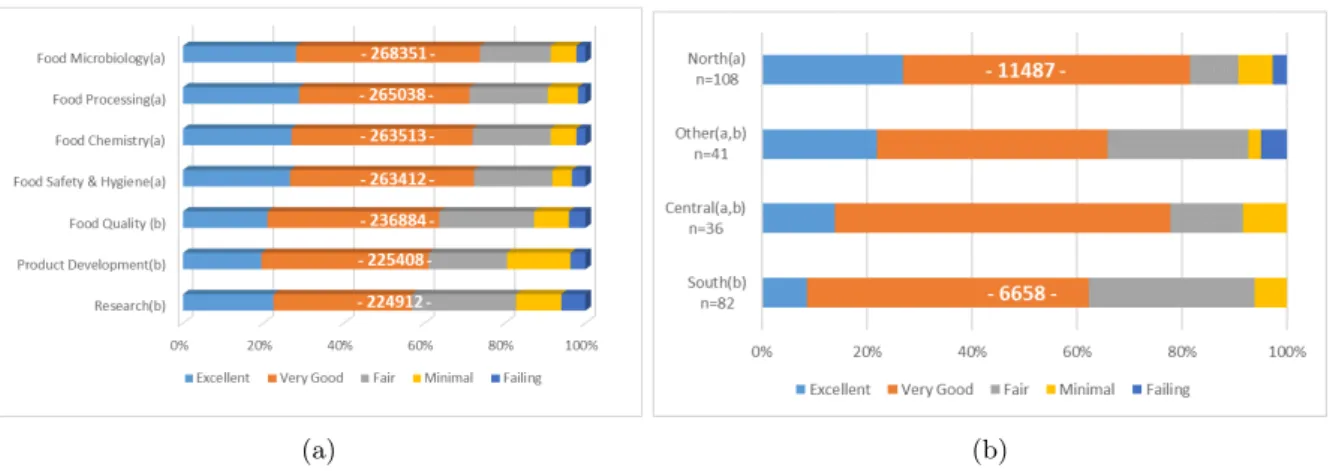
There was a significant difference in satisfaction with improvement among the 7 specific technical skills (p<3.6 x 10⁻⁷). Post hoc analysis (Fig-ure2A) showed that the skills were divided into two groups, with students more satisfied with their training in Food Microbiology, Food Pro-cessing, Food Chemistry, and Food Safety & Hy-giene than with their training in Food Quality Management, Assurance & Control (p<0.001), Product Development (p<0.0002) and Research (p<0.00002). If the respondents were primarily undergraduates, it would be understandable that they were more satisfied with their improvement in more basic science courses i.e., Microbiology and Chemistry than in more advanced and even post-graduate courses i.e., Food Quality, Product Development and Research as in general these are disciplines included in 2nd level/Master de-gree and Ph.D. programmes. However, one half of the respondents were working on a Master or Ph.D. and thus it is surprising and somewhat disconcerting that, on average, 40% of food sci-ence students found their improvement in these three food-specific courses to be “Fair”, “Mini-mal” or “Failing”. The dissatisfaction that food science students have with their training in Re-search may later contribute, once they are in the working world and particularly in industry, to the low R&D investment found in EU food and drink enterprises, which are rated as a Medium-Low intensity sector (together with Travel & Leisure, Media, etc.), accounting for only 6% of¿171 bil-lion invested in European R&D (EC,2015). University training in Research is part of many scientific disciplines, including the Food Science
programmes at the authors’ home universities. It generally encompasses course work in experimen-tal design, research methods and statistical anal-ysis; often students work closely with a faculty mentor on a specific research project. If research is seen as a pre-requisite for innovation, and in-novation as a requirement for continued growth and improvement, then the results here suggest that increased attention to training future Eu-ropean food scientists in research is needed, and likely applied research oriented towards indus-try and with attention to knowledge and tech-nology transfer will be the most beneficial. A hard look at the current presentation of research to FS&T students can start with sharing opin-ions and best practices among FS&T educators, followed by ambitious changes and careful mon-itoring of the results – this will likely require in-vestment of time and money by universities. The increased student satisfaction, and later success in research will be a well-deserved outcome and one which might move the food sector up from its current position as a Medium-Low R&D in-vestment sector and later confer the benefits that robust R&D brings to industry.
There was only one significant difference in stu-dent assessment of their improvement in techni-cal skills based on demographics, and that was an interaction between Overall Satisfaction with technical skills and Geographic Region (Figure 2B), which showed students in the north of Eu-rope three times more satisfied than those in the South (p<0.002). This is consistent with rank-ings which place the top universities in the north-ern countries of UK, Sweden, Switzerland and Germany (THE, 2016). High student satisfac-tion with technical training may be linked to higher funding for universities in Northern Eu-rope and thus more advanced technical equip-ment. Importantly, satisfaction with improve-ment in soft skills was not linked to Geographic Region, thus apparently not linked to attending a higher ranked university or higher funding, and suggesting separate frameworks for the teaching and learning of technical and soft skills. This fur-ther suggests that effective soft skill teaching and learning are independent of funding and equip-ment but rely on other, perhaps less tangible, re-sources. An interesting and important question for further research is to identify the resources
(a) (b)
Figure 2: A) Among Technical Skills, food science students were more satisfied with their progress in Food Microbiology, Food Processing, Food Chemistry and Food Safety than with their progress in Food Quality, Product Development and Research. p<0.001. B) Students in the North of Europe were more satisfied with their overall training in technical skills than were students in the South of Europe. p<0.002. Numbers indicate rank sum for each skill. Ranks for skills with the same letter are not significantly different.
necessary for success in soft skill education.
3.4
Satisfaction with soft skills
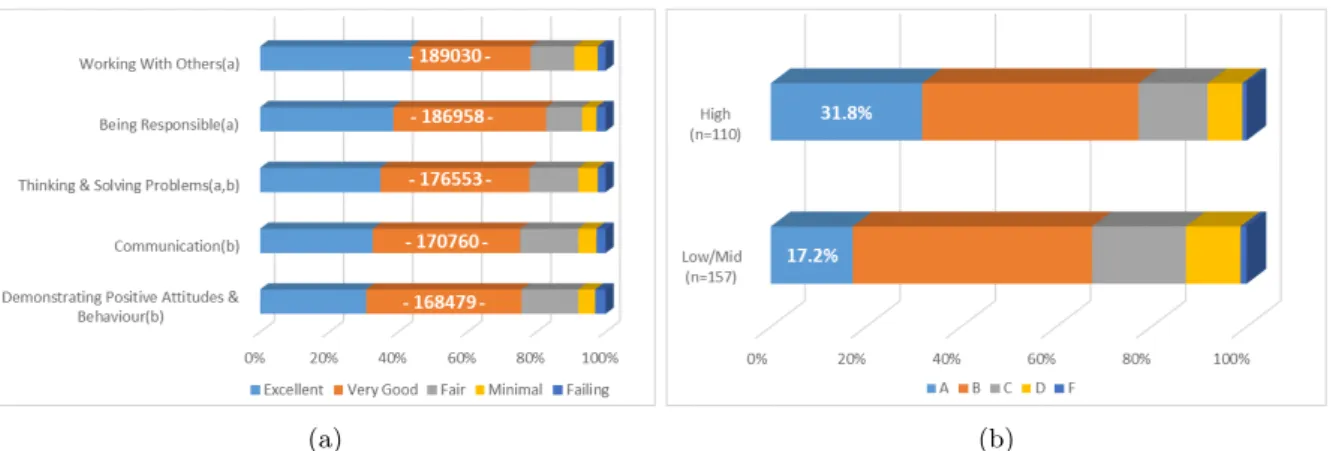
There was a significant difference in satisfaction with improvement among the 5 specific soft skills (p<0.02). Post hoc analysis (Figure3A) showed students were most satisfied with their training in Working with Others and Being Responsible, sig-nificantly more than with their training in Com-munication (p<0.0007) and Demonstrating Posi-tive Attitudes & Behaviours (p<0.0003). Having “a team approach”, or Working with Others was identified as an important soft skill by a national study to determine training recommendations for the food sector in Ireland (EGFSN, 2009) and “having a sense of responsibility and commit-ment” or Being Responsible was among the cru-cial soft skills listed by a U.S. focus group study with food industry executives (Napoleon, Freed-man, SeetharaFreed-man, & Sharma, 2006). Thus, overall, students are highly satisfied with their improvement, and therefore apparently receiving good instruction in soft skills valued by the food sector.The respondents here, however, were signifi-cantly less satisfied with their training in Com-munication skills, whose importance for food
science and technology professionals cannot be overstated. A survey of skills most desired by European employers in the food and drink sec-tor showed communication to be the single most sought after skill (Flynn, Ruiz-Bejarano, et al.,
2013). In the chemical industry, high level repre-sentatives listed communication as the number 1 personal skill for engineers (CEFIC, 2009) and, in Australia, communication is being integrated into some university engineering courses (Arm-strong & Baillie, 2011). In the medical profes-sion, communication skills influence patient rat-ings of technical competence: Physicians judged to be good communicators were also believed to be technically competent (Robin DiMatteo & Hays, 1980). This link between technical skill and ability to communicate needs recognition from the food and drink sector; food industry and food regulators are often in the public eye and the ability to communicate well can mean the difference between public vilification or pub-lic respect. As judged by students, the training of FS&Ts in communication skills needs focus and significantly more attention.
Demographics of the respondents showed a sta-tistically significant interaction between Over-all Satisfaction with soft skills and Desired Job Responsibility (Figure 3B). Students who
de-(a) (b)
Figure 3: A) Among Soft Skills, food science students were more satisfied with their progress in Working with Others and Being Responsible than with their progress in Communication and Demonstrating Positive Attitudes & Behaviour. p<0.0003. B) Students anticipating a High Responsibility position were more satisfied with their overall training in Soft Skills than were students anticipating Low or Mid-level Responsibility. p<0.007. Numbers indicate rank sum for each skill. Ranks for skills with the same letter are not significantly different.
sired a high responsibility position were signif-icantly more satisfied overall (p<0.007), and for three specific soft skills, Demonstrating Positive Attitudes & Behaviours, Being Responsible and Thinking & Solving Problems (data not shown) than those desiring mid or low responsibility work. There was no interaction between “Over-all Satisfaction with soft skills” and level of an-ticipated education, suggesting again that stu-dents who anticipate a high degree are not the same as those who anticipate a high responsibil-ity job. This further supports the work of Seib-ert et al. (2001), which showed executive posi-tions linked to being “proactive”, and suggested that innate personality may predispose a person to attain high responsibility work. It is possible that the personality that tends to achieve high responsibility positions is also the one that views improvement in a positive light; meaning they are more likely to be satisfied given the same re-sults as others. Conversely, those with a “proac-tive” personality may actually get the most ben-efit from current methods of soft skill education in the food science curriculum. They are more satisfied because they did actually have better results. In either case, in the food sector, it is clear that high levels of education are not neces-sarily linked to high responsibility work and thus
it is important to stress the soft skills associated with high responsibility at all educational levels.
4
Conclusions
The geography and current educational level of respondents gave a good, though small, sample of food science and technology students. Based on this, FS&Ts appear to be trending towards higher levels of education, with more students aiming for a Ph.D. than in previous years, but divided on the amount of desired job responsi-bility and having a strong interest in working for small and medium sized enterprises.
Slightly more than 70% of surveyed students rated “Overall Satisfaction” with their improve-ment in the listed skills as excellent or good. This is a satisfactory result, but should not lead to complacency in food science education. Stu-dents were most satisfied with progress in Micro-biology, Chemistry, Food Safety and Food Pro-cessing, highlighting the efficacy of food safety training in the FS&T curriculum. Disconcert-ing for the researcher is the low student satis-faction with training in Research. Research and development have long been accepted as lead-ing to growth in productivity and, more recently, to the innovations needed to underpin the food
and agricultural systems of the future (EAFS,
2013; ETPFL, 2012), thus research must be a successful part of food science education. Stu-dents in the north of Europe were most satisfied with improvement in technical skills; while high soft skill satisfaction was found in those antic-ipating jobs with high responsibility. A closer look at this satisfied group could provide infor-mation on how to effectively teach soft skills. The placement of Communication in the group of lower satisfaction soft skills raises concern be-cause communication was clearly identified as the single most important skill to FS&T employers (Flynn, Wahnstrom, et al., 2013). Science and technology faculties must put more focus on ef-fectively teaching communication skills. In con-clusion, there is room for improvement in stu-dent satisfaction with their education in FS&T and universities might do well to gather specific input from current and past students when (re)-designing food science curricula. The growing importance of the food sector means that excel-lence in food science and technology education is a necessary component in facing the grand global challenges of the coming years.
Acknowledgements
The authors thank the 267 Food Science stu-dents who took time from their busy day to com-plete this on-line survey and also the partners in ISEKI Food 4 who gave constructive criticism to a first draft of the survey and then distributed the final survey to their classes and their col-leagues. This work was funded by the project ‘ISEKI Food 4, Toward the innovation of the food chain through the modernization of food studies’ a grant through the Lifelong Learning Programme of the Commission of the European Communities, grant agreement number: 2011-3634. The funders had no role in the details of the study design; data collection analysis and interpretation; writing of the report; nor deci-sion to publish. None of the authors of this manuscript have had any financial, personal, or other relationships with any people or organi-zations that could inappropriately influence this work.
References
Armstrong, R. & Baillie, C. (2011). What! No Lectures? The facilitation of learning about the engineering challenges of the 21st cen-tury. Australian Association of Engineering Education (AAEE) Conference Abstracts, 18. Retrieved from http : / / www . aaee . com.au/conferences/2011/docs/AAEE% 202011%20Conference%20Abstracts.pdf Brown, G. T. L. & Harris, L. R. (2013).
Sage handbook of research on classroom assessment. In J. H. McMillan (Ed.), (Chap. Student self-assessment, pp. 367– 393). Sage Thousand Oaks, CA. doi:10 . 4135/9781452218649.n21
CEFIC. (2009). European Chemical Industry Council. Skills for Innovation in the Eu-ropean Chemical Industry. Brussels BE. Retrieved from http : / / www . cefic . org / Documents / PolicyCentre / Skills for Innovation in the European Chemical -Industry.pdf
Di Palo, M. T. (1997). Rating satisfaction re-search: is it square poor, square fair, square good, square very good, or square excel-lent? Arthritis Care and Research, 10 (6), 422–430. doi:10.1002/art.1790100610 EAFS. (2013). European Association for Food
Safety, SAFE Consortium. Keeping food safety on the agenda. Brussels BE: SAFE Consortium. Retrieved fromhttp://www. safeconsortium . org / index . php ? option = com content%5C&view=article%5C&id= 1388:keeping-food-safety-on-the-agenda% 5C&catid=111:publications%5C&Itemid= 789
EC. (2015). European Commission, Joint Re-search Commission, Industrial ReRe-search and Innovation. EU R&D Scorecard: The 2015 EU Industrial R&D Investment Score-board. (Report EUR 27540 EN). Luxem-bourg: Publications Office of the European Union. doi:10.2791/15792
EGFSN. (2009). Expert Group on Future Skills Needs. Future skills requirements of the food and beverage sector. Dublin IE: EGFSN. Retrieved from http : / / www . skillsireland . ie / media / egfsn091120 skills food beverage.pdf
ETPFL. (2012). European Technology Platform Food for Life. (2012) Strategic research and innovation agenda (2013-2020 and Be-yond). Brussels BE. Retrieved fromhttp:// www . fooddrinkeurope . eu / uploads / press -releases documents / SRIA ETP Food for Life 2012.pdf
Falchikov, N. & Boud, D. (1989). Student self-assessment in higher education: a meta-analysis. Review of Educational Re-search, 59 (4), 395–430. doi:10 . 3102 / 00346543059004395. eprint: http://dx.doi. org/10.3102/00346543059004395
FDE. (2015). Food Drink Europe. Data and Trends of the European Food & Drink In-dustry. Brussels BE. Retrieved from http: / / www . fooddrinkeurope . eu / publication / data trends of the european food and -drink-industry-2016/
Flynn, K., Ruiz-Bejarano, B., Wahnstrom, E., Echim, C., & Quintas, M. A. C. (2013). Profile of currently employed european food scientists and technologists: educa-tion, experience and skills. International Journal of Food Studies, 2 (2), 37–149. doi:10.7455/ijfs/2.2.2013.a1
Flynn, K., Wahnstrom, E., Popa, M., Ruiz-Bejarano, B., & Quintas, M. A. C. (2013). Ideal skills for european food scientists and technologists: identifying the most desired knowledge, skills and competencies. Inno-vative Food Science & Emerging Technolo-gies, 18, 246–255. doi:10.1016/j.ifset.2012. 09.004
Mayor, L., Flynn, K., Dermesonluoglu, E., Pit-tia, P., Baderstedt, E., Ruiz-Bejarano, B., . . . Costa, R. (2015). Skill development in food professionals: a european study. European Food Research and Technology, 240 (5), 871–884. doi:10.1007/s00217- 014-2400-z
Napoleon, L., Freedman, D., Seetharaman, K., & Sharma, P. (2006). An educational needs assessment of pennsylvania workforce: op-portunities to redefine secondary career and technical education to meet food in-dustry needs. Journal of Food Science Ed-ucation, 5 (2), 19–23. doi: 10.1111/j.1541-4329.2006.tb00077.x
Robin DiMatteo, M. & Hays, R. (1980). The significance of patients’ perceptions of physician conduct. Journal of Commu-nity Health, 6 (1), 18–34. doi:10 . 1007 / BF01324054
Seibert, S. E., Kraimer, M. L., & Crant, J. M. (2001). What do proactive people do? a longitudinal model linking proactive per-sonality and career success. Personnel Psy-chology, 54 (4), 845–874. doi:10 . 1111 / j . 1744-6570.2001.tb00234.x
THE. (2016). Times Higher Education. World University Rankings. Retrieved fromhttps: //www.timeshighereducation.com/world-university-rankings/2016/world-ranking# ! / page / 0 / length / 25 / sort by / rank / sort order/asc/cols/stats