Seed germination of Brazilian guava (
Psidium guineense
Swartz.)
1Márcia Adriana Carvalho dos Santos
2, Manoel Abílio de Queiróz
2,
Jaciara de Souza Bispo
2, Bárbara França Dantas
3*
ABSTRACT- Brazilian guava (Psidium guineense Swartz.) is a plant species native from Brazil and present in all Brazilian biomes. This species occurs in the Caatinga biome as a wild fruit that has broad utility and can generate income, as well as provide material for breeding. The objective of this work was to study seed germination of guava accessions collected in two municipalities in Bahia. Seeds imbibition curve was studied. Also, seed germination and seedlings initial growth were evaluated for 44 days on different temperatures (15, 20, 25, 30 and 35 °C), fruit maturation, drying, pre-soaking and priming. Seeds imbibition curve was triphasic in which lag-phase begun after 30 hours imbibition and lasted 256 hours. An effect of guava genotype was observed in seeds physiological quality. Temperatures of 20 and 25 °C were ideal for guava seeds germination. Seeds pre-soaking and priming techniques are feasible to reduce germination time and increase seedling performance.
Index terms: genetic resources, Myrtaceae, vigor.
Germinação de sementes de araçá (Psidium guineense Swartz.)
RESUMO- O araçá (Psidium guineense Swartz) é uma espécie nativa do Brasil e presente em todos os biomas brasileiros. Ocorre na Caatinga de forma silvestre e é uma fruteira que apresenta ampla utilidade, podendo gerar renda além de fornecer material para o melhoramento genético. O objetivo deste trabalho foi estudar o processo germinativo de sementes de quatro acessos de araçá coletados em dois municípios da Bahia. Foi estudada a curva de embebição das sementes, bem como o efeito de diferentes temperaturas (15, 20, 25, 30 e 35°C), estágio de maturação, secagem, pré-embebição e condicionamento osmótico na germinação, vigor e crescimento inicial de plântulas dos acessos de araçá. A curva de embebição das sementes se mostrou trifásica, na qual a fase-lag iniciou após 30 h de embebição e durou 256 h. Foi observado um efeito dos genótipos na qualidade fisiológica das sementes de araçá. As temperaturas de 20 e 25 °C foram ideais para a germinação de sementes de araçá. As técnicas de pré-embebição e condicionamento osmótico das sementes reduziram o tempo de germinação e aumentaram o desempenho das sementes.
Termos para indexação: recursos genéticos, Myrtaceae, vigor.
1Submitted on 08/10/2015. Accepted for publication on 11/24/2015. 2Departamento de Tecnologia e Ciências Sociais, Universidade do Estado da
Bahia, Caixa Postal 171, 48905-680 - Juazeiro, BA, Brasil.
3Embrapa Semiárido, Caixa Postal 23 , CEP 56302-970- Petrolina, PE, Brasil.
*Corresponding author < [email protected]>
Introduction
Numerous species of genus Psidium that produce edible fruits can be found in all regions of Brazil, such as common guava (Psidium sp) and guava-pear (Psidium acutangulum DC) (Giacobbo et al., 2008).
Psidium guineense Swartz, commonly named araçá, Brazilian guava, or simply guava is a wild plant from Myrtaceae family, which occurs throughout Brazil. Its shrub or tree has twisted stem, smooth bark with evergreen leathery leaves and are well adapted to climate and soil of northeastern Brazil, where it grows spontaneously in many places (Bezerra et al., 2006).
These guavas are classified as berry type fruits, with yellow, red
Few literature on P. guineense seeds germination state that alternate temperatures from 20-30 ºC, or 25 ºC constant temperatures are the most appropriate to access seed quality (Mugnol et al., 2014). However, it is not agreed whether seeds should undergo any pre-treatment for higher germination percenteges and rates in accessions harvested in the Cerrado biome of Brazilian midwest region (Mugnol et al., 2014;
Masseto et al., 2014). Although it is common scientific
knowledge that different mother plants produce seed with different physiological responses (Turesson, 1922; Andersson and Milberg, 1998; Galloway, 2005), literature have not displayed these differences regarding seeds behaviour of different accessions of Brazilian guava in different temperatures, fruit maturation stage, desiccation tolerance and pre-germinative treatments.
Due to its potential for different uses, as well as the lack of studies regarding Brazilian guava seed propagation, this study aimed to evaluate germination process of seeds native from the Caatinga biome of Brazilian northeastern semiarid region.
Material and Methods
Four independent essays were performed in order to characterize guava seeds germination and its optimal conditions. The essays used seeds of four different guava accessions in the cities of Jacobina and Campo Formoso, Bahia State, Brazil. Accessions and geographic coordinates of occurrence were: Y52 (11°15`S e 040°31`W), Y53 (11°15`S e 040°31`W) and Y95 (11°11`S e 040°27`W) harvested in Jacobina- BA; Y85 (10°29`S e 040° 17`W) harvested in Campo Formoso - BA. The experimental design of all essays was totally randomized.
Fruits of each accession were collected manually. For processing of seeds, mucilage was removed in running tap water over a sieve. Then seeds were placed to dry in shade. After extraction, shriveled, withered and damaged seeds were eliminated and the remaining good seeds were packed in paper bags and placed in a cold chamber at 10 °C and 40% relative humidity. Accessions Y85 and Y95 were stored for one year and accessions Y52 and Y53 for few days prior to essays.
Seeds imbibition curve: eight replications of 20 guava seeds of Y85 accession, were initially weighted on a precision scale (0.001g). After weighting, seeds were distributed on blotting paper moistened with 13 mL of distilled water and fungicide (Captan, 1 mg. g-1) solution in germination boxes
(gerboxes) and incubated in BOD (Biochemical Oxygen Demand) germination chamber at 25 °C. Soaked seeds were weighted after 3, 6, 24, 26, 30, 48, 50, 54, 72, 78, 96, 98, 102, 120 hours and every 24 hours until 408 hours of imbibition,
evaluating water gain. Data was plotted into a non-fitted
scattered curve with average mean error bars.
Optimum temperature: in a 5x2 factorial scheme (temperature x acessions), four replicates with 20 seeds of Y85 and Y95 accessions were placed in gerboxes on blotting paper moistened with 13 mL of distilled water and fungicide solution. Gerboxes were placed in plastic bags to prevent evaporation of water and incubated at different temperatures, which were 15, 20, 25 30 and 35 °C, in BOD germination chambers. Germination evaluation was performed daily for 44 days, considering germinated those seeds with 2 mm emission radicle length.
Fruit post-harvest ripening and seed drying: an essay was performed in a 2x2x2 factorial with two accessions (Y52 and Y53), in two maturation stages (ripe and overripe) and seed drying (not dried and dried seeds), with 80 seeds per treatment and four replications.
Guava fruits of Y52 and Y53 accessions were harvested at physiological maturity (ripe) in Jacobina - BA. Seeds were immediately extracted from half of the fruits of each accession and the other half was kept in a laboratory environment (25±4 °C, RH 60%) for eight days to overripe before seed extraction. Thus, after extracting seeds of each accession (Y52 and Y53) and each maturation stage (ripe and overripe), they were divided into two lots. A lot, without seed drying, was immediately submitted to germination test. The remaining seeds were placed to dry in shade for 24 hours, in lab environment with room temperature ranging from 25 to 35 oC and relative
humidity ranging from 30-40%. For germination evaluation seeds were distributed on blotting paper moistened with 13 mL of distilled water and fungicide (Captan, 1 mg. g-1)
solution in gerboxes and incubated in BOD germination chambers at 25 °C. Germinated seeds were daily counted during 44 days, considering germinated those seeds with a 2 mm radicle length.
Pre-soaking and seed priming: 160 seeds of each accession (Y52, Y53, Y85 and Y95) were distributed in gerboxes on two sheets of blotting paper moistened with 13 mL of polyethylene glycol (PEG 6000) solution with osmotic potential -1.0 MPa (Villela et al., 1991). Gerboxes were maintained in BOD germination chamber at 20 °C for eight days. After this period, seeds were washed in running
tap water, dried superficially and the half of the seeds
three pre-treatments (pre-soaking, priming and control). For germination evaluation seeds were distributed on blotting paper moistened with 13 mL of distilled water and fungicide solution in gerboxes and incubated in BOD germination chambers at 20 °C. Germination evaluation was performed daily for 44 days, considering germinated those seeds with 2 mm emission radicle length.
In the three later essays, germination data accessed were used to estimate germination percentage (%), germination speed index (Maguire, 1962), mean germination time (days-1, Labouriau,
1983), germination speed (seedling.days-1, Labouriau, 1983).
Seedlings were evaluated for length (cm), fresh and dry matter accumulation (mg) after 44 days. Data were submitted to ANAVA and the averages compared by Tukey’s test at 5 % probability.
Results and Discussion
Guava seeds imbibition curve showed a triphasic pattern (Figure 1). Phase I (FI) was completed in 30 hours (left arrow in Figure 1), due to rapid water absorption. The second phase (FII) or lag phase, in which seeds slowly uptake water and does not display any embryo growth (Bewley et al., 2013), lasted about 250 hours (time elapsed between arrows in Figure 1). The third phase of imbibition (FIII) began after that. After approximately 280 hours (right arrow in Figure 1) 10% of seedlings had root protrusion and a sharp increase in seeds water uptake begun. At this stage, embryo starts axis its growth and seedlings newly formed cells require large volumes of water (Dantas et al., 2008a; 2008b; Borges et al., 2009; Smiderle et al., 2013). These results showed guava seeds do not have dormancy, because only non-dormant and viable seeds reach phase III of imbibition curve (Bewley et al., 2013). The imbibition
Guava accessions seeds subjected to different temperatures
showed a signifi cant interaction for the accessed variables.
Seeds of Y85 accession showed a higher physiological quality than Y95 accession (Table 1). Germination percentage showed no statistical difference among higher temperatures (20, 25 and 30°C) for Y85 accession and at temperatures 20 and 25 °C for Y95 accession. For both accessions of guava (Y85 and Y95), mean germination time (MGT), mean germination speed (MGS) and germination speed index (GSI) showed best results at 20 and 25 °C. At 15 °C, Y95 accession seeds showed no germination, whilst Y85 seeds showed 35% germination, but not seedling development. None of the seeds germinated at 35 oC.
Figure 1. Imbibition and germination curves of guava (Psidium guineense), accession Y85. Vertical bars indicate the standard error of the mean.
W
ater uptake (mL) Germination (%)
Time (hours)
Table1. Physiological quality of guava (Psidium guineense) seeds submitted to different temperatures.
Variables Accessions Temperatures (°C) CV (%)
15 20 25 30
Germination (%)
Y85 35.0 Ab 88.33 Aa 85.00 Aa 71.66 Aa
19.5 Y95 0.00 Bb 70.0 Ba 56.56 Ba 10.00 Bb
MGT (days)
Y85 42.25 Ab 28.37 Aab 26.0 Aa 29.23 Bab
24.57
Y95 - 33.0 Aa 32.6 Aa 10.0 Ab
MGS (seedlings.days-1 )
Y85 0.02 Ab 0.037 Aa 0.04 Aa 0.033 Aab
27.08 Y95 0.0 Bb 0.03 Aa 0.03 Aa 0.01 Bb
GSI (seedlings.days-1 )
Y85 0.17 Ac 0.63 Aab 0.68 Aa 0.50 Ab
19.8 Y95 0.0 Bb 0.43 Ba 0.35 Ba 0.07 Bb
Seedling length (cm)
Y85 0.0 Ac 2.82 Ab 3.89 Aa 2.82 Ab
9.75 Y95 0.0 Ac 1.68 Bb 2.18 Ba 1.68 Bb
Fresh matter (mg)
Y85 0.0 Ab 45.0 Aa 61.33 Aa 45.0 Aa
25.77 Y95 0.0 Ab 34.67 Aa 49.33 Aa 34.67 Aa
Dry matter (mg)
Y85 0.0 Ab 14.0 Aa 14.0 Aa 14.0 Aa
16.90 Y95 0.0 Ac 7.67 Ab 11.66 Aa 7.67 Bb
MGT (mean germination time), MGS (mean germination speed, GSI (germination speed index). Means followed by same capital letters in the column and lower case letters in the line, do not differ statistically at 5%.
Variations in air temperature and rainfall during development and maturation of seeds can provide various physiological responses in mature seeds, such as thermal requirement and basal temperature for germination (Lamarca et al., 2013). Seedlings from both accessions grown at 25 °C showed increased length in comparison to other temperatures. Accession Y85, which
showed higher seedling fitness than Y95, was not influenced by
temperature regarding dry matter. Seedlings fresh matter, however, was not altered by temperatures ranging from 20 to 30 ºC.
Seeds germinate when environmental conditions (moisture, oxygen, temperature and light) indicate a temporal or spatial window for seedling emergence, development and survival (Long et al., 2014). Usually seeds germinate more
efficciently, with higher percentages and speed, in temperatures
similar to those environments were they were produced. Native tree species from Cerrado and Atlantic Forest biomes usually germinate well at constant temperatures of 25 °C, however for those that occur in the Amazon biome the ideal temperature for the germination test is 30 °C (Brancalion et al., 2010). Altough Caatinga native seeds germinate better in temperatures closer to 30 oC (Oliveira et al., 2014a), some species that are
widely spread in different biomes seem to have lower optimum temperatures for seed germination. Myracrodruon urundeuva seeds, as an exemple, has optimum germination temperature around 20 oC (Oliveira et al., 2014b).
Seed vigor can be defined as all characteristics of a lot
that determine potential for a uniform and rapid emergence and development in a wide range of environmental conditions (Rajjou et al., 2012). Therefore, seeds with higher vigor, as shown by Y85 accession, are able to tolerate abiotic stresses better than those with lower vigor (Dantas et al., 2007), such as Y95 accession (Table 1). Alves et al. (2005) concluded that the origin of Mimosa caesalpiniifolia Benth. accessions
strongly influenced seed germination. Thus the areas where
the fruits of both guava accessions were harvested, despite having very similar climatic and geographical conditions,
may have influenced seeds physiological quality.
On the other hand, changes in germination responses among different seeds of same species may be also due to seed maturity stage when it was harvested or dispersed by motherplants (Lamarca et al., 2013), as well as post-harvest processing and conservation (Pessoa et al., 2010; Resende et al., 2012).
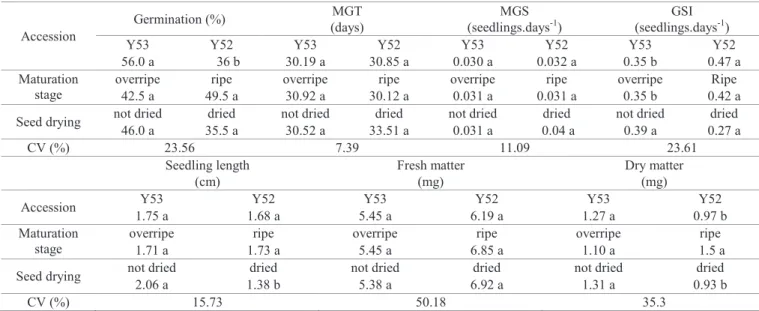
Regarding fruit post-harvest ripening and seed drying essay, there was no interaction between stage of maturation, seed drying and accession (Table 1). Regarding accessions response, there was statistical difference only for germination percentage, germination speed index and seedling dry weight (Table 2). Accession Y53 presented the best averages for germination and seedling dry weight, while accession Y52 showed higher average only for GSI (Table 2). This advantage could be related to low germination percentage obtained by this accession.
Table 2. Fruit post-harvest ripening and seed drying effect on physiological quality of guava (Psidium guineense).
Accession
Germination (%) MGT
(days)
MGS (seedlings.days-1)
GSI (seedlings.days-1)
Y53 Y52 Y53 Y52 Y53 Y52 Y53 Y52
56.0 a 36 b 30.19 a 30.85 a 0.030 a 0.032 a 0.35 b 0.47 a Maturation
stage
overripe ripe overripe ripe overripe ripe overripe Ripe 42.5 a 49.5 a 30.92 a 30.12 a 0.031 a 0.031 a 0.35 b 0.42 a
Seed drying not dried dried not dried dried not dried dried not dried dried 46.0 a 35.5 a 30.52 a 33.51 a 0.031 a 0.04 a 0.39 a 0.27 a
CV (%) 23.56 7.39 11.09 23.61
Seedling length (cm)
Fresh matter (mg)
Dry matter (mg)
Accession Y53 Y52 Y53 Y52 Y53 Y52
1.75 a 1.68 a 5.45 a 6.19 a 1.27 a 0.97 b
Maturation stage
overripe ripe overripe ripe overripe ripe
1.71 a 1.73 a 5.45 a 6.85 a 1.10 a 1.5 a
Seed drying not dried dried not dried dried not dried dried
2.06 a 1.38 b 5.38 a 6.92 a 1.31 a 0.93 b
CV (%) 15.73 50.18 35.3
MGT (mean germination time). MGS (mean germination speed). GSI (germination speed index). Means followed by same capital letters in the column and lower case letters in the line do not differ statistically at 5%.
The effect of fruits maturation stage from which the seeds
were extracted was significant only for GSI, on the other hand,
seed drying showed no positive effect on seed physiological quality
can withstand harsh environmental conditions of this biome. Furthermore, seeds of many Brazilian tropical tree species in Myrtaceae family show high water content at shedding and have been considered to be sensitive to desiccation. However, among some species of this family, there are different desiccation sensitivity levels based on water content (Delgado and Barbedo, 2007; Masetto et al., 2008; Delgado and Barbedo, 2012). The seedlings development (length and dry matter) was better without seed drying (Table 2), thus, accessions Y52 e Y53 showed a mild sensitivity to dessication,
although they do not show recalcitrant characteristics.
Priming and pre-soaking increased seed overall physiological quality of the guava accessions studied in this work, which can be observed in germination percentage, MGT and seedling length (Table 3). This is related to the fact that during these treatments occurs reserve mobilization, activation of DNA and RNA synthesis, ATP production, and repair of damage in membrane system suffered during storage (Bewley et al., 2013) improving seed vigor, increasing germination percentage and uniformity.
Table 3. Physiological quality of guava (Psidium guineense) seeds accessions subjected to pre-soaking and priming.
Pre-treatment Germination (%)
Y53 Y52 Y85 Y95
Pre-soaking 76 aA 6.66 bB 81.33 aA 76 aAB
Priming 65.33 bA 16 cB 92.0 aA 86.67 aA
Control 38.66 cB 33.33 cA 88.33 aA 70.0 bB
CV (%) 12.07
Mean germination time (days)
Y53 Y52 Y85 Y95
Pre-soaking 27.77 cA 26.43 bcA 19.27 aA 21.1 abA
Priming 31.73 bAB 29.27 bAB 20.27 aA 21.6 aA
Control 34.84 bB 32.33 abB 28.37 aB 33.0 abB
CV (%) 7.97
Mean germination speed (seedlings.days-1 )
Y53 Y52 Y85 Y95
Pre-soaking 0.03 bA 0.03 bA 0.05 aA 0.05 aA
Priming 0.03 aA 0.03 aA 0.03 aB 0.03 aB
Control 0.04 bA 0.04 bA 0.05 aA 0.05 aA
CV (%) 9.78
Germination speed index (seedlings.days-1 )
Y53 Y52 Y85 Y95
Pre-soaking 0.73 bA 0.033 cB 1.10 aA 0.90 abA
Priming 0.53 bA 0.13 cAB 1.17 aA 1.10 aA
Control 0.28 bB 0.26 bA 0.63 aB 0.43 abB
CV (%) 17.46
Seedling length (cm)
Y53 Y52 Y85 Y95
Pre-soaking 2.78 aA 3.00 aA 3.68 aA 2.48 aA
Priming 2.02 bAB 1.95 bB 3.16 aAB 2.22 bAB
Control 1.3 bB 1.75 bB 2.82 aB 1.59 bB
CV (%) 16.00
Seedling fresh matter (mg)
Y53 Y52 Y85 Y95
Pre-soaking 3.07 aB 3.13 aB 5.36 aA 2.85 aA
Priming 4.3 aB 3.4 aB 2.37 aA 1.73 aA
Control 8.1 Aa 8.1 aA 4.5 bA 2.33 bA
CV (%) 37.53
Seedling dry matter (mg)
Y53 Y52 Y85 Y95
Pre-soaking 1.53 aA 1.39aA 1.44 aA 0.92 aA
Priming 1.48 aA 1.17 aA 1.22 aA 0.74aB
Control 1.31 aA 1.09 aA 1.40 aA 0.60 aB
CV (%) 24.86
Seed priming showed a large increase in germination percentage in Y53 and Y95 accession when compared to control seeds, however there was no statistical difference between the pre-soaking and priming treatments for accession Y53 and among all treatments for accession Y85 (Table 3). Pre-soaking and priming treatments interfered negatively in the germination percentage of accession Y52. Possibly the seeds from this accession are in the deterioration process, resulting in poor germination, as demonstrated in control treatment results (Table 3).
Germination time is an important parameter in seedling
establishment in field (Carvalho and Nakagawa, 2012). Tarquis
and Bradford (1992) observed priming and prehydration treatments had little effect on seed germination of various species, other than Psidium, but significantly reduced mean time to germination by up to 61% relative to untreated seeds. In this work we found up to 57% reduction in MGT, which means 12 days anticipation in germination in Y95 accession (Table 3).
Pre-soaking also influenced length of seedlings (Table 3).
Accessions with higher (Y85) and lower (Y52) seed vigor showed less sensitivity to priming or pre-soaking treatments (Table 3). According to Masetto et al. (2014) priming in Psidium guinea seeds showed an increase in germination, root growth and reduction in the average time for germination. Differences in the effects produced by priming seeds with different vigor levels, reinforces the statement that responses of seeds submitted to osmopriming are more intense for lots which have begun deterioration process, however are not yet utterly deteriorated (Powell, 1998).
In numerous species, growing conditions of a parent plant, both wild and cultivated, may affect germination of its seeds (Fenner, 1991).Variations in environmental conditions during seed development may result in variations plant and seed performance. Among environmental traits, temperature changes during seed maturation plays a dominant role in both plant and seed performance, whereas light signaling (light intensity and photoperiod) has more impact on plant traits (He et al., 2014). Asides parent environment, some studies have shown there is wide variability for germination and vigor of seeds of different accessions, cultivars and progenies of many fruit species (Cardoso et al., 2009; Nerling et al., 2013; Negreiros et al., 2015), such as observed for guava accessions (Tables 1-4). Santos et al. (2014) described genetic diversity for fruit characteristics among guava accessions harvested in the same municipality and in different municipalities in the semiarid region of Bahia.
For guava, it is likely that an interaction between parental environment, genotype and initial seed physiological quality affects plant and seed performance, as occurs with Arabidopsis (He at al., 2014).
Conclusions
Brazilian guava accessions collected in semiarid Bahia showed different germination behavior for all studied traits.
Temperatures of 20 and 25 °C were ideal for germination test of guava seeds in laboratory.
Pre-soaking and priming in guava seeds are recommended to reduce germination time and increase seed physiological quality.
References
ALVES, E.U.; BRUNO, R.L.A.; OLIVEIRA, A.P.O.; ALVES, A.U.; ALVES, A.U.; PAULA, R.C. Influência do tamanho e da procedência de sementes de
Mimosa caesalpiniifolia Benth. sobre a germinação e vigor. Revista Árvore, v.29, n.6, p.877-885, 2005. http://www.scielo.br/pdf/rarv/v29n6/a06v29n6.pdf ANDERSSON, L.; MILBERG, P. Variation in seed dormancy among mother plants, populations and years of seed collection. Seed Science Research, v.8, n.1, p.29-38, 1998. https://people.ifm.liu.se/permi/PlantEcology/ SeedSciRes98.pdf
BEWLEY, J.D.; BRADFORD, K.J.; HILHORST, H.W.M.; NONOGAKI, H. Seeds: physiology of development germination and dormancy. New York: Springer, 2013. 392p.
BEZERRA, J.E.F.; LEDERMAN, I.E.; SILVA-JÚNIOR, J.F.; PROENÇA, C.E.B. Guava. In: VIEIRA, R.F.; AGOSTINI-COSTA, T.; SILVA, D.B.; FERREIRA, F.R.; SANO, S.M. Frutas Nativas da Região Centro-Oeste do Brasil. Brasília: Embrapa Recursos Genéticos e Biotecnologia, 2006. p.42-63. BORGES, R.C.F.; COLLAÇO-JÚNIOR, J.C.; SCARPARO, B.; NEVES, M.B.; CONEGLIAN, A. Caracterização da curva de embebição de sementes de pinhão -manso. Revista Científica Eletrônica de Engenharia Florestal, v.13, p.1-8, 2009. http://www.scielo.br/scielo.php?script=sci_ nlinks&ref=000080&pid=S0101-3122201200030001900003&lng=pt BRANCALION, P.H.S.; NOVEMBRE, A.D.L.C.; RODRIGUES, R.R. Temperatura ótima de germinação de sementes de espécies arbóreas brasileiras. Revista Brasileira de Sementes, v.32, n.4, p.15-21, 2010. http:// dx.doi.org/10.1590/S0101-31222010000400002
CALDEIRA, S.D.; HIANE, P.A.; RAMOS, M.I.L.; RAMOS-FILHO, M.M. Physical-chemical characterization of guava (Psidium guineense SW.) and taruma (Vitex cymosa Bert.) of Mato Grosso do Sul State, Brasil. Boletim do Centro de Pesquisa e Processamento de Alimentos Brasil, v.22, n.1, p.145-154, 2004.
CARDOSO, D.L.; SILVA, R.D.; PEREIRA, M.G.; VIANA, A.P.; ARAÚJO, E.F. Diversidade genética e parâmetros genéticos relacionados à qualidade fisiológica de sementes em germoplasma de mamoeiro. Revista Ceres, v.56, n.5, p.572-579, 2009. http://www.ceres.ufv.br/ceres/revistas/ V56N005P04108.pdf
CARVALHO, N. M.; NAKAGAWA, J. Sementes: ciência, tecnologia e produção. 5.ed. Jaboticabal: FUNEP, 2012. 590p.
DANTAS, B.F.; RIBEIRO, L.S.; ARAGÃO, C.A. Germination, initial growth and cotyledon protein content of bean cultivars under salinity stress. Revista Brasileira de Sementes, v.29, n.2, p.106-110, 2007. http://www.scielo.br/pdf/ rbs/v29n2/v29n2a14.pdf
DANTAS, B.F.; SOARES, F.S.J.; LÚCIO, A.A.; ARAGÃO, C.A. Alterações bioquímicas durante a embebição de sementes de baraúna (Schinopsis brasiliensis Engl.). Revista Brasileira de Sementes, v.30, n.2, p.214-219, 2008b. http://www.scielo.br/pdf/rbs/v30n2/a27v30n2.pdf
DEGÁSPARI, C.H.; WASZCZYNSKYJ, N. Antioxidants properties of phenolic compounds. Visão Acadêmica, v.5, p.33-40, 2004. http://ojs.c3sl. ufpr.br/ojs/index.php/academica/article/viewFile/540/453
DELGADO L.F.; BARBEDO, C.J. Tolerância à dessecação de sementes de espécies de Eugenia. Pesquisa Agropecuária Brasileira, v.42, n.2, p.265-272, 2007. http://www.scielo.br/pdf/pab/v42n2/16.pdf
DELGADO, L.F.; BARBEDO, C.J. Water potential and viability of seeds of
Eugenia (Myrtaceae), a tropical tree species, based upon different levels of
drying. Brazilian Archives of Biology and Technology, v.55, n.4, p.583-590, 2012. http://www.scielo.br/pdf/babt/v55n4/a14v55n4.pdf
FENNER, M. The effects of the parent environment on seed germinability. Seed Science Research, v.1, n.2, p.75-84, 1991. http://dx.doi.org/10.1017/ S0960258500000696
FORZZA, R.C.; LEITMAN, P.M.; COSTA, A.F.; CARVALHO-JÚNIOR., A.A.; PEIXOTO, A.L.; WALTER, B.M.T.; BICUDO, C.; ZAPPI, D.; COSTA, D.P.; LLERAS, E.; MARTINELLI, G.; LIMA, H.C.; PRADO, J.; STEHMANN, J.R.; BAUMGRATZ, J.F.A.; PIRANI, J.R.; SYLVESTRE, L.; MAIA, L.C.; LOHMANN, L.G.; QUEIROZ, L.P.; SILVEIRA, M.; COELHO, M.N.; MAMEDE, M.C.; BASTOS, M.N.C.; MORIM, M.P.; BARBOSA, M..; MENEZES, M.; HOPKINS, M.; SECCO, R.; CAVALCANTI, T. B.; SOUZA, V.C. 2012. Introdução. In: Lista de Espécies da Flora do Brasil. Jardim Botânico do Rio de Janeiro. http://floradobrasil.jbrj.gov.br/2012/
GALLOWAY, L. F. Maternal effects provide phenotypic adaptation to local environmental conditions. New Phytologist, v. 166, n. 1, p.93-100. 2005. http://onlinelibrary.wiley.com/doi/10.1111/j.1469-8137.2004.01314.x/pdf GIACOBBO, C.L.; ZANUZO, M.; CHIM, J.; FACHINELLO, J.C. Avaliação do teor de vitamina c em diferentes grupos de guava-comum. Revista Brasileira de Agrociência, v.14, n.1, p.155-159, 2008. http://periodicos.ufpel. edu.br/ojs2/index.php/CAST/article/viewFile/1899/1732
HE, H.; VIDIGAL, S.D.; SNOEK, L.B.; SCHNABEL, S.; NIJVEEN, H.; HILHORST, H.; BENTSINK, L. Interaction between parental environment and genotype affects plant and seed performance in Arabidopsis. Journal
of Experimental Botany, v.65, n.22, p.6603-6615, 2014. http://jxb.
oxfordjournals.org/content/early/2014/09/18/jxb.eru378
LABOURIAU, L.G. A germinação de sementes. Washington: OEA, 1983. 174p.
LAMARCA, E.V.; SILVA, C.V.; BARBEDO, C.J.; Limites térmicos para a germinação em função da origem de sementes de espécies de Eugenia (Myrtaceae) nativas do Brasil. Acta Botanica Brasilica, v.25, n.2, p.293-300, 2013. http://www.scielo.br/pdf/abb/v25n2/a05v25n2.pdf
LONG, R.L.; GORECKI, M.J.; RENTON, M.; SCOTT, J.K.; COLVILLE, L.; GOGGIN, D.E.; COMMANDER, L.E.; WESCOTT, D.A.; CHERRY, H.; FINCH-SAVAGE, W.E. The ecophysiology of seed persistence: a mechanistic view of the journey of germination or demise. Biological Reviews, v. 90, n. 1, p. 31-59, 2014. http://onlinelibrary.wiley.com/doi/10.1111/brv.12095/pdf
MAGUIRE, J.D. Speed of germination—aid in selection and evaluation for seedling emergence and vigor. Crop Science, v.2, n.2, p. 176-177, 1962. MASETTO, T.E.; SILVA NEVES, E.M.; SCALON, S.D.P.Q.; DRESCH, D.M. Drying, storage and osmotic conditioning of Psidium guineense Swartz seeds. American Journal of Plant Sciences, v.5, n.17, 2014. http://www.scirp. org/journal/PaperInformation.aspx?PaperID=48419
MASETTO, T.E; FARIA, J.M.R.; DAVIDE, A.C.; SILVA, E.A.A. Desiccation tolerance and DNA integrity in Eugenia pleurantha O. Berg. (Myrtaceae) seeds. Revista Brasileira de Sementes, v.30, n.2, p.51-56, 2008. http://www. scielo.br/pdf/rbs/v30n2/a07v30n2.pdf
MIRANDA, G.B.; SOUZA, R.D.; GOMES, V.M.; FERREIRA, T.D.F.; ALMEIDA, A.M. Avaliação de acessos de Psidium spp. quanto à resistência a Meloidogyne enterolobii. Bragantia, v. 71, n. 1, p. 52-58, 2012. http://www. scielo.br/pdf/brag/v71n1/aop1126.pdf
MUGNOL, D.D.; QUINTÃO, S.S.P.; SILVA, N.E.M.; ELISA, M.T.; MARA, M.R. Effect of pre-treatments on seed germination and seedling growth in Psidium guineense Swartz. Agrociencia, v. 18, n. 2, p. 33-39, 2014. http:// www.scielo.edu.uy/pdf/agro/v18n2/v18n2a04.pdf
NEGREIROS, J.R.D.S.; ALEXANDRE, R.S.; ÁLVARES, V.D.S.; BRUCKNER, C.H.; CRUZ, C.D. Divergência genética entre progênies de maracujazeiro- amarelo com base em características das plântulas. Revista Brasileira de Fruticultura, v.30, n.1, p.197-201, 2015. http://www.scielo.br/ scielo.php?script=sci_arttext&pid=S0100-29452008000100036&lng=en&tl ng=pt. 10.1590/S0100-29452008000100036
NERLING, D.; COELHO, C.M.M.; NODARI, R.O. Genetic diversity for physiological quality seeds from corn (Zea mays L.) intervarietal crossbreeds. Journal of Seed Science, v.35, n.4, p.449-456, 2013. http://www.scielo.br/ pdf/jss/v35n4/06.pdf
OLIVEIRA, G. M.; MATIAS, J. R.; DANTAS, B. F. Temperatura ótima para germinação de sementes nativas da Caatinga. Informativo ABRATES, v.24, n.3, p.44-47, 2014a. http://www.abrates.org.br/images/--Informativo/ v24_n3/Palestras.pdf
OLIVEIRA, G. M.; RODRIGUES, J. M.; RIBEIRO, R. C.; BARBOSA, L. G.; SILVA, J. E. S. B.; DANTAS, B. F. Germinação de sementes de espécies arbóreas nativas da Caatinga em diferentes temperaturas. Scientia Plena, v.10, n.4, p.1-6, 2014b. http://www.scientiaplena.org.br/sp/article/view/1790/954 PESSOA, R.C.; MATSUMOTO, S.N.; MORAIS, O.M.; VALE, R.S.D.; LIMA, J.M. Germinação e maturidade fisiológica de sementes de Piptadenia
viridiflora (Kunth.) Benth relacionadas a estádios de frutificação e
conservação pós-colheita. Revista Árvore, v.34, n.4, p.617-625, 2010. http:// www.scielo.br/pdf/rarv/v34n4/v34n4a06.pdf
POWELL, A.A. Seed improvement by selection and invigoration. Scientia Agricola, v.55, p.126-133, 1998.
RAJJOU, L.; DUVAL, M.; GALLARDO, K.; CATUSSE, J.; BALLY, J.; JOB, C.; JOB, D. Seed germination and vigor. Annual Review of Plant Biology, v.63, p.507-533, 2012. http://www.annualreviews.org/doi/pdf/10.1146/ annurev-arplant-042811-105550
SANTOS, C.M.R.; FERREIRA, A.G.; ÁQUILA, M.E.A. Características de frutos e germinação de sementes de seis espécies de Myrtaceae nativas do Rio Grande do Sul. Ciência Florestal, v.14, n.2, p.13-20, 2004. http://cascavel. ufsm.br/revistas/ojs-2.2.2/index.php/cienciaflorestal/article/view/1802
SANTOS, M.A.C.; QUEIRÓZ, M.A.; SANTOS, A.S.; SANTOS, L.C.; CARNEIRO, P.C.S. Diversidade genética entre acessos de guava de diferentes municípios do semiárido baiano. Revista Caatinga, v.27, p.48-57, 2014. http://periodicos.ufersa.edu.br/revistas/index.php/sistema/article/ view/2887/pdf_113
SMIDERLE, O.J.; LIMA, J.M.E.; PAULINO, P.P.S. Curva de absorção de água em sementes de Jatropha curcas L. com dois tamanhos. Revista Agro@mbiente, v.7, n.2, p.203-208, 2013. http://revista.ufrr.br/index.php/ agroambiente/article/view/1056/1150
SOUZA, A.G.; RESENDE, L.V.; LIMA, I.P.; SANTOS, R.M.; CHALFUN, N.N.J. Variabilidade genética de acessos de araçazeiro e goiabeira suscetíveis e resistentes a Meloidogyne enterolobii. Ciência Rural, v.44, n.5, p.822-829, 2014. http://www.scielo.br/pdf/cr/v44n5/a14514cr6237.pdf
TARQUIS, A.M.; BRADFORD, K.J. Prehydration and priming treatments that advance germination also increase the rate of deterioration of lettuce seeds. Journal of Experimental Botany, v.43, n.3, p.307-317, 1992.
TURESSON, G. The genotypical response of the plant species to the habitat. Hereditas, v.3, n.3, p.211-350, 1922. http://onlinelibrary.wiley.com/ doi/10.1111/j.1601-5223.1922.tb02734.x/abstract