© 2013 Elsevier Editora Ltda. All rights reserved.
ASSOCIAÇÃO MÉDICA BRASILEIRA
Volume 58 • Número 6 • Novembro/Dezembro 2012 • ISSN 0104-4230 • ISSN 1806-9282 (On-line)
www.ramb.org.br ARTIGOS
ARTIGOS ORIGINAIS _____________Qualidade da informação da internet disponível para pacientes em páginas em português ___________________________________________________________645 Acesso a informações de saúde na internet: uma questão de saúde pública? ______650 Maus-tratos contra a criança e o adolescente no Estado de São Paulo, 2009_______659 Obesidade e hipertensão arterial em escolares de Santa Cruz do Sul – RS, Brasil ___666 Bone mineral density in postmenopausal women with and without breast cancer ___673 Prevalence and factors associated with thoracic alterations in infants born prematurely __________________________________________________679 Análise espacial de óbitos por acidentes de trânsito, antes e após a Lei Seca, nas microrregiões do estado de São Paulo ___________________________________685 Sobrevida e complicações em idosos com doenças neurológicas em nutrição enteral ______________________________________________________691 Infliximab reduces cardiac output in rheumatoid arthritis patients without heart failure ______________________________________________________698 Análise dos resultados maternos e fetais dos procedimentos invasivos genéticos fetais: um estudo exploratório em Hospital Universitário _______________703 Frequência dos tipos de cefaleia no centro de atendimento terciário do Hospital das Clínicas da Universidade Federal de Minas Gerais __________________709 ARTIGO DE REVISÃO ______________Influência das variáveis nutricionais e da obesidade sobre a saúde e o metabolismo __714
EDITORIAL
Conclusão: como exibir a cereja do bolo 633
PONTO DE VISTA
Os paradoxos da medicina contemporânea 634
IMAGEM EM MEDICINAObstrução duodenal maligna: tratamento endoscópico paliativo utilizando prótese metálica autoexpansível 636 Gossypiboma 638
DIRETRIZES EM FOCO
Hérnia de disco cervical no adulto: tratamento cirúrgico 639
ACREDITAÇÃOAtualização em perda auditiva: diagnóstico radiológico 644 SEÇÕES ____________________________
•
•
•
www.ramb.org.br
Revista da
ASSOCIAÇÃO MÉDICA BRASILEIRA
A RT I C L E I N F O
Article history: Received 21 May 2012 Accepted 20 August 2012
Keywords: Diabetes mellitus Risk screening Diabetes prevention
Risk factors for diabetes mellitus
A B S T R A C T
Objective: To screen the risk of developing diabetes mellitus type 2 (DM2) in adult individuals. Methods: Several risk factors for DM2 (sedentary lifestyle, previous coronary artery disease, hyper glycemia-inducing medications, body mass index [BMI], blood pressure, serum trigly-ceride, and HDL-cholesterol levels) were assessed in 314 adults as a function of gender and age group.
Results: 73.2% of the population had two or more concurrent risk factors and 26.8% had less than two factors. The occurrence of risk factors for DM2 development was observed even in young adults, and the risk factors are likely associated with aging. Differences in risk factors and incidence were observed between men and women in the same age group. Conclusion: Regardless the age studied, the most prevalent risk factors associated with DM2 were: BMI, sedentary lifestyle, and reduced serum HDL-cholesterol, which are modifiable, thus increasing the importance of preventive measures. Discrepancies found in prevalent risk factors in men and women also suggest that sociocultural differences influence the risk of developing DM.
© 2013 Elsevier Editora Ltda. All rights reserved.
Rastreamento do risco de desenvolvimento de diabetes mellitus
em pais de estudantes de uma escola privada na cidade de Jundiaí, São Paulo
R E S U M O
Objetivo: Este trabalho objetivou rastrear em indivíduos adultos o risco de vir a desenvolver diabetes mellitus (DM) tipo 2.
Palavras-chave: Diabetes mellitus
Original article
Diabetes mellitus risk screening of parents of private school
students in the city of Jundiaí, São Paulo, Brazil
q
Maria Cristina Ritter Mazzini
a, Milena Grossi Blumer
a, Eduardo Luiz Hoehne
a,
Kátia Regina Leoni Silva Lima de Queiroz Guimarães
a, Bruno Caramelli
b,
Luciana Fornari
b, Sônia Valéria Pinheiro Malheiros
c,d,e,*
aSchool of Nutrition, Centro Universitário Padre Anchieta, Jundiaí, SP, BrazilbInstituto do Coração, Hospital das Clínicas, Faculdade de Medicina, Universidade de São Paulo, São Paulo, SP, Brazil cFaculdade de Medicina de Jundiaí, Jundiaí, SP, Brazil
dUniversidade São Francisco, Campinas, SP, Brazil
eUniversidade Metodista de Piracicaba, Piracicaba, SP, Brazil
qStudy conducted at Centro Universitário Padre Anchieta, Unianchieta, Jundiaí, São Paulo, SP, Brazil
Introduction
During the last century, the epidemiological picture showed a reversal of disease pattern, moving from high prevalence of transmissible diseases towards non-transmissible conditions, such as cancers, cardiovascular diseases (CVD), and diabetes mellitus (DM), especially from the 1960s onwards.1,2 This
fact is suggested to result from the increased life expectancy associated with changes in smoking, inactivity, high blood pressure (HBP), DM, hyperlipidemias, overweight and obesity, high-calorie and high-protein diets, and other factors that cannot be changed, such as gender, race, and heredity.3,4
DM is mainly divided into two types: type 1, also termed juvenile diabetes or insulin-dependent diabetes, an autoimmune disease affecting approximately 10% of the diabetic population, in which the body itself destroys the insulin-producing pancreatic b cells and type 2, affecting
approximately 90% of the diabetic population and impairing insulin action and production. Diabetes mellitus type 2 (DM2) is directly associated with bad lifestyles.5
DM is a global pandemic,6,7 and 300 million people are
estimated to have the disease in the next 20 years.5 In Brazil,
after a DM screening campaign in 2001, it was found that 50% of the diagnosed population were unaware they had the disease.8 DM is the sixth leading cause for hospitalizations,
and contributes to other intervening causes, such as ischemic heart disease, heart failure, strokes, and HBP.9
Early in its course, DM2 is asymptomatic and, although life expectancy has raised compared to the scenario decades ago, the disease reduces the quality of life by causing serious comorbidities, such as peripheral nerve diseases, kidney diseases, extremity amputations (DM is the major cause for nontraumatic amputations), retinopathies (it is the main cause for visual loss in the 16-64 age group), and poses a high risk for CVD. For every ten people with diabetes, eight will die as a result of a cardiovascular event.10 This condition costs the
public treasury millions in medications, hospitalizations, and early retirement.5
There are two populations at risk of progressing to DM2, and they can be considered pre-diabetic: individuals with abnormal
fasting glucose, and those having abnormalities in the second hour of the oral glucose tolerance test.11 The best way to
identify pre-diabetes is by the blood glucose test. Pre-diabetes can be defined when fasting blood glucose (at least eight-hour fasting) is between 100 and 125 mg/dL and/or blood glucose in the second hour of the oral glucose overload test is between 140 and 199 mg/dL;12 this portion of the population can also
be classified as glucose-intolerant.
Several models can be used to screen the risk of developing DM they are characterized by identifying a set of risk-predictive factors in a certain population, which, combined, indicate the individual risk.13 Although
numerous risk factors associated with DM are mentioned in the literature, there is not a single pattern or model used in clinical practice.13 Among the many risk factors for DM2,
this study used the following: age, overweight, HBP, elevated triglycerides (TG), coronary artery disease, gestational diabetes mellitus (GDM), use of hyperglycemia-inducing medications, and fasting blood glucose, as proposed by the Brazilian Diabetes Society (2002).12
The importance of identifying individuals at risk for DM is associated with the possibility to reverse the risk position, since numerous factors are modifiable. Changes in lifestyle, mainly body weight reduction and physical activity implementation, are observed to reduce DM incidence and to prevent or retard its comorbidities.5,13,14 In large studies conducted with
pre-diabetic individuals, these measures reduced the new case rate by over 50% in a two- to five-year follow-up.12,15,16 Thus,
in this study aimed to screen the study population for the risk for developing DM, to identify the most prevalent risk factors for gender, and to evaluate the age influence on risk factors associated with DM development.
Methods
Study population
The subjects in this project were 314 adults (54.5% women and 45.5% men), parents of 6- to 10-year-old children, 1st
to 5th grade students of a private elementary school in the Métodos: Diversos fatores de risco para DM (sedentarismo, doença coronariana prévia, uso de medicação hiperglicemiante, índice de massa corporal (IMC), pressão arterial, níveis séricos de triglicerídeos e colesterol HDL-col) foram avaliados em 314 adultos, em função do sexo e faixa etária.
Resultados: 73,2% da população somou dois ou mais fatores de risco simultaneamente, e 26,8% apresentaram menos de dois fatores. Observou-se a ocorrência de fatores de risco para o desenvolvimento da DM mesmo entre adultos jovens, e a ocorrência dos mesmos tende a estra associada com o avanço da idade. Foram observadas diferenças nos fatores e incidência de risco entre homens e mulheres na mesma faixa etária.
Conclusão: Independentemente da idade estudada, os fatores de risco associados a DM de maior prevalência foram: IMC, sedentarismo e diminuição do HDL-colesterol, os quais podem ser modificáveis, reforçando a importância de medidas preventivas. Divergências encontradas entre os fatores de risco prevalentes em homens e mulheres sugerem também que diferenças socioculturais influenciam o risco de desenvolvimento da DM.
© 2013 Elsevier Editora Ltda. Todos os direitos reservados. Rastreamento de risco
Prevenção do diabetes
municipality of Jundiaí, SP, who had been selected for a cardiovascular risk prevention study.17 When assessing risks
by age, seven individuals whose age was not reported were excluded, thus reducing the sample size to 307.
Study tools
A structured questionnaire was used as study tool to obtain the following data: age, prior history of gestational DM, sedentary lifestyle, previous coronary artery disease, and hyperglycemia-inducing medications. In addition to completing the questionnaire, the following data were assessed for the clinical exam: body weight, height, and blood pressure. Blood was also sampled for the following biochemical tests: fasting blood glucose, TG levels, and HDL-cholesterol levels.
Data collection and parameter analysis
A previously trained multidisciplinary team consisting of university health care students, nurses, nutritionists, pharmacists, and physical educators collected data from the structured questionnaire, as well as data from clinical exams and venous blood samples.
The clinical examinations performed by the multidisci-plinary team fulfilled the following parameters:
– Weight was determined by using a digital scale with 100-g accuracy; height was measured with a portable stadiometer with a 1-mm accuracy. From these data, BMI (body mass index) was determined, calculated by the weight (in kilograms) divided by the height squared (in meters). – The abdominal circumference was measured by a fiberglass
tape measure with a 1-millimeter accuracy, on the largest abdominal diameter.
– Blood pressure was assessed through a mercury sphygmo-manometer, with the individual sitting with his/her right arm positioned at the heart level and using a cuff covering 2/3 of the arm length. The systolic blood pressure was considered at Koroktoff phaseI and diastolic blood pressure at Koroktoff phase V of.
Diabetes mellitus risk factors
The parameters below, cited by the Brazilian Diabetes Society (2002),12 were considered as DM risk factors; the sedentary
lifestyle parameter was based on the criteria proposed by Mendonça and Anjos.17 The other parameters were evaluated
as described by Fornari et al.18
– Age ≥ 45 years
– Overweight (BMI ≥ 25 kg/m2)
– HDL-cholesterol (< 40 mg/dL in men and < 50 mg/dL in
women)
– Elevated fasting blood glucose (> 100 mg/dL)
– Elevated TG (> 150 mg/dL)
– HBP (> 140 mm Hg)
– CVD
– Previous gestational DM (GDM)
– Use of hyperglycemia-inducing medications (corticosteroids, thiazide diuretics, etc.)
– Sedentary lifestyle (< 30 minutes a day, according to
Men-donça and Anjos)17
Statistical analysis
Data descriptive analysis was performed by using relative frequencies of the variables studied. Either the chi-squared test or the Fisher’s exact test were used to find the association between two qualitative variables when needed. The significance level adopted for statistical tests was 5%.
Ethical issues
This project is the result of an INCOR-UNIANCHIETA partner-ship, and is part of a larger project whose initial proposal considered an educational program to prevent cardiovascular events.18 The project was approved by the Ethics Committee
on Human Research (CEPSH) of the Centro Universitário Padre Anchieta through the opinion number 002/2010.
Study limitations
The following study limitations have to be considered when interpreting the results:
– the population was initially selected for a cardiovascular disease prevention study17 and, thus, individuals already
diagnosed with diabetes, pregnant women, and patients having untreated hypothyroidism, patients having untreated hypopituitarism, nephrotic syndrome, chronic kidney failure, congenital biliary atresia, storage diseases, systemic lupus erythematosus, and acquired imunnodeficiency syndrome were excluded;
– by defining the 1st- to 5th-grade students’ parents (children
aged 6 to 10 years) of a private elementary school in the municipality of Jundiaí, SP, as the population sample, the following features were narrowed: socioeconomic status and age group, predominantly characterized by young adults, resulting in 84.4% of the study individuals aged younger than 45 years.
Results and discussion
Descripton of diabetes mellitus-associated risk factors
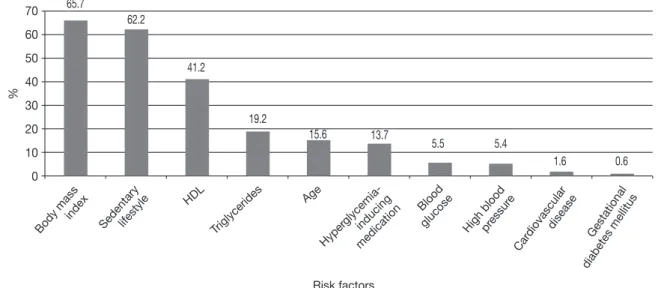
(CI: 15.0%, 24.0%). In a sample of 307 people, 48 (approximately 15.6%) presented age as a DM risk factor (CI: 11.8%, 20.2%). In a sample of 314 people, 43 (approximately 13.7%) were on hyperglycemia-inducing drugs (CI: 10.1%, 18,0%). In a sample of 291 people, 16 (approximately 5.5%), had elevated fasting blood glucose, that is, (CI: 3.2%, 8.8%). In a sample of 312 people, 17 (approximately 5.4%) had HBP (CI: 3.2%, 8.6%). In a sample of 312 people, five (approximately 1.6%) had cardiovascular disease (CI: 0.5%, 3,7%). In a sample of 170 study women, only one (approximately 0.6%), had a history of GDM (CI: 0.0%, 3.2%). Figure 1 shows risk factors contributing to DM development evaluated in the study population. Due to the lack of information, the sample varies according to the related parameter.
The risk factors with higher incidence were BMI (65.7%) and sedentary lifestyle (62.2%). These data are comparable to other data found in the literature in studies related to identifying DM risk factors: Ortiz e Zanetti19 showed that
70% of individuals studied reported sedentary lifestyle and 51.5% had a BMI higher than 25 kg/m2; Souza et al.,20 when
studying individuals already diagnosed with diabetes, observed the highest DM prevalence is due to overweight; and Martinez and Latorre21 found that sedentary lifestyle is the
most prevalent DM risk factor (63.3%), followed by elevated BMI (42.7%). Several studies have demonstrated overweight is one of the most important risk factors associated with DM2 development,13,22,23 increasing the role of adipose tissue
in the establishment of insulin resistance.
Figure 2 shows the distribution of DM risk factors associated with the study population. The sum of individuals having an association of two or more risk factors corresponds to 73.2% of the total; the remaining 26.8% correspond to no risk factors or only one DM-associated risk factor.
According to Franco, prevention can act on three fronts: by avoiding the disease onset, by early diagnosis, and by treating DM to prevent comorbidity onset.24 It is recommended that
screening should be performed every three to five years in people aged ≥ 45 years, and yearly in those having two or more
factors consistent with DM onset.12 Therefore, 73.2% of the
study population is indicated to undergo yearly DM screening, since they have two or more risk factors simultaneously, and 26.8% every three to five years since they have less than two associated factors.
Gender influence on diabetes mellitus-associated risk factors
Interestingly, sociocultural features may contribute to different behaviors in females and males, implying which DM risk factors are favored. Table 1 shows the study risk factor prevalences separated by gender, as well as the test significance level (p-value).
70
60
50
40
30
20
10
0
%
65.7
62.2
41.2
19.2
15.6 13.7
5.5 5.4
1.6 0.6
Risk factors
Body mass index
Car diovasculardisease
High bloodpressur e
Blood glucose
Hyper glycemia-inducing
medication Age
Triglycerides HDL
Sedentarylifestyle
Gestational
diabetes mellitus
Fig. 1 – Diabetes mellitus-associated risk factors in 314 adult individuals, both men and women, parents of children from an elementary school in the city of Jundiaí, SP, Brazil, in 2010.
None 1 2 3 4 5 or 6 Number of risk factors
35 30 25 20 15 10 5 0
7.6
%
19.1
32.2
24.2
13.1
3.8
In the male study population (n = 143), risk factors in
descending order of prevalence were: elevated BMI, sedentary lifestyle, low HDL-cholesterol, elevated TG, age, blood glucose, hyperglycemia-inducing medications, and HBP. In the female study population (n = 171), the most prevalent risk factors
were: sedentary lifestyle, elevated BMI, low HDL-cholesterol, and hyperglycemia-inducing medications.
Although BMI is a highly prevalent risk factor, this para-meter is higher in the male population than in the female population. These data differ from those found in literature, according to the Family Budget Survey (Pesquisa de Orçamento Familiar – POF) 2008-2009, conducted by the Brazilian Institute of Geography and Statistics (Instituto Brasileiro de Geografia e Estatística – IBGE),25 in which 50.1% of Brazilian men and
48% of women were overweight. Another relevant finding in comparing the risk factor prevalence between men and women is elevated TG, which, in the male population, is 74.2% as high as in the female population; HBP is 54.2% higher in men, and low HDL is 27.9% lower in men. These data might have been mostly influenced by the higher prevalence of overweight presented by the male study population. On the other hand, the female study population was shown to be more susceptible to other risk factors, such as the use of hyperglycemia-inducing medications (contraceptives) and sedentary lifestyle.
The evaluation of the sum of risks according to the gender shows that while 34.5% of the women had less than two risk factors, only 17.5% of men lie in this category. Thus, 82.5% of the men in this study had an association of two to five DM-associated risk factors, a value above that shown by women. This information is in line with the report by Martinez and Latorre,21 who found that men had a higher chance to
present DM influenced by high BMI and sedentary lifestyle. Gender imbalances are reflected in laws, policies, and social practices, as well as in people’s identities, attitudes, and behaviors, which alter patterns of suffering, illness, and death patterns.26 Although women have shown to be more
sedentary than men in this study population, culturally women often assume more responsible attitudes and are more careful regarding their health than men,27 possibly warranting a lower
association of risk factors in the present study’s female group. Although the results are related to a specific social class (see
considerations in the topic Study Limitations), some behaviors defined by gender, including better health care and more frequent demand for health services by women, are so strongly rooted that they pervade across social classes,28,29 and perhaps
these results can reflect other segments of society.
Age influence on diabetes mellitus-associates risk factors
Although a predominantly young adult population was studied, with 84.4% of individuals younger than 45 years, the results allowed clear discrimination of the age influence on increased risk to develop DM. When risk factors contributing to DM development in accordance with population age are evaluated, the following result profile is obtained, in descending order of prevalence, for the population under 45 years (84.4%): BMI ≥ 25 kg/m2 (65.6%), sedentary lifestyle (63.7%), low HDL
(40.1%), elevated TG (18.2%), use of hyperglycemia-inducing agents (12.7%), HBP (5.8%), blood glucose (3.3%), coronary artery disease (1.5%), and gestational diabetes (0.6%). In the group aged 45 years or older (15.6%), data obtained per risk factor were: BMI ≥ 25 kg/m2 (66.7%), sedentary lifestyle (58.3%), low
HDL (46.8%), elevated TG (23.4%), hyperglycemia-inducing agents (20.8%), and high blood glucose (18.2%), and none had coronary artery disease.
It is noteworthy that, regardless of age, the most prevalent DM risk factors were elevated BMI, sedentary lifestyle, and decreased HDL-cholesterol. As demonstrated,18 chronic disease
prevention can be reached through educational measures aiming to change habits directly influencing these factors.
Evaluating the sum of risks with age allows for the observation that, after 45 years of age, a relevant increase in the sum of risk factors occurs: the association of four risk factors rises from 10.0% to 31.3%, the association of five risk factors rises from 1.5% to 10.4%, and the previously not found association of six risk factors reaches 6.3%. The relationship between aging and higher DM prevalence is widely described in literature: Goldenberg et al.30 indicate DM is more prevalent among
older people; the Multicentric Study on Diabetes Prevalence in Brazil31 describes a 6.4-fold higher diabetes incidence in the
population aged 60 to 69 years compared with the 30 to 59 years
Risk factor Women, % Men, % p-value
BMI 53.5 80.3 < 0.001*
Sedentary lifestyle 65.9 57.7 0.140
HDL-cholesterol 35.5 47.9 0.027*
TG 8.3 32.2 < 0.001*
Age 8.9 23.7 < 0.001*
Hyperglycemia-inducing medications 18.1 8.4 0.012*
HBP 3.5 7.7 0.102
Blood glucose 1.9 9.8 0.003*
Coronary artery disease 1.2 2.1 0.662
GDM 0.6 0 −
BMI, body mass index; GDM, gestational diabetes mellitus; HBP, high blood pressure; HDL, high density lipoprotein; TG, triglycerides.
age group; according to Collins et al.,13 age is found as the most
widely used risk factor in stratifying DM risk. As age is not a modifiable parameter, the present data confirm the importance that individuals older than 45 years increase care to control the modifiable risk factors, as they tend to be found in association, and DM has a higher incidence in this age group.
Interestingly, many of the risk factors assessed in this study, such as overweight, dyslipidemias, HBP, and sedentary lifestyle, are considered risk factors for other non-transmissible chronic diseases, such as cardiovascular diseases.18,32 The present
results show that, regardless of age, the most prevalent DM risk factors were elevated BMI, sedentary lifestyle, and decreased HDL-cholesterol, all of which are modifiable risk factors. Thus, their identification and intervention can contribute not only to a decrease of DM in this population, but also to a decrease in other comorbidities and mortality in this population. As demonstrated,18 chronic disease prevention can be reached
through educational measures aiming to change habits directly influencing these factors.
Conclusion
Even after considering that the aforementioned particularities of this study limit result correlation, so the results cannot be directly correlated with the adult population of the city of Jundiaí, they reflect relevant aspects that might lead to studies with greater coverage. The results found reveal a high occurrence of DM risk factors, most of which are modifiable. Thus, prevention actions, as well as periodic DM screening, are important in this particular population. Another relevant feature is the difference in risk factors shown in males and females. In the study population, men had more risk factors than women, and therefore are more susceptible to DM development. The results demonstrate a great occurrence of DM risk factors among young adults, which stresses the importance of this study as an indicator that DM2 prophylactic action should target young adults, even considering that this condition is typically shown in older ages.
Acknowledgements
The Centro Universitário Padre Anchieta, Jundiaí, SP, provided a Scientific Initiation Scholarship (BIC). FAPESP provided funding for the study (2009/17450-3).
Conflict of interest
All authors declare to have no conflict of interest.
R E F E R E N C E S
1. Costa RP, Silva CC. Doenças cardiovasculares. In: Cuppari L. Guias de medicina ambulatorial e hospitalar: Unifesp- Escola Paulista de Medicina. 2nded. São Paulo: Manole; 2005. p. 287-312. 2. Ministério da Saúde, Secretaria de Vigilância em Saúde. A
construção da vigilância e prevenção das doenças crônicas
não transmissíveis no contexto do Sistema Único de Saúde. Brasília (DF): Ministério da Saúde; 2006.
3. Fisberg RM, Stella RH, Morimoto JM, Pasquali, LS, Philippi ST, Latorre MRDO. Lipid profile of nutrition students and its association with cardiovascular disease risk factors. Arq Bras Cardiol. 2001;76(2):143-7.
4. Ishitani LH, Franco GC, Perpétuo IHO, França E. Desigualdade social e mortalidade precoce por doenças cardiovasculares no Brasil. Rev Saúde Pública. 2006;40(4):684-91.
5. Sociedade Brasileira de Diabetes. Diretrizes da Sociedade Brasileira de Diabetes. São Paulo; 2009. [falta editora]
6. Selli L, Papaléo LK, Meneguel SN, Torneros JZ. Técnicas educacionales en el tratamiento de la diabetes. Cad Saúde Pública. 2005;21(5):1366-72.
7. Christie D, Strange V, Allen E, Oliver S, Wong ICK, Smith F, et al. Maximizing engagement, motivation and long term change in a structured intensive education programme in diabetes for children, young people and their families: Child and Adolescent Structured Competencies Approach to Diabetes Education (CASCADE). BMC Pediatr. 2009;9(1):57.
8. Barbosa RB, Barceló A, Machado CA. Campanha nacional de detecção de casos suspeitos de diabetes mellitus no Brasil: relatório preliminar. Rev Panam Salud Publica. 2001;10(5): 324-27.
9. Seidel AC, Nagata AK, Almeida HC, Bonomo M. Epistemologia sobre amputações e desbridamentos de membros inferiores realizados no Hospital Universitário de Maringá. J Vasc Bras. 2008;7(4):308-15.
10. Sociedade Brasileira de Diabetes. Diretrizes do diabetes mellitus, 2007. São Paulo; 2007.
11. Sucupira MJ, Souza IS, Lima DMS, Kffuri JM, Eubank JCB, Silva MAP, et al. Diabetes mellitus: prevalência e grupos de risco na população de servidores da Secretaria Especial de Editoração e Publicações do Senado Federal. Diabetes Clín. 2000;4(1):40-9.
12. Sociedade Brasileira de Diabetes. Consenso brasileiro sobre diabetes - diagnóstico e classificação do diabetes mellitus e tratamento do diabetes mellitus tipo 2. São Paulo; 2002 13. Collins GS, Mallet S, Omar O, Yu LM. Developing risk prediction
models for type 2 diabetes: a systematic review of methodology and reporting. Medicine. 2011,9(1):103.
14. Tuomilehto J, Lindstrom J, Eriksson JG, Valle TT, Hamalainen H, Ilanne-Parikka P, et al. Prevention of type 2 diabetes mellitus by changes in lifestyle among subjects with impaired glucose tolerance. N Engl J Med. 2001;344(18):1343-50.
15. Diabetes Prevention Program Research Group. Reduction in the incidence of type 2 diabetes with lifestyle intervention or metformin. N Engl J Med. 2002; 346(6): 393-403.
16. Sartoreli DS, Franco LJ, Cardoso MA. Intervenção nutricional e prevenção primária do diabetes mellitus tipo 2: uma revisão sistemática. Cad Saúde Pública. 2006;22 (Supl 1)7-18.
17. Mendonça CP, Anjos LA. Aspectos das práticas alimentares e da atividade física como determinantes do crescimento do sobrepeso/obesidade no Brasil. Cad Saúde Pública. 2004;20(3): 698-709.
18. Fornari LS, Giuliano I, Azevedo F, Pastana A, Vieira C, Caramelli B. Children First Study: how an educational program in cardiovascular prevention at school can improve parents’ cardiovascular risk. Eur J Prevent Cardiol. 2012. [Epub ahead of print]. doi: 10.1177/2047487312437617.
19. Ortiz MCA, Zanetti ML. Levantamento dos fatores de risco para diabetes mellitus em uma instituição de ensino superior. Rev Latinoam Enferm. 2001;9(3)58-63.
de risco em Campos dos Goytacazes, RJ. Arq Bras Endocrinol Metab. 2003;47(1):69-74.
21. Martinez MC, Latorre MRDO. Fatores de risco para hiper-tensão arterial e diabete melito em trabalhadores de empresa metalúrgica e siderúrgica. Arq Bras Cardiol. 2006;87(4):471-9. 22. The Decode Study Group. Glucose tolerance and mortality:
comparison of WHO and American Diabetes Association diagnostic criteria. European Diabetes Epidemiology Group. Diabetes Epidemiology: collaborative analysis of diagnostic criteria in Europe. Lancet. 1999;354(9179):617-21.
23. UK Prospective Diabetes Study (UKPDS) Group. Effect of intensive blood-glucose control with metformin on complica-tions in overweight patients with type 2 diabetes (UKPDS 34). Lancet. 1998;352(9131):854-65.
24. Franco LJ. Prevenção do diabetes mellitus tipo 2. Diabetes Clín. 2004;3(2):217-25.
25. IBGE. Instituto Brasileiro de Geografia e Estatística. POF 2008-2009: antropometria e estado nutricional de crianças, adoles centes e adultos no Brasil.
26. Organización Panamericana de la Salud. OPS. Plan de acción de desarrollo y salud de adolescentes y jóvenes en las Américas. 1998-2001; 1998.
27. Ribeiro MCSA, Barata RB, Almeida MF, Silva ZP. Perfil socio-demográfico e padrão de utilização de serviços de saúde para usuários e não-usuários do SUS – PNAD 200. Ciência Saúde Coletiva. 2006;11(4):1011-22.
28. Aquino EML, Menezes GMS, Amoedo MB. Gênero e saúde no Brasil: considerações a partir da Pesquisa Nacional de Amostra por Domicílios. Rev Saúde Pública. 1992;26(3):195-202. 29. Giffin K. Pobreza, desigualdade e equidade em saúde:
consi-derações a partir de uma perspectiva de gênero transversal. Cad Saúde Pública. 2002;18(Supl):103-12.
30. Goldenberg P, Schenkman S, Franco LJ. Prevalência de diabetes mellitus: diferenças de gênero e igualdade entre os sexos. Rev Bras Epidemiol. 2003;6(1):18-28.
31. Malerbi D, Franco LJ. The Brazilian Cooperative Group on the Study of Diabetes Prevalence. Multicenter study of the prevalence of diabetes mellitus and impaired glucose tolerance in the urban Brazilian population aged 30-69 years. Diabetes Care. 1992;15(11):1509-16.