Characterization of the motor performance of newborns in a
neonatal unit of tertiary level
LUCIANA GIACHETTA1, CARLA MARQUES NICOLAU1, REGINA CÉLIA TUROLA PASSOS JULIANI2, WERTHER BRUNOWDE CARVALHO3,
VERA LÚCIA JORNADA KREBS4*
1Physiotherapist, Instituto da Criança, Hospital das Clínicas, Faculdade de Medicina, Universidade de São Paulo (HC-FMUSP), São Paulo, SP, Brazil 2Director of the Physiotherapy Service, Instituto da Criança, HC-FMUSP, São Paulo, SP, Brazil
3Full Professor of Intensive Care/Neonatology, Department of Pediatrics, FMUSP, São Paulo, SP, Brazil
4Habilitation (BR: Livre-docência) – Head Physician of the Neonatal Center, Instituto da Criança, HC-FMUSP, São Paulo, SP, Brazil
SUMMARY
Study conducted at Centro Neonatal do Instituto da Criança, Hospital das Clínicas, Faculdade de Medicina, Universidade de São Paulo (HC-FMUSP),São Paulo, SP, Brazil
Article received: 6/29/2016
Accepted for publication: 7/26/2016
*Correspondence:
Instituto da Criança Address: Av. Dr. Enéas de Carvalho
Aguiar, 647 São Paulo, SP – Brazil Postal code: 05403-901 [email protected]
http://dx.doi.org/10.1590/1806-9282.62.06.553
Objective: To characterize the motor performance of newborns in a neonatal unit of tertiary level and compare the results to the values recommended by the Test of Infant Motor Performance (TIMP).
Method: Newborns between 34 and 416/7 weeks of corrected gestational age,
breathing spontaneously and presenting state of consciousness 4 or 5, according to Brazelton, were included. TIMP was used to evaluate the motor performance.
Results: The age groups of 34-35 and 36-37 weeks showed on average TIMP scores similar to the reference values (p>0.05), while in the age groups of 38-39 weeks and 40-41 weeks TIMP scores were statistically lower than the reference values (p<0.001 and p=0.018, respectively). The 34-35 and 36-37 week groups were rat-ed as average, while the 38-39 and 40-41 week groups were deinrat-ed as low aver-age. Classiications below average and very below average were not observed.
Conclusion: The newborns showed average scores compared to the TIMP ref-erence values; however, there were two groups whose performances were within the low average. There was no signiicant difference in motor performance of newborns in the age groups of 38-39 and 40-41 weeks. This behavior suggests that the sample studied has special features that possibly negatively inluenced their motor performance. The results showed that the TIMP is a very useful tool and can be used safely in tertiary neonatal units.
Keywords: newborn, motor performance, TIMP, premature, motor delay assessment.
I
NTRODUCTIONMonitoring of motor development in newborns discharged from the intensive care unit (ICU) is of great importance for early detection of possible deicits and to prevent and minimize consequences. The earlier the diagnosis of mo-tor delay and therapeutic intervention, the less the future impact on child development.1-3 Knowledge of the
se-quence of development and use of standardized and val-idated assessment tools are useful to guide professionals on whether to refer newborns at risk to specialized ser-vices.4,5 The standardization of most motor development
assessment scales was done in European countries and North America. There is little research on this topic in children in underdeveloped or developing countries.6
In Brazil, some authors have established the proile of acquisition of motor skills both in relation to the pat-tern and the pace at which they are processed, trying to set rules to assess normality.6,7,9 The Test of Infant Motor
Performance (TIMP) is the only discriminative instru-ment of evaluation and prognosis developed for preterm infants with gestational age of 34 weeks to 4 months cor-rected gestational age (cGA) with high predictive value for use in the neonatal unit. This is a postural and selec-tive motor control test whose purpose is to record longi-tudinally the motor performance of newborns at risk for delays in motor skills.10 In Brazil, although TIMP is
admitted to the Neonatal Center of Instituto da Criança, HC-FMUSP, constitute a population at high risk for de-layed motor development due to prematurity and com-plications derived from maternal and/or neonatal illness. Therefore, due to the characteristics of these patients, mo-tor impairment may be more frequent in this population. The hypothesis analyzed in this study is that there may be differences between the motor development of Brazil-ian newborns discharged from Neonatal Intensive Care Unit (NICU) and the normative values of the TIMP. The objective was to characterize the motor performance of newborns admitted to the NICU and compare them to TIMP reference values.
M
ETHODWe conducted a prospective cross-sectional study of 136 hospitalized newborns admitted to the Neonatal Center of Instituto da Criança, HC-FMUSP, who met the follow-ing criteria: corrected gestational age between 34 and 416/7
weeks; in common cradle; breathing spontaneously in room air; and presenting state of consciousness 4 or 5, accord-ing to Brazelton.11 Neonates undergoing invasive or
non-invasive mechanical ventilation for ≥ 96 h, with congeni-tal malformations, genetic syndromes, congenicongeni-tal infections, chronic lung disease, musculoskeletal disorders, intracra-nial hemorrhage grade II, III and IV, periventricular leuko-malacia, neurological disorders, congenital heart disease, children born to users of illicit drugs, 5 minute Apgar < 7, exchange transfusion, or state of consciousness 1, 2, 3 or 6 according to Brazelton were excluded.11
A database was created with prenatal, perinatal, and postnatal information. We used the TIMP (version 2.0, 2005) to assess motor performance. The test was admin-istered by a trained physiotherapist, once in each newborn (NB), at the time that it met the study’s inclusion criteria during hospitalization. To evaluate the behavioral state, we used the Brazelton scale for states of consciousness.11
To compare the infants studied with normative test val-ues, they were divided into four groups according to the cGA: NB with cGA between 34 and 356/7 weeks; NB with
cGA between 36 and 376/7 weeks; NB with cGA between
38 and 396/7 weeks; NB with cGA between 40 and 416/7
weeks. After obtaining the total test score, the normative table of the TIMP was applied. Newborns were classiied as within the average, low average, below average or much below average.10
Parent/guardian authorization was obtained by sign-ing a Free and Informed Consent form. The study was approved by the Ethics Committee for Analysis of Re-search Projects of the HC-FMUSP.
R
ESULTSRegarding maternal characteristics according to age groups, and comparison between groups, the number of pregnan-cies was lower in mothers of newborns with 34-35 and 36-37 weeks (p=0.014). Hypertension was more frequent among the mothers of newborns with 38-39 and 40-41 weeks (p=0.008), while gestational diabetes mellitus was more
fre-quent among mothers in the group of 34-35 and 36-37 weeks (p=0.024). There was a higher frequency of infections among mothers of newborns with 38-39 weeks (p=0.013). There was no signiicant difference between the groups with respect to characteristics such as maternal age (p=0.808), heart disease (p=0.076), psychiatric disease (p=0.652), neu-rologic disease (p=0.268), cancer (p=0.842), use of prenatal corticosteroids (p=0.119), and smoking habit (p=0.119).
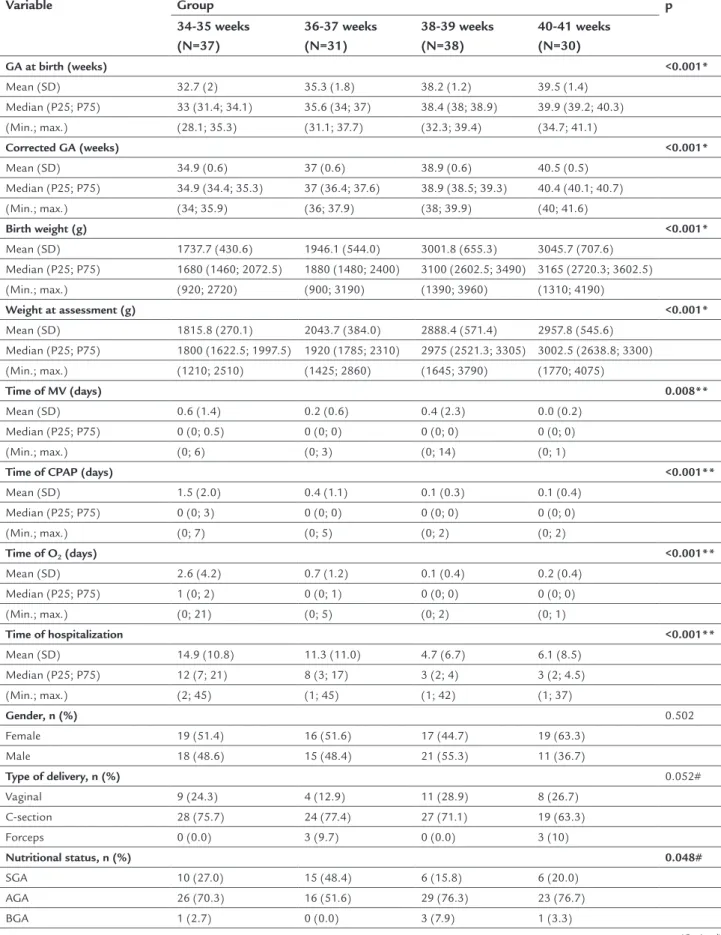
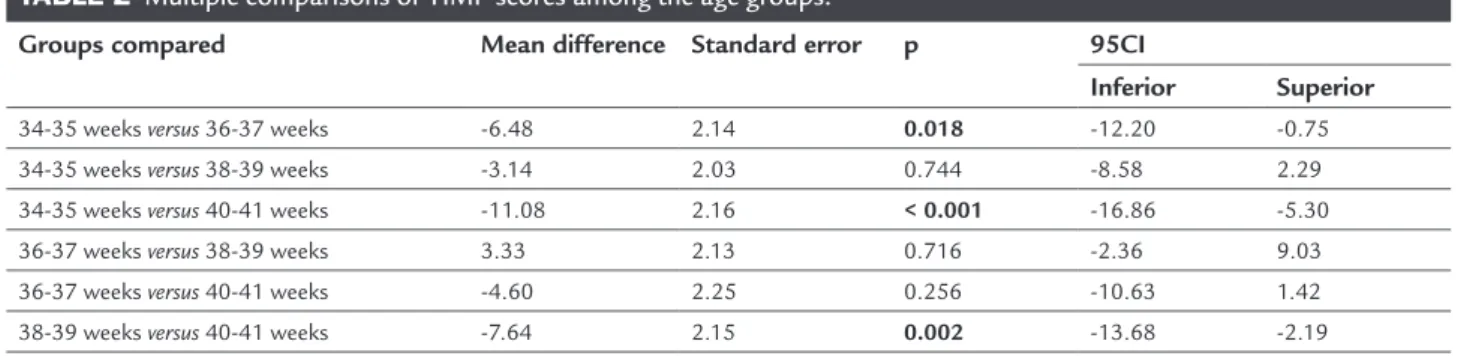
After characterizing the motor performance, we ob-served mean values of TIMP score of 46.6 for the group of 34-35 weeks, 53.1 for the group of 36-37 weeks, 49.8 for the group of 38-39 weeks, and 57.7 for the group of 40-41 weeks (Tables 1 and 2). According to the normative values of the TIMP, the groups of 34-35 and 36-37 weeks were classiied as within the average, while the groups of 38-39 and 40-41 weeks were classiied as low average. Clas-siications below average and well below the average were not obtained in any of the groups.
D
ISCUSSIONTABLE 1 Characteristics of the newborns and comparison between groups.
Variable Group p
34-35 weeks (N=37)
36-37 weeks (N=31)
38-39 weeks (N=38)
40-41 weeks (N=30)
GA at birth (weeks) <0.001*
Mean (SD) 32.7 (2) 35.3 (1.8) 38.2 (1.2) 39.5 (1.4)
Median (P25; P75) 33 (31.4; 34.1) 35.6 (34; 37) 38.4 (38; 38.9) 39.9 (39.2; 40.3)
(Min.; max.) (28.1; 35.3) (31.1; 37.7) (32.3; 39.4) (34.7; 41.1)
Corrected GA (weeks) <0.001*
Mean (SD) 34.9 (0.6) 37 (0.6) 38.9 (0.6) 40.5 (0.5)
Median (P25; P75) 34.9 (34.4; 35.3) 37 (36.4; 37.6) 38.9 (38.5; 39.3) 40.4 (40.1; 40.7)
(Min.; max.) (34; 35.9) (36; 37.9) (38; 39.9) (40; 41.6)
Birth weight (g) <0.001*
Mean (SD) 1737.7 (430.6) 1946.1 (544.0) 3001.8 (655.3) 3045.7 (707.6)
Median (P25; P75) 1680 (1460; 2072.5) 1880 (1480; 2400) 3100 (2602.5; 3490) 3165 (2720.3; 3602.5)
(Min.; max.) (920; 2720) (900; 3190) (1390; 3960) (1310; 4190)
Weight at assessment (g) <0.001*
Mean (SD) 1815.8 (270.1) 2043.7 (384.0) 2888.4 (571.4) 2957.8 (545.6)
Median (P25; P75) 1800 (1622.5; 1997.5) 1920 (1785; 2310) 2975 (2521.3; 3305) 3002.5 (2638.8; 3300)
(Min.; max.) (1210; 2510) (1425; 2860) (1645; 3790) (1770; 4075)
Time of MV (days) 0.008**
Mean (SD) 0.6 (1.4) 0.2 (0.6) 0.4 (2.3) 0.0 (0.2)
Median (P25; P75) 0 (0; 0.5) 0 (0; 0) 0 (0; 0) 0 (0; 0)
(Min.; max.) (0; 6) (0; 3) (0; 14) (0; 1)
Time of CPAP (days) <0.001**
Mean (SD) 1.5 (2.0) 0.4 (1.1) 0.1 (0.3) 0.1 (0.4)
Median (P25; P75) 0 (0; 3) 0 (0; 0) 0 (0; 0) 0 (0; 0)
(Min.; max.) (0; 7) (0; 5) (0; 2) (0; 2)
Time of O2 (days) <0.001**
Mean (SD) 2.6 (4.2) 0.7 (1.2) 0.1 (0.4) 0.2 (0.4)
Median (P25; P75) 1 (0; 2) 0 (0; 1) 0 (0; 0) 0 (0; 0)
(Min.; max.) (0; 21) (0; 5) (0; 2) (0; 1)
Time of hospitalization <0.001**
Mean (SD) 14.9 (10.8) 11.3 (11.0) 4.7 (6.7) 6.1 (8.5)
Median (P25; P75) 12 (7; 21) 8 (3; 17) 3 (2; 4) 3 (2; 4.5)
(Min.; max.) (2; 45) (1; 45) (1; 42) (1; 37)
Gender, n (%) 0.502
Female 19 (51.4) 16 (51.6) 17 (44.7) 19 (63.3)
Male 18 (48.6) 15 (48.4) 21 (55.3) 11 (36.7)
Type of delivery, n (%) 0.052#
Vaginal 9 (24.3) 4 (12.9) 11 (28.9) 8 (26.7)
C-section 28 (75.7) 24 (77.4) 27 (71.1) 19 (63.3)
Forceps 0 (0.0) 3 (9.7) 0 (0.0) 3 (10)
Nutritional status, n (%) 0.048#
SGA 10 (27.0) 15 (48.4) 6 (15.8) 6 (20.0)
AGA 26 (70.3) 16 (51.6) 29 (76.3) 23 (76.7)
BGA 1 (2.7) 0 (0.0) 3 (7.9) 1 (3.3)
On the characterization of motor performance, all new-borns presented normal TIMP results, i.e., classiications below average and well below average were not observed. However, groups with corrected gestational age of 38-39 and 40-41 weeks presented scores in the low average range. The absence of newborns outside the normal range on the TIMP scale may be related to the sample selec-tion criteria, which did not include patients with neuro-logical morbidities. Studies that include infants with neonatal intraventricular hemorrhage and seizures show that these risk factors are worse performance determi-nants based on TIMP.12 Lee et al.13 correlated risk factors
and TIMP in 80 newborns admitted to intensive care unit at the age of 40 weeks. Birth weight, multiple births, gender, type of delivery, Apgar, seizures, and intraven-tricular hemorrhage were analyzed. The authors found that intraventricular hemorrhage was the risk factor most strongly correlated with low TIMP scores. Other
factors cited were C-section, seizures, multiple births and low birth weight.
Raniero et al.7 characterized the pattern and race of
acquisition of motor skills of preterm infants in the irst 4 months of corrected age, comparing them to a group of term infants. The newborns were evaluated monthly, from 0 to 4 months of age based on TIMP. Preterm infants had mean scores higher than those presented by term infants between 1 to 4 months old. In this group, the rate of mo-tor acquisition was higher between 0 and 1 month than between 3 to 4 months. The authors concluded that pre-term infants have a motor development pattern similar to the typical regarding the sequence of acquired skills and accelerated pace from birth to one month of age. Sim-ilar results were observed in our study, where the young-er infants, groups of 34-35 and 36-37 weeks, had bettyoung-er scores than older infants, between 38-39 and 40-41 weeks, compared to the reference values of TIMP (Chart 1).
TABLE 1 (Cont.) Characteristics of the newborns and comparison between groups.
Variable Group p
34-35 weeks (N=37)
36-37 weeks (N=31)
38-39 weeks (N=38)
40-41 weeks (N=30)
Respiratory disorders, n (%) <0.001
No 12 (32.4) 23 (74.2) 36 (94.7) 25 (83.3)
Yes 25 (67.6) 8 (25.8) 2 (5.3) 5 (16.7)
Neurological disorders, n (%)
No 33 (89.2) 30 (96.8) 38 (100.0) 30 (100.0) 0.034#
Yes 4 (10.8) 1 (3.2) 0 (0.0) 0 (0.0)
TIMP score <0.001*
Mean (SD) 46.6 (9.6) 53.1 (8.1) 49.8 (8.8) 57.7 (8.3)
Median (P25; P75) 45 (39.5; 55) 54 (48; 60) 50 (43; 57) 58.5 (54.8; 62)
(Min.; max.) (31; 64) (30; 67) (27; 68) (34; 74)
Chi-squared test; #Likelihood ratio test; *ANOVA; **Kruskal-Wallis.
GA: gestational age; SD: standard deviation; MV: mechanical ventilation; CPAP: continuous positive airway pressure; SGA: small for gestational age; AGA: appropriate for gestational age; BGA: big for gestational age.
TABLE 2 Multiple comparisons of TIMP scores among the age groups.
Groups compared Mean difference Standard error p 95CI
Inferior Superior
34-35 weeks versus 36-37 weeks -6.48 2.14 0.018 -12.20 -0.75
34-35 weeks versus 38-39 weeks -3.14 2.03 0.744 -8.58 2.29
34-35 weeks versus 40-41 weeks -11.08 2.16 < 0.001 -16.86 -5.30
36-37 weeks versus 38-39 weeks 3.33 2.13 0.716 -2.36 9.03
36-37 weeks versus 40-41 weeks -4.60 2.25 0.256 -10.63 1.42
38-39 weeks versus 40-41 weeks -7.64 2.15 0.002 -13.68 -2.19
Campbell et al.14 evaluated the discrimination ability of the
TIMP scale among children with different degrees of risk for delayed motor development, based on morbidity and perinatal medical complications. Ninety-eight children were evaluated until 4 months of age, divided into ive groups: infants born at term or preterm without signii-cant medical problems (low and intermediate risk, respec-tively), gestational age less than 30 weeks or birth weight < 1500 g (high risk), chronic pulmonary disease (high risk), and brain changes (high risk). Groups at low and medium risk did not differ, but showed signiicantly better perfor-mance than the high-risk group. Children with brain dis-orders had a signiicantly lower performance than the oth-ers. The authors found that TIMP can discriminate against children with different risks for motor delay.
Preterm newborns with gestational age below 30 weeks and birth weight less than 1500 g constitute a popula-tion at high risk of showing deicits in neurodevelopment in case of clinical complications.18 In our study, most
new-borns had mean gestational age at birth greater than 32 weeks and birth weight greater than 1500 g; in addition, they did not have intracranial hemorrhage, chronic lung disease or convulsive syndrome. Therefore, the absence of these biological risk factors certainly contributed to
the motor performance within the average. Guimarães et al.15 reported different results after comparing preterm
newborns with corrected gestational age of 38-40 weeks and term newborns based on TIMP. Among 46 preterm newborns with gestational age at birth between 28 and 33 weeks, 26.1% were classiied as atypical, with signii-cantly lower average score, while 100% of the term new-borns were typical. Even though the higher frequency of developmental disorders occurs in children with a histo-ry of prematurity and low birth weight, there is contro-versy as to the characteristics of these sequelae and their long-term progression.16 Comparative studies with
pre-term and pre-term newborns demonstrated that there are dif-ferences in motor performance between them, and also among the preterm themselves, depending on their clin-ical status and gestational age.15,17 Van Haastert et al.,18
after evaluating 800 preterm newborns with 1 to 18 months of corrected age assessed based on the Alberta Infant Motor Scale, observed that they showed a differ-ent evolution of gross motor developmdiffer-ent compared to term newborns, suggesting that the scales should be adapt-ed according to gestational age at birth.
Several factors may contribute to the dificulties of accurate assessment of motor development, such as the
CHART 1 Mean values of TIMP scores according to age groups and the results of the comparative tests.
TIMP scores
Reference Sample
34-35 weeks 70
60
50
40
30
20
10
0
p=0.376 p=0.720 p<0.001 p=0.018
36-37 weeks 38-39 weeks 40-41 weeks
small number of speciic diagnostic tools, the transience of neuromotor disorders in preterm infants in early life and the effects of environmental factors.19 In Brazil, some
studies4,5,20,21 sought to establish the developmental
pro-ile of normal infants; however, there are few longitudinal studies with representative samples to characterize the preterm newborn proile. Such knowledge could facilitate the differentiation between preterm newborns with actu-al motor deicits and those whose pace of acquisition is slower, but does not lead to future motor impairment. In-vestigations8,22,23 on normal infants in order to determine
the proile of motor skill acquisition, regarding both pat-tern and pace of development, reported differences in the pattern of motor development between children from dif-ferent countries. These differences occurred in children belonging to different cultural groups and also within the same cultural group, conirming that the neuropsycho-motor development (NPMD) depends on biological, cul-tural and environmental risk factors.
Campbell et al.24 studied 990 children at risk for
de-velopmental delay in 11 regions of the United States. They analyzed the TIMP scores in relation to sex, risk of poor performance, race, and ethnicity. They noted that Hispan-ic children had signiHispan-icantly lower scores than children in all other ethnic groups. There was no difference in rela-tion to sex. In our study, a statistically signiicant differ-ence was found in TIMP score compared to normative val-ues only in the 38-39 and 40-41 week groups (Chart 1), and it was not able to say that Hispanic ethnicity inlu-enced the results observed in these two groups. Analyz-ing the behavior of all groups compared to each other, we observed that the mean TIMP scores of the group with corrected age of 36-37 weeks was signiicantly higher than those observed in the 34-35 week group (p=0.018). Sim-ilarly, the group with 40-41 weeks showed a mean score higher than that observed in the 34-35 and 38-39 week groups (Chart 1).
In the normative table of the TIMP scale, there is a progressive score increase as the corrected age increases, i.e., the greater the maturity of the central nervous sys-tem, the more the motor abilities will be developed and observed when the test is performed. To check this pro-gression and the changes in TIMP scores over time, Rose et al.25 evaluated 25 children with biological risk of
devel-opmental delay, born with gestational age less than or equal to 30 weeks, at 32 weeks of post-conceptual gesta-tional age, and at 36 weeks. There was a signiicant in-crease in TIMP scores over time, but no correlation be-tween risk variables. In our study, this increase was
progressive up to the corrected gestational age of 36 weeks. In the 38-39 week group, however, there was a signiicant decrease in TIMP score. The group of 40-41 weeks, de-spite showing a rebound in the progression curve, main-tained a signiicant difference compared to the norma-tive value (Chart 1). This behavior suggests that the two groups with lower scores may have presented character-istics that adversely affected their motor performance. We ind it important to analyze the maternal factors, as
the hospital of high complexity where the study was con-ducted primarily receives high-risk pregnant women with chronic diseases such as hypertension, diabetes, heart dis-ease, and more. We found the groups that achieved low-er mean TIMP scores had the highest frequency of ma-ternal infection, diabetes mellitus, and smoking habit. It is
known that infections during pregnancy are associated with a higher rate of prematurity, and that chorioamni-onitis and urinary infection, complications frequently observed in Brazil, increase the risk of neonatal morbid-ity.26 Likewise, newborns to diabetic mothers have
in-creased risk of prematurity, metabolic disorders and mal-formations. Despite the developments in obstetric and neonatal care, diabetes remains a major complication in pregnancy.27 P and perinatal exposure to nicotine is
re-lated to changes in cognition and development. Smok-ing durSmok-ing pregnancy accounts for 20% of fetuses with low birth weight and 8% of premature births, and may contribute to signiicant changes in the development of the central nervous system.28 While the use of illicit drugs
was considered one of the exclusion criteria, maternal smoking was accepted in the selection of our patients. Even though there was no statistical association, this factor was present in 39% of the newborns in the 38-39 week group, which obtained a low mean score.
So far, the prognosis of motor development of in-fants born to mothers with serious illnesses during preg-nancy is a major challenge for health professionals. San-tos et al.,29 in a meta-analysis of 17 articles selected from
455 studies, critically reviewed the evaluation instruments most widely used today for early screening and identii-cation of abnormalities in child development. They high-lighted the importance of the TIMP scale among the in-struments studied due to its high sensitivity and speciicity in young children.
C
ONCLUSIONfrom an intensive care unit indicates the need for careful monitoring of these children in order to detect early pos-sible future deicits.
We recommend that the evaluation of neonates and infants based on TIMP score be part of the preparation of your treatment plan during hospitalization. Early eval-uation can also be of great value to establish the future potential of these children, and follow-up after hospital discharge.
R
ESUMOCaracterização do desempenho motor de recém-nascidos em unidade neonatal de nível terciário
Objetivo: caracterizar o desempenho motor de recém--nascidos em unidade neonatal de nível terciário e com-parar os resultados com os valores normativos preconi-zados pelo Test of Infant Motor Performance (TIMP).
Método: foram incluídos recém-nascidos entre 34 e 416/7
semanas de idade gestacional corrigida, em respiração espontânea e estado de consciência 4 ou 5, segundo Bra-zelton. Para avaliar o desempenho motor, foi utilizado o TIMP.
Resultados: os grupos etários de 34-35 e 36-37 semanas apresentaram em média escore TIMP semelhante aos va-lores de referência; já nos grupos etários 38-39 semanas e 40-41 semanas, os escores TIMP foram estatisticamen-te menores que os valores de referência (p<0,001 e p=0,018, respectivamente). Os grupos de 34-35 e 36-37 semanas foram classiicados como dentro da média, enquanto os grupos 38-39 e 40-41 semanas como média baixa. As clas-siicações abaixo da média e muito abaixo da média não foram observadas.
Conclusão: os recém-nascidos apresentaram escores den-tro da média quando comparados aos valores de referên-cia do TIMP; porém, houve dois grupos cujo desempe-nho se situou na classificação média baixa. Houve diferença signiicativa no desempenho motor dos recém--nascidos nos grupos etários de 38-39 e 40-41 semanas. Esse comportamento sugere que a casuística estudada apresenta particularidades que, possivelmente, inluen-ciaram de modo negativo o desempenho motor. Os re-sultados obtidos mostram que o TIMP é instrumento de grande utilidade e pode ser usado com segurança em uni-dade neonatal terciária.
Palavras-chave: recém-nascido, desempenho motor, TIMP, prematuro, avaliação de atraso motor.
R
EFERENCES1. Araújo ATC, Eickmann, SH, Coutinho SB. Factors associated with late motor development in premature children admitted to a neonatology unit. Rev Bras Saúde Matern Infant. 2013; 13(2):119-28.
2. Mancini MC, Megale L, Brandão MB, Melo APP, Sampaio RF. Efeito moderador do risco social na relação entre risco biológico e desempenho funcional infantil. Rev Bras Saúde Matern Infant. 2004; 4(1):25-34. 3. Silva NDSH, Lamy Filho FL, Gama MEA, Lamy ZC, Pinheiro AL, Silva DN.
Instrumentos de avaliação do desenvolvimento infantil de recém-nascidos prematuros. Rev Bras Cresc Desenv Hum. 2011; 21(1):85-98.
4. Barbosa VC, Formiga CKMR, Linhares MBM. Avaliação das variáveis clínicas e neurocomportamentais de recém-nascidos pré-termo. Rev Bras Fisioter. 2007; 11(4):275-81.
5. Eickmann SH, Lira PIC, Lima MC. Desenvolvimento mental e motor aos 24 meses de crianças nascidas a termo com baixo peso. Arq Neuropsiquiatr. 2002; 60(3B):748-54.
6. Mancini MC, Teixeira S, Araújo LG, Paixão ML, Magalhães LC, Coelho ZAC, et al. Estudo do desenvolvimento da função motora aos 8 e 12 meses de idade em crianças nascidas pré-termo e a termo. Arq Neuropsiquiatr. 2002; 60(4):974-80.
7. Raniero EP, Tudella E, Mattos RS. Padrão e ritmo de aquisição das habilidades motoras de lactentes pré-termo nos quatro primeiros meses de idade corrigida. Rev Bras Fisioter. 2010; 14(5):396-403.
8. Grantham-Mcgregor SM, Lira PIC, Ashworth A, Morris SS, Assunção MAS. The development of low birth term infants and the effects of the environment in Northeast Brazil. J Pediatr. 1998; 132(4):661-6.
9. Santos RS, Araújo APQC, Porto MAS. Diagnóstico precoce de anormalidades no desenvolvimento em prematuros: instrumentos de avaliação. J Pediatr (Rio J). 2008; 84(4):289-99.
10. Campell SK. The Test of Infant Motor Peformance. Test User’s Manual Version 2.0. Chicago: Infant Motor Performance Scales; 2005.
11. Brazelton TB. Neonatal behavioral assessment scale. 2.ed. Philadelphia: JB Lippincott; 1984. (Clinics in Developmental Medicine 88).
12. Tekgul H, Gauvreau K, Soul J, Robertson R, Stewart J, Volpe J, et al. The current etiological proile and neurodevelopmental outcome of seizures in term newborn infants. Pediatrics. 2006; 117(4):1270-80.
13. Lee EJ, Han JT, Lee JH. Risk factors affecting Test of Infant Motor Performance (TIMP) in pre-term infants at post-conceptional age of 40 weeks. Dev Neurorehabil. 2012; 15(2):79-83.
14. Campbell SK, Hedeker D. Validity of the Test of Infant Motor Performance discriminating among infants with varying risk for poor motor outcome. J Pediatr. 2001; 139(4):546-51.
15. Guimarães CLN, Reinaux CM, Botelho ACG, Lima GMS, Cabral Filho JE. Desenvolvimento motor avaliado pelo Test of Infant Motor Performance: comparação entre pré-termo e a termo. Rev Bras Fisioter. 2011; 15(5):357-62.
16. Oliveira GE, Magalhães LC, Salmela LFT. Relação entre muito baixo peso ao nascimento, fatores ambientais e o desenvolvimento motor e cognitivo de crianças aos 5 e 6 anos. Rev Bras Fisioter. 2011; 15(2):138-45. 17. Goyen TA, Lui K. Longitudinal motor development of apparently normal
high-risk infants at 18 months, 3 and 5 years. Early Hum Dev. 2002; 70(1-2):103-15.
18. Van Haastert IC, de Vries LS, Helders PJ, Jongmans MJ. Early gross motor development of preterm infants according to the Alberta Motor Scale. J Pediatr. 2006; 149(5):617-22.
19. Kolobe T HA, Bulanda M, Susman L. Predicting motor outcome at preschool age for infants tested at 7, 30, 60 e 90 days after term age using The Test Of Infant Motor Performance. Phys Ther. 2004; 84(12):1144-56.
20. Morris SS, Victoria CG, Barros FC, Halpern R, Menezes AMB, Cesar JA, et al. Lenght and ponderal index at birth: associations with mortality, hospilizations, development and post natal growth in Brazilians Infant. Int J Epidemiol. 1998; 27(2):242-7.
21. Santos DCC, Gabbard C, Gonçalves VMG. Motor development during the irst 6 months: the case of Brazilian infants. Infant Child Dev. 2000; 9(3):161-6. 22. Brill B. Motor development and cultural attitudes. Themes in Motor
Development. 1986; 35:297-313.
24. Campbel SK, Levy P, Zawacki L, Liao PJ. Population-based age standards for interpreting results on the test of motor infant performance. Pediatr Phys Ther. 2006; 18(2):119-25.
25. Rose RU, Westcott SL. Responsiveness of the Test of Infant Motor Performance (TIMP) in infants born preterm. Pediatr Phys Ther. 2005; 17(3):219-24.
26. Bittar RE, Zugaib M. Indicadores de risco para o parto prematuro. Rev Bras Ginecol Obstet. 2009; 31(4):203-9.
27. HAPO Study Cooperative Research Group, Metzger BE, Lowe LP, Dyer AR, Trimble ER, Chaovarindr U, Coustan DR, et al. Hyperglycemia and adverse pregnancy outcomes. N Engl J Med. 2008; 385(19):1991-2002.
28. Leopércio W, Gigliotti A. Tabagismo e suas peculiaridades durante a gestação: uma revisão crítica. J Bras Pneumol. 2004; 30(2):176-85.