Official Journal of the Brazilian Psychiatric Association Volume 34 • Number 3 • October/2012
Psychiatry
Revista Brasileira de Psiquiatria
Abstract
Objective: To verify the frequency of positive Blood Alcohol Concentration (BAC) among drivers and to examine associated factors in a cross-sectional study of Brazilian state capitals. Methods:
3,398 drivers were approached on highways crossing all 27 Brazilian capitals from 12 p.m. to 12 a.m. (Fridays and Saturdays). They were breathalyzed and data on their driving characteristics and alcohol consumption were collected. Multivariate logistic regression following a hierarchical conceptual framework was used to evaluate associated factors. Results: The overall weighted prevalence of positive BAC (> 0.1 mg/L) was 4.2%. The multivariate analysis showed that education up to 8 years (OR = 2.0; 95% CI: 1.4-3.0), age > 30 years (OR = 2.6; 95% CI: 1.8-3.8), type of vehicle (cars: OR = 3.0; 95% CI: 1.7-5.1; motorcycles: OR = 3.7; 95% CI: 2.1-6.4), binge drinking (OR = 1.7; 95% CI: 1.3-2.4), having been breathalyzed before (OR = 2.6; 95% CI: 1.8-3.7), and purpose of the trip (coming from a party: OR = 1.9; 95% CI: 1.3-3.0; leisure trip: OR = 1.7; 95% CI: 1.32.4; driving after 8 p.m.: OR = 1.7; 95% CI: 1.3-2.3) were independently associated with DUI. Conclusion: Study indings suggest that selected external environmental factors, such
as socioeconomic and demographic characteristics as well as personal characteristics like alcohol consumption and the relationship between drinking and driving were associated with positive BAC among Brazilian drivers. Results can help to inform drinking and driving policy and preventive approaches.
Predictors of positive Blood Alcohol Concentration (BAC)
in a sample of Brazilian drivers
Flavio Pechansky,
1Paulina do Carmo Arruda Vieira Duarte,
2Raquel De Boni,
1Carl G. Leukefeld,
3Lisia von Diemen,
1Daniela Benzano Bumaguin,
1Fernanda Kreische,
1Juliana Balbinot Hilgert,
4Mary Clarisse Bozzetti,
4Daniel Fernando Paludo Fuchs
11 Center for Drug and Alcohol Research of the Hospital das Clínicas de Porto Alegre,
Universidade Federal do Rio Grande do Sul, Brazil
2 Secretaria Nacional de Políticas sobre Drogas (Brazilian Secretariat for Drug Policies), Brazil 3 Center for Drug and Alcohol Research, University of Kentucky
4 Postgraduation Program of Epidemiology, Universidade Federal do Rio Grande do Sul, Brazil
Received on October 7, 2011; accepted on December 25, 2011
DESCRIPTORS
Epidemiology; DUI;
Alcohol;
Trafic. ORIGINAL ARTICLE
Corresponding author:Flavio Pechansky, MD, PhD. Associate Professor of Psychiatry. Director, Center for Drug and Alcohol Studies. Hospital das Clínicas de Porto Alegre – Universidade Federal do Rio Grande do Sul. Rua Ramiro Barcelos 2350, room 2201A, 90035-003, Porto Alegre, Brazil. E-mail: [email protected] / www.cpad.org.br Phone/fax: (55 51) 33597480
Preditores de alcoolemia positiva em uma amostra de motoristas brasileiros
Resumo
Objetivo: Veriicar a frequência de alcoolemia positiva entre os motoristas e examinar fatores
associados em um estudo transversal nas capitais brasileiras. Métodos: 3.398 motoristas foram abordados em rodovias que atravessam todas as 27 capitais brasileiras nos horários entre 12:00 e 00:00 (sextas e sábados). Eles realizaram o teste do etilômetro e foram coletados dados sobre suas características de condução e consumo de álcool. Para avaliar os fatores associados, foi realizada uma regressão logística multivariável seguindo um quadro conceitual hierárquico. Resultados: A prevalência de alcoolemia positiva (> 0,1 mg/L) foi de 4,2%. A regressão logística múltipla
mostrou que educação (até 8 anos de estudo: OR = 2,0; IC 95%: 1,4-3,0), idade (> 30 anos: OR = 2,6; IC 95%: 1,8-3,8), tipo de veículo (dirigir um carro: OR = 3,0; IC 95%: 1,7-5,1; conduzir uma motocicleta: OR = 3,7; IC 95%: 2,1-6,4), consumo excessivo de álcool (OR = 1,7; IC 95%: 1,3-2,4),
ter realizado o teste do etilômetro anteriormente (OR = 2,6; IC 95%: 1,8‑3,7), e a inalidade
da viagem (retorno de uma festa: OR = 1,9; IC 95%:1,3-3,0; viagem de lazer: OR = 1,7; IC 95%: 1,3-2,4; e estar dirigindo após as 20 horas: OR = 1,7; IC 95%: 1,3-2,3) foram independentemente
associados com o dirigir sob inluência de álcool. Conclusão: Os resultados sugerem que fatores
ambientais externos selecionados, tais como características socioeconômicas e demográicas, bem
como características pessoais, como o consumo de álcool e comportamento em relação a beber e dirigir, foram associados com alcoolemia positiva entre os motoristas brasileiros. Os resultados podem ajudar a orientar políticas em relação a beber e dirigir e abordagens preventivas.
DESCRITORES:
Epidemiologia; DEA;
Álcool; Trânsito.
Introduction
Acording to recent studies, since the beginning of the 80's,
Brazilian trafic accidents have been the second highest
cause of death in the country.1 For example, in 2004, 35,460
individuals died in Brazilian trafic accidents,2 and a report
provided by the Brazilian Confederation of Municipalities sug-gests that a number of deaths of up to 55,024 was obtained in 2009, according to the system responsible for administering the obligatory insurance to be paid in the case of a crash fatality (DPVAT).3 It has been evident that the relative risk
of involvement in fatal crashes increases with alcohol use.4,5
In the United States, most driving under the inluence (DUI)
is alcohol-related with rates for alcohol almost three times
higher than rates for driving under the inluence of illicit
drugs (13.2% versus 4.3%, respectively),6 which makes
drink-ing while drivdrink-ing in the U.S. a major public health problem.7
In 2008, a new law was passed in Brazil, requiring that all
drivers involved in trafic accidents who are under suspicion of driving under the inluence must submit to an alcohol
breath test, clinical exam, or any other test that would cer-tify the driver’s alcohol use status.8 Breath alcohol analysis
is the most frequently used test worldwide and is accepted forensically.9,10 It has been used for more than 75 years and
in connection with trafic enforcement for about 65 years.11
According to Cherpitel, drivers who report drinking within six hours before an injury are most likely to be intoxicated and/or to have a positive Blood Alcohol Concentration (BAC) at the time of admission to an emergency room.12 Age and
other risk factors also inluence the risks of alcohol‑related trafic accidents. For example, risk increases when drivers
are under 40, when driving at night, driving on less traveled roads,13 and among drivers who engage in heavy and/or binge
drinking.14 International studies have clearly demonstrated
this type of association. Caetano et al.7 reported that those
who drank and drove in the U.S. were more likely to be men, not married, to drink more alcohol and to be more alcohol dependent than drinkers who did not engage in alcohol-impaired driving. In fact, a minority of males and
very few females were classiied as persistent risky drivers.
Among males, factors that predicted at least one or more alcohol-related outcomes included personality traits like low constraint (i.e. low scores of control, harm avoidance, and traditionalism) and aggressive behavior in addition to
cannabis dependence.15
Although these risk factors and patterns are well estab-lished in most developed countries, little is known about this reality in Brazil. Of the few data available, numbers are quite impressive: a cross-sectional analysis of 845 drivers in sobriety checkpoints on weekends in the city of São Paulo in 2007 showed a prevalence of positive BAC of 21.9%, typically among young single males.16 Another
sobriety checkpoint study with 579 drivers on major roads in the city of Belo Horizonte on weekends found 38% of BAC+.17 Pechansky et al.18 found a reported prevalence of
DUI of 34.7% on respondents of a household survey about alcohol use in a representative sample of Brazilian adults. Regarding victims of fatal accidents, de Carvalho et al.19
found 42.3% of BAC+ (above 0.6 g/L) among 357 drivers in São Paulo.
Since most studies have been conducted in the northern hemisphere, and studies in Brazil have been mostly conducted
in speciic situations, such as sobriety checkpoints, there
alcohol use and trafic risks in Brazil in order to attempt to
reduce DUI-related accidents. Therefore, the purpose of this study was to determine the frequency of positive BAC among Brazilian drivers, and to examine associated factors in this
irst nationwide roadside survey.
Method
Design and sampling
We designed a roadside survey with the sample selected from federal highways that intersect in major metropolitan areas in each of the 27 Brazilian state capitals. Data collec-tion sites were selected with no more than 50 km from the geographical center of each state capital city. The sample was
stratiied by the type of vehicle ‑ automobile, motorcycle,
bus and truck - with random selection in proportion to the
leet size of each state.I Sample size was estimated to the
least prevalent outcome, since data were collected for drug use as well (not analyzed in this study). For example, a 6% prevalence for amphetamine use among truck drivers – which,
by a 2% error margin and with a 95% conidence interval (CI)
yielded a minimum sample of 542 truck drivers. It is important to report that 3,492 drivers were asked to participate, and 3,398 agreed to participate (97%) of the study; proportions were kept in the sampling design (51.1% for cars, 10.1% for buses, 9.9% for trucks, and 28.9% for motorcycles).
I drivers in each state and the number of vehicles.
Data collection
Data were collected between August 8, 2008, and September 26, 2009. Eight data collectors were trained using roadside
data collection procedures developed by the Paciic Institute
for Research and Evaluation (2007) and adapted for use in Brazil20 after pilot testing and rigorous training. A senior
fed-eral police oficer and three senior members of the fedfed-eral highway patrol were co‑trained, since these oficers were
responsible for consistent data collection approaches for each highway stopping point. Additional training for local
police oficers was scheduled at each state capital highway
police station.
Data were collected on Fridays and Saturdays from 12 p.m. to 12 a.m. on each individual day.Regional, local, and national holidays were excluded. The data collection
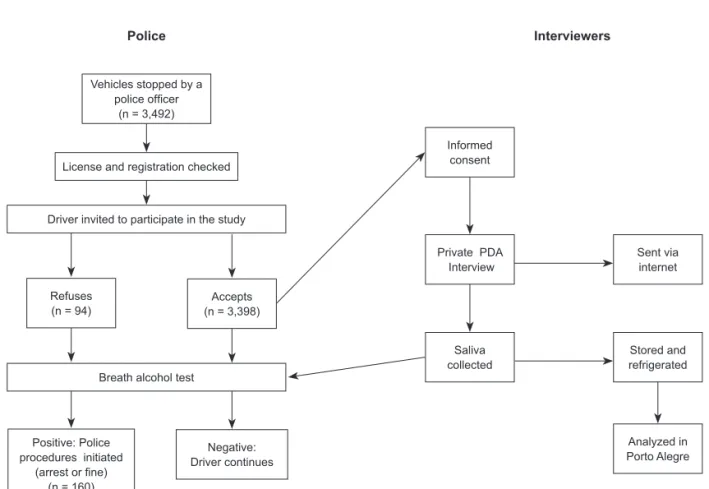
ap-proach is presented in Figure 1. Speciically, each selected vehicle was stopped by a uniformed police oficer. After drivers were given project liers, which included information about safe driving, oficers invited the driver to participate
in the study. Drivers who agreed were interviewed, after in-formed consent, in a parking area away from the road. After
the interview, the police oficer breathalyzed each driver. If a police oficer found a reason to keep the driver from
driving (suspended driver’s license, not driving a registered vehicle, or intoxication), appropriate police procedures were followed.
Interviewers Police
Vehicles stopped by a
police oficer
(n = 3,492)
Refuses (n = 94)
Positive: Police
procedures initiated (arrest or ine)
(n = 160)
Accepts (n = 3,398)
Negative:
Driver continues License and registration checked
Driver invited to participate in the study
Breath alcohol test
Informed
consent
Private PDA Interview
Saliva collected
Sent via
internet
Stored and refrigerated
Analyzed in
Porto Alegre
Figure 1 Data collection procedures.
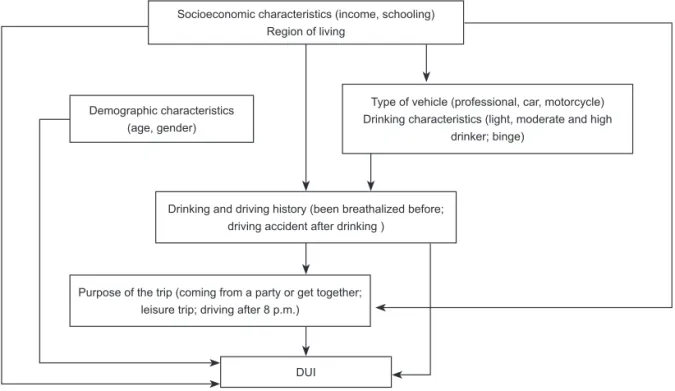
Figure 2 Hierarchical Model for analysis.
Socioeconomic characteristics (income, schooling)
Region of living
Demographic characteristics (age, gender)
DUI
Type of vehicle (professional, car, motorcycle) Drinking characteristics (light, moderate and high
drinker; binge)
Drinking and driving history (been breathalized before; driving accident after drinking )
Purpose of the trip (coming from a party or get together; leisure trip; driving after 8 p.m.)
Inclusion Criteria
We included drivers 18 years of age and older who consented to participate in the study.
Measures
Study measures were adapted from U.S. National Highway
Trafic Safety Administration questionnaires.21 Data were
collected using Personal Digital Assistants (PDAs). Data in-cluded demographics, vehicle information and recent alcohol consumption. Data were immediately transmitted to an encrypted webpage that was only accessible to the investiga-tors. Blood Alcohol Concentration (BAC) was estimated from breath samples obtained using Alco-Sensor IV (Intoximeters, Inc) digital devices which were calibrated by the Brazilian Institute for Metrics, Normatization, and Industrial Quality (INMETRO). Any positive reading (different from zero) in the breath analyzer was considered as a positive BAC. This is in consonance with the current Brazilian law of 2008,8 which
considers any alcohol level reading as a trafic offense.
Statistical Analyses
Multivariable analysis was performed (Multiple logistic re-gression) followed a conceptual framework, which allowed for the adjustment for potential confounding variables. The primary outcome variable of concern was Driving Under the Inluence (DUI), deined as any positive BAC reading
(different from zero), to comply with the Brazilian new
trafic law, and/or any reported drinking in the six hours
prior to the interview.
In order to assess which variables were associated with DUI, a hierarchical model was developed. This framework posits that characteristics of the external environment
(socioeconomic and demographic characteristics) and
per-sonal characteristics inluence the outcomes. The model
introduces personal characteristics as intermediate
indepen-dent variables which would, in turn, inluence DUI. Variables
were grouped into a hierarchy of categories which included socioeconomic, demographic and personal characteristics such as type of vehicle, drinking characteristics, drinking and driving history, and purpose of the trip (leisure or work). A hierarchical block design approach was used in the logistic regression to determine the separate contribution of the different blocks of independent variables on the outcome. Socioeconomic characteristics represented the distal de-terminants of DUI (First level), followed by demographic characteristics and type of vehicle/drinking characteristics. The Second level was drinking and driving history. The most
proximal level was the purpose of the speciic trip (Figure 2).
Initially, the hierarchical approach included univariate re-gressions that examined the measures of effect for each stud-ied variable in respect to the study outcome. Subsequently, multivariate logistic regressions were carried out for each level, using a stepwise backward method. Variables were selected to be kept in the subsequent hierarchical levels if their p values were < 0.20 after adjustment for confounders within their own level and after adjustment for hierarchi-cally superior variables. In other words, only variables with
a p < 0.20 in the previous models were added in the inal,
fully adjusted model. All statistical analyses were performed using the SPSS 16.0 (SPSS Inc., Illinois, U.S.A.) software for statistical analysis.
Ethics
The study was fully approved by the Institutional review board of Hospital das Clínicas de Porto Alegre before initiation.
Results
A total of 3,398 drivers participated in the study, of which 163 (4.2%) had a positive BAC. When data were weighted, based on the representative proportions of each vehicle in the appropriate state, the overall prevalence found was slightly lower – 4.8%. The combined proportion of drivers who either had a positive BAC or reported drinking in the six hours prior to data collection was 7.4%.
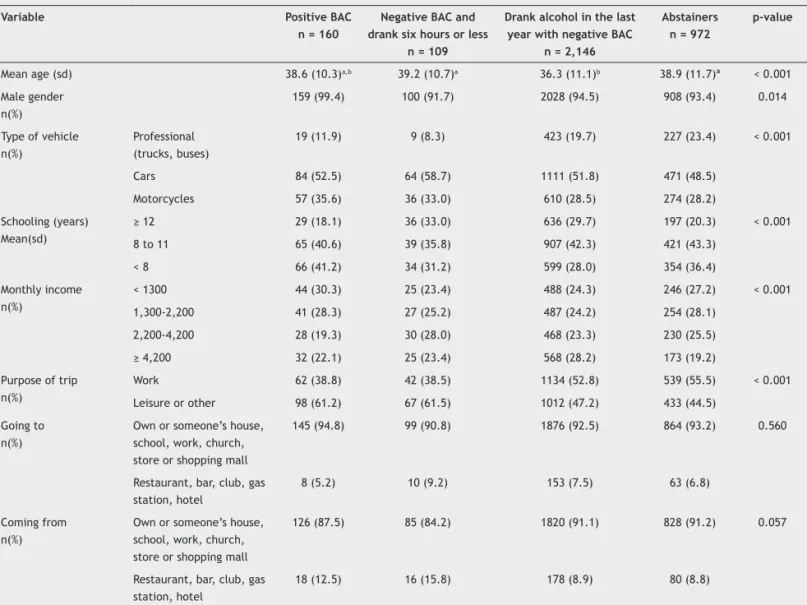
Almost all study participants (94.3%) were male. Age ranged from 18 to 80 years (median age: 36 years - interquar-tile range: 28-45) with a median family income of U$1,208 (range: U$714 – U$2,307). Truck and bus drivers reported the lowest median monthly income at U$824 and U$659, re-spectively, as well as the lowest education levels, with 59.9% of truck drivers and 53.3% of bus drivers reporting they had completed elementary school. Demographic characteristics are shown in Table 1, in addition to a positive or negative breath alcohol test and time since last alcohol drink.
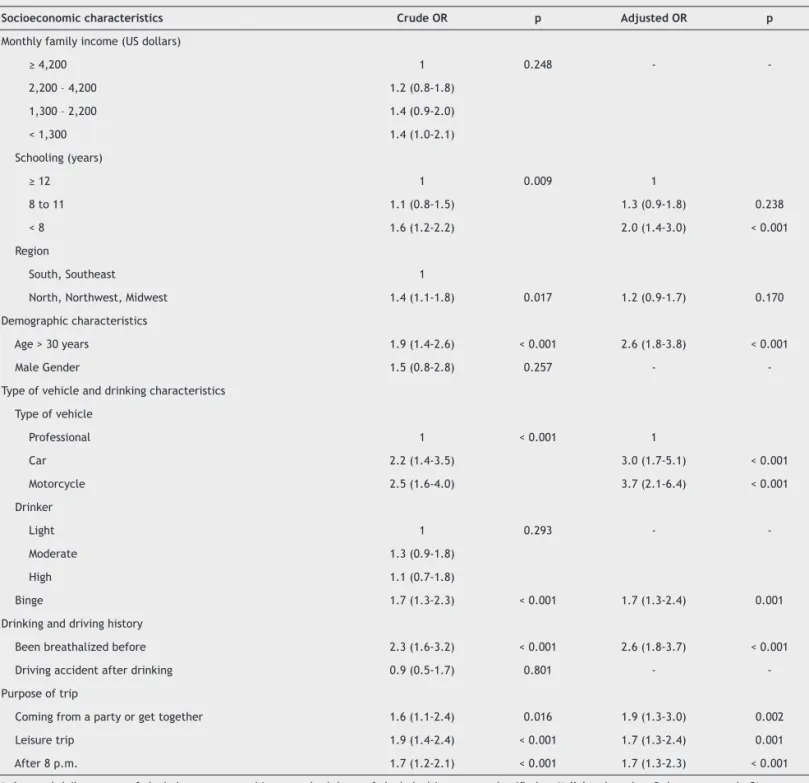
Results of the logistic regression analysis are shown in Table 2. In the univariate logistic regression model, less education, geographic region [Level 1], age [Level 2], type of vehicle (car and motorcycle), binge drinking [Level 3], having been breathalyzed before [Level 4], and purpose of
trip – returning from a party, leisure travel and trips after 8
p.m. [Level 5] were signiicantly associated with DUI. After
the multivariate analysis, education up to 8 years [Odds
Ratio (OR): 2.0; 95% Conidence Interval (CI): 1.4‑3.0],
age > 30 years (OR = 2.6; 95% CI = 1.8-3.8), type of vehicle (car: OR = 3.0; 95% CI = 1.7-5.1; motorcycle: OR = 3.7; 95% CI = 2.1-6.4), binge drinking (OR = 1.7; 95% CI = 1.3-2.4), been breathalyzed before (OR = 2.6; 95% CI = 1.8-3.7), and purpose of the trip (coming from a party: OR = 1.9; 95% CI = 1.3-3.0; leisure trip: OR = 1.7; 95% CI = 1.3-2.4; driving after 8 p.m.: OR = 1.7; 95% CI = 1.3-2.3) remained independently associated with DUI, even after adjusting for potential confounders.
Discussion
This is the irst Brazilian study to provide survey data from
a nationwide sample of drivers, yielding a high estimated positive BAC level overall, and a higher estimate of recent alcohol consumption, if BAC and self report were combined for analysis. The prevalence of positive BAC was elevated in the sample studied, considering the conservative methodol-ogy utilized. However, the limits for positive BAC in Brazil are
quite low, and therefore, these indings have their compara
-bility limited with international indings. Recent data show
Table 1 Demographic characteristics of the study sample stratiied by positive alcohol test
Variable Positive BAC
n = 160
Negative BAC and drank six hours or less
n = 109
Drank alcohol in the last year with negative BAC
n = 2,146
Abstainers n = 972
p-value
Mean age (sd) 38.6 (10.3)a,b 39.2 (10.7)a 36.3 (11.1)b 38.9 (11.7)ª < 0.001
Male gender n(%)
159 (99.4) 100 (91.7) 2028 (94.5) 908 (93.4) 0.014
Type of vehicle n(%)
Professional (trucks, buses)
19 (11.9) 9 (8.3) 423 (19.7) 227 (23.4) < 0.001
Cars 84 (52.5) 64 (58.7) 1111 (51.8) 471 (48.5)
Motorcycles 57 (35.6) 36 (33.0) 610 (28.5) 274 (28.2)
Schooling (years) Mean(sd)
≥ 12 29 (18.1) 36 (33.0) 636 (29.7) 197 (20.3) < 0.001
8 to 11 65 (40.6) 39 (35.8) 907 (42.3) 421 (43.3)
< 8 66 (41.2) 34 (31.2) 599 (28.0) 354 (36.4)
Monthly income n(%)
< 1300 44 (30.3) 25 (23.4) 488 (24.3) 246 (27.2) < 0.001
1,300-2,200 41 (28.3) 27 (25.2) 487 (24.2) 254 (28.1)
2,200-4,200 28 (19.3) 30 (28.0) 468 (23.3) 230 (25.5)
≥ 4,200 32 (22.1) 25 (23.4) 568 (28.2) 173 (19.2)
Purpose of trip n(%)
Work 62 (38.8) 42 (38.5) 1134 (52.8) 539 (55.5) < 0.001
Leisure or other 98 (61.2) 67 (61.5) 1012 (47.2) 433 (44.5)
Going to n(%)
Own or someone’s house, school, work, church, store or shopping mall
145 (94.8) 99 (90.8) 1876 (92.5) 864 (93.2) 0.560
Restaurant, bar, club, gas station, hotel
8 (5.2) 10 (9.2) 153 (7.5) 63 (6.8)
Coming from n(%)
Own or someone’s house, school, work, church, store or shopping mall
126 (87.5) 85 (84.2) 1820 (91.1) 828 (91.2) 0.057
Restaurant, bar, club, gas station, hotel
18 (12.5) 16 (15.8) 178 (8.9) 80 (8.8)
Table 2 Crude and adjusted odds ratio and 95% conidence interval of the variables associated with DUI
Socioeconomic characteristics Crude OR p Adjusted OR p
Monthly family income (US dollars)
≥ 4,200 1 0.248 -
2,200 – 4,200 1.2 (0.8-1.8)
1,300 – 2,200 1.4 (0.9-2.0)
< 1,300 1.4 (1.0-2.1)
Schooling (years)
≥ 12 1 0.009 1
8 to 11 1.1 (0.8-1.5) 1.3 (0.9-1.8) 0.238
< 8 1.6 (1.2-2.2) 2.0 (1.4-3.0) < 0.001
Region
South, Southeast 1
North, Northwest, Midwest 1.4 (1.1-1.8) 0.017 1.2 (0.9-1.7) 0.170
Demographic characteristics
Age > 30 years 1.9 (1.4-2.6) < 0.001 2.6 (1.8-3.8) < 0.001
Male Gender 1.5 (0.8-2.8) 0.257 -
-Type of vehicle and drinking characteristics
Type of vehicle
Professional 1 < 0.001 1
Car 2.2 (1.4-3.5) 3.0 (1.7-5.1) < 0.001
Motorcycle 2.5 (1.6-4.0) 3.7 (2.1-6.4) < 0.001
Drinker
Light 1 0.293 -
Moderate 1.3 (0.9-1.8)
High 1.1 (0.7-1.8)
Binge 1.7 (1.3-2.3) < 0.001 1.7 (1.3-2.4) 0.001
Drinking and driving history
Been breathalized before 2.3 (1.6-3.2) < 0.001 2.6 (1.8-3.7) < 0.001
Driving accident after drinking 0.9 (0.5-1.7) 0.801 -
-Purpose of trip
Coming from a party or get together 1.6 (1.1-2.4) 0.016 1.9 (1.3-3.0) 0.002
Leisure trip 1.9 (1.4-2.4) < 0.001 1.7 (1.3-2.4) 0.001
After 8 p.m. 1.7 (1.2-2.1) < 0.001 1.7 (1.3-2.3) < 0.001
& the total daily amount of alcohol was converted into standard doses of alcohol –drivers were classiied as 1) light – less than 3 doses per week; 2)
moderate – between 3-14 doses/week for man and 3-7 doses/week for woman and; 3) heavy – more than 2 doses/day for men and more than 1 dose/day for women.22
* Binge (episodic consumption of alcohol) was assessed by the following question: “in the last year, did you drink more than 5 doses (men) or 4 doses (women) in just one occasion?”23
that alcohol remains by far the number one psychoactive substance found in European roads. On a European level, alcohol is estimated to be used by 3.48% of the drivers.24
Some previous studies have also collected data on weekend
nights. However, the comparison with indings of the cur
-rent study is limited by the differences in times of data collection. While previous studies collected data between 10 p.m. and 3 a.m.,17,20 we collected data between 12 p.m.
to 12 a.m. As for the United States, a cross-sectional study
conducted in 2007 in 300 locations across the contiguous U.S. on weekend nights and Fridays during the day (primarily of weekend nighttime drivers, but also with drivers on Friday daytimes) showed a prevalence of 12.4% of positive BACs in 9,413 drivers surveyed.25
Our indings include a positive association between BACs
of drivers with less education and those above the age of 30, as a previous Brazilian study has estimated.18 Our data
associated with low education.26 A U.S. study has reported
the opposite: an association between higher levels of educa-tion and a higher risk of drinking and driving.27 Age deserves
further discussion here, since underage drinking is associated with high risk of injury.28,29 However, it should be noted that
the present study is a sample of all drivers on federal
high-ways, not those involved in trafic accidents. A U.S. study that
examined alcohol-related relative risk of driver involvement in fatal crashes by age and gender as a function of BAC30
found that, with only very few exceptions, older drivers had lower risk of being fatally injured in a single-vehicle crash than younger drivers, as did women in the same age range. In addition, a Finnish study31 concluded that, for young adult
males, drunk driving was part of a generally riskier driving style, while among middle-aged males, drunk-driving was more related to a risky lifestyle associated with drinking problems. In this study, 94.3% of the drivers were male. In Brazil, men had around 70% of driver licenses, however there is no information on how many drivers who cross federal
highways are male; it would be dificult to infer if this is a
typical situation in highways.32
In this study, motorcycle and car drivers were more posi-tively associated with DUI when compared to bus and truck drivers. The association of DUI and type of vehicle is poorly studied worldwide, and comparison with international data is still quite challenging. In the present study, possible reasons include the idea that motorcycle and car drivers had higher levels of education, which has been constantly associated with DUI.27 Moreover, professional drivers, particularly bus
drivers, are closely monitored by Brazilian transportation companies, and truck drivers usually avoid high alcohol use while driving, since this goes against their wish to be awake and drive for further hours. In Europe, truck drivers have low prevalences of positive BAC as well,33 but legislation
and enforcement may be the main reason for the difference, which is not the current Brazilian scenario. We believe this may help explain the differences found between groups.
Binge drinking has been associated with different types of problems and high disease burden.34,35 In this study, binge
drinking was positively associated with DUI, as expected. In addition, drivers who had been previously breathalyzed were associated with the analyzed outcomes, suggesting that a previous history of alcohol abuse may increase the odds of DUI among Brazilian drivers, since these drivers could have presented risk driving behavior before, which lead to poten-tial situations where breath tests might had been previously obtained. However, drivers with prior convictions for driving while alcohol impaired are overrepresented among drivers in fatal crashes in different studies. For example, a U.S. study reported that drivers convicted of alcohol-impaired who were driving during the previous 3 years were 1.8 times as likely to be in fatal crashes as drivers with no prior convictions and were about 4 times as likely to be in a fatal crash in which the driver had a high BAC.36 In 2008, only 8 percent of drivers
in fatal crashes with high BACs had prior alcohol-impaired driving convictions. The actual incidence of previous convic-tions could be higher, because information on convicconvic-tions was only available for the 3 years prior. In addition, some alcohol-related offenses are not included in driver records because selected court programs remove or defer convictions
if a person attends an educational program. However, most alcohol-impaired fatal crashes do not involve drivers with a long history of multiple alcohol convictions.37
The current indings of this study must be seen under some methodological limitations: irst, the study was conducted in
federal highways only, and in close geographical proximity with the state capitals, preventing us from generalizing the
indings to other roads or other geographic regions other
than the metropolitan surroundings of state capitals. Another aspect that can bias these results is that higher prevalences may be found in urban metropolitan areas.38 Also, although
data were collected in days when typically prevalences of DUI are high, we purposefully collected data in a fashion that excluded holidays and the major concentration of alcohol consumption (from midnight to 6 a.m.). Hazardous driving is strongly associated with drinking and driving, and this was
conirmed in our sample. However, it is possible that the
rate was underestimated, since drivers were interviewed only on Fridays and Saturdays from noon to midnight, and holidays were excluded. Consequently, our data may be
more conservative than indings from other studies, and the aforementioned limitations prevent generalizing the indings
for the whole population of drivers in the country.
There are several knowledge gaps about drinking and driv-ing in Brazil. The current study only presents a “snapshot”,
and must be observed under a speciic perspective. One of the possibilities for the indings of higher prevalence of BAC in
Brazilian drivers, compared to other countries, may lie on the fact that there may be cultural differences regarding the use of alcohol and the permissiveness of alcohol consumption in the national environment. The low perception of punishment may underlie the expressed behavior of high alcohol con-sumption associated with risk exposure.39 Additional research
could focus on alcohol policy changes, patterns of drinking, and drinking and driving trends. For example, a Brazilian study using national data from 2006 to 2009 showed that binge drinking decreased in the month after implementation of a 2008 national DUI law but increased two months later.40
In order to understand changes in general alcohol policies on drinking and driving fatalities and non-fatal injuries in Brazil, additional research is needed which is important for public health and public safety. For example, understanding the impact of changing policies on reducing drinking and driving in an environment where other risk factors for
traf-ic accidents are high could better inform prevention and
education initiatives. It seems that the limited enforcement of existing policies is a major barrier to health and safety which can be overcome with additional resources along with political commitment and public support.
Brazil must react to the increasing change provided by the growth of its economy, increasing motorization, and an upsurge of middle-class in the country, which are a result
of positive economic growth, but will ultimately relect on
increased use of cars, streets, roads and highways. We
un-derstand that the provision of sound scientiic information
to the policymaker is one of the potential ways to generate momentum to formulate change in the policies of DUI in the country. A combination of systematic data collection and
re-view by different sectors of the scientiic community, as well
intend to curtail the spread of accidents related to drinking and driving. We were able to show that it is feasible to
col-lect such type of data, and that there are speciic risk groups
that should deserve priority of attention regarding public policies. Of course, it is to the choice of the policymaker to
deine what priorities should generate the change agenda,
but it is clear that risky driving related to alcohol is of utmost importance for prevention on Brazilian roads right now.
Acknowledgements
The authors would like to acknowledge the dozens of members of the Brazilian Policia Rodoviária Federal, Policia Federal,
and in particular oficers (codenames) Rubin, Rossy, Getulio
and Uelber for their efforts in the data collection procedures.
Author Contribution
FP, PCAVD and RB designed the study, wrote and reviewed
the inal manuscript; CL provided overall consultation for
the project design and sample development, as well as reviewing the different English versions. RB supervised data collection, and reviewed methodological issues; LVD, DB, MCB and JH designed the analytical model and prepared results and tables; FK and DF reviewed the literature and prepared
bibliographic references. All the authors approved the inal
version of the manuscript.
Disclosures
Flavio Pechansky
Employment: Center for Drug and Alcohol Research of the Hospital das Clínicas de Porto Alegre, Universidade Federal do Rio Grande do Sul, Brazil.
Paulina do Carmo Arruda Vieira Duarte
Employment:Secretaria Nacional de Políticas sobre Drogas (Brazilian Secretariat for Drug Policies), Brazil.
Raquel De Boni
Employment: Center for Drug and Alcohol Research of the Hospital das Clínicas de Porto Alegre, Universidade Federal do Rio Grande do Sul, Brazil.
Carl Leukefeld
Employment: Center for Drug and Alcohol Research, University of Kentucky, USA.
Lisia von Diemen
Employment: Center for Drug and Alcohol Research of the Hospital das Clínicas de Porto Alegre, Universidade Federal do Rio Grande do Sul, Brazil.
Daniela Benzano Bumaguin
Employment: Center for Drug and Alcohol Research of the Hospital das Clínicas de Porto Alegre, Universidade Federal do Rio Grande do Sul, Brazil.
Fernanda Kreische
Employment: Center for Drug and Alcohol Research of the Hospital das Clínicas de Porto Alegre, Universidade Federal do Rio Grande do Sul, Brazil.
Juliana Balbinot Hilgert
Other: Postgraduate Program of Epidemiology, Universidade Federal do Rio Grande do Sul, Brazil.
Mary Clarisse Bozzetti
Other: Postgraduate Program of Epidemiology, Universidade Federal do Rio Grande do Sul, Brazil.
Daniel Fernando Paludo Fuchs
Employment: Center for Drug and Alcohol Research of the Hospital das
Clínicas de Porto Alegre, Universidade Federal do Rio Grande do Sul, Brazil.
This study was funded by the National Secretariat for Drug Policies, under grant #2929-7.
* Modest
** Signiicant
*** Signiicant. Amounts given to the author’s institution or to a colleague for
research in which the author has participation, not directly to the author.
References
1. Santos Modelli M, Pratesi R, Tauil P. Blood alcohol concentration
in fatal trafic accidents in the Federal District, Brazil. Rev
Saude Publica. 2008;42(2):350-2.
2. Ministério da Saúde. Evolução da Mortalidade por Violência no
Brasil e Regiões. [http://portal.saude.gov.br/saude/visualizar_ texto.cfm?idtxt=24448]. Accessed on June 15, 2010.
3. Brazilian Confederation of Municipalities. Mapeamento das Mortes por Acidentes de Trânsito no Brasil. 2009.
4. Fell JC, Tippetts AS, Voas RB. Fatal trafic crashes involving
drinking drivers: what have we learned? Ann Adv Automot Med. 2009;53:63-76.
5. Voas RB, Tippetts AS, Romano E, Fisher DA, Kelley-Baker T. Alcohol involvement in fatal crashes under three crash exposure
measures. Trafic Inj Prev. 2007;8(2):107‑14.
6. Rockville MD, The NSDUH Report: State Estimates of Drunk and Drugged Driving. Substance Abuse and Mental Health Services Administration, Center for Behavioral Health Statistics and Quality. [updated Dec 2010; cited Oct 2011]. Available: [http:// oas.samhsa.gov/2k10/205/DruggedDriving.html].
7. Caetano R, McGrath C. Driving under the inluence (DUI) among
U.S. ethnic groups. Accid Anal Prev. 2005;37(2):217-24. 8. Jurídicos PdR-Cc-SpA. [http://www.planalto.gov.br/ccivil/_
Ato2004-2006/2006/Lei/L11275.htm]. Accessed on June, 2010. 9. Berzlanovich A, Muhm M, Bauer G. The value of breath alcohol
determination in street trafic. Beitr Gerichtl Med. 1992;50:229‑34.
10. Fleck K, Schoknecht G. Use of breath alcohol analysis in France. Blutalkohol. 1989;26(6):376-80.
11. Zuba D. Accuracy and reliability of breath alcohol testing by handheld electrochemical analysers. Forensic Sci Int. 2008;178(2-3):e29-33.
12. Cherpitel C, Bond J, Ye Y, Room R, Poznyak V, Rehm J, Peden M. Clinical assessment compared with breathalyser readings in the emergency room: concordance of ICD-10 Y90 and Y91 codes. Emerg Med J. 2005;22(10):689-95.
13. Keall M, Frith W, Patterson T. The contribution of alcohol to night time crash risk and other risks of night driving. Accid Anal Prev. 2005;37(5):816-24.
14. Quinlan K, Brewer R, Siegel P, Sleet D, Mokdad A, Shults R, Flowers N. Alcohol-impaired driving among U.S. adults, 1993-2002. Am J Prev Med. 2005;28(4):346-50.
15. Begg D, Langley J. Identifying predictors of persistent non-alcohol or drug-related risky driving behaviours among a cohort of young adults. Accid Anal Prev. 2004;36(6):1067-71.
16. Duailibi S, Pinsky I, Laranjeira R. Prevalence of drinking and driving in a city of Southeastern Brazil. Rev Saude Publica. 2007;41(6):1058-61.
17. Campos VR, Salgado R, Rocha MC, Duailibi S, Laranjeira R.
Prevalência do beber e dirigir em Belo Horizonte, Minas Gerais, Brasil. Cadernos de Saúde Pública. 2008;24:829‑34.
18. Pechansky F, De Boni R, Diemen LV, Bumaguin D, Pinsky I, Zaleski M, Caetano R, Laranjeira R. Highly reported prevalence of
drinking and driving in Brazil: data from the irst representative
household study. Rev Bras Psiquiatr. 2009;31(2):125-30. 19. de Carvalho Ponce J, Muñoz DR, Andreuccetti G, de Carvalho DG,
Leyton V. Alcohol‑related trafic accidents with fatal outcomes
in the city of Sao Paulo. Accid Anal Prev. 2011;43(3):782-7. 20. Furr-Holden CD, Voas RB, Lacey J, Romano E, Jones K. The
prevalence of alcohol use disorders among night-time weekend drivers. Addiction. 2011;106(7):1251-60.
22. NIH-NIAAA. Alcohol use and alcohol use disorders in the United
States:main indings from the 2001‑2001 national epidemiologic
survey on alcohol and related conditions (NESARC). NIAAA. Bethesda: NIH 2006.
23. NIAAA. NIAAA council approves deinition of binge drinking.
NIAAA newsletter. Bethesda: NIH 2004.
24. Druid-Project Homepage [internet]. Prevalence of alcohol and other psychoactive substances in drivers in general
trafic ‑ Part I: General results [cited Oct 2011]. Available
from: [http://www.druid-project.eu/cln_031/nn_107534/ sid_B348F54A086D5ACDD4CC29F5A30617B4/nsc_true/]. 25. National Highway Traffic Safety Administration - NHTSA.
Washington DC: 2007 National Roadside Survey of Alcohol and Drug Use by Drivers - Alcohol results [cited Oct 2011].
Available from: [http://www.nhtsa.gov/DOT/NHTSA/Trafic%20
Injury%20Control/Articles/Associated%20Files/811248.pdf]. 26. Riala K, Isohanni I, Jokelainen J, Taanila A, Isohanni M, Räsänen
P. Low educational performance is associated with drunk driving: a 31-year follow-up of the northern Finland 1966 birth cohort. Alcohol Alcohol. 2003;38(3):219-223.
27. Chou S, Dawson D, Stinson F, Huang B, Pickering R, Zhou Y, Grant BF. The prevalence of drinking and driving in the United States, 2001-2002: results from the national epidemiological survey on alcohol and related conditions. Drug Alcohol Depend. 2006;83(2):137-46.
28. Sise C, Sack D, Sise M, Riccoboni S, Osler T, Swanson S, Martinez
MD. Alcohol and high‑risk behavior among young irst‑time
offenders. J Trauma. 2009;67(3):498-502.
29. Peck R, Gebers M, Voas R, Romano E. The relationship between blood alcohol concentration (BAC), age, and crash risk. J Safety Res. 2008;39(3):311-9.
30. Zador P, Krawchuk S, Voas R. Alcohol-related relative risk of driver fatalities and driver involvement in fatal crashes in relation to driver age and gender: an update using 1996 data. J Stud Alcohol. 2000;61(3):387-95.
31. Laapotti S, Keskinen E. Fatal drink-driving accidents of young adult and middle-aged males--a risky driving style or risky
lifestyle? Trafic Inj Prev. 2008;9(3):195‑200.
32. Departamento Nacional de Trânsito - DENATRAN. Anuário estatístico de acidentes de trânsito - Brasil: RENAEST 2008 [cited Oct 2011]. Available from: [http://www.denatran.gov. br/frota.htm].
33. European Transport Safety Council. Brussels: Drink driving in commercial transport [updated Jan 2010; cited Oct 2011]. Avaliable from: [http://www.etsc.eu/ documents/ DrinkDriving%20in%20CommercialTransport%20ETSC.pdf]. 34. Karagülle D, Donath C, Grässel E, Bleich S, Hillemacher T. [Binge
drinking in adolescents and young adults]. Fortschr Neurol Psychiatr. 2010;78(4):196-202.
35. Naimi T, Nelson D, Brewer R. Driving after binge drinking. Am J Prev Med. 2009;37(4):314-20.
36. Fell J. Repeat DWI offenders: their involvement in fatal crashes.
National Highway Trafic Safety Administration. 1991.
37. Lund A, McCartt A, Farmer C, editors. Contribution of alcohol-impaired driving to motor vehicle crash deaths in 2005. Proceedings of the18th International Conference on
Alcohol, Drugs and Trafic Safety; 2007; Seattle, WA, USA: International Council on Alcohol, Drugs, and Trafic Safety.
38. De Boni R, Leukefeld C, Pechansky F. Young people’s blood alcohol concentration and the alcohol consumption city law, Brazil. Rev Saude Publica. 2008;42(6):1101-4.
39. Pinsky I, Labouvie E, Pandina R, Laranjeira R. Drinking and driving: pre-driving attitudes and perceptions among Brazilian youth. Drug Alcohol Depend. 2001;62(3):231-7.